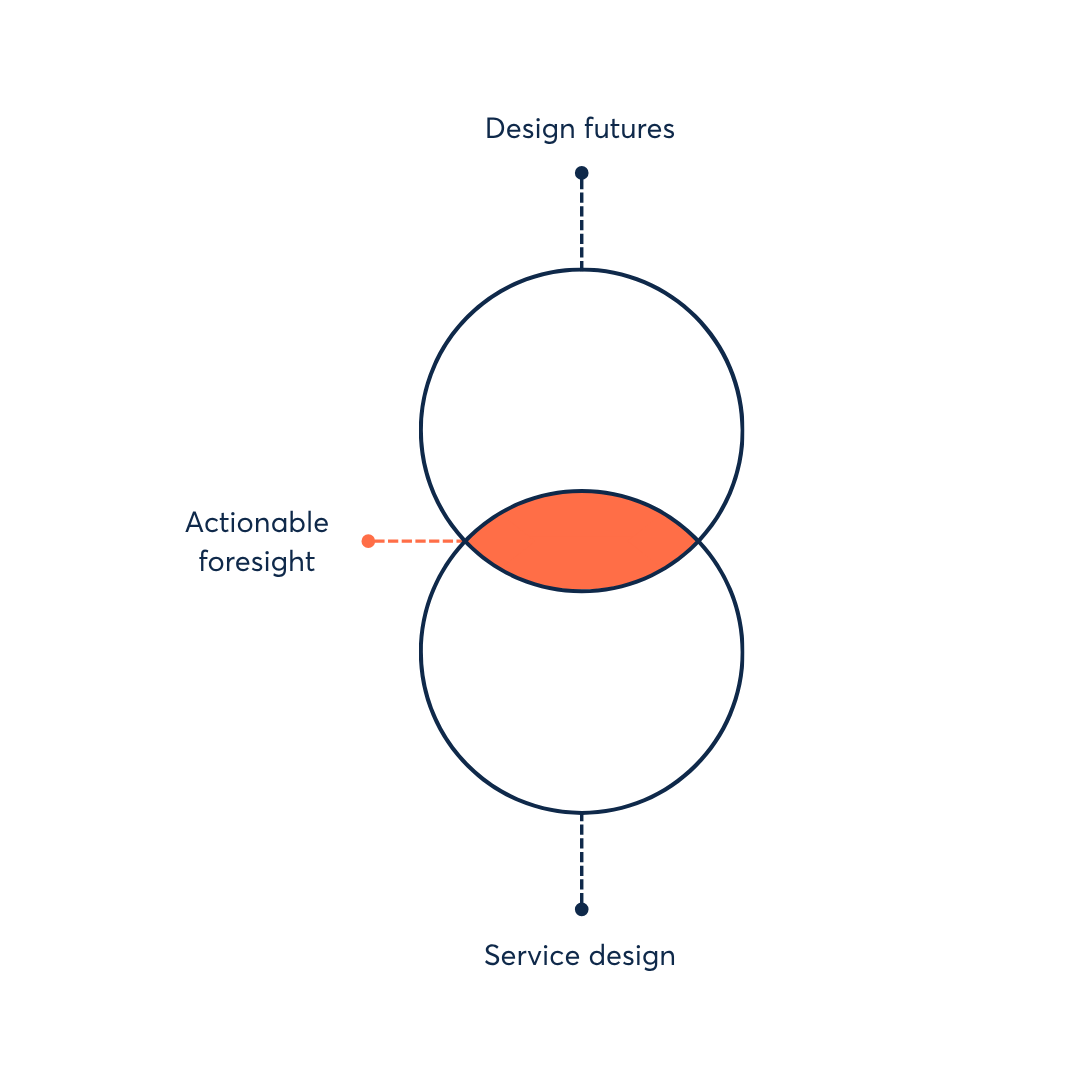
There's a name for this combination that's been circulating in the field: actionable foresight. Futures work is good at widening the frame; service design is good at landing but often too tied to what already exists. Putting the two disciplines in one room was the experiment. The aim was to see what happens when teams are asked to do both things at once - build a plausible, well-evidenced picture of 2040, and then pull it back into something concrete enough to test now. Three teams took on three briefs, each tied to one of Nesta’s missions.
Run over five days, each day had a goal:
- Day 01 - Scanning and sense-making: take the brief apart and map what's already in motion.
- Day 02 - Future scenarios and personas: build a plausible 2040 and the people living in it.
- Day 03 - Design responses: backcast from that 2040 into concepts, with partners in the room to challenge them.
- Day 04 - Testing and prototyping: pressure-test ideas with practitioners, iterate and repeat.
- Day 05 - Presentation: three sets of ideas presented that didn't exist a week ago.
Every team delivered on three things:
- A future vision - potential futures brought to life in a creative, accessible and clear way.
- Tangible concepts - derived from ‘backcasting’ in response to the future vision tested during the week.
- A testing plan - outlining what Nesta could do in the next two to four weeks to take the work a step further.
Each team worked on a brief related to one of Nesta's missions. The dedicated pages below set out what they did, learnt, and provocations for next steps.
- The future of parenthood in the age of AI (A fairer start)
- The future of weight-loss drugs and eating together (A healthy life)
- The future of managing home energy (A sustainable future)
We'll be sharing a deeper dive into each project over the coming weeks, so keep an eye out for updates linked above.
The value of bringing service design and design futures together
The two disciplines correct each other's failure modes. Futures work alone tends to produce a compelling picture and no route into it. Service design optimises the system as it currently stands, including the parts of it that won't survive the next fifteen years. Running them in sequence within one week meant neither had room to settle into its habits.
Balancing pace with depth
Student teams new to Nesta’s mission areas were able to explore future possibilities, develop concepts, and produce recommendations for next steps within five days. However, a week is too short to deeply explore future possibilities and grapple with the complexity of mission challenges, with the risk of committing to a position too early and limiting time to validate concepts. Doing it again we’d consider spreading the work out over two weeks.
Working back from future scenarios to identify new opportunities
Backcasting is what kept teams from drifting. Each concept has to answer where it sits on the path from now to 2040, which rules out both the near-term obvious and the untethered speculative. What's left is the more useful middle.
 www.nesta.org.uk/project/service-futures-innovation-sprint-a-new-way-to-design-for-whats-coming/