The future of weight-loss drugs and eating together
 www.nesta.org.uk/project-updates/the-future-of-weight-loss-drugs-and-eating-together/
www.nesta.org.uk/project-updates/the-future-of-weight-loss-drugs-and-eating-together/
www.nesta.org.uk/project-updates/the-future-of-weight-loss-drugs-and-eating-together/

What happens to a household once weight loss drugs (like GLP-1s) become part of daily life, not just a prescription? Adoption of these drugs for obesity and excess weight is accelerating fast, but the system around them is still built as if the medication is the whole intervention. As a tangible way into this question the team focused on what happens at the dinner table, once someone's appetite changes but nobody else's has.
The students found two things happening at once in a disconnected way. Firstly, adoption of these drugs is growing fastest among people who are younger and comparatively affluent, while the healthcare system built around them stays fixed on the prescription itself. Patients often regain weight when they stop taking the drugs, and psychological or behavioural support is thin to non-existent. Research findings that the team flagged showed that many current users don't fully understand the drug's effects have a limit, typically 12 to 24 months before discontinuation. When people don't know the intervention is time-bound, they're unlikely to engage with anything designed to help them beyond it.
Secondly, users felt that what happens in the home wasn’t being considered. Someone in the household, usually whoever already does most of the cooking, ends up managing two sets of appetites - creating more food waste, meals that are cooked and not eaten, and a slow erosion of the rituals that used to hold family meals together. They still have to make meals for their family while not wanting to eat them anymore.
The team weighed two possible directions before choosing one:
They went with the second option, arguing it was underserved and closer to where daily behaviour actually plays out. Their theory of change centred on what they called the "motivation window", which is a loop where a lighter food burden, shared responsibility and the right technology reinforce each other - keeping healthy behaviour going after the initial prescription ends.
Their preferable future, set in 2035, imagined cooking and eating shifting from obligation toward something closer to a shared ritual. Treatment and nutrition education prescribed together rather than separately, alongside a concept product called ‘Second Nature’ - a shared smart utensils set and small camera device giving the whole household gentle, ambient feedback on eating pace and portioning so that the transition became something the family did together rather than something one person quietly managed alone.
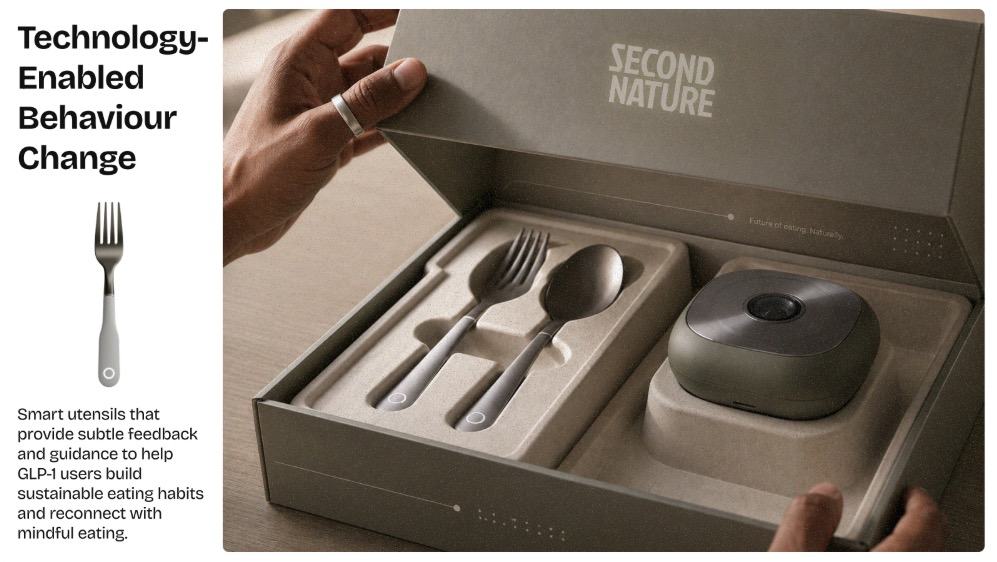
Opened Second Nature product box containing smart utensils and a circular feedback module designed to build sustainable eating habits and support GLP-1 users
Pressure-testing the idea against the room surfaced tensions the team hadn't fully closed, which they grouped into four risks:
The strongest challenge came from the floor. Why reach for a technology solution to a social problem? The team’s response held up - the tech was chosen to bring people together at the table, not automate them out of it, and the core idea (cooking as shared ritual) works even without the hardware; the smart utensils are one way in, not the point.
Rather than starting with the hardware, the team pointed to a lower-risk entry point: extending Mealia, Nesta's existing meal-planning product, with a portion-adjustable, mixed-appetite planning feature, letting a household cook one meal that flexes across different appetites instead of two. Practically, this means shipping it first as a beta feature for GLP-1-specific food groups, then measuring engagement, retention and feedback before deciding whether to build it out into full planning-and-delivery.
This was framed as needing far less involvement to test and far lower stakes to get wrong, with the resulting engagement data telling Nesta whether the more ambitious Second Nature concept is worth building at all.
The question they left open: does giving a household shared visibility into eating actually rebuild the ritual around the table and support people to sustain weight loss, or does it just add one more thing to monitor?
Brief rep: Björn Rust
Student team: Veera Vishal Bagasaria, China Saxton, Kamya Agal, Mudra Vichare, Anagha Musalgaonkar, Yiwen Chen - RCA MDes Design Future & MA Service Design 2026 Batch