The future of managing home energy
 www.nesta.org.uk/project-updates/the-future-of-managing-home-energy/
www.nesta.org.uk/project-updates/the-future-of-managing-home-energy/
www.nesta.org.uk/project-updates/the-future-of-managing-home-energy/
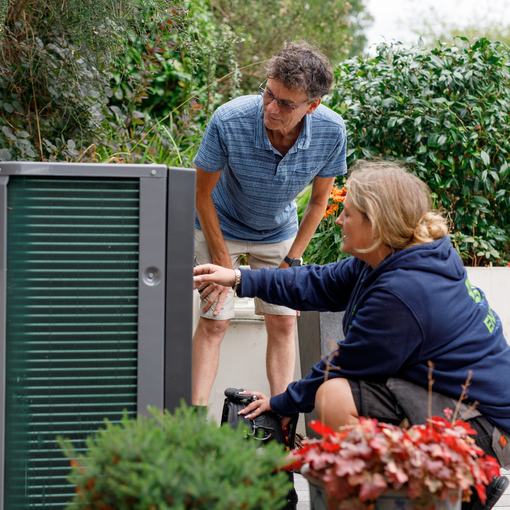
What might digital public infrastructure and services in 2040 look like to ensure equitable, low-carbon home heating at scale? Gas boilers remain the default for most UK households. While heat pumps offer a zero-emission alternative and are gaining government support, adoption alone isn't the whole story.
As a tangible starting point, the team reframed the challenge: how might digital public infrastructure continuously guide households to make better energy decisions, rather than simply measuring energy consumption after the fact? This set the direction for everything that followed.
Home energy is becoming a multi-asset system that most households were never equipped to manage. Heat pumps, solar panels, electric vehicles and batteries typically run on separate apps, leaving households to coordinate all of it manually. Smart meter coverage is nearing completion with roughly 70% of UK homes today, with near-universal coverage targeted by 2030. However, only 9% of households are actually on time-of-use tariffs that would let them benefit from that infrastructure.
The team mapped a three-stage progression of household energy management. Today, most homes sit between two extremes: some still run on flat tariffs with no flexibility, while others have smart meters but must manage dynamic pricing manually.
As more technologies enter the home the team's modelling showed the management burden peaking before it improves, with households needing to coordinate an increasing number of decisions across an increasing number of systems. Their preferable future imagined this burden disappearing entirely.
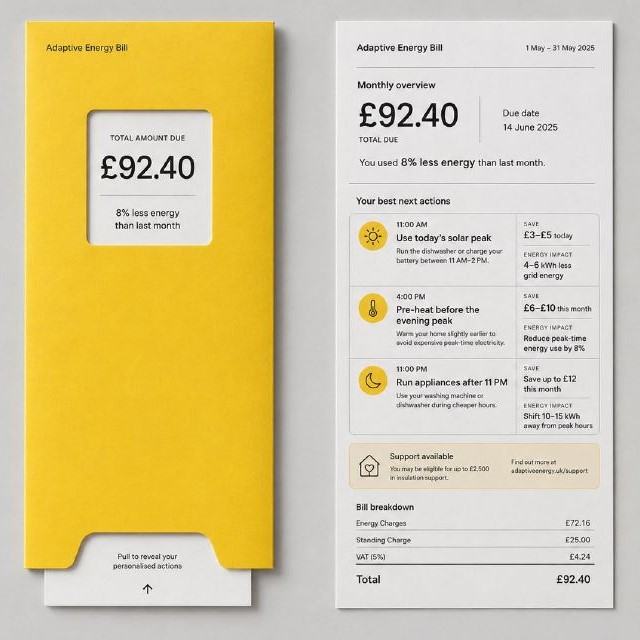
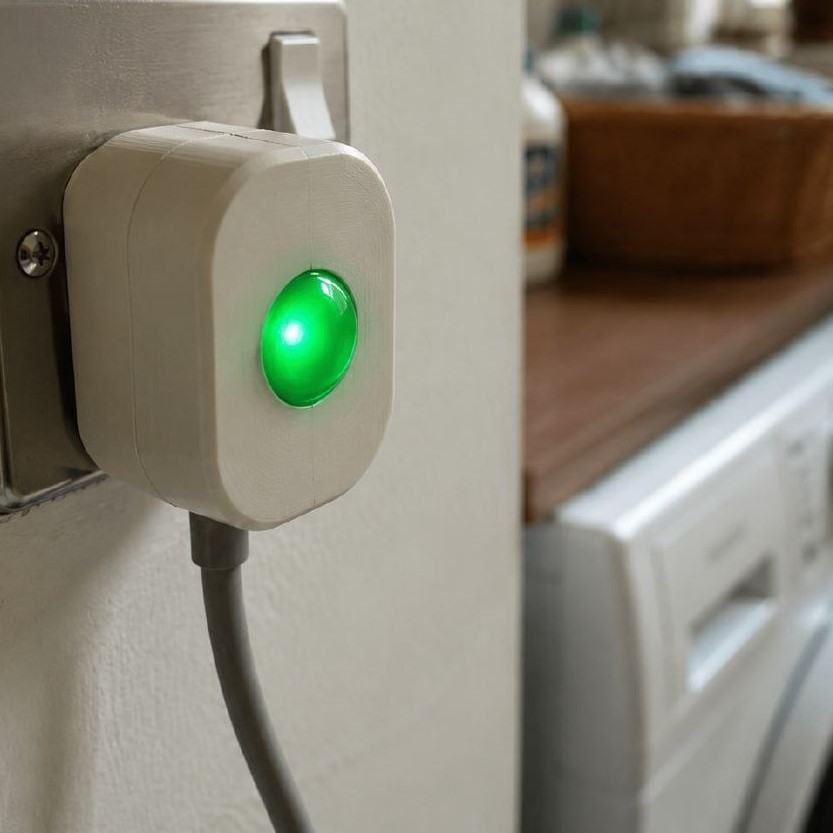
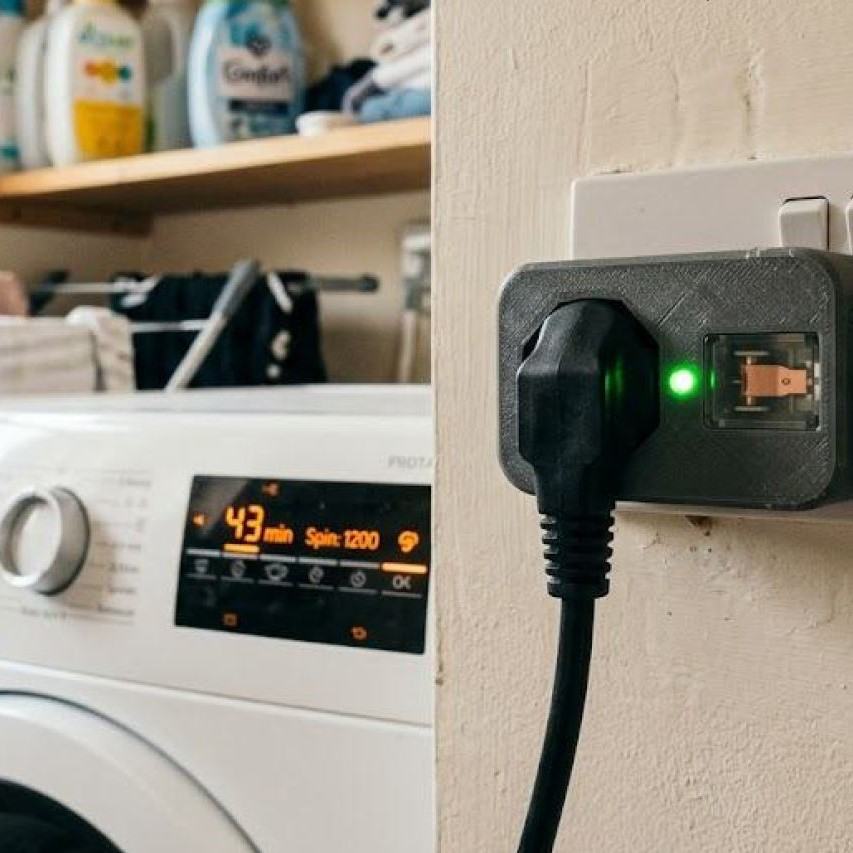
To get there, the team proposed a layer of context-aware nudges alongside prototypes.
Running these ideas through a panel of practitioners surfaced an equity tension the team hadn't fully resolved: heat pump adoption today skews toward more affluent households and electricity remains more expensive than gas per unit. This means, people best placed to benefit from smart automation are often not the people who need the savings most. The team's response was that dynamic tariffs and off-peak usage are the mechanism that could make the switch financially viable more broadly, but were candid that this depends on incentive structures currently missing from the market.
Private providers who already connect these systems have little commercial reason to actively guide users toward cheaper usage. Government subsidy, by contrast, is currently the primary mechanism to encourage adoption, and even here uptake lags behind available funding, partly due to low trust in outcomes after installation.
A policy intervention suggested by the team partially addresses the adoption challenge. Every home should have a secure, interoperable digital ‘home health record’ that combines smart meter data and low-carbon technologies into one continuously updated record linked to the property. The unique home ID, modelled after NHS numbers, enables longitudinal energy tracking and evidence-based reform. Pair it with every household having a ‘dynamic carbon score’ that replaces static EPC ratings by tracking energy efficiency, carbon emissions and renewable energy use through the home health record. That said, the ‘how’ is yet to be explored.
Two questions carried the team's thinking past the sprint.
The team proposed a way to test both; starting small and focused. Five days of the sprint gave limited time to accommodate primary research this would really need, so what follows are scoped, near-term tests rather than answers. Settling either question properly means bringing users (households), researchers, innovators and policymakers into the same room.
| Assumption | Test | To track |
|---|---|---|
| A clearer, redesigned bill changes behaviour, not just awareness. | Recruit 15-20 households, observing response to a single artefact. | Whether clearer savings info drives actual behaviour change, not just recall. |
| Full automation would be trusted over manual control. | Introduce the ’dynamic switch’ as a low-stakes, single-appliance entry point before scaling to whole-home automation. | Compare actual pounds saved against previous bills. |
Brief reps: Andy Marsden & Eve Lerouge
Student team: Anusha Pokharna, Amita Nagare, Jiawei Wan (Jerry), Shubhangi Prasad, Weisi Liang, Xingyu Xie - RCA MDes Design Future & MA Service Design 2026 Batch