The future of parenthood in the age of AI
 www.nesta.org.uk/project-updates/the-future-of-parenthood-in-the-age-of-ai/
www.nesta.org.uk/project-updates/the-future-of-parenthood-in-the-age-of-ai/
www.nesta.org.uk/project-updates/the-future-of-parenthood-in-the-age-of-ai/

The involvement of technology in childhood has increasingly become a pressing topic for parents - but what could it look like in 10 years time? The students honed in on technology and AI as an inevitable feature in the lives of children: rather than looking at technology as a risk, the students explored how it could be used to enrich a childhood.
The students were well-versed in today’s headlines about the ramifications of technology on childhood. From child safety online, to using AI bots as emotional and social crutches. The influence of this new digital age has been commonly seen with scepticism and distrust. But this doesn’t mean it’ll go away. As a result, the students reframed the problem. If the influence of technology and AI was inevitable, how can it either be used to benefit or enhance the relationship between parents and children in 2040?
The team split their efforts into two research areas:
Initial research into the latter of the two topics highlighted the many benefits of reinforcing strong familial bonds to circumvent an increasing presence of divisive or distancing technology in a household.
However, some issues were beyond our 10-year scope. Creating housing stock more suitable for intergenerational households; creating a culture where multi-generation homes were desired, and not due to financial necessity; and communities having the third spaces needed for child, parent and grandparent to thrive. Just these three issues alone suggested this was a solution that required long-term planning and commitment - and may not even solve the same problem it was handling in 2040.
As a result, the team turned their efforts to the first research area: using technology in urban communities. From speaking to millennial and gen Z parents, it became apparent that childrearing in cities is more scattered, self-reliant, and even isolating compared to previous generations. In previous generations, the phrase ‘it takes a village’ referred to the multitude of support and familiarity typically present to raise a child. However now and particularly in urban communities, these varied and multiple support networks typically aren’t present. But what if technology could be an enabler for this traditional concept?
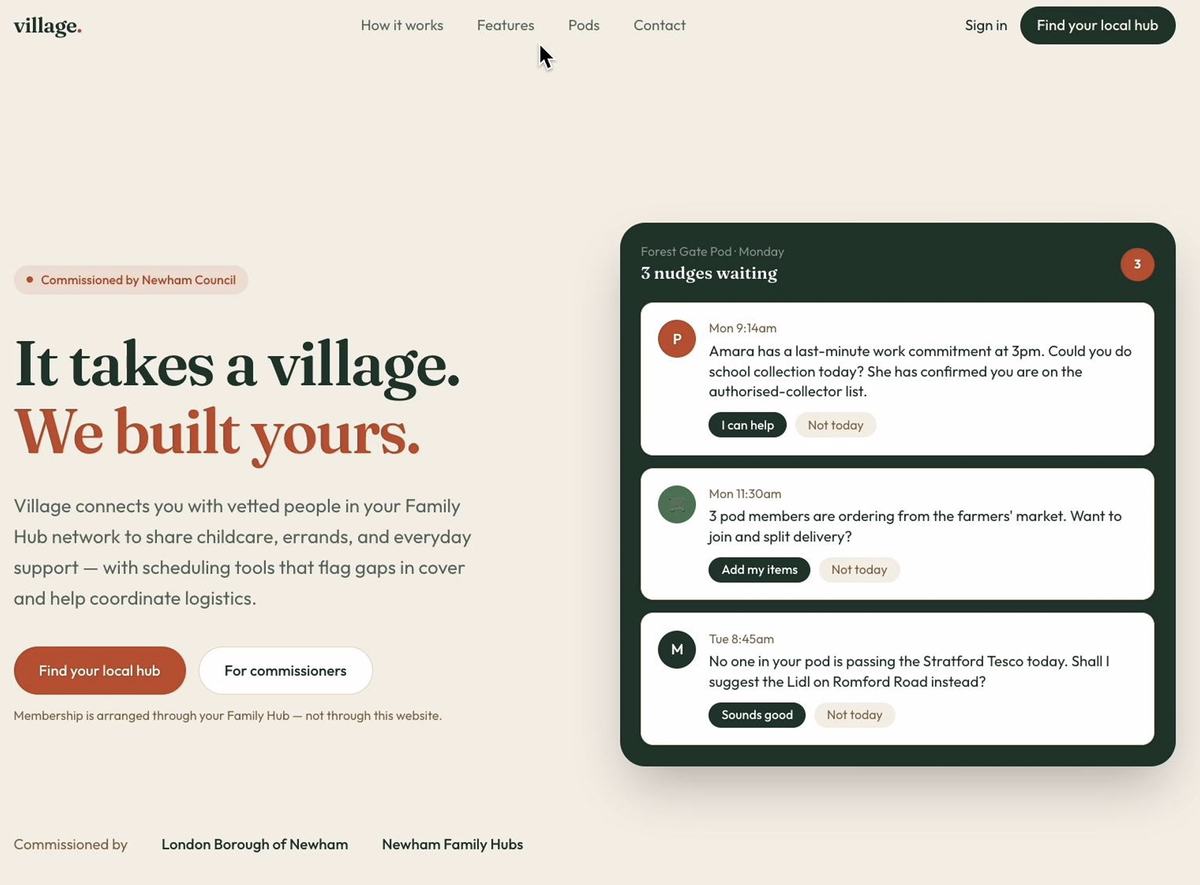
Website homepage for Village, a community platform connecting local networks for childcare and everyday support
The team settled on the concept of an adaptive digital village. By connecting the calendars, interests and other metrics about parents and children: they could form a digital village between families. It would suggest clubs or activities interesting to the user; noting when one parent is available when another needs childcare; and other connecting capabilities that put the onus on mutual support.
Stress-testing the concept surfaced four tensions the team couldn't fully resolve in the time available: access versus safety, assumed help versus recognised caregiving, structured intervention versus relational time, and the risk of tensions within the ‘digital village’.
The sharpest insight came from running two family personas side by side, solving the same problem streets apart: a child's wellbeing turned out to be less about the child directly and more a proxy for how well the surrounding adult relationships were designed and supported.
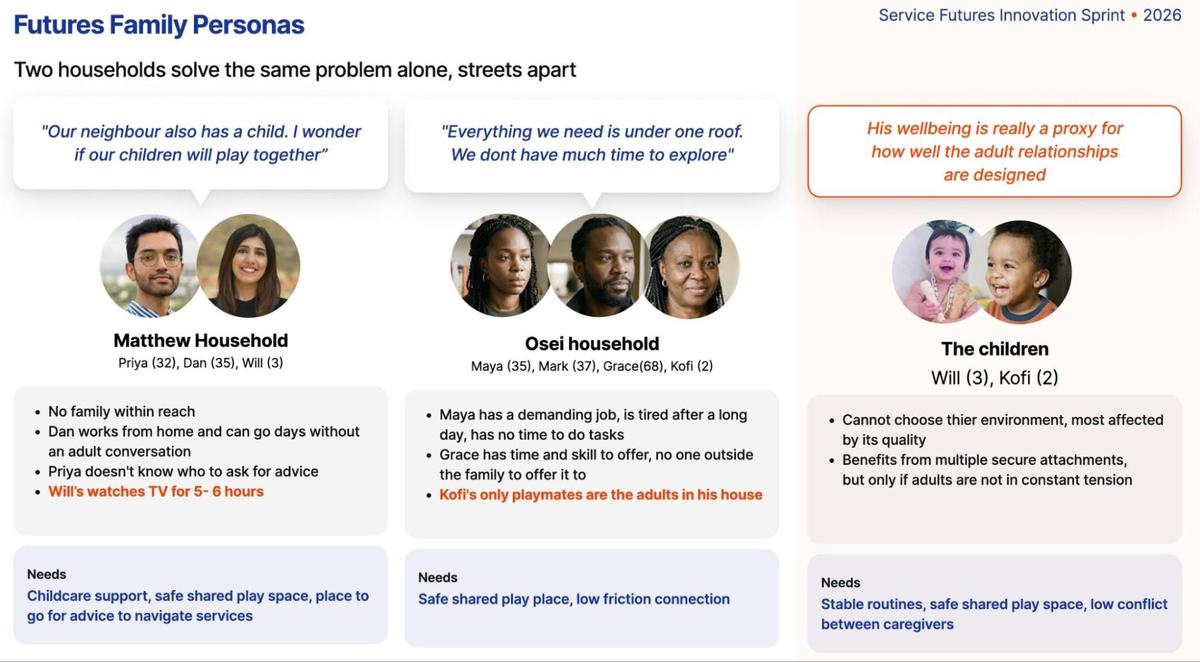
Futures Family Personas presentation slide detailing household scenarios, needs, and impacts on children
There was also a clear case for the council. Informal, vouched-for support networks could reduce pressure on an already overspending children's social care budget and delay costlier formal interventions for isolated grandparents loneliness alone is estimated to add £813–£885 in extra NHS cost per person per year. But the team was clear that goodwill isn't infrastructure: trust, safeguarding and vouching have to be designed in from day one, not retrofitted once a network exists.
The team proposed a focused four-week test to find out whether the digital village concept works today, not just in 2040:
Voluntary opt-in, digital nudges turning into action, and digital connections spilling over into offline meetups; warning signs would be cost-saving becoming the only driver, drop-off over privacy concerns, or the network deepening exclusion rather than closing it. Beyond the pilot, the roadmap runs from validation in Newham (2026) through AI-assisted matching and expansion to more London boroughs (2035), to a self-sustaining, normalised community model by 2040.
The team flagged that the more ambitious territory around reshaping housing stock, shifting culture around multigenerational living, and building the "third spaces" needed for the village to work offline, as well as on an app, sat outside this sprint's scope, and were candid that the policy challenges around co-living remain substantial.
Brief rep: Umesh Pandya
Student team: Navia (Luyung) Wang, Katelyn Bogucki, Manasvini Shrivastava, Sakshi Mathur, Yoona Lee, Qiaoying Jin - RCA MDes Design Future & MA Service Design 2026 Batch