Methodology
Phase one: Quantitative segmentation
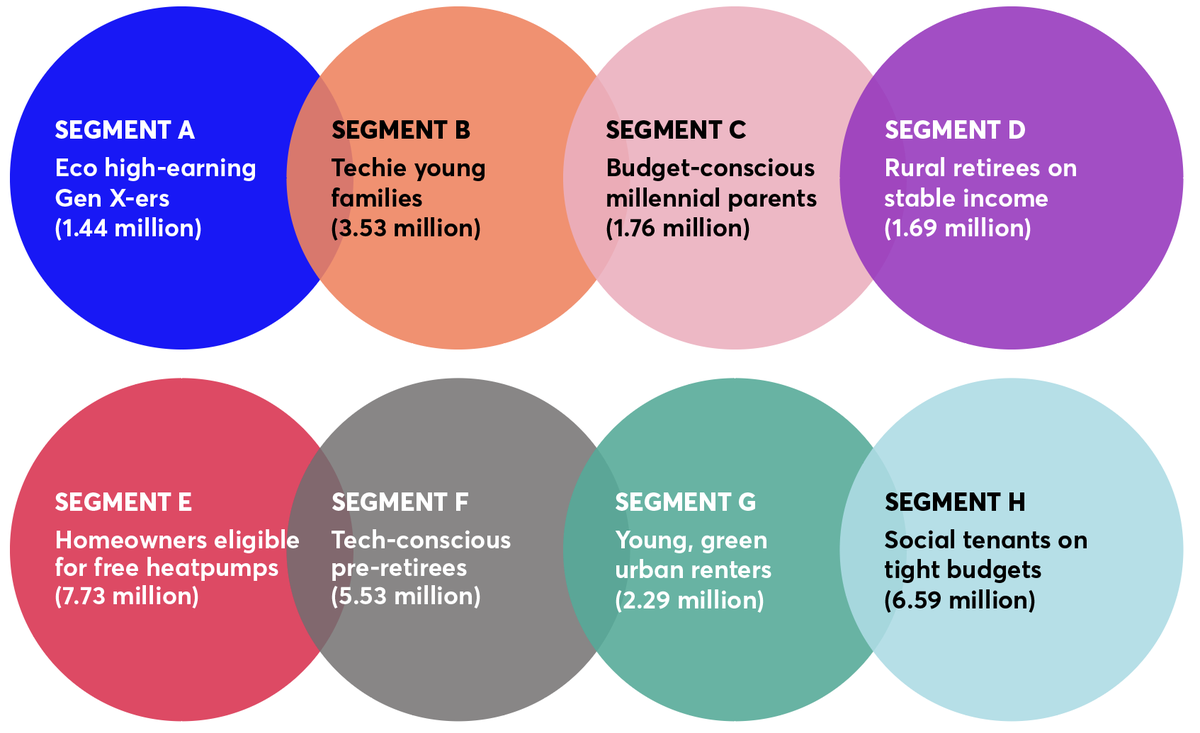
We grouped Great Britain’s population into eight segments, based on their relationships to heat pumps, to identify their motivations and barriers to installing heat pumps in their homes. We worked with Experian to create profiles of bespoke segments of the population. More details on how we did this can be found in our project methodology. In this report, we use the insights from this work in the ‘By the numbers’ section at the start of each segment.
Phase two: Qualitative deep-dives and message testing
For phase two of this work, we aimed to gain richer insights into the segments through qualitative interviews. We wanted to learn more about the decision-making processes and priorities segments had when it came to their home and home heating, as well as where they looked for credible information. We were also keen to get some initial insights into which messages appear to engage our segments on social media platforms, to indicate which themes are worth exploring further.
To do this, we ran AI-powered interviews, conducted by an AI-bot, over WhatsApp, following the structure and format defined by the research team in the topic guide. The questions were asynchronous and could be replied to by participants in their own time. We conducted interviews with 25 participants from each of the eight segments to get a richer understanding of:
- What do participants care about when they think about their home heating?
- What would be their main motivations for switching to an electric heating system?
- How do participants approach making decisions around home renovation and heating systems?
- Where do they look for information, and who do they seek advice from? Who do they trust/distrust? What are their primary sources of information?
- General attitudes to heat pumps: would they switch in practice, reasons why, and what would they need to remove barriers to switching?
More details on the methodology can be found in the qualitative research report.
We then developed creative messaging for four of these segments with Four32. We created audience profiles in Meta with Experian and ran social media adverts over a six-week period, presenting audiences with a range of messages to understand which adverts gained the most engagement and therefore which themes could be worth exploring further.
This report provides an overview of our insights from our initial quantitative research, our latest qualitative research, learnings from work by others in this field, as well as insights for each of the eight segments.
To note, the AI-powered interviews took place between October 2025 and February 2026. Message testing took place from February to April 2026, during which time the impact of the Iran war saw a great deal of media attention around energy security and potential consumer energy bill increases. Oil heating customers (Segment D) were affected at the time with higher consumer oil prices.