The energy edit: getting over the 2030 energy bill bump
 www.nesta.org.uk/blog/the-energy-edit-5/
www.nesta.org.uk/blog/the-energy-edit-5/
www.nesta.org.uk/blog/the-energy-edit-5/
Every six weeks Andrew Sissons - director, sustainable future - assesses the most important signals and trends underpinning the UK’s energy transition. Andrew is a specialist in climate change and economic growth, as a previous chief economist of the Environment Agency and civil servant in the Cabinet Office.
The energy edit is brought to you by Nesta, the UK's innovation foundation - focused on new solutions to society's biggest challenges.
We have a new government and a refreshed ministerial team in the Department for Energy Security and Net Zero (DESNZ) with lots of experience in the department - not least Miatta Fahnbulleh, the new Secretary of State.
Energy remains a central issue for the government, as part of its drive to ease the cost of living and reflected by the VAT cut on electricity bills being one of Andy Burnham’s first announcements. We hope this signals further action on bills is coming in October’s Budget and have set out our proposals on how the UK government could cut bills while reducing the electricity-to-gas price ratio as low as 2.7.
But I want to dwell in this newsletter on a wider issue: the idea of a “2030 bump” in energy bills that we have to get over. We are, in my view, in one of the most difficult parts of the energy transition and we are going through it at a bad time, with high fossil fuel prices and high interest rates. That is pushing up bills, in what should be a temporary bump that we get over in the 2030s. However, there is a risk that the bump throws the whole energy transition off track, which would make a surmountable bump turn into an ever-growing mountain.
If you ask me for a short answer on why Britain’s energy is expensive, I will usually say: we are over-reliant on gas and we are also having to invest a lot upfront to build a new, clean energy system to replace gas. The result is higher bills, mainly from wholesale costs (due to gas frequently setting the price of electricity) but also from the fixed costs of building the new energy system.
The solution should be clear: keep going. Britain must stay committed to its new clean energy system - one with high investment costs and low running costs - and reduce the influence of gas as quickly as practical. There are some early signs this is working, like the hints of decoupling between electricity and gas prices in the July price cap and the energy geeks on LinkedIn posting their incredibly low energy bills (powered by big investment in solar, batteries, EVs and heat pumps).
But for the typical household, which does not have access to such technologies, the main experience is higher bills. In this context, the action from the government’s new leadership to lower bills is welcome -– but to succeed, it needs to help us get over the 2030 bump and unlock the lower energy bills on the other side of it. Let’s get into how it could do that.
A new report by energy company SSE illustrated the “2030 bump” in energy bills very well. Their analysis - summarised in their chart below - shows electricity bills remaining high until 2030 and then undergoing a steady descent in real terms after that.
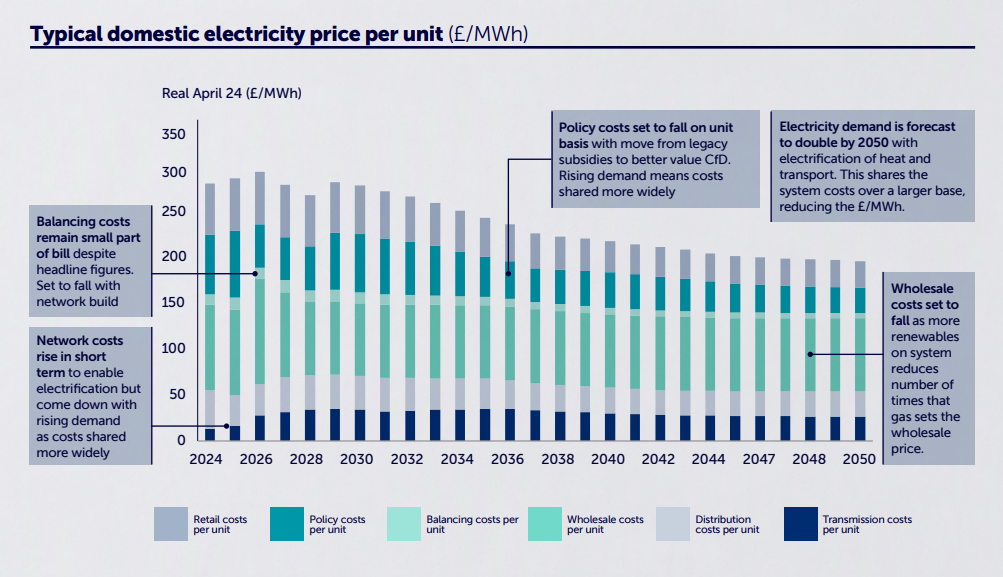
Typical domestic electricity price per unit projections. Source: SSE
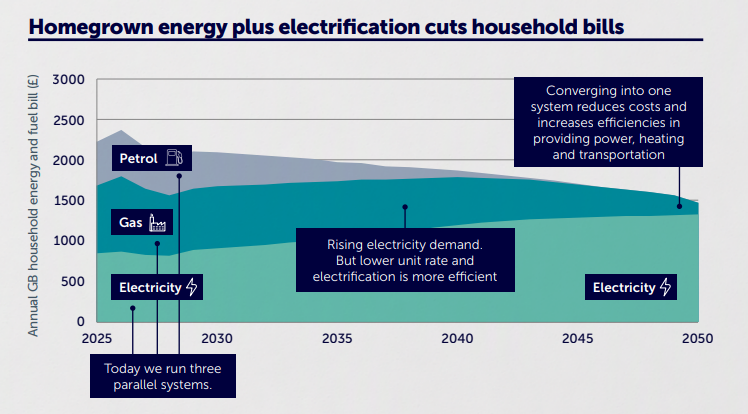
This post-2030 glide path extends to the whole household bill as well, which SSE projects falling from almost £2,500 today to £1,500 (in today’s prices) by 2050. This is the result of electrification - or, as SSE put it, switching from three separate parallel energy systems (electricity, gas and petrol) into a single system, powered by clean electricity.
What is driving this expected downwards glide path for energy bills after 2030? There are two key factors:
To put it another way, the rollout of EVs and heat pumps can make the high upfront cost, low marginal cost renewable energy system work in a way today’s energy system does not.
But there is a problem. The downward trajectory of bills after 2030 is premised on a lot more households adopting electric technologies, particularly EVs and heat pumps. The Holistic Transition in NESO’s Future Energy Scenarios, which SSE’s report uses, projects over 2.3 million homes having a heat pump by 2030. We currently have fewer than half a million and are currently adding around 100,000 a year - nowhere near fast enough to keep up with that scenario.
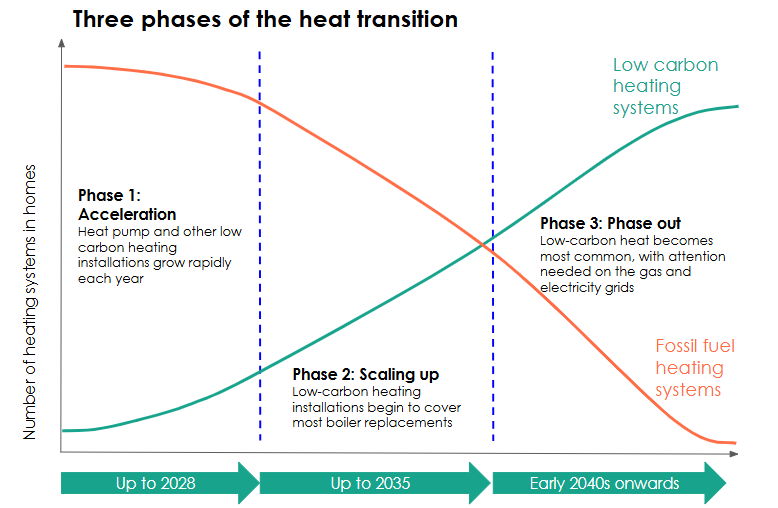
Three years ago, I wrote a piece about the “three phases of the heat transition”. The idea was that the period from now until 2035 was all about accelerating the take up of heat pumps and other low carbon heating, so that it would be feasible to stop installing any new boilers by 2035 (that was UK government policy at the time!). We could worry about most of the other problems - such as reinforcing the electricity grid and what to do about the future of the gas grid - once we had achieved this. For now, the main focus had to be on turning the heat pump curve upwards.
But three years on, there are few signs of that happening. Electricity demand is still falling, even as EVs become more common. Yet we are still planning to build out the infrastructure needed for a rapid rollout of heat pumps, with some of the costs already landing on our electricity bills, and more to come.
These rising costs on electricity bills, in turn, make it even harder to turn the heat pump curve upwards. Britain’s central energy problem is that electricity is too expensive relative to gas - and that problem is starting to make electricity even more expensive, by reducing demand. Until we start to increase electricity demand, the fixed costs of the new electricity system cannot be spread over more units of electricity. Unless we can turn the heat pump curve upwards, we won’t be able to get over the 2030 bump. Instead, we will most likely be stuck with higher energy bills and slow adoption of low carbon heating - the bump will become more of a mountain.
Given this trap, there is an increasingly strong case for the UK government to smooth out the 2030 bump. This could involve subsidising some investment in electricity infrastructure, or pushing it further into the future.
One option would be for the government to take on part of the cost of investing in new electricity infrastructure and remove it from electricity bills. This could be by directly investing in new infrastructure - via transmission and distribution operators - or by subsidising some of the costs on bills. This might sound radical, but it is similar to how we fund new hospitals, schools and often road infrastructure.
Another option is to defer the costs of infrastructure upgrades into the future. This would mean borrowing to invest now, but only recovering costs from bills when electricity demand increases and the network upgrades are actually needed. There are various ways this could be done - for example, Michael Liebreich has a proposal here for a “Great Electrification Amortisation Account”, which would help to spread costs over 50 years or more. A more modest change would be to extend depreciation rates on network assets.
Of course, both of these options would ultimately impose costs on government, either through higher taxes now or more borrowing to be paid back in the future. But even so, the case for doing this remains strong - our mid-2030s selves will likely be better off with a bit more tax or borrowing to service than we would if still stuck in a permanent energy bill trap with a system still reliant on gas.
You can subscribe to future editions of the energy edit here and chat to Andrew on Bluesky or LinkedIn. View Andrews's profile to see his other content for Nesta.