Authors
Sarah Davies and Tom Leach, with contributions from Lucy Makinson, Jessica Jenkins, Georgina Bremner and Alison Howard-Macey.
About UK 2040 Options
UK 2040 Options is a policy project led by Nesta and delivered in partnership with the Behavioural Insights Team. It seeks to address the defining issues facing the country, from tax and economic growth to health and education. It draws on a range of experts to assess the policy landscape, explore some of the most fertile areas in more depth, test and interrogate ideas and bring fresh angles and insights to the choices that policymakers will need to confront, make and implement.
About Nesta
We are Nesta. The UK's innovation agency for social good. We design, test and scale new solutions to society's biggest problems, changing millions of lives for the better.
About the Behavioural Insights Team
BIT is a global research and innovation consultancy which uses a deep understanding of human behaviour to improve people's lives.
Executive summary
Children born today will be taking their first steps into adulthood in 2040. What will life in the UK be like for them, according to current trajectories? What policy options do we have now that can influence or change that trajectory for the better?
Almost all of the UK Government's options to improve outcomes by 2040 will be shaped by our economic fortunes. Economic growth is a lynchpin for improved standards of living and social progress, and bolsters the tax receipts that fund better public services. Policy that secures higher productivity and growth enables governments to pursue ambitious policies elsewhere to keep our citizens healthy and look after those who are not, provide good educational opportunities, to both resist and build resilience against a changing climate, and more.
But growth has been elusive for the UK in recent years, and particularly since the financial crisis of 2007-2008. The consequences of this continue to reverberate across the economy; the gap between where we are headed and where we could have been, based on pre-Global Financial Crisis trends, is stark.
We've convened the brightest and best economists and thinkers in the UK and beyond to discuss the issues, trade-offs and ideas for reversing the trend. We've already examined the fundamental facts and choices and here we highlight some of the many ideas raised by those at the forefront of growth economics.
Focusing on four areas that came up time and time again – our institutions, land use, labour markets, and business productivity – some of the ideas are big, and some are small. Some aim to add to the literature on well-trodden ground, and some are more novel. They don't aim to provide a comprehensive strategy for 'fixing' growth, but we hope all are thought provoking.
The nine ideas that follow in this report are:
- Establish an enduring new independent growth institution
- Empower functional economic areas by establishing regional and local governments in England with a route to devolution and fiscal agency
- Tackle the housing crisis by moving to a zone-led planning system that simplifies the rules for developers
- Improve land use efficiency by introducing a land value tax
- Reduce labour market inactivity by harnessing data and AI to proactively support individuals
- Improve the transparency of the labour market to improve job quality
- Introduce regionally-specific migration routes
- Create ultra-low-cost energy zones to support industry
- Embrace experimentation by developing a productivity innovation fund to understand the most effective interventions
Introduction
Growth has risen up the policy agenda, becoming key to narratives across the political spectrum, with the new UK Government making growth its cornerstone mission.
But getting growth policy right is difficult, and this is only exacerbated by a challenging global and national economic context. Our previous UK 2040 Options reports explored this context and set out the fundamental facts of UK economic growth, painting a worrying picture.
GDP and productivity growth has become sluggish over time, and recently the UK has lagged behind comparator countries. Inflation has risen significantly above the trend rates since the beginning of the century, while real wages have stagnated. These trends are highly noticeable at the population level, as the price of food and the costs of paying rent or mortgages have risen.
There are some structural economic features that inform both the picture now and the potential solutions: almost 80% of our economy is made up of services rather than the production of goods; we have stark regional disparities in productivity which have worsened over time; and demographic changes mean our labour force is growing, but will need to support an even faster-growing population of pensioners.
The UK also suffers from specific issues, resulting from a combination of policy failings and uncertainty. Public and private investment is lower than in other countries, by about 4%, which amounts to the equivalent of almost £16,000 less investment per person compared to Germany and the US. There are also limitations in our built environment in the form of poor housing and transport infrastructure relative to the needs of the economy. And although unemployment remains low, there are cross-economy challenges in the supply of domestic and international labour to support economic activity.
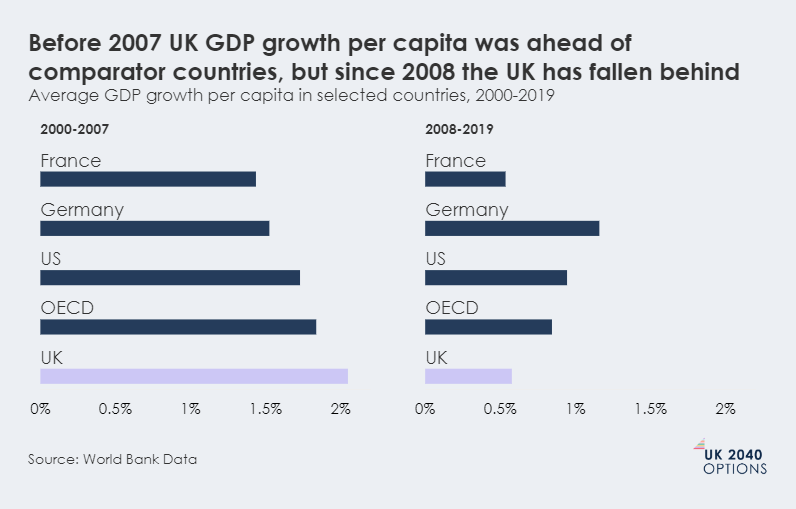 Source: World Bank Data
Since our fundamental facts were published in July 2023, the latest Office for National Statistics (ONS) growth statistics have provided politicians and economists with some breathing space, reporting higher-than-expected growth in early 2024. In the context of fears that the UK would be facing recession, it's easy to see how politicians can get excited about any growth. But growth that only amounts to 0.6% in the first quarter of the year hardly signals a secure and prosperous economic future. The Be The Chancellor interactive tool that we developed with the Institute for Fiscal Studies (IFS), which allows the user to dial growth expectations up and down as one of many variables affecting the fiscal picture, shows that balancing the books with much less than 3% growth will involve some difficult trade-offs.
Is growth the right metric?
Growth is just one way of measuring the success of an economy. Lots of attention has been given to whether metrics tracking the economy are useful – for example, GDP was later regretted by its inventor) and can be seen as a 'slippery' measure of growth. Some governments – including Scottish and Welsh governments – are increasingly looking at alternative measures of economic success, such as the Wellbeing Economy Alliance.
Some challengers contest whether the historic link between GDP growth and rising living standards can continue, with arguments ranging from concern that excessive inequality will reverse this historic trend, to the argument that growth stagnancy could be a positive sign. And advocates of ‘degrowth', propose taking actions that actively harm growth in order to protect the climate and environment, due to the unsustainability of consumption that typically accompanies growth. Environmental scientists such as Professor Vaclav Smil have scorned the "physically impossible narratives of continuing growth”.
It's important to acknowledge this debate, but since major parties across the political spectrum are committed to pursuing growth, and the new Government has named securing the highest growth in the G7 as one of its missions, this report seeks to focus on the options open to this and future UK governments in stimulating higher productivity and economic growth.
Many of the problems the UK faces are long running, with the ‘productivity puzzle' (precipitated by the events of 2007-2008 but signalled in the years preceding) now well into its second decade. A series of challenges, ranging from the once-in-a-lifetime crises of the global financial crash and the Covid-19 pandemic to the uncertainty and disruption generated by the drawn-out process of exiting the European Union, have placed strain on public finances and exacerbated structural weaknesses within the economy.
Emerging labour supply issues threaten to further frustrate efforts to grow the economy. Just as the revenues from a growing economy can facilitate investment in public services such as our education and health systems, investment in these areas in turn enables a healthy and skilled labour force. This is a critical resource for businesses in raising their productivity and growth: this investment has suffered over years of austerity and the labour market impacts of a less healthy, less skilled population are beginning to bite.
Our 'Choices' report established that, although there is consensus around the problems and broad-brush solutions, the trade-offs required to design and implement growth policies that work are difficult, and are hindering progress.
Despite these challenges and choices, there are reasons to be optimistic. The renewed fixation on growth is shedding new light on the interrelationship between wider policy issues (such as housing and health) and productivity, making a more meaningful space for reform. The relationship between central and local government is changing after decades of mistrust and erosion of local powers and finance. Strong local leadership in some areas enables pioneering new approaches to local governance, and there is fresh central recognition of the value of the services local authorities provide now that those services are under threat (see our power and place work). And fundamentally, the UK is starting from a reasonably advantaged position. As former special advisor Giles Wilkes puts it:
"We are fundamentally still a good capitalist economy with trusted institutions, stable rule of law, financial markets that broadly work, quite well-educated people and an underlying openness to the world in spite of some of our worst politicians."
— Giles Wilkes
Building on these opportunities, what options do we have for solving the UK's weak economic growth and poor productivity? In order to answer this question we spoke to expert economists, ran a number of specialist roundtables, and drew on the results of our Delphi exercise.
The devil is in the detail
Politicians understandably like to focus on the big, splashy things they want to do to fix the problems the country faces. In describing their new mission to 'secure the highest growth in the G7', the Labour manifesto largely pitched weighty reforms relating to fiscal rules, an overhaul of the planning system and the creation of new national institutions.
It will be necessary to explore bold ideas to piece together our productivity puzzle and address lagging growth. But Nesta's Andrew Sissons has questioned whether the answers to the productivity puzzle won't just lie in the big interventions, but as much in the many ‘little things' that are in government's gifts to influence. There are lots of examples of what these kinds of things might be, from 'boring innovations' to fixing the small things to support the 'foundational economy'.
Take transport. Poor transport infrastructure was flagged by our expert economists as the third most important issue inhibiting the economy. And while there could be a long debate about the relative merits of capital expenditure on new high-speed rail lines for better inter-city connectivity, or investing more in local bus networks and road upgrades, economists have also flagged that simply fixing the infamous wi-fi on trains could – via rudimentary calculations – deliver benefits equivalent to one-third of the total benefits of delivering the London to Birmingham leg of HS2 (£9.9 billion), for 1/250th of the cost.
The ideas we present here give just a flavour of some of the many policy options that could have an impact on the long-run growth rate, with a view to impact by at least 2040. They aren't intended as a set of recommendations or a comprehensive strategy, but we hope they serve to showcase some of the ideas that experts have raised with us. They are split across four themes that recurred:
1. Setting the UK up for success – institutional design
Growth policy takes lots of small, consistent actions and patience. Yet political and institutional tensions structurally hinder a long-term approach to growth policy, from the short-termism promoted by the electoral cycle to the prioritisation of hawkish fiscal management over investment for growth. We explore two ideas for reforming the institutional architecture to set growth policies up for long-term success – nationally and regionally – ensuring the right inputs from the right people, and maintaining sharp oversight of delivery to ensure politicians make good on promises.
2. Building physical resources – planning, land use and infrastructure
The ability to relatively rapidly build high-quality infrastructure – transport networks, housing, energy networks – enables an effective economy, but building in the UK is often frustrated by an outdated and slow planning system. Despite relatively low cost and broad consensus over the need for reform, this politically emotive issue has evaded progress.
3. Creating a fit labour market – skills and workforce
Businesses need healthy and skilled people to operate and grow. We look at the options the UK Government has for bringing in skilled foreign talent and addressing the concerning trend towards greater economic inactivity.
4. Bolstering productivity – supporting businesses
Improving firm-level productivity will drive growth. This is contingent in part on the broader business environment and macroeconomic factors, but providing individual support may also be necessary to drive behaviours such as tech adoption and better management practice. We consider how the UK Government can get more proactive in targeting support, and experiment more to understand what support works and how reducing the price of energy could change the sector mix of the economy in the long run, with growth payoffs.
Many of the policy levers shaping economic growth and productivity are reserved to the UK Government, such as macroeconomic policy and employment. However, areas like transport and housing are under the jurisdiction of the devolved governments. The below ideas are directed at the UK Government, meaning where an issue is devolved this would impact England only. Furthermore, the UK and devolved governments have shown differing policy priorities for tackling low productivity and growth – the ideas in this report are intended to reflect the priorities and rhetoric of the UK Government, but many could be adopted by devolved governments.
Rethinking the institutional architecture
"Institutions provide the incentive structure of an economy; as that structure evolves, it shapes the direction of economic change towards growth, stagnation, or decline."
— Douglass North
Our institutions, from the structures of our governments to the expert public bodies that critique and oversee policy decisions, impact the nature and success of UK growth policy in many ways. While there are some strengths to the existing set-up, a recurrent theme of our research and interviews was that elements of our institutional architecture are ripe for reform.
Decisions aren't happening in the right places and don't involve the right people. Government isn't joined-up, and too many policy issues languish under the remit of organisations whose objectives don't relate to growth. Decisions are often taken at the wrong level. Historic churn in institutions has created instability. Frequent changes hinder long-term goals: examples include the disbanding of Regional Development Agencies (between 2010-2012) and defunding of centrally-supported Local Enterprise Partnerships (announced in 2023), changes to the machinery of central government, and the repeated cycle of the creation and abolition of advisory councils.
Poor transmission through to policy solutions is partly a result of an implementation gap between announced intentions and delivered programmes.
The ideas that follow have the potential to radically shift both where power to influence the economy is held, and how those in charge are held accountable for exercising it.
Mission-driven government, or 'the radical how'
Engineering the array of institutions that exist is meaningless without attention to how they are geared to work.
In collaboration with the Institute for Government, Nesta recently published work examining 'mission-driven government', drawing on lessons from Nesta's practical experience working in a mission-oriented way. An initial report in collaboration with Public Digital, 'The Radical How', began to sketch out a model that prioritises testing, learning and adapting the way the UK Government and public service providers operate, to achieve specific outcome-focused missions. It proposed ten reforms to make the transition to this way of working possible, from changes to public procurement systems, to oversight mechanisms, to the way civil servants are recruited and trained.
Following the UK General Election, the Institute for Government and Nesta detailed a further vision for how mission-driven government could work in principle. Outlining the concept of mission-driven government, which involves setting ambitious, long-term goals to address complex societal challenges, it calls for three core components to a new, mission-oriented mode of public sector delivery:
- direction of travel (including missions, targets and game plans)
- the role of government (driving public service innovation, shaping markets and harnessing intelligence)
- foundational enablers (structures and processes, people and culture, and data and technology).
The approach emphasises collaboration across government departments, the private sector and civil society, with a focus on outcomes rather than outputs.
Establish an enduring new independent growth institution
What
Establish a new expert growth and productivity institution, funded by, but independent from, government. It would support the development of policy solutions, analyse proposals and hold government departments, devolved administrations and regions to account for delivery. It would also evaluate the impact of implemented policies. This idea takes inspiration from recent calls from The Productivity Institute (TPI) and others.
Why
Growth policies in the UK have a poor history of longevity. Big-ticket policies make headlines if they're not delivered (see HS2), but there are countless examples of smaller-scale initiatives announced and undelivered, or funds allocated but underspent. This means that new announcements can lack credibility and be treated with scepticism, lessening their impact on business behaviour and ultimately growth.
There are a myriad of reasons that policies fail to stick, including the effects of a relatively short-term political cycle: new incoming ministers want to lead and implement something new, which can provide a good announcement. But once the announcement is made, there can be limited political accountability to deliver policies. Increasingly, programmes and interventions are also at risk due to polarising views over the ‘answer’ to growth, exacerbating the extent to which policies are subject to political swings. Prime Minister Liz Truss and Chancellor Kwasi Kwarteng's short-lived 'mini-budget' was an infamous example of this, making unfunded tax cuts in a bid to stimulate growth, destabilising the economy.
Why
Taking inspiration from existing institutions such as the Climate Change Committee and the Office for Budget Responsibility (OBR), TPI's report provides a 'blueprint' model for a new organisation. Key features include:
- a focus broad enough to remain above shifting political priorities (primarily examining the direct drivers of productivity including investment in physical, intangible and human capital, with secondary consideration of driving forces for these – sectors, places and technologies)
- responsibilities to conduct discretionary policy inquiries, monitor and evaluate announced policies, and produce high-quality data and reporting on productivity
- establishment as a statutory non-departmental body, reporting to Parliament.
There have been various attempts to set up a body like this in the UK, most recently in the Industrial Strategy Council (ISC). Established by the 2017 Industrial Strategy, the ISC was disbanded in 2021, theoretically having its responsibilities overtaken by the Build Back Better Business Council, then the Prime Minister's Business Council. The broader growth-focused institution proposed here would need to have a distinguishable value and strong design, as well as strong will from politicians in resisting the temptation to rip it up and start again.
Industrial policy and strategy
After a few decades of resistance to industrial policy due to scepticism at government's ability to ‘pick winners', global developments have increased the scale of industrial policy interventions in other Western countries – from the CHIPS and Science and Inflation Reduction Acts in the US to the European Chips Act and Green Deal Industrial Plan in the EU.
There was a shared view among our consulted experts that strategic direction has been lacking in recent UK interventions. Monitoring, governance and accountability mechanisms fell through the gaps between eye-catching announcements. Where sector deals were published, they varied in quality, and funding commitments remained small scale. The approach hasn't acted effectively as a challenge to industry to step up and co-create an energised and credible plan of action to improve productivity and growth. While the Labour Party's 2023 Industrial Strategy proposed a mission-focused strategy, it remains to be seen if this can bring about effective policy change.
There are key industrial policy choices around whether and how to: influence the sector base of the economy in pursuit of growth, or focus on upping the productivity of our existing services-weighted mix of industries; provide support primarily to high-flying sectors or commit more resource to increasing performance, innovation and tech adoption in the foundational economy, or both; and work out the optimum scale of support.
A new institution could support with all these questions and more, although democratically-elected politicians should retain responsibility for setting strategic direction.
Remit
The TPI blueprint offers a starting point for an effective new institution, and there are interesting international examples to learn from, such as many similarly mandated Productivity Councils, the Economic Strategy Tables in Canada, and the Industry Transformation Maps in Singapore.
- 'Marking the Government's homework'. The institution must ensure that the Government is sticking to a credible growth strategy, tracking and appraising the impact of policies on growth and force honesty about what has been delivered. It should not set the policy agenda. An appropriate ministerial department – and democratically-elected politicians – should be responsible for setting the strategic direction of industrial and wider growth policy.
- Providing advice to national and local governments. The institution could act in an advisory function, providing independent expertise and analysis. It might reasonably undertake specific inquiries in agreement with the Government, going in-depth on specific issues. However, experts highlighted that an independent institution with sufficiently deep expertise on UK growth and productivity could also avoid focusing solely on the priorities of the current Government. A core function it could provide would be to institutionalise the evidence base, reducing the scope for political polarisation of the 'facts' on what works for growth.
- Primary research and evidence development. The institution could design and trial policy ideas to help improve the evidence basis. It could collaborate with existing research infrastructure: universities (and their public sector funders and partners including UKRI and Innovate UK), business productivity advocates like Be the Business, and research organisations like the What Works Centre for Local Economic Growth, TPI, and Nesta. It could also conduct primary research by operating an Experimental Productivity Fund to check hypotheses about what causes low growth, and the potential for new solutions.
Longevity
Designing the institution on a statutory footing is one means of encouraging longevity, but this alone is unlikely to be sufficient. A cautionary example is that of the Office for Tax Simplification, which was placed on a statutory footing in 2016 but abolished in 2022. Clarity of remit and cross-departmental (ideally cross-party) conceptual buy-in are necessary; a dedicated cross-government team should be established to design the governance and financial frameworks, steered by a Cabinet-level growth council.
Credibility
Another critical success factor is this institution's credibility, which relies on the depth of its expertise and ability to influence and improve policy. The institution would need to recruit highly-qualified analysts with relevant policy and evaluative experience, in addition to an experienced, non-partisan leadership team; this would require sufficient budget to pay competitively. As above, collaborations with business organisations, universities and research institutions would foster ongoing knowledge exchange and access to a wider pool of expertise.
Formal cooperation agreements could be established between the new institution and sectoral and regional authorities to ensure effective collaboration and enable partnerships (such as data sharing agreements) for mutual benefit. Defining the relationship with other public sector institutions such as OBR is also key, where there are risks of tension or duplication of efforts. Finally, defining the relationship with central government, devolved administrations and local regions – particularly the Treasury - is critical.
Power and independence
Any new organisation must have the teeth to ensure consequences if delivery is sub-standard. A success of the OBR has been the requirement for the Chancellor to report their analysis of the economic forecast at every budget, as it frames and influences all fiscal events. It should be empowered to deliver its remit effectively by being able to independently control its own budget. OECD research emphasises the importance of adequate and stable funding in enabling an organisation to operate independently and credibly, and increase its impact on growth.
Impact and trade-offs
Impact would depend on design, governance, personnel and cultural context. Institutions take time to bed in, and its success is also likely to depend on the shape of the Government's growth mission. Realising value from investment here depends on how the Government responds to the advice and expertise that a new institution would provide. Although the Australian Productivity Commission, the earliest example, is seen as successful, it's sometimes criticised for lacking clout – providing expert advice and scrutiny that doesn't get translated into action.
The implementation costs of establishing an institution do not need to be high. Indicatively, the Climate Change Committee and the OBR have annual average budgets of £7 million and £5.4 million respectively. Resourcing of a new institution needs to be consistent and sufficient for it to deliver its mandate: our experts criticised the “miniscule” budget afforded to the previous Industrial Strategy Council, which prevented it from having a strong research, analytical or monitoring role. Additional costs might ramp up depending on specific responsibilities, but the hope would be that over time the organisation pays for itself by positively impacting UK productivity.
Empower functional economic areas by providing regional and local governments in England with a route to devolution and fiscal agency
What
Co-develop a comprehensive, long-term devolution arrangement across English regional authorities, that works for the whole country, and incentivises local governments to drive local economic growth. Comprehensive preparatory work would be required between now and 2035, covering:
1. analysis of which powers for economic planning and development should be granted to regional authorities over time, and what the stage-gates are for determining when regions are ready for these new responsibilities
2. targeted capacity-building initiatives to strengthen local government with a view to empowering sub-national bodies to operate new powers effectively
3. research into devolved fiscal arrangements to ensure regional authorities are equipped with the means of resourcing and capitalising on these new powers.
Local government financing
Local government finances are not in a healthy way; with significant concern that the impacts of austerity, compounded by increased pressure during and after the Covid-19 pandemic, have stretched the local governance system to breaking point in many places around the country. Seven English local authorities have announced bankruptcy since 2021
Local government financing is primarily made up of:
- grants from central government, made up of Revenue Support Grants (to enable authorities to fund general services) and specific ring-fenced grants (intended for particular purposes, and often provided on the basis of bids from local authorities to deliver initiatives based on national objectives)
- local tax revenues, primarily from Council Tax and Business Rates
- fees and charges, as determined by local authorities (for example, parking fines, and income from leisure facilities).
In limited circumstances, local governments can also borrow for capital investments, such as the development of new large-scale infrastructure, like bridges.
Tensions in the relationship between central and local government have played out in an erosion of the financial resources of councils. Thatcher-era cuts were compounded by austerity's hit to local coffers: real-term cuts to grant funding have been significant since 2010-2011, amounting to 49.1%. Increases in Council Tax mean that the 'spending power' of councils has only reduced by 28.6% in real terms, although this remains a stark reduction in resources at a time when pressure has been building on the services local governments provide. Impacts have been felt unevenly, with the poorest councils hit the hardest.
Why
Momentum for further devolution is increasing, even as the 'levelling up' slogan fades from the political forefront, thanks to persistent regional inequality that sees stark differences in value created between London and the rest of the country.
The UK has high regional inequality in productivity and this has worsened.
Population-weighted coefficient of variation in regional gross value added (GVA) per worker in selected countries
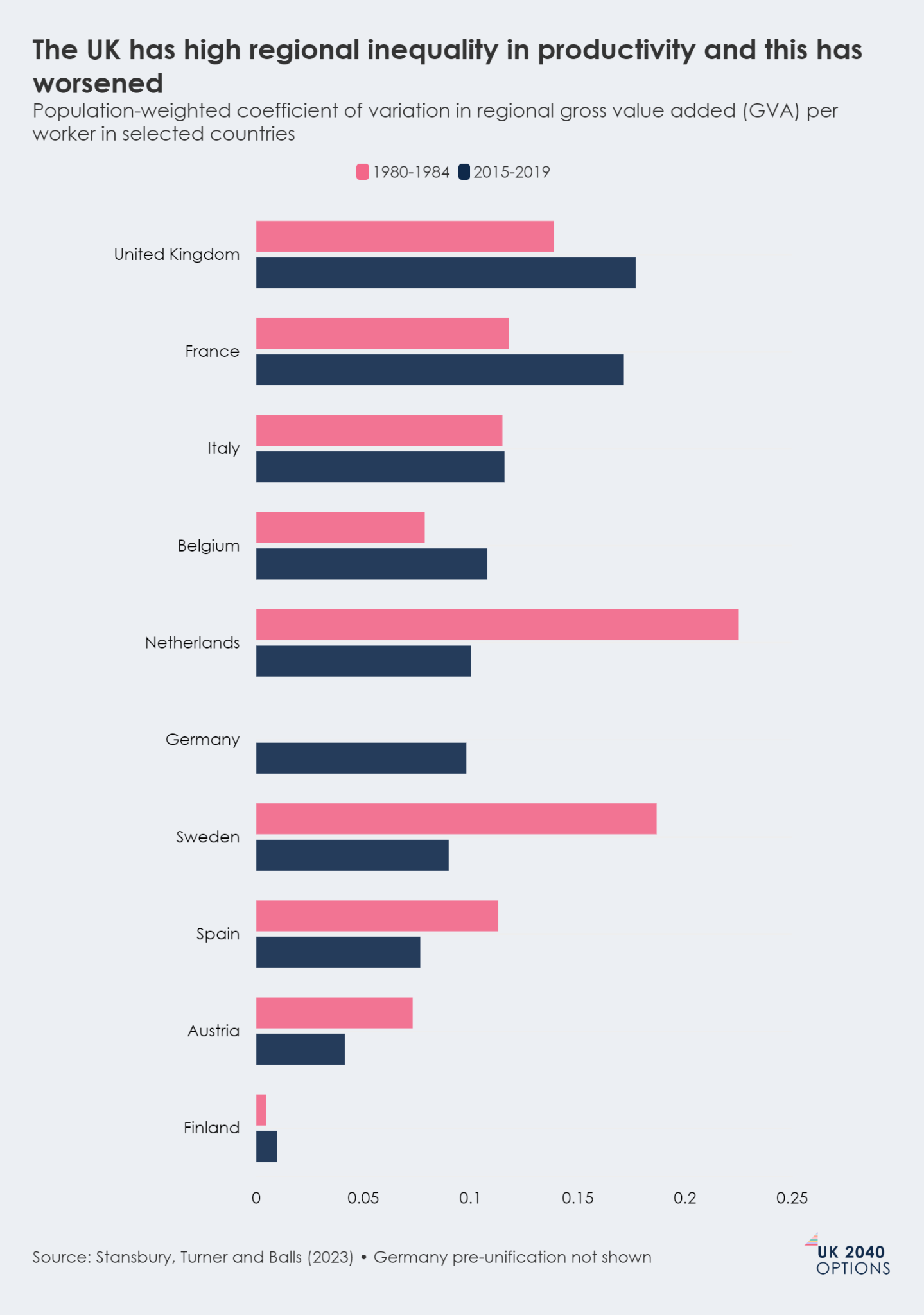 Source: Stansbury, Turner and Balls (2023) • Germany pre-unification not shown
According to economic theory, decentralisation and devolution can spur regional growth through increased efficiency, increased policy innovation, and by creating more powerful systems of local accountability for economic development. There is a clear global trend towards decentralisation (approximately 40.4% of public expenditure in OECD countries now occurs at the sub-national level), but the UK lags behind, having historically pursued centralisation in the belief that it would foster growth.
Place-shaping activity is occuring unevenly across the country. A patchwork of devolution deals has resulted in some particularly successful regions now enjoying the opportunities afforded them by 'Trailblazer deals', chomping at the bit for still greater powers. Left in the dust are a series of smaller, less well-coordinated regions and localities.
Despite this approach clearly yielding uneven outcomes across regions, there remains resistance to further decentralisation, with reported Whitehall perceptions of lack of capacity at the local level to effectively utilise devolved powers.
Concerns about local capacity and capability are justified: empirical evidence on the success of decentralisation in fostering regional economic development is mixed, suggesting that the success of devolution for growth heavily depends on the specific design and governance of the devolved structures. The UK context is unique, marked not only by stark and long-running regional economic disparities, but also by the fact that even our largest regional entities (combined authorities like Greater Manchester and the West Midlands) are sub-scale compared to those in other OECD countries, compromising any attempt at comparison.
Experts agree: institutions will be crucial for devolution that empowers regions to level the productivity playing field with London. But rather than rushing to impose a new regional institutional framework with extensive new responsibilities and fiscal governance arrangements, the Government should first ensure they get the devolution 'groundwork' right.
How
Commit to devolution: To support a devolution pathway, the Government could commit to accelerating the process of combining local authorities into larger-scale combined authorities. This could involve creating incentives for local authorities to collaborate with neighbouring authorities and look beyond their traditional boundaries. Building on the understanding that devolution is not a linear process, the Government could establish stage-gates for regional authorities to demonstrate their readiness to take on new powers and responsibilities. This could involve working closely with successful combined authorities to determine the appropriate criteria and rigorously stress-test them to ensure they can be effectively applied to other areas. Maintaining open and constant dialogues with local leaders would be crucial throughout.
A plan for devolved powers: Existing devolution deals, even in trailblazer regions, have done little to significantly expand the powers of local authorities and combined authorities. A more ambitious plan for devolved responsibilities could unlock greater regional economic growth. For example, granting regional bodies more control over infrastructure planning, financing, and delivery – particularly for crucial intra-city transport links in the North – could enable more tailored and effective investments. Further devolution of skills and labour market support initiatives, building on partial powers over adult education, could allow for more locally-responsive and impactful programmes, as evidence shows locally-delivered initiatives tend to be more successful. Empowering regional authorities to coordinate and capitalise on the innovation capabilities of local universities could better translate research strengths into economic benefits.
Build devolved capacity and capability: Ramping up recruitment, training, and professional development opportunities for local authority staff, and creating more career pathways and secondment programmes could facilitate the movement of civil servants between central and local government departments and help cross-pollinate skills and knowledge. Shared training and learning and development programmes across national and local levels could also foster stronger collaboration and alignment. Reviewing the pay and compensation structures in local government would ensure they can attract and retain top talent.
Public sector growth isn't spread equally: a growing share of the UK government workforce is employed by central government
Share of total UK government employment rates, full-time equivalent, 2010-2023
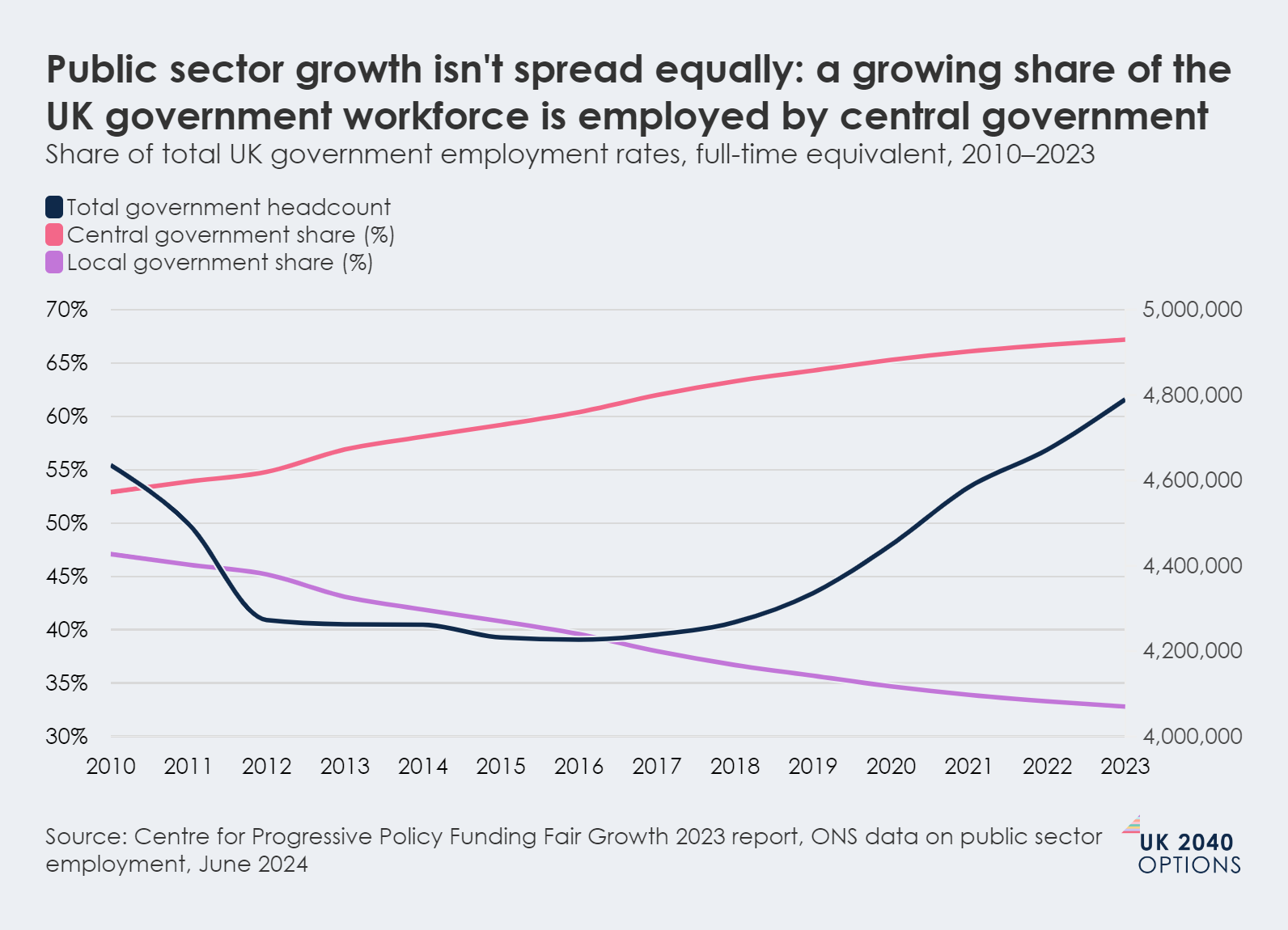 Source: Centre for Progressive Policy Funding Fair Growth 2023 report, ONS data on public sector employment, June 2024
Provide fiscal agency: While evidence on the impacts of decentralising power is mixed, this may be due to the prevalence of ‘unfunded mandates', where regions and localities are given new responsibilities without the requisite resources to deliver them effectively. Research indicates it is the mismatch between the degree of fiscal and political decentralisation, rather than the absolute levels, that is a key determinant of regional economic growth.
Over time, the goal should be to devolve greater fiscal responsibilities, particularly for highly buoyant taxes where revenue rises with growth, to sub-national entities like combined authorities, thus aligning their incentives with boosting local productivity. While detailed models have been proposed by think tanks like the Centre for Cities and Centre for Progressive Policy, this process must be carefully managed to avoid exacerbating existing disparities. Setting a clear intention to move towards greater fiscal devolution in the future could incentivise local authorities to work collaboratively with national government to design a settlement.
Mitigating investment risk in the regions
Making moves to nominally devolve or decentralise won't result in meaningful change for places without private investment as well as public. The confidence of investors is dependent on certainty: in this case, certainty that the centre won't intervene to disrupt any investment. Past patterns of behaviour from the centre have dented this confidence. The stage-by-stage cancellation of the HS2 rail link between London, Birmingham and Manchester is an example of central investment in regions which is called off, with fear of impact on local investment.
Analysis by Professor Philip McCann of the The Productivity Institute shows that one of the reasons that the economic fortunes of regions outside of London and the South East have been so damaged by the Global Financial Crisis is due to poor capital resilience, with investment levels failing to recover since. The resulting divergence in risk premiums between London and some regions of the UK is equivalent to differences between the sovereign yields of UK gilts and those of Romania or Chile.
A new system of fiscal governance should therefore not only be predicated on the basis of current needs (for example, what the requirements are to fund local social care), but determined equally by the extent of market confidence in a region or locality. One idea, proposed by Professor McCann, is for central government to derisk regional investment by underwriting significant initiatives determined by regional/local authorities, subject to due diligence and quality governance. This might encourage private risk capital to crowd into regions, supporting the economic development of areas currently facing a dearth of investment.
Impact and trade-offs
Several key trade-offs will need to be navigated. The first is whether to devolve powers uniformly across regions or prioritise equipping areas with the most economic potential. This is where the proposed stage-gate approach, based on an assessment of local capabilities and credible growth plans, becomes crucial. There is also the inherent 'catch-22': devolving meaningful powers requires trust in sub-national authorities, but that trust must also be earned through demonstrated capabilities. True devolution differs from mere decentralisation, where control remains centralised.
Policymakers must carefully manage the opportunity costs. This could involve establishing a dedicated unit to identify risks from devolution and opportunities for greater collaboration and coordination between combined authorities and local governments. Ensuring robust data capabilities and cooperation agreements for data sharing will also be essential to unlocking the full potential of devolved responsibilities. Navigating these complex trade-offs and impact uncertainties will require a thoughtful, evidence-based, and iterative approach. But by getting the foundations right, devolution holds the promise of empowering UK regions to drive more tailored and effective economic development.
In our earlier Delphi exercise, 'poor transport infrastructure' and 'insufficient housing supply' were listed as the third and fourth most important issues holding back economic growth, with 'planning reform' ranked as the third most impactful intervention the Government could make.
The current planning system is a barrier to growth in multiple ways. The burdensome process of complying with planning rules and regulations means development is slow and expensive and necessary infrastructure (housing development, rail and road, energy, and telecoms) can be frustrated by lengthy consultation and review processes. This results in the direct loss of productivity, as unnecessary time and capital are spent meeting these processes. There are also indirect economic drawbacks, such as the unavailability of housing and transport denting the positive potential of effective agglomeration and efficient allocation of labour.
With the impact of planning on growth and the relative cheapness of the interventions, the political will to change our planning system is clearly growing. Keir Starmer is a self-professed 'YIMBY': the pro-housing opposite to those who support planning, but ‘Not In My Back Yard'. Having put planning reform front and centre of its 2024 General Election campaign, the new Labour government has made it one of its top issues to tackle. Recent announcements on planning reform and the consultation on the new National Planning Policy Framework show progress on this front.
We explore two ideas to go further, looking firstly at a new model for our planning system, and secondly at a more radical overhaul to land use in the UK through change to the tax system.
Tackle the housing crisis by moving to a zone-led planning system that simplifies the rules for developers
What
The UK Government could move away from the discretionary planning system to a zone-led system – a widely discussed alternative that is recommended by the Centre for Cities. This would require local planning authorities to implement a zoning code with clear guidelines, with local authorities legally required to accept housing proposals that comply. Local consent for the process would be built into the design.
Why
The UK consistently underdelivers the number of new homes needed, causing spiralling prices and unaffordable rents for large parts of the country. This has pushed home ownership out of reach for many, and caused acute affordability challenges for renters. It's estimated that half of all children living in the private rented sector in the UK are in poverty, once housing costs are factored in. There are stark economic impacts too. If we build more housing in core UK cities, and generate agglomeration benefits comparable to European cities, productivity could increase by up to 6%. This could help reduce the £1.4 billion per year the NHS is spending to treat people affected by poor housing.
The Centre for Cities estimates there is a housing deficit of over four million homes. To reverse decades of undersupply we need to roughly double new housing supply for a generation. And this comes at a time where the ONS expects England's population to increase by 383,000 a year until 2036.
Many have argued that our discretionary planning system is the reason why we aren't building enough houses. This system, which stands as an outlier internationally, means that any proposed development automatically entails a public consultation, often leading to rejection of the application: from January to March 2023, around 14% of applications were rejected in England. Local authorities are frequently put under sharp political pressure from their constituents to reject new developments. Residents are quick to find reasons to oppose new housing (citing disruption, strained public services and unwanted change), but find it hard to identify and balance more diffuse benefits (such as economic growth, job creation and increased housing affordability). Hence we have the concept of a NIMBY – yes to housing, but 'Not In My Back Yard'.

This uncertainty in the outcome of planning applications has costs for developers, who must price it into their business model. The uncertainty also favours the business model of large housebuilders who can afford to speculate on land gaining planning permission, and wait out the lengthy approval process. Overall, this leads to a less diverse housing market with fewer houses being built, and in inefficient locations.
How
Designing democratic zoning: Many believe that a greater degree of certainty from a zonal system is in direct opposition to the core values of the English planning system – its adaptability to local circumstances, and the idea that local people should get a say in any new development. But there are ways to ensure zone-led systems are democratic and maintain public buy-in.
1. Extend the use of permitted development and adopt 'Street Votes'
This least radical of the options links to retrofit rather than new development, but could be achieved within the current system.
Permitted development rights effectively mean a developer doesn't require planning permission for certain types of building work. These rights are currently quite limited, but the policy could be extended to larger-scale (uncontroversial) retrofits such as small extensions at the back of properties. Street Votes would come in where neighbours propose a street plan, setting out exactly what additional building work should be permitted and how it should look. If the vote passes, everyone on the street has the right to develop their property in line with the plan.
2. Mandate local authorities to develop area-specific design codes or pattern libraries for new developments
This is technically achievable within the current system and mentioned in the National Planning Policy Framework, but there has been low and ineffective take-up. Better resourcing for planning authorities, good case studies to draw from, and a mandate from central government would accelerate their uptake.
Local authorities could work with the community to define a set of building types that are acceptable. As long as a developer sticks to these, they would get permission. Authorities would be able to determine how strict these are, and what they apply to (eg, 'no suburbs', or just certain building types). Implementation is key: some areas which have used design codes have not implemented them effectively – they are not specific enough and need to be more visually and numerically defined to give existing residents more confidence on crucial features of future development. Policies requiring 'good design' or 'appropriate materials' are capable of almost infinite interpretation.
3. Designate specific land and/or building types for development using zoning (or up-zoning)
This is a more radical reform and would require new primary legislation.
Central government would instruct local authorities to institute a new rules-based, flexible system: this would mean shifting away from case-by-case decision-making to a system where development is lawful so long as it follows the rules as designated in any given area. There are various options in terms of how much is pre-defined and how zonal rules are governed and reviewed. An example could be that development is allowed for any two-storey residential building in certain areas to 'up-zone' to a four-storey residential building.
Public buy-in: This is already embedded into Street Votes, since the vote itself is a democratic process. For design codes and zoning, more participatory approaches could be used to ensure the changes don't backfire. Create Streets propose “bringing the democracy forward" and co-creating house types and a design code hand-in-hand with the community and the Neighbourhood Plan from the outset. This would require additional resources, but would involve far less engagement and consultation at the later planning phase and for individual projects.
Impact and trade-offs
The assumption is that this would increase land availability, reduce the costs to develop new housing, and crowd-in small- and medium-sized (SME) housebuilders to increase the overall delivery of new housing.
A recent evaluation of the up-zoning reforms in Auckland, New Zealand found that around 22,000 new homes consented between 2016-2021 were a direct result of up-zoning in the Auckland Unitary Plan – one-third of all homes consented in residential areas in that period, and 50% more dwellings consented than would otherwise have been the case. In Japan there are 12 different zones which shape the density and use of land while still providing much more flexibility than our current system. Japan has much more affordable housing than England, as it builds 900,000 homes a year while England struggles to build 240,000.
But there are several trade-offs to this approach. The idea is not new – it's common internationally and has even been tried before in England, but new primary legislation has always failed on political grounds. Most recently, Boris Johnson's government proposed the policy, but it was toppled by backbench MPs who feared a backlash from local residents. There are ways to improve public acceptability and explain to the public, but regardless major changes here require strong political will.
There could also be more legal challenges as a result. Zoning systems can create controversy over development and land values, as a consequence of sometimes seemingly arbitrary zoning allocations which are then legally binding. This might lead to an increase in appeals or judicial reviews if landowners and developers see their sites allocated unfavourably, with cost and reputational implications for the Government.
It's not anticipated that these approaches would involve additional costs, however local authorities may require temporary funding (in the order of tens of millions) to set up new zoning plans since it will require upfront resources which may be difficult to reallocate.
Improve land use efficiency by introducing a land value tax
What
The UK Government could abolish current property taxes (Stamp Duty Land Tax and Council Tax) and replace them with a system that primarily taxes properties based on the value of the land it occupies.
Why
The current system of property taxation is outdated and unfair, and creates incentives for landowners to 'bank' undeveloped land in the hope it will increase in value. This is distortionary, bad for house building and bad for growth.
The reform of current property taxation to a land-value-based system has been advocated by several prominent economic thinkers, from Henry George to Martin Wolf. Land is in fixed supply, unlike capital, labour, and many other taxed variables, so a land value tax does not distort economic decisions or dis-incentivise productive activity because land cannot be hidden or moved to avoid taxation. For this reason, compliance and enforcement also become simpler and more effective.
The arguments that land value taxation could raise economic growth mostly relate to the expectation that land value taxation leads to better land use efficiency. By increasing the costs of holding undeveloped or under-developed land, land value taxation encourages people who own land to use it as productively as possible, leading to more and denser development.
Land value taxation would have three clear benefits:
1. Tackling land 'banking'
Under the current system, land banking can be lucrative for developers and landowners; the Local Government Association estimates that 1.1 million plots of land with planning permission have not been built upon.
2. Densifying urban and suburban areas
Land value taxation encourages higher density housing development, which reduces the difficulty of the current trade-off between delivering more housing supply in economically rational areas such as those close to urban centres, and building on green belt land.
3. Encouraging higher occupancy
both by encouraging downsizing for older people living in empty nests, and by reducing the affordability of allowing properties such as second homes and foreign-owned property investments to sit empty.

The UK's housing stock also desperately needs upgrading to increase energy efficiency, adopt new green technologies and adapt to a net-zero future. Optionally, designing in tax reliefs related to other government priorities – for example tying in discounts for low-carbon heating – will encourage the pace of the green transition in retrofitting and development of new green homes.
How
Valuation
Agreeing on a fair contemporary valuation of land without mass dissension and lengthy legal appeals is one of the main practical barriers. The equivalent of a modern-day Domesday project seems daunting, but available public data increases the feasibility of revaluing land across the whole country quickly and fairly.
Separating the value of land and buildings
There are already existing mechanisms for valuing land and property for other tax purposes, like Business Rates, overseen by the Valuation Office Agency. Valuation is usually based on the transactional or rental price of land. Most transactions of land include property as well as land, so in the case of implementing a tax based on land, it's harder to separate the respective value of the land and the property located on it. Methods for valuing the land without the property (when there is property on the land), include:
- Residual value measurement: Taking the value of both land and property, and making a deduction of the costs required in replacing any buildings present on the land. This relies on accurate assessments of rebuilding costs.
- Hedonic regression techniques: Similar, but accounting for the relative values of the property itself, its age, condition, desirability, and using a more complex assessment of rebuilding costs that accounts for variability in construction costs.
There is precedent for undertaking a modern mass revaluation exercise. Between 2018-2022, Germany mandated a revaluation of property values for taxation purposes, due to the previous property taxation system being declared unconstitutional by the German Federal Constitutional Court. As property taxation is devolved to federal states, each state was able to determine its own methods of valuing property according to a range of options set out in law, and drawing on standard land values devised by central committees.
Transition period
To avoid creating significant financial shocks to households and businesses, phasing would be required. Many people's tax bills would be very different under a land-value-based model compared to the current property tax system, which is based on 1991 property valuations.
Supporting the ‘losers’
There would inevitably be winners and losers. Providing support for at least some of those who are disadvantaged by the reform is likely to be necessary for financial stability reasons.
Reducing house prices will plunge many mortgaged householders into negative equity (as the value under a land-value-based tax system may not match the level of debt held against the property). Providing mortgage support is likely to be necessary: this could involve negotiating mortgage payment holidays or providing discretionary payment support. Another option would be to design the tax to apply only to values above current values, as proposed by a Centre for Economic Policy Research paper in 2021.
2. Means-tested deferrals could also be allowed.
Some people may be rich in land or property which is under-taxed under the current system, yet they could be relatively cash-poor. Introducing a system of deferring payment of tax until the land is sold or the taxpayer dies is a way of ameliorating financial distress for these people.
3. The Government might consider offering a compensatory package to land or property speculators who have invested in real estate as an asset class,
although this is likely to be a regressive use of taxpayers' money. Ultimately, any investment carries risk, and under the current system, property speculation is a low-productivity investment, so it may be preferable to accept that less vulnerable investors such as property speculators lose out in the broader scheme of progressive reform.
Using the tax to meet other policy objectives
Permutations of a land value tax can be used to create incentives for other policy goals. For example the Green Land Value Tax, a proposed split-rate property tax explored by a recent OECD report, partially taxes the value of the land, as well as buildings located on the land.
This makes the tax more progressive, because it imposes higher taxes on high-value properties, although it disincentives home upgrades. The 'green' element derives from a discount to the total tax levied to reflect the energy efficiency of buildings, sunsetted to ensure that in the long run, once the green transition is achieved, revenue from land taxation is fiscally sustainable.
Land value taxation and public value capture
Land value taxation could also be a tool for helping the state capture the value that accrues to land due to state actions, such as granting planning permissions and developing public infrastructure. When the state provides planning permission, it significantly uplifts land value, but traditionally, this increase benefits private developers, not the public sector. Despite this private gain, the state bears the cost of building and maintaining the public infrastructure and amenities, like roads, stations, and parks, that turn new housing developments into places that people can live and work.
Current mechanisms for capturing land value include Section 106 agreements and the Community Infrastructure Levy (CIL), which require developers to contribute to infrastructure costs. Existing mechanisms like these go some way to meeting costs, but better capturing gains in value from granting planning permission will better enable the state to recoup some of the value generated from its actions.
Other proposals to enhance land value capture include land auctions (which could set the market value more transparently and fairly, and reforms to compulsory purchase orders (CPOs) to enable the state to buy at land value rather than ‘hope value’. These measures aim to ensure that the benefits of increased land value due to public actions are more equitably shared between the private sector and the public.
Impact and trade-offs
Over time, introducing a land value tax should increase the supply of housing available, and precipitate a drop in the cost of housing. Incentivising efficient land use encourages denser housing development and denser occupancy of existing housing by encouraging downsizing and dis-incentivising the ownership of second homes. In turn, this should benefit the economy through the network effects of closer agglomeration on productivity.
Implementing reform at this scale would bring significant implications for the tax system. The proposal would likely reduce overall tax revenue. It would also require a rethink of how local councils are funded, as Council Tax and Business Rates revenues currently make up a significant proportion of funding. Simply substituting existing taxes for the new land-value-based one would retain incentives for local authorities to improve their local areas in order to raise the value of land. However, this may also result in greater disparities in revenues raised due to revaluation laying bare the significant differences in land value that have been exacerbated since 1991. Councils in some of the most economically disadvantaged parts of the country with lower land value, like parts of northern England, would be disadvantaged. It's likely that some form of redistributive mechanism would be necessary.
Overhauling property taxation also provides an opportunity to move away from transactional property taxes like Stamp Duty Land Tax (SDLT), which distort economic behaviour. Not only does SDLT increase the costs of moving and thereby hampers labour mobility, it dis-incentivises older people from downsizing, which means many older homeowners under-occupy larger houses. This restricts the supply of well-located family-sized housing to younger generations of working-age people and has a knock-on impact on housing costs. While aspects of the policy might be phased, abolishing SDLT immediately might be necessary to avoid penalisation of those moving. This would have fiscal implications (SDLT accounts for around 1.2% of government tax receipts).
Careful attention would also need to be paid to managing the politics: Even with a proactive approach to mitigating impacts for some losers, reforming the property taxation system will be highly politically controversial. Memories of Thatcher's disastrous attempt to introduce a poll tax loom large in the political consciousness, and those likely to lose out are vocal.
The current level of investment in lucrative UK real estate crowds out investment in areas of the economy with higher long-term productive potential, which has negative consequences for growth. Where that investment is fuelled by credit, there can also be financial stability risks. Although a land value tax will cause some short-term instability by impacting house prices, reducing the attractiveness of land as an investment asset might prompt a shift in investment habits in the long term. There are significant risks to this assumption, including that redirected investment isn't guaranteed to be located in the UK nor realise greater productivity.
Costs
Although the transitional and implementation costs of a land value tax may be higher than continuing to operate current property tax systems, the marginal costs would likely be low. As explored above, short-term transitional support is likely to be necessary to mitigate political backlash, and this could be very costly.
Creating a fit labour market
Uninterrupted growth in the UK's labour supply has been a key feature of our economic context since the early 1990s, and one that's supported growth over and above gains in productivity in recent decades.
While the UK benefits from a broadly well-educated workforce with high levels of skills, as well as high levels of employment (75%), we're facing emerging challenges in our changing demography and rising economic inactivity. Our experts highlighted three potential areas to focus on: skills, migration and reversing the trend of rising economic inactivity.
In an earlier roundtable we convened on economic growth, contributors acknowledged that a skilled workforce is both the end and the means in a productive economy. We should seek to upskill workers because better skills correlate with higher growth. Skilled workers are in themselves more productive, but they're also a means of unlocking greater productivity gains as they are more likely to adopt productivity-enhancing behaviours and approaches, such as using new technologies.
While the UK has a highly-skilled population compared to other countries, the skills-related choices that people and businesses make are not always strongly aligned with the needs of our economy and future opportunities. Businesses do not invest enough in training, which also affects job quality, and there are skills shortages in industries ranging from the usual suspects (such as social care and other health sectors), to the promising industries of the future (such as green technologies). Of course the Government has a role to play in anticipating and addressing this through the education system – our Education: the ideas report explores the options in more detail.
Low unemployment also masks a concerning rise in economic inactivity (people not seeking work). This is driven by long-term sickness; lasting illnesses of different kinds are affecting the ability of people across the age spectrum to work, leading the Resolution Foundation to conclude that this 'U-shaped' legacy is influenced by our health and education systems. Taking preventative measures at a system level could help reduce the numbers of people falling out of work, reversing the trend.
Additionally, in the wake of Brexit and the pandemic, patterns of migration are changing and new visa rules affecting various parts of the skills spectrum have come into force, meaning we may have stopped benefitting from the flow of lower- or mid-skilled migrants. For mid-high skilled labour the UK is increasingly competing with other countries for talent in fields with a scarcity of skilled labour, for instance green industries and other frontier technologies.
The ideas we examine look less at direct levers like skills investment, where the consensus amongst our expert consultants was that simply more is needed. Instead, we consider two avenues to ameliorate labour market inactivity, focusing on job quality and the use of digital technologies. We also consider resituating migration controls at a regional level to empower those with the best knowledge of local economic needs to attract talent.
Reduce labour market inactivity by harnessing data and AI to proactively support individuals
This idea has been contributed by the Behavioural Insights Team.
What
A whole-of-government approach to effectively tackle labour market inactivity, using cutting-edge data and AI tools to proactively prevent job loss, could connect individuals outside the labour market towards the most appropriate support interventions across government services, and understand gaps in the public offer. A starting point would be to create a National Labour Market Inactivity Data Strategy to pave the way for investment in dynamic, real-time predictive models to support the delivery of personalised labour market interventions and ensure that services are as cost-effective as possible.
Why
The number of people economically inactive due to long-term sickness reached a record high of 2.8 million in early 2024, creating vulnerabilities in the efficient supply of labour to support growth.
Research has consistently shown that the longer someone is out of the labour market, the more challenging it is for them to re-enter employment. The ONS reports that the likelihood of finding employment drops significantly after just six months of unemployment, with the chances worsening as time goes on. Certain populations, such as disabled people and those with diagnosed health conditions are least likely to return to work after a period of unemployment.
AI-driven predictive analytics can identify those at risk of exiting the workforce due to health-related issues, as well as those who are already outside of the labour market. Estonia already do this: integrated tax records, social security contributions and healthcare data are used to identify individuals who have stopped working.
Although new schemes such as Universal Support and WorkWell show welcome progress towards integrating employment support with wider social services, major barriers to better integration continue to exist, including lack of common purpose, poor collaboration and funding and resourcing silos. Existing efforts have been hampered by data-sharing limitations, but a more sophisticated digital back-end could facilitate a more holistic approach. This could be done via coordinated strategies across services that make room for the targeted interventions that address the complex root causes of inactivity.
There is a wealth of available data. For example, HMRC data can accurately, reliably and comprehensively track how individuals move through the labour market based on tax information. Currently this data is underutilised due to limited resources and difficulties with access. For example, no HMRC employment data is available on the integrated data service (IDS) and it is incredibly challenging to request this data even within government, limiting the understanding of UK labour market patterns. Better utilisation, especially when integrated with other datasets, would allow for better identification of individuals in need of support and more real-time monitoring of progress and outcomes. Alternative datasets such as social media or mobile phone data could also provide large accessible sources of information that could be used to provide real-time data on inactivity.
How
A whole-of-government approach:
Just as many factors that impact a person's health sit outside the direct control of the NHS or DHSC, factors affecting employment can lie outside of the control of employment support agencies. As suggested in this report by Boston Consulting Group, a whole-of-government approach requires unifying government departments under a common vision around addressing economic inactivity due to poor health, putting in place new accountability structures and adapting Treasury funding mechanisms to better support health outcomes and economic benefits, with a focus on more integrated and flexible resource allocation.
The whole-of-government approach would leverage big data and AI tools to achieve the following.
1 Proactively prevent job loss through the use of risk scores, pattern recognition and detection of trigger events (such as sudden changes in income or health status) by combining data such as employment data, welfare and benefits data, and health data, and using predictive analytics. This aligns with the broader goal of embedding a whole-systems approach within a National Data Strategy for Labour Market Inactivity.
2 In addition to identifying at-risk individuals, AI could also be harnessed to provide personalised and holistic support plans to individuals who have been out of the labour market for some time. AI has already been successfully used to match individuals to appropriate job or training opportunities, or to health interventions. The development of a more integrated model (or 'one-stop-shop') is likely to add significant value such that users interact with one interface to find the more relevant support across a range of services.
3 Understand gaps in provision and design programmes to fill these. DWP has previously run programmes, such as 'Group Work (also known as JOBS II)' that are effective in supporting those most in need back into employment – those with poorer mental heath and lower confidence in their job search. More integrated data systems that enable real-time monitoring of progress and outcomes will be hugely valuable in informing the ongoing iteration and development of effective interventions.
Establish a National Labour Market Inactivity Data Strategy: In-depth scoping is required to launch an effective AI and predictive modelling strategy for boosting labour market activity. Assembling experts from data science, labour economics, social policy and health to define objectives; auditing data and IT infrastructure comprehensively; identifying data integration needs; and opportunities to connect systems and implement new tools are all key components. Practical delivery aspects should also be scoped, examining, amongst other things, which platforms should be built versus acquired, how security can be maintained, and how ethical data-sharing agreements can be designed to protect individual privacy.
Invest in AI and data analytical tools: These tools should be capable of predictive analytics, machine learning, and real-time data processing to provide insights into labour market trends and individual risk factors, as well as accessible to cross-departmental teams.
Create cross-departmental Data Science Teams in the DWP, NHS and HMRC: These multidisciplinary teams should be composed of data scientists, statisticians, and economists who can interpret data, build models, and generate actionable insights. They would collaborate on data integration projects and ensure a coordinated approach to data-driven decision-making.
Improve data collection mechanisms within government agencies: This would ensure high-quality data is being gathered that accounts for the current labour market trends. This might involve updating survey methods, improving administrative data systems, and incorporating new data sources like social media analytics or mobile data.
Impact and trade-offs
It would take time for the full benefits to materialise, and for the effects to be felt on the broader economy. And to be effective, the strategy would need to align with the policies it would drive, such as public health, social care and education, which all play a role in keeping people in work. Alignment with broader economic needs, particularly through employment regulations and in-work support, like the New Deal for Working People, would be key to its successful introduction. Scaling the most effective support programmes, such as JOBS II, which have proven successful but need more investment, would be crucial for maximising the impact of a more sophisticated data-driven support offer.
AI offers significant opportunities for efficiency and innovation but also raises concerns about privacy, fairness and accountability. To address these issues, robust data governance policies that clearly define data access, usage and quality standards, are essential. Appointing data officers in each government department would ensure compliance with privacy regulations like GDPR. Introducing a data tracker, like the example in Estonia, would encourage transparency by allowing individuals to see how their data is used, building public trust and improving data quality, as well as engagement in labour market initiatives. It would be helpful to regularly publish reports on the impact of AI-driven interventions.
Improve the transparency of the labour market to improve job quality
This idea has been contributed by the Behavioural Insights Team.
What
The UK Government could create and make publicly available robust metrics of job quality that combine the employee experience with quantitative data on staff turnover and pay progression.
Why
'Good' jobs are key to productivity. A 2019 meta-analysis found that higher workplace wellbeing and employee satisfaction were strongly associated with productivity and profitability, and negatively related to employee turnover. One study, for example, found that winners of the Gallup Great Workplace Award grew more than four times faster than their peer companies. People who enjoy their work also return to work 2.5 times faster after major illness, reducing the risk of long-term health-related inactivity. This evidence is further supported by experimental studies of management practices: personalised performance-tracking increases job performance and satisfaction; more regular check-ins between managers and workers reduces employee attrition by 12% and raised revenue by 6%; and telling managers to prioritise staff turnover reduces quit rates by 20%-25%.
The UK has a particularly long tail of poor management practices that contribute to low productivity. Part of the problem is that there is little information available for jobseekers to identify good jobs, dampening competitive pressure. The best source of information is employer reviews, such as on Glassdoor and Indeed. However these are naturally self-selecting, often low in volume (particularly for SMEs) and not always consistent. This makes it hard for jobseekers to identify good jobs, and hard for policymakers to identify systemic issues for intervention.
How
A recent report from the Behavioural Insights Team highlights this lack of transparency in the labour market as an example of 'shrouding', which has wide-ranging costs across the economy. By pursuing interventions to 'deshroud' the labour market, the Government could improve the health of the labour market overall. The idea is that the competition between employers for staff is based more on job quality than it is currently, meaning that employers with low job quality are incentivised to improve it, and high performers continue to innovate in this area.
Commit to increasing job quality transparency
Give responsibility for introducing measures to counter opacity to the Work and Health Unit (a joint unit between the DWP and the DHSC). The work programme should draw on existing evidence about the features of high-quality jobs that get the best out of people, such as the Good Work Index and the report from the 2018 Measuring Job Quality Working Group.
Using government data
The Government already holds considerable data on pay and retention, particularly through Pay As You Earn (PAYE) data for all payrolled employees. For the last few years, this data has been released monthly to provide pay statistics by industry and area. This same data could be used to create metrics on average earnings, turnover and pay progression at an employer level, for all employers over a given size (to preserve the anonymity of individual employees).
Collecting additional data
This data could be supported by using existing government touchpoints to enrich measures of the job experience. For example, jobcentres could collect standardised surveys from all jobseekers who have recently left a job. HMRC data could also be used to invite feedback from employees at set points after hiring (for example, one year into a role). This would help to tackle the self-selection effects in current rating systems, whereby people must proactively give feedback.
Data alone will not change jobseeker behaviour: it needs to be easily accessible at the point a decision is made. For example, the Indeed job platform currently displays employer scores alongside job adverts. To encourage similar adoption by platforms, data should be made available through an API. This could be further mandated by legislation, if necessary, similar to the mandation of energy ratings for electrical goods.
A single score or grade is likely to be easier to understand, but it may be important to preserve the distinction between turnover, progression and experiential factors. There should be significant user testing (including experimental studies) to estimate the impact of different rating systems on comprehension and jobseeker choices.
Using data to improve the policy offer
Core metrics should also be presented back to policymakers, to help them identify problem areas and combat them. For example, if certain industries were found to be scoring particularly badly, this could justify targeted management-support initiatives (similar to Help to Grow: Management, but adapted and marketed to specific industries), or additional legislation to protect workers' rights where the industry as a whole is unwilling to change. This is an example of a mission-driven approach, where novel and timely data directly feed into the system to improve decisions. It also illustrates a way that the Government can play a useful role in shaping and improving the effectiveness of markets.
Impact and trade-offs
Similar interventions to improve job market transparency have had substantial impact. In Colorado, a new law requiring job adverts to list salary expectations increased actual salaries by 3.6%. It also increased salary transparency and actual salaries in neighbouring states, showing that complete coverage is not necessary for impact. Similarly, UK gender pay gap reporting led to an estimated 1.6 percentage point increase in women's hourly wages (nearly a 20% reduction in the pay gap).
By most standards, this is a low-cost intervention. Most of the costs will be upfront (for example, developing a clear metric and identifying and analysing the necessary data) but the running costs once established would be low, given that most of the data required is already collected by HMRC.
Introduce regionally-specific migration routes
What
In close collaboration with local and regional governments, the Home Office could trial a new system of part-regionalising migration policy to increase the economic responsiveness of the system. Building on the thinking proposed by Professor Ricardo Hausmann, place-based working visas could be created to bolster the attraction of specific regions for new investment and industries. One option would be for the sectors and skills needed to be defined by local boards to reflect regional economic plans and align migration decisions with opportunities for transformational growth.
Why
Despite political narratives since the 2010s that have implied fixed levels of migration are desirable and achievable, the 'right' levels of migration for the economy will vary because labour markets are dynamic. As technology and consumer preferences change, new skills are needed to meet consumer demand. This dynamism contributes to the shape of skills shortages across the country.
In the long run, changing needs could be in part met by upskilling the population. Both the UK's public and private sector can and should pursue approaches to upskill the domestic workforce to meet the needs of its future economy – and that skills investment needs to be locationally-nuanced and strategic. But in the short run, foreign talent provides value as skills requirements shift at a faster rate than the lead-in times for training people. Migration therefore plays an important role in addressing important skills gaps, enabling industries to grow.
In the UK, the benefits of this dynamism are disproportionately felt by London and the South East, which attracts nearly half of migrants (despite having only around 27% of the population). This concentration partly reflects the economically efficient allocation of skills in the economy as economic migrants tend to move to where the jobs are, supported by the employer-linked design of the UK economic migration system.
But the system design also makes it difficult for other, less prosperous regions to compete. Requirements such as high salary thresholds for incoming migrants are more likely to be met in and around London. There are also likely behavioural and informational factors that introduce distortions, like poor knowledge of parts of the country outside of London.
Giving regions more flexibility to create local migration routes could help foster more even regional economic development by making migration more responsive to labour market demands. Regions with acute shortages in specific sectors (healthcare, manufacturing and technology) could attract the specific skills they need, rather than competing in a national pool dominated by the interests of London and the South East. Taking advantage of migration flexibilities could enable regions with poor growth to pursue new export activities to bring in new income, generating multiplier effects.
The arguments for and against regionalising migration in the UK have been well-rehearsed over the years. The 2010 Liberal Democrat manifesto proposed introducing "a regional points-based system to ensure that migrants can work only where they are needed”. Scotland, which is already unique in having its own shortage occupation list, has been calling for devolution of migration for a number of years to address its unique economic challenges (such as population decline in rural areas), and due to dissatisfaction with decisions taken by the Westminster Government, such as over the dissolution of the post-study work visa. Similarly, the Welsh Government has expressed openness to a more “spatially-differentiated” approach to migration. Although regionalised migration isn't currently a regular part of the policy discourse, as we see greater devolution across economic policy issues, there may be cause to reconsider the case.
The labour market impacts of migration are fairly well understood, and there's a growing body of evidence to suggest that immigration has a positive impact on productivity. Analysis of the impact of migration on total factor productivity in different regions by sector also suggests that this positive impact is greatest in regions outside of London.
How
As well as drawing on a rich literature examining how migration could be regionalised in practice, the UK Government could take lessons from successful approaches to regional migration internationally. It could look to examples in Canada and Australia, and similar proposals for 'heartland visas' in the US, while recognising very different geographical and economic drivers behind the UK's labour deficiencies and migration challenges. Key decisions would require consideration of the following issues.
- Top-down or bottom-up: Determining which level of government should be responsible for working with employers to determine skills gaps and allocate visas. If the argument is that local or regional authorities will better understand the needs of local economies and how to engage effectively with local employers, the benefits of regionalising migration come from decentralising this process. There are different ways of providing place-based migration policy flexibilities. For example, the centre could empower regional authorities to work with local employers to offer place-specific visas, up to an agreed cap. Or the Home Office could enable regional authorities to offer regional variance on salary thresholds for incoming migrants at a level proportionate to comparable regional benchmarks, to avoid a 'race to the bottom'.
- Demand-led migration that works for growth-generating employers: The UK migration system is currently a demand-led system of employer-sponsored visas. None of the experts we spoke to advocated moving to a supply-based model of creating jobs (which would require a lot of economic engineering but might be preferred by a government that seeks more active planning of regional economies). The employer-led system is established and well understood by businesses and migrants. Therefore, even a regionalised migration system should take an employer-led approach. Sourcing labour locally is arguably more easily done once a firm is well established and can plan its human resource needs. One way to implement this would be that a new firm, particularly one in an industry with export growth potential, is empowered by local authorities to offer a number of work visas proportional to either the amount of investment it is making in a local area, or the size of the total labour force employed. It would be up to the firm to decide where in the skills distribution to use those visas, within reason.
- Defining regions: Government could provide the new flexibilities to existing local or regional institutions, e.g., local or combined authorities. The problem with a blanket approach is low sensitivity to size and capability of the authorities: local authorities might be too small, but combined authorities might be too big, and there is also no system of combined authorities in Scotland, Wales and Northern Ireland. Alternatively, the Government could agree on a case-by-case basis where to establish new regional Migration Boards with close links to the combined authorities that have the necessary capabilities to assess local economic needs on an ongoing basis.
- Sectors: This approach may work better for some sectors and job types than others, and the Home Office would likely want to retain some national-level controls on the policy to avoid abuse. There are more likely to be enforcement and compliance issues in sectors riddled with exploitation such as construction. Sectors that tend to require large volumes of lower-skilled individuals, such as hospitality, are also not likely to enable regions to attract the migrants that will make net contributions to the UK. The first stage is for the Home Office to work collaboratively with local authorities to determine needs before beginning a dialogue about the exact terms of the new flexibility.
Tying visas to places
The migration system should still be primarily operated by the Home Office to ensure economies of scale in administration (e.g., operating the necessary checks and balances). Practically, the administering office would need to amend work permits to specify the geographic region in which the individual could live and work.
Legislation
As migration is a reserved issue, legislative amendments are likely to be required to provide devolved governments and regional authorities with the necessary powers. New primary legislation may be required to provide the powers, providing suitable amendments to relevant immigration legislation (such as the foundational Immigration Act 1971 and subsequent acts in 2002 and 2006), and various national and English devolution legislation. Specific policy changes might be reflected in the Immigration Rules, regulations which can be updated outside of the parliamentary process as long as they comply with provisions in law.
Improving responsiveness of migration policy requires better data
The UK Government is good at using data when it comes to compliance and operations, but not good at using it for strategic insight. Information is held on the characteristics of people upon entry (which visa they come under, what they're doing for work, how much they're earning), but not what they go on to do. This data gap limits the extent to which we can empirically understand how migration patterns affect productivity and growth.
This might mean collecting better data (surveying more and so on), but linking already-held data is a first step. The Government could create links between different existing administrative datasets, for example using information about migrants and migration patterns by the Home Office with wider, publicly-held records on individuals. The recent Migration Advisory Committee's Rapid Review of the Graduate Route linked HMRC and Home Office records for the first time to understand the economic contributions of migrants using the graduate route to live and work in the UK, but this was a discrete project rather than an ongoing commitment to better link data. Connecting data at the time of immigration with income tax return data and others could open avenues of research regarding career progression and corporate performance.
In addition to collecting and linking data, one idea explored by the Institute for Government for making data-informed, responsive migration policy decisions is to adopt a public-spending style approach to migration by committing to presenting to parliament an 'annual migration plan' that takes account of independent migration forecasts (akin to the process of presenting a budget).
Impact and trade-offs
Whether this initiative results in more or less migration to the regions is less important for growth than whether regions can attract migrants with the right skills to facilitate a healthy local labour market. In creating flexibilities to shape policy at a regional level, the migration system has the potential to be more dynamic and economically responsive to needs of areas outside London. Operating regional systems may throw issues with the national migration system into greater relief: if many different regions identify similar skills gaps where migration is the most appropriate solution, this points to a deficiency at the national policy level.
Greater responsibility for, and engagement with, migration policy at the regional and local level might also prompt better join-up with other locally-delivered public sector policy development and service provision (like skills development planning).
Some of the risks include:
- Creating a backdoor to the immigration system through poor enforcement of the place ties. Enforcement systems currently rely on third parties such as employers and landlords for the verification of rights to reside and work; adding place constraints increases this burden. Since Covid-19, full or partial homeworking has become common, so the residency stipulation is important to ensure that immigrants are located in their designated region to contribute fully to the local economy.
- Increased pressure on public and private services in areas less used to accommodating migrant communities may create friction, particularly where service provision is already fragile. While crumbling public services are a broader economic and social risk, ultimately local authorities are empowered with the decision to provide or not provide visas, and can factor their ability to provide services into this decision-making. There may even be a positive argument to make for more integrated local management between providers of services under pressure and immigration management systems.
- Further politicisation of migration issues through local political lens: The politics around immigration is complex and risks distorting local decision-making away from economic development. Notably the areas voting against Brexit were those that had the biggest immigrant populations, but those voting in favour were often the parts of the country facing the fastest increases in migration. The pace of change matters, and regions should bear this in mind as they develop their local economic plans. Moreover, migration shouldn't just be a sticking plaster for economically-deprived areas, many of which will also have the highest levels of unemployment.
Better productivity from better deployment of existing displaced talent
While the 'brain drain' is a familiar concept, growth economists are also concerned with 'brain waste', or the unemployment or under-employment of the existing migration population, including refugees, asylum seekers and others who arrived through non-economic visa routes. The benefit of reducing brain waste lies both in the productivity payoff from efficiently matching people to jobs, and in increased tax receipts from better employment of migrants.
We can see this phenomenon particularly with recent migrants from Hong Kong and Ukraine, where specific non-economic migration routes have been opened up owing to political unrest. According to recent surveys of Hong Kong migrants, only 52% of under-65s are employed, and 47% of employed migrants self-report that their jobs are poorly matched with their skills. Asylum seekers – who are not allowed to work due to fears about creating perverse incentives – are another example. The National Institute of Economic and Social Research has attempted to quantify the impacts of lifting the restrictions on asylum seekers working, suggesting increased tax revenues of £1.3 billion, £6.7 billion in cost savings for the Government, and a £1.6 billion increase in GDP.
Policy ideas to address the issue range from the familiar – better adult education and language support offers, adequate refugee inclusion services, active labour market measures – to the more innovative.
One innovative proposal is asylum seeker bonds. The Government could allow asylum seekers to work in sectors with severe shortages subject to the withholding of a substantial portion of the wage as a 'bond' (illustratively, one third). This bond would then be repaid either when the person's claim is accepted or, if it is refused, when they have left the country. This is likely to be particularly effective because it harnesses an 'endowment effect' – something that you think of as your own (in this case the wages held by the Government as a bond) is experienced as much more valuable. It might also disproportionately benefit regions outside of London, as asylum seekers are more widely dispersed around the country than migrants as a whole.
Bolstering business productivity
Although the UK Government spends almost £10 billion on business support programmes annually, firm-level productivity is persistently low, and one of the drivers is low business investment. Government has attempted to address this via recent measures including broadening full-expensing, meaning companies receive tax deductions when investing in new plant and machinery: this was widely called for and made permanent in the Finance Act 2024.
Yet investment requires confidence and stability. In our conversations with expert economists, providing businesses with policy certainty and wider macroeconomic stability in order to increase levels of business investment was the most common refrain. The Government needs to offer clear, consistent policies (underpinned by evidence), to reduce uncertainty and build trust with business communities.
Part of this lies in setting out and sticking to a clear industrial strategy. The Government faces strategic choices in shaping the structure of the future UK economy, including identifying and supporting sectors with the potential to drive innovation, tap into world markets, and grow. Our discussions explored the innovative levers that governments could use to structurally alter the underlying sectors of the economy, with a view to higher productivity in the long term.
But a splashy industrial strategy alone won't be enough. Crucially, there's still a lot that we don't know about the UK's productivity puzzle. Experimentation and evidence-building is key to understanding what really drives productivity.
Create ultra-low-cost energy zones to support industry
What
The UK Government could influence the location of industrial activity by establishing low-cost energy zones where electricity is cheaper near to sites of high-capacity renewable generation. This could be achieved partly through wholesale market reform that exempts certain zones from the current system of national electricity pricing, and partly by guaranteeing low prices through retail price interventions. Government could also prioritise investment in energy infrastructure in target zones to help bring energy costs down.
Why
Cheap energy can power productive economies. Nesta's work with historian Anton Howes showed the historic link between increased energy usage (typically driven by plentiful, cost-effective energy supply) and economic growth.
But at present, energy costs are one of the highest overheads faced by our most productive sectors, such as manufacturing. The cost of electricity is particularly high for businesses in the UK relative to costs faced across Europe. This is in part due to policy decisions such as the allocation of levies, but also wider economic factors, such as the cost of labour which mean our network and distribution costs are relatively high. This impacts the competitiveness of the UK in attracting global businesses to set up electricity-intensive activities here. As industries make plans to decarbonise, the price of electricity will be an important factor in business location decisions.
This is one of the reasons that investing in clean energy infrastructure and systems now could be transformative in productivity payoffs by making cheap energy plentiful. Lower energy prices reduce operating costs, freeing up funds for productivity-enhancing expenditures such as R&D, employee training and capital investment. This can also enhance global competitiveness, particularly if UK energy prices fall more than those in other countries, leading to lower product prices. The resulting knock-on macroeconomic benefits include business expansion, job creation and increased consumer demand, which drive productivity across various sectors.
Although the UK has a healthy manufacturing sector (ranked eighth in the world by volume of manufactured goods) representing 9.3% of economy-wide gross value added, the economy remains service-dominated, with 80% based on service provision (rising to 93% in London).
The UK's economy is 80% services
Sectoral breakdown of the UK economy by gross value added (£billion), 2023
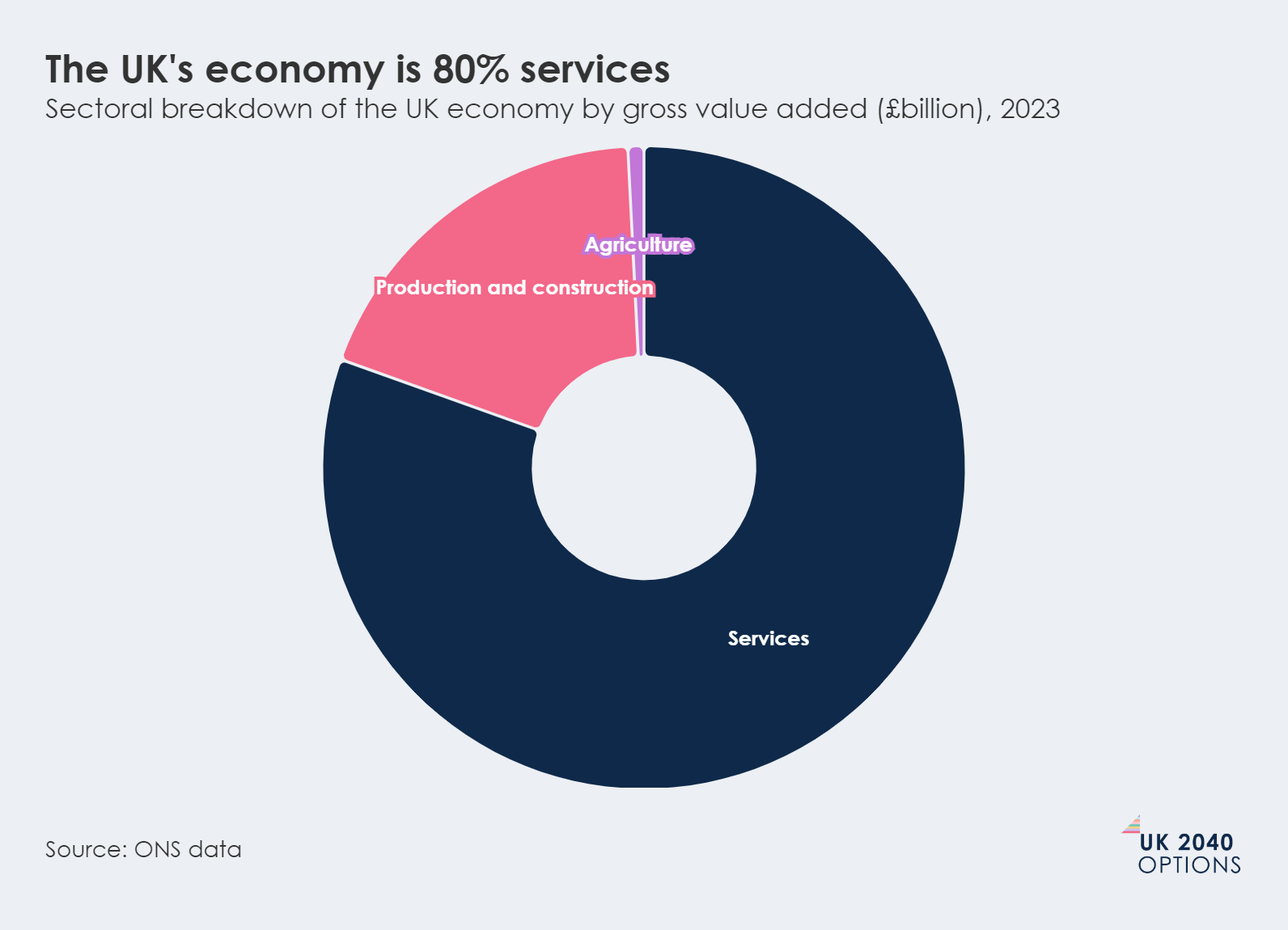
Source: ONS data
All-you-can-eat energy and what it means for costs
Weather-dependent renewable energy generation will increasingly create peaks and troughs of energy supply. Current approaches to fixing this problem rely on managing demand through innovations in energy storage and flexible consumption.
Another approach would be to fix the supply side to mitigate the troughs. By building much greater generative capacity than we need in times of high supply, we could ensure we can always meet our energy demands in periods of low sun and wind. There would also be periods of considerable excess supply, when wind and sun are plentiful.
If renewable infrastructure is located in the right places, its high upfront capital costs are offset by low marginal costs when generation systems are up and running. This causes worry that overcapacity could become an 'economic liability'; fluctuation in demand and supply risks price volatility. At periods of excess supply, excessively low, or even negative, energy prices could harm profits. This may dissuade investors.
Finding productive uses for excess energy – uses that can be turned on and off intermittently to match fluctuating energy supply/demand – is one answer to helping stabilise energy prices by ‘flattening the curve'. Nesta has been asking what adopting an ‘abundance mindset' could look like in practice, and will publish findings in due course.
How
Enabling location-specific lower energy costs: Industrial decarbonisation is highly capital-intensive, and business location decisions are based on many complex factors and long-time horizons spanning over 30 years. There must be clear signals that energy pricing will be structurally lower in the long term in order for locational decisions to be affected.
The Review of Electricity Market Arrangements proposed changes to make wholesale energy prices more location-sensitive by splitting the country into large price zones, like in Italy. A more granular system, called locational marginal pricing (LMP), creates even more location-specific price variance related to proximity to generation points, or 'nodes'. Government could pilot a nodal system by establishing certain areas that are exempt from a retained national pricing system (through business subsidies), targeting areas with high supply of low-cost energy suitable for industrial activity. This could create natural, market-led incentives for energy-intensive industrial activity to locate in certain areas. A large-scale, long-term trial to pilot nodal LMP over a sustained period could bolster the credibility to impact business location decisions.
Additionally, the Government could invest more in spatially-strategic facilitative infrastructure. Increasing the UK's renewable generative capacity will naturally lower prices. While manufacturers often treat short-term subsidies with suspicion, signalling support through longer-term infrastructure investment in the grid and electricity generation ('buying the kit') could be more influential in affecting business location decisions as it increases prospects for lower prices, long term. The Government already does this, but more investment in spatially strategic locations that align with industrial strategy could bring the cost of energy down as supply increases and periods of cheaper energy become more frequent.
Design additional retail pricing support: The above structural interventions should enable a market-driven reduction in electricity prices in certain locations. Drawing on the logic of past policies such as investment zones and freeports, this natural price drop could be bolstered by specific industrial policy interventions to reduce industrial electricity costs further and faster, creating strong signals to global industry that Britain is the place to invest.
There is already precedent for providing energy support this way: for example the previous Government claimed that the British Industry Supercharger programme, which cut network charges and exempted industry from electricity charges, reduced the price of energy for qualifying businesses by £24-£31 per kWh. The Government could influence retail electricity prices by introducing direct subsidies, reliefs from government obligation costs such as levies, or offering location-specific special tariffs via a state-owned energy supplier.
Another option would be for the Government to provide a financial guarantee that per-unit electricity prices would not rise above a certain threshold for a certain proportion of any given year. In other words, this would introduce a form of non-domestic price capping in high-supply locations. Pursuing this approach has the benefit of going with the grain of natural energy pricing, while still providing more certainty to businesses about the costs of electricity. As the energy system matures and supply of cheap, clean electricity becomes more secure, the costs of the guarantee might be expected to reduce over time.
Funding the intervention:
While the Government could shoulder the cost of a retail pricing intervention like a guarantee (as it did for the Energy Bill Relief Scheme) it would be very expensive and fiscally unsustainable. A likely alternative is recouping costs by spreading them between other energy bill payers (the British Industry Supercharger programme is an example of this in practice). One means of doing this is through carbon pricing, via expansion of the UK Emissions Trading Scheme to set a price on the generation of fossil fuels. This will also increase the price of gas and further incentivise industrial electrification by making fuel switching to electric technologies more cost effective, but introduces cost pressures for hard-to-abate industries and probably domestic households, and is likely to be politically difficult to introduce.
Governance:
Robust governance arrangements would be required to manage judgements such as where zones locate, if and how costs are redistributed, and how the policy interacts with wider net zero and economic policymaking. Where responsibilities lie would depend on which version of this policy is pursued. The Department for Energy Security and Net Zero (DESNZ), Ofgem, National Energy System Operator (NESO), energy suppliers and other bodies could plausibly be responsible for different aspects of this policy. For example, the new GB Energy might
have a role to play in building supportive infrastructure, or reform of the wholesale energy market, but would likely not be a suitable home for designing retail-side subsidies. The responsible entity will require appropriate resources and capacity to deliver effectively.
Locating zones:
A methodology for identifying promising zones would need to be determined, working closely with the NESO in alignment with the proposed Strategic Spatial Energy Plan. Zones should be located close to high-capacity renewable generation points that generate (or have strong potential to generate) excess energy. Ideally, zones would also be located close to ports to ensure that exporting businesses have easier access to international markets. Potential areas include parts of Merseyside, Humberside, Teeside, and Scotland.
Required legislation:
This would require new primary legislation. The Energy Act 2008 only allows for limited subsidisation of gas costs, and the circumstances under which electricity costs can be subsidised are even more limited. The Energy Prices Act 2022 might contain relevant powers, but was intended only for short-term support measures, and given the significant scope and complexity of this policy, the Government would likely need to legislate.
Impact and trade-offs
Shaping the sector mix of the economy towards greater production is a strategic industrial policy choice. As explained in our Choices document, production industries like manufacturing can enjoy mechanically higher productivity growth, and there are specific sectoral opportunities the UK could enjoy comparative advantages. It stands to reason that reducing the costs of electricity will ease burdens on industry, particularly energy-intensive industries (excepting hard-to-electrify industries), and increase productivity. But the certainty of lower costs, and the degree of cost-reduction, depends on the design of the policy. A subsidy-based approach gives the Government more control in reducing costs, but is much more expensive and likely not sustainable in the long term. In turn this risks undermining impact – businesses make location decisions based on very long-term planning assumptions due to the considerable capital costs involved; temporary measures are not enough for businesses to develop financial modelling.
By contrast, a market-based approach may have less certainty regarding cost reductions, but is likely to last. Views differ on whether pursuing wholesale electricity market reform will reduce costs. Of course, energy costs are just one factor for firms in choosing where to locate activities – if competing internationally, the Government will need to consider many related aspects of the business environment at both the national level (trade relations and export conditions, taxation, R&D support, etc) and more localised level (availability and flexibility of labour, infrastructure and amenities).
Pricing impacts of locational marginal pricing (LMP)
While LMP would, in theory, allow the market to price energy efficiently (reflecting the cost of delivering electricity to specific locations), the real energy price impacts of moving to LMP are disputed.
Analysis from Octopus suggests that business savings from a shift to zonal pricing could be up to a 65% reduction in wholesale energy costs assuming energy is used as at present, with up to 99% reductions if adopting a more flexible energy usage approach. They also argue that energy would be cheaper across the country (even in zones with lower generation) because costs that are increasing under the current system (like those associated with curtailing supply to better match demand) would be lower.
The counterarguments to this are that there would be significant volatility of prices under LMP, and not all analyses price in such extensive benefits for parts of the country with lower generative capacity.
There are a number of potential energy system trade-offs to account for in pursuing this policy. Removing high-supply nodes from the national pricing system increases costs of energy elsewhere. The current system of single national pricing for wholesale energy means that parts of the country low in generative capacity and reliant on long-range transmission enjoy cheaper energy because of high generation elsewhere.
By removing high-generation points from the national pricing system by exempting certain zones, national prices might rise significantly. Limiting the scheme to certain renewable energy zones rather than reforming the whole system may reduce this impact slightly, but this will also increase dependencies on types of generation that are less subject to weather patterns elsewhere in the country, such as nuclear or fossil fuels. Even by moving to LMP across the board, a market-based LMP system means that while lower costs are enjoyed in areas of high energy supply, costs are raised in places where supply is lower.
Funding this policy in a fiscally sustainable way will create pressures elsewhere in the energy system. Some of the broader questions about how the Government finances the net-zero transition (explored in our Net zero: the choices report) apply here. Spreading the costs of this policy elsewhere in the energy system involves choices and trade-offs on who bears the cost (households or businesses) and which part of the bill the costs are added to (gas, electricity or both).
System disruption impacts investor confidence. Investment in generation capacity across the UK is critical for meeting our net-zero goals. Artificially lowering the price of energy for specific customers in some areas risks making this investment a bad deal for generation businesses, who may prefer to sell into the general wholesale market or even internationally. Even envisaging a nationalised firm in that role (say, GB Energy) in delivering power to these locations, the choice is essentially not to deliver value for money from that vehicle, risking impact to its goal to deliver lower bills overall, as well as even risking illegality. This chimes with broader debates around the role of regulators like Ofgem and the propriety of expanding their remit to ensure the energy system supports the UK's broader economic interests – sometimes touted as the fourth aspect of the energy trilemma.
A valid challenge might be to ask why it's up to the state to intervene to lower energy prices. From a business demand point of view, some of these benefits could be achieved through Power Purchase Agreements, and for the largest firms through a private network. Nesta has asked some of these questions and more in a related piece of work on the role of the state in energy markets.
There could be opportunities too to meet broader policy objectives through the design of this policy. As climate pressures grow, industrial decarbonisation becomes more urgent. By centering electricity price reductions rather than providing general energy support, this creates incentives for businesses to decarbonise, and attracts clean industrial activity to designated locations. Clean, green decarbonised industries have strong growth potential, and clean energy could also give UK businesses competitive advantages on the European market given their Emissions Trading Scheme.
While the growth benefits of supporting the creation of ultra-low-cost energy zones partly lies in competing internationally to encourage industry to set up on British soil, there could also be benefits in providing new economic opportunities for left-behind places and evening out disparities in regional growth. There is some uncertainty about the growth effects that this policy seeks to secure, specifically that location-specific pricing might enable growth in one area, but that would displace growth elsewhere rather than being additional. This is an argument deployed against comparable policy initiatives, like freeports or investment zones.
Cost:
Some variants of the idea effectively mean the Government pays large parts of the energy costs for manufacturing businesses, and all variants will need a significant programme of public infrastructure investment. However, this includes upgrading the grid, which needs to happen under any future energy scenario to enable the Government to meet legally-binding net-zero commitments. In the case of wholesale market reform, there are likely to be transitional costs.
Embrace experimentation by developing a productivity innovation fund to understand the most effective interventions
What
The Government could introduce a large-scale productivity experimentation fund similar to that called for by the Innovation Growth Lab. This pot could be used for five purposes:
- Open up the policy development process.
- Test hypotheses about the drivers of low productivity, and help to define clearer problem statements.
- Horizon-scan for innovative productivity policy or programme ideas internationally.
- Fund a rolling programme of productivity innovation experimentation, testing new ideas and improving the quality of evidence around older concepts and programmes.
- Deliver an ongoing programme of translational work designed to help policymakers and practitioners better navigate existing evidence and implement programmes that are most effective in achieving productivity-related outcomes.
Why
Policy experimentation has been gaining traction in recent years. Around the world, efforts are being made to introduce experimentation and innovation to the policymaking process – from the development of whole-government efforts to instil an experimental culture in Finland, to the widespread emergence of challenge funds and other quasi-experimental innovation policy tools which are increasingly being borrowed from to inform other policy areas.
This trend also holds in the UK. Experimentation is covered in the Magenta Book, which provides central government guidance on public sector policy and programme evaluation, innovations such as Policy Lab advocate for ‘experimental' policy design methods and the Department for Science, Innovation and Technology has established a new Metascience Unit, jointly with UKRI, to experiment with new methods of innovation funding.
Even the new Labour government is flirting with experimentation. Prior to winning the 2024 election, Labour's white paper on mission-driven government emphasised ‘flexibility and innovation' as a key component. While the details of mission-driven government are still unfolding, Nesta and the Institute for Government have flagged experimentation as one of the intellectual influences defining the Government's mission-driven philosophy, as well as a key tool in practical delivery.
There's a strong case to apply a much more experimental approach to testing hypotheses around the drivers of low growth and poor productivity, and trialling potential solutions. Many of the areas related to the 'productivity puzzle' suffer from low-quality evidence.
Taking business support policy as an example: around the world, governments invest significant funds into business productivity support programmes: a 2016 analysis by the Innovation Growth Lab suggested Europe alone spends €152 billion annually on business support. But there's limited evidence on what really works, and particularly how to encourage business leaders to actively pursue productivity and growth improvements. There have been some attempts to rectify this evidence gap in the UK and elsewhere. The What Works Centre for Local Economic Growth, established in 2013, synthesises evidence for policymakers and others on various topics like business advice and access to finance, and it calls for greater use of public experimentation to develop improved evidence on effective economic development interventions. Nesta has also previously collaborated with the University of Manchester to produce a compendium of evidence on the effectiveness of innovation.
The operational design of experimental programmes and funds needs to enable a stepped approach to testing ideas as evidence builds so that ideas and approaches can be iterated. These lessons and more could be combined to inform a new, scaled-up programme of systematic experimentation and trialling to improve the productivity evidence landscape for future policymaking, with a view to introducing the most impactful programmes by 2040. But with a shift to 'mission-driven government', there's also an opportunity to build a culture of experimentation and centre it in the policymaking process.
How
Set-up and capabilities:
This could be delivered as an initiative through any combination of: the Department for Business and Trade, Innovate UK, the new growth-focused institution (see above) and the What Works Centre network. Experimental capability is important within the administering body, but may also be required amongst a wide network of delivery partners for various productivity-related interventions, from jobcentres to business advice providers.
Identifying a small number of specific objectives relating to productivity issues that are high priority for the Government to understand and intervene in would give the fund focus. Once those issues are identified, the fund could play the following roles:
- Testing problem hypotheses: defining a clear problem to test solutions for is necessary. Co-development of the problem statement with stakeholders.
-
Horizon-scanning for innovative solutions: tapping into the expertise across the ecosystem, nationally and internationally, with the aim of crowdsourcing the most promising ideas.
-
Funding a rolling programme of experiments: adopting the 'fail early and learn fast' principle, the primary objective for the fund should be financing delivery organisations to explore interventions to improve productivity. Designing this as a rolling programme could bypass some of the sequencing issues experienced in prior efforts such as the Business Basics Fund. A priority for the body delivering the fund would be the development of a taxonomy of tools and instruments for testing ideas, building on existing third party resources, and working with potential delivery partners to create high-quality experiments.
- Translating evidence to policy: evidence is of no use unless it's understood and used by policymakers. Evaluation should be repositioned as a form of R&D for policy interventions. High levels of transparency would also force up the quality and use of evidence at all stages – designing and delivering experiments, publishing results, and developing policy advice for ministers. In addition, the fund could be part used to resource a rolling informational campaign targeted at the public sector. This could make use of existing tools available for policymakers to understand and assess the quality of evidence behind policy programmes and interventions, for example the Maturity Matrix toolkit developed by the What Works Centre for Local Economic Growth.
Scale and ambition:
The fund should be backed by a large-scale financial commitment from the Treasury; the Innovation Growth Lab proposed a £1 billion fund, albeit envisaged as an EU-wide programme. The same scale of investment is unlikely to be feasible or necessary for the UK alone, but providing sufficient resource could facilitate higher-quality experimentation and, as a result, more reliable evidence. Identifying other countries that face similar productivity challenges and seeking co-investment is one way to scale-up the fund while increasing collaboration in research and evidence development. The Government should also signal long-term commitment to the fund, potentially harnessing the 'mission-driven government' framing to secure longevity.
Experimenting to understand and support SME adoption of Al technology
The rapid developments in Al hold significant potential for boosting UK productivity. While the extent of the impact remains uncertain and debated, we know that successful adoption and diffusion across the economy will be crucial. Historically, the process of tech adoption has been surprisingly slow. As economist Robert Solow once said: “You can see the computer age everywhere but in the productivity statistics".
The spread of large language models (LLMs, a type of Al) has been especially rapid. Research demonstrates the benefits in a range of contexts, such as how consultants handle knowledge-intensive tasks. However, most existing studies focus on specific task-related gains. In practice, users encounter what innovation academic Ethan Mollick calls the “jagged edge”, where Al tools excel in some unexpected areas but perform surprisingly poorly in others. Otis et al (2024) found that when an Al tool was provided to a group of entrepreneurs, the challenge of identifying suitable uses led to an uneven impact on performance.
For policymakers, the challenge associated with new technologies will add to longstanding concerns that SMEs are slow to adopt even proven technologies and management practices. This is due to a complex set of barriers that can occur within individual businesses, the markets into which they buy and sell, and overarching factors such as regulation and infrastructure.There has been substantial investment in programmes to support SMEs to adopt new technologies and management practices. However, we have relatively limited information on how effective these investments have been or how they are best delivered.
An experimentation fund could enable proper testing of when and how Al tools can be beneficial to productivity, the barriers to Al specifically (building on existing understanding of broader barriers to tech adoption) and the positive and negative consequences of different approaches to adoption.
Impact and trade-offs
By investing more in and normalising policy experimentation at a range of scales, the hope would be that, in the medium to longer term, teams across the public sector embrace a culture of experimentation and openness to innovation, much like Finland has aimed for. This partly relates to the risk appetite teams have for problem-solving, which can be somewhat reduced by diversification and the right-sizing of experiments to the level of evidence behind any given idea. A sufficiently resourced fund also creates an effective incentive for innovative policy ideas to surface.
There are a number of trade-offs to consider in design of the experimentation fund.
- Broad or narrow scope: A broad range risks spreading too thin, making it hard to compare effectiveness and collate policy lessons. Alternatively, targeting a narrow range of policy issues could enable the development of a more detailed understanding of these specific areas, but risks lower interest and a smaller set of public and private sector teams and organisations to draw from. If taking a narrower scope, the Government could focus on two or three particularly challenging problems where the feasibility of government intervention is high, and may benefit from focusing attention on areas that the Government is already intervening in but the cost:benefit ratio is low or poorly understood.
-
Novel ideas or established thinking: There can be a tension between the aim of bringing forward very novel policy solutions and seeking to quickly deliver robust evidence on the causal impacts of interventions. Prior to setting up a large-scale field experiment that provides reliable causal evidence of impact, it is important to ensure first that the intervention is feasible and can be delivered as planned. Otherwise, any trials may only show that the intervention was pushed forward too soon and is not yet capable of being delivered in a way that could hope to generate the expected impacts. Yet focusing only on ‘proven' interventions risks excluding truly fresh ideas, which take longer to be ready for large-scale testing (hence the importance of staging funding over different time horizons depending on the type of project).
-
Evidential rigour or practical applicability: Developing experiments to the highest academic standards will deliver the strongest evidence, but has to be traded off with longer timescales and higher costs per experiment. Shifting the balance to research excellence can also create distance between how an intervention must be delivered to benefit the research and how it would be applied in practice by practitioners. For example, academic researchers may want to retain complete consistency during delivery to provide clarity of what has caused the observed outcomes and how. In contrast, policymakers may prefer having greater flexibility to adjust support within broader parameters, at the cost of losing such precise insights about what worked.
Cost:
When the Business Basics programme kicked off in 2018, then-CEO of Nesta, Geoff Mulgan, stated: “With this move, the UK is taking a lead in applying experimental methods to boosting productivity – much the best way of ensuring that in the long run public money goes on programmes that really do work." The crucial phrase is "in the long run" experimenting now would have high programme costs to resource effectively, particularly if implementing at the recommended scale.
However, it's critical not to overlook the 'spend to save' principle as better-evidenced interventions in the long run should increase the success rate for future programme spend supporting productivity, and deliver better value for money over time.
Conclusion
Each idea profiled here, and many more beyond, could have tangible impacts on the extent to which we as a nation can prosper: from the incentives that shape the decisions made by our national and sub-national institutions, to the vagaries of UK planning and development machinery, to the support government offers to the individual people and firms whose fortunes collectively shape our nation. We've prioritised examining ideas for fixing the problems the UK needs to resolve at home, but our Delphi exercise strongly emphasised the UK needs to be outward-facing, and tap into global opportunities and markets for longer-term prosperity.
The ideas we have explored range from profound overhauls to changes implementable broadly within the systems that operate now. None of them, however, are quick fixes. Neither are they an exhaustive strategy for addressing ailing UK productivity and growth. Each idea should be considered in the context of the broader suite of policy changes required to retune our economy for the better.
But we can choose to see this as an opportunity, recognising too that when government policy fixes one market, economic activity refracts more effectively through others too. For example, fixing the labour market gives businesses access to more skills and labour, tighter competition encourages higher performance that drives higher productivity, while higher employment increases consumption, in turn boosting consumer markets. This interlocution has worked against the UK in recent years, but by taking a long-term, strategic approach and embracing new ideas, politicians between now and 2040 have the chance to flip the script and drive broad-based growth.
Acknowledgements
Many thanks to the following individuals who offered their time and expertise in developing the ideas in this report.
We thank Professor David Halpern for his contribution to this work and Lord Gus O'Donnell for sponsoring the UK 2040 Options project, and the following for their time and insight on these ideas: Dame Kate Barker, Adam Bell (Stonehaven), Emily Beynon (Octopus Energy), Dame Carol Black, Anthony Breach (Centre for Cities), Emma Burns (Octopus Energy), Dr Adam Coutts (University of Cambridge), Dr Tony Curzon-Price, Sam Dumitriu (Britain Remade), Dr William Fleming (University of Oxford Wellbeing Research Centre), Ben Franklin (Centre for Progressive Policy), Professor Ricardo Hausmann (Harvard Growth Lab), Professor Christian Hilber (London School of Economics), Professor Ashwin Kumar (Institute for Public Policy Research), Professor Philip McCann (University of Manchester), Tracey Mattinson, Professor John Muellbauer (University of Oxford), Louise Murphy (Resolution Foundation), Joe Owen (Institute for Government), James Phipps (Innovation Growth Lab), Diane Pochard (Centre for Science and Policy, University of Cambridge), Andy Regan (Nesta), Lord David Sainsbury, Will Somerville (Migration Policy Institute), Anna Stansbury (MIT Sloan), Dr Madeleine Sumption (Migration Policy Observatory), Dr Gemma Tetlow (Institute for Government), Anna Valero, Professor John van Reenen (London School of Economics), Giles Wilkes (Institute for Government), Tony Wilson (Institute for Employment Studies). Please note that not all contributors will agree with all the ideas in this report.
UK 2040 OPTIONS
UK Options 2040 supports policymakers as they make choices about what to prioritise and how to deliver: setting out alternative policy options and pathways for the future, creating space for honest debate about the trade-offs and testing and interrogating ideas that take us beyond immediate crises.
58 Victoria Embankment
London EC4Y ODS
+44 (0)20 7438 2500
[email protected]
@nesta_uk
www.nesta.org.uk
nesta
THE
BEHAVIOURAL
INSIGHTS
TEAM

Nesta is a registered charity in England and Wales with company number 7706036 and charity number 1144091. Registered as a charity in Scotland number SCO42833. Registered office: 58 Victoria Embankment, London EC4Y ODS.