## Economic growth and the productivity puzzle: the choices
We've rounded up the essential facts and spoken to economic experts to assess the state of play and choices for a future government
*Ben Szreter* and *Alexandra Burns*
Economic growth and the productivity that underlies it remain squarely at the centre of the policy debate. From Labour's mission for the UK to secure the highest sustained growth in the G7 to Sunak's pledge to get the economy growing, it is an issue of central importance across the mainstream British political spectrum.
The options available to the government – and in fact to individuals and families – between now and 2040 are dependent in no small part on achieving sustained growth.
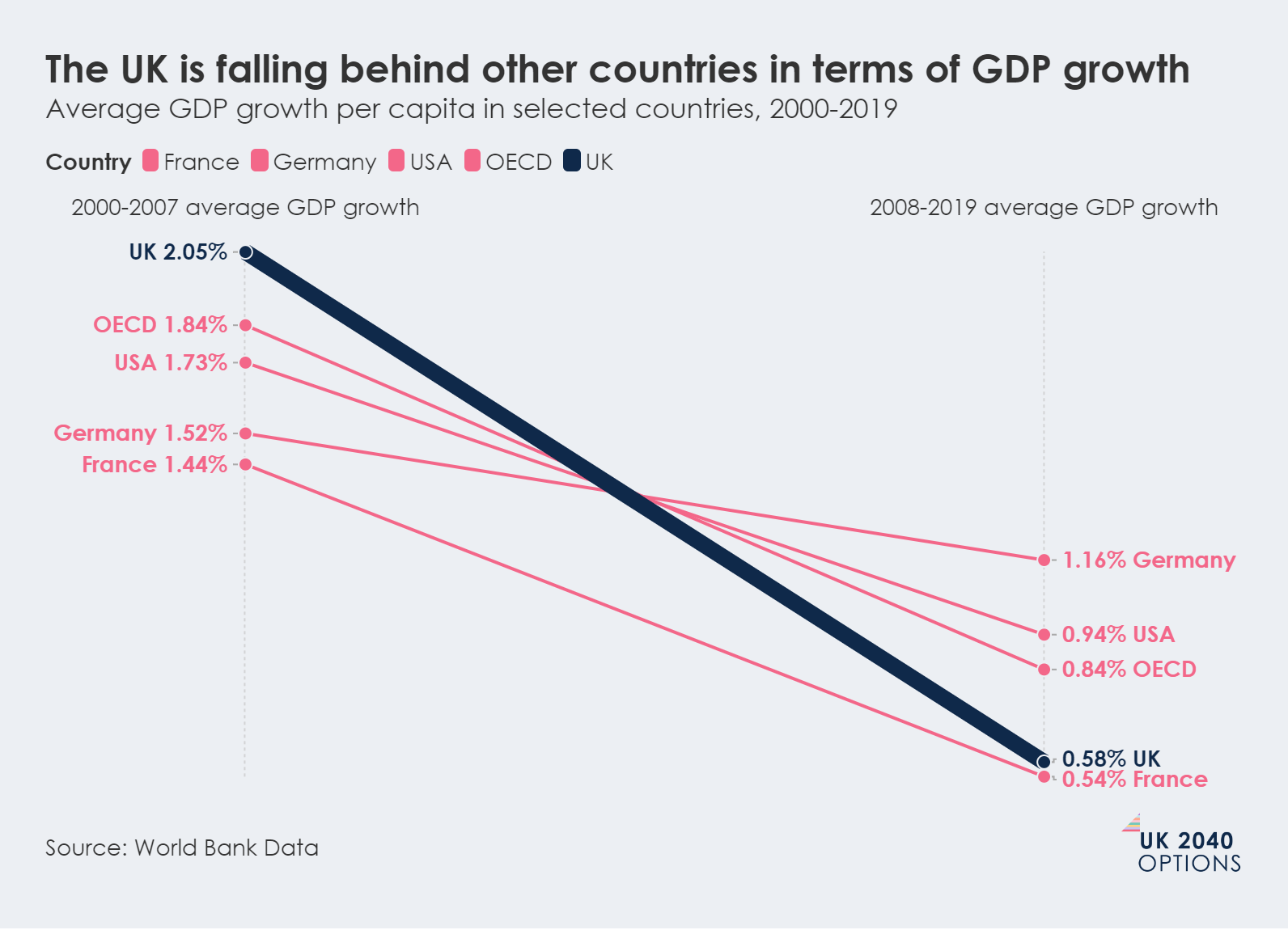
Right now the situation looks bleak, both in absolute and relative terms. GDP (gross domestic product) per capita is flatlining, and the UK's performance over time compared with comparator countries is falling.
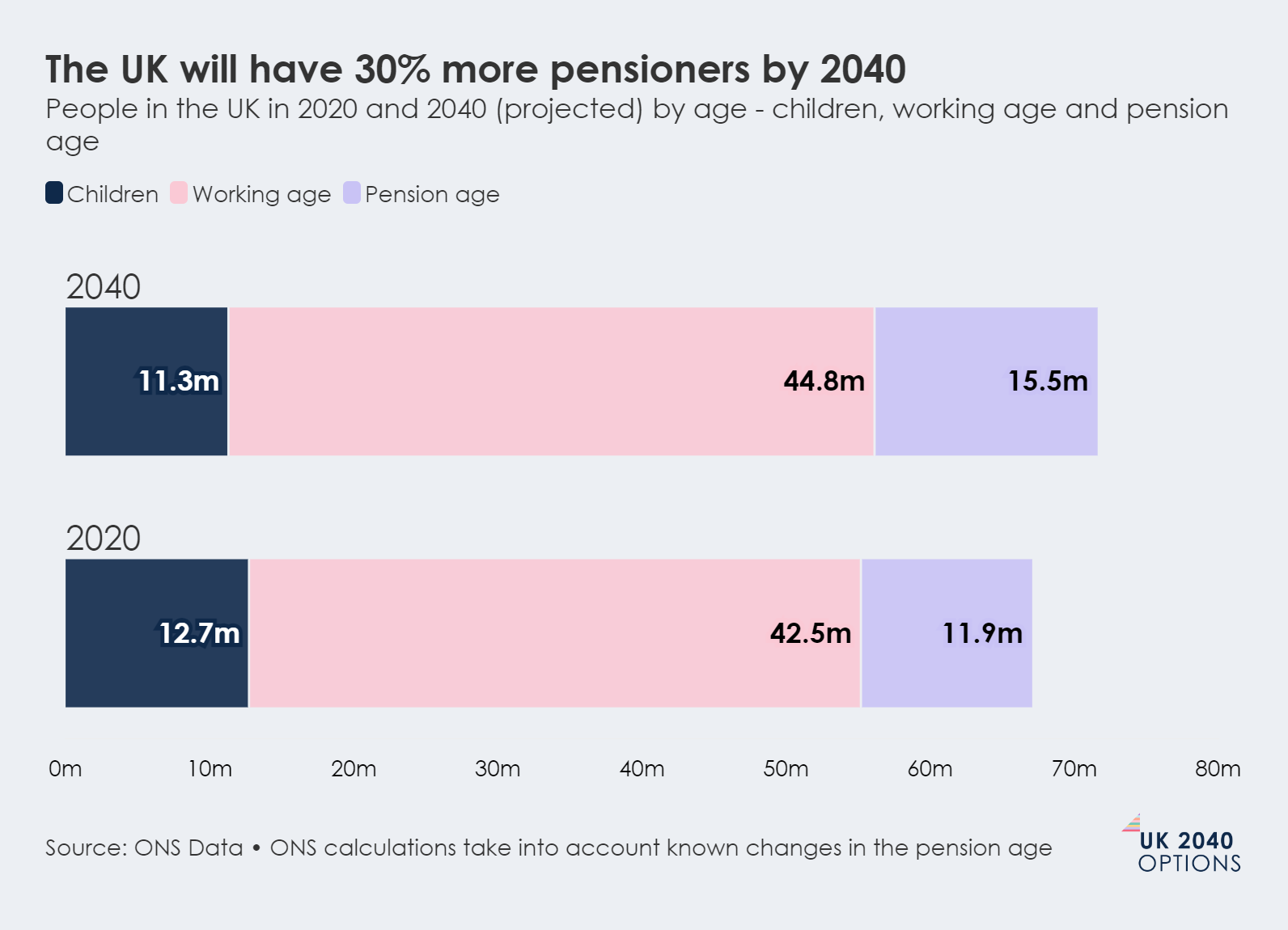
Looking ahead, the demographic trends don't make for easy reading for economists either. By 2040, the UK's labour force will be around 44.8 million: 5.6% larger than it is now, [according to projections from the ONS](https://www.ons.gov.uk/). Putting this into sharp relief, though, is the number of people of pension age, which will rise by 30% to 15.5 million.
If the UK is to achieve continued improvement in the standard of living by 2040 – whether that relates to the homes people live in, the hospitals they are treated in when they're sick or the holidays families can afford to go on – economic growth will be key.
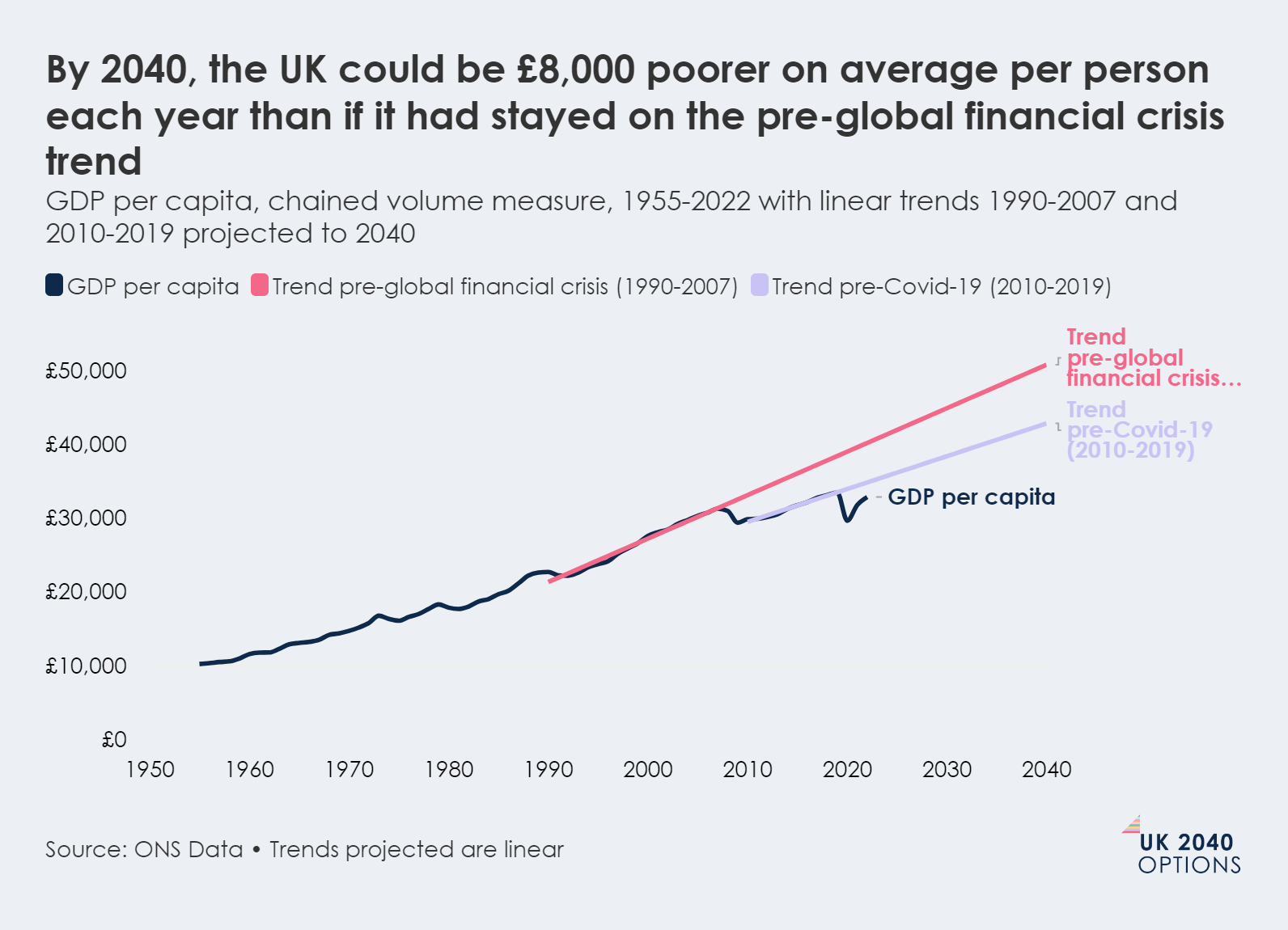
Before the global financial crisis (GFC), the UK was on track for a GDP per capita figure of £50,800 by 2040. But even if we were able to return to 2010-19 growth rates - which is by no means guaranteed – following Covid-19, the average person could now be £8,000 poorer each year than they would otherwise have been.
The government is faced with a complex and highly challenging picture, and there is no shortage of debate about what matters and how to address it. In an attempt to systematically sort the signals from the noise, we've done three things: taken a cold, hard look at the most [fundamental facts](https://www.nesta.org.uk/blog/economic-growth-and-productivity-puzzle-fundamentals/); run an exercise using the Delphi technique, with a range of expert and emerging economists to gauge the range of opinion and see where there is convergence in views (what are the no-brainers?); before gathering an expert workshop of 11 leading thinkers, chaired by Andy Haldane, former Chief Economist at the Bank of England, to chew over the big questions.
What did we learn about growth and the productivity puzzle from taking this approach?
## 1. There's no shortage of ideas, and there's relative consensus about the main problems and potential solutions {: #section-1 }
The Delphi exercise indicated a high level of consensus among economists that business investment, trade, infrastructure and housing are top problem areas to be tackled. In their collective opinion, issues such as the impact of regional inequality, population health as well as skills and the education system were important, but ranked slightly lower.
This wasn't just an exercise in problem definition, though. The economists involved contributed 116 unique ideas for impactful interventions the government could make to boost growth. The group collectively ranked rejoining the single market, improving transport and planning reform as most impactful, but the long list included ideas such as a land value tax, devolved skills policy and making full expensing for business investment permanent allowing investment to be tax-deductible.
Considering the Delphi exercise, participants at our workshop reflected that many of the interventions have been identified and agreed upon repeatedly and over multiple governments. A more pertinent question may be: why is policy design and implementation failing, and how can we get the transmission of ideas to reality right?
Top issues and interventions from the Delphi exercise
The most important issues:
1. Poor business investment
2. Impacts of Brexit and wider barriers to trade
3. Poor transport infrastructure
4. Insufficient housing supply
5. Underinvestment in public services and infrastructure
The most important interventions:
1. Rejoining the European single market
2. Improving local/regional transport
3. Planning reform
4. Rejoining the EU
5. A large, sustained increase in the public transport budget for major cities
6. Improving trade deal with the EU
7. Higher and more stable public investment
8. Massive investment in green transport infrastructure in the UK's second tier of cities
9. Public investment
10. Setting up bodies that can override planning constraints eg, development corporations
## 2. Infrastructure rules, and planning policy presents choices {: #section-2 }
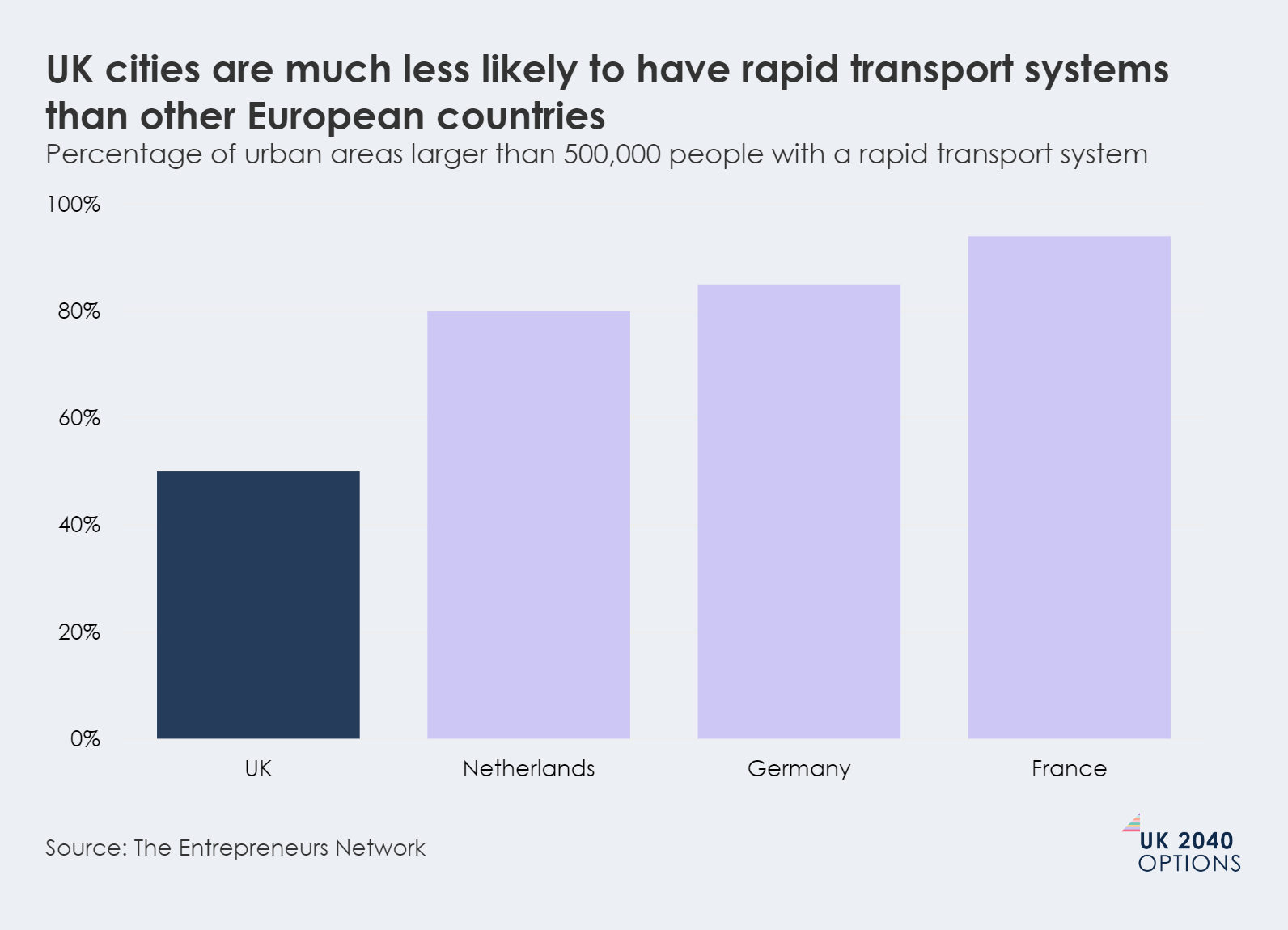
Infrastructure – from transport to housing – crops up again and again as a constraint on growth. The economists in our group highlighted the unfortunate combination of low-density urban areas with poor transport as “double doom”. For example, large cities in the UK are much less likely to have rapid transit systems than European counterparts.
One choice for the next government might be whether to go big on intra-city transport (one idea discussed was flipping the focus of central transport budgets to have a much higher proportion on local transport), or on building bold, ambitious and sustainable new settlements that go wider than just core cities. Here, perhaps unsurprisingly, the preference of our economists was: both.
Across both of these problems, it seems that effective engagement with local communities and smart incentives for development are lacking. Ideas surfaced here worth further exploration include: for local property tax to be properly retained as an incentive for local communities to accept new developments near them; using new, deliberative methods of public engagement on renewable energy infrastructure; and properly facilitating cooperation between close areas to try to ensure that benefits of planning decisions can be felt in the area that feels the “cost”, given at present they are often felt over a more diffuse area.
Considering the path to 2040, there may also be value in politicians taking inspiration from a more engineering-focused approach when it comes to long-term infrastructure. This would mean being clear about the goal and the minimum viable product, and leaving more flexibility than the government typically does for adaptations as technology develops. Imagine a transport system that could make best use of autonomous vehicles, or settlement plans that can evolve and be shaped by developments in sustainability or citizen engagement.
Overall, there appears to be consensus that the planning system needs reform, but there is much less agreement on what the right answer is. Here lies another of the big choices the future government will have when it comes to economic growth: how should it reform planning and how directive should it be on regional developments?
## 3. Levelling up is here to stay but devolution can be a double-edged sword {: #section-3 }
In the UK, there are higher regional economic imbalances than in many other comparable countries and this has worsened over the last 45 years.
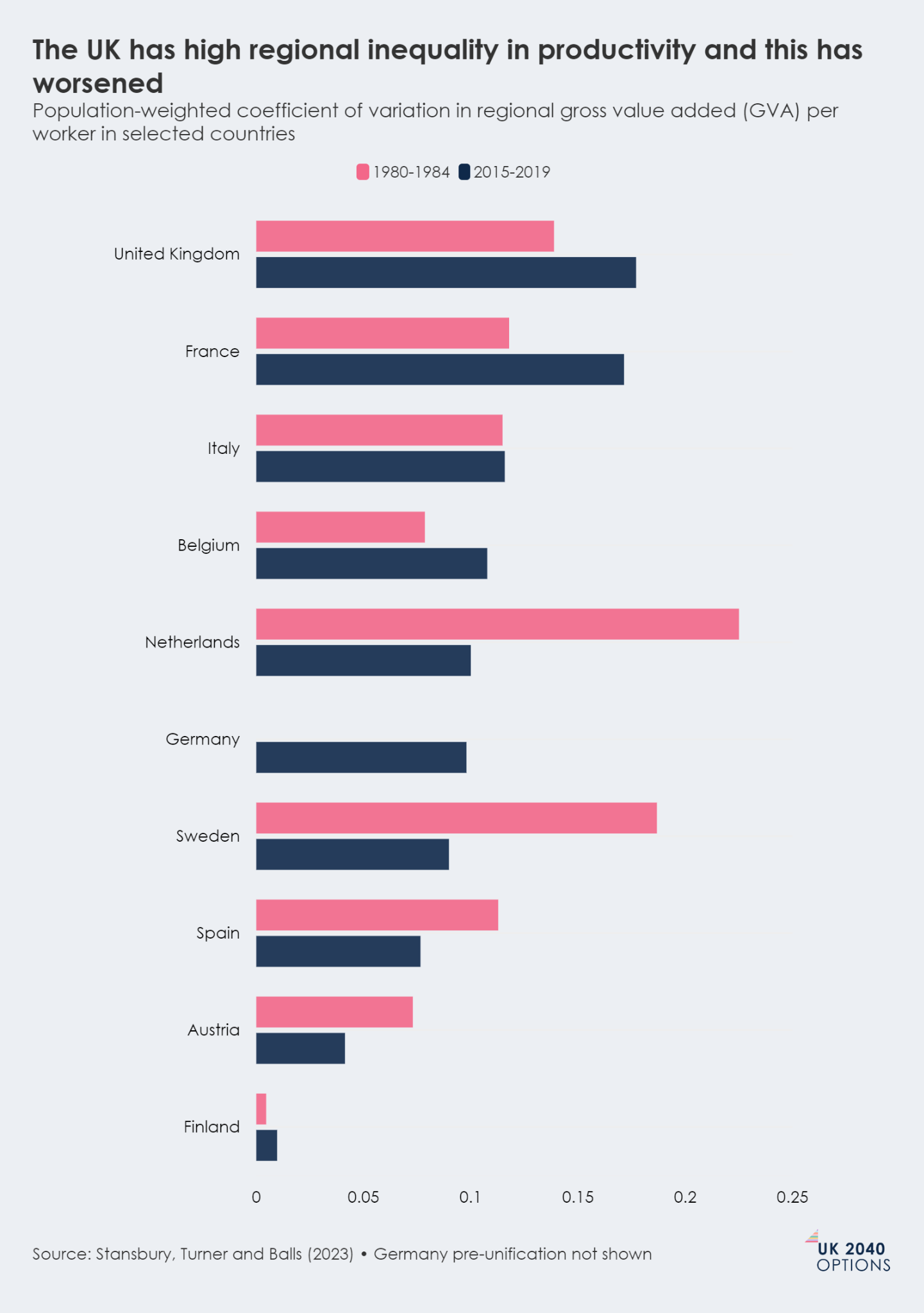
While regional inequality was mid-ranking in our expert consensus on issues to address, the infrastructure issues identified are clearly local in nature, and our economists agreed that there is a clear prize to be won by lessening the regional productivity gap.
In particular, Britain's second tier of cities by size (ie, those smaller than London) aren't generating the productivity and economic growth that other countries are able to produce from similar size cities. Cities as natural units of economic agglomeration have not fully flourished in the UK.
The choices for government to wrestle with here are focused on what the right level and type of devolution is. What kinds of power should be devolved? To what level? Accompanied by what funding or level of fiscal devolution?
Our economists emphasised the need to be more trusting of local areas to create and build expertise and make decisions, with greater capacity built in at the regional level: for example, by backing combined authorities. A new model of public engagement is also needed to win the argument for local development that is for the benefit of all, such as onshore wind.
But the delegation of decision-making clearly can't be an answer on its own, and we heard a view that devolution can be a double-edged sword. For example, when it comes to planning, we have a highly devolved system by international standards, and yet there is consensus that it doesn't deliver the right outcomes. Devolving power for some responsibilities in isolation of a wider model that works won't solve the problems.
Government will need to decide what combination of central versus local planning can facilitate better growth, bearing in mind that while national politics can drive the wrong outcomes in a system that is too centralised (a focus on announceable and media-friendly infrastructure), local politics can hinder progress in a more devolved system (everyone needing to have a slice of the pie), too.
## 4. Investment is a big problem but it isn't just an input to fix {: #section-4 }
Lifting our heads from the local and regional to the national and international, poor business investment came out as the leading problem. Looking at the data, it's easy to see why. The chart below shows the UK's investment per year as a percentage of GDP, compared to Germany and the USA. While the gap initially looks relatively small, as a percentage of GDP it is around three percentage points. This is equal to more than £100 billion per year less investment in the UK – a huge investment gap and almost equivalent to the UK's annual expenditure on education and defence combined.
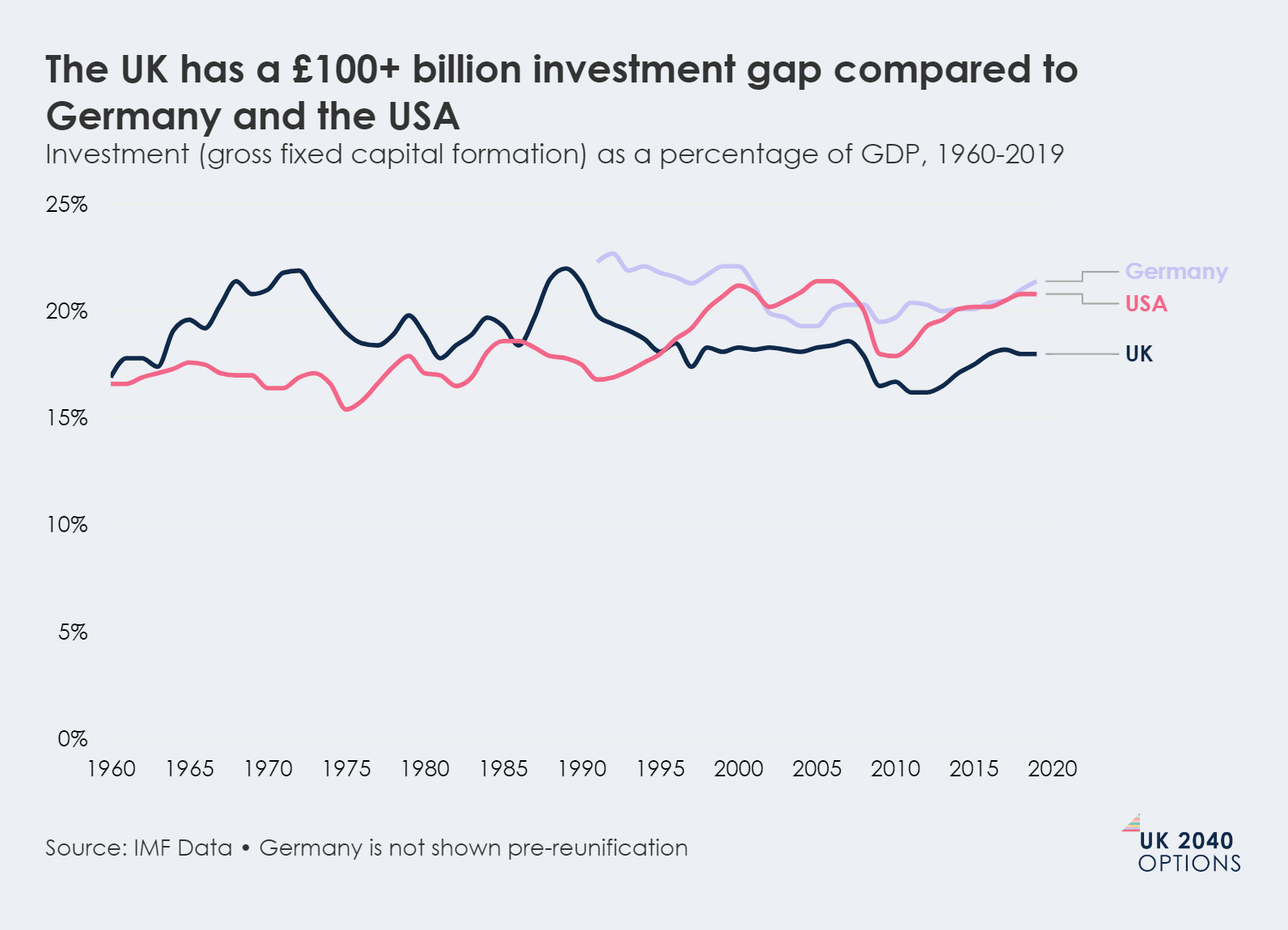
While investment is partially a direct spending choice for government, public investment was only a fifth of the size of private investment in the UK in 2019 – so creating the environment to encourage the latter will be key. As one economist described to us: “Investment is an outcome – if we get our policy right, then investment is the reward." Another noted that "real investment is a hard business" – it typically requires thinking in longer time horizons than political cycles and perceived policy stability can be important to potential investors, who want to be sure about the rules of the game before they agree to play.
Large-scale investment will also be required to achieve net zero, both public and private. Both the amount and the nature of the investment matters, and there will be a need for a strategic approach to green industrial policy in light of the actions the US and EU are taking.
One choice for the government after the election will be the balance it seeks to achieve between domestic and overseas investment. Geopolitical developments in recent years have thrown this into sharper context, with control over supply chains raising the importance of domestic investment.
## 5. The institutional environment may be hindering growth {: #section-5 }
Policy certainty and the institutional architecture in the UK are related issues that the economists we consulted think have the potential to play a big role. As one put it, potential investors are “maddened by uncertainty" and the UK doesn't have effective institutions that can provide a reasonable degree of certainty and regulatory consistency. And looking to 2040, we know that developments in low carbon technology or AI will provide both disruptions and opportunities for different firms and workers. How can the UK remain nimble and take advantage of those opportunities while managing disruptions effectively? One choice for government will be to decide whose job it is to anticipate and understand the implications and thread that through to the set of decisions that inform economic policy and strategy.
Similarly, how can we alter the system that government and businesses are operating in to properly enable a long term view on, for example, infrastructure investment decisions, in order to make better informed decisions about the trade offs between short and long term cost and benefit, and between economic, societal and security needs? When we look back from 2040 on, for example, net zero, what investment decisions in which parts of the system need to be taken now to have long term positive consequences for growth?
One idea about institutional design was to create an independent institution with responsibility for monitoring growth plans, in the mould of the Climate Change Committee. Another suggestion was to create development corporation-style organisations that could override planning constraints where appropriate.
## 6. Don't forget the people at the centre of the economy {: #section-6 }
Issues of culture and behaviour are often quoted in discussion about the economy, but can feel less tractable. Our economists discussed some of the practical differences that could be feeding into cultural differences between our businesses and those in other countries.
For example, the UK stands out when it comes to firm ownership and governance. On the one hand, [the UK has the lowest share in the OECD](https://www.oecd.org/corporate/OECD-Guidelines-Corporate-Governance-Key-Recommendations.pdf) of blockholder shareholders big enough and engaged enough to affect firm decisions on their own. On the other hand, it is relatively unusual for UK firms to have worker representation on boards, which evidence shows can lead to improved investment and performance. This exceptionalism means that management in our large businesses arguably have less pressure from both above and below. One point potentially worth further exploration is the view that senior management themselves also appear to have different qualifications than those in the USA (with relatively more CEOs acquiring MBAs in the US compared with the UK) which could be a factor underlying a different appetite for risk when it comes to investment and scale.
Similarly, our workshop discussed the possibility of looking more closely at the decisions individuals are making and why – where to live, what job to go for, what to study and what to buy. Using behavioural science to study these decisions that ultimately drive our economic inputs and outputs, and whether policy has the ability to influence them, could shed new light on an approach to shifting culture towards the UK's growth objectives.
## Conclusion: glimmers of hope
No-one can be in any doubt that there are significant problems to address in the UK economy. But there are glimmers of hope to be found.
As some of our [fundamentals document](https://www.nesta.org.uk/blog/economic-growth-and-productivity-puzzle-fundamentals/) illustrates, when compared internationally, the UK too often ends up being on the wrong end of extremes: from the regional productivity gap to intra-city transport to built up land per capita. This isn't a good status quo, but it does mean that even just shifting our economy closer to the average of our international counterparts could enable big gains – we don't have to do something no-one else is doing.
And we have strengths. In particular, the expert economists we met with mentioned strong links between universities and industry, the life sciences sector, clean technologies and world-leading services exports. A final choice for government to consider will be the extent to which we double down on our strengths or focus on improving productivity in broad-based bulk employers such as retail and distribution, given that these sectors have a bigger impact on our aggregate productivity. An effective ambitious industrial strategy would need to involve strategic decision-making about the areas and sectors in which we should invest not only money, but also time and energy.
The UK 2040 Options project will be taking some of these choices forward to consider policy options in more depth, before testing and interrogating them. For now, we'll conclude on the optimistic note struck by one of our economists:
<blockquote markdown="1">"The UK does have underlying strengths...we just need to work towards realising those strengths."</blockquote>
## Workshop participants
We sincerely thank our workshop participants for their time and contributions. Please note that not all participants will have agreed with all of the discussion points above.
* Andy Haldane, RSA [Chair]
* Andy Westwood, The Productivity Institute
* Anna Valero, LSE
* David Halpern, The Behavioural Insights Team
* Chris Pook, The Nuclear Advanced Manufacturing Research Centre
* Emily Fry, Resolution Foundation
* Gemma Tetlow, Institute For Government
* Giles Wilkes, Flint Global and Institute for Government
* Joanna Key, The Treasury
* Ravi Gurumurthy, Nesta
* Shreya Nanda, The Social Market Foundation
### Additional participants in the Delphi exercise
* Anthony Breach, Centre for Cities
* Aveek Bhattacharya, Social Market Foundation
* Dan Mawson, Department for Business and Trade
* Diane Coyle, University of Cambridge
* Jakob Schneebacher, Competition and Markets Authority
* Lord Jim O'Neill, Honorary Chair of Economics at Manchester University
* John Asthana Gibson, Social Market Foundation
* John Springford, Centre for European Reform
* Josh Martin, Bank of England
* Dame Kate Barker, Productivity Institute
* Kitty Ussher, Institute of Directors
* Liz Ditchburn, Honorary Professor, University of Glasgow
* Mike Brewer, Resolution Foundation
* Nida Broughton, The Behavioural Insights Team
* Sam Bowman, Works in Progress
* Sam Dumitriu, Britain Remade
* Tera Allas, McKinsey
## Annex 1: Economic growth and productivity: the fundamentals {: #annex-1 }
## Annex 2: Delphi detail and workshop attendees {: #annex-2 }
### What is a Delphi exercise and how have we run them?
Delphi exercises allow us to get collective deliberation from a group of people - in this case it is the most important issues and impactful interventions in growth and productivity in the UK.
A Delphi exercise involves asking for expert input or opinion, feeding back what other respondents said, and then allowing respondents to revise their judgements or opinions.
Opinions are kept anonymous throughout.
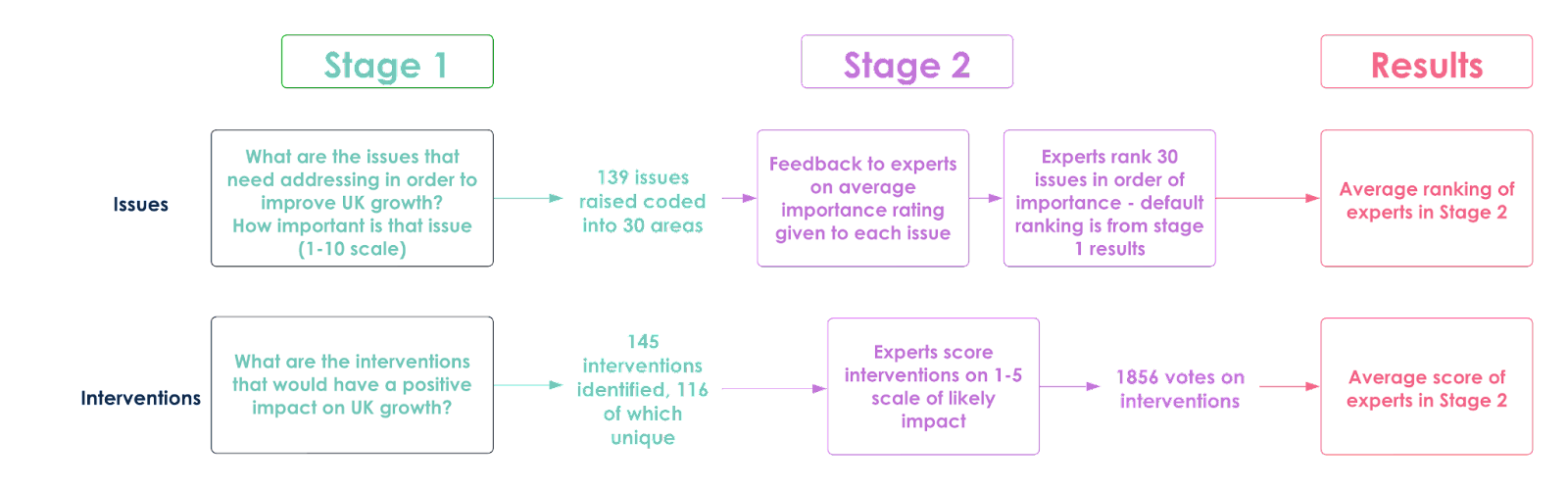
For this roundtable, our Delphi exercise included two rounds. In round 1, we asked respondents about the issues and interventions that could impact growth and productivity in the UK, and asked how important each of them are. In round 2, we fed these issues and interventions back to the respondents alongside their average importance score before asking the panel for their final judgement.
Our final results are the average scores given by experts in round 2.
This process can be seen in the below diagram.
<div class="diagram-description" markdown="1">
</div>
The appendix below includes the full list of questions asked in the Delphi exercise.
For more on the Delphi method, see [information from Rand](https://www.rand.org/pubs/reports/R01374.html) and [the British Medical Journal](https://pmc.ncbi.nlm.nih.gov/articles/PMC1124237/).
### Delphi questions asked
#### Round 1
1. What are the issues that need addressing in order to improve UK growth? (free text box)
2. How important are each of these issues that you identified for the future government to address in order to improve growth in the UK? (1-10 scale)
3. What are the interventions that would have a positive impact on UK growth? (free text box)
4. Of these interventions that you identified to improve growth, how impactful do you think they could be? (1-10 scale)
#### Round 2
1. Taking into account both your thoughts as well as the average ranking of other experts, please rank the importance of the issues that have been identified below that need addressing in order to improve UK growth. (Ranking)
2. Please rank the likely impact you think each of these inventions could have on growth and productivity in the UK (1-5 scale)
## Annex 3: Full list of interventions provided by respondents to the Delphi exercise {: #annex-3 }
1. Rejoining the European single market
2. Improving local/regional transport
3. Planning reform
4. Rejoining the EU
5. A large, sustained increase in the public transport budget for major cities
6. Improving trade deal with the EU
7. Higher and more stable public investment
8. Massive investment in green transport infrastructure in the UK's second tier of cities
9. Public investment
10. Setting up bodies that can override planning constraints eg, development corporations
11. Incentivise business investment
12. Deregulate the planning system and switch to a zonal, rules-based one (rather than case-by-case decision model)
13. Improving institutions around growth policy
14. Invest more in energy infrastructure
15. Tax incentives and policy stability for business investment
16. Devolve more infrastructure investment funding and powers (eg, intracity transport) to Combined Authorities/Metro Mayors
17. Permitted development rights for a wider range of clean energy projects
18. Allowing development on Green Belt land near train stations
19. Policy consistency
20. Broadening full expensing and making it permanent
21. Invest more in building homes and the infrastructure around them
22. Stability in corporate tax system with strong incentives for investment
23. Some kind of locally devolved property tax on land value uplifts
24. Aggressive, consistent net zero policies
25. Better funded technical education/institutions
26. Commit to bipartisan, long term industrial strategy
27. New trade deals (rejoining the EU would be more effective but not realistic)
28. Increasing the supply of lab space and commercial property
29. Climate proof and future proof infrastructure investment, correcting historic underinvestment
30. Increased supply of childcare, and subsidies for working parents
31. Extending full expensing to longlived assets and buildings
32. Invest in adult education
33. Accelerating delivery of net zero and IRA response
34. Improved incentives for work based training
35. A land value tax
36. Active labour market policies to help economically inactive
37. Consistent tax policy on investment,
38. Devolution of economic policy to local authority level (largescale, sustained experiment)
39. migration policy reform
40. IT infrastructure investment
41. Lowering the amount of money raised in local taxes sent to central pot
42. Bigger, wider devolution.
43. Consistent and devolved skills policy
44. Improving lifelong learning opportunities
45. Increased funding and availability of technical education
46. Large expansion in quantity of qualified STEM teachers at all school levels
47. Allowing specialist labs to be built quicker/
48. Make the labour market as flexible as possible so that people can move between jobs more easily without fearing loss of earnings or benefits
49. Significant investment in social housing
50. Develop nationwide spatial strategy
51. Do more countercyclical fiscal spending
52. Focus more education and skills resources on schools and colleges with poorer intakes
53. Offer further, targeted tax incentives to incentivise business investment in automation and training
54. Review business investment incentives to better match the fact they investments are lumpy and have different approaches for large versus small firms
55. Streamline existing range of central government funding pots and recycle the money into local government budgets
56. Noneconomy policies to reduce inactivity such as investment in better healthcare, social care and childcare
57. Raise taxes on property and land and make them more progressive
58. Addressing inequalities in access to good quality education and opportunities
59. Early years intervention targeting children at risk of exclusion
60. Placed based education initiatives
61. Support for line manager skills and management practices through funded basic training
62. Credible regulation that derisks investment
63. Less risk aversion in government intervention,
64. Reforming Environmental Assessments to be less admin-intensive
65. Street votes and similar mechanisms for housing supply
66. Shifting taxation from capital to consumption
67. Design taxes and regulations that distinguish between productive and unproductive economic activity
68. A more assertive use of R&D funding in area of UK comparative advantage, incl. Innovation Strategy's 'tech families'
69. Reform our fiscal rules (lengthen the time horizon and lower the threshold for evidence)
70. A true Global Britain strategy
71. Provide support for start ups and scale ups
72. Reduce policy complexity of R&D tax incentives, explore more direct funding (e.g., R&D grants, guarantees, public private VC
73. Big FDI deals with world's top 100 businesses from all geographies
74. Reform of tax system rebalancing focus from income towards wealth
75. Electoral reform to diminish abrupt switches of political mood,
76. Improving the allocation of skills diversity and inclusion
77. A new approach to fiscal policy
78. Broading the VAT base
79. Business-related skills training for everyone at school/uni (basic project and team management, comms, etc)
80. Largescale, sustained campaign to improve leadership skills (10 years, similar to antismoke campaigns but positive)
81. Provide targeted sectoral support with greater certainty and longevity, understanding what each sector / subsector needs and tailoring support accordingly
82. Well paid civil servants, in return for making it easier to reflect talent in hire and fire,
83. A higher pupil premium and possibly salaries for teaching in schools with poorer intakes
84. Community Land Auctions
85. Embrace hybrid working
86. Upscale help to growth (management) type offers
87. More transparency and open deliberation in HMT tax decisions,
88. Fund social care properly, phase in a levy
89. Pensions reforms
90. Review public sector agility and devolve decisions
91. Expand Be the business
92. Overhauled university courses for computer science to make much more business relevant
93. Proper office for investment with staffing to concierge top 200 investment projects,
94. Every uni/business school required to upskill X thousand business leaders per year
95. Create a proper social safety net that allows people to take time out to start their own businesses, innovate, look for a better job etc
96. HE and FE to explicitly teach workplace skills (at the expense of knowledge)
97. Reform Civil Service recruitment
98. Tax breaks, advertised through accountants, to implement business best practice
99. Market transparency (deshrouding)
100. Allowing private companies to use NHS data for research
101. Fiscal discipline
102. Improve Civil Service pay
103. Trust building (see also deshrouding)
104. Ditching the ALARA principle in nuclear regulation [ALARA = as low as reasonably achievable exposure to radiation]
105. Create a right to housing that is affordable and within a reasonable distance of one's workplace/other ties
106. Build more universities
107. Draw on US angel investors
108. More/better competition in provision of software services for businesses
109. Reducing / scrapping childcare ratios & other childcare regs
110. Welfare system reform and testing of eg UBI ideas to incentivise skills acquisition and entrepreneurship
111. Raise rates of capital gains tax
112. Intermediate market / firm investment
113. Consider reducing income tax allowances, introducing a middle rate of income tax and an increase in the upper rate
114. Lowering the headline rate of corporation tax
115. Abolishing prohibitions on abuse of dominance in competition law
116. A more laissez faire approach to antitrust (especially abuse of dominance) and SEPs (standard essential patents)


