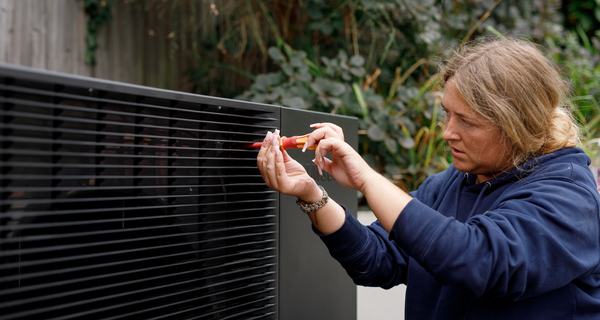
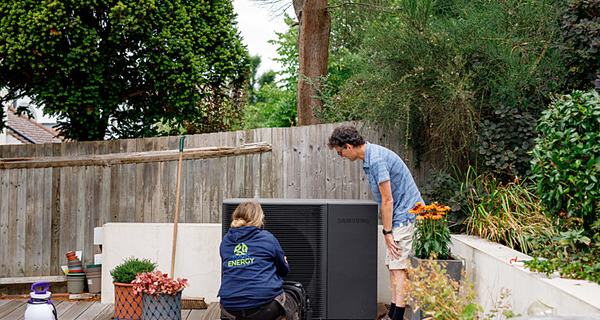
Area-based decarbonisation will require an engaged ecosystem of local decision-makers, supply chains and residents. While planning is a crucial first step, delivering area-based schemes remains challenging. Current offers are siloed between different tenure and building types and fail to scale. With our latest project, we want to collaborate with places to understand what business models could help unlock low-carbon heat. Read on to find out how you could be involved.
Devising compelling offers for delivery
To decarbonise, areas will use a variety of solutions depending on local needs and preferences. Different technologies may lend themselves to new approaches, such as a group leasing model for individual air source heat pumps or a ground array connected to a smart grid. It is important that private companies can offer tailored, place-based solutions. With this new phase of our work, we are shifting our attention from the planning stage of decarbonisation to explore how local authorities and supply chains can identify business models to increase heat pump and shared infrastructure uptake.
Policy changes, such as lowering the cost of electricity bills, will be critical to drive more households and building owners to change their heating solutions. However, businesses also have a role to play in presenting them with a menu of options suitable for their home and situation.
Out in the cold: clean heat needs a stronger business model
Despite policy interventions, installing a heat pump, a heat network or a shared ground loop remains too expensive for many homes. Grants, such as the Boiler Upgrade Scheme and the Green Heat Network Fund, cannot fully fill this gap.
Uncertain demand for shared infrastructure projects raises the cost of capital, impacting costs to customers and making these projects hard to deliver. As a result, projects that involve domestic connections to heat networks have struggled to develop at scale.
At an individual scale, the lifetime cost of a heat pump remains high compared to a gas boiler. However, area-based purchases require high levels of coordination between different stakeholders to generate opportunities of scale that would meaningfully improve outcomes for customers.
New legislation and regulations offer an opportunity to rethink the role of place-based business models. The upcoming Future Homes Standard regulations in Wales and in England, the devolution of powers to local authorities and the rollout of heat network zoning in England could give innovative businesses a first-mover advantage in developing proof-of-concept solutions to area-based decarbonisation. However, innovation, resources and evidence are needed to enable projects to scale.
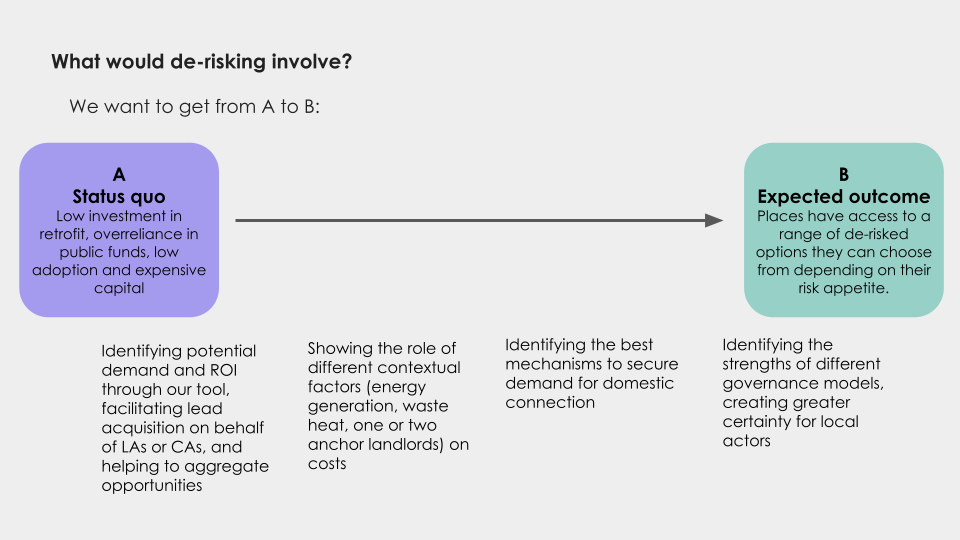
De-risking low carbon heat
Image Description
This flowchart illustrates the journey to de-risk low-carbon heat. It presents a horizontal transition from the status quo of low investment to an expected outcome offering diverse de-risked options. Below an arrow, four steps outline the process: identifying demand and ROI, showing contextual cost factors, securing domestic connection demand and identifying governance model strengths to create certainty for local actors.
We want to support this process by helping areas develop and test approaches, identify where they are most suited and secure financial savings. Our goal is to de-risk the market, boosting consumer and project confidence to drive uptake.
We will be looking to work in a test-and-learn way, building on our existing research such as the local heat planning tool, to help build new projects situated in place that and explore replicable and scalable approaches to the area-based delivery of clean heat.
The kind of involvement we will bring will vary depending on the partners, local context and technologies being delivered. Our involvement could be categorised in three ways, which may overlap:
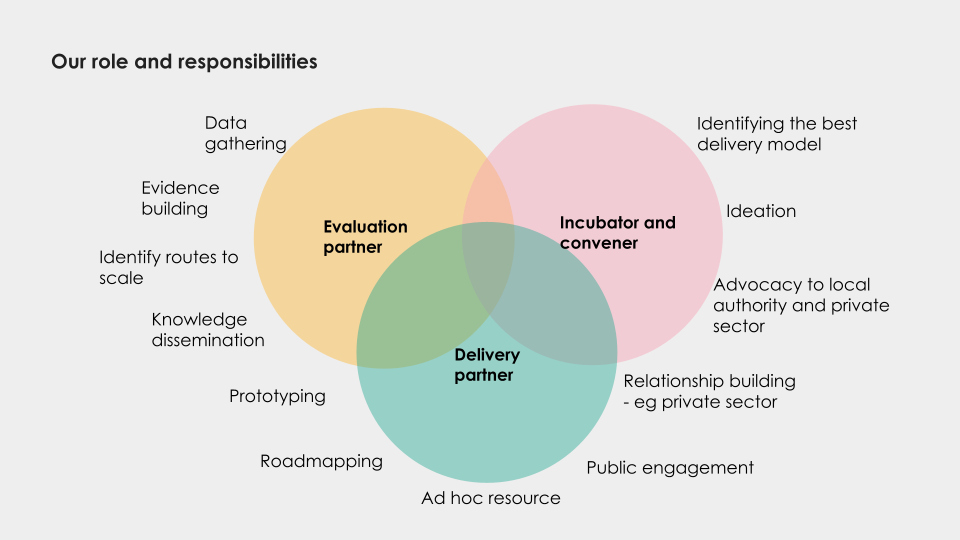
A Venn diagram outlining roles and responsibilities across three overlapping areas: Evaluation partner, Incubator and convener, and Delivery partner, detailing specific tasks for each role
Read the text-based description of this image
Image Description
This venn diagram displays roles and responsibilities through three overlapping circles. The Evaluation partner role includes data gathering, evidence building, identifying scaling routes and dissemination. The Incubator and convener role encompasses identifying delivery models, ideation, advocacy, relationship building, and public engagement. Finally, the delivery partner role involves prototyping, roadmapping and providing ad hoc resources.
1. Evaluation partner
We are keen to support places in evaluating projects, disseminating evidence with a view to support scalability.
2. Delivery partner
We will look to lend help to projects in delivery, identifying tasks where Nesta could bring value, including in an advisory capacity.
3. Incubator and convener
Where possible, we may also play a role in identifying and designing projects from the ground up, or helping convene the required partners to do so.
Note: We are looking to support areas working towards de-risking their projects through innovative models. We will not directly provide subsidies or finance.
What are we hoping to achieve and what would this look like in practice?
We welcome contact from local authorities, supply chain partners and local stakeholders (such as social landlords) interested in scoping area-based decarbonisation projects.
We expect that our collaboration with project partners could take different shapes, adapting to local needs, technology considered and project maturity. For example, it could take the form of an ad hoc workshop to help understand the needs of involved partners at an early stage of the project. It could also look like a working session to accelerate lead generation using our recently launched heat planning tool, working with places to identify areas closest to delivery. In the case of a longer-term project, Nesta could lend resources or support an organisation with project administration, evaluation, or support the cost of events to engage supply chain actors.
The aim of a partnership, while flexible, should be to achieve one of the following:
- Support delivery or take a project closer to installing low-carbon heating systems or shared infrastructure such as a heat network or shared ground loops, with a clear, achievable roadmap to scale.
- Validate a solution likely to work in more than one area, bringing together the elements of a pilot or an innovative business offer.
- Providing evidence and evaluation for an approach that is looking to generate scale. Approaches could be focused on facilitating lead acquisition, offering cheaper solutions to customers through lowering the cost of heat, or lowering the cost of doing business through innovative approaches to coordinating retrofit etc.
We would welcome expressions of interest from existing projects at different stages of maturity. Please email us at [email protected] if you’re interested in discussing this further.
 www.nesta.org.uk/project-updates/call-for-collaboration-enabling-area-based-cross-tenure-decarbonisation-through-innovative-business-approaches/