We are Nesta. The UK's innovation agency for social good.
We design, test and scale solutions to society's biggest problems. Our three missions are to give every child a fair start, help people live healthy lives and create a sustainable future where the economy works for both people and the planet.
For over 20 years, we have worked to support, encourage and inspire innovation.
We work in three roles: as an innovation partner working with frontline organisations to design and test new solutions, as a venture builder supporting new and early stage businesses and as a system shaper creating the conditions for innovation. Harnessing the rigour of science and the creativity of design, we work relentlessly to change millions of lives for the better.
Find out more at nesta.org.uk
If you'd like this publication in an alternative format such as Braille or large print please contact us at: [email protected]
Authors
Benoit Siberdt, Oliver Zanetti, Shaan Jindal, David Bleines and Robin Parker
About SNIPEF
The Scottish and Northern Ireland Plumbing Employers' Federation (SNIPEF) is the principal trade association representing plumbing and heating businesses across Scotland and Northern Ireland. With over 700 member firms employing more than 3,500 plumbing and heating professionals, SNIPEF plays a vital role in supporting the profession's growth, resilience and reputation for excellence.
SNIPEF provides expert guidance, accredited training and practical business support to help members navigate evolving technical standards and regulatory frameworks.
As part of its commitment to the future workforce, SNIPEF oversees the Modern Apprenticeship in Plumbing and Heating in Scotland and, through its Managing Agent role, supports over 1,200 apprentices currently progressing through their training.
The Federation actively promotes low-carbon and sustainable technologies, ensuring members are equipped to contribute to the net-zero transition.
Working closely with government, skills bodies and industry partners, SNIPEF champions the interests of its members and upholds the highest standards of quality, safety and innovation across the profession.
Acknowledgements
The authors would like to thank all participants who took part in the Start at Home project. Their involvement is invaluable in helping us, and others, understand the issues that new heat pump installers across the UK face, and how they can be better supported in their work. We hope that this project will encourage industry stakeholders to create their own version of the Start at Home scheme, making it available to all heating professionals in the UK.
We would like to thank our partner SNIPEF, especially Scott Sanford, Richard Campbell, and Fiona Hodgson, for their continuous involvement in all aspects of the project. SNIPEF played a central role in the success of the project by recruiting experienced heating professionals, coordinating and funding heat pump training for all 36 installers, and providing essential technical support throughout delivery. Their commitment was instrumental in supporting installers as they entered the heat pump sector. It not only enhanced installer capability but also contributed significantly to the project's wider goals of capacity building and sector readiness. We are deeply grateful for SNIPEF's collaboration and dedication.
Last, we would like to thank the members of our scaling group for their continuous interest and involvement in the project: Association of Plumbing and Heating Contractors, Baxi, BPEC, City Plumbing, Department for Energy Security and Net Zero, Energy Saving Trust, Grant UK, Greater South East Net Zero Hub, Heat Geek, Heat Pump Association, Heat Pump Federation, HISA, LCL, MCS, Mitsubishi, Retrofit West, Scottish government, Scottish Renewables, Secon Renewables, Sustainable Energy Authority of Ireland, Vaillant, Viessmann, VitoEnergy, Welsh government, West of England Combined Authority, and Worcester Bosch. Their feedback during our regular workshops has been instrumental in the success of the Start at Home project.
At Nesta, we would like to thank Oli Berry, Marine Furet, Camille Stengel, Daniel Lewis and Elin Price for their valuable support in carrying out the project.
Executive summary
Heat pumps are central to the UK's strategy for decarbonising home heating. Both the UK government and the Climate Change Committee (CCC) have identified widespread deployment as critical to achieving net zero. However, while the number of heating professionals completing heat pump training is growing, many still face a significant barrier: the transition from training to real-world installation.
The Start at Home project, delivered in partnership with the Scottish and Northern Ireland Plumbing Employers' Federation (SNIPEF), addresses this gap. The scheme offers newly trained installers the opportunity to fit an air source heat pump in their own home, giving them practical, hands-on experience in a low-risk environment. This first installation not only reinforces technical skills but builds confidence, fosters long-term engagement with the technology, and enhances credibility with customers.
We piloted the scheme with 36 experienced heating engineers in Scotland. Our evaluation found that this approach directly addresses key post-training challenges and helps bridge the gap between training and confident installation capability.
The pilot revealed four clear outcomes, summarised below:
- Hands-on home installation boosted installers' confidence and technical knowledge
After installing a heat pump in their own home, all participants reported increased confidence and deeper technical understanding, particularly in areas such as system design, heat loss calculation, and commissioning.
- Day-to-day use at home increased understanding of heat pump systems
Living with the system provided valuable opportunities for continuous learning. Because of this, participants could monitor performance, optimise efficiency, and gain insights into user experience – knowledge they can apply and share with their customers.
- Home installations and umbrella organisations supported paths to MCS certification
Around half of the participants who installed a heat pump system at home are exploring gaining their own certification. For these installers, the home installation will serve as credible evidence of their technical competency.
- Lived experience led to greater confidence promoting heat pumps to customers
Lived experience with a heat pump strengthened participants' ability to promote the technology. Installers reported greater confidence when discussing heat pumps with customers, backed by first-hand insights and added credibility.
The Start at Home pilot points to a clear, scalable solution to a significant bottleneck for heating engineers seeking to move into the heat pump sector: the gap between training and widespread installations. The scheme not only accelerates installer readiness but also equips them to champion heat pump adoption more effectively within the industry.
There is clear demand and enthusiasm among heating professionals. Scaling this scheme across the UK presents a powerful opportunity – for policymakers, training providers, manufacturers, and suppliers – to build a capable, confident workforce and drive the uptake of heat pumps. It would empower thousands of installers, improve installation quality, foster trust with homeowners, and accelerate progress toward the UK's net-zero goals.
Introduction
Decarbonising home heating is a key priority in the UK's strategy to cut emissions, and heat pumps are expected to play a pivotal role. The UK government and the CCC have both emphasised that large-scale deployment will be essential to meeting the country's net-zero target.
To achieve this, we wanted to test whether facilitating the first heat pump installation for plumbing and heating professionals would encourage more professionals to enter the marketplace with more confidence and better skills. In the Start at Home project, we piloted giving newly trained heat pump installers first-hand experience from installing an air source heat pump in their own home. Our goal was to test whether this would help accelerate the expansion of their business to incorporate retrofit heat pump installations into their service offerings. We anticipated that the home install would boost their confidence in their skills and the technology, and enhance their credibility by showing customers they trust the technology they recommend by having it in their own home.
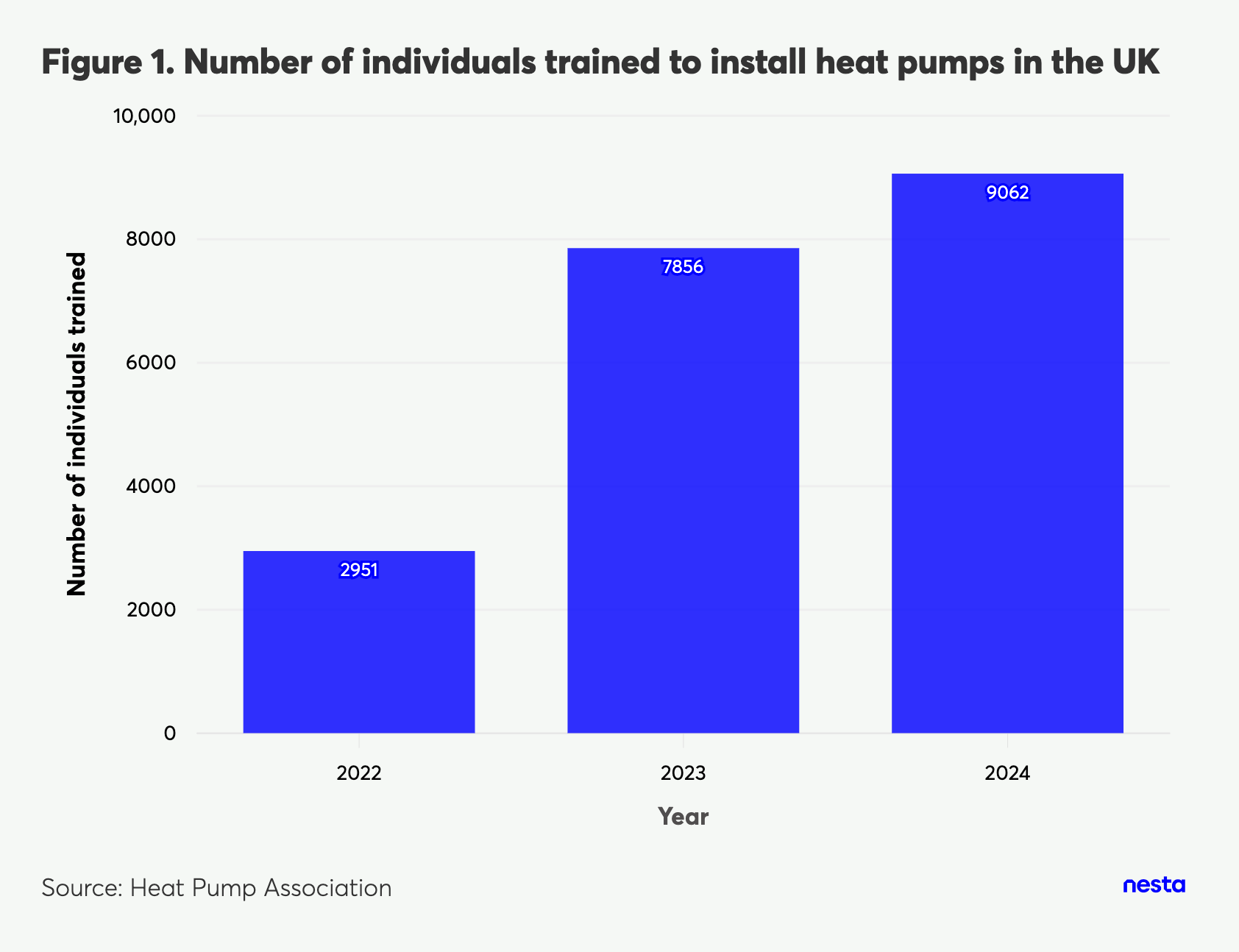
Across the wider industry, thousands of heating professionals are engaging with the transition to low-carbon technologies: the number of individuals completing heat pump training continues to rise, as shown in Figure 1. This signals growing enthusiasm within the plumbing and heating industry to expand their businesses to include heat pump installations.
Figure 1. Number of individuals trained to install heat pumps in the UK
Source: Heat Pump Association
But while training numbers are increasing, this has not yet translated into a large, active workforce of heat pump installers. A recent DESNZ survey of 121 installers trained within the past year found that at the time the survey was conducted only 27% of newly trained installers had gone on to complete a heat pump installation. This highlights a persistent and widespread challenge: making the leap from training to practical, real-world heat pump work remains difficult for many.
Our exploratory research and conversations with industry stakeholders suggested that this gap in adopting heat pump installations is driven by several overlapping barriers.
- Newly trained installers often struggle to find their first heat pump customer, which would then allow them to achieve MCS certification and access government installation grants.
- After training, many still lack confidence in designing, installing and commissioning heat pump systems or may even require some additional reassurance about the effectiveness of the heat pump technology.
- A lot of newly trained installers are also wary of the additional paperwork involved in retrofit heat pump installation, making them feel that integrating heat pumps into their business will be difficult.
- All the while, there remains steady demand for gas and general plumbing work, which offers greater certainty and familiarity.
In a previous project, we piloted whether financial incentives, such as bursaries toward capital expenditure or post-installation payments over the first six months after training completion, could help overcome this gap. While helpful for some, these measures were not enough on their own to shift most businesses towards retrofit heat pump work. What emerged was a clearer picture of how significant and multi-dimensional the ‘first install' problem is.
The Start at Home project directly targeted this widespread challenge by exploring whether giving newly trained installers the opportunity to fit a heat pump in their own home, a setting where the stakes and risks are lower, could help turn training into real-world capability, confidence and business growth.
How the Start at Home project worked
The aim of the project
With support from our delivery partner SNIPEF, we recruited 36 experienced heating engineers which were divided in two groups. One group attended only the standard training courses of Level 3 Air Source Heat Pump Systems and Level 3 Low Temperature Heating and Hot Water Systems. In this report, we describe this group as 'those who attended training only'.
The second group attended both these training courses and were also offered, for free, the essentials of an air source heat pump system to install in their own home. This included the air source heat pump itself, a hot water storage solution and controls, but did not include home upgrades including radiators, underfloor heating or additional insulation measures. They were also offered an Open Energy Monitor if they wanted one. In this report we describe this group as 'those who installed a heat pump at home'.
We aimed to explore whether participants who both attended the training and installed a heat pump at home felt more confident in their ability to install heat pumps for customers during domestic retrofits. We also wanted to see whether they were more likely to steer their business toward heat pump installations compared to those who only attended the training.
To better understand the impact of participation, we broke the project down into a series of key activities and their hypothesised pathways to impact:
- By installing a heat pump at home after training, heating engineers have a clear way of practising their skills in a safe environment.
- They also get to live with a heat pump, learning to tweak and improve the system, which will further boost their skills.
- They can use their first install at home to become MCS certified, if they want to be.
- They signal to customers their commitment to the heat pump technology and are better equipped to promote heat pumps to their customers.
These routes to impact were based on our understanding of the barriers that new heat pump installers face, and helped guide the design and delivery of the project. We will return to explore these elements in more detail in the results section of the report.
How the project was conducted
Our delivery partner SNIPEF took the lead on participant recruitment by advertising the project to their membership. SNIPEF members were informed that they would receive fully funded training and would have the chance of receiving a fully funded heat pump through random allocation as part of the project. SNIPEF used their charitable fund to provide the training courses attended by participants, and they offered considerable technical and pastoral support to participants during the project. The heat pumps and associated equipment were supplied by City Plumbing and funded by Nesta.
In this pilot, we sought the participation of microbusinesses of ten or fewer employees, though in practice we allowed a little flexibility in business size. We chose to focus on microbusinesses because they currently make up 95% of the existing heating sector so their buy-in is essential to progress the decarbonisation of home heating. Moving into heat pumps is challenging for this group. They typically have little capital to invest in changes to their business they perceive as risky, and have built a customer base through reputation for quality in technologies they are familiar with. We offered a heat pump at home to the business owner rather than an employee because the owner was considered to be the most able to influence the trajectory of the business as a whole. We wrote in detail about the participant profiles and their experience of running a plumbing and heating business in our interim report.
We sought to access participants with no heat pump experience. This was challenging because those attracted to the project were typically those who already had some knowledge and experience with heat pumps. In the end, as shown in Table 1, around half the final pool of participants had some heat pump experience from commercial work, new build homes, or in a few cases assisting on a domestic retrofit led by others.
Table 1. Summary of participants' prior experience with heat pumps, results from participant survey
| Experience with heat pumps |
Heat pump at home pathway |
Training only pathway |
Total |
| No design or installation experience |
9 |
6 |
15 |
| Some experience installing in new builds (design and commissioning done by contractor) |
6 |
3 |
9 |
| Experience designing and installing in new builds only |
1 |
0 |
1 |
| Experience designing and installing in domestic retrofit only |
2 |
1 |
3 |
| Total |
18 |
10 |
28 |
We sought to recruit 40 heating engineers in total, 20 of whom would attend training only, while 20 would also install a heat pump at home. Project participants were self-selecting, responding to an email sent in early May 2024 by SNIPEF directly to 605 of their members with details of the project. As shown in Figure 2, out of the entire SNIPEF membership, 90 businesses opened and engaged with the content linked in the call for interest. Importantly, over half of those who engaged expressed an interest in taking part in the project (48 out of 90). Following discussions with interested businesses, screening against our selection criteria, and some dropouts later on, we were able to confirm 36 participants in the project.
Figure 2. The Start at Home recruitment process
Note that the number of heat pumps available in this pilot project was fixed at 20 from the start of the project given funding constraints. This in turn informed the recruitment target, which was estimated at 40 plumbing and heating professionals.
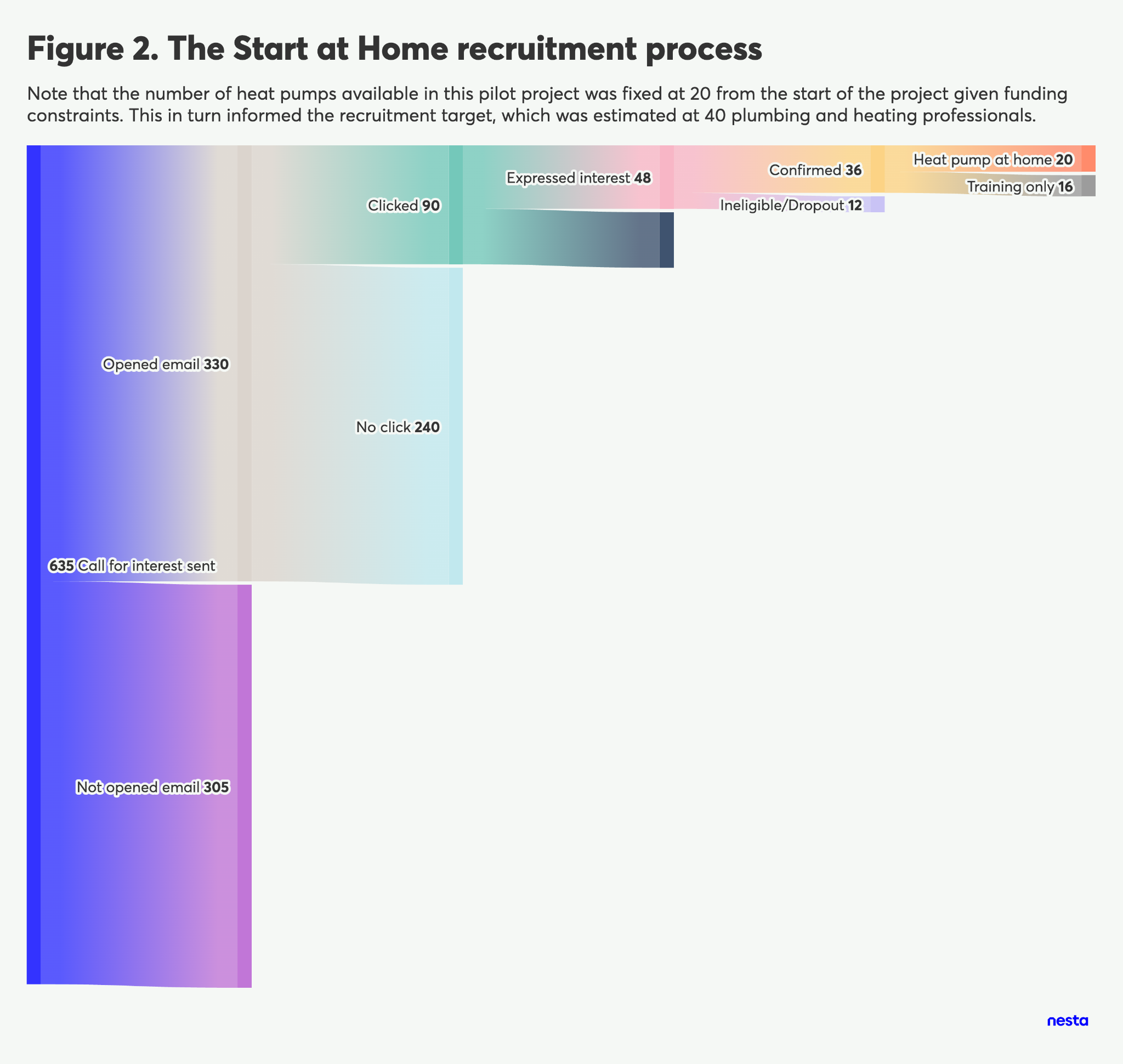
We had initially expected to allocate heat pumps at random to project participants, but some initially offered a heat pump were not able to install them within the project timeframe and so their heat pumps were offered to other participants. As such, almost every participant was offered a heat pump. Out of the 20 installers who chose to install a heat pump, 18 went on to successfully install one at home. Two installers were not able to proceed with the install due to personal circumstances. The other 16 participants attended training only. We had also envisaged that participants who installed a heat pump at home would also be able to access the grant and loan from Home Energy Scotland to support additional home upgrades or pay themselves for their labour. However, this proved challenging due to Home Energy Scotland's rules and, while several installers started the application, no one has yet claimed this funding. Across the 18 heat pump orders, the average cost for each heat pump and associated equipment was £7,700 including VAT.
Training was delivered between August and October 2024 which all participants attended aside from two participants who dropped out at this stage. For those who attended training only, this marked the end of their participation in the project in terms of support provided. However they were still asked to take part in two rounds of interviews and complete an online survey to learn from their experience entering the heat pump sector.
Those who were offered a heat pump began work on their home installation from October 2024 onwards. Several heat pumps were allocated between October and the end of December 2024 due to time constraints or changes in personal circumstances that led some engineers to decline the offer later on. The engineers who installed a heat pump were required to complete a heat loss survey and system design in line with MCS standards, which were shared with delivery partners at City Plumbing. Installers then went through the standard quotation process. Heat pump orders had to be placed by May 2025, though most were ordered and installed earlier.
How we assessed impact
To evaluate the impact of the Start at Home project, we used two participant surveys and two rounds of qualitative interviews. The first survey, run in June 2024, measured participants' attitudes, knowledge and confidence towards heat pumps at the start of the project. A follow-up survey in May 2025 included repeated questions to assess changes over time and the impact of different pathways to installation. We received 32 and 28 responses, respectively.
We also conducted semi-structured interviews with participants at two points: after training (Nov-Dec 2024) and after their installation work, at the end of the pilot (Apr-May 2025). These interviews explored their experiences of training, motivations, confidence and skills as well as business development. In the second round, we interviewed 17 of 20 installers and 9 of 16 training-only participants, 4 of whom had withdrawn early. We also interviewed key delivery partners from SNIPEF and City Plumbing.
The survey data provided cohort-wide insights and are presented visually in the report. Interview findings offered deeper understanding and are quoted anonymously. While the sample size was small and participation self-selecting, we are confident in the findings and their relevance for understanding the project's impact. Because the cohort moving into heat pump installations chose to do so themselves, our results show the effectiveness of giving enthusiasts an extra push after heat pump training completion.
Challenges faced by heating engineers getting into heat pumps
This chapter explores the experiences of the project participants and their motivations to join the project. Through this chapter we expose challenges likely faced by many other heating engineers as they take their first steps into the heat pump sector, and what could motivate other installers to join were similar schemes available more widely.
Where installers are starting from
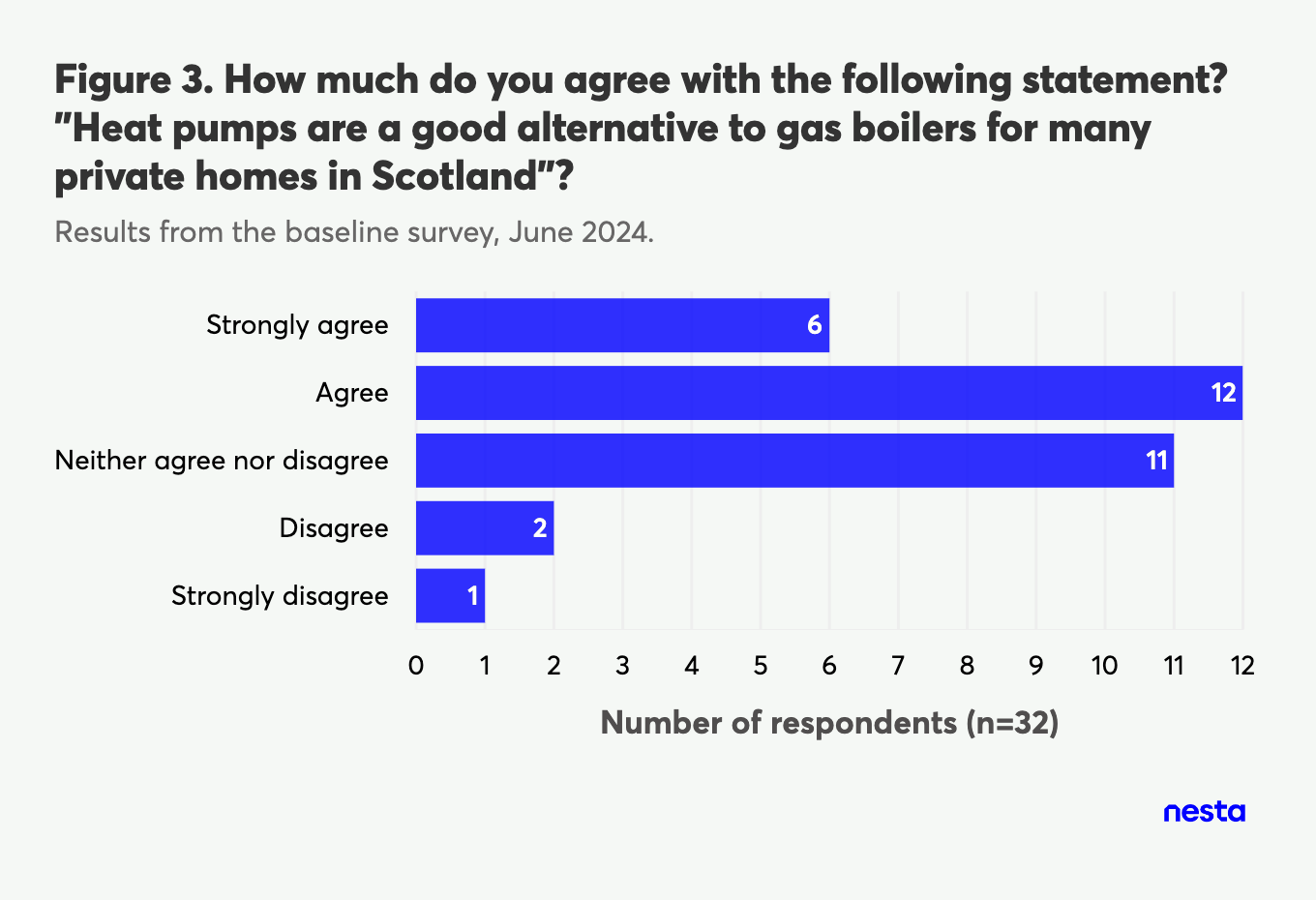
The majority of installers in the project (18 out of 32) saw heat pumps as a good alternative to gas boilers for Scottish homes at the start of the project, as shown in Figure 3. However, a sizable group (11 participants) were on the fence, and a small number (3 participants) disagreed or strongly disagreed. This suggests that while there was broad support for heat pumps, a notable minority was uncertain or unconvinced.
Figure 3. How much do you agree with the following statement? "Heat pumps are a good alternative to gas boilers for many private homes in Scotland"?
Results from the baseline survey, June 2024.
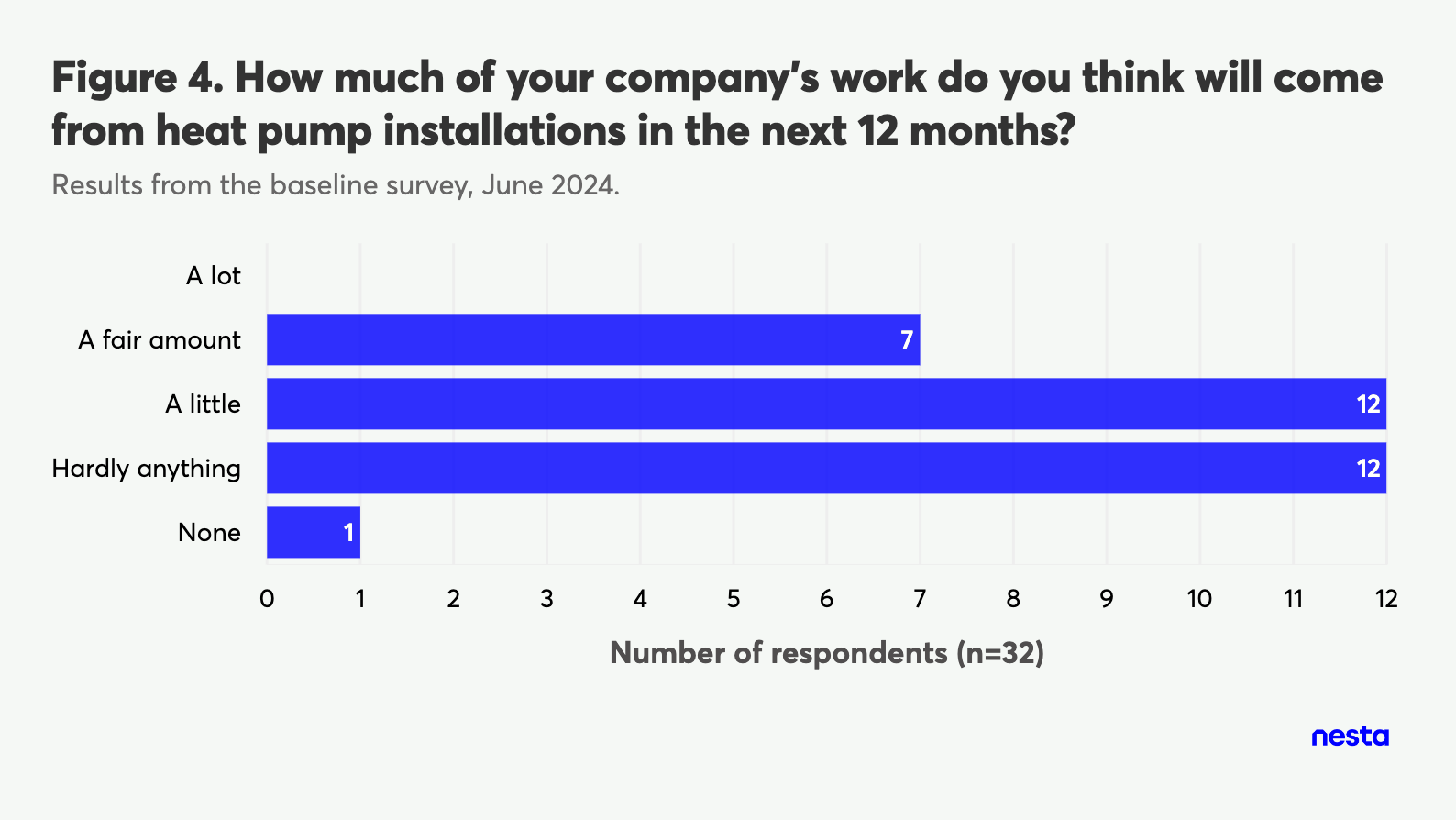
In addition, Figure 4 indicates that most participants did not anticipate substantial heat pump installation work in the near term. None expected "a lot" of their company's work to come from heat pumps in the next 12 months, while the majority expected only "a little" (12 participants) or "hardly anything" (12 participants). Together, these findings suggest that although heat pumps were generally viewed positively, expectations around immediate uptake were cautious at the start of the project.
Figure 4. How much of your company's work do you think will come from heat pump installations in the next 12 months?
Results from the baseline survey, June 2024.
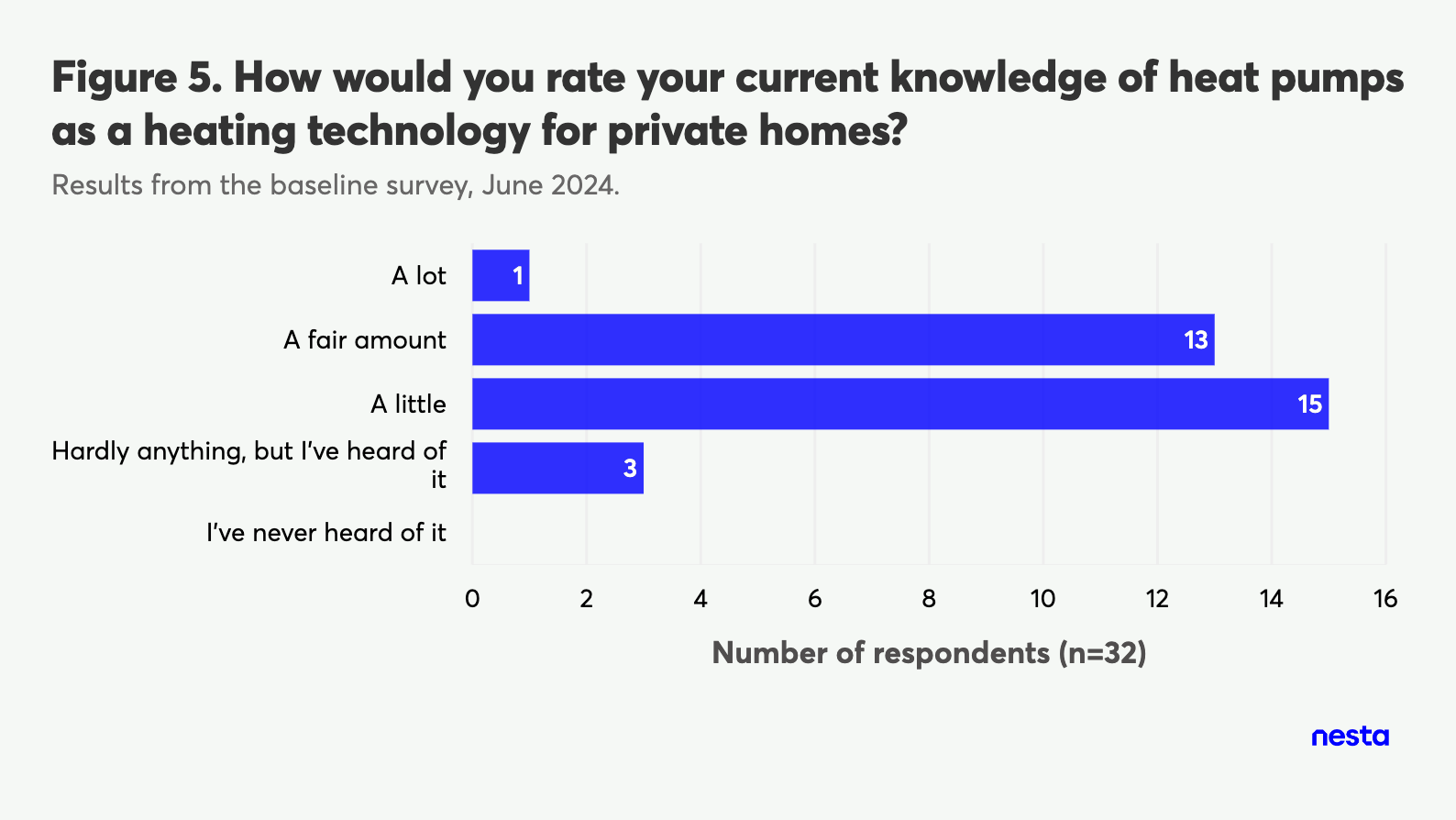
As shown in Figure 5, which displays results from the survey ran before the participants attended training, while a minority of them (14 participants) reported having some knowledge of heat pumps, the majority had relatively little.
Figure 5. How would you rate your current knowledge of heat pumps as a heating technology for private homes?
Results from the baseline survey, June 2024.
Overall, while most participants entered the project with a positive view of heat pumps, their limited experience and cautious expectations about short-term demand highlight the need for further support and confidence building to accelerate adoption.
Why installers joined the project
At the start of the project, we asked participants about their motivations to join. We identified three overarching themes: timeliness, learning-by-doing, and broader societal change. These are discussed in more detail in our interim report.
The timely nature of the project was the most dominant theme mentioned by installers. These motivations include the desire to “future-proof my business” (1-4 employees, heat pump at home) and wanting to “get a head start on any other companies by being qualified to do the new roles before it becomes mainstream" (sole trader, heat pump at home). This suggests that many installers were thinking about the future of their business when considering entering the heat pump industry.
Another key motivation for participation was the hands-on learning opportunity offered by the Start at Home scheme. Installers saw it as a valuable chance to gain practical experience. One engineer described it as “a great learning opportunity to find out exactly what's needed, what process you have to do, what steps you have to do” (sole trader, heat pump at home). Others added that it was a possibility to practice an install “right through, from start to finish” (5-9 employees, heat pump at home) and that doing it in their own home allowed them to “try them [heat pumps] out a wee bit, just to see how good they are... so I know I can recommend it" (1-4 employees, heat pump at home). These reflections suggest that installers were eager to learn and especially motivated by learning through doing, allowing them to kickstart their move into heat pumps.
The last often-mentioned motivations referred to broader societal change. These included the increasing salience of green discourses, the recent changes in legislation (such as the New Build Heat Standard) and the fact that heat pumps are becoming more common and customer demand is increasing. As one installer explained: "I'm interested in heat pumps because in a few years that's going to be how most houses are gonna go. Especially in new builds where we are predominantly focused on doing heat pumps now” (1-4 employees, training only).
The engineers' motivations in our project align with previous industry surveys, like Vaillant's from April 2023, which found that heating professionals are mainly driven by future-proofing their business, broadening their income streams, and contributing to net-zero goals. But our findings highlight something new: the distinctive features of the Start at Home project, namely hands-on training and the chance to do a first install at home, sparked strong interest on their own.
Addressing the training gap
Overall, for many participants, training led to increased in-depth knowledge of heat pumps and built their confidence in using the technology. One installer explained how the training: “really did make me understand [heat pumps] a whole lot better" (sole trader, heat pump at home).
The low temperature and hot water heating system course was especially praised by participants. As one heating engineer described: “low-temperature training was absolutely first class. It highlighted things that are often taken for granted and unpacked them” (5-9 employees, heat pump at home).
Some even mentioned changing their mind about heat pumps as a result of the combination of training and further discussions with peers. As one engineer told us:
“I'll be honest – when I started this process, I wouldn't have given you a fiver for a heat pump! But, having actually gone on the courses, and spoken to people that are doing it, I'm actually becoming a believer in them.” (1-4 employees, heat pump at home)
Not all were fully satisfied with the training. Most engineers we spoke to felt the training lacked practical aspects, resulting in the engineers not feeling sufficiently confident about installing a heat pump for a customer. Factors mentioned by participants included wanting the training to be “more hands-on" and focused on “how the heat pump works", as well as a desire to learn by “making the mistakes".
One heating engineer summed up the experience of others we spoke to, saying: "at the end of it, you couldn't walk out of that and then go fit a heat pump" (1-4 employees, training only). This quote illustrates a key barrier for installation: confidence. Even after training, some installers still didn't feel ready to take on retrofitting jobs, suggesting that both confidence in their own skills and in the technology can hold them back from moving forward. Another installer clearly explained that:
"I certainly know a lot more about heat pumps, but what I would say though is that I still don't think I'd be 100% confident doing a retrofit in an existing property.” (sole trader, training only)
A key point is that many installers saw the specific features of the Start at Home project as central to building their confidence: the chance to practise on a real retrofit without the pressure of a customer job, and the opportunity to live with the heat pump themselves. This hands-on experience directly addressed a common motivation for joining the project: a desire to learn-by-doing, which many felt was not fully met through formal training alone. Start at Home was designed to close this gap by providing installers with a heat pump for their own home, helping them gain practical experience, boost their confidence, and build momentum.
This environment provides an opportunity for learning-by-doing, as a sole trader explained:
"I've learned a lot and I've made a lot of mistakes and I've corrected a lot of mistakes and I feel like I am sort of moderately experienced now with heat pumps, you know, within a very short space of time.” (sole trader, heat pump at home)
This highlights that while training provides essential knowledge, the hands-on experience of a home installation may provide a unique learning opportunity which installers can use to further practise their skills, driving increased confidence.
Heat loss, design and commissioning were the biggest learning points
Among those who installed a heat pump at home, many described that fitting it was easier than anticipated, “straightforward”, “the easy part”, “what we've done for 20 years-plus". As a sole trader explained: “Even putting the system in, I really expected it to be much harder than it was. It really was just like piping up a normal heating system, only the pipework was slightly larger” (sole trader, heat pump at home).
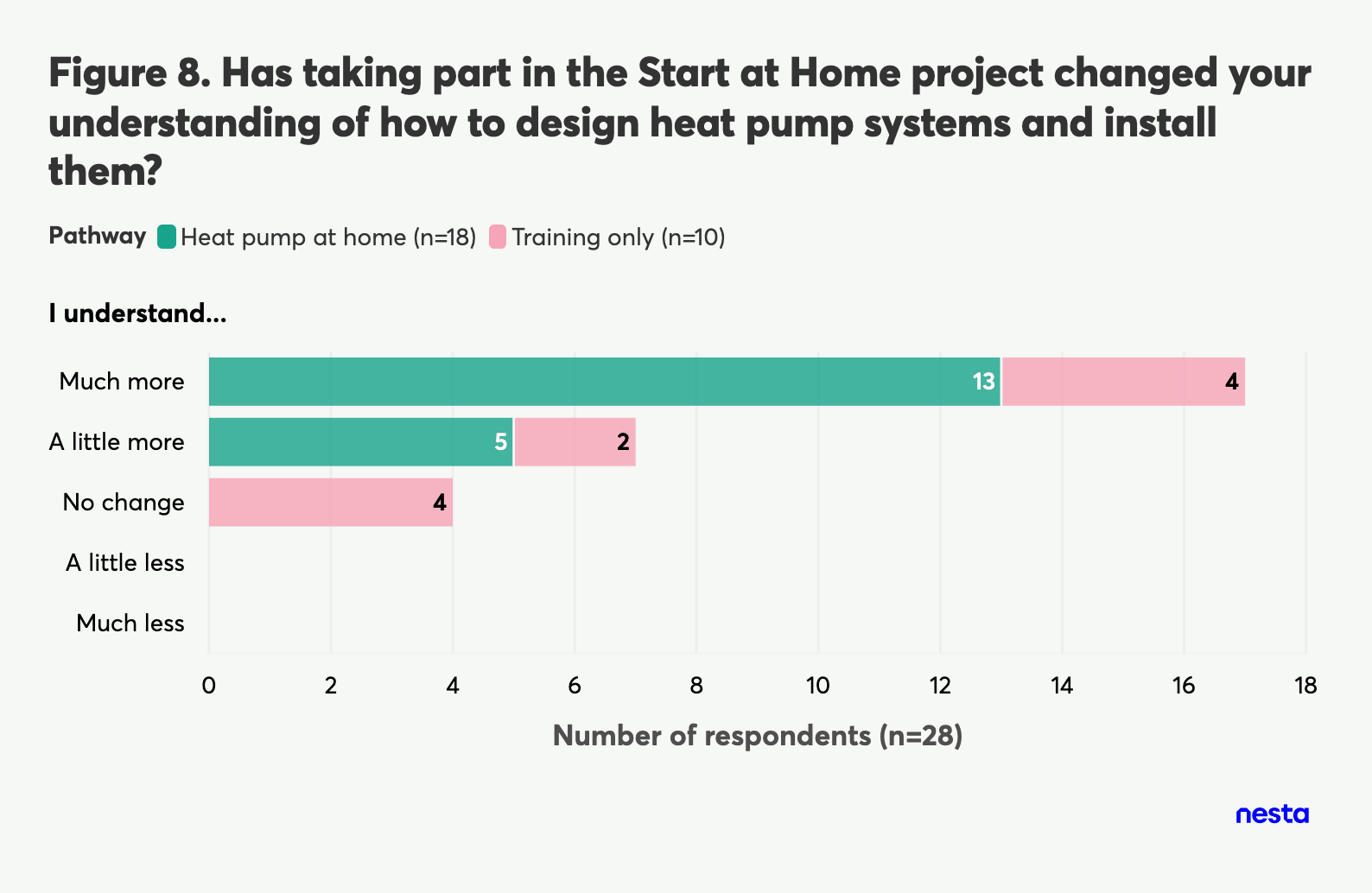
Heat loss calculations and system design stood out as areas where installers felt they'd made real progress through the project. As shown in Figure 8, most engineers experienced a significant increase in their understanding of heat pump system design and installation. While many who attended training only reported increased confidence, this improvement was particularly pronounced among those who installed a heat pump at home: every one of them noted an increase in understanding, with 13 out of 18 describing it as a substantial gain.
Figure 8. Has taking part in the Start at Home project changed your understanding of how to design heat pump systems and install them?
Pathway Heat pump at home (n=18) Training only (n=10)
For many new installers, getting the system design right was one of the most challenging aspects of their first heat pump job, and the support they received made a difference. Those who installed a heat pump at home received support from our partners at SNIPEF and City Plumbing, as well as from the manufacturer of the heat pump they had chosen. Most manufacturers provide comprehensive support to new installers and project participants regarded this as essential. From help with heat loss calculations and selecting the right unit, to guidance on radiator sizing, this hands-on advice gave them a real confidence boost. As one installer put it: “The fact that they [manufacturer] were supporting it as well gave me a wee bit more confidence” (1-4 employees, heat pump at home). While some installers still didn't feel fully confident with calculations and sizing, most agreed that doing their first install at home was a valuable learning experience.
Commissioning was another element of the heat pump installation that installers highlighted as key learning. This is particularly important as some participants mentioned that training courses were lacking in this aspect. Some mentioned they improved their learning by playing around and getting familiar with the controls on their heat pump at home, as they had no prior experience with them. Many also benefited from the support manufacturers gave them with the commissioning process, which was sometimes done in person. As an installer explained:
"Once it was up and running, [the manufacturer] came out. I had already commissioned the heat pump but they came out to double-check it and do the warranty. The guy popped out there as well. He's been on site twice.” (1-4 employees, heat pump at home)
Day-to-day use at home increased understanding of heat pump systems
At the time of writing, most of the scheme participants who installed a heat pump at home have yet to experience a full heating season with their heat pump. However, most of them already highlighted the opportunity created by having the heat pump in their own house to “fiddle with the controls all the time” (sole trader, heat pump at home) and experiment. Four engineers installed an Open Energy Monitor to monitor in more detail the operation and performance of their home installation.
In that regard, the home install offers unique opportunities to continue learning. System efficiency and running costs are key areas of monitoring for most of the installers who installed a heat pump in their home, which allows them to put into practice and test the insights they gain from online forums and peers. As one engineer observed:
“I listen to recommendations on YouTube from people that have been running them for a few years and learn from their mistakes, see what they say, take that on board and see if it's transferrable to my own installation. [...] So, if there's anything I learn on that, I certainly try and implement that into my own installation or try and tinker about with settings to try and increase efficiency.” (sole trader, heat pump at home)
And many expect to be using their experience of living with a heat pump to reassure their customers, or help them find faults:
“As we've lived with it, I can say, ‘Oh no, you're doing it wrong if you do it this way. This is how I do it. I have the heating on at this temperature until then.' So I would know the issues that the customer has because I've probably already had them and I know how to solve them now.” (1-4 employees, heat pump at home)
Overall, living with a heat pump provides installers with valuable first-hand insights that enhance installers' technical knowledge and strengthen their ability to support customers with practical, experience-based guidance.
Using home installations and umbrella organisations as pathways to MCS certification
For domestic heating engineers, having access to MCS certification for the heat pumps they install is essential in order to be able to offer government funding schemes to their customers. For some engineers, getting this access through an MCS umbrella scheme is preferable while, for others, their own MCS certification makes more practical and financial sense.
Of the group who installed a heat pump in their own home, about half were exploring gaining their own MCS certification. For those who wished to do this, the home installation would be shown to the certification body as evidence of the installer's technical ability. At the time of writing, one described being “now officially a registered heat pump installer and can offer government funding on our installs. We have two customers already in the quote stage and I'm excited to see what the future holds" (sole trader, heat pump at home). Most installers who were interested were in the early stages.
“I think we're going to look at being MCS accredited ourselves rather than go under an umbrella scheme. We're quite a sizable company, so I think it'll be worthwhile.” (10 or more employees, heat pump at home)
For many, joining umbrella organisations appeared a more attractive route. Interviews revealed that several installers plan to access customer grants through manufacturer-led umbrella schemes, often with brands they already trust and work with for other heating technologies. They also highlighted the added value of having support with system design and commissioning, areas they found especially challenging during their own home installs. For example, an installer explained:
"I think that [umbrella scheme] would be the best way forward for us as a small family business. We'd be able to have that wee bit of added security on the heat calculations and your sizing and actually upgrading the radiators or whatever that particular project may be.” (1-4 employees, heat pump at home)
Others who plan to use the umbrella model aim to gain practical experience under the umbrella scheme and monitor customer demand before deciding whether to pursue their own MCS certification:
"I'll do it under an umbrella company for the moment. And then once I'm confident..., then we can go for accreditation.” (1-4 employees, training only)
Some found the tasks required to achieve MCS certification were arduous, particularly for smaller businesses. This was frustrating to them because they felt there were advantages of being MCS certified. These included attracting customers who they felt might regard MCS certification as a sign of quality, corporate clients like housebuilders or local authorities who preferred MCS certified installers even when MCS certification was not a requirement for the work they were doing, or that being listed on the MCS website was a potential route to attracting new customers.
While a home installation can certainly benefit engineers new to heat pumps seeking to become MCS certified, other challenges still remain. However, by prompting installers to explore these options, installers also gained familiarity with umbrella schemes and were thus encouraged to explore in detail alternative options to delivering grant-eligible heat pump installations to householders.
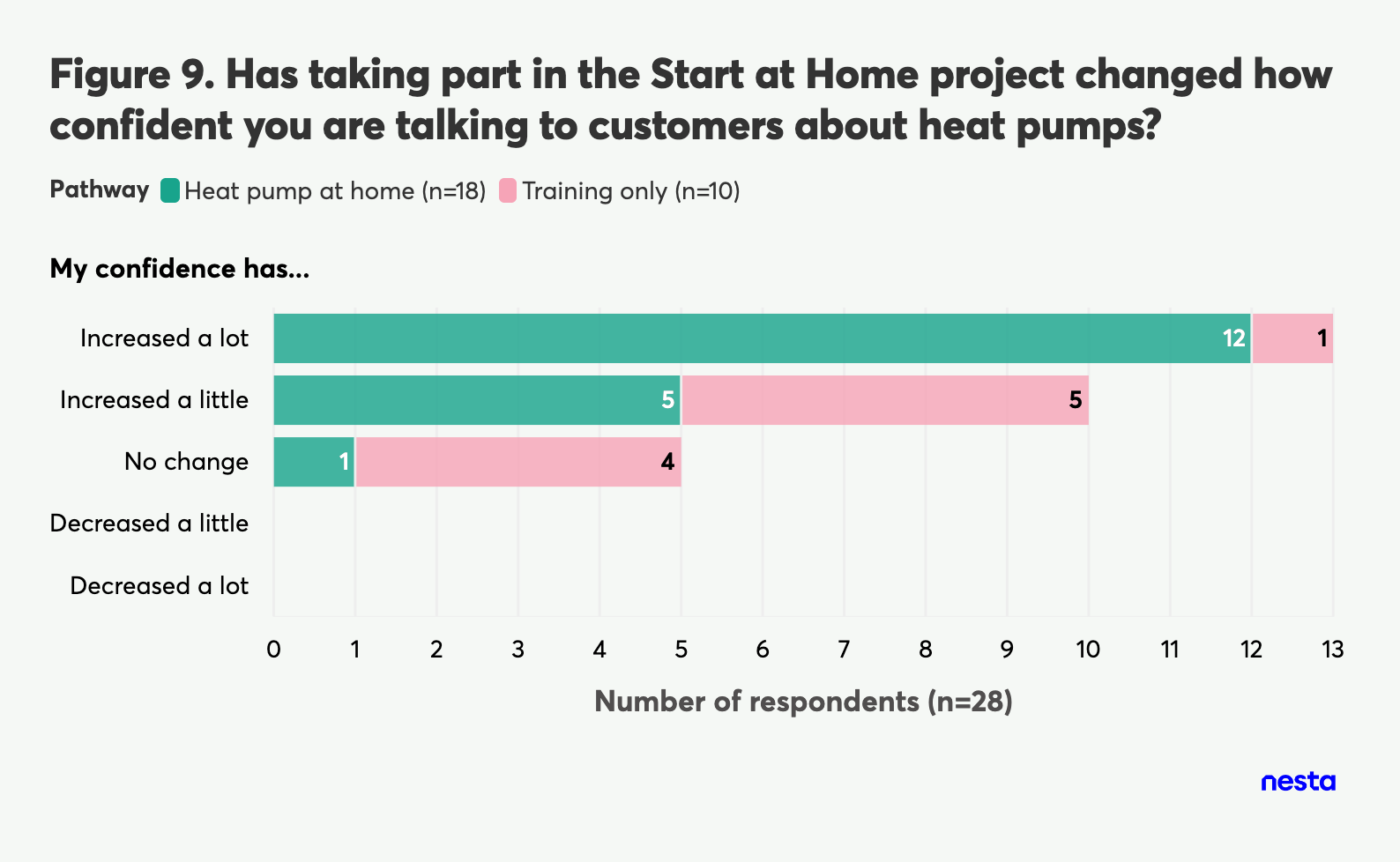
Alongside increased confidence in the technology and installation skills, one clear advantage of home installation, based on installer feedback, was improved confidence in communicating with customers about heat pumps. As shown in Figure 9, two-thirds of those who installed a unit at home reported a substantial increase in their confidence talking to customers about heat pumps, while those who only attended training saw more modest gains. This outcome is likely closely linked to the enhanced understanding that comes from completing an installation from start to finish and the added benefit of living with a heat pump.
Figure 9. Has taking part in the Start at Home project changed how confident you are talking to customers about heat pumps?
Pathway Heat pump at home (n=18) Training only (n=10)
Many participants feel that they now know enough about the technology to be able to recommend it to their customers. They also feel confident advertising heat pumps as a viable option to gas boilers, using their real-life energy consumption and costs as a convincing factor. A sole trader explained that:
“I can say that it does work. It's cheaper than a gas boiler. It's not just based on online information. This is based on real-time information. I can show people my electricity consumption. I can show people how warm my home is day by day. I can see first hand exactly how well it works. So that's really helpful.” (sole trader, heat pump at home)
Many also feel that having a heat pump at home improves the credibility of their customer recommendation, and can improve their sales pitch. For example, an installer said that: “It's helpful, when you say that [you have a heat pump] they actually start listening to you, so you're kind of spreading the gospel to them a wee bit" (1-4 employees, heat pump at home).
Many participants suggested they'd go even further and invite customers to see their heat pump if they were unsure about them, echoing Nesta's Visit a heat pump scheme. Using their heat pump as a real-life example would be beneficial as they'd be able to: “bring them along and answer a lot of their questions. They'll see it and hear it, and it should just be a win-win" (10 or more employees, heat pump at home).
Several installers also highlighted the unique opportunity to guide customers through the transition to living with a heat pump. By drawing on their own experience, they felt better equipped to show customers how to adjust settings and adopt new habits for optimal performance. They emphasised that heat pumps require a different approach to customer engagement, one that involves setting realistic expectations about longer installation times and supporting people as they adapt to a new way of heating their homes.
Next steps for the Start at Home participants
This section looks beyond the immediate outcomes of the project to explore how participants are applying the knowledge and confidence gained through their involvement, particularly from the hands-on home installation, into ongoing and future work and business practices. By linking what was learned to what participants are now doing or expect to do soon, we aim to understand how these early gains are translating into real-world impact and longer-term benefits.
In designing and running this project, we focused on four key areas:
- Whether the hands-on installation at home boosted technical knowledge and confidence over training alone.
- Whether a heat pump to use at home improved understanding of operation and system performance.
- Whether the home install provided a pathway to MCS certification.
- Whether installing and living with a heat pump at home improved the ability to advocate for and promote heat pumps to customers.
As reported in this chapter, we observed meaningful progress across all four areas, especially the first two. While it is still early to measure the full impact on participants' businesses, promising signs are emerging regarding how these benefits are being put into practice.
Most significantly, since taking part in the project, several installers have taken on retrofit installation jobs for customers while several installers explained that they would seek to do more heat pump installations on new builds in the future. For this second group, new build installs provide a great opportunity to get more familiar with heat pumps until strong signals come from the retrofit market. This participant concisely summarised the strategy described by others:
"We will stick with the new builds just now until things change slightly on the retrofits and then we'll probably go into that area. But hopefully this year, maybe the start of next year I'd like to be looking towards going into retrofitting and advertising and push that a bit more as a business.” (1-4 employees, training only)
Several engineers also cited maintenance and repairs as a promising way to gain more hands-on experience with heat pumps, across both project pathways. Some saw it as a strong business opportunity, predicting that demand will only grow as existing systems age and need replacing. One described it as a continuation of the work he does around boilers: “I service all the boilers that I fit, and I'd hope that the heat pump would be the same” (1-4 employees, heat pump at home) and as one installer puts it, there's already a clear volume of work emerging around maintenance and servicing:
“I reckon that we're gonna be working more and more with heat pumps. I mean, there's more and more heat pumps getting fitted across the board. Apart from the actual installation work, there is an awful lot of work with service and maintenance.” (5-9 employees, heat pump at home)
Installers described different strategies to integrate heat pumps in their business. For most of them, moving into the heat pump sector implies planning installations around other work on which the success of the business relies heavily. All installers who reported planning to offer heat pump installations also intended to continue installing boilers for their customers. However, this can feel like running a whole new business alongside their existing one, which is often already stretched to capacity. As this engineer aptly puts it:
"It's difficult when you're trying to run two businesses which are, one's in its infancy and the other one's quite mature so it's hard to balance it all out. You need to get your feet on both pedals.” (1-4 employees, heat pump at home)
Project participants were optimistic but realistic about what it would take to move into the heat pump sector, noting the relatively low level of customer demand at present. One installer used low temperature heating as an analogy for how they expected to take the heat pump part of their business forward:
“Basically, we're doing it the same as a heat pump, low and slow. That's exactly how we're bringing heat pumps into your company low and slow. And I think we'll build a foundation for them that way as opposed to rushing in for big money.” (1-4 employees, heat pump at home)
In sum, the project has laid a strong foundation for participants to build their involvement in the heat pump sector, with early signs of technical growth, strategic business planning, and a cautious but committed approach to integrating heat pumps into their future work.
How all new heat pump engineers can participate in Start at Home schemes
Having studied the effect of the Start at Home pilot, we conclude that installing a heat pump at home alongside heat pump training offers greater benefits than training alone for experienced heating engineers new to domestic retrofit installations. The evidence presented in the previous chapter highlights improvements in four main areas: increased technical knowledge and confidence in designing and installing heat pumps, enhanced understanding of heat pump operation and system performance, progress toward MCS certification, and strengthened ability to promote heat pumps to customers. Together, these outcomes suggest that the hands-on home installation supports participants in building both their skills and makes them more inclined to orient their business towards heat pumps.
To conclude this report, we argue that making a home heat pump installation easily available to heating engineers new to the heat pump sector will create benefits that will both help accelerate our trajectory towards decarbonisation targets and help advance the heat pump industry as a whole. In the first part of this chapter, we set out five key insights from the delivery of the project highlighting what worked well and what we would do differently if delivering it again. These learnings will be useful to scaling this initiative more widely, which is the focus of the second part of this chapter.
Learnings from delivery of the Start at Home pilot
This section draws from evidence gained from end-of-project interviews with heating engineers and delivery partners to identify key learnings related to project delivery.
Installers are motivated but need support to keep momentum
All heating professionals who participated in this project showed a high level of commitment, making time for training and, for those who received a heat pump, completing the home installation in their spare time. Of 36 participants, only four dropped out during the project: two before attending training and two for personal reasons after the project began.
However, we found that some participants required regular reminders and coordination to stay engaged and on schedule, for instance to ensure they attended their training, did surveys and interviews, or completed their installation on time. This was typically a consequence of the priorities that come from running a small business in a world where quality and reputation are integral. In short, participants were putting their customers first.
Thus, given the right opportunity and support, installers are willing to take initiative and learn through doing but they may need support. Future scheme organisers will need to identify the lowest effort ways to offer that support and keep participants engaged.
Accessing training must be low friction for installers
Training courses in heat pump installation and low temperature heating were valued by participants and, for many, the access to those courses was a key motivation to join the project. However, project organisers and heating engineers had challenges accessing training. Colleges and training providers were reluctant to confirm courses until they reached a threshold number of attendees; heating engineers sometimes forgot about training or booked jobs that clashed with the time they were due to train requiring last minute reorganisation; and, because several participants were based in rural or remote locations, reaching training centres could be arduous.
For future schemes to be successful, making training more accessible both in terms of timing and location, is key to keeping installers engaged and making progress.
New installers require reassurance from experts
One of the strengths of the project was the installers' clarity on what they wanted. Many had researched extensively and arrived with clear plans and others were able to apply the learning from their training. Where support was needed, it was less about fundamentals and more about confirmation and confidence-building. SNIPEF, City Plumbing and the manufacturers of the heat pumps installed by participants provided this support, and installers also supported one another through their connection in a WhatsApp group.
In future schemes, it is vital that installers have access to the support they need to ensure their first installation is successful.
Timing is key, and future projects must align with industry rhythms
While the project achieved high levels of participation, the most significant learning was that timing matters. We ran the project over winter, and because our project was a time limited trial, we were not able to extend the timeline. This was not ideal as many professionals were at their busiest attending to customer calls at the peak of the heating season. Of the participants who installed a heat pump at home, some reported working on their install in short bursts over evenings and weekends.
For future delivery, two lessons are clear. First, schemes should be open for a longer time allowing installers to plan their participation alongside their other work. Ideally, schemes should be open indefinitely. Second, while participants should be free to engage at any time in the year, a particular focus on training and installation support in the summer months would ensure the highest levels of success.
Making Start at Home available to all heating engineers
At Nesta, we would like to see as many heating engineers as possible to have access to schemes like Start at Home. While this pilot focused exclusively on company owners, we believe that opening the scheme to all individuals working across the heating and plumbing sector is essential to achieving high levels of uptake and building widespread impact. Moreover, although we initially offered the scheme mainly to microbusinesses, scaling up should mean making heat pumps available to everyone in the sector, ensuring the benefits reach far beyond the smallest companies.
Providing heating engineers access to a heat pump to install at home will confer benefits across all aspects of the adoption of heat pumps: increasing awareness and growing the number of heat pump advocates amongst a particularly influential group; increasing the quality of installations for customers; and readying the installer base for the rapid increase in installations that is expected as the move away from gas gathers pace in the years to come. We foresee a virtuous circle, where enthusiastic heating engineers become trailblazers in the heating decarbonisation by upgrading their own homes first, going on then to encourage householders to adopt low carbon technologies and bust myths among more sceptical colleagues too.
In the final section of this report, we set out in more detail why and how Start at Home schemes could be implemented.
Why Start at Home schemes should be implemented more widely
As illustrated in this report, Start at Home schemes have clear benefits for the installers that participate in them, helping them take meaningful steps to expand their business from fossil fuel heating to include low carbon heating. Without wishing to downplay the overall challenges of the heat transition, particularly installation and running costs that consumers face, it is also true that with each additional installer trained and confident in delivering low carbon heating to householders, the pathway to home heating decarbonisation set out in the Seventh Carbon Budget becomes a little easier.
We foresee a role for heat pump manufacturers, umbrella schemes, local government bodies tasked with heat decarbonisation and others to become operators of Start at Home schemes. These operators would carry out many of the same activities we performed in this pilot, but at a larger scale to enable broader participation. We believe scaling the Start at Home scheme will bring benefits not only to heating engineers but also to these organisations.
As outlined below, we consider MCS umbrella organisations and manufacturers to be the most effective potential scheme operators. When well run, Start at Home schemes could serve as entry points into a wider ecosystem of products and services managed by such organisations. For instance, installers familiar with an MCS umbrella organisation through their first install at home are likely to continue engaging with that scheme in their future customer work. Likewise, installers confident in the quality and efficiency of a particular heat pump brand, gained through hands-on experience at home, are more likely to specify that brand professionally. Supporting this, 11 out of 17 respondents who installed a heat pump at home said they were likely or very likely to recommend the same brand to their customers, while five were open to recommending it, indicating strong potential to build brand loyalty through the scheme.
Key elements for successful implementation
There are multiple ways in which Start at Home could be implemented by different industry stakeholders and, at the time of writing, at Nesta we are actively working with industry to help scale the Start at Home concept. Here, we highlight the elements we see to be key to making the concept work for installers and scheme organisers.
The equipment is free to the heating engineer and the scheme organiser
At the time of writing, the Boiler Upgrade Scheme and Home Energy Scotland grants are both set at £7,500. For typical heat pump installations, this is sufficient to cover the cost of the heat pump, hot water storage, and associated kit and control systems that we provided as part of our pilot, especially if scheme providers are able to take advantage of reductions from the manufacturer list price that are often available to bulk heat pump purchasers. In this way, the only cost is the cost of the credit line between the time the heat pump is delivered and the time the government grant is received for a successful installation.
We believe that many scheme operators will be able to carry that cost as a business expense of operating the scheme and generating potential new business with the participating heat pump installer. If the scheme organiser is an MCS umbrella, they become responsible for the costs of operating that umbrella. The heating engineer is responsible for the costs of additional equipment for their home and the time they take doing the installation.
An alternative financing method we have explored is one where the participating heating engineer purchases the equipment themselves at a small discount from the manufacturer and then receives a cashback incentive for future heat pumps they install in customers' homes that in time total the full value they paid for the heat pump. There are merits to this scheme and it is worth exploring further, particularly that it allows the engineer to claim the government grant in addition to accessing a heat pump on attractive terms. However, we have chosen not to prioritise this at present because we think the fact that the participant is obligated to make an upfront payment puts too much friction into the process.
Excellent training and ongoing support is a must
Heating engineers new to heat pumps require high quality training to feel confident about taking the next steps to a home installation. They also need access to support at key points during the installation process, namely system design and commissioning. Providing this support is critical to ensure that installers complete the installation and do so to a high quality with a system that runs at high efficiency.
Most manufacturers and umbrella schemes do offer both training and support to a very high level, but in order to scale up Start at Home schemes they will need to ensure their capacity to offer this is sufficiently scaled up too. Without this, there is a risk that the schemes backfire and installers either decline to install the equipment or, worse, install the equipment poorly and experience high running costs or a cold home. This could lead to reputational damage to the heat pump sector or even affect the trajectory of the overall heating transition.
Access to MCS certification for future installations
For heating engineers to have any realistic chance of attracting able-to-pay home retrofit customers, having MCS certification associated with their installations is essential so that they or their customers can access the relevant government grants. For microbusinesses and sole traders, umbrella schemes are likely to be the most appropriate route to go down because they minimise cost and paperwork. Thus, we suggest that Start at Home schemes include the offer of a pathway to ongoing umbrella scheme membership.
For some businesses, an umbrella scheme might not be the most suitable route and they would prefer to get their own MCS certification. We thus believe that it is advantageous to installers if schemes offer a route to do this, using either that first installation at home or through a subsequent installation in a customer's home. In this latter case, because they would not be gaining a revenue scheme from an MCS umbrella, scheme organisers would need to be innovative in devising ways to ensure they gained value from engaging in the Start at Home process. It might be that manufacturers or wholesalers would thus be better placed to offer this kind of scheme.
Conclusion
The evidence presented in this report underpins our belief that newly trained heat pump installers who cut their teeth on a heat pump installation at home will build skills and gain confidence that will stand them in good stead to enter the heat pump sector and deliver retrofit to householders. We also believe there are parallel benefits to offering Start at Home type schemes to industry players, including umbrella schemes and manufacturers.
We are invested in trying to make this work. We expect to be working with industry over the latter half of 2025, into 2026, and potentially further still to help make these schemes a success. You can find out more about how we can support you on our website, or get in touch with us on [email protected].
Appendix
Further details on how we investigated Start at Home's effectiveness
Participant surveys
We conducted two surveys as part of the Start at Home project which were sent to participants in both groups. In June 2024, we ran a survey to assess the participants' attitudes, knowledge and confidence towards heat pumps. Almost one year later, in May 2025, we ran a second survey to assess the impact of each pathway to heat pump installation for experienced heating engineers. This second survey included a selection of questions from the initial survey, which we used for drawing comparisons aimed at capturing the impact of participating in the Start at Home project. All participants were offered a £25 shopping voucher for completing the second survey. We received 32 and 28 responses for the first and second surveys respectively, out of 36 for the first survey and 32 for the second given that four participants withdrew from the project.
Qualitative interviews
Alongside the surveys, we did two rounds of interviews with all participants to better understand their experiences entering the heat pump industry, as well as their experience of the project.
The first round of interviews took place in November and December 2024, after the participants had finished their heat pump training and some of them had started working on their home installation. In total, we conducted 24 interviews during this phase, asking installers about their plumbing and heating career to date, their motivations to enter the heat pump market, their experience of training, and their aspirations for their heating business. In April and May 2025, we conducted a second round of 26 interviews focused on assessing the impact of the Start at Home project. Our aim in these interviews was to learn about the career trajectory and business development since joining the project, and to explore the differences between the two groups (those who did and did not receive a heat pump for home installation).
How we used the data
To analyse the qualitative data from the 50 interviews conducted across two rounds, we developed a coding framework for each phase. This framework combined deductive elements (drawn from the interview guide and the key themes of the impact evaluation) with space for inductive insights to emerge from the data. Three researchers collaboratively coded the interview transcripts using NVivo, holding regular meetings to ensure consistency and alignment in interpretation. This process enabled us to systematically classify participants' insights, identify patterns across the dataset, and capture both expected and emergent themes.
The findings from the surveys and interviews are set out in the report. The quantitative data from the surveys are used to provide insights on the experience across the whole cohort and are presented visually in charts or diagrams. The qualitative data from interviews is used to get deeper insight into the experience of the cohort. The quotes that were selected from specific participants are those that best represent the prevalent themes across the data. As agreed with the participants, all installer insights are quoted anonymously.
Over the process of working with the installers on this project, we believe that the data is trustworthy and a true representation of the experiences of the participants. However, it is important to note some limitations:
- The sample size is small, so while we consider the comparisons between the two groups to be meaningful there is no intention to suggest that they are statistically significant or imply causal effects.
- Participation in the project was self-selecting and thus inevitably attracted those who were more interested in heat pump adoption. Thus, the findings do not represent a neutral cohort within the plumbing and heating sector and may not generalise to the sector as a whole. However, because the cohort moving into heat pump installations chose to do so themselves, we are confident that our results show the effectiveness of giving enthusiasts an extra push after heat pump training completion.
This does not reduce our confidence in the overall claims made on the impact of this research.
58 Victoria Embankment
London EC4Y 0DS
+44 (0)20 7438 2500
[email protected]
X @nesta_uk
f nesta.uk
www.nesta.org.uk
ISBN: 978-1-916699-39-7
Nesta is a registered charity in England and Wales with company number 7706036 and charity number 1144091. Registered as a charity in Scotland number SC042833.
Registered office: 58 Victoria Embankment, London EC4Y 0DS.