1. Why we need to fix the unfair levy system
This paper sets out Nesta's proposal for reforming the levies on British household energy bills to make them fairer, greener and fit for the future. The paper draws on Nesta's detailed modelling of levies on energy bills, as well as polling of the British public conducted for Nesta by Public First. The paper has three sections:
- Why we need to fix the unfair levy system
- The solution: rebalance levies and support households
- The benefits of rebalancing levies
High energy bills are an economic, social and political problem for the UK. A typical household energy bill is now around £800 a year higher than it was in 2021.[^1] Seventy-one percent of British households say their energy bills have gone up over the past year, and energy is the expense that worries them the most.[^2]
High energy bills are primarily driven by Britain's reliance on gas. Household energy bills are highly dependent on wholesale gas costs, which directly set heating bills for most households and heavily influence electricity prices. Gas has become expensive, and its price is volatile, while Britain depends on imported gas for over 40% of its annual consumption.[^3] By contrast, renewable electricity prices are expected to get lower and more predictable in the long term, as well as being home-grown.
Reducing energy bills will require sustained action by the UK government. Investing more in renewable energy should help lower prices over time by reducing the role of gas in the electricity grid. At the same time, the UK also needs to help households move away from gas for heating, which makes up around half of a typical home's energy bill. Doing that means replacing gas boilers with clean, efficient electric heating, which can run on homegrown electricity rather than imported gas.
However, there is one big problem with our energy bills, which discourages households from swapping from gas to electric heating, and which the government could easily fix: the levies that are added to energy bills. These levies raise over £6 billion a year from British households and add around £200 to a typical dual-fuel energy bill. They fund a number of government programmes, such as insulating fuel-poor homes, as well as the legacy costs of early renewable energy programmes. They are skewed heavily towards electricity bills, adding £156 to a typical electricity bill compared to £52 to a typical gas bill.[^4] These levies are problematic for several reasons.
1. High electricity prices discourage switching to low-carbon heat
The ratio of electricity to gas prices determines the cost difference between heating a home with gas and with a heat pump. The ratio, currently at 3.9, is one of the highest in Europe.[^5] The levies on bills have become a reverse carbon tax, subsidising fossil fuels at the cost of clean electricity.
2. Levies heavily penalise households that use direct electric heating
Around 2.3 million UK households use electric heating, such as storage heaters. Lacking the efficiency of heat pumps, this type of heating can cost almost four times more to run than a gas boiler, owing to the high price ratio. As a result, households with electric heating are twice as likely to be fuel poor (21%) than those using gas (10%); they also experience much more severe fuel poverty.[^6] Placing the burden of levies on electricity exacerbates this situation.
Our polling shows only about a third (34%) of British adults know that electricity is more expensive than gas per unit of energy. When explained, half of the public (50%) agree that it is unfair that people who use electricity for heating pay more in green levies than those using gas, while only 11% disagree.
3. Levies are regressive, with poorer households paying more than their fair share
Energy consumption is only weakly linked to income, with many low-income households using a significant amount of energy. Because levies are charged at the same rate for all households, this means that low-income households pay a larger share of their income towards levies. For some of the lowest-income households, levies take up more than 1% of the household's annual income.[^7] Households that rely on highly taxed electricity for heating also tend to be poorer.
The regressive nature of levies may reduce public support for the government's energy policy. Our polling found that 54% of British adults think green levies should reflect people's ability to pay rather than the type of energy they use, compared to 13% who disagree.
The current system urgently needs reform. This paper, along with accompanying Nesta reports, sets out how the government reform levies to deliver cheaper electricity and fairer bills.
To reform levies in the best way possible, we propose that the UK government should follow four principles:
- Fairness–the distribution of energy costs should be fairer, so that low-income and vulnerable households pay a proportionate share of the policy costs, and do not lose out because of any reform.
- Affordability – there needs to be a credible route to reduce energy costs over time. Any changes should alleviate pressure on households experiencing the most acute fuel poverty and make it cheaper to electrify energy use for all.
- Climate – energy bills should support emissions reductions by reducing the ratio of gas and electricity prices as much as possible in favour of electricity.
- Technology – any change should be technology-neutral. Reforms should be broad-based and support the wide range of technologies needed to electrify domestic energy use.
| Levy |
Bill |
Household annual fee |
Annual revenue (2025) |
| Renewables Obligation |
electricity - unit |
£94 |
£3.2 billion |
| Feed-in Tariff |
electricity - unit |
£21 |
£737 million |
| Energy Company Obligation + Great British Insulation Scheme |
electricity - unit |
£25 |
£839 million |
| Network Charging Compensation |
electricity - unit |
£3 |
£90 million |
| Assistance for Areas with High Electricity Distribution Costs |
electricity - unit |
£1 |
£42 million |
| Warm Home Discount |
electricity - standing charge |
£12 |
£306 million |
| Total levies on electricity bill |
|
£156 |
£5.2 billion |
| Energy Company Obligation + Great British Insulation Scheme |
gas - unit |
£37 |
£839 million |
| Green Gas Levy |
gas - standing charge |
£3 |
£74 million |
| Warm Home Discount |
gas - standing charge |
£12 |
£258 million |
| Total levies on gas bill |
|
£52 |
£1.2 billion |
| All household levies |
|
£207 |
£6.4 billion |
Table 1. All levies on domestic energy bills (2025). Source: Ofgem. Levies include VAT.
2. The solution: rebalance levies and support households
Although levy reform is essential, it is not straightforward. Removing levies from electricity bills means that their costs need to be met somewhere else, either through taxation or from other parts of energy bills. It is impossible to reform levies without facing some kind of tradeoff, but there are better and worse ways to tackle them.
We propose moving some levies from electricity bills onto gas bills – known as "rebalancing” – while providing extra targeted support to low-income and vulnerable households, to ensure they are all better off. This approach would make electricity cheaper and make energy bills fairer, while limiting costs to the government.
Our specific proposal is to:
- Move the Renewables Obligation and Feed-in Tariff levies to gas bills. This would reduce the price ratio from 3.9 to 2.7, making electricity bills cheaper for all households, but increasing bills for those on gas.
- Expand eligibility for the Warm Home Discount (or an equivalent scheme funded by levies) by 840,000 households, and supplement the existing £150 rebate with an additional 0.5p/kWh discount on both gas and electricity. This would protect the most vulnerable gas-using households from any increase in bills.
This approach would significantly reduce energy bills for 8 million households, including all those using heat pumps and direct electric heating and many of the poorest and most vulnerable gas-using households. While it would slightly increase bills for many gas-using households, there are ways for the government to minimise these bill increases.
The first step would be to remove the Great British Insulation Scheme (GBIS) from gas and electricity bills.[^9] GBIS adds £491 million to energy bills, but has performed poorly. Removing it would represent better value for money for energy bill payers. To go further, the government could move the portion of the Energy Company Obligation (ECO4) levy that is on gas bills to general taxation, at a cost of £593 million per year.
How will this affect different households?
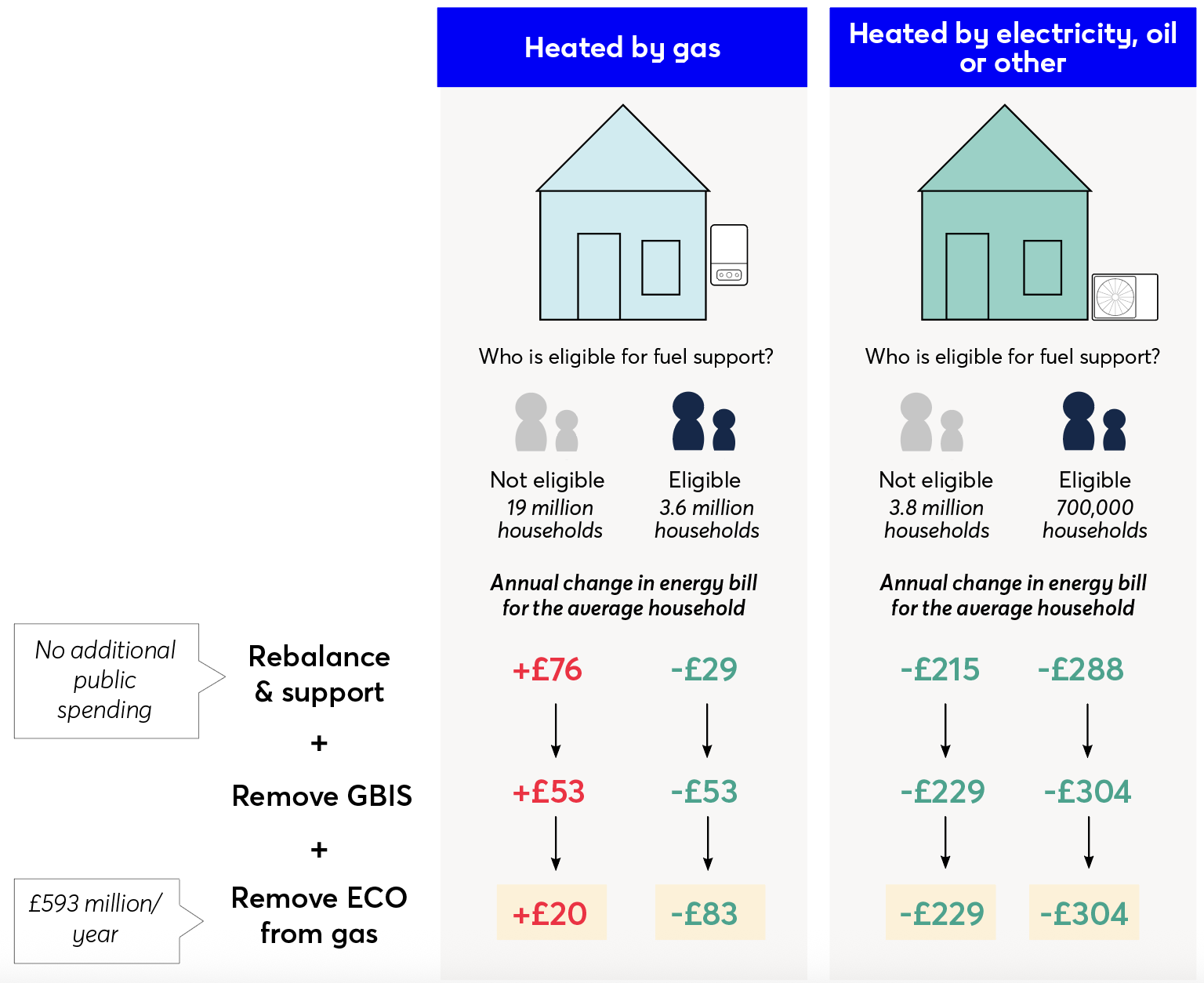
Figure 1 shows the change in the annual bill of the average household under each scenario. The compound proposal, highlighted in yellow, would cut energy bills for 8 million British households. This includes:
- 4.5 million off-gas households who would save on average £240 as a result of cheaper electricity – 700,000 of those who are eligible for bill support would have even larger savings, at £304.
- 3.6 million poorer gas-using households who are eligible for fuel support and would save £83 on average.
Meanwhile, around 19 million gas-using households would see their energy bills rise slightly, by an average of around £20 per year, or £1.70 per month, less than 1% of their total bill. These households would generally not include the most vulnerable households.
Nesta's polling work with Public First found that 92% of households would consider this level of bill increase affordable.[^11] At the same time, rebalancing in this way would create an opportunity for households to make significant energy bill savings by switching to cleaner electric heating such as heat pumps.
Figure 1. Impact on annual energy bills in three rebalancing scenarios
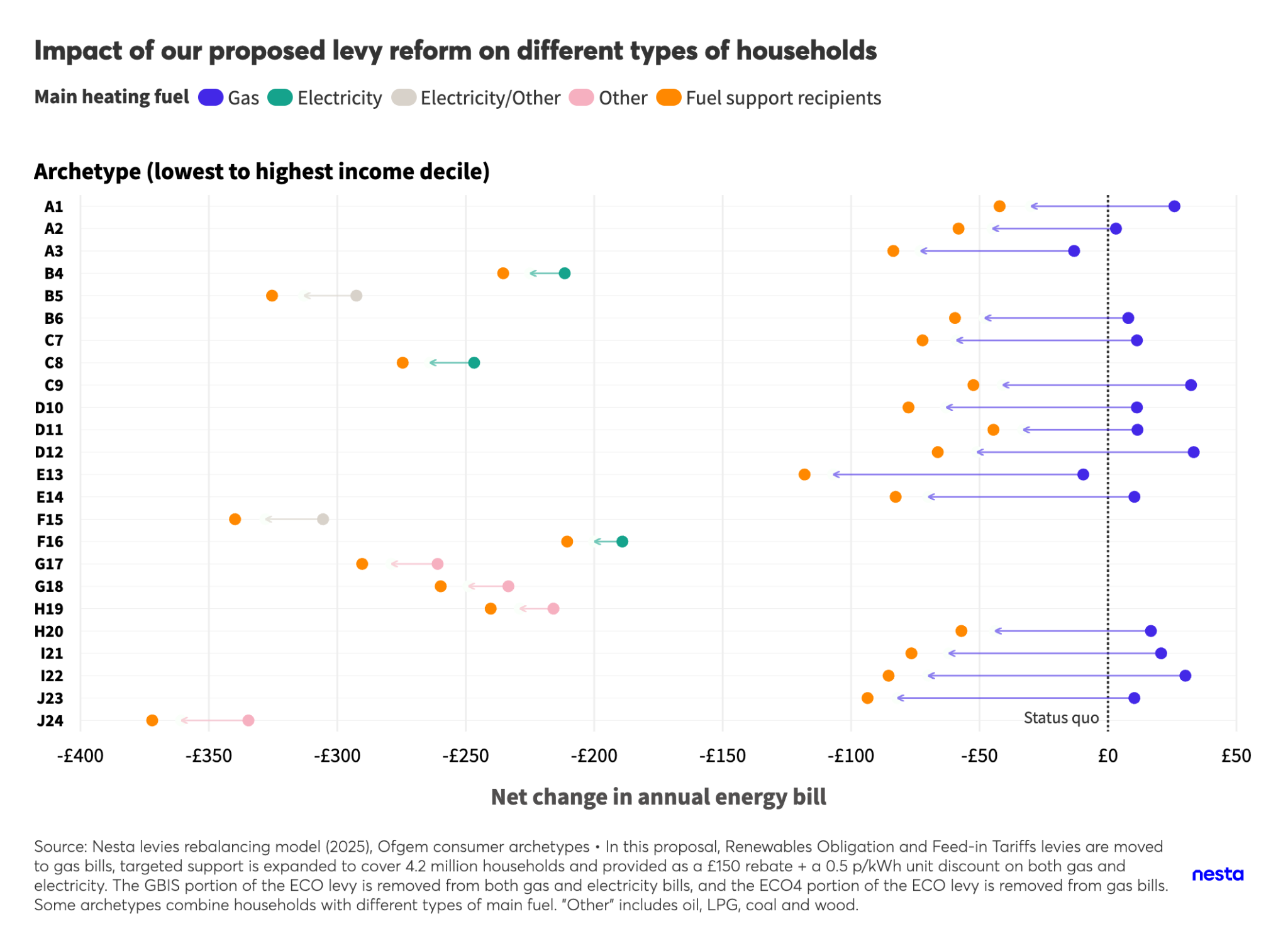
The change in bills will differ considerably between households, depending on their relative consumption of gas and electricity. Figure 2 shows how our proposal would change the annual energy bill for 24 different types of households.
We use Ofgem's consumer archetypes to demonstrate distributional effects. Archetypes are defined by their heating fuel, consumption and demographic characteristics and are ordered by income deciles, from lowest (A) to highest (J). Coloured dots show that the benefit is broadly progressive compared to the status quo - lower-income archetypes at the top have larger savings and smaller bill rises.
Figure 2. Change in annual bill for Ofgem's consumer archetypes under our proposed rebalancing scenario. Open the interactive chart and hover over dots to read descriptions of archetypes.
In our view, targeted bill support is an essential component of levy reform that makes the impact on households fairer. The current support schemes (Warm Home Discount, Cold Weather Payment and Winter Fuel Payment), are limited, but expanding them could ensure they not only mitigate the impacts of moving levies to gas bills for poor gas-using households but also lower bills for those households.
Our scenario uses a modified Warm Home Discount to provide targeted bill support. The government should aim to improve the targeting of bill support – using data-matching instead of solely relying on the benefits system – but for illustrative purposes, we model the discount based on Cold Weather Payments eligibility criteria. Eligibility could be set differently, keeping a similar number of recipients. Our proposal increases the number of households receiving bill support by 840,000 to 4.3 million, which would bring the scheme's core budget from £514 million to £640 million. To ensure that the level of support scales with the needs of individual households, we also propose implementing a 0.5p/kWh discount on each unit of both gas and electricity on top of the current flat £150 rebate. This ensures that those with very low consumption on low income still receive help. This unit discount would add an additional £310 million cost to the scheme, which remains levy-funded.
Phase the changes in gradually
To make the shift more acceptable to households, the government could split up the implementation of reforms and phase them in gradually, coinciding with falling price caps to avoid any overall bill rises at any given time. If rebalancing were introduced over three falling price caps, increased levies on gas-using households could be reduced from a single shift to several smaller ones.
Additionally, our polling shows that fairness is a much more powerful argument than enabling the transition to low-carbon heat, although a third of gas users say they would consider switching to electric heating if electricity was made cheaper. When communicating levy reforms to the public, the government should highlight the immediate benefits of cheaper electricity and any expanded schemes to support low-income households.
3. The benefits of rebalancing levies
Levy reform is challenging, but it would have many important benefits which far outweigh the short-term costs.
1. Fuel poverty strategy can be aligned with net-zero objectives
Rebalancing delivers immediate, significant benefits to the more than 400,000 households in fuel poverty who rely on electric heating. This goes further and at much lower cost to the government than what the Warm Home Discount achieves.
Cheaper electricity is a necessary condition for low-carbon heat to play a bigger role in the fight against fuel poverty. When low-carbon heat can guarantee large savings, fuel poverty schemes will be able to use clean heating as a core tool for reducing fuel poverty, alongside energy efficiency improvements. Without rebalancing, we risk vulnerable households falling behind on the green transition and getting trapped in fossil fuels with unpredictable prices.
2. Heat pumps become an even more affordable option
Heat pumps currently cost about the same to run as gas boilers. Under our proposal, a typical household would save £400 a year by switching from gas to a heat pump.
By extension, it would also reduce the lifetime cost of owning a heat pump when both installation and running costs are factored in. After rebalancing, a typical household that gets a heat pump would also pay over £400 less per year on average than for a gas boiler over its lifetime. This includes using the Boiler Upgrade Scheme (BUS) grant and paying for finance to avoid any upfront cost. Without any rebalancing, a household getting a heat pump will only break even on lifetime costs.
3. Low-carbon uptake increases
Nesta's previous work testing the impact of lowering costs provided evidence that lowering electricity prices by rebalancing could increase uptake by 60% per year.[^12] Lower running costs combined with zero-interest finance increased the number of people choosing heat pumps by 200%. This effect would make the UK more likely to meet its carbon budgets.
4. Public spending on subsidies goes much further
Reducing the relative running costs means that the government can offer smaller subsidies while still ensuring that heat pumps are cheaper than boilers on a whole-life basis. This is because the extra upfront costs for households will be offset by energy bill savings.
Our analysis shows that under rebalancing, the Boiler Upgrade Scheme grant could be reduced to £2,000 by 2030, while keeping heat pumps at cost parity with gas boilers over their lifetime. This reduction would save the government on average £2.8 billion a year over the course of the next parliament, compared to a scenario without rebalancing, where millions of households need a high level of subsidy.
Endnotes
- Ofgem (2025) Energy price cap (default tariff) levels.
- Survey conducted by Public First for Nesta on a 4,000 sample representative of the GB population.
- DESNZ (2024) Historical gas data: gas production and consumption and fuel input.
- Levies including VAT.
- Nesta (2024). For the first time, UK household electricity prices rose to levels higher than those in any EU country.
- Fuel poverty statistics for England under the LILEE definition (DESNZ 2024).
- Nesta (2024) Cheaper Electricity, Fairer Bills (Technical report), Figure 1.
- Typical consumption (11,500 kWh and 2,700 kWh electricity) under April-June 2025 Ofgem price cap. Including VAT at 5%. Rounded to £1.
- GBIS is grossly underperforming against its objectives. If the government wants to avoid more budget spending and wants to keep bills down, it could absorb the objectives of GBIS into a new, more effective scheme.
- ECO4 is worth £1,187 million in 2025, and half of it is raised from gas bills.
- 92% of households say they could afford a bill increase of £5 per month.
- Nesta (2022). How to increase the demand for heat pumps. In an online experiment, changing heat pump and gas boiler running costs in line with rebalancing levies increased the proportion of homeowners choosing a heat pump from 12% to 19%.