We are Nesta. The UK's innovation agency for social good.
We design, test and scale solutions to society's biggest problems. Our three missions are to give every child a a fair start, help people live healthy lives and create a sustainable future where the economy works for both people and the planet.
For over 20 years, we have worked to support, encourage and inspire innovation.
We work in three roles: as an innovation partner working with frontline organisations to design and test new solutions, as a venture builder supporting new and early stage businesses and as a system shaper creating the conditions for innovation. Harnessing the rigour of science and the creativity of design, we work relentlessly to change millions of lives for the better.
Find out more at nesta.org.uk
If you'd like this publication in an alternative format such as Braille or large print please contact us at: [email protected]
Authors
Karen Dawson, Stuart Cook, Eilidh Hughes, Madeleine Gabriel and Tom Leach
Acknowledgements
This report was commissioned by Nesta. Complete Strategy led in delivering the work and authoring the report, in collaboration with project partners and the Nesta project team.
Lead authors
Karen Dawson, Stuart Cook and Eilidh Hughes (Complete Strategy)
Project partners
- Tom Luff (Energy Systems Catapult)
- Neil Barnes
Nesta project team
Tom Leach, Madeleine Gabriel
We would like to thank the following individuals for their advice and challenge throughout the project and feedback on the report:
- Ravi Gurumurthy (Nesta)
- Andrew Chittenden
- Simon Wilde
- Andy Regan (Nesta)
- Alexander Belsham-Harris (Citizens Advice)
Additionally, we would like to thank all the stakeholders across the energy sector who participated in the research and shared their views with us.
Executive summary
Getting to net zero will require significant changes to the way households use energy. If decarbonisation policies are successful, people will adopt electric vehicles, heat pumps and other green technologies in much higher numbers, pushing up demand for electricity and reducing demand for gas.
Meanwhile, as the power sector decarbonises, more electricity will come from intermittent renewable sources, such as wind and solar. This means that balancing energy supply and demand will become more complex. The ability to use energy 'flexibly' - to help avoid large peaks of demand, and encourage households to use energy when it is available – will be increasingly important.
This has major implications for the retail energy market. In Great Britain, households buy their energy from suppliers. This model is known as the 'supplier hub', as, from a customer's perspective, the energy supplier is their point of contact for nearly all interactions with the energy market.
It is not clear that this is the best model to deliver the transition to a decarbonised energy system. Under the current market framework, suppliers have limited incentives to help customers use energy efficiently. The most straightforward way to increase revenue is to sell more energy, and while some suppliers are positioning themselves to help customers decarbonise their homes and reduce energy use, others find it difficult to make this work commercially. This is compounded by other consumer barriers – for example, heat pumps generally cost more than fossil fuel alternatives, and some types of insulation are costly and disruptive to install.
Upgrading millions of homes with low-carbon technologies and other energy efficiency improvements also requires high levels of consumer trust and engagement, neither of which are currently strong in the energy retail market. Doing it quickly requires planning and coordination across suppliers and other institutions, such as distribution network operators (DNOs) and local authorities. Historically, this has not been easy.
Many people across the sector believe that the market could operate differently, but there is little consensus on how it should change.
This report considers a range of potential models for a future retail energy market. Our work focuses on how the market could interact with households and on the delivery of electricity. We do not explore the energy market for businesses nor the role that hydrogen might play in the future energy market.
When imagining what the future energy system will need to deliver, we had in mind a point roughly 10 to 12 years in the future, when (we assume) renewables will provide most generated electricity, electric vehicles will be widespread and heat pumps will be mainstream. The transition to low-carbon heat and transport will be far from complete, however, and the timescale for getting to net zero will be increasingly short. In this imagined future, we assume that the energy market must have three key objectives. It will need to:
- help consumers adopt low-carbon technologies, such as heat pumps at scale, and incentivise energy to be used at home more flexibly
- protect vulnerable consumers and ensure that all customers have access to at least one energy supplier
- enable innovation because there will continue to be obstacles and opportunities that emerge during the transition to net zero, and a successful energy market will need to respond to these as they arise.
In this report we present five broad models for possible retail market arrangements, and discuss the extent to which these would deliver the objectives above. These models, along with an outline of the status quo, are presented separately, but are not mutually exclusive – elements of them could be combined or removed. They are:
Business as usual
Suppliers continue to act as the single link between customers (the supplier hub model) and the wholesale energy market. Consumers continue to have a single energy supplier, and energy suppliers are still obliged to offer a universal service. Government and Ofgem incrementally adjust the regulatory framework to try to speed up progress towards net zero while improving outcomes for consumers, for example by introducing reforms that make it easier for suppliers to reward customers for using less energy at peak times.
Model 1: loosening regulation to encourage more innovation
The supplier hub model stays, and customers still have a relationship with a single supplier. However, regulations are changed to encourage and enable new types of suppliers to enter the market, potentially with different licence conditions. For example, some suppliers are not required to provide a universal service, which allows them to create products and services that are tailored to specific customer groups. We start to see new businesses offering combinations of low-carbon technologies, such as heat pumps and batteries, bundled with specialist tariffs, without having to become a traditional, licensed supplier or partner with an existing energy supplier to do so. We might see well-known brands from other sectors starting to offer energy services.
Model 2: introducing a default supplier with a "no frills" service, and enabling other suppliers to innovate
A new, "default" energy supplier is created – potentially publicly owned. It takes over the obligation to provide a universal service, and it manages billing for monopoly activities on behalf of all domestic customers. Customers can use the default supplier for everything, or they can choose to buy energy (and other services, such as home energy management) from other suppliers. If they do the latter, the default supplier either bills them directly for monopoly activities, or settles this behind the scenes with their energy supplier. This means that existing and new energy suppliers no longer have to manage billing for monopoly activities, and can focus on offering more sophisticated, innovative services and products. They can specialise to serve particular customer groups.
Model 3: introducing split metering in addition to a default supplier
As with model 2, a default supplier is introduced, and customers can choose to use the default supplier for everything. But those who opt to go elsewhere don't have to limit themselves to a single supplier – with split metering, they can have different suppliers for different types of energy use. A household might choose a basic plan for general electricity use around the house, with a flat rate for kWh usage, but additionally opt for a time-of-use tariff from a different supplier for its heat pump and main electric vehicle (EV).
Model 4: awarding franchises on a competitive basis
This model focuses on creating longer-term relationships between suppliers and customers. Each local or regional authority procures a single supplier – or franchisee – to deliver energy services to all the customers in their geographical area, for a set period of time. From a customer's point of view, this removes supplier choice, but the franchise agreement incentivises the awarded supplier to invest in helping customers to upgrade their homes and manage their energy use effectively. We can imagine two variations of this model. In what we've called model 4A, the franchisee takes on responsibility for supplying energy to customers and providing additional products and services, such as installing low-carbon technologies. In model 4B, the franchisee is responsible for these additional products and services only, and customers can still buy their energy supply from other suppliers.
Model 5: turning electricity network operators into energy suppliers
Under this model the local electricity network company builds on its existing role in managing and growing an efficient, decarbonised electricity network, becoming the energy supplier for customers in its geographical area. It also takes on responsibility for rolling out low-carbon technologies to homes. In practice, much of this work is outsourced to specialist installers, so there is still room for a variety of different companies in the market. As with model 4, it would be possible to vary this model, retaining a competitive market for energy supply, and only giving the network company responsibility for rolling out low-carbon technologies.
We do not recommend which of these models, if any, should be pursued, nor do we explore the practicality of implementing them in any detail. Instead, the aim of this report is to prompt a wider conversation about the long-term future of the energy retail market and spark debate about the types of changes that could potentially accelerate decarbonisation and better outcomes for consumers.
Our approach
This report asks the question: how could the electricity retail market be designed to better support the delivery of net zero? Our goal is to present options, not recommendations. Future phases of work could include more rigorous analysis and modelling, which was not in scope here.
Our premise was that a successful energy market would be one that helps consumers to cut carbon emissions by installing low-carbon technologies and using energy flexibly and efficiently. To do this, we assumed that innovation would be needed in products and business models. We assumed it was likely that the market would need to provide services (such as support to manage demand, financing and installation of technology) as well as, or even instead of, selling energy to customers by the kWh.
At the same time, the market would need to have appropriate levels of regulatory oversight to protect customers (particularly vulnerable customers) and ensure that energy is affordable. We assumed that future consumers would have varying capabilities and motivation to engage with energy use and home decarbonisation; retail market design would need to take this into account.
Figure 1 illustrates the steps we went through in delivering the project.
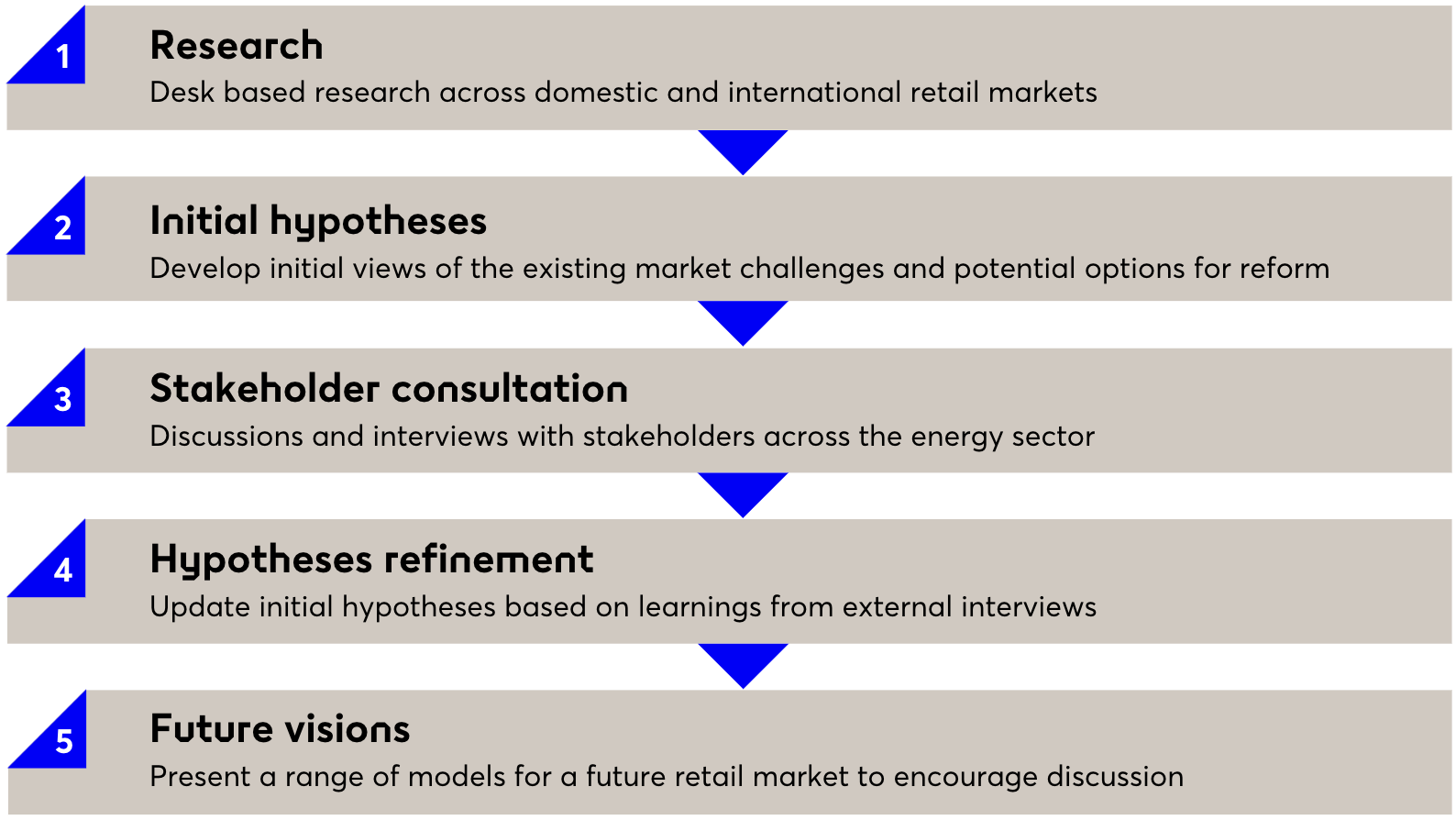
Figure 1. Overview of structured approach
We also looked at the experience of international electricity markets, although we recognise that the British market is seen by many as one of the most competitive and innovative markets globally. In order to learn from other regulated, customer-facing industries, we consulted experts in the financial services and telecoms sectors. While drawing on international and cross-sector learnings is important, we acknowledge the potential limitations in their applicability to the British retail electricity market.
We tested our initial hypotheses and emerging thinking with a wide range of stakeholders with diverse experience of the British electricity sector, including suppliers, the regulator, civil servants, industry commentators, consumer groups, academics and innovators. We grouped our refined hypotheses into a set of models. We present the models to prompt thinking about potential retail sectoral change and drive forward the conversation regarding what is needed from the British retail electricity sector in the future.
The status quo and case for change
The British energy retail market today: a 'supplier hub' model
The current retail energy market is based around a 'supplier hub' model, where licensed energy suppliers act as a single interface between customers and the other parts of the sector.
Energy suppliers procure energy on wholesale markets to meet aggregate customer needs, offer tariff choices to customers, provide metering and billing and respond to customer enquiries. Suppliers also have a range of obligations that go beyond buying and selling energy, including rolling out smart meters to customers, collecting customer contributions for network costs, social and environmental policies and passing them on, and managing the delivery of some of these schemes, such as the Energy Company Obligation (ECO). During the energy price crisis in 2022, suppliers played a key role in passing on energy bill support to customers. Many of these activities are necessary for the electricity market to function, but they are also monopoly activities over which the supplier has little control or influence.
Those looking to enter the British energy retail market have a range of options for doing so, including applying for a full supply licence or partnering with licensed suppliers. However, in practice there has been limited uptake of ‘alternative' supply options. Suppliers are subject to a Universal Service Obligation, meaning they have to offer terms to all customers and cannot disconnect them at the end of a contract.¹
While the supplier hub model is a fundamental part of the British energy sector, it is not used everywhere internationally. The New York and Pennsylvania markets do not require consumers to have a relationship with a supplier – instead, network operators (DNOs) provide a default tariff. In California, the domestic energy market is centred around regional networks which provide default tariffs, and consumers are only able to access alternative tariffs by forming Community Choice Aggregators to procure energy on their behalf. Many European markets retain a combined network operator/supplier model.
The British energy market continues to evolve. There is significant work ongoing on wider electricity system reforms, including the introduction of Market-wide Half Hourly Settlement, which will use household half hourly meter readings to provide faster and more accurate settlement (the system that reconciles differences between a supplier's contractual purchases of electricity and the demand of its customers) for suppliers, and aims to enable more sophisticated time-of-use tariffs for willing customers. There may be further changes as a result of the government's Review of Electricity Market Arrangements (REMA), which is considering whether reforms, such as introducing locational pricing (where wholesale prices vary to reflect the value of electricity at different locations), could support the transition to a decarbonised, cost-effective and secure electricity system.² The UK Government has committed to delivering a net zero power system by 2035, with the Labour party pledging to do so even more quickly. In this report, we focus only on retail market arrangements, while acknowledging that retailers are part of a wider energy market, which itself is changing, potentially rapidly.
The net zero challenge and the role of energy retail
With homes and car use accounting for 16% and 13% of total emissions respectively, 3,4 the UK will not be able to reach its net zero goals without action from households. Consumers will need to adopt new technologies such as electric vehicles (EVs) and heat pumps, improve the thermal performance of their homes, and change the way they use energy – for example, shifting energy use away from times of peak demand.
Currently, this is not happening quickly enough. There were only 72,000 heat pump installations in 2022, despite generous government subsidies⁵ a long way off the government's target of 600,000 installations per year by 2028. In 2022, while 71% of properties with cavity walls had wall insulation, the same was true of only 9% of properties with solid walls – and these figures had grown by just 1.5% per year across both property types.⁶ While adoption is growing, EVs make up only 2%-3% of the domestic vehicles on the road.⁷ At the moment, many households appear not to engage very actively with their energy use: in 2021, an estimated 7-13 million customers had never even switched energy provider⁸ and fewer than half actively monitored their energy use, even among those with a smart meter (although the success of the Demand Flexibility Service, which compensated households and businesses for reducing consumption at specific times when the system was stressed over winter 2023-2024, suggests that it is possible to motivate households to take part in demand shifting at scale).
We need customers to engage more actively in energy use than before, but we don't necessarily need everyone.
Stakeholder interview
All this sits against a backdrop in which many households are struggling to pay their energy bills and vulnerable consumers continue to miss out, with less access to innovative tariffs and little chance of being able to afford investment in new technologies.
There is, therefore, a significant opportunity for the customer-facing parts of the electricity sector to support households in making the changes needed to reach net zero. This could be by introducing new products and services tailored to different homes, income levels and energy needs, and communicating with households through channels that suit them.
Several of the stakeholders we spoke to said the retail sector was beginning to rise to this challenge. They pointed out positive recent developments in the household retail electricity market that are helping customers adopt low-carbon technologies, reduce energy demand and/or use energy more flexibly. These include, for example:
- a greater range of time-of-use tariffs, which typically require a smart meter to be installed, and incentivise customers to shift energy consumption to times of the day when demand (and hence prices) are lower
- innovative trials and tariffs, such as those that allow suppliers to determine when a customer's EV is to be charged over a predetermined period and use the EV as a storage battery within that period
- suppliers partnering with low-carbon technology providers to offer heat pump, battery or solar panel installation alongside tariffs that incentivise customers to use these technologies flexibly
- suppliers offering customers the opportunity to take up smart meter installation as part of a targeted, local rollout (such as street by street)
- the National Grid's Demand Flexibility Service enabling large numbers of households to participate in demand reduction schemes and earn a rebate.
Providing proper price signals and a route to market will help to drive innovation.
Stakeholder interview
However, many of the stakeholders we interviewed nevertheless felt that the market is not currently designed in a way that supports households to decarbonise in the timescales required. They cited several potential problems.
- Suppliers lack strong financial incentives to help customers reduce consumption: although suppliers increasingly have social purpose obligations, it is not clear that the current combination of financial incentives and licence obligations provides an effective reward for suppliers to help their customers to reduce consumption, for example through energy efficiency measures.
- There is relatively little differentiation in products and services to support customers in the net zero journey: some stakeholders questioned the rationale of a competitive market given that suppliers are largely selling the same products and services to customers, with little variation in price. However, they also recognised that the energy price crisis, and subsequent policy and regulatory decisions to protect consumers, temporarily limited suppliers' ability to offer targeted services, and that more variety in products and services might emerge as market conditions improve.
- A focus on price competition has reduced other forms of competition – for example, on customer service – and has damaged trust in suppliers: research suggests that, across the market, consumers do not trust the energy sector: a survey in 2023 found that 49% of respondents think that energy companies are untrustworthy when considering whether they give customers a fair deal.⁹ Against this backdrop, suppliers may not be the best placed to support customers to make investments in low-carbon technologies, or even to change their energy use behaviour.
- Low margins act as a barrier to investment: Ofgem's Default Tariff Cap is calculated on an assumption that suppliers will make a 2.4% margin.¹º This was cited by some stakeholders as a risk to investment for more innovative players.
- Regulatory complexity limits large-scale innovation: Ofgem's principal duty is to protect consumers, and much of the market regulation in place was developed with protection in mind (for example, measures addressing mis-selling of tariffs, ending enforced prepayment meter installation and reducing the risk of supplier financial failure). The level of regulation in the market has increased since 31 energy companies ceased trading between early 2021 and 2023.¹¹ Stakeholders argued that the overall regulatory burden presents barriers to innovative new entrants. For example, companies primarily seeking to provide energy efficiency services, such as 'behind the meter' flexibility, may need to become, or partner with, licensed energy suppliers to access the market. Compliance with licence conditions entails high upfront costs, the need for access to significant capital to cover against potential losses, and the requirement to supply any consumer in the British market. This may make business models impractical.
- Data is fragmented and hard to access, making it more difficult to offer targeted products and services at scale: the energy sector has arguably lagged behind other sectors, such as finance, in the way it has harnessed and used data. The Energy Data Taskforce highlighted challenges with data gaps, limited access, poor data discoverability and poor quality data, among others.¹² The UK Government and Ofgem are taking steps to improve this – for example, Ofgem has recently consulted on ways to give consumers the ability to share data securely with market participants¹³ – but there's still some way to go to meet the Energy Digitalisation Taskforce's vision that “new business entrants can tailor and shape new propositions to a wide and varied range of options designed around customer products as well as commodity needs".¹⁴
- The market doesn't incentivise customers to change their behaviours or adopt low-carbon technologies. For example, environmental and social levies fall mainly on electricity bills, meaning that these may reduce the gains from switching from gas to electricity, despite reducing their carbon emissions. The incentives for customers to export energy to the grid are not consistent – if a consumer provides electricity from their low-carbon technology, their supplier only needs to offer a price above zero for the electricity (although a consumer can export via a different supplier who may offer a more attractive tariff).¹⁵ While wholesale electricity prices vary widely depending on time, customers have little incentive or ability to take advantage of this currently – only 12% of households said they were on a time-of-use tariff in 2022.¹⁶
The extent to which this creates a burning platform for change is a matter of debate. Further reforms, such as the Market-wide Half Hourly Settlement, and reforms to wholesale market arrangements (REMA) could make it possible for suppliers to reward customers for changing their energy behaviours. Some stakeholders argued this means there is no need for thoroughgoing change to the current market – particularly as this will be costly and time consuming. However, others argued that there are strong reasons to believe the current market design will be a barrier to delivering net zero. We think it's at least worth exploring what alternative market arrangements could look like – at a minimum, this might prompt different lines of thinking around how the existing market could evolve.
Endnotes
What roles are needed in a future energy market?
To help generate options for alternative ways to design the energy retail market, we identified the market roles we believe will be needed to successfully support the net zero transition.
By doing this, we aimed to disentangle activities from the bodies that currently undertake them, so that we could think more freely about how a future energy market might be arranged.
| Service |
Description |
| Energy services |
Provision of electricity to customers, either on a per kWh basis or as a service (for example, heating a home to a specific temperature). |
|
Provision of flexibility services (such as aggregation of household demand to support local grid balancing). |
|
Provision of monopoly services to consumers (which may or may not involve a customer relationship) such as use of network charges or policy levies. |
| Household energy management services |
Provision of remote control of household devices (for example, managing EV charging, automatic demand shifting), provision and maintenance of technology or providing the means and capability of customers to respond to price signals and manage demand. |
| Data services |
Provision, analysis and interpretation of consumption data to customers and/or service providers. |
|
Provision of system data (such as meter technical data) to service providers. |
| Advisory services |
Provision of unbiased insights and local advice to consumers regarding energy efficiency, low-carbon technologies, financing options, etc. |
|
Provision of tariff information across multiple suppliers (for example, energy comparison websites). |
|
Provision of information and support for vulnerable customer groups. |
| Financial services |
Provision of financing for household alterations and low-carbon technologies, including heat pumps and EVs. |
| Household alteration services |
Installation and system design of low-carbon technologies and supporting hardware and software to maximise the decarbonisation and cost benefits obtained from the assets. |
Some, but not all, of these roles are currently played by energy suppliers.
In developing options, we assumed it would be possible to shift some roles between entities. For example, some roles currently undertaken by suppliers could be reduced or changed. Conversely, suppliers could take on additional roles, such as provision of household energy management and data services.
There are some roles for which commercial participants may not be best placed. For example, commercial entities may not be the right participants to provide independent advisory services to consumers. Similarly, more significant policy interventions might be needed to develop appropriate financial services to enable consumers to afford their transition.
Market models
In this section we set out five possible models for the future of the energy retail market and discuss the ways these would change the roles of different stakeholders within the retail market, as well as the models' pros and cons. We briefly outline the regulatory actions, targets and enablers that could be put in place or would be needed in order for these models to be used. We distinguish between broad categories of services that different market players might provide to customers. We define these services as follows.
- Monopoly services are those that suppliers provide on behalf of other players, such as billing customers for levies and network charges.
- Basic services refer to the provision of electricity charged on a simple per kWh basis (with or without a standing change) including existing tariffs such as Economy 7.
- Enhanced services describe more innovative offerings from suppliers, such as more sophisticated time-of-use tariffs, household energy management services, low-carbon technology installations and other energy efficiency improvements to homes, and meter splitting services. These could also be bundled with energy supply.
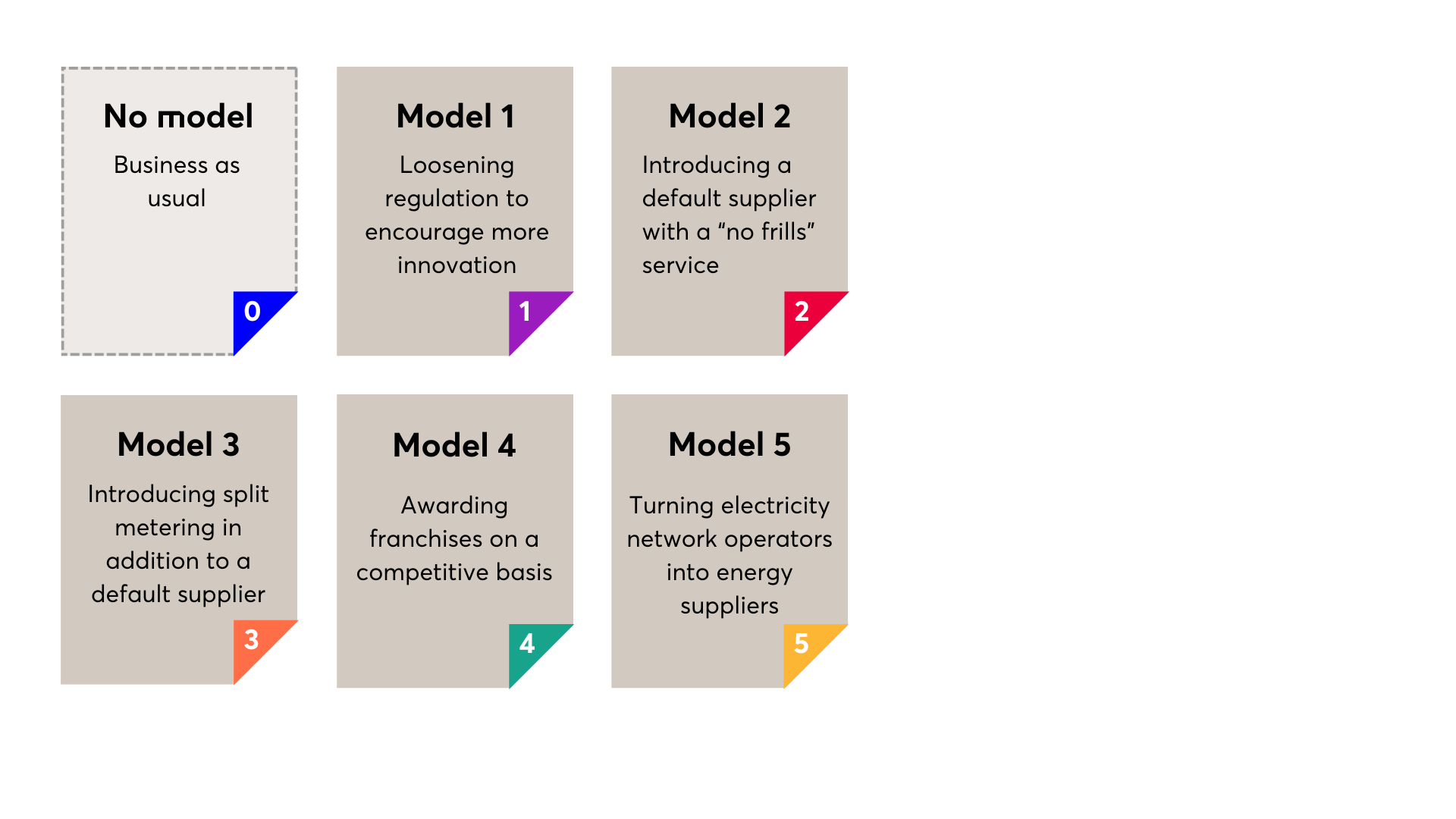 Figure 2. Overview of models
The models follow three customers. Tim is a disengaged customer who is content with his current electricity tariff. Anna is keen to reduce her consumption and/or take advantage of opportunities to reduce her bills. Maya has already purchased an EV and is keen to install other low carbon technology if she can afford it.
Business as usual
The supplier hub model stays in place, which means suppliers act as the single link between customers and the wholesale energy market. Consumers continue to have a single energy supplier, and energy suppliers are still obliged to offer a universal service. Government and Ofgem incrementally adjust the regulatory framework to try to speed up progress towards net zero while improving outcomes for consumers, for example by introducing reforms that make it easier for suppliers to reward customers for using less energy at peak times.
Model 1: loosening regulation to encourage more innovation
The supplier hub model stays, and customers still have a relationship with a single supplier, but regulations are changed to encourage and enable new types of suppliers to enter the market, potentially with different licence conditions. For example, some suppliers are not required to provide a universal service, which allows them to create products and services that are tailored to specific customer groups. We start to see new businesses offering combinations of low-carbon technologies, such as heat pumps and batteries, bundled with specialist tariffs, without having to become a traditional, licensed supplier or partner with an existing energy supplier to do so. We might see well-known brands from other sectors starting to offer energy services.
Model 2: introducing a default supplier with a “no frills" service, and enabling other suppliers to innovate
A new, "default" energy supplier is created – potentially publicly owned. It takes over the universal service obligation, and it manages billing for monopoly activities on behalf of all domestic customers. Customers can use the default supplier for everything, or they can choose to buy energy (and other services such as home energy management) from other suppliers. If they do the latter, the default supplier either bills them directly for monopoly activities, or settles this 'behind the scenes' with their energy supplier. This means that existing and other new energy suppliers no longer have to manage billing for monopoly activities, and can focus on offering more sophisticated, innovative services and products. They can specialise to serve particular customer groups.
Model 3: introducing split metering in addition to a default supplier
As with model 2, a default supplier is introduced, and customers can choose to use the default supplier for everything. But those that opt to go elsewhere don't have to limit themselves to a single supplier – with split metering, they can have different suppliers for different types of energy use. A household might choose a basic plan for general electricity use around the house, with a flat rate for kWh usage, but additionally opt for a time-of-use tariff from a different supplier for its heat pump and main EV. The household might have a second car – perhaps owned by a young adult – who wants the cheapest tariff and is willing for their charging to be completely automated, and they might go with a specialist tariff from yet another supplier.
Model 4: awarding franchises on a competitive basis
This model focuses on creating longer-term relationships between suppliers and customers. Each local or regional authority procures a single supplier – or franchisee – to deliver energy services to all the customers in their geographical area, for a set period of time. From a customer's point of view, this removes supplier choice, but the franchise agreement incentivises the awarded supplier to invest in helping customers upgrade their homes and manage their energy use effectively. We can imagine two variations of this model. In what we've called model 4A, the franchisee takes on responsibility for both supplying energy to customers and providing additional products and services, such as installation of low-carbon technologies. In model 4B, the franchisee takes on responsibility for these additional products and services only, and customers can still buy their energy supply from other suppliers.
Model 5: turning electricity network operators into energy suppliers
Under this model, the local electricity network company (DNO) builds on its existing role in managing and growing an efficient, decarbonised electricity network, becoming the energy supplier for customers in its geographical area and taking on responsibility for rolling out low-carbon technologies to homes. In practice, much of this work is outsourced to specialist installers, so there is still room for a variety of different companies in the market. As with model 4, it would be possible to vary this model, retaining a competitive market for energy supply, and only giving the DNO responsibility for rolling out low-carbon technologies.
Business as usual
The most straightforward option would be to keep the current supplier hub model and continue adjusting the regulatory framework to speed up progress towards net zero while improving outcomes for consumers.
Some significant regulatory changes are already in train, such as the introduction of the Market-Wide Half Hourly Settlement. If implemented effectively, this will incentivise suppliers to launch more innovative tariffs that reward customers for shifting their energy use to times of day when demand is lower. Customers with smart meters will be better able to take up these opportunities, so there will be an additional incentive for suppliers to invest in speeding up smart meter rollout. From a customer perspective, new tariffs and flexibility services might increase interest in smart meter uptake (although the prospect of differential pricing might further entrench distrust of smart meters for some).
Ofgem can also adjust regulations to encourage further innovation or new types of organisation to enter the market, such as recent changes to open up flexibility markets to a wider range of actors. Meanwhile, the Review of Electricity Market Arrangement (REMA) could introduce further significant changes, such as the introduction of locational pricing, which in turn could stimulate more innovation, although it could also increase complexity and risk.
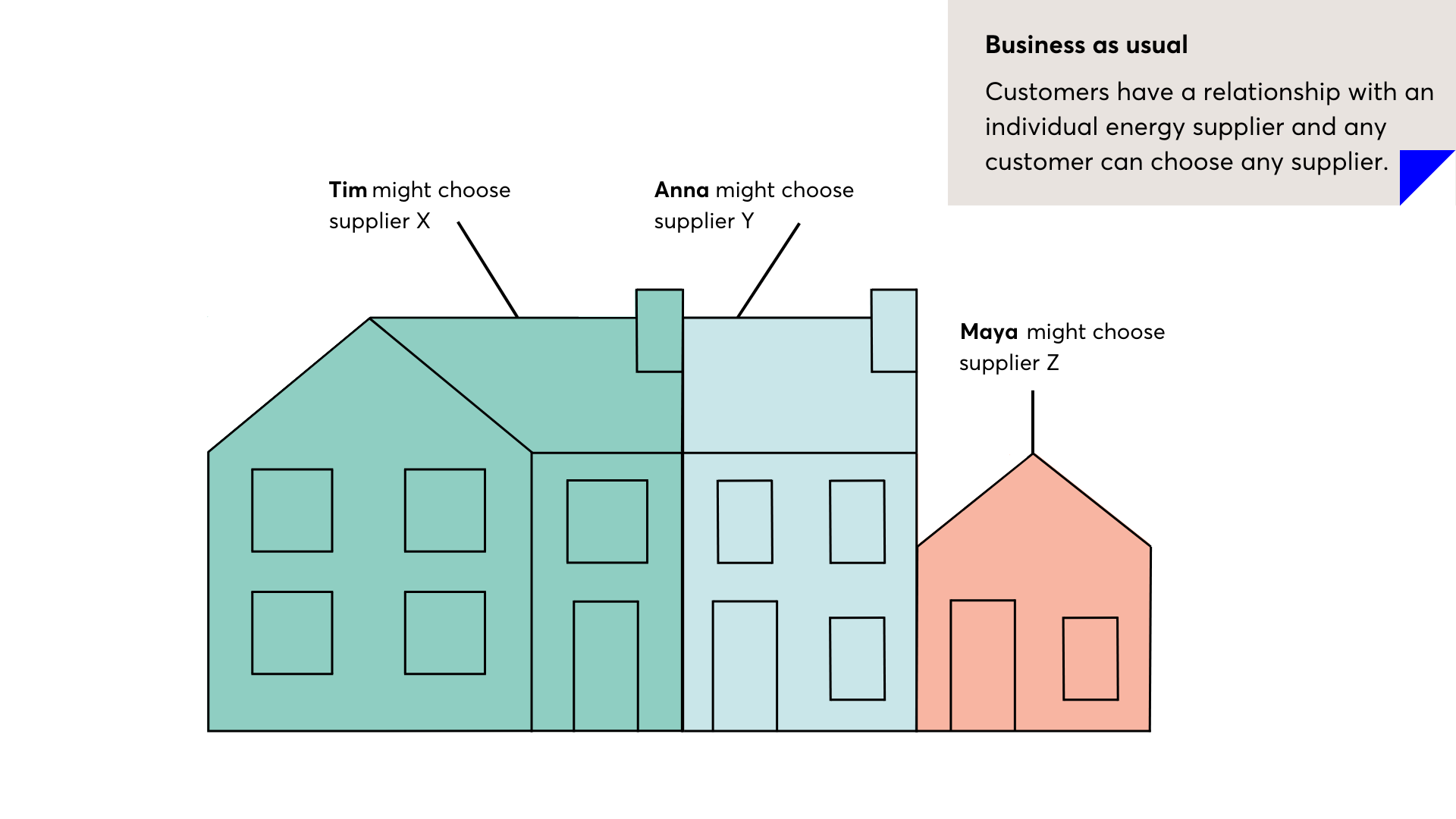 Figure 3. Business as usual
Pros and cons of sticking with the status quo
The current supplier hub model is well understood by stakeholders and, to a lesser degree, by consumers and politicians. Continuing along the current trajectory would be the least disruptive approach. Although stakeholders agree that innovation in the retail market has been slow for most of the last three decades, they also agree the sector is now becoming more innovative. A fundamental change to retail market arrangements risks undermining progress already made, and even opening debate about the prospect of change could potentially damage investor confidence, making it harder for suppliers to innovate.
However, while it is plausible that existing market structures, with slight evolution, will be successful in helping consumers use electricity more flexibly, suppliers' incentives to support customers with energy efficiency and installing low-carbon technologies will still be weak. Without further changes to the current model, it seems unlikely many suppliers will be incentivised to drive the necessary shifts in customer behaviour.
Model 1: loosening regulation to encourage more innovation
One option to move beyond the status quo would be to make regulatory changes that reduce barriers to retail market entry.
To do this, Ofgem would need to introduce more regulatory flexibility or provide greater regulatory incentives for a broader set of suppliers to emerge, offering a greater range of products and services.
Regulatory changes could include reforming or abolishing the universal supply obligation; narrowing the range of activities that require a supply licence; or restricting customers' freedom to switch supplier at any point (for example, if they had purchased a bundle comprising low-carbon technologies, installation and tariff, part of which was funded by their supplier and recovered over time).
Under this model, we might expect a greater range of organisations to enter the energy supply market, some of which could look quite different from traditional energy suppliers.
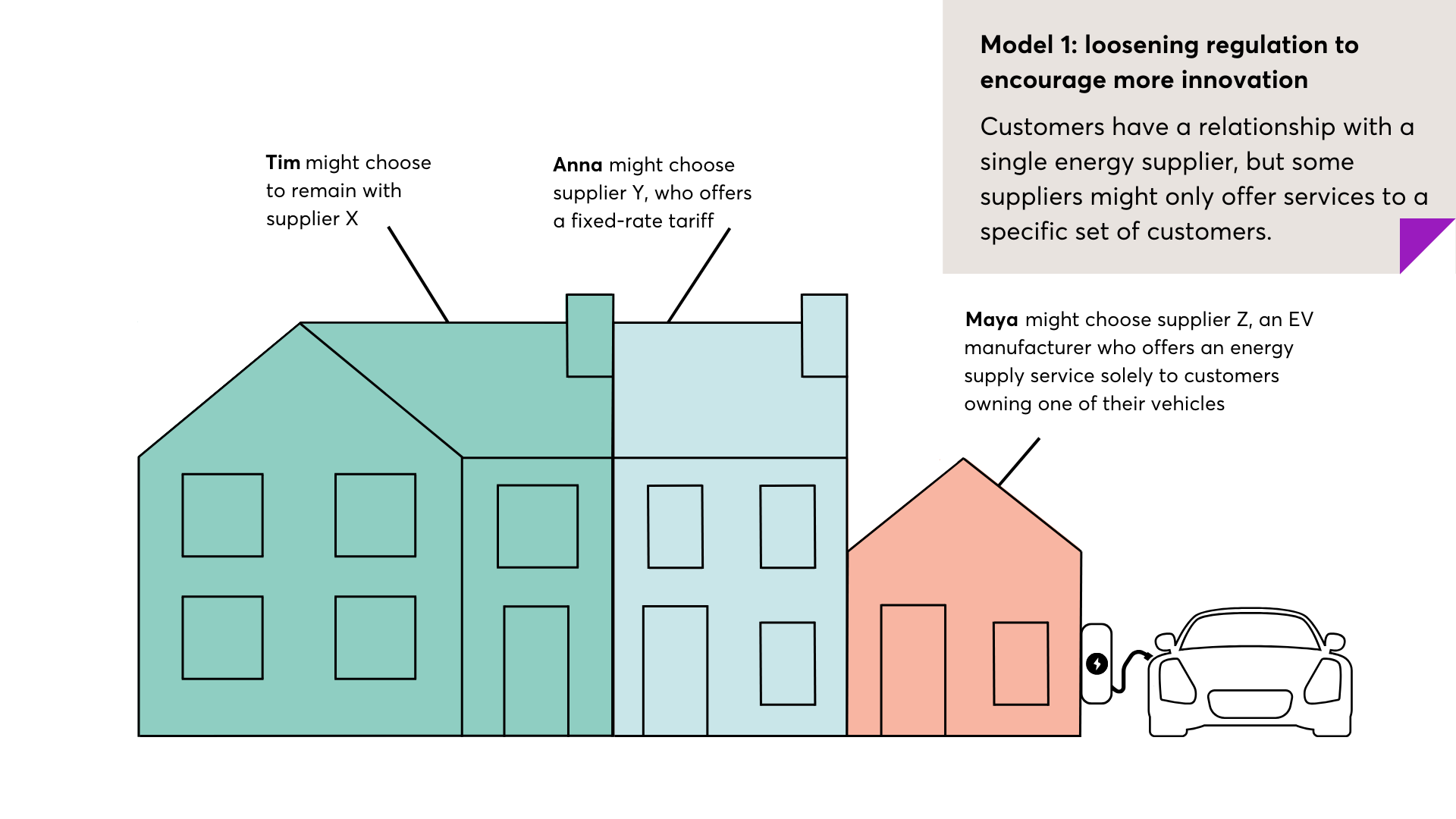 Figure 3. Model 1
Pros and cons of loosening regulation to encourage more innovation
Abolishing the universal supply obligation could open the door to specialised or regional suppliers. These suppliers may not be physically or economically capable of supplying customers anywhere in the country, but they could provide a specific or value-added service to certain groups of customers. For example, a community-run onshore wind farm may be well suited to supply energy to customers in a local area, which could reduce transport costs and potentially take advantage of customer-side storage opportunities, such as EV and storage batteries.
The narrowing of activities requiring a supply licence would make it easier for innovative businesses to provide services that would have previously required a supply licence, such as heat pump installation and tariff bundles or Energy as a Service (EaaS)¹⁷. Enabling this kind of specialisation could reduce overall costs for customers and allow them to purchase value-added, decarbonisation-focused services that suit them. ¹⁸
This model could provide greater customer choice, improve the overall functioning of the market (for example, enabling new entrants with strong customer service expertise) and expand the potential for innovations to be brought to market. It could also allow for innovative entrants to the market to continue to grow past the 250,000-customer threshold at which they must currently comply with all licence obligations.
However, abolishing the universal supply obligation could be seen as a drawback as it would allow suppliers to decide which types of customers they wished to supply. This would potentially leave disadvantaged customers with little choice, less protection and exclude them from the more innovative options. There would need to be some form of obligation such that every customer had access to at least one supply tariff or set of tariffs.
Meanwhile, non-traditional suppliers can already enter the market through the licence-lite mechanism (where a new supplier can partner with an existing supplier to be responsible for some of the more costly and technically challenging parts of a supply licence), but there has been low take-up. It's arguable that further reforms to licensing might still generate little interest among new entrants. Consumer demand for more sophisticated energy products and services is also still nascent, so it's not clear that loosening regulation would lead to a flush of successful product and service launches. With large numbers of suppliers having recently left the market, there is an understandable hesitance about encouraging new entrants and appearing to dilute protections for consumers.
Targets and enablers
Delivering this model would require two significant changes in approach from Ofgem. Firstly, Ofgem would need to look at the potential for new market structures to better support the roll out of products and services that support decarbonisation (while keeping the supplier hub model), including the implications of removing the universal supply obligation. Secondly, and supporting this, Ofgem would need to create space for new innovations to be effectively trialled within the current market structure. While the Energy Regulation Sandbox currently provides a route for those innovators with a supply licence to trial new products, services, business models and methodologies in a slightly reduced regulatory environment, there is a limited route to rolling out successful new innovations. A reformed market would need clarity around how innovations could become market products.
Beyond reforming regulations to reduce barriers to entry, the UK Government and Ofgem could also shape the activities of regulated suppliers and new entrants to the market by introducing new targets or obligations that incentivise good performance and decarbonisation, thereby encouraging innovation.
Medium and large suppliers currently have a range of obligations they need to meet, including the Energy Company Obligation (ECO) and Great British Insulation Scheme (GBIS). These schemes mandate that suppliers install a certain number of upgraded energy systems or insulation products, depending on their size, and allow suppliers to trade their obligations with other companies.¹⁹ Suppliers often outsource the planning and installation processes to third party companies.
Future obligations placed on suppliers could include targets for developing more innovative products, such as behind-the-meter balancing systems, battery storage, EV chargers or bundled low-carbon technology and electricity tariffs. If combined with incentives for good performance, this could provide motivation for new and innovative suppliers to join the market and invest in bundled low-carbon technology and tariff offerings. Another way to bring forward more innovation to help customers decarbonise their energy use would be to support longer-term relationships between customers and suppliers. These could include introducing property-linked finance²⁰ and/or simple, standardised ways to transfer liabilities between suppliers when contracts end. The model considers suppliers taking on the role but other alternatives could include managing costs through council taxes or other forms of taxation.
Suppliers would then have more incentive to offer services that include installing low-carbon technologies or other upgrades to homes, which require customers to pay back over a longer period of time. These could, for example, bundle the installation of solar panels and a heat pump with the supply of electricity and provision of a behind-the-meter balancing service. This would allow the customer to spread the cost of installation over their contract and give the supplier certainty on their returns for the installation of the kit.
The nature of the financial product used could take several forms and would need further discussions on the pros and cons of each form.
Stakeholder roles
There are no major changes to stakeholder roles from business as usual, as monopoly services are likely to be provided by existing suppliers, and basic and enhanced services will be provided by both existing and new suppliers.
Model 2: introducing a default supplier with a “no frills" service, and enabling other suppliers to innovate
In comparison with model 1, a more fundamental change to the retail market would be to introduce a default supplier – potentially a DNO or publicly owned national supplier – operating alongside existing and new suppliers. The default supplier could offer a basic, “no frills” energy supply, while other suppliers could concentrate on offering more sophisticated products and services for customers interested in and willing to engage with the energy market. This would end the supplier hub model.
In this model, the billing for monopoly services currently undertaken by all licensed suppliers would be moved to the default supplier, which would also take over the universal service obligation. Customers could use the default supplier for all their energy supply, or opt to contract with one or more other providers to deliver energy supply and enhanced services. Where a customer used a different supplier for energy supply, monopoly services would still be provided by the default supplier. Customers would be billed directly by the default supplier for these services, or bills would be settled ‘behind the scenes’ between the customer's main energy supplier and the default supplier. The customers would retain a relationship with a single supplier but the nature of the supplier would differ across customers.
Competitive suppliers and non-supplier third parties – legacy and new entrants – would need to provide meaningfully differentiated services to attract customers. They might focus on helping customers access the potential benefits of household flexibility, or offer other innovative services. For example, customers could be offered a 'behind-the-meter' balancing service, which could automatically optimise their energy usage to take advantage of the cheapest rates on their time-of-use tariff and sell back excess energy stored in batteries at peak times. Suppliers could also bundle services together, such as offering to install low-carbon technologies alongside a long-term energy contract to spread the cost of installation over several years.
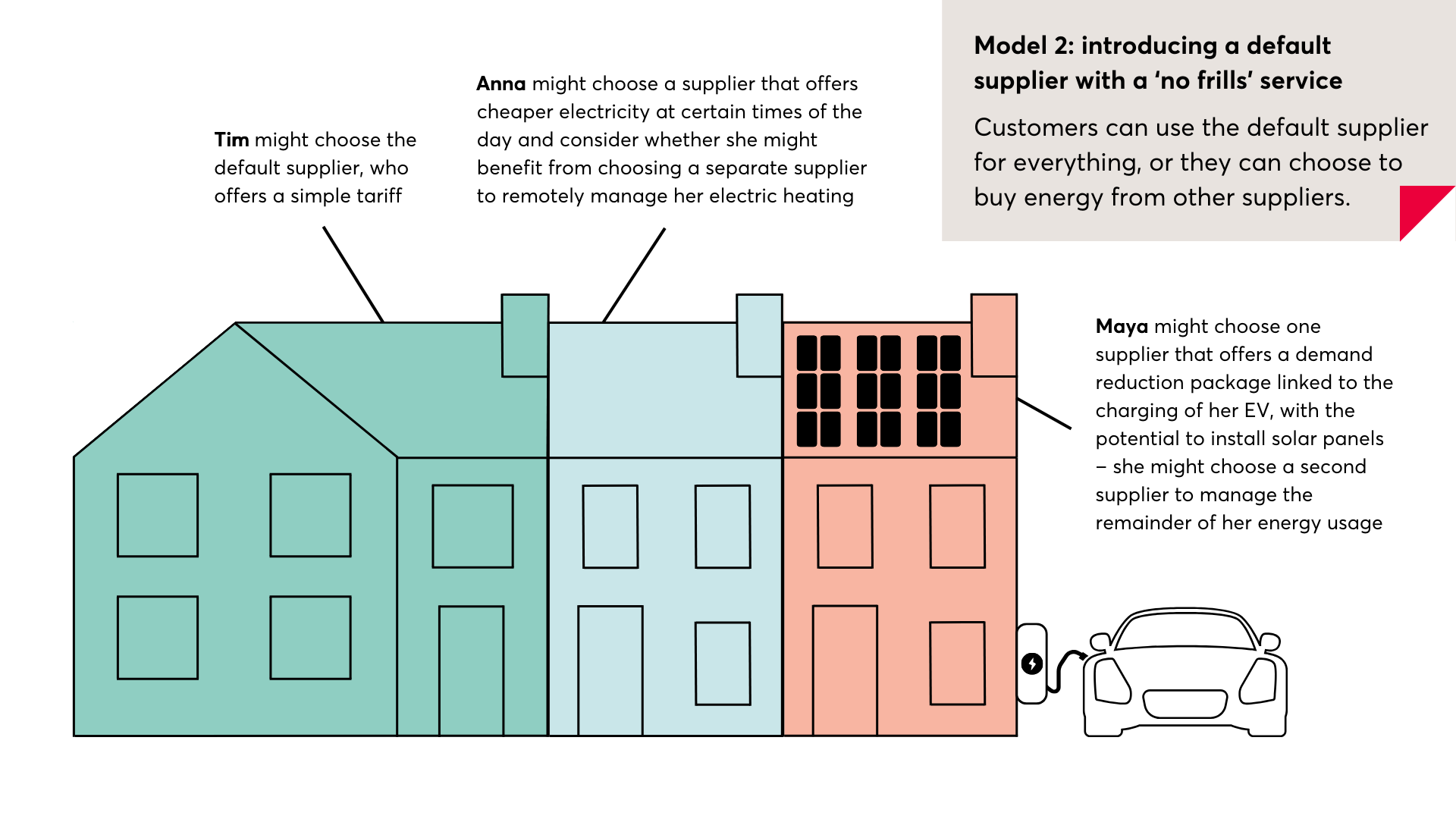 Figure 5. Model 2
Pros and cons of introducing a default supplier
This model would alleviate the regulatory burdens on suppliers by moving monopoly services to a default supplier. This could then enable competitive suppliers to focus on value-added services, potentially fostering innovation, including in tariffs.
Customers could opt to stay with the default supplier and receive a basic “no-frills" service or choose an alternative supplier that offers services best suited to their needs. This approach could provide greater financial protection for customers who would be unlikely or unable to engage in the market.
However, customers who wish to obtain value-added or innovative services would need to actively engage with the market and select those products or services; this model places the onus on customers to procure additional services to ensure the energy and cost efficiency of their tariff.
Suppliers may decide they do not want to provide basic services and so only focus on the engaged customer base with an interest in more innovative offerings. As a result, disadvantaged customers might effectively be restricted to the default supplier, and miss out on novel service offerings that could improve their energy efficiency. This would deepen the divide between disadvantaged or disengaged customers and those who are active in the market. Targets and enablers may be required to ensure that disengaged customers are not left behind by the energy transition and are encouraged to make use of appropriate innovative tariffs and low-carbon technologies.
Targets and enablers
As with model 1, the UK Government and Ofgem could shape the activities of stakeholders towards decarbonisation aims through targets, enablers and obligations. However, in a non-supplier hub model, these may need to take a different form.
One approach could be to put obligations on the default supplier. This would make them responsible for installing certain quotas of low-carbon technologies, but it could crowd out competitive suppliers and third-party companies and hamper their innovation.
A different approach could be to offer incentives to suppliers and companies offering flexibility services and installing low-carbon technologies to upgrade certain heating systems or roll them out in targeted regions. This would help to draw businesses to certain areas of the market which may otherwise be neglected by competitive suppliers and third-party companies. For example, incentives could be offered to companies willing to install EV chargers in rural areas.
Stakeholder roles
The main change from the current model is that the default supplier would take on monopoly services and the universal service obligation. It could also take on further activities, such as the provision of advisory services for vulnerable customers.
Model 3: introducing split metering in addition to a default supplier
Like model 2, this model is dependent on creating a default supplier to take on monopoly services and provide basic energy supply, freeing up competitive suppliers and third parties to offer more sophisticated, enhanced services. However, under this option, meter points would be split such that multiple suppliers could provide electricity to customers for different purposes. Technical and financial settlement innovation would be required to enable meter splitting.
This model would allow for an increased level of third-party activities, potentially facilitating a wider range of services and encouraging innovation. For example, a household might take out an EV-specific time-of-use tariff with one supplier and a flat rate household energy supply tariff with another. Rather than having to move all their electricity use out of peaks to avoid high prices, they would just use this tariff to charge their EV. This would allow an EV manufacturer to sell a car with a bundled electricity tariff, or for a heat pump manufacturer to sell a bundled heat services agreement.
The launch of OVO's bundled heat pump and heat pump electricity tariff suggests that customers might be incentivised to install low-carbon technologies if they can obtain different electricity prices for different purposes. At present, the OVO heat pump tariff is only available as part of a bundle with a new heat pump, as an introductory offer. However, in future, meter splitting could enable more of these types of offers to emerge.
Figure 6. Model: Diagram illustrating customer energy choices under "Model 3: introducing split metering."
- Tim might choose the default supplier for all energy needs.
- Anna might choose a supplier that offers cheaper electricity at certain times of the day.
- Maya might choose one supplier who manages the solar panel installation and usage, and any supply back to the grid. She might choose a second supplier to manage the remainder of her energy usage, including EV charging.
Model 3: introducing split metering in addition to a default supplier
Customers can use the default supplier for everything, or they can choose to buy energy from other suppliers. Meter splitting allows customers to choose different suppliers for different parts of their energy demand.
Pros and cons of introducing split metering
Meter splitting could make it easier for households to obtain different tariffs that best suit their energy needs and allow them to engage different suppliers for different purposes, rather than restricting them to the tariffs offered by one supplier.
It could be particularly beneficial for households generating their own electricity or those with battery storage or EVs. While it is currently possible for households to sell self-generated and stored electricity to the grid at peak times for higher prices than at off-peak times, the rates that suppliers offer vary considerably. If consumers could shop around for a tariff which allowed them to sell more energy back to the grid, suppliers may be more likely to offer higher feed-in tariffs. This could incentivise a greater number of households to install equipment to generate their own energy and offer flexibility to the grid. The implementation of the Market-wide Half Hourly Settlement may provide more clarity to consumers on the relative value of their power at different times of day and encourage low-carbon technology uptake.
This model could also create more incentives for customers to optimise their energy usage if they become more exposed to their actual usage costs through their different supplier relationships and tariffs.
However, the success of this model relies on customers wanting to engage multiple suppliers, and it is not clear whether customers would be sufficiently incentivised to do so as a matter of course – or if suppliers would be able to benefit from offering more focused tariffs.
There are also questions about the level of customer protection Ofgem should provide for those prepared to consider risk/reward options. For example, if a customer is able to take advantage of high and low electricity prices through storage, use of solar panels and EV charging, should they be entitled to the same levels of consumer protection as those customers who remain on a “no-frills” tariff? The potential need to distinguish between types of customers may be a drawback.
There is an economic challenge associated with charging different tariffs for electricity used for different purposes at a single point in time and further assessment of the costs and benefits perceived by different categories of consumers may be required to determine the attractiveness of this model.
The complexity of settlement may deter some suppliers (and customers) from offering services under split meters. We might expect questions to be raised around the confidence that the metered data was correctly apportioned, the ability to correctly estimate (and audit) meter data in the case of a meter fault and the extent of new settlement rules.
Targets and enablers
Under this model, the targets, enablers and obligations would also need to be tailored to maximise the decarbonisation potential of supplier and third-party activities. The approach taken in model 2 could be extended and targeted at suppliers based on the products or services offered. For example, rewards could be offered to suppliers for reducing the energy used by customers on heating specifically, incentivising them to install insulation in their customers' homes. They could do this directly or engage a third party to do so, stimulating the wider energy efficiency market.
Stakeholder roles
The main changes in roles under a meter-splitting model are focused on the services offered. The default supplier would provide monopoly services and could provide a basic service to households, as well as data services. Other more innovative suppliers and third parties could provide various forms of electricity supply, based on specific low-carbon technologies or using time-of-use tariffs. They could equally provide data services or system data that allowed customers to make their own usage decisions.
Information and support for vulnerable households could be provided by all types of suppliers and third parties, particularly through targeted incentives such as working with local authorities to roll out low-carbon technologies across social housing developments.
Model 4: awarding franchises on a competitive basis
This model moves further away from the current supplier hub model. Under this model, the National Energy Systems Operator, government, local authority or regulator would run periodic tenders to award franchises, most likely on a regional basis, but potentially for delivering services to a specific set of customers within or across regions. Suppliers, in conjunction with other businesses, would form consortia to bid for the franchise. The local DNO may also need to be involved in the tender assessment process, as it would have to work with the winning consortium to deliver the agreed services. The DNO's role would continue to be monitored through regulation.
The winning bidder would take on responsibility for supplying energy to customers and/or improving access to enhanced products and services in the region. These could include anything beyond a basic “no-frills” service, such as time-of-use tariffs, behind-the-meter balancing services, and upgrades to homes including low-carbon technologies and insulation.
We've distinguished two variants of this model. In model 4A, the winning bidder could take on responsibility for supplying energy to its customers and delivering a specific range of enhanced services, such as installing low-carbon technologies and insulation. This would give franchisees an opportunity and strong incentive to build relationships with all customers. It would make it easier for the franchisee to sell bundled low-carbon technologies and innovative tariffs, which could help encourage uptake and maximise efficient energy use by customers.
In model 4B, the franchise could cover a specific set of enhanced services only, in which case there would need to be another supplier offering the basic energy services. Contracts could be awarded for the roll out of low-carbon technologies, potentially alongside service contracts. In this case, franchises would operate alongside business-as-usual, or models 1, 2 or 3, described above.
Care would need to be taken to ensure that the obligations of suppliers and franchisees were aligned – for example, that suppliers, franchisees, DNOs and other third parties agreed on the timing and scale of low-carbon technology rollout. However, in the same way, if the franchisee took over both supply duties and the roll out of enhanced products and services, their interests may be conflicted if the incentives are not properly calibrated.
In both options, competition for installing low-carbon technologies and other enhancements would remain (independent installers would still be able to operate), but the franchisee would be incentivised to install these through targets or obligations. The franchisee would be expected to offer attractive packages for household installations of low-carbon technologies due to economies of scale and an optimised rollout plan across a town or region. Customer choice would remain and they could decide whether to participate in the optimised rollout.
Where the responsibility for specific services has been devolved, further consideration would need to be given to determine a consistent national approach.
Figure 7. Model 4: Diagram illustrating customer choices for energy suppliers under "Model 4: awarding franchises on a competitive basis."
- Tim is allocated supplier X, based on where he lives and receives a default supplier tariff.
- Anna is also allocated supplier X and chooses a tariff that varies the price of electricity over the day. She accepts an offer of more insulation, which she pays for over an agreed timescale.
- Maya is also allocated supplier X and chooses a demand reduction package linked to charging her EV. She takes up an offer of solar panels and a heat pump installation, where she pays back the installation costs over time.
Model 4: awarding franchises on a competitive basis
Customers no longer get a choice of energy supplier. Suppliers may have franchise agreements to install low-carbon technologies for their allocated customers.
Pros and cons of moving to a franchise model
Current market and regulatory approaches place constraints on contract lengths (customers are able to exit contracts at any time, although they may incur a financial penalty), which means there is no guaranteed relationship between supplier and customer. A franchise model would change this, enabling franchisees to develop meaningful long-term relationships with customers. With certainty over contract timescales, franchisees could offer financial support to customers for major low-carbon investments, such as heat pumps. This could lower the upfront cost of installing low-carbon technologies for customers and make them accessible to a wider range of households. It might make customers more willing to take up offers of low-carbon technologies, insulation or other products and services that could optimise their energy use.
Regional franchises could also make it easier to deliver street-by-street rollouts of low-carbon technologies, creating the potential to optimise measures based on local circumstances and increasing the chance of engaging with otherwise hard-to-reach customers. Further, franchisees could be incentivised to consider larger-scale solutions, such as heat networks or flexible energy use within communities, in order to minimise costs and maximise access to value-added products and services.
The successful franchisee could work with the local authority to access cheaper finance for the rollout of low-carbon technologies. Further assessment of the relative cost benefits of a targeted rollout of low-carbon technology installation, in conjunction with local authorities and other local providers, would be required.
The extent of regulatory oversight possible in a regional franchise model could also enhance customer protection and better enable a just energy transition. For example, the installation of low-carbon technologies by the regional franchise could be means-tested, with low-income households able to obtain installations for free or at a reduced cost.
It would be important to include innovation as one of the factors assessed during the franchise competition, so that the successful consortium could be held to account for delivering innovative services, tariffs or low-carbon technology rollout throughout its concession period. There would be a risk that, without appropriate regulatory oversight, the franchisee may not continue to innovate during its franchise period.
There are challenges associated with franchises, not least that it may be difficult to remove a poorly performing franchisee. This could lead to an increased regulatory burden on franchisees, which could restrict the range of companies prepared to lead a bid, although it should not impact the overall composition of consortia. Without regulation to restrict the number of franchises that individual consortia could hold, there could be a risk of an even smaller number of energy suppliers dominating the market.
Setting up a regional franchise would mean switching a large number of customers from their existing suppliers to the successful bidder. This would remove the element of consumer choice and could be unpopular. Outstanding debts would also need to be cleared before customers were transferred from a supplier to the successful franchisee. From a customer perspective, they should not be liable for any costs associated with exiting a supplier tariff early.
Targets and enablers
In the tender for the franchise, the targets and enablers would be defined, with associated penalties and rewards to incentivise good performance. Those submitting bids would develop their proposals for operating the franchise to meet those targets.
Stakeholder roles
The main change in roles under a competitive franchise model is that the successful franchisee could take on virtually all the roles set out in Section 4. The exception would be providing advisory services and tariff information across suppliers in its region, where there would need to be an independent provider of information, particularly if there was still competition for enhanced services.
However, DNOs, the National Energy Systems Operator (NESO), government bodies, Ofgem and other third parties could continue to play current roles to avoid too much reliance on the franchisee. NESO might be well placed to run tenders for franchises, given its visibility of whole system needs. It would also be important to involve local stakeholders in the assessment of the bids, particularly the local authority and DNO. This would give local actors buy-in to the winning franchisee's proposal and improve the chances of successful collaboration. For example, it would be important to ensure that appropriate distribution network reinforcement and balancing mechanisms were in place, and for the franchisee to have comprehensive awareness of local needs and opportunities, including through the involvement of social housing. Given the need to work with any winning franchisee, DNOs and local authorities could not be party to any bids.
Model 5: turning electricity network operators into energy suppliers
Under this option, DNOs would become responsible for the management and growth of efficient low-carbon electricity networks (rather than being responsible for delivering electricity to connected customers). In addition, they would be responsible for electricity supply, and incentivised to roll out low-carbon technologies to homes. As such, they would be required to build a direct relationship with households.
This model would go a step further than model 4 (competitive franchise), given that the DNO would also have control over the operation of the distribution network. This would give the DNO greater oversight of the performance of the network, which could increase the potential for maximising decarbonisation, and the DNO would be incentivised to install energy efficiency measures and provide enhanced services where they matter most. For example, the DNO would know where there were constraints in the distribution network, and could manage them through innovative short-term tariffs, behind-the-meter services and low-carbon technology installations.
While the DNO would be the lead entity and have overall responsibility for providing low-carbon technologies and electricity services to customers, much of the work could be outsourced to third party providers, including specialist suppliers.
As with the franchisee under model 4, the DNO could either be responsible for improving access to enhanced products and services and electricity supply, or enhanced products and services only. Being responsible for both would increase its opportunities to build a relationship with customers, and may offer greater control over prioritising the rollout of energy efficiency measures to households where they will have the biggest impact. For example, the DNO could work with local authorities to reinforce local networks to support the implementation of low-carbon technologies in social housing, enabling those customers to access a wider range of tariffs as well as reducing their overall demand.
However, there are also advantages to retaining a competitive supply market and allowing the DNO to focus on maintaining and upgrading the network and maximising decarbonisation. Competitive suppliers may be able to supply customers more efficiently and at lower cost through a range of hedging strategies, which could outweigh the additional value that DNOs could provide in being responsible for supply. Competitive suppliers may also be better able to offer services that meet the needs of specific customer segments and be more responsible to changing needs.
From a conceptual viewpoint, the DNO could be privately or publicly owned. One option would be to retain the current privately owned, regulated regional DNO companies, but give them the additional responsibilities detailed above. This is perhaps the simpler of the two options. However, these new responsibilities (and potential payouts from related incentives) would be extensive, particularly if supply were to be included. Consequently, there may be pushback from the public, existing suppliers and installers of low-carbon technologies and energy efficiency measures if these responsibilities were to be given to such a small number of private companies. There may also be concerns from DNO shareholders on the attractiveness of their investments.
Alternatively, some interviewees suggested that the DNOs could be nationalised. This could result in several regional publicly owned DNOs, or a single DNO responsible for the distribution network across Great Britain. This arrangement could give the government greater scope to implement government energy policy directly, rather than relying on regulatory incentives to shape the activities of companies. There may still be some scope for private sector involvement, for example through public-private partnerships, which could help to make use of existing expertise in the energy sector and allow room for innovation and efficiency growth. However, this option would be a major change programme with profound implications for Government finance, for the sector and beyond.
Figure 8. Model 5: Diagram illustrating customer energy choices under "Model 5: turning electricity network operators into energy suppliers."
- A local electricity company manages the decarbonisation of the electricity network, energy supply, and household decarbonisation.
- The distribution network operator might upgrade the grid surrounding these houses since it plans to offer to install heat pumps for all households in the street, which will use more electrical power than the grid can currently support.
- Tim is allocated supplier X, based on where he lives and will move from a default supplier tariff to a heat pump-based tariff, which also spreads the cost of installation.
- Anna is allocated supplier X, remains on a tariff that varies the cost of electricity over the day which changes to take account of her new heat pump usage and accepts an offer of more insulation to reduce her overall demand, which she pays for over an agreed timescale.
- Maya is also allocated supplier X but as she already has a heat pump installed, her tariff may only change to reflect the cost of the grid upgrade.
Pros and cons of turning electricity network operators into energy suppliers
Under this model, it might be possible to use Regulated Asset Base (RAB) based investment to support the rollout of low-carbon technologies (although other approaches could also be adopted). A RAB-based approach could allow for investments in household decarbonisation to be made at a similar cost of capital to larger infrastructure projects undertaken by DNOs. This would provide access to long-term, low-cost capital, potentially removing a financial barrier for customers if they took up these technologies from the DNO.
This model offers the potential for improved coordination and prioritisation of network upgrades and rollout of low-carbon technologies.
It is likely that the DNO supplier companies would need to tender for a wide range of services to maintain access to innovation in the supply chain, and provide additional capabilities. They may, over time, be able to develop additional skills in-house, but would need external support to deliver short- to medium-term targets. This model would, however, put some existing suppliers out of business, leading to loss of existing innovation capability and potentially restricting future innovation.
Consumer choice in suppliers would be completely removed if the DNO were to be permanently responsible for supply, rather than undergoing periodic competitions as in model 4. This would further increase the importance of an effective regulatory regime to ensure that DNOs were accountable to customers and incentivised to provide a high-quality service.
Perhaps the biggest drawback of this model is the extent of political capital needed for reform on such a scale, and the associated costs and legislative changes required. Nationalisation would be even more divisive and complicated, and it is not clear whether it would result in improved outcomes compared to placing obligations on the DNO suppliers, whether the costs would outweigh the benefits and whether there would be negative impacts on innovation in the run-up to implementing such a major change.
Targets and enablers
As a regulated monopoly or a publicly owned body, the targets, enablers and obligations are inherent within this model. If a private ownership model was used, the existing RIIO-ED regime would need to be extended to introduce incentives for DNOs to improve the energy efficiency and decarbonisation of the network. This would include the installation of low-carbon technologies and other enhancements in customer properties. These regimes could run in five-year cycles, as they currently do, and DNOs could earn rewards or be subject to penalties depending on their performance. This has the potential to increase the deployment of low-carbon technologies and enhancements significantly, provided that DNOs had access to sufficient funding to pursue incentive rewards.
A publicly owned DNO could also be subject to financial incentives tied to targets and obligations, although the regulatory regime might have a different form. Good performance could be rewarded with additional funding for designated activities, which could give the government further scope to shape activities and maximise energy efficiency. One challenge would be in ensuring there were no disparities between regions, due to the “easier” options being prioritised, so the level of oversight would need to be significant.
Targets to ensure strong levels of customer service and trust would be required, given the lack of competitive pressure.
Stakeholder roles
There would be significant changes to stakeholder roles due to the expanded role of the DNO. In particular, any role currently undertaken by a competitive supplier would now be carried out by the DNO itself or a competitive supplier under contract to the DNO, who would retain the ultimate responsibility and obligation.
Analysis of models
This section gives an initial comparison of the models based on the objectives we set for this report: delivering net zero, protecting customers, enabling innovation and deliverability. We have purposely kept the analysis high level and do not recommend a model to pursue. We instead aim to stretch thinking on what is possible and prompt debate.
Delivering net zero
Delivering net zero requires a shift in incentives among market participants. Suppliers will need to move away from making money by selling more units of energy and focus instead (or as well) on delivering new services. These could include encouraging customers to use new tariffs which encourage flexibility, or incentivising the installation of low-carbon technologies. It also requires a large mobilisation of capital, along with engagement – or at least acceptance – among millions of consumers.
Greater centralisation in the energy retail market, as in models 4 and 5 (competitive franchise and DNO supplier) could help resolve, or circumvent, concerns around access to capital, customer engagement, fairness and supplier incentives. It may enable the energy transition to be delivered more quickly and bring greater certainty over timescales and deliverability – for example, enabling a more planned approach to rolling out low-carbon technologies at a local level.
However, while centralising activities provides the ability to plan and deliver large-scale deployment, it also risks a loss of innovation when compared with markets in which competitive tensions are stronger. Models 1 to 3 and 4B (loosening regulation, introducing a default supplier, introducing meter splitting and franchisees only providing enhanced services) all create significant scope to bring new players and business models into the market. These models aim to create better market conditions and incentives for energy suppliers to compete on services to deliver net zero.
A competitive regional franchise (models 4A and 4B) could provide new approaches to overcome financial barriers to investment. In these models there would be the potential to provide consumers with easier access to the capital
needed to invest in low-carbon technologies. A DNO supplier (model 5), meanwhile, could provide access to cheaper capital.
Aligning decarbonisation activities with the needs of local communities is likely to be important in creating buy-in to deliver change at scale. A regional structure (as in models 4A, 4B and 5) could make it easier to get customer buy-in than a purely competitive market. For example, we heard from stakeholders that localisation would enable low-carbon technologies to be rolled out on a street-by-street basis, providing economies of scale, operational efficiencies and cost savings. Equally, we heard that community energy schemes have the potential to galvanise local support to enable customers to benefit from the natural resources that exist in their local area. Involving local companies in delivery (possible in any model, but more likely in models 4A, 4B and 5) could improve uptake of energy efficiency and low-carbon technologies and quality of installations, by taking advantage of local knowledge of technical conditions and housing stock. This could also help stimulate local economies.
Stakeholders raised a concern about the large variations in regional consumer deprivation, and the likelihood that different communities might react differently to the options available to them. The regional models (4A, 4B and 5) could therefore be well suited to ensuring that local needs are understood and that actions are targeted to address them.
Local characteristics must play an important role in how the transition is approached, but stakeholders agreed that it also needs to be a nationwide process. Even in the regional models, support from central government is likely to be needed, such as through information campaigns, national policies, encouragement of regional skill bases and support with access to capital.
Protecting consumers
The protection of consumers in the energy market has previously focused on ensuring costs are fair, promoting switching and avoiding supplier failure. In any future energy market, it will also be necessary to help consumers achieve decarbonisation through tariffs, access to low-carbon technologies and energy efficiency.
Moving to a default supplier model (models 2, 3 and 4B) would offer a means to provide financial protection to a broad set of customers who are unlikely or unable to engage in the market. Having a default supplier would ensure that all consumers have access to a ‘no-frills’ tariff, reducing the risk of overpaying for a more sophisticated tariff (such as a smart time-of-use tariff) that is not suitable for their needs.
However, default supplier models do not automatically provide consumers with equal access to participation in the energy transition. These models assume that competitive suppliers would be focused on more complex products and services and would not be expected to provide a product which works for all customers. Under such models there would be more onus on engaged consumers to procure additional services to ensure the efficiency of their tariff.
The regionally focused models (models 4A, 4B and 5) may be best placed to ensure that consumers who are unable or unwilling to engage are not left behind in the future energy market. Wide-scale or means-tested rollouts of smart meters and low-carbon technologies (run by, for example, a publicly owned supplier, DNO or local responsible body) could ensure a minimum level of decarbonisation for each household, without the need for consumers to engage an installer or bear the costs themselves. This option may be expensive for taxpayers or bill-payers in the short term, but it could reduce overall costs due to greater efficiencies in rolling out low-carbon technologies at scale.
However, these models may also reduce individual choice if adoption of the decarbonisation measure is mandatory or highly encouraged (for example, if failing to agree to the installation results in higher costs to supply to that property, reflected in the standing charge). Consumers would not have a means to switch suppliers, which could mean that it is more difficult for them to resolve problems or gain recourse if things go wrong. On the other hand, it may be easier to regulate supplier activities under models 4A, 4B and 5.
Regardless of the model adopted, some level of engagement will be required from consumers to change their behaviour. In all cases, we would expect some central funding to be needed to provide advisory services to support consumers make their transition to net zero.
Enabling innovation
In a recent call for evidence, the UK Government recognised there is further scope to increase innovation in the retail market. While we have seen some innovation under existing regulatory structures, such as the development of more complex time-of-use tariffs, this has been relatively limited. It appears that the current regulatory burden limits the ability for players with new business models to enter the market, with no new entrants into the domestic market since 2021.
In particular, the need for new players to obtain a full supply licence and the limited ability for new approaches to be tested in the market appear to be genuine barriers to innovation.
All stakeholders recognised that there will continue to be a need for regulatory oversight of the retail sector, particularly to protect vulnerable customers, but that it will need to change if it is not to constrain innovation. One commented that fast changing, innovative industries can benefit from outcome-based regulation, which focuses on the overarching end goals that companies and customers would like to see achieved in order to guide the actions that need to be taken. In the case of the retail electricity sector, the key outcomes could be reducing carbon emissions and optimised costs. The changes to regulation currently underway were welcomed, but concerns raised about whether they can drive decarbonisation at the levels and speed required.
Regulatory change is assumed in all the models, with more extensive changes assumed in models 4A, 4B and 5 (competitive regional franchises and DNO supplier). Changes may be licence-based to allow different business models, rules-based to recognise different roles and responsibilities, or principle-based to find different ways of achieving the universal service obligation. We assume that regulatory incentives will be needed to support and encourage innovation and would be applied more strongly in models where there is less competitive pressure. Conversely, in models 1-3, where competition is likely to be stronger (and model 4B to a lesser extent), decarbonisation targets and measures to enable long-term relationships with customers could be introduced to incentivise and enable suppliers to focus on delivering net zero. Locking in long-term relationships with customers could change incentives to innovate where competition is limited, particularly in models 4A, 4B and 5. The quality of regulatory oversight, and the duration of franchises, then become more important. In all models, regulatory protection for customers would remain, but be tailored to recognise the nature of the customers and the risks they are taking.
The changes required to deliver model 1 (reducing barriers to retail market entry) are likely to be the least cumbersome of the options beyond business as usual, but have the potential to create much greater space for innovation.
Each of the models provides options for suppliers to take on different roles. For example, different supplier business models would emerge and regulatory changes could enable different types of suppliers. Partnerships could build expertise, or enable suppliers to offer enhanced tariffs, products or services.
Reducing the requirement for competitive suppliers to manage monopoly activities associated with the running of the market (for example, through model 2, introducing a default supplier) could enable competitive suppliers to focus on value-added services, potentially fostering innovation. Equally, a multiple supplier model (as in model 3, introducing meter-splitting) would allow for an increased level of third-party activities, potentially facilitating a wider range of services and encouraging innovation.
A government-owned supplier in a market which also contains competitive suppliers (as in models 2 and 3) would have different objectives from commercial suppliers. This could provide an incentive for competitors to introduce new, more innovative offerings to customers. It is unclear how the introduction of a government-owned supplier would be viewed by competitive suppliers. If it resulted in suppliers exiting the market, this could lead to a loss of innovation.
The impacts of a move to renationalisation (which could take place under model 5) on innovation are also unclear. While some stakeholders felt that this approach could result in less focus on innovation, there would continue to be a need for private sector involvement (such as through procurement exercises), which could provide routes for continued innovation.
Deliverability
The supplier hub model is well understood by energy system stakeholders and, to a lesser extent, by consumers and politicians. Its continuation offers stability, which should not be undervalued. Incremental changes, such as the Market-wide Half Hourly Settlement and smart meter rollout, are already in train. While some aspects of the other models have been implemented in different markets, this is not the case for all models, and it would be necessary to develop new regulatory frameworks to deliver the potential changes. Indeed, for all models there would be considerable additional work to deliver the new structures.
Beyond our main objectives, we also considered various factors that might affect the deliverability of each of the models, as follows:
- how robust proposals would be to different political environments
- whether the market structures would be likely to attract market participants to provide services via new routes or structures
- the ease with which the proposals could be delivered (for example, the level of change required to existing regulatory frameworks)
- the scale of the potential implementation costs and likely funding routes.
The more significant the move away from the status quo, the bigger the risk that existing players may leave the market. This is particularly the case in the DNO supplier model, but it is also a risk under a competitive regional franchise, where the franchisee takes on both default supplier and provider of additional services roles (model 4A). Despite this risk, all models appear to have the potential to attract players to various roles required – whether or not these roles are delivered by the existing private sector entities in the market.
We have presented the models roughly in order of the level of change required to move from the current market structure to a new model – with model 1 requiring the least change and model 5 the most (in particular, the nationalisation option). Models 2 and 3 envisage an option where a publicly owned national supplier provides a default level of service to customers. This might not involve renationalisation, as a default supplier could be set up as a new company or provided by one or more incumbents under contract to the government or regulator. The DNO supplier model (model 5) could also involve renationalisation of DNOs, which would likely be divisive. While full nationalisation would provide the state with complete control over the energy market, allowing it to drive activities towards decarbonisation in a coordinated way, it would likely be expensive, time consuming and could limit investment by incumbents in the lead up to change. It also fails to take advantage of existing private sector expertise and innovation. Widespread public ownership alone is unlikely to deliver the scale or speed of innovation required, but public procurement could act as an enabler.
In relation to model 5, stakeholders expressed differing views on the desirability or practicality of DNOs taking on more customer-facing roles. Some highlighted that DNOs’ geographic focus could make them well placed to work alongside local partners to deliver the transition, and they had incentives to increase the uptake of low-carbon technologies at a household level. Other stakeholders were concerned that DNOs are primarily focused on the physical delivery of electricity rather than offering products and services to domestic consumers, and may not have the breadth and depth of experience.
"Putting all of the energy efficiency obligations on DNOs will encourage them to think about where they most need demand reduction and demand response."
Stakeholder interview
Internationally, there are several examples of DNOs with a more significant customer relationship. In some markets, such as the Netherlands, DNOs provide bills to customers and offer a default tariff. In others, such as California, the use of a joint DNO/supplier role for many customers presents the opportunity to avoid some of the challenges over the rollout of low-carbon technologies and smart meters to households. In jurisdictions where DNOs have a greater customer-facing role, this is generally a legacy structure – they have not had to build these capabilities from scratch. The British market is starting from a position where retail supply and transportation are under separate responsibilities, so options putting greater responsibility on DNOs would require that they, or other regional players, would need new or expanded capabilities.
Within models 4A and 4B we identify the potential for local authorities and community schemes to play major roles in the delivery of a localised market. These approaches could provide greater legitimacy (as local authorities are more dependent on keeping their constituents (customers) satisfied to maintain political power) but would have to overcome large capability gaps relating to the energy sector.
In terms of the process to reach a new energy retail market, moving further from business as usual would not only require greater adjustments to the market but it would be likely to incur higher implementation costs. We have not sought to quantify these costs.
Ultimately, however, implementation costs would need to be weighed up against the potential benefits of the changes. We have discussed how a move to a regionally focused model could enable different forms of capital to be used to help deploy low-carbon technologies – for example, the use of a RAB-based model to take advantage of the low cost of capital for a DNO. Equally, policy decisions can shift costs from customers to taxpayers to reduce capital expenditure burdens. Given the scale of low-carbon technology deployment required, there is also potential for a version of public-private partnerships to be developed, although these would have to take account of lessons learned from previous experience.
Increasing the deployment of low-carbon technologies is crucial for the delivery of net zero and is a key reason for considering adapting the existing market. Approaches which facilitate faster deployment are likely to offset the costs of transforming the market – in particular when the societal cost of carbon is considered.
Conclusions
There are questions about whether the current energy retail market will deliver decarbonisation quickly enough. We support the view of most stakeholders that some change in the market design would help the decarbonisation journey and that the status quo isn't the long-term solution. Our work has identified five models, each of which has the potential to help consumers speed up their decarbonisation journeys. However, we found little consensus on the scope, focus or timing of changes needed, with stakeholders debating the idea of competitive suppliers and the feasibility of radical change. On the whole, there was a feeling that the role of suppliers will need to develop, but views on the level of change required varied. We hope this report will start a debate on what that change could look like.
The Government and wider energy sector need to press on to deliver the current package of reforms. The smart meter rollout, Market-wide Half Hourly Settlement, and a decision and plan for the future of the wholesale market may help deliver value to consumers in the near-term through shifting incentives for suppliers to innovate and for customers to change their behaviour and choose new products and services. We should deliver this quickly and learn from the impacts.
These reforms should not be a distraction from setting a longer-term plan. While we acknowledge the lack of consensus and uncertainty on the direction of the energy retail market, we think there are positive steps we can take now to trial and improve policies so we can discover what works best.
For example, the Energy Regulation Sandbox and the Energy Systems Catapult's Living Lab should be prioritised as innovation tools and could be expanded to conduct more and larger-scale experiments. In this way we can find out how regulatory changes in models 1-3 might play out. Players from across the energy sector, including DNOs, suppliers and local authorities, should work more closely together to test new decarbonisation approaches such as street-by-street decarbonisation, and to share expertise and test different ways of working. This will inform how we think about models 4 and 5. Elements of the models we've described could be piloted, for example in specific geographical areas.
We expect a future market to combine elements of different models, and for the implementation process to be iterative. We can start that process now and build confidence in ideas that might help deliver household decarbonisation.
We encourage a wider discussion of this work, and ask that the Government and Ofgem look beyond the near-term reforms to consider an energy retail market of the future. We hope that our models raise questions and challenges about what needs to happen to get to that future, and look forward to continuing the debate.
Endnotes
- Citizens Advice (2020) When the cap no longer fits. Discussion paper on protecting energy consumers when the price cap ends. Available at: citizensadvice.org.uk/policy/publications/when-the-cap-no-longer-fits-a-discussion-paper-on-protecting-energy-consumers-when-the-price-cap-ends
- Department for Energy Security and Net Zero (2024) Review of Electricity Market Arrangements. Options Assessment. Available at: assets.publishing.service.gov.uk/media/65eb48f362ff48ff7487b30a/rema-options-assessment.pdf
- Department for Energy Security and Net Zero (2023) 2021 UK greenhouse gas emissions, final figures by end user and uncertainty estimates. Available at: assets.publishing.service.gov.uk/media/64233c373d885d000cdadd32/annex-1990-2021-uk-ghg-emissions-final-figures-by-end-user-sector-and-uncertainties-estimates.pdf
- Edwards, H, Mawhood, B, Stewart, I, Bolton, P, Tyers, R (2023) Electric vehicles and infrastructure (Briefing Paper Number CBP-7480, House of Commons Library 21 February 2023). Available at: researchbriefings.files.parliament.uk/documents/CBP-7480/CBP-7480.pdf
- Harris, B, Walker, A (2023) Heat pumps, (POSTnote 699, UK Parliament 14 July 2023). Available at: researchbriefings.files.parliament.uk/documents/POST-PN-0699/POST-PN-0699.pdf
- Department for Energy Security and Net Zero (2023) Household Energy Efficiency. Available at: assets.publishing.service.gov.uk/media/66043d95e8c442001a2203bb/HEE_Statistics_Detailed_Release_March_2024.pdf
- Department for Transport and Driver and Vehicle Licensing Agency (2023) Vehicles at the end of the quarter by licence status and body type: Great Britain and United Kingdom. Available at: gov.uk/government/statistical-data-sets/vehicle-licensing-statistics-data-tables and RAC (2023) The road to electric - in charts and data. Available at: rac.co.uk/drive/electric-cars/choosing/road-to-electric [2-3% reflects the estimated number of BEVs in the UK as a percentage of total cars in the UK]
- MoneySuperMarket (2022) What's stopping us switching energy provider? Available at: moneysupermarket.com/gas-and-electricity/switching-energy-provider and Mavrokefalidis, D (2021) “Nearly 13m customers have never switched energy supplier", Energy Live News. Available at: energylivenews.com/2021/09/17/nearly-13m-customers-have-never-switched-energy-supplier
- Jackman, J (2023) The National Home Energy Survey 2023. London: The Eco Experts. Available at: [theecoexperts.co.uk/blog/national-home-energy-survey-2023#:
:text=4%20in%205%20Brits%20change,to%20reduce%20their%20energy%20usage](https://www.theecoexperts.co.uk/blog/national-home-energy-survey-2023#::text=4%20in%205%20Brits%20change,to%20reduce%20their%20energy%20usage)
- Ofgem (2023) Energy prices to fall again this winter. Available at: ofgem.gov.uk/publications/energy-prices-fall-again-winter
- Ofgem (2023) Number of active domestic suppliers by fuel type (GB) in Retail Market Indicators. Available at: ofgem.gov.uk/retail-market-indicators
- Energy Data Taskforce (2019) A Strategy for a Modern Digitalised Energy System. Birmingham: Energy Systems Catapult. Available at: es.catapult.org.uk/report/energy-data-taskforce-report
- Ofgem (2023) Data Sharing in a Digital Future. Call for Input. Available at: ofgem.gov.uk/publications/data-sharing-digital-future
- Energy Data Taskforce (2022) Delivering a Digitalised Energy System. Energy Digitalisation Taskforce Report. Birmingham: Energy Systems Catapult. Available at: es.catapult.org.uk/report/delivering-a-digitalised-energy-system
- Ofgem (2019) Guidance for SEG Licensees. Available at: ofgem.gov.uk/sites/default/files/docs/2019/12/guidance_for_seg_licensees_final.pdf
- Department for Energy Security and Net Zero (2023) DESNZ Public Attitudes Tracker: Summer 2023. Available at: gov.uk/government/statistics/desnz-public-attitudes-tracker-summer-2023
- Energy as a Service (EaaS) is a business model that replaces the notion of "energy as a commodity” by outsourcing energy management. In this new model, energy suppliers provide energy and other services – such as advice, systems installation and usage monitoring software on a subscription basis, freeing customers from having to make any upfront capital expenditure.
- Citizens Advice further discuss potential benefits and drawbacks of enabling greater specialisation through reforms to the supply licence in the recent report, Ripping off the band aids: ways to reform the retail energy market (2023) (available at: citizensadvice.org.uk/Global/Ripping%20off%20the%20band-aids%20-%20Ways%20to%20reform%20the%20retail%20energy%20market.pdf)
- Ofgem (2022) ECO4 Guidance: Supplier Administration. Available at: ofgem.gov.uk/sites/default/files/2022-07/ECO4_SupplierAdministration_GuidanceV0.1.pdf and Ofgem (2023) Great British Insulation Scheme Supplier Administration Guidance. Available at: [ofgem.gov.uk/publications/great-british-insulation-scheme-supplier-administration-guidance#:
:text=Scheme%20name&text=The%20ECO4A%20Order%20(parts%201.runs%20until%2031%20March%202026.&text=The%20Supplier%20Administration%20guidance%20is,requirements%20of%20the%20ECO4A%20Order](https://www.ofgem.gov.uk/publications/great-british-insulation-scheme-supplier-administration-guidance#::text=Scheme%20name&text=The%20ECO4A%20Order%20(parts%201.runs%20until%2031%20March%202026.&text=The%20Supplier%20Administration%20guidance%20is,requirements%20of%20the%20ECO4A%20Order)
- Green Finance Institute has published several studies on the potential to introduce property-linked finance to the UK, including, most recently, Property Linked Finance: A new financial solution to decarbonise the UK's homes and buildings (2023) (available at: greenfinanceinstitute.com/wp-content/uploads/2023/11/Property-Linked-Finance-A-new-financial-solution-to-decarbonise-the-UKs-homes-and-buildings.pdf)
- OVO (2023) Get your heat pump through OVO. Available at: ovoenergy.com/heat-pumps
- The Eco Experts (2023) The Best Smart Export Guarantee Rates 2023. Available at: https://www.theecoexperts.co.uk/solar-panels/smart-export-guarantee
58 Victoria Embankment
London EC4Y 0DS
+44 (0)20 7438 2500
[email protected]
X @nesta_uk
f nesta.uk
www.nesta.org.uk
ISBN: 978-1-916699-22-9
Nesta is a registered charity in England and Wales with company number 7706036 and charity number 1144091. Registered as a charity in Scotland number SC042833.
Registered office: 58 Victoria Embankment, London EC4Y 0DS.
CC BY NC SA