






Diet-related ill health and obesity cost the UK more than £126 billion a year. To help tackle this, the government has proposed updating its nutrient profiling model (NPM) to be in keeping with the latest dietary advice and strengthen some existing regulations. Notably, if the government implements NPM 2018, food and drink products will be scored on free sugars instead of total sugars.
In short, free sugars are sugars added to foods or drinks and those released from the structure of fruits and vegetables through processing*. There is debate over how challenging it is to calculate free sugars accurately.
To help move discussions forward and quantify this challenge, Nesta calculated free sugars and NPM 2018 for over 11,000 real-world products – using nutritional information available online. We also investigated how the uncertainty present due to missing or ambiguous data on ingredients would impact NPM 2018 scoring.
We then present two pragmatic simplifications which could streamline free sugars calculations for the majority of products and reduce the data and calculation burden for industry.
Eliminating unnecessary complexity in free sugars calculation, without compromising public health goals, is essential for the introduction of NPM 2018. However, this should not delay progress on the Government’s flagship obesity policy, the healthy food standard (HFS), which will introduce mandatory reporting and healthiness of sales targets for large food businesses and could drive a ~20% reduction in obesity. The NPM update and the HFS can be pursued in parallel, and as such, the HFS reporting consultation should begin as soon as possible.
What’s in the report
- We innovated at pace, deploying data science and a Bayesian probabilistic model to estimate ingredient weights, processing levels, and product free sugars content for over 11,000 food and drink items using publicly available back-of-pack labels.
- We quantified the complexity and uncertainty involved in calculating products’ free sugars content when following the government technical guidance (as at October 2026). We also show how uncertainty in free sugars calculations alters NPM 2018 scores and ‘healthy’ vs ‘less healthy’ status under HFSS regulations, offering an assessment of free sugars implementation at scale.
- We presented two pragmatic simplifications which could streamline free sugars calculations for the majority of products and reduce the data and calculation burden for industry.
- We developed a framework that maps calculation difficulty against public health impact – ie, the contribution of different product categories to national free sugars intake. Its purpose is to help government and industry prioritise calculation for the leading free sugars contributors, instead of regarding all categories as equal. This could ensure that technical hurdles and calculation challenges for minor contributors to UK free sugar intake do not delay action on the major ones.
Findings and recommendations
- Calculating free sugars involves some uncertainty. However, just 4% of our dataset (~500 products out of a full retail portfolio) had free sugars scores uncertain enough to result in ambiguity in their “healthier” or “less healthy” status under current advertising and promotion regulations.
- We investigated two potential simplifications which, when implemented together, streamlined free sugars calculations for 73% of products in our dataset.
- By revising the ‘decision trees’ in the technical guidance (as of October 2026) to use back-of-pack information only and re-ordering questions by increasing difficulty, 50% more products can be triaged easily and immediately for free sugars calculation without sourcing ingredient-level details.
- Applying a fixed percentage assumption for the free sugars content of fruit and vegetable ingredients of ambiguous or undeclared processing cuts through the complexity of determining precise processing, without altering NPM scoring for most products. Assuming 50% of the total sugars content of fruit and vegetable ingredients was free, only 0.5% of products changed their HFSS ‘healthier’ vs ‘less healthy’ status under NPM 2018, with fixed assumptions of 25%, 75% or 100% as possible feasible alternatives.
- Requiring highly precise calculations for every single product as standard is disproportionate. Resolving any HFSS ‘healthier’ vs ‘less healthy’ classifications for ‘higher-impact’ foods must be the immediate focus. To guide prioritisation, we categorised foods and drinks into four groups, weighing the effort of free sugars calculation against their public health impact [Table 1].
We present options that could enable industry and policymakers to find a route through the free sugars debate and implementation of NPM 2018. Government and industry leaders should now collaborate on these pragmatic solutions to simplify free sugars calculation. However, this should not delay the healthy food standard. The reporting consultation should begin as soon as possible to deliver its crucial public health benefits.
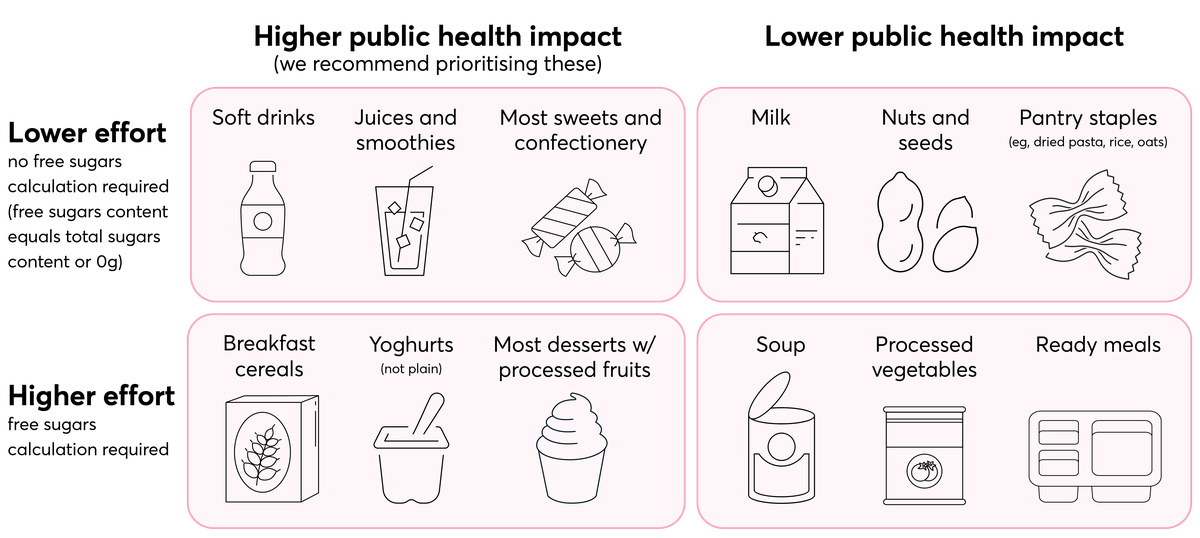
Table 1. Example product categories by free sugars calculation effort vs public health impact (via contribution to population free sugars intake)