About this report
This is the final report of the Realising the Value programme, an 18-month programme funded by NHS England and led by Nesta and the Health Foundation. The programme was set up to support the NHS Five Year Forward View vision to develop a new relationship with people and communities. The programme sought to enable the health and care system to support people to have the knowledge, skills and confidence to play an active role in managing their own health and to work with communities and their assets.
This report sets out the key learning and recommendations from the programme, based on what we think it means to realise fully the value of people and communities at the heart of health and wellbeing – a 'social model of health' that combines a deep understanding of what matters to people, with excellent clinical care, timely data, and strong, sustained social support. By drawing together the evidence, this report also shows the differences that person- and community-centred approaches can make.
This report was written by Annie Finnis, Halima Khan and Johanna Ejbye, Nesta, Suzanne Wood, the Health Foundation and Don Redding, National Voices. It reflects the thinking and input from the wider Realising the Value consortium. It is licensed under a Creative Commons Attribution NonCommercial-ShareAlike 4.0 International License. We hope you find it useful.
Acknowledgements
Many thanks to those who have provided input and advice to this report: staff at Nesta and the Health Foundation, all of the Realising the Value consortium and advisory group members, and the NHS England supported self care team. Thanks also to the many people who have engaged with the Realising the Value programme in different ways over the last 18 months.
The Realising the Value programme partnered with five voluntary, community and social enterprise sector organisations that are exemplars in the field, and are committed to scaling their work and spreading good practice. The understanding brought by our local partner sites – of working with person- and community-centred approaches on the ground, and with their stakeholders, including people with lived experience, commissioners and providers – has informed all aspects of the Realising the Value programme, and has been central to its development and focus.
Contents
- About this report
- Acknowledgements
- About the Realising the Value programme
- Foreword
- 1. Vision for the future
- Ten key actions to put people and communities at the heart of health and wellbeing
- What local areas can do now
- 2. What it means to put people and communities at the heart of health and wellbeing
- 3. The difference that person- and community-centred approaches can make
- 4. Ten key actions to put people and communities at the heart of health and wellbeing
- What needs to happen
- 1. Implement person- and community-centred ways of working across the system, using the best available tools and evidence
- 2. Develop a simplified outcomes framework focused on what matters to people
- 3. Continue to learn by doing, alongside further research
- 4. Make better use of existing levers such as legislation, regulation and accountability
- 5. Trial new outcomes-based payment mechanisms and implement them as part of wider national payment reform
- Alex McCraw, Father, Community Volunteer, Salford Dadz committee member, Expert Link Advisory Panel member
- How people need to work differently
- 6. Enable health and care professionals and the wider workforce to understand and work in person- and community-centred ways
- 7. Develop strong and sustained networks as an integral part of implementation
- 8. Value the role of people and communities in their health and wellbeing, including through co-production, volunteering and social movements for health
- 9. Make greater use of behavioural insights to increase effectiveness and uptake
- 10. Support a thriving and sustainable voluntary, community and social enterprise sector, working alongside people, families, communities and the health and care system
- References
- Realising the Value programme resources
- About Realising the Value
About the Realising the Value programme
Over the last 18 months, the Realising the Value consortium has brought together the perspectives of people with lived experience, the voluntary, community and social enterprise (VCSE) sector, practitioners, academics, commissioners, providers and policymakers to consolidate what is known about person- and community-centred approaches for health and wellbeing and make recommendations on how they can have maximum impact. The Realising the Value programme has also developed practical resources to support implementation of these approaches at the frontline.
Full details of the resources produced by the Realising the Value programme are provided at the end of this document.
We also highlight particularly relevant resources at various points in the text.
Foreword
Across the country, the NHS is changing as the vision of person- and community-centred care comes to life.
We are coming to realise that over-medicalisation is not just wasteful, it is often harmful. We are beginning to understand that people living with long-term conditions are themselves the experts in living with their conditions – and that they can teach others to do so. And we are starting to recognise that although clinical outcomes are important, for most people living with long-term conditions, it is their own sense of wellbeing that is most important to them.
In short, we are waking up to the fact that the roots of health and wellbeing lie not in our hospitals but in our communities. And although medicine and hospitals make an important contribution to our health and wellbeing, so does a sense of being connected into a thriving community. And it is not just our sense of wellbeing that improves as a result - clinical outcomes improve as well.
Ninety years ago, a group of pioneering GPs in Peckham demonstrated all of this but, ironically, the advent of the NHS heralded the end of the ‘Peckham Experiment'. Recently what has become known as social prescribing has been rediscovered and now over 400 general practices across England regularly refer patients to walking groups, gardening clubs and other forms of group activities.
But we also know that more formal group education for people living with long-term conditions can help as well, as does peer support. And we also know that health coaching has an important role to play. Finally, the evidence tells us that access to all these approaches is reliably provided by systematically putting in place personalised care and support planning.
Thanks to the work of the Realising the Value consortium, we now have the evidence and the practical examples that show us how to link all of these ways of working into a system of care. And not only do we have the evidence that these approaches add value to people's lives; we know that they help create social value and they provide value for the taxpayer.
Given this evidence, NHS England is committed to providing leadership for the NHS to engineer Realising the Value principles and practice into the way it works. Over the next three years, we will work with other arms length bodies to provide support for local health and care systems to come together with the communities they serve and the voluntary sector. We will support them to create thriving social networks where people living with long-term conditions feel confident to manage their own health and wellbeing and live independently. In short, putting in place Realising the Value will go a long way towards delivering the vision of Chapter 2 of the Five Year Forward View.
I hope you find the time to read all of the work of the Realising the Value consortium. And if you do, I hope you are as inspired as me to help realise the value of your communities in the place that you work.
Anu Singh
Director of Patient and Public Participation and Insight,
NHS England
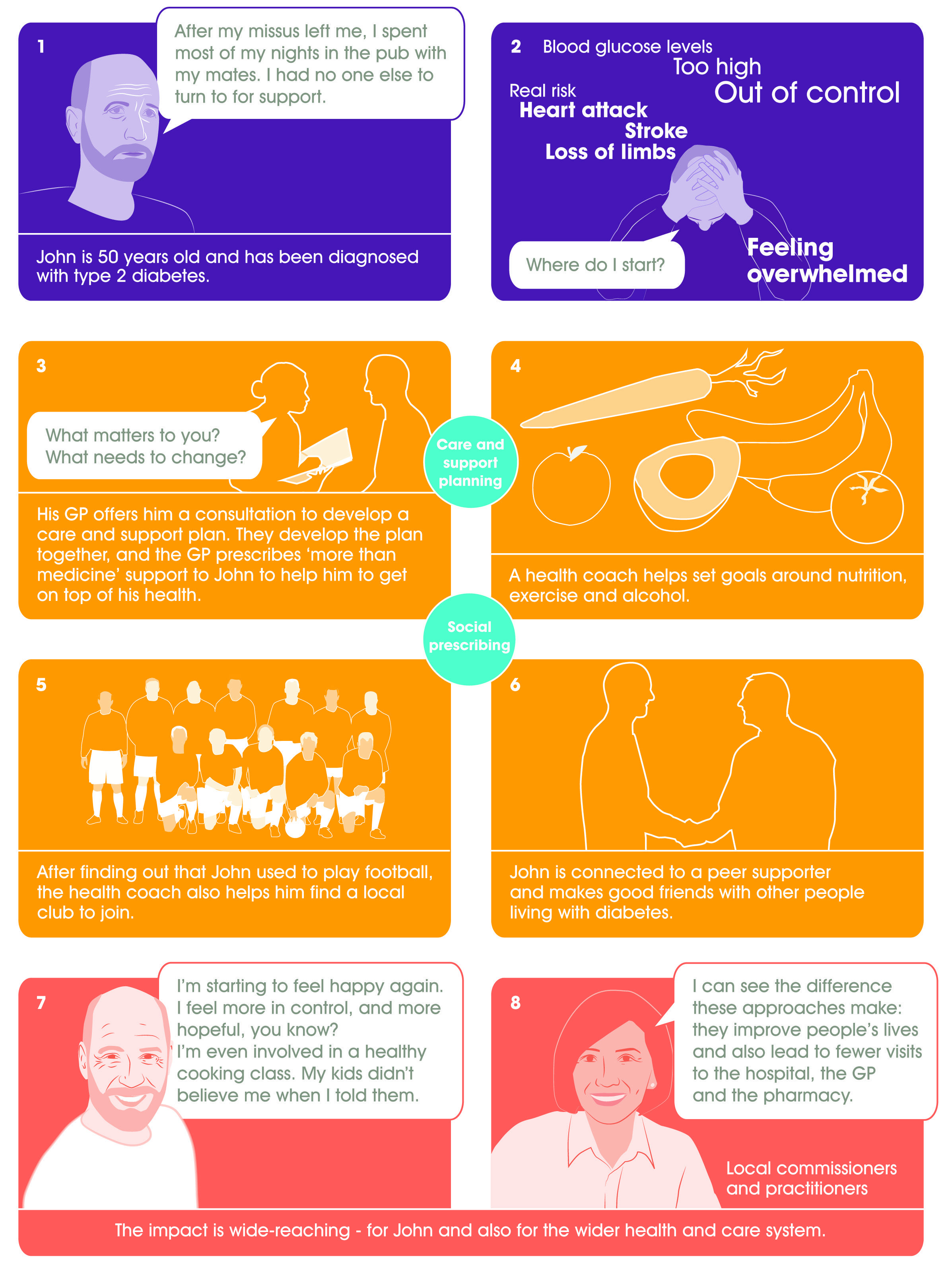
Figure 1: Realising the value of people and communities – John's story
1. Vision for the future
Our vision is of people, families and communities at the heart of health and wellbeing.
We want a health and care system that listens to what is important to people and works with them to build the best care to meet their goals. A system in which excellent clinical and social care is combined with support that equips people to take an active role in their health and to live as well as possible with health conditions. A system in which people feel in control, valued, motivated and supported.
This is what it means to realise the value of people and communities at the heart of health and wellbeing – a 'social model' of health and wellbeing that combines a deep understanding of what matters to people with excellent clinical and social care, timely data and strong, sustained social support.
This vision means working in partnership with people to improve their health and wellbeing – building their emotional strength, skills and knowledge to do so. It means taking account of family, friends and communities and working to reduce wider inequalities. This way of working involves and engages people in ways that enable them to have a voice, to be heard, and to have the opportunity and support to choose how best to live their lives. It means giving people a sense of hope. Figure 1 on page 6 illustrates what this might look like in practice.
It is better for people themselves to be active partners in their care, and it can also reduce inappropriate and unplanned use of health and care services, freeing up valuable resources.
Turning the vision into reality
For this vision to become reality, person- and community-centred ways of working need to become widely understood and valued as core to the whole health and care system, not just ‘nice to have'. They need to be woven into not just the infrastructure of the system but also the culture of how things are done. Every health and care professional needs to understand their role in this way and every health and care service needs to be designed and delivered this way. This will look and feel very different across the system (whether in A&E or wellbeing checks) but there should be a universal commitment to a future in which care that is not person-centred is viewed as a ‘never event' across the system.
The system has committed to this broad agenda and much work is underway to embed person- and community-centred approaches in national programmes and in the delivery of local services. There now needs to be a step change in ambition, leadership and alignment – combined with sustained implementation – to move from intent to action.
The Realising the Value programme has moved this field on by drawing together the evidence base, establishing new networks and creating practical resources for commissioners, practitioners and others. We have aimed to build on, amplify and reinforce existing work.
We hope the Realising the Value programme will help future work marshal resources to create the transformational shift that is needed. We recognise this will be challenging, with tough choices to be made. For example, it will be vital to strike the delicate balance between national consistency (such as core metrics) and local adaptation and co-production with people and communities.
Overall, success will depend on the extent to which the approaches implemented reflect the values that underpin them. The benefits will not be realised – for people or the system – if implementation is treated in narrow transactional, compliance-based or cost-reduction terms. Implementation needs to reflect underlying values. The following value statements have been developed during the Realising the Value programme to help local areas work in ways that are genuinely person- and community-centred. The paper, New approaches to value in health care, gives details of some actions that applying these statements in practice might involve:
We value the creation of health and wellbeing
We value people feeling supported, in control, socially connected and independent
We value the outcomes that are most important to people and their communities
We value people's contributions (their strengths, time, effort, and skills)
We value sustainable outcomes over time, achieved through working together, as services and in partnership of people
We value equity, and the gains to be made by targeting and tailoring our approaches to people with greater need for our partnership.
For more details about how the value statements were developed, and how they can be used in practice, see the paper New approaches to value in health and care. Available to download from: www.realisingthevalue.org.uk
This report sets out what the Realising the Value programme found about the difference person- and community-centred approaches can make – and what needs to happen to support their successful implementation and spread.
Ten key actions to put people and communities at the heart of health and wellbeing
Our recommendations include both what should be done and how people need to work differently. Based on our learning and insights from the Realising the Value programme, we believe that significant progress can be made through the following 10 actions:
What needs to happen
- Implement person- and community-centred ways of working across the system, using the best available tools and evidence.
- Develop a simplified outcomes framework, focused on what matters to people.
- Continue to learn by doing, alongside further research.
- Make better use of existing levers such as legislation, regulation and accountability.
- Trial new outcomes-based payment mechanisms and implement them as part of wider national payment reform.
How people need to work differently
- Enable health and care professionals and the wider workforce to understand and work in person- and community-centred ways.
- Develop strong and sustained networks as an integral part of implementation.
- Value the role of people and communities in their health and wellbeing, including through co-production, volunteering and social movements for health.
- Make greater use of behavioural insights to increase effectiveness and uptake.
- Support a thriving and sustainable voluntary, community and social enterprise sector, working alongside people, families, communities and the health and care system.
These ten actions should build on the Realising the Value value statements
What local areas can do now
There is a lot that can be done now in local areas to make real progress towards a health and care system that is person- and community-centred. Many local systems already have person- and community-centred approaches in place, though no place has yet mobilised a fully person- and community-centred model.
What this looks like will differ from area to area, and it will be important for local systems to focus on their local context, priorities and assets. The list below illustrates some key ingredients of what can be done now, based on the learning from the Realising the Value programme:
WHAT - vision and purpose
- Develop shared purpose across the local health and care system, including the voluntary, community and social enterprise (VCSE) sector, to put people and communities at the heart of what you do.
- Adopt the value statements developed by Realising the Value to ensure that implementation is genuinely person- and community-centred.
- Embed person- and community-centred approaches into mainstream local strategies and programmes, and ensure governance and accountability structures reinforce this agenda.
- Develop new and deeper forms of engagement between the formal health and care system and citizens, starting with tested models of co-production, and high impact volunteering opportunities for citizens to contribute their time, skills and commitment.
WHO - involving everyone
- Involve a wide range of people to make it happen, including people with health conditions, carers, other citizens, clinical and non-clinical staff and the VCSE sector.
- Recognise the VCSE sector as a 'system partner', including involving the sector in strategic processes and local decision-making structures.
- Recognise patients, unpaid carers, volunteers and the VCSE workforce as an essential part of the wider health and care workforce. Ensure they are provided with appropriate support and training alongside those working for statutory services.
- Support local networks to co-produce with citizens, build capacity to work in genuinely person- and community-centred ways, and collaborate across professional boundaries.
HOW - making it happen
- Work with people and communities to design and implement person- and community-centred approaches.
- Commission in ways that support person- and community-centred models.
- Implement approaches in ways that increase knowledge about ‘what works', such as experimentation that enables learning by doing.
- Focus on those who stand to gain the most, such as people with co-morbidities or people who are least engaged with formal services.
- Use behavioural insights in practice with people and communities, for example, by embedding behaviour change approaches in care and support planning.
- Use the resources developed by the Realising the Value programme, like the economic modelling tool for building the business case for person- and community-centred approaches, as well as resources from other programmes such as the Integrated Personal Commissioning programme.
2. What it means to put people and communities at the heart of health and wellbeing
Putting people and communities at the heart of health and wellbeing requires systematic change in the way people access, interact with and experience health and care services and wider support. Figure 2 provides a framework for how different interventions and approaches can fit together.
Figure 2: An illustrative person- and community-centred model
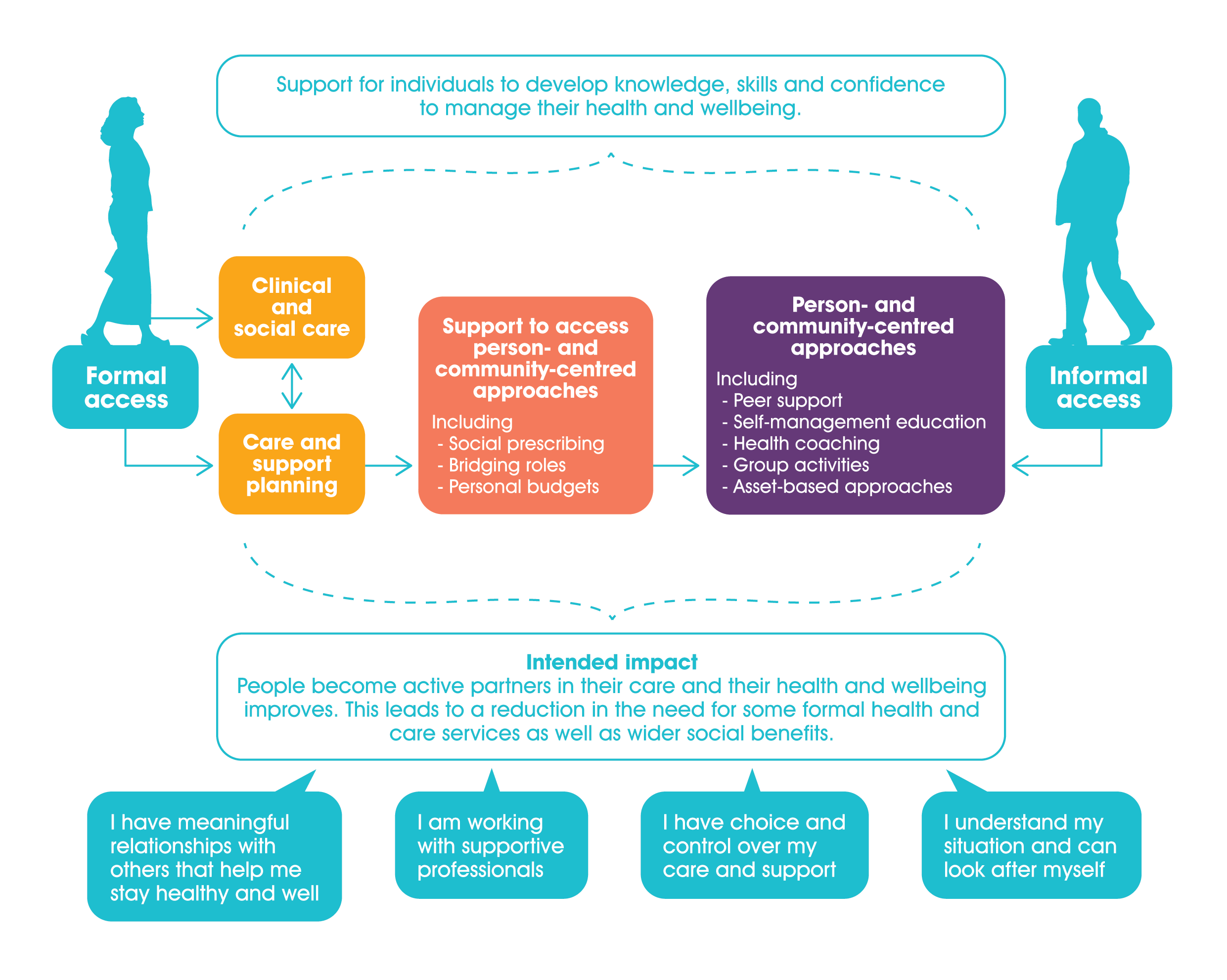
The model illustrated in Figure 2 will manifest in different ways across the country, depending on local needs and assets. However, there are two key components:
- 'Enabling mechanisms’. These support access to person- and community-centred approaches, and connect the world of formal health and care services with local communities. They include personalised care and support planning, personal budgets, social prescribing and bridging roles such as health trainers and community navigators. These mechanisms are often the way that people are introduced to person- and community-centred approaches and also form the ongoing structures that provide coherence and accountability.
- Person- and community-centred approaches. These encompass a very broad range of practice, ranging from 'more than medicine’* support that complements and enhances clinical care for people with long-term conditions (such as peer support) to everyday community activities that enable people to improve their health and wellbeing (such as a local football team or gardening club). Many of these activities can be enjoyed and engaged in by all citizens, whether or not they have health conditions.
While person- and community-centred approaches vary significantly, they are united by a common purpose: to put people and communities at the heart of health and wellbeing, focusing on what is important to people, what skills and attributes they have and on the role of their family, friends and communities.
There is a very broad range of approaches in this field – see Figure 3 for some examples. The Realising the Value programme focused on five in particular, working with a partner site for each (see pages 15-17 for more details). The approaches (and partner sites) chosen were:
- Peer support (Positively UK)
- Self-management education (Penny Brohn UK)
- Health coaching (Big Life Group with Being Well Salford)
- Group activities to promote health and wellbeing (Creative Minds)
- Asset-based approaches in a health and wellbeing context (Unlimited Potential with Inspiring Communities Together).
Undertaking a 'deep dive' into these approaches enabled the programme to develop a richer understanding of how they add value, and what works to embed and spread them in practice. We know that the five approaches are not completely separate or distinct from one another (for example, peer support can include elements of self-management education and health coaching). However, some distinction was necessary to enable greater understanding of what the approaches look like and how they work. That said, it has been clear that practitioners often see greater benefits when the interventions are combined and this should be factored into implementation plans.
*This language was first used as part of the People Powered Health programme, to recognise a range of social interventions that build on and complement clinical care – see more at www.nesta.org.uk/project/people-powered-health
†For more information about person- and community-centred approaches for health and wellbeing, and how these approaches have developed, see At the heart of health: realising the value of people and communities (2016).
Figure 3: Common examples of person- and community-centred approaches
This diagram illustrates various pathways and components of person- and community-centred approaches. It connects formal health and care settings with community-centred approaches.
Formal Health and Care Setting elements:
* Hospital
* GP
* Care Home
Connectors/Enabling Mechanisms (Blue elements):
* Care and support planning
* Shared decision making
* Social prescribing
* Health coaching
* Self management support
* Personal budgets
* Bridging roles
* Health trainees
* Community navigators
* Health champions
Community-Centred Approaches (Orange elements):
* Peer support
* Group-based activities
* Asset-based approaches
* Community Centre
* Volunteer health roles
* Community hubs
* Timebanking
The five person- and community-centred approaches explored by the Realising the Value programme
Peer support
Image of four hands clasped together at the fingertips, forming a circle. The background is yellow-orange. This image visually represents "Peer support".
Peer support in health and care encompasses a range of approaches through which people with shared experiences, characteristics or circumstances provide mutual support to promote health and wellbeing.
Our local partner site for peer support has been Positively UK. Positively UK believes that the emotional and practical needs of people living with HIV can only be truly understood and addressed by the meaningful involvement of others living with HIV. Positively UK supports over 1,000 people each year through one-to-one support, group support and workshops and integrated peer support in HIV clinics across London. Positively UK's peer support has been shown to improve the mental health and emotional wellbeing of participants, reduce isolation and increase social inclusion, and promote self-management through increased understanding of HIV.
Self-management education
Stylized illustration of a lightbulb and a human brain, connected by lines, in shades of grey and white. This image visually represents "Self-management education".
Self-management education includes any form of formal education or training for people with long-term conditions that focuses on helping people to develop the knowledge, skills and confidence to manage their own health and care effectively. The content of self-management education varies depending on who is taking part, their conditions and information and support needs. It can be generic (i.e. for people regardless of their long-term condition) or specific to a particular condition or group (e.g. group education for school children with asthma or structured education for people with type 2 diabetes).
Our local partner site for self-management education has been Penny Brohn UK. Penny Brohn UK is a charity that has specialised in helping people to live well with cancer since it was founded in 1980. The Living Well course is it's main way of delivering self-management education across the UK. This course has been delivered over 500 times. It has been shown to lead to improvements in diet, exercise and use of self-help techniques, improved wellbeing and better relationships and communication with family, friends and medical professionals.
Health coaching
Stylized illustration of two cupped hands holding a heart, in shades of purple and white. This image visually represents "Health coaching".
Health coaching helps people set goals and take actions to improve their health or lifestyle. Health coaching can be built into the role of existing health care professionals, or delivered in a community setting. Key characteristics include: a focus on a person's goals rather than what professionals think they should do; empowering people to take ownership and responsibility for their health; and helping people plan and break down their goals into manageable steps.
Our local partner site for health coaching has been Big Life Group with Being Well Salford. Their health coaching approach works with people who want to change two or more entrenched lifestyle issues: low mood, activity levels, weight, smoking or alcohol intake. The people who receive health coaching support are likely to find it hard to believe they can effect change and are not sure what to tackle first. Coaches and participants meet in community settings, from health centres and libraries to fire stations, as well as having telephone sessions. Last year, Being Well Salford delivered more than 7,000 individual health coaching appointments and over 500 health coaching group sessions. After using the service, people achieving their activity targets more than doubled, from 23% to 49%, and two thirds of participants said their mood had improved.
Stylized illustration of two cupped hands holding three small circles, repeated multiple times. The background is shades of orange. This image visually represents "Group activities to promote health and wellbeing".
A wide range of group activities can benefit health and wellbeing. Many group activities promoted through health and social care organisations focus on healthy living. These include cookery groups that encourage a healthy diet, exercise activities, and other approaches involving physical activity, such as gardening groups.
Our local partner site for group activities has been Creative Minds. Creative Minds aims to develop creative group activity projects that help people who use mental health services to live well in their community and to reach their potential. Activities include music, dance, poetry, football, walking, gardening and knitting. Creative Minds has supported more than 250 creative projects in partnership with over 120 voluntary, third sector and community groups, reaching more than 20,000 people.
Asset-based approaches in a health and wellbeing context
Stylized illustration of a house or box with several birds flying out, in shades of blue. This image visually represents "Asset-based approaches in a health and wellbeing context".
Asset-based approaches are ways of working that build on and connect existing assets and strengths. A health asset is any factor or resource that enhances the ability of people, communities and populations to maintain and sustain health and wellbeing – assets could include, for example, passions, skills, interests or social networks. Fundamentally, asset-based approaches in a health and wellbeing context ask the question "What makes us healthy?” rather than “What makes us ill?".
Our local partner site for asset-based approaches has been Unlimited Potential with Inspiring Communities Together. They have been applying asset-based approaches in health and wellbeing across Salford for more than 10 years. Examples include the 'Tech and Tea' project, which aims to engage older people in understanding the benefits of technology and reduce social isolation and loneliness, and 'Dadly Does It', which creates male-friendly spaces where positive role models can talk to each other openly and try out fun bonding activities with their children. A social return on investment study of 'Dadly Does It' found that £1 invested yielded approximately £3 of potential savings to children's services and £13 of wellbeing value for the fathers involved.
For more details of the work done by the partner sites, how the work has been evaluated and what they learned, see Making it happen: Practical learning and tips from the five Realising the Value local partner sites.
Available to download from www.realisingthevalue.org.uk
3. The difference that person- and community-centred approaches can make
It is well established that person- and community-centred approaches can be the right thing to do for many people and their carers, families and communities. The moral and ethical argument has been made and accepted.
The priority, therefore, is to become clearer about the difference that these approaches make to people's own health and wellbeing and to the wider system. The evidence base remains underdeveloped and requires further investment. Nonetheless, there is growing – and increasingly convincing – evidence that person- and community-centred approaches lead to better outcomes and significant benefits for individuals, services and communities.
Throughout the Realising the Value programme, we have explored the value of person- and community-centred approaches in three areas:
Mental and physical health and wellbeing
Mental and physical health and wellbeing, including improved clinical outcomes and improvements in people's confidence to self-manage as well as their wider wellbeing and quality of life. Person- and community-centred approaches have been shown to increase people's self-efficacy and confidence to manage their health and care, improve health outcomes and experience, and reduce social isolation and loneliness.
Financial sustainability
Financial sustainability, including reducing demand on formal, particularly acute health services, as well as achieving savings for local authority care budgets. Person- and community-centred approaches can impact how people use health and care services and can lead to reduced demand on services, particularly emergency admissions and A&E visits, freeing up staff time.
Wider social value
Wider social value, including more resilient communities and greater social connections as well as wider societal benefits from supporting people to return to work and reducing demand on other public services. Person- and community-centred approaches can lead to a wide range of social outcomes, from improving employment prospects and school attendance to increasing volunteering. They may also contribute to reducing health inequalities for individuals and communities.
In today's financial environment there is significant pressure for approaches to demonstrate return on investment. Therefore, the Realising the Value programme has undertaken economic modelling of the five approaches. We have used this to develop a tool for commissioners, working with NHS England and individual clinical commissioning groups (CCGs). The tool allows commissioners to assess the potential impact of commissioning person- and community-centred approaches in their local area. The aim is to help people who want to commission these approaches to build their business case for doing so.
The Realising the Value economic modelling tool allows commissioners to assess the potential impact of commissioning person- and community-centred approaches in their local area. It aims to help people who want to commission these approaches build the business case for doing so, using local data.
The tool is available to download from www.realisingthevalue.org.uk
Implementing person- and community-centred approaches will not solve the short-term problem of financial deficits. New ways of working take time. The timeframe for transformational change at scale could be 10 years* and the evidence base remains underdeveloped and cannot yet tell us how the potential long-term benefits of a shift towards person- and community-centred approaches will play out.
However, set against this are the many practitioners and people directly involved with these approaches, who report beneficial effects to both people and the system. And there are increasingly robust sources of evidence for some approaches, which corroborate these experiences.
*For example, the Wachter Review recognises that digital technology can take 10 years to show a return on investment.
Findings from the economic modelling
The economic modelling undertaken as part of the Realising the Value programme suggests that implementing person- and community-centred approaches at scale has the potential to contribute to efforts to slow the demand pressures on the system and may yield efficiency savings.
The modelling estimates that all five approaches show promise to deliver efficiency savings. However, the evidence is relatively stronger in two areas – peer support and self-management education.
The potential of peer support and self-management education
In terms of financial benefits, our modelling suggests that implementing peer support and self-management approaches for people with a subset of particular long-term conditions could equate to net savings of around £2,000 per person reached per year, achievable within the first year of implementation. This is based on:
- providing peer support to people with mental health issues and coronary heart disease
- providing self-management education to people with cardiovascular diseases and asthma
- targeting the people who are expected to see the most benefit (between 5 and 25% of the total population affected by these four conditions – the 'eligible population').
Figure 4: Estimated annual net savings from implementing targeted peer support and self-management education
Wider social savings are based on offering: peer support to individuals with HIV, and self-management education interventions to people with cancer.
Savings to the health system are based on providing: peer support to people with mental health issues and coronary heart disease; and self-management education to people with cardiovascular disease and asthma.
|
Savings per person |
Savings for one CCG |
National savings |
| Potential wider social savings |
~£20,800 |
~£22m |
~£4.5bn |
| Estimated savings to the health system |
~£2,100 |
~£5.2m |
~£950m |
| All five approaches show a range of positive effects for individuals, as well as great financial promise. The evidence is particularly robust for peer support and self-management education. |
If these interventions were provided at CCG level, we estimate that CCGs could save around £5.2m per year. |
It is harder to make robust estimates at a national level – e.g. we don't know what has already been implemented. |
| If these initiatives were offered to people with the four long-term health conditions we have data for, they have the potential to offer commissioners a net saving of ~£2,100 per person per year. |
This would require the intervention to be targeted carefully, at those people who might see the most benefit, and implemented well. |
The model suggests that, if implemented well and at scale across England, there may be potential for savings of up to £950m per year from targeted peer support and self-management education to people with specific conditions who are expected to see the most benefit. |
*For example, there could be financial and non-financial benefits for wider society due to the approach, but not a direct saving for the commissioner.
The estimates focus on specific health conditions and interventions because they have the most robust financial evidence to date (e.g. evidence that uses control group comparison). The model developed for the Realising the Value programme aims to produce estimates within a clearly defined scope. These estimates do not, for example, extrapolate evidence from condition-specific research on other health conditions, or put financial values on outcomes where there is not sufficient evidence to do so. We have also modelled the impact of investing in approaches over one year, since most studies have only followed participants for one year.
However, the estimates are subject to a set of assumptions, as described in Box 1. In addition, while the model uses some of the most robust evidence available, the data still has limitations. In particular:
- we have had to use some non-UK based studies
- some studies had relatively small sample sizes
- some studies were conducted on a specific population and the results may not apply to everyone with the same condition
- studies conducted in one part of the UK may not produce the same results in another part with different demographics, or with different levels of existing provision.
For some people, these assumptions and the limitations of the data may feel high risk. Others will be comfortable taking action informed by these estimates, bearing the caveats in mind.
Box 1: Assumptions in the economic model
- Per person savings are calculated using results from a CCG with a population of approximately 250,000 people (the average CCG population is 259,000).
- For CCG and national results, we have assumed that there would be no overlap between peer support and self-management education benefits, especially as they are targeted at different conditions.
- For net financial savings, we are only showing benefits for conditions we have evidence for, and for conditions that show positive net savings.
- For net wider social benefits, we are only showing benefits for conditions we have evidence for, and for conditions that show positive net benefits.
- All results use the economic model's 'suggested targeted population' rather than the total eligible population. This is because we recognise that a CCG is unlikely to provide person- and community-centred approaches to all of its residents with a health condition such as cancer or diabetes. We assume that CCGs will target the proportion of the population most likely to benefit; for example, patients with severe health conditions and the ability to commit to an intervention.
- The results assume that person- and community-centred approaches have not yet been implemented in CCGs and there would be capacity in the system to scale up (i.e. providers would be able to offer the interventions). If a large number of providers are already implementing these approaches, there would be lower potential benefit.
For more details of the economic modelling, see Impact and cost: Economic modelling tool for commissioners. Available from www.realisingthevalue.org.uk
Potential benefits of health coaching, group activities and asset-based approaches
Looking at the potential financial impact of the three other focus areas for the Realising the Value programme - health coaching, group activities and asset-based approaches – there is currently limited evidence that can be used to calculate the potential direct savings to a CCG. However, we do have evidence of potential wider social savings. For the purposes of our modelling, we have assumed that these three approaches would be as effective as peer support. On this basis, the potential impacts could be as shown in Figure 5. This is purely for illustrative purposes. Further research would be needed to understand the true potential.
Figure 5: Estimated annual net savings from targeted group activities, health coaching and asset-based interventions
There is currently limited financial evidence with which to calculate the potential savings from offering group activities, health coaching and asset-based approaches to a population. However, we do have information about the costs of providing each intervention.
If we assume that these interventions are as effective as providing peer support to people with mental health issues and coronary heart disease, for each intervention we can predict a saving somewhere in the region of £1,000-£1,500 per person per year.
Though evidence is currently scarce for direct savings to commissioners, we do have evidence for wider social savings for asset-based approaches, group activities and health coaching. The potential wider social savings are based on the average of all three interventions.
As the evidence base increases, these estimates can be refined: a key purpose of this programme’s economic model is to allow the development of additional evidence with CCGs so that we can build the evidence base and make more accurate calculations.
|
Savings per person |
Savings for one CCG |
National savings |
| Potential wider social savings |
~£18,000 |
~£7m |
~£1.3bn |
| Estimated savings to the health system |
~£1,000 - £1,500 |
~£1.8m - £2.7m |
~£380m - £550m |
We do not know the full costs and benefits of these approaches over time and at scale. However, this modelling could potentially be seen as representing the 'tip of the iceberg'. It is plausible to suggest that there may be unaccounted-for benefits (shown 'under the water' in Figure 6) that could outweigh unaccounted-for costs. But this remains conjecture until further evidence is developed.
Figure 6: The potential of person- and community-centred approaches
The savings we have modelled could be the tip of the iceberg
Potential saving to health and care system
Our economic model has identified potential for direct savings to commissioners within one year of commissioning person- and community-centred approaches for some of its population.
Wider social savings
Our research has shown that, in addition to offering significant direct benefits to commissioners, these approaches deliver wider social benefits, such as improved employment outcomes and reduced social isolation.
Approaches which have not yet been modelled
We currently have quantitative, financial evidence for a very small number of conditions and approaches. If person- and community-centred approaches were offered for more conditions, to a wider population, and in different forms, the savings could be greater.
Longer-term savings
We have modelled the impact of investing in person- and community-centred approaches over one year, since most studies have only followed participants for one year. However, prevention can deliver savings over a longer time period.
For me the Recovery College was a sea change in the way I was able to deal with my mental health. The shift from the medical model to a recovery approach was profound in which all the cogs fell into place.
Louise Patmore, Senior Peer Trainer, Sussex Recovery College/Sussex Partnership NHS Foundation Trust

I have seen a transformation in the way services see people with mental health challenges and people see themselves – from a diagnosis to people who have strengths and abilities to follow their hopes and ambitions.
Sara Meddings, Clinical Psychologist, Sussex Recovery College/Sussex Partnership NHS Foundation Trust – participant in Realising the Value self-management education community of interest
To have someone else to talk to who absolutely gets it and to have the experiential knowledge that the clinical team can't convey is really important... Having peer support and clinical care closely integrated makes a real difference.
Professor Jane Anderson, doctor specialising in HIV at Homerton University Hospital NHS Foundation Trust – working with Positively UK since 1987
Mark Wisbey, Creative Minds Coordinator - South West Yorkshire Partnership Foundation Trust (SWYFT)
My journey is a long and complex one. Having struggled with poor mental health over nearly 40 years, I found myself lurching from crisis to crisis, albeit over different timespans and frequency, which was extremely debilitating. I felt completely worthless, unable to contribute to society in any meaningful way, just existing, and I just wanted to die.
A series of chance conversations, which happened when I was at my lowest, started me on a different path once again. Over time, I became a passionate service user agitator, and I am now driven by an intense drive to make life better, however slightly that might be, for service users and carers.
I was being supported by my psychiatrist when we hit upon a possible misdiagnosis of my condition and a new medication regime was put into place – at the same time I was signposted to the Calderdale Inclusion Support Services team and started to take part in a Friday afternoon football session in Halifax.
I live eight miles away from Halifax and was struggling with incredible levels of anxiety as well as quite crippling depression, but over time I learned to enjoy the football, the routine, and slowly began to move away from a very dark place. I began to look forward, not just to the football, but the camaraderie between players (no one talked about their mental health as such, we just came together to play football) and even managed to begin to do some food shopping for the weekend round the corner from the sports centre, something that set me up for the weekend a small thing for many but a huge thing for me.
Five years later, I work for Creative Minds and with our creative partners we have had phenomenal success. We've worked with over 20,000 people on hundreds of projects, yet it feels like we're still at the start of a fantastic journey. The possibilities and opportunities are still huge but at the same time tangible - they do feel sometimes just a little out of grasp but SWYFT has supported us throughout this process and continues to do so.
The future – who knows what it holds? We now want to take this approach to the next level. We've proved the concept, we've had the plaudits, we want to do more and for others to be part of the movement, to “be the change you want to see in the world".
I have seen at first hand the impact of listening to what individuals want and need.
4. Ten key actions to put people and communities at the heart of health and wellbeing
A great deal of work is already being done at both national and local level to embed person- and community-centred approaches in national programmes and local services.
Yet despite relatively strong commitment by system-leading bodies, as well as increasing consensus and activity levels, progress overall is being hampered by three factors:
- Statements of intent that lack full-scale follow-on implementation plans.
- Dedicated programmes of work that remain too disconnected or small to affect mainstream transformation.
- Insufficient connection across the work of different system-leading bodies.
The combination of these factors means that progress risks being dissipated, duplicated and delayed. Now a step change in ambition, leadership and commitment is needed to translate the high-level vision into reality on the ground.
We have developed 10 major recommendations to help make the health and care system more person- and community-centred. These focus on both what needs to happen and how the work should be implemented. All 10 recommendations should be implemented in ways that are consistent with the value statements set out on page 8.
What needs to happen
A number of these recommendations are based on our report What the system can do: The role of national bodies in realising the value of people and communities in health and care. This focuses on how national bodies can best remove barriers to progressing person- and community-centred approaches for health and wellbeing.
1. Implement person- and community-centred ways of working across the system, using the best available tools and evidence
The enabling mechanisms and person- and community-centred approaches described in section two set out some of the key components of a person- and community-centred system. There is a growing body of evidence to show that these ways of working are effective – enough for decision-makers and commissioners to act now. And there is also a significant range of tools and resources to guide and support people wishing to do so (see page 43 for details of Realising the Value resources).
At the local level, implementation of these approaches will vary according to local needs and assets. However, it is not yet clear whether the transition to more person- and community-centred ways of working can be managed within existing budgets, or if investment now is needed to realise longer-term savings in the future. This requires immediate attention as it will determine how far and fast these approaches can reach more people. Additional support to local areas may be required.
Leaders across the system need to understand what it looks like when the system is working in person- and community-centred ways, to value these ways of working and to commit to implementing them. Part of the process of scaling and spreading person- and community-centred approaches therefore requires leaders - locally and nationally – to champion them and reinforce their importance.
Suggested priorities
- Use the resources developed by the Realising the Value programme, and other related programmes, to implement person- and community-centred approaches.
- Work with people and communities to design and implement person- and community-centred approaches, ensuring local approaches are based on local needs and are genuinely person- and community-centred.
- Fully embed person- and community-centred approaches into mainstream national strategies and programmes, championed by local and national leaders and given appropriate transitional support, and the time and space needed for effective implementation.*
*Within NHS England, this should include Sustainability and Transformation Plans, the New Care Models programme (ensuring the standard contracts for multispecialty community providers and primary and acute care systems integrate the six principles for effective local engagement) and national clinical programmes like The Five Year Forward View for Mental Health.
2. Develop a simplified outcomes framework focused on what matters to people
As set out in our paper New approaches to value in health and care, many organisations have already called for a new, simplified outcomes framework. These include the NHS Confederation, the Local Government Association, the association of directors of adult social services in England (ADASS), the Academy of Medical Royal Colleges and patient organisations. System-leading bodies that support engaging and empowering communities want “a better, shared understanding of what good looks like and how to measure it.” This is welcome as, although it is not simple to achieve, there is currently too much fragmentation and duplication, even in how the same outcomes are measured. This misses opportunities for joined-up learning and building a more coherent field of knowledge.
NHS England and others should respond to this cross-sector, multi-organisational demand for a change and take action. This work will need to engage with the tension between centralisation and standardisation, and the diverse perspectives of people and communities. This can be addressed by focusing on a small set of outcomes, such as: independence; empowerment; social connection; the ability to have a family and community life; health-related quality of life; feeling supported.
How people and communities achieve core outcomes like these will differ, and some people will want to achieve outcomes beyond those outlined. However, a clear and consistent set of core outcomes will help develop both practice and evidence by creating tangible ways for the system to measure and understand its performance, and by building commitment, focus and skills for improving it.
Suggested priorities
- Build consensus on a small set of core national outcomes that reflect what people, families and communities value.
- Involve a variety of organisations, as well as people and communities themselves, in establishing these core national outcomes, including those that have already called for a single, simplified outcomes framework.
- Ensure core national outcomes, once developed, can be used effectively by local areas, according to their local context, priorities and assets.
3. Continue to learn by doing, alongside further research
There is an 'evidence trap' of under-investment in research into person- and community-centred approaches leading to an immature evidence base that is in turn holding back implementation. An urgent priority is therefore further development of the evidence base for person- and community-centred approaches to establish not just ‘what works', but ‘what works for who, when, where and with whom'. The focus should be on rapidly scaling up approaches that have been shown to work. And, in parallel, developing other promising approaches on a 'test and learn' basis that generates evidence through implementation, using rapid experimental methods combined with long-term research.
Continuing to learn by doing
As more people commission and provide person-and community-centred approaches, the evidence base can be further enhanced. In fact, the health and care system can be understood as a ‘natural laboratory' in which it is possible for frontline teams and people using services to work together to identify what change is needed, co-produce solutions and explore the impact of changes through experiments in real conditions.
Developing a learning system approach will require investment in new and different ways of generating evidence. For complex, systemic approaches a randomised controlled trial may not always be feasible or desirable. Further work is needed to develop and apply improvement approaches such as Plan Do Study Act cycles. We also need new evaluation methods, such as formative evaluation and rapid cycle evaluation, such as those currently being trialled as part of the New Care Models programme. These methods can suit complex social interventions and advance the evidence base while continuing to learn by doing.
When used appropriately, technology can support this by creating clinically- and research-valid data while being immediately useful to people. For example, self-monitoring technology has the potential to allow people to track and analyse their own health data, and to share this and other health knowledge with others in ways that will aid prevention and management of long-term conditions. This in turn should lead to a much greater understanding of what works, for whom and when.
Critically, new approaches to involving people and communities need to be implemented sensitively. Person- and community-centred approaches are about relationships: how they are implemented is absolutely central to the value they create.
Investment in research to scale and spread
Investment in research into person- and community-centred approaches for health and wellbeing needs to be increased and coordinated more effectively. Biomedical research is well developed and a single new drug can cost more than £1bn to bring to market. The ambition behind increased use of person- and community-centred approaches must therefore be matched by appropriate investment in building the research base.
This will require action from both large research funders and the endowed charitable sector. The National Institute for Health Research (NIHR) and other research funders do already support research in this area, which is welcomed, but it needs to be prioritised further if the evidence base is to be strengthened sufficiently to underpin a transformational shift of the magnitude required.
Research should be conducted on topics that directly meet the demand for knowledge from decision-makers in the health and care system. This can be achieved by aligning research with strategic national and local priorities, so that the evidence can be used to support robust investment decisions and effective implementation. Research insights must also be brought together in ways that are accessible to decision-makers. The research in this field is highly diffuse and valuable insights therefore risk being underused by practitioners.
This more systematic focus on evaluating person- and community-centred approaches for health and wellbeing could be achieved by adopting the recommendation set out in The NHS in 2030, to bring together a partnership of academic and charitable institutions to seed-fund research and development into health and care that is person- and community-centred.
This will take time and money – both of which feel in short supply in today's overstretched and financially challenged system. But this challenge must be met. If this process of investment, action and further evidence generation does not happen now, there will be a long-term impact on health and care budgets and outcomes.
Suggested priorities
- Implement person- and community-centred approaches in ways that increase our knowledge about 'what works', such as rapid experimentation to evaluate complex social interventions.
- Make much greater use of data that supports person- and community-centred approaches, including data generated by people themselves using digital devices like smartphones.
- Consider focusing on those who stand to gain the most from person- and community-centred approaches, such as:
- people with co-morbidities (where benefits could potentially be under-measured)
- people with the lowest levels of knowledge, skills and confidence (or 'activation') – evidence suggests that people who start at the lowest activation levels tend to improve the most.
*Leonard Kish has argued that an engaged patient is the 'The Blockbuster Drug of the Century' http://healthstandards.com/blog/2012/08/28/drug-of-the-century/
†For example, NIHR has recently commissioned research to understand how community interventions are effective in improving health and wellbeing and reducing health inequalities www.nets.nihr.ac.uk/_data/assets/pdf_file/0007/170656/16_122_Community-orgs-Comm-brief-V5.pdf. In addition, the Campaign for Social Science is conducting a review, The Health of People, to demonstrate the role of social science research and practice in contributing to health and addressing specific issues facing the NHS, UK health care, and health more broadly – https://campaignforsocialscience.org.uk/news/the-contribution-of-social-sciences-to-health-call-for-evidence/
4. Make better use of existing levers such as legislation, regulation and accountability
When people talk about system levers, they are often referring to ‘hard levers' such as legislation and regulation. In What the system can do: The role of national bodies in realising the value of people and communities in health and care, we look at a wide range of levers, and find that ‘hard levers' can be overused, and in some cases can act as a barrier to change. We therefore think the focus should not be on creating new 'hard levers' but rather making better use of existing ones, to help create the right conditions for person- and community-centred approaches to flourish.
Existing legislation, regulatory powers and commissioning approaches can be used more effectively. A range of legislative duties seek to direct how health and social care providers and commissioners involve people and communities in decision making. These include the following:
- The Health and Social Care Act 2012 requires NHS England and CCGs to promote the involvement of patients and carers in decisions relating to their care or treatment, and to ensure public involvement and consultation in commissioning.
- The Care Act 2014 includes a duty on local authorities to promote an individual's wellbeing. The Act and its statutory guidance make clear that personalised care planning and personal budgets should be joined-up processes across health and care; it also refers widely to co-production.
- The Public Services (Social Value) Act 2012 (‘the Social Value Act') requires people who commission public services (including health) to think about how they can also secure wider social, economic and environmental benefits.
The Social Value Act is particularly underused in health. A review conducted by Lord Young found – despite promising examples of how the Act was supporting commissioning for value in social care and other public services – that there is limited evidence of its take up by health commissioners. Health commissioners should commission for comprehensive value (personal, social, community). To do this well, they need the skills, knowledge and confidence to commission based on an understanding of what matters to people.
Regulation can be used to reward performance but is primarily a mechanism for identifying concerns about an individual organisation's safety, quality or financial performance. Given the potential consequences, meeting regulatory requirements is taken very seriously by provider organisations. It is therefore important that regulatory work continues to incorporate principles that support person- and community-centred approaches, and the importance of integrated care. People working in these regulatory organisations should have the training, support and resources to understand what good person- and community-centred approaches look like.
Suggested priorities
- Commission in ways that support person- and community-centred models (described in section 2), including increased use of the Social Value Act in health care commissioning.
- Regulators, the Care Quality Commission and NHS Improvement continue to deepen their focus on person- and community-centred approaches, including continuing to build the approach to regulating integrated models of care.
- Strengthen governance and accountability arrangements for the implementation of person-and community-centred approaches. This should be done across system-leading bodies including NHS England and other arms-length bodies.
5. Trial new outcomes-based payment mechanisms and implement them as part of wider national payment reform
As set out in our report What the system can do, the current NHS payment system is a highly complex mix of methods, prices, incentives and penalties. It has evolved out of at least a decade of reforms to its separate components, in isolation from one another. As a result, a wide range of approaches are employed across sectors and areas, and many payments are not aligned with one another or with stated system objectives.
There is widespread agreement that the NHS payment system needs reform if it is to support new models of care, integration and joint working, and person-centred care. We therefore support ongoing testing of new payment and contracting mechanisms at the local and national level – through programmes such as New Care Models, Integrated Personalised Commissioning and Integrated Care and Support Pioneers.
However, these trials must be systematically built on to ensure the whole system is moved towards implementing person- and community-centred payment mechanisms at scale, through joined-up national payment reform.
Suggested priorities
- Trial person- and community-centred payment and contracting mechanisms.
- Capture learning from the use of different payment mechanisms to build understanding of what works, with ongoing capacity to harness all relevant learning.
- Learn from trials to inform the design of wider national payment reform.
If I am listened to, my health care becomes a partnership, I am no longer alone in my experience.
Lissa J Haycock, Senior Peer Trainer, Brighton & Hove Recovery College, Southdown Housing Association

The conversation between any clinician and patient is paramount. Only by understanding what's really going on and putting patients more in the driving seat can we enable them to better manage their own health and adopt more healthy behaviours.
People often know they need to improve their health they just don't know how. Behaviour change science shows that just telling people what to do often doesn't work – as clinicians we have to become more empowering. If we ask patients what matters to them, and work together to create plans that motivate them and fits in with their life, we will improve their health and wellbeing”.
Dr Penny Newman, Medical Director at Norfolk Community Health and Care, an Associate with Health Education East of England, and one of the first wave of NHS Innovation Accelerator Fellows – participant in Realising the Value health coaching community of interest. See www.betterconversation.co.uk for more information on her work in health coaching

I am a 41-year-old father of three. I faced many challenges growing up of sexual and mental abuse, bullying, mental and physical health issues and social isolation. I received some help in my early adulthood to various degrees where I believed the doctors had done an okay job. However, I ended up losing faith in everything from the system to the people. I learnt how to survive by cutting myself off from nearly everything and everyone.
I spent most of my adult life trying to help others where I could so they never ended up in my situation, but I never realised how I could make that much of a difference until lately.
A couple of years ago I received the best help from somewhere I wasn't expecting... A new project was set up to promote the importance of fathers' wellbeing and the impact it has on their kids. This project was called Salford Dadz. They put me in direct contact with other fathers who had been through their own struggles, some of which were similar to mine. Here I found that actually talking about and sharing lived experiences helped me to bring some clarity to my life. I discovered that within myself that I could change and that the tools needed to do this were within me and these other fathers all along.
I had heard about these various support services in the past but they always seemed out of reach for me because there was no connection. Salford Dadz has allowed me to sit down and talk with someone who 'has been there and got the t-shirt'.
On reflection, I understand that when you are at rock bottom it is hard to see any hope. But talking to someone who has also been at rock bottom too can help change your perspective as they have a similar lived experience. This can benefit you more than talking to a professional where there is not that type of connection or understanding.
Moving forward, I feel this kind of support should not be offered as a replacement for the system, but should be a big part of the wider support system. Some of this change in society has started to happen already. I hope to be able to help this change happen and that it can continue to lead me and others to a better future.
The biggest change I have seen was within myself. This change began when I learnt to use my lived experiences as strengths not weaknesses.
How people need to work differently
Putting people, families and communities at the heart of health and wellbeing is not a simple, technical exercise. There are things that the system needs to do – but the value people and communities bring to creating better health and wellbeing can only be fully created through new relationships, conversations and behaviours.
Realising the value of people and communities at the heart of health is about citizens and professionals working differently – from the conversations that take place between citizens and professionals to decide on the best care, to the 'more than medicine' support provided to people, the engagement with carers and communities, and the relationships that exist within and across health economies between people working in the system.
6. Enable health and care professionals and the wider workforce to understand and work in person- and community-centred ways
The workforce – both formal and informal – should be supported to work in ways that are person- and community-centred. What matters to people and communities should be part of every health and care professionals' core understanding of their role.
As set out in our report What the system can do, this needs to be reflected in the following areas:
- The education and training provided to the clinical workforce. Health and care professionals need to combine their specialist and technical capacities with the ability to practice care that puts people and communities at the centre. To do this well, they need the right skills, confidence and understanding of person- and community-centred approaches. Person-centred care is already included in many of the outcomes frameworks for education and training, and there are positive examples of it being increasingly incorporated into curricula and training.* However, despite the successes, this is far from being fully embedded across health and care education and training for professionals. Continuing this work should be encouraged and supported. It is also important to recognise that how people train is as important as what is taught. Education should include training that is co-designed and co-delivered by people with lived experience, in community settings.
- Support for the existing workforce, including the non-clinical workforce, through both professional development and staff engagement. When staff are supported to work in new ways and develop new relationships with the people they support – through supported self-management, health coaching or shared decision making for example – they have increased job satisfaction and report more meaningful relationships with patients and communities. This should be supported through a greater focus on staff engagement and morale.
*For example, the Doubleday Centre for Patient Experience has been established to involve patients and the public in the training of doctors http://sites.bmh.manchester.ac.uk/doubledaycentre/aboutus/
- Support for the voluntary, community and social enterprise (VCSE) sector and informal workforce. Education and training should be available to volunteers, peer mentors, carers, voluntary sector professionals and others who work alongside formal health and care services. The VCSE sector has shown leadership here – for example, through the Wellbeing our Way communities* – and it is critical that there continues to be ongoing support for peer mentors, volunteers, carers and others.
Suggested priorities
- Base education and training of health and care professionals on person- and community-centred principles, with curriculum reform at much greater scale at all levels of the system including universities, royal colleges and professional regulators.
- Embed person- and community-centred approaches into supervision and ongoing training, including increased involvement of people with lived experience, carers and volunteers and more exposure to community settings.
- Recognise patients, unpaid carers and volunteers and the VCSE workforce as an essential part of the wider health and care workforce. Ensure they are provided with appropriate support and training alongside those working for statutory services.
*Wellbeing Our Way brings together charities, community organisations and individuals, to develop culture and practice across the voluntary sector to enable people with health needs to live well, in ways that matter to them. www.nationalvoices.org.uk/wellbeing-our-way/about
7. Develop strong and sustained networks as an integral part of implementation
Implementing person- and community-centred approaches at a local level is often driven by passionate individuals leading change and local partnerships that have grown in strength over time, including partnerships with the VCSE sector.
Networks of people are essential to scaling these approaches well and should be developed as a key element of implementation. They create opportunities for members of staff and others to come together around common challenges, share learning and provide peer support, either virtually or in person. They are particularly critical in helping people to understand how to achieve change, not just what to change.
The Realising the Value programme has supported the creation of new communities of interest for person- and community-centred approaches, bringing together not just frontline practitioners but researchers and commissioners with a shared interest in and passion to spread these approaches in practice. We have developed a catalogue of learning, Making it happen: Practical learning and tips from the five Realising the Value local partner sites, that brings together practical learning and tips from our local partner sites, with input from communities of interest.
Networks should be designed with their members to maximise their value. They should be supported to share learning, build capacity and increase the potential for effective approaches to spread. Local multidisciplinary networks should be nurtured to empower people to problem solve together, and to build collaborative networks of people working across professional boundaries to get the very best outcomes for people and communities. Larger-scale regional and national networks are also important to spread and sustain good practice from one place to another.
Suggested priorities
- Recognise the importance of, and support shared learning through, communities of interest and other networks, beyond time-limited programmes of work and as a sustained part of the implementation of person- and community-centred approaches.
- Provide national, coordinated and ongoing support for communities of interest and practice networks, through NHS England and other system-leading bodies across health and care,* to enable people involved in person- and community-centred work to share learning and practical insight.
- Build and sustain a variety of networks for different purposes, for example, for connecting new adopters with pioneer practitioners or to focus on particular areas of practice such as social prescribing.
*For example: NHS Improvement; ADASS; Think Local Act Personal, which has an existing national network of practitioners working to build community capacity.
Figure 7: The core features of effective networks - the ‘5C wheel’
This diagram illustrates the "5C wheel" model for effective networks, comprising five interconnected elements:
- CRITICAL MASS: Indicating a sufficient number of participants.
- COMMON PURPOSE: Signifying shared goals and objectives.
- STRUCTURE: Referring to the organizational framework of the network.
- COLLECTIVE INTELLIGENCE: Representing shared knowledge, insights, and learning.
- COMMUNITY BUILDING: Highlighting the creation and nurturing of connections among members.
8. Value the role of people and communities in their health and wellbeing, including through co-production, volunteering and social movements for health
The formal health and care system needs to work with and alongside networks of citizens. This is essential to ensuring the system can genuinely become more person- and community-centred. The only way to understand and support what matters to people and communities is to work with them. Carers are a huge asset and resource; they sustain and support the lives of people they care for and, by doing so, sustain and support the wider health and care system. Citizens more broadly are also valuable contributors to health and care through high impact volunteering, co-designing services and becoming employees with lived experience in the sector.
The most successful examples of person- and community-centred approaches in practice are those developed by people and communities, working with and alongside commissioners and policymakers, to co-produce solutions that work.* Support and training is needed for both people and the practitioners and policymakers they work with to support co-production.
Volunteers are an increasingly important part of the health and care workforce and there is evidence that high quality, well-supported volunteering can benefit patients and health and care services, as well as having reciprocal benefits for people who volunteer.
Greater 'pull' or demand from people with lived experience, service users, carers and other active citizens can be a powerful driver for change. In some cases, this demand is driven through purposeful citizens having the determination and courage to stand up, speak out and seek change in the issues that matter to them and their loved ones. This ‘demand side' of citizen action should be embraced by the health and care system, and more systematically supported, as it represents an essential component of a person- and community-centred system.
Suggested priorities
- Develop new and deeper forms of engagement between the formal health and care system and citizens, including carers, volunteers and employees with lived experience, starting with tested models of co-production across local and national parts of the system.
- Create high impact volunteering opportunities and other ways for citizens to contribute their time, skills and commitment to improving health and care.
- Support social movements to scale up both inside and outside the NHS to create demand for working in person- and community-centred ways.
*See, for example, the Coalition for Collaborative Care Co-production model http://coalitionforcollaborativecare.org.uk/wp-content/uploads/2016/07/C4CC-Co-production-Model.pdf
9. Make greater use of behavioural insights to increase effectiveness and uptake
Behavioural insights into change are a promising way of making new person- and community-centred approaches for health and wellbeing more effective and enabling their uptake. They can stimulate meaningful shifts in how people behave and enable the uptake of person- and community-centred approaches. A behavioural change perspective should be embedded throughout the implementation of person- and community-centred approaches. It is critical to apply behavioural insights with people not to people.
As part of the Realising the Value programme, the Behavioural Insights Team has drawn on high quality studies of what influences behaviour, and used the EAST framework to consider effective approaches for addressing them.
Figure 8: The EAST framework
This diagram illustrates the four components of the EAST framework:
- EASY
- ATTRACTIVE
- TIMELY
- SOCIAL
As part of Realising the Value, the Behavioural Insights Team created two behavioural insights guides that consider the main drivers of behaviour and generate effective approaches for addressing them. The two guides - Supporting self-management and Spreading change – include ideas and tools for practitioners, commissioners and others seeking to impact change in practice.
They are available to download from www.realisingthevalue.org.uk
In our report, Making the change, the following were identified as being particularly valuable:
- Having a growth mindset, building self-efficacy and ‘grit': Person- and community-centred approaches reflect a certain mindset: that people are capable of development and self-improvement over time (a growth mindset). Learning from behavioural insights in areas outside health show that growth mindsets can be taught. If health and care professionals believe that people can change, this will affect how they interact and the extent to which they adopt supportive behaviours.
- Removing small barriers to healthy behaviour: Seemingly small increases in the effort (‘friction costs') needed to perform a behaviour can make a surprisingly large difference to whether that behaviour takes place. This means, for example, accounting for the difficulty of travelling if a long-term condition makes that challenging or public transport links are poor.
- Strengthening social connections: Social capital and reciprocity are important theories underpinning the case for enhancing peer support and group activities for community development. Connecting to others, receiving support when needed and giving back at other times are strongly linked to experiencing a sense of wellbeing and buffering against mental ill health.
- Tapping into intrinsic motivation: Intrinsic values are those we personally hold dear, for example 'helping people' or 'striving for self-sufficiency'. If practitioners can be reconnected to the intrinsic values that often brought them into the sector, they can be reoriented towards a person-centred focus using simple, yet salient approaches.
- Using goal-setting and feedback: Proactive goal-setting can be an effective strategy for promoting self-management activities. There is particularly strong evidence for creating simple 'if-then' plans, that shift the focus from 'what' to do, to ‘how' and 'when' to do it, meaning that people make more 'mindful' plans that anticipate the influence of the world around them.
Suggested priorities
- Embed a behavioural change perspective throughout the implementation of person- and community-centred approaches, including:
- Use behavioural insights in practice with people and communities, for example, by embedding behaviour change approaches in collaborative care and support planning, to provide the practical, memorable information and simple actions that people should take to meet specific goals or access support.
- Use behavioural insights in practice with the health and care workforce, for example, by tapping into the intrinsic motivations of staff, and supporting staff and the people they work with to have a growth mindset to change.
10. Support a thriving and sustainable voluntary, community and social enterprise sector, working alongside people, families, communities and the health and care system
A strong and sustainable VCSE sector is needed for person- and community-centred approaches to flourish. This was a clear message from the Realising the Value local partner sites, as well as the recent review of the VCSE. The review recognised that, at both national and local level, the VCSE and statutory sectors need each other, each bringing its own kind of expertise and resources, with a shared focus on the wellbeing of people and communities. The VCSE review made a number of recommendations, many of which are reinforced in this report.
The Realising the Value local partner sites have also demonstrated the critical inter-relationship between a strong and sustainable VCSE sector and effective commissioning of person- and community-centred approaches. Effective commissioning can play a central role in improving the quality of care by ensuring that services provided in a local area are centred on what really matters to people and communities. Poor commissioning is fragmented, with a lack of engagement between commissioners and local community organisations, and a focus on competition over collaboration. When commissioning works well, there are strong and sustained local relationships and co-production occurs at every stage of the commissioning cycle.
Suggested priorities
- Recognise the VCSE as 'system partner' including involving the sector in strategic processes and local decision-making structures, and by moving away from short-term pilot funding to core and long-term funding.
- The health and care system and the VCSE sector working in partnership to increase access to person- and community-centred approaches, and to design and deliver health and care approaches that are grounded in what matters to people.
- Support VCSE organisations to build their capacity to work with commissioners in new and different ways, particularly where infrastructure is limited.
*This should include health and wellbeing boards and national transformation programmes such as New Care Models, working in partnership with statutory services.
References
- Redding D. New approaches to value in health and care. London: Nesta; 2016. Available from: www.nesta.org.uk/publications/new-approaches-value-health-and-care.
- Wood S, Finnis A, Khan H, Ejbye J. At the heart of health: Realising the value of people and communities. London: Nesta; 2016. Available from: www.nesta.org.uk/publications/heart-health-realising-value-people-and-communities.
- Ejbye J, Holman A, et al. Making it happen: Practical learning and tips from the five Realising the Value local partner sites. London: Nesta; 2016. Available from: www.nesta.org.uk/publications/making-it-happen-practical-learning-and-tips-five-realising-value-local-partner-sites.
- PPL. Impact and cost: Economic modelling tool for commissioners. London: Nesta; 2016. Available from: www.nesta.org.uk/publications/impact-and-cost-economic-modelling-tool-commissioners.
- Think Local Act Personal (TLAP). Integrated Care and Support: Our Shared Commitment. TLAP; 2013. Available from: www.gov.uk/government/uploads/system/uploads/attachment_data/file/287815/DEFINITIVE_FINAL_VERSION_Integrated_Care_and_Support_-_Our_Shared_Commitment_2013-05-13.pdf.
- Bland J, Khan H, Loder J, Symons T, Westlake S. The NHS in 2030: a vision of a People-powered, Knowledge-powered Health System. London: Nesta, 2015. Available at: www.nesta.org.uk/sites/default/files/the-nhs-in-2030.pdf.
- The Health Foundation. Evaluation: what to consider. London: The Health Foundation; 2015. Available from: www.health.org.uk/publication/evaluation-what-consider.
- Hibbard JH, Greene J, Overton V. Patients with lower activation associated with higher care; delivery systems should know their patients' 'scores'. Health Affairs. Feb 32(2): 216-22.
- Bland J, Khan H, Loder J, Symons T, Westlake S. The NHS in 2030: A vision of a people-powered, knowledge-powered health system. London: Nesta; 2015. Available from: www.nesta.org.uk/sites/default/files/the-nhs-in-2030.pdf.
- Allcock C, Dormon F, Taunt R, Dixon J. Constructive comfort: Accelerating change in the NHS. London: the Health Foundation; 2015. Available from: www.health.org.uk/sites/health/files/ConstructiveComfortAcceleratingChangeInTheNHS.pdf.
- Wood S, Henderson S. What the system can do: The role of national bodies in realising the value of people and communities in health and care. London: Nesta; 2016. Available from: www.nesta.org.uk/publications/what-system-can-do-role-national-bodies-realising-value-people-and-communities-health-and-care.
- Cabinet Office. Social Value Act Review. London: Cabinet Office; 2015. Available from: www.gov.uk/government/uploads/system/uploads/attachment_data/file/403748/Social_Value_Act_review_report_150212.pdf.
- The Health Foundation. Effective networks for improvement: Developing and managing effective networks to support quality improvement in healthcare. London: The Health Foundation; 2014. Available from: www.health.org.uk/sites/health/files/EffectiveNetworksForImprovement.pdf.
- Report of the annual social prescribing network conference. 20 January 2016. Available from: www.westminster.ac.uk/patient-outcomes-in-health-research-group/projects/social-prescribing-network.
- NHS England. NHS England's Commitment to Carers. NHS England; 2014. Available from: www.england.nhs.uk/wp-content/uploads/2014/05/commitment-to-carers-may14.pdf.
- Graham J, Holman A, Loder J, et al. Helping in hospitals. A guide to high impact volunteering in hospitals. London: Nesta; 2016. www.nesta.org.uk/sites/default/files/helping_in_hospitals_guide.pdf.
- Service O, Hallsworth M, Halpern D, et al. EAST: Four simple ways to apply behavioural insights. The Behavioural Insights Team; 2014. Available from: www.behaviouralinsights.co.uk/publications/east-four-simple-ways-to-apply-behavioural-insights.
- Burd H, Hallsworth M. Making the change: Behavioural factors in person- and community-centred approaches for health and wellbeing. London: Nesta; 2016. Available from: www.nesta.org.uk/publications/making-change-behavioural-factors-person-and-community-centred-approaches-health-and-wellbeing.
- Burd H, Hallsworth M. Supporting self-management: A guide to enabling behaviour change foe health and wellbeing using person- and community-centred approaches. London: Nesta; 2016. www.nesta.org.uk/publications/supporting-self-management-guide-enabling-behaviour-change-health-and-wellbeing-using-person-and-community-centred-approaches.
- Burd H, Hallsworth M. Spreading change: A guide to enabling the spread of person- and community-centred approaches for health and wellbeing. London: Nesta; 2016. Available from: www.nesta.org.uk/publications/spreading-change-guide-enabling-spread-person-and-community-centred-approaches-health-and-wellbeing.
- Joint review of partnerships and investment in voluntary, community and social enterprise organisations in the health and care sector. Available from: www.gov.uk/government/uploads/system/uploads/attachment_data/file/524243/VCSE_Investment_Review_A.pdf.
Realising the Value programme resources
Realising the value: Ten key actions to put people and communities at the heart of health and wellbeing
Realising the value: Ten key actions to put people and communities at the heart of health and wellbeing
Key learning and recommendations from the Realising the Value programme, based on what we think it means to realise fully the value of people and communities at the heart of health and wellbeing.
At the heart of health: Realising the value of people and communities
At the heart of health: Realising the value of people and communities
This report explores the value of people and communities at the heart of health, in support of the NHS Five Year Forward View vision to develop a new relationship with people and communities.
Making the change: Behavioural factors in person- and community-centred approaches for health and wellbeing
Making the change: Behavioural factors in person- and community-centred approaches for health and wellbeing
Drawing on robust studies of what influences behaviour, this report sets out a number of factors that can lead to greater involvement in self-care.
Spreading change: A guide to enabling the spread of person- and community-centred approaches for health and wellbeing
Spreading change: A guide to enabling the spread of person- and community-centred approaches for health and wellbeing
Guide to how behavioural science can help spread the take-up of person- and community-centred approaches to health and wellbeing.
Making it happen: Practical learning and tips from the five Realising the Value local partner sites
Making it happen: Practical learning and tips from the five Realising the Value local partner sites
Catalogue of practical learning and examples of good practice from the five Realising the Value local partner sites.
Supporting self-management: A guide to enabling behaviour change for health and wellbeing using person- and community-centred approaches
Supporting self-management: A guide to enabling behaviour change for health and wellbeing using person- and community-centred approaches
Guide to how the science of behaviour can help people to self-manage their health and wellbeing.
New approaches to value in health and care
New approaches to value in health and care
Calls for action to ensure that the approach to understanding, capturing, measuring and assessing value in health and care takes full account of value as it is experienced and created by the people and communities with whom formal systems seek to work.
What the system can do: The role of national bodies in realising the value of people and communities in health and care
What the system can do: The role of national bodies in realising the value of people and communities in health and care
How national bodies can best remove barriers to progressing person- and community-centred approaches for health and wellbeing.
Impact and assessment: Economic modelling tool for commissioners
Impact and assessment: Economic modelling tool for commissioners
Economic model, in the form of an excel spreadsheet, a user guide and a report, to help commissioners evaluate the potential impact of investing in person- and community-centred approaches for health and wellbeing in their local area.
Available from: www.realisingthevalue.org.uk; www.health.org.uk/realising-the-value
About Realising the Value
Realising the Value was a programme funded by NHS England to support the NHS Five Year Forward View. It ran from May 2015 to November 2016. The programme sought to enable the health and care system to support people to have the knowledge, skills and confidence to play an active role in managing their own health and to work with communities and their assets.
There are many good examples of how the health and care system is already doing this. For example, recognising the importance of people supporting their peers to stay as well as possible or coaching to help people set the health-related goals that are important to them.
Realising the Value was not about inventing new approaches, but rather about strengthening the case for change and identifying evidence-based approaches that engage people in their own health and care. It also sought to develop tools to support implementation across the NHS and local communities. But putting people and communities genuinely in control of their health and care also requires a wider shift. The programme therefore considered the behavioural, cultural and systemic change needed to achieve meaningful transformation.
www.realisingthevalue.org.uk
www.health.org.uk/realising-the-value