The Realising the Value programme has developed an economic modelling tool to help commissioners evaluate the potential impact of investing in person- and community-centred approaches.
The Realising the Value programme has developed an economic modelling tool to help commissioners evaluate the potential impact of investing in person- and community-centred approaches.
Key findings
- The tool consists of an Excel spreadsheet, a user guide which explains how to use the tool and a summary report which sets out the context and some of the key findings that the model has generated.
- The economic modelling undertaken by the Realising the Value programme and detailed in the summary report suggests that implementing person- and community-centred approaches at scale has the potential to contribute to efforts to slow the demand pressures on the system and may yield efficiency savings.
- The summary report also suggests how the evidence base can be enhanced in the future, in order to produce more robust modelling and local business cases.
The Realising the Value economic modelling tool allows commissioners to assess the potential impact of commissioning person- and community-centred approaches in their local area. It aims to help people who want to commission these approaches build the business case for doing so.
The tool has been developed in close collaboration with local sites, commissioners and experts in economic modelling and person- and community-centred approaches. It draws on high-quality research evidence as well as data collected from the five Realising the Value local partner sites across the country. These sites are all mature practitioners in the area of person- and community-centred approaches.
In the three links below you will find:
- The summary report: gives a full introduction to the tool and sets out some findings from the model.
- The user guide: gives a brief introduction to the tool and explains how commissioners can use it, using worked examples.
- The economic modelling tool: enables the exploration of different scenarios for commissioning person- and community-centred approaches for health and wellbeing.
Other relevant resources: a collaboration including SIMUL8, Datalytics, a small group of CCGs, and NHS England has developed a tool to help organisations understand the financial and/or activity implications for new models of care for people with long-term conditions across different cohorts of patients and settings. The model is similar to the Realising the Value economic modelling tool as it uses some pre-populated data for areas and can be used to support the development of business cases. It uses simulation and requires users to enter assumptions about the impact of desired approaches. It can therefore can be used to model a wide range of person-centred care interventions. The model can be accessed for free by registering here.
Author: PPL
Purpose of this document within package of resources
The infographic "Purpose of this document within package of resources" shows three key resources:
-
Impact and cost: summary of the economic modelling tool for commissioners This box describes the program's benefits in empowering people in health and care. It mentions the toolkit helps local health and care budget holders decide on investments in person- and community-centred approaches. It also highlights data from five Realising the Value local partner sites. Below this description, an image depicts various support approaches:
- Peer Support
- Health coaching
- Group activities
- Asset-based approaches
- Self-management education
It provides a full introduction to the tool for commissioners, explains how it fits into the context of the Realising the Value programme, and sets out some findings from the tool.
- User Guide: Economic modelling tool for commissioners This box shows a green book illustration. It gives a brief introduction to the tool and explains how commissioners can use it.
- Downloadable Tool
This box contains a screenshot of an Excel spreadsheet.
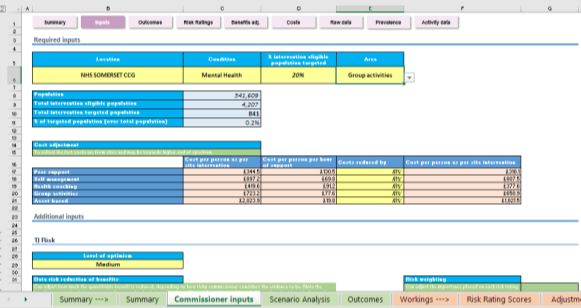 It enables the exploration of different scenarios for commissioning person- and community-centred approaches for health and wellbeing.
Realising the Value resources
All of this is underpinned by the tools and recommendations from the Realising the Value programme.
Glossary of terms
Realising the Value (RtV)
Over the last 18 months, the Realising the Value consortium has brought together the perspectives of people with lived experience, the voluntary, community and social enterprise (VCSE) sector, practitioners, academics, commissioners, providers and policymakers to consolidate what is known about person- and community-centred approaches for health and wellbeing and make recommendations on how they can have maximum impact. The Realising the Value programme has also developed practical resources to support implementation of these approaches at the frontline. Full details of the resources produced by the Realising the Value programme can be found on the programme website.
Person- and community-centred (P&CC) approaches for health and wellbeing
These encompass a very broad range of practice, ranging from support that complements and enhances clinical care for people with long-term conditions (such as peer support) to everyday community activities that enable people to improve their health and wellbeing (such as a local football team or gardening club). Many of these activities can be enjoyed and engaged in by all citizens, whether or not they have health conditions.
Local partner sites
Five local partner sites supplemented data used in the assessment tool, each broadly covering one type of P&CC approach: 1) Positively UK (peer support); 2) Penny Brohn UK (self-management); 3) Being Well Salford (health coaching); 4) Creative Minds (group activities to promote health and wellbeing); and 5) Unlimited Potential with Inspiring Communities Together (asset-based approaches in a health and wellbeing context)
Context around the economic modelling tool
The economic modelling tool
As part of Realising the Value, PPL has developed an economic modelling tool for commissioners. The tool consists of an economic model in the form of an Excel spreadsheet, and a user guide which explains how to use the model.
The economic modelling tool has been designed to:
- Help commissioners (the intended users of the tool) evaluate the potential impact of investing in person- and community-centred approaches for health and wellbeing in their local area;
- Facilitate the incorporation of person- and community-centred approaches into commissioning plans, such as Sustainability and Transformation (STP) plans.
The five approaches explored by the Realising the Value programme and tool for commissioners are:
- Peer support: People with similar conditions or experiences support each other to better understand their condition and aid recovery or self-management.
- Asset-based approaches: Community-based approaches that promote good health and wellbeing and strong social connections.
- Self-management education: Helps people develop the knowledge, skills and confidence to effectively manage their own health and care.
- Group activities: Group activities that support health and wellbeing, such as exercise classes or cookery clubs.
- Health coaching: Helps people set goals and take actions to improve their health or lifestyle.
This report sets out some of the key findings from the economic model. It also explains how the model works, how it was developed, and how commissioners can help enhance the evidence base for person- and community-centred approaches for health and wellbeing.
The modelling has shown the benefits of people taking an active role in their health and care
The economic modelling tool for commissioners has been designed to help the benefits of person- and community-centred approaches to reach local communities. This involves giving the people in charge of local health and care budgets the information they need to gain a better understanding of the value of these approaches.
In addition to evidence from academic literature, the model uses data collected from five Realising the Value local partner sites across the country. These sites are all mature practitioners in the area of person- and community-centred approaches.
The programme shows the benefits of empowering people to take an active role in their health and care, leading to outcomes in: * Mental and physical health and wellbeing * Financial sustainability * Wider social impact
Peer Support
- POSITIVELY UK: Peer support for individuals who have been diagnosed as HIV-positive.
Self-management education
- Penny Brohn UK - Living Well with Cancer: Residential courses and ongoing support for people who have been diagnosed with cancer.
Health coaching
- Being Well Salford: Health coaching for people who want to make improvements to their health and wellbeing, such as by giving up smoking.
Group activities
- Creative Minds: Group activities for people with mental health issues, including an arts café which provides an evening support network and creative outlet.
Asset-based approaches
- INSPIRING COMMUNITIES TOGETHER - Unlimited Potential: Asset-based approaches including a community-based project in which fathers are encouraged to support each other.
The modelling has been a collaborative process involving a range of groups and partners
Five Realising the Value local partner sites
- Five sites based across the country have contributed data, qualitative evidence and learning to the Realising the Value programme.
Sites' communities of interest
- The five Realising the Value partner sites each established a 'community of interest' in their topical area of practice. The communities of interest had three overarching aims:
- Shape programme outputs
- Harness in-depth thematic expertise
- Set up a network for the future
Expert Challenge Group
- In collaboration with Nesta and The Health Foundation, an Expert Challenge Group was established. The group provided guidance throughout the modelling process (from design through to final development).
- The group consisted of experts in economic modelling, healthcare, and person- and community-centred approaches.
NHS England and a consortium of partners
- NHS England and a consortium of partners have been closely involved throughout the modelling process, with a view to creating a tool which informs national and local planning.
Commissioning for Person-Centred Care Working Group
- The person-centred care group is a national group which meets on a quarterly basis. Patients, commissioners and providers from across England come together to share learning and provide challenges to each other and to policy makers. The group disseminates examples of innovation and good practice so that local populations have the chance to benefit from new ways of working.
- Other commissioners from Clinical Commissioning Groups and Local Authorities around the country were also involved in designing and testing the tool.
The model estimates the potential impact of commissioning P&CC approaches
The economic model estimates the potential impact of commissioning person- and community-centred approaches for health and wellbeing by combining two elements: data which is programmed into the model and variables the commissioner can alter (e.g. by selecting their local area and adjusting how strong they think the evidence is).
The model combines "Model's programmed input (evidence)" and "User input" to produce "Local impact".
The elements of Model's programmed input (evidence) are: * Population size in each location in England * How many people have certain conditions in each location * Evidence for the person- and community-centred approaches * How much it might cost to offer those approaches * Data about how much the health and care system and wider society could benefit by offering those approaches
The elements of User input are: * The user can select their local area from a drop-down list * The user can adjust various parts of the model to suit their needs (e.g. approach and condition)
The Local impact reveals: * The model shows how much the health and care system and wider society could benefit by offering person- and community-centred approaches for specific conditions in specific locations.
The model calculates impact across three key areas:
- Financial outcomes: How much commissioners could benefit if they implement the approach.
- Health & Wellbeing Outcomes: Non-financial positive impacts on the health and wellbeing of individuals.
- Wider social impact: Financial and non-financial benefits that wider society could experience due to the approach, but that won't lead to a direct saving for the commissioner.
We have used a wide range of evidence to estimate the potential impact of the five approaches
The estimation of impact involves a combination of: * Literature review: A wide collection of studies providing evidence of impacts on health and wellbeing across the five approaches. * Site data: Data collected by the five local Realising the Value partner sites. * Proxies: Financial measures for impacts such as 'increased confidence' and 'being employed'.
Below is an example of how evidence from the literature review and sites is combined with proxies to estimate benefits:
| Area | Condition | Impact type | Evidence | Benefit | Source |
|---|---|---|---|---|---|
| Peer support | Mental health | Bed days reduction | 48% reduction in inpatient hospital bed days (treatment vs control) | Financial | Sledge et al. (2011) |
| Peer support | Heart disease | Behavioural change | 3% reduction in number of current smokers (treatment vs control) | Health & wellbeing | Coull et al. (2004) |
| Peer support | HIV | Confidence | 72% of participants reported increase >2 points in Positively UK wellbeing score | Wider social | Positively UK (2016) |
| Proxy: | £13,080 = Value of high confidence in adults (using wellbeing valuation technique) | Wider social | Social Value Bank (HACT 2014) |
The modelling process involved collecting evidence to input as data into the economic model
The modelling process involved four key areas of evidence collection:
- Data from the five Realising the Value partner sites:
- Data provided by sites included:
- Evidence of health and wellbeing, wider social, and financial benefits
- Set-up and running costs
- Detailed information about the approaches
- Data provided by sites included:
- Evidence review of the benefits of P&CC approaches:
- Newcastle University looked at the evidence base for P&CC approaches, prioritising randomised controlled trials and systematic reviews
- 37 studies from the review were included in the model
- Additional sources of evidence for P&CC approaches, highlighted by partner sites:
- Sites and other partners were asked to highlight any further sources of evidence for P&CC approaches that could be used in the model
- These were followed up by the modelling team
- Financial proxies*:
- Some financial proxies were provided by sites and the evidence review
- Where financial proxies had to be found we prioritised: 1. Quality Adjusted Life Year proxies; 2. Social Value Bank proxies
*Financial proxies are a way of ascribing financial values to non-financial outcomes. For example, increased confidence is a non-financial value, but studies have tried to evaluate how much increased confidence is worth to an individual.
We worked closely with sites, commissioners and experts in economic modelling and P&CC approaches
Area Assessment Report
- Before we started modelling the data, we sent this report to sites, their communities of interest, and our expert challenge group.
- The report detailed our plan for the modelling and information about where the data had come from.
- We used the feedback when developing the economic model.
Engagement with commissioners
- We met with commissioners from local authorities, CCGs, the person-centred commissioning group, and commissioners associated with the five sites.
- Their feedback on the model design was crucial in creating a model which is user-friendly and measures outcomes that commissioners care about.
Testing
- Once the model had been fully developed, we tested it with commissioners with whom we had previously engaged.
- This allowed us to iron out any technical issues, improve the usability of the model, and check that the estimates and savings produced by the model seemed realistic to commissioners.
Expert Challenge Group
- We established an expert challenge group which provided guidance throughout the modelling process (from design through to final development).
Examples of our response to feedback:
- In order to avoid the risk of double-counting, we have not summed benefits across approaches and conditions.
- To provide transparency of data, we have provided sources for all our data, and assigned a risk rating to each piece of data presented.
- We have not attempted to monetise health and wellbeing impacts at this stage due to lack of available data.
- We are providing a user guide for commissioners testing/using the economic model.
This process helped us develop a model which produces robust estimates within a clearly defined scope
Following discussions with our Expert Challenge Group, the Realising the Value consortium and NHS England, we reached conclusions about how the model could produce robust benefit estimations for commissioners. This meant being clear about what the model could and could not do.
The model is designed to:
- Enable commissioners to estimate the likely impact of applying the five person- and community-centred approaches to specific sections of their local population (e.g. peer support for 20% of the local population that is HIV positive).
- Further work may look at estimating benefits at STP level to assist with broader transformational strategies.
- Provide a bank of evidence which can stimulate discussion around the benefits of person- and community-centred approaches, and assist with decision making when paired with commissioner knowledge.
- Be simple and easy to use and allow options for depth of use: i.e. commissioners can have limited input if they wish, or they can adjust many of the default settings and tailor the results using their local knowledge and expertise.
- Put financial values on outcomes where there is sufficient evidence to do so. Some approaches currently have more robust financial evidence than others (peer support, self-management, health coaching). For those with less financial evidence (group activities, asset-based approaches) we have focused on health outcomes and wider social impacts.
- Help NHS England estimate the national impact of person- and community-centred approaches for health and wellbeing.
The model is not designed to:
- Extrapolate from condition-specific schemes to other health conditions – e.g. evidence for the benefits of using asset-based approaches in groups of fathers with mental health issues will not be given as evidence of asset-based approaches in groups of elderly people with mobility issues; however, commissioners can decide for themselves whether two conditions or populations might experience similar benefits.
- Articulate whether there is capacity within the system to invest in person- and community-centred approaches in specific area. This is a decision for local commissioners based on their understanding of local provision and competing priorities.
- Articulate whether part of the total opportunity (‘size of the prize') has already been realised. If commissioners are aware that any of the five P&CC approaches have already been targeted at local populations, they should adjust the estimated benefits accordingly. The model assumes that none have been implemented.
- Put financial values on outcomes where there is not sufficient evidence to do so, or quantify/monetise things that cannot be quantified or monetised.
- At this stage, there is not enough financial evidence to be able to put a monetary value on all health and wellbeing outcomes. However, this does not mean that those health and wellbeing outcomes do not lead to financial savings – lack of evidence does not mean negative evidence.
The benefits produced by the model are conservative estimates; the true benefits may be higher
The estimates produced by the model are at the lower, more conservative end of what we expect the benefits might be. There are a number of reasons why the true benefits of person- and community-centred approaches for health and wellbeing are likely to be significantly greater in some cases:
- Prevention can deliver savings over a long period: The five person- and community-centred approaches explored in the model are understood to have preventative effects. The model does not cite long-term impact, meaning that some benefits could be greatly underestimated or excluded from the evidence.
- The approaches may not need to be offered every year: The approach may not need to be delivered more than once in order for the benefits to be realised over a period of years (e.g. health coaching to reduce BMI may influence someone's lifestyle for the rest of their life, without being repeated). Although costs may be high in the first year, the cost:benefit ratio improves if the approach is preventative.
- The costs recorded by sites may be significantly higher than necessary: Costs of implementing the approaches were taken from the five sites. For some providers, there were large start-up, project design and evaluation costs associated with the projects, leading to them proving much more expensive per person than would be expected, e.g. £39.70 per person for a 2-hour asset-based session run by volunteers.
- Some financial benefits may not have been recorded: The studies in the model measured and recorded specific outcomes, e.g. reduction in bed days. It is possible that savings would accrue through other outcomes which were not measured, such as reduction in medication use, reduction in GP appointments, decrease in smoking and alcohol use, and discontinuation of employment support allowance.
- The model is risk-averse: We have been very careful not to overestimate benefits in the model. This may mean that benefits have been greatly underestimated in some cases e.g. if a person with multiple long-term conditions is offered an approach, they may experience benefits across a number of those conditions (the model does not account for this impact).
A key reason for this was to avoid passing unnecessary risk on to commissioners
In developing the model, we did not wish to pass unnecessary risk onto commissioners. This meant being transparent about the quality and strength of data on which any assumptions were made.
We have enabled commissioners to define their own appetite for risk. Commissioners are able to override programmed inputs, such as population and disease prevalence, and adjust aspects such as assumed efficiency, costs, and the value placed on specific risk ratings.
As a result, the model functions best when combined with the existing knowledge of a commissioner.
Why being transparent about the data was important:
- The evidence for person- and community-centred approaches is still emerging and is not yet as mature as some other approaches, such as clinical treatments for coronary heart disease.
- We have used the most robust evidence available, although since this is such an innovative area, the data does have some limitations; for example:
- we have had to use some non-UK based studies;
- some studies had relatively small sample sizes;
- some studies were conducted on a specific population and the results may not apply to all people with the same condition;
- studies conducted in a specific part of the UK may not produce the same results in other parts of the UK with different demographics.
- There is a risk of overestimating benefits since;
- if you target twice as many people, you might not see double the benefits (since the most severe cases or most receptive people are often targeted first);
- doubling the amount of support won't necessarily double the benefits to the person and the health and care systems (24 peer support sessions are not necessarily twice as effective as 12).
What we have done to reduce the risk to commissioners:
- We have risk-rated the quality of evidence and subsequent estimated benefits.
- We have programmed default adjustments to benefits to prevent overestimating potential benefits, but commissioners can adjust how much the benefits are reduced based on their local knowledge and experience.
- For example, commissioners can adjust:
- how much importance is placed on specific risk ratings (e.g. whether the study was UK-based)
- how much the approach would cost in their local area
- how much activity they would like to provide
- the reduction in benefit estimates to reflect benefits that would have occurred even if no P&CC approaches were offered
- overall benefits based on the volume of person- and community-centred approaches which have already been commissioned locally
Commissioners are able to use the model to varying degrees of detail
Users are able to adjust various inputs in the model and we anticipate that users will broadly fall into three categories:
- Those who seek a high-level summary without having to adjust anything
- Those who have a particular approach in mind and want to know the effect of targeting different numbers of individuals
- Those who have the capacity to perform a more thorough analysis
| Type of user | Inputs to change | What the results will show them |
|---|---|---|
| 1Those seeking a high-level summary of potential impacts of investing in P&CC approaches in their local area | Location (CCG) | A summary based on the model's default assumptions and available information about the CCG |
| 2Those who have a particular approach in mind and want to know the effect of targeting different numbers of individuals | Location approach % pop. targeted | Information about the impact of targeting an approach towards a certain population, again based on default assumptions |
| 3Those who have capacity to perform a more nuanced analysis and adjust the model's default assumptions based on local knowledge | Additional inputs (e.g. risk weighting, cost efficiency and number of sessions) | Results tailored more specifically to commissioner's local population, using their knowledge and requirements (e.g. cost of services and how many sessions to provide) |