Quick wins and long-term fixes: how the UK government can create breathing space on the cost of living
 www.nesta.org.uk/blog/how-the-uk-government-can-create-breathing-space-on-the-cost-of-living/
www.nesta.org.uk/blog/how-the-uk-government-can-create-breathing-space-on-the-cost-of-living/
www.nesta.org.uk/blog/how-the-uk-government-can-create-breathing-space-on-the-cost-of-living/

Pollsters consistently tell us that the cost of living is the number one issue for people in Britain. In a world where prices are mostly determined by global forces, changing them is a tough task for any government. How can they go about this in the most efficient way?
Broadly speaking, the government can help people with the cost of living by either cutting prices or raising wages. The current UK government’s early interventions have been primarily focused on the former, whereas economists tend to think the latter is the most effective.
A government committed to addressing cost of living issues will need to consider the long-term options available to create breathing space on the cost of living, as well as quick wins.
The UK is far from alone in seeing rising prices and pressure on the cost of living. Looking at the breakdown of drivers of inflation in the UK and the euro area, it is clear that inflation is a global phenomenon (see figure 1 below). Putin's invasion of Ukraine and instability in the Middle East pushed up energy prices; energy is an input into almost everything else, including - via fertiliser - the price of food. Similarly, poor harvests in many regions have led to inflation in raw food items (fish, meat, vegetables), chocolate and cereals. These are common shocks through which the UK’s inflation has broadly mirrored the EU.
Figure 1: Comparison of inflation contributions by category between the UK and the euro area
This graph presents the euro area inflation versus the UK one between 2002 and 2025. It shows that both regions follow the same pattern in the same magnitude, although the UK may have higher peaks and go more slowly back to target after a shock.
Behind these global shocks, there may still be a UK story: in most sectors, UK inflation is slightly above the euro area and has been slower to fall. There are structural features of our economy that make this inevitable: our economy relies on imports, so global shocks (Covid, energy crisis) are amplified. But there are choices the UK makes that also lead to an avoidable inflation premium. For example, due to the government’s high interest payments on its debts, the Bank of England is more constrained than other countries to act and fight inflation as soon as it becomes rampant. Other policy choices have lowered competition or enabled excessive rents to prosper, leading to unwarranted higher costs.
This could be fixed by improving competition in some sectors, and regulating excess profits in others. These reforms cost political capital and take time to materialise in people's bills, but they carry by far the largest potential gains.
For three specific factors that push up the UK’s inflationary premium, here’s what the UK government could do about them.
Our tight fiscal position constrains the Bank of England’s ability to deal with persistent inflation shocks and raises borrowing rates for everyone. Fixing this would help the Bank of England’s responsiveness and lower borrowing costs for everyone.
The UK currently borrows at one of the highest rates of any advanced economy (see figure 2 below). Its high debt-to-GDP ratio and deficit level puts the UK government in a tight fiscal position (one with little headroom against its own rules) and means markets are less forgiving of bad news. This translates to a higher premium on UK debt. This in turn impacts the cost of living: when there is a persistent inflation shock, the Bank of England is more reluctant to raise the rates, as it knows that higher rates increase the government's own debt repayments – a dynamic known as fiscal dominance. And our tight fiscal position also has an effect on people’s borrowing rates: the UK government borrowing rates set the floor for mortgage rates and business borrowing costs across the economy.
Lowering costs for everyone therefore starts with the UK government getting its finances in order. Policy choices to increase fiscal headroom would then enable the Bank of England to curb inflation quicker during a persistent shock. The savings could be substantial: if we assume fiscal irresponsibility raised long-term yields by 0.5 percentage points during the September 2022 mini-budget crisis and this is still the premium on our debt, signalling more commitment would save the UK government £14 billion a year in interest payments. To gain more fiscal headroom, the UK government could lower spending while making people better off by reforming the triple lock, and increase revenues by reforming VAT or introducing a land value tax.
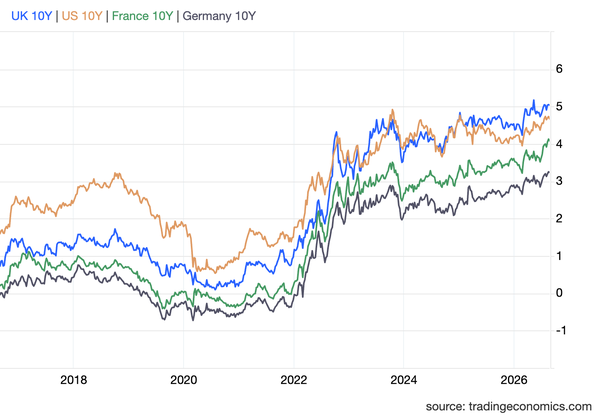
Figure 2: Comparison of the 10-year borrowing rates between FR, UK, DE and US (%)
Structural policy choices have reduced competitive pressure, making goods and services more expensive to supply. Increasing the level of competition in the economy in sectors where this is relevant would make sure consumers have access to the lowest prices.
Our economy relies primarily on imports, which means that global shocks affect us through all the countries we trade with. This is hard to avoid. However, we have worsened the problem with Brexit, which introduced additional trade barriers, such as more paperwork, more regulatory cost for importers and non-EU workers. This makes it more costly for people and goods to flow with our main trading partner and these costs get passed on to the consumer - research estimated that consumer prices rose by 2.9% between the Brexit vote and June 2018 and that food prices would have been 30% lower between December 2019 and March 2023 without Brexit. In addition, planning restrictions have constrained the supply of housing and commercial property for decades, pushing up land values and rents well beyond what a more permissive system would produce. Energy policy choices have also left UK electricity prices out of step with other countries.
Some decisions made were also necessary, despite raising costs. For example, increases in the National Living Wage were needed to support those on low incomes but this has now partly been reflected in higher prices in labour-intensive sectors, especially services.
These policies have stifled competition, which is the primary force that drives prices down. To fix this, the UK government should make it easier for existing firms to compete against each other and for new firms to enter the market. This can have both short-run and long-run effects and can be powerful to lower prices in retail, telecommunications and banking, for example. This could be achieved in a number of ways.
Weak regulation in natural monopolies has led to an increase in prices and decrease in quality. Stronger regulation would ensure that excess profits are constrained.
More competition is not the silver bullet to bringing prices down in all sectors. There are areas in which more competition is not desirable. For example, economists would not recommend building multiple sewage systems or railway networks just to increase competition. These are natural monopolies with high fixed costs, where more competition would largely duplicate infrastructure. In these sectors, effective regulation has to do the job that competition does elsewhere. Conversely, in sectors where competition is possible, poorly designed regulation can have the opposite effect: raising costs, creating barriers to entry and ultimately pushing up prices. The challenge, therefore, is not simply to have more or less regulation, but to regulate where it is necessary and remove or redesign regulation where its costs exceed its benefits.
Planning, which is key to raising competition as said above, is an example where regulation is simply too costly for what it delivers. It took Aldi five years to get planning permission to demolish a disused Jaguar showroom and replace it with a supermarket of almost exactly the same size in a suburban Surrey location recently. As well as taking five years, that supermarket planning application generated more than 1,000 documents of 33 types. Barristers are employed to argue such cases. The costs mount up - costs that directly increase the cost of food, and the cost of living.
But there are some sectors where we need more regulation, not less, particularly in utilities, water, transport and infrastructure. Here, regulation must replicate the competitive pressure which the market structure cannot provide on its own. It can do so by capping returns, restricting the cost of capital these firms are allowed to pass through to customers, or imposing minimum standards of service.
As a rule of thumb, the UK government could and should look at UK regulations relative to those elsewhere. If our regulations appear onerous and our outcomes no better, we should question the benefit of those regulations. John Fingleton’s recent review of nuclear power construction is the best example of this approach: he showed that it is perfectly possible to reduce costs while securing at least as good environmental outcomes. Similarly laws that require fish discos and bat tunnels at costs running into the many millions, for little meaningful outcome, are not sensible and need to be addressed.
These reforms are politically hard and we do not have good estimates of how much they'd actually save a typical household, but they are where real savings exist.
Structural reforms take years and require political capital which governments may not have. This is why there is a case for a second set of policies that deliver visible improvements quickly, even where the effect on the aggregate cost of living is more modest.
Some markets do not behave competitively, because consumers face real search and switching costs. There is evidence that households overpay because they never actively choose to stay on their current deal, yet firms may overcharge them in various sectors such as energy, mobile phones, home insurance, broadband, mortgages. Part of it may be rational, as the time spent looking for a better deal may cost more than the savings it could incur. But it becomes a problem when it occurs because information is costly to acquire, prices obscure and switching is difficult.
This tendency of buyers to stick with their current brand, product, or service provider is known as consumer inertia, and a government looking for quick fixes to combat this could therefore look into the following options.
These are cheap interventions that could save households real money, though their effect on the headline cost of living is likely to stay modest. Very crude estimates suggest that savings could be between £8 per month for 13 million customers in energy markets, and £5 per month for 1 to 2 million customers in mobile phone and broadbands, although they rely on the assumption that firms can sustain providing their cheapest tariff to everyone.
The UK government has already taken steps to reduce two prices: bus fares and electricity. In the case of buses, it has increased the subsidy rate. In the case of electricity, it removed VAT - the only country in Europe to do so. Although these price cuts have been welcomed by consumers, economists rarely see government dictated price falls as a sustainable solution to a cost of living crisis.
Unlike reducing regulations, these price cuts need to be paid for, either by reducing the quantity or quality of public services, or by increasing taxes or by reducing other financial transfers. In the case of bus fares and electricity price cuts, the government has opted to fund these measures within their existing budget. Shifting costs around within the government’s budget is unlikely to have a large impact on cost of living pressures and may indeed have no overall net effect, since the money spent on these things could have been used in other ways that might also reduce the cost of living.
The biggest, most durable gains come from fixing the structure of the economy and getting the public finances in order; the fast wins are real, but necessarily narrow in scope, and are unlikely to provide lasting relief to anyone.