We are Nesta.
The UK’s innovation
agency for social good.
We design, test and scale solutions to society’s biggest problems. Our three missions are to give every child a fair start, help people live healthy lives and create a sustainable future where the economy works for both people and the planet.
For over 20 years, we have worked to support, encourage and inspire innovation.
We work in three roles: as an innovation partner working with frontline organisations to design and test new solutions, as a venture builder supporting new and early stage businesses and as a system shaper creating the conditions for innovation. Harnessing the rigour of science and the creativity of design, we work relentlessly to change millions of lives for the better.
Find out more at nesta.org.uk
If you’d like this publication in an alternative format such as Braille or large print please contact us at: [email protected]
Authors
Max Hadley, John Barber and Katherine Parkin
Click the Nesta logo on any page to return to the contents
Executive summary
Ultra-processed foods (UPFs) have become the centre of recent debate around fixing our broken food environment, with the House of Lord's Food, Diet and Obesity Committee calling for further research on potential harms as a health priority.
Currently, the UK defines whether a food is ‘healthy' for policy purposes using the 2004 Nutrient Profiling Model (NPM), which scores products based on their nutrient content. Food and drinks exceeding a set threshold are classified as 'High in Fat, Sugar or Salt' (HFSS) and subject to regulation.
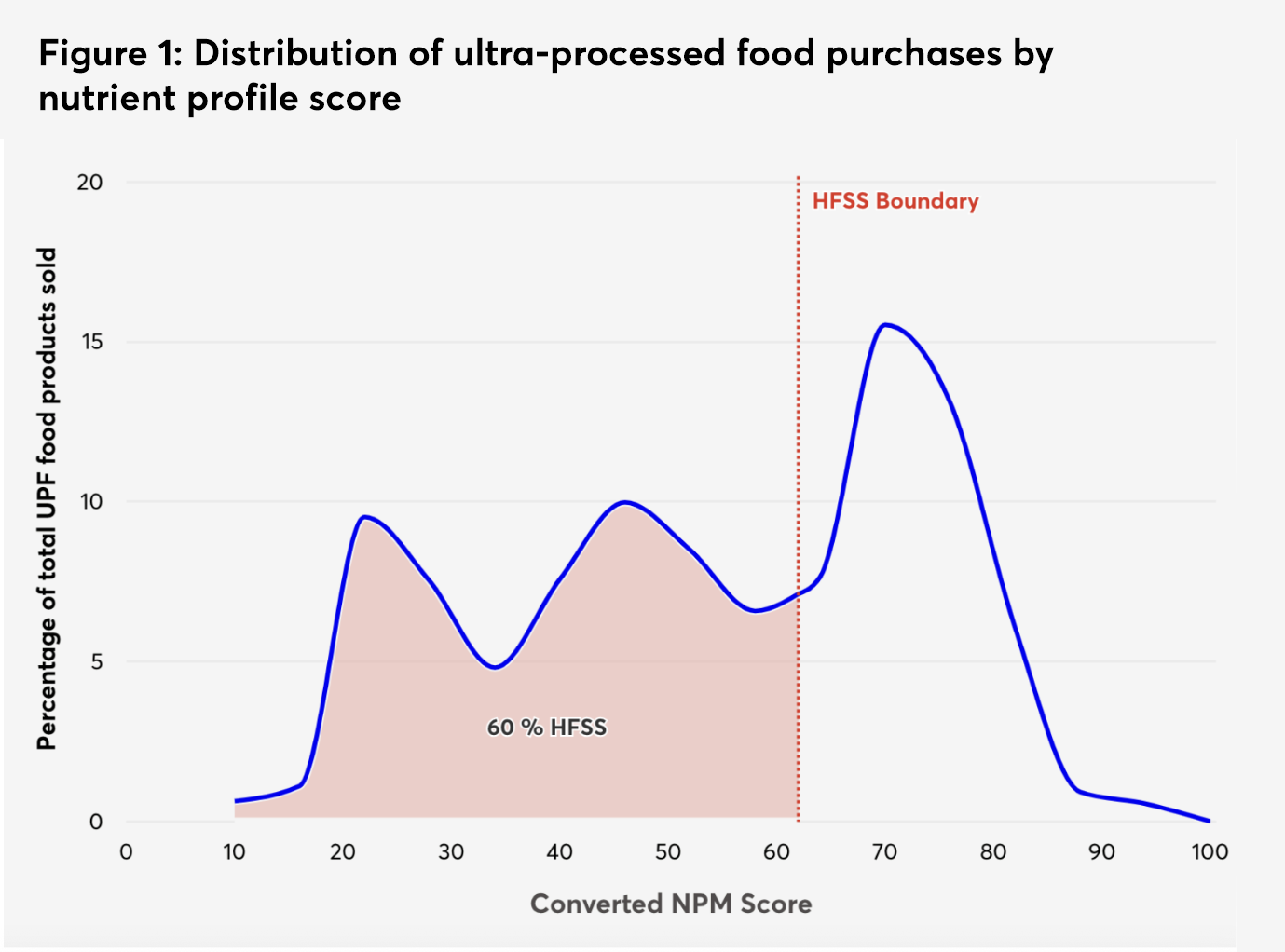
Our analysis, using data from Kantar's Worldpanel Take Home service 2021[^1], examines how well the HFSS classification targets UPFs. We found that 64% of UPF calories come from HFSS products, and this proportion grows to almost 80% when some staple foods such as bread and yoghurt – which are often UPF but not strongly linked to negative health outcomes – are excluded.
As a result, we argue against shifting to a UPF-based approach, which lacks a strong enough evidence base to guide policy. Instead, we advocate for strengthening the existing NPM framework, which offers a practical basis for addressing problems in the food environment now.
Introduction
The global food environment has changed substantially over the past few decades, and at the heart of this change has been an influx of 'ultra-processed food' (UPF). Manufactured on an industrial scale, these foods rely on novel processes and chemical additives to enhance flavour and texture. In the UK, UPFs have flooded our shopping baskets, and now make up more than half of what we eat.
There is a growing body of evidence that high consumption of UPFs is associated with increased risk of diet-related disease, including obesity, hypertension and diabetes. As a result, many countries, such as Belgium and Brazil, have introduced recommendations against the consumption of UPFs to their national dietary guidelines. Colombia has recently introduced a so-called UPF tax - although this isn't strictly linked to processing[^2].
The UK continues to adopt a nutrient profiling model (NPM)-centric approach to define the 'health' of food in national policy. This considers nutritional content but not the level of processing. While some are demanding that policymakers shift their focus to reducing the prevalence of ultra-processed food in our diets, the Scientific Advisory Committee on Nutrition (SACN) cautions that there is no strong evidence that processing itself causes harm.
But it's not clear that these two approaches are really in competition. Most typical 'junk food' - chocolate bars, crisps, doughnuts – are classified as unhealthy either way. And too much debate over the details is dangerous: misplaced disagreement only creates space for bad actors to undermine well-supported policies.
At Nesta, we are committed to halving obesity in the UK by 2030, and that means tackling the root cause of the problem – our obesogenic food environment. The places we go, the media we are exposed to, and the design of supermarkets all drive us to overconsume.
We set out to assess how well the UK's existing policy paradigm captures UPFs, and whether changes are needed to ensure that harmful products are effectively addressed.
Policy context
What are ultra-processed foods?
One of the biggest challenges for policymakers in reducing the consumption of UPFs is that there is limited consensus on which products exactly are ultra-processed.
Almost all research on UPFs uses the NOVA classification, developed by Brazilian researcher Carlos Monteiro and colleagues, which defines UPFs as 'formulations of ingredients, mostly of exclusive industrial use, made by a series of industrial processes, many requiring sophisticated equipment and technology'.
While useful for research purposes, this is considered too imprecise to be used as the basis for regulation; even experts have been shown to inconsistently label products as UPF using NOVA, and a clear line for which products would be targeted by policy is critical.
This lack of a clear definition is largely due to a limited understanding of the mechanism through which processing may cause harm. Hypotheses include the soft texture making us eat faster, the low nutritional content leading to low satiety (we don't feel full) and the high energy density. These effects combine to make UPFs hyperpalatable, ie, very easy to overconsume and displace more nutritious foods from our diets
But without clear evidence relating specific processing techniques or specific ingredients, to adverse health outcomes, it's hard to justify targeting policy at any specific product or food group.
HFSS: The existing regulatory framework
As mentioned earlier, the UK uses the 2004 Nutrient Profiling Model (NPM) to assess the 'healthiness' of food.
This is a score based on the nutrient composition of the product and intends to balance 'positive' nutrients (such as protein and fibre) with 'negative' nutrients such as fat and total sugars. Once a product breaches an ‘unhealthy' threshold on this score, it is labelled as High in Fat, Sugar or Salt (HFSS).
It was originally developed by the Food Standards Agency to provide the UK communications regulator Ofcom with a tool to differentiate foods in order to restrict junk-food advertisements for children. It has since been adopted more widely by the government, and existing and upcoming policies all target HFSS products.
Could we regulate UPFs with HFSS-focused policy?
Many ultra-processed foods, such as chocolate bars, pastries, and cakes, already fall under the HFSS classification, meaning they can be targeted using NPM-based policy. If this overlap applied to most UPFs, it would be great news for policymakers, as there would be little need for a separate UPF-specific approach.
To explore which ultra-processed products fall under the existing HFSS framework, we analysed over 3.3 million transactions from a major UK supermarket, accounting for over 80% of products purchased, using data from Kantar's Worldpanel Take Home service 2021[^3]. This dataset captures purchases from a continuously reporting panel of 30,000 GB households.
UPF products were defined using the NOVA classification, and were labelled at product level by an independent data labeller taking NOVA scores from the Open Food Facts database. This is a significant advantage of this analysis as it does not rely on broad category-level classifications (eg, “biscuits”) that can mask differences between UPF and non-UPF products.
That said, it's important to highlight that this analysis was designed as a quick exploration and is limited for a variety of reasons.
Most notably, the sample is drawn from a subset of products sold by a single major supermarket. We have assumed that this provides a reasonable reflection of the retailer's overall portfolio and that the proportion of UPFs sold is broadly similar across the sector.
While supermarket purchases do not represent the entirety of people's diets, they do account for the majority of calories consumed in the UK. Moreover, supermarkets are a key focus for potential reform, as a small number of retailers (11) supply over 90% of the calories consumed at home. For more details on the scale and impact of large retailers on our diets, and the potential benefits of a novel NPM-based policy on this sector, see Nesta's Retailer Targets Policy.
Further limitations
- The data is from 2021, meaning it doesn't capture more recent trends, although given market saturation of ultra-processed products in the UK significant shifts are unlikely.
- As this analysis is on purchases rather than consumption, it does not account for food waste or buying food for others.
- The NOVA score labelling relies on the Open Food Facts database, which is crowd-sourced. While moderated, it may contain errors. When an exact product match was unavailable, the closest equivalent was used.
Analysis
Food products
Based on our analysis, ~60% of UPF food products purchased are HFSS (64% of calories purchased). This aligns with a similar analysis of the National Diet and Nutrition Survey.
The most purchased HFSS UPF product categories are:
- Confectionery (12.1%)
- 'Morning goods' which include crumpets, sweet breads, pancakes and scones (6.8%)
- Cakes & Pastries (4%)
- Crisps & Savoury snacks (6.8%)
- Ice cream (2.7%)
The most purchased non-HFSS UPF product categories are:
- Bread & other ‘Morning goods' (almost all supermarket bread is UPF) (8.4%)
- Cooked meats (2.5%)
- Yoghurt (2%)
- Baked beans (1.7%)
While the HFSS products are typical 'junk-food' the non-HFSS UPF products include staples such as bread, yoghurt and baked beans. There is limited evidence for health concerns associated with these foods.
Drink products
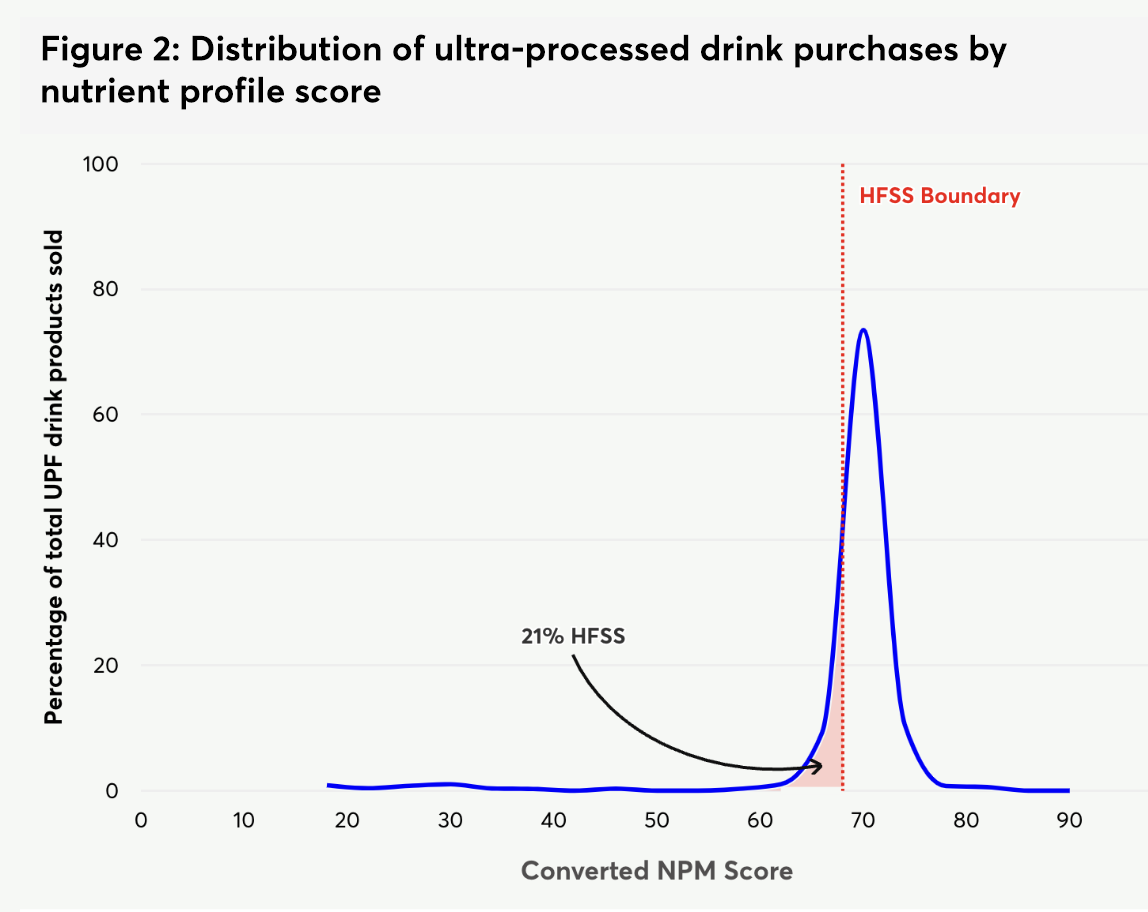
The situation is very different when we consider just ultra-processed drinks (or ‘UPF drinks'). Only 21% of UPF drinks are HFSS, and we get a ‘bunching' effect on the HFSS boundary. Despite this, strikingly, 56% of calories consumed from UPF drinks are from HFSS products.
The peak is populated by an abundance of low-calorie/diet drinks and is likely due to reformulation efforts as a result of HFSS-based policies and the Soft Drinks Industry Levy (SDIL; aka 'the sugar tax').
Outlook on regulating UPFs
As established, NPM is the dominant metric for assessing the “healthiness" of food in policy. It is both well-established in law and already familiar to retailers, manufacturers and policymakers. As a result, there are substantial barriers to a UPF-focused paradigm shift, which could only be justified if harmful products were being overlooked. Our analysis suggests this is not the case.
Nearly two-thirds of calories consumed from UPF food products are HFSS, and this overlap becomes very large when we exclude some staples that are unlikely to pose health risks.
To see this point clearly, let's focus on two of the most popular food categories that are typically ultra-processed: bread and yoghurt. Generally affordable and nutritious, both wholemeal sliced bread and yoghurt are encouraged as part of a healthy diet in the Eat Well guide. In fact, multiple studies that have found correlations between UPF and negative health outcomes notably exclude bread as a subcategory for which no association is found.
These foods make up almost 10% of all food purchases in our data and correspondingly, if we choose to exclude them, then 68% of UPF products are covered by HFSS regulation, and importantly 78% of calories purchased[^4].
With such a large calorie overlap, any possible benefits of switching from NPM-based to UPF-based policy may well be marginal, irrespective of the context of the current evidence base and steep implementation challenges.
This isn't to reject concerns surrounding UPF, or a call to inaction. As research evolves, policymakers should consider refining the NPM to reflect new evidence. We know this is a viable option, with a US study demonstrating that by adding elements to the HFSS definition – such as flavour enhancers, colours, and emulsifiers – all UPFs could be captured. So far, updates to NPM have been slow to occur, with revised guidance from 2018 still yet to be implemented.
But obesity is a pressing issue now. Our analysis suggests that concerns around UPFs should not prevent us from pushing for immediate effective NPM-based regulation, which is likely to target the majority of harmful products without being affected by some of the potential drawbacks of introducing the UPF definition to policy.
Drinks
For drinks, we see that the suitability of HFSS policy hinges on artificial sweeteners being considered an acceptable alternative to sugar. While these are widely considered to be safe, there is ongoing research into their health effects, which strengthens the case for ensuring NPM remains aligned with the latest evidence.
Endnotes
- Specifically the 52-week period 01/01/2021 to 31/12/2021
- The tax is applied to products that exceed a sugar, salt and fat threshold, so it is arguably a "UPF" tax in name only.
- Specifically the 52 week period 01/01/2021 to 31/12/2021
- 85% according to our data.
58 Victoria Embankment
London EC4Y ODS
+44 (0)20 7438 2500
[email protected]
X @nesta_uk
f nesta.uk
www.nesta.org.uk
ISBN: 978-1-916699-35-9
Nesta is a registered charity in England and Wales with company number 7706036 and charity number 1144091. Registered as a charity in Scotland number SC042833.
Registered office: 58 Victoria Embankment, London EC4Y ODS.