This report should be referenced as follows: Wylinka and Nesta (2019) Understanding Brazil's innovation system.
Content and research: Paulo José Furlan Mendonça, Amanda Cecília Sant'Ana Dusse, Arthur Araújo Ribeiro, Elimar Pires Vasconcellos, Artur Tavares Vilas Boas Ribeiro (Wylinka)
Design: Priscila Vanneuville
Disclaimer: Information and data collected in February 2019.
1. COUNTRY PROFILE: Brazil's Innovation System
1.1 INTRODUCTION
To explain the Brazilian context is not an easy task. For one thing, its size - the 5th largest country in the world - means a varied set of opportunities and challenges are presented to policymakers. The country is a major market and has the potential to produce substantial economic outputs. Nonetheless, unequal levels of regional development, a complex public administration system and a tangled/over-centralised budget and tax collection structure hinder this potential. A recent democracy, its public policy mechanisms are also yet to be developed. Policy discontinuity, lack of institutional maturity and regulatory uncertainty are frequent problems.
In spite of these challenges, leading initiatives give a sense of Brazil's potential. Two champions of excellence spearhead the Brazilian innovation system: agriculture - with an institution, EMBRAPA, employing more than 9.000 staff and 2.400 researchers around the country - and aerospace - with a world leading innovation ecosystem based in São José dos Campos.
The Brazilian public administration system is characterised by centralization: the country is divided into states, and Federal revenue is distributed through these states and municipalities. Although comprising 26 states, 5 states are responsible for more than 60% of national GDP - São Paulo (32,4%), Rio de Janeiro (11,0%), Minas Gerais (8,7%), Rio Grande do Sul (6,4%) and Paraná (6,3%).
After a period of high growth (2000-2010), the country was recently faced with political and economic downturns, in parts due to its lack of institutional maturity - more than ever it seems, its main challenge today would be to overcome issues related to productivity, economic stability and innovation capabilities.
Overview of the Brazilian innovation system
Over the last 20 years, Brazil implemented a series of new science, technology and innovation (ST&I) policies, most of which on the model of widespread state-of-the-art practices on innovation promotion. Examples include the creation of funds to finance innovation, the passing of laws to regularise university-company cooperation, and the implementation of tax breaks for R&D. Efforts were made to consolidate institutions, e.g. improving the design of financing schemes, and adopting broad legislation to encourage ST&I. As a result, both the resources available for innovation and the regulatory framework have been expanded and improved. These advances have been reflected in the improvement of important ST&I indicators, related to publications, infrastructure, research centers and companies declaring to have innovated.
Despite the above however, the results achieved were for the most part modest. The country scores an intermediate level in practically all indicators of production, use of knowledge and of new technologies. While a leader in Latin America, with indicators comparable to some European countries, it is still far from being a global innovation leader. It is worth noting that Brazil scores poorly in measures of the level of bureaucracy and rigidity of the system, in which, it ranks near to last - of instance, on the number of days required to open a company.
Historically, the Brazilian system of innovation has been unevenly developed, and low levels of diversification were the standard, public sector institutions traditionally constituting the main actors. Significant investments were made by the government in innovation, but in a scattered way and without bringing about a sense of building a competitive system. Most Brazilian companies concentrate their expenditures on the acquisition of machines, equipment and software, absorbing technology from the outside. The activities of academia are not directed to a specific mission and evidence the dispersion and lack of focus on strategy projects for the economic and social development of the country.
What we can see is that although we witness some economic development and efforts have been made to improve the innovation system, Brazil's growth rate did not reach the level sought after and is not consistent with the efforts made so far. This can be proven by observing the country's productivity rate, which has been virtually stagnant since the late 1970s.
1.2 STATISTICAL HIGHLIGHTS
Innovation indicators in Brazil and suitable comparator countries
| INDICATOR |
BRAZIL |
CHILE |
INDIA |
MEXICO |
UK |
LATIN AMERICA AND THE CARIBBEAN |
| GLOBAL INNOVATION INDEX RANK (2018) |
64/126 |
47/126 |
57/126 |
56/126 |
4/126 |
BR: 6/18 |
| GLOBAL COMPETITIVENESS INDEX (2017-2018) |
80/137 |
33/137 |
40/137 |
51/137 |
8/137 |
BR: 9/20 |
| R&D GROSS DOMESTIC EXPENDITURE AS % OF GDP (2018) |
1.30 |
0.30 |
0.60 |
0.50 |
1.70 |
BR: 1/15 av: 0.70 |
| HIGH-TECH EXPORTS, IN %, OF MANUFACTURES EXPORTS (2016) |
13.45 |
6.95 |
7.13 |
15.29 |
21.83 |
BR: 5/21 av: 12.136 |
| PCT PATENTS PER MILLION POPULATION (2017-2018) |
3.4 |
8.8 |
1.7 |
2.4 |
99.1 |
BR: 2/20 av: 1.35 |
| PATENTS APPLICATION RESIDENT (2016) |
5200 |
386 |
13199 |
1300 |
13876 |
BR: 1/18 av: 479 |
| DAYS REQUIRED TO START A BUSINESS (2017) |
79.5 |
5.5 |
29.8 |
8.4 |
4.5 |
BR: 30/33 av: 30.952 |
| % OF THE 18-64 POPULATION WHO BELIEVE THEY HAVE THE RIGHT SKILLS/KNOWLEDGE TO START A BUSINESS (2017-2018) |
55.9 |
61.8 |
42.1 |
50.1 |
48.2 |
BR: 8/11 av: 58.85 |
Population: 209 million world ranking: 5
Area: 5th largest country
GDP: $2056 trillion +0.976% in 2017 world ranking: 9 latin america ranking: 1
Data compiled from:
Global Innovation Index
World Economic Forum
UNESCO
World Bank
Global Entrepreneurship Monitor
- Brazil invested 1,3% of its GDP in R&D in 2017. This percentage is growing in the last few years. Although, this rate is much less than the average of OCDE countries, where the investment represents 2,38% of GDP. Brazil showcases nonetheless better results than all Latin America countries and than Portugal and Spain. This percentage is a sum of public and private investments. In 2015, each contribution was almost the same (50,2% public and 49,8% private). One of the challenges was to increase the private participation. On Brazil's Science, Technology and Innovation Plan for 2007-2010, the goal was to reach 1,5% of GPD and the participation of 65% of the private sector, which was clearly not achieved.
- Innovation within companies is not low. The percentage of companies which implemented innovation on products or processes in 2012-2014 was superior to the average of European countries (36% vs. 34%). Despite the latter, the innovation process consists mainly of modernization and technology imitation, based on the high investments in machine and equipment acquisition and the low number of new processes and products introduced in companies, Brazilian or not.
- The Brazilian academic production has increased in the last few years. The country's participation in world publications jumped from 0,7% to almost 3%, in the period between 1991 and 2013, overtaking the world average rate of publications per habitant. This growth is related to the increase of graduate programs and the consequent higher number of masters and PhDs in this same period (MCTIC, 2017). Although, the quality and the international impact of the academic production still have low relevance. In 2015, Brazil only contributed 1,67% of the citations over the world. This is also reflected in patent applications: only 7% of patents are deposited by companies located in the country, which reflects the low innovative and patenting activity of Brazilian companies.
- Technology exports are facing a downturn. In 2000, they were 9% of all exports, and in 2014 they reached only 3%. The decrease was related to the high price of commodities, which increased even more their percentage in exports. This movement reflects how the country's competitivity is fragile and dependent on low technology products.
1.3.1 KEY INNOVATION PROGRAMMES
- BRAZILIAN AGRICULTURAL RESEARCH CORPORATION (EMBRAPA): linked to the Ministry of Agriculture, is undoubtedly one of the most important institutions in the Brazilian innovation system. It is a public company created in 1973 under the administration of the Ministry of Agriculture with the objective of developing science and technology applied to the Brazilian agricultural sector. Today, it has more than 9,000 employees and about 2,400 researchers working in more than 60 units across the country. https://www.embrapa.br/
- SECTORAL FUNDS: are derived from collections linked to different economic activities. Its creation has significantly changed the composition of the sector financing and represented an increase in the volume of resources as a stable and diversified source for the promotion of science, technology and technological innovation.
- AERONAUTICAL COMPLEX: the innovation system in the aeronautical sector is highly competitive. Brazil is the only successful emerging country in the complete cycle of aircraft production - from aircraft design and development to commercialization.
- NATIONAL CENTER FOR RESEARCH IN ENERGY AND MATERIALS (CNPEM): is a social organization qualified by the Ministry of Science, Technology, Innovation and Communications (MCTIC). It has four laboratories, worldwide references, open to the scientific and business community, among them the National Synchrotron Light Laboratory (LNLS), which operates the only Synchrotron light source in Latin America and is currently building Sirius, the new Brazilian accelerator, to analyse the most diverse types of materials, organic and inorganic. http://cnpem.br/
- STARTUP BRAZIL: Initiative of the Ministry of Science, Technology and Innovations in partnership with the accelerators to support the technology-based nascent companies/ Startups. The first edition was in 2013 and it was primordial in developing the country's entrepreneurial ecosystem. https://www.startupbrasil.org.br/
- FOUNDATIONS OF RESEARCH SUPPORT (FAP): are entities that integrate the National System of Science and Technology, alongside with traditional institutions such as the National Council for Scientific and Technological Development (CNPq) and the Financier of Studies and Projects (FINEP). They are entities that play a significant role in the definitions of national scientific and technological policy. http://confap.org.br/novo/pt/faps
1.3.2 KEY INNOVATION PROGRAMMES: TIMELINE
BRAZILIAN INNOVATION PIONEERS: Period "Imperial Science”, with the creation of the first institutions such as "School of Anatomy and Surgery of Rio de Janeiro” (1808) and "School of Mines of Ouro Preto” (1875). Post-war period as a fundamental milestone in the development of S&T, with the creation of CNPq and Capes (1951).
1999
CREATION OF SECTORAL FUNDS
The Funds are composed of taxes and contributions from various sectors of activity (for that reason, sectoral), and that part of the royalties of the oil that feeds the Funds, constitutes its main source.
2004
INNOVATION LAW
It provided rules for the participation of researchers from public institutions in projects with companies and for the commercialization of intellectual property derived from this type of partnership.
2005
LEI DO BEM
It broadened the scope and facilitated the use of tax incentives for the realization of private investments in R&D.
2012
NATIONAL STRATEGY FOR SCIENCE, TECHNOLOGY AND INNOVATION (ENCTI)
Designed to build a consistent scientific and technological base capable of responding to the demands of the Brazilian economy and society.
2013
EMBRAPII
Social organization aimed at supporting technological services for industrial companies, with a new mode of operation in Brazil, inspired by the Fraunhofer-Gesellschaft institutes in Germany. https://embrapii.org.br
2016
NEW REGULATORY FRAMEWORK FOR S&T
It was established prioritizing the development of three main axes: the integration of private companies into the public research system; the simplification of administrative, personnel and financial processes in public research institutions; and the decentralization of the STI sectors development promotion in the States and Municipalities.
1.4.1 INSTITUTIONAL MAP OF THE BRAZILIAN INNOVATION SYSTEM
This diagram illustrates the institutional map of the Brazilian innovation system, categorizing entities into:
-
COORDINATING COUNCILS/OVERSIGHT:
- CNS (National Health Council)
- CNE (National Education Council)
- CCT (National Council of Science and Technology)
- CNDI (National Council for Industrial Development)
- COMASSE (C&T advisory commission for defense)
-
MINISTRIES:
- MS (Ministry of Health)
- MEC (Ministry of Education)
- MCTIC (Min. of Science, Technology, Innovation and Communications)
- MDIC (Min. of Industry, Foreign Trade and Services)
- Ministry of Planning, Development and Management
- MAPA (Ministry of Agriculture, Livestock and Food Supply)
- Ministry of Foreign Affairs
- MD (Defense Ministry)
-
AGENCIES OR UNDER-MINISTRIES:
- Anvisa
- CAPES
- CNPQ
- ABDI
- IPEA
- APEX
- EMBRAPII
- FINEP
- SEBRAE
- ANPROTEC
- CGEE
- BNDES
- CNA
- CNI
-
BENEFICIARIES OR OTHER RELEVANT INSTITUTIONS:
- Fiocruz
- Federal Universities
- ISTs*
- INPI
- INMETRO
- INCA
- Federal Institutes
- EMBRAPA
- ISTs*
- INMET
Legends:
* *ISTs except universities and federal institutes
* MCTIC serves as the Coordinator of the SNCTI.
* "Attached to" is indicated by solid lines.
* "Provides funds" is indicated by dashed lines.
1.4.2 ROLE AND INFLUENCE DIAGRAM OF KEY MINISTRIES AND AGENCIES
This diagram is a bubble chart illustrating the role and influence of key ministries and agencies in Brazil's innovation system. The size of the bubble indicates the level of influence in the innovation system. The entities are grouped conceptually into four quadrants:
-
DESIGN: (Top-right)
- MCTIC (Min. of Science, Technology, Innovation and Communication)
- MDIC (Min. of Industry, Foreign Trade and Services)
- MAPA
- MS
- MD
- MEC
-
INNOVATION: (Right-side, overlapping with DESIGN)
- CNI
- CNA
- SEBRAE
- BNDES
- ABDI
- EMBRAPII
-
OPERATION: (Bottom-center)
-
SCIENCE AND TECHNOLOGY: (Left-side, overlapping with DESIGN)
Key Observations:
* MAPA, MS and MD have the same position on the map.
* CNA and CNI have the same position on the map.
* Level of influence: the bigger the size of the bubble, the more influence in the innovation system.
* This influence map is indicative and reflects the insights of the project team rather than a formal statement of roles and structures.
1.5 GLOSSARY OF INSTITUTIONAL ABBREVIATIONS AND ACRONYMS
- CNS: National Health Council
- CNE: National Education Council
- CCT: National Council of Science and Technology
- CNDI: National Council for Industrial Development
- COMASSE: C&T advisory commission for defense
- MS: Ministry of Health
- MEC: Ministry of Education
- MCTIC: Ministry of Science, Technology, Innovation and Communication
- MDIC: Ministry of Industry, Foreign Trade and Services
- MAPA: Ministry of Agriculture, Livestock and Food Supply
- MD: Defense Ministry
- ANVISA: Brazilian Health Regulatory Agency
- CAPES: Coordination for the Improvement of Higher Education Personnel
- EMBRAPII: Brazilian Agency for Industrial Research and Innovation
- CNPq: National Council for Scientific and Technological Development)
- FINEP: Brazilian Funding Authority for Studies and Project
- CGEE: Center for Strategic Studies and Management
- ABDI: Brazilian Industrial Development Agency
- SEBRAE: Brazilian Service to Support Micro and Small Enterprises
- BNDES: Brazilian Development Bank
- IPEA: Institute of Applied Economic Research.
- APEX: Brazilian Agency for the Promotion of Exports and Investments
- ANPROTEC: Brazilian Association of Science Parks and Business Incubators
- CNI: Brazilian National Confederation of Industry
- CNA: Brazilian Agriculture and Livestock Confederation
- Fiocruz: Oswaldo Cruz Foundation
- INCA: Brazilian National Cancer Institute
- INPI: National Institute of Industrial Property
- INMETRO: National Institute of Metrology, Quality and Technology
- EMBRAPA: Brazilian Agricultural Research Corporation
- INMET: National Institute of Meteorology
1.6 STRENGTHS AND WEAKNESSES ANALYSIS
STRENGTHS
Several advances have been made for education in the last 15 years
- Increased number of universities / courses (REUNI program), increased scholarships number (ProUni program), increased subsidies for private studies (FIES program) and consequently, the number of students enrolled in higher education has grown significantly.
- Increased offer of postgraduate courses, consequently of PhD students and scientific production.
- Improvement of physical infrastructures and creation of new laboratories.
WEAKNESSES
There are several gaps in the education system that need attention and, although we had great investment, the Brazilian science impact did not grow as expected.
- The areas in which Brazil is most competitive (agrarian, human sciences and health) do not correspond to those most demanded by innovation activities in the rest of the world (engineering, physics, inorganic chemistry, materials sciences).
- The research facilities in Brazil are predominantly public, and most of them are within public universities.
- Brazil ranked 112th out of the 137 countries assessed by the WEF Global Competitiveness Report 2017-2018 in terms of the quality of primary education.
- Only 15% of all graduates are in the technology area, with the global average being 25%.
1.6 Strengths and Weaknesses Analysis
FUNDING
STRENGTHS
Different policies have been implemented to increase R&D funding:
- i) subsidised credit; ii) fiscal incentives; (iii) subsidy for companies; iv) subsidy for research projects in universities and ICTs, among others.
- The creation of EMBRAPII (Brazilian Research and Industrial Innovation Enterprise), a social organization linked to MCTIC, marked the adoption of a new S&T investment model.
- Brazil is good at promoting cooperation between federal and the state-level S&T and innovation promotion agencies.
- Recognition and attempt to protect the figure of angel investor.
WEAKNESSES
Effects were modest:
- On private investments in R&D, patent deposits, innovation rate and high technology exports - show modest effects.
- The S&T budget oscillates due the non continuity of governments and their priorities. There is a lack of strategic thinking for actions.
- Brazil has increased private investment in R&D over the last 15 years, but in relative terms it is still the same.
- Low diversity in the possibilities of supporting science and technological production in the country. Basically, the S&T investment model in Brazil consists in the awarding of grants, credit or direct research execution and is strongly centralised in the MCTIC.
- The research infrastructure in Brazil and the distribution of public sector R&D investments are overly fragmented.
INSTITUTIONAL FRAMEWORK
STRENGTHS
Improvements of Brazilian national innovation system
- Implementation of new policies focused on science and technology (S&T) and for innovation, such as:
i) sectoral funds,
ii) lei do bem,
iii) innovation law,
iv) Legal framework for innovation.
- New attempts by INPI to expedite the granting of patents for biotechnology (green patents) and MSB.
- Presence of social organizations, a structural alternative developed in 1998. These private, non-profit entities manage public research facilities under contract to federal agencies with autonomy and flexibility.
WEAKNESSES
The bureaucracy and rigidity of Brazil's institutions is considerable.
- Brazil is among the 15 worst countries in the world in terms of difficulty to open new businesses, according to the World Bank's “Doing Business” study.
- It can take up to 11 years for INPI to review a patent application.
- Brazil's public research institutes and universities follow rigid rules that tend to make them very difficult to manage.
BROADER ENVIRONMENT
STRENGTHS
The strong growth and considerable social progress of the last two decades has made Brazil one of the world's major economies.
- A dynamic labour market combined with better access to education, allowed millions of Brazilians to achieve better jobs and a better standard of living.
- Abundance of natural resources, allowing to use them for innovation.
- Brazil is in a window of demographic opportunity of about 30 years (ranging from 2010 to 2040). In this period, the predominant population profile is the population of active age, with possibility of occupation in the labour market, generation of income and without significant commitments with dependents.
WEAKNESSES
Since 2015, Brazil is facing a period of political instability and economic recession
- Worst performance indicators registered in Brazil are consequences of bureaucracy and policy discontinuity in relation to the change of government.
- Regulatory barriers faced by Brazil's enterprises are one of the highest in the world.
- For more than two decades Brazil has been the country with one of the highest real interest rates in the world.
- It remains one of the most unequal countries in the world. Half of the population has access to 10% of total family income while the other half has access to 90%.
- The domestic market is very protected from importation, thus, companies are less exposed to more productive and better quality international competitors, which also makes difficult the use of insumes and imported equipments.
ECOSYSTEM CONNECTIONS
STRENGTHS
Efforts are made in order to promote connexions in the national innovation system
- Policies to promote cooperation among companies and research institutes were implemented by the government, such as the "Lei do Bem", the Innovation law and the legal framework for innovation.
- Several initiatives were created in order to promote integration and partnership between different actors of the innovation system, for example: the National Association of Research and Development of Innovative Companies (ANPEI), or Movement Competitive Brazil and Business Mobilization through Innovation (MEI).
WEAKNESSES
Cooperation between different actors of the national innovation system is insufficient
- Brazil ranks 70 out of 137 in University-industry collaboration in R&D, according to The Global Competitiveness Index 2017-2018.
- One of the biggest challenges raised by policymakers in this study is the collaboration between the different actors and sectors. The lack of institutional flexibility makes it difficult to connect.
2. REGIONAL PROFILES
Innovation in Brazilian States
2.1 INTRODUCTION
Innovation in Brazilian States
Brazil has a vast territory and the distribution of its wealth and technological potential is heterogeneous. The nature of its public policy system means the most important innovation policies are implemented in a top-down fashion. Nonetheless, initiatives at state or municipal level are more diversely implemented.
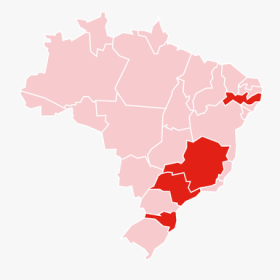
Looking at the Endeavor Entrepreneurial Cities Index 2017, one can easily see that Brazil's main and most innovative cities are concentrated in São Paulo and Santa Catarina States. Minas Gerais State is also worth mentioning, being well known for its concentration of top tier universities and leading ecosystems (cities such as Belo Horizonte, Viçosa and Santa Rita do Sapucaí). In Brazilian Northeast, a region yet affected by a lack of access to resources, the city of Recife hosts a technology cluster named Porto Digital, home of a dozen of fast growing startups along large companies' research centers (such as Microsoft and Samsung).
These four states will be the main focus of the present study, representing three Brazilian regions and its main entrepreneurship ecosystems.
2.2 STATISTICAL HIGHLIGHTS
| INDICATOR |
MINAS GERAIS |
PERNAMBUCO |
SANTA CATARINA |
SÃO PAULO |
BRAZIL |
| GDP SHARE (%) |
8,7 |
2,6 |
4,2 |
32,4 |
4/126 |
|
3/27 |
10/27 |
6/27 |
1/27 |
|
| POPULATION (2017) |
21,1 millions |
9,5 millions |
7 millions |
45 millions |
8/137 |
|
2/27 |
7/27 |
11/27 |
1/27 |
|
| FEDERAL UNIVERSITIES (2017) |
11 |
4* |
2 |
3 |
1,70 |
| STATE UNIVERSITIES (2017) |
2 |
1 |
1 |
4 |
21.83 |
| STATE EXPENDITURES ON R & D, % TOTAL REVENUES (2015) |
0,32 |
0,26 |
1,02 |
3,54 |
99.1 |
|
11/27 |
14/27 |
4/27 |
1/27 |
|
| STATE EXPENDITURES ON S&T, % TOTAL REVENUES (2015) |
0,98 |
0,57 |
2,07 |
3,92 |
13876 |
|
14/27 |
22/27 |
3/27 |
1/27 |
|
| RESEARCHERS PER THOUSAND INHABITANTS |
1,02 |
0,88 |
1,56 |
1,01 |
4.5 |
| PATENT APPLICATIONS FILED WITH INPI BY RESIDENTS (2016) |
826 |
190 |
575 |
2696 |
48.2 |
|
10% |
2% |
7% |
33% |
|
Data compiled from: 1 IBGE, 2 MCTIC, 3 CNPq.
* A university in Pernambuco was recently sanctioned, but has not yet begun to operate.
SÃO PAULO
2.3.1 INTRODUCTION
São Paulo is the most advanced state of Brazil, accounting for 22% of the country's population (+45mm habitants), 36% of the whole national production of goods and services and housing 63% of the multinationals established on Brazilian territory.
Being the main financial, commercial and corporate center in Latin America, São Paulo's economy is rooted in a transformation process that started in the 19th century. In the early years of 1800, the state became an important route of Brazilian sugar production - and also started to play a role in national politics (with the country independence being proclaimed in São Paulo by Dom Pedro I, 1822). Later, the state became a relevant coffee exporter and started to develop a strong bourgeoisie and European immigrant concentration that created the pillars for São Paulo's development - investments in the industry (e.g. Matarazzo's industries), education (e.g. São Francisco Law School) and infrastructure (e.g. São Paulo Railway). This demographic and economic boom became the basis of the great advancements that the state faced in the XX and XXI century, like the development of the automotive industry (ABC Region), aerospace complex (São José dos Campos) and textile cluster (Americana, Hortolândia, Santa Bárbara D'Oeste and others).
Nowadays, if São Paulo state were seen as an entire country, it would be together with the 25 biggest economies in the world. São Paulo's capital, which is also named São Paulo, is the 10th richest city in the world. The state is also well developed in social indexes, having the second biggest HDI, the second biggest GDP per capita and the fourth lowest illiteracy rate in Brazil. It is important to notice that São Paulo is, by far, the state that most invests in Science, Technology and R&D, housing the Brazilian leading universities, such as University of São Paulo (USP), University of Campinas (UNICAMP) and Institute for Technology Advancement (ITA), also being responsible for 28% of the nation's scientific production and 40% of its deposited patents.
2.3.2 SÃO PAULO'S INNOVATION SYSTEM
As the largest economy in the country, the State of São Paulo has a system of innovation marked by an abundance of resources compared to other states. It is the second largest investor in R&D in Latin America, in front of Mexico and Argentina. Two thirds of public R&D funding in São Paulo - around 1.1% of its GDP - comes from state sources, including funding for the three state universities (USP, UNICAMP and UNESP), 19 research institutions and the Foundation for Research Support of the State of São Paulo (FAPESP), which supports science and technology activities.
The State of São Paulo has six public universities, as well as four higher education institutions - two state and two federal ones -, 34 public research institutes, 18 private research institutes and, according to the Innovation Survey (PINTEC) 2014, almost 15 thousand companies that produce or contribute to some level of innovation.
Important research institutes are also present in the state, such as the Technological Research Institute (IPT), the Nuclear and Energy Research Institute (IPEN), the BUTANTAN Institute, the Biological Institute, the Pasteur Institute, the Tropical Medicine Institute of São Paulo (IMTSP), the Forestry Institute, the National Space Research Institute (INPE), the National Synchrotron Light Laboratory (LNS) and the Campinas Agronomic Institute (IAC).
As for the startups ecosystem, São Paulo is notable for the presence of large companies and large seed and venture capital funds, with success cases from the birth of Buscapé to the recent exit of 99, sold for more than 1 billion dollars. The state also has other initiatives, spaces of innovation, coworkings and incubators, such as CUBO and INOVABRA, from the banks Itaú and Bradesco, respectively.
São Paulo shows itself as the main pole of innovation in the country, leveraged by the greater volume of public and private investments, the state is a technological power at continental and world levels.
2.3.3 KEY INNOVATION PROGRAMMES
-
FAPESP: The Research Development Foundation from the State of São Paulo was the first institution for developing research (FAP) created for the first time in 1960, and later replicated across the country. 1% of the state's income constitutes its main source of funding, which represented about US$ 350 millions in 2017. Among its main projects, the PIPE [Innovative Research in Small Companies Program], which supports scientific and/or technological research in small São Paulo's companies, stands out. In 2017 there were about US$ 20 millions disbursed for 269 projects by the program.
www.fapesp.br/
-
SYSTEM OF TECHNOLOGY PARKS (SPTEC): created to provide support to technology parks, helping these enterprises to attract investments and generate new companies that are knowledge intensive or technology based, promoting the economic development of the State. São Paulo is the state that has the most parks, 12 according to the state government.
www.desenvolvimento.sp.gov.br/parques-tecnologicos
-
ENTREPRENEURSHIP AND INNOVATION SPACES: São Paulo concentrates a large number of private initiatives, such as CUBO (Itaú), Google Campus, Hack Station (Facebook), Habitat (Bradesco), FAROL (Santander), etc.
-
STATE UNIVERSITIES: Campinas State University and University of São Paulo have the second and third place, respectively, in 2019 Latin America university ranking.
Key Innovation Events Timeline
- 1950: Creation of the Technical Center of Aeronautics in São José dos Campos. The city became the pole of the aeronautical industry, with the later foundation of Embraer and other organizations and public agencies.
- 1960: Creation of FAPESP, the first research support foundation in Brazil.
- 2006 (APPROVED IN 2008): Law of Innovation of the State of São Paulo. The law establishes a creation of the São Paulo System of Technological Innovation, with the purpose of encouraging the sustainable development of technological Innovation, the use of special projects and programs, articulated with the public and private sector.
- 2006: São Paulo System of Technology Parks. Decree signed by the governor to create five technological parks, in Greater São Paulo, Campinas, São José dos Campos, São Carlos and Ribeirão Preto, to promote economic development and generation of jobs and incomes in these regions.
- 2007 & 2009: IPO of Mercado Livre on Nasdaq and purchase of Buscapé for 342 million dollars, respectively. These two events represent a milestone for the São Paulo and national startups ecosystems, attracting the attention of investors to the market.
- 2014 (APPROVED IN 2008): Decree 60.286, which establishes and regulates the Sao Paulo's System of Environments of Innovation (SPAI). The SPAl comprises the São Paulo's Technology Parks System (SPTec), the São Paulo's Technological-based Business Incubators Network (RPITec), the São Paulo Technological Innovation Centers Network (RPCITec) and the São Paulo's Network of Technological Innovation Centers (RPNIT).
- 2018: Creation of Sao Paulo's Innovation Environments Network (SP REDE). The initiative brings together, supports and articulates technical, political, institutional and managerial actions, as well as the innovation and entrepreneurship environments.
2.3.4 INSTITUTIONAL MAP OF SÃO PAULO'S INNOVATION SYSTEM
São Paulo System of Innovation
This diagram illustrates the institutional map of São Paulo's innovation system, showing relationships between various entities.
SECRETARIES (Top Level):
* Secretary of Education
* Secretariat for Economic Development, Science, Technology and Innovation
* Secretariat of Planning and Management
* Secretary of Finance
AGENCIES (Mid Level):
* FAPESP (connected to Secretariat for Economic Development, Science, Technology and Innovation)
* SEBRAE/SP (connected to Secretariat of Planning and Management and Secretary of Finance)
BENEFICIARIES OR OTHER RELEVANT INSTITUTIONS (Bottom Level):
* State Universities (connected to Secretary of Education, and FAPESP)
* Technology Parks (connected to FAPESP)
* Investe SP (connected to Secretariat of Planning and Management, and SEBRAE/SP)
* Desenvolve SP (connected to Secretary of Finance, and SEBRAE/SP)
Relationships:
* — Attached to
* —> Provides funds
Note: SEBRAE/SP receives resources from the national unit, but exerts great influence in the state context, having participations in several actions of the state.
2.3.5 ROLE AND INFLUENCE DIAGRAM OF KEY MINISTRIES AND AGENCIES
This diagram shows the roles and influence of key ministries and agencies in São Paulo's innovation system, represented by interconnected "bubbles" of varying sizes.
Main Categories:
* SCIENCE AND TECHNOLOGY (connected to FAPESP and Federal and State Universities)
* DESIGN (connected to FAPESP and SEDECTI)
* INNOVATION (connected to SEDECTI, SEBRAE SP, DES-ENVOLVE SP, INVESTE SP, and FIESP)
* OPERATION (connected to Federal and State Universities, Tech Parks, and FIESP)
Entities and their connections (clockwise from top-left):
* SCIENCE AND TECHNOLOGY
* FAPESP (connected to Science and Technology, Design, Federal and State Universities, Tech Parks)
* SEDECTI (connected to FAPESP, Design, Innovation)
* INNOVATION
* SEBRAE SP (connected to Innovation, DES-ENVOLVE SP, INVESTE SP)
* FIESP (connected to Innovation, INVESTE SP, FIESP)
* INVESTE SP (connected to Innovation, SEBRAE SP, FIESP)
* DES-ENVOLVE SP (connected to Innovation, SEBRAE SP)
* OPERATION
* TECH PARKS (connected to FAPESP, Operation)
* FEDERAL AND STATE UNIVERSITIES (connected to Science and Technology, FAPESP)
Notes:
* A very industrial state, FAPESP receives a large amount of resources that are used, among other things, in activities for innovation. The institution has a big influence on the innovation system.
* Level of influence: the bigger the size of the bubble, the more influence in the innovation system.
* This influence map is indicative and reflects the insights of the project team rather than a formal statement of roles and structures.
2.3.6 GLOSSARY
- FAPESP: Foundation for Research Support of the State of São Paulo
- SEBRAE/SP: Brazilian Service to Support Micro and Small Enterprises (Regional of São Paulo)
- INVESTE SP: State Agency for the Promotion of Investments and Competitiveness
- DESENVOLVE SP: State Development Agency
REGIONAL PROFILES
2.3.7 STRENGTHS AND WEAKNESSES ANALYSIS (SÃO PAULO)
HUMAN CAPITAL/ KNOWLEDGE ASSETS
The state has great national relevance in the development of human capital, representing almost 30% of Brazil's scientific production and 20% of Brazil's PhDs.
STRENGTHS
- Almost 30% of Brazil's scientific production originates in São Paulo.
- The share of PhDs in São Paulo corresponds to more than 20% of Brazil's PhDs.
- São Paulo has about 73 PhDs per hundred thousand inhabitants.
- The distribution of universities within the state is very broad. Four of the five best Brazilian universities are located in São Paulo.
- The State concentrates 25% of the total of higher education institutions in Brazil and has a great capacity of attracting talents from all over Brazil.
WEAKNESSES
As a consequence of the state concentration in highly skilled labor, this workforce is 60% to 100% more expensive than in the rest of the country.
Although the state concentrates a great, highly qualified workforce, there are no institutes or schools specialised in public policy, similar to Fundação Dom Pinheiro in Minas Gerais. This reflects in the capacity of the state to conduct innovation policymaking.
FUNDING
STRENGTHS
Funding is the main strength of São Paulo. Being the largest economic center in Latin America makes the state a fertile ground for innovation.
- São Paulo invested 3.54% of its Gross Domestic Product (GDP) in R&D in 2015.
- The state of São Paulo accounts for 73.7% of all Brazilian state governments expenditures in R&D.
- The state counts on the presence of large Seed and Venture Capital funds, such as Canary and Monashees, which encourage the conception and maturation of new tech companies.
WEAKNESSES
Although it is the state with the greatest interaction between private and public investors, the investment culture in the state also has a low maturity.
- The number of private investors is increasing. However these investors need to be more prepared. Most of them are trying to take advantage of wave of good results brought about by some technology companies.
- The state faces similar major challenges as at national level, such as bureaucracy and lack of formalization and legal security for investments.
- Some VC funds only invest on the offshore model, to avoid the high taxes practiced at national level.
INSTITUTIONAL FRAMEWORK
STRENGTHS
The state and its capital have been investing value and time to facilitate the creation of new enterprises, offering tax incentives and reducing bureaucracy through programmes such as Empreenda Fácil, that has considerably reduced the time to open a business in the city of São Paulo.
- São Paulo is the state with the highest average number of State Tax Incentives.
- The Municipal Secretariat of Innovation and Technology from São Paulo's Capital is leading the EMPREENDA FÁCIL initiative, with the objective of reducing bureaucracy in the process of opening, licensing, altering and closing companies in the city of São Paulo through an electronic and simplified process. If successful, this system might be implemented in the whole state.
WEAKNESSES
Although the State Capital, São Paulo, has reduced the bureaucracy the state in general face the same main challenges that are faced nationally: bureaucracy for most business regulatory procedures and a lack of security in the innovation environment.
BROADER ENVIRONMENT
STRENGTHS
The State of São Paulo stands out in the national economy, accounting for about 32% of the Brazilian Gross Domestic Product (GDP).
- Robust and diversified, the economy of São Paulo has the largest industrial park in the country, and a labour market characterised by the high qualification of its workforce.
- The industry of São Paulo is constituted over a solid technological base, generating products with high added value, with emphasis on the Information Technology and Communication (ICT), Oil and Natural Gas, Green Economy, Aeronautics and Automotive sectors.
- The state has excellent infrastructure. The state comprises 4 of the national top 10 cities with best infrastructure (which include aspects such as transportation, internet access and security).
- São Paulo performs at the top of national rankings in relation to living conditions of the population. More than 90% of its 645 municipalities have a high Human Development Index (HDI). Of them, 24 cities have very high HDI (UNDP).
WEAKNESSES
The state suffers from excessive bureaucracy, regulatory insecurity for innovation, lack of access to innovation for the low-income population and others problems registered at national level.
2.4.1 INTRODUCTION (MINAS GERAIS)
Minas Gerais has the third largest GDP in Brazil, equivalent to 8.7% of the country's total GDP in 2015, behind only São Paulo and Rio de Janeiro. Despite the size of its economy, the state scores last among Southeast and Southern states in the quality of human development (as measured by the HDI).
The geographical location of Minas Gerais is strategic. Since it is the link between São Paulo and a large part of the Midwest and the Northeast, it allows the flow of products both internally, due to the proximity of large consumer centers, and externally, through access to the main exporting ports of the country.
The history of Minas Gerais is strongly influenced by mining and has been since the 18th century. The productive specialization of the state has long revolved around natural resources (Salles, 2018). The profile of the state economy is characterised by three relevant clusters: mining & metallurgy, agro-industry and automotive. The state is the second largest exporter in the country, but two products, iron ore and coffee, account for more than half of the exported value.
Industrial production is important and accounts for 28% of state GDP (at national level, the sector contributes 22.5% of GDP). This greater participation, especially linked to the mining industry, generates a peculiar phenomenon. When Brazil is doing well, Minas scores above national average, but the opposite is also true. Minas Gerais has not yet been able to produce a very diversified and integrated industrial park. The mechanical metal chain is not integrated enough and very dependent on São Paulo. In the agribusiness sector and the chemical value chain, integration is equally low and many opportunities to add value are lost.
The economy of Minas Gerais scores one of the worst state results in economic sophistication. The state has fallen into a “low complexity trap”: the more the productive structure benefited from export earnings, the smaller were the incentives for investment in new areas.
Reversing this situation is essential to develop Minas Gerais's economy. Although not without challenges, several state programs have been implemented to stimulate Minas Gerais's innovation system. These programs were designed not only to bring about innovation in traditional industries, but also to produce new economic activity. Until now, they have not been successful at transforming the state's economy.
Nonetheless, longer term plans are in progress, for example, to transform Belo Horizonte into the national capital of information technology (Programa MGTI 2022) and transform Minas Gerais into the great pole of the creative industry.
2.4.2 MINAS GERAIS' INNOVATION SYSTEM
The regional innovation system of Minas Gerais, similarly to the national innovation system, is biased towards public institutions over private R&D institutions. Universities and public research institutes assume a central role, with a predominance of basic research over applied research.
Minas Gerais stands out for being the state with the largest number of Federal Universities in Brazil, eleven in total. Incubators and technology parks are also a positive feature of the state. These initiatives seek to create environments favourable to innovation and the interaction between companies and universities.
With regards to education, it is worth mentioning two institutions: the João Pinheiro foundation, a state institution for research and teaching of public policies, and the Dom Cabral Foundation, the best ranked business school in Latin America and 12th in the world.
The state also has some R&D organizations that act closer to the market in direct link with companies. They played a key role in the state's industrial development process, especially in the 1970s. However, since the 1980s, these state organizations have been heavily affected by state funding cuts, reducing their functions.
One outstanding industrial cluster is Santa Rita do Sapucaí, Brazil's largest electronics and technology cluster and the only mature cluster of this field in the country. Belo Horizonte concentrates several clusters, such as the “metallurgical mining complex”, the automotive cluster, which emerged after the installation of the FIAT Factory in 1976, and a concentration of companies in the biotechnology and Information Technology (IT) sectors. In agribusiness, the complex for grains and poultry farming stands out at Minas Triangle, the main food-producing region of the state. The coffee sector in the South of Minas makes Minas Gerais the largest national producer of coffee, and dairy farming in Zona da Mata region also places Minas as the largest milk producer in Brazil. Still relevant to the economy is the steel valley ("Vale do Aço”), a region that stands out for its production of steel, stainless steel and mechanical metal products. Likewise,
In Minas Gerais, state and federal government funding is made available to companies for them to innovate however, the participation of private financing is still very low.
2.4.3 KEY INNOVATION PROGRAMMES (MINAS GERAIS)
- SEED (STARTUPS AND ENTREPRENEURSHIP ECOSYSTEM DEVELOPMENT): The only governmental startup accelerator program in Brazil. In each round, 40 startups from all over the world are accelerated for six months. Since the beginning of operations in 2013, 152 projects from 27 nationalities have been supported and have already generated more than R$20 million.
seed.mg.gov.br/
- SIMI (MINAS GERAIS INNOVATION SYSTEM): A portal bringing together key content related to science, technology, innovation and entrepreneurship in Minas Gerais, with the aim of promoting the convergence between governmental, business, and academic actions.
www.simi.org.br/
- FINIT (INTERNATIONAL FAIR OF BUSINESS, INNOVATION AND TECHNOLOGY): The largest innovation fair in Latin America, gathering national and international events in Belo Horizonte. It connects large companies and startups with solutions to the demands of the market and promotes scientific dissemination and encourages the production of knowledge in Minas Gerais.
www.finit.mg.gov.br/
- INNOVATION INCENTIVE PROGRAM - PII: This program aims to take advantage of the knowledge generated in universities to create business or transfer technology to companies.
- INATEL (NATIONAL INSTITUTE OF TELECOMMUNICATIONS): Founded in 1965, it was the first educational institution in the country to offer an engineering degree having telecommunications as its focus. The electronic cluster from Santa Rita de Sapucaí was consolidated around this institution, leading by its alumni.
www.inatel.br/
- IMPACTFUL EXITS: The trajectory of two companies in IT and biotechnology impacted the innovation system, both as an example for other enterprises and for boosting their sectors of activity.
- BIOBRÁS: the first Brazilian biotechnology company, created in 1976, was a university spin-off and a successful example of Minas Gerais pioneering. It was acquired by the Danish group Novo Nordisk, the world's largest producer of insulin.
- AKWAN: created within the university, was acquired by Google in 2005, settled in Belo Horizonte and later chose this city to host the Google Research and Development Center in Latin America.
Key Innovation Programmes Timeline
FAPEMIG (1985)
FAPEMIG aims to promote activities that foster, support and encourage scientific and technological research in the State.
fapemig.br/pt/
MINAS GERAIS INNOVATION SYSTEM (SIMI)
Through a portal, it brings together in one place the main information on entrepreneurship, science, technology and innovation.
www.simi.org.br/
INNOVATION INCENTIVE PROGRAM (PII) (2006)
Aims to take advantage of the knowledge generated in universities to create business or transfer technology to companies.
PROGRAM SEED (2013)
Program created to develop the entrepreneurship ecosystem.
seed.mg.gov.br/
ENTREPRENEURSHIP PROGRAM FOR MINAS GERAIS
offers alternatives to insert master's and doctorate students from Minas Gerais universities, in practical contexts of technological innovation.
MINAS GERAIS INNOVATION NETWORK RMI (1997)
Created with the central objective of integrating research, technology and innovation, through the association of technology parks, incubators and research center.
www.rmi.org.br/rmi/
MINAS GERAIS INNOVATION LAW (2008)
Aligned with the federal law, lays down the conditions to public research institutions commercialise inventions and technologies.
STATE FUND FOR INCENTIVE TO TECHNOLOGICAL INNOVATION (FIIT)
Provides resources for the financing of up to 90% of the value of the investments foreseen in Projects of Technology-Based Companies and Private ISTs.
LAW N° 22929 (2018)
Defines the minimum percentage of FAPEMIG's budget destined to financing projects developed by the state institutions as 40%.
2.4.4 INSTITUTIONAL MAP OF MINAS GERAIS' INNOVATION SYSTEM
Minas Gerais's System of Innovation
SEBRAE/MG and FIEMG receives resources from the national unit, but has great influence in the state context, having participations in several actions of the state.
This diagram illustrates the institutional map of Minas Gerais's innovation system, showing relationships between Secretariats, Agencies, and Beneficiaries/Other Relevant Institutions.
Legend:
* Attached to (solid arrow)
* Provides funds (dotted arrow)
* Political influence (dashed arrow)
Secretaries:
* SES (State Secretary of Health)
* SEAPA (State Sec of Agriculture, Livestock and Supply)
* SEDECTES (State Sec for economic dev., S&T and higher education)
* SEPLAG (State Sec. of agriculture livestock and supply)
* SEF (State Sec for Finance)
Agencies:
* BDMG
* CODEMIG
* FAPEMIG
* SEBRAE MG
* FIEMG
* INDI
Beneficiaries or Other Relevant Institutions:
* FUNED
* EPAMIG
* RMI
* João Pinheiro Foundation
* Hemominas
* EMATER
* State Universities
* ISTs
* Technology Parks
Key Relationships:
* SEDECTES provides funds to BDMG, FAPEMIG, RMI, João Pinheiro Foundation, State Universities, ISTs, and Technology Parks.
* SEF provides funds to INDI.
* BDMG, CODEMIG, FAPEMIG, SEBRAE MG, FIEMG are all under the influence of various secretaries.
* SEBRAE MG and FIEMG receive resources from the national unit and have influence in the state context.
2.4.5 ROLE AND INFLUENCE DIAGRAM OF KEY MINISTRIES AND AGENCIES (MINAS GERAIS)
This diagram is a "Role and Influence Diagram of Key Ministries and Agencies" in the Minas Gerais innovation system. It shows various entities within a circular structure, categorized by their primary roles.
Key: Level of influence: the bigger the size of the bubble, the more influence in the innovation system.
This influence map is indicative and reflects the insights of the project team rather than a formal statement of roles and structures.
Categories and Entities:
- DESIGN:
- FAPEMIG (large bubble)
- SEDECTES (large bubble)
- CODEMIG (medium bubble)
- INNOVATION (large bubble, central)
- SCIENCE AND TECHNOLOGY:
- FEDERAL UNIVERSITIES (medium bubble)
- OPERATION:
- TECH PARKS (small bubble)
- BDMG (medium bubble)
- SEBRAE MG (small bubble)
- FIEMG (small bubble)
2.4.6 GLOSSARY OF INSTITUTIONAL ABBREVIATION AND ACRONYMS AND AGENCIES (MINAS GERAIS)
- BDMG: Minas Gerais Development Bank
- CODEMIG: Minas Gerais Economic Development Company
- EMATER-MG: Empresa de Assistência Técnica e Extensão Rural do Estado de Minas Gerais
- EPAMIG: Empresa de Pesquisa Agropecuária de Minas Gerais
- FAPEMIG: Research Funding Agency of the State of Minas Gerais
- FIEMG: Federation of Industries of the State of Minas Gerais
- FUNED: Ezequiel Dias Foundation
- INDI: Minas Gerais State Economic Promotion Agency
- RMI: Minas Gerais innovation network
- SEBRAE: Serviço Brasileiro de Apoio às Micro e Pequenas Empresas
- SEDECTES: Minas Gerais State Economic Development, Science, Technology and Education Agency
- SEF: State Secretariat for Finance
- SEPLAG: State Secretariat for Planning and Management
- SES: State Secretary of Health
- SEAPA: state secretary of agriculture livestock and supply
- SIMI: Minas Gerais State Innovation System
2.4.7 STRENGTHS AND WEAKNESSES ANALYSIS (MINAS GERAIS)
HUMAN CAPITAL/ KNOWLEDGE ASSETS
STRENGTHS
Minas Gerais has a good higher education system with a strong presence of federal universities and index of scientific production.
- It is the state with the largest number of public universities (11 federal and 2 state), other than federal technology institutes.
- About 10% of scientific production and patent registration in Brazil originate in Minas Gerais.
- It is the second state with most information technology and biotechnology companies.
- The State has research and higher education institutions spread throughout its territory.
- The volume of articles published per thousand inhabitants in Minas Gerais between 2000 and 2010 increased almost five folds (from 1.1 to 5 articles per thousand inhabitants), surpassing the national average in 2010.
WEAKNESSES
The state's scientific research is conducted almost exclusively at federal universities. Dissemination, which would amplify the benefits of this research to the whole population, remains a most challenging activity.
- Federal universities accounted for over 97% of the state scientific articles, publications and patent applications in 2010. The participation of other institutions is negligible.
- The research produced in the state is extremely academic, which makes it difficult to convert to business.
FUNDING
STRENGTHS
Minas Gerais receives great support from the federal government for its universities. The state was quite contemplated by federal government investments in its efforts to foster the expansion and spatial deconcentration of Brazil's educational system.
The state also benefits from strong support from its development agencies:
- The BDMG contributes to the state's regional financial competence and has substantially expanded its lines of credit for innovation in recent years through the establishment of partnerships with FINEP, BNDES and FAPEMIG.
- FAPEMIG is the main support agent for ST&I in the state.
- Codemig Participações S.A - Codepar, a wholly owned subsidiary of Codemig, seeks to attract, maintain and encourage companies and projects by expanding the chain of high technology producers in Minas Gerais.
- Fundepar (Fundep Participações S.A.) is a program of investments in technology-based companies generated from projects developed at the University. It is the first Support Foundation of Brazil to invest its own capital in projects of this nature.
WEAKNESSES
Despite the investments made by its development agencies, Minas Gerais state investments in innovation are low. In addition, innovation investments count on a small participation of the private financial sector (banks, investment funds and investors)
- Expenditures made by state government in S&T and R&D as % of GDP are significantly below national level.
- Note the unsustainability of investments in Minas Gerais, which have been declining since 2010, accumulating a much more pronounced reduction than at national level.
- Since the 1980s, state technology centers and research and development institutes have been heavily affected by state funding cuts, which for the most part reduced their functions.
- Self-financing is the main source of financing for companies.
- The private financial system, represented by investment funds, is totally isolated from the other organizations of the Minas Gerais innovation system, and is, for the most part, unknown to other organizations.
BROADER ENVIRONMENT
STRENGTHS
The state has a solid entrepreneurial ecosystem, which followed successful cases from the early 2000's. Equally, it enjoys a strong industrial value chain, based on mining and its production.
- The state's innovative entrepreneurship movement is based on solid foundations and presents sustainable growth.
- In Minas Gerais, industry is responsible for 28% of GDP, while the national average of the sector is a contribution of 22.5%. The presence of mining attracted steelmakers, which attracted automobile makers, consolidating a strong mining-metallurgical production chain.
WEAKNESSES
Despite the investments made by its development agencies, Minas Gerais state investments in innovation are low. In addition, innovation investments count on a small participation of the private financial sector (banks, investment funds and investors)
- The mining sector is still heavily specialised in branches and segments of primary and semi-finished goods and presents low and medium intensity of innovation.
- Social and economic inequality within the state is striking. Almost half of the state GDP is produced in the central region (44.9%), while the Northwest, North and Jequitinhonha/Mucuri regions together contribute only 7.5% of this wealth. These latter regions continue to concentrate most municipalities with low HDI.
INSTITUTIONAL FRAMEWORK
STRENGTHS
The state has one of the most consolidated ecosystem of entrepreneurship and innovation in Brazil, putting forward several successful business cases and showcasing great levels of interaction among startups.
- Minas Gerais has more than 1000 technology-based companies, distributed in four technology parks, 21 companies incubators, 13 accelerators and 31 communities of entrepreneurship.
- Renowned institutions are located in Minas Gerais, such as Google, IBM, GE, Accenture, Infosys, among others.
- The startup community in the capital Belo Horizonte, the San Pedro Valley, won the country's best Brazilian Startups Community award in 2014 and 2015, as attributed by the Spark Awards.
- Presence of federal research centers such as FIOCRUZ and EMBRAPA contributes to the generation of new technologies.
WEAKNESSES
- Due to the large role played by governmental entities, Minas Gerais's innovation system is particularly sensitive to changes in government and extremely dependent on public strategies.
- The number of organizations involved in financing innovation is low.
- Activities and actions of ST&I agents are strongly concentrated in the capital. This is also the case for services to micro/small and large companies. Moreover, medium-sized companies are poorly served.
- The traditional and more representative sectors of the state (Mining, Steel and Food) have low interaction with the innovation system.
Minas Gerais
2.4.7 Strengths and Weaknesses Analysis
ECOSYSTEM CONNECTIONS
Strengths
The economy of Minas Gerais is characterised by the existence of several agglomerations or relevant industrial clusters, which present successful combinations of locational advantages and productive specialization in relation to the national economy. The State also has some Initiatives to integrate the ecosystem such as:
- Minas Gerais Innovation Network (RMI), created with the central objective of integrating research, technology and innovation, through the association of technology parks, incubators and research centers.
- Minas Digital innovation agents, who work in interior communities of the state promoting actions to popularise science and technology.
The State has several options to develop business and generate critical mass for entrepreneurship and innovation, such as:
- SEED
- Biostartup Lab
- Fiemg Lab
- Lemonade
- GoMinas, Agita
- Empreenda em ação
- Mining lab
Weaknesses
The relations of cooperation between innovative companies and universities, centers and research institutes in Minas Gerais, is lower than the Brazilian average.
- Difficulties related to bureaucratic procedures, access to information and communication problems are the main barriers to the process of interaction between companies and universities or centers of knowledge.
- Despite the large number of organizations that claim to be active in promoting interaction between companies and universities, PINTEC data show that the effectiveness of this interaction is still very incipient.
Pernambuco
2.5.1 Introduction
Pernambuco was the first Brazilian economic center, due to its exploitation of pau-brasil timber and effective cultivation of sugarcane. Since Dutch occupation, in 1630, the state had an intensive commercial activity, especially in Recife. Sugar, along with cotton, remained the main products exported for three centuries while the region slowly developed its industry. A number of factors, including the sharp decline in export volume and the market “invasion” from more industrialised regions of the country, led to the relative decline of the economy of the entire Northeast in the second half of the last century.
Over the last three decades, this scenario has changed as a result of the increase in activity of the service sector stimulated by commerce and industry and which attracted several investments. The state's HDI has improved, but has lost relative positions and today ranks 18th of the 27 states.
Pernambuco's GDP growth averaged at 4.1% yearly between 2004-2014, while the Brazilian economy grew at an average of 3.5%. This recent expansion is linked to the attraction of big companies and huge investments, such as Atlântico Sul Shipyard and Abreu e Lima Refinery.
The state's economy is diversified through the clustering of different activities (dairy products, textile confections, plaster products processing and irrigated fruit and wine growing). Industrial activity is one of the biggest in Brazilian North-Northeast, concentrated around naval and automotive industries, the chemical sector, metallurgy, electronics and foods.
Although geographically distant from the largest Brazilian economic centers, Pernambuco has designed interesting public policies to foster entrepreneurship and innovation. One first example is the arrangement of fiscal incentives to attract companies and economic activity to its territory; such was executed with the FCA Group (Fiat, Chrysler Automobile) and for Suape's Seaport. Seeking to foster economic sophistication through technology advancements, Pernambuco invested in the development of the Porto Digital initiative, an effort to transform one of Recife's downtown neighbourhoods into a high technology cluster. Nowadays, Porto Digital houses hundreds of companies, from small startups to big companies like Microsoft, Samsung, Accenture, HP and Motorola. Pernambuco also has the second biggest medical cluster in Brazil.
2.5.2 Pernambuco's Innovation System
The Pernambuco Innovation System, although it has taken off late and is still in the process of construction and densification, has elements that allow the state to carry out fundamental transformations. It is a relatively consolidated innovation system in terms of strategic actors, with a significant number of innovative companies, universities, S&T institutes, laboratory infrastructures, governance bodies, innovation habitats, incubators and accelerators, but with regional deficits in the linkages among them.
Over the last decades, the state of Pernambuco advanced in the development of ST&I and R&D, however, it presents indicators relatively below the national average (SECTI,2017). Recife, the capital of Pernambuco, is the most prominent expression of this change. With the implementation and expansion of Porto Digital, which concentrates hundreds of companies in the IT sector, Recife has assumed an important role in the global value chains, as not only an IT center but also a player in many of its subsectors.
The state has three Federal Universities and is the 6th biggest Brazilian state when it comes to number of PhD granted (a relevant accomplishment given its territory size).
Over the last decades, fiscal incentive programs have emerged directed at some sectors of economic activity, among which are the industrial and supply chain, destined to attract new investments to Pernambuco and maintain in its territory those already existing.
A major challenge that the state is facing is to encompass significant internal heterogeneity that considerably increases the challenges for a successful innovation strategy. On the one hand, it comprises territories with high levels of innovation, knowledge-based companies and a significant number of major S&T public entities. On the other hand, the state includes inland territories, some of which face major challenges for socioeconomic development, important barriers to innovation and concerns about inclusion and sustainability.
2.5.3 Key Innovation Programmes
- PORTO DIGITAL: is the largest technology park in Brazil, as a result of a coordinated action between government, academia and companies. Currently, Porto Digital is the base of 300 companies, development organizations and government agencies, that employs more than 9,000 workers. The group of companies that are part of Porto Digital in 2017 generated approximately R$ 1.7 billion. http://www.portodigital.org/home
- PEPE - PROGRAM RESEARCHER AT THE COMPANY OF PERNAMBUCO: the aim of this program is to support technological research and innovation activities, through the insertion of high qualified personnel (Ph.D`s) in companies located in Pernambuco.
- C.E.S.A.R - RECIFE CENTER OF ADVANCED STUDIES AND SYSTEMS: is a private innovation centre that creates products, services and businesses involving Communication and Information Technologies (ICTs). It was considered twice the Most Innovative Research Institution in Brazil by FINEP. https://www.cesar.org.br/
- TERRITORIAL INNOVATION SYSTEM AUTOMOTIVE-IT: it is organised around Fiat-Chrysler Automobiles production unit and Engineering Center in Goiana and benefits from the strong expertise in information technology that has characterised Recife in recent years. It is highly qualified and technologically intensive.
- NECTAR (CENTER OF ENTREPRENEURSHIP IN SCIENCE, TECHNOLOGY AND ARTS): It aims to contribute to the socioeconomic development of the state of Pernambuco, by gathering specific competence in several areas of knowledge. site.nectarpe.org/
- FACEPE (FOUNDATION FOR SCIENCE AND TECHNOLOGY DEVELOPMENT OF THE STATE OF PERNAMBUCO)
FACEPE aims to promote activities of foment, support and incentive to the scientific and technological research in the State.
www.facepe.br/
1989
- SOCIAL ORGANIZATION LAW
Legalise a Social Organization format.
- PORTO DIGITAL
Created as a social organization, aiming to attract companies and investments in information and communication technology in the Northeast.
www.portodigital.org/home
2000
- DEVELOPMENT AGENCY OF THE STATE OF PERNAMBUCO (AGEFEPE)
Seeks to support the modernization and innovation of the companies, and stimulating the decentralization of the economy and generation of employment and income.
www2.agefepe.pe.gov.br
2011
- PERNAMBUCO NETWORK OF RESEARCH AND EDUCATION (REPEPE)
The network will take high-speed internet to 20 cities, reaching 10 of the state's 12 development regions.
www.secti.pe.gov.br/repepe/
2017
- 1999 PERNAMBUCO DEVELOPMENT PROGRAM (PRODEPE)
Tax incentives program targeting key sectors of economic activity.
- 2008 STATE INNOVATION LAW
Complementing federal law, it provides incentives for scientific and technological research and innovation in the productive and social environment in the State of Pernambuco.
- 2013 REGULAMENTARY R&D INVESTMENT LAW
Establishes the obligation of investments in RD&I and establish the State of Pernambuco Innovation Fund.
2.5.4 Institutional Map of Pernambuco's Innovation System
SEBRAE/PE receives resources from the national unit, but exerts great influence at state level, participating in several actions of the state.
Institutional Map of Pernambuco's Innovation System
This diagram illustrates the hierarchical and functional relationships between various entities in Pernambuco's innovation system, categorized into Secretariats, Agencies/Under-Ministries, and Beneficiaries/Other Relevant Institutions.
Key Entities:
- Secretariats:
- SECTI (Sec. of Science, Technology and Innovation)
- SDEC (Secretary of Economic Development)
- SEMPETQ (Secretariat for Micro and Small Enterprise, Work and Qualification)
- Agencies or Under-Ministries:
- FACEPE
- SEBRAE PE
- AD Diper
- AGEFEPE
- Beneficiaries or Other Relevant Institutions:
- State University UPE
- Technological Institute ITEP
- Porto Digital
- INOVAR PE
Legend for Relationships:
- Solid arrow: Attached to
- Dashed arrow: Provides funds
- Dotted arrow: Political influence
(The diagram shows SECTI connected to FACEPE and SEBRAE PE, which in turn connect to State University UPE, Technological Institute ITEP, and Porto Digital. SDEC connects to SEBRAE PE, AD Diper, and AGEFEPE. SEMPETQ connects to AGEFEPE. Porto Digital is also shown as a beneficiary.)
2.5.5 Role and Influence Diagram of Key Ministries and Agencies
Role and Influence Diagram of Key Ministries and Agencies
This diagram illustrates the relative roles and influence of key ministries and agencies within the Pernambuco innovation system, with different sized bubbles indicating varying levels of influence.
Central entities and areas of focus:
- Science and Technology: FACEPE, SECTI, Federal and State Universities.
- Design
- Innovation: SECTI, SEBRAE PE, AGEFEPE, AD DIPER.
- Operation: PORTO DIGITAL.
(The diagram shows FACEPE, SECTI, and Federal and State Universities as central to "SCIENCE AND TECHNOLOGY". SECTI and Porto Digital have connections. SEBRAE PE, AGEFEPE, AD DIPER are linked to INNOVATION. Porto Digital is also linked to OPERATION. SEBRAE PE, AGEFEPE, AD DIPER have varying bubble sizes, indicating influence.)
Level of influence: the bigger the size of the bubble, the more influence in the innovation system.
This influence map is indicative and reflects the insights of the project team rather than a formal statement of roles and structures.
2.5.6 Glossary of Institutional Abbreviations and Acronyms
- AD DIPER: Economic Development Agency of Pernambuco
- AGEFEPE: Development Agency of the State of Pernambuco
- FACEPE: Foundation for Science and Technology of Pernambuco
- INOVAR PE: Innovation of the State of Pernambuco fund
- SECTEC: Secretaria de Ciência e Tecnologia
- SECTI: Pernambuco State Science, Technology and Innovation Secretariat
- SDEC: Secretary of Economic Development
- SEBRAE-PE: Pernambuco Micro and Small Business Support Service
- SEMPETQ: Secretariat for Micro and Small Enterprise, Work and Qualification
2.5.7 Strengths and Weaknesses Analysis
HUMAN CAPITAL/ KNOWLEDGE ASSETS
Strengths
The state has increased investments in education. Advances can be seen in the quantity, quality and internalization of higher education, post graduation and technological teaching.
- The coverage of the state territory by higher education institutions, universities and public research institutes is significant.
- The number of graduate programs in Pernambuco increased from 58 to 155 between 2000 and 2015, in all areas of knowledge, with emphasis on Health, Agrarian, Human and Applied Social Sciences.
- Significant increase in the number of doctors from 3 per 100 thousand inhabitants in 1993, to 55 per 100 thousand in 2014.
- The total number of researchers almost tripled in Pernambuco between 2004 and 2014.
- In 2015, Pernambuco was the state of the Northeast with the second largest training of masters and the greater training of PhD.
- Pernambuco is currently one of the most important Brazilian states in the area of information technology.
- It is the 6th biggest Brazilian state when it comes to number of PhD granted.
Weaknesses
The state score is inferior to national average in all following matters:
- Growth rate of the number of students in higher education per thousand inhabitants in period 2003-2014.
- The number of registrations per 100 thousand inhabitants in STEM.
- The rate of graduate programs per million inhabitants.
- The total number of researchers per 100 thousand inhabitants.
- Students performance at PISA, especially in mathematics.
- Growth rate of articles published in periodicals indexed in Web of Science (WOS)
- Most postgraduate programs are classified by CAPES with concepts 4 and 3 (minimum concept), revealing the need for actions that support this evolution.
FUNDING
Strengths
The state of Pernambuco has expanded its use of financing instruments over the last 10 years.
- The Program University for Everyone in Pernambuco (PROUPE), created in 2011, is a scholarship program for higher education that provides opportunities for young people from the interior and has the support of the Government of Pernambuco. There are currently 8,000 fellows in activity.
- IT budget assurance.
- The State of Pernambuco has a unique legislation to encourage research, development and innovation (RD&I) in enterprises, it is the Law 15,063 of 04/09/2013. The Law establishes the obligation to invest in RD&I by taxpayer of ICMS beneficiary of the fiscal incentive and the Innovation Fund of the State of Pernambuco INOVAR-PE.
- AGEFEPE (Development Agency of the State of Pernambuco) was created to structure and make financially viable projects considered to be priorities for the development of various sectors of the economy of Pernambuco.
Weaknesses
Private financing institutions are limited, and the capacity of state public development is unsatisfactory.
- The percentage of expenditures on science and technology (S&T) of the Pernambuco government as % of GDP is less than half of the national average and is below the Northeast average.
- The state government spent 0.26% of GDP in R&D in 2015. This figure is well below the Brazilian average and also the state average of the last fifteen years, i.e. 0.33% (Pinto, 2018).
- Absence of private financing for activity of technological risk.
- Only 1.9% of FACEPE's available budget in 2015 was for projects with priority themes for the state.
- Reduced capacity to obtain resources external to the State.
BROADER ENVIRONMENT
Strengths
The state stands out in northeast of Brazil.
- Diversified state economy, where clusters have been developed over time in different segments of activity (such as dairy products, confections, plaster and irrigated fruit and Viticulture).
- Highest GDP among North/Northeast States.
- According to a study by Urban Systems, Recife is the Brazilian city with the best infrastructure for business.
Weaknesses
The state is marked by historical problems
- Late Industrialization.
- Reduced culture of innovation.
- Low knowledge intensive economy.
- Deep social and regional inequality.
- More than half of the formal workforce is employed in segments of low technological intensity (food and beverages, textiles and clothing, preparation and manufacture of leather goods and wood products).
INSTITUTIONAL FRAMEWORK
Strengths
The state relies on several organizations to disseminate innovation.
- Eight National Institutes of Science and Technology (INCT).
- Center for Strategic Technology of the Northeast (CETENE) and Center for Nuclear Sciences of the Northeast- CRCN.
- Brazilian Agricultural Research Corporation - Embrapa Semiarid.
- Organizations that act in the articulation of academic competences and the productive sector, with emphasis on Porto Digital.
- Incubators and accelerators in the environment of Porto Digital, universities and even other private initiatives.
- Electrical & Electronics Technology Park of Pernambuco- ParqTel.
- Private R&D centers, which have been settling independently of each other, but are a considerable advantage for the statewide CT&I scene.
Weaknesses
Critical points in both the private and public sectors:
- In spite of efforts made, private financing institutions for innovation are almost non-existent, and the same goes for organizations that are part of the seed capital chain, originating in Brazil, and more critical, in Pernambuco.
- The local institutional apparatus has not yet internalised as its function to stimulate and provide satisfactory conditions for innovation in the state.
ECOSYSTEM CONNECTIONS
Strengths
Strong university-company collaboration
- Pernambuco is among the top federation units in the ranking regarding the rate of interaction between research groups and companies in Brazil.
- In relation to the innovation rate of the companies surveyed in Pernambuco between 2009-2014, relative participation was found to be higher than at national average. This performance is mainly due to the introduction of new processes and, to a lesser extent, to product innovation.
- Public policies have been implemented in the state in order to increase the structural competitiveness of the Pernambuco economy. They aim to orient economic activity towards segments of higher technological intensity.
- The "Manguezal Community” reunite startups from Recife in order to support collaborative practices and the sharing of knowledge in technology, design and entrepreneurship.
Weaknesses
Low innovation rate within companies
- Between 2014 and 2016, only about 200 Pernambuco companies benefited from federal and state instruments to foster R&D and innovation, representing a very small fraction of enterprises with potential for innovation in the existing economic structure.
- Low innovative effort of local companies. Even considering the improvement in recent years, they continue to innovate below national performance.
- The rate of product innovation aimed at the national market is lower in the state than the national average. Only 33 industrial enterprises reported product innovation aimed at the national market over the 2012-2014 period.
- The participation of more intensive industries in technology in the state's economy is historically low.
Santa Catarina
2.6.1 Introduction
Santa Catarina has the second highest HDI of Brazilian states. The total population reaches seven million inhabitants, of whom 84% live and work in urban areas. It is located in the south of Brazil and had multiple colonisers: the Portuguese during the XVII century in the coastal area and later the Germans in the north and Italians in the south and west regions. Until the first half of the XX century the regional economy was mainly rural and was based on trade of raw materials and a subsistence agriculture. It is only in the fifties that the state started to develop an industrial base to satisfy local demand of consumer goods. Since then, the economy of Santa Catarina has developed a wide manufacturing and agricultural employment sectors, with a larger average relative relevance than the other Brazilian States.
The State is specialised in some branches such as clothing, electrical machinery and food products, and between 12% and 25% of the total Brazilian production of those branches is produced in the state. Santa Catarina therefore has developed a marked specialization in manufacturing based on clusters of firms located in sub-regional areas.
Employment growth in the State shows a remarkable sector dynamics in which local synergies, inter-firm connections as well as the external demand from other states operate as powerful drivers of growth. It also shows that this productive organization in clusters and value chains can offset a lower productivity growth than in the rest of the country in many manufacturing branches.
The economic performance of Santa Catarina remains attached to the national economy since the export performance is modest and still confined to raw materials and food products and, to a more limited extent, electro mechanical equipment.
The State of Santa Caterina is characterised by relevant income disparities between main urban areas, specially the capital Florianopolis, and the inner rural and agricultural areas. The capital attracts the main firm activities, market services including the ICT and high tech clusters, which have been growing around the many tech parks and incubators whose number is still increasing.
2.6.2 Santa Catarina's Innovation System
In the state, innovation and R&D policy lies within the competences of the State Secretariat for decentralised development. Unlike other states, Santa Catarina has not devoted a specific Secretariat to innovation policy.
The governance and decision making process of Santa Catarina's system of innovation is formally assured by the State Council, CONCITI, which provides a space for the representation of interests. FAPESC (State) and FINEP (National) are the main sources of public funding for research in the State.
The main institutions devoted to science and technology in Santa Catarina are the State and Federal Universities, as well as private Universities located mostly in urban areas. Additionally, the state counts on technical education and training bodies (ACAFE), and a State organization who deals with research, training and technical consultancy to agriculture and livestock production including fishery (EPAGRI). These have decentralised offices, responding to the needs of the firms and the municipalities in which they are located. The main entrepreneurial organization dealing with innovation are the CERTI foundation, SEBRAE, SENAI and IEL (body of the entrepreneurial association FIESC). It is worth mentioning that some of the institutions of the system represent national organizations.
Santa Catarina is the Brazilian state with the highest ratio of researchers per thousand inhabitants (1.57/1000), with a strong specialization in engineering and with 60% of research groups specialised in hard science and agriculture (Santa Catarina, 2010). The state stands out nationally in the field of information and communication technologies. There are more than 3,000 companies in the sector, employing around 30,000 employees in specialised technical functions, whom graduated from universities, technical schools or vocational courses. The sector produces more than 500 million dollars a year of goods and services, with 80% being exported to other states and countries. The Catarinense Association of Technology Companies (ACATE) and the Foundation Center of Reference of Innovative Technologies (CERTI) are prominent entities that help develop this sector.
Regarding university-market collaboration, the State has the highest record in all Brazil. A mix of public and private universities helps to feed this networking. The UFSC and UNIVALI, UDESC, FURB and UNISUL score the highest performance. More than 30% of contacts are with firms located outside the State, which shows that the system of research in Santa Catarina is a point of reference for companies in the whole country.
2.6.3 Santa Catarina's Innovation System
- UFSC: The Federal University of Santa Catarina (UFSC) is the main teaching and research institution in the region and it is responsible for training a large part of the specialised workforce in the areas of Engineering, Computer Science and Information Systems. It also contributed for the creation of great part of the companies installed in the state.
ufsc.br/
- CERTI FOUNDATION: created by an initiative within the Department of Mechanical Engineering at UFSC, CERTI is a non-profit organization and an Institute of Science and Technology (ICT) that also acts in the development of the innovation ecosystem. In addition to acting in applied technological research, focusing on information technology and industrial automation, the foundation also fosters entrepreneurship and innovation from courses and programs such as “Sinapse da Inovação” and the incubator of companies Celta, elected as the best incubator in Brazil in 2011.
www.certi.org.br/
- ACATE: The Santa Catarina Association of Technology was founded in 1986, with the main purpose of representing and benefiting companies in the Information Technology sector. Recently, the association has had a great impact on innovation and entrepreneurship initiatives, with the creation in 2015 of the ACATE Primavera Innovation Center, which houses the incubator MIDI Technological and the International Institute of Innovation i3, as well as other companies from the sector. Currently, the organization is leading the state's main initiatives for the technology sector and has +1,200 associated companies.
www.acate.com.br/
- SINAPSE DA INOVAÇÃO: program created in 2008 focused on business in the ideation phase. Approximately 30,000 citizens, from almost all Santa Catarina municipalities (90%), submitted 8,394 innovative ideas to the program until its VI Edition in 2018. In its 10 years of existence, it has generated almost 500 companies and 151 patents.
portal.sinapsedainovacao.com.br/
- STARTUP SC: Program developed by SEBRAE/SC to develop and strengthen the state's startup ecosystem. Founded in 2013, the main action is the Startup SC Training Program, which is in its 8th class and already had as participants the entrepreneurs of the main companies born in Santa Catarina. Another major focus is dissemination actions, such as STARTUP WEEKENDS and the STARTUP SC Meetup.
www.startupsc.com.br/
2.6.3 Key Innovation Programmes
Timeline of Key Innovation Programmes in Santa Catarina
The timeline highlights significant milestones from 1984-86 to 2018.
- 1984-86 CERTI CREATION: The institution represents the first move in the state in applied technological research, and in the creation of collaboration between technological based companies and public agents.
- 2007 ESTABLISHMENT OF CONCITI: The main functions of the State Council of Science, Technology and Innovation are to formulate state ST&I policy and to stimulate the scientific and technological development of the state.
- 2008 SANTA CATARINA'S INNOVATION LAW : The legislation ensured advances such as the targeting of 2% of the state's net revenue for research applications.
- 2015 CREATION OF ACATE INNOVATION CENTER: As a milestone of the association's new structure, it represented a gain of impact and capillarity in the state's initiatives of innovation and entrepreneurship.
- 2017 GUIDE TO ECOSYSTEM DEVELOPMENT AND INNOVATION CENTERS : Document developed by Santa Catarina State, which details the strategy of the Innovation Pact and the implementation of the Innovation Centers of the state.
- 2018 PLANO SC 2030 : Santa Catarina's Development Plan for 2030 aims to integrate the state's public administration actions for the medium and long term. The references for the strategy are sustainability, innovation, entrepreneurship and regional social equity.
2.6.4 Institutional Map of Santa Catarina's Innovation System
Santa Catarina's System of Innovation
The Secretary of State for Planning is responsible for Plan SC 2030. Sapiens Park is specifically managed by CODESC, SCPar and counts the Certi Foundation as a partner. SEBRAE/PE and FIESC receive resources from the national unit, but exert great influence in the state context, participating in several actions of the state.
Diagram: Institutional Map of Santa Catarina's Innovation System
The diagram illustrates the hierarchical relationships and connections between various institutions involved in Santa Catarina's innovation system, categorized into: COORDINATING COUNCILS/OVERSIGHT, SECRETARIES, AGENCIES OR UNDER-MINISTRIES, and BENEFICIARIES OR OTHER RELEVANT INSTITUTIONS.
Legend:
- Attached to
- Provides funds
- Political influence
Structure:
COORDINATING COUNCILS/OVERSIGHT:
* CONCITI (State Council of Science, Technology and Innovation)
SECRETARIES (Reporting to CONCITI):
* State Secretary of Education
* State Secretariat for Sustainable Economic Development
* Secretary of State for Planning
* State Secretary of Finance
AGENCIES OR UNDER-MINISTRIES (Reporting to Secretaries):
* SEBRAE/SC (under State Secretary of Education)
* FAPESC (under State Secretariat for Sustainable Economic Development)
* INVESTE SC (under State Secretariat for Sustainable Economic Development)
* FIESC (under Secretary of State for Planning and State Secretary of Finance)
BENEFICIARIES OR OTHER RELEVANT INSTITUTIONS:
* Nucleos of Educational Technology (under SEBRAE/SC)
* State University UDESC (under SEBRAE/SC)
* IMETRO/SC (under FAPESC)
* TECHNOLOGY PARKS (under FAPESC)
* CERTI (under INVESTE SC)
* ACATE (under INVESTE SC)
* EPAGRI (under FIESC)
Dotted lines indicate indirect or influential relationships.
2.6.5 Role and Influence Diagram of Key Ministries and Agencies
Diagram: Role and Influence Diagram of Key Ministries and Agencies
This diagram is an influence map, where the size of the bubbles indicates the level of influence within the innovation system. It shows the relationship between different organizations and their roles (DESIGN, SCIENCE AND TECHNOLOGY, OPERATION, INNOVATION).
Key Entities and their connections:
- DESIGN is linked to SEDES.
- SCIENCE AND TECHNOLOGY is central, linked to FAPESC, CERTI, FEDERAL AND STATE UNIVERSITIES, and indirectly to SEDES.
- OPERATION is linked to TECH PARKS, and also connected to CERTI and FEDERAL AND STATE UNIVERSITIES.
- INNOVATION is linked to ACATE, SEBRAE SC, and FIESC.
Central Clusters of Influence:
- FAPESC is linked to SEDES and CERTI.
- CERTI is linked to FAPESC, ACATE, TECH PARKS.
- FEDERAL AND STATE UNIVERSITIES are linked to FAPESC, CERTI, TECH PARKS, and OPERATION.
- ACATE is linked to CERTI, SEBRAE SC, FIESC, and INNOVATION.
- SEBRAE SC and FIESC are linked to ACATE and INNOVATION.
Influence Levels:
- FAPESC, CERTI, ACATE, SEBRAE SC, FIESC, FEDERAL AND STATE UNIVERSITIES, SEDES, and TECH PARKS are all shown as interconnected nodes. The largest bubbles (implying more influence) are FAPESC, ACATE, SEBRAE SC, FIESC, FEDERAL AND STATE UNIVERSITIES.
Level of influence: the bigger the size of the bubble, the more influence in the innovation system.
This influence map is indicative and reflects the insights of the project team rather than a formal statement of roles and structures.
2.6.6 Glossary of Institutional Abbreviations and Acronyms
- FAPESC: Foundation for Research and Innovation Support of the State of Santa Catarina
- INVESTE SC: investment promotion agency in Santa Catarina
- FIESC: Federation of Industries of the State of Santa Catarina
- CODESC: Development Company of the State of Santa Catarina
- INMETRO/SC: National Institute of Metrology, Quality and Technology (Regional of Santa Catarina)
- CERTI: Reference Center for Innovative Technologies
- ACATE: Santa Catarina State Technology Association
- EPAGRI: Agricultural Research and Rural Extension Company of Santa Catarina
- SEBRAE/SC: Brazilian Service to Support Micro and Small Enterprises (Regional of Santa Catarina)
2.6.7 Strengths and Weaknesses Analysis
Human Capital/ Knowledge Assets
STRENGTHS
The state has a large proportion of highly skilled labor:
- The State of Santa Catarina has more than 90 doctors per hundred thousand inhabitants.
- Florianópolis, its capital, has a high proportion of Masters and Doctors in S&T, ie. 19.41 per 100 companies.
- The State has high levels of schooling in elementary school.
WEAKNESSES
Low innovation rate within companies
- Startups have vacancies not completed for months.
- Universities are disconnected from the market and cannot generate the skilled workforce needed for these companies and startups.
- The state's research activities are heavily concentrated in the metropolitan area of Florianopolis. Almost 70% of doctors in the state come from this region.
- High school enrolment rates have fallen in recent years, falling from 1st to 8th place in national rankings.
Funding
STRENGTHS
There is a recent growth in the number of financing and accelerators programmes in recent years:
- From 2016 to 2017, Florianopolis doubled the number of venture capital transactions.
- Three accelerators installed in 2013 amplified startups support in the state, i.e. ACE, from São Paulo, SPIN and DARWIN.
- The state already has successful startups, which are running large acquisitions, such as the start up made by the company Resultados Digitais, buying Plug CRM, from Minas Gerais.
WEAKNESSES
Despite the good results presented by the state, the volume of funding is still low:
- The state of Santa Catarina obtained only 1.02% of the percentage distribution of expenditures of the state governments in R&D.
- Low number of deals performed, total of 15 in 2017, 5% of total operations in the country alone.
- FAPESC has a large negative difference in capital power, when compared to FAPESP and FAPEMIG for example, which compromises the States innovation actions.
Broader Environment
STRENGTHS
The results of recent years show great advances in economic and social development, mainly focusing on the technology sector.
- Santa Catarina was the state that most created jobs in 2017, i.e. 29 000.
- It is the state with greatest transparency in tax administrative judgments.
- 11 cities of the state are featured in the top 100 best cities for creating business in Brazil.
- Social vulnerability and public security rates with good results, being among the best in the country.
- The technology sector represents 5.65% of the state GDP, with 3,87 billions of dollars of revenue.
- The state has well defined clusters for each region, i.e. the west with agribusiness, the city of Joinville with industry and Florianópolis, the state capital, with technology and services.
WEAKNESSES
Economically, the state is one step behind the main states of the country and has a high dependence on the coastal region.
- Santa Catarina's GDP is only the 6th in the country.
- The state suffers from the phenomenon of littoralism, with the coastal regions presenting demographic growth far above the others and a participation in the state GDP of more than 60%.
- The state and, mainly, the capital Florianópolis, suffers from urban mobility issues, with very low use of public transport by the population.
Institutional Framework
STRENGTHS
The State presents great synergy among agents, good diversity of actors in the ecosystem with a presence throughout the state and little centralization in public agents.
- Major initiatives are developed by a group of institutions, such as the Synapse of Innovation, designed and executed by the CERTI Foundation, and promoted by the state government, FAPESC and SEBRAE/SC.
- The major initiatives developed in the state are made by non public agencies, which make those initiatives less influenced by a change of government, bringing more stability.
WEAKNESSES
The state government does not have a specific secretary for innovation. The main agency for innovation is the Directorate of Science Development, Technology and Innovation, from the State Secretariat for Sustainable Economic Development.
Ecosystem Connections
STRENGTHS
The states presents a great strategic alignment among public and private actors:
- In the last years, strategic plans were built with the objective to align and integrate public and private agencies. Examples are the Pact for Innovation, the SC 2030 Plan and the strategy for the Innovation Centers in the State.
- Most of the initiatives are built or have the contribution of the founders of the big startups of Santa Catarina, like the Meetups of the Startup SC.
WEAKNESSES
Universities are not major actors of the innovation and entrepreneurship initiatives, which may suggest the State still has plenty of opportunities for innovation.
- The State University UDESC has relevant participation, but has a limited impact due to its small leverage power, compared to other institutions.
- The federal university, UFSC, does not participate in most current initiatives, playing an important part only in the SC 2030 Plan.
3. Capacity Building for Innovation in Brazil
3.1 Mapping Innovation Policymakers
In the table below, we estimate the number of policymakers employed in key federal institutions or in nationally active organizations who play a role in innovation policy at each of the four defined key levels of seniority. The numbers below are extrapolated from expert interviews conducted during the scoping study.
|
L1 |
L2 |
L3 |
L4* |
TOTAL CORE INNOVATION POLICYMAKERS |
| AVERAGE PER ORGANIZATION |
1 |
3 |
9 |
21+ |
34+ |
| TOTAL NATIONAL SUM |
14 |
42 |
126 |
294+ |
476+ |
*L4 figures were difficult to access due to non-definition of their roles as managers in the organizations.
Publicly available data did not allow an accurate appreciation of the actual roles of employees and their involvement in innovation policy. Similarly, many of the organisations, and especially public-private organisations, are not listed in government portals, making it difficult to estimate with precision the number of policy makers active at national level. This analysis only looks at the Federal level.
3.2 Innovation Policymaker 'Personas'
Under secretary of Innovation
STATE GOVERNMENT
Has been working in the public sector for 20 years, but only a few months in the innovation field. Has a PhD in biology, with great knowledge of technical aspects, but does not know much about innovation.
Innovation policies are not her only attributions in the organization.
"We have a small team. For bigger actions we will need more people"
"Since last years, we have less resources"
"We really want to do a nice job, but with these kind of resources it is not possible."
"It is so difficult to develop innovation in Brazil. Let's wait and see what happens."
KEY INDIVIDUAL AND COLLECTIVE CHALLENGES:
- To have a more systemic vision of her institution and how it can make a better use of its resources.
- To be more proactive and start making actions with the resources available, to use the results as an argument to obtain more resources.
- As she is a new worker in the innovation field, has the challenge to get to speed with innovation 101.
- Being an extremely technical professional, she need more tools to be results oriented.
DESIRES FOR THE PROGRAM:
- As a newcomer to the innovation system, she expects to discover how other institutions are dealing with similar activities and objectives to hers.
- Currently, there is no pressure for innovative action in her organization. And when there is, the main source of knowledge are other practices working in Brazil.
- Compared to following international ones, following national practices means simpler executions and less risks.
Innovation Coordinator
PUBLIC INNOVATION AGENCY
Graduate in public administration.
Civil Servant.
Has worked in other public agencies before.
"It's hard to hire for innovation positions in the government.”
"I have a good network for consulting and sharing of experiences."
"We have access to a lot of information. The point is how to apply those good practices in our own work."
KEY INDIVIDUAL AND COLLECTIVE CHALLENGES:
- Lack of strategic direction and long-term government actions.
- Potentially synergetic agents that build overlapping actions. Difficulty in articulating those actions with other agencies.
DESIRES FOR THE PROGRAM:
- Want to understand and learn from other successful policy makers how to implement big actions for innovation and, mainly, how to measure their impact.
- Sees the project as an opportunity to change the mindset of brazilian agencies for a more collaborative and long term vision.
Executive Director of State Research Foundation
Has 35 years experience and a PhD in biochemistry from the US.
Was the executive director of a Federal Agency in the past.
Has worked in the writing of the recent legal framework of Science, Technology and Innovation.
"It's hard to have and keep a highly skilled team.”
"Over the last years, the resources available to my agency became much less."
"It is difficult to develop actions with the short-term vision of our government.”
KEY INDIVIDUAL AND COLLECTIVE CHALLENGES:
- Human resources challenge. The Foundation has employees with different levels of skill and understanding of innovation.
- How to motivate the team to develop the needed skills for the job.
- How to orchestrate a longer term project and continue to implement it after a possible change of government.
DESIRES FOR THE PROGRAM:
- Get to know actual practices for innovation policies from other countries. With this learning, wants to share with her team the main strategic directions for the construction of actions in the foundation.
- To learn how to measure and promote the impact of the projects in development.
Vice Director of Innovation
Has worked for a public agency for 17 years and in the innovation department for the last 3 years.
Since her new position, has immersed herself in the innovation system, with mission in other ecosystems, like China, US and Israel.
Our local ecosystem is still immature.
My organisation is understanding the importance of working with innovation.”
We do not want to overlap with what has already been developed by other actors”
KEY INDIVIDUAL AND COLLECTIVE CHALLENGES:
- Lack of agility in the public sector
- Great difficulty in leading actions which make use of the knowledge acquired from looking at other systems
- Other big challenge is the collaboration with other agencies and their respective directors
DESIRES FOR THE PROGRAM:
- Improve her network and learn from successful policy makers from other agencies and countries
- Have seen many technical lectures, but wants do know practical solutions for her organization actions on innovation
- Wants the program to have co-creation of actions with her and the agents of UK, for learning by doing together.
4. ASSESSMENT OF CURRENT AVAILABLE RANGE OF SUPPORT AND TRAINING FOR INNOVATION POLICYMAKERS IN BRAZIL
INSTITUTO TELLUS
www.tellus.org.br/agencia/#!/servicosagencia
Non-profit organization, located in the city of São Paulo, but with projects throughout the country
* Focused on Innovation and Design for public services.
* As an example of project, Tellus developed a strategic service map for the INOVATIVA, a program develop by SEBRAE and MCTIC, with the objective of companies internationalization.
WeGov
https://www.wegov.net.br/
- Learning center for innovation in the public sector, located in Florianópolis-SC
- Their main product is HubGov, a program aimed at public institutions wishing to build new solutions.
EIPP (SCHOOL OF INNOVATION AND PUBLIC POLICIES)
eipp.fundaj.gov.br/portal/
- Focus on innovation and educational policies, EIPP offers long courses of specialization and short duration courses
- Located in Recife / PE, the school was launched in September of 2017.
GovLab (ELOGROUP)
www.govlab.elogroup.com.br
- School of entrepreneurship for the public sector linked to EloGroup, managing consulting company with projects throughout Brazil.
- Offers training to public sector organizations. A 1 to 3 weeks program for the development of new solutions for the organizations.
ENAP (NATIONAL SCHOOL OF PUBLIC ADMINISTRATION)
www.enap.gov.br/
ENAP is an organization of the federal government that offers courses on several topics related to public administration.
* As an example, ENAP offers the course Innovation, Leadership and Digital Governance, in partnership with the University of Georgetown, Microsoft and the University of São Paulo Center for Studies in Society and Technology (CEST-USP), which began in November of this year (2018). Focused on senior agents, the course is aimed at secretaries and directors of ministries and other agencies.
5. ASSESSMENT OF LIKELY AREAS OF FOCUS FOR POLICY ACCELERATOR TEAMS FROM BRAZIL
| CONTENT AREAS |
PROCESS ISSUES |
CAPABILITY THEMES |
| Clusters in the building sector |
Coordination between ministries and agencies to provide specific services and programmes |
Boosting public innovation systems ability to evaluate policies |
| Technology transfers |
Improving the level of citizen engagement in innovation policy making |
Introducing more experimental approaches |
| Boosting connections between universities and enterprises |
Promoting regional development through innovation |
Quantitatively evaluating innovations policies |
| Boosting connections between social and for-profit innovation |
|
Making scalable and accessible innovation tools for the population, with the least possible resources and maximum quality. |
| Boosting connections between startups and big companies |
|
|
| Creating incubators, accelerators and technology parks |
|
|
| Integrating the government into the innovation ecosystem, to solve issues of discontinuity |
|
|
| Supporting company internationalisation |
|
|
| Boosting corporate social investment, focusing on the development of skills in innovation and entrepreneurship in young people in situation of socioeconomic vulnerability |
|
|
6. DIAGNOSIS AND RECOMMENDATIONS
This study clearly shows that improvements in Brazil have been implemented that would promote innovation in a more structured and perennial way. The creation of sectoral funds for innovation, or more recently, the creation of a legal framework for innovation are testimonies of the work delivered by several actors in order to achieve the latter objective. These actions are deployed by states and municipalities. Each in their own way initiates action spreading these concepts and seeking greater competitiveness and quality of life for their inhabitants.
Nonetheless, there remain many opportunities for improvement, many of which could be the focus of the Global Innovation Policy Accelerator. These points of improvement are both structural - e.g. lack of resources, legal insecurity -, as well as cultural - e.g. a large part of the population still showing great aversion to risks, among other behaviours that inhibit the creation of a nurturing innovation environment.
When it comes to innovation capabilities, institutional structures are still immature, suffering from a lack of medium/long term vision, diffuse innovation policies and little articulation between innovation agencies. Added to this, frequent changes of government cause discontinuity of action which culminates in an unproductive environment achieving few results.
Finally, among the agents responsible for developing public policies and changing this scenario, what prevails are low capabilities (training) in innovation policy-making and the maintenance of the Status Quo. This means the overall environment is less fertile for experimentation and prototyping and does little to develop a solid innovation system.
All in all, elements put together means the potential for innovation is hardly explored. Academia puts forwards diffuse lines of research misaligned to market demands, and companies hover far from these concerns and are not very innovative.
We suggest that the Global Innovation Policy Accelerator tackles the following challenges, as brought out by the interviewees of this study.
- CHALLENGE 1
How to bring greater competitiveness to small and medium enterprises?
- CHALLENGE 2
How to prepare academia for them to connect with the market?
- CHALLENGE 3
How to prepare the market so that they can connect with academia?
- CHALLENGE 4
How to increase collaboration between agencies and institutions that foster innovation?
- CHALLENGE 5
How to facilitate the take up of innovative solutions by governments?
- CHALLENGE 6
How to spread an entrepreneurship culture?
These challenges reflect in part those presented throughout the study, providing an overview of the shortfalls of the Brazilian innovation systems. Transversal to these challenges, we emphasise the damaging lack of strategic vision and vision for results, which explains the multitude of overlapping actions and the loss of resources that could be better applied if a systemic view on innovation in the country were to be put forward.
According to secondary analyses and interviews with experts carried out throughout the study, in order to be able to go forward with the presented challenges, the actions below need to be tackled and brought to completion:
1Getting to know actions and actors seeking frameworks to foster collaboration between academia and the market to bring about new technological developments.
2Actions focused on bringing private initiatives closer to innovation, helping to foster and develop actions in this direction.
3Good practices of managing interactions between agencies, with self- and respective understanding of roles in the system of innovation, and a sense of joining efforts for a common good.
4Development of leadership skills, so that team engagement and perpetuity of actions can be achieved, even with changes in government.
5Vision by results, so that resources applied in innovation are better utilised, with clearer understanding of objectives and results sought after.
6Definition of metrics and indicators, to help control and evaluate the impact caused by each initiative.
7Examples of practices aimed at knowledge optimisation and dissemination, such as initiatives that challenge employees to seek new knowledge linked to innovation, to allow more experimentation in the innovation-related activities of their agency or organization.
Another way to get recommendations for the study is by looking at policy makers and comparing them to the competency framework developed by Nesta's Innovation Skills Team. The framework establishes the key capabilities needed for a policymaker working on innovation policy. When analysing the Brazilian ecosystem, it is possible to highlight the capabilities that would have, if improved, a major impact on the national and local innovation systems:
- EMPATHY
Understanding the experience of other practitioners, as well as their frames of reference and how they can be applied to a certain reality
- RESILIENCE
The perseverance to deal with resistance (especially considering the challenges faced locally)
- FOCUS ON RESULT
Strong commitment to real world problems and objective actions to solve them;
- REFLECTIVE
A habit of reflecting critically on processes and results, proposing systemic improvements;
- WORKING TOGETHER
Engaging stakeholders towards a common goal, facilitating the process of bringing and aligning everyone's point of view, bringing mutual benefits and collaboration;
- SYSTEM THINKING
Combining micro and macro perspectives to understand complexities.
- INTRAPRENEURSHIP
to be insurgent and to use business vision to create opportunities (again related to the breakdown of the Status Quo and difficulties in finding resources for innovation);
The Brazilian innovation system would benefit from these more developed competencies, bringing about more collaborative work to achieve better results, and forming a virtuous circle of development.
7. BIBLIOGRAPHY
BRAZIL
ALVES, J. E. D. (2008) A transição demográfica e a janela de oportunidade. São Paulo: Instituto Fernand Braudel de Economia Mundial.
ARBIX, G. (2017) Dilemas da inovação no Brasil. Políticas de apoio à inovação tecnológica no Brasil : avanços recentes, limitações e propostas de ações / organizadores, IPEA, 47-80.
BRASIL (2004) LEI Nº 10.973, DE 2 DE DEZEMBRO DE 2004. (Lei da Inovação). Brasília: Casa Civil - Subchefia para Assuntos Jurídicos, 2004.
BRASIL (2005) LEI Nº 11.196, DE 21 DE NOVEMBRO DE 2005. (Lei do Bem). Brasília: Casa Civil - Subchefia para Assuntos Jurídicos, 2005.
BRASIL (1016) LEI Nº 13.243, DE 11 DE JANEIRO DE 2016. Brasília: Casa Civil - Subchefia para Assuntos Jurídicos, 2016.
BRASIL (2016) LEI COMPLEMENTAR N° 155, DE 27 DE OUTUBRO DE 2016. Brasília: Casa Civil - Subchefia para Assuntos Jurídicos, 2016.
BRASIL (2018), DECRETO N° 9.283, DE 7 DE FEVEREIRO DE 2018. Brasília: Casa Civil - Subchefia para Assuntos Jurídicos, 2018.
CGEE, 2008. Estudos de Caso de Programas Financiados com Recursos dos Fundos Setoriais de CT&I: Pappe & PPP. In: Descentralização do Fomento Público Federal. Relatório Final : 2008. Brasília: Centro de Gestão e Estudos Estratégicos.
DE NEGRI, F., & Squeff, F. D. H. S. (Eds.). (2016) Sistemas setoriais de inovação e infraestrutura de pesquisa no Brasil. IPEA.
DE NEGRI, F. (2018) Novos caminhos para a inovação no Brasil. Organizadores: Wilson Center, Interfarma – Washington, DC: Wilson Center, 2018.
KOELLER, P. (2018) Dinâmica da inovação: Brasil frente aos países da União Europeia (indícios de 2014). IPEA.
MAMEDE, M., Santa Rita, L. P., Sá, E. M. O., Radaelli, V., Gadelha, D. P., Junior, C. C. S., & Uggioni, N. (2016) Sistema nacional de inovação: uma análise dos sistemas na Alemanha e no Brasil. NAVUS-Revista de Gestão e Tecnologia, 6(4), 6-25.
MCTI (2012) Estratégia Nacional de Ciência, Tecnologia e Inovação. Available from: http://livroaberto.ibict.br/218981.pdf
MCTIC (1999), Fundo Nacional de Ciência e Tecnologia (FNDCT). Available from: https://www.mctic.gov.br/mctic/opencms/fundos/fndct/paginas/fundos_documentos_atas.html
MCTIC (2017) Indicadores Nacionais de Ciência, Tecnologia de Inovação. Available from: https://www.mctic.gov.br/mctic/opencms/indicadores/indicadores_cti.html
OECD (2018) Economic Survey of Brazil 2018 . Available from: http://www.oecd.org/eco/surveys/economic-survey-brazil.htm [Accessed: 22/08/2018].
RIBEIRO, L. C., et al. (2010) "Matrices of science and technology interactions and patterns of structured growth: implications for development.” Scientometrics 83.: 55-75.
SCHWAB K., Sala-i-Martín X. (2017) The Global Competitiveness Report 2017–2018. World Economic Forum.
TURCHI, L. M. O., & Morais, J. M. D. O. (2017) Políticas de apoio à inovação tecnológica no Brasil: avanços recentes, limitações e propostas de ações.
UNESCO (2015) SCIENCE REPORT Towards 2030.
SÃO PAULO
Abstartups (2017) Vencedores do Startup Awards!, available from https://abstartups.com.br/2018/12/07/vencedores-do-startup-awards/
CAGED (2017)Cadastro Geral de Empregados e Desempregados, First semester of 2017 - Ministério do Trabalho e Emprego.
Endeavor Brasil (2017) ICE Endeavor: Índice Endeavor de cidades empreendedoras 2017. Available from: https://d335luupugsy2.cloudfront.net/cms/files/6588/1512651268AF-REAL-ICE-2017-web.pdf
IBGE (2017) Estimativas da população residente no brasil e unidades da federaçãocom data de referência em 1º de julho de 2017. Available from: hftp://ftp.ibge.gov.br/Estimativas_de_Populacao/Estimativas_2017/estimativa_dou_2017.pdf
Lattes, P. A. I. N. E. L. (2016) Estatísticas da Base de Currículos da Plataforma Lattes. Available from: http://estatico.cnpq.br/painelLattes. Access on 11/09/2018, v.27.
Newman, J. (2018). QS World University Rankings.
São Paulo (1960) Lei nº 5.918, de 18/10/1960. São Paulo: Assembléia Legislativa de São Paulo. Secretaria Geral Parlamentar - Departamento de Documentação e Informação, 1960.
São Paulo (2006) Decreto nº 50.504, de 06/02/2006. São Paulo: Assembléia Legislativa de São Paulo, 2006.
São Paulo (2008) Lei nº 1.049, de 19/06/2008. São Paulo: Assembléia Legislativa de São Paulo. Secretaria Geral Parlamentar - Departamento de Documentação e Informação, 2008.
São Paulo (2014) Decreto nº 60.286, de 25/03/2014. São Paulo: Assembléia Legislativa de São Paulo. Secretaria Geral Parlamentar - Departamento de Documentação e Informação, 2014.
QS World University Rankings Latin America 2019. Available from: https://www.topuniversities.com/university-rankings/latin-american-university-rankings/2019
UNESCO (n.d.) Website. Gross domestic expenditure on R&D (GERD). Available from: http://uis.unesco.org/indicator/sti-rd-gerd-total
MINAS GERAIS
Abstartups (2017) Vencedores do Startup Awards!, available from https://abstartups.com.br/2018/12/07/vencedores-do-startup-awards/
CODEMIG (2016) Management Report – January 2015 till June 2016 [Online] Available from: http://www.codemig.com.br/a-codemig/relatorio-de-gestao/ [Accessed: 10/08/2018].
FARIA, A. (2017) Estudo dos ambientes de inovação de Minas Gerais: empresas, incubadoras de empresas e parques tecnológicos. http://www.centev.ufv.br/Recursos/Imagens_CK/files/EstudoAmbInova%C3%A7%C3%A30-MG.pdf. Acesso em, 12(01), 2017.
FARIA A. F., Sediyama J.A.S., Leonel, D. S. (2017) Censo mineiro de startups e demais empresas de base tecnológica. Viçosa, MG : NTG / UFV, 2017.
GUIMARÃES, A. Q. (2014) Ideias em desenvolvimento: políticas para a promoção do avanço econômico em Minas Gerais.
LEMOS, M. B., & Diniz, C. C. (1998) Sistemas regionais de inovação: o caso de Minas Gerais. Nota Técnica, 6, 98.
Minas Gerais (2008) Lei nº 17348, de 17/01/2008. Minas Gerais: Assembléia Legislativa de Minas Gerais, 2008.
Minas Gerais (2008) Decreto n°44.874, de 18/08/2008. Minas Gerais: Assembléia Legislativa de Minas Gerais, 2008.
MINAS GERAIS (2016) Desenvolvimento Econômico e Social Sustentável de Minas Gerais: Redução das Desigualdades Sociais e Regionais. PDMI – Plano Mineiro de Desenvolvimento Integrado 2016-2027.
Minas Gerais (2018) Lei nº 22.929, de 12/01/2018. Minas Gerais: Assembléia Legislativa de Minas Gerais, 2018.
SALLES, F. C., da Rocha, E. M. P., de Bessa Porto, I. V., & Vasconcelos, F. L. V. (2018) A armadilha da baixa complexidade em Minas Gerais: o desafio da sofisticação econômica em um estado exportador de commodities. Revista Brasileira de Inovação, 17(1), 33-62.
SEDECTES (2018) Minas Digital, Mais oportunidade, mais futuro.
SOUSA JÚNIOR, C. C. (2014) O Sistema Regional de Inovação do Estado de Minas Gerais: uma análise a partir de suas organizações e interações.
PERNAMBUCO
DE ARROXELAS GALVAO, O. J. (2015) A economia de Pernambuco: da longa estagnação a um novo ciclo de crescimento sustentado. Revista Econômica do Nordeste, 46(3), 131-154.
MCTIC (2017) Indicadores Nacionais de Ciência, Tecnologia de Inovação. Available from: https://www.mctic.gov.br/mctic/opencms/indicadores/indicadores_cti.html
DE OLIVEIRA, M. R. G., Marques, D. B., & Cavalcanti, A. M. (2012) Ação propulsora da inovação: uma análise do projeto dos agentes locais de inovação no estado de Pernambuco. Gestão Pública: Práticas e Desafios-ISSN: 2177-1243, 3(1).
Pernambuco (1999) Decreto N° 21.959, DE 27 DE DEZEMBRO DE 1999. Pernambuco: Assembléia Legislativa de Pernambuco, 1999.
Pernambuco (2000) Lei N° 11.743, DE 20 DE JANEIRO DE 2000. Pernambuco: Assembléia Legislativa de Pernambuco, 2000.
Pernambuco (2008) Lei N° 13.690, DE 16 DE DEZEMBRO DE 2008. Pernambuco: Assembléia Legislativa de Pernambuco, 2008.
Pernambuco (2013) Lei N° 15.063, DE 20 DE DEZEMBRO DE 2013. Pernambuco: Assembléia Legislativa de Pernambuco, 2013.
PINTO, H. (2018) RIS3E: Para uma visão da Estratégia de especialização inteligente em territórios inovadores selecionados do Estado de Pernambuco, Final Report.
SECTI (2017) Estratégia de Ciência, Tecnologia e Inovação para Pernambuco 2017-2022
SANTA CATARINA
Endeavor Brasil (2017) ICE Endeavor: Índice Endeavor de cidades empreendedoras 2017. Available from: https://d335luupugsy2.cloudfront.net/cms/files/6588/1512651268AF-REAL-ICE-2017-web.pdf
FLORIDA, R., Hathaway, I. (2018) Rise of The Global Startup City: The New Map of Entrepreneurship and Venture Capital. Center for American Entrepreneurship. New York University. New York, 2018.
Fórum Brasileiro de Segurança Pública (n.d.) Website, consulted in 2018. Available from: http://www.forumseguranca.org.br/
Governo de Santa Catarina (2018) Plano SC 2030. Available from: http://www.spg.sc.gov.br/visualizar-biblioteca/acoes/plano-catarinense-de-desenvolvimento/1162-plano-sc-2030-versao-final/file.
IBGE (2017) Estimativas da população residente no brasil e unidades da federaçãocom data de referência em 1º de julho de 2017. Available from: hftp://ftp.ibge.gov.br/Estimativas_de_Populacao/Estimativas_2017/estimativa_dou_2017.pdf
Ismeria Europa (2010) Regional innovation systems in latin america: policy lessons. Available from: https://ec.europa.eu/regional_policy/sources/international/pdf/final_report_ris_la_en.doc
Magazine PEGN (2017) “Falta de mão de obra qualificada impede avanço das startups de santa catarina". Published online on 12.07.2018. Available from https://revistapegn.globo.com/Startups/noticia/2018/07/falta-de-mao-de-obra-qualificada-impede-avanco-das-startups-de-santa-catarina.html. Accessed in 21/09/2018
MCTIC (2017) Indicadores Nacionais de Ciência, Tecnologia de Inovação. Available from: https://www.mctic.gov.br/mctic/opencms/indicadores/indicadores_cti.html
MATTEI, L., Rodolfo, F., & Teixeira, F. W. (2012). Economia catarinense: crescimento com desigualdades e concentração regional e setorial. Revista NECAT-Revista do Núcleo de Estudos de Economia Catarinense. 1(1), 8-17.
NEF FGV/Direito (n.d.) Núcleo de Estudos Fiscais da FGV
Santa Catarina (2008) Lei nº 14.328, de 15 de janeiro de 2008. Santa catarina: Assembléia Legislativa de Santa Catarina, 2008.
Santa Catarina, Secretaria de Estado do Desenvolvimento Econômico Sustentável. Guia de Implantação dos Centros de Inovação: Livro I-conceito e fundamentos / Secretaria de Estado de Desenvolvimento Econômico Sustentável. - Florianópolis: 2017.
8. INTERVIEWEES
Global Innovation Policy Accelerator
| ORGANIZATION |
NAME |
| University of Sao Paulo (USP) |
Paulo Almeida |
| Brazilian Service to Support Micro and Small Enterprises (SEBRAE) |
Alexandre Souza |
| Federal University of the State of Rio de Janeiro (UNIRIO) |
Mariza Almeida |
| Institute of Applied Economic Research (IPEA) |
Fernanda De Negri |
| University of Sao Paulo (USP) |
Guilherme Ary Plonski |
| Development Bank of Minas Gerais (BDMG) |
Carolina Marinho do Vale Duarte |
| Basic Sanitation Company of the State of São Paulo (SABESP) |
Eduardo Henrique de Azevedo |
| Ministry of Science, Technology, Innovation and Communications (MCTIC) |
José Gustavo Gontijo |
| Ministry of Industry, Foreign Trade and Services (MDIC) |
Rafael Guilherme Wandrey |
| City Hall of São Paulo |
Vitor Cipriano de Fazio |
| Federation of Industries of the State of Rio de Janeiro (FIRJAN) |
Flávio Coelho Dantas |
| National Council for Scientific and Technological Development (CNPq) |
Márcio Ramos de Oliveria |
| Foundation for Science and Technology Support of Pernambuco (FACEPE) |
Neildes Pedrosa Vieira Paiva |
| Foundation for Research and Technological Innovation Support of the State of Sergipe (FAPITEC) |
Manuelle Cristina Saturnino De Andrade |
| Innovation Center for Brazilian Education (CIEB) |
Gabriela Gambi |
| State Secretariat of Science, Technology and Innovation of the State of Pernambuco (SECTI) |
Fernanda de Oliveira Muniz |
| Innovation and Technology Park of Ribeirão Preto (SUPERA) |
Saulo de Souza Rodrigues |
| Foundation for Research Support of the State of Goiás (FAPEG) |
Marcia Schiavon |
| Transport Agency of the State of São Paulo (ARTESP) |
Lucilla Idalina de Cássia Borges Ramos Dias |