About Nesta
We are Nesta, the UK's innovation agency for social good. We design, test and scale solutions to society's biggest problems. Our three missions are to give every child a fair start, help people live healthy lives and create a sustainable future where the economy works for both people and the planet.
For over 20 years, we have worked to support, encourage and inspire innovation.
We work in three roles: as an innovation partner working with frontline organisations to design and test new solutions, as a venture builder supporting new and early stage businesses and as a system shaper creating the conditions for innovation. Harnessing the rigour of science and the creativity of design, we work relentlessly to change millions of lives for the better. Find out more at nesta.org.uk
About Public Health Scotland
Public Health Scotland is the lead national agency for improving and protecting the health and wellbeing of all of Scotland's people.
Our vision is for a Scotland where everybody thrives. Focusing on prevention and early intervention, we aim to increase healthy life expectancy and reduce premature mortality by responding to the wider determinants that impact people's health and wellbeing. To do this, we use data, intelligence and a place-based approach to lead and deliver Scotland's public health priorities.
We are jointly sponsored by COSLA and the Scottish Government and collaborate across the public and third sectors. We provide advice and support to local government and authorities in a professionally independent manner.
Our values of respect, collaboration, innovation, excellence and integrity are at the heart of our work.
Authors
Dr Meadhbh Maguire, MRTPI; Dr Suzanne Connolly, Public Health Scotland; and Frances Bain, Nesta
If you'd like this publication in an alternative format such as Braille or large print, please contact us at [email protected].
Executive summary
This report, produced by Nesta in partnership with Public Health Scotland, explores how Scotland's planning system can be used to create healthier food environments and support efforts to reduce obesity and health inequalities. It draws on research, stakeholder engagement, and lessons learned from England to recommend practical steps for integrating food environment policies into the local planning system.
Why does planning matter for health?
Planning policies shape the places where we live, work, and play. They influence access to green spaces, active travel, community facilities, and crucially, the types of food outlets in our neighbourhoods. The food environment, the availability, accessibility, and marketing of food, strongly affect what people eat and their risk of obesity. Around two-thirds of adults in Scotland are living with overweight or obesity, and one in three children starting Primary 1 are at risk. Rates are higher in more deprived areas, and modelling projects further increases by 2040, underscoring the need for upstream action on the food environment..
The planning system in Scotland – an overview
There is no single body responsible for food environments, but many organisations, including local authorities and health boards, have a role to play in the planning process. The Scottish Government's National Planning Framework 4 (NPF4) and Local Development Plans (LDPs) set the rules for land use and development. Until now, planning policies in Scotland have rarely addressed food environments or obesity directly. Most existing policies focus on issues like noise, amenity, or preserving retail units, rather than health.
An example of food environment planning policy – Takeaway Management Zones
Takeaway Management Zones (TMZs) are planning policies used in parts of England to restrict new hot food takeaways, especially near schools, to help address obesity. They aim to create healthier food environments by restricting planning permission for new takeaways within a set distance of schools or in areas with many existing outlets.
Evidence from England shows that TMZs can reduce the number of new takeaways and may help improve diet and health over time, though they are only one element of a wider approach.
The implementation of Takeaway Management Zones in Scotland
Scotland's planning system now provides an opportunity to introduce TMZs or similar policies, thanks to the adoption of NPF4. However, there are challenges to the practical implication of TMZs in Scotland, including:
- Evidence gaps: More local data is needed on obesity, food outlet locations, and health impacts.
- Consistency: All local authorities would need to adopt and enforce these policies to ensure a national approach, which requires resources and collaboration.
- Legal and practical limits: TMZs can only affect new outlets, not existing ones, and cannot control or assess the healthiness of the specific foods sold.
How can health boards and public health professionals get involved in shaping local development plans?
Once a Local Development Plan (LDP) is adopted, it will shape local policy for up to 10 years, so there is now a limited window of opportunity for Health Boards and Public Health to influence the planning process – with early and proactive engagement being critical. This report outlines several key stages in the development of local plans where public health professionals can influence the planning process:
- Evidence gathering: Provide local health data and expertise to support the case for food environment policies.
- Gate check: Review and comment on the sufficiency of evidence in draft plans.
-
Proposed plan: Submit formal representations to ensure food environment policies are included and robust.
-
Examination: Participate in hearings or provide further evidence if policies are challenged.
Key recommendations
- Act now: There is a limited window to influence new LDPs before 2028.
- Build partnerships: Stronger collaboration between planning and Public Health is needed to gather evidence and advocate for change.
- Focus on health inequalities: Policies should prioritise areas with the greatest need, where unhealthy food environments and obesity rates are highest.
- Explore TMZs as a first step: While not a silver bullet, TMZs can help shift the planning system towards supporting healthier food environments and pave the way for more ambitious policies in the future.
Conclusion
Improving Scotland's food environment through planning is both necessary and possible. Takeaway Management Zones and other planning interventions can help, but only as part of a broader, long-term strategy involving better data, stronger partnerships, and a focus on reducing health inequalities. Missing this opportunity to influence LDPs now could delay progress for another decade.
Nesta and Public Health Scotland's planning residency project
This report is based on research that has been conducted in partnership by Nesta and Public Health Scotland. It is the result of a residency placement within Nesta to explore the potential role of the planning system in improving food environments in Scotland. Dr Meadhbh Maguire, a senior policy planner, was seconded to Nesta from Aberdeenshire Council for 7 months to carry out the research and provide expertise to help inform possible future actions in the area. Dr Maguire has previously undertaken research funded by the Royal Town Planning Institute exploring the drivers and barriers of takeaway management zone planning policies in the North East of England, and was therefore uniquely positioned to undertake this work with her knowledge of the parallels and differences between the English and Scottish planning systems.
During the residency, Scottish planning policy, including the new National Planning Framework, development plan examinations, local authority planning policies, decisions and also planning appeal decisions were identified and reviewed. This information was then scrutinised and considered in light of the research question to identify potential opportunities, highlight current practice, and suggest actions stakeholders could take. Several key stakeholders were also engaged in discussions around how planning could be used to improve food environments. They included public health and planning professionals working at both local and national levels, as well as colleagues who have been working on this issue in England. Engagement included 1:1 interviews, group interviews, an in-person policy blueprinting workshop and a national webinar. The content of the report has been independently reviewed by experts in the Scottish and English planning systems.
The findings presented below are the result of this research and aim to shed light on the current and potential future role of the planning system in Scotland in shaping healthier food environments. This report is intended to guide and inform future actions by the public health and planning sectors at both local and national levels.
Introduction
Planning policy plays a pivotal, often underestimated, role in shaping public health and wellbeing. Far from being solely about land use and development, it directly influences the environments in which we live, work, and play, impacting our physical and mental health.
Effective planning policies can foster healthier communities in a number of ways, including ensuring equitable access to green spaces, promoting active travel through well-designed pedestrian and cycling infrastructure, and mitigating environmental hazards like air and noise pollution. They dictate the provision of essential social infrastructure, such as healthcare facilities, schools, and community centres, which are vital for social cohesion and support networks. Planning decisions can also impact housing quality, access to healthier food options and the creation of safe, inclusive public spaces that encourage social interaction and reduce isolation.
By considering public health benefits, planning policy can be used as a powerful tool for preventing chronic diseases, reducing health inequalities, and enhancing overall quality of life. Although it has a role in the provision of primary and secondary healthcare, it is also a powerful tool for health promotion, creating resilient and thriving places where wellbeing is supported by the built and natural environment. Prioritising health in planning doesn't just improve quality of life for communities, but is also an investment in their long-term health and prosperity.
As described, spaces and places where we live, work, shop and learn can affect our health. One element of our environment that can have a significant impact on our health is our food environment. This encompasses our neighbourhoods, workplaces, schools and even online spaces, everywhere we encounter food in our daily lives.
How healthy our food environment is is shaped by the availability, accessibility, affordability and marketing of food, and it plays a vital role in:
- shaping what people buy and eat
- influencing what foods are available, affordable, and accessible.
Eating well, maintaining a healthy weight, and regular physical exercise are key public health priorities for Scotland. This is highlighted in the recently published 10 Year Population Health Framework, which has as its vision that ‘We live longer, healthier and more fulfilling lives' and which has initial priorities of 'embedding prevention in our systems' and 'improving healthy weight' across the population. A Healthier Future: Scotland's Diet and Healthy Weight Delivery Plan, published in July 2018, sets out five outcomes to achieve a vision where everyone eats well and has a healthy weight. One of these outcomes is to achieve a food environment that supports healthier choices through a wide range of regulatory and other actions. The Scottish Government has also committed to publishing a new Diet and Healthy Weight Implementation plan, supporting the delivery of the 10 Year Population Health Framework.
The Scottish Burden of Disease analysis indicates that of all healthy years lost in Scotland, one in ten is attributable to excess weight, and one in ten is attributable to poor diet. Around two-thirds of all adults in Scotland (67%) are living with overweight (including obesity), with one third (33%) of children starting primary school being at risk of overweight (including obesity). In Scotland's communities most affected by poverty, adult obesity rates persistently exceed those living in the least deprived areas. Children living in our communities most affected by poverty are twice as likely to be at risk of overweight compared to those in our least affected, with the gap widening in recent years.
Moreover, research indicates that Scotland's current food environments often fail to support healthy eating. This challenge is particularly acute in our communities where people are most affected by poverty, where access to affordable, nutritious food can be limited and there is a proliferation of fast food and less healthy outlets, alongside other health-harming products such as alcohol and tobacco and also betting shops.
This is a particularly timely issue as, due to the current stage in the 10-year planning policy cycle in Scotland, any new planning policies that aim to improve the food environment would need to be designed, developed and implemented now. There is currently a limited window of opportunity in which to consider and take action if there is a desire to include food environment policies in new local development plans.
Current food environment and planning policy in Scotland
This report will consider how the planning system and the food environment interact in Scotland and explore options for how the public health system can influence future planning policies within this window of opportunity.
There is no one body legally responsible for overseeing the quality of food environments (although Food Standards Scotland is the public body responsible for food safety, food standards, nutrition, and labelling in Scotland). Improvements to food environments are recognised as being most successful when a number of different levers are used to intervene. These levers could involve restrictions on the advertising of unhealthy foods, improved food procurement standards and increased uptake of school meals. They span different remits and require various organisations to oversee their implementation. As we have described above, one identified lever with the potential to intervene in food environments is the planning system.
The Out of Home Action Plan published by the Scottish Government in 2021 provides a framework to help outlets provide healthier food choices and states that the revision of the National Planning Framework in Scotland should include planning policies that address the impact on the Out of Home (OOH) food environment on public health including the ability to enforce access to healthier food and take account of the location and density of food outlets in local areas. Recent research has also shown that there is a huge variation in the healthiness of SME Out of Home meals, with many containing significantly over the recommended daily amounts of calories, fat, salt, etc.
Place and Wellbeing: Integrating land use planning and public health in Scotland serves as an informative briefing to introduce planners to the public health system, and public health professionals to the planning system, highlighting the key stages where greater collaboration between both sectors can deliver better equality in health and wellbeing outcomes. The briefing considers a wide range of aspects where planning and public health have the potential to collaborate to develop policies that can make a difference to the population's health, such as active travel, open space, play and recreation provision, healthy food environments, public realm and high-quality housing.
Previous research has been undertaken by the Scottish Government in 2018 to establish the relationship between the planning system and the food environment, including exploring how food outlets in the vicinity of schools can be better controlled. The research included a review of National Policy and Local Development Plans (LDPs) across Scotland and found that as of 2018, planning policy had no interaction with the food environment insofar as seeking to address obesity is concerned, with no direct reference to tackling obesity or opportunities to influence the food environment in health terms.
Since that time, however, new Local Development Plans have come into force in several local authorities and Scotland's National Planning Framework has been revised - the impacts of which are discussed further in this report.
The planning system in Scotland - an overview
Scotland's planning system regulates the use of land and buildings by granting or refusing planning permission. It aims to balance competing demands to decide where development should happen, where it should not and how development affects its surroundings. The planning system in Scotland has been through a process of review since 2019. These reforms have required substantial changes to legislation.
Roles and responsibilities in the planning system
The Scottish planning system involves distinct roles for various bodies.
The Scottish Government is responsible for setting the legislative framework and national planning policy, including the National Planning Framework (NPF4), which outlines the long-term spatial strategy for Scotland.
Local authorities (the 32 councils and two National Park Authorities) are the primary planning authorities, responsible for planning at a local level, preparing Local Development Plans (LDPs) that guide local development, deciding on planning applications, and enforcing planning controls.
Key agencies, for example, the Scottish Environment Protection Agency, NatureScot, and Historic Environment Scotland, act as statutory consultees, providing specialist advice and expertise on specific environmental, natural heritage, and historic environment matters to ensure national policies in these areas are integrated into local planning decisions and developments.
The three primary components of the Scottish planning system are development plans, development management and enforcement.
Development plans
These set out how places should change, what kinds of development are acceptable, and the policies used to make decisions about planning applications. In Scotland, the statutory development plan for any area comprises:
- National Planning Framework 4 (NPF4) The National Planning Framework sets out national policies and proposals for the development and use of land to deliver a vision of Scotland in 2045. This is produced by the Scottish Government and was published in February 2023. This is the Scottish equivalent of the National Planning Policy Framework (NPPF) used in England.
- Local Development Plan (LDP) Planning authorities in Scotland's 32 Local Authorities and 2 National Park Authorities must prepare one or more LDPs for their area. Adopting an LDP requires a statutory process to be correctly followed. Many current adopted LDPs in Scotland predate NPF4. New-style LDPs are currently being prepared in accordance with the new regulations and guidance (since the introduction of NPF4) and are expected to be in place across Scotland by May 2028. LDPs are not required to duplicate NPF4 policies, but should provide further detail, variations to reflect local circumstances, and place-based policies (place-based policies are focused on geographic areas and address specific local issues and inequalities). Any new policies that aim to improve the food environment would need to be included in these new LDPs in order to be adopted and enforced. LDPs have a lifetime of 10 years, so there is currently a limited window of opportunity in which to consider and take action if there is a desire to include food environment policies in new LDPs.
- Statutorily adopted Supplementary Guidance (SPG) to support the LDP, provided this was adopted prior to 31st March 2025, as Scotland has since transitioned away from SPG. New-style LDPs will not have SPG.
Development management
Development management is the process of deciding whether to grant or refuse planning permission according to the policies within the statutory development plan - NPF4 and the relevant LDPs and SPG. When there's a conflict between policies in NPF4 and those in LDPs, the most recent policy prevails. Until new-style LDPs are in place, this will often mean that NPF4's newer, updated policies prevail. There are variations in how planning applications are determined depending on whether the proposed development is local, major or national. These different categories allow councils to treat developments in a way which is suited to their size, complexity and the issues they are likely to raise. Most applications for planning permission in Scotland are for local developments, for example, for a hot food takeaway and planning decisions for this category are mostly made by the Council's Planning Officers. However, in some instances, they may need to be decided by elected Councillors, the circumstances of which are outlined in the local authority's Scheme of Delegation. This is a document that identifies which types of applications are delegated to officers and which must be decided by a committee of elected councillors. The main other reasons a local development planning application would be referred to the Planning Committee for a decision include If an application receives a certain number of objections from the public, if a planning officer's recommendation is to approve an application that is contrary to the local development plan and if an elected councillor has "called in" an application to be decided by the committee as they believe it raises issues of particular public importance or concern.
Enforcement
This is the process to ensure that development is carried out correctly and takes action when development happens without permission or when conditions have not been followed. The 32 Local Authorities and the two national parks in Scotland are the enforcing agencies. There are a range of different ways planning enforcement is typically carried out:
Identifying breaches
Planning authorities actively monitor developments to ensure compliance with planning permissions and policies. An example of a breach could include instances where restaurants or shops have changed their use to a Hot Food Takeaway without securing the required planning permission to change their Use Class.
Investigation
Upon receiving information about a potential breach, a planning enforcement officer will investigate. This often involves visiting the site to gather more information and establish whether a breach has indeed occurred.
Discretionary power and resolution
Enforcement is a discretionary power. Even if a breach is confirmed, the planning authority must consider if it is in the "public interest" to take formal enforcement action. They are not obligated to take action and can decide that no action is necessary if the breach has no adverse effect on the character of the area or residential amenity.
If informal resolution is not possible or the breach is serious, planning authorities can issue various formal notices which require remedial action within set timescales.
Local Development Plan preparation
As noted above, the period in which an LDP is being prepared by a local authority is the only opportunity for suggested new food environment policies to be proposed and considered within the lifetime of the plan (currently 10 years). Scotland's LDPs are prepared in accordance with the Planning (Scotland) Act 2019, which provides the primary statutory framework governing the Local Development Plan (LDP) process in Scotland, alongside the Town and Country Planning (Development Planning) (Scotland) Regulations 2023, which sets out the legal requirements that Planning Authorities must meet when preparing an LDP.
Following the publication of the National Planning Framework 4, every Planning Authority in Scotland is expected to have a new-style LDP in place by 2028. As noted, LDPs shall cover a 10-year period from their point of adoption and are envisaged to take around four years to produce.
This, in essence, means that all 32 local authorities and 2 National Park Authorities are preparing their new-style LDPs at present (mid 2025) and, once adopted, these LDPs
will likely cover a period spanning 2028–2038, or potentially longer should any delays to adoption occur. In the period leading up to 2028, there is an opportunity for public health stakeholders to engage and support the preparation of LDPs across Scotland, and if desired, propose new food environment policies.
Anyone can get involved and propose policy ideas as part of the preparation of an LDP, but there are mandatory requirements for planning authorities to consult with key groups. Among other groups, such as people living with disabilities, community councils, Gypsy/Travellers, and children and young people, Planning Authorities are required specifically to engage with key agencies when producing an LDP. These agencies are listed specifically within the Development Planning Regulations (2023) and include health boards. The planning regulations themselves do not include a direct requirement for the nomination of an SRO (Senior Responsible Officer) within health boards for their planning functions. The responsibility for engaging with the planning system typically falls under the broader strategic and corporate planning functions of each individual NHS Board. The input of health boards and other Key Agencies is most impactful at certain stages in LDP preparation.
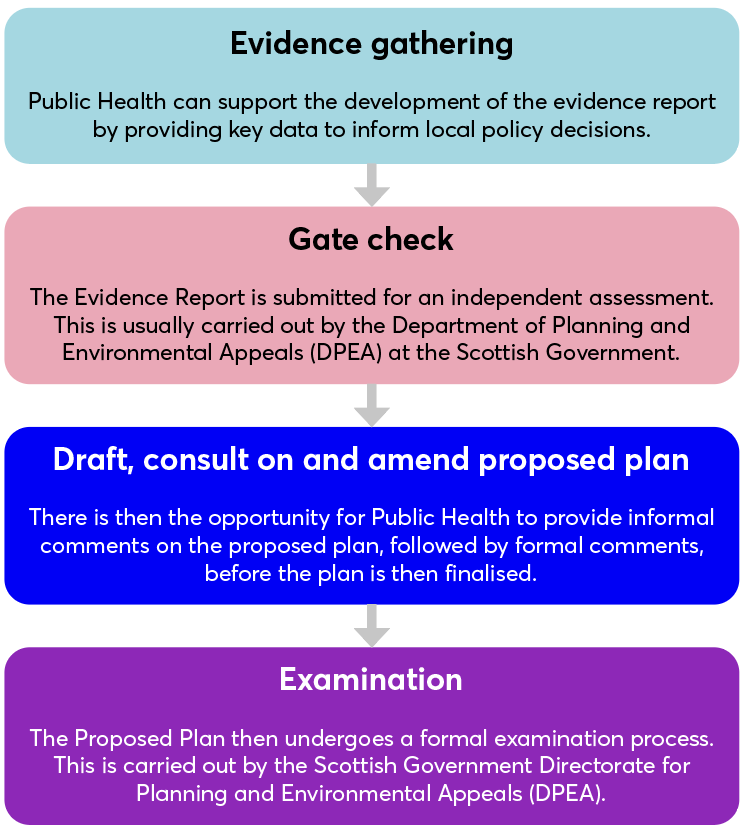
The key stages of LDP preparation are summarised in Figure 1.
Figure 1. LDP Preparation Stages (amended from Place and Wellbeing)
The stage a planning authority is currently at in relation to their LDP development can be identified from their Development Plan Scheme, which sets out the Council's timetable for preparing its LDP, and their participation statement, which indicates when consultation is likely to take place on the LDP, with whom, and the likely form of the consultation. Planning authorities must prepare a Development Plan Scheme every year. A list of Scotland's planning authorities with links to their respective Development Plan Schemes is provided in Appendix 1.
Stage 1: Evidence gathering
The first step towards adopting any potential food environment policy within an LDP is providing a robust evidence base to demonstrate that such a policy may be justified. As of mid-2025, most Planning Authorities in Scotland are currently at this evidence gathering stage.
Planning Authorities must consider evidence on a wide range of policies, aspects and topics as detailed within NPF4 and the Local Development Planning Guidance. Of most relevance to food environments are the following policies:
NPF4 Policy 23: LDPs should seek to tackle health inequalities, particularly in places which are experiencing the most disadvantage. LDPs should create healthier places, for example, through opportunities for exercise, healthier lifestyles, land for community food growing and allotments, and awareness of locations of concern for suicide.
Examples of potential evidence that could be relevant include:
- Identifying areas of health inequality within the area, specifically indicators associated with unhealthy diet and weight ( See Appendix 2 for an example from Midlothian Council).
- Environmental factors and physical amenities which influence health and wellbeing.
- Food environment evidence, such as food availability and food deserts; food outlet clusters; provision and demand for local and community food growing; food markets; market gardens; and non-agricultural commercial food growing.
NPF4 Policy 27: LDPs should be informed by evidence on where clustering of non-retail uses* may be adversely impacting the wellbeing of communities. They should also consider, and if appropriate, identify any areas where drive-through facilities may be acceptable, where they would not negatively impact the principles of local living or sustainable travel. *Non-retail uses include hot food takeaways (including permanently sited vans), Betting offices, and high-interest money lending premises.
Examples of potential evidence that could be relevant include:
- Locations and clusters of Hot Food Takeaways and drive-through facilities within the authority, alongside
- evidence of poor associated town centre vitality or health indicators within proximity to those locations.
NPF4 Policy 28: LDPs should identify areas where proposals for healthy food and drink outlets can be supported.
LDP Guidance considers that it may be useful to assess the nature of the food environment in the area, including:
- the diversity and availability of food through retail and how it is or is not contributing towards a healthy diet and weight in the area. There will potentially be links between this and information covered in respect of Policy 23.
How Public Health can engage at the Local Development Plan evidence gathering stage
Public health can effectively support the development of the evidence report by providing key health data to inform any local policy responses and place-based approaches. This is discussed in more detail in The Place and Wellbeing: Integrating Land Use Planning and Public Health in Scotland report. At present, planning authorities are not accustomed to using evidence on diet and obesity to feed directly into planning decisions, and without Public Health input, this aspect of NPF4 Policy risks being omitted from decisions where evidence is not known or provided.
As Key Agencies, health boards have an important role in informing the evidence base on all matters relating to health, such as health inequalities, primary care and social care capacity, changing health and social care needs, future needs of assets, public health concerns, and policy evidence in support of healthier lifestyles. It is recognised that health boards may have different named contacts best placed to advise on different aspects of health information within LDPs, and some may have a specific public health lead for obesity and healthy weight.
Key actions for public health that would increase the consideration given to food environments in the LDP at this early stage are as follows:
- Nominating one designated contact tasked with collating input from colleagues on all areas of interest would help ensure that food environment matters are not missed. This role would be tasked with liaising with development planning teams for the local authorities and National Park authorities in their area of jurisdiction.
- Identifying and circulating the timelines that planning authorities are working to and if/when they would expect to receive any draft evidence report contents for review.
- Provide local health and obesity evidence to the planning authority. Health boards could prepare and publish Evidence Statements to support the authorities' evidence report, such as NHS Lothian's, which could include information on obesity prevalence at small statistical levels within the adult and child population in the area, existing and forecasted expenditure on weight management services, or local information on healthcare burden caused by unhealthy weight. Local evidence may carry more weight than national statistics as the policy criteria of NPF4 Policy 27c is that the development will undermine the health and wellbeing of the community. health boards may also be able to provide expertise or pull on existing data sets relating to the type and, therefore, likely nutritional profile of food outlets in the authority area.
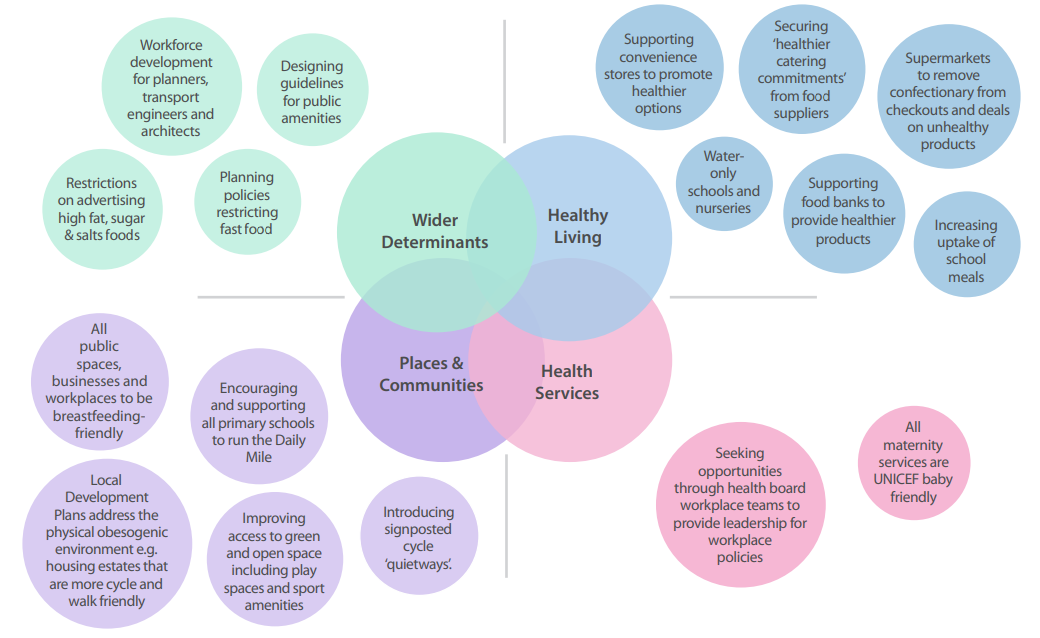
- Highlight relevant content in the Director of Public Health's Annual Reports, which each NHS health board publishes, setting out the public health priorities for the area, especially if obesity and food environments are an identified priority within this. For example, NHS Grampian's Director of Public Health Annual Report 2023 references obesity and obesogenic environments specifically, and identifies potential planning policies that could intervene as part of a whole systems approach (WSA) as shown in Figure 2.
Figure 2. Examples of Actions that can be taken as part of a WSA to healthy weight
- Publish guidance or criteria for planning authorities, setting out the health board's expectations for evidence on food environments within the evidence report. Similar advice has been issued by other Key Agencies, such as SEPA, which provides an example of how this guidance could be structured.
- Review of food environments, this could make explicit the expectation of:
- an assessment of the Food Environment within the area – specifically the provision of hot food takeaways, and supermarkets, which can be facilitated by the Food Environment Assessment Tool, and Creshmap,
- Assessment of the proximity between hot food takeaways and fast-food outlets and nearby schools using the Council's own records, the Council's Environmental Health Team will often have information on known takeaway locations using their information management databases.
- Assessment of allotment provision within the area, sourced from the authorities' Open Space Audit or Food Growing Strategy,
- Assessment of drive-through provision in the authority.
- Collate input from colleagues on the required evidence and disseminate the draft evidence report contents to them for review, once shared by the planning authority, ensuring this is provided to the local authorities timeously.
Planning authorities must have regard to the views of Key Agencies, including health boards, when preparing the evidence report and are expected to undertake early and proactive engagement to ensure collaborative and transparent evidence gathering. However, this is a two-way responsibility and if particular key agencies do not opt to participate, the LDP will most likely progress without their involvement. The sufficiency of the evidence within the evidence report is not expected to be revisited at later stages, so the evidence gathering stage provides health boards and other stakeholders with the only opportunity to ensure that, in this case, the evidence relating to obesity and food environments is collected and presented in the report. Any policies without sufficient supporting evidence have the potential to be challenged and found deficient at later stages, and therefore risk being removed, ie, not adopted and implemented via the LDP.
Stage 2: Gate check
The gate check is the next stage in the process of developing and adopting an LDP. A summary of all evidence considered and the planning authority's interpretation of what the evidence means for the LDP is compiled into an evidence report, which is submitted for an independent assessment, known as the gate check. This is usually carried out by an appointed Reporter from the Department of Planning and Environmental Appeals (DPEA) at the Scottish Government. This is a qualitative assessment based on guidance and standards set by the Scottish Government. The reporter assesses whether the report contains the necessary statutory information, demonstrates effective engagement and identifies any gaps and uncertainties.
The gate check is an assessment of and then a decision on whether the planning authority has sufficient information to progress to preparing an LDP. Should the reporter decide there is sufficient information, the planning authority may then progress to prepare and publish their proposed plan. Should the reporter consider that there is not sufficient information to proceed, they may provide recommendations for improving the evidence report. The Scottish Government has published an examinations list, which outlines which local authorities have current gate check examinations ongoing, or completed examinations.
How Public Health can engage at the Local Development Plan gate check stage
There are two potential options for engagement at the gate check stage. Health boards may choose to either:
- Issue statements of sufficiency or agreement to the planning authority, which is a public note of record that the health board considers the evidence on their areas of interest presented in the evidence report to be sufficient. The planning authority will likely submit this, along with the evidence report to the Scottish Government Department for Planning Environmental Appeals (DPEA) at the gate check stage to demonstrate the engagement that has occurred.
Or
- Issue statements of dispute to the planning authority, which is a public note of record, that the health board considers the evidence on their areas of interest presented in the evidence report to be insufficient, where some relevant evidence may have been missed and should be considered. Planning authorities should aim to resolve any issues raised by stakeholders on the sufficiency of the evidence before submitting to gate check, where possible, but are also required to disclose to the DPEA at gate check if any disputes remain.
Stage 3: Draft, consult on and amend proposed plan
After completing the Gate Check stage, Scottish Planning Authorities are expected to move quickly to prepare their proposed plan. The proposed plan is in essence the draft LDP, which must be produced in accordance with regulations, impact assessments and consultation requirements, which are detailed within the Local Development Planning Guidance. During the drafting of the plan and its preparation, informal ideas and comments are welcomed by the Planning Authority to help inform and shape the plan's content at this early stage.
Once the Proposed Plan has been drafted and signed off by the Council, planning authorities are statutorily required to consult with health boards and other Key Agencies. They do this by circulating a copy of the Proposed Plan to them and providing a clear statement of when the consultation window will close. Key agencies have a duty to cooperate with a planning authority in the preparation of the Proposed Plan and should respond to the consultation of the Proposed Plan within the statutory consultation period.
How Public Health can engage at the Local Development Plan proposed plan stage
There may also be opportunities for health boards to provide input and informal comments during the drafting of the proposed plan and if the planning authority undertakes a 'call for ideas' stage. This informal input helps to ensure that any ideas in relation to food environment policies are considered from the outset, rather than being addressed reactively at later stages.
However, the most significant opportunity for health boards to provide input to the proposed plan, if they wish to advocate for food environment policies, is at the consultation stage.
If achieving food environment policies in the LDP of an area is a key priority for health boards, it is imperative that they provide a full representation (response) to the proposed plan. The representation should clearly explain the issues they wish to be considered by the planning authority and, if unresolved, by the reporter at the Examination. It is up to those making representations to make their case, which could include details of community support. There is no automatic opportunity for parties to expand on their representation later in the process, so it is important that they provide their full case at this stage. This will then form part of the material available to the reporter at any subsequent examination.
Health boards could establish an internal steering group to oversee and draft the organisation's submission to the Proposed Plan, to ensure that all matters of interest, including food environments, are covered. For food environments specifically, the representation could:
- Iterate support for any food environment policies, including takeaway management zones, allotment provision requirements in new housing developments or others.
- Refer to the Proposals Map and identify whether they agree with the boundaries shown within the proposals map, and if any food environment policies are intended in select locations.
- Suggest modifications if desired to either the Proposals Map or the detailed criteria of the proposed policies. If there are no food environment policies within a plan, a suggested modification could be to rectify this. If promoting alternatives to the content of the Proposed Plan, information on environmental impact and community opinion should be provided as part of the representation.
At present, no local authorities in Scotland have produced a new-style post-NPF4 Proposed Plan, so it remains speculative at this stage how these will progress. Establishing how far each local authority has progressed already in the LDP process and how much consideration they've given to food environment policies can be done by contacting the planning authorities themselves. The details to reach each of Scotland's planning authorities and view their published timetables for their next LDPs are provided in Appendix 1.
Stage 4: Examination
The final stage in the process before an LDP is adopted is the examination stage. Once it has been prepared and consulted upon as a proposed plan, it undergoes a formal examination process. This examination is carried out by Reporters appointed by the Scottish ministers, through the Directorate for Planning and Environmental Appeals (DPЕА).
The purpose of the examination is to address any unresolved issues or objections raised during the public consultation period. Reporters will assess whether the plan is sound, deliverable, and consistent with national planning policy (including NPF4). They will consider all relevant representations and challenges and may hold hearings to gather further information.
At examination, should the Reporter consider they do not have all the information they need to make a proper assessment of an issue, they can request further information from any person at their discretion – not only those who have made representations but potentially key agencies such as health boards.
Once the Examination has been completed, the appointed Reporter prepares an Examination Report setting out their conclusions and recommendations, which can involve modifications to the Proposed Plan and which the planning authority must then consider before finally adopting the LDP.
These modifications can include amending policies and proposed sites, or in some instances, removing them entirely. Recommendations in an Examination Report to make modifications to a Proposed Plan are largely binding on planning authorities, unless further legal recourse is taken. The Local Authority typically makes these recommendations and proceeds to adopt the LDP. The policies are then in force and implemented by the planning teams.
Anyone can challenge an aspect of the Proposed Plan and have their challenges or objections reviewed via the examination. Food environment policies could be a matter raised by those who support them or oppose them and all representations are considered.
As few Proposed Plans in Scotland have as yet sought to adopt a food environment policy, we cannot at this stage speculate as to who would oppose these, but evidence from England demonstrates that these policies have encountered resistance from prospective takeaway businesses and other food retailers such as chain fast-food outlets, even though fast food chains typically haven't been
Summary – the role of health boards in food environment policy implementation
If health boards wanted to support the development and implementation of planning policies that seek to improve the food environment, there are a number of opportunities during the local development plan process that would allow this.
An outline of the indicative timeline of this process and the key stages for public health involvement are below:
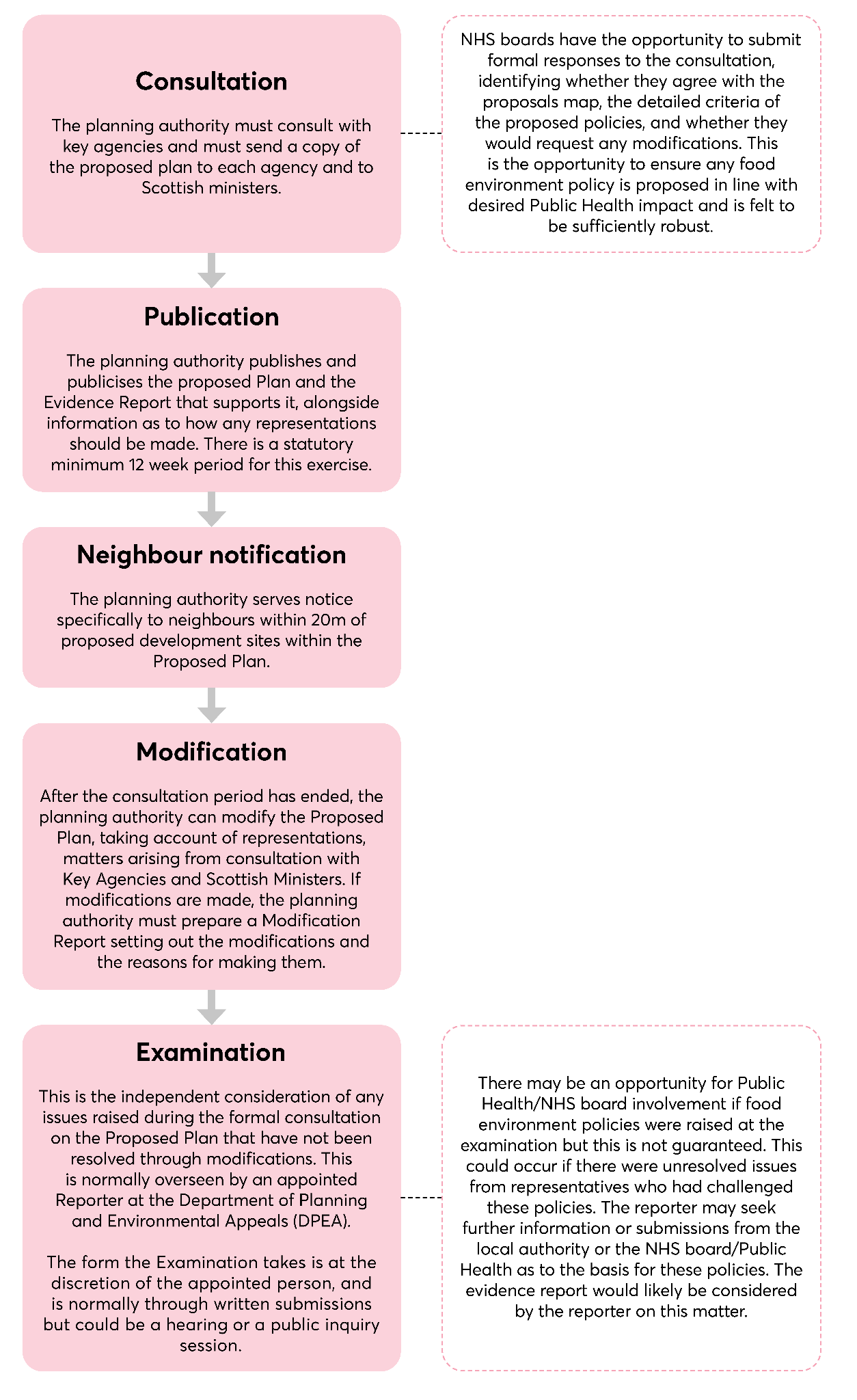
Figure 3: Timeline of the proposed plan
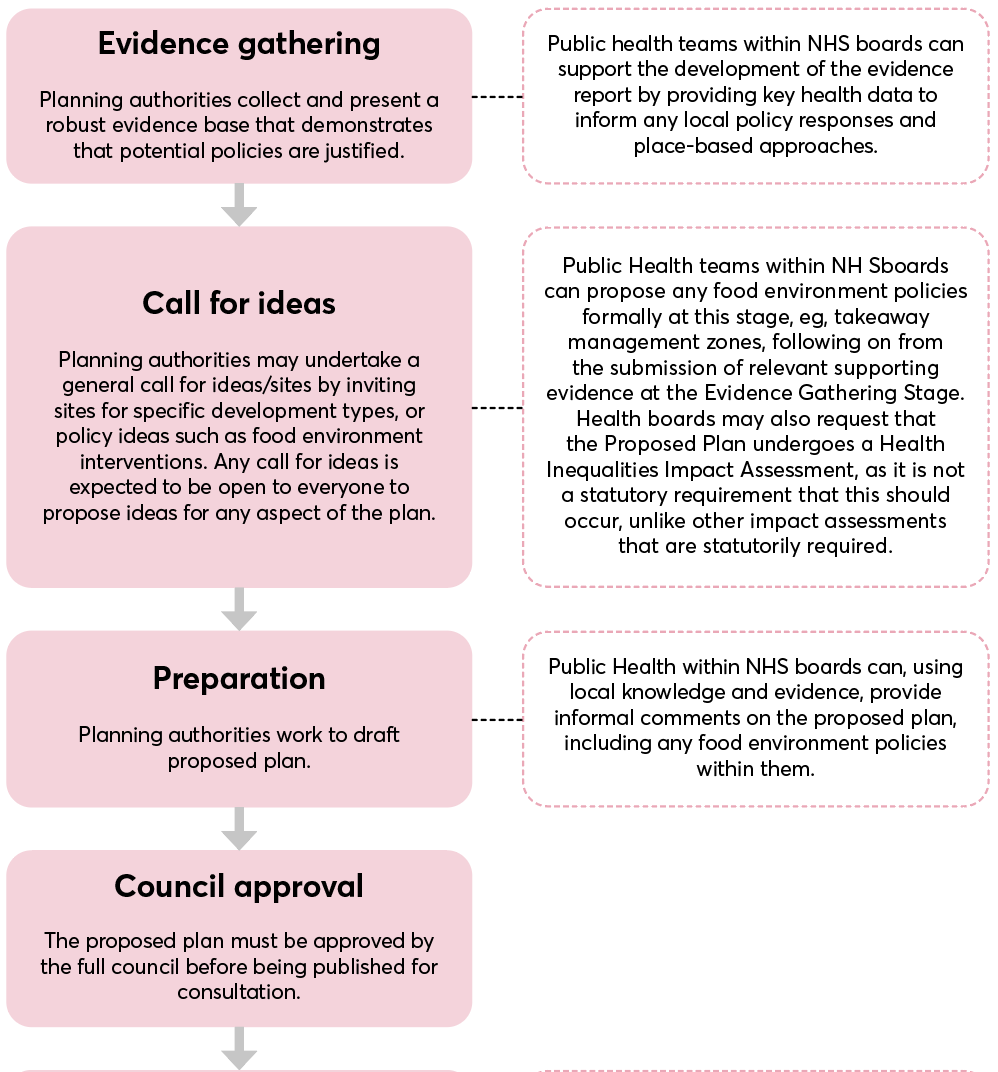
Consultation
The planning authority must consult with key agencies and must send a copy of the proposed plan to each agency and to Scottish ministers.
NHS boards have the opportunity to submit formal responses to the consultation, identifying whether they agree with the proposals map, the detailed criteria of the proposed policies, and whether they would request any modifications. This is the opportunity to ensure any food environment policy is proposed in line with desired Public Health impact and is felt to be sufficiently robust.
Publication
The planning authority publishes and publicises the proposed Plan and the Evidence Report that supports it, alongside information as to how any representations should be made. There is a statutory minimum 12 week period for this exercise.
Neighbour notification
The planning authority serves notice specifically to neighbours within 20m of proposed development sites within the Proposed Plan.
Modification
After the consultation period has ended, the planning authority can modify the Proposed Plan, taking account of representations, matters arising from consultation with Key Agencies and Scottish Ministers. If modifications are made, the planning authority must prepare a Modification Report setting out the modifications and the reasons for making them.
Examination
This is the independent consideration of any issues raised during the formal consultation on the Proposed Plan that have not been resolved through modifications. This is normally overseen by an appointed Reporter at the Department of Planning and Environmental Appeals (DPEA).
The form the Examination takes is at the discretion of the appointed person, and is normally through written submissions but could be a hearing or a public inquiry session.
There may be an opportunity for Public Health/NHS board involvement if food environment policies were raised at the examination but this is not guaranteed. This could occur if there were unresolved issues from representatives who had challenged these policies. The reporter may seek further information or submissions from the local authority or the NHS board/Public Health as to the basis for these policies. The evidence report would likely be considered by the reporter on this matter.
impacted by the proposed policies. One study highlights two case studies in England where Planning Inspectors were unconvinced of the public health evidence and removed the policies from the plan. Reviews of these cases suggest that improving the evidence involves moving beyond general statements to provide specific, localised, and robust data that clearly justify the planning policy's health objectives and demonstrate its likely effectiveness in addressing identified local health challenges.
How Public Health can engage at the examination stage
As outlined above, if a food environment policy or the evidence underpinning it was challenged within the proposed plan, any challenge would be considered during examination, in addition to any representations supporting the policy, particularly if these were made by health boards and other key agencies. In relation to the examination process, engagement by a health board could be as follows:
- The health board submits the organisation's representation to the proposed plan alongside any supporting evidence and productions to the planning authority.
- The health board collates and provides further representations or further information in liaison with colleagues, if this is requested by the appointed Reporter at Examination.
- Contacts within the health board liaise with appropriate colleagues and identify named contacts to represent the organisation within a hearing or public examination should the appointed Reporter opt for this form of examination to consider an unresolved matter. Those present should be qualified and prepared to put forward and evidence their case for the proposed food environment policy at hand.
Health boards could strengthen the likelihood of being invited for further participation in the examination process by ensuring that they responded to the Proposed Plan, but even then, being invited to participate in this process is not automatic and is at the discretion of the appointed Reporter.
Were a food environment policy to be considered at examination through either written submissions or an oral session, health board officials with a qualified background in public health may be key in making the case for the policy to remain within the Proposed Plan, as public health officers are well placed to respond to questions around public health evidence as is shown to have occurred in England.
What might food environment policies look like within Local Development Plans?
We have considered the process of developing local planning policies in the section above, but now outline how this might relate specifically to food environment policies. We have outlined the need for policies in the LDP to be closely linked to the baseline evidence in the evidence report. In relation to food environments, if the planning authorities' evidence report highlights a clustering of hot food takeaways, or drive-through locations, or identifies areas of poorer food environments, it would be expected that food environment policies in the LDP follow logically from this evidence. Similarly, should a proposed plan contain a policy to improve the food environment, but no evidence within the evidence report refers to food environments, obesity or or the current proliferation of food retail, it could be challenging for the planning authority to justify why these policies were considered necessary at the examination stage. These policies could be challenged by other stakeholders, who may seek that these policies be removed.
The LDP should identify where new development should take place and where it should not. Some planning policies would be expected to apply across the entirety of the plan area, while others would be specific to certain locations. To make this distinction clear, LDPs must include a proposals map that describes and illustrates the policies and proposals of the plan spatially. This means that any food environment policies would be expected to be displayed visually (see Appendix 2 for an example from Midlothian Council) so that the extent of the areas covered within them could be clearly examined and scrutinised.
As stated above, Local Development Planning guidance sets out how LDP policies could be developed at the proposed plan stage, informed by the corresponding policies within NPF4. Food environment policies within LDPs could therefore specify areas where specific food provision would be supported as per NPF4 Policy 28, such as allotments or larger supermarkets (ie, the LDP would specify areas where supermarkets would be favourably viewed for development). They could also specify areas where specific food provision would not be supported as per NPF4 Policy 27, such as hot food takeaways, delivery-led businesses (dark kitchens), or drive-through facilities. Once the LDP is adopted, these policies will then be used in the determination of planning applications. Planning permission could then be granted in instances where the proposal aligns with the policy, or refused when it doesn't.
It is important that any food environment policies in the LDPs can be enforced. A policy that is considered unreasonable or unenforceable can be identified as 'deficient' when the plan is assessed and could be modified to address the deficiency, or removed. When thinking of potential food environment planning policies, examples of likely deficiencies would include:
- A policy restricting further fast food chain outlets. Most fast food chain outlets are classed as Class 3 (restaurants) within the Town and Country Planning (use classes) (Scotland) Order 1997 and there are no further subcategories for fast food restaurants specifically. Any existing restaurant could reopen as a fast food restaurant without requiring planning permission because in planning terms, there is currently no legal distinction between the two, which would make this policy unenforceable. Similarly, the planning system is concerned with the use of the land being appropriate, not the owner or the name of the business. Food environment planning policies, therefore, cannot be used to stop a specific business operator from acquiring further existing restaurant premises.
- A policy restricting or specifying what food is sold on the premises. This is not a material planning consideration and would be unenforceable and likely unreasonable. From a planning perspective, the use of the land and how it relates to neighbouring uses is the primary consideration.
An example of food environment planning policy in action – Takeaway Management Zones
In England, some local government areas currently use the planning system to intervene in food environments. A 2019 census of all 325 English local government areas found that 164 had a planning policy specifically aimed at reducing the number of new takeaway food outlets, with 56 doing so for health reasons such as obesity prevalence. The most common policy approach taken is defining and enforcing exclusion zones or Takeaway Management Zones (TMZs) around schools.
TMZs work by allowing local authorities to refuse planning permission for new hot food takeaways in proximity to schools or in other circumstances, as laid out in Local Policy. It is to be noted that they don't apply to existing hot food takeaways, only applications for new ones. They are usually mandatory and are designed to reduce the proliferation or clustering of further hot food takeaways in a specific area. TMZs are enforceable because the introduction of a new hot food takeaway requires planning permission. This is because they have a separate, legally defined land use class (sui generis) under the Town and Country Planning (use classes order) (amendment) Regulations 2020 and any change of land class use requires planning permission to be granted. The point at which planning permission is applied for is the point at which the TMZ policy is applied.
In relation to the impact of TMZs, research conducted has found that areas with TMZ policies in force saw fewer planning applications for further hot food takeaways, and ultimately fewer hot takeaways opening in the subsequent period. Further research has additionally examined the impact of TMZs on diet and weight within populations, finding that the reduced exposure to further hot food takeaways was associated with reduced caloric intake, lower BMI, lower likelihood of obesity, and reduced healthcare burden in the adult population.
National planning policy in England, updated in December 2024, now offers explicit support for TMZ policies as a material consideration. This is outlined in England's National Planning Policy Framework paragraph 97:
(In England) Local planning authorities should refuse applications for hot food takeaways and fast food outlets:
- within walking distance of schools and other places where children and young people congregate, unless the location is within a designated town centre; or
- in locations where there is evidence that a concentration of such uses is having an adverse impact on local health, pollution or anti-social behaviour.
Most TMZ policies in force in England, however, predate this updated policy, and have been in force before this support was explicit in national policy. For more details on how TMZs are implemented in England and a case study from North Tyneside, see Appendix 3.
Key points of note in relation to TMZs
- In England, Takeaway Management Zones cannot be used to revoke permission from existing hot food takeaways that already have planning consent.
- Takeaway Management Zone policies cannot prevent an existing hot food takeaway from closing and reopening as another hot food takeaway under a different operator, as the land use has not changed.
- Takeaway Management Zones do not apply to restaurants, as these are a separate land use class (A3) within the Order. The distinction lies in that restaurants are used for the sale of food and drink for consumption on the premises, whereas hot food takeaways are for the sale of hot food for consumption off the premises. Where a restaurant with takeaway provision is considered, the planning authority is required to assess whether the principal use of the site is for consumption on or off the premises, and can only apply the policy in the latter case.
- In England, 'fast food outlets' are specifically included alongside hot food takeaways in the NPPF. Fast food outlets are not currently defined in planning terms, but a definition is available from the Office for Health Improvement and Disparities.
- The criteria of the policy must be applied as worded with limited flexibility, meaning, for example, that if the TMZ policy specifies a 400m distance from schools, this cannot be flexibly adjusted to apply to takeaway applications beyond that threshold.
- The nutritional content of the food served within the unit is not currently classed as a material planning consideration. This means that an application for a 'healthy' hot food takeaway would likely not be treated any differently to a 'traditional' hot food takeaway if within the TMZ. It is therefore a blunt instrument, principally concerned with land use, rather than the content of the food provided. Public health teams might, however, use the nutritional content of the food served to evidence against paragraph 97b, to propose that the concentration of the use is having an adverse impact on local health.
- While TMZs have been successful in reducing the number of new Hot Food Takeaways in England, there have been instances where appeal decisions were allowed, and therefore Hot Food Takeaways were granted permission by the Planning Inspectorate, contrary to the policy. A critical factor in appeal decisions is the evidence base underpinning the policy. In one study, appeals may be more likely to be allowed when local public health teams provided no response to the application highlighting the importance of continued collaboration to implement the policy successfully.
The implementation of Takeaway Management Zones in Scotland
Although there are currently no Takeaway Management Zones in Scotland, there are examples of local authorities that have implemented policies which have sought to restrict hot food takeaways. Those identified are as follows:
The City of Edinburgh City Plan 2030 was adopted in November 2024 and contains policy Re 11 Food and Drink Establishments, which states:
The change of use of a shop unit or other premises to a licensed or unlicensed restaurant, cafe, pub, or shop selling hot food for consumption on the premises (hot food takeaway) will not be permitted:
- if likely to lead to an unacceptable increase in noise, disturbance, on-street activity or anti-social behaviour to the detriment of the living conditions or **health and wellbeing** of nearby residents, or
- in an area where there is considered to be an excessive concentration of such uses to the detriment of the living conditions or **health and wellbeing** of nearby residents.
As of May 2025, this policy is the only instance where regulation of hot food takeaways for health reasons is placed in the current Scottish Local Development Plans. This policy has been cited in some planning decisions to refuse hot food takeaways in Edinburgh, although these again have tended to be for amenity reasons, despite the inclusion of health and wellbeing within the policy wording. Some recent planning applications for hot food takeaway uses in Edinburgh have however, been granted as they were deemed by the planning authority to comply with the development plan. As Edinburgh's City Plan has only been in force for a short period at the time of writing, it remains speculative how this policy will be enforced and what impact it may have.
Glasgow City Council's Network of Centres Supplementary Guidance is equivalent to a Supplementary Planning Document (SPD) as used in England. It provides detailed guidance on how developments will be assessed to comply with the Glasgow City Development Plan. It contains Assessment Guidelines which deal with food, drink and entertainment uses, outdoor food and drink areas, treatment and disposal of cooking/heating fumes and other considerations. An extract states:
Assessment Guideline 10 a) city-wide
- Proposals for food, drink and entertainment uses must not result in a detrimental effect on the amenity of residents through the effects of increased noise, activity and/or cooking fumes. No more than 20%* of the number of units in a street block frontage, containing or adjacent to residential uses, should be in use as a hot food shop, public house, composite public house/class 3 or composite hot food shop/class 3 use.
* In all calculations of the proportion, the Council will include any use which incorporates a hot food takeaway service and any unimplemented planning permissions for changes of use to hot food shop, public house, or Class 3 use, likely to include a hot food takeaway service.
While not forming part of the statutory development plan, SG4 is referred to in planning decisions and cited as a reason for refusal of hot food takeaway uses. A review of all planning applications for “takeaways" in Glasgow since February 2017 (when SG4 was introduced) using a keyword search reveals that of a total of 294 applications, 132 were refused.
Dundee City's Local Development Plan Policy 27 Public Houses, Restaurants and Hot Food Takeaways states that:
Within District Centres proposals for hot food takeaways and restaurants, including external seating areas, may be supported subject to the hours of operation being limited to between 7am and 11pm and there being no significant detrimental impact on amenity through issues of noise and odour.
Outwith the City Centre and District Centres proposals for hot food takeaways and restaurants, including external seating areas, will only be supported where:
- the proposal has a gross floor area up to 150 square metres and is more than 30 metres* from existing or proposed housing or;
- the proposal has a gross floor area in excess of 150 square metres and is more than 45 metres* from existing or proposed housing.
Hot food takeaways, sandwich shops and coffee shops which would not meet the above requirements may be permitted subject to:
- the hours of operation being limited to between 7am and 7pm; and
- the hot food only requiring heating by means of a microwave oven or other method which would not cause a nuisance to the surrounding residential property by virtue of noise and odour.
*(Distance measured from the curtilage of the proposal to the facade of existing or proposed houses).
As a policy within the statutory development plan, the policy is referred to in planning decisions for further takeaways, although evidently some have been granted.
It is evident from the examples above that regulation of hot food takeaways within planning policies is emerging within Scotland, but this appears to be largely within urban authorities, and largely justified for reasons such as amenity rather than healthy diet and obesity. In essence, the basis for any regulation of hot food takeaways in Scotland has not been driven as a food environment intervention, but rather has been driven by a desire to safeguard potential retail units within town and city centres from being lost in significant numbers to takeaway uses, and mitigate against cooking fumes in proximity to other uses. This may in part explain why no specific consideration has been given within planning policy to the proximity of hot food takeaways to schools in Scotland, which is a key difference between decisions taken in England.
In practical terms, planning decisions for hot food takeaways in Scotland tend to be assessed by the individual case officers within planning authorities without consultee input from other remits such as public health. This, in part, likely explains the defined focus on amenity issues when determining such applications, as planners would often be unable to assess the impact of an application on health matters without input from qualified agencies. While health and wellbeing now form part of NPF4 Policy 27c, the assessment of impacts on health and wellbeing would benefit from stronger collaboration between planning and public health if this policy aspect is to be evidenced and implemented within decisions, like the introduction of TMZs.
Key considerations for TMZs in Scotland
There are a number of factors to be taken into account when considering the possible implementation of TMZ policies in Scotland. The following supportive factors were identified for TMZs:
- Policy support: NPF4 Policy 27c provides national policy support for regulation of hot food takeaways. Local Development Planning Guidance outlines how planning authorities could evidence this so that future LDPs can also provide a policy position, and this includes for health reasons. This appears to indicate that the Scottish planning system is open to being convinced of the need for this, should local authorities decide to pursue food environment policies, including TMZs.
- Regulations: In Scotland, as in England, any change from another land use to a hot food takeaway requires planning permission, creating an opportunity for regulation and enforcement. Hot Food Takeaways are classed as a Sui Generis or having a unique use, distinct from restaurants within the Town and Country Planning (use classes) (Scotland) Order 1997.
- Culture of evidence gathering: The new process of producing LDPs in Scotland has instigated a stronger practice of evidence gathering, as there is a requirement to produce an evidence report. While some local authorities are further along in this process than others, the consensus seems to indicate that this has been a learning curve, requiring stronger data analysis and curation skills within planning authorities. This new reality provides a stronger opportunity for food environment evidence to be considered than has occurred previously. This provides an opportunity to provide evidence supporting the introduction of TMZs.
- Cross-departmental buy-in: The new process of producing LDPs in Scotland has also involved a stronger emphasis on working in partnership with other council services and Key Agencies. Gathering the evidence required to demonstrate sufficiency often necessitates data being shared from these stakeholders, and planning authorities have been required to demonstrate that these stakeholders agree with the evidence presented in the evidence report. This should provide a stronger opportunity for food environment policies such as TMZs to be developed and adopted as planning authorities are now working in a stronger culture of partnership, albeit it is recognised that this needs considerable resources to sustain.
This research suggests that it would be possible to propose and implement TMZs in Scotland. However, there have also been a number of challenges identified that would need to be addressed in order to achieve widespread adoption of food environment planning policies such as TMZs.
- National vs local scope: Planning decisions are made in most instances by planning authorities. Implementation and consistency at a national level would require all 34 of Scotland's planning authorities to adopt TMZs as part of their next Local Development Plans, and this would likely not occur until 2029 or potentially later. This means that engagement by public health with local authorities on this issue would need to be replicated and require considerable ongoing resources in order to achieve population-wide impact. Local authorities may set their own criteria for where TMZ policies apply, which may or may not include proximity to schools, local obesity prevalence, or town centre locations, or they may simply decide not to pursue such policies at all.
- Availability of evidence: Engagement with local authorities and wider agencies in Scotland's planning system as part of this project reveals a lack of knowledge regarding the links between the food environment and health. Evidence of local child obesity prevalence differs in Scotland relative to the NCMP available in England and is only available at one point of measurement in Primary 1. While research undertaken in Scotland reveals that fast food outlets and other health harms are clustered in deprived communities and contribute to health inequalities, there are a greater number of such studies undertaken in England, often in urban areas. Further research that assesses the effects of takeaway outlet exposure across a range of Scottish communities and contexts, particularly in relation to rural areas and schools would strengthen the evidence around this issue.
- Collaboration with Public Health: NHS Boards in Scotland have an opportunity to advocate for food environment policies in their area if they wish to, when LDPs are being prepared. They can also carry out a consultee role within development management, providing responses to planning applications. This is a two-way responsibility between public health and planning. In order to ensure the implementation of the policy consistently, it requires cross-organisational working relationships to be developed and formal consultation processes to be established and communicated. Without this, planning authorities may not be able to definitively evidence how food environment policies in a specific area would undermine the health and wellbeing of that community, or support effective planning decisions once a policy is implemented.
- Influence points within the LDP process: Food environment policies are more likely to be successfully taken forward within LDPs if they are proposed at specific stages in the LDP process. Ideally, they should be underpinned by robust evidence within the evidence report, and should be developed in collaboration with NHS Boards as part of the Proposed Plan. NHS Boards should provide a formal representation on the proposed food environment policies when the plan is circulated for consultation. They may have a role at the examination stage to support the authority in justifying the policy for health reasons. Health boards can seize opportunities to intervene in this process similarly by submitting a dispute to the evidence report if they consider that the evidence on food environments, diet and healthy weight is insufficient, and similarly can seek modifications to the Proposed Plan. Given the 10-year-plus timeline for developing and implementing LDPs in Scotland, decisions need to be made soon and action taken if there is a wish for food environment policies to be introduced at any point in the next 10-15 years.
- Resources and leadership: Both the planning system and the NHS are under significant pressure and have had ongoing resource challenges across Scotland. Partnership working between these two sectors will need to occur alongside other statutory requirements and already committed work packages. While this research has examined the potential for food environment policies specifically, it must be remembered that the planning system has to consider many competing priorities to achieve the best long-term interest for the use of land. Matters that have traditionally dominated the consideration of LDPs include housing provision, transport infrastructure, energy developments and business/commercial land, to name but a few. Food environment policies can have benefits, but these will likely have to compete for attention and priority to ensure their inclusion.
Other potential planning interventions
- Gatekeepers and compliance: As with any policy, consistent implementation is more likely to achieve the desired outcomes. It is possible that food environment policies may not be consistently applied, or even be contained within an LDP. Anyone can make a representation to oppose policies such as TMZs. They can do this either when they are being considered as a policy in the Proposed Plan, or even once adopted, they may appeal a planning decision. Evidence indicates that the fast food industry has been particularly vocal and well-resourced to challenge TMZ policies. The Department of Planning and Environmental Appeals in Scotland is a significant gatekeeper and decision-maker of proposed policies, which will ultimately go on to influence population health and well-being. Similarly, elected Councillors have a role in making some planning decisions if they are decided at a planning committee, or appealed to the Local Review body. Ensuring that elected Councillors support any potential policy and understand the health evidence underpinning it is fundamental to ensuring that it is consistently applied.
In summary, as outlined above, the evidence suggests that the NPF4 planning framework would support the introduction and implementation of TMZs in Scotland as a viable and feasible policy option. As this is an as-yet-untested policy in the context of NPF4, the details of the proposed restrictions and what the policy would look like in practice (ie, zones around schools, limits on proliferation and density of outlets) would obviously need to be considered and proposed by planning authorities in relation to their specific local needs and circumstances.
Changes to the use class order
As outlined above, Takeaway Management Zones are currently the most common mechanism for the planning system to be used as a lever to intervene in food environments. Other potential planning interventions were, however, also identified during the research and are discussed as follows:
At present, the land use classes within the Town and Country Planning (use classes) (Scotland) Order 1997 do not reflect the diversity of outlets represented within Scotland's food environment. As these are defined in legislation, it is not within the power of local authorities to deviate from these.
Note that class 1 (shops) applies to shops where cold food is available for consumption off the premises. A guide to the use classes order more clearly illustrates the existing use classes and which ones can change between one another without requiring planning permission. In practical terms, class 1 makes no further distinctions between different forms of shops, such as food vs non-food retail, healthier or less healthy food retail, convenience vs comparison goods, or supermarkets vs convenience stores. This means that a building currently operating as a bookshop can reopen as a cold sandwich shop or vice versa without requiring planning permission, because both uses are Class 1 (Shops), and in planning terms, no change in land use has occurred.
At present, NPF4 states that LDPs should identify areas where proposals for healthy food and drink outlets can be supported, but there is no such use class for healthy food and drink outlets or currently a recognised metric for classifying an outlet 'healthy'. Class 1 (retail) makes no distinction between different types of shops (for example, food v's non-food retail or supermarket v's convenience store) or the relative healthiness of the food that they sell. It remains unclear how any areas identified for these purposes would therefore currently be enforced, as such uses could foreseeably change to less healthy food outlets without requiring planning permission. Wider evidence, however, suggests that communities most affected by poverty can suffer from a lack of shops and often contain no large supermarkets specifically requiring residents to shop in smaller convenience stores where food prices are higher, and the selection of fresh, healthy food is more limited.
More varied retail classes
Changes to the planning use classes order to encompass greater variation in retail categories and then prescribing which categories require permission would provide the Scottish planning system with greater opportunity to intervene in food environments. This, however, could be highly complex in reality, as many retail outlets provide a wide range of products and services. In a similar vein, amending the use classes order to provide a use class for healthy food retail would require a robust process to define what ‘healthy' food retail would actually be. Existing units would be unaffected by any changes to the use classes order. However, recent policy announcements by the UK government, which follow on from work developed as part of the food data transparency partnership include mandatory health reporting by large food businesses and targets for healthy food sales for supermarkets. These developments may, if implemented, help to better define the relative healthiness of food retail and therefore support changes to use classes. The introduction of healthy food standards, involving a sales-weighted ‘healthiness' score across a business's whole portfolio, would allow the classification of retail businesses according to the overall healthiness of the products they sell. Similar targets could also, in theory, be set for out-of-home businesses.
This would involve changing Scottish legislation, as the planning use classes order is derived from the Town and Country Planning (Scotland) Act 1997 and therefore requires a medium to long-term approach.
Planning use classes order in Scotland has been changed before. From March 2023, a new use class 1a for "shops, and financial, professional and other services" was created, which combined previous uses class 1 (shops) and class 2 (financial, professional and other services) to form a single use class. This enabled the change of use of premises between financial or professional services users and retail users without applying for planning permission. By bringing uses together and allowing movement between them, this was considered to give businesses and other occupiers greater flexibility to adapt more rapidly to changing circumstances, community needs and customer demands and potentially help town centres become more agile and responsive. Given that this recent amendment to the use class order sought an amalgamation of two previous uses into one, it remains uncertain whether disaggregation of use classes would be a feasible option.
Also, before this, in February 2017, betting shops and payday loan shops were removed from class 2 (financial, professional and other services) as applied at that time. From this point onwards, new betting shops and payday loan shops required planning permission, in that a building currently used as a bank could not begin operating as a payday loan shop without requiring planning permission. This change provided an ability to enforce restrictions, and therefore implement NPF4 Policy 27, which states that LDPs should consider policies to prevent the over-provision and clustering of betting offices and high-interest money lending premises.
Dark kitchens
This change was introduced after the Scottish Government's consultation in August 2014 on proposed reforms to the planning system aimed at reducing the number of payday lenders and betting offices in town and city centres. Representations made in this consultation considered whether there could be some difficulty in making a distinction between the activities of a payday loan shop and other financial lending institutions, where, in practical terms, the only distinction may be the period of the loan and the rate of interest or charges which such a facility might incur. Deciding whether these issues relate to land use and planning is critical to assessing whether a change to the use classes order is warranted. Just as hot food takeaways have been refused on the basis of amenity and potential loss of retail uses, it is possible that regulating payday loan shops within the planning system is driven by similar concerns of safeguarding retail units, rather than an expressed desire to improve Scotland's consumer lending landscape.
Delivery-based 'dark kitchens' or food service businesses that serve customers exclusively by delivery and pick-up are a rising trend in urban areas, and there is currently no Use Class within the Use Classes order that has been deemed to apply to these in Scotland. Clarification as to what use class dark kitchens fall within, or whether they are explicitly sui generis, would assist planning decision making. Dark kitchens generate significant transport movements to fulfil the delivery-based requirements of the business and therefore could have the potential for conflict with neighbouring land uses (such as residential areas) due to the frequency of these movements. For these reasons, coupled with the need for good ventilation and management of cooking smells, there could be greater potential for the creation of a separate or sui generis planning use class for dark kitchens, which would provide local authorities with a means to restrict planning permission for them in specific locations if they wished to.
As with other food retail, the nutritional content of the food served has not, until this point, been considered a land use and planning consideration, and a robust scheme to define and classify businesses according to the health of food sold would be needed if they were to be managed on public health grounds.
No planning policies specific to dark kitchens or delivery-based food preparation facilities have been identified in any current Scottish LDPs in force, nor are they referred to in NPF4. This is perhaps not unusual owing to their recent emergence, but there is potential for dark kitchens to continue growing in prevalence and be of significance in terms of our food environment by the time Scotland's new-style LDPs are in force.
Similarly, in England, no consistent approach has been taken by local authorities for dark kitchens, with some operating within Class E(g) (iii), which refers to business and industrial uses that can be carried out in a residential area without causing any detriment to the area's amenity. Camden Council, however, classifies dark kitchens as a sui generis use, meaning they don't fit into standard planning classes and require specific planning permission. This is because they are considered "commercial kitchen and delivery centres" and are distinct from other food uses. Because of this unique classification, operators must seek specific planning approval for a dark kitchen. Appeal decisions from England, however, indicate that this may not be an appropriate use class for dark kitchens owing to their frequency of deliveries. Given the relatively recent emergence of dark kitchens, there are not many Local Plans with policies specifically for them, although some like Camden are being progressed.
Changes to advertisement consent
Recent attention has been given to the opportunities for restricting the advertisement of HFSS foods, including the new regulations banning pre-9pm HFSS advertising on TV and any online HFSS product adverts. Transport for London (TfL) has implemented this ban on HFFS ads voluntarily across their advertising estate, which includes rail estate, buses, bus shelters and outside locations owned by TfL. Other businesses and organisations (including local authorities) can introduce similar policies. This differs from the matters at hand when considering the advertisement consent planning policy.
Advertisement consent is granted by planning authorities in accordance with The Town and Country Planning (Control of Advertisements) (Scotland) Regulations 1984 and is therefore defined in legislation. An advertisement is defined as any word, letter, sign, placard or device used to advertise or make an announcement or direction. It can be illuminated or non-illuminated. The types of advertising that normally require advertisement consent include:
- the majority of illuminated signs;
- advertisements using specialised structures for their display, such as poster hoardings;
- most roadside signage, including advance warning and remote signage;
- large signs or those positioned high up on buildings
Many advertisements may be displayed with what is called 'deemed consent'. This means that they do not need advertisement consent if they meet the conditions set out in the regulations. Local authorities can only use the powers within the advertisement consent regulations in the interests of amenity and public safety. This means that when an application for advertisement consent is submitted, the content of the advertisement, and whether it promotes health-harming commodities or in relation to the food environment, HFSS foods, are not matters that the regulations provide for and therefore are not considered by the authority.
The 'interests of amenity' in essence means, in the light of the general characteristics of the locality, including the presence of any feature of historic, architectural, cultural or similar interest. Public safety is specifically concerned with the safety of persons who may use any road, railway, waterway, etc, so that navigation and movement is not obscured.
In summary, local authorities have the power to serve an enforcement notice if they consider that an advert is affecting the amenity of an area or impacting public safety, eg, obstructing the visibility of road traffic signs, not if they consider it has a negative impact on public health.
The Control of Advertisements Regulations in Scotland have not been modified for some considerable time. As with the use classes order, any amendments to these regulations to widen the scope of the powers within them to control the prevalence of adverts for less healthy food, or remove the provision of 'deemed consent', would require legislative change to do so. It is highly unlikely that this could be applied retrospectively to existing advertisements placed that already have advertisement consent in place. Equivalent Advertisement Consent regulations in England, are similar to Scotland and again only control advertisements in reference to amenity and public safety.
Conclusion
It is widely accepted that the most effective way to increase the prevalence of healthy weight in Scotland is to improve the food environment, the food we see, buy and eat in our everyday lives. Planning has been identified by the public health sector, governments and academics across the UK as a lever available to local authorities to help achieve this.
This report has set out how planning policies are developed and implemented in Scotland in the context of National Planning Framework 4 and Local Development Plans and how public health may be able to engage in this process. Takeaway Management Zones have been explored as a current policy that has been used in England to intervene in food environments, and we have discussed the opportunities and challenges involved in replicating that approach in Scotland.
TMZs are currently the most feasible new planning policy, relating to the food environment, to introduce in Scotland due to the precedent set in England and the recent introduction of supportive policies into NPF4. As we have seen, the current basis for any regulation of hot food takeaways in Scotland has not been driven as a food environment intervention, but a desire to safeguard potential retail units within town and city centres from being lost in significant numbers to takeaway uses and for issues of amenity, such as to mitigate against cooking fumes in proximity to other uses. There is now, however, an opportunity within NPF4 (if sufficient evidence is included in the new LDPs) for planning authorities to design and implement TMZs. They should be able to do this in a way that best addresses their local circumstances, eg, zones around school, proliferation of outlets or town centre restrictions. Research shows TMZs could have positive impacts on obesity and population health over the long term and as part of a suit of food environment measures. Their introduction also increases the awareness of planning's role in health improvement, an area which has not traditionally been a focus.
TMZs are, however, insufficient in themselves to make a significant and immediate impact on current obesity rates. Modelling by Nesta demonstrates that they would have no impact on reducing obesity rates over the next 5 years due to the policy only affecting planning decisions for new outlets. Research does show that the policy can be successful in reducing the growth of new takeaways.
The main value in pursuing TMZs may be in the opportunity they provide for further planning policy development relating to the food environment. At the moment, the planning system is not equipped to allow it to make decisions on land use relating to the health of food provided by businesses. This would require consistent and universal data being available with which to classify the healthiness of the food sold by businesses. It would also likely require changes to the use class order in Scotland, the system by which businesses are classified in respect to planning decisions.
Although these capabilities and conditions don't currently exist, TMZs could be an albeit imperfect stepping stone on a journey to more impactful and targeted policy if data availability changes in the future. The recent announcement by the UK government around mandatory reporting for all large food businesses, once implemented, should improve the quality of the data around the food we buy. This would provide a tangible method of establishing the relative healthiness of large food businesses and open up opportunities to better manage their proliferation and location via the planning system.
From a Public Health perspective, an ideal planning policy would be one that would allow us to make rational and informed decisions on the placement of food-related businesses within communities, taking into account the current health of the community, the healthiness of the food sold by a business and the prevalence and type of other food businesses in the area. As discussed, this would require improvements in the available data and would also require an overhaul of the use class orders relating to food and retail businesses. This would not be a quick process, but a precedent has been set that this could be possible with recent and proposed legislative changes.
While TMZ policies, as they stand, have their limitations, they do still provide, if adopted into the next round of Local Development Plans, a lever for the planning system to intervene in food environments which would remain in place for a 10-year period. Missing the opportunity to adopt any kind of food environment policies within this current round of LDP development will likely postpone their introduction and then any subsequent potential future policy development by a decade.
Appendix 1
| Planning authority |
Corresponding health board(s)* |
| Aberdeen City |
NHS Grampian |
| Aberdeenshire |
NHS Grampian |
| Angus |
NHS Tayside |
| Argyll and Bute |
NHS Highland |
| Cairngorm National Park |
NHS Highland, NHS Grampian, NHS Tayside |
| City of Edinburgh |
NHS Lothian |
| Clackmannanshire |
NHS Forth Valley |
| Dumfries and Galloway |
NHS Dumfries and Galloway |
| Dundee City |
NHS Tayside |
| East Ayrshire |
NHS Ayrshire and Arran |
| East Dunbartonshire |
NHS Greater Glasgow and Clyde |
| East Lothian |
NHS Lothian |
| East Renfrewshire |
NHS Greater Glasgow and Clyde |
| Eilean Siar |
NHS Western Isles |
| Falkirk |
NHS Forth Valley |
| Fife |
NHS Fife |
| Glasgow City |
NHS Greater Glasgow and Clyde |
| Highland |
NHS Highland |
| Inverclyde |
NHS Greater Glasgow and Clyde |
| Loch Lomond and Trossachs National Park |
NHS Forth Valley, NHS Greater Glasgow and Clyde, NHS Highland |
| Midlothian |
NHS Lothian |
| Moray |
NHS Grampian |
| North Ayrshire |
NHS Ayrshire and Arran |
| North Lanarkshire |
NHS Lanarkshire |
| Orkney Islands |
NHS Orkney |
| Perth and Kinross |
NHS Tayside |
| Renfrewshire |
NHS Greater Glasgow and Clyde |
| Scottish Borders |
NHS Borders |
| Shetland Islands |
NHS Shetland |
| South Ayrshire |
NHS Ayrshire and Arran |
| South Lanarkshire |
NHS Lanarkshire |
| Stirling |
NHS Forth Valley |
| West Dunbartonshire |
NHS Greater Glasgow and Clyde |
| West Lothian |
NHS Lothian |
*The boundaries of Scotland's two National Park authorities do not align with local authority boundaries. The extent of the Cairngorm National Park Authority (CNPA) contains areas within Highland, Aberdeenshire, Moray, Angus and Perth & Kinross Councils, and is therefore served by three NHS health boards. The extent of the Loch Lomond and Trossachs National Park Authority contains areas within Stirling, West Dunbartonshire and Argyll and Bute Councils, and is therefore served by three NHS Boards.
Appendix 2
What does food environment evidence like in evidence reports?
The evidence report prepared by Midlothian Council was deemed sufficient by the DPEA at gate check in September 2024, and provides examples of evidence relating to food environments.
First, Midlothian's evidence report was supported by a supplementary evidence statement from NHS Lothian Public Health, which contains a section on obesity, including prevalence of childhood obesity in the area as shown below:
“Data on high, low and healthy body mass index (BMI) is published for primary 1 school children (those aged around 5 years old). This shows that of the 2021/22 P1 school year in Midlothian, 23.3% were at risk of overweight or obesity and 1% were at risk of underweight. This compares to 24.1% and 1.1% in Scotland. Risk varies by deprivation: 31% of children in Midlothian's most deprived areas are at risk of overweight or obesity compared to 15.2% in the least deprived (based on SIMD quintiles).” – NHS Lothian Public Health Team
The primary 1 BMI statistics Scotland referred to are held by Public Health Scotland and are, in effect, the closest Scottish equivalent of the English National Child Measurement Programme, referred to in English TMZ policies.
Midlothian's evidence report also refers to evidence from Food Standards Scotland (FSS) as demonstrated below:
"Food Standards Scotland's (FSS) report overview of the total food and drink landscape in Scotland (MC232) indicates that expenditure in the out-of-home (OOH) market was sharply down in 2021 compared to 2019, but this may simply reflect delayed recovery from lockdown. Quick service restaurants were the only OOH sector to see an increase in trade in that period. Very high growth was observed in the use of OOH online orders, and the ready availability of food ordering apps may spur increases in sales in the OOH home delivery market (ie, goods purchased from a restaurant or takeaway but consumed at home). The FSS report notes there were 14.9 delivery 'occasions' per head in 2021 compared to 36.6 per head dining in a restaurant.” – Midlothian Council
Midlothian Council's evidence report also provides evidence of hot food takeaway provision (an indicator linked to high levels of obesity) within the area, as shown below:
"There are approximately 55 premises serving hot food takeaways in Midlothian. MC316 demonstrates the proximity of these outlets to high schools."
Midlothian Council
Figure 4. Proximity of hot food takeaways to schools - Midlothian Council
A map of Midlothian showing hot food takeaways (red dots), secondary schools (green dots), high school buffers (200m radius, red circles), and settlement boundaries (red outline). The map illustrates the concentration of hot food takeaways in relation to schools within the Midlothian Boundary.
Legend:
* Midlothian Boundary
* Hot Food Takeaways
* Secondary Schools
* High School Buffers (200m radius)
* Settlement Boundaries
Midlothian Council's evidence report also illustrates the implications of what the evidence present means for the preparation of the plan. For food environments, an example is highlighted below:
"Provision of allotments is a legislative duty on the Council. MLDP2 [the next LDP] will have a role in addressing the shortfall in current provision and in ensuring additional demand resulting from new housing development is addressed. This is likely to take to form of making specific provision for allotments, either through on-site provision or financial contributions, separate from community growing space provision. Experience with MLDP 2017 [previous LDP] has shown that clear and specific requirements relating separately to community growing spaces and allotments are required to ensure appropriate provision is made."
— Midlothian Council.
Appendix 3
How are TMZs applied in England?
Tracking how TMZ policies in England are used in practice, once a planning application for a hot food takeaway is submitted, is shown in the following timeline:
- Validation: Planning application is submitted to the local authority, and reviewed to ensure it meets validation conditions, such as having correctly scaled plans, defined boundaries of the extent of the site, and the correct fee has been paid.
- Assigned to case officer: Application is registered and assigned to a case officer, normally a planner. The case officer is made aware that this is a takeaway application and flags that policies exist specifically for takeaways.
- Consultation: Application is publicised in local press and adjoining neighbours to the site are notified. Relevant council departments and statutory bodies may be contacted for responses. Policy planners/public health officers/designated takeaways team may be contacted for advice on application. All responses are considered if received within the designated timeframe. This is typically 21 days. Consultees within their responses indicate whether they object to the development, have no objection subject to conditions, object pending further information, or have no objection.
- Assessment: Application is reviewed against local plan consisting of planning policies, spatial development strategy and neighbourhood plan. Material considerations are also referred to. The case officer follows a checklist to ensure all policies and guidance have been considered and follows the advice of consultees, such as policy planners and public health officers, particularly when they have objected to the development.
- Decision: Planning officers issue their decision if they have been given delegated powers, or can recommend refusal, which is reviewed by elected members who issue the decision. Application outcomes include approving application, approving with conditions or denying permission. Policy planners and/public health officers may review the decision and response before it is issued.
- Appeals: Decisions can be appealed to the Secretary of State via the Planning Inspectorate. Policy planners and public health officers are consulted for advice when appeals are received and may have to provide a more detailed response than provided within the original application, but cannot raise new reasons for objecting.
TMZ case study: North Tyneside Council
North Tyneside introduced a TMZ around schools on July 20, 2017 when the North Tyneside Local Plan was adopted. As part of the preparation of the Local Plan, North Tyneside Council published Public Health Evidence in relation to the use of the planning system to control Hot Food Takeaways, which provided evidence to justify the need for the policy in the Council area. This evidence base contains information in relation on obesity levels, the local food environment, and evidence of clustering of Hot Food Takeaways.
The wording used within North Tyneside Council's TMZ Policy (DM3.7) to determine planning applications for Hot Food Takeaways is as follows:
Proposals for A5 hot food takeaways will be permitted unless:
- It would result in a clustering of A5 uses to the detriment of the character, function, vitality and viability of the defined centres or it would have an adverse impact on the standard of amenity for existing and future occupants of adjacent land and buildings.
- There are two or more consecutive A5 uses in any one length of frontage. Where A5 uses already exist in any length of frontage, a gap of at least two non-A5 use shall be required before a further A5 use will be permitted in the same length of frontage.
To promote healthier communities, the Council will:
Appendix 4
Differences between the English and Scottish national planning policies:
There are evidently some key differences between NPF4 and NPPF's equivalent paragraph 97 for English local authorities.
- Scotland's NPF4 Policy 27c aims to provide a policy that applies to three separate entities, encompassing betting shops and payday loan shops, which are also sui generis use classes. England's NPPF Paragraph 97 is explicit in its application to Hot Food Takeaways and Fast Food outlets.
- Scotland's NPF4 Policy 27c does not specifically mention schools and other places where children and young people congregate, but notes first the amenity and character of the area, then the health and wellbeing of communities, and then specifically mentions disadvantaged areas. England's NPPF Paragraph 97 policy connection to schools is explicit.
- Scotland's NPF4 Policy 27c is phrased that development proposals will "not be supported if..." which contrasts with a more direct tone adopted in England's NPPF Paragraph 97 stating, "Local Planning authorities should refuse..."
- Scotland's NPF4 Policy 27c is phrased so as to require a judgment as to "if further provision of these services will undermine the character and amenity of the area or the health and wellbeing of communities.” England's NPPF Paragraph 97, by contrast, states, “in locations where there is evidence that a concentration of such uses is having an adverse impact on local health..." This distinction is potentially significant and alludes to a higher threshold for Scottish planning authorities to demonstrate to some degree of conclusiveness that further Hot Food Takeaway provision will undermine health and wellbeing, as opposed to providing evidence to this effect.
The key similarity between the two however, is that both policies place an onus on the local authorities (and not the applicant) to take their view on the development and demonstrate how the particulars of the policy apply.
Appendix 5
Current examples of food environment policies in Scotland
There are some examples of food environment policies within already adopted LDPs; however, these are not based specifically on improving health or reducing obesity. They include the Edinburgh City Plan 2030 Policy Re 11 Food and Drink Establishments and Dundee City's Local Development Plan Policy 27 Public Houses, Restaurants and Hot Food Takeaways.
Wider examples of food environment policies beyond takeaway regulation include Scottish Borders LDP2 Policy EP17 Non-Commercial Food Growing and Community Growing Spaces, which states:
The Council will support development that safeguards and enhances the quality of an existing non-commercial food growing area. Development that results in the loss of any noncommercial food growing area, where no satisfactory alternative location has been identified, will not be supported.
The Council will support development for new or extended non-commercial food growing areas that meet community needs, provided the following requirements are met:
- the site is of an appropriate size to accommodate the identified demand
- the site has satisfactory access and off-street parking and provision
- incorporation of screen planting where appropriate
- any onsite buildings and perimeter fencing to be of appropriate materials and sympathetic to the surroundings
- the development must have no significant adverse impacts on nearby land uses
Similarly, an extract from Scottish Borders LDP2 Policy IS2: Developer Contributions states:
Where a site is otherwise acceptable in terms of planning policy, but cannot proceed due to deficiencies in infrastructure and services or to environmental impacts, any or all of which will be created or exacerbated as a result of the development, the Council will require developers to make a full or partial contribution towards the cost of addressing such deficiencies. [...] for one or more of the following:
e) landscape, open space, allotment provision, food growing spaces, trees and woodlands, including costs of future management and maintenance.
- Prevent the development of A5 use within a 400m radius of entry points to all middle and secondary schools, as shown on the policies map.[^87]
- Prevent the development of A5 use in wards where there is more than 15% of the year 6 pupils or 10% of reception pupils classified as very overweight.
- Assess on an individual basis the impact hot food takeaways have on the well-being of residents
Unless otherwise specified, planning policies are generally interpreted in total, meaning all criteria have to be satisfied for the development to be deemed compliant. This means that a Hot Food Takeaway can be refused on the basis of one of the TMZ criteria alone. The first two criteria (A) and (B) are principally concerned with preventing clustering to the detriment of town centres. Some TMZs in England only restrict hot food takeaways for these reasons.
Criteria (C), (D), and (E) are specifically concerned with promoting healthier communities. Criteria (D) refers directly to the recorded levels of pupils classed as very overweight. This is taken from the National Child Measurement Programme (NCMP) in England, which assesses overweight and obesity levels in children within primary schools, at Reception class (aged 4 to 5) and year 6 (aged 10 to 11). The NCMP is undertaken in England, and data is collected by local authorities annually from all state-maintained schools within their area. Local government areas in England that have ‘health-focussed' TMZs in force tend to be more urban, with higher levels of deprivation, and higher proliferation of takeaways.
Endnotes
- https://www.gov.scot/publications/scotlands-population-health-framework/
- A healthier future: Scotland's diet and healthy weight delivery plan
- Disability Adjusted Life Years
- The Scottish Health Survey 2022 – volume 1: main report
- The Scottish Health Survey 2022 – volume 1: main report
- Inequalities in concentration of fast food outlets
- Do 'environmental bads' such as alcohol, fast food, tobacco, and gambling outlets cluster and co-locate in more deprived areas in Glasgow City, Scotland?
- Local Levers for Diet and Healthy Weight
- Out of Home Action Plan
- Testing the calories of the UK's favourite takeaway foods
- Place and wellbeing: integrating land use planning and public health in Scotland
- Research Project: To Explore the Relationship Between the Food Environment and the Planning System
- National Planning Framework 4
- The Town and Country Planning (Development Planning) (Scotland) Regulations 2023
- Section 40A of The Town and Country Planning (Scotland) Act 1997 (as amended)
- The Town and Country Planning (Development Planning) (Scotland) Regulations 2023
- Place and wellbeing: integrating land use planning and public health in Scotland
- Evidence Statement from NHS Lothian Public Health Team
- Primary 1 Body Mass Index (BMI) statistics Scotland
- Regulatory mechanisms to create healthier environments: planning appeals and hot food takeaways in England
- NHS Grampian Director of Public Health Annual Report 2023
- SEPA Planning Advice Note for Planning Authorities LDP Evidence Gathering: Achieving sufficiency of evidence relating to flood risk and the water environment
- Food Environment Assessment (FEAT) Tool
- CreshMap
- Development Plan Examinations: List
- Local Development Planning Guidance
- Town and Country Planning (Scotland) Act 1997: Section 18(10)
- Retailer Responses to Public Consultations on the Adoption of Takeaway Management Zones Around Schools: A Longitudinal Qualitative Analysis
- Using the planning system to promote a healthier food environment: review of planning policies and appeal decisions in England for hot food takeaways
- The adoption and implementation of local government planning policy to manage hot food takeaways near schools in England: A qualitative process evaluation
- The Town and Country Planning (Development Planning) (Scotland) Regulations 2023: Regulation 7(1)
- The Town and Country Planning (Use Classes) (Scotland) Order 1997
- How does local government use the planning system to regulate hot food takeaway outlets? A census of current practice in England using document review
- The Town and County Planning (Use Classes) (Amendment) (England) Regulations 2020
- Changes in the number of new takeaway food outlets associated with adoption of management zones around schools: A natural experimental evaluation in England
- Health impacts of takeaway management zones around schools in six different local authorities across England: a public health modelling study using PRIMEtime
- Planning policies to restrict fast food and inequalities in child weight in England: a quasi-experimental analysis
- National Planning Policy Framework
- Wider Determinants of Health: statistical commentary on the location of fast food outlets, February 2025
- Hot Food Takeaways: Planning a route to healthier communities
- Exploring the fast food and planning appeals system in England and Wales: decisions made by the Planning Inspectorate (PINS)
- Regulatory mechanisms to create healthier environments: planning appeals and hot food takeaways in England
- Using the planning system to promote a healthier food environment: review of planning policies and appeal decisions in England for hot food takeaways
- City of Edinburgh City Plan 2030
- 24/02038/FUL Report of Handling
- 24/05068/FUL Report of Handling
- Glasgow City Council SG4 Network of Centres Supplementary Guidance
- Glasgow City Development Plan
- 24/02129/FUL Report of Handling
- 25/00148/FUL Report of Handling
- Glasgow City Planning Applications Search
- Dundee City Local Development Plan 2019
- 24/00684/FUL Report of Handling
- Local Development Planning Guidance
- The Town and Country Planning (Use Classes) (Scotland) Order 1997
- Exploring the nutritional quality of 'out of school' foods popular with school pupils
- Resourcing the Planning Service (RTPI Scotland Research briefing)
- A Guide to Planning Appeals in Scotland
- The Town and Country Planning (Use Classes) (Scotland) Order 1997
- Planning permission: Food and Drink uses
- The Town and Country Planning (General Permitted Development and Use Classes) (Scotland) Miscellaneous Amendment Order 2023
- Guide to Use Classes Order in Scotland
- https://www.gov.uk/government/groups/food-data-transparency-partnership
- The Town and Country Planning (General Permitted Development and Use Classes) (Scotland) Miscellaneous Amendment Order 2023
- Planning - permitted development rights review - phase 2: consultation
- The Town and Country Planning (Miscellaneous Amendments and Transitional Saving Provision) (Scotland) Order 2016
- Tackling Payday Lending and Gambling in Scottish Town Centres and neighbourhoods
- Draft New Camden Local Plan
- Appeals Casework Portal APP/N5660/C/23/3334240
- Draft New Camden Local Plan
- A Global guide to the TfL HFSS policy for Outdoor Advertising
- Town and Country Planning (Control of Advertisements) (Scotland) Regulations 1984
- Regulation 4 Town and Country Planning (Control of Advertisements) (Scotland) Regulations 1984
- Town and Country Planning (Control of Advertisements) (England) Regulations 2007 (as amended)
- https://www.medrxiv.org/content/10.1101/2024.06.11.24308755v1
- https://blueprint.nesta.org.uk/intervention/restrict-the-number-of-new-fast-food-restaurants-opening-within-400-metres-of-schools/
- https://www.sciencedirect.com/science/article/pii/S2352827324000466
- Midlothian Council LDP2 Evidence Report
- Primary 1 Body Mass Index (BMI) statistics Scotland
- Evidence Statement from NHS Lothian Public Health Team
- MC232 Overview of the Total Food and Drink Landscape in Scotland
- MC316 Proximity of Hot Food Takeaways to High Schools - Midlothian
- Takeaway Management Zone Toolkit
- The Town and Country Planning (Development Management Procedure) (England) Order 2015
- North Tyneside Local Plan
- Public Health Evidence in relation to the use of the planning system to control Hot Food Takeaways
- North Tyneside Local Plan Policies Map
- National Child Measurement Programme
- Correlates of English local government use of the planning system to regulate hot food takeaway outlets: a cross-sectional analysis
- City of Edinburgh City Plan 2030
- Dundee City Local Development Plan 2019
- Scottish Borders Local Development Plan
- Scottish Borders Local Development Plan
58 Victoria Embankment
London EC4Y 0DS
+44 (0)20 7438 2500
[email protected]
X @nesta_uk
f nesta.uk
www.nesta.org.uk
ISBN: 978-1-916699-45-8
Nesta is a registered charity in England and Wales with company number 7706036 and charity number 1144091. Registered as a charity in Scotland number SC042833.
Registered office: 58 Victoria Embankment, London EC4Y 0DS.
CC BY NC SA