ACKNOWLEDGEMENTS
We would like to thank the following people for their valuable insights and time which have informed this work:
Shahar Avin (University of Cambridge), Haidee Bell (Wellcome Trust), Ksenia Benifand (Institute for the Future), Liz Bohm (Academy of Medical Sciences), Anne Bowers, Genevieve Cameron (Health Foundation), Ruth Catlow (Furtherfield), Dan Daley (Ashford Borough Council), Stephanie Draper (Bond), Mikko Dufva (Sitra), Ken Eklund (Writerguy), Richard Fisher (MIT), James Goodman (Local Trust), Alice Granville (Previously of London Borough of Waltham Forest), Hannu-Pekka Ikäheimo (Sitra), Lisette Jones (States of Jersey), Jenna Lähdemäki-Pekkinen (Sitra), Liz Landray, Adam Lent (New Local Government Network), Jonathan Lloyd (London Borough of Camden), Sarah Mackenzie (The Co-op), Phoebe Morris-Jones (London Borough of Camden), Rowena Morrow (Futureshift), Pinja Parkkonen (Sitra), Richard Puleston (Essex County Council), Steve Skelton (States of Jersey), Chun-Yin San, Tom Saunders (UKRI), Karissa Singh, Simon Ward, (London Borough of Waltham Forest), Emma Woods (Royal Society), Esmee Wilcox and Noriko Wynn (Aurecon).
We also benefited hugely from the input of our colleagues:
Harry Armstrong, Peter Baeck, Theo Bass, Will Bibby, Bea Karol Burks, Carrie Deacon, Madeleine Gabriel, Sinead MacManus, Belinda Moreau-Jones, Geoff Mulgan, Rosalyn Old, Jen Rae and Oli Usher.
And we are also most grateful to the project advisors:
Sohail Inayatullah and Ivana Milojevic.
Finally, we would like to thank the Global Swarm:
Nur Anisah, Jacque Barcia, Pupul Bisht, Donna Dupont, Rok Kranjc, Gareth Priday, Daniel Riveong, Aaron B. Rosa, and Guy Yeoman.
ABOUT NESTA
Nesta is a global innovation foundation. We back new ideas to tackle the big challenges of our time.
We use our knowledge, networks, funding and skills, working in partnership with others, including governments, businesses and charities. We are a UK charity but work all over the world, supported by a financial endowment.
To find out more visit www.nesta.org.uk
If you'd like this publication in an alternative format, such as Braille, large-print or audio, please contact us at: [email protected]
Published November 2019
CC BY NC SA
Nesta is a registered charity in England and Wales with company number 7706036 and charity number 1144091. Registered as a charity in Scotland number SCO42833. Registered office: 58 Victoria Embankment, London, EC4Y ODS.
Foreword
All over the world democracies are struggling to cope. Many of their citizens increasingly see the future as something to be afraid of and want to take refuge in the past. Many have lost confidence that their children will be better off than them. At the same time many governments are weak – lacking strong electoral support – and fiscally fragile. As a result, even more than usual, governments are tending to avoid the hard choices.
As this guide shows, however, there are many tools available which can make it easier to forge a consensus on actions now that may have a big impact in the long-run. These many methods mobilise far larger numbers of people in thinking about the future - rather than relying just on professionals and experts. In this sense they are a good counterweight to two very damaging trends.
The first of these is fatalism - the assumption that we are no more than victims of decisions made elsewhere, and usually against our interests. The second is the elite futurism that colonises the future for just one set of interests, usually either rooted in business (like the many commercial visions of smart cities) or in Silicon Valley (through organisations like the Singularity University) or in the interests of big government.
The alternative is to open up and democratise the future. That can be done through exercises that are authorised by leaders – and given a formal remit to feed into decision-making whether by Mayors or Ministers and Presidents. Other exercises are much more informal, bottom-up, and designed to create a body of opinion, and again there are many examples.
Some participatory futures exercises try to be very broad, mapping out the options for a whole society, and seeing the connections between things (for example, between food, energy, city designs and lifestyles). Others by contrast are more granular dealing with specific issues.
I've had the good fortune to be involved with quite a few of these exercises - from running complex scenarios out of the UK government on the future of fishing, which involved the communities and interests most likely to be affected, to the ambitious Australia 2020 project, which mobilised schools and newspapers across the country to think together about issues such as water, climate change and ageing.
They left me convinced that healthy democracies should open up engagement with the future just as they should be open about the dilemmas of the present.
But how is this best done? One important message is to be honest about uncertainty. No-one knows what the world will be like in ten or twenty years time, so we can all be equal, and humble, in the face of uncertainty. Another important message is that it's generally best to separate out different phases of thought, starting off with shared diagnosis of the key facts, trends and problems, and only then moving on to consider possible solutions. Most everyday politics does the opposite, which greatly inhibits necessary change, since people react negatively to possible solutions before they have adequately engaged with understanding of the problems. Finally, a third lesson is that all exercises of this kind need to be thought of as a loop one that stretches out from the present into the future, but then ultimately loops back to influence the decisions we take now.
As the guide shows all of this needs to be carefully curated. It takes time to understand, imagine and feel the shape of possible futures. But I'm not aware of any plausible alternatives if we want to bring people along with tough choices on issues like climate change, ageing or refugees. Indeed without more use of methods like these, it's highly likely the future will remain blocked. Without more serious use of participatory futures methods, too many of our most powerful institutions risk being trapped in an eternal present, unable to describe, let alone act on, the challenges that matter most.

Geoff Mulgan
Chief Executive,
Nesta
Executive summary
Why we don't think about the future
From the news cycle to the political term, the quarterly shareholder report to the Twitter storm, the salience of the present makes it hard for us as individuals and institutions to think beyond the immediate. A survey by the Institute for the Future found that thinking about the future is not a habit people come by easily or practice often. More than half of Americans said they rarely or never think about the 'far future', described as something that might happen 30 years from today, while 32 per cent said it never crosses their mind at all.¹ This lack of foresight is compounded by our propensity to succumb to 'present bias' – favouring short-term payoffs over longer term benefits or rewards.²
Why short-termism leads to poor decisions
We are currently stuck on how to solve many of our most complex problems, whether its climate change or ageing populations. A common denominator is that the benefits of actions taken today may only be felt by future generations who we may never meet, while simultaneously imposing costs on us here in the present. Few politicians or societies have found effective ways to navigate this dichotomy well. It has contributed to our epidemic of short-termism, and the avoidance difficult decisions. Conversely, for those working in science and technology, it has meant forging ahead with developing novel techniques because we can, but without always enough debate to consider whether we should. A broad range of researchers, artists, technologists and philosophers are now converging on the idea that short-termism may be the greatest threat our species is facing this century.³
Engaging more people in thinking about the future will lead to better decisions
Currently, the ability to think long-term about the future and the capacity to shape it is grossly imbalanced. It is dominated by experts in technology companies and other large businesses, academia, consultancies and government foresight teams. But to unblock decision-making on complex challenges and ensure the benefits of emerging technologies are spread more widely, we must redress this imbalance. Engaging more citizens in shaping the future will lead to better policy-making, more effective socialisation of emerging technologies, and greater legitimacy for hard decisions, as well as creating the constituencies for long-term change that can survive political and news cycles. We believe the places that tap into the collective intelligence of communities will thrive in the 21st century. The places that do not will be trapped by outdated thinking and practice.
Participatory futures help people diagnose change and develop collective images of the futures they want
Participatory futures are a range of approaches that can help unblock decision-making and action on contentious, long-term challenges by involving citizens in exploring or shaping potential futures. They build collective intelligence about the future by helping people to diagnose change over the long-term, draw out knowledge and ideas about how the future could be, and develop collective mental images of the futures people want. Participatory futures exercises aim to democratise and encourage long-term thinking, with a goal to inform collective actions in the present. There are five key roles participatory futures exercises can play within more traditional strategy and decision-making processes. They are: mapping horizons, creating purpose, charting pathways, acting together and testing ideas. One of the keys to success is the ability to separate diagnosis of issues, where people collectively make sense of the facts and their implications, from prescription, where pathways and solutions for change are developed or tested.
We need to move beyond citizens' assemblies and traditional public engagement
Bringing citizens together to think about the future is not new but emerging digital technologies and the involvement of new players like artists, designers, psychologists and game-makers allow people to be involved at scale in new ways. We have grouped these approaches into five categories: play, sense, immerse, create, deliberate. What's more, advances in brain science are beginning to show the limitations of only engaging people to think about the future in an analytical and rational way.⁴ Art, embodied and experiential processes have a much greater influence on citizens, their sense of meaning, motivation and subsequent actions.⁵ This stands in contrast to conventional public engagement techniques, such as surveys and town hall meetings, which regularly fail to enthuse people to participate and can be seen as tokenistic rather than leading to real change. While some see citizens' assemblies as a solution, they are unlikely to fully democratise futures thinking given the expense and limitations of conducting these at scale.
There is no cookie cutter participatory futures exercise
Commissioning participatory futures exercises requires careful consideration of the type of strategic impact desired, the level of citizen engagement, and the way the future or alternative futures are used. For practitioners' too, these variables should be key to any design process. The flexibility of participatory futures approaches means they can operate across many countries, like Moral Machine, a game that involved nearly 40 million people. They can also be be local and place-based, like the online engagement on cycling in the Polish town of Plock, which involved a couple of hundred residents. They can be driven initially by the state or institution, like Nos Arubas 2025 that sought to create a vision for a Carribean island nation, or by the energy of individual citizens like Reclaim the Streets' parties and marches, with their festival atmosphere.
Better evaluation of techniques is needed
Despite the opportunities offered by participatory futures, the evidence about these approaches is still limited. Engagements are often not evaluated or conducted in a very robust way. From the limited evidence that exists so far, we do know that the impact can potentially be transformational. For individuals, involvement in participatory futures exercises can help overcome anxiety about the future and lead to a greater sense of agency, as well as more pro-social behaviour. For communities, they can help generate inclusive visions and improve social cohesion. For institutions they can help address strategic blind spots, and help rebuild trust and accountability. But we need more systematic experimentation and evaluation to build the evidence base. When designing projects involving participatory futures, commissioners should therefore set aside time and resources for proper evaluation. We provide an initial framework to support this.
A call to action
As the world struggles with increasing polarisation, stuck decision-making on our most complex challenges and emerging risks from new technologies, we must build the capability of citizens to think long-term and shape the futures they want for the benefit of people we might never live to see. We call on national governments, city leaders, public institutions, funders, and civil society to be at the forefront of creating more sustainable futures – by supporting, experimenting with and evaluating participatory futures techniques. We offer specific ideas for how this can be done through funding, strategy and practice.
01 Introduction
As part of an initiative to understand how climate change can and might impact the Hawai'ian islands, the State Office of Planning reached out to the Hawai'i Research Center for Futures Studies to create scenarios for 2060. As always, a workshop was organised, but this was no ordinary event. Taking a participatory approach, four rooms at the Waikiki Marriott were turned into unique experiences from alternative futures. When you walked into one of the rooms, you were in 2060.
In one room, you could listen to a quarterly report from a multinational CEO negotiating the purchase of one of the islands. In another, you sat on the floor and had to work out how you were going to feed everyone on the largest of the eight islands. In yet another scenario, dramatic sea level rise led residents to survive and thrive in underwater environments, and life could not be better! While this 'transformational' future was certainly designed as the most fantastical, it was, like all the others, based on data and research, including extensive interviews with scientists at the state's flagship university.
Throughout the event, participants expressed their gratitude for "not running another workshop" and "helping them feel the future."
Hawai'i 2060 is an example of participatory futures. It brought together participants from civil society, government, academia, and the native Hawai'ian community. By immersing participants in a set of alternatives, the exercise enabled discussion about a preferred future and viable pathways to it in the context of climate change.
As a result of the event, in July 2012, Act 286 was signed into law. It encourages collaboration and cooperation toward the mitigation of climate change and directly mentions protecting against the "loss of life, land, and property of future generations."⁶
Throughout this guide, we showcase a range of participatory futures exercises. Some larger than Hawai'i 2060, some much smaller. We demonstrate how governments, institutions and communities are adopting digital technologies and techniques borrowed from design, art and psychology to enable more meaningful conversations with citizens about the long-term. We explain how these approaches can be used to unblock decision-making and action in the present, and how their impact can be measured.
02 About this guide
Who is the audience?
This guide has been created for early adopters in the public sector or civil society who might commission participatory futures, perhaps due to their involvement with public engagement or strategy.
We also hope the guide is of interest to senior figures in public sector or civil society organisations, futures practitioners and experts, civil society organisations and citizens. Box 1 offers examples of the sort of questions this guide might help specific professionals address. We hope it is a first step to addressing the considerable imbalance between the capabilities of different institutions, such as technology companies and private consultancies, and citizens to think long term and shape the futures they want.
Box 1: How this guide might help different audiences
- Strategy lead in local government
"How do we create a longer-term vision for our community that all our residents can support?"
- Technology regulator
"How can we understand what people think is acceptable and the trade-offs they're willing to make?"
- Director of Economic Development
"How can we create an ecosystem of inclusive and sustainable innovation?"
- Research and innovation funder
"How do we make sure the social implications of new technologies and scientific developments are considered?"
- Technology company
"How can we optimise the benefits of this technology for society and address any potential negative implications?"
- CEO of civil society organisation
"Is our vision and work aligned with the futures that people actually want?"
Structure of the guide
| Section |
Purpose |
| 03 What are participatory futures? |
Provides a working definition of participatory futures. |
| 04 Why do we need participatory futures? |
Outlines the need for participatory futures. |
| 05 What are the benefits of participatory futures? |
Describes the benefits of participatory futures. |
| 06 Beyond citizens' assemblies: new approaches to participatory futures |
Showcases the exciting variety of new approaches that now exist for engaging citizens to explore and shape the future. |
| 07 What role can participatory futures play in decision-making? |
Helps policy-makers understand how participatory futures can be incorporated into strategy and decision-making, and the benefits of doing so. |
| 08 Building the evidence base for participatory futures |
Encourages greater efforts and focus on evaluating different approaches to help the field mature. |
| 09 Design variables for participatory futures |
Illustrates the different variables to be considered before designing or commissioning participatory futures. |
| 10 Ten tips for success |
Provides some practical tips based on experience. |
| 11 Our call to action |
Outlines our call to action |
03 What are participatory futures?
Participatory futures refers to a range of approaches for involving citizens in exploring or shaping potential futures. It aims to democratise and encourage long-term thinking, and inform collective actions in the present.
There are three broad aims that inform the practice of participatory futures:
- To democratise and encourage long-term thinking; shifting foresight from a traditionally elite occupation to a process of creating collective intelligence that is shared and used by many.
- To scaffold public imagination; drawing out knowledge and ideas about how the future could be, and developing collective mental images of the futures people want.
- To translate collective images of the future into new collective actions and behavior in the present. These prefigurative actions generate agency and offer glimpses of the preferred, better futures.
Underpinning participatory futures lies the concept that 'the' future does not exist. Rather, at any given moment there are a range of possible futures, from the shorter to the longer-term, which can have both unwanted and preferred aspects.
It also premised on the fact that most people underestimate how malleable these futures are.⁷,⁸ Participatory futures approaches help raise comprehension of the future's plasticity, and this becomes an important precondition for people to then act in new or different ways.
As a practice, participatory futures can be considered a crossover between public engagement and the field of futures studies.
Box 2: Relationship between futures studies and public engagement
A Venn diagram showing two overlapping circles. The left circle is labeled "Future studies" and the right circle is labeled "Public engagement". The overlapping area is labeled "Participatory futures".
Futures studies is the systematic exploration of images of the future. It incorporates analysis of complexity and generates knowledge of long-term changes. Although some practitioners have been committed to participation for decades, the field has tended to be dominated by experts in large businesses, academia, consultancies and government foresight teams.
Public engagement is the myriad of ways those in governmental or public institutions elicit people's views and opinions, typically in relation to public services and investment. However, this often focuses on solving problems of the present rather than the future, and may occur late in policy-making processes after key decisions have already been made.
For a long time, participatory futures methods relied on group workshops, interviews, and in-person discussions – in much the same way that many public engagement exercises still do. In recent years, however, this has begun to change. A growing movement of artists and designers are creating new immersive experiences of the future in today's physical world. At the same time, digital technologies are expanding the reach of futures exercises – enabling more, diverse citizens to play, create and participate virtually in future worlds, as well as generating ideas and sharing information about the future.
Participatory futures activities are incredibly diverse. From a geographical perspective, they can be large, engaging citizens from multiple countries or involving whole nations. But they can also be undertaken at a local level – in villages or city blocks – or regionally. They can be driven by institutions as part of a policy or strategy-making process, or led by citizens without connection to formal decision-making; some are hybrids, where institutions create the conditions in which citizen-driven participatory futures can thrive. More detailed design variables to describe participatory futures engagement can be found in Section 9.
4. Why do we need participatory futures?
The need for participatory futures arises from four interrelated points:
1. Decision-making needs to get better at accounting for future generations
For much of human history, we only needed to solve the problems of the present, but the 21st century's complex challenges mean today's decision-making also has to cope with the threats, opportunities and dilemmas of the future, too. Biodiversity loss, climate change, extreme technological risks, and ageing populations are just some of the issues that will transform the world and our cities for future generations and place new burdens on them. As the school climate strikes have highlighted, with every action or inaction, we help decide the futures others will inherit. This means switching our frames as policy-makers and as citizens to consider our role as ancestors – acknowledging social inclusion from a temporal perspective. Recent initiatives, such as Lord Bird's call to enshrine the rights of future generations in decision-making processes, and Finland's Committee on the Future, which challenges ministers on short-term approaches, show how this concept is beginning to get traction. Most people, however, rarely think beyond the short-term, and this is one reason that makes it hard for politicians and societies to agree on the trade-offs we are prepared to collectively make for long-term benefit. Making progress in how we think and decide together for the future is critical to our ability to solve these complex challenges while we still have time.
2. We need to rebuild people's trust in institutions to deal with long-term challenges
Surveys of people's trust in politicians and governments generally show a long-term decline, with just one in five people now feeling that the system works for them. In the US, 48 per cent of people say they don't have confidence in politicians to deal with future challenges. In the UK, 69 per cent of people think that MPs aren't taking enough action to guard against the challenges of the next wave of technological change. Across the West, young people are losing faith in democracy.
It is not just our democratic institutions that are failing to grapple effectively with long-term challenges. Doteveryone's survey of UK tech workers found that of those focusing on AI, 59 per cent thought they were working on products that could be harmful for society. In 2018, the phrase 'techlash' was runner-up for Oxford Dictionary's word of the year, defined as the "strong and widespread negative reaction to the growing power and influence that large technology companies hold." To regain trust, institutions will need better ways to reconnect with what matters to people, which may result in them being reshaped or changed. Trust will be essential to help build constituencies for long-term change that can negotiate sustainable solutions and survive political cycles, or overcome market myopia.
3. We need to help people and communities deal with uncertainty, build resilience to change and act collectively
People are feeling overwhelmed by the pace of change and pessimistic about the future. In 2018, Gallup's World Poll found the world was more angry, fearful and sad than at any other time. Global public opinion polling also shows a majority pessimistic view about the future: just 34 per cent of people in advanced economies think their children will be financially better off than them when they grow up. This view only slightly increases to 42 per cent for people who live in emerging economies. The uncertainty experienced by individuals in relation to rapid change has been linked to support for nationalism and religion, as people search for a collective identity to provide security and answers. Helping people to feel a sense of agency over their own futures is critical for maintaining social cohesion and preventing a fracturing along ethnic, racial, cultural, historical or other identity lines. Participatory futures can also facilitate collective action that is necessary to tackle systemic challenges like climate change.
4. We need to create inclusive futures and ensure the benefits of emerging technologies are shared
The lack of diversity in the tech industry and STEM subjects has been well-documented and much lamented. Just 15 per cent of scientists come from working class backgrounds, for example, while only 13.8 per cent of AI researchers publishing on arXiv (the academic pre-prints website) were found to be female., Similarly, innovators tend to be predominantly white and wealthy. The consequences of this are already manifest in technologies that have fundamental blind spots in relation to the broader social and ethical implications. For example, the Amazon recruitment engine that was biased against women. It is perhaps unsurprising that more than half of the British public does not believe technological benefits will be shared evenly across society. The 2019 Edelman Trust Barometer also warns that the benefit of new technologies is becoming tougher to discern; on a global level, 32 per cent of people say they've personally suffered loss or hardship because of technological innovations, and 47 per cent believe technological innovation is happening too quickly. Addressing the public's concerns will be as crucial for the acceptance of new technologies and companies' social licence to operate as it is for governments grappling with regulation.
5. What are the benefits of participatory futures?
We have identified three sets of benefits from participatory futures exercises, which explain how they can help unblock decision-making and action, especially when the rewards and impacts may not be directly felt by those involved today:
1. Collective images of the future help orient and organise in times of disruption
Throughout history, humans, organisations and societies have used mental images in the form of myths, legends and religion to organise themselves. Images of the future play a particularly significant role in our lives, since our ability to make plans, decisions or set goals rests on them. Brain research shows that collective images offer orientation in times of uncertainty or when the necessity of reshaping our living environments becomes apparent. Participatory futures approaches use and create shared public images of the future that can provide a 'destination identity' - acting as a motivating force to turn the 'imagined' into the real. Like Martin Luther King's "I have a dream" speech, or John F. Kennedy's 'Moon speech', positive images help pull us towards the future helping to catalyse social change and overcome cultural obstacles to it. Participatory futures help people develop shared perspectives on what is possible and, as a result, people experience a shared sense of hope, identity, possibility and power in relation to the future. Participatory futures approaches therefore offer real opportunities to support our organisations, communities and citizens in addressing our 21st century challenges in new, creative, and potent ways.
2. Diversity of perspectives helps prevent blind spots - especially in relation to new technologies
Whether as individuals, communities or organisations, when we hold assumptions about the future that are unquestioned, we amass blind spots. These not only limit our ability to react to negative changes, blind spots can lessen our ability to anticipate and exploit opportunities. Many of our blind spots are simply engrained ways of seeing the world - worldviews. Theories of collective intelligence and cognitive diversity show that more diverse groups are better at solving problems. This goes for thinking about the future and the social implications or contextual application of new technologies, too. When we hear perspectives on the future that differ from our own, we enhance our ability to question assumptions and imagine the possible in new ways. Participatory futures can help provide a 'citizens-in-the-loop' approach to the socialisation of new technologies – drawing on diverse views to help identify potential blind spots and previously unforeseen opportunities or needs.
3. Catalysing distributed experimentation and more inclusive innovation
To address the challenges of the 21st century, organisations and communities need to become skilled in mobilising collective intelligence from all parts of society. Participatory futures approaches help to democratise knowledge and insight about the future. Enabling a wider range of people to understand the dynamics of what is happening diversifies the pool of innovators and increases opportunities to generate solutions. Working backwards from preferred futures also enables people to build future-oriented roadmaps and more sustainable innovations, and mobilises key players from different sectors to decide collectively on a new course of action. Rather than being overwhelmed by change, participatory futures activities enable citizens and communities to be proactive in shaping their futures.
6. Beyond citizens' assemblies: new approaches to participatory futures
Participatory futures are important now
Participatory futures are not new. In 1970, the freshly elected Governor of Hawai'i, John A. Burns, launched a project to explore public opinion on what the State should look like in 2000.
The year-long exercise involved thousands of residents and blended citizen engagement with scenario-based futures methods. Hawai'i 2000 is just one of many participatory futures exercises that have taken place around the world since the 1960s. Yet the technique has so far failed to achieve mainstream adoption.
The zeitgeist, however, may be changing. Conventional futures methods are now being combined with emerging digital technologies and new players are getting involved, such as artists, designers, game makers, writers and psychologists. Over the last decade, this has led to an explosion of new ways of thinking about or experiencing the future – a phenomena that can be described as 'mutant futures' because of the combination of approaches involved.
The recent expansion in participatory futures methods is important because it can help overcome the challenge of making public engagement enticing and meaningful. Too often public and charitable organisations seek to involve citizens through dry, traditional techniques, such as surveys and town hall meetings, which can sometimes be seen as tokenistic rather than leading to real change.
Conventional surveys offer some insights but when used alone are rarely the best way to understand how people think about the future, as participants often haven't had the space to sufficiently develop their ideas and offer meaningful answers. Workshops allow richer dialogue but frequently require considerable time and resource, so in practice can only involve very few people. While interest in citizens' assemblies has grown, these are unlikely to fully democratise futures thinking, as they cannot be conducted at sufficient scale.
Cognitive science and participatory futures
Even more important than imaginative engagement techniques are recent advances in brain science that offer new insights into how people think about the future. Research shows that shared stories, myths and legends can quickly orientate people in the face of disruption and changing environments. Engaging people rationally and intellectually only has limited impact on behaviour and decision-making. Art and embodied and experiential processes have a much greater influence on citizens, their sense of meaning, motivation and subsequent actions.
Neuroscientific research also suggests that when we are asked to think about the future, the parts of our brain that 'light up' are those associated with memory, which is to say that we "walk backwards into the future.", Built into human neurophysiology is a seeming bias towards seeing the future as a continuation of the present and the past. To tackle this bias and consider the future differently, there is a case that new 'memories' of alternative futures need to be formed. This is where the new ways of conducting participatory futures can help. Experiences involving art, food and games can harness all of our senses and draw upon embodied intelligence to forge new 'memories' of the future.
What new approaches are available?
To give a sense of the new ways available to experience the future, we have grouped some of the different approaches into five categories:
- Play
- Immerse
- Sense
- Create
- Deliberate
Rather than serve as a precise taxonomy, these categories are intended to provide some loose order to what is a complex field. They are described below.
Play
Play engages people with different futures by means of amusement or fun. Through games, participants can experiment, explore different futures and weigh the trade-offs of a decision in a safe, pressure-free environment. The promise of play includes the potential to build greater futures literacy and arguably resilience among citizens. The emphasis is often on helping more people to anticipate the future, and generate ideas for how to prepare or change course. Massive multiplayer computer games in particular involve larger, more diverse audiences. One early, seminal example was the World Without Oil, which is described in Box 3.
Box 3: World Without Oil


Image: Ken Eklund
What?
World Without Oil was an alternative reality game to engage the public with a possible near future oil shortage. The game ran from May to June 2007 and was commissioned by non-profit public media company ITVS and the Corporation for Public Broadcasting.
Why?
The idea behind the game was "Play it before you live it." It was intended to give the unheard a voice and to allow people to tell their own stories.
Who?
World Without Oil was open to anyone but focused on the USA. People could play the game by telling their own stories about their imagined future lives through blogs, emails, video, voicemails, comics, and geo-caches. In its 31 days of play, the game averaged over 50 player storymaking contributions per day, and attracted significant online and press attention with its participatory narrative and timely cautionary message.
So what?
World Without Oil received considerable international media attention. It became a bellwether for harnessing collective intelligence about future perceptions through digital technologies. World Without Oil's archives are public and include lesson plans for teachers.
For further information see: writerguy.com/wwo/metahome.htm
Immerse
Different futures can be explored through immersive physical or virtual environments and experiences. This might involve techniques like digital simulations, interactive exhibitions or immersive theatre. Immersive futures are often more immediate, tangible and visceral than traditional analytical futures techniques or conventional public engagement. They allow people to place themselves in a future world and experiment with new behaviours or values. A recent example is the interactive artwork Carnival 2020, described in Box 4.
Box 4: Carnival 2020
What?
Carnival 2020 invited participants to immerse themselves in a 'future credit society' in which they were asked to undertake a series of missions to increase their social credit scores. Earned credit scores could be used to redeem 'rewards', such as a free ticket to a robot restaurant in Japan or the right to purchase an apartment in Beijing, and 'punishments', such as slow internet or losing access to medical care.
Why?
To let the audience experience the Chinese social credit system through highly immersive experiences.
Who?
Participants involved in the experience and those who viewed the subsequent video. Carnival 2020 was conducted in New York in 2018 by the artist Ziyang Wu.
So what?
Carnival 2020 tangibly illustrates to participants how social credit systems eliminate our humanity and reconstruct lives. It draws parallels between the science fiction drama Black Mirror and the reality of China today.
For further information see: www.ziyangwu.com/news/31.html
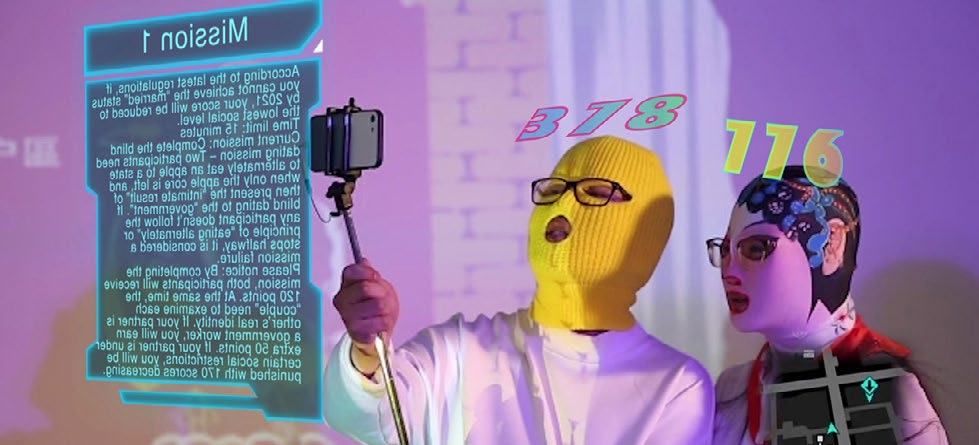
Image: Ziyang Wu
Sense
Sensing initiatives engage people through digital technologies at scale to scan, sense, explore and forecast the future. Involving more people is more democratic, inclusive and draws upon a wider range of skills, knowledge and experience. It also helps avoid cognitive bias or groupthink, which can occur when futures exercises are dominated by experts or decision-makers. One example of this sort of approach is the Seeds of the Good Anthropocenes project, which is described in Box 5.
Box 5: Seeds of the Good Anthropocenes
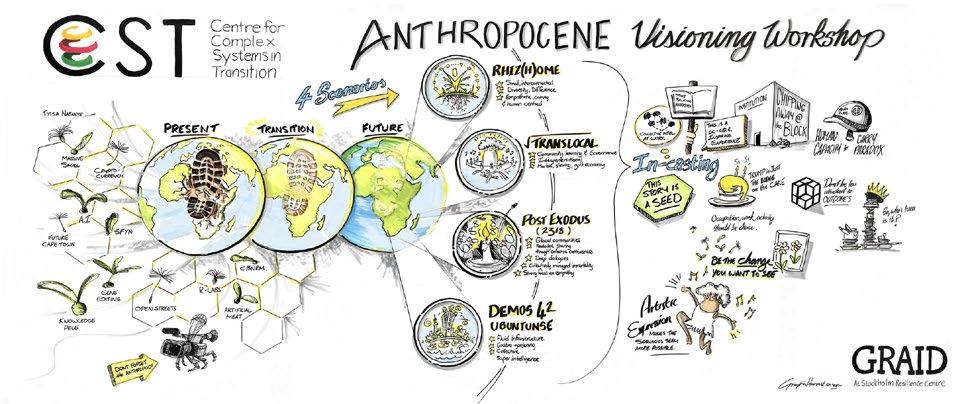
Image: Graphic Harvest
What?
Acknowledging that humanity has shifted into a new geological era, the Seeds of Good Anthropocenes project is an effort to document and map 'seeds' of change towards a sustainable future. The project features an open, global online map that allows anyone with access to contribute towards a 'good Anthropocene'.
Why?
The project aims to counter dystopian images of the future by showcasing realistic and optimistic images of the future that can guide action and strategy.
Who?
The project was founded and initially driven by 22 prominent academics, including many from Africa, Canada, and the EU. The project has engaged hundreds in workshops around the world and led to a map detailing seeds of change happening around the world.
So what?
The GRAID project funded a synthesis of how the seeds could help achieve the Sustainable Development Goals in Africa. It also helped pioneer a new bottom-up scenarios methodology based on the seeds, which has now been used in the Intergovernmental Platform on Biodiversity and Ecosystem Services (IPBES) process.
For further information see: goodanthropocenes.net
Create
Involves making and engaging with physical objects that represent the future, challenge current mental models and open up thinking about new pathways. These techniques show rather than tell and give participants the space to discursively imagine what a future world might look like, rather than have that world thrust upon them. They can also provide experiences that are tangible and present, which can often be more engaging than abstract ideas alone. One example of this sort of approach is the art exhibition Time Portals, which is detailed in Box 6.
Box 6: Time Portals
What?
Time Portals is a 2019 art exhibition in London's Finsbury Park and online, which was inspired by African American science fiction writer Octavia E Butler's thinking about time being circular. Many exhibits have interactive components, such as an augmented reality billboard about progressive visions of the future. Others are being co-created with citizens, such as a future machine to respond to environmental change.
Why?
The exhibition celebrates the 150th anniversary of Finsbury Park, which was one of London's first people's parks created for the free movement of citizens and ideas. It is part of Citizen Sci-Fi, a three year programme from not-for-profit Furtherfield that seeks to use the imagination of citizens to generate new visions of stewardship for public, urban green space.
Who?
The 55,000 people who use Finsbury Park each week have the opportunity to engage with this exhibition. Many come from the local neighbourhood where nearly 200 languages are spoken. The exhibition is also online.
So what?
Time Portals seeks to involve large numbers of people from diverse backgrounds in conversations about the future - both on and offline - through interactive art exhibits that are more imaginative than many traditional engagement techniques.
For further information see: www.furtherfield.org/time-portals-exhibition-2019/
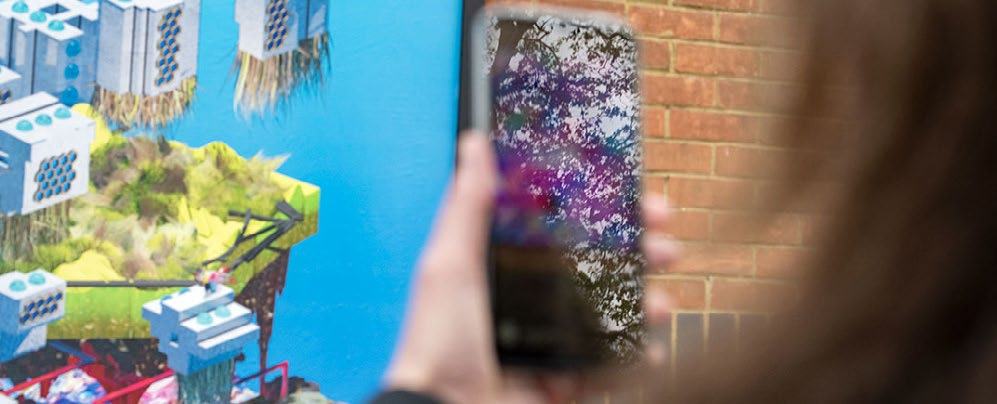
Image: Furtherfield Gallery visitor engages with AR work 'What We Can Do' by Antonio Roberts and Studio Hyte as part of the Time Portals exhibition. Photo by Pau Ros.
Deliberate
Futures methods have long relied on deliberation through workshops, interviews and in-person discussion, but these techniques are often limited by the need for participants to be in close physical proximity. Digital technologies in particular are offering new ways of enabling diverse citizens to interact and share ideas at scale, across large distances. The arts too can present novel means of conferring, such as moving beyond speech by using symbols, pictures and music. The iterative interactions conducted by the citizens of the Polish town of Płock, detailed in Box 7, offer an example of a deliberative approach.
Box 7: Płock
What?
In 2016, citizens in Płock, Poland, were consulted on the future of cycling, using an online real-time Delphi platform with an integrated spatial visualisation module. This allowed residents to engage with each other's ideas through iterative interactions. Citizens discussed expected cycling path trajectories, their desired usage, preferred path types and possible future locations of bike stands.
Why?
Although investment in infrastructure has increased in Poland over the past few decades, citizens have not played an active part in shaping the overall vision for mobility at a local level. As past investments had triggered some controversy, this project was aimed at forging a collaborative vision for Płock's cycling infrastructure.
Who?
Over 250 Płock residents participated.
So what?
There was significantly more alignment on preferences among participants who used the Delphi platform compared to those who were questioned in traditional interviews. Overall, the consultation process shaped the city bicycle transportation policies at a strategic level, especially for network development, prioritisation, and safety issues.
For further information see: eeagrants.org/archive/2009-2014/projects/PL05-0374
Participatory futures are not limited to engagement with relatively wealthy, educated people in richer countries. Examples in less privileged circumstances include Kaun Banega Shubh Kal Leader, a 2009 radio-based participatory futures exercise in rural India that reached thousands of listeners and led to changes in farming practice. The purpose of the exercise was to raise awareness of the present and future threat of climate change in Bundelkhand, a drought prone region of Central India. The show was India's first rural reality competition and involved a mix of education and entertainment such as talk shows, folk songs and drama. It won the World Banks' Development Marketplace Award in the innovation category.
Table 1 provides additional examples aimed at helping those who might commission participatory futures consider the many forms each category can take.
Table 1: New approaches for participatory futures
| Category |
Approach |
Examples |
| Play |
Online games and simulations |
Magnetic South was one of a series of Christchurch City Council-supported public engagement activities following the major earthquakes in Christchurch, New Zealand, which destroyed much of the city. The project used the Foresight Engine, a MMORPG (Massive Multiplayer Online Role-Playing Game), run by the Institute of the Future and played with almost a thousand people over a two day period. Players generated cards, ideas and strategies for rebuilding the city, with 8,889 micro forecasts. |
|
LARP Live-Action Role-Play (LARP) |
At a course for senior executives in Australia at the Mt Eliza Executive Education Centre, The Sarkar Game was played. In this live facilitated game, participants play an archetypal role (worker, warrior, priest or merchant) and derive futures-related insights from the game dynamics. It is done over approximately one hour as part of a longer foresight process. |
|
Board games |
The Joint Research Center's Scenario Exploration System is a board game developed to help people to explore a particular issue using alternative scenarios. Players need to make choices that resolve multiple stakeholder needs within particular scenario contexts. |
|
Video games |
He Ao Hou, which means 'a new world' in Hawai'ian, was created by 13 Kanaka Maoli (native Hawai'ian) and two non-native teenagers at a three-week workshop in Honolulu. The participants, who were inspired by their ancestors' tradition of long-distance navigation by the stars, created a game set in the future that is entirely in the Hawai'ian language. The aim was to create a virtual environment informed by different perspectives and inspire young indigenous people to help create technology less plagued with cultural bias. |
|
Game shows |
Afrorithms from the Futures is a live game show format, which has been played at the Institute for the Future in Palo Alto (and other venues), where the goal is to create stories of positive change, resolving tensions and leveraging emerging issues, in an afro-futurist context. |
| Immerse |
Immersive scenarios |
Byologyc was an experiential futures project, which explored the possible impacts of biotechnology in the context of consumer health. The project developed a fictional company, fictional employees and live events that participants could engage with. |
|
Interactive theatre |
In the Futures Studies Reintegration into Society Project at Santa Martha Acatitla Women's Prison in Mexico City (March – June 2015), Teatro de Devenir/Forward Theatre was used with adult women in prison. Teatro de Devenir is a therapeutic approach to theatre where participants co-construct and act out simulations of what they could think, feel and behave in light of future situations in a given subject, ending with participants presenting possible futures scenarios (played by themselves) when coming out from prison. Run by the UNESCO Participation Programme and the World Futures Studies Federation. |
|
Augmented reality |
Leviathan was an augmented reality experience where an 80-foot whale flew over 5,000 people at a Consumer Electronics Show. At the Sundance Film Festival the whale developed into a full virtual reality immersive and interactive laboratory experience, set in a parallel universe. It was run by the World Building Media Lab at the University of Southern California. |
|
Extended reality |
Augmented Urbans involves co-developing integrated urban planning practices through Extended Reality (XR = VR/AR/MR) technologies. The project linked long-term visions with actions today. |
|
Virtual reality |
Future Dreaming is an immersive VR film allowing audiences to join four Aboriginal youths in their futures. Inspired by Australian Aboriginal Dreamtime storytelling, the project uses a mental visualisation technique to see your spirit move through the past, present or future. |
| Sense |
Crowdsourcing |
Futurecoast was a storytelling project about possible climate-changed futures where anyone could participate by voicemail. The game generated a range of perspectives on climate change from the future. |
|
Gamified crowdsourcing |
One Shared House uses an online application form for a hypothetical co-living space opening in 2030, and asks which goods and services – including kitchens, workspace and childcare – potential applicants would be willing to share. |
7. What role can participatory futures play in decision-making?
Delivering public value is increasingly complex for governments and organisations facing an array of challenges, from climate change to social care. Today's leaders will need to decide on actions now that may only deliver benefits in the long-term, and possibly even deliver some pain in the short-term. Not only will tackling these challenges require new ways of managing public investment, they will also require new ways to have conversations with the public about desired destinations, the route maps to get there and the trade-offs they are willing to accept.
These challenges become more acute when institutions and organisations alone do not have sufficient power or knowledge to influence the changes they wish to see in communities or across society. The goal instead must become one of building constituencies for long-term change.
Traditional public engagement activities and strategy consultation processes are fine as a snapshot of what people think, but they aren't especially good at helping to create movements for change or for shifting fundamental behaviours. While important information can be extracted from them, these activities rarely leave participants feeling that their perception or agency has been altered in any significant way.
This section highlights how participatory futures can act as an input into more traditional strategy and decision-making processes, enhancing the ability of institutions and organisations to produce public value in conditions of long-term uncertainty. We also show how it can act as a social process, helping to unleash the intelligence of citizens and unlock the assets of communities in creative and potent ways. One of the keys to success is the ability to help people separate diagnosis of the how the world is changing, from prescription of the solution. When this fails to happen, decision-making can often be paralysed or fuzzy.
We discuss the different roles of participatory futures under the following five headings:
- Mapping horizons
- Creating purpose
- Charting pathways
- Acting together
- Testing ideas
In the following sections, we describe these roles and provide examples of some of the participatory futures activities that are typically employed to fulfill each role. We also illustrate each role with a case study of an institution employing participatory futures approaches as part of a strategy or policy-making process.
Mapping horizons
Participatory futures can be used to deepen awareness of changes on medium and long-term time horizons. These activities involve citizens in identifying signals of change, emerging issues and the factors driving them. They can also involve exploration of different ways these changes may play out and their potential impacts through the creation or use of alternative scenarios.
Examples of participatory futures activities that can be used for mapping horizons include:
- Crowdsourcing citizens' images or stories of the future through art, audio or writing.
- Engaging citizens as a sensor network – sharing examples of the changes they see or early indications that something new or different might happen.
- Engaging citizens as forecasters – using online platforms to predict the likelihood of particular events occurring.
- Citizens engaging with future scenarios through games, or interacting with physical objects or 'artefacts' from future scenarios to explore drivers of change and consider implications.
A more detailed example of mapping horizons is Whatfutures that is described in Box 8.
Box 8: WhatFutures
What?
The International Federation of Red Cross and Red Crescent Societies (IFRC) partnered with Newcastle University's OpenLab to create a massive multiplayer online game played through WhatsApp. WhatFutures asked players to imagine the challenges and opportunities of 2030 and design stories about how the organisation met the humanitarian needs of the future.
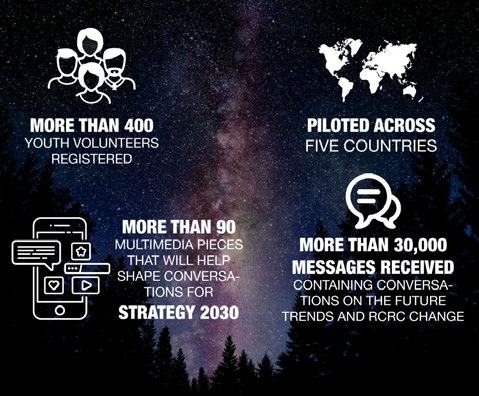
Image: International Federation of Red Cross and Red Crescent
Why?
As the secretariat for 191-member National Societies, IFRC has a mandate to engage its stakeholders, including over 14 million volunteers, as part of its ten-year strategy development process. Aimed at garnering local insights and contextualised priorities, WhatFutures sought to shift consultation practices within the organisation.
Who?
In June 2017, a pilot version of WhatFutures focused on five countries and registered 400 players. In September 2017, the global game brought together 4,000 youth volunteers from 120 countries.
So what?
Content from both games was turned into a 'Newspaper from the future', part of a broader humanitarian experiential futures exhibit at the IFRC General Assembly 2017 – the highest decision making body of the 191 member Federation. Outcomes from WhatFutures contributed to the final priorities of IFRC's Global Strategy 2030
For further information see:
media.ifrc.org/innovation/solferino-academy/whatfutures-global/
Creating purpose
Participatory futures can be used to develop a sense of meaning and direction. These activities explore values, needs, and aspirations of citizens that lead to a vision of a preferred future. They can also involve examining and reframing deep-seated cultural or organisational assumptions.
Examples of participatory futures activities that can be used for creating purpose include:
- Use of citizen dialogue and facilitated discussion to explore assumptions with regard to identity, values and purpose.
- Sampling citizens' preferred images of the future (e.g. of their cities, regions).
- Engaging citizens in evaluating or exploring the ethical implications of an emerging technology.
A more detailed example of creating purpose is Nos Aruba 2025 that is described in Box 9.
Box 9: Nos Arubas 2025
What?
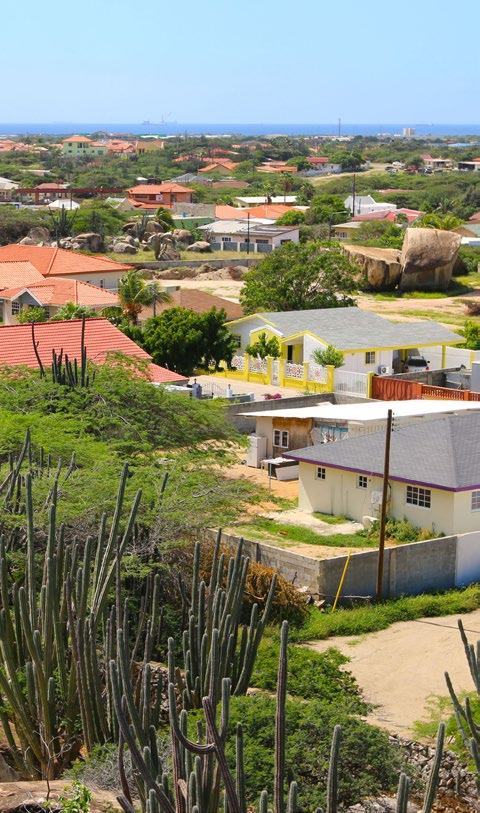
In 2008, the government of the Dutch Caribbean nation of Aruba initiated a deliberative exercise to chart a 2025 vision for the island – a process that survived a change of government. It used two main methods: appreciative inquiry, using a structured set of questions to generate positive visions for the future, and scenario building, creating stories about different futures.
Why?
The programme was undertaken because of existential and long-term challenges facing the island, such as threats to fragile ecosystems and vulnerability to volatile global energy markets.
Who?
Participants included half of the island's 100,000 population alongside civil society and businesses, some of which provided in-kind support, such as paid staff leave to engage with the initiative. The project scaled partly through open courses where participants repeated what they had learned in their own communities.
So what?
Involving citizens may have saved the exercise from closure part way through following a change of government. The main output was a national plan, which included recommendations ranging from constitutional reform to the construction of cycle paths.
For further information see:
www.nosaruba2025.aw/nosaruba.html
Charting pathways
Participatory futures can be used to help create high level strategies and socially acceptable pathways for desired change. They often involve citizens in generating novel ideas to realise a vision or collaboratively setting priorities and milestones.
Examples of participatory futures activities that can be used for charting pathways include:
- Citizens collaboratively imagining and developing a timeline narrative that articulates the journey between the present and the preferred future, with specific strategies, milestones and pathways.
- Citizens using an online voting or petition system to prioritise ideas for ways to achieve a vision, eliciting which strategies have the most support or perceived efficacy.
- Citizens using games where participants can generate ideas for ways to achieve a shared purpose and test them with other players.
- Citizens are immersed in a preferred future and asked to generate ideas for how that future was achieved.
A more detailed example is Creating a Constitution for Mexico City that is described in Box 10.
Box 10: Creating a constitution for Mexico City
What?
Laboratorio Para La Ciudad, the experimental arm of the city government, was tasked with developing a public engagement process for the development of the new constitution. This included: a writing platform co-developed with MIT Media Lab; an online petition system, which generated 342 petitions and gathered 278,000 signatures; a process for facilitating citizen-driven encounters (over 20); and the Imagine Your City project, which gathered over 34,000 effective surveys.
Why?
The population of Mexico City had for decades been politically disenfranchised because, like many federal districts, it had no status as a state and citizens were not given the opportunity to vote for local representatives.
Who?
Public engagement spanned residents of poor neighborhoods engaged by local survey brigades, concerned citizens using online petitioning and committees of legal experts co-drafting documents.
So what?
The participatory nature of the process and guarantees for including issues and ideas with strong support meant that a diversity of progressive issues entered into the constitution, which became law in September 2018.
For further information see:
citiesofservice.org/resource/crowdsourcing-a-constitution-mexico-city
Image: Jezael Melgoza on Unsplash
Acting together
Participatory futures can be used as a process to mobilise collaborative action and distributed innovation across a community to realise a desired future. They might involve supporting citizens and a wider range of organisations to initiate and drive social innovations, community enterprises, or change campaigns.
Examples of participatory futures activities that support communities in acting together include:
- Citizens co-developing and co-running campaigns or movements for change.
- Citizens using an 'open space' or autonomous format where they can select their own change projects and begin to organise.
- Citizens generating ideas for specific social innovations and community enterprises, which they will play a key role in driving.
A more detailed example of acting together is Transition Management in Ghent that is described in Box 11.
Box 11: Transition management in Ghent
What?
A 'transition management' process was initiated in Ghent, which aimed to address major sustainability challenges, particularly climate change. The process first developed a long-term vision that provided the overall context to guide newly-involved actors in piloting social innovations.
Why?
The approach saw participants 'learn by doing' and showed how citizens could be signposts of change, building enthusiasm, and driving more public participation.
Who?
One hundred highly motivated people who attended a launch event. They joined working groups, which included members from various backgrounds, to develop projects.
So what?
This group initiated and drove a number of projects, experiments, and social innovation processes. This included: an energy efficiency project working with small and medium enterprises; a network of cultural organisations monitoring their CO2 emissions; a project to use sewage water to produce heat, biogas, nutrients and water; a 'carrot mob' action that pressed a local business to adopt sustainable practices; an urban farming initiative; a blue economy initiative; a sustainable university initiative; and a future mobility initiative. All but one initiative was successful.
For further information see:
drift.eur.nl/wp-content/uploads/2016/11/DRIFT-Transition_management_in_the_urban_context-guidance_manual.pdf
An illustration of a Ferris wheel next to a historic cathedral, with a vibrant street scene below.
Image: Jorge-Fernandez-Salas on Unsplash
Testing ideas
Participatory futures can be used to generate feedback and learning about a specific idea of the future, a scenario, or prototype. They can produce novel insights as citizens interact with scaled experiments that enable people to interrogate the desirability of that future, to stress test it and consider potential unintended consequences.
Examples of participatory futures activities that can help with testing ideas about the future include:
- Immersing citizens in a simulation of a future scenario to elicit feedback.
- Citizens trying and experiencing a small-scale, but real-world experiment, which is then evaluated.
- Creating an artefact-from-the-future to generate responses and insights from citizens.
- Generating a computer simulation of a particular future or intervention and using citizens to evaluate its first and second order consequences.
- Providing temporary physical spaces or online worlds that allow people to experiment with new values or behaviours.
- Citizens are immersed in a preferred future and asked to generate ideas for how that future was achieved.
A more detailed example of testing ideas is Reimagine London that is described in Box 12.
Box 12: Reimagine London
What?
As part of World Car Free Day, the Mayor of London announced that on 22nd September 2019, 20km of roads in and around the city would be closed. From skate ramps to treasure hunts, Greater London featured a variety of festival-esque activities, including special programming for young people.
Why?
As cities become more congested and seek out creative ways to reimagine mobility, they are increasingly using large-scale events to inspire alternatives. With a focus on improving health while also reducing emissions, 'car free' roads create spaces for imagination to come alive.
Who?
Citizens, residents, and anyone visiting London participated, and the organisers explicitly sought to include people of all ages and from all backgrounds.
So what?
What makes Reimagine London interesting is that it involved local government providing freedom to citizens to experiment with and create new future visions for their car-free areas. Reimagine has echoes of an older London-based people-powered movement, Reclaim the Streets, which has a shared ideology of community ownership of public spaces.
For further information see:
www.london.gov.uk/press-releases/mayoral/londons-biggest-ever-car-free-day
A busy aerial view of a city street crowded with pedestrians.
Table 2 provides an overview of each role, where it might fit in relation to a typical stage of a strategy or policy-making process, and the potential added value of incorporating participatory futures at this point.
| What roles can participatory futures play? |
Where might they be incorporated into organisational or community decision-making activities? |
What added value can this offer? |
|
|
|
The impacts of participatory futures
Research has demonstrated the benefits of applying futures techniques in general to organisations in the private sector and to individuals. Despite the enthusiasm of many of those involved, however, rigorous or longitudinal evaluations of participatory futures are relatively few, so the evidence base is sketchy. Of the literature that does chronicle these techniques, much is descriptive rather than evaluative. The reasons for this are not clear. Perhaps this is due to the field being so eclectic, the lack of clarity on how to evaluate these methods (as many benefits are intangible or qualitative, so hard to measure), or the belief among supporters that the impact is self-evident.
For participatory futures to mature and these techniques to become more mainstream, we need more systematic experimentation and evaluation to build the evidence base. When designing projects involving participatory futures, commissioners should therefore set aside time and resources for proper evaluation.
Building on our review of over 300 participatory futures case studies, we have created a framework that is a first step towards better evaluation of these techniques (see Table 3). The first dimension of the framework concerns the level of impact that might be evaluated from individual to community to organisation. The second dimension of the framework is based on the five stages of decision-making outlined in Section 7.
The framework asks what impacts to look for or anticipate in a participatory futures engagement. These questions act as a starting point for considering benefits and impacts to initiate an evaluation. As with any other monitoring and evaluation process, context matters, and adjustment and localisation will depend upon the specific scope, scale, and speed of the engagement undertaken.
The questions are prompts for customising an evaluation within a specific context. We expect that this will include in-house evaluations done to drive learning and improve the application of participatory futures through various iterations, and independent evaluations designed to offer more impartial perspectives on the value of an undertaking.
Table 3: Framework for evaluating participatory futures
|
Mapping horizons |
Creating purpose |
Charting pathways |
Acting together |
Testing ideas |
| Individual |
How did participatory futures deepen individuals' understanding of emerging issues within the context? How did participatory futures engender a greater sense of responsibility for the future among individuals? |
How did participatory futures shift awareness of the future (temporal, optimism, agency) among individuals? How did participatory futures make citizens feel more involved in decision-making? |
How did participatory futures foster individuals' agency in strategising about the future? How did participatory futures promote greater ownership among individuals over change processes (e.g. strategic planning)? |
How did participatory futures foster individuals' agency in creating the future? How did participatory futures generate public value for individuals? What does this mean in this context? How did participatory futures help to change individual behaviours? |
How did participatory futures support individuals to explore the impacts of this prototype on the life of themselves and their families? How did the participatory futures experiment help the exploration of individual values and aspirations? |
| Community |
How did participatory futures support creative exploration of the challenges facing the community? How did participatory futures help the community target opportunities for change? |
How did participatory futures create a more positive vision for the community? How did participatory futures create a more inclusive vision for the community? To what extent did it increase social cohesion? |
How did participatory futures help the community to identify strategies for change? How did participatory futures help align community values and aspirations with stated priorities? |
How effective were the strategies for initiating change? How did participatory futures help the community to mobilise citizen energy and resources for social change and sustainability? |
How did participatory futures help consideration of the long-term impacts of the pilot on the community? How did participatory futures help make the prototype more relatable or desirable for the community? How did the participatory futures process generate feedback from the community that led to changes or different decisions? |
| Institutional |
How did participatory futures reduce institutional blind spots? What assumptions were challenged? How? How did participatory futures help the institution identify new opportunities? |
How did participatory futures enhance the institution's purpose? How did participatory futures generate more inclusivity/diversity with respect to the institution's purpose? |
How did participatory futures expand the number of options for creating change that were considered by the institution? In what ways did participatory futures help align institutional strategies with community needs and desires? |
In what ways did participatory futures make the institution's actions more effective? How did the participatory futures improve trust in the institution? |
How did participatory futures help the institution to identify blind spots and opportunities with respect to the prototype? How did participatory futures help make adoption or rejection of an idea by the institution more effective/easier? How did participatory futures help the institution improve its quality of engagement with citizens? |
9. Design variables for participatory futures
In this section, we show the design variables of participatory futures projects.
This can be used to help:
- Describe particular projects.
- Compare what are in many ways unique exercises.
- Commissioners identify inspirational case studies that are similar to their requirements.
For example, a head of public engagement might want to test ideas, focus on organisational impacts and think in the near-term, so might look to case studies with these properties, such as Waitrose Unpacked, described later in this section.
There are eight design variables under three broad categories.
Strategic focus
How the exercise helps decision-makers and where the benefits are mainly felt:
- Aspect of decision-making process – this is based on the roles for participatory futures discussed earlier in this guide (Mapping horizons, Creating purpose, Charting pathways, Acting together, Testing ideas).
- Impact – whether benefits are mainly at the individual, community or institutional level, as described in Section 8.
Engagement
The ways in which citizens participate in the project:
- Participation – what agency the participants have and to what extent are they empowered; divided into exercises that are:
- Curated – participants do not interact with each other and the experience is prescribed.
- Contributory – participants suggest and contribute ideas, but the experience is prescribed and they do not interact with other participants.
- Interactive – participants make some contributions and can also interact with other participants.
- Facilitated – participants make nuanced contributions, have substantial interaction with others and can alter the course of the engagement.
- Constitutive – participants initiate and run the engagement in the way they want.
- Mode of engagement – divided into play, immerse, create, sense and deliberate, as described in the Section 6.
- Medium – whether engagement is in-person, online, or hybrid (combined); important because participatory futures increasingly involve digital technologies.
Image of the future
Important properties of the future under consideration:
- Future(s) – whether the exercise concerns a single future or many.
- Image of the future – the extent to which the future is explicit, such as a scenario of a particular possible future, or implicit, such as responding to a future challenge like climate change but without specifying the future.
- Time horizon – whether the future(s) under consideration is/are near or distant.
To show how the variables can be applied, we have created them for five case studies that span the decision-making process described in Section 7.
Box 16: GhostFood
What?
Organised as a food truck from the future, GhostFood allowed the public to smell foods lost to climate change. The performance paired foods with scents, which required wearing a custom-built antennae. These were designed to stimulate dialogue on food scarcity and the possible extinction of staple foods, such as chocolate, peanuts and codfish.
Why?
The impacts of climate change are often difficult to comprehend, especially on daily life, such as eating a favourite or staple food. By using smell, GhostFood created a bodily response to the potential effects of climate change.
Who?
GhostFood was performed in New York, Newark, and Philadelphia throughout 2013, and later in Moscow. The project was commissioned by the Robert Rauschenberg Foundation and conceptualised by artists Miriam Simun and Miriam Songster.
So what?
The food truck experience sparked reflective dialogue on family, food, and the many ways in which climate change will impact species survival.
For further information see: www.theverge.com/2013/10/18/4851966/ghost-food-shows-how-we-might-eat-after-global-warming

Summary of design variables for Box 16: GhostFood
This visual summary illustrates the positioning of GhostFood across key design variables:
Strategic focus:
* Aspect of decision-making cycle: Primarily focused on 'Creating purpose' but touching 'Mapping horizons' and 'Charting pathways'.
* Impact: Primarily focused on 'Individual' impact, with some 'Community' relevance.
Engagement:
* Participation: Positioned between 'Contributory' and 'Interactive'.
* Approach: Leans towards 'Immerse'.
* Medium: 'In-person'.
Image of the future:
* Future(s): 'Singular'.
* Image of the future: 'Implicit'.
* Time horizon: 'Near'.
Box 17: Moral Machine
What?
Moral Machine is an online game launched in June 2016. It presents players with scenarios about car accidents with an emphasis on choices about who to save: humans or animals, men or women, old or young people, etc.
Why?
Today, the responsibility for the design and regulation of algorithms sits in an ambiguous space between the companies designing them and the policy-makers tasked with regulating them. Moral Machine aims to bridge this gap.
Who?
A total of 39.61 million people from 233 countries actively participated and expressed their preferences. Voices from diverse socio-economic backgrounds were elicited, and culture had a clear effect on how participants made decisions.
So what?
Moral Machine reveals cultural nuances that must be taken into account to create culturally-appropriate and responsible decisions. The implications of the game go beyond self-driving cars and extend towards any and all automated and algorithmically-enhanced decision-making systems, shining a light on how our values can and might drive our technologies rather than the other way around.
For further information see: Moralmachine.mit.edu
"What should the self-driving car do?"
Two diagrams illustrating decision outcomes for a self-driving car.
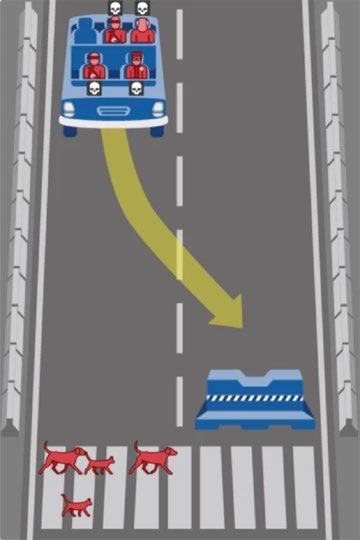
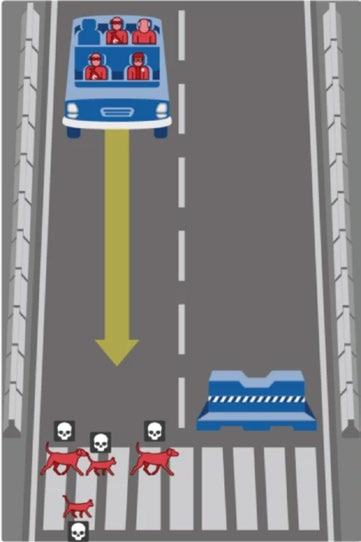
Image: ©The Moral Machine team: Edmond Awad, Sohan Dsouza, Azim Shariff, Jean-François Bonnefon, Iyad Rahwan
Summary of design variables for Box 17: Moral Machine
This visual summary illustrates the positioning of Moral Machine across key design variables:
Strategic focus:
* Aspect of decision-making cycle: Primarily focused on 'Creating purpose'.
* Impact: Primarily focused on 'Community' impact.
Engagement:
* Participation: Leans towards 'Contributory'.
* Approach: Positioned between 'Sense' and 'Deliberate'.
* Medium: 'Online'.
Image of the future:
* Future(s): 'Singular'.
* Image of the future: 'Explicit'.
* Time horizon: 'Distant'.
Box 18: Carbon Ruins
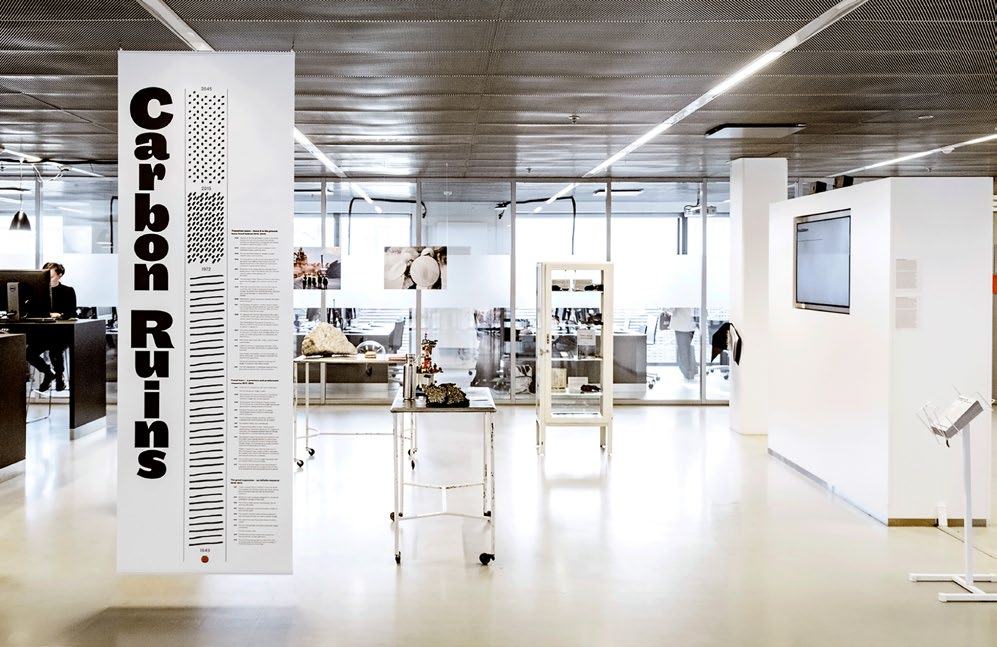
Image: Carbon Ruins, exhibition view, Lund University, photo: Håkan Röjder
What?
Carbon Ruins is an exhibition set in the year 2053, which tells the story of how Sweden became the first nation to achieve net-zero emissions in 2045. Taking a global perspective, the exhibition uses artefacts from the future, which were generated through workshops with researchers and practitioners in various sectors, to explain how the world achieved this goal in 2050.
Why?
Aiming to bridge the gap between the global implications of climate change and local effects, Carbon Ruins highlights viable pathways towards a sustainable future and raises questions about what is and is not necessary to mitigating the effects of climate change.
Who?
The exhibit will tour around Sweden from Spring until Autumn 2019.
So what?
Based on current climate models and research, Carbon Ruins demonstrates how scientific data can be translated into various forms aimed at creating awareness and stimulating thought on transformative action at a global scale. The exhibition was in progress at the time of writing, so we are unaware of an evaluation.
For further information see: www.climaginaries.org/carbon-ruins
Summary of design variables for Box 18: Carbon Ruins
This visual summary illustrates the positioning of Carbon Ruins across key design variables:
Strategic focus:
* Aspect of decision-making cycle: Primarily focused on 'Charting pathways'.
* Impact: Primarily focused on 'Community' impact.
Engagement:
* Participation: Positioned between 'Curated' and 'Contributory'.
* Approach: Leans towards 'Create'.
* Medium: 'In-person'.
Image of the future:
* Future(s): 'Singular'.
* Image of the future: 'Explicit'.
* Time horizon: 'Distant'.
Box 19: Mozilla Common Voice
What?
Common Voice is part of the Mozilla Foundation's efforts to help teach machines how real people speak, which could shape the future of this technology. Participants donate their voices and validate clips from others.
Why?
To build the most diverse public voice dataset optimised for building voice technologies for apps, devices and services, while also supporting researchers and smaller players. Voice is becoming the interface that will enable us to interact with technology, but machine learning systems are being trained on data that is biased and excludes thousands of languages. Unless this lack of diversity is addressed, people will be left even further behind by the digital divide.
Who?
The crowdsourced dataset includes 1,400 hours of recorded data in 18 languages from more than 42,000 people. Participants consist of global communities of what Mozilla describes as 'passionate volunteers'. Data collection efforts are underway in 70 languages.
So what?
Common Voice is contributing to Mozilla's Deep Speech, a suite of voice-to-text and text-to-voice engines and trained computer models, which can convert speech to text live. This potentially allows transcription of lectures, phone conversations and television programmes. Common Voice makes its data public, which is useful for those without the substantial resources of big tech companies, and the data can be labelled if the contributor wishes, so it can be more easily used by others.
For further information see: voice.mozilla.org/en
Image: Mozilla Foundation licensed under CC BY-SA 3.0
Summary of design variables for Box 19: Mozilla Common Voice
This visual summary illustrates the positioning of Mozilla Common Voice across key design variables:
Strategic focus:
* Aspect of decision-making cycle: Primarily focused on 'Acting together'.
* Impact: Primarily focused on 'Organisational' impact.
Engagement:
* Participation: Positioned between 'Interactive' and 'Facilitated'.
* Approach: Leans towards 'Sense'.
* Medium: 'Online'.
Image of the future:
* Future(s): 'Singular'.
* Image of the future: 'Implicit'.
* Time horizon: 'Near'.
Box 20: Waitrose Unpacked
What?
The UK supermarket Waitrose started an 11-week trial in June 2019 aimed at reducing packaging and plastic from food, drink and detergents. Customers could bring in their own containers, 'borrow boxes' were provided for a deposit, and pick and mix frozen fruit was offered.
Why?
To help determine how customers might be prepared to shop differently in the future by taking hundreds of products out of their packaging with the aim of saving thousands of tonnes of unnecessary waste.
Who?
Customers at the company's Botley Road branch near Oxford. More than 7,000 customers provided feedback through in-store notice boards, interviews, Instagram, Twitter and the retailer's website.
So what?
The scheme trialled a preferred future with customers who could buy packaged versions that were offered alongside unpackaged goods to create an effective test. Following positive feedback from shoppers, the trial has been extended beyond the original end date and has been rolled out in three more stores.
For further information see: www.thegrocer.co.uk/store-design/unpacked-a-closer-look-at-waitroses-plastic-free-trial/594188.article
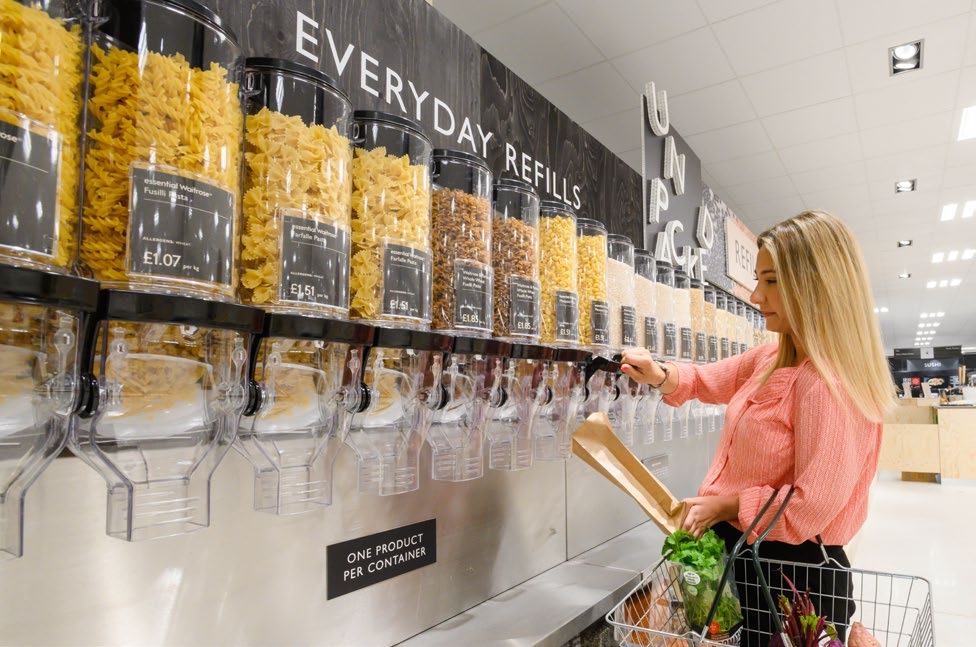
Image: Waitrose and Partners
Summary of design variables for Box 20: Waitrose Unpacked
This visual summary illustrates the positioning of Waitrose Unpacked across key design variables:
Strategic focus:
* Aspect of decision-making cycle: Primarily focused on 'Testing ideas'.
* Impact: Primarily focused on 'Organisational' impact.
Engagement:
* Participation: Positioned between 'Curated' and 'Contributory'.
* Approach: Leans towards 'Immerse'.
* Medium: 'In-person'.
Image of the future:
* Future(s): 'Singular'.
* Image of the future: 'Implicit'.
* Time horizon: 'Near'.
Mapping our case studies
We have also mapped some of the case studies described in this guide across our design variables.
Table 4: An overview of case studies mapped against key design variables
Strategic focus
Aspect of decision-making cycle
| Mapping horizons |
Creating purpose |
Charting pathways |
Acting together |
Testing ideas |
| Carnival 2020 |
CIMULACT |
Plock |
Transition management in Ghent |
World Without Oil |
| Time Portals |
Moral Machine |
Future Design |
Reimagine London |
Waitrose Unpacked |
| GhostFood |
Nos Aruba 2025 |
Carbon Ruins |
Mozilla Common Voice |
|
| What Futures |
Early Days |
Creating a constitution for Mexico City |
|
|
|
|
Seeds of the Good Anthropocenes |
|
|
Impact
| Individual |
Community |
Organisational |
| World Without Oil |
Time Portals |
CIMULACT |
| Carnival 2020 |
Plock |
WhatFutures |
| GhostFood |
Carbon Ruins |
Nos Aruba 2025 |
|
Creating a constitution for Mexico City |
Transition management in Ghent |
|
Seeds of the Good Anthropocenes |
Waitrose Unpacked |
|
Reimagine London |
|
|
Early Days |
|
Engagement
Participation
| Curated |
Contributory |
Interactive |
Facilitated |
Constitutive |
Carbon Ruins
Waitrose Unpacked |
World Without Oil
Moral Machine |
Carnival 2020
Time Portals
GhostFood
Creating a constitution for Mexico City
Mozilla Common Voice
Early Days |
Plock
Future Design
CIMULACT
Nos Aruba 2025
Reimagine London
WhatFutures
Seeds of the Good Anthropocenes |
Transition management in Ghent |
Approach
| Play |
Create |
Immerse |
Sense |
Deliberate |
World Without Oil
WhatFutures |
Time Portals
Carbon Ruins
Transition Management Ghent |
Carnival 2020
Future Design
GhostFood
Reimagine London
Waitrose Unpacked
Early Days |
Seeds of the Good Anthropocenes
Moral Machine
Mozilla Common Voice |
Plock
CIMULACT
Creating a constitution for Mexico City
Nos Aruba 2025 |
Medium
| In-person |
Hybrid |
Online |
Future Design
GhostFood
Carbon Ruins
Nos Aruba 2025
Transition management in Ghent
Reimagine London
Waitrose Unpacked
Early Days |
Carnival 2020
Time Portals
CIMULACT
Creating a constitution for Mexico City
Seeds of the Good Anthropocenes |
World Without Oil
WhatFutures
Plock
Moral Machine
Mozilla Common Voice |
Image of the future
| Future(s) |
Singular |
Multiple |
World Without Oil
Carnival 2020
Plock
GhostFood
Carbon Ruins
Moral Machine
Nos Aruba 2025
Mozilla Common Voice
Early Days |
Transition management in Ghent
Reimagine London
Time Portals
CIMULACT |
Future Design
WhatFutures
Creating a constitution for Mexico City
Seeds of the Good Anthropocenes |
| Implicit |
Explicit |
Transition management in Ghent
Reimagine London
Mozilla Common Voice
Plock
GhostFood
Carnival 2020
WhatFutures
Time Portals
Future Design
CIMULACT
Creating a constitution for Mexico City
Seeds of the Good Anthropocenes
Nos Aruba 2025 |
World Without Oil
Moral Machine
Carbon Ruins
Early Days |
Time horizon
| Near |
Medium |
Distant |
Carnival 2020
Plock
Reimagine London
Mozilla Common Voice |
Creating a constitution for Mexico City
Moral Machine
Transition management in Ghent
CIMULACT
GhostFood
WhatFutures
Nos Aruba 2025
World Without Oil |
Carbon Ruins
Seeds of the Good Anthropocenes
Early Days
Time Portals
Future Design |
10. Ten tips for success
Participatory futures encompass many different modes of practice and contexts. While there is no exact formula for success, there is a body of shared experiences that offers important insights.
To complement the ways of thinking about participatory futures we described earlier, here we offer ten tips to help increase the likelihood of success. The tips focus on participatory futures specifically rather than futures in general, advice for which can be found elsewhere, such as in the UK Government Office of Science's Futures toolkit, Policy Horizon Canada's Foresight Training Modules and Nesta's Futures Explainer., ,
1. Start with the problem you want to solve
Participatory futures can involve exciting new methods, such as building virtual worlds and harnessing collective intelligence. While we hope commissioners are inspired by novel approaches, the starting point for participatory futures should be the problem to be solved rather than the method. The decision-making section of this guide offers advice on which approaches are useful for which problems, although most techniques can be used for multiple challenges.
2. Identify a dedicated champion
Commissioning participatory futures requires time and energy, so it is important to identify a champion (or champions) to shoulder the overall responsibility for 'producing' the engagement. Giving this person or group adequate authority, time and resources is essential.
3. Secure senior buy-in and make the business case
Even the greatest champion will struggle to launch and sustain a participatory futures project without senior buy-in. This will help the project to secure greater resources and receive cross-organisational support. To obtain senior buy-in you often need to make the business case as described in the Section 5. As participatory futures is experiential, senior sponsors should be involved in at least part of the activity, even if they are unable to join throughout.
4. Find and involve the 'unusual suspects'
Involving diverse perspectives and creating insight from this diversity is critical to success. Too often people seek out others who think like them. For participatory futures, however, this leads to blind spots. When a vision of the future is created that unconsciously or actively excludes certain groups, the vision itself becomes divisive. Of particular importance is engaging hard-to-each groups, such as those without access to the internet or rough sleepers. Participatory futures should also take account of the constraints on people's lives, such as childcare, shift work and limited access to public transport.
5. Work with existing bottom-up movements
Many compelling examples of participatory futures are driven from the bottom-up by existing movements, such as Reclaim the Streets or Burning Man. Those wishing to commission participatory futures should seek to work with and build on this sort of work, for example by creating the conditions in which these activities might flourish or forming partnerships.
6. Ensure engagement is genuine and manage expectations
While we are enthusiastic about the potential of participatory futures, there is no single project or process that will solve everything. Creating a sense of hope about the future necessitates follow-through. Be clear about what comes after the participatory futures engagement, who is responsible for next steps and stages, and how it will or will not be used in a social change, policy or governmental process.
8. Use mixed methods
Many of the successful participatory futures case studies described in this guide use combinations of participatory futures methods. While we can imagine circumstances in which a single method would be suitable, the advantage of a range of approaches is that the strengths of one can compensate for the weaknesses of another. This can, however, make evaluation more challenging.
9. Check along the way
Participatory futures are often complex and can evolve, so the overall purpose and outcomes of projects can shift over time. It is therefore essential to 'check along the way' and update not just outputs but also methods and means of evaluating impact.
10. Sustain momentum and evaluate
Participatory futures can create great experiences, a renewed sense of possibility, agency, hope, and clarity of strategy. It is important for the project to offer people avenues for taking next steps and for the work to be evaluated. This can be done with dedicated resourcing that will coordinate and support these next steps, or a more open call to action for people to take greater ownership and accountability.
7. Create shared purpose
It is easy to create a sense of purpose for a project in a small room of initiators, but this purpose may not be shared by the wider community and may not necessarily resonate. Find a way to test the purpose with the community, and ideally hold an open conversation with participants about the purpose of the engagement. As discussed in the Foreword, separate diagnosis from prescription.
11. Our call to action
Overcoming the complex challenges we face to create positive futures for people and planet won't happen unless we democratise futures thinking. Participatory futures provide one means to do so. To create better futures and unblock decision making we call for the following actions to stimulate demand for, and support to, participatory futures in three areas:
Funding
Publicly funded mission-oriented research to be informed by participatory futures exercises to help give the public a say in how missions are chosen. In the UK, the Industrial Strategy Challenge Fund is the main means of funding mission-oriented research, where money is directed towards achieving specific societal challenges. Nesta and others have called for the public to have more of a say in how missions are chosen and for government to identify better ways to align missions with public priorities., , Participatory futures activities should be used to help generate a more holistic set of priorities.
Voluntary sector funders, public bodies and private philanthropists to develop a programme of support, experimentation and evaluation for participatory futures exercises. To build momentum in this field quickly, Nesta will convene a roundtable of senior leaders from potential funders of participatory futures from the public and third sectors to explore how funders can collaborate to develop a programme of activity and support for the field. This could include support to three vanguard regional or local authorities to to engage citizens around pressing long-term challenges.
The Shared Prosperity Fund to support experiments with and evaluation of participatory futures. The Government has proposed the Shared Prosperity Fund to reduce inequalities between communities as a replacement for European structural funds after the UK leaves the EU. To ensure the investments made by this fund are shaped by citizens, experiments with and evaluation of participatory futures should be integrated into the initiatives funded through this mechanism.
Devolve decision-making on R&D investment, and ensure participatory futures approaches give local people a say on priorities. Nesta recently called for control over 25 per cent of public R&D funding to be given to the nations, regions and local places of the UK to trigger a revolution in R&D beyond the South East. Participatory futures offer a way of helping to ensure that this investment reflects the aspirations and values of local citizens.
Strategy
The UK Government should introduce legislation on future generations that includes a requirement on government departments to use participatory futures approaches to inform decision-making and strategies. In 2015, the Welsh Government adopted groundbreaking legislation on the wellbeing of future generations. Calls for similar legislation to be enacted across the UK have also recently been made. To ensure that citizens have the opportunity to help shape our futures, any legislation of this nature should require local and central government to include participatory futures in its decision-making and strategies. Additional funding should be made available from central government to enable local authorities to do this well.
The European Union should adopt participatory futures approaches as part of the incoming president's programme to give citizens a voice in reshaping the future of Europe and European democracy. The President-Elect of the European Commission has announced plans for a Conference on the Future of Europe to consider European democracy. This programme of work will start in 2020, run for two years and bring together citizens, civil society and European institutions. We call on the European Commission to use and test a wide variety of participatory futures approaches to enable the fullest contribution of citizens to this process.
Practice
Participatory futures, as well as other public engagement and futures approaches, to be part of the Civil Service Competency Framework and equivalent frameworks for local government and charities. Officials in the public sector and charities need to be able to understand, commission, evaluate and apply insights from participatory futures, so these sorts of skills should be built into their competency frameworks. The exact competency should be tailored to the role and circumstance, and learning and development programmes should be created for officials.
The Department for Business, Energy and Industrial Strategy, the UK Regulators Network and the National Infrastructure Commission, to work with all regulators to develop a wider participatory futures and public engagement programme that could support future regulatory decisions and action. These activities would support a shift towards an 'anticipatory' approach to regulation. Regulators increasingly have to make difficult, values-based decisions in the face of new challenges from emerging technologies and shifting industries. Participatory futures activities, along with other public engagement methods, would help fill the democratic deficit regulators often struggle with.
Endnotes
- . McGonigal J (2017) Our puny brains are terrible at thinking about the future https://slate.com/technology/2017/04/why-people-are-so-bad-at-thinking-about-the-future.html Accessed: 21 October 2019.
- . O'Donoghue T and Rabin M (1999) quoted in Behavioural Economics, Present bias https://www.behavioraleconomics.com/resources/mini-encyclopedia-of-be/present-bias/ Accessed: 21 October 2019.
- . Fisher R (2019) The perils of short-termism: civilisation's greatest threat. https://www.bbc.com/future/article/20190109-the-perils-of-short-termism-civilisations-greatest-threat Accessed: 21 October 2019.
- . Hüther (2010) quoted in Wilhelmer, D (2016) Society in need of transformation. Citizen-Foresight as a method to co-create the future, Public Philosophy & Democratic Education, 5(2):51-72.
- . Lederwasch A (2012) Scenario art: A new futures method that uses art to support decision-making for sustainable development. Journal of Futures Studies, 17(1), 25-40.
- . Frey H, Yim, S and Troumbley R (2011) Hawai'i 2060: Visioning Hawai'i's Adaptation to Climate Change http://futures.hawaii.edu/publications/environment/HRCFSSOP_Final_Report.pdf Accessed: 4 October 2019.
- . Greenfieldboyce N (2013) You can't see it, but you'll be a different person in 10 years https://www.npr.org/sections/health-shots/2013/01/03/168567019/you-cant-see-it-but-youll-be-a-different-person-in-10-years. Accessed: 11 October 2019.
- . Hammond C (2018) The surprising reason people change their minds https://www.bbc.com/future/article/20180622-the-surprising-reason-people-change-their-minds Accessed: 11 October 2019.
- . Bird S (2019) Lord Bird: We must shift from short term thinking and incorporate a future generations test in policy making https://www.politicshome.com/news/uk/social-affairs/children-and-young-people/house/house-magazine/104578/lord-bird-we-must-shift Accessed: 10 October.
- . McGonigal J (2017) Our puny brains are terrible at thinking about the future. https://slate.com/technology/2017/04/why-people-are-so-bad-at-thinking-about-the-future.html Accessed: 21 October 2019.
- . Edelman (2019) The 2019 Edelman Trust Barometer https://www.edelman.com/trust-barometer Accessed: 10 October 2019.
- . Parker K, Morin R and Menasce Horowitz J (2019) Looking to the future, public sees an America in decline on many fronts. https://www.pewsocialtrends.org/2019/03/21/public-sees-an-america-in-decline-on-many-fronts/ Accessed: 10 October 2019.
- . Bartlett J and Gasten S (2017) Public views on technology futures https://demos.co.uk/project/public-views-on-technology-futures/ Accessed: 10 October 2019.
- . Gray A (2016) The troubling charts that show young people losing faith in democracy https://www.weforum.org/agenda/2016/12/charts-that-show-young-people-losing-faith-in-democracy/ Accessed: 10 October 2019.
- . Shead S (2019) UK tech staff quit over work on 'harmful' AI project https://www.forbes.com/sites/samshead/2019/05/13/uk-tech-staff-quit-over-work-on--harmful-ai-projects/#28293d664df5 Accessed: 10 October 2019.
- . Nair S (2019) Trust in tech is wavering and companies must act https://www.edelman.com/research/2019-trust-tech-wavering-companies-must-act Accessed: 17 October 2019.
- . Picheta R (2016) The world is sadder and angrier than ever, major study finds https://edition.cnn.com/2019/04/25/health/gallup-world-emotions-index-scli-intl/index.html Accessed: 10 October 2019.
- . Stokes B (2019) A decade after the financial crisis economic confidence rebounds in many countries https://www.pewresearch.org/global/2018/09/18/α-decade-after-the-financial-crisis-economic-confidence-rebounds-in-many-countries/ Accessed: 10 October 2019.
- . Kinvall C (2004) Globalization and Religious Nationalism: Self Identity, and the Search for Ontological Security, Political Psychology, 25(5).
- . Demneh M and Morgan R (2018) Destination Identity: Futures Images as Social Identity, Journal of Futures Studies, 22(3):51-64.
- . Sargent J (2019) There's a diversity problem in the tech industry and it's not getting any better https://sdtimes.com/softwaredev/theres-a-diversity-problem-in-the-tech-industry-and-its-not-getting-any-better/ Accessed: 10 October 2019.
- . Nature (2016) Is science only for the rich? https://www.nature.com/news/is-science-only-for-the-rich-1.20650 Accessed: 10 October 2019.
- . Mateo-Garcia J and John J (2019) AI is in danger of becoming too male https://theconversation.com/ai-is-in-danger-of-becoming-too-male-new-research-121229 Accessed: 10 October 2019.
- . Leonhardt D (2017) Lost Einsteins: The innovations we're missing https://www.nytimes.com/2017/12/03/opinion/lost-einsteins-innovation-inequality.html Accessed: 10 October 2019.
- . Dastin J (2018) Amazon scraps secret AI recruitment tool that showed bias against women https://www.reuters.com/article/us-amazon-com-jobs-automation-insight/amazon-scraps-secret-ai-recruiting-tool-that-showed-bias-against-women-idUSKCN1MK08G Accessed: 10 October 2019.
- . Bartlett J and Gasten S (2017) Public views on technology futures https://demos.co.uk/project/public-views-on-technology-futures/ Accessed: 10 October 2019.
- . Nair S (2019) Trust in tech is wavering and companies must act https://www.edelman.com/research/2019-trust-tech-wavering-companies-must-act Accessed: 10 October 2019
- . Hüther (2010) quoted in Wilhelmer D (2016) Society in need of transformation. Citizen-Foresight as a method to co-create the future, Public Philosophy & Democratic Education, 5(2): 51-72.
- . Slaughter R (1991) quoted in Demneh M and Morgan R (2018) Destination Identity: Futures Images as Social Identity, Journal of Futures Studies, 22(3):51-64.
- . Page SE (2008) The Difference: How the Power of Diversity Creates Better Groups, Firms, Schools, and Societies. Princeton University Press, Princeton.
- . In numerous studies, diversity has been shown to provide a competitive advantage. See: Hunt V, Layton D and Prince, S (2014) Diversity Matters. McKinsey & Company.
- . Dator J et al (1999) Hawaii 2000: Past, Present and Future http://www.futures.hawaii.edu/publications/hawaii/HI2KDBEDTReport1999.pdf Accessed: 6 October 2019.
- . Examples from the USA in the 1960s and 1970s can be found in Bezold C (ed) (1978) Anticipatory democracy: People in the politics of the future. Random House, New York.
- . Examples of previous participatory futures work from around the world can be found in academic futures journals such as Futures, Foresight, Journal of Future Studies, Technological Forecasting and Social Change, World Futures Review, World Futures, European Journal of Futures Research and On the Horizon.
- . Ramos J (Forthcoming) Messy Grace: the Mutant Futures Program, In Bussey, M. Phenomenologies of Grace: The Body, Embodiment and Transformative Futures, Palgrave Macmillan, UK.
- . Wilhelmer D (2016) Society in need of transformation. Citizen-Foresight as a method to co-create urban future https://pdfs.semanticscholar.org/47ff/397a9dbd642e94a55d5a46ba24ddd1f57038.pdf?_ga=2.127527437.1069435835.1570116065-1239967308.1561884243 Accessed: 6 October 2019.
- . Lederwasch A (2012) Scenario art: A new futures method that uses art to support decision-making for sustainable development. Journal of Futures Studies, 17(1), 25-40.
- . Benoit RG, Szpunar K K and Schacter DL (2014) Ventromedial prefrontal cortex supports affective future simulation by integrating distributed knowledge. Proceedings of the National Academy of Sciences, 111(46), 16550-16555.
- . Mullally SL and Maguire EA (2014) Memory, imagination, and predicting the future: a common brain mechanism? The Neuroscientist, 20(3), 220-234.
- . Candy S and Dunagan J (2016) Designing an experiential scenario: The People Who Vanished, Futures, (86) February 2017, Pages 136-153.
- . Peach K (2019) New platforms for public imagination https://www.nesta.org.uk/blog/new-platforms-public-imagination/ Accessed: 6 October 2019.
- . Interview with Ken Eklund, 20 August 2019.
- . World Without Oil website http://writerguy.com/wwo/metahome.htm Accessed: 10 October 2019.
- . World Without Oil CISCO case study: https://www.cisco.com/c/dam/en_us/solutions/industries/docs/education/WorldWithoutOil.pdf Accessed: 10 October 2019.
- . Boingboing (2017) Play Jame McGonigals World Without Oil https://boingboing.net/2007/05/03/play-jane-mcgonigals.html Accessed: 10 October 2019.
- . Imagination for People case study: http://imaginationforpeople.org/en/project/world-without-oil/ Accessed: 10 October 2019.
- . Visual Conversations on Urban Futures (2015) World Without Oil https://subjectivefutures.wordpress.com/2015/06/29/world-without-oil/ Accessed: 10 October 2019.
- . Bennett E et al (2016) 'Bright Spots: Seeds of a Good Anthropocene.' Frontiers in Ecology and the Environment 14 (8): 441-48. https://doi.org/10.1002/fee.1309
- . Draw C (2018) Speculative design https://www.youtube.com/watch?v=nzD3uH2_Fo0 Accessed: 8 October 2019.
- . Interview with Ruth Catlow, 19 August 2019.
- . Development Alternatives (Unknown) Rural Reality Show https://www.devalt.org/images/L2_ProjectPdfs/DevelopmentMarketplace.pdf Accessed: 26 September 2019.
- . Drucker P et al (2010) Nos Aruba 2025: National Integrated Strategic Plan http://deugdelijkbestuuraruba.org/wp-content/uploads/2016/04/Nos-Aruba-2010-2025.pdf Accessed: 11 October 2019.
- . Lustig T and Hazel M. Personal communication. November 22, 2017.
- . CDMX Constitution https://labcd.mx/experimentos/constitucion-cdmx/ Accessed: 1 September 2019
- . See: Hicks, D. (2003). Lessons for the future: The missing dimension in education. Routledge.
- . Sakura O and Saijo T (2019) Discussion between Professor Sakura Osamu and Professor Saijo Tatsuyoshi https://www.japanpolicyforum.jp/society/pt20190109210522.html Accessed: 8 October 2019.
- . European Commission (2017) Citizen and Multiple Actor Consultation on Horizon 2020 https://cordis.europa.eu/project/rcn/197909/factsheet/fr Accessed: 28 October 2019.
- . European Commission (2018) Deliverable 5.3 Report in the impact of the project http://www.cimulact.eu/wp-content/uploads/2018/06/CIMULACT-D5.3.pdf
- . Gardner A and Bishop P. (2019) A Special Issue: Foresight and Evaluation. World Futures Review. 11(4).
- . Calof J and Smith JE (2012) Foresight impacts from around the world: a special issue. Foresight. 14(1).
- . Rohrbeck R (2010) Corporate foresight: Towards a maturity model for the future orientation of a firm. Springer Science & Business Media.
- . Rohrbeck R and Schwarz JO (2013). The value contribution of strategic foresight: Insights from an empirical study of large European companies. Technological Forecasting and Social Change, 80(8), 1593-1606.
- . Gidley J, Ingwersen N and Inayatullah S (Eds.) (2002) Youth futures: Comparative research and transformative visions. Greenwood Publishing Group.
- . Examples include: Bezold, C. (1978). Anticipatory democracy: People in the politics of the future. Random House, New York.
- . Edmond A et al (2018) The Moral Machine Experiment. Nature 563 (7729): 59-64. https://doi.org/10.1038/s41586-08-0637-6 Accessed: 11 October 2019.
- . The design variables and categories are intended to be a simple, pragmatic tool to help commissioners consider particular participatory futures exercises, rather than an exhaustive and detailed attempt to codify participatory futures. The variables are intentionally qualitative to avoid unwarranted claims of precision.
- . Personal communication from the Head of CSR Food and Agriculture at Waitrose.
- . BBC (2019) Bring your own containers says Waitrose https://www.bbc.co.uk/news/business-48498346 Accessed: 5 November 2019.
- . BBC (2019) Waitrose pilot to cut the use of plastic https://www.bbc.co.uk/news/av/business-48501154/waitrose-pilot-aims-to-cut-use-of-plastic Accessed: 5 November 2019.
- . Guardian (2019) Waitrose launches plastic free trial https://www.theguardian.com/business/2019/jun/04/waitrose-launches-packaging-free-trial Accessed: 5 November 2019.
- . Independent (2019) Waitrose extend bring your own container trial to reduce plastic waste https://www.independent.co.uk/life-style/food-and-drink/waitrose-plastic-container-bring-your-own-trial-a8942876.html Accessed: August 2019.
- . Smithers R (2019) Plastic free trial Waitorse hits the ground running https://www.theguardian.com/society/2019/jun/04/packaging-free-trial-waitrose-hits-the-ground-running Accessed: 5 November 2019.
- . Heath O (2019) Waitrose trials eight new plastic-free concepts to save thousands of tonnes of packaging and plastic https://www.housebeautiful.com/uk/lifestyle/shopping/a27711237/waitrose-oxford-store-unpacked-plastic-free-concepts-trial/ Accessed: 5 November 2019.
- . Schraer N (2019) Waitrose trials selling groceries without packaging https://www.moneysavingexpert.com/news/2019/06/waitrose-trials-packaging-free-groceries/ Accessed: 5 November 2019.
- . Government Office for Science (2017) The Futures Toolkit https://assets.publishing.service.gov.uk/government/uploads/system/uploads/attachment_data/file/674209/futures-toolkit-edition-1.pdf Accessed: 8 October 2019.
- . Policy Horizons Canada (2018) Foresight Training Modules https://horizons.gc.ca/en/resources/ Accessed: 8 October 2019.
- . Nesta (In press) Futures Explainer.
- . Falconer G (2019) Fuelling the future of UK Innovation https://www.nesta.org.uk/blog/fuelling-future-uk-innovation/ Accessed: 10 October 2019.
- . Mazzucato M (2018) Mission-oriented research and innovation in the European Union https://ec.europa.eu/info/sites/info/files/mazzucato_report_2018.pdf Accessed: 10 October 2019.
- . Gabriel M (2019) More R&D spend should be mission led https://www.nesta.org.uk/blog/more-rd-spend-should-be-mission-led/ Accessed: 17 October 2019.
- . Further details are available from: https://www.ukri.org/funding/funding-opportunities/strength-in-places-fund/
- . For further information see: https://futuregenerations.wales/about-us/future-generations-act/
- . UK Parliament (2019) Policy-making: Future generations' interests https://hansard.parliament.uk/Lords/2019-06-20/debates/E11B7D05-3E68-4D7F-BF09-81E9312918C0/Policy-MakingFutureGenerations%E2%80%99Interests#contribution-7DC35F17-EDC6-4192-BFD3-465847F6975C Accessed: 10 October 2019.
- . Von der Leyen U (2019) Political guidelines for the next European Commission 2019-2024 https://ec.europa.eu/commission/sites/beta-political/files/political-guidelines-next-commission_en.pdf Accessed: 10 October 2019.
- . Armstrong H, Gorst C and Rae J (2019) Renewing Regulation: 'anticipatory regulation' in an age of disruption. https://www.nesta.org.uk/report/renewing-regulation-anticipatory-regulation-in-an-age-of-disruption/ Accessed: 11 October 2019.
Contact Information
58 Victoria Embankment
London EC4Y 0DS
+44 (0)20 7438 2500
[email protected]
@nesta_uk
www.facebook.com/nesta.uk
www.nesta.org.uk
Nesta is a registered charity in England and Wales with company number 7706036 and charity number 1144091.
Registered as a charity in Scotland number SC042833. Registered office: 58 Victoria Embankment, London, EC4Y 0DS.
Footnotes