Authors
Isobel Scott-Barrett and Tom Leach, with contributions from Andy Marsden
About UK 2040 Options
UK 2040 Options is a policy project led by Nesta and delivered in partnership with the Behavioural Insights Team. It seeks to address the defining issues facing the country, from tax and economic growth to health and education. It draws on a range of experts to assess the policy landscape, explore some of the most fertile areas in more depth, test and interrogate ideas and bring fresh angles and insights to the choices that policymakers will need to confront, make and implement
About Nesta
We are Nesta. The UK's innovation agency for social good. We design, test and scale new solutions to society's biggest problems, changing millions of lives for the better.
About the Behavioural Insights Team
BIT is a global research and innovation consultancy which uses a deep understanding of human behaviour to improve people's lives.
Executive summary
Children born today will be taking their first steps into adulthood in 2040. What will life in the UK be like for them, according to current trajectories? What policy options do we have now that can influence or change that trajectory for the better?
The UK has a strong track record of leadership on net-zero targets, but this is a country that is veering substantially off-track for future carbon budgets unless it massively accelerates the pace and breadth of its decarbonisation.
Through Delphi exercises, workshops and interviews, we've asked experts two questions: what are the biggest priorities facing the UK Government as it seeks to deliver on climate targets, and what interventions could deliver on these priorities and get the UK back on track by 2040, ahead of the Government's target to reach net zero by 2050? It's worth being explicit that targets are a proxy – a necessary one for the things we really care about. In this case, stabilising the impacts of global warming to reduce global harms, and making the UK better off, greener, more comfortable and healthier as we do so.
We've already distilled the challenges and priorities into the fundamental facts and the big choices for Government to grapple with. This paper is the third in our series, and focuses on the ideas that could help deliver that better, greener, healthier UK by 2040, and beyond.
The ideas presented here are not intended to form a comprehensive strategy across all priority sectors, nor are they a clear-cut set of recommendations. Instead, they are intended to be practical, thought-provoking policy ideas which could support the trajectory to net zero.
The ten ideas that follow in this report are:
- Bring citizens into the key issues: launch a national engagement campaign on net zero
- Support an effective market for green products and services: increase information transparency for consumers using green subsidies
- Explore an alternative delivery model for home retrofit: coordinate household decarbonisation street-by-street
- Increase centralised planning for major infrastructure: make NESO a system architect
- Increase efficacy of land use for environmental outcomes: develop a national rural land use framework and use it to underpin farming payments
- Make better use of carbon pricing mechanisms: expand the scope of the UK Emissions Trading Scheme (ETS)
- Harness the market power of state funding: amend government procurement to require net-zero carbon construction materials to reduce embodied emissions
- Change incentives and increase innovation in energy markets: reform the structure of the energy retail market to support household decarbonisation
- Incentivise households to decarbonise when they're moving house: reform Stamp Duty Land Tax to become an energy-saving stamp duty
- Show leadership on the impacts of climate change: develop and legislate adaptation targets
Introduction
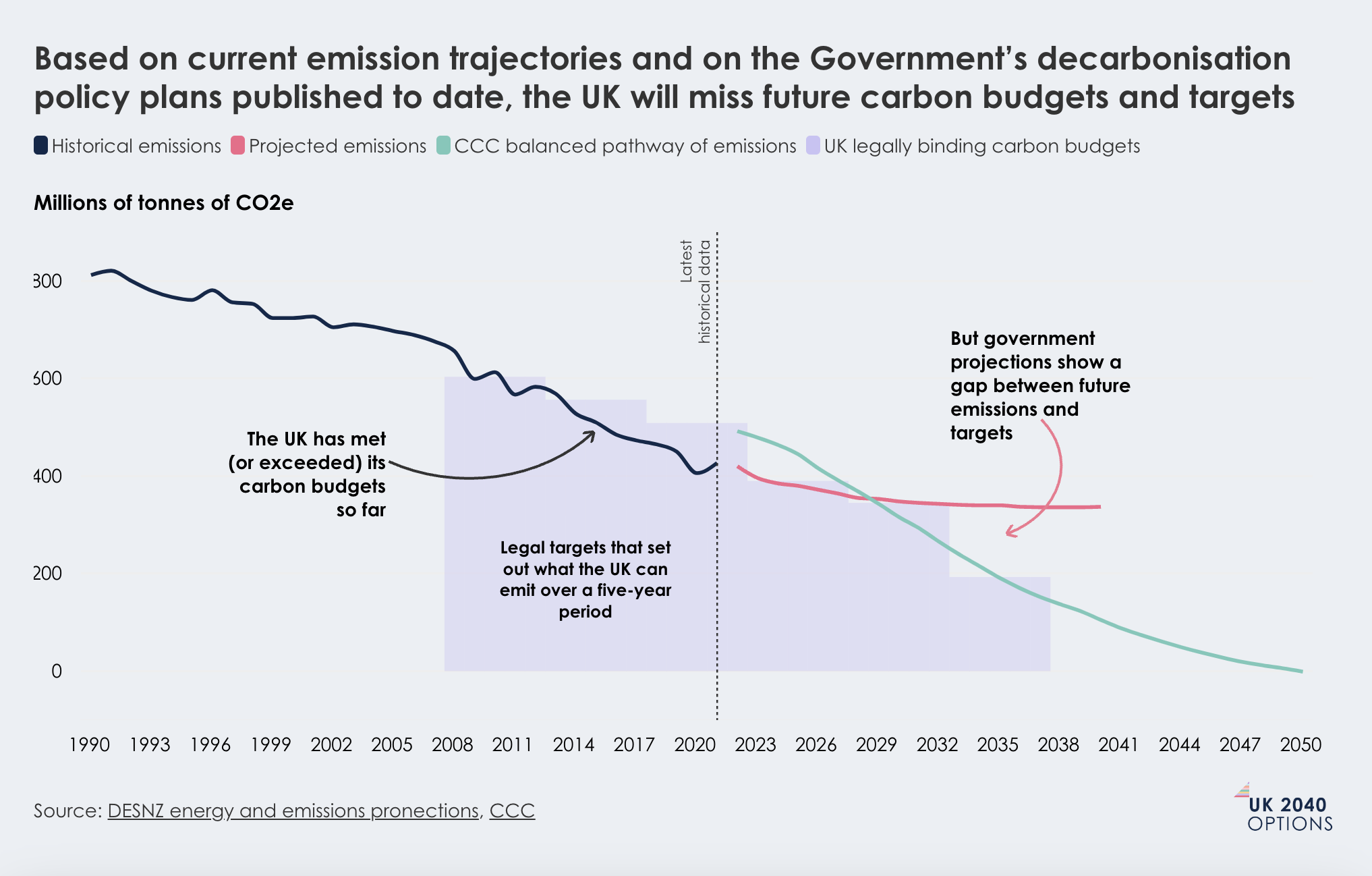
The UK Government has a track record of strong leadership on net-zero targets. The UK was the first country to set ambitious net-zero targets and is the first major economy to halve its emissions, driven largely by power sector decarbonisation. But it has banked most of the easy wins and the road ahead looks much rougher. The country is substantially off-track to meet future carbon budgets unless it massively accelerates the pace and breadth of its decarbonisation.
Based on current emission trajectories and on the Government's decarbonisation policy plans published to date, the UK will miss future carbon budgets and targets
UK 2040 OPTIONS
Source: DESNZ energy and emissions projections, CCC
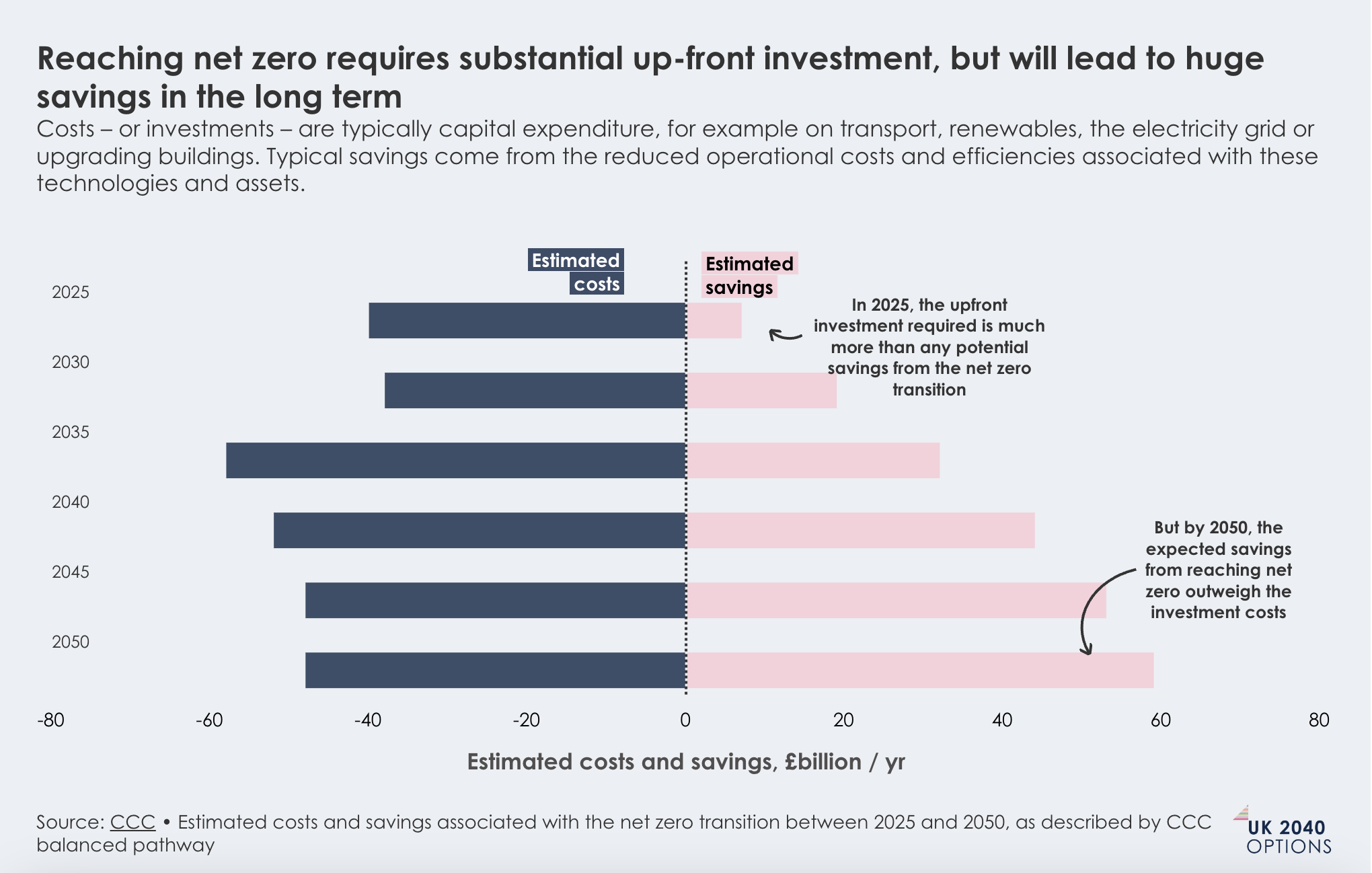
The scale of the challenge demands the same scale of response. The net-zero transition is the industrial revolution of our era, but it's worth repeating the benefits, not just the challenges. By mitigating climate change and the effects of global warming, and enabling the UK to adapt, this new industrial revolution has the potential to make the UK better off, greener, more comfortable and healthier. And by 2050, the expected savings from reaching net zero will outweigh the investment costs.
Reaching net zero requires substantial up-front investment, but will lead to huge savings in the long term
Costs – or investments – are typically capital expenditure, for example on transport, renewables, the electricity grid or upgrading buildings. Typical savings come from the reduced operational costs and efficiencies associated with these technologies and assets.
UK 2040 OPTIONS
Source: CCC Estimated costs and savings associated with the net zero transition between 2025 and 2050, as described by CCC balanced pathway
We know that a lot of infrastructure will need to be built over the next ten years to realise those long-term benefits. From installing heat pumps in our homes, to upgrading our grid capacity, the infrastructure change ahead is huge. This could cause disruption, and will require careful public engagement, but will set the country up with clean, cheap and resilient energy supply for years to come.
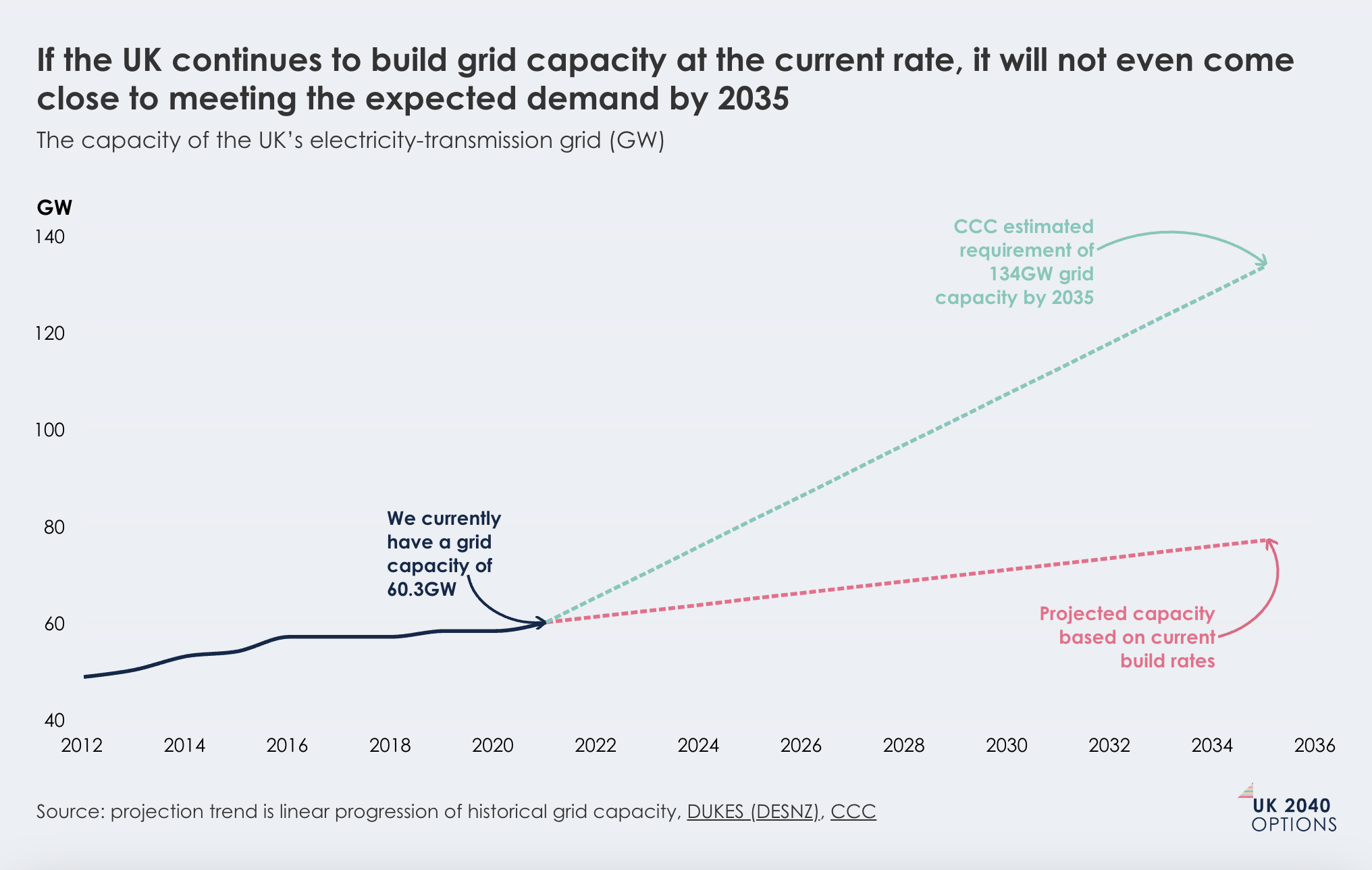
If the UK continues to build grid capacity at the current rate, it will not even come close to meeting the expected demand by 2035
The capacity of the UK's electricity-transmission grid (GW)
UK 2040 OPTIONS
Source: projection trend is linear progression of historical grid capacity, DUKES (DESNZ), CCC
The choices made by the Government, businesses and citizens now will determine how the UK can capitalise upon the opportunities the transition presents, spread the benefits equitably and minimise the costs.
The ten ideas presented here illustrate the art of the possible. Some focus on the most pressing delivery priorities such as clean energy and decarbonised homes where we know pace and coordination are key, but haven't yet cracked how. Others focus on shaping the system – the structures and incentives that will determine the path to net zero and what we account for along the way. We've not focused on transport despite its contribution to emissions, because experts have argued that trends are broadly heading in the right direction, nor on future dispatchable power generation as its technical nature is outside the scope of this paper.
The ideas range in their cost too. Some are low to no-cost in recognition of fiscal realities in the immediate, and others require more capital – whether political or financial - for scale of impact as we look to 2040 and beyond.
The ideas are structured into four themes; threads that run through the ideas. Weaving these threads together will be key for a UK government seeking to get back on track with its own net-zero goals.
1The deliberative and decision-making power of people as citizens and consumers
2The potential for centralised planning to increase pace and coordination, particularly when it comes to how the UK uses its land and for what
3Market efficacy when directed towards shared goals with policy certainty
4The galvanising effect of outcome targets on long-term issues.
A mission-driven approach to reach net zero
The Government has committed to being mission led. To some extent, work to achieve net zero already fits into this framework and way of working: the legal target provides a clear and ambitious goal, and a bold vision for change; the Government has the institutional set-up and capacity to monitor and evaluate progress, through the Climate Change Committee (CCC); and Government shapes markets to varying degrees towards achieving net zero. But there is more that the Government could do to deliver on the promise of missions, set out in detail by a roadmap published by Nesta and the Institute for Government. It describes a more directive and ambitious strategy for how the Government can deploy a range of tools to shape markets for net zero, including:
- Vision setting: The speed and interdependent nature of the net-zero transition requires the Government to become increasingly directive and specific about its vision, including the specific type and location of technologies.
- Spatial planning: Laying out the optimal location for new power stations and grid infrastructure, for example, will reduce whole-system costs and speed up the process.
- Use of tax, regulation and subsidy: Instruments such as Contracts for Difference (CFD) price in externalities and provide revenue certainty, reducing the cost of capital for the private sector.
- Risk and reward sharing: De-risking can occur by the state having 'skin in the game'. Equity stakes or other gain-share mechanisms can ensure the state captures the upside benefits from value partially created by government decisions.
- Solving coordination failures: Supply-chain investment for offshore wind is conditional on greater certainty in the likely volume and price of demand, infrastructure investment and a skilled workforce. Government can play an enabling role to solve ‘chicken and egg' coordination problems.
- R&D investment: The market opportunities being created will require R&D, but private R&D may be insufficient due to the inability to capture all the benefits or inherent risk. Public R&D could be directed by the Government in line with its vision, rather than hoping this will emerge bottom-up through the research funding system.
- Accurate and timely data: It is critical to de-risk decisions by Government, the private sector and consumers, and to enable regulators and policymakers to intervene and course correct. For example, millions were spent due to bad estimates of wind speeds offshore which led to mispricing wind subsidies.
To deliver the benefits of mission-driven approaches, the Government must also harness intelligence and drive public service innovation alongside market shaping. The former is critical for net zero: collecting and learning from the views and preferences of citizens and professionals to create systems that constantly improve and optimise, build legitimacy and engagement, and improve public acceptability of change.
The ideas that follow throughout this report all highlight elements of what taking a more mission-driven approach to net zero could look like.
Many of the key policy levers helping the UK to reach net zero are reserved to the UK Government, whether energy generation or the tariffs and levies on gas and electricity consumption. However, other policy levers such as planning are under the jurisdiction of the devolved nations. The ideas described here are directed at the UK Government meaning that where an issue is devolved the idea would impact England only – although could be adopted or amended by devolved administrations. In some cases, ideas already have traction in some form or another in Scotland, Wales and Northern Ireland given the different – and historically sometimes more ambitious – net-zero policy priorities in these nations.
Harness people power
Of the emissions reduction needed to deliver on climate targets, 62% involve some societal or behavioural change: including both the adoption and use of low-carbon technologies such as electric vehicles and heat pumps, and changes in consumption behaviours including reductions in meat and dairy consumption and aviation. Many changes the Government can make 'on its own' are dependent on public support – or at least lack of active opposition – for their success too, including building new energy infrastructure.
There is a supportive environment for climate action, with 80% of people saying they are fairly or very concerned about climate change and the majority of the population supporting climate policies. But this support varies hugely across regions and issues and people have a poor understanding of actions they can take that are most beneficial for environmental impact.
Government has levers and can use its position as a credible messenger to increase the public mandate for delivery, dispel negative narratives in public discourse and improve information for consumers so they can make better, greener choices. Harnessing the collective intelligence of citizens to make policy design better, and for the Government to quickly learn and course-correct based on data, is a key pillar of a mission-driven government.
Bring citizens into the key issues via a national campaign
What
A sustained nationwide umbrella campaign coordinated by the UK Government to engage the public on the net-zero transition, instilling confidence and helping people take action. The campaign would combine awareness-building and calls to action with forums for citizen participation to help shape the transition.
Why
Reaching climate targets entails widespread change across the UK economy and society. There is public support for this in theory: around 7 in 10 people in every generation say climate change, biodiversity loss and other environmental issues are big enough problems that they justify significant changes to people's lifestyles. And it's clear that the green transition has the potential to deliver immense benefits, ranging from health improvements to cost savings.
But the reality of disruption and cost along the way may bite: households will need to change their heating systems, use energy differently and adapt their food and transport choices, while energy and grid infrastructure expansion will happen near to where people live in some cases. Ensuring transition happens in a way that maintains public support will be important both politically and in order to achieve the end goals.
Low public engagement and mistrust – through to active backlash – is likely to slow progress, require costly adjustments and result in sub-optimal decisions. These could jeopardise the trajectory to net zero by 2050. As of 2023, 63% of the UK population have little or no confidence that they have a say in what the Government does, suggesting a legitimacy gap that could bite just as the UK is getting to the tougher part of the net-zero transition. On the flip side, increased public understanding and participation in decision-making about climate policies can improve decisions, increase trust, create space for further political action and reduce the costs of potential policy failure.
But evidence shows that people have a poor understanding of actions they can take that are beneficial for environmental impact. Support also varies according to household income, with higher support from those living comfortably compared to those finding it difficult on their current incomes. These variables indicate that public approval is not static: Government can and should bolster support if it is to reach its own climate goals.
The key components of the campaign would include:
- Coherent and sustainable vision: a single brand and vision across the lifetime of the campaign, communicating the broad benefits and opportunities the net-zero transition will bring.
- Sub-brands or assets for the major priority at each stage of the campaign: for example, the focus between 2025 and 2030 could be energy infrastructure and low-carbon heating, shifting to carbon capture and storage (CCS) and hydrogen and then to adaptation measures.
- Tailored and multi-channel communications: the campaign would use ‘through the line' marketing. This combines both broad reach ‘above the line' techniques such as billboards, buses and national TV advertisements – which build brand awareness and trust – with 'below the line' messaging such as digital marketing, which targets specific messages to specific audiences. Calls to action are most effective when they are easy, attractive, social and timely.
- Actionable information and opportunities for participation in decision-making: eg, how people can get ready for low-carbon heat; what changes they can make to gardens and streets to mitigate the effects of heat and flooding; and how they can inform decisions around energy infrastructure. Done effectively, forums for participation would encourage deliberation, provide clarity, counter misinformation and feed directly into policymaking.
- Public and explicit celebration of key successes or major contributions across the transition: these could include, for example, days powered entirely by clean energy, particular areas coming off the gas grid or the contribution of landmark citizen deliberations.
The national umbrella campaign could be led by a team within the Cabinet Office, given its cross-departmental nature, underpinned by a national engagement strategy. It would take its lead on climate priorities from the Department for Energy Security and Net Zero (DESNZ), and work with the relevant government departments and units – such as Mission Control for clean power, or Skills England on workforce – to design, test and 'go live'. Citizen participation forums could be designed and delivered at a local level, with resources and capabilities entirely devolved to local authorities or independent organisations. Or, priorities could be defined more centrally, coordinated by an ‘Office of Citizen Deliberation' within either DESNZ (for net zero alone), or within Cabinet (for citizen participation across missions), but delivered at the local level.
To be delivered effectively the campaign would need to draw on cross-disciplinary capabilities including the Behavioural Science Office, data science and strategic communications capabilities and business engagement teams, as well as the Government Office for Science. Ensuring the campaign is behaviourally informed is critical. Ongoing testing and evaluation of communications and participation fora would be critical to improve understanding of what works and therefore efficacy in actually driving action.
Finally the campaign would use relevant and trusted messengers, working with local authorities or partnering with local organisations for grassroots engagement. It would also work with industry stakeholders, including banks and consumer groups, to ensure a coherent brand and message across various channels, reinforcing messages and providing opportunities for campaign 'activation' at consumer decision points. For example, you could envisage a future scenario where a consumer visits a DIY store and sees a campaign asset to 'get heat pump ready' and chooses to buy a new radiator, knowing that this product will help them save money when they later install a heat pump.
Impact and trade-offs
Increased public support and individual action: Emphasising how effective climate policies are in reducing risks, improving health, creating jobs and reducing inequalities is particularly persuasive in building support for climate action. It can also be used to increase the scope and mandate for political action. The umbrella campaign's focus on one ‘vision and the positive benefits of the net-zero transition'
should drive personal action and contribute to creating a supportive environment for action. Such an effort has been likened to the Vaccines Taskforce in its role as an effective cross-sector rallying cry.
Improved policymaking, legitimacy and public acceptability: Public participation in policymaking is likely to result in policies – and outcomes – that are fairer and more responsive to people's values and aspirations. This is critical because perceived fairness and effectiveness are the two most important determinants of climate policy acceptability. But research on public support for net-zero policies by the Behavioural Insights Team (BIT) for Nesta shows that principles such as fairness are insufficient to increase acceptability across all contexts, particularly for sensitive issues like meat consumption, Ultra Low Emission Zones (ULEZ) and aviation reduction. Instead, acceptance levels increase when people's specific concerns are addressed with tailored approaches. Public engagement across both policy design and implementation is an effective way of tailoring solutions to specific demographic and interest groups, particularly to prevent disproportionate burdens falling on low-income and vulnerable households.
Costs: The fully fledged campaign and citizen engagement could be expected to cost around £60 million a year. Costs for the campaign element could be expected to sit in the region of £30 million a year based on the costs of Smart Energy GB's 'Gaz and Leccy' campaign to roll out smart meters (£29 million a year), whilst Demos estimates that its set of public participation recommendations would cost £29-£31 million and could be funded by reallocating 5% of the Government's R&D budget. A key benefit of linking with industry partners would be funding, potentially up to 50%.
To put this in perspective – the campaign would likely cost less than a fifth of the year one budget for the Boiler Upgrade Scheme (BUS). Campaigns and upstream public engagement cost much less than subsidies, so could save government money, and could prevent costly policy U-turns such as the Conservative government's £1.5 billion green homes grant scheme which was scrapped six months after its 2020 launch due to poor design and low take-up.
Initial investment and prioritisation of resources: The campaign would require upfront investment in team and marketing, the establishment of governance and accountability mechanisms and the devolution of resources to local government.
Setting up a climate assembly or running digital deliberations is also more time
intensive and costly than running a campaign focused on awareness and action
only. The latter, exclusive of any participatory element, could focus on encouraging
immediate individual actions and creating a more supportive environment for
climate action. This could make a difference, but falls short of realising the impact
potential set out above.
Complexity and coordination: Coordinating a national campaign with multiple
stakeholders, including government bodies, local authorities, businesses and
community groups,would be complex, with overheads in terms of time and
coordination. If sub-brand messages change too frequently, or differ too widely
across nations or interest groups, there is a risk of confusion.
What
Make green subsidy payments conditional upon submission of reviews of the
products and services purchased, and make this information easily accessible to
consumers and policymakers alike.
Green subsidies are government schemes which provide financial incentives to help
people and businesses reduce their environmental impact. In this case, every
consumer in receipt of grant support from green subsidy schemes including the Boiler
Upgrade Scheme (BUS) or ECO4 would be required to submit a review about the
product and service they choose, with this information then centralised and
published by the UK Government. This idea is an extension to the mandatory review
scheme for all products purchased with Home Energy Scotland subsidy support in
Scotland.
Why
How does a consumer find a credible, high-quality heat pump installer when seeking
to make use of government subsidy for low-carbon heating? At present, in England,
the answer is it is very time-consuming and difficult. The subsidies for decarbonisation
are there, but consumers have little information available to them about the quality
and cost of products they can buy with these subsidies. This means they cannot
easily identify the best product choices, and firms have no incentive to compete on
quality.
As part of the net-zero transition, it is important that consumers have confidence that
work will be carried out to a high standard by reputable installers, they will get good
value for money, and the outcomes they want will be achieved. High consumer
confidence and strong consumer protections will ultimately drive demand.
Government has little information about the quality of products and services for
which public funds are being used via these schemes, and therefore limited
information on which to act when introducing consumer protection or
market-shaping measures. The approach at present is to ensure minimum standards,
for example by requiring low-carbon heating installers who access subsidies through
the BUS to have MCS accreditation. MCS certification is an umbrella scheme that
provides assurance to both Government and the consumer about the standard of
installation, but consumers and policymakers have no easy access to information
about products and services beyond this accreditation. In this context, the most
productive low-carbon heating businesses, who can offer the best products and
services, also struggle to differentiate themselves and grow.
This lack of transparency in the market is an example of what a recent report from BIT
terms 'shrouding' in the economy, which has costs to the Exchequer and costs to
businesses and consumers alike. Shrouding is more than just information asymmetry,
as all parties lack clear and usable information and are affected by overload and
choice complexity. It is hard for consumers to compare across the market, and hard
for policymakers to identify systematic issues for intervention. Interventions which
'deshroud' markets – whether for labour, or for low-carbon heating – by making
information transparent and available have the potential to drive up quality and
demand, boosting productivity.
How
User-friendly data collection: A short survey would be integrated into the existing
subsidy application and payment process, making it easy (and unavoidable) for
consumers to fill out. For the BUS, where it is installers who apply for the voucher rather
than consumers, this could mean a final Ofgem communication to the property
owner before MCS accreditation or voucher redemption. The survey – regardless of
product or service – would include:
- balanced Likert scale responses to questions about quality, cost, customer
service, ease of install and likelihood of recommendation, ensuring data
coherence across key information points
- free-text options, because qualitative data provides rich insights and nuance
- multiple choice questions for specific product and service questions.
Transparent and accessible publication: Consumer reviews would be made
accessible by publishing them via existing digital platforms, whether proprietary
government platforms such as gov.uk, via a dedicated portal associated with a
regulator such as Ofgem, or via third party platforms such as TrustPilot. In Scotland, for
example, those seeking grants for low-carbon and energy-saving installations access
advice via Home Energy Scotland and are required to leave an installer review on
the Energy Savings Trust website, building out a robust database for future users.
Data analysis and feedback: A new body could be established, or an existing body
like Ofgem could be expanded to collect and analyse the data. This data would be
used to inform and shape future policies associated with both the specific products
and services in question, and the design and implementation of systemic market
interventions.
This approach could also be extended to other green products and services, such as
green finance offers (eg, green mortgages). As this market expands, consumers,
businesses and policymakers will likely find a similarly 'shrouded' set of choices.
Impact and trade-offs
Enhanced market transparency will encourage the low-carbon heating market to
improve its products and services over time, moving businesses from a position of
meeting the minimum legal requirements towards a 'race to the top'. Consumers will
benefit immediately as they will be better informed to make decisions, and they will
see an overall rise in standards in the longer term. This process weeds out the
worst-performing businesses, but allows the best-performing businesses to thrive. In a
US study, a five-star restaurant rating boosted a restaurant's sales by 7% in the
following year, with small and independent businesses disproportionately benefitting.
There is a data gap at present, limiting the Government's ability to be responsive to
consumer protection issues and to develop and improve other market-shaping
measures. If it had been collecting it, the UK Government would have 64,604 data
points from the solar PV, air source, ground source and hybrid heat pumps installed
with subsidies between 2019 and 2023, according to Nesta research for its policy
plan for clean heat. Given the target to install 600,000 heat pumps a year by 2028, to
say nothing of future green subsidy schemes, the data prize is sizable.
This is a small and low-cost measure – a quick win in and of itself. Implementing the
measure as described would require the introduction of data collection functions
into existing processes, and the capability and resource to analyse and use it. These
are likely possible within existing resources, or require only a small upfront cost. This
specific idea is illustrative of small tweaks to existing processes and as such potential
downsides include increased friction for consumers and installers, and potential
impact upon speed of grant disbursal. However, if designed well the downsides are
minimal and an alternative could be to make the survey non-mandatory which
would be likely to generate responses – particularly when paired with incentives –
albeit in smaller numbers.
Government could also extend the approach described to other green subsidies
such as those for short training courses on 'green' skills. Currently, an applicant
looking to retrain as a heat pump engineer, for example, has little insight into the
quality or post-course employment outcomes of different providers. Extending
university-level feedback measures into vocational training could 'deshroud' this
market too.
Extending it even further to product labelling, comparison tools and recognised
certification, at a national level across the economy, could drive estimated savings
of £5-£23 billion. This would lift the growth rate and provide an immediate boost of
0.2%-1.0% to UK GDP by shifting demand to better businesses (even before factoring
in long-run benefits via improving quality and export confidence).
The efficacy of 'deshrouding' measures rests on how salient they are and how much
they are trusted by consumers. The FCA and CMA require that banks publish their
ratings on their website, which can help consumers. The ratings are conducted by an
independent third party, which helps give them credibility. The utility of reviews for
consumers would rest in the quality and accessibility of data about their installers.
Increase centralised planning
Land is a scarce resource, needed to grow food, build homes, support the natural
environment, generate power and support energy infrastructure. To date, choices
about the optimal location and technologies for certain sorts of activities – whether
an offshore wind farm, a heat network, or peatland restoration – have been down to
businesses and individuals.
Government has shaped these markets, providing incentives and outcome goals,
but given the pace of decarbonisation needed across sectors, a more directive
approach to matching locations and technologies with outcomes could be a real
enabler. The establishment of GB Energy starts to take us in that direction, but there
are ways it can accelerate coordination in other sectors by effectively collecting
data about land and the built environment and using it to direct investment and
support. This all fits with a mission-driven approach to government. A better
understanding of the system, and using technology and citizen engagement to
make strategic choices and optimise planning can help to accelerate progress and
provide certainty to other actors in the system.
Coordinate household decarbonisation street-by-street
What
Develop a new coordinated delivery model for households to switch to electrified
heat. This will complement the current model as part of a twin-track approach to
provide options to households and enable governments to drive the transition more
directly. This idea has been developed as part of a wider programme of work by
Nesta.
Why
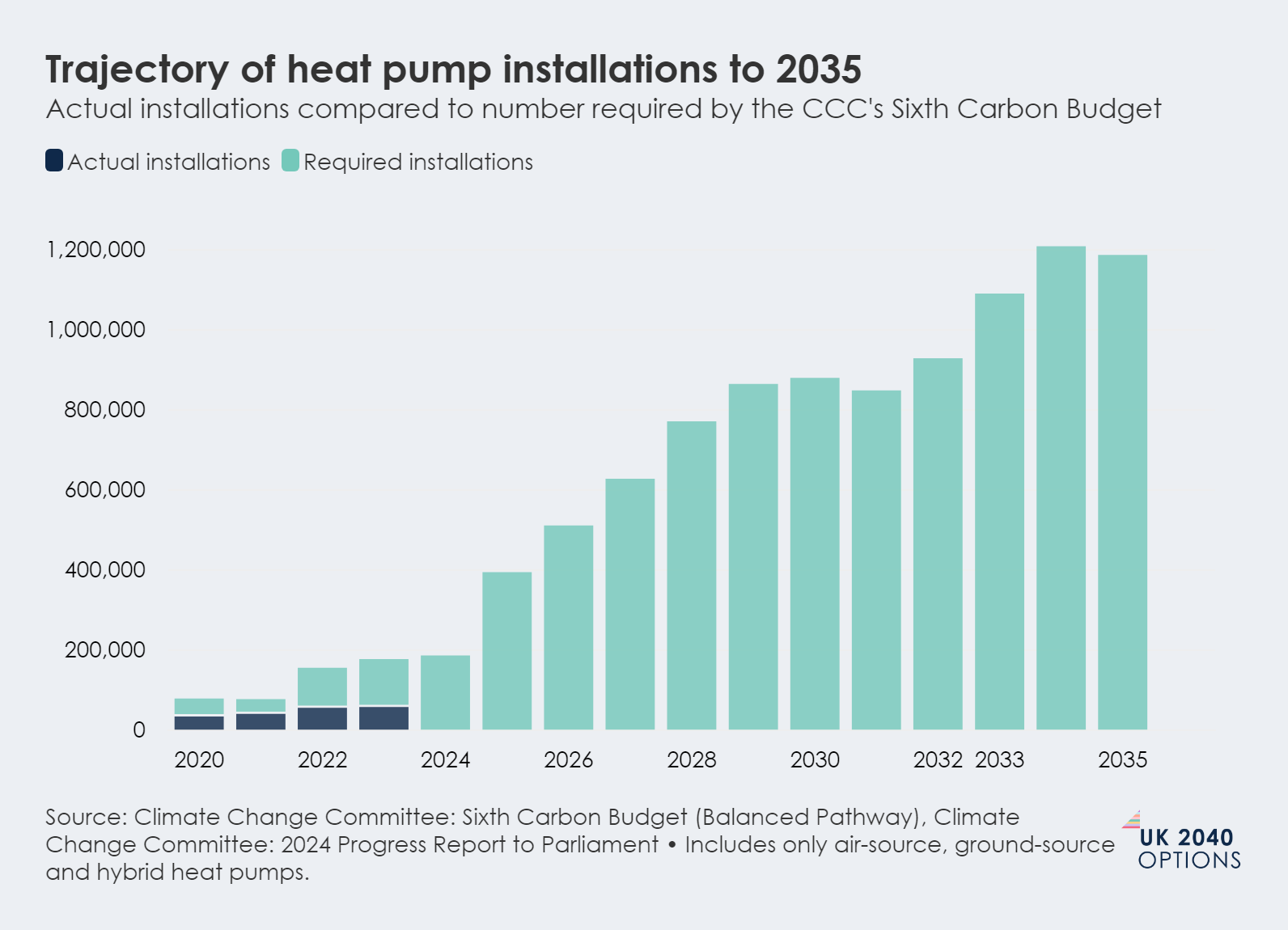
The UK is currently off-track to decarbonise home heating and could miss future
carbon budgets as a result. Around 69,000 heat pumps were installed in 2022, but the
UK needs to achieve 10 times that by 2028 to stay within the Committee for Climate
Change's (CCC) Sixth Carbon Budget.
Trajectory of heat pump installations to 2035
Source: Climate Change Committee: Sixth Carbon Budget (Balanced Pathway), Climate
Change Committee: 2024 Progress Report to Parliament • Includes only air-source, ground-source UK 2040
and hybrid heat pumps.
OPTIONS
The current approach to heat pump rollout is led by individual choice. Households
are making independent decisions about whether they want to decarbonise their
heating, which technology they choose, and when they decide to do it – if at all.
These choices are underpinned by a number of different consumer policies designed
to increase uptake: government advice, combined with a carrot (subsidies for a new
heat pump) and a stick (the threat of regulation which could in future restrict the
installation of new fossil fuel heating systems).
Despite this government effort, getting consumers to install heat pumps still comes
with a number of delivery challenges. They can be expensive, even with government
subsidies; they're for the most part unknown to the public; they often require
substantial work to install and it can be difficult to find a good installer; there can be
difficulties in certain dense housing types such as terraces; and they don't necessarily
reduce your energy bills. Heat pumps are different to other decarbonisation
'switches' such as purchasing an electric car, which offer consumers a product seen
as better than the fossil fuel alternative.
The individual delivery approach therefore has a number of drawbacks. An
alternative – a coordinated approach – may help speed things up. It may make it
easier and more attractive for households to switch to electrified heat, and make
people more likely to act if their neighbours are doing so. It may reduce costs
through economies of scale, and help to build local and national supply chains.
Schemes that would benefit from communal infrastructure, such as heat networks or
networked ground source heat pumps, may face more barriers if the
decarbonisation of household heat isn't coordinated locally.
How
Nesta's vision for a coordinated approach would require two new organisations: a
national unit and a local government-led body.
The national unit would build on the approach of the existing Heat Networks Delivery
Unit to provide technical, legal and procurement expertise and frameworks to local
areas. Its core function would be to provide technical support and guidance to local
areas.
- Specialist expertise: A centralised source of expertise to help with heat
planning, finance, commercialisation, project management, procurement
and specific engineering challenges. This would be similar to the successful
model of the Heat Networks Delivery Unit (currently within DESNZ), enlarged
and given wider responsibilities.
- Heat and energy planning: Support local authorities to develop local heat
and energy plans by providing guidance and advice to ensure consistency.
- Mediation between local and regional energy planning: The national unit
should be the conduit for local plans to be visible at a regional and national
level. They should facilitate the alignment of local and regional parties around
roadmaps to ensure that energy infrastructure and local heat delivery are
aligned.
- Driving private sector investment: As we move beyond piloting approaches,
the Government should look to switch its funding from supporting pilots to
de-risking finance. Building a portfolio of projects to de-risk future investment in
similar schemes could reduce the cost of finance for delivery organisations.
For example, the national agency may also wish to consider
part-guaranteeing heat networks or providing bridging finance during the
development and construction phases, until the network establishes sufficient
revenue that it can switch to using commercial borrowing as a mature
infrastructure asset.
- Data and learning: Collect, analyse and share data on approaches to local
delivery, in order to improve performance and impact.
Alongside the national unit, local areas should be supported to create heat delivery
bodies at a combined authority level. New local government heat planning teams
would be responsible for creating granular local transition roadmaps, driving
supply-side confidence and leading procurement.
-
Local heat bodies should be created in as many areas as possible, to fill the
gap in heat planning and coordination at a local, granular level.
-
These bodies' main responsibilities would be creating and owning a roadmap
of local low-carbon heat schemes, consulting industry and the public and
securing delivery partners.
- Areas already driving forward with energy and heat planning should be used
as pilot locations to form initial local heat bodies. These should cover a diverse
set of contexts, for example, dense urban and off-gas-grid rural.
Understanding the resources, guidance and playbooks required by local
areas in different contexts to deliver these plans will be critical to further
capacity building. Bodies should be built from the ground up and be flexible
to accommodate the local context.
- Households should be consulted and supported throughout the process.
Engagement should be sought early on the zoning of areas and design of
switching schemes, before communicating attractive offers to incentivise the
switch. This communication, consultation and instruction should de-risk
schemes while ensuring citizen buy-in. The approach should aim to ensure
agency over the time in which a switch occurs and present compelling
coordinated switching offers for citizens outside of an individual switch.
Impact and trade-offs
Building a new heat unit at a national level would require funding, likely in the tune of
the tens of millions per year, although some of this may be redirected from existing
government spending. Building local delivery capacity will also come with a cost,
likely to be in the tens of millions per year.
This approach could have a huge impact on homes that would struggle to
decarbonise without access to shared infrastructure. Across England and Wales
there are almost seven million terraced houses and over six million flats/maisonettes,
amounting to half of all housing stock – a good proportion may benefit from
schemes that use shared infrastructure.
There will be a balance to be struck between individual-led switching and a
coordinated approach. Nesta does not propose removing the right of households to
individually make the switch to low-carbon heat. Through clarity in direction setting
and clearer information, the coordinated approach should complement and even
increase the number of households making an individual switch. There is a choice as
to how much effort and funding coordinated switching is given over the
individual-led approach. A coordinated offer could, in time, cover the whole of the
UK. However it may be that the coordinated offers are focused on those homes that
may benefit the most from shared infrastructure, where individual switches may not
be the most convenient.
There is also a question of whether the national unit sits within central government or
is an arms-length agency, since its role could vary in terms of its remit and ambition.
An organisation that focuses purely on enabling local government-led planning and
procurement of heat may be better suited to central government. This approach
may also build on work already underway as part of the Heat Networks Delivery Unit
and this proposed unit could be absorbed within any new unit. However, if the remit
were to be expanded to encompass wider heat policy, such as the administration of
subsidies or consumer advice, an arms-length agency may be more suitable.
Make NESO a system architect
What
Make the National Energy System Operator (NESO) a 'system architect', making it
the 'prime' state actor responsible for planning the energy system, giving it
responsibility for coordinating and issuing guidance to other actors such as The
Crown Estate (TCE). This would extend its scenario-based network planning
responsibilities to include defining the location, high-level technology mix and most
appropriate funding mechanism for major energy infrastructure assets.
Why
A market-driven approach to planning where power is best generated and with
what technologies is highly unlikely to deliver clean, affordable, secure energy in
sufficient quantities to meet 2030 targets and beyond.
To date, the UK Government has taken this more market-driven approach with
marked success: carbon dioxide emissions from the power sector have fallen by 78%
since 1990, and 41.8% of the UK's energy came from renewables in the 12 months to
July 2024. A regulatory framework has been established that increasingly directs the
market towards clean energy, whether through incentives set by Ofgem or
mechanisms that support investment in renewables such as CFD. But it is businesses
that have determined where renewable power generation facilities get built and
what technologies get used. Businesses have also built and maintained the pipes
and wires that get energy from where it is produced to where it is consumed.
When it comes to the pace and scale needed to build energy infrastructure and
decarbonise to meet carbon budgets en route to 2050, market incentives and
regulations are unlikely to be enough. The environment for energy decarbonisation
will get trickier too. Demand for electricity will skyrocket as transport, home heating
and industry all decarbonise, and intense global competition for the investment and
material resources to fund and build clean energy infrastructure will push prices up
and exacerbate supply chain issues.
So, to deliver enough clean, affordable, secure energy going forward, the transition
will require much greater coordination and certainty across different parts of the
energy system, from generation to transmission to storage. Capital deployment,
planning processes and supply chains will all need to move faster too. Research by
Baringa and Nesta suggests that the cost of under-supply as market competition
between low-carbon businesses plays out is likely to be higher than the cost of
marginal oversupply or redundancy from a more directive 'all hands on deck'
approach. Increasing domestic energy supply in this way will also reduce exposure to
price shocks from geopolitical events, keeping costs down for consumers.
The state is already taking a much greater role in energy decarbonisation through
the establishment of GB Energy and the development of the Strategic Spatial Energy
Plan (SSEP) by the soon-to-be-publicly-owned NESO, but it could go further in shaping
locational and technology decisions rather than leaving them to the market.
How
DESNZ would continue to set policy objectives including decarbonisation targets and
continue to manage overarching trade-offs, such as that between faster delivery of
infrastructure versus changes in planning policy. DESNZ would also have final sign off
on the plan NESO develops, and the budget.
The role of NESO as system architect – via a change in licence and remit – would
then be to recommend the optimal pathway to achieving DESNZ's objectives, within
policy constraints and consulting with DESNZ on key trade-offs or options.
The key difference between NESO's current expected role, and this idea, is in the shift
from intelligent forecaster of what other actors are doing, to a state-directed plan.
The SSEP currently takes the energy system assets such as windfarms or transmission
networks expected to be part of the system as a result of market choices, as inputs
into future scenarios which inform the Centralised Strategic Network Plan (CSNP).
NESO's extended remit would be to define the optimal scenario based on
established system assets. NESO would define the optimal specific location,
high-level technology mix and appropriate revenue support mechanisms for large
generation, hydrogen production, interconnection, carbon capture, utilisation and
storage (CCUS), and storage sites, as well as the network infrastructure required to
connect them. It would also define the preferred zones for development of
smaller-scale assets. Specifically, the ‘optimal pathway' would include the plan, and
the mechanisms (below) that would deliver the capacity named in the plan.
- For the largest and most strategically important parts of energy infrastructure,
such as large offshore wind, new nuclear and so on, NESO's expanded system
plan would determine both the technology and the location, removing
uncertainty.
- For other parts of the system reliant on less certain technologies – as with
unabated gas projects and Long Duration Energy Storage – the system plan
could reduce uncertainty through targeted tenders specifying clear system
needs and geographic zones while retaining the benefits of market
competition to define the best precise location and most cost-effective exact
technology.
- And lastly for smaller-scale parts of the system, the market would continue to
make choices about location and technology according to market signals
from universal mechanisms such as CfDs or network charges.
HM Treasury (HMT) would need to define, and give NESO visibility of, the long-term
budget available to fund energy infrastructure (whether revenue support
mechanisms or network regulatory allowances) and network infrastructure. Ideally,
'long-term' would mean at least ten years. Once committed, this budget should be
ring-fenced.
- This would require a change in how HMT defines and projects budgets:
currently budgets for CfDs, for example, are set annually and the previous
Levy Control Framework was linked to wholesale prices, creating volatility in
available funding.
- It would also require outcomes from NESO's plan to flow through to Ofgem's
decisions on network infrastructure.
The shift from NESO-as-is to its new role can be illustrated by decision-making about
where offshore wind generation sites should be built. At present, and under the SSEP,
the precise locations of offshore wind sites are reliant upon independent seabed
leasing decisions taken by TCE and the Crown Estate Scotland (CES) and then upon
the results of site-agnostic CfD auctions. Decisions taken by TCE and CES don't fully
take into account considerations such as optimal locations (and associated costs)
for networks to transport the energy generated from these seabed sites. Under
NESO's expanded role as system architect, its expanded 'plan' would specify the
optimal sites for future seabed leases. This would remove uncertainty about seabed
'supply' rather than specifying windfarm demand without knowing whether or when
supply would be granted or developed.
Impact and trade-offs
A comprehensive and directive system plan for energy generation, transmission and
storage should translate into greater pace and coordination in building and
deploying these system assets. Faster pace should mean greater, cleaner domestic
supply, responding to increased demand while reducing vulnerability to external
shocks. Greater coordination should deliver greater co-optimisation for generation,
production, storage and transmission too, bolstering pace and increasing efficiency.
The certainty such a system plan provides would enable businesses across the supply
chain to invest in capacity and attract investment. Taken together, these outcomes
should enable the UK to better deliver on climate targets, drive growth in domestic
manufacturing, services and skills and reduce energy costs for consumers.
The cost of changing NESO's remit is likely to be small, with marginally greater
institutional capacity needed to deliver on expanded responsibilities. Baringa and
Nesta research suggests potential costs saved from coordination dividends alone –
reducing network constraints and delays in connections and deployment – could be
around £1.5 billion per year based on the 2023-2024 cost of curtailing electricity
generation because of network constraints and paying for the dispatchable power
generation to replace it. The same research estimates that “savings from the
elimination of inframarginal rent for offshore wind projects alone could reduce
energy bills by around £20/year."
There are a number of potential trade-offs:
-
Potential impact on energy generation capacity already in development:
There is an existing pipeline of onshore and offshore wind generation, battery
storage, solar PV and CCS projects at various stages of development. New
NESO responsibilities would need to be implemented in ways that minimise
disruption to the existing pipeline whilst maximising coordination. This could
mean new responsibilities applying to new projects only in the first instance.
-
Risk of diminished technological innovation and suboptimal choices: Market competition is good for innovation and identifying cost-efficient solutions. There is a risk that central planning fails to identify the most cost-efficient solutions, take risks, or to anticipate and adapt to technology developments. These could lead to choices about location or technology which are suboptimal with hindsight. Baringa and Nesta research suggests the significant coordination benefits likely outweigh the downside costs.
- Risk that extended remit disproportionately inflates budget and dilutes institutional purpose: Net-zero experts engaged across the course of the UK 2040 Options project have cautioned against the over-inflation of institutional remits and budgets, highlighting how easy it is for costs to spiral and focus to be diluted, reducing efficacy. In this case, the remit extension should be sufficiently specific to mitigate the latter, while additional costs should be limited to the funding required only to recruit or upskill in the capabilities needed.
Tie agricultural budgets to a national land use framework
What
Develop a national rural land use framework and use it to inform farming payments and support delivered through the Environmental Land Management schemes (ELMs) in England. This would direct public funding for agriculture and land towards 'public goods', providing farmers and growers with certainty about available support and the outcomes tied to it. This idea is not new: it combines two recommendations made within the National Food Strategy to secure agricultural budgets and develop a rural land use framework, and builds on work conducted by the Green Alliance.
Why
In order to reach net-zero goals whilst delivering on environment targets and producing food, the UK is going to have to do more with its land. It will need to sequester carbon and restore the natural environment (for ecological reasons as well as to increase resilience against the hotter, wetter and stormier conditions arising from climate change) as well as grow food, and for housing and energy infrastructure. The CCC has estimated that approximately 21% of agricultural land in England will need to change function to forestry, energy crops, restored peatland or agroforestry in order to meet net-zero commitments.
Different patches of land have characteristics that make them suited to different purposes. The land that could deliver the greatest environmental benefits from afforestation to peatland restoration is often least suited to food production. The most productive 33% of English land produces around 60% of the total output of the land, while the bottom 33% – overwhelmingly upland farms – only produces 15%. Currently, data on what land is best suited for what is not collated or used effectively as part of the agricultural support system. Post-Brexit, the EU's Common Agricultural Policy (CAP) became a land area-based Basic Payment Scheme (BPS) which paid farmers according to the amount of land they farmed, not the outcomes from that land. BPS will be phased out in England by 2027 as part of the 'Future of Farming' reforms, in favour of ELMs that do incentivise environmental outcomes. However, the largest – the Sustainable Farming Incentive (SFI) – is not spatially targeted.
This is problematic given that agriculture is responsible for around 10% of total greenhouse gas emissions – mostly from livestock farming and fertiliser use and net emissions have remained static for a decade. Intensive agriculture practices have also contributed to UK wildlife species decreasing by 41% since 1970, and the UK failing to meet 14 of its 20 biodiversity targets in the last ten years.
There is a valid question about whether the market could drive farmers to make the most effective use of their land, without need for a land use framework. The reality is that nearly 40% of farms currently depend on BPS payments to make a profit, and environmental uses of land such as peatland restoration and broadleaf afforestation are not commercial enterprises – the market for carbon sequestration or natural capital restoration is nascent and voluntary. Government support and certainty of direction is needed on both fronts if farmers are to stay in business (and appeal to the next generation), and deliver on nature and climate goals.
How
- Produce the framework from existing data about what land across the UK is best suited for intensive farming for food production, what land is best suited for lower-intensity farming and biodiversity restoration (without sacrificing food production capacity) and what land is best suited for nature restoration including woodland and peatland restoration. Defra would own the framework, working with Local Nature Recovery Networks to prepare the map, including data on land productivity from existing classifications and surveys, and priority areas for the environment.
- Publish the framework and update it annually. This would be owned by Defra and published for accountability and transparency. It would also be shared across government, coordinated by the Geospatial Commission. In future, it could be joined or aligned with the SSEP for a more coherent and coordinated national approach to 'infrastructure', whether for energy, nature or food production. Defra could also work with the Ministry of Housing, Communities and Local Government (MHCLG) and local authorities on land designation for new housing. This ambition should not prevent the development of an initial version used to direct agricultural support alone.
- Integrate the framework's conclusions into ELM's design and delivery so that farmers and growers have clarity about what land is best suited for what use, and what funding is available to support them. The scheme should be easy for tenant farmers to enter, as well as farmers who own their land. It should also be checked to ensure it does not disadvantage tenants or commoners. Previous woodland creation schemes, for example, have had limited participation due to the complexity of prescriptions, payment delays and uncertainty over funding.
- Retain agency and flexibility. Government would not mandate what people should grow and where, but this policy would tailor existing opt-in schemes to make the most effective use of public resources for outcomes, whether for individual farmers in terms of income level and security, or for UK citizens in terms of food production, environmental improvements and carbon sequestration.
- Guarantee funding. Defra could guarantee the budget for agricultural funding of £2.4 billion in real terms to 2029, providing certainty for farmers and growers and encouraging them to make full use of the adapted ELMs, rather than hedging with intensive agriculture on the assumption that budgets and schemes will change.
The crux of the idea is to tie budget to the framework so it has teeth and delivers on the intended outcomes. By way of comparison, the Scottish Government introduced their third land use strategy in 2021, aiming to set out a long-term vision for sustainable land use, but the lack of budgetary implications has meant little incentive for farmers to change the way they use their land.
Impact and trade-offs
Directing agricultural budgets towards public goods in the way described should deliver both security of income and investment to individual farmers and growers, and progress against environmental targets. Existing data about land use suggests it is possible to deliver on the 30x30 commitment to protect 30% of land in England for nature by 2030 as well as the 25-year plan for nature and carbon budgets between now and 2050. This can be achieved while reducing land use for agricultural food production by only 1% per year to 2050. Publishing a rural land use framework and tying agricultural budgets to it would enable the UK to realise this possibility: planting woodland, restoring peat and other natural habitats, and moving to lower-intensity farming, while maximising the most productive land for higher-intensity farming.
Repurposing agricultural land for environmental purposes in England through the proposed rural land use framework is estimated to reduce the land available for food production by 1% per year to 2050 while delivering on that net-zero goal. Given productivity differences, using the least productive 20% of farmland for environmental purposes would reduce the calories the UK produces by only 3%. Another consideration is what to prioritise when land is both highly suitable for environmental purposes and food production, although this applies largely only to the Fens, which is highly agriculturally productive because of its peaty soil, which could otherwise be a carbon sink.
A major trade-off associated with this idea is that it would result in a major decrease in public funding for the biggest and most productive farms. Whilst these farms do not need subsidies to make a profit from food production, they have received substantial income from the CAP and BPS. Reducing it or removing this income full stop over time will be unpopular and politically challenging to implement. These farms can still be supported with incentives to decarbonise their existing practices, particularly around methane reduction additives for livestock and slurry management.
The direct cost to the Government of implementing this idea would be relatively low, given that it is about 'how' existing budget is directed, rather than 'what' budget. Much of the data that would underpin such a land use framework is already collected meaning costs would largely be associated with resourcing the relevant teams within Defra, the Geospatial Commission et al. However, there is a working assumption as set out above that, to be effective, the agricultural budget would be maintained in real terms and guaranteed to 2029 or beyond.
Estimates provided for the CCC suggest that the agricultural transition to net zero in the UK, enabled in part by this idea, would cost landowners a net total of £700 million a year (£1.6 billion per year with £900 million in private revenues). But there would be multiple returns in social impact value for each pound invested, with improved air quality, flood resilience and physical health bringing benefits worth £4 billon per year for a cost of around £2.4 billion. Different forms of environmental land use also offer different returns on investment, with saltmarsh restoration providing 2:1 returns, and inland wetland restoration providing 9:1.
Cultivating the alternative protein industry: delivering diet change to reduce emissions while protecting farming livelihoods and consumer choice
Reducing emissions from raising livestock is necessary to deliver on net-zero goals. Whilst the organic increase in plant-based dietary patterns will reduce some demand for meat, and feed additives will reduce some emissions, the two are unlikely to be enough to deliver on the pathway to net zero. But the idea of government policies to encourage reduced meat consumption is deeply unpopular with consumers and livestock farmers alike. Farming livelihoods are at stake and people want to maintain choice over what they eat and enjoy.
But government policies to shape the growth of the alternative protein industry could deliver on emissions reduction goals and protect consumer choice without putting farmers out of business. The UK could take a lead given the opportunity of alternative proteins in Europe.
- Policy interventions to bring down the cost of electricity versus gas would bring down the price of alternative proteins, making them competitive with the cheapest – mostly imported – animal proteins.
- R&D investment to accelerate and de-risk innovation and manufacturing, as well as lower electricity prices, would mean lower-cost alternative proteins could become a lucrative export given growing population levels and demand.
- Trade deals to protect the domestic production of meat would make the mid-high end of the market resilient to the growth of alternative proteins, preserving choice, while reformed farming payments would pay farmers for environmental land uses.
- Supporting farmers and producers to test and learn from innovative uses of farm equipment and buildings for the manufacturing of alternative proteins, alongside livestock, would support diversification of income streams. The growth of dual-use land for solar and livestock illustrates what's possible.
Shape markets
The net-zero transition is a systems challenge, and requires change across the entire economy. Harnessing the power of markets, directing them towards outcome targets and ensuring they are effective is one of the key ways the UK Government can work in a mission-oriented way to achieve this system transformation. Some have argued markets alone provide the answers, while some advocate for a greater role for the Government to shape and drive change needed for net zero. As we have seen in the previous section, the answer will involve a combination of both approaches.
Market mechanisms are designed to chase the most efficient ways for financing decarbonisation and adaptation solutions. They have the potential to push the boundaries of innovation, at pace, and in a cost-effective and attractive way for consumers and businesses. We will need to accelerate their use where they are most effective. But as we saw above, the Government will also need to provide coordination, direct resources and ensure fairness across the system, so there will also be a greater role for direct government intervention.
Expand the scope of the UK Emissions Trading Scheme (ETS)
What
The UK and devolved governments could expand the Emissions Trading Scheme's scope so it includes road transport fuels and building heating fuels. This would help drive decarbonisation in these key sectors and would align with the upcoming changes to the EU ETS.
Why
Carbon pricing is often suggested as a simple and elegant solution to net zero. Economists often argue that rather than maintaining a complex system of state intervention, subsidies and regulatory levers, could we not create an ambitious carbon pricing scheme to 'let the market do the work'?
Burning fossil fuels, making cement, raising livestock and a host of other activities emit greenhouse gases. Market participants bear the private costs of these activities – the costs of mining coal, for example – but don't bear the social costs. This leads to more of these activities being undertaken than is socially optimal (or would be undertaken if these market participants paid the private and social costs). A simple solution to this problem is to add a tax to these activities to force market participants to ‘internalise' the activities' social costs, ie. put a price on carbon.
There are a number of different types of carbon pricing, which are set out below. The UK currently has an ETS, also known as a cap-and-trade scheme, however this only currently applies to part of the economy. It has however delivered some important changes, even though it has largely gone unnoticed. For example, it has contributed to eliminating coal from electricity generation.
What are the different types of carbon pricing?
There are two main types of carbon pricing: ETS and carbon taxes.
An ETS - sometimes referred to as a cap-and-trade system – caps the total level of greenhouse gas emissions and allows industries with low emissions to sell their extra allowances to larger emitters. By creating supply and demand for emissions allowances, an ETS establishes a market price for greenhouse gas emissions. The cap helps ensure that the required emission reductions will take place to keep the emitters (in aggregate) within their pre-allocated carbon budget.
A carbon tax directly sets a price on carbon by defining a tax rate on greenhouse gas emissions or – more commonly – on the carbon content of fossil fuels. It is different from an ETS in that the emission reduction outcome of a carbon tax is not predefined, but the carbon price is.
The UK has an ETS which covers roughly a quarter of carbon emissions. Although originally combined with the EU, both the UK and the EU now have separate markets following Brexit. The EU plans to expand the scope of its ETS scheme so that from 2027, road transport and buildings and industrial installation will be covered by a new ‘ETS2'.
The current UK scheme covers about a quarter of emissions, however there are a whole set of environmental levies and duties that place a price on carbon in a less formal sense. This means that there are very different levels of carbon taxation on some sorts of emissions compared to others. For example, the UK tends to tax households' use of energy less than businesses, and taxes electricity emissions associated with electricity a lot more than for gas.
Within this wider tax regime, there are two ongoing issues that need resolving, and expanding the UK ETS could form part of the solution.
- 1. The first issue is the price of electricity relative to gas. This variable is one of the most important in driving the uptake of low-carbon heat (which uses electricity, rather than gas). A unit of electricity is currently 4.1 times more expensive than a unit of gas, one of the highest ratios in Europe. This is partly due to domestic gas being exempt from any carbon taxes, while electricity from gas generation is included in the UK ETS. Furthermore, domestic gas receives a VAT exemption, which in effect results in a discounted carbon price. Incorporating domestic gas consumption into the ETS would lower the price ratio, and would help to incentivise the uptake of low-carbon technologies. There would be distributional impacts of this price adjustment, which would lead to a net increase in price for consumers. However, this could be mitigated through some kind of dividend raised by the additional carbon taxation.
- 2. The second issue is fuel duty. This is a politically charged issue, and the tax per litre of fuel has been frozen since 2011. Increasing the duty substantially in its current form will be politically challenging: however, if this tax was supplemented by extending the ETS to cover vehicle fuels, it could help break the deadlock by reframing the tax as a carbon-reducing mechanism rather than a revenue-raising one. The additional tax revenue could be used to explicitly support lower-income drivers and subsidise individuals to switch to electric cars or public transport.
How
Extending the ETS to more consumer sectors, such as domestic gas consumption and fuel for vehicles, presents an implementation challenge. The Government does not control the price of carbon, and it would be difficult to predict what sort of carbon price would result and how volatile it would be. This could cause financial harm, especially for more vulnerable consumers. For this reason, it might be better for the additional sectors to initially be part of a separate scheme so there are, at first, more guardrails that ensure the initial price of carbon is managed and stable. In time, these can be released as the scheme matures, or could be integrated with the existing UK ETS. It should also be designed to target upstream actors, such as fuel producers or energy retailers, as this would mitigate potential double counting issues while maximising the carbon price signal to households. Innovative business models could be developed to support building owners in decarbonising their heating systems, and energy retailers are already well-placed to support households.
Carbon pricing, particularly for domestic goods, has the potential to be regressive, since poorer citizens spend a larger share of their income on carbon-intensive goods. This could lead to a reduced public acceptability for the tax and for the wider net-zero transition as a whole. Moreover, extending the tax base will always be a politically tough choice to make. To mitigate this, there could be a decarbonisation rebate, similar to the one introduced in Canada. The Canada Carbon Rebate is a tax-free amount to help eligible individuals and families offset the cost of the federal pollution pricing. It consists of a basic amount and a supplement for residents of small and rural communities.
The current UK ETS, without extension to any new sectors, is due to raise £6 billion for the UK Treasury in the financial year 2023-2024 according to the Office for Budget Responsibility. Those receipts are currently used as general Treasury income with no ring-fencing.
Carbon pricing alone will not be sufficient to incentivise a complex value chain to provide low-carbon heating technologies in a market where there is no 'one-size-fits-all' solution, and where decarbonisation can be disruptive and come with high capital expenditure. We will need to continue to offer subsidies, provide additional support for more vulnerable customers, and offer independent advice.
Impact and trade-offs
The Grantham Research Institute and Energy Systems Catapult found that the revenue that could be raised is potentially significant – up to 0.62% of gross domestic product (GDP) when the high carbon price is applied to both sectors – and sufficient to mitigate distributional impacts of 50% of all income deciles with surplus to spend on other priorities. It's also important to understand that if the carbon price achieves its decarbonisation objective, then naturally the revenue will decrease over time. This is already becoming an issue for fuel duty, and we should be considering whether this is a good opportunity to comprehensively reform revenue collection from transport, with the creation of a national road user charging system. There are also other alternatives for narrowing the gap between electricity and gas prices, which may be much quicker to implement and bring dividends, as set out in this paper by Nesta.
Although the current UK ETS has been successful as a means to decarbonise some sectors of the economy, there isn't consensus on whether applying the same policy to these domestic sectors would achieve the same scale of change. Some have argued that carbon prices do not alter people's choices much when there are too few substitutes for carbon-intensive goods, or when those substitutes have high upfront costs that act as a significant short-term barrier to changing behaviour in response to fuel price signals. High fuel taxes, for example, tend to be ineffective at reducing transport emissions and often provoke a political backlash. Britain has had high levels of fuel duty in recent decades, but this has not correlated with drivers' take-up of electric vehicles, which has only ramped up more recently. On the home heating side, using the ETS as a means to reduce the price ratio would mean fossil fuel alternatives, such as heat pumps, are much more price comparable on a lifetime cost basis and result in a higher uptake.
The framing of this policy will be crucial. Up until now, the UK ETS has acted as a 'stealth tax' since a large proportion of the public does not know it exists and does not directly feel its impact. There is a choice: to make the tax more salient, and concentrate on its benefits as well as the decarbonisation rebate to keep the public on side, or to continue to keep the ETS out of public consciousness and focused on decarbonising the existing sectors. There is also a balance a government will need to make on the extent to which they use the ETS as a general revenue raising measure, and the extent to which it's used to redistribute wealth or to fund additional policies that support decarbonisation.
Amend government procurement to require zero-carbon construction materials to reduce embodied emissions
What
Starting in 2030, the UK Government could require signature projects to procure 50% of their cement from near-zero emission material production. Such projects would include new flagship infrastructure, the new towns programme and strategic defence projects. This would encourage the rapid decarbonisation needed in cement production.
Why
One of the key pledges from the UK Government is to 'get Britain building again'. Government is a significant driver of demand in the construction industry, and funds affordable housing, infrastructure and defence projects. It will be key to consider the environmental impact of these projects, in order to reduce carbon emissions in line with the 2050 commitment.
In the domestic construction sector, regulation to date has focused on operational emissions: these are emissions resulting from energy consumption in the day-to-day running of a building, such as heating. In comparison, emissions from the construction, maintenance and demolition of buildings, known as 'embodied' emissions, have largely been ignored. This could be problematic as the UK builds more, since embodied carbon emissions are not required to be controlled other than on a voluntary basis. A recent analysis found that embodied carbon from the construction and refurbishment of buildings currently makes up 20% of UK built environment emissions, and building the UK Government's promised 1.5 million new homes could emit far more than the carbon budget allows.
Steel and concrete are two of the most carbon-intensive commodities on the planet and are the most widely-used building materials. The long-term aim will be to decarbonise these materials at source, ensuring that there are zero carbon emissions as a result of their production.
Part Z proposal
Industry has advocated for one particular route to reducing the embodied carbon of new buildings: set new limits through building regulations in what has been termed 'Part Z'.
The Part Z proposal is to reform building regulations so that they specifically consider the embodied carbon of new construction. The proposed changes would be made in stages over time, and would start by standardising the assessment method for whole-life carbon emissions, which are the combined total of embodied and operational emissions over the whole lifecycle of a building. This important step would be a prerequisite to setting any future limits on embodied carbon. The first phase of reform would be to mandate the measurement and reporting of whole-life carbon emissions for all projects with a gross internal area of more than 1,000 square metres or more than 10 dwellings. The next phase would be to introduce legal limits on the upfront embodied carbon emissions of such projects and revise this over time.
Part Z has been advocated by the Institution of Structural Engineers and the UK Green Building Council, and has support from a huge number of voices from industry. They argue that government intervention is needed to ensure all construction companies are on a level playing field, and over time this will ensure embodied carbon is factored into the design process of all buildings.
State-backed procurement can also be used to ensure industry is measuring and reporting embodied carbon, and is incentivised to reduce the carbon impact of a project. In the United States, the Buy Clean California Act was implemented in full in 2022 and requires contractors who are bidding on state infrastructure and construction projects to disclose the embodied carbon for certain materials, such as concrete and steel, used in those projects, and sets upper limits on the emissions of products procured. New York state's Low Embodied Carbon Concrete Leadership Act requires contractors to disclose the embodied carbon of concrete in bids for projects over a certain size. Depending on the quantity of embodied carbon of the concrete, a discount is applied to the bid, reducing the cost of greener bids by up to 5%.
The UK has made some progress and set ambitions here. Last year the Government signed up to the Industrial Deep Decarbonisation green public procurement pledge, however many of the actions focus on upstream research and development, or on whole lifecycle carbon assessments for major projects. Whilst there is a drive to encourage the wider public sector to set higher standards of procurement, there are no mandatory targets, and this may be holding back the step change that's needed in the sector.
Carmakers have spurred early investments in green steel by demonstrating they are willing to pay more for green steel, but no obvious lead market exists for clean concrete. This is why the Government should take action. Large infrastructure projects in particular are crucial to stimulate demand for green materials by guaranteeing 'offtake', a pre-construction agreement to buy a portion of such materials in order to secure market revenue.
How
The UK could draw from different international examples in designing its approach to green procurement – for instance, Ireland has recently released new public procurement guidance to promote the reduction of embodied carbon in construction, which sets out an increasing level of ambition between now and 2030.
Initially, standards could apply to new projects in the UK Government Major Projects Portfolio, but could also be applied to other high profile and strategic government projects, such as major defence projects or the new towns house building programme.
If the idea is successful, the UK Government could scale the impact by working to secure voluntary sign-up with other large material procurers such as the large housebuilders, or set standards for wider public sector procurement.
## Impact and trade-offs
The proposal is ambitious, and the International Energy Agency has noted that there are few cement plants currently in operation or under construction that could be classified as having “near-zero emissions”. Even fewer are operating at the commercial scale required to achieve the 50% pledge.
The exact proportion of cement required to be from near-zero emission material production would need to be considered to ensure it's both technically and economically viable for the cement industry. But it should set a high level of ambition to create the required incentive to accelerate the investment in commercial-scale decarbonised cement works at the necessary pace by increasing material demand. This demand could be immediate, even if the supply is not yet ready, if the products could be ordered in advance.
Greener public procurement will likely increase costs to the Government, however it is unlikely to affect the end price for consumers. According to [World Economic Forum analysis](https://www.weforum.org/agenda/2021/11/carbon-zero-cement-concrete-construction-decarbonisation/), this could mean increasing the cost of procurement between 3% and 6%. The amount that the UK Government spends on concrete is difficult to quantify, but as a rough estimate, it could expect to spend an additional £12 million per year as a result of the idea outlined, calculated by scaling down (based on GDP) what the US Government spends (where data is available), and increasing the procurement costs by 6%.
There is a clear trade-off and cost here to decarbonisation, however the aim would be to kick-start the industry to build greater capacity and capability for lower-carbon materials, which would drive down costs over time.
## Reform the market structure of energy retail to support household decarbonisation
### What
Nesta recently published a [report exploring five different approaches to reform the energy retail market](https://www.nesta.org.uk/report/five-approaches-reform-energy-retail-market/). Here we set out two of these ideas.
The first is a reform designed to incentivise the competitive market so it better supports innovation. In practice, this could mean loosening regulation to encourage new market entrants, sharpening incentives to increase competition, or opening up the market to new types of business models. The second idea takes a different approach: instead of relying on the competitive market to support innovation, decarbonisation could be delivered through area-based approaches. One example is giving responsibility to regional bodies to supply energy but to also decarbonise households.
<a id="paragraph-1" href="#paragraph-1" class="section__global-number">1</a>Introduce a default supplier offering a 'no frills' service, to protect customers while enabling other suppliers to innovate
A default supplier would operate alongside existing and new suppliers. The default supplier could offer a basic, no frills energy supply and look after the monopoly activities such as the use of network charges or policy levies, while other suppliers could concentrate on offering more sophisticated products and services for customers interested in, and willing to engage with, the energy market.
<a id="paragraph-2" href="#paragraph-2" class="section__global-number">2</a>Turn electricity network operators into energy suppliers
Under this option, Distribution Network Operators (DNOs), which are regional companies responsible for electricity transmission, would also become responsible for electricity supply and the management and growth of efficient low-carbon electricity networks. They would be incentivised – through targets, or within a competitive franchise model – to roll out low-carbon technologies to homes.
### Why
Getting to net zero will require significant changes to how households use energy. If decarbonisation policies are successful, people will adopt electric vehicles, heat pumps and other green technologies in much higher numbers. Balancing energy supply and demand will become more complex and the ability to use energy 'flexibly' will be increasingly important.
This has major implications for the retail energy market. Britain's current energy retail model has been around for 30 years and is based on the supplier hub model, where suppliers act as the single link between customers and the wholesale energy market. The retail market has a key role to play in the net-zero transition.
There is scepticism whether the current supplier hub model is best placed to deliver the transition to a decarbonised energy system. Experts we spoke to cited the following reasons:
- There are limited incentives for retailers to help customers reduce their energy demand, insulate their homes or adopt low-carbon technologies.
- Pricing structures, and the way that government green levies are weighted towards electricity bills, mean there is little financial reward for consumers to opt for low-carbon electric options either.
- Customers are struggling to pay their bills. [Earlier this year, energy debt reached a record figure of £3.1 billion](https://www.ofgem.gov.uk/energy-data-and-research/data-portal/data-sets?topic=debt-and-disconnections-statistics).
- A focus on price competition has reduced other forms of competition – for example, on customer service – and has damaged trust in suppliers, which is currently very low.
- Although it's hard for most people to believe – with bills still historically high – selling energy to consumers isn't a high-margin business. In the few instances where energy retailers are making healthy margins, these usually come from their other business activities. The problem with low margins is that they create low incentives for investment, and therefore low incentives for innovation.
### How
Many people across the sector believe the market could operate differently, but there is little consensus on how it should change.
Both models would require fairly radical market reform, moving away from the current supplier hub model to a new approach. We set out in detail below how each of these would look in practice:
<a id="paragraph-1-a" href="#paragraph-1-a" class="section__global-number">1</a>In the first model, the billing for monopoly services currently undertaken by all licensed suppliers (such as charges for green levies or energy efficiency schemes), would be moved to the default supplier. The default supplier would also take over the universal service obligation – regulation that ensures basic services are available at an affordable price to all across the UK. This in turn would free up competitive suppliers to focus on providing innovative services, and would enable them to tailor these to different customer groups.
Customers could use the default supplier for all their energy supply, or opt to contract with one or more other providers to deliver energy supply and 'enhanced' services such as sophisticated time-of-use tariffs, household energy management services, low-carbon technology installations and other energy efficiency improvements to homes. Competitive suppliers and non-supplier third parties – legacy and new entrants – would need to provide meaningfully differentiated services to attract customers. They might focus on helping customers access the potential benefits of household flexibility, or offer other innovative services.
<div class="illustration-description" markdown="1">
**Introducing a default supplier with a 'no frills' service**
Customers can use the default supplier for everything, or they can choose to buy energy from other suppliers.
**Tim might choose the default supplier, who offers a simple tariff**
**Anna might choose a supplier that offers cheaper electricity at certain times of the day and consider whether she might benefit from choosing a separate supplier to remotely manage her electric heating**
**Maya might choose one supplier that offers a demand reduction package linked to the charging of her EV, with the potential to install solar panels – she might choose a second supplier to manage the remainder of her energy usage**
</div>
<a id="paragraph-2-a" href="#paragraph-2-a" class="section__global-number">2</a>The second market model, turning electricity network operators (Distribution Network Operators – DNOs) into energy suppliers, involves a more radical market reform. While the DNO would be the lead entity and have overall responsibility for providing low-carbon technologies and electricity services to customers, much of the work could be outsourced to third party providers, including specialist suppliers. The DNO would be responsible for improving access to enhanced products and services and supplying electricity, which would give it more opportunity to build a relationship with customers. This may offer greater control over prioritising the rollout of energy efficiency measures to households where they will have the biggest impact. For example, the DNO could work with local authorities to support the implementation of low-carbon technologies in social housing, enabling those customers to access appropriate tariffs as well as help to reduce their overall demand.
<div class="diagram-description" markdown="1">
**Turning electricity network operators into energy suppliers**
A local electricity company manages the decarbonisation of the electricity network, energy supply, and household decarbonisation. The distribution network operator might upgrade the grid surrounding these houses since it plans to offer to install heat pumps for all households in the street, which will use more electrical power than the grid can currently support.
**Tim is allocated supplier X**, based on where he lives and will move from a default supplier tariff to a heat pump-based tariff, which also spreads the cost of installation
**Anna is allocated supplier X**, remains on a tariff that varies the cost of electricity over the day which changes to take account of her new heat pump usage and accepts an offer of more insulation to reduce her overall demand, which she pays for over an agreed timescale
**Maya is also allocated supplier X** but as she already has a heat pump installed, her tariff may only change to reflect the cost of the grid upgrade
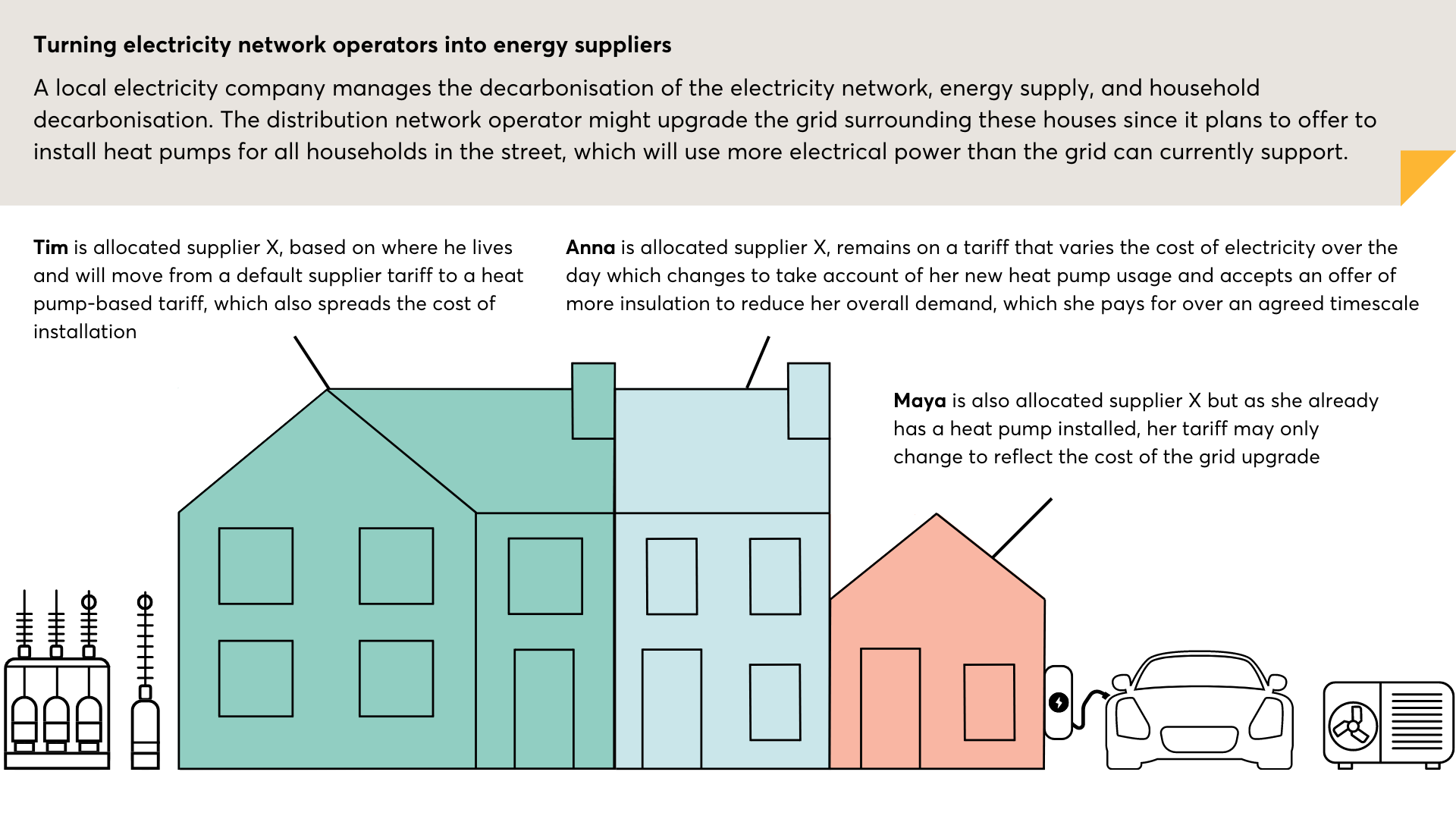
</div>
### Impact and trade-offs
The Nesta project concluded that while there were clearly problems associated with the current retail market design, there was no clear consensus from experts about both the case for reform, and also what exactly that reform should look like.
The easiest and least risky option would be to stick with the status quo. This would mean retaining the current supplier hub model and delivering on reforms that are already in progress. Retailers argue that while innovation in the sector has been a long time coming, it's now taking root. This has been driven by challengers such as Octopus (now the UK's largest electricity provider), with legacy suppliers starting to follow suit.
But seriously engaging with the question of how the market could look is worthwhile – as is asking if a different structure would improve net-zero delivery and innovation, as well as protecting vulnerable customers.
- **Net-zero delivery**: Delivering net zero requires a shift in incentives among market participants. Suppliers will need to move away from making money by selling more units of energy and focus instead on delivering new services. Greater centralisation in the energy retail market, the second model we outline would create, could help ease concerns around access to capital,
- customer engagement, fairness and supplier incentives. It may enable the energy transition to be delivered more quickly and to bring greater certainty over timescales and deliverability – for example, enabling a more planned approach to rolling out low-carbon technologies at a local level. However, while centralising activities provides the ability to plan and deliver large-scale deployment, it also risks a loss of innovation. In contrast, the first model could speed up net-zero delivery through innovation.
- **Innovation**: Moving to a default supplier would reduce the requirement for competitive suppliers to manage monopoly activities associated with the running of the market. This could enable competitive suppliers to focus on value-added services, potentially fostering innovation. In the second model, which places electricity networks in the lead, there would be less competitive pressure, which might reduce incentives to innovate. On the other hand, by locking in long-term relationships with customers, it might positively change the underlying incentives to innovate for retailers.
- **Protecting customers**: In any future energy market, as well as ensuring costs are fair, it will also be necessary to help all consumers achieve decarbonisation through tariffs, access to low-carbon technologies and energy efficiency. Moving to a default supplier could protect vulnerable customers by ensuring they have access to a fair tariff. The second model may be better placed to ensure that consumers who are unable or unwilling to engage are not left behind in the future energy market. Wide-scale or means-tested rollouts of smart meters and low-carbon technologies could ensure a minimum level of decarbonisation for each household.
- **Deliverability**: Any fundamental restructure to a market that affects every British household comes with significant cost and risks, and would require a hefty amount of political capital to push through. This is particularly the case for the second model, but there are some international examples that can give us more confidence. In the Netherlands, DNOs provide bills to customers and offer a default tariff. In California, the use of a joint DNO/supplier role means that some of the challenges over the rollout of low-carbon technologies and smart meters to households are avoided.
In jurisdictions where DNOs have a greater customer-facing role, this is generally a legacy structure – they have not had to build these capabilities from scratch. The British market is starting from a position where retail supply and transportation are under separate responsibilities, so options putting greater responsibility on DNOs would require that they, or other regional players, would need new or expanded capabilities. More work would be needed to understand the costs to implement, and this would depend on the specific market changes and design.
## Reform Stamp Duty Land Tax to become an energy-saving stamp duty
### What
The Energy Efficiency Infrastructure Group (EEIG) and the UK Green Building Council have recommended that the UK Government reforms Stamp Duty Land Tax so that the rate payable depends on the energy efficiency of the property, and incentivises green upgrades to newly-purchased properties by offering a rebate of the tax paid. This would mean less energy efficient properties are liable to higher rates of stamp duty, and more energy efficient properties would receive a discount, helping to price in energy efficiency by encouraging negotiation of house prices. New homeowners would have two years to undertake energy efficiency improvements in order to claim back the tax they had paid.
### Why
The UK has some of the oldest housing stock in Europe and housing represents one of the UK's toughest challenges in meeting its 2050 net-zero emissions targets. Upgrading this housing stock can be disruptive and challenging, but house moves present a particularly optimal moment: homeowners are more likely to be considering other upgrades at the same time, so energy efficiency improvements would not result in too much additional hassle for the homeowner. This also coincides with the requirement to market a property with an Energy Performance Certificate (EPC) which makes energy efficiency salient for buyers.
Hassle is a big barrier to retrofit: a BIT survey found nearly [three in five homeowners with a gas boiler cite installation hassle](https://www.bit.org.uk/publications/closing-the-net-zero-demand-gap/) as a key barrier to getting a heat pump. But if homeowners are already considering building work, then adding a heat pump or replacing double glazing won't cause too much extra inconvenience.
Around a quarter of upgrades take place in the two years following a house purchase. This is a rough estimate from BIT, but suggests that new homeowners are more than twice as likely to be making home upgrades than at other points.
Missing this timely moment is an oversight. On average, owner-occupiers move house every 23 years. If opportunities are missed when people are most receptive to them, then other opportunities to incentivise upgrades will involve more friction and could be less effective. If someone buys a house today, misses an opportunity to make energy efficiency improvements and then doesn't upgrade until they move again, it could well be past 2050 before fossil fuels are no longer being used to heat their home.
A new energy saving stamp duty incentive would stimulate the housing market to attach importance to energy performance, in the same way it does to kitchens and bathrooms.
### How
The process would work as follows:
<a id="paragraph-1-b" href="#paragraph-1-b" class="section__global-number">1</a>The expected energy demand (total kWh) of the home is calculated from the independently produced Energy Performance Certificate (EPC), which is already a requirement of a house sale.
<a id="paragraph-2-b" href="#paragraph-2-b" class="section__global-number">2</a>The stamp duty to be paid is then adjusted up or down based on the home's calculated energy demand – the better the energy performance, the lower the tax paid.
<a id="paragraph-3" href="#paragraph-3" class="section__global-number">3</a>Energy improvements made by a registered installer within two years of purchase, validated by an updated EPC, trigger a rebate to be paid to the new homeowner. Any recognised improvement in a home's energy efficiency (fabric, heating, services) would reduce the stamp duty paid. There could be additional rebate for heat pumps if the Government wanted to prioritise that over other energy efficiency upgrades.
Key to the success of this policy would be cross-government buy-in and the implementation detail. The policy area is owned by HM Treasury, but involves a number of different departments (for example, HMRC is responsible for delivery of the tax, MHCLG is responsible for the home buying journey, and DESNZ own home retrofit policy). The aim would be to develop a simple process for citizens that is easy to understand and unambiguous about what improvements to make and how much they would receive as a rebate.
## Impact and trade-offs
A stamp duty rebate is likely to be effective because it's applied when barriers to home upgrades are already lower. It would also take advantage of the behavioural science principle of ‘loss aversion' – namely that we feel losses roughly twice as much as we feel an equivalent gain, so [reframing incentives as avoiding a loss can be much more powerful](https://www.nesta.org.uk/report/closing-the-net-zero-demand-gap/). To see how this translates to stamp duty rebates, imagine you want to claim a standard government grant to install insulation. You apply and, if successful, get awarded the grant. This is a 'gain'. In contrast, with a stamp duty rebate, you are eligible for the rebate as soon as you purchase the property. But, if you don't make upgrades in time, you are no longer eligible. You will lose your benefit.
A stamp duty rebate has broad appeal – a recent BIT survey found that [78% of people would support this policy](https://www.bit.org.uk/publications/closing-the-net-zero-demand-gap/). As well as helping people directly, it could start to have second-order impacts such as the creation of a market for energy efficient properties that would be liable for less stamp duty. This could encourage homeowners who want to sell to undertake energy efficiency improvements before selling, or incentivise a new buyer to do the work through a rebate discount. The certainty of the rebate means that mortgage providers could offer an increased loan to cover the costs, so a homeowner wouldn't have to have additional funds for improvements before receiving the rebate.
This policy won't hit everyone: it only applies when stamp duty is paid. Last year, this was [2.4 million residential sales](https://www.gov.uk/government/statistics/transactions-of-residential-properties-for-stamp-duty-land-tax), or around 9% of households. Some of these will be new builds, many of which are already efficient and so it may be better to consider a cut-off build date for when properties are liable for a discount. It also limits the size of the incentive. Around half of purchases require less than £2,500 in stamp duty – substantially less than current heat pump incentives of £7,500. Some have argued that the policy is a regressive tax cut, favouring households that are buying expensive homes. There could be an option to also include an enhanced rebate for lower-value homes which would further contribute to the costs of energy improvements.
This policy won't, single-handedly, lead to efficiency improvements across the UK housing stock. But it could form part of a wider programme of incentives to encourage home upgrades, and would likely be effective at a lower cost to the Government. If a quarter of house sales that incur stamp duty make an upgrade as a result, around 10% of housing stock would be improved over a five-year period. It wouldn't complete the jigsaw, but would be an important part of the puzzle.
## Set outcome targets
Adaptation has been [described by the CCC](https://www.theccc.org.uk/publication/independent-assessment-of-uk-climate-risk-advice-to-government-for-the-uk-national-adaptation-programme-2023/) as “the Cinderella of climate change, still sitting in rags by the stove: under-resourced, underfunded and often ignored". Adaptation to climate change is hard to resource because it's hard to quantify other than through 'risk' and hard to act on until the risk is so real it is almost too late. But immense progress has been made to mitigate climate change since the UK established its carbon emissions targets, and countries around the world are beginning to do the same for adaptation. The UK Government could take up the mantle of climate change leadership once again. Outcome targets are a key enabler to mission-driven governments, and can help galvanise action across the system.
## Develop and legislate adaptation targets
### What
Introduce adaptation targets to regulated industries, with targets and metrics derived from an assessment of what a well-adapted UK looks like. This would be a step towards the introduction of primary legislation to place adaptation targets on a statutory footing akin to carbon reduction targets.
### Why
Getting emissions down matters because if global temperatures stay within 1.5°C above pre-industrial levels, scientists agree the effects of climate change will stabilise and the most extreme impacts of climate change will be kept at bay. But estimates suggest human-induced warming is already nearly 1.3°C above 1850-1900 temperatures, and is projected to surpass 2°C by 2040 and requires planning for 4°C.
[The UK is already experiencing the effects](https://www.theccc.org.uk/publication/independent-assessment-of-uk-climate-risk-advice-to-government-for-the-uk-national-adaptation-programme-2023/): 2022 was the first year in which 40°C was recorded, bringing [heat-related deaths, wildfire incidents and infrastructure disruption](https://www.gov.uk/government/publications/uk-climate-change-risk-assessment-2022). On the trajectory to 2040, the UK can expect more heatwaves, more flooding, more water scarcity and drought, and more extreme weather events such as storms. The UK's housing stock and buildings are at risk of overheating and flooding, causing ill-health and displacement; businesses will need access to insurance and capital to adapt and manage the effects of weather extremes; transport and power networks may be disrupted; and biodiversity, soil and sea health will further degrade, affecting food prices and health. Regardless of whether the UK delivers on its own net-zero targets by 2050, it will need to respond to climate changes resulting from emissions already produced and from the level of progress made by the wider global community by 2050.
To reduce the severity of climate impacts, mitigation measures are the priority, but to enable people to live comfortably and healthily with those climate impacts, adaptations will be needed. Adaptation is difficult to prioritise and act on, though, because there is no agreed or well-defined vision for what a well-adapted UK looks like. There are no targets, goals or standards at a national, local or sectoral level. There is governance, but it doesn't have legislative heft in the way carbon targets and budgets do.
### How
Develop adaptation targets: Targets should be developed jointly by the governments of the UK, Scotland, Wales and Northern Ireland, building on the metrics and targets being developed by the CCC for [Climate Change Risk Assessment 4 (CCRA4)](https://www.theccc.org.uk/publication/independent-assessment-of-uk-climate-risk-advice-to-government-for-the-uk-national-adaptation-programme-2023/), with defined five-yearly 'budgets' for adaptation. These could be 'resilience budgets' which describe different pathways to deliver. These would be set in advance – as with carbon budgets – to enable policymakers, businesses and individuals to prepare. They would need to be expanded in scope and iterated over time to account for the needs of different sectors and the real impacts of climate change as the efficacy of UK and global mitigation efforts becomes apparent.
- The first set of metrics should be drawn from CCRA4's five outcome areas: immediate progress is more important than having a perfectly modelled and
defined set of metrics for all sectors. Perfect modelling is also not possible given contingency on mitigation efforts.
- Climate assemblies or similar participatory forums are effective ways to understand what level of inconvenience people are prepared to put up with as a result of climate change, and what level of protection or support people are prepared to pay for. Public outcry over sewage overflows is indicative of the sort of issue and reaction likely to play out as weather extremes become more frequent. For example, in a fully electrified 2050, would people be willing to put up with an electricity outage of an hour, and if so – or if not – to what extent would they expect to rely on individual action to mitigate the effects, whether by having EV or solar storage, or on community or state responses?
Introduce adaptation targets to regulated industries: The specificity of these targets should be akin to ‘all regulated assets must be resilient to a one in three hundred year drought, flood, etc'. This is at the more feasible and immediate end of the spectrum, but to drive the level of progress needed across sectors, the UK Government would need to consider how to introduce adaptation elsewhere, for example into regulations for existing housing (eg, by extending Part 0 to cover existing housing stock so it can withstand temperatures of 40°C by 2050).
Accountability: Defra would maintain its remit for adaptation and responsibility for coordination across the UK Government, with an expanded team. The CCC's existing risk assessment, advisory and assessment role on adaptation could evolve to include responsibility for reporting on progress made against the new targets. Its monitoring framework for climate adaptation already places increased focus on the tangible outcomes needed to deliver climate resilience in different sectors, setting out the role of public policy in achieving these outcomes and tracking progress.
In order to deliver on the more ambitious version of this idea – primary legislation to place adaptation targets on a statutory footing – the CCC could be resourced by Defra in line with its resource levels on mitigation (ie, quadrupling existing resources on adaptation) and tasked with proposing targets. These would still be on a rolling basis, starting with electricity and other regulated industries.
Impact and trade-offs
Targets can be very effective at galvanising action on long-term priorities, as demonstrated by the impact of the UK's carbon emissions targets. They also bolster action's resilience against political partisanship and public opinion, and drive coordination across UK government departments, in a way that department-specific priorities often cannot. The potential impact dividend of legislated adaptation targets is galvanised action on adaptation across society and the economy.
However, given the benefits from adaptation measures are widely distributed across the economy, health, infrastructure, the built environment and nature, they are difficult to quantify and monetise. The costs of inaction are clearer. The valuation report attached to the CCC's most recent climate change risk assessment (CCRA3) estimated that economic damages could exceed £1 billion per year, for eight of the risks identified. The UK Government's Third National Adaptation Programme (NAP3) that followed estimated the impacts of climate change could cost England's economy 1%-1.5% of GDP by 2045. The near-term cost is likely to be in rising insurance premiums, with the Government forced to intervene in the insurance market as it already does through Flood Re.
The cost of making legislative change is relatively low. The costs associated with bolstering Defra's role and the adaptation focus of the CCC would be on the expanded capabilities and resources needed to deliver year on year. The costs of adaptation delivery itself will be dependent on both the nature of climate changes, the efficacy of adaptation measures and choices around cornerstone public investment. Market creation for adaptation outcomes will be essential to leverage investment, with user fees, household expenditure and philanthropic funding all playing a role.
There is a risk that legislation is a relatively low-cost way for the UK Government to give the appearance of action, without necessarily delivering, as the costs and challenges associated with adaptation delivery remain. It is also extremely difficult to set meaningful adaptation targets – there is no single metric such as carbon emissions - increasing the risk that the UK Government will get it wrong. Getting it slightly wrong is, however, likely to be less costly than inaction. As with climate mitigation, the pace of change required is such that imperfect action is better than delays in anticipation of perfect information.
Looking out to 2050, in any scenario there will need to be an increased focus on adaptation regardless of whether a focus on mitigation can drop off because of successes. The division in responsibility between DESNZ and Defra for mitigation and adaptation respectively also means that fewer mitigation costs does not automatically translate into increased budget availability for adaptation.
Finally, targets rely on a number of mechanisms for compliance, ranging from political embarrassment through to judicial action: it's not entirely clear what happens if the UK Government misses its legally binding net-zero targets, and adaptation targets risk the same uncertainty.
Conclusion
The ten ideas explored here were suggested, tested and debated with us by the net-zero experts, practitioners and emerging thinkers that we spoke to throughout the course of this past year.
The ideas themselves range from narrow and sector-specific interventions, such as the energy saving stamp duty, or coordinating household decarbonisation street by street, through to the much bigger and much bolder, such as reforming the structure of the energy retail market or expanding the UK ETS. This range is deliberate: these ideas are not a strategy or game-plan for reaching net zero but are intended to illustrate the many and various ways in which the UK Government can get back on track with net zero. Some ideas are supported by a marked degree of consensus, such as public engagement on net zero, others have stirred more debate.
It's worth repeating the threads that run through these ideas: citizens and consumers as agents or blockers of change, the potential pace and coordination dividend of greater centralised planning, the potential cost and innovation benefits of directed markets, and the heft of outcome targets over delivery targets. The UK Government will have to weave these threads if it is to deliver on the cleaner, healthier, better off country that the green transition offers as its prize.
The net-zero legal target has baked long-term thinking into policy, but there are enormous gaps in our understanding of how we get there. The ideas in this report are a contribution to the ‘how'. We hope they spark interest and debate about the art of the possible as well as the pragmatic.
Acknowledgements
We thank Professor David Halpern for his contribution to this work and Lord Gus O'Donnell for sponsoring the UK 2040 Options project, and the following for their time and insight on these ideas: Will Arnold (Institute of Structural Engineers), Lydia Collas (Green Alliance), Josh Doble (Community Land Scotland), Emily Fakhry-Darian (DLUHC), Madeleine Gabriel (Nesta), Kirsty Girvan (UK Green Building Council), David Joffe (Royal Academy of Engineering), Professor Dame Julia King (CCC), Katy King (Nesta), Toby Park (BIT), Freddy Parker (BIT), Robin Parker (Nesta), Andrew Shein, Marcus Shepheard (Nesta), Andrew Sissons (Nesta), Colin Vaida (University of Cambridge), Rory Walshe (GO Science), Natasha Watson (Buro Happold), Ed Whincup (BIT), Edwin Wood (DESNZ). Please note that not all contributors will agree with all the ideas in this report.
UK 2040 OPTIONS
UK Options 2040 supports policymakers as they make choices about what to prioritise and how to deliver: setting out alternative policy options and pathways for the future, creating space for honest debate about the trade-offs and testing and interrogating ideas that take us beyond immediate crises.
58 Victoria Embankment
London EC4Y ODS
+44 (0)20 7438 2500
[email protected]
@nesta_uk
www.nesta.org.uk
nesta THE BEHAVIOURAL INSIGHTS TEAM
CC BY NC SA
Nesta is a registered charity in England and Wales with company number 7706036 and charity number 1144091. Registered as a charity in Scotland number SCO42833. Registered office: 58 Victoria Embankment, London EC4Y ODS.