
Nesta welcomes the UK government's commitment to develop a single, fully funded low-income scheme and the ambition to lift a million households out of fuel poverty by 2030.
Getting this right means the UK government must learn from ECO's failures, including fragmented consumer protection, rigid targets that excluded the homes most in need, and widespread quality issues.
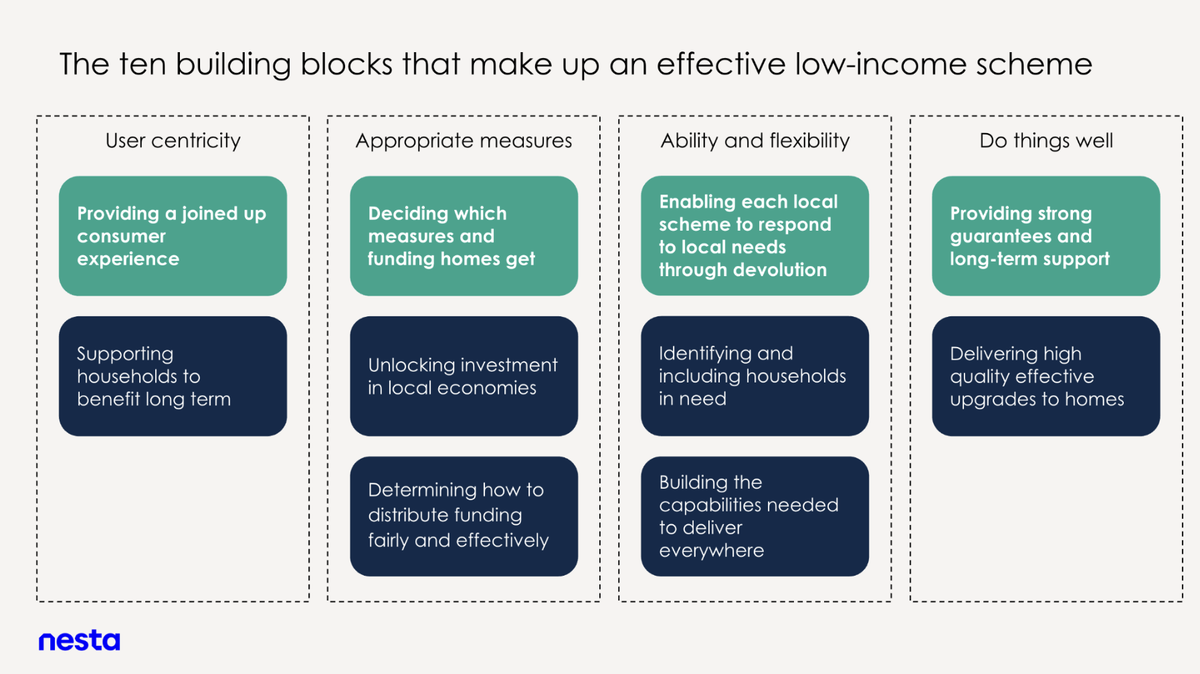
For the new scheme to achieve its objectives, there are a range of different functions that it will need to provide. We identified ten individual components, what we call ‘building blocks’, that make up a low-income scheme.
What's in the policy brief
In this policy brief, we focused on four ‘building blocks’, the options government has for each of these and what we recommend:
1. Enabling local schemes to respond to local needs through devolution
Striking the right balance between local and national delivery is crucial. We think that a balanced approach is best, with objectives and targets being nationally led, while eligibility, specific measures and delivery methods being locally flexible.
2. Deciding what measures and funding homes get that achieves the scheme’s objectives
The package of measures provided by the low-income scheme will depend on the objectives being prioritised. We think that local authorities should offer a package of home measures that achieve a multi-goal approach of comfort, reduced bills and decarbonisation.
3. Providing strong guarantees and long-term support
Consumer protection has historically been overly complex and relied on a patchwork of scheme providers, certification bodies and consumer codes. We think that the scheme needs to have robust consumer protection and this can be delivered by Warm Homes Agency having oversight of the whole process and moving to a performance-based approach.
4. Providing a joined-up consumer experience
Combining the existing low-income schemes into a single one presents an opportunity to design a more coherent consumer journey. We think that having a good experience involves providing adequate support, accessible touchpoints and minimising burden on households.
Findings and recommendations
The building blocks laid out above are a way to frame and structure the key policy and design choices. None of these building blocks can be considered in isolation; for example, decisions about devolution will shape the consumer journey and measures offered, and having multiple entry points will affect how protection and support can be given.
The Warm Homes Plan set out strong ambitions for the new low-income scheme, but government has yet to set out detailed plans on its design and delivery. There are big questions around devolution, the role the Warm Homes Agency will play, and the type of funding the government is offering as part of the scheme. We suggest de-risking this by adopting test and learn approaches such as rapidly trialling the biggest unknowns through smaller scale experiments before national rollout.