The energy edit: the Chancellor’s winter energy bill problem isn’t solved yet
 www.nesta.org.uk/blog/the-energy-edit-7/
Authored by Andrew Sissons, subscribe to the six-weekly newsletter to keep up with the most important signals and trends underpinning the UK’s energy transition.
The single biggest spending measure in John Healey’s first Budget was giving £100 to 20 million households to help with energy bills this winter. Will it be enough or will the Chancellor need to make a further intervention on household energy bills this winter?
Energy bills are going to rise by much more than £100 in January, as wholesale gas prices continued to climb through September and October. EDF’s latest forecast suggests the typical bill will go up by £440 from October to January, a rise of nearly £700 since April. The Chancellor’s payment will look small in the context of these much higher bills, which will make for an extremely painful winter.
Forecasts suggest bills will be nearly £700 higher in January 2027 than in April 2026
A bar chart titled “Forecasts suggest bills will be nearly £700 higher in January 2027 than in April 2026.” Bars show the typical household energy bill in each quarter. A blue line shows the increase since April 2026.
The first three bars use the Ofgem price cap. The final bar uses an EDF forecast. The largest jump is between the October to December and January to March quarters, when the increase since April grows by over £440.
Those EDF forecasts of bills reaching nearly £2,200 in January looked high when they first appeared, but that is no longer the case. My colleague Daniel Lewis has been tracking gas and electricity wholesale prices (charts below) during the Ofgem observation window and they have kept on rising for most of it. Even though wholesale prices have fallen since the US midterm elections, it is too late: the average used by Ofgem is now guaranteed to be at a very high level for January. A sharp rise in bills is now baked in come the new year.
My colleague Marcus Shepheard has also pointed out that Balancing Costs on the electricity system have risen dramatically recently - partly as a result of very high gas prices, the same as in 2022 - and will also likely push bills even higher from April next year.
Gas and electricity wholesale prices during the Ofgem observation window for the January price cap
And it is not just households who will suffer this winter; the UK economy will also face significant repercussions. Higher energy bills will reduce household spending on everything else, which will have a knock-on effect across the rest of the economy. Because the UK is now a net importer of energy, more money will flow out of the economy, making it smaller.
Not only that, higher bills will push up inflation. The inflation rate had already reached 3.5% in September, well above the Bank of England’s 2% target and it is set to rise further in January. I estimate that, if the EDF forecast is right, energy bills will push inflation up by at least 0.7% in January. The Bank is now forecasting that inflation will peak at 5% in April to June next year.
As well as being a problem in its own right, higher inflation could also push the cost of government borrowing higher. If inflation is higher, bondholders require a higher interest rate to offset it; and this rise in inflation is not yet baked into the government’s fiscal plans. The Office for Budget Responsibility (OBR) forecast alongside the Budget showed CPI inflation averaging 3.4% during 2027. This now looks likely to be an underestimate, which could be revised upwards in the OBR’s Spring forecast.
All of this means that 25 November, the day that the January price cap is due to be announced, will be a very difficult one for the Chancellor. There will be a very large rise in energy bills, with the possibility of further rises in borrowing costs to come. John Healey will only recently have completed his Budget and will plan to wait until the spring when the fiscal forecasts are reopened.
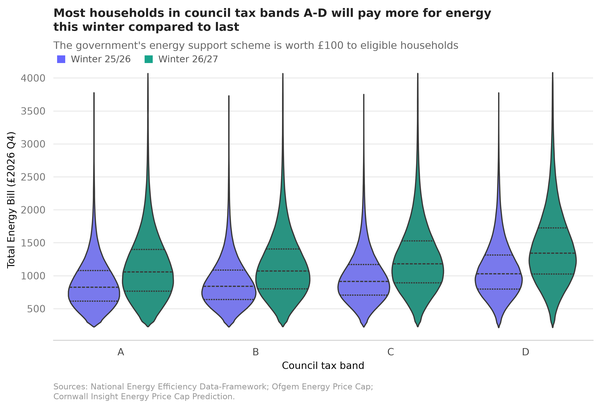
Daniel Lewis has pulled out the data on how energy bills this winter will compare to last winter for households in council tax bands A-D. If we compare the coming winter (October 2026 to March 2027) to the same period last year, the median household in bands A-D will face a bill rise of £258 this winter (see chart below). The £100 payment will only offset a small part of that increase. For households in bands E or higher, the median rise is projected at £431 and they will receive no support. It’s also worth noting that this analysis is based on Cornwall Insight’s forecast for January, which is lower than EDF’s. So the bill increases could be even higher - around £60 higher for bands A-D - if we use the EDF forecast.
So while the Chancellor’s intervention is welcome, it has a number of challenges. It offsets only some of the bill rise this winter, it will not stop inflation rising in January, but it still costs the Exchequer a significant £2.6 billion.
What else could the Chancellor do when the sharp rise in energy bills is announced in late November?
The period between 25 November and 1 January would be the perfect time for the Chancellor to introduce a gas price stabiliser: that is, to fix household gas prices at their current level (around 8p/kWh) for the next three to five years. This would mean the Treasury providing a subsidy in the short term when prices are above 8p/kWh, but then recovering revenue once gas prices fall again. This is how it would compare to the OBR’s implied forecasts for household gas prices, including their “central” and “severe shock” scenarios.
The OBR central forecast implies gas bills would fall below the Proposed Stabiliser Rate by April 2027, the OBR severe shock scenario by July 2028
A line chart titled “The OBR central forecast implies gas bills would fall below the Proposed Stabiliser Rate by April 2027, the OBR severe shock scenario by July 2028.” The vertical axis shows gas unit rate in pence per kWh, from 0p to 14p. The horizontal axis runs from January 2027 to beyond January 2031.
A flat purple line shows the Proposed Stabiliser Rate at about 8p.
The blue OBR central forecast starts at about 8.8p in January 2027, falls below the stabiliser rate within a few months, and levels off at around 6.5p to 7p for the rest of the period.
The green OBR severe shock line starts much higher, at about 13.6p, and falls steadily to just under 8p by mid-2028. It then stays between about 7p and 7.8p. From around mid-2030 it is almost identical to the central forecast, and both rise slightly to about 7.4p by 2031.
A footnote says forecasts add non-wholesale costs to the OBR wholesale gas price forecast and exclude changes to standing charges.
That would mean knocking around £300 off the increase in energy bills in January, reducing it from £465 to £165 (based on the EDF forecast). At that level, the £100 rebate would cover a big chunk of the rise in bills for many households.
And there are several other benefits. It would limit the rise in inflation in January, because it reduces the consumer price of gas (rather than providing a separate rebate). It would strengthen the long-term incentives to electrify the economy by keeping the electricity-to-gas price ratio much more stable; volatile gas prices are underrated as a barrier to heat pump uptake.
And crucially, it would be fiscally neutral under the current OBR forecast. Based on the OBR’s latest assessment of future gas prices, the Chancellor would spend now but recover revenue later, ultimately making it pay for itself under his own fiscal framework. Even in the OBR’s “severe shock” scenario, it would be fiscally neutral in years three to five of the forecast. While a Gas Price Stabiliser might come with some risks, there will be very few risk-free options available for the Chancellor on 25 November: doing nothing could be just as risky.
Even in the OBR's "severe shock" scenario, a gas price stabiliser would be fiscally neutral by year three
A line chart titled “Even in the OBR’s ‘severe shock’ scenario, a gas price stabiliser would be fiscally neutral by year 3.” It shows the yearly fiscal impact of a gas price stabiliser from 2026/27 to 2030/31, under two OBR gas price forecasts. The vertical axis runs from -£6bn to £4bn; negative values are a net cost to the Exchequer.
Under the OBR central forecast, the stabiliser costs £0.9bn in 2026/27, then turns positive: £1.9bn in 2027/28, £3.2bn in 2028/29, £3.1bn in 2029/30 and £2.4bn in 2030/31.
Under the OBR severe shock scenario, the costs are much larger early on: -£6bn in 2026/27 and -£5.3bn in 2027/28. The impact then reaches roughly break-even at £0.1bn in 2028/29, before rising to £2.2bn in 2029/30 and about the same in 2030/31.
Both scenarios end with a net gain to the Exchequer of over £2bn a year.
Aside from the Gas Price Stabiliser, there are other things the government should also be doing to help tackle the energy crisis this winter. First, it should help every household to use energy more efficiently by promoting zero- and low-cost steps to conserve it. Nesta has launched a new version of the Money Saving Boiler Challenge, a campaign which saw three million households turn down their boiler flow temperature in the winter of 2022/23. Our new campaign highlights six steps to save £220 this winter, while turning down boiler flow temperature alone could save households £57. These savings are based on current energy prices, so if bills rise as much as EDF expects, the savings from these actions will grow too.
Second, the government must help as many households as possible switch away from gas in the short and longterm - which means boosting the uptake of heat pumps. The Chancellor delivered a decidedly mixed bag in the Budget, abolishing the gas standing charge (good for lowering the price ratio) while cutting the Boiler Upgrade Scheme in future years (bad for the heat pump industry). Hopefully the pain of high gas bills this winter will cause the Chancellor to reconsider and commit more funding to heat pump subsidies.
This is going to be a very painful winter for many households and the Chancellor may find the Budget is not his final intervention on energy bills. He needs to remember that the pain is overwhelmingly being caused by oil and gas, and the best course of action is to move away from using them altogether.