Introduction
The UK Climate Change Committee and the UK government's independent review of net zero have both emphasised an urgent need for the public, as citizens and consumers, to have a much larger role in net zero.
They have both also recommended that the government publish a public engagement strategy on climate change, and this idea has gained widespread support from civil society.
This paper presents tangible ideas for how this could be done.
It reiterates why public participation in climate policy making is critical, and draws on pioneering practices from all over the world to propose new initiatives that could be employed, and different ways the civil service could be reorganised to deliver this more effectively.
Part 1: The case for public participation in climate policy
Improving public policy and public understanding
Public engagement and consent will be crucial to securing the UK's pathway to net zero. Many of the emissions reductions now needed to get us to net zero will have major implications for people's lives: from how we travel, to how we heat our homes or the food we eat. Policies promoting widespread societal change will need both public mandate and adoption in a short timeframe if they are to succeed. But although public understanding of net zero has grown, it currently remains limited.
At the heart of this is a vacuum of understanding that has opened up since the net zero target was committed to legislation in 2019. But it is also not surprising, for there has never been any coordinated and meaningful large-scale public engagement on how we might get to net zero, or how to do it in a way that is equitable, affordable and practical to everyone in our society.
Large-scale public participation in shaping the country's different pathways to net zero would help increase public understanding and strengthen the role of citizens as active contributors in the delivery of climate goals. But that isn't the only benefit.
Involving people of different ages, gender, race, politics and class from across the country would also bring more diverse insights and perspectives into policy-making. When properly designed, the result is likely to be policies and outcomes that are likely to be fairer, based on real-world contexts, and are responsive to people's values and aspirations.
It can also help the government avoid costly mistakes and u-turns, by helping to identify and overcome practical barriers to delivery for certain groups or local areas, and help avert public resistance.
When given the opportunity to explore and debate for themselves, research from previous deliberative activities has demonstrated that the public can often be willing to go further and faster than politicians - helping to create scope and mandate for bolder political action.
Protecting against short-termism and populism
In recent months, we have seen political attacks on a range of net zero-related policies and ideas - from London's ULEZ to 15 minute cities and a rolling back on deadlines to ban new petrol vehicles and gas boilers. These attacks have been widely interpreted as attempts to make net zero a 'wedge issue' ahead of a general election.
The shortfall in democratic engagement in developing our responses to climate change has left the long term agenda vulnerable to political opportunism and populist rhetoric that can exploit disquiet, and legitimate concerns with individual policies. At best, this vulnerability in our approach to climate policy-making will delay the rate of transition to a green economy, and at worst could derail the UK meeting its net zero targets, discredit ‘green' policies and create wider public disenchantment.
Globally and domestically, we have seen that political populism is a potent and fast-moving force that can sweep aside long standing conventions, policies and initiatives, whether fit for purpose or not. The currently high levels of concern expressed by the public about climate change, should not be cause for complacency.
By building new mechanisms for large scale public participation into government policy making, we have the opportunity to bulwark our system. Welding in additional layers of democratic participation will help give added protection against the forces of populism and short-termism - as well as ensuring that the government comes up with better, more inclusive solutions.
Increasing legitimacy and trust in government
In 2022, a majority (58%) of the UK population said that they were not confident that people like them have a say in what the UK government does. While over one-third (36%) were not confident in their own ability to participate in politics. These figures show people do not believe that we currently have a healthy, flourishing democracy that is working for them.
The perceived legitimacy of government decisions and policies will be critical to the country's ability to reach its net zero goals. How else to bring the country along with the societal changes needed, and navigate their potential trade-offs, without a backlash?
It is unlikely that the business-as-usual of general and local elections will be sufficient to turn around people's feeling of lack of agency and influence, particularly when people are given just one vote to express their views on a whole raft of different policy measures in a manifesto.
Both national and local government have major work to do. Current efforts at public consultation or engagement are insufficient – reaching too few people, often too late in a policy-making process when the impression is of a done-deal, and offering too little real influence on decision-making.
Well-designed public participation that occurs throughout the policy-making process (not just at the end) can demonstrate procedural fairness in policy design, and show that change is being managed fairly. This builds trust in institutions and perceived legitimacy of the outcomes, and importantly also avoids people feeling 'done to'.
Arguments against public participation in policy processes often include the time required to plan and run such processes. But conversely, building public support could in fact allow the government to go faster and further in the long term, building consensus that can outlast the vagaries of the political and news cycles - and to ensure the benefits of net zero are shared more widely, for more people.
Part 2: How to revamp participation for better climate policy
The current set of tools used for public consultation and participation looks and feels limited. Too often, participation is equated with carrying out a survey, holding some focus groups and workshops, or putting on a town hall meeting.
The recent burst of citizen assemblies, including both the UK and Scottish climate assemblies, is an acknowledgement that policy-making benefits from the input of members of the public. But a major limitation of these processes is that they can engage only small numbers of people (typically 50-100 people), require a significant time commitment and can therefore address only a small part of the participation challenge. What has been missing so far is a programme of joined-up and large-scale public participation activities and mechanisms that can offer a variety of ways for people to participate. Not public advertising or education campaigns - but activities with a connection directly into local and national government and with a genuine remit to inform policy and action.
To grow the scale and quality of public participation there must be a greater variety of ways for people to participate than are available at present - using a range of online and offline methods, drawing on more innovative approaches and digital tools. This would allow people to contribute in ways that are both convenient, engaging and meaningful.
Don't leave participation until the end
A more strategic approach to participation, would also consider thinking about participation across the policy-making cycle. Too often, public consultation is left until the end of the policy-making process, where already well-developed proposals are published for comment and scrutiny. By this point the scope to influence or even change direction is severely curtailed and the perception can be of a tick-box exercise.
The table on the following page sets out illustrative examples of the types of participation methods that could be used at different stages in a policy-making process. It breaks this down into seven different stages; from setting the framing or agenda for public debate (stage 1) through to monitoring policy implementation and its effectiveness (stage 7).
- Stage 1: Setting or framing the policy agenda for debate
- Stage 2: Generating data/knowledge about a policy area
- Stage 3: Proposing policies and making recommendations
- Stage 4: Developing and implementing solutions
- Stage 5: Scrutinising policy proposals
- Stage 6: Making decisions on options
- Stage 7: Monitoring implementation and accountability for action
As the table shows, policy-makers have a range of different options for bringing more diverse perspectives into their process to create more inclusive and robust policy. It also gives some examples in practice. Choosing the right method for the task, and for the audience will increase both public engagement and the impact of that engagement activity.
To generate new data or evidence on an issue (stage 2 of our policy-making process), a method like citizen science - where volunteers work with scientists to collect or analyse data - could help. For example, the Harlem Heat Project worked with disadvantaged communities in the US to monitor heat and humidity inside buildings during heatwaves using low cost sensors. It helped researchers quantify and model the impact of different building characteristics on indoor temperatures, as well as making local government agencies aware of the challenges faced by residents who lacked access to air conditioning or nearby cooling stations.
At the other end of the process, where decisions need to be made about which options should be implemented and funded (stage 6 in our table), a method like participatory budgeting - where members of the public vote on how funding should be allocated - could be employed. Participatory budgeting is already widely used on the continent and elsewhere. For example in Paris, residents already vote on how to allocate €75 million of annual investment, and by 2026 they are expected to decide on 25 per cent of the total City investment budget.
Participation will not always be necessary or desirable at each stage, and people will be motivated and able to participate in different ways at different points. Using a framework, like the one proposed below, should help government officials responsible for public engagement to think both more strategically and tactically about the right approach for the policy challenge and the audience.
Figure 1: Framework for participation methods across the policy cycle
| Stage of policy cycle |
1. Setting or framing the agenda for policy debate |
2. Generating data/knowledge about a policy area |
3. Proposing policies and making recommendations |
| Which participation methods are best suited for this purpose? |
* Participatory Futures
Citizens assemblies
Petitions |
* Citizen science
Crowdsourcing information
Crowdmapping |
* Citizens assemblies
Crowdsourcing ideas
Collaborative legislation |
| Example in practice |
Paris standing citizen's assembly chooses the theme of next year's participatory budget, ensuring that PB is reflective of citizen's priorities. €75M. |
Harlem Heat Project worked with disadvantaged local residents to monitor temperatures and humidity inside buildings during heatwaves to build better data on impacts. |
Brazil e-Democracia platform used by lower house of National Congress enables people to contribute ideas and improvements to legislative bills. |
| Stage of policy cycle |
4. Developing and implementing solutions |
5. Scrutinising policy proposals |
6. Making decisions on options |
7. Monitoring implementation and accountability for action |
| Which participation methods are best suited for this purpose? |
* Open innovation challenges
Grants for entrepreneurs
Community-led schemes/initiatives |
* Collaborative legislation
Crowdsourcing opinions
Simulations
* Crowd forecasting |
* Participatory budgeting
Referenda
Voting on specific proposals
Crowd financing
Citizen's assemblies |
* Open data
Open budgets
Social accountability tools
* Citizen journalism |
| Example in practice |
Plant for the Planet-platform that allows tree restoration projects to register and monitor their progress towards a collective goal in real time. |
South Korea Deliberative polling-Govt used deliberative poll to decide whether it should resume construction of 2 nuclear energy facilities. The deliberation was also broadcast on TV to the wider public. |
[Lisbon participatory budgeting](https://opc.lisboa.pt/ -residents propose and vote on ideas that contribute to sustainability and climate change mitigation and adaptation. |
Climate Watch Helsinki-residents used an open data website to hold city officials to account for accomplishing the 147 targets that were collaboratively agreed. (Note: The PDF image implies this is Climate Watch Helsinki, but the text on page 21 says it didn't seem to be running at the time of writing). |
Embed participation in both local and national policy-making
Opportunities to participate must not just focus on shaping national policy, but enable people to engage with and influence what happens locally too. Our research has shown that people in different places have different needs and preferences when it comes to net zero policy choices. Because future net zero changes will impact most obviously at the local level, it is equally important that there is support, funding and tools that local councils can use to enable their residents to participate.
The good news is that there are innovative examples from around the world, showing how to expand the participation toolkit and do local and national democratic participation differently. Nesta has been documenting and supporting many of these initiatives since we first published our report on the evolution of new tools for digital democracy in 2017, our research on participatory futures in 2019, through to our more recent work with three cities in Norway, Finland and Sweden understanding the barriers to mainstreaming the use of digital democracy tools and how these can be addressed.
The experience from this work fed directly into our Strategy Room project, which took the principles of deliberation from citizens assemblies and combined it with novel digital interactive polling and creative video content to help people define different net zero pathways for their local areas.
Part 4 (p.16) of this paper provides an example of what a flagship participation programme on climate policy could look like - employing a range of different methods at different points of the policy cycle.
To build a large-scale public participation programme on net zero policies both locally and nationally, a Prime Minister and his team will have to wrestle the machinery of government into a structure and set of capabilities that can actually deliver it. Although participation and public engagement expertise exists within the civil service it is fragmented across many teams and departments, while activities and budgets suffer from a lack of coordination and alignment, as well as under-investment.
The Centre for Collective Intelligence Design at Nesta has carried out research which has shown that democratic innovations can risk being siloed as one-off initiatives without any real power, and these can become sidelined as civil service personnel and governing parties change.
This is why any programme of public participation on climate policy must be accompanied by institutional reform to ensure these become embedded in the way the government works with a clear mandate to inform policy.
Key objectives of any public participation machinery within Whitehall must include the following:
- Creating a coordinated plan for public participation - with stronger cross-government leadership to reduce duplication and fragmentation of activities.
- Creating clear pathways from public participation into policy action - plus creating a strong remit and accountability across government to take public views more seriously.
- Improving the quality of, and capacity for public participation, by creating better tools and resources that can be adapted by different departments and local Government, and providing access to skilled practitioners, best practice or training.
- Tackling the wider influences on public attitudes that could negatively impact on the conditions needed for constructive public participation. For example, setting up a rapid action team for climate misinformation, and the regulation of advertising and media/social media.
There are different ways for how the machinery of government could be reformed to achieve some of the ambitions set out in this paper.
Three potential options are presented here for how this could be done - each with varying levels of ambition, requiring different levels of institutional reform, and with varying levels of closeness to Government.
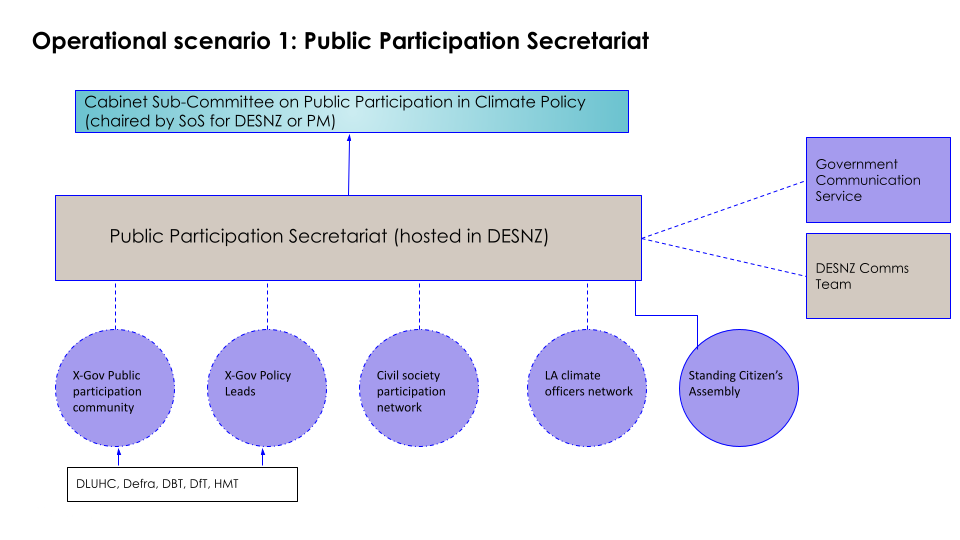
Option 1: A Public Participation Secretariat in the Department for Energy Security and Net Zero
This option would involve a light touch reorganisation to create something akin to a 'Public Participation Secretariat' in DESNZ, and would focus on improving cross-government coordination.
By convening existing public engagement experts and researchers across government, departmental communications teams and the Government Communication Service it could make useful progress in shaping direction for activities, and sharing learning between them.
Pros & Cons
This would require little internal reorganisation and would be relatively quick and easy to do. But is likely to lead to only incremental improvements in public participation - and not the step change needed at this important juncture. The challenge of high coordination costs and matrix management could also be an issue.
Figure 2: Structure for Public Participation Secretariat hosted in the Department for Energy Security & Net Zero
Types of participation activities deliverable (see Part 4):
Option 2: Create new public bodies to shape a new participation landscape
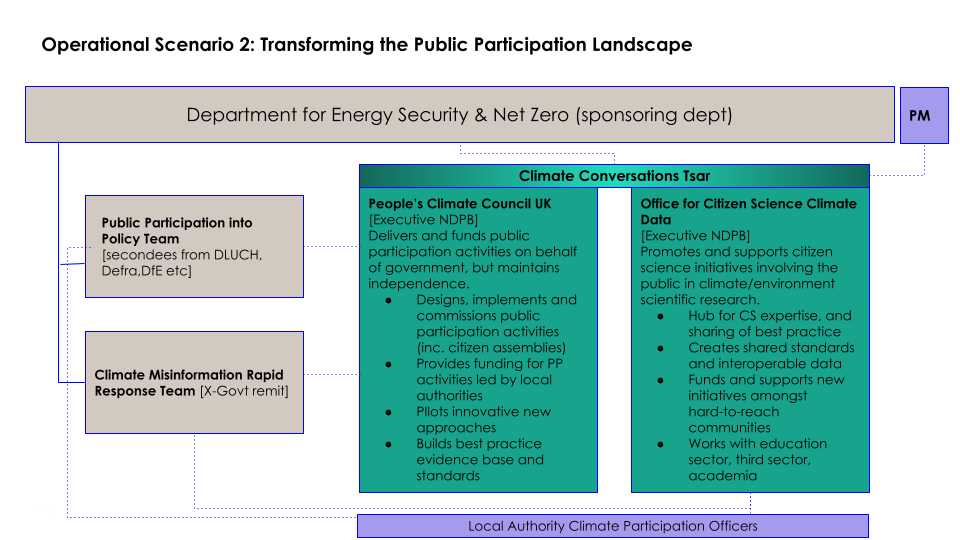
An entirely different option would be to reshape the public participation landscape by creating new non-departmental public bodies.
The People's Climate Council UK
The first of these, called here ‘The People's Climate Council UK', would be tasked with delivering high quality participation activities at scale on all relevant net zero policy areas but at arms-length from the government. It would be bolstered with statutory responsibilities to make recommendations for government policy based on the outcomes from its activities, as well as advise on standards for public participation.
The Office for Citizen Science Climate Data
A second public body, called ‘The Office for Citizen Science Climate Data', would grow the reach and impact of citizen science initiatives - engaging large numbers of the public in collecting, analysing and using climate and environmental data for local government planning, national policy, climate modelling and community-led action. It would provide shared infrastructure, data standards and protocols plus best practice, helping to bring together existing initiatives - and helping to close the gap between scientific and public knowledge.
Climate Conversations Tsar
The appointment of a high-profile ‘Climate Conversations Tsar' would provide these new organisations with access and influence with senior ministers, plus public visibility and media profile.
To make this model work the Department for Energy Security and Net Zero Department would also need to establish a 'Public Participation into Policy Team' to ensure findings, recommendations and data from the public bodies are fed into Government policy, establishing clear processes for accountability. Sitting alongside this would be a 'Climate Misinformation Rapid Response Team' to ensure effective cross-whitehall action to deal with this emerging threat.
Pros & Cons
The advantages of this model are the potential access and reach into communities and media that a body outside of Government may be able to achieve. The Climate Conversations Tsar is likely to be the quickest way to build public profile as the appointee can go directly to the public and media. And a public body may potentially also have more scope for innovation and agility than a team inside government might typically have.
However, the disadvantages of this model are the risk of disconnection from Government policy and limited influence, which comes from sitting outside of government. Plus the likelihood of potentially unstable funding overtime and limited capacity if not properly resourced. It would also require significant time to operationalise and embed.
Figure 3: Structure for new public bodies responsible for citizen participation in climate policy
Types of participation activities deliverable (see Part 4)
- Mini-maxi publics
- Greening our Futures Fund
- Local Climate Action
- Neighbourhood Science Programme
Option 3: A Citizen's Participation Service in Government
The third option is potentially the most appealing and pragmatic.
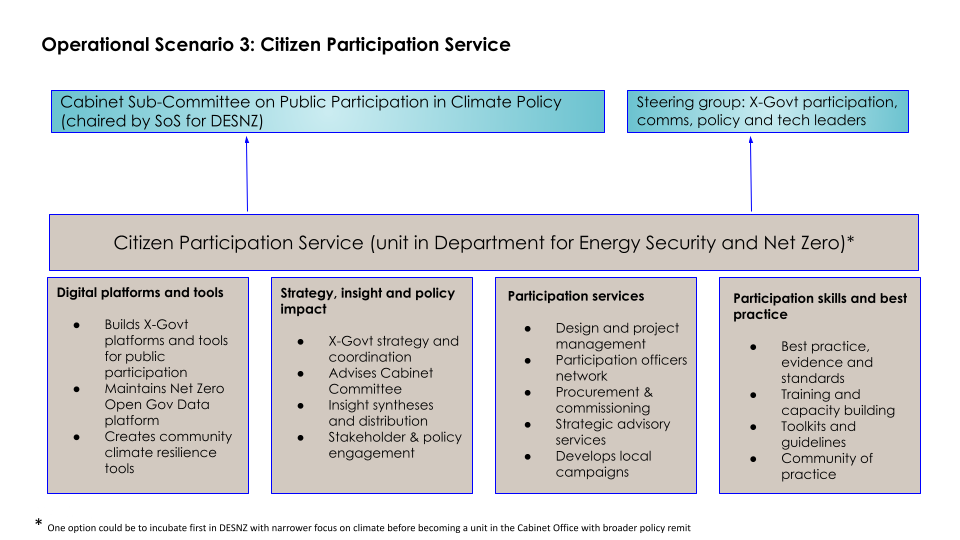
In this option a Citizen Participation Service unit would be established as a centralised centre of excellence for citizen participation within Government, drawing inspiration from the original vision and ethos of Government Digital Service (GDS).
Like the original aim for GDS it would help with setting strategy, standards and oversight for participation. It would build, maintain and improve cross-Government platforms and develop innovative digital tools and offline approaches for public participation on net zero and climate adaptation.
It would work collaboratively with relevant departments to help plan, commission or deliver participation activities, including through a network of skilled participation officers. And it would provide clear pathways and accountability from public participation to government decision-making through a Cabinet Subcommittee, and close collaboration with policy leads.
Pros & Cons
The main advantages of this model would be lowering the cost of public participation by centralising functions, and streamlining processes. It would help build capacity and skills back up within the civil service, and promote the interoperability of tools and data across departments. The Citizen Participation Service would most importantly also drive up the quality and impact of participation activities. This could be incubated initially within DESNZ as a 'proof of concept' focusing on climate-related participation, and once established move to the Cabinet Office providing support across all policy areas.
The disadvantages of this model are the time needed to establish the Service - requiring secondments from many other teams (for example, GDS, Government Communication Service etc) and the recruitment of external experts.
Figure 4: Structure of a Citizen Participation Service based in the Department for Energy Security & Net Zero
Types of participation activities deliverable (see Part 4)
- Mini-maxi publics
- Greening our Futures Fund
- .GovEngage Software Suite
- Open Climate Data Platform
- Local Climate Action
Overview and international precedents
The institutional options above might sound radical at first, but there is plenty of international experience that these are drawn from and inspired by - from Taiwan's cadre of participation officers, to Barcelona City's Office of Citizen Science, the Ostbelgien model of an institutionalised, standing citizen's assembly with responsibility for making recommendation to Parliament, and France's Interministerial Center for Citizen Participation. These demonstrate that bringing public participation into 21st Century policy making and government organisational structures is entirely possible.
Figure 5: Comparison of the different options for reforming the machinery of Government to deliver public participation in climate policy
|
Closeness to Government |
Degree of centralisation and control of PP activities |
Amount of reorganisation / legislation required |
|
In |
Out |
Low |
| Option 1: small participation secretariat in NZD leverages existing machinery for better coordination |
Closer to In (left-mid) |
Further from Out (mid-right) |
Mid-low |
| Option 2: creation of new NDPMs and a 'climate conversations tsar' centralised Citizen |
Mid-range |
Mid-range |
Mid-low |
| Option 3: Participation Service - centre of excellence within Government (akin to GDS) |
Mid-range |
Mid-range |
Mid-low |
Net zero as catalyst for embedding public participation across government
The risks of not getting public participation on climate change policy right are becoming increasingly obvious – such as the backlash in Germany over the government's phase out of gas boilers and the protests of Dutch farmers against plans to reduce emissions from livestock.
The UK government still has an opportunity to avoid this and navigate its way to a fairer, more democratic and green future - while also smoothing the road to net zero. But to do this the government will have to rethink how it does public participation, and invest in building the skills, infrastructures and resources to do it well.
Although this paper has focused on climate policy-making, the ideas in it do not need to be limited to it. In fact, climate change and net zero could be the catalyst for creating and embedding a culture of participation and collaboration with people right across government. New initiatives and structural reforms such as the Citizen Participation Service should be incubated initially within the Department for Energy Security and Net Zero Department as a 'proof of concept' focusing on climate-related participation, but once proven they could be moved to the Cabinet Office and the remit broadened to provide participation support across other policy areas where significant public policy or societal change are needed.
Part 4: A flagship participation programme for climate policy
A new public engagement strategy and plan should support climate policy-making not just within the Department for Energy Security and Net Zero, but provide a mechanism for integrating public participation in climate policy-making across other relevant departments (including the Department for Environment, Food & Rural Affairs, the Department for Transport and the Department for Levelling Up, Housing & Communities). It should also support councils to scale and improve the quality of participation at the local level - driving the devolution of decision-making where it is needed and relevant.
Below are some suggestions for what could be included in a flagship programme of public participation activities, inspired by and building on practices that already exist elsewhere. The initiatives would operate at different stages in the policy-making cycle, and draw on a wide range of different methods that could appeal to and engage different groups of people. They would also operate at different levels - from supporting local policy-making and delivery, to shaping departmental policy and building new participation infrastructure for more coherence and higher quality participation activities across government.
These proposals are intentionally ambitious and bold. Together they are designed to illustrate how the government could help foster a deeper and more widespread culture of participation in climate policy and the delivery of net zero and climate adaptation goals.
Figure 6: Overview of proposed flagship participation initiatives for climate policy
DESNZ
"Mini-maxi publics" for policy making
A process for engaging the public on priorities and proposed legislation that combines mini publics (including citizens assemblies) and maxi publics (open consultation) to generate wide and rigorous input into policy. Combining methods addresses limitations of just one approach.
Example policy case: Establishing guidelines on who should shoulder the costs of achieving net zero.
Best for: All stages in policy cycle
X-Govt Coordination Function - national and local
GovEngage: software for public participation
Suite of open source tools and platforms that offer high-quality user experience for the public engaging with government policy processes. For example, crowdsourcing policy ideas, weighing up policy options, participatory budgeting etc. Individual departments and local authorities can adapt platforms to specific needs.
Example policy case: Allowing local residents to input on where and how onshore wind or solar energy could be located
Best for: Making recommendations & scrutinising policy proposals
Open Data for Climate
Centralised repository on all Government efforts to achieve net zero and climate adaptation. Includes policies, budgets, emissions data, energy consumption, green infrastructure etc. Citizens can also contribute data to the platform (e.g. reporting progress on the implementation of local plans).
Example policy case: Civil society organisations use the data for advocacy and accountability initiatives
Best for: Monitoring implementation & accountability
Initiative 1: Mini & Maxi publics for climate policy making
Combining mass participation and in-depth citizen deliberation for depth, breadth and diversity
This first initiative would establish a new and world-leading process for combining 'mini-publics' (like citizen's assemblies) with ‘maxi-publics' (open processes that involve a larger public using digital tools) to shape government policy.
Combining the two approaches helps to maintain space for an in-depth deliberation supported by experts, as well helping to increase the diversity and scale of participation - contributing to enhanced legitimacy, wider public awareness and political uptake of the recommendations made.
Examples of maxi-publics (wider public engagement processes) being combined with citizen's assemblies could include crowdsourcing views on what the assembly should discuss, or generating ideas to input into an assembly - as the Scotland Citizen's Assembly pre-engagement activities did. Alternatively, maxi-publics could be used to consult with a wider public on options that have been developed by an assembly. In the Netherlands, a digital tool enabled residents to take part in a 'participatory value evaluation' process where local residents assigned 100 points between six options developed by an assembly, and stated their reasons for supporting some options over others.
Local Delivery Function
Neighbourhood Science Campaign
Citizen science projects that involve local communities in gathering, analysing and using data about aspects of their neighbourhood e.g. water quality, climate impacts, tree coverage. Data is fed into local and national plans and models. It also helps close the gap between scientific and public knowledge.
Example policy case: Identify urban heat islands and vulnerability to extreme heat
Best for: Generating data about a policy area
Local Climate Action
The Net Zero Department sets campaign targets on issues where local actions could be aggregated for large impact on mitigation or adaptation e.g. soil health, household retrofit, community energy.
Tech tools enable verification and monitoring. Potential to link to impact financing mechanisms and crowdfunding.
Example policy case: Ecosystems restoration and reforestation initiatives
Best for: Developing and implementing solutions
Greening our Future Fund
Centrally funded Participatory Budgeting Programme delivered by Local Authorities for initiatives that support net zero or adaptation.
Communities set priorities, generate ideas, vote on which should be funded. Potential to link to local plans.
Example policy case: Town centre planning to promote low-carbon/active travel
Best for: Developing solutions + Making decisions
This combination of methods also addresses the limitations and biases of using mini-publics like citizen's assemblies in isolation (which can include co-option, favouring expert opinions, losing touch with the wider public, and reinforcing existing social prejudices). It can also combat the critiques of open consultation processes (including self-selection bias, less in-depth consideration of the issues, and lower quality contributions).
How it could work in practice:
- A citizen's assembly first establishes the parameters and content of several policy alternatives.
- These proposals are put to a wider 'maxi' public for input and scrutiny using a digital public engagement tool, potentially combined with offline engagement opportunities.
- A second citizen's assembly (with different participants) translates the outcomes from the ‘maxi-public' into policy recommendations.
- The government either adopts, modifies or rejects these recommendations and feeds back.
Net zero policy example
Establishing guidelines or principles for the government on who should shoulder the costs of achieving net zero.
This approach was used in 2022 by the largest municipality in The Netherlands to decide its future energy strategy.
Initiative 2: GovEngage
Building new software applications for public participation in climate policy decisions
GovEngage would change the current practice of government departments and local authorities all building or commissioning their own digital tools for public participation or consultations without a consistent approach or set of standards.
GovEngage would provide an open suite of digital tools & platforms that offer high-quality user experience for the public engaging with government policy processes.
This could include tools for:
- Crowdsourcing ideas to solve policy challenges
- Weighing up and recommending policy options
- Collaborative legislation drafting
- Clustering of public opinions on policy topics
- Participatory budgeting exercises
All software created should build on, and contribute to open source software - allowing individual government departments and local authorities to adapt platforms to specific needs, but following best practice and using tools that have been rigorously tested. Creating new communities of practice around these digital tools would help embed a culture of open democracy and routine citizen participation. It would also save the Government money, improve efficiency and the quality of the user-experience.
Net zero policy example
A digital platform that allows local residents to provide input on where and how onshore wind and solar energy could be located, or how local land is used e.g. for rewilding vs flood plains.
The City of Barcelona created its own open source suite of digital democracy tools (Decidim), as did the City of Madrid (Consul). Both have been used by other institutions around the world and could serve as a basis for .GovEngage.
Initiative 3: Open Data for Climate
Creating climate transparency and citizen-centred accountability
Monitoring policy implementation and real-world impact is often neglected when it comes to public participation efforts.
The Open Data for Climate (ODC) platform could promote accountability and transparency across the public sector for progress to net zero. It would provide aggregated, easy to understand data and simple interfaces on the following:
- National and local government goals
- Agreed actions and targets
- Information on who is responsible for delivery
- Performance measures - progress to date against key policy targets
- Critical data on emissions, renewable energy etc.
- Budgets and contracts
- Citizen-monitoring and reporting functions
Sharing data in a single system rather than being siloed across different websites or departments would enable the public, business and civil society to monitor and analyse what is being done across the whole of government. It would also enable civil servants to coordinate more effectively.
Citizens could also contribute to the evaluation of policy effectiveness - for example through providing data on the real-world progress on the implementation and impact of policies.
Net zero policy example
Civil society organisations and local community groups use the data for advocacy and accountability initiatives at local or national level.
In 2018, the city of Helsinki introduced a ‘Climate Watch' platform to enable citizens and business to track progress and hold local officials to account for the 147 targets which had been collectively agreed. However, at the time of writing this platform did not seem to be running.
In the UK, Climate Emergency UK has worked with MySociety to help make it easier for people to find their council's Climate Action Plan, and to rate the quality of them through a scorecard system.
Initiative 4: Neighbourhood Climate Science Programme
Speeding up climate science by closing the gap between scientific and public knowledge
Citizen science is the collection and analysis of data by members of the public working alongside scientific researchers.
The Neighbourhood Climate Science Programme would help to boost climate citizen science projects across the UK; enabling academics to work with local communities to create new data and knowledge for more effective climate action and empowered communities.
New digital tools, data collection platforms and open protocols, would enable neighbourhood citizen scientists to collect large quantities of crowdsourced observations and insights that are useful for scientific research, local action planning and climate models.
The Neighbourhood Science Programme would also help to close the gap between scientific and public knowledge; participating in projects builds communities' knowledge and awareness, is linked to behaviour change and increased social capital.
Climate adaptation policy example
Extreme heat: residents create a map of tree coverage, and monitor indoor and/or outdoor temperatures during summer. The data informs local plans for tree planting to tackle 'heat islands', helps identify optimal locations for cooling stations, and provides data for national policy makers on heat vulnerability.
There is a long history of people in the UK taking part in voluntary initiatives to monitor the environment, from the RSPB's Big Garden Birdwatch to the UK's Zooniverse platform. Previous research found that volunteer observers for biodiversity surveillance in the UK in 2007 were estimated to contribute time in-kind worth more than £20 million, while a global figure for 2015 put the estimated value of in-kind contributions as £2.5bn.
Initiative 5: Local Climate Action
Digital infrastructure to support and scale local community-led climate action
The role of local delivery is critical in achieving net zero at scale and pace, but revised frameworks, governance and financing mechanisms are needed to realise this potential.
Local Climate Action would be a software toolset to fund, support and monitor distributed local climate action by community organisations, businesses, and councils.
Together with experts, local councils, and other stakeholders, the Department for Energy Security and Net Zero would set campaign targets on issues where local actions could be aggregated for large impact on mitigation or adaptation e.g. soil health, household retrofit, community energy.
The Local Climate Action tool set would provide:
- Standards and guidelines, plus 'how-to' kits
- Monitoring of progress towards goals using tech-enabled verification and citizen-reporting
- The ability to map and view all local projects
- The ability for projects to solicit and monitor project donations, including through crowdfunding
- Associated education and advocacy initiatives
Initiative 6: Greening Our Future Fund
Giving communities the power to shape local climate spending
The Department for Energy Security and Net Zero would fund an annual Participatory Budgeting Programme to be delivered by Local Authorities for initiatives that support net zero or climate adaptation.
Communities set priorities, generate ideas, and vote on what should be funded. This initiative goes beyond consultation - devolving power to communities to shape the agenda, solutions, and spend.
How it could work:
- Department for Energy Security & Net Zero allocates each local authority a set budget for the participatory budgeting process
- Local citizens assemblies establish high-level priorities for the participatory budgeting process that year
- Awareness and information campaigns to local residents
- Offline and online workshops are run to support communities to develop proposals, potentially with expert support
- Public submits proposals
- Technical review of proposals by experts and council
- Shortlisted proposals open to public voting using an online digital platform
- Budget allocated by the local council to projects, according to public vote
Net zero policy example:
Ecosystem restoration and reforestation initiatives.
The Plant for the Planet platform provides free software to over 200 reforestation planting initiatives around the world. It enables them to meet agreed standards, verify impact and makes it easy for individual or corporate funders to find and fund projects.
Net zero policy example:
Town centre planning to promote low-carbon / active travel
In 2008, Lisbon was the first European city to adopt participatory budgeting at municipal level - empowering its residents to allocate part of the council's budget each year. Between 2008 and 2018, over 300,000 citizens voted in the budget process, and 36.3 million euro was invested through 11 Participatory Budget cycles. Since 2020 Lisbon decided to transform this into a green participatory budget which focuses exclusively on proposals for a more sustainable, resilient and environmentally-friendly city.
Conclusion: Communicating with the public about public participation
This paper is intended for a policy audience and participation experts. To attract people to become involved in any participation exercise will require effective, accessible and compelling communication about the purpose, remit and mechanisms that are part of any planned activities. It will also require a thorough understanding of different motivations for participation, and ensure that messaging and incentives are appropriately matched to encourage and enable everyone to contribute.
Acknowledgements
Author: Kathy Peach, Director of the Centre for Collective Intelligence Design, Nesta
With thanks to Daniel Mazliah and Katherine Merrifield for their ideas and feedback on the options presented above, as well as Nesta colleagues including Faizal Farook, Peter Baeck, Aleks Berditchevskaia, Chris Edgar, Alexandra Albert, Andrew Sissons and Madeleine Gabriel.
58 Victoria Embankment
London EC4Y ODS
+44 (0) 7438 2500
[email protected]
@nesta_uk
nesta.uk
www.nesta.org.uk
Find out more about the team
www.nesta.org.uk/project/centre-collective-intelligence-design/
Nesta is a registered charity in England and Wales with company number 7706036 and charity number 1144091. Registered as a charity in Scotland SC042833. Registered office: 58 Victoria Embankment, London EC4Y ODS