About us
This citizens' jury was designed and delivered by Nesta's Centre for Collective Intelligence (CCI). It was commissioned by the Information Commissioner's Office (ICO).
Nesta's CCI helps people take part in the big decisions that shape our shared futures. We believe the best decisions come from many voices, not just the loudest ones. We exist to help governments, public agencies, and charities to make better, faster, and fairer decisions, guided by the collective intelligence of the people they serve.
The ICO is the UK's independent regulatory body responsible for upholding information rights, enforcing data protection, promoting freedom of information and supporting growth and innovation in the UK. It oversees laws including the UK GDPR and Data Protection Act 2018, providing guidance to organisations and investigating data breaches.
Acknowledgements
We would like to thank Rob McCombe, Allaina Kilby, Eliza Wide, David Barnard-Wills, Pawel Latoszek, Helen Conlon and other colleagues at the ICO for commissioning this work and being supportive and engaged throughout the process. We would also like to thank the Department for Science, Innovation and Technology (DSIT) Regulatory Innovation Office for funding the work through the fourth round of the Regulators' Pioneer Fund (RPF4).
We would like to thank the specialists who contributed their time and expertise to make the workshops engaging and informative: Emilė Radytė from Samphire Neuroscience, Dr Beth Parkin from the University of Westminster and Harry Lambert from the Institute of Neurotechnology and Law and Cerebralink Neurotech Consultancy.
Most importantly, we would like to thank all of our jurors for giving up their time and for sharing their views and ideas openly and constructively. Thank you to Dionne Buckman and Reema Patel for their support in facilitating some of the jury discussions.
The Centre for Collective Intelligence project team were Aleks Berditchevskaia, Tiffany Holmgren, Kathy Peach, Joe Asher, Andriana Laskari and Kate Furber.
Executive summary
This report presents findings from a citizens' jury with 20 members of the UK public, exploring their views on neurotechnology and neurodata.
Why explore public views on neurotechnology and neurodata now?
Neurotechnologies (or neurotech), broadly defined as devices that record and/or send electrical signals to the brain and nervous system, are an emerging area of innovation and expertise in the UK. As these technologies extend beyond healthcare into more consumer-facing applications, there are significant ethical and legal questions about their use of data derived from the brain. Specifically, the developers of devices face considerable uncertainty when navigating data protection law. Without clear regulatory guidance, there is a risk of controversial practices by innovators or that public backlash could undermine the legitimacy of emerging technologies.
Within its remit of supporting organisations to handle personal data legally and ethically, the Information Commissioner's Office (ICO) is currently working to develop guidance for innovators on the application of data protection law to neurotechnologies and neurodata. They commissioned this citizens' jury so that the guidance can be informed by public opinion. The jury was delivered by Nesta's Centre for Collective Intelligence.
Why use a citizens' jury to capture public views?
A citizens' jury brings a small, diverse group of the public together to learn about a complex issue from specialists. The jury spends time deliberating together, and at the end of the process, will often share priorities or recommendations for the commissioner.
Over two weeks in March 2026, the citizens' jury exploring public views on neurotechnology and neurodata met for three online sessions. They watched informational videos, listened to specialists, and had discussions guided by expert facilitators. The process was designed to gradually build their understanding of the topic to answer the overarching question: how do we make the most of the benefits of neurotechnology while managing the risks?
Key findings
The jury focused on current and near-term commercial applications of neurotechnology with the aim of understanding the public's feelings toward different uses, and their expectations around necessary safeguards or governance measures to protect data protection rights and minimise potential harms.
Early optimism and curiosity were tempered by concerns about commercial exploitation
Most jurors started with a low understanding of neurotechnology but expressed early optimism and curiosity about different applications, particularly those supporting health and wellbeing.
After learning about the current state of neurotechnology's development, jurors were enthusiastic about its potential, particularly for medical uses like Parkinson's treatment, cochlear implants, and managing conditions like ADHD or dementia. However, this optimism was contingent on there being robust data security and privacy rules in place. From the outset, jurors were concerned that highly sensitive, intimate neurodata could be hacked by malicious actors or used by commercial entities for targeted marketing, which they felt would be highly intrusive.
For jury members, the acceptability of specific neurotech applications depended on the perceived balance between the benefits for individual users and the potential for discrimination. Jurors supported technologies where the person whose neurodata is being processed is in control of what happens to their data, and how it is used. For example, a majority of jurors were comfortable with wellbeing devices that help individuals improve their sleep and mood, or devices that could replace inconvenient or unpleasant medications for managing pain and daily wellbeing. Many jurors were also comfortable with fatigue and attention tracking neurotech devices for the workplace, designed to prevent accidents when driving or operating heavy machinery.
In contrast, many jurors opposed the processing of neurodata to track employee focus and student productivity, because they identified risks of discrimination in the workplace and educational settings. They worried that forcing individuals to conform to a narrowly defined 'normal' range of brain activity could lead to unfair dismissals, anxiety and bias against older or neurodiverse individuals. Furthermore, they worried that workplace and classroom power dynamics could make it difficult for individuals to withdraw consent.
Jurors supported clear regulatory standards to build public confidence
The majority of jurors cautioned against a 'blanket ban' on neurotechnology, fearing that overly restrictive rules would stifle innovation and leave the UK at a global economic disadvantage. However, they wanted regulatory standards to set a high bar for approval.
1. Restrictions on neurodata collection from children or people who need extra support to protect themselves
Many jurors wanted to see restrictions on the collection of neurodata from children or people who need extra support to protect themselves, such as elderly people and individuals with mental illness. They felt these groups might be unable to provide genuinely informed consent or understand the potential longer-term impacts of sharing their brain data.
2. Restrictions on uses of neurodata for marketing or access to services
Jurors expressed strong support for restrictions that would prevent the use of neurodata for purposes that shape consumer decision making, including targeted advertising, or for automated decision-making regarding access to services like insurance.
3. Higher regulatory standards for 'read-write' devices
Several jurors felt that all ‘read-write' devices should face stricter regulatory standards than ‘read-only' technologies. They also felt that any neurotech making explicit clinical claims must undergo medical-grade testing to protect consumers.
4. Establishing a new legal category for brain data
Many jury members viewed neurodata as fundamentally different from other forms of personal data, as it inherently captures subconscious thoughts and intentions that individuals cannot fully control. They supported the idea of creating a distinct new legal category for neurodata to mitigate the risk of exploitation of legal loopholes by commercial actors.
Jurors had high expectations for trustworthy neurotech
Most participants started the jury with low baseline levels of trust towards tech companies. Throughout the deliberations, jurors provided a clear message for neurotech developers: they felt trust could be earned through adopting a ‘privacy by design' approach, working to improve accuracy and shifting from passive 'opt-out' models and dense legalese to accessible, ‘opt-in' frameworks that prioritise simple, clear informed consent.
1. Better transparency and consent options for users
The importance of users retaining control over the neurodata collected by neurotech devices was a recurrent priority for the jury members. They were critical of traditional approaches to terms and conditions, which they found too dense and confusing to capture genuine informed consent. To prevent the misuse of neurodata, jurors expect neurotech companies to offer simple, accessible 'opt-in' controls that allow users to actively choose how their neurodata is processed.
2. Prioritising user privacy and device accuracy
Highlighting the unique sensitivity of neurodata, jurors would like to see companies adopt a 'privacy by design' approach when developing their tech, by embedding protections such as local data storage on the device and data traceability. Additionally, jurors emphasised the technical accuracy of neurodata processing as paramount, believing that flawed or misinterpreted neurodata could lead to serious consequences such as unfair dismissal at work.
The ICO's role in strengthening public understanding and coordinating regulatory oversight
Jury members were supportive of the ICO playing a bigger role in raising public understanding. Jurors perceived public understanding levels of neurotech, neurodata and data rights more generally as very low, and they worried that this could limit people's ability to make informed decisions regarding the unique privacy risks associated with neurodata. Some jurors suggested that the ICO could take a proactive lead in public education and further engagement.
Recognising the evolving landscape of neurotechnology regulation, jurors highlighted the importance of the ICO continuing to work with other regulators to ensure that innovation in neurotech doesn't happen at the expense of people's data and information rights. Jurors viewed the ICO as a trusted regulator whose primary role is to champion people's data protection rights over corporate economic interests. This suggests that jurors would be supportive of greater collaboration across regulatory bodies to coordinate on preventing harms due to potential misuse of neurodata.
1. Introduction
1.1 Background
Innovation in the neurotechnology sector is advancing rapidly, moving beyond the confines of clinical and research environments into consumer-facing applications across the wellbeing, workplace and education sectors.
In the UK, neurotechnology is an emerging area of industry. As of June 2026, there are over 50 dedicated UK neurotechnology companies, generating nearly £120 million in turnover, attracting over £200 million in investment and growing at around 14% annually. This includes investment from major public funders, including UK Research and Innovation and ARIA (the UK's Advanced Research and Invention Agency). However, the lack of clear regulatory guidance regarding neurodata protection has meant that innovators in the space are navigating an uncertain landscape, balancing the drive for progress against the risks of regulatory non-compliance and public backlash.
At the same time, data recorded from an individual's brain (neurodata) is among the most sensitive and uniquely personal information that can be collected. Because of its involuntary nature and the limited control individuals have over the data created or the inferences drawn from that data, neurotechnologies challenge the notion of consent as a cornerstone of data protection. This raises new questions for the effective protection of the public and how to ensure compliance with data protection rights. There is increased recognition by regulators internationally that neurodata presents a new ethical frontier, which may warrant unique regulatory interventions.
To date, there have been few attempts to understand public views on neurodata. As the sector continues to expand into commercial uses, gaining insight into public views on this topic is vital for both helping the sector to achieve its full economic and social potential and for minimising potential harms caused by infringement of data protection rights.
1.2 Methodology
In February 2026, the ICO commissioned Nesta's Centre for Collective Intelligence to design and run a citizens' jury to explore how people perceive neurotechnologies and to understand the concerns and expectations that should inform future regulatory guidance for neurotech innovators. The ICO's commissioning of this research is part of their wider commitment to supporting organisations in navigating challenges of neurodata and neurotechnologies by providing guidance on how data protection law applies.
The ICO chose to commission a citizens' jury because this methodology is well-suited to capture informed and considered public views on ethically and technically complex topics, such as neurotechnology and neurodata. By presenting members of the public with specialist information on the topic and giving them time to deliberate with fellow jurors from different backgrounds over several sessions, insights go beyond the surface-level reactions captured by traditional methods like surveys or one-off focus groups.
We set out to answer the overarching question: How do we make the most of the benefits of neurotechnology while managing the risks? The jury focused on current and near-term commercial applications with the aim of understanding the public's feelings towards:
- neurotechnologies and their current or potential uses, and
- the safeguards or governance measures that are necessary to minimise potential harms caused by infringement of data protection rights by neurotechnologies.
We recruited 20 people broadly reflective of the demographics of the UK population, including representation from the devolved nations. Jury sessions were run as online workshops. The group met three times over two weeks in March 2026. They were guided by expert facilitators through a series of short informational videos, voting exercises, and deliberative discussions. Each session focused on a different theme, building participants' understanding of the topic and allowing them to delve deeper each time (Figure 1). Sessions were recorded and transcribed, and both discussion data and voting exercise responses were systematically analysed to identify key themes, areas of agreement, and differing perspectives, which were synthesised into the findings presented in this report.

Figure 1: A horizontal flowchart presenting the three jury workshops and their main focus. Three blue rounded rectangles with white text represent ‘Session 1’, ‘Session 2' and 'Session 3', connected by directional arrows outlining the progression of topics from introductory concepts and regulatory overviews to ethics, specific use cases and safeguards.
1.3 About this report
This report opens with jurors' initial attitudes towards the topic, including their hopes and concerns regarding the processing of neurodata, before moving into their views on the acceptability of sector-specific neurodata processing applications. It then presents jurors' expectations for how innovators building neurotech will handle neurodata appropriately, and the measures that would increase their trust in how these new technologies collect and process neurodata. The report closes with juror reflections on how public confidence in neurotech can be built through regulation and oversight of how neurodata is processed, as well as some additional considerations suggested by jurors for the ICO.
Citizens' jury reports are qualitative in nature. Anonymised, verbatim quotations are used throughout to highlight points made by jurors. We refer to jury members as jurors, participants and jury members interchangeably. We do not report on the exact number of times something was said, but use the following quantifiers to represent the frequency of key themes:
- 'many' or 'most' when it is clear that all or almost all jurors share a similar view
- 'some' or 'several' when fewer participants shared a similar view
- 'a few' when a small number of participants shared a similar view
A glossary of key terms used throughout the report, including all neurotechnology terminology, is provided in the appendices.
Quantitative polling was embedded throughout this deliberative process through voting and prioritisation exercises. These were used to provide insight into the relative weighting and strength of juror views. The figures capturing the polling results are presented throughout the report to reflect the jury's preferences at specific stages of deliberation. They are intended to support qualitative interpretation of the jury members' reasoning; they are descriptive rather than statistical and should not be interpreted as representative of wider public opinion.
2. Initial attitudes: curiosity and optimism tempered by concern about commercial exploitation
The jury showed a mix of curiosity and cautious optimism about neurotechnology. Existing concerns about personal data security and commercial exploitation of personal data also played a key part in shaping initial attitudes and reactions.
2.1 Low awareness of neurotech
Initially, jurors exhibited low awareness of the current state of neurotech development. Many viewed the field through a lens of “science fiction", assuming it only existed in a remote, speculative future. Several jurors recognised existing medical applications, which helped them feel less intimidated by the topic. However, many were surprised to discover that neurotechnology is progressing rapidly towards consumer applications. This instilled the group with a new sense of importance about their contribution as they recognised they were deliberating on something important happening now, rather than an abstract concept.
“I felt it was very science fiction, very futuristic, and a little bit sort of out there, but I hadn't actually realised until watching that video that it's already here."
2.2 Early optimism and curiosity
Medical applications of neurodata processing
Despite this knowledge gap, participants expressed a high degree of enthusiasm and curiosity as they learned more. Many were particularly positive about existing medical applications of neurodata processing, such as cochlear implants, Parkinson's treatment and prosthetics. Building on this, the jury was hopeful about the future potential of neurodata processing to tackle other conditions where they felt treatment options may be limited, such as dementia or brain injuries.
“I'm quite pro innovation and seeing things like this impresses me and gives me hope for the future and how we could tackle different medical issues as well as other problems in life.”
"I'm a big rugby fan. I thought this would have sort of great potential for concussions and stuff like that. If you could monitor players as the game was going on to see if their sort of brain was getting negatively affected, that could reduce some of the neurological problems that come, like with sports, later down the line."
One juror imagined that neurodata processing may help provide effective support for neurodevelopmental conditions such as ADHD in the future. After their own negative experiences with existing medication options, they expressed an interest in trying out a neurotechnology alternative, should one become available.
“I suffered with ADD myself and I didn't like taking the medication personally, so I think that if there was an alternative to that, it could probably benefit a lot of people in a lot of ways."
Baseline confidence in regulatory oversight
Some jurors specified that their optimism around neurotechnology and neurodata processing was anchored in a baseline confidence in regulatory bodies, such as the ICO, to effectively oversee the field.
“I'm quite confident that our institutions tend to have the right regulation and ensure that our data is being used appropriately.”
"There are bodies that are designed for that specific purpose [data regulation]. So...I think I won't worry too much about it.”
Surprise at the value of everyday brain data
Another notable finding from these initial deliberations was the surprise expressed by several jurors at the concept that their personal, everyday brain data possessed value. Many initially downplayed the significance of their own neurodata, feeling that their routine thoughts and daily activities were too ordinary to be of interest or worth to external parties.
"I don't really understand why anybody would need my data because I have no monetary value or interesting thoughts of any description.”
2.3 Early concerns
Vulnerability to breaches
Some of the jury's initial excitement was tempered to an extent by concerns about highly sensitive neurodata becoming vulnerable to breaches. Participants highlighted the frequency of data leaks for other personal data and worried that neurodata would be even more attractive to malicious actors. They wanted reassurance that brain data would be stored securely.
“Every week it seems like there is a [personal] data leak or breach or something so there are real concerns about security as well.”
If neurotechnology was potentially hacked or poorly secured and neurodata was stolen, some jurors worried about the following possibilities:
- The individual's brain control, including actions and thoughts, might be taken over by a malicious actor controlling a read-write device.
- Subconscious and innermost thoughts might be shared against the individual's will.
- The neurodata collected might be used for identity theft or malicious 'cloning' activity.
“What I'm worrying about is...that bad people could use the technology for many other purposes and then somehow make me, you know, influence [my] brain and control it to make bad decisions."
Authorised data sharing leading to consumer choice manipulation
Some participants were more concerned about neurodata being sold to commercial organisations than being hacked by malicious actors (ie, more concerned about the consequences of authorised data sharing). This concern was rooted in a feeling that individual autonomy is gradually being reduced by commercial organisations using personal data that they collect through systems such as cookies to manipulate consumer choices. Jurors worried that neurodata would "unlock” a new level of commercial power over an individual's behaviour.
“Big companies...would love to get your neurodata and use that to manipulate the way we behave and the options that we have in our daily lives."
Mixed initial reactions
After initial deliberations, jurors completed a ‘check-in' voting exercise. The results of this exercise illustrate these mixed reactions to the topic of neurotechnology and neurodata processing (Figure 2). While the majority of jurors felt comfortable about the technology, these views were accompanied by more cautious responses from a smaller number of jurors, shaped by the concerns raised.
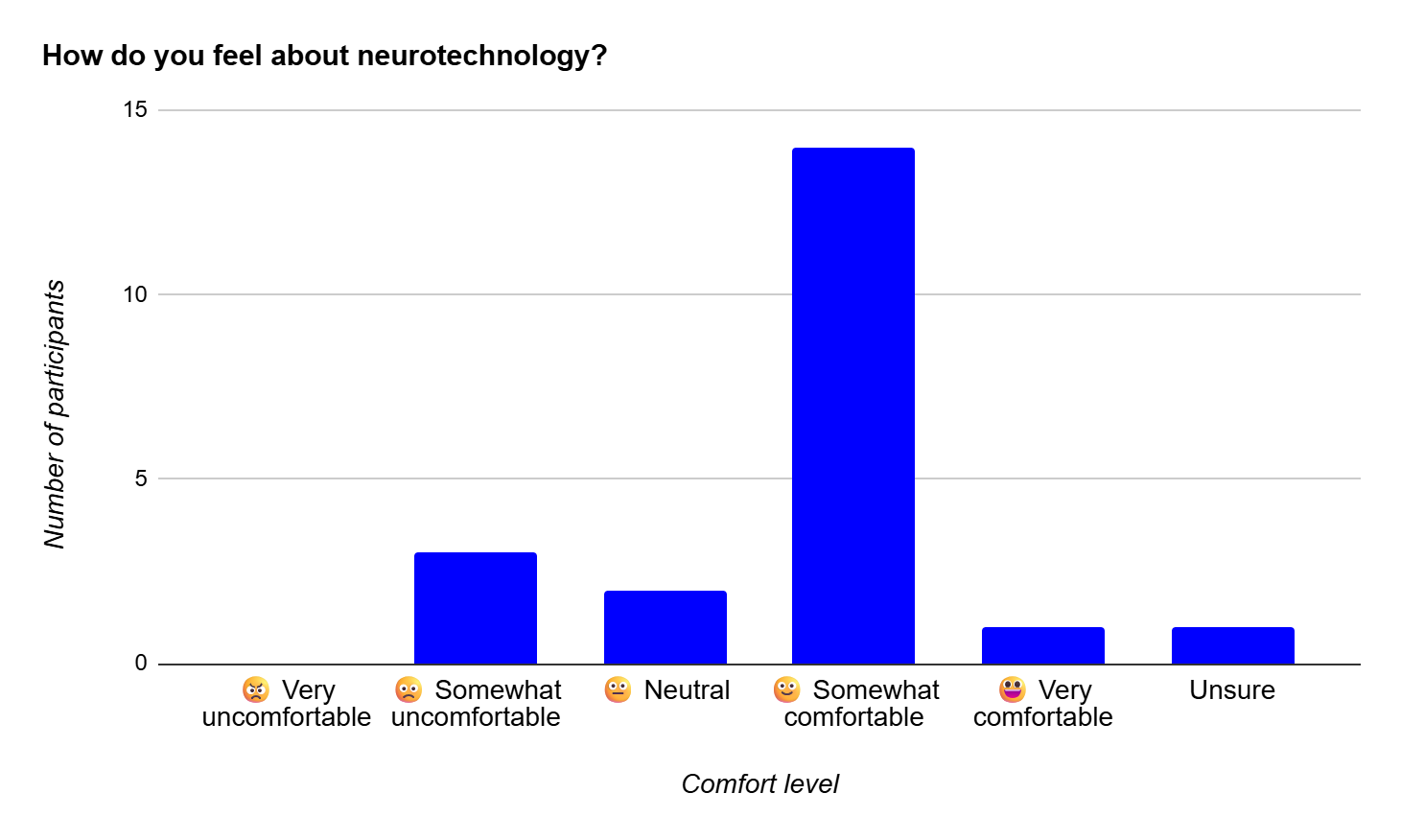
Figure 2: After initial deliberations on the topic, we asked jurors to vote on how comfortable they felt about neurotechnology. n=20.
3. Navigating neurotech acceptability: individual benefit vs. performance monitoring
To assess public feelings about the commercialisation of neurotechnology, the second jury workshop focused in more depth on non-medical neurotech innovations across education, wellbeing, and workplace settings. Jurors learned about existing and potential near-term applications through videos and Q&A sessions with sector specialists.
The specific neurotechnology examples shared were:
- Wellbeing: Devices capable of tracking real-time emotional and cognitive states, mood and managing pain. The neurodata collected could be analysed to provide insights into stress and lifestyle management.
- Workplace: Devices designed for safety, such as monitoring driver fatigue, as well as future devices that could be used to track the focus and productivity of office workers. Neurodata from these devices could be shared with both employees and employers.
- Education: Neurotechnology that could be used in the future to measure student brain data. This neurodata would potentially be used to assess children's attention and focus in schools, or to tailor learning programs for children with specialised needs.
3.1 Neurotech in education, work, and wellbeing: comfort levels and acceptability
Jurors were most comfortable with neurotech applications developed for wellbeing and safety, while applications that tracked focus and attention in workplace or education settings were most concerning. Figure 3 shows the results of a voting exercise after jurors were introduced to examples across the three sectors and had a chance to ask experts questions about the different uses.
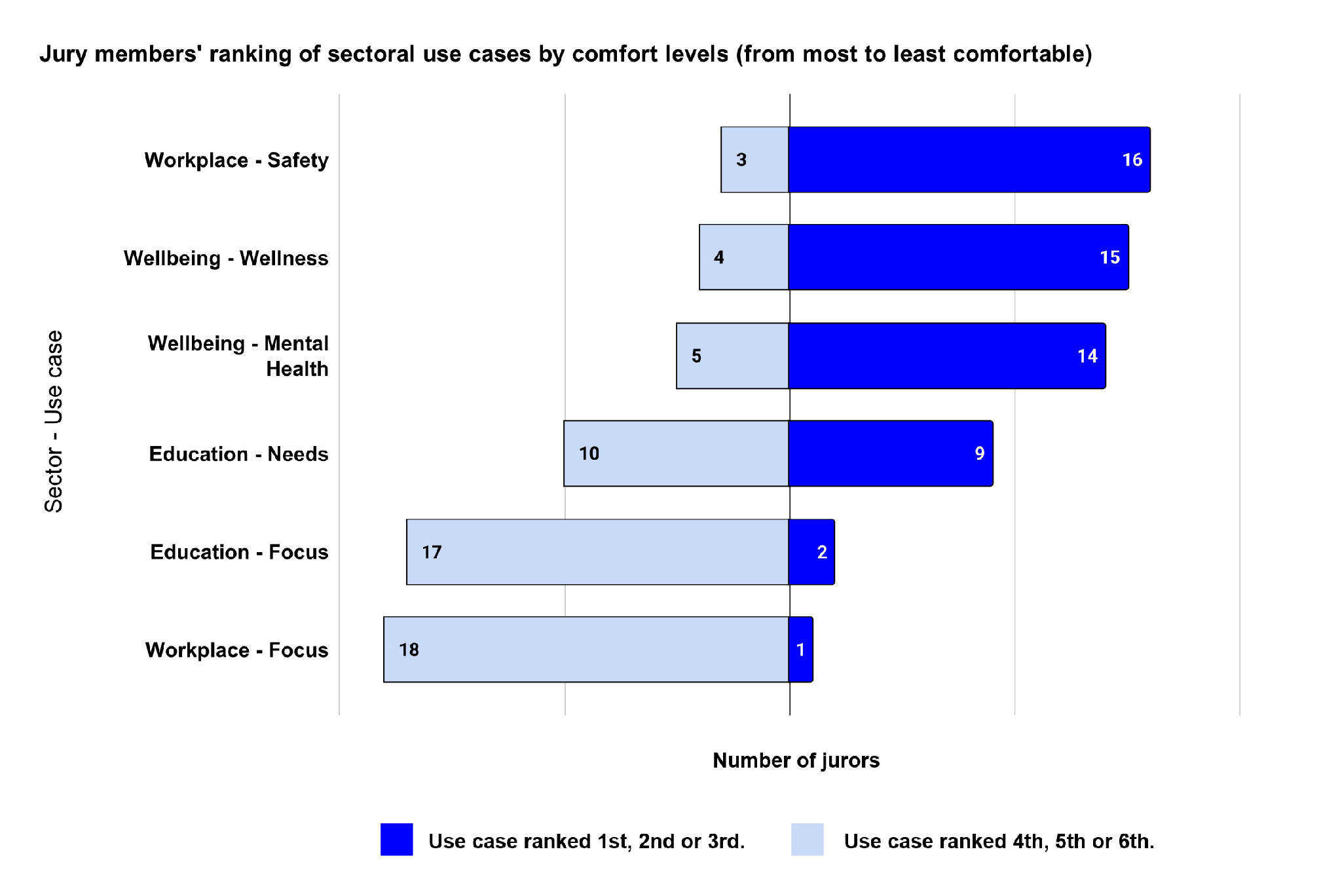
Figure 3: Results of simple ranking of six sectoral use cases by the group. Jurors were asked, “How comfortable are you with these uses of neurotechnology?”. This chart shows how the jury, n=19, ranked each use case. Higher rankings (more comfortable, ranking 1st, 2nd and 3rd) are depicted in dark blue. Lower rankings (less comfortable, ranking 4th, 5th and 6th) are depicted in light blue. This voting exercise was conducted in the middle of the second workshop, after the jurors learned about different examples.
Deliberation revealed that jury members' attitudes towards different sectoral uses of neurotechnology were largely determined by whether the individual providing the brain data was clearly the main beneficiary and had control over how their data was used. The key factors that determined how comfortable they were with different neurotech applications included:
- Does the technology directly empower or improve the life of the user?
- Is there a risk that the technology use leads to discrimination or behavioural manipulation?
- Can the user of the technology effectively consent to or opt out of the data collection?
3.1.1 High acceptability and comfort: neurotechnology that keeps users safe and promotes personal wellbeing
Support for medical and wellbeing neurotech
From the outset, many jurors strongly supported neurotechnology applications to enhance medicine and research, and their comfort with these uses extended to neurotech that focused more on wellbeing; for example, devices that could be used in the home to help individuals monitor stress, sleep and mood levels. After learning about these devices, a majority of jurors agreed that they could imagine using them. Several jurors were excited about the idea that, in the future, neurotech wellbeing devices might be able to replace ineffective, inconvenient or unpleasant medications.
“I've got sort of inflammatory arthritis which causes [...pain] episodes sometimes if it's like flaring up. So I think they could be useful to manage stuff like that, because I think a lot of pain medication, frankly, there's a lot of side effects that make [..it] very hard like to tolerate"
Participants drew direct comparisons between wellbeing neurotech and wearable technologies they already used (eg, smart watches). Several jury members shared the personal value they derived from these types of devices and saw neurotech as adding an additional layer of personalised information they could use.
“I find it really fascinating. I track everything with my Apple watch. It's always something I am trying to improve in terms of my deep sleep. So if I could improve that in any way I would."
Support was rooted in the fact that this technology would primarily serve as a tool for self-improvement and safety, where the main beneficiary is the individual user. Jurors also felt confident that the likelihood of the collected neurodata being exploited to manipulate or discriminate against the user was low.
“I'm most comfortable with the tech being used more on an individual, personal basis. So, for example, when it comes to wellbeing, you know, I have a smartwatch because I find it interesting to track my data, and my stats to see whether I can make improvements...so using neurotech in a similar way.”
Similarly, the jury's views on neurotechnology applications designed to prevent accidents, such as monitoring driver fatigue or tracking focus for workers in charge of operating heavy machinery, were very positive. This support remained consistent throughout the process and generated less discussion because jurors consistently saw it as an application with clear benefits through the potential to mitigate human error and protect lives.
"The things that I felt quite positive about was when it said...to rule out workplace accidents. I think it could override things like human errors and keep people safe in that way if you are fatigued."
Caveats
Despite the overall high levels of comfort with applications focused on wellbeing and safety, a minority of jurors shared concerns. One participant questioned the technology's ability to assess complex mental states through wellbeing applications, with concerns about the reliability of inferences about mental health conditions where factors other than brain data would need to be taken into account. Others worried that overreliance on neurotechnology solutions for symptom management would mean that the root causes are left unaddressed.
"I know how complex mental health can be and I'd be a bit worried about how they're calculating stuff like perceived anxiety and whether it was just pure electrical signals that they're detecting or hormone levels and everything else that affects it as well."
"I suppose it's good to replace medication where you can, but you could equally become reliant on one of these devices, so even if I was using one I'd want to be addressing the root cause of whatever condition that I was trying to treat at the same time."
Comparisons to wearables and tracking of biometrics raised negative associations for a few participants. They highlighted that these devices sometimes resulted in negative impacts on individuals, for example, increasing anxiety.
“I'm not actually sure how religiously tracking all these different markers for your sleep or steps [...] can always be a good thing. I think sometimes that can just lead to more anxiety about what you're tracking. So perhaps we don't always need to know everything"
They also challenged the underlying need to collect neurodata if other options were available.
“There's already technology that will help if a driver's getting sleepy, there's kind of technology within the vehicles themselves now that can help with that."
3.1.2 Low acceptability and comfort: tracking focus and productivity in the workplace or education settings
Discomfort with neurotech for productivity and focus tracking
In contrast to wellbeing and safety applications, jurors were consistently uncomfortable with neurotechnology being used to track productivity or focus in the workplace and educational environments. This was mostly due to underlying worries about the potential for discrimination.
Participants started the jury with high baseline levels of trust that employers would keep their personal information safe and use it responsibly. Despite this, they were very resistant to the use of neurotech for performance monitoring by employers. A key concern was that these devices would be used to judge or penalise workers. They felt it would be impossible to standardise highly individual brain data to make inferences about states like tiredness and doubted that these categories could be applied fairly across diverse employees. Jurors feared that defining a 'normal' range of focus or productivity could lead to discriminatory outcomes, such as the termination of employment or changes to hiring practices which privilege certain brain patterns above others.
"My concern would be that the data collected could be used against that individual...saying look, you're 55 years old now, and you're really not fit to do nights."
“Could our employers start seeing if we had a health problem...and then start using that as a kind of power imbalance thing and being like, well, I know that you've got this, so maybe I won't renew your contract."
“Even if it didn't result in certain people losing their jobs and things, it would definitely result in just not hiring people over a certain age or people with certain disabilities."
Likewise, the idea of using neurotechnology in schools made a majority of jurors very uncomfortable. They worried that devices risked forcing children into a narrow “normal mode”, suppressing natural differences and stigmatising those who learn in different ways. Jurors raised concerns about negative consequences for young people, such as the imposition of rigid, corrective measures on students and the danger of anxiety or burnout from being monitored.
“[I'd be concerned that] every child then has got to behave and focus within this narrow range or else corrective action will be taken."
“With regards to the students being monitored, it could increase their anxiety and stress, knowing that they're being monitored all the time."
In contrast to neurotech uses for wellbeing, participants were worried that workplace power dynamics would make it difficult for employees to opt out of attention tracking. Participants were also concerned that employers and schools might use these technologies without full transparency, which would prevent individuals from making meaningful decisions about consent.
"I guess potentially the more insidious thing would be if [...] people's employers might buy some of this or start using some of this and then an individual doesn't really have a say over that."
“I don't think it's good for the kids and [if they] just don't know about it, and then they can't really assess that information [so] they can make that decision."
Caveats
A small number of neurodiverse jurors were open to the idea of using neurotechnology in education. Drawing on personal experiences where their learning needs were misunderstood, they viewed neurotech as a potential catalyst for transformative, tailored support.
These jurors argued that if implemented with safeguards, such as teacher training, the technology could create more inclusive learning environments and improve foundational understanding of how neurodiverse people learn. This nuance also extended into workplace applications, where some jurors acknowledged that tracking could genuinely help individuals manage their own focus and attention, provided robust, necessary protections were put in place.
"If there was something that could help the teachers understand, that would be really positive. If it was used right."
Even among those optimistic about neurotechnology's educational benefits, jurors raised practical concerns about the plausibility of implementation. Specifically, they questioned whether teachers would have the capacity to both ensure the technology is being used properly and learn about how to accurately interpret complex neurodata, alongside their existing workload.
3.2 Secondary uses of neurodata: discomfort with neurodata use for marketing purposes, and support for medical research
In general, participants were reluctant for neurodata to be shared or used for secondary purposes due to its sensitive nature and how this sharing would ultimately give them less control over their data. This reluctance was driven by concerns that highly personal neurodata could be hacked by malicious actors or used by commercial entities for targeted marketing, which they felt would be highly intrusive. This is also linked to a general frustration from jury members about the lack of clarity about the purposes of data re-use from technology providers. Several jurors cited past experiences where tech companies mined personal data without clear benefits to the user.
The jury were strongly opposed towards the idea of ‘neuromarketing', where neurodata is used to make inferences about preferences, mood or emotion for nudging or targeted advertising. Jurors were concerned about the potential for behavioural manipulation, particularly if it resulted in overconsumption. They worried about how intrusive and manipulative this might feel, seeing it as a step beyond existing advertising practices.
"What you wouldn't want to happen is to wake up after a bad night's sleep and then suddenly you've got all these adverts hitting you for magnesium or something that is going to help you sleep well. I would worry there could be manipulation of data...but also to sell products that could help remedy problems [the neurotech] identified."
“I don't think I want to use a device where I am the product and my neurodata [was being used] to sell me stuff off the back of it.”
Beyond fears of neurodata being exploited for targeted advertising, some jurors were troubled by other potential secondary uses: for example, in determining insurance eligibility. They particularly feared that the potential selling of neurodata to life insurance companies could lead to discriminatory outcomes, such as individuals being refused coverage or facing increased premiums.
“What about life insurance and companies refusing to cover people...because they know X about their brain function."
Caveats
Despite reservations about most secondary uses of neurodata, many participants found it acceptable to process data to support medical innovations, and for individuals' data to be aggregated for research and wider societal benefit. Some also recognised that the reuse of individuals' data could potentially help companies to improve devices, which would ultimately benefit users. Even for these uses, jury members emphasised the importance of upfront, clear explanations about how their data would be processed.
"I think it depends widely on what's said upfront. Like if I'm told upfront, this data might be used in the future for research, then I can consent to it, or I can just decide not to use it. I think that's completely different to the violation that is just selling it without telling me, and maybe not providing, you know, compensation for using my data in research, especially for something that's so unique."
"So if you buy a device and you can opt in and say, OK, you can track how much I move every day or you can track my blood pressure...that could be really useful for innovation because companies need lots of data from different places to actually innovate. Without that data, they're not going to be able to do it."
4. The jury's expectations for regulation: balancing consumer and commercial interests
A key focus for this research project was understanding public expectations around appropriate governance measures and safeguards for neurotechnology. We asked participants to feed back on six options that could be put in place by regulators, government or companies. Jurors were asked to allocate 10 points between these options to indicate which combination they felt could best support building trust in neurotechnology.
- Measures that could be put in place by regulators or lawmakers: 1) Create a new brain data category; 2) Restrict the collection of neurodata for certain purposes; 3) Restrict the collection of neurodata from certain groups
- Measures that could be put in place by innovators: 4) Anonymise brain data; 5) Strict design requirements; 6) Offer opt-in controls.
This voting exercise indicated that jurors felt actions taken by companies alone would be less effective. They allocated the most points to the three governance and safeguard options that could be implemented by regulators (Figure 4), indicating a preference amongst jurors for regulatory involvement. We note that these measures are not entirely within regulators' control. Some would also require the government to introduce new legislation.
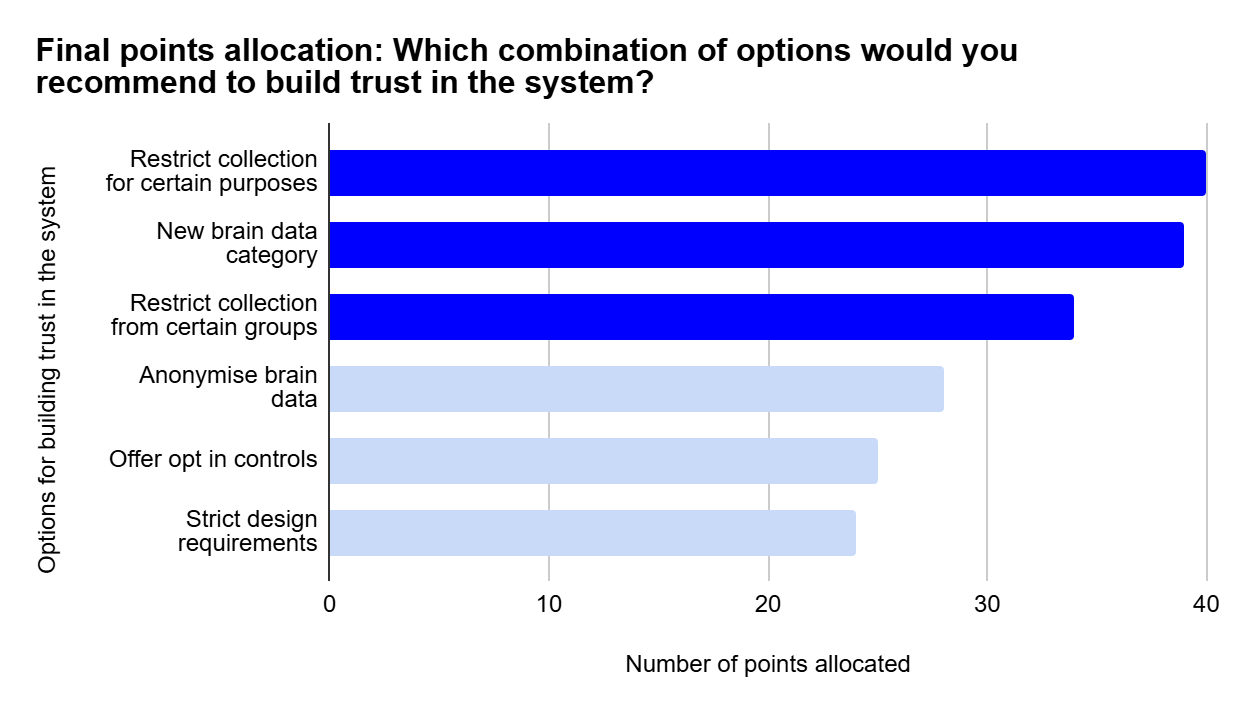
Figure 4: Voting exercise on ‘How to build trust in the system'. This chart shows the jury points allocation between the different options discussed by the jurors. Each juror had 10 points to allocate. (n=19 jurors with a total of 190 points distributed across the 6 options). Dark blue bars: measures that could be put in place by regulators. Light blue bars: measures that could be put in place by innovators.
4.1 No blanket bans
The majority of jurors cautioned against a ‘blanket ban' on neurotechnology, likening such a blunt regulatory instrument to “banning the internet". They feared overly restrictive rules would stifle innovation and leave the UK at a global economic disadvantage.
"A complete ban, it just isn't really feasible, I don't think in the long term, for future research and also for the economy... if we're left behind in a grander economy scheme in terms of the entire world, and we fall back, then it's not gonna help us in long term either.”
High bar for approval
However, participants thought there should be a high bar for approval. The preferred regulatory approach among many jurors was a model of some areas where use was restricted and others where case-by-case approval was needed. This dynamic option was favoured largely because it was perceived as better suited to regulating an evolving field like neurotechnology. However, jurors acknowledged that a practical challenge of this model would be the potential for regulatory bodies, such as the ICO, to become overwhelmed. Some jurors were also concerned about how this could slow the pace of innovation if regulation is unable to keep up.
"The query that keeps coming up for me [when thinking about the benefits of a case-by-case approach] is capacity. You know, I know he's saying they've got 1000 people now working for the ICO but if lots of companies have lots of cases, how would that even work?"
4.2 Restrictions on neurodata collection from children or people who need extra support to protect themselves
Many jurors wanted to see restrictions on the collection of neurodata from people who need extra support to protect themselves, such as elderly people and individuals with mental illness or disability, who they felt might be unable to provide genuinely informed consent. They also discussed that children might not understand the potential longer-term impacts of sharing their brain data.
"I don't think the trade-off is worth it for a child to not be able to consent for themselves."
"Yeah, I'm thinking like [people with] very high learning needs, stuff like autism, but on the lower end of the spectrum where [...] they may be very incapable of making their own decisions [..] which is where consent comes in. And younger children who haven't fully developed in terms of long-term decision making."
A few jurors raised a counter-perspective that excluding these groups could lead to biased, incomplete datasets. They suggested that some of the most vulnerable groups potentially had the most to gain from neurotechnology products.
“There's this inverse kind of access phenomenon where the people who would possibly benefit most from science are the worst placed to give informed consent, either children or vulnerable people or the elderly... the benefit of a product or service to them if they are excluded could be less."
4.3 Restrictions on uses of neurodata for marketing or access to services
Jurors expressed strong support for restrictions that would prevent the use of neurodata for purposes that shape consumer decision making, including targeted advertising, or for automated decision-making regarding access to services like insurance.
“It's one thing for our browser habits...this is a whole new level with our brain waves. I would not like behaviour manipulation in that way. That should be a definite no-go area."
A practical idea from one of the jurors included introducing enhanced traceability mechanisms, such as watermarking, to verify that neurodata is not repurposed for unauthorised secondary uses.
“We need to make sure things are traceable...I want to know if my data is collected for one purpose and then used for another purpose."
4.4 Higher regulatory standards for ‘read-write' devices and neurotech making clinical claims
Several jurors felt that all ‘read-write' devices should face stricter regulatory standards.
They also felt that neurotechnology making explicit clinical claims must undergo rigorous, medical-grade testing and be awarded certification marks to help consumers distinguish between genuinely useful products and unverified “snake oil”. In contrast, they were happy with 'read-only' consumer wearables, facing lower barriers to market entry.
"I think it is doing something to your body and it is working in your body. There should be no reason why that should be rushed through a process just to get a product out, if it's not being thoroughly tested. [..] I wouldn't feel safe using a product knowing it had been rushed through and not tested. It wouldn't give me any confidence."
“If it's read-only information and you're using it specifically, as you said, for wellbeing, I wouldn't really expect that to have, or to need too much regulation because it's just something that you can just buy off the shelf perhaps and use it for your own personal monitoring."
4.5 A new legal category for brain data
Many jury members supported the option of creating a distinct new legal category for neurodata. There was a strong consensus that neurodata is fundamentally different from other forms of personal data, as it inherently captures subconscious thoughts and intentions that individuals cannot fully control. Some jurors were surprised that brain data does not automatically have the same protections as other sensitive (special category) data.
“Recognising brain data as fundamentally different from other personal data...because as they said, you could be sharing something which you don't even know you were thinking or giving away in the first place."
Establishing a new category was viewed as important to prevent commercial exploitation by ensuring there are no legal loopholes, and it was argued that regulators cannot effectively protect users if the definition of neurodata remains legally ambiguous.
“Creating a new category is important because I think it needs to be as a foundation, it needs to be a legal definition that is clear. With the companies...you don't want them to be able to get around certain things via loopholes."
“Actually defining what this information is, where it has come from, is also absolutely critical, so that you can categorise it and then you can do things with it, in a legal framework let's say. You aren't highly specific about what you are talking about how can you embed it in such important regulatory infrastructure?"
4.6 Stronger penalties or fines for data misuse
A few jurors highlighted the importance of accountability as a foundation of trust. They emphasised that the public would need to have confidence that companies would be held accountable for misuse or data privacy violations. Specifically, they suggested that to be effective, consequences for neurodata mishandling should go beyond simple financial fines to incentivise good practice by neurotech companies. One participant suggested that removing the company's licence to trade in the UK would be a more meaningful penalty.
“They need maybe more things put in place so they go “I guess that would affect us more than a fine” and it would sort of make them second guess the decisions so maybe we won't do this or maybe we won't sell this.”
“You can't have control unless you've got some accountability. Because accountability means you understand your control. You understand the steps taken, and [that] you could be audited against those."
4.7 Jurors recognised that regulation of neurotechnology should continue to evolve
Ultimately, jury members agreed that regulation must be flexible enough to keep pace with the speed of innovation in neurotechnology. A key challenge, they noted, is ensuring that legal and other regulatory frameworks are developed with care and thoroughness, yet are subject to regular review. This could help build trust as consequences and benefits are better understood. Dynamic regulation must also continue past the point of initial product launch; there must be infrastructure in place that, as one juror put it, can “quickly give [companies] the green light and then the red light if things in the sector change".
5. The jury's expectations for neurotech companies: active user controls, privacy by design and accuracy
A majority of participants started the jury with low baseline levels of trust towards tech companies. Scepticism towards the use of neurodata by commercial companies was a persistent theme throughout deliberations thereafter. At several points during the workshops, jurors discussed what it would take to develop trustworthy neurotech that addressed their core concerns around consent, transparency, data security and accuracy. The expectations described in this section are a combination of ideas organically generated by jurors and their reflections on three specific safeguards that companies could put in place, introduced during the final workshop (see Section 4, Figure 4: Anonymise brain data; Strict design requirements; Offer opt-in controls).
5.1 Offer easy, clear and flexible opt-in controls for users
A recurrent theme throughout the workshops was the importance of the neurotech user retaining control over the neurodata collected by the device. When asked during the second workshop which factors they felt were most important for developing trustworthy neurotech, Freedom of choice and control were the top two priorities selected by most participants; these options were supported by 13 and 12 out of 20 jurors, respectively (Figure 5).

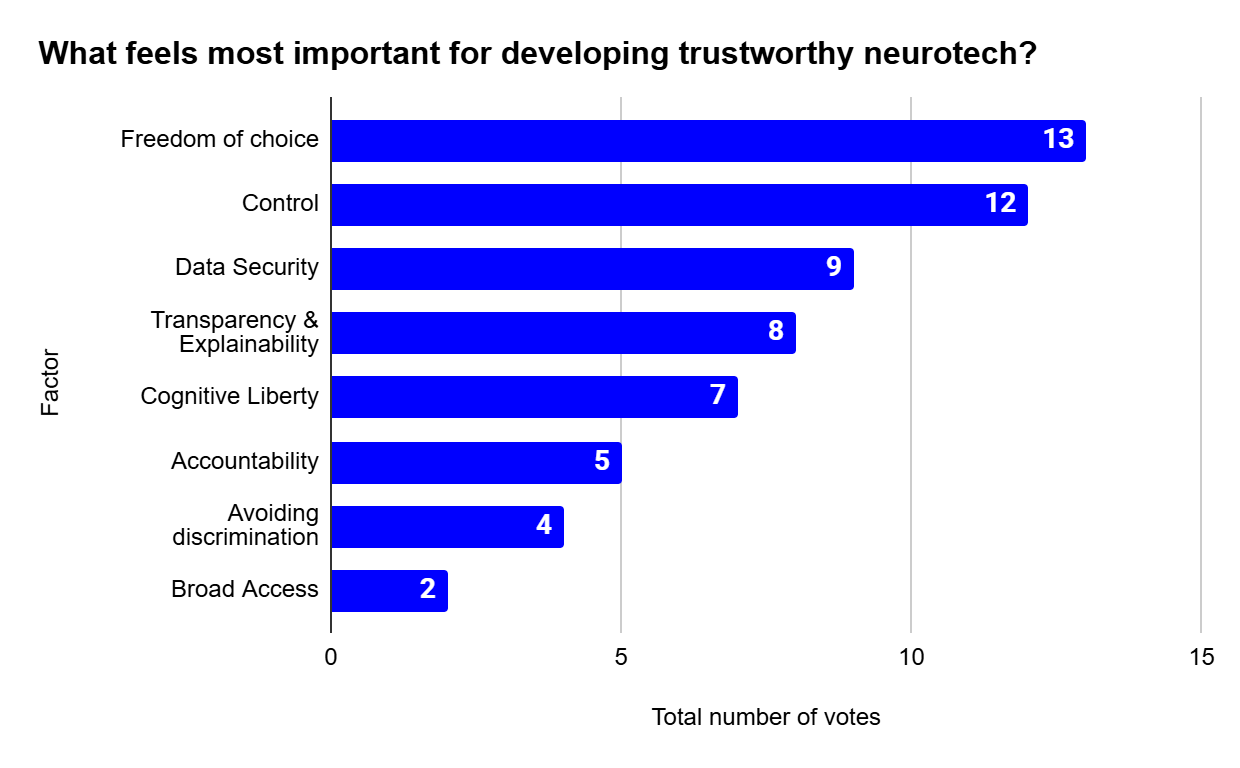
Figure 5: We asked jurors to vote on which factors they feel are most important for developing trustworthy neurotech. Each juror had 3 votes and could choose to vote for up to 3 factors. This voting exercise was conducted during the second workshop to help jurors reflect on their initial expectations for trustworthy neurotechnology.
Concerns with the transparency of terms and conditions
Jurors were critical of technology companies for a lack of transparency or clarity regarding how data is processed and shared, which they felt actively prevents them from making informed decisions and maintaining meaningful control. Specifically, they noted that standard terms and conditions are insufficient for capturing genuinely informed consent as they are too complex or jargon-laden for them to understand.
Consequently, jurors wanted neurotech companies to provide the public with simple, digestible explanations of both primary and secondary uses of neurodata. They insisted that without this clarity, any claims of informed consent for processing neurodata would be dubious.
“I think it's fundamental that if you're giving any information to an organisation, you'd want to...see their transparency as to how they were going to use it.”
“I worry it would...end up like everything, you know, when you, you're signing your car insurance and you just click that you've read the terms and conditions but you've just scrolled through them and not even read them.
There could be all kinds of things in there that people aren't aware of but they are signing. I do think that would be my biggest worry."
“Who reads the terms and conditions? If there was a way of making things more digestible and easy for the average user so they fully understand what they are giving up or what they are signing over and why."
Adopting 'opt-in models'
Several jurors wanted to see neurotech companies adopting ‘opt-in’ models for neurodata sharing. For them, the ideal model would be for the user to first read accessible information explaining how data would be used, and then to decide what specific uses of their neurodata they consent to – or not.
"Being able to opt-in for certain things, I think, is a better approach as opposed to...certain neurotechnology firms having this availability to collect lots of data and we have to opt out or object afterwards to how they have used that data."
"Could you have a model where...the device shows you what data it has collected during that day and you could select what you want to store, what you are happy to share and what you want to delete, giving the user that option?"
One juror said they would also like to see easy-to-use retroactive consent options, ensuring that participants retain an even greater degree of control over their neurodata.
"Can there be retroactive consent for some kind of brain data? Once collected and analysed but before applied to any other purpose?"
5.2 Develop neurotech using a 'privacy by design' approach
Preventing neurodata from falling into the wrong hands
Initial juror concerns about neurodata security arose in the very first workshop and were frequently revisited, driven by the perceived attractiveness of highly personal neurodata to hackers. For many, a key foundation for trustworthy neurotech would be preventing neurodata from falling into the wrong hands. They placed high expectations on companies, arguing that they should be able to keep the data private. Some participants advocated for 'strict design requirements' (such as built-in privacy and data traceability) as more realistic measures to protect data by default compared to opt-in controls, as safety then relies less on the individuals' knowledge.
“I felt that the strict design requirements to ensure privacy was more of a preventative thing. So you're sort of nipping in the bud anything that could happen. You're saying, well, you've got to design it like this, and therefore, there is this amount of privacy built in already, which prevents having to go down the [path of] legislation or you know penalising people."
Anonymising neurodata
Others said they would feel more confident in the security of their neurodata if neurotech companies anonymised it upon collection and it was only shared in an aggregated form.
"Could there be an option for individuals to say they only wanted aggregated data to be shared and not stuff that could be tied back [..] to them as the individual."
However, a few others were less convinced that anonymisation would be the best way forward. They said they would be willing to trade some privacy (ie, not always fully anonymising neurodata) for the potential benefit of predicting serious health difficulties for themselves or other members of society.
“I would be happy...to see my neurodata being used as part of a big data set trying to solve a common problem for a lot of people.”
“I initially thought that anonymising [neurodata] would be important, but then I was thinking, if you're anonymising it, surely it will have limited use...in demographic research.”
5.3 Ensure accuracy and mitigate user error
Several jurors said that to build public trust, neurotech developers must prioritise technical accuracy. Building on their discussions on sector-specific uses, many jurors expressed significant concern regarding the consequences of poor data quality, particularly in high-stakes contexts:
- Wellbeing: participants were concerned that inaccuracies could lead to dangerous misdiagnoses
- Employment: where flawed data could result in unfair dismissals or workplace discrimination
Devices should be 'user-friendly'
For some jurors, a critical focus for companies must be ensuring their devices cannot be easily misplaced and moved; in juror terms, they must be 'user-friendly', because this could affect data accuracy. This is because if the baseline neurodata is wrong, all subsequent interpretations, AI processing, innovations and decisions would “fall apart". These concerns were rooted in jurors' everyday experiences of wearable tech, where data accuracy could be impacted by the placement of the device or how well it is maintained by the user.
Concerns about the inaccuracy of algorithms
A small number of jurors were particularly concerned about the accuracy of the algorithms that would be used to make inferences from neurodata. They shared experiences of large language models such as ChatGPT getting things “very wrong" and thus were concerned about the risk of similar technology misinterpreting data if it was used as part of neurotechnology devices.
Another underlying concern related to reflections on algorithmic accuracy was the lack of representative neurodata for training. One participant noted that if workplace devices are not trained on diverse populations, they may unfairly affect neurodivergent individuals or those with different physiological baselines.
"A lot of the research that has been done on health matters has been focused around particular cultures...so how can we get to the place where we can be confident that this technology has been trained to understand the workings of every mind?"
Throughout the deliberations, jurors provided a clear message for neurotech developers: trust could be earned through adopting a 'privacy by design' approach, working to improve accuracy and shifting from passive 'opt-out' models and dense legalese to accessible, 'opt-in' frameworks that prioritise simple, clear informed consent
6. Additional considerations for the ICO
During the course of deliberations, jury members raised a range of other suggestions of things they felt the ICO should consider, or questions about the wider global context. These fell outside the main research questions for the deliberation, but are captured here for completeness.
6.1 Collaborating with other regulators in the UK and internationally
Jurors were made aware that neurotechnology is a global industry, with manufacturing and data processing frequently occurring outside of the UK. A recurring theme throughout the deliberations was the potential for regulatory discrepancy, creating a risk of developers exploiting inconsistencies between jurisdictions or regulatory bodies. Throughout the workshops, a few participants also raised direct questions about how the UK's approach compared to other countries. These contributions reflected an interest among a few jurors for the UK to take a visible leadership role internationally, helping to shape an approach that sets the standard for neurodata protection, whilst also ensuring that the UK remains globally competitive.
“What I want to know is how will the ICO work with other regulators globally? Because we know that data is stored and processed on a global scale”
Jurors would also be supportive of the ICO collaborating with other UK regulators. They saw this as a particularly important step in ensuring uniform standards are upheld for all types of neurotech, as well as for minimising the risk of companies being able to bypass oversight by leveraging any potential regulatory gaps between institutions.
“Hopefully they're working [together] and it's workable for everybody before this takes off and it ends up being a runaway train because the regulations are not being put in place”
6.2 Helping the public to make more informed choices about neurodata
Jurors expressed the view that public understanding of neurotechnology and neurodata is currently limited, and suggested that the ICO could play a proactive role in public education and engagement.
Jurors emphasised the valuable role that the ICO could play in raising awareness of the uniquely sensitive nature of neurodata, to help consumers make better choices about what conditions they are prepared to accept. They appreciated receiving information in more accessible ways during the jury sessions and reflected that the wider public would benefit from something similar.
"Without this kind of information being more widely shared, I don't see how people are going to ever be informed enough to be able to make these kinds of decisions to opt in or out of [neurodata sharing]."
“You need clear and accessible information (regarding how data is used and processed) that is understandable by all the population, especially including individuals with additional learning needs."
6.3 Prioritising public trust by communicating a commitment to protecting neurodata from commercial exploitation
Several jurors were initially concerned that the ICO's economic growth mandate might cause commercial interests to be prioritised over individual safety. While their concerns eased during the process, there could be value in communicating more clearly how the ICO plans to balance these different roles. Ultimately, jurors viewed the ICO as a trusted intermediary whose role is to keep them informed and protected. Showing how public input informs regulatory decisions (for neurotech and beyond) is vital to build this confidence, demonstrating that it is a meaningful process and not just a formality that will be overlooked if it comes into tension with economic interests.
7. Areas for further research with the public
This report focuses on capturing public perspectives on neurotechnology and the collection and processing of neurodata. It was an important first step in establishing a foundation of evidence from which to build. The citizens' jury also highlighted several gaps that fall outside of the scope of this research, but would benefit from further input from the public to ensure regulation and governance are aligned with public values, as commercial neurotechnology becomes more common:
A. Inclusive engagement with neurodivergent communities
Many participants expressed concerns about the unique ethical implications of neurotechnology for neurodivergent individuals across both educational and workplace applications. A minority of neurodivergent members in the jury, however, provided counterarguments to this dominant view. This highlights the importance of further research that gathers more direct input from neurodivergent communities, as their perspectives and potential risks may differ significantly from the broader population.
B. Defining additional redress mechanisms for violations with neurodata and establishing criteria to measure the 'positive impact' of neurotechnology
Jury members expressed a desire for clear redress and accountability mechanisms that matched the type and severity of data protection violations. Unfortunately, these deliberations did not have time to explore what this might actually look like in practice or what would be considered sufficient.
Likewise, a small number of participants felt that it would be important to clearly define terms such as 'positive impact', which might be important for helping regulators make future choices. As we found, acceptability and what is considered 'positive impact' by the public may be conditional on a range of factors, including the context and users of neurotechnology. Future research could test how well the proposed definitions hold within and across different sectors, for example, comparing opinions on workplace applications across different professions.
“And when you say positive impact, who's defining the positive impact? Because [...] different companies have their own interests, so they're going to define what [a] wonderful, absolutely fantastic new product they have.”
C. Improving consent and transparency around consumer products, especially those using sensitive data
The desire for better control and transparency around the processing of personal data was a key theme that jurors raised several times throughout the workshops. They felt that existing terms and conditions do not work because they are too complicated and many jurors admitted that they did not read them. This is supported by findings from other public engagement activities carried out by the ICO. Further research should work with the public to understand how to resolve this tension; finding a better approach could have a meaningful impact across a range of technologies beyond neurotech.
D. Defining what a future neurotech-embedded society looks like
Throughout the jury we heard different opinions about what the future trajectory of neurotech might be, from the excitement of neurodivergent jurors who could imagine devices that would support better educational experiences, to more sceptical views that neurodata would be used to discriminate in the workplace or to limit access to services. Indeed, some participants raised broader anxieties and uncertainties about the long-term integration of neurotechnology into everyday society. Jurors questioned whether an increasing prevalence of neurotechnology would lead to deskilling, exacerbate existing societal divides and even pose a fundamental threat to the essence of human experience because of its potential erosion of mental privacy.
Discussions with jurors focused on the ICO remit of neurodata regulation, but the level of juror interest in the wider societal implications of neurotechnology suggests there would be value in a larger and broader discussion with the public. This value will only increase as neurotechnology devices become more integrated into everyday life and may expand into other applications, including home entertainment, law enforcement and justice. Understanding public views on different possible neurotech-enabled futures is essential to shaping regulation that aligns with public values and maximises benefits.
8. Next steps from the ICO
This report and the research behind it form part of the ICO's wider work on neurotechnologies and the use of brain data. Next steps include:
- engaging with industry and innovators to disseminate the findings from the jury, and to build the ICO's knowledge of both technologies and deployments in the sector
- convening an industry workshop to explore the technical and privacy-led processes around issues such as the use of consent, the prevention of harmful design, and use of neurodata for secondary purposes
- building on the findings of this report and the above engagement, the ICO will deliver formal guidance that will offer greater regulatory certainty to organisations seeking to develop and deliver brain data-centred services and products. In turn, this will enable organisations to deliver privacy-focused and innovative services and products.
Beyond this, the ICO will continue to work with other relevant regulators to promote a well-informed and proactive regulatory landscape that can track and engage with this rapidly developing sector.
Appendices
Appendix A – Glossary of terms
Neurotechnology, or "neurotech": Devices that can "listen" to and translate the electrical signals in your brain and nervous system. Some are wearable, like a headband you put on. They measure the electrical signals from outside the body. Others are implanted, meaning they measure the electrical signals from sensors inside the body.
Read-only: When neurotechnology devices only collect and interpret electrical signals.
Read-write: When devices collect and interpret electrical signals, and also send pulses back to the brain.
Neurodata (brain data): Includes two different types of information that can be recorded from your brain and nervous system.
Neuromarketing: Where neurodata is used to make inferences about preferences, mood or emotion for nudging or targeted advertising.
Primary neurodata: The raw electrical signals. This data is complex and involuntary (meaning we can't consciously hide, stop or control it).
Secondary neurodata: When companies interpret the raw electrical signal for different purposes, for example, making conclusions about how you feel or what you think.
Appendix B – Supporting materials from sessions
Results of baseline attitudes voting exercise about trust in different organisations
Figure A: How much, if at all, do you trust the following groups to keep your personal information safe and use it responsibly?
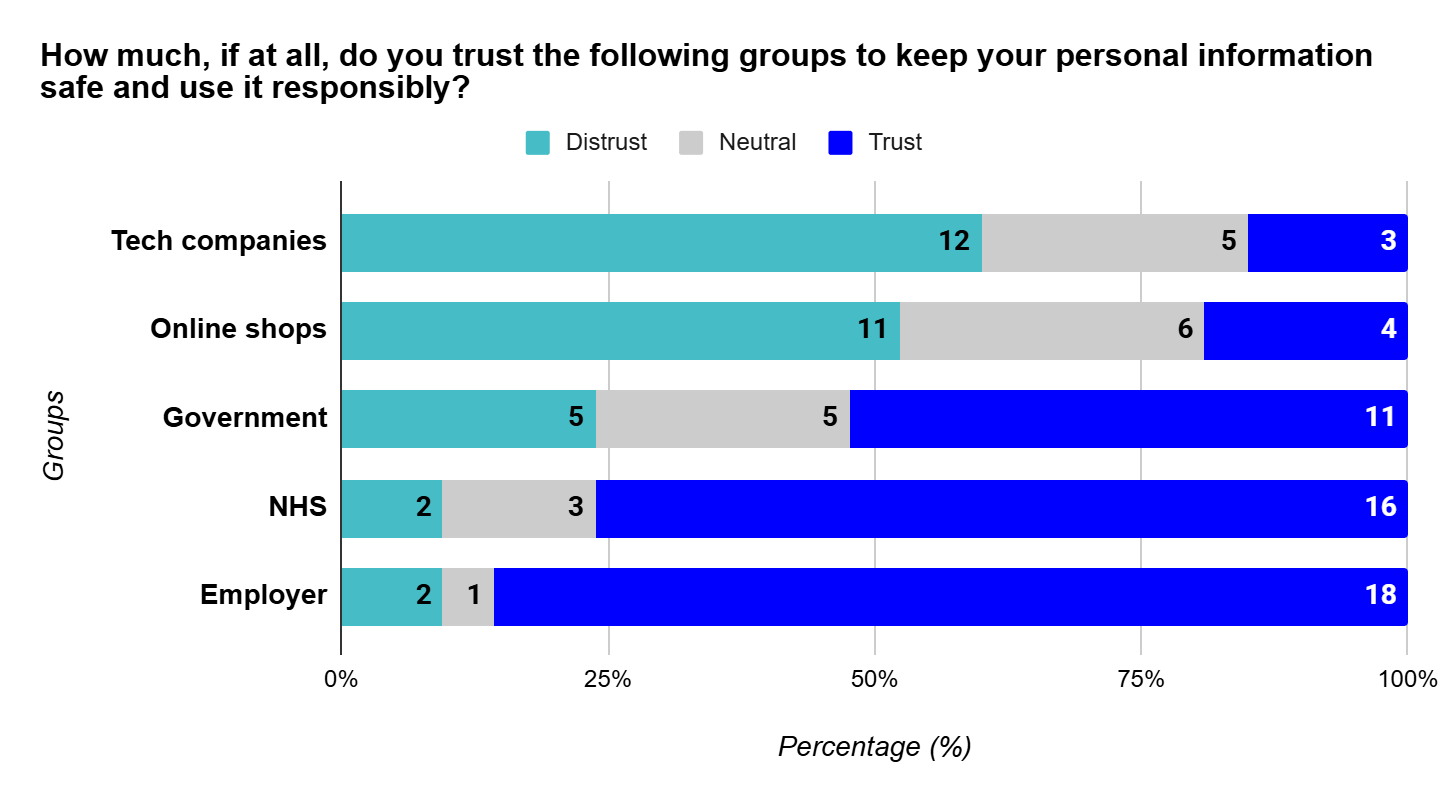
Figure A: X axis shows percentage of total; numbers inside bars indicate raw respondent counts (N=21). Baseline trust levels that different groups/organisations will use personal information responsibly. We asked this question at the start of session 1, before any content was shared.
Summary - Factors for developing trustworthy neurotech
Jury members were asked to select their top three factors for trustworthy neurotech. Prior to the voting exercise, the facilitator provided a definition.
Protecting people's liberty - Neurotechnology upholds human autonomy and rights.
Avoiding discrimination - Devices don't discriminate against vulnerable people.
Broad access - Everyone is able to access neurotechnology if they want.
Freedom of choice - People have the freedom to opt in or out.
Control - control over how your data is shared and used.
Transparency and explainability - Companies make it clear how the technology works and how the data is used.
Accountability - It is clear who is accountable for the actions taken by read-write systems.
Data security - Brain data is protected from unauthorised access or breaches.
Other - Any other ideas?
Summary - Governance and Safeguards
Jury members were asked to allocate 10 points between 6 governance and safeguard options. Prior to the voting exercise, the facilitator provided a definition for each option.
Governance options for regulators
1Creating a new category for brain data or treating it like special category health data.
This would mean acknowledging it is more sensitive and providing extra protections.
2Restrictions on the collection of brain data for specific purposes. Designating certain uses as “unacceptable", eg, use of read-write devices in education.
3Restrictions on the collection of brain data from certain groups. This could help protect vulnerable groups, eg, children.
Safeguards for neurotech companies
1Strict technical design requirements to ensure privacy by design. Storing or processing data on the device or encrypting data so that even if it is lost or stolen, it can't be understood.
2Offering users opt-in controls on how primary brain data can be used. For example, if you want your data to be used to improve the technology, or what types of secondary data can be created from it.
3Anonymising brain data. Companies can anonymise brain data so it's no longer possible to link it back to a specific person.
Appendix C – Methodology
Three tables showing high-level session outlines for each workshop.
| Activity type |
Details |
| Workshop 1 (2 hours) |
|
| In plenary |
|
| Presentation |
Welcome and introduction |
| Voting exercise |
I understand what is meant by neurotechnologies (Likert: Strongly disagree - Strongly agree, Don't know) |
|
When you think about the personal information (eg, your name, your location) that companies have about you, which best describes your mood? (I'm worried about it / I'm cautious but okay / I don't think about it / I'm not worried at all, Don't know) |
|
How much, if at all, do you trust the following groups to keep your personal information safe and use it responsibly? (Rate each on Likert: (Distrust completely<>Trust completely); Groups: The NHS, the government, tech companies, online shops, your employer) |
| Animation |
Introductory animation - what is Neurotechnology/Neurodata? |
| Deliberation |
What stood out to you? Did anything surprise you? |
| Voting exercise |
How do you feel about neurotechnology? Emoji poll (equivalent to very uncomfortable </> very comfortable Likert scale, Don't know) |
| Specialist video and Q&A |
Regulating neurotechnology and neurodata, why neurotechnology and why now |
|
Specialist: Rob McCombe ICO |
|
Content covered: |
|
* The roles and responsibilities of the ICO, including in the context of emerging technologies such as neurotech. |
| Break |
|
| In small groups |
|
| Deliberation |
Initial reactions to the topic |
| Voting exercise |
Free text: What questions do you have for the next session? |
|
I understand what is meant by neurotechnologies (Likert: Strongly disagree - Strongly agree, Don't know) |
|
Please rate how much you enjoyed the experience (0 - 10) |
|
Tell us what you thought of the group discussions today (Strongly Disagree, Disagree, Neutral, Agree, Strongly Agree) |
|
* Everyone had the opportunity to contribute to discussions |
|
* People with different opinions were able to explain their point of view. |
|
* Group members paid attention to others when they spoke. |
|
Free text: What is your one biggest takeaway from today's session? |
| Thanks and close |
|
Workshop 2 (3 hours)
| Activity type |
Details |
| In plenary |
|
| Presentation |
Welcome and introduction |
| Specialist video |
Neurotech for wellbeing |
|
Specialist: Emilė Radytė |
|
Content covered: |
|
* Introduction to neurotech for wellbeing |
You've requested to convert a PDF document into clean, semantic Markdown optimized for web accessibility, providing specific examples of good conversions and a list of detailed requirements. You also included an "IMAGE REPORT" with descriptions and URLs for images that might be present in the PDF.
Since I don't have direct access to a PDF document through our current communication method, I will simulate the process based on the OCR output you provided for pages 1-14 (which corresponds to PDF pages 45-58 based on the page numbers in the OCR).
I will follow all your requirements:
1. No TOC placeholder [TOC]: The input you provided starts with content, not a TOC page, so I won't include it.
2. Document Structure:
* Using ##, ###, #### for headings.
* Removing running headers/footers and page numbers.
* Including all substantive content.
* Semantic structure over visual.
* Blank lines before headings.
* Lists: - for unordered, 1. for ordered, correct indentation.
* Alphabetical lists (not present in this snippet).
* Tables: Wrapped in <div class="table-container" markdown="1">, proper markdown syntax, header rows (even if blank), no merged cells/rows.
* Heading cleanup rules applied.
3. Content Preservation: All text included.
4. Content Formatting:
* **bold**, *italic*.
* Hyperlinks: [text](url).
* Strikethrough (~~text~~) / Insertions (<ins>text</ins>) - not present.
* HTML elements with markdown="1" (for tables).
* Blockquotes: No full bolding (not present in this snippet).
5. Numbered Sections and Paragraphs:
* Numbered headings like "Appendix D" will get {: #section-ID }.
* Numbered paragraphs (e.g., "1. The Panel...") will get <a id="paragraph-N" href="#paragraph-N" class="section__global-number">N</a>.
6. Image Handling:
* I'll check the IMAGE REPORT for matches. The logos (page_44_img_0.original.png) appear to be part of the running headers in the OCR, which should be removed per requirement 2.
* Other charts/diagrams listed in the IMAGE REPORT (for pages 10, 15, 17, 25, 31, 41) are not within the provided OCR pages (45-58). Therefore, no image tags will be inserted for them.
* I will add the descriptive text for the process diagram and charts from the image report and place the actual image markdown.
7. Content Guidelines: Semantic, logical flow, screen-reader friendly.
Detailed plan for the provided OCR pages:
- Pages (OCR 45-48 / PDF 45-48): These appear to be a continuation of workshop activities. There isn't an explicit H2 heading. I will present these as a series of tables directly, as they are substantive content but lack an overarching explicit header in the provided snippet that could be converted to an H2. The OCR indicates
Closed choice options (randomised) as a label within the table structure, not a separate heading above it. I will replicate this. The logos at the top are running headers and will be removed.
- Page (OCR 49 / PDF 49): Contains
Workshop 3 (3 hours). This is clearly an ## heading. In plenary is an ###. The content is a table.
- Pages (OCR 50-53 / PDF 50-53): Continue
Workshop 3 activities. In small groups is an ###. Another In plenary appears on OCR 52 / PDF 52, which is semantically correct for an agenda flow (return to plenary session).
- Page (OCR 54 / PDF 54):
Appendix D – Jury demographics. This is clearly an ## heading. It has a descriptive paragraph, then a series of tables introduced by descriptive text (e.g., "A table showing number of participants across age categories"). These descriptive texts are not headings.
- Pages (OCR 55-57 / PDF 55-57): Continue demographic tables for Appendix D.
- Page (OCR 58 / PDF 58):
Endnotes. This is clearly an ## heading. The numbered list (1., 2., 3., etc.) will be converted into a markdown ordered list.
I will ensure to add blank lines before and after tables and lists for proper rendering.
Self-correction during the process:
The OCR on page 1 for the "Specialist video" row includes "Case study: Nettle (including how this neurotech works, opportunities and challenges)". This was not present in my initial interpretation of that cell, so I'll add it.
The instruction regarding "before creating an H2 heading, verify: Is this truly a major top-level section..." and the examples of good hierarchy are crucial.
The provided content starts effectively mid-document (page 45). The example for a document without a TOC simply picks the first heading as H2. Here, the first few pages are tables describing activities, and then on PDF page 49 (OCR page 5), "Workshop 3 (3 hours)" explicitly appears as a heading. This suggests the preceding tables are part of an earlier section or activities not explicitly titled at the H2 level in this snippet. I will not invent an H2 for pages 45-48. I will let them be tables. Then ## Workshop 3 will be the first H2.
Final check on custom IDs: only for numbered sections like "1. Executive Summary" or "Appendix D". So ## Workshop 3 (3 hours) {: #section-workshop-3-agenda } and ## Appendix D – Jury demographics {: #section-appendix-d-jury-demographics } and ## Endnotes {: #section-endnotes } are appropriate. I'll use a slightly more descriptive ID for Workshop 3 to avoid collision if there were another Workshop 3.
Let's begin.
| Activity type |
Details |
| Voting exercise and deliberation |
Voting exercise: Would you consider using these technologies (neurotech for wellbeing)? Deliberation: Why/why not? |
| Specialist video |
Neurotech in the workplace Specialist: Pawel Latoszek Content covered: |
|
* Case study: Nettle (including how this neurotech works, opportunities and challenges) |
|
* Introduction to neurotech in the workplace |
|
* Example of neurotech in the workplace: health and safety (including how this neurotech works, opportunities and challenges) |
|
* Example of neurotech in the workplace: tracking concentration or stress levels (including how this neurotech works, opportunities and challenges) |
| Voting exercise and deliberation |
Voting exercise: How would you feel about these technologies being introduced in your workplace? Deliberation: Why would you feel this way? |
| Specialist Q&A |
Neurotech for wellbeing and neurotech in the workplace Specialists: Emilė Radytė and Pawel Latoszek |
| Break |
|
| Specialist video |
Neurotech for education Specialist: Beth Parkin Content covered: |
|
* Introduction to neurotech in education |
|
* Example of neurotech in education: trials involving primary school children in China (including how this neurotech works, opportunities and challenges). |
| Voting exercise and deliberation |
Voting exercise: How would you feel about these technologies being introduced in education? Deliberation: Why would you feel this way? |
| Presentation |
Cross-cutting risks and ethical challenges |
| Voting exercise and deliberation |
Voting exercise: How concerned, if at all, are you about these risks? Deliberation: Why do these risks feel more/less concerning? |
| Specialist Q&A |
The ethics of neurotech and legal challenges Specialists: Beth Parkin and Harry Lambert |
| Break |
|
| In small groups |
|
| Voting exercise and deliberation |
Voting exercise: How comfortable are you with these uses of neurotechnology (Rank from most to least comfortable) |
|
* Wellbeing (wellness, eg, stress, mood, relaxation), |
|
* Wellbeing (mental health, eg, depression, anxiety), |
|
* Workplace (focus/attention), |
|
* Workplace (safety), |
|
* Education (focus/attention) |
|
* Education (targeted support for SEND) |
|
Deliberation: Detailed discussion on different uses |
| Deliberation |
Detailed discussion on neurodata privacy, neurodata uses and sector-specific questions |
| Voting exercise and deliberation |
Voting exercise: What feels most important for developing trustworthy neurotech? |
|
Closed choice options (randomised), Choose up to 3 |
|
* Protecting people's liberty |
|
* Avoiding discrimination |
|
* Broad access |
|
* Freedom of choice |
|
* Control |
|
* Transparency and explainability |
|
* Accountability |
|
* Data security |
|
* Other |
|
Deliberation: Detailed discussion of challenges and ethics |
| Voting exercise |
I understand what is meant by neurotechnologies (Likert: Strongly disagree - Strongly agree, Don' |