Episode Transcript: The Fix — Fixing Britain's Housing Crisis
Host: Ravi Gurumurthy (Chief Executive, Nesta)
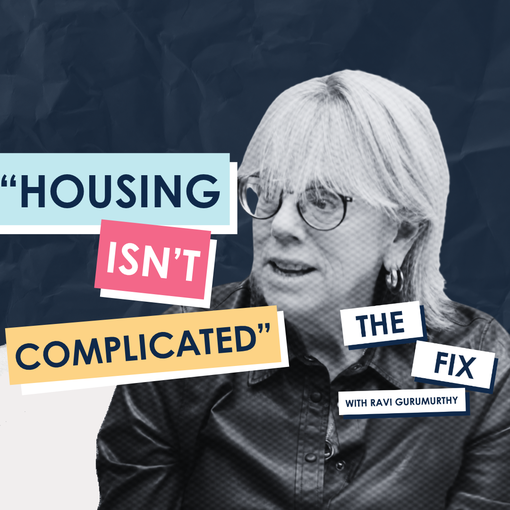
Guest: Polly Neate (Former Chief Executive of Shelter; Crossbench Peer)
Chapter 1: Introduction
Polly Neate: [0:04] He'd have been the last person that I would have expected to hear saying, "We have got to have more social housing in the village." But he was saying that because the pub's going to close; there's no one to work in it. The school's going to close; there's no one to work in it. The shops are going to close. And it actually is hollowing out that community, and even somebody in his position can see that.
Ravi Gurumurthy: [0:30] Hello, I'm Ravi Gurumurthy and welcome to The Fix. This is the podcast where prominent people from across British public life come to talk about the biggest challenges we face in the UK and how we sort them out for good.
Why does this matter to me? Because I'm chief executive of Nesta, the innovation foundation working to find solutions that make a genuine difference and improve the lives of people across the country.
Today we're looking at housing. More than 177,000 children in England are living in temporary accommodation, and...
Chapter 2: Is fixing housing simpler than we make it?
Ravi Gurumurthy: [1:01] ...the government's own forecasters now expect fewer homes to be built in this Parliament than in the last one. So what would it take to end Britain's housing crisis?
My guest has spent years campaigning on exactly this. Polly Neate ran Shelter for nearly eight years, and before that Women's Aid. She now sits in the House of Lords as a crossbench peer. What would she change and what's her fix?
Polly Neate, welcome to The Fix.
Polly Neate: [1:23] Thank you. Lovely to have you.
Ravi Gurumurthy: [1:26] You once had a brilliant quote which was: "If I had a thousand quid for every bloke that said housing is a lot more complicated than I think it is, I could build the bloody social housing right now."
Polly Neate: [1:37] I did say that. I remember saying that!
Ravi Gurumurthy: [1:41] So it begs the question: is it simpler than we make it?
Polly Neate: [1:44] Yeah. If what you mean is: is solving the absolute emergency in our housing simpler than we make it? The answer to that, I think, is yes.
Ravi Gurumurthy: [1:54] Mhm.
Polly Neate: [1:54] But we have a lot of very simple slogans these days. That quote predates "Everyone In by Christmas", for example, which I would say makes it somewhat more simple than it is.
It depends what you're talking about really, and it all depends what in your mind the housing crisis is. In my mind, it's the fact that in this country, if you're on a low income, you cannot afford—and increasingly this is in the vast majority of the country—you cannot afford a decent home. That is what I mean by it.
I think we're seeing in Europe the real warning signs of the level of social disenchantment and disenfranchisement that that can create, and where that could ultimately go. I think it feeds the divisions in our society. So when I say "housing crisis", that's what I'm talking about, and I think the solution to that is quite simple: it is social housing. It is for the government to invest in building more social housing than it currently seems to have the political will to do.
So yes, it's that simple. But of course, you've got to be careful with slogans...
Chapter 3: Why governments get bogged down in policy detail
Polly Neate: [3:10] ...because, just like the government's just found—I couldn't believe it when I saw it last week, I can't remember who it was, was quoted as basically saying, "Oh, actually we're not going to manage Everyone In by Christmas because there isn't enough social housing." No!
Ravi Gurumurthy: [3:28] Do you think we sort of overcomplicate the issue of housing in some way, and what are the areas where we kind of make a meal of it, I suppose?
Polly Neate: [3:38] I think of course there are policy fixes that need to be in place to smooth the path. But every government I've ever worked with on housing—which, bearing in mind how many changes we've had over the last decade, is quite a few—every government I've worked with has focused on policy detail: "How can we tweak planning?" that kind of thing, rather than focusing on getting the political will and making the argument to the British public for a significant level of investment in social housing.
So I think that's simple, but it's incredibly radical. If we're waiting for growth as a prerequisite for making that investment, we're getting it completely the wrong way round: that investment is a vehicle for growth. It's an engine of growth.
Chapter 4: Social housing or more homes of every kind?
Polly Neate: [4:30] Yeah, so I think we're just getting things in a muddle by getting bogged down.
Ravi Gurumurthy: [4:37] I mean, you jump straight to building social housing, but I guess what's the outcome that we care most about? Isn't it housing becoming affordable to people?
Polly Neate: [4:47] Yeah.
Ravi Gurumurthy: [4:48] And that could take you to the government's actual target of 1.5 million homes built in a Parliament, that they're not going to meet.
Polly Neate: [4:54] Exactly.
Ravi Gurumurthy: [4:55] Would you be very happy with that focus on that original target? Because that's not primarily about social housing; it's all sorts of homes being built. The reason I say it is that it sounds like Andy Burnham has deprioritised that target and is much more focused on social housing. And I would question that, because to really get to affordable housing for everybody, I think it's more about the total homes that have been built rather than just focusing on the social side.
Polly Neate: [5:21] So it depends, as I was saying, on what you think the crisis is. I think the most urgent thing to fix—from the point of view of social justice, fairness, and dealing with the level of disenchantment and disinvestment in our country that we're seeing—I think social housing is the right way to go. So I think Andy Burnham's right on that. I don't think he's putting enough money into it, I don't think he's doing enough of it, but I think his shift of focus is absolutely right.
Chapter 5: Where the 90,000 social homes a year target comes from
Polly Neate: [5:55] We do need more of all types of housing, yeah, but I think we have to make social housing the priority.
Ravi Gurumurthy: [6:03] So what kind of target would you have around social housing? Do you have a particular number in mind?
Polly Neate: [6:11] Well, when I was at Shelter, shortly after I started and in the wake of the Grenfell Tower tragedy, we launched a commission on social housing, and that's where the 90,000 social homes a year target comes from. People can find that report on the Shelter website if they want to—I mean, that was published in 2019, so it is quite old now—but that target is still what, within the housing sector, most people agree is what's needed in order to ultimately have a situation where there are enough properly affordable social homes for the people that need them, where we see those waiting lists coming down—there's a huge waiting list for social housing at the moment—and where we really see an impact on homelessness.
Ravi Gurumurthy: [6:56] And so in an ideal policy framework, you would still keep the overall target for new homes being built for the long term...
Polly Neate: [7:05] Yeah.
Ravi Gurumurthy: [7:07] ...for sort of 300,000 a year, but within that you'd have a much higher proportion of social housing as part of that target.
Polly Neate: [7:14] Yeah, and that does require a far greater level of investment from government. I can remember going in for my first meeting with Michael Gove when he became Secretary of State at MHCLG—Ministry of Housing, Communities and Local Government—when he first got into that job, because he was in that job twice, if you remember, in different switches around of government. I remember the first meeting I had with him: I went into his office and he had a whiteboard on the wall, and on the whiteboard was written quite a short list of priorities, and "Build more social homes" was at the top right. So he 100% got it, and the Labour government now...
Chapter 6: Council housing or housing associations?
Polly Neate: [7:59] ...100% gets it, but it's the political will to actually do it that I think we're still struggling with.
Ravi Gurumurthy: [8:08] So there are two kind of particular questions that I think are interesting here. One is why build certain types of tenure versus others—so we could say why social housing versus private rental or others—but let's actually keep within the social bucket, because one of the things that Andy Burnham's particularly focused on is council housing. He said, "Actually, I don't want this target just to be about housing associations." It's not quite clear what actually is happening on that front, but does it matter whether it's council housing or housing association housing that builds social homes?
Polly Neate: [8:37] To me?
Ravi Gurumurthy: [8:39] Yeah.
Polly Neate: [8:39] No, it doesn't matter. When Boris Johnson was Prime Minister, I once said I don't care if he calls it "Boris building" if he does it! I don't think it matters.
I think there's quite a lot that needs to change in terms of local authority funding in order for them to be able to do that, but either way it requires a far greater level of investment. And housing associations are currently tied up in having to build commercial housing in order to fund the delivery of social housing, and that is automatically restricting the amount of social housing that can be delivered. That's not their fault; that could be changed.
So to me, I'm neutral about who delivers it. Where housing associations do have an advantage is they're meant to have a social purpose. I'm a non-executive director on the board of a housing association, Abri, that absolutely does align its social purpose, and I can hear how that social purpose is behind every decision that's made. That is not the case across the housing association sector, so that is an issue. But ideologically, if you like, I'm neutral on that.
Chapter 7: Why private renting isn't the answer
Ravi Gurumurthy: [10:06] And what about with private rental? Because if the government strengthened the protections for...
Polly Neate: [10:13] Yes, which I campaigned on at Shelter for many years!
Ravi Gurumurthy: [10:16] Exactly. So if you have stronger protections for those renting, what is the problem with relying even more on a private rental housing market?
Polly Neate: [10:25] Well, because it isn't going to ever be as genuinely affordable as social housing is going to be.
Ravi Gurumurthy: [10:34] Isn't that a function of the supply of how many houses are actually built?
Polly Neate: [10:38] No, I think it's a function of—and this isn't a criticism of why landlords are in the rental market—they're in it to make a profit over a shorter time span than the payback on social housing.
Ravi Gurumurthy: [10:53] But often they're getting subsidised through Housing Benefit, aren't they?
Polly Neate: [10:58] Well, that's another problem. Do you really want to dump this finance into the benefit system, rather than an investment that will actually pay back to the state if it's social homes?
I just can't see the argument for it. We've now got Housing Benefit—I don't know the annual Housing Benefit bill figure off the top of my head anymore, but last time I checked it was over £30 billion. Bearing that in mind, I worry about any social policy area that relies on the benefit system to take the strain of a lack of investment elsewhere, partly because benefit recipients are quite stigmatised. So actually, if you do that—and we see this in other policy areas too—you can always cut the benefits another time. You can cap Housing Benefit; that's politically very easy to do, it makes people homeless, and it messes up the private rental market. So I would be very wary of allowing the benefit system to take the strain there.
I think the fact that private landlords are subsidised by Housing Benefit is not an argument for private renting; it's an argument against it.
Chapter 8: Is the housing crisis a funding problem?
Ravi Gurumurthy: [12:13] So is the core problem then one of funding, and is it simply about how much money we've allocated to capital, when we're actually spending a lot on temporary accommodation and on Housing Benefit? If it's basically a spending problem, there is some degree of savings that you could offset if you get that right, because you might be spending less on temporary accommodation and benefits...
Polly Neate: [12:39] And actually, just to say, local authorities are having to spend the money they should be spending on preventing homelessness on temporary accommodation for people who are homeless. That's where we're at. So we're not investing in preventing homelessness; we're investing in picking up the pieces of the fact that we don't have properly affordable homes.
Ravi Gurumurthy: [13:03] And is there any way of being quite innovative with that potential stream of revenue spend for temporary housing and using that to actually build more homes? So could you say, "Look, we're going to spend £3 billion every year for the next 10 years—can I roll that up and borrow against the savings and then invest that in new council or housing association builds?" Is that an idea that's been tried and failed, or has it just not been tried properly?
Polly Neate: [13:31] It might be an idea; I can't see that generating enough. I don't see that generating enough, so I think we have got to be talking about central government generating that spend, not just local government.
It's very, very difficult to shift spend from the emergency side of things to the prevention side of things because there's an element of double running there, isn't there? You can't just turn off the tap immediately on picking up the pieces of whatever social policy failure you're talking about—housing is only one of those—you can't immediately turn off that tap in order to generate money that you can spend at the prevention end.
Ravi Gurumurthy: [14:17] Mhm.
Polly Neate: [14:18] So you have to be willing—and this I think does have to be the government—to really seriously invest in prevention. And again, Andy Burnham has talked about this; he's talked about the "preventative state", and if that's an indication of direction, then great.
Chapter 9: Is regulation making new homes too expensive?
Ravi Gurumurthy: [14:38] Yeah. The other way to try and get more homes built is also to try to make the cost of building those homes cheaper. Many in the sector—not necessarily in the social housing sector—would say that regulation gets in the way, whether that's environmental regulation, safety, or requiring certain heat pumps, for instance, or environmental standards. What's your view about the regulation of housing? Have we got the right balance between those wider objectives and low-cost homes, or do we need to remove more of the regulatory burden?
Polly Neate: [15:16] I think we've seen a lot of examples of what can happen when homes aren't safe, and it's really frightening. So yes, safety costs money. Being more environmentally friendly and responsible costs money. That's right.
I don't see it as being an either/or. I know some housebuilders do, but I don't think it's right to see it as an either/or. I think if we're going to build homes, we have to build decent homes for people to live in. I'm not talking about palaces here; I'm talking about homes that are safe. And I think we do have a responsibility to try and make new homes environmentally friendly. It's actually a lot cheaper to build a new home that is environmentally sensible than to retrofit existing stock to do that. So I've heard that argument, yes, and I've heard it made, but I don't think it should be an either/or.
Ravi Gurumurthy: [16:22] So if you take your example of environmental regulations, there are these things called "zero-bill homes" that some people build, and it might only cost £9,000 or £10,000 up front to put in place really good insulation, solar panels, battery, and heat pump, and they will actually guarantee zero bills for five years. It's interesting that housebuilders complain about that because of the upfront cost it increases, even though obviously it saves money over a long period of time.
Polly Neate: [16:53] Well, this whole story is about people not wanting to invest money in order to save money over a long time, or in order for a long-term payback on that investment. The thing about housing is that culturally we see a house or a home as an asset, not primarily as somewhere to live. So it's about building something you can rent out for maximum profit, or building something you can sell on, or getting a bit of land that is going to massively increase in value. It's all treated as an asset, rather than: how do we maximise this economy, if you like, in order to create decent homes that people on low incomes can afford to live in?
That is a significant cultural shift now. It wouldn't have been many decades ago—it wouldn't have been when I was a child, for example—but it's a significant cultural shift now, and it needs really bold leadership to do it. I guess I'm hoping that what we're hearing Andy Burnham saying is the start of that sort of bold leadership.
Chapter 10: NIMBYism and bringing communities with you
Ravi Gurumurthy: [18:12] So we've focused so far on social housing. That's got quite a big price tag attached to it if you're really going to build 90,000 homes.
Polly Neate: [18:19] Absolutely. It does have a huge price tag.
Ravi Gurumurthy: [18:20] A big price tag, yeah, which is challenging right now given all the other pressures fiscally and the lack of growth and so on. The other dimension to this, though, is just building more houses generally—for private rental or ownership. That's where you get into the planning system and also NIMBYism, and how you tackle that. So I just want to cover some thoughts on that.
One question is: how do you get local authorities to make decisions and release land when there are local pressures to not necessarily build? And also, where should that decision sit? Should it sit with the local authorities? Should it sit ultimately with the combined authority, the mayor, strategic authorities? Or should it sit even higher up in government? Should we call in every development above 50 homes rather than, say, 150 homes, so that we don't allow local pressures to bias the decision in favour of the incumbents rather than the people who haven't got on the housing ladder?
Polly Neate: [19:19] I do think that it's better to bring local communities with you when it comes to changing their living environment. If you do a significant housing development, you're not only creating an environment for people who are going to live in it; you're changing the environment for everybody around it. And I do think it's better if you can bring local communities with you.
Some of that is about people understanding the issues. It's about what the homes that are proposed to be built actually look like. It's about who they're for—so in particular, are they for local people?
I do think that increasingly—not even just in rural areas—there is an acceptance that the lack of affordable housing is part of what's hollowing out rural communities. So I'm much more hopeful that NIMBYism could be overcome at the local level. In general, if people are resistant to building in their local area, I don't think if they feel that decision's taken further away from them, or higher up in the chain, that's going to make them feel better about it. In fact, I think it's probably going to make them feel worse about it.
On the other hand, you can enforce building targets. So I think it's a balance between the two. There are examples of where—and actually, NIMBYism is worst when it comes to social homes traditionally. Very interesting, though: not that long ago I had a conversation socially with somebody that I met who lives in a very, very rural area in a village, used to be chair of the local Conservative Party and parish council, has always lived in that area, lives in a big house in that village—and he'd have been the last person that I would have expected to hear saying, "We have got to have more social housing in the village."
But he was saying that because the pub's going to close; there's no one to work in it. The school's going to close; there's no one to work in it. The shops are going to close; the only shops left in that village are for tourists. In the summer there's loads and loads of tourists, there's increasingly a lot of second homes, and it actually is hollowing out that community, and even somebody in his position can see that.
Ravi Gurumurthy: [22:03] So you're getting recognition. You're optimistic that if you get it right, then you can bring communities with you and therefore make the local politics work.
Polly Neate: [22:16] I'm relatively optimistic. I think it requires a lot of work on the part of local government in order to achieve that. They've really got to lean into it and bring people with you, and I do think it's a lot more effort and it might be slower than just mandating from on high. So I think there's got to be a mixture of the two.
Ravi Gurumurthy: [22:42] I guess it's just making sure we've got a failure regime. So if you can't actually meet the target for your houses, then maybe we do move towards more things being called in at a 50-home level rather than 150-home level, and have the Planning Inspectorate boosted so it has the capacity to make decisions quickly. I think speed is really important.
Polly Neate: [23:03] Yeah—the speed of decision-making and the mechanisms of how people are consulted and brought along on the journey. I think at the moment very few of these conversations feel genuinely consultative.
Chapter 11: Developers, land banking and homes as assets
Ravi Gurumurthy: [23:24] The other dimension to this is not just the planning system and how you open up more land, but also the decisions that developers make. Now, one criticism of them is that they're only going to drip-feed—they're only going to build a certain amount of homes because otherwise they'll flood the market and prices will drop. Now, that's just a rational economic thing for them to do...
Polly Neate: [23:46] Yeah.
Ravi Gurumurthy: [23:47] ...but it probably does mean that the total numbers that get built out are not what society would want.
Polly Neate: [23:54] Totally.
Ravi Gurumurthy: [23:55] Do you agree that that happens, and what do we do about it?
Polly Neate: [23:59] It does happen, for sure. And I do think that's part of what I was talking about really—about how we see land and what we build on land as an asset rather than as a home.
My real interest is in social housing, and I think that does need government investment and targets behind it so that it actually happens and happens at pace. In terms of how developers then make their profits—yeah, I mean that's up to them; that's their problem.
Ravi Gurumurthy: [24:41] The other way people will say we tackle this problem of developers sitting on land is that actually we just need to stimulate the market more. One justification for the latest incarnation of the subsidy for first homes—I think it's called First Homes now, it was called Help to Buy—is that we actually might encourage more building to happen. What's your view of the track record of Help to Buy-type schemes? Are they a useful complement, or a distraction, or even harmful?
Chapter 12: Has Help to Buy worked?
Polly Neate: [25:12] I think they have been a problem for the actual homeowner in a lot of cases—particularly shared ownership. I think there's a lot of dissatisfaction among people who have bought into shared ownership; they feel mis-sold, basically.
Ravi Gurumurthy: [25:31] Yeah.
Polly Neate: [25:32] Yeah, they do. So I think that has caused a lot of problems. And a lot of the incentivising—so Help to Buy, for example—in the main has helped people who ultimately would have been able to buy anyway, maybe at a later date. It hasn't transformed the first-time buyer market in the way that possibly the hype around those kind of products indicated it was going to do. I don't think they've fulfilled their promise.
At the same time, I do fully accept the frustration of people who—when I think about the age at which I bought my first home, I mean I'm old, you know—it's totally unrealistic now for most people. But as I say, I think if you're going to really transform that, you need something a lot more radical. It's not my expertise, though. I guess the main thing I would say about first-time buying is: let's not make it Right to Buy!
Ravi Gurumurthy: [26:43] Right.
Chapter 13: Rough sleeping and "everyone in by Christmas"
Ravi Gurumurthy: [26:44] I just want to finally end on rough sleeping, because that's an area where obviously the Prime Minister made a big commitment in his first days in office to end rough sleeping—something he tried to do in Manchester.
I was going to get you to reflect: you've been involved in housing for a long, long time. If you think back to the first attempt under the Tony Blair government to end rough sleeping, where a target was set to reduce rough sleeping by two-thirds—which was met—and then obviously it's now got worse again. It's not just a housing problem; it's very much a problem that's related to many different agencies given the reasons people are on the streets. What's your advice to the government on how to actually tackle rough sleeping this time? Is it a very similar problem, or has it changed in scale and nature?
Polly Neate: [27:37] I think it's changed because—I know I'm going to sound like a broken record here—you cannot solve homelessness without homes. The clue's in the word "homelessness": it is about people not having a home.
Rough sleeping actually is also about people not having a home. There are other things a lot of people who are rough sleeping need. Some of those needs are not necessarily causes of their rough sleeping; some of them are consequences of it, or they're the consequences of other failures in public services and the failures of prevention which I've talked about previously.
So I think there's a lot that needs to be done across public services about thinking about how you prevent homelessness in terms of people who are currently rough sleeping—otherwise there's just going to be a pipeline of rough sleepers. That's partly about affordability, partly about benefits, and some of it is about mental health services and so on. Some of it—domestic abuse is a major factor, which needs to be thought about in a different way if it's not going to feed into homelessness.
So there's a lot of stuff that is around prevention, but ultimately, if you're going to get people off the streets, you have to have somewhere to put them. And honestly, as I said right at the beginning, when I heard the minister saying, "Well, actually, we won't be able to get everyone in by Christmas because we haven't got enough homes," it was just like... yeah, no surprise there!
It was really frustrating because you could have foreseen that right at the beginning. And if I hear one more person say, "We did it in COVID, so we can do it again"—in COVID, you had a load of empty hotels. Now, you do not even have a load of empty temporary accommodation, never mind a load of empty homes. There's a crisis in temporary accommodation supply, which is ridiculous because of the amount of people who are homeless. So if you're adding the rough sleepers into that, you're just adding to the temporary accommodation crisis—and we see that even on the asylum-seeking side, where that whole debate has got much, much worse because of hotels. So it comes back to the same issue.
Chapter 14: What the end of no-fault evictions will change
Ravi Gurumurthy: [30:07] Yeah. One dimension to why people end up homeless has been no-fault evictions, which ended in May—which is a big campaign of Shelter for many years. What sort of difference might that make?
Polly Neate: [30:20] Well, it will make a difference because it takes away the right of a landlord to evict somebody for no reason. There is still a danger that people are kind of evicted by the back door through rent increases, so it hasn't made private renting not a route into homelessness.
But it has given people more breathing space and more ability to challenge bad conditions, for example, without being evicted as a result of the fact that the landlord, just after six months, wants to get rid of you, paint over the stuff you were complaining about, get someone else in, and the cycle goes round. Before you get all "not all landlords" on me—obviously not all landlords, but at the bottom end of the market that was a real issue. So I think the end of Section 21 is going to help.
Chapter 15: The idea Britain should copy from Australia
Ravi Gurumurthy: [31:23] Final two questions. What's one idea from anywhere in the world that Britain should adopt?
Polly Neate: [31:29] Does it have to be about housing? Because actually it's about wider justice and fairness.
Ravi Gurumurthy: [31:35] No, it doesn't!
Polly Neate: [31:37] Because I was told you were going to ask this and I've been really thinking about it, and I actually think it's compulsory voting, which they have in Australia.
Ravi Gurumurthy: [31:45] Okay. Yeah, yeah.
Polly Neate: [31:46] It is from somewhere else in the world, and that would change the whole dynamic of politics. It means we see the votes of people who—for example, younger people get a really raw deal compared to older people, and I say that as a rapidly approaching old person! I think part of that is because old people have voting power; everyone knows they're the ones that vote. That's why they can't do anything about the triple lock, for example.
I do think compulsory voting is a way towards fairness on all kinds of fronts. Housing would be one of them, definitely, but it's about more than housing; it's a means to greater fairness overall.
Ravi Gurumurthy: [32:36] I don't follow Australian politics very closely, but I guess one question would be: do the next generation's concerns get more of a hearing in Australian politics than, say, in other countries?
Polly Neate: [32:47] Yeah, I've seen evidence that that is the case. And then what they do in Australia is they have a barbecue at the polling station and get people to come and have a barbecue. I don't know if you'd do that in this country—you could have tea and scones!
Ravi Gurumurthy: [33:02] Tea and scones! Tea and scones votes.
Again, final question we also close every episode with, which is: what's the one big thing you'd tell the Prime Minister he has to fix?
Polly Neate: [33:15] I'm tempted to say he just has to loud and clear make the economic case for investing in building social housing. Because I genuinely believe that people living in squalid, overcrowded, dangerous, or no accommodation feeds a divided society—it feeds the divisions in society, and I think we should all be really worried about the level of polarisation that we're living with.
And as my idea from abroad wasn't about housing, I thought I'd better make the one thing about housing!
Ravi Gurumurthy: [34:16] It was related to housing, yeah. Polly, thank you very much for being on The Fix.
Polly Neate: [34:21] You are welcome.
Ravi Gurumurthy: [34:22] Thank you for listening. Don't forget we bring you insightful conversations every other Wednesday, so make sure you don't miss them by following The Fix wherever you get your podcasts, or subscribe on YouTube where you can catch my chats with former Business Secretary Peter Kyle and ex-Care Minister Norman Lamb. You can of course also find Nesta on social media.
I'm Ravi Gurumurthy. Catch you next time.
 www.nesta.org.uk/feature/the-fix-with-ravi-gurumurthy/how-to-solve-britains-housing-crisis-with-polly-neate/