With energy bills to surge in January, what should the UK government do next?
 www.nesta.org.uk/blog/with-energy-bills-to-surge-in-january-what-should-the-uk-government-do-next/
Ofgem has announced that the energy price cap for the typical home will be £2,166 per year in January, a rise of £443 or 26% on current bills. Bills have gone up by £690 - almost 50% - since April 2026, with surging gas costs making up the majority of this increase.
This is a major escalation of the energy crisis that has been growing throughout this year. Household energy bills will be similar to the level at which government capped them at during the 2022/23 crisis. This will bring serious financial pain to many households this winter, while raising inflation and hurting the economy.
The main cause is a sharp rise in wholesale gas prices, triggered by the US-led war in Iran. Household gas bills are climbing very steeply, while the rise in electricity prices has been more restrained. This reflects a continued decoupling between gas and electricity prices, driven by a higher share of renewable energy on the grid and more widespread use of Contracts for Difference that lock in longer-term, more stable electricity costs. Since April, electricity prices have risen only 23%, compared with a 77% rise in gas bills.
This piece compares the new January 2027 price cap to the 2022/23 energy crisis, looks at how far government support will offset bill rises and considers the Treasury’s options for responding to them.
During the 2022/23 crisis, Ofgem continued to calculate the price cap according to its usual formula, but the government capped electricity and gas prices under a scheme called the Energy Price Guarantee.
The underlying price cap peaked at £3,582 in January 2023 (it was reported as £4,279 at the time because Ofgem’s “typical” household had higher energy consumption at the time). But household energy bills were capped at around £2,200 in today’s terms by the Energy Price Guarantee.
The typical January 2027 bill will be £2,166, only marginally below what households paid during the peak of the 2022/23 energy crisis as the chart below shows. However, in addition to the Energy Price Guarantee, other bill support was more generous in the 2022/23 crisis:
This package was significantly more generous than the £100 rebate for council tax bands A-D announced this time.
January 2027 compared to Energy Price Guarantee total bills
The table below compares the cost for a unit of gas and electricity for January 2027 and January 2023, under the Energy Price Guarantee. Electricity unit rates were slightly higher in 2023 (although only because of VAT being removed), whereas gas unit rates will be higher this time than at the peak of the previous energy crisis. It’s worth mentioning that standing charges are also higher now than in 2022/23, especially for electricity.
| Date | Gas unit rate (p/kWh) | Electricity unit rate (p/kWh) |
|---|---|---|
| January 2023 (after Energy Price Guarantee) | 10.3 | 34.0 |
| January 2027 | 10.96 | 32.7 |
| Difference | +0.66 | -1.3 |
The Ofgem price cap is expressed as an annual figure, but how does it look if we compare this winter (October 2026 to March 2027) with the same period last year? And how much difference will the £100 payment make? The median household in bands A-D will face a real terms bill rise of £274 this winter, with a further breakdown in the chart below. The £100 payment will offset only a small part of that increase. For households in bands E or higher, the median rise is projected at £455 and they will receive no support.
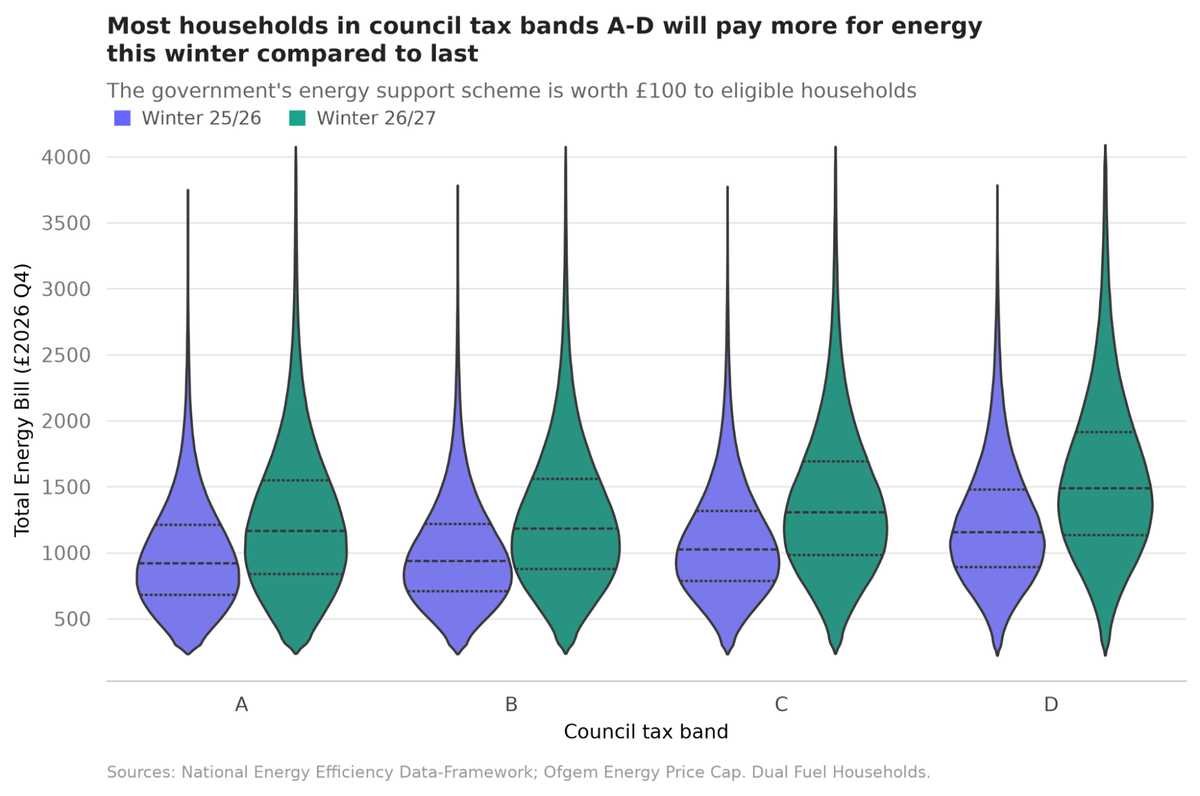
Note: chart above shows distribution of energy bills for households in council tax bands A - D. For each shape, the shape is the full distribution, while the three dotted lines are the interquartile ranges, marking the bottom 25%, median and top 25%.
There are three things the government could do in response to this jump in energy bills:
The Chancellor could choose to take no further action beyond the £100 payments announced at the Budget. Although this would avoid the Exchequer spending any more money on the crisis, it would leave households facing a sharp rise in bills and inflation rising well above 4%. This could also create a fiscal headache for John Healey in his Spring Statement: because the October OBR forecast was based on a lower forecast of gas prices, there is a risk that higher inflation and lower growth may reduce the Chancellor’s fiscal headroom.
The Chancellor could commit more money to energy bill support, most likely by increasing the £100 payment to households in council tax bands A-D. However, this is expensive for the Exchequer. Doubling the payment to £200 would cost a further £2.6 billion, while raising it to £274 to fully offset the median increase in bills would cost £4.5 billion. This support would likely ease the economic pain of bill rises, but it would not affect the headline rate of CPI inflation. This would leave inflation rising to well above 4%, and would extend the Chancellor’s fiscal challenge.
A third option would be to fix household gas prices at their current level (8p/kWh) for the next five years. This would mean the Treasury subsidising gas bills in the short term, but then recovering revenue if gas bills drop below the 8p/kWh level. This would reverse £280 of the £440 bill increase in January, leaving it at just £160 (concentrated on electricity). It would reduce CPI inflation early next year, as headline prices would be lower. It would improve incentives for electrification, by making the electricity-to-gas price ratio more stable, ultimately helping Britain avoid future energy crises. And crucially, it should be fiscally neutral or better for the Treasury over its lifetime. It would provide short term bill support and medium term stability to energy bills and the public finances.
This final option is the most radical, but none of the options is risk-free, given how serious the rise in bills is. Taking direct control of gas bills may be the most fiscally sustainable way for the government to respond to this severe worsening of the energy crisis, while laying the ground for getting off the oil and gas rollercoaster for good.