Why the answer to tackling obesity isn’t another weight-loss ad
 www.nesta.org.uk/blog/why-the-answer-to-tackling-obesity-isnt-another-weight-loss-ad/
www.nesta.org.uk/blog/why-the-answer-to-tackling-obesity-isnt-another-weight-loss-ad/
www.nesta.org.uk/blog/why-the-answer-to-tackling-obesity-isnt-another-weight-loss-ad/
Advertising of weight-loss medications and services has become a familiar feature of bus stops, websites, and social media feeds. According to the Advertising Standards Authority (ASA), there has been a rapid increase in advertising of glucagon-like peptide (GLP-1) based medications such as semaglutide (eg, Wegovy) and tirzepatide (eg, Mounjaro), mirroring the rising public interest in these medications and expansion of the online weight management services market.
GLP-1 medications and weight-loss services could play a transformative role in obesity treatment. However, how they are promoted matters. As advertising of weight-loss medications and services becomes more pervasive, it is likely to play a greater role in shaping public perception of obesity and its treatment. By framing obesity as something to be treated at an individual level, advertising risks undermining the need for proactive prevention and shifting focus away from the factors driving obesity across the population, specifically the food environment, which includes the cost, convenience, and marketing of unhealthy foods. The stakes are particularly high when access depends heavily on the ability to pay for GLP-1s, while action to improve the UK food environment remains limited.
Prescription-only medications cannot be advertised directly to the public in the UK. Unlike ordinary consumer goods, their use should be based on appropriate clinical assessment, and advertising restrictions help reduce the risk of inappropriate use and harm. Providers, including online retailers, can advertise a consultation or weight management service, but the advert must not directly or indirectly promote GLP-1 medications, or any other prescription-only medication. Beyond naming medications, advertising cannot promote medications by using descriptors or imagery that are likely to be understood as referring to prescription-only medications; so phrases like ‘obesity jab’, images of injection devices, advertising discounts on GLP-1 medications, and landing pages implying that GLP-1 purchase should be the outcome, are all likely in breach of the rules set by the Committee of Advertising Practice (CAP) and under legislation.
Whether an advert falls on the right or wrong side of these rules can be a finely balanced assessment. ASA’s findings show that people often interpret adverts as promoting GLP-1s even when no prescription medicine was named, drawing meaning from its language, imagery and context. In our view, Voy’s recent “the weight is over” campaign illustrates this potential ambiguity. Ostensibly, the campaign relates to an over the counter supplement - the small print of the advert promotes glucomannan. Glucomannan is a non-prescription supplement which usually comes in capsule or powder form and has been on the market for years. Yet with the very recent launch of prescription-only medication Wegovy, which comes in oral pill form, the focus of the advertisement on a round pill alongside the headline “The weight is over” arguably is more likely to be interpreted by consumers as promoting prescription-only medications*.
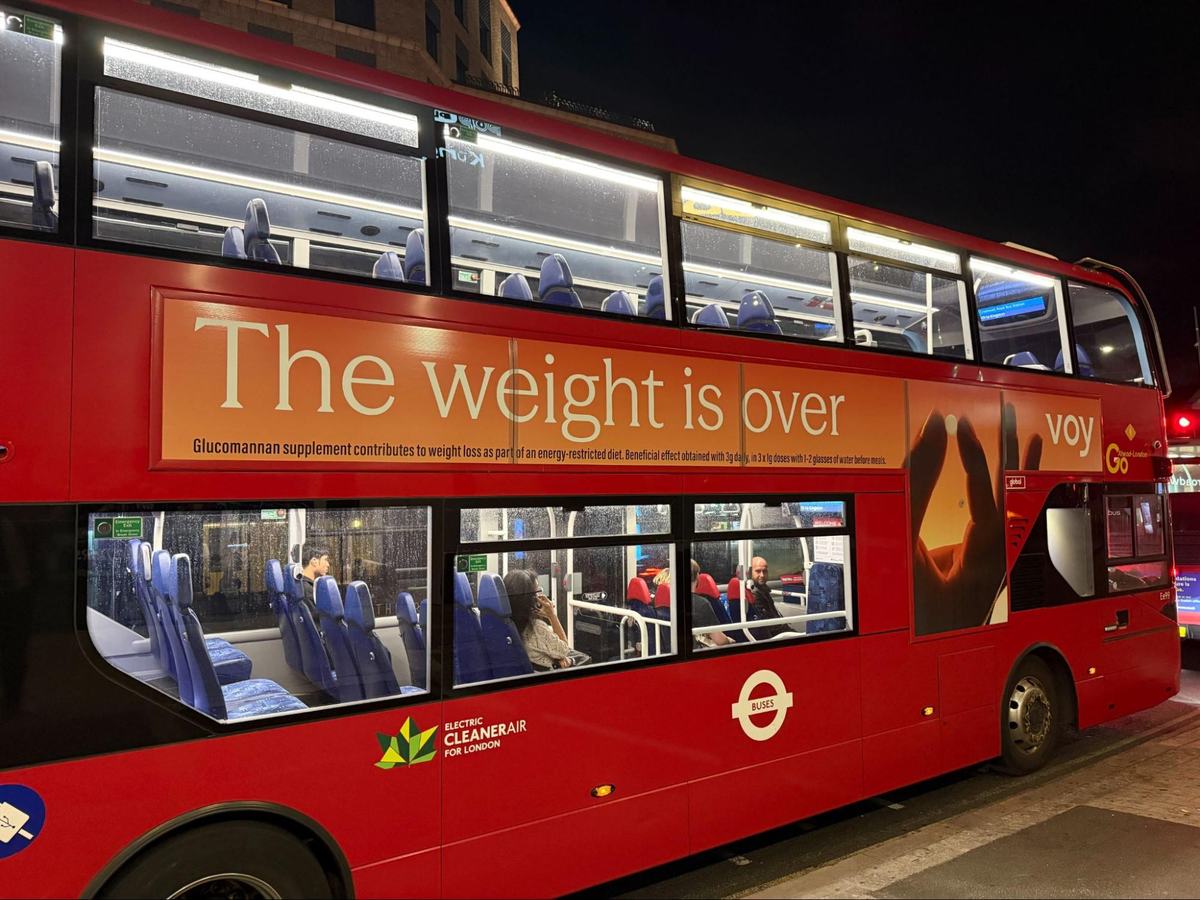
A bus ad displaying Voy's 'the weight is over' campaign. Image taken in September 2026. © Voy
The Medicines and Healthcare products Regulatory Agency (MHRA) and ASA have stepped up enforcement of adverts that break the rules. Together with the General Pharmaceutical Council (GPhC), they issued an enforcement notice in September 2025 to reiterate the rules around the advertising of prescription-only medicines for weight management. Rulings have been issued to companies including Juniper, Voy, Bolt Pharmacy, SheMed and Simple Online Pharmacy.
Although medicines advertising offences can result in a fine or even up to two years imprisonment, the MHRA typically resolves cases through informal agreement. So when the likely penalty for a non-compliant advertisement is simply being asked to take it down, companies face a simple calculation: launch a high-impact campaign and gain exposure, or do not advertise at all. By the time regulators step in, the campaign has already caught public attention. Without more substantial financial consequences and immediate regulator action, current enforcement measures are no longer effective.
Further, given how quickly the weight-loss industry is evolving, we think regulators should help address remaining ambiguity through regularly updating the guidance to explicitly cover all relevant products, including pills and any future innovations in medication delivery.
Public opinion on the causes of obesity often over-emphasises the impact of individual factors such as willpower and underestimates the role of its biological, social and environmental causes. There is a credible case that advertising of weight-loss services could support the medicalisation of obesity and correct this public opinion, which may reduce stigma and make it easier to seek support. Eli Lilly and Company’s recent campaign, ‘Obesity is a Disease’, provides an example of how advertising could help push this narrative. However, one survey of 1,000 US adults, found that greater exposure to GLP-1 adverts was associated with greater self-criticism about weight and appearance.
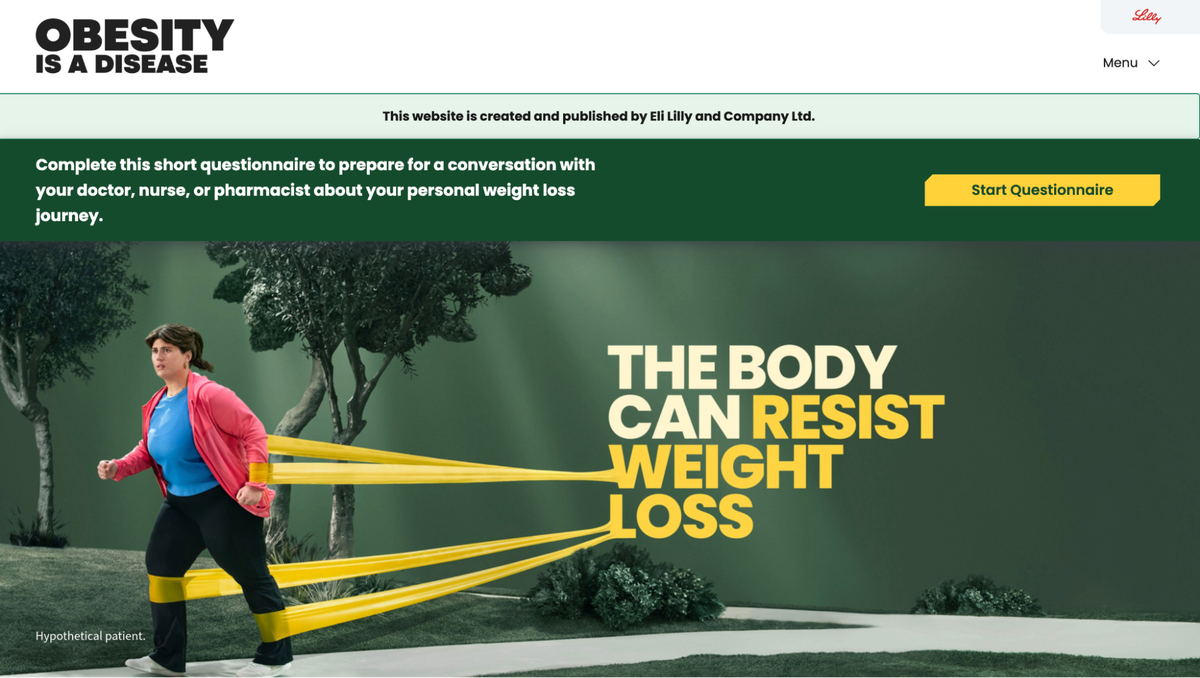
Obesity Is A Disease homepage. Image captured 5 October 2026. © Eli Lily
Weight-loss services advertising operates alongside extensive marketing of unhealthy foods, creating a commercial dynamic where one market fuels overconsumption while another treats its fallout. Although new restrictions on paid advertising of specified less healthy food and drink are a positive step, Nesta estimates that they initially cover around 8% of food and drink advertising spend, potentially falling to around 1% as spending shifts into exempt channels and formats. Rather than viewing weight-loss service advertising and junk food advertising as separate issues, we should consider them as interacting forces shaping public health.
Whether obesity is framed as personal “failure” or as a medical condition requiring treatment, the cultural narrative, reinforced by current weight-loss advertising, remains centred on individuals - not the wider environmental factors that drive obesity.
Given current access to GLP-1 medications is unequal, the rise in advertising risks widening this gap by further increasing uptake amongst those who can afford to pay privately. In England, the NHS expects to provide tirzepatide to around 220,000 people over the first three years of a 12 year rollout, despite 3.4 million people meeting the NICE criteria. Many people are therefore paying privately. UK evidence suggests that people in the least deprived areas were more than twice as likely to access private GLP-1 treatment as those living in the most deprived areas, despite obesity prevalence being higher in the latter. Without careful oversight, widespread marketing may increase GLP-1 usage but may leave behind those who cannot afford the medication.
While GLP-1s and weight-loss services are a valuable tool for people living with obesity, reducing obesity rates requires population-level preventative action and cannot solely rely on individuals seeking treatment. It should consist of equitable access to weight-loss treatment for those with the highest clinical need, as well as improvements to the availability, affordability and promotion of healthy food. The approaches should include strengthening advertising restrictions on unhealthy foods and importantly, to maintain momentum on the healthy food standard, a policy which would require large food businesses to report on the healthiness of their sales and set targets for improvement. In addition, the government should strengthen enforcement of rules restricting the advertising of prescription weight-loss medicines, and apply this across all channels. Taken together, these measures will be essential to address the causes of obesity and achieve a healthier society.
*As of the date of publication, we aren’t aware of any enforcement action being taken in relation to this advert.
This blog contains third-party intellectual property, including brand logos and advertising materials. These are reproduced under the 'Fair Dealing' exception of the Copyright, Designs and Patents Act 1988 for the purposes of criticism, review, and public policy analysis. Their inclusion does not imply any affiliation with or endorsement by the trademark owners.