What is marginal pricing and how does it work?
 www.nesta.org.uk/blog/what-is-marginal-pricing-and-how-does-it-work/
www.nesta.org.uk/blog/what-is-marginal-pricing-and-how-does-it-work/
www.nesta.org.uk/blog/what-is-marginal-pricing-and-how-does-it-work/
Most of us have a rough sense of why petrol prices move: oil is a global commodity, traded on international market and the pump price follows the principles of supply and demand. When supply reduces or demand increases, prices rise. Gas is the same, it is bought and sold on international exchanges, and the price households pay broadly tracks what is happening in those markets.
When electricity bills spiked across Europe in 2021 and 2022, as a result of gas shortages, many people with electricity supplied primarily by renewable energy were left asking a reasonable question: why had electricity prices increased so much?
The answer to this question lies in a feature of electricity markets called marginal pricing, and understanding it is essential to evaluating almost any proposal to reform the energy system.
A consumer’s monthly electricity bill covers the cost of many parts of our energy system, including the wholesale cost of electricity (the fuel itself), the cost of maintaining the network, VAT, policy costs and more. This explainer aims to understand how the ‘wholesale electricity cost’ within a consumer's energy bill is set, focusing on the spot market.
To understand what the spot market is, it first warrants thinking about the supply of our electricity. Electricity can be generated in multiple ways, from renewable sources (such as solar, offshore wind or onshore wind), from nuclear power stations or from fossil fuel powered stations (such as gas turbines or, in the past, coal-fired power stations).
The supply of electricity at each period of the day is determined in two ways. According to the Competition and Markets Authority, 60% is contracted in advance where generators have committed to selling a quantity of electricity at a price in advance (via forward contracts or contracts for difference). The other 40% is determined a day before, on the “spot market”, which determines a live price of electricity, the “spot price” (“on the spot”).
A feature of the spot market is that even though the different sources will all have different costs to generate one megawatt-hour (MWh), there will only be one price charged and paid to every generator. Understanding why requires understanding how the electricity spot market actually works.
Electricity is a uniform, fungible commodity, meaning one MWh is identical regardless of whether it came from a wind turbine, solar panel, or a gas plant. This has a profound implication: on the spot market, there can only be one price at any moment in time.
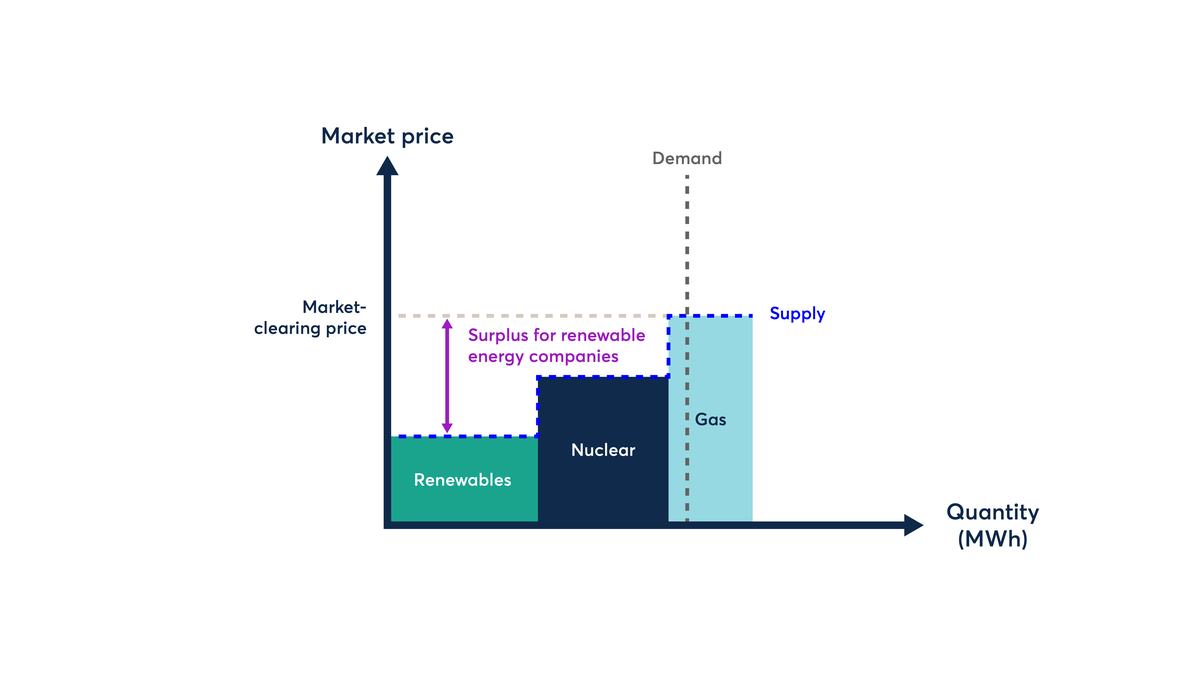
To determine electricity spot prices grid operators use what is called the merit-order. This consists of ranking electricity generation types – such as gas, solar, wind – by the cost of supplying one megawatt-hour. The generators that have the lowest cost, mostly renewables from wind and solar, are called upon first, then comes nuclear, and lastly gas.
The price is then set by the highest price per MWh that is needed to meet the level of demand, even if much of the energy is coming from lower cost sources.
Figure 1 illustrates this process and draws the supply curve in red. Demand is then collected, drawn in green. The intersection between demand and supply determines the price.
Importantly, this marginal price applies to everyone supplying electricity to the grid, regardless of whether it comes from renewable energy or gas turbines - this illustrates the “law of one price”. This unique price is determined by the intersection of supply and demand.
In the figure below, demand is high enough that gas turbines are required to generate enough electricity to meet demand. Therefore, the marginal price is determined by gas turbines - and gas becomes the marginal price setter. Everyone paying for electricity at this point will pay the price set by the gas supplier.
The law of one price states that identical goods should sell for the same price on a market.
Let’s consider the opposite, that one identical MWh produced by a solar farm was sold at a lower price than one produced by a gas plant. Rational buyers would all prefer to buy the cheaper electricity coming from the solar farm. As a result, demand for solar would exceed available supply, pushing its price up because buyers would compete to offer a higher price, up to the point where the prices between solar and gas are equal. This is why differential pricing unravels, and why we can only have one price on the spot market.
The crucial point is that the marginal price is set for everyone, renewable electricity and gas generators alike.
During the crisis, gas has become more expensive owing to constraints associated with ships crossing the Strait of Hormuz. Shown in Figure 2, this now means that the marginal price of gas goes up.
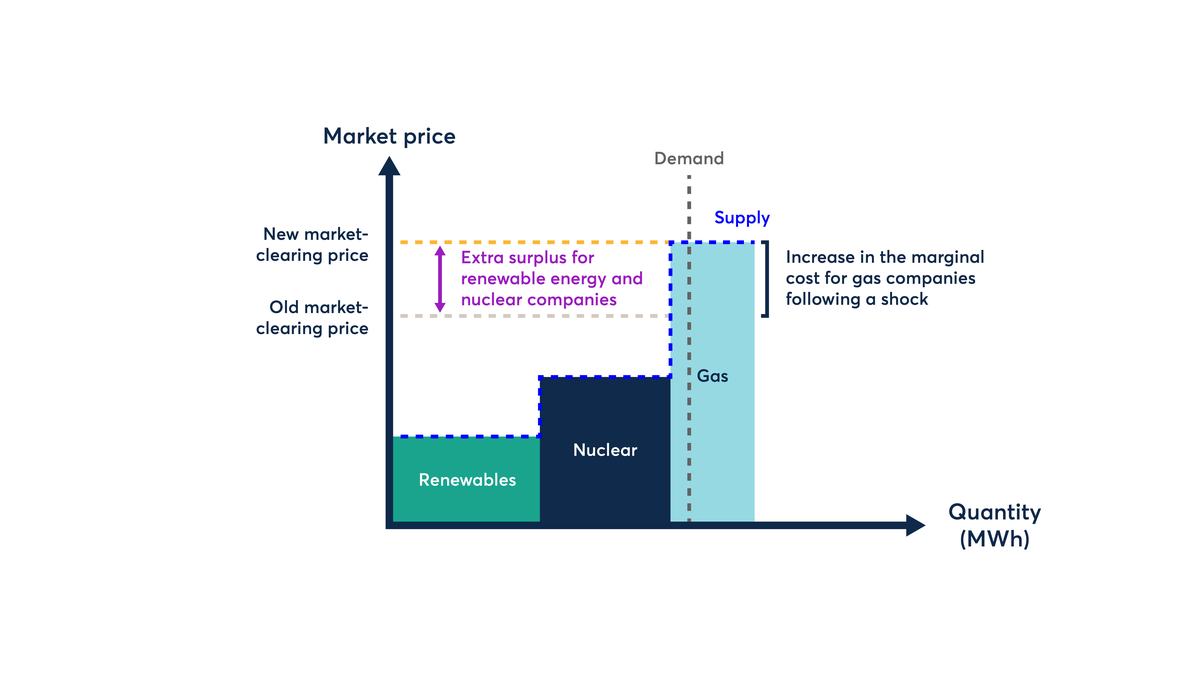
Figure 2: Effect of an increase in marginal cost of producing gas on the market
The winners of this are not gas companies that buy gas to power their turbines, they still have zero surplus because they produce at cost. Some may raise that this does not reconcile with the excess profits that gas companies reported since the start of the crisis. But these gains typically come from separate business units within the firms, namely the ones extracting gas upstream or trading gas. These may make profits as they now sell reserves at a higher price, or as they have secured long-term call options. But departments that have to buy high gas to power turbines now face a higher cost, which they pass on.
The winners are renewables and nuclear companies, which have a low marginal cost and now get remunerated at a higher market price. For solar and wind companies this can be positive – as their sector is characterised by high fixed costs and they can sometimes face negative electricity prices and perhaps make a loss. These unexpected profits may give them the opportunity to recoup previous losses, and may incentivise future investments.
The government also sees an increase in tax receipts with this raised market price.
And what does this mean for consumers’ electricity bills? Ultimately, when gas is setting the marginal price and pushing up electricity costs for all types of electricity generation, this is paid for by consumers and drives up household bills.
Some argue that the UK government could ‘break the link’ between gas and electricity by allowing different marginal pricing, and letting a different price for different sources. As explained above, the current market structure does not allow having different marginal price setters.
So, if it is not possible to have different marginal prices, what are the options available to the UK government if it wants to lower the price of electricity for everyone? There are four options for the UK government:
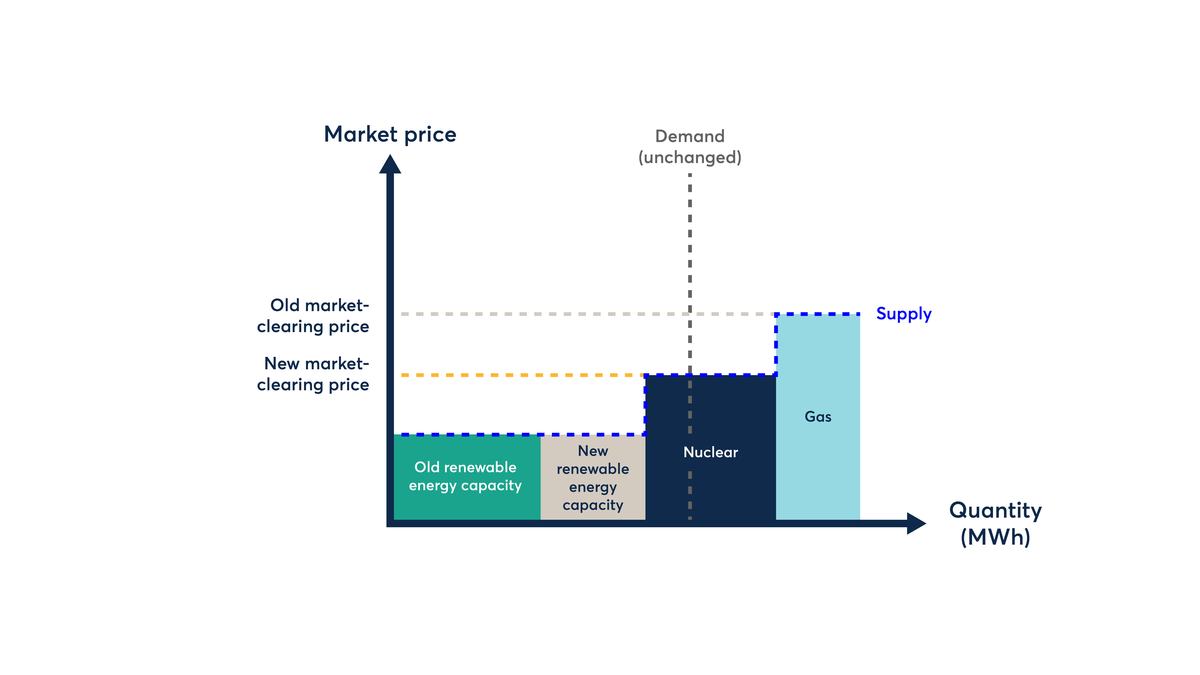
In order to reduce the wholesale cost of electricity, the UK government has so far focused on increasing renewable energy capacity in order to decrease our reliance on gas. But this is a long-game and consumers do not benefit right away.
We have more expensive electricity and lower renewables capacity than other EU countries. The Clean Power 2030 (CP2030) plan aims to increase renewable electricity capacity, and Ed Miliband anticipates that this would bring 10 GW of extra-capacity to existing capacity of around 110 GW. This is welcome, as it means reducing the frequency at which gas sets the marginal price.
Research shows that gas set the electricity price 97% of the time in the UK in 2021, compared to 72% of the time in Germany (although these figures have fallen since then). France has nuclear as marginal price setter 97% of the time. Increasing the renewable energy capacity means gas will be the marginal price setter for a lower share of the time - but we are still a long-way off reaching a more balanced market.
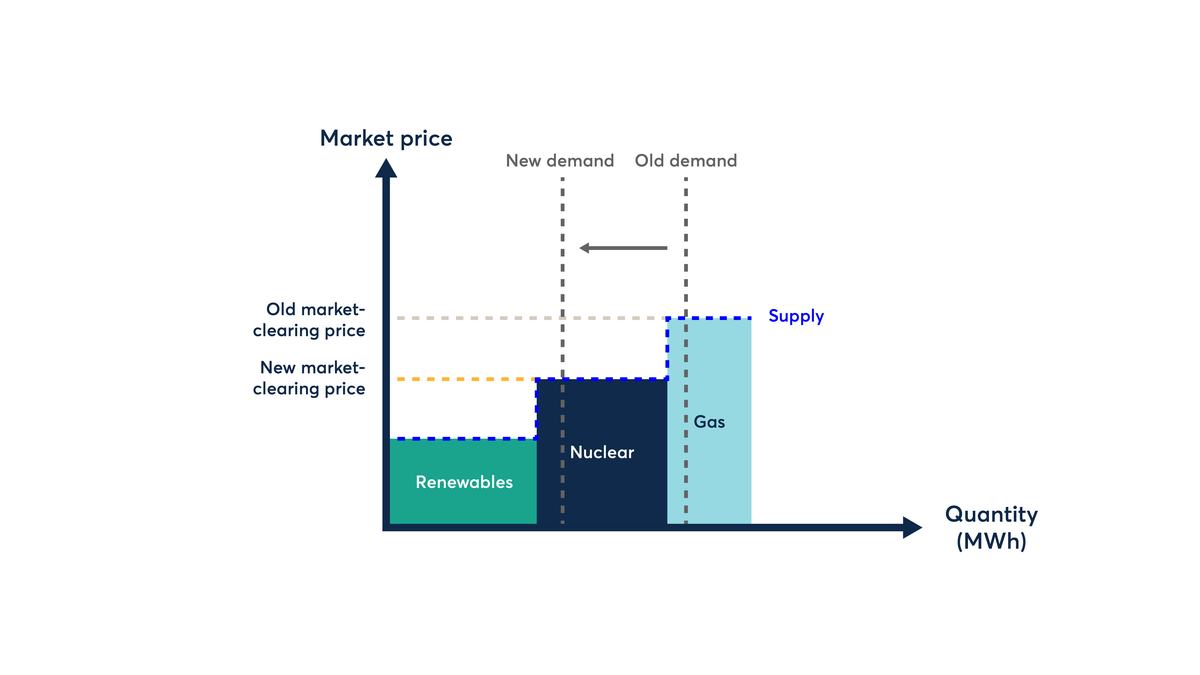
Nevertheless, the government could go further to lower prices. As mentioned above, by adapting demand, the UK government could also reduce our reliance on gas as the marginal price setter. This can happen either by reducing demand altogether, or by shifting our demand away from times when gas turbines are turned on and setting the marginal price.
Indeed, even as we go through a new energy shock, there are still times during the day when electricity prices are lower, as prices are set by other, cheaper, sources. Adapting our demand - via flexible mechanisms, combined with smart meters or batteries - could tap into these times where prices are cheap, lowering prices on our final bill.
Of course, for consumers, wholesale electricity costs are only part of the story of their electricity bills. Separate to wholesale electricity costs, the UK government can also look at other parts of the bill to reduce household costs, including policy costs, network charges and other levies.
Importantly, for electrification, making electricity cheaper relative to gas is critical. Today, electricity bills still carry a disproportionate share of these additional costs, despite electricity being the route through which we decarbonise heating, transport and much of industry.
Making electricity cheaper, either by reducing the wholesale cost of energy or by rebalancing costs away from electricity, would strengthen the economic case for technologies like heat pumps and electric vehicles, helping households reduce exposure to volatile international gas prices.
Combined with continued investment in renewables, storage and flexibility, lowering the overall cost of electricity across the bill would support faster electrification and deliver greater long-term resilience for consumers and the wider economy.