
Tax-free electricity
A proposal to remove most taxes on electricity to reduce bills and promote clean heating
Summary
We welcome reports that the government is considering major intervention to reduce energy bills at the upcoming Budget. Cheaper energy is an important ambition, but we do not believe simply cutting VAT from gas and electricity bills is the best way to deliver this.
Any major intervention on energy bills should produce immediate, meaningful savings for consumers, alongside supporting the government to meet long-term commitments around home decarbonisation, fuel poverty and carbon emissions.
The government's best option is to focus on making electricity cheaper. Electricity is used by all households, unlike gas, and it is the clean, homemade fuel of the future, essential to reducing carbon emissions.
Nesta proposes that the government should remove almost all taxes from electricity in the upcoming Budget. It should remove or offset the legacy renewable levies - Renewables Obligation (RO) and Feed-in-Tariffs (FiT) - and remove VAT and the Energy Company Obligation (ECO) levy from electricity bills.
Taken together, these measures would immediately reduce a typical dual fuel (gas-using) household's energy bill by £151 per year at a cost of £5.4 billion in 2026/27.
This would reduce the headline rate of inflation by around 0.3%.
Crucially, it would also reduce the crucial electricity to gas price ratio from 4.2 to 3.1, meaning that switching to a heat pump would greatly reduce energy bills. This would support the government's forthcoming Warm Homes Plan, enabling it to reduce energy bills and fuel poverty at the same time as supporting longer-term efforts to reduce carbon emissions and meet the Carbon Budgets and the UK's international climate commitments.
While this option is more expensive than a VAT cut, it has two key advantages. First, the reduction in bills is large enough to both create a tangible difference that people will notice and to avoid it being swallowed up by upcoming increases in energy bills. Second, the government can achieve two key objectives - lower bills and lower carbon emissions - at once. Focusing any government support on reducing electricity bills is the best option in the short and long term.
Context and principles to guide action
If the government is considering making a major intervention on energy bills, it should aim to:
1. Bring down bills by an amount that will make a tangible difference to people's bank accounts and to inflation.
The UK has higher energy costs than most peer nations and expensive energy bills are a major driver of inflation.,, The cost of energy is a top public concern. Over the last two years, average bills have regularly changed quarter-to-quarter - rising by up to £123 and falling by up to £270. For the average billpayer to feel a tangible difference in their energy costs, we expect that bills would need to fall by ~£150.
2. Futureproof the bill reduction.
Rising global exports of LNG may herald cheaper gas. But network costs, generation subsidies, and debt costs are all set to increase in the near future. Rising network charges alone could add £30 to electricity bills next year. Government actions need to address both current costs and the headwinds facing electricity bills.
3. Ensure that action supports the government's key commitments in the Plan for Change and its legal obligations.
including the statutory targets set out in the Carbon Budget and Growth Delivery Plan. Electricity is currently 4.2 times the price of gas, and without action, this price ratio may get worse. This will make it harder to deliver both the Clean Power Action Plan and Warm Homes Plan. Conversely, lowering electricity prices will boost demand for electricity and, in turn, support the delivery of these key commitments. The government should act to reduce the electricity/gas price ratio to 3.3 or below - the point at which heat pumps become cheaper to run than gas boilers.
Nesta's proposal: tax-free electricity
We welcome reports that the government is considering major intervention to reduce energy bills at the upcoming Budget. Nesta's proposal is to remove the main taxes from electricity bills, including policy costs and VAT. This proposal would:
- Cancel out the cost of legacy renewables subsidies. The Renewables Obligation and Feed-in-Tariff, which are ongoing subsidies to early renewable energy projects, add around £3.9 billion to electricity bills. While the levy mechanisms are complex and cannot be unpicked in the short term, the government can immediately offset the unit cost of the levies by using the Energy Price Guarantee mechanism (effectively removing them). This would cost £3.9 billion a year initially, but this would fall over time as the schemes wind down. By itself, it would reduce the typical dual-fuel energy bill by £114.
- Remove VAT from electricity. Removing VAT from electricity bills would cost around £1.5 billion a year and reduce a typical household bill by a further £43.
- Adjust the ECO levy so that it does not fall on electricity. The government should remove the electricity part of the ECO levy in a cost-neutral way that does not raise bills for the typical dual fuel household. This can be achieved by reducing the overall size of the ECO levy (to around £1.4 billion per year) and putting these costs entirely on gas bills. Because the amount being added to gas bills equals the amount that dual fuel households already contribute through their electricity bills, there is no net change in their energy cost. This is also cost-neutral to the government and would reduce the price ratio.
The table below summarises the components of this proposal. Taken together, it would:
- Reduce the typical dual fuel household's energy bill by more than £150
- Reduce the electricity to gas price ratio to around 3.1, making heat pumps cheaper to run than gas boilers and supporting the government's Warm Homes Plan
| Cost |
Typical savings (dual fuel) |
Typical savings (heat pump) |
Price ratio |
| £0 |
£0 |
£0 |
4.2 |
| £3.9 billion |
£114 |
£249 |
3.5 (Reduces the price ratio by ~0.7) |
| £1.5 billion |
£43 |
£83 |
4.0 (Reduces the price ratio by ~0.2) |
| £0 |
£0 |
£55 |
3.9 (Reduces the price ratio by ~0.3) |
| £5.4 billion |
£151 |
£387 |
3.1 |
Tax-free electricity versus removing VAT from energy bills
A decision to cut VAT from both electricity and gas bills would cost the government around £2.5 billion per year (in perpetuity). It would reduce energy bills by £83 for both a typical dual fuel household and a typical household with a heat pump. While a VAT cut would be cheaper than our proposal (at least initially), it has a number of drawbacks compared to our tax-free electricity proposal:
- Risk of bill savings being cancelled out - saving £83 is within the range of normal movements in the price cap and is at risk of getting missed by households.
- Smaller benefit for non-gas households - 18% of households would have no benefit from a VAT cut on gas.
- Failing to support the Warm Homes Plan and Plan for Change - a VAT cut on both bills would have no impact on the electricity/gas price ratio, meaning that the government would still need to take action on electricity prices for the Warm Homes Plan to work.
If the option to cut VAT is pursued, the government must also reduce and rebalance the ECO levy from electricity to gas bills, as set out above, and introduce a targeted discount to ensure that when consumers install heat pumps, they can save money.
Alternatively, if the Treasury is prepared to spend £2.5bn to reduce bills, but not to go as far as our proposal, a much better use of this money would be to reduce levy costs. This would reduce the price ratio to 3.8. Rebalancing the ECO levy would then reduce the price ratio to 3.5 with changes to ECO. Further targeted measures would still be needed to reach the target of 3.3.
| Cost |
Typical savings (dual fuel) |
Typical savings (heat pump) |
Price ratio |
| £2.5 billion |
£83 |
£83 |
4.2 |
| £2.5 billion |
£83 |
£135 |
3.9 |
| £2.5 billion |
£73 |
£160 |
3.8 |
| £2.5 billion |
£73 |
£215 |
3.5 |
| £5.4 billion |
£151 |
£387 |
3.1 |
Distributional impacts of policy choices for energy bills
Any reduction in the unit cost of energy will benefit wealthier households more in absolute terms than poorer households, as wealthier households on average use more energy. However, poorer households spend more on energy as a proportion of their overall income. Raising money to support government policies through energy bills is generally seen as less progressive than funding them through general taxation.
Cutting taxes on electricity specifically has a few points in its favour over a VAT cut on both energy bills:
- Dual fuel households have the lowest rates of fuel poverty and the smallest fuel poverty gap., The highest rates of fuel poverty (and the largest gap) is seen in households using electric heating. Reducing electricity costs would benefit these households significantly, as the chart below shows.
- Heating is the main use of energy in most homes. While heat demand is closely linked to the size and quality of homes (and therefore income), other (non-heat) energy use is almost all electricity and the amount used varies more between households.
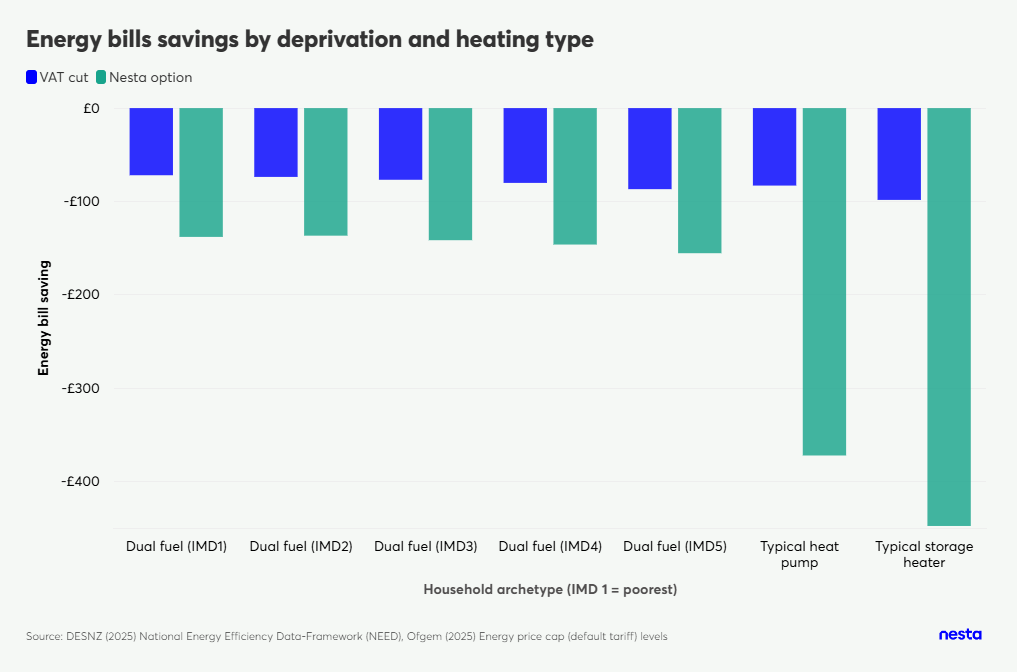
Source: DESNZ (2025) National Energy Efficiency Data-Framework (NEED), Ofgem (2025) Energy price cap (default tariff) levels