Dialogues with scottish citizens about health and care data
In 2019, Nesta and the Scottish Government embarked on a dialogue with Scottish citizens to understand their opinions and ideas for the use and sharing of health and care data and to explore possible futures that improve outcomes for everyone. This builds on Nesta's previous work on new methods of public engagement, which seeks to better engage citizens to collectively imagine and create more sustainable, inclusive futures.
The goals of the dialogue were to:
- Better understand the views, opinions and ideas of Scottish citizens around the use and sharing of health and social care data – now and in the future.
- Explore and co-design possible futures for the use of health and social care data that could benefit everyone.
- Test and evaluate innovative methods of engaging and involving the public in conversations about their data.
The dialogues
To conduct the dialogues, Nesta worked with four partner organisations. Links to their individual reports can be found at the bottom of each box
ALLIANCE
Exploring trust and value in using health and wellbeing data that sits outside of clinical care.
Target group:
People with long term conditions; over 60; BME communities plus white minorities including people of Eastern European background,; LGBTQI+ people.
Method:
Creative workshops across Scotland. An interactive online survey.
View report >
SHIFT
Codesiging an online social game for young people which will focus on questions of sharing health data
Target group:
Young people living in a predominantly rural or urban areas and; living in areas of different levels of deprivation
Method:
To create a ‘MadeByPlay' online digital game
View report
To conduct the dialogues, Nesta worked with four partner organisations. Links to their individual reports can be found at the bottom of each box
THE LIMINAL SPACE
Experiencing a fictional pharmacy through online workshops
Target group:
100 people from across Scotland, split across different ages and geographies (Glasgow, Aberdeen, Lanarkshire, Fife, Highlands and Islands)
Method:
A physical pack that includes unique 2D and 3D elements for use in choreographed online sessions.
View report >
CARE DATA FUTURES
Working with cared for people and their carers to codesign uses of data in social care.
Target group:
People on the frontline of giving, receiving and working in care, and experts and leaders in care industry
Method:
2 workshops to create 3 distinct speculative design provocations.
View report
Synthesis process
Each consultation yielded different insights and was reported on in unique way. We synthesised these insights into one coherent output that captures the key findings from each set of dialogues. The synthesis process is outlined below.
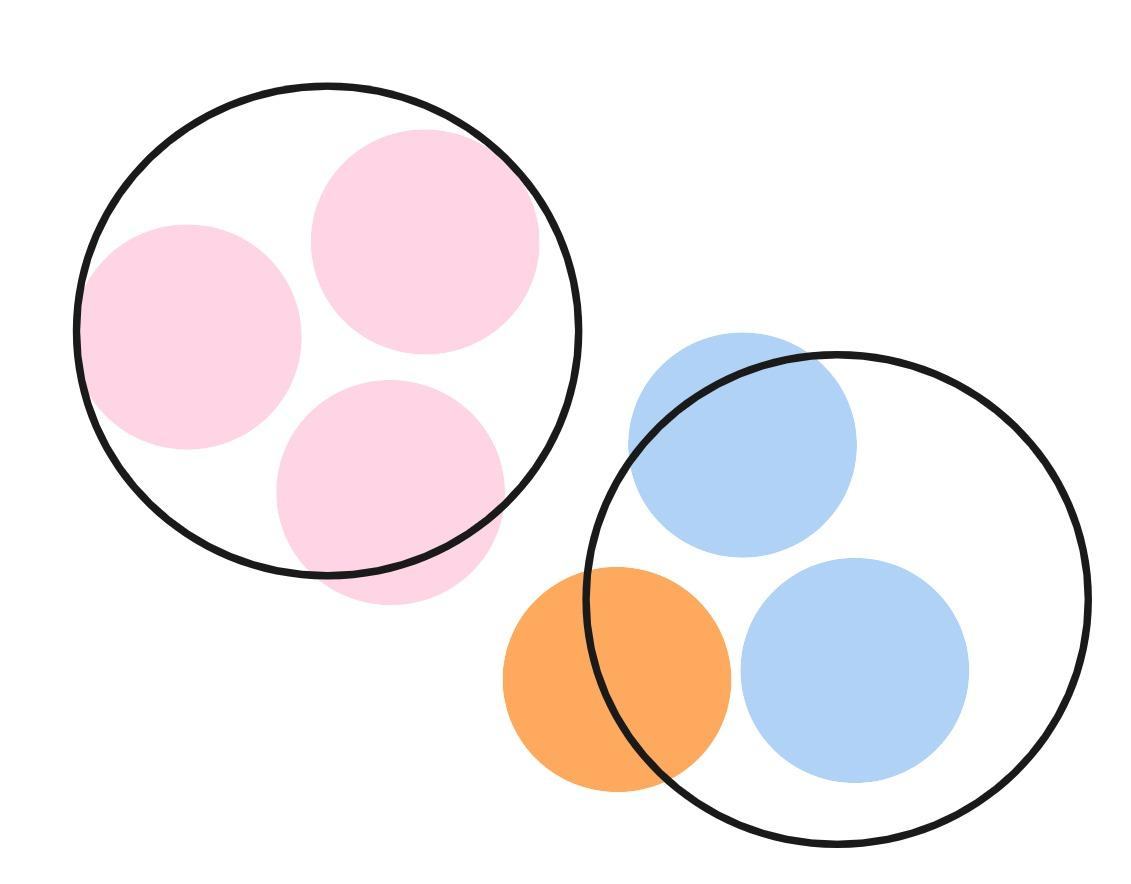
- Quotes and comments were pulled from all of the reports, and clustered into a series of themes that that were important to different groups of the population
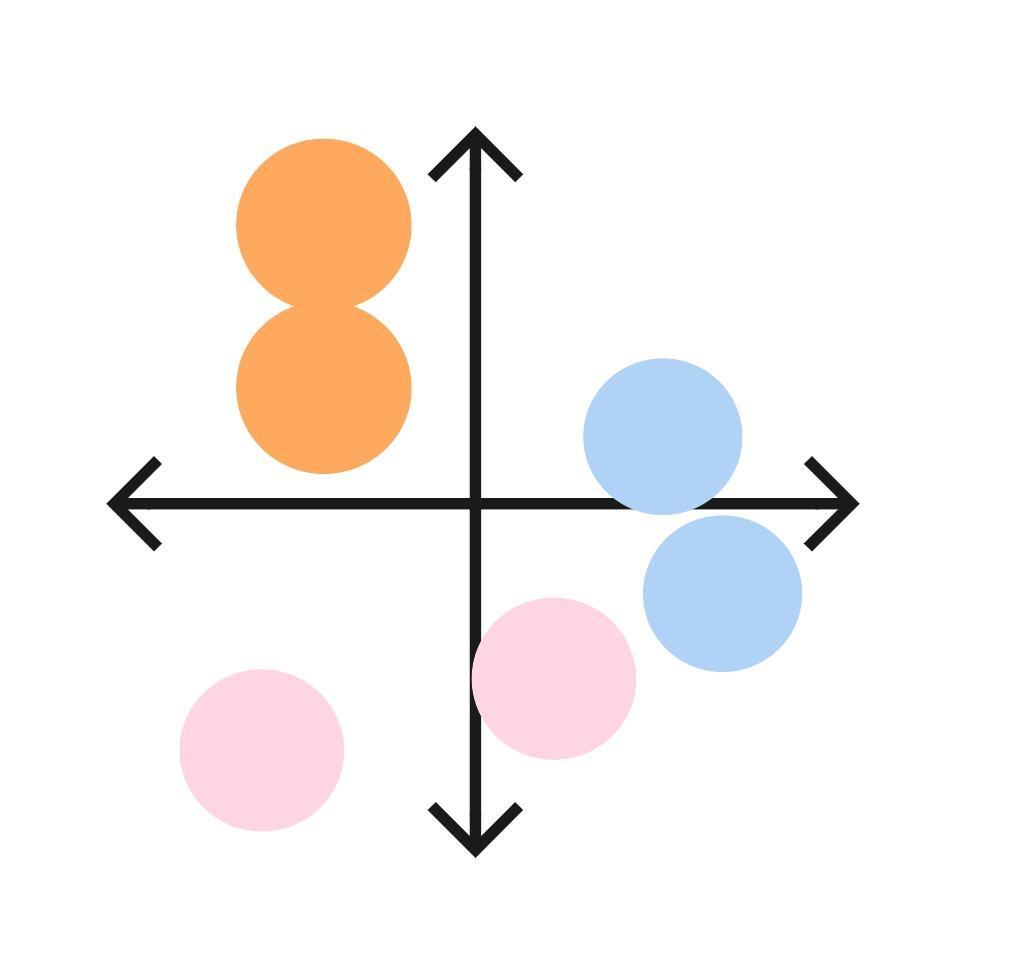
- Insights on people's needs and attitudes towards health and care data were extracted from each of these clusters. These insights varied by group, situation and conditions of data sharing.
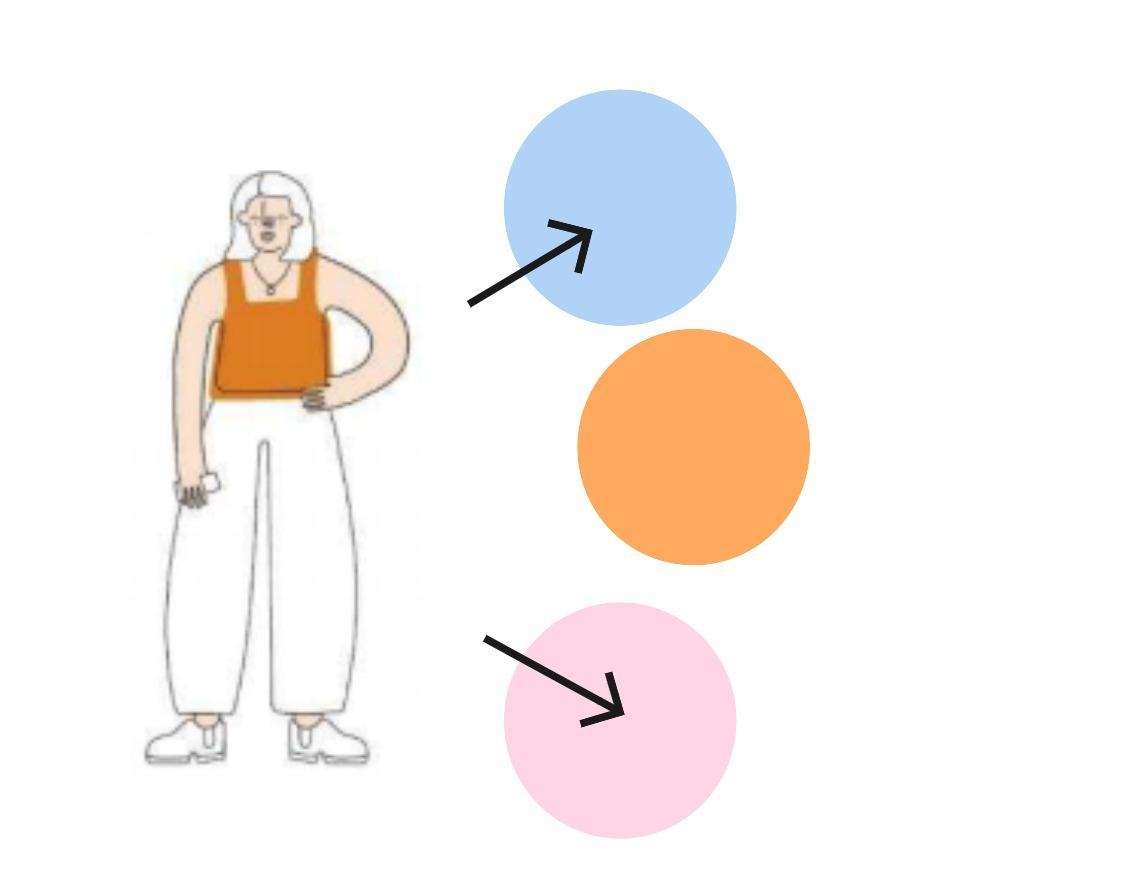
- Where reports included personas these were unpacked, and where the reports didn't use personas we created new personas to capture the situations and attitudes of the people they talked to.
- Personas from all the consultations were repeatedly mapped to compare their similarities and synergies. Personas that aligned across multiple issues were combined. Seven distinct personas emerged.
- The clustered insights from step 2 were mapped across the 7 personas to form nuanced, and evidenced relationships of the way different people interact with their health and care data.
Data relationships
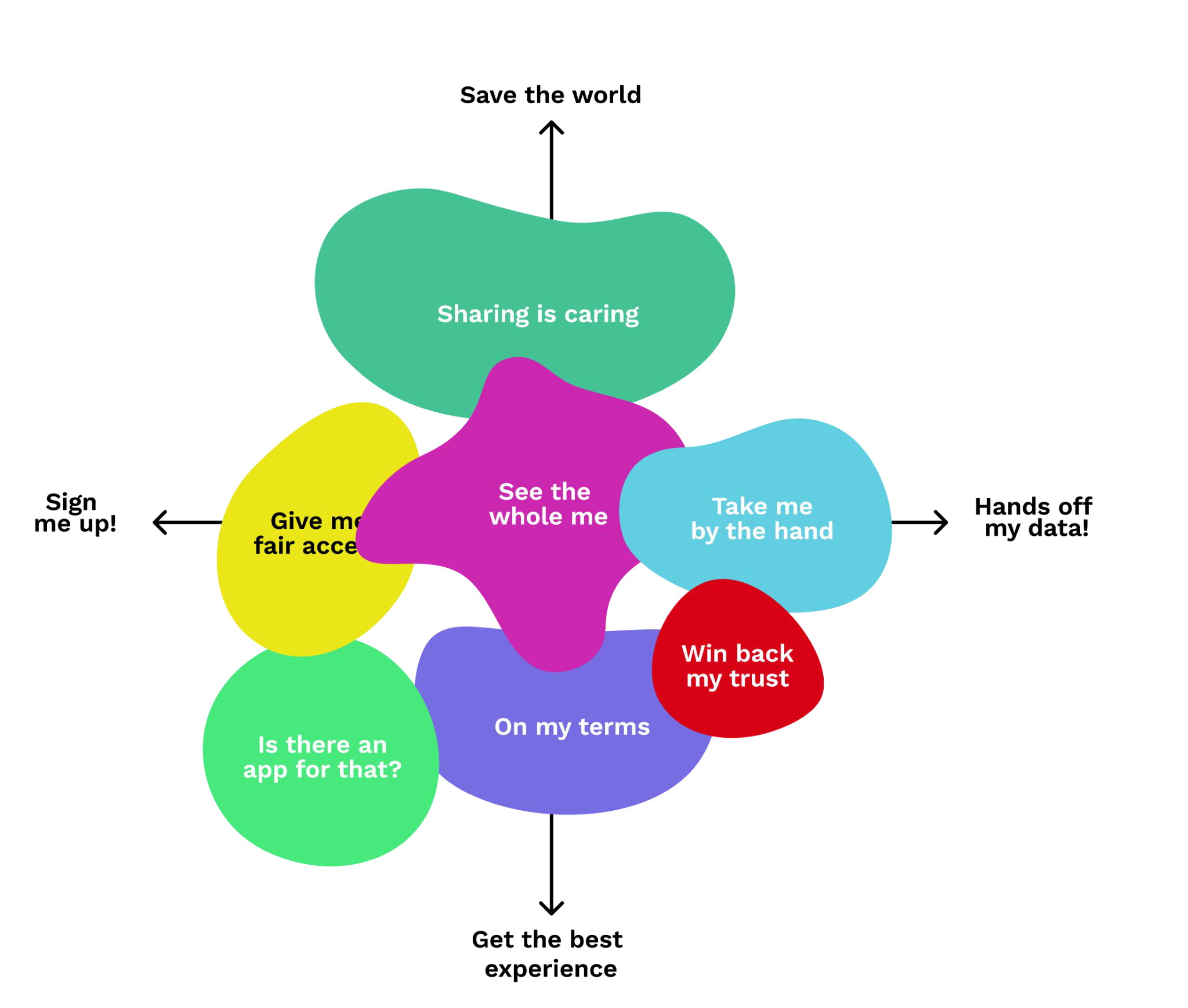
7 relationships that Scottish Citizens have with their health and care data
A data relationship includes both the way that a person shares and benefits from data, as well as their attitudes, understanding and beliefs around data sharing.
These relationships are not intended to be exhaustive, but describe the most interesting and surprising relationships that were unearthed from the consultations.
It should be noted that one person might not have only one relationship with data, but they might adopt a number of different relationships in different circumstances. Similarly, while each relationship is informed by insights from a few specific groups, these relationships could be adopted by many different people.
The 7 relationships are arranged by people's willingness to share data and whether they are driven by personal or societal concerns.
The following slides present a summary of the findings about each relationship.
To experience an immersive dialogue that communicates each relationship please click here.
See the whole me
We've heard this from LGBTQIA+ people, Young people, and people with a named condition.
People might be part of several communities that intersect to give them a unique set of experiences that influence the care they want and need. They want to be understood holistically, be treated without judgment, and receive tailored support. They would like to be taken care of by a support network that can include AI, specialists, and peers that share their experiences.
People with this data relationship said:
- We often want a more holistic approach to our health, being acknowledged as a whole person rather than treated only for specific conditions.
- We worry that our data will be inaccurate, used out of context or misunderstood. We want authorship over our own healthcare information.
- We want our data to be used by specialists - whether in a sensitive topic or simply in avoiding bias.
- Many young people don't feel understood by doctors and we would rather interact with online communities, or even an AI.
So what can we do?
Designing for people with this relationship might mean pooling data from multiple sources to offer more holistic views of people, inputting data alongside a health worker who listens to your story and training doctors in the effective use of data. There may also be opportunities to build data-enabled support networks, or to encourage sharing of sensitive data such as sexual or mental health data if patients can chat with an AI, or if opportunities are provided to speak with a specialist.
Give me fair access
We heard this from people with disabilities or chronic health conditions and people who need some level of care.
The lives of people with sensory loss, dementia or different abilities can be transformed by data sharing. However, accessible technologies are often unavailable or people lack choice over how they share their data. Nonetheless, these services can offer a radical benefit, improve lives and are often positively viewed by those who use them.
People with this data relationship said:
- We really want a joined up health and care system.
- We don't want to have to constantly repeat our stories and disability needs, but for them to be easily shared.
- Many of us see surveillance as a means of safety and support - it reassures us that we are being looked after.
- We want access to inclusive technologies but also a fair choice over what data we have to sacrifice in order to participate.
So what can we do?
Designing for people with this relationship means developing inclusive and accessible user interfaces and pursuing more seamless routes for data sharing and collection. Digital services should also explore how to better integrate carers and family members into personal health management.
Is there an app for that?
We heard this from young people and people and from the general public.
Many people are interested in getting the best health and care service they can. In this relationship people might be active internet users, where they already share a lot of data. The most important thing in this relationship is for people to be able to personally use the data, or feel its benefit in an improved or personalised experience.
People with this data relationship said:
- We will share our data if it improves or personalises our own experience.
- We might not mind sharing data with private companies if they are offering a great service.
- We want access to our own data so we can manage our own health.
- We want more convenient data collection - why do we have to input data ourselves when there is tech to get it so seamlessly?
So what can we do?
Services for people with this data relationship might provide people with access to their own data in return for sharing, might lean into self care, offering training and support for self diagnosis or might develop private partnerships for projects with citizen facing benefits. There is also an opportunity to treat people with this relationship as early adopters: they can be targeted for trial programmes to build numbers and support for early stage innovations.
Take me by the hand
We've heard this from older people and people in care.
A lot of people value health and social care practitioners for not only medical care but also human connection. They might resist data-enabled technologies, fearing that they will replace the human connections they already have. They value familiarity and require personal guidance on sharing and benefiting from data.
People with this data relationship said:
- We just want to feel cared for and listened to by another person. We want healthcare with a human touch.
- We worry that data-enabled healthcare will replace, rather than enhance, face to face interactions.
- We should be able to opt out of data sharing without getting worse quality care.
- Having someone take the time to talk to us face-to-face about data sharing is really reassuring and helps us to trust the system.
So what can we do?
Services for people with this data relationship might support data collection with targeted social interventions and invest in face to face approaches to ensure everybody is brought along. Services might be designed to enhance networks and communities, while multiple systems might co-exist while people transition, rather than replacing one system immediately with another. Face to face dialogue should be encouraged, as an effective way to reassure and convince people to opt in to data sharing.
Win back my trust
We heard this from minority groups, people in care and people receiving Universal Credit.
Many people think that data will only be used against them. In some cases this fear is abstract but others have suffered at the hands of the system, have experienced prejudice in health and care services, and feel the system isn't designed to help people like them. These people are wary of sharing data. The first step to improving this relationship is to acknowledge the existence of these fears and to address them in a genuine way.
People with this data relationship said:
- Many of us have experienced judgement and discrimination at the hands of the health service. Our negative experiences are real and they stay with our communities.
- We want you to earn our trust before we would be willing to share our data. First and foremost we want to be listened to and acknowledged by those in power.
- People who haven't experienced discrimination find it impossible to imagine that it exists.
- We are most concerned about where the power lies. What happens when people are mistreated and things go wrong? How do we get justice?
So what can we do?
Acknowledging people with this relationship could involve training health workers in bias reduction, building systems for monitoring bias in healthcare decision making, and including the option to opt out of data sharing until trust has been earned. Crucially, governments need to make sincere efforts to listen and to respond to people with negative experiences of the health and care systems.
On my terms
We heard this from a broad cross section of society.
Many people don't have a strong need for data sharing health and care solutions and they don't recognise a radical benefit to their lives. They are concerned with more abstract issues of autonomy, and worry about losing control of their own decisions. This tends to be an uneasy relationship but can be improved by transparency over data use and the provision of simple data controls.
People with this data relationship said:
- We want to be in control of our own data sharing.
- We don't understand how it benefits us to share our data. This makes us nervous and much more critical of sharing.
- Some of us are concerned about preventative care. It will only increase the burden on the NHS and increase our fears when we are actually well.
- We are most worried about the future. What if we are ruled by a Big Brother government? Or what if our data is misused in the future?
So what can we do?
Accommodating for people with this relationship to data might involve designing flexible systems that allow easy, case-by-case opt-out, or storing data locally so people can see what data exists about them and retain close control of it. It will also be important to provide education about controls, regulations and the benefits of data sharing so that reluctance to share data is not driven by a lack of understanding.
Sharing is caring
We've heard this from a broad cross section of society, but particularly young people, LGBTQIA+ people and people with a named condition.
In this relationship, the primary motivation for sharing healthcare data is to help the greater good. These people feel well-informed about the risks and benefits, either through their own research or through their own experiences. It is important for them to know how their data is being used to help people and that proper protections are in place to ensure an ethical and equitable system.
People with this data relationship said:
- Many of us are happier to share our data, if it will help people with similar conditions or experiences.
- We are more willing to share our data if there is a clear benefit to society - and if we think the data will actually be acted on.
- We don't trust the intentions of private companies and are not very willing to share with them.
- It's nice to be appreciated when we share our data. Even a simple thank you helps us to feel we are doing good.
So what can we do?
When designing services for people with this relationship we should clearly show the intentions and public benefits of data sharing, maximise the transparency around how data is used, and make systems to feed back how it has helped society. Even a simple reframing eg. as donating data rather than sharing data could help to emphasise the benefit to society.
Acknowledgements
This report was authored by Finn Strivens, Eva Oosterlaken, Alice Clay, and Kyle Usher.
Illustrations were by Eva Oosterlaken
Design of the Interactive output was by Daniel Karaj
The public consultations were run by SHIFT, ALLIANCE, The Liminal Space and Lydia Nicholas.
The Data Dialogues programme was managed by Alice Clay and Kyle Usher.
We are grateful for the valuable input and expertise of Grant Collinson and Adam Lang throughout the process.
About Nesta
We are Nesta. The UK's innovation agency for social good. We confront challenges that affect millions of people, from inequality and ill-health to the climate crisis.
We believe that innovation offers more potential now than ever before. We see opportunities to mobilise citizens and influence behaviour. Private and public capital that can be used more creatively. A wealth of data to mine.
And so we draw on these rich resources by bringing together diverse teams. Data scientists, designers and behavioural scientists. Practitioners, academics, entrepreneurs and people with lived experience.
Together, we design, test and scale new solutions to society's biggest problems. We partner with frontline organisations, build new businesses and work to change whole systems. Harnessing the rigour of science and the creativity of design, we work relentlessly to put new ideas to the test.
We'll keep going until we change millions of lives, for the better.
Find out more at nesta.org.uk
If you'd like this publication in an alternative format such as Braille or large print, please contact us at: [email protected]