About Nesta
Nesta is a research and innovation foundation that designs, tests and scales solutions for the biggest challenges of our time.
Driven by a vision to improve the lives of millions of people, our focus up to 2030 is on three missions: breaking the link between family background and life chances, halving obesity and cutting household carbon emissions.
We work with partners to develop high-potential solutions and test them as they evolve, drawing on expertise in qualitative and quantitative research, data science, behavioural science and design.
Once confident in the effectiveness of a solution, we take it to scale. We create national policy proposals, develop consumer-facing products and services, build and spin out commercial ventures and harness the power of the arts.
We work with two specialised units: BIT applies a deep understanding of human behaviour to help clients achieve their goals. Challenge Works designs and runs challenge prizes to spark innovation in science, technology and society.
Find out more at nesta.org.uk
If you'd like this publication in an alternative format such as Braille or large print please contact us at: [email protected]
Executive summary
Nesta's research indicates that improving the nation's health requires reshaping the environments where most food is purchased. In 2023, Asda and Nesta embarked on a two-year partnership to understand how Asda can support customers to make healthy choices at scale while remaining commercially sustainable. There were two key phases of the partnership.
Phase 1: Data sharing and defining Asda's target health score
The health score is a single number that reflects the average nutrition quality of all food and drink sold, weighted by sales volume. The score is calculated using the Nutrient Profiling Model (NPM), where a lower score indicates that, on average, customers are taking home healthier baskets. Supporting targets were also set at the category level so that all food and drink departments contribute to achieving the health score. Nesta has estimated that achieving the target health score could generate approximately £900 million in societal value over five years due to reduced obesity levels, leading to NHS savings, productivity improvements, and better quality of life.
Phase 2: Levers for change.
To identify what might work in practice, Asda and Nesta ran eight proof-of-concept trials across 4 to 20 stores within the frozen, snacks, and produce categories. The trials examined four levers.
- Positioning: Where healthier products are placed in-store
- Messaging: How healthier choices are signposted to customers
- Merchandising: The relative shelf space of healthier options
- Incentives: Encouraging customers to buy more
The trials demonstrated that these levers have a promising impact on health without disrupting commercial performance.
Achieving the 2030 target will require Asda to test and scale a wide range of interventions across many more products, categories, and stores, as well as pursuing other levers, such as reformulation, ranging, and pricing strategies, that were outside the scope of this partnership. The trials provide confidence that health and commercial performance can coexist. Based on lessons learned from phases 1 and 2, Nesta and Asda identified four key enablers of change, creating a pathway to business-wide impact:
- Integration of health into routine commercial decisions
- Consistent measurement of progress
- Strengthening colleague engagement
- Aligning suppliers behind shared health goals
As the UK government moves towards mandatory healthy sales reporting and targets for large food businesses, this partnership offers timely evidence that outcome-based targets can drive healthier sales, while remaining commercially viable for retailers. The partnership learnings summarised in this report provide practical insights for policymakers, retailers, and civil society organisations aiming to shift the food system towards healthier norms at scale.
Our partnership
Small shifts in customers' grocery baskets can significantly improve the nation's health. This insight inspired our partnership.
Nesta, an innovation and research foundation, aims to halve obesity in the UK by 2030. Nesta's research shows the crisis is solvable, requiring only an 8.5% daily calorie reduction for those with excess weight, which is achievable through many small changes in the food system. Since approximately 80% of calories we consume are sold at supermarkets, Nesta was keen to partner with Asda to drive this change.
Asda, as the UK's third-largest food retailer, recognises its crucial role in improving the nation's health, particularly given that Asda's research shows 95% of customers are already making, or are open to making, lifestyle changes to improve their health. Asda's motivation for the partnership was centred on harnessing the multidisciplinary, cross-sector expertise of both organisations to drive positive change for customers.
Nesta and Asda's partnership ran from October 2023 to March 2026.
Phase 1: Defining Asda's target health score
Asda has committed to driving healthier sales, improving its 2023 baseline sales-weighted average (SWA) NPM score year on year to 2030, using Nesta's recommended metric. Achieving their target health score would generate approximately £900 million in social value over five years.
A single health target was vital for aligning the whole business by providing a clear goal, shared accountability, and maximum impact. This outcomes-based approach allows the business autonomy to deliver health improvements in a cost-effective, customer-centric way.
Setting the target health score was enabled by Asda's commitment to automating NPM (2004/05) scoring for own-brand products, supplier engagement to collate data for branded lines, and integration of NPM data with commercial systems to enable sales-linked reporting. Asda shared its sales-linked NPM data with Nesta to support the definition of the health score metric and target.
What does SWA NPM mean?
In simple terms, it reflects the average health of all food and drink products sold, weighted in kilograms.
The Nutrient Profiling Model (NPM), developed in 2004 by the UK Department of Health, is a holistic metric that underpins UK food and drink regulation. It assigns points for nutrients of concern—calories, saturated fat, sugar, salt—and deducts points for positive nutrients—protein, fibre, fruit, vegetables. A lower score indicates a healthier product. The metric is weighted by sales volume and the weight of product sold to measure health impact accurately.
Based on Nesta's recommendation to the government for mandatory health reporting, Asda adopted the sales-weighted average (SWA) NPM 2004/05 as its health score. This single number reflects the average nutritional quality of all food and drink sold, weighted by sales volume (kg). Unlike a binary healthy/not healthy classification, this continuous metric rewards incremental improvement. Even small reformulations or shifts in what customers buy contribute to progress. This matters because it allows every category to improve, whether it is predominantly healthy, such as bread and canned goods, or predominantly less healthy, such as confectionery and cakes. A binary metric would offer little incentive in either case, since most products in those categories would remain on the same side of the threshold regardless of improvement. The continuous approach also gives commercial teams greater flexibility in how they achieve their targets, making health goals more economical to deliver and easier to integrate alongside existing business priorities.
Asda has committed to improving its 2023 baseline sales-weighted average (SWA) NPM score of food and drinks year on year to 2030. Achieving their target health score would be roughly equivalent to removing around 30 calories per day from each customer’s diet, assuming each customer bought most of their groceries from Asda. This would reduce obesity, driving ~£900 million in societal value over five years through NHS savings, productivity improvements, and better individual quality of life.
What allows the target health score to work in a business context?
Operational feasibility is essential for any health metric used by large, fast-moving businesses. The 2004/05 NPM is workable because it relies on objective data that businesses already generate for existing labelling legislation, using standardised and validated methods that allow consistent calculation. The proposed update to the 2018 NPM presents a key challenge as Asda would need to calculate and collect 2018 NPM scores for all of its products, integrate this into their data and operational systems, and re-calculate their target health score and associated category targets.
To achieve this overall target, Asda is integrating health targets across every category of the business.
Asda's scale is important; it serves approximately 20 million customers per week and is supported by 150,000 colleagues across 1,200 stores, 20 food depots, and three home offices. Asda recognises that to implement long-term positive change in a large organisation, the health score must be embedded into business processes. To support this integration, the overarching business target has been broken down into a series of smaller sub-targets for each product category sold by Asda, which, when met, would ladder up to achieving Asda's 2030 ambition. Each category team is accountable for delivering its own health target and can use various levers to do so.
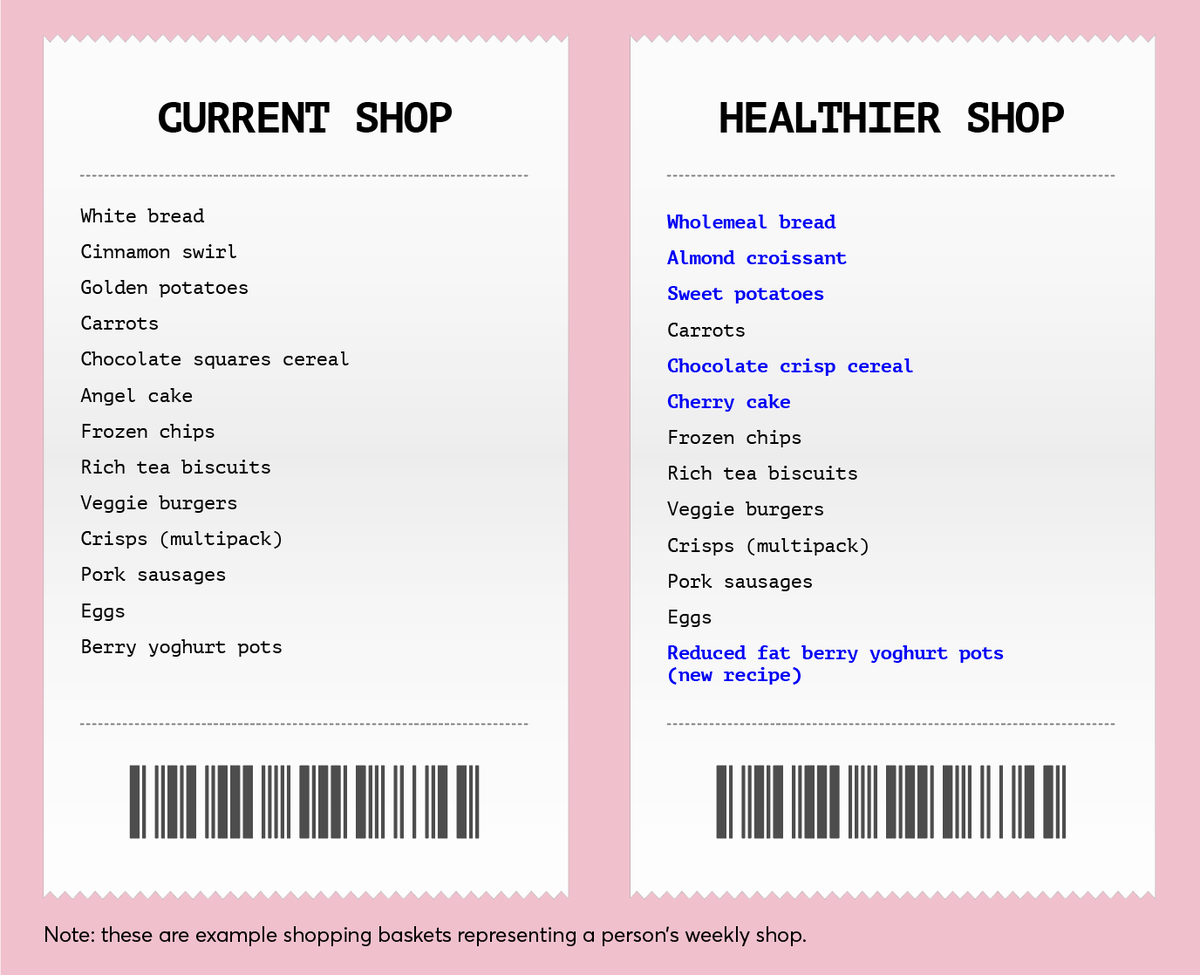
To bring the scale of change to life, we've shown an illustrative example of the small, positive health changes an average consumer could make when shopping at Asda. The blue items in 'new shopping' reflect the healthier product swaps. If all customers' baskets improve by a similar magnitude, this would achieve the SWA NPM improvement needed to hit the 2030 target health score.
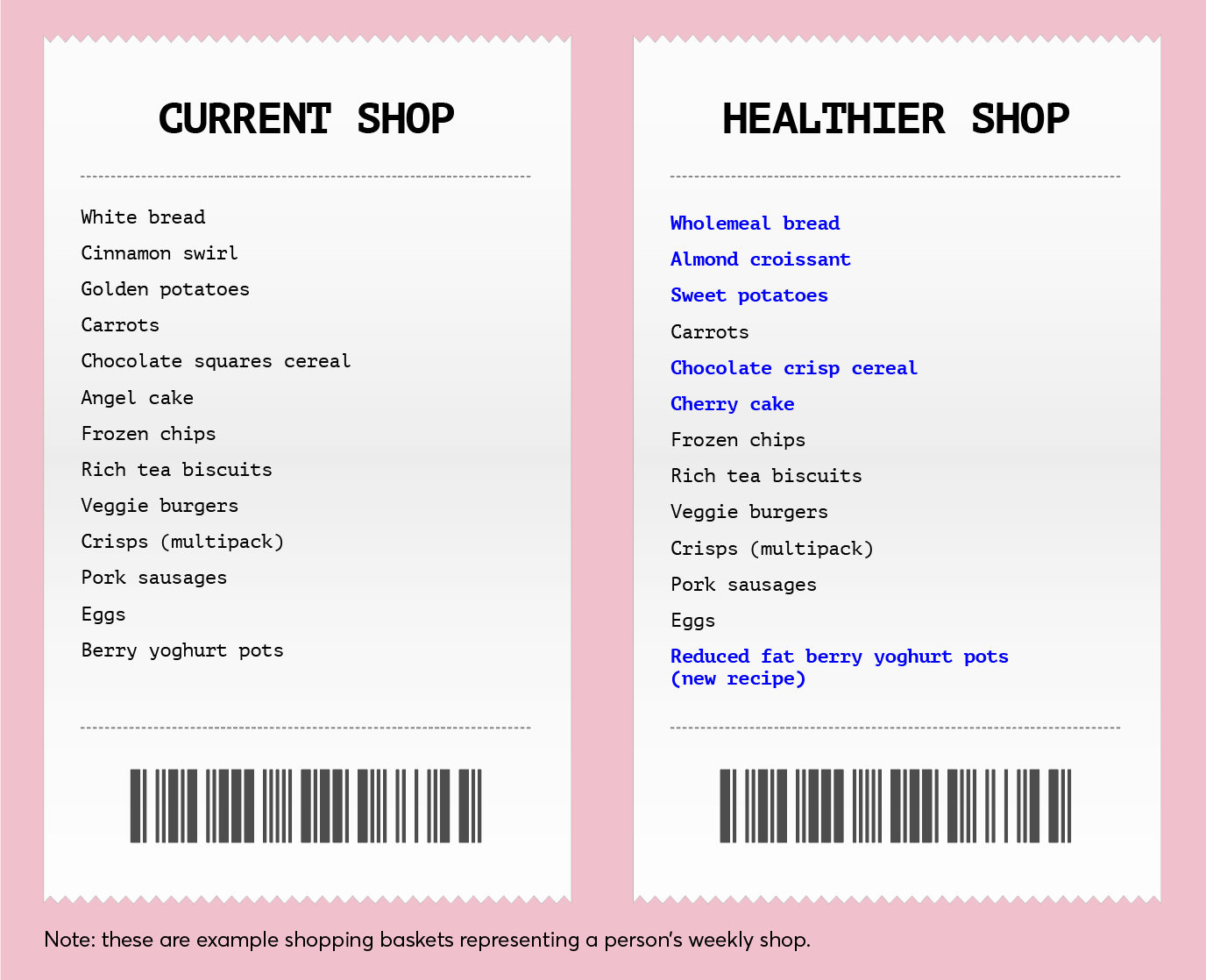
Note: these are example shopping baskets representing a person's weekly shop.
Phase 2: The trials
We ran eight 'proof-of-concept' trials to drive healthier choices in stores, observing some promising health impacts and generally no negative commercial impacts.
Trial design
Asda and Nesta co-designed eight proof-of-concept trials across 4 to 20 stores, which, if scaled, could help improve Asda's health score. They weren't intended to be at a sufficient scale to fully meet the health target, but to provide confidence to expand what works and test more health interventions across a much wider set of stores, categories and products going forward. We tested four levers to shift toward healthier purchasing: positioning, merchandising, messaging, and incentives. We did not test pricing or reformulation in our trials. Initiatives were implemented in Frozen, Snacks, and Produce, as each area plays a distinct role in customers' diets. Together, these categories cover 7 out of 36 categories.
Trial and control stores were selected based on a set of metrics, including pre-trial commercial performance, customer demographics, and store attributes. To simplify the operationalisation of trials, Asda selected trial stores located within a limited geographical area in the south east of England, and deemed representative of their national range of stores.
Trial measurement
We considered the health and commercial impact to define the success of the trials.
Nesta evaluated the health impact using a difference-in-differences design, comparing test stores with control stores selected by Asda's measurement team to be the most similar based on store attributes and financial patterns relevant to the trials. Whilst, ideally, the health impact would have been measured using the ‘SWA NPM' metric, the sample size for trial stores was often too small to detect changes. Therefore, Nesta used the most appropriate metric for each trial to assess health: SWA NPM, units sold, or spend.
Asda measured the commercial impact, i.e., the ‘healthier lines sales (£) lift' and 'product category sales (£) lift', using Mastercard's 'Test & Learn' platform. Asda also used a difference-in-differences design, comparing test stores and control stores in the pre- and post-periods. Control matching was based on financial patterns, store attributes, and predefined metrics most relevant to each trial.
It is important to note that, for the commercial analysis, Asda had access to data with greater granularity, a larger number of control stores, and better store-matching capabilities than those shared with Nesta. When direct health impacts were statistically 'insignificant' because of low sample size, correlational or ‘unknown', as Nesta was unable to run the analysis, we consider Asda's 'healthier lines sales (£) lift' as a proxy to assess interventions with promising health potential.
Results by levers
Table of results key: A=Asda conducted the analysis; N=Nesta conducted the analysis
Significance at the 95% level indicates high confidence that the result is due to the trial, and at 80% it indicates medium confidence.
Positioning
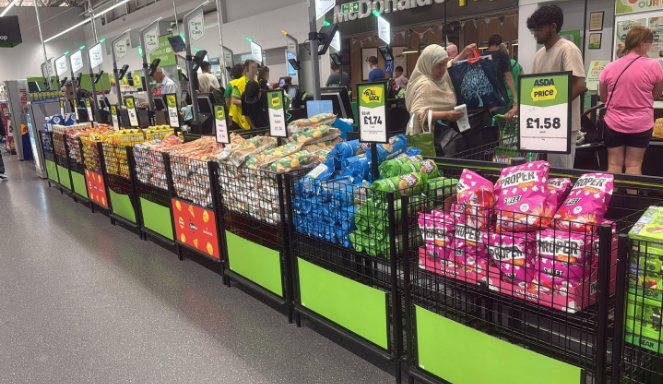
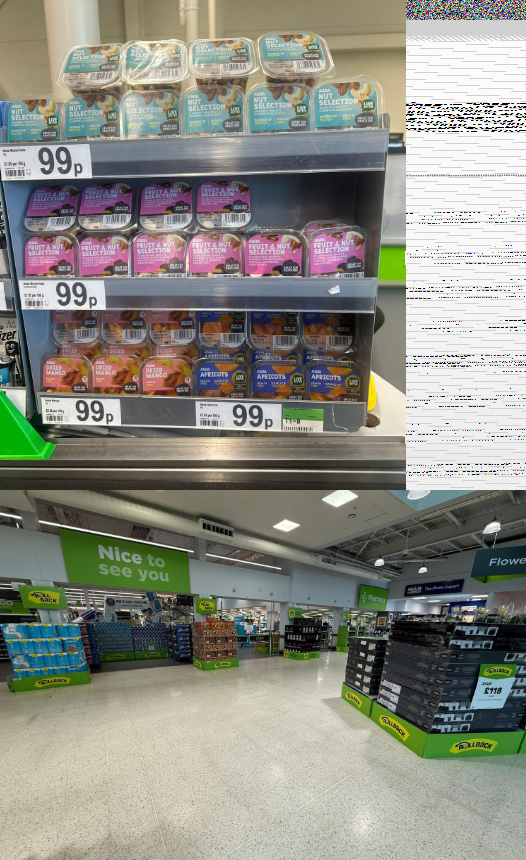
Rationale for trial: High-traffic areas, such as wire bins placed around the shop floor, checkout space, and store entrances, can be used to drive purchases of healthier products. Products in wire bins and store entrances were replaced with healthier alternatives, and fruit and nut pots were merchandised by the checkouts.
| Trial |
Trial stores |
Magnitude of impact |
Illustrative example |
| Healthy wire bins |
10 |
A: Healthier lines sales (£) lift: +19.9% (tested at 95% significance (significant))
A: Product category sales (£) lift: +0.9% (tested at 80% significance (not significant))
N: Health impact: +14% units sold (tested at 80% significance (significant)) |
 |
| Fruit and nut (Checkout) |
7 |
A: Healthier lines sales (£) lift: +24.9% (tested at 95% significance, significant)
A: Product category sales (£) lift: +0.9% (tested at 80% significance (not significant))
N: Health impact: +16% units sold (tested at 80% significance (not significant)) |
 |
| Healthier Store Entrances |
4 |
A: Healthier lines sales (£) lift: +10.7% (tested at 95% significance, significant)
A: Product category sales (£) lift: +1.0% (tested at 80% significance (not significant))
N: Health impact: Unknown (not analysed because of implementation issues) |
|
What did we find?: Placing healthier products in high-traffic areas, i.e., wire bins near self-checkouts, in-person checkout aisles, and store entrances, consistently increased sales of those healthier lines by approximately 10-25% without negatively affecting overall category sales. Wire bins showed the strongest health signal, with a 14% increase in healthier snack volume. Checkout placements also showed promising volume increases, and interestingly, this was driven mainly by nuts rather than dried fruit, suggesting that product choice matters as much as positioning. Store entrance results appeared positive from a commercial standpoint, but stock shortages and a small number of trial stores made the health impact unreliable to assess. Across all three trials, the pattern was the same; customers responded to healthier products when they were placed where impulse purchases naturally happen, and the business saw no commercial downside.
Recommended to scale
Uplift in sales across the healthier lines indicates this could be an effective way to drive purchases of healthier products.
Additional considerations
The effectiveness of this trial was likely minimised because several of these areas are already subject to HFSS location regulations. Therefore, products merchandised in affected areas were already defined as 'healthy' and would contribute less to an improvement in health than shifting from unhealthy to healthy products.
Merchandising
Rationale: Increasing the visibility and shelf space for healthier frozen pizzas relative to unhealthier pizzas will nudge customers towards healthier choices.
| Trial |
Trial stores |
Magnitude of impact |
Illustrative example |
| Healthier pizzas |
20 |
A: Healthier lines sales (£) lift: -0.0% (tested at 95% significance (not significant))
A: Product category sales (£) lift: -0.5% (tested at 80% significance (not significant))
N: Health impact: -0.006 SWA NPM (tested at 80% significance (not significant)) |
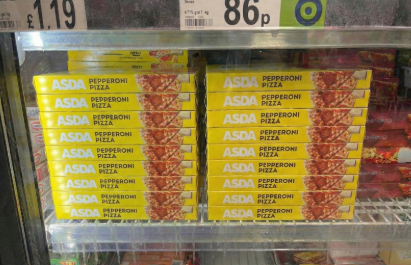 |
What we found: Increasing the shelf space given to healthier frozen pizzas had no measurable effect on either health outcomes or sales. 'Facings' represent the products customers can see at the shelf edge. In practice, the change to healthier facings in trial stores was small, around 2 percentage points, and this subtle shift was not noticeable enough to influence customer behaviour. Control stores also increased their healthier pizza facings during the same period due to routine layout updates, further reducing any contrast. Neither healthier pizza sales nor overall category sales were meaningfully affected.
Recommendations to scale
Given minimal results and implementation challenges, we do not recommend scaling as is. Since the change in facings we tested was small, it could be retested with a much larger increase in healthier products relative to unhealthy products on the shelf to assess whether this yields a positive outcome.
Additional considerations
Facings is a complex construct within the retail environment, and the relationship between facings and the extent of product visibility for the customer is not obvious, so interventions focusing on facings need to take this operational reality into account. Additionally, the trial demonstrated it is challenging to control facings in a retail setting - throughout the day, customer purchasing and movement of product at the fixture leads to changes at the shelf edge.
Messaging
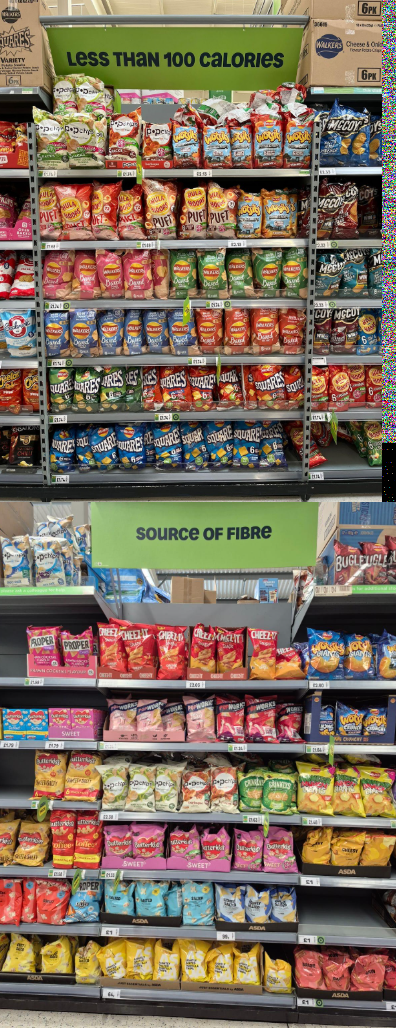
Rationale: Customer messaging calling out healthy choices will increase sales of these products. Products that met necessary health criteria were merchandised together in bays, under two different messages: ‘less than 100 calories' or 'source of fibre'.
| Trial |
Trial stores |
Magnitude of impact |
Illustrative example |
| 100 kcal snacking bay (versions 1 and 2) |
10 |
A: Healthier lines sales (£) lift: +6% and+6.8% (tested at 95% significance (significant))
A: Product category sales (£) lift: +1.1% and+1.5% (tested at 80% significance (significant))
N: Health impact: +0.003 SWA NPM (tested at 80% significance (not significant)) |
 |
| Fibre snacking bay |
6 |
A: Healthier lines sales (£) lift: -7.8% (tested at 95% significance, significant)
A: Product category sales (£) lift: -0.2% (tested at 80% significance (not significant))
N: Health impact: -0.04 SWA NPM (tested at 80% significance (not significant)) |
|
What we found: Asda's analysis showed that product sales increased by approximately 6% when merchandised in a bay with 'less than 100 calories' messaging. However, sales decreased by approximately 8% when merchandised in a bay with 'source of fibre' messaging. The uplift in healthier products is promising, but Nesta's analysis found that neither bay produced a detectable shift in the overall health score for the snacking category as the trial products made up too small a share of the wider category. This suggests that for health messaging to meaningfully contribute to category-level improvement, they would need to include a larger range of products. The difference in effect between the two bays also suggested different customer motivations, so it's important to understand which messages resonate best with customers to drive healthier sales.
Recommendations to scale
The trial's impact was both message and product-dependent. The ‘less than 100 calories' message increased snack sales within the calorie-controlled bay, but the 'source of fibre' message reduced snack sales within the fibre snacking bay. Therefore, it is recommended that the 100 kcal snacking bay be scaled, and that the fibre snacking bay messaging and product selection be further considered, including potential applications or suitability in other categories.
Additional considerations
100 kcal and fibre bays were implemented in the same stores. Therefore, we do not know whether customers purchased more 100 kcal snack products at the expense of the fibre products.
Incentives
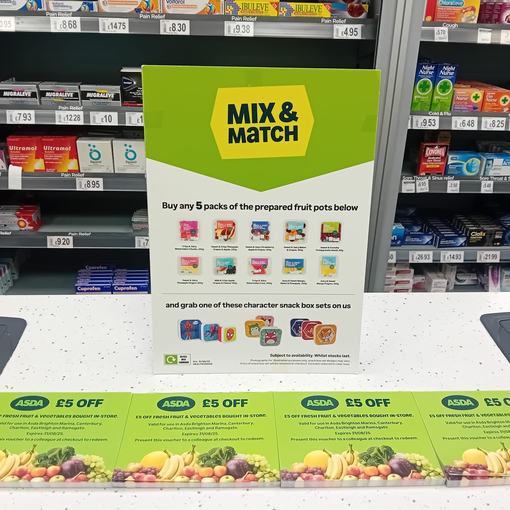
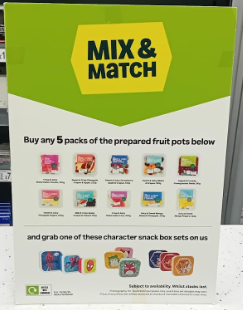
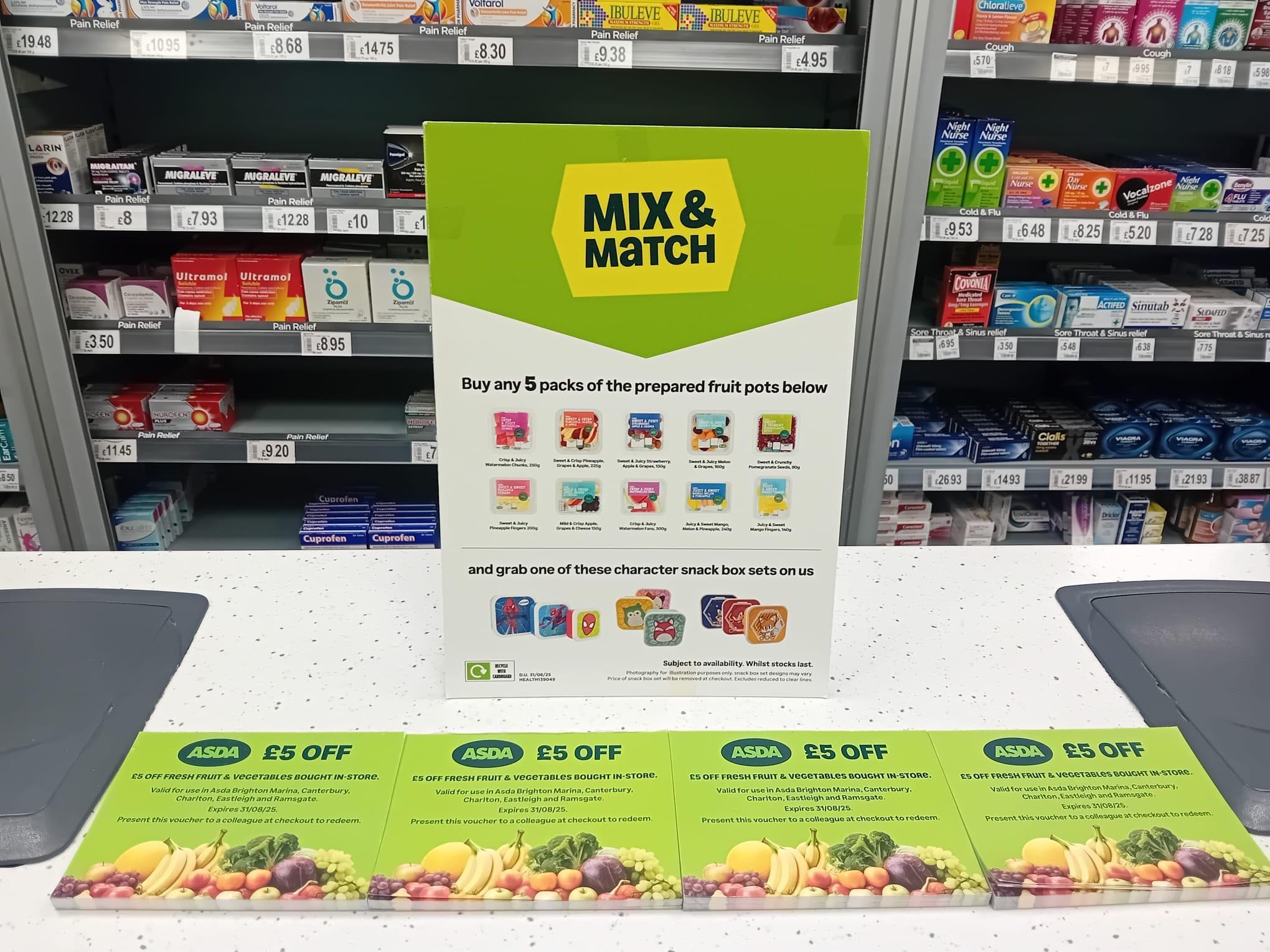
Rationale for trial: One stated barrier for purchasing more fresh produce is affordability. Providing a £5 voucher to pharmacy customers for produce will increase purchase volume. Incentivising the purchase of fruit in a way that appeals to children will increase the amount of fruit purchased, so a free kids' character snack pot was offered with the purchase of five prepped fruit pots.
| Trial |
Trial stores |
Magnitude of impact |
Illustrative example |
| Snack pots (Link-Save) |
10 |
A: Fresh produce lines (£) lift in customer baskets: +10.1% (tested at 95% significance (significant))
A: Fresh produce category sales (£) lift in customer baskets: +26.4% (tested at 95% significance, significant)
N: Health impact: +£1.50 produce spend per basket (customer analysis with no control, so correlational only) |
 |
| Produce vouchers |
5 |
N: Voucher redemption: ~7%
A: Fresh produce lines (£) lift in customer baskets: +10.1% (tested at 95% significance (significant))
A: Fresh produce category sales (£) lift in customer baskets: +10.3% (tested at 95% significance, significant)
N: Health impact: Unknown (data challenges) |
|
Note: The results above represent the uplift to customers baskets who participated in the trial promotions.
What we found:
Both trials tested whether incentives could encourage customers to buy more fresh produce. The snack pot link-save trial, in which Asda offered a free children's lunchbox with the purchase of five fruit pots, drove an increase of approximately £1.50 in produce spend per basket among participating customers, with no sign that they simply switched from other produce items. However, uptake was low, and Asda's analysis showed the effect disappeared once the promotion ended. The produce voucher trial, in which Asda offered £5 towards fresh produce to pharmacy customers, saw only approximately 7% of vouchers redeemed. Evidence suggested that customers largely used them to pay for produce they would have bought anyway rather than adding more to their baskets.
Recommendations to scale
It is recommended that both incentives be redesigned before trialling again to significantly increase uptake, and consider if the cost can be reduced.
Additional considerations
Customers were given £5 to spend on produce, yet there was minimal additional produce purchased, suggesting that price is not the only barrier to increasing produce purchasing. Other barriers to purchasing more produce should be explored in the future.
Scaling for impact
Asda's proof-of-concept trials offer valuable lessons as the retailer advances toward achieving its 2030 target health score.
Proof-of-concept trials have been invaluable in allowing Asda to work closely with stores, understand real customer behaviour and operational challenges, and test interventions in a controlled and rigorous way. Asda will now take these learnings forward to implement positive change at scale. Delivering health interventions at a larger scale across many more stores, levers, categories and channels will enable Asda to accurately measure the impact on its health score and make further progress to its 2030 target.
Through these proof-of-concept trials and our wider partnership, Asda and Nesta identified four enablers for successfully driving change in a large business within a complex retail environment.
1. Business-as-usual (BAU) integration
Embedding health into business-as-usual is a major opportunity for Asda to meet its target health score. By empowering category teams to champion health alongside commercial priorities, Asda can ensure health becomes a part of everyday decision-making across the business.
2. Consistent measurement and accountability
A metric, such as the SWA NPM, ensures that all teams share a collective, consistent understanding of what makes a product healthier. Asda has invested in data systems and supplier engagement to ensure that progress on the 2004/05 SWA NPM metric can be measured and reported. If the 2018 NPM model is introduced by the UK government, Asda will need to prioritise efforts to calculate and collect 2018 NPM scores for its products, integrate this into operations, and set a revised target health score and related category targets.
3. Colleague responsibility and advocacy
Colleague engagement is essential to healthier sales initiatives. To drive the 2030 target health score and associated category targets, extensive colleague engagement will be required to ensure a sense of responsibility and advocacy.
4. Industry-wide collaboration and shared goals
Positioning health as a shared agenda with suppliers enables Asda to benefit from their deep understanding of products and strategies to drive change. With a clear and consistent business goal, aligned to policy and well understood across manufacturers, health can be embedded into joint business planning and collaborative decision-making.
Policymaker and sector implications
The partnership provides evidence relevant to policymakers and other food businesses, especially as new mandatory health data reporting and target regulations are expected in the coming years.
Outcomes-based approaches are preferable to prescriptive rules. Allowing businesses the freedom to operate in ways that are right for their customers helps empower them to drive change in a sustainable and meaningful way.
Changes to the way that a business drives healthier sales must be and can be commercially sustainable. The consistency of commercial sustainability across seven out of eight trials provides evidence that healthier sales initiatives can be commercially viable.
Trials are a useful tool for understanding the impact on customer behaviour. Due to the operational complexity of the retail environment and customer behaviour, trials are important to test and translate academic theory into real-life impact.
Health objectives should and can be embedded into core business ways of working. Sustained impact requires integrating health objectives directly into existing business structures and processes, shifting accountability to teams across the business, particularly commercial teams, and ensuring health becomes a routine consideration in decision-making.
Policies should account for the complex operational reality. The retail environment is complex due to its scale, wide variety of products sold, customer behaviour, and influence of external factors. Policies that account for operational reality and can fit within business-as-usual are more likely to succeed. This includes ensuring any new policies, including the proposed 2018 NPM update, are accompanied by clear timelines and implementation guidance. Consistency across the devolved nations also supports business feasibility.
Asda's partnership with Nesta places it ahead of the regulatory curve regarding the UK government's newly proposed mandatory reporting and targets policy. The trials serve as a proof of concept; the category targets and enablers create the foundations to get there. We hope that other retailers follow a similar path and that collectively, as policymakers, businesses, and charities, we improve the nation's health whilst maintaining commercial success.
58 Victoria Embankment
London EC4Y ODS
+44 (0)20 7438 2500
[email protected]
@nesta_uk
@nestauk.bsky.social
nesta.uk
Nesta
nesta_uk
www.nesta.org.uk
ISBN: 978-1-916699-51-9
Nesta is a registered charity in England and Wales with company number 7706036 and charity number 1144091. Registered as a charity in Scotland number SCO42833.
Registered office: 58 Victoria Embankment, London EC4Y ODS.