The internet’s environmental impact is increasing at a staggering rate and it is time for Europe to act. This report lays out a plan to clean up the internet.
Within a few short decades, the internet has become an indispensable part of our lives, powering business and trade, accelerating research and innovation and keeping us connected during times of crisis. Looking towards 2030, the emergence of new technologies - from Artificial Intelligence (AI) to the Internet of Things (IoT) - is only going to deepen the interdependence of our material and digital lives.
But as the internet grows increasingly complex, and with it our demands on hardware and services, the environmental impact of this digital infrastructure threatens to spiral out of control. By 2030, the internet could contribute as much as 25 per cent of all greenhouse gas emissions and the IoT could create unprecedented amounts of electronic waste.
As Europe emerges from the COVID-19 crisis and sets out a plan for socio-economic recovery, it must urgently address and resolve the tension between our growing reliance on connected technologies and our ambitions for environmental sustainability.
Key findings
- As Europe embarks on an ambitious recovery plan and anticipates future crises, it should transition towards a socio-economic model that is at once more digitally connected and greener.
- This twin transition presents a significant challenge. Although considered intangible, our digital lives have a material impact on the planet. If left unchecked, the exponential growth in internet-enabled devices and data-intensive services will account for a significant share of our environmental footprint.
- At the same time, the twin transition is an opportunity for Europe to demonstrate its technological and competitive edge. In this report, we show how through integrating the full cycle into policy, improving designs and repairability, informing consumers about their decisions and incentivising green buying, Europe and its partners could lead the world in the development and promotion of sustainable internet technologies.
About
AUTHORS
Louis Stupple-Harris, Senior Researcher, Nesta Contributions by Hessy Elliott, Markus Droemann and Katja Bego
Note: This reports only reflect the views of the authors. It forms part of the NGI Forward project's overarching recommendations for the Next Generation Internet initiative and future European internet policy. It does not necessarily reflect the views of the European Commission.
ABOUT NGI
NGI Forward is the strategy and policy arm of the Next Generation Internet (NGI), a flagship initiative by the European Commission, which seeks to build a more democratic, resilient and inclusive future internet. The project is tasked with setting out an ambitious vision for what we want the future internet to look like, and identifying the concrete building blocks – from new technologies to policy interventions – that might help bring us closer towards that vision.
NGI Forward is made up of an international consortium of seven partners: Nesta in the United Kingdom, which leads the project, DELab at the University of Warsaw in Poland, Edgeryders in Estonia, the City of Amsterdam in the Netherlands, Nesta Italia in Italy, Aarhus University in Denmark and Resonance Design in Belgium. The NGI Forward project commenced in January 2019 and will run for three years.
To learn more or get involved, visit http://research.ngi.eu.
1. Executive Summary
The internet has become an indispensable part of our lives, powering the economy, facilitating research collaboration and keeping us connected during the COVID-19 pandemic. Connected technologies drive up the efficiency of our public services, limit our need for carbon-intensive travel, and drastically reduce paper waste. The internet even makes environmental action more effective, allowing us to better monitor and understand climate change and educate citizens around the globe about shared challenges and solutions. It is clear that the internet will play a central role in Europe's ambition of reaching net-zero greenhouse gas emissions by 2050.
What is less well understood are the environmental costs associated with internet technology and digital consumerism itself. The connected devices and services we use have their own footprint and sustainability challenges. Although deemed intangible and invisible, the upkeep of our digital economy requires large-scale mining of natural resources and colossal quantities of energy, while producing significant amounts of waste that is increasingly difficult to recycle.
As our demands on this infrastructure grow, so does its environmental impact. By 2030, the internet could be responsible for almost a quarter of all greenhouse gas emissions. If we are to reach our ambitions for a greener, more digitalised European economy, policymakers and the tech sector will have work together to better understand and mitigate the unique sustainability challenges of the internet and emerging technologies like IoT and AI. As governments across the globe are beginning to reckon with the looming climate emergency and prepare far-reaching environmental legislation, such as the European Green Deal, more thought must be given to the dual role of technology as a solution and potential contributor to its worst effects.
Four pillars
This report aims to shine a spotlight on some of the often-overlooked sustainability challenges associated with internet infrastructure, services and hardware. To address, these challenges, we establishe four broad principles or pillars for officials and legislators to consider when designing policy for internet sustainability:
- Integrate sustainability thinking into all areas of digital policy, from the GDPR to competition enforcement.
- Improve the design of technology by setting standards, regulating where needed and encouraging manufacturers to align their ambitions for sustainability and innovation.
- Inform consumers about the impact of their purchases and activities and empower them to make more sustainable decisions.
- Incentivise positive change and create markets for more sustainable alternatives through procurement, funding and taxation.
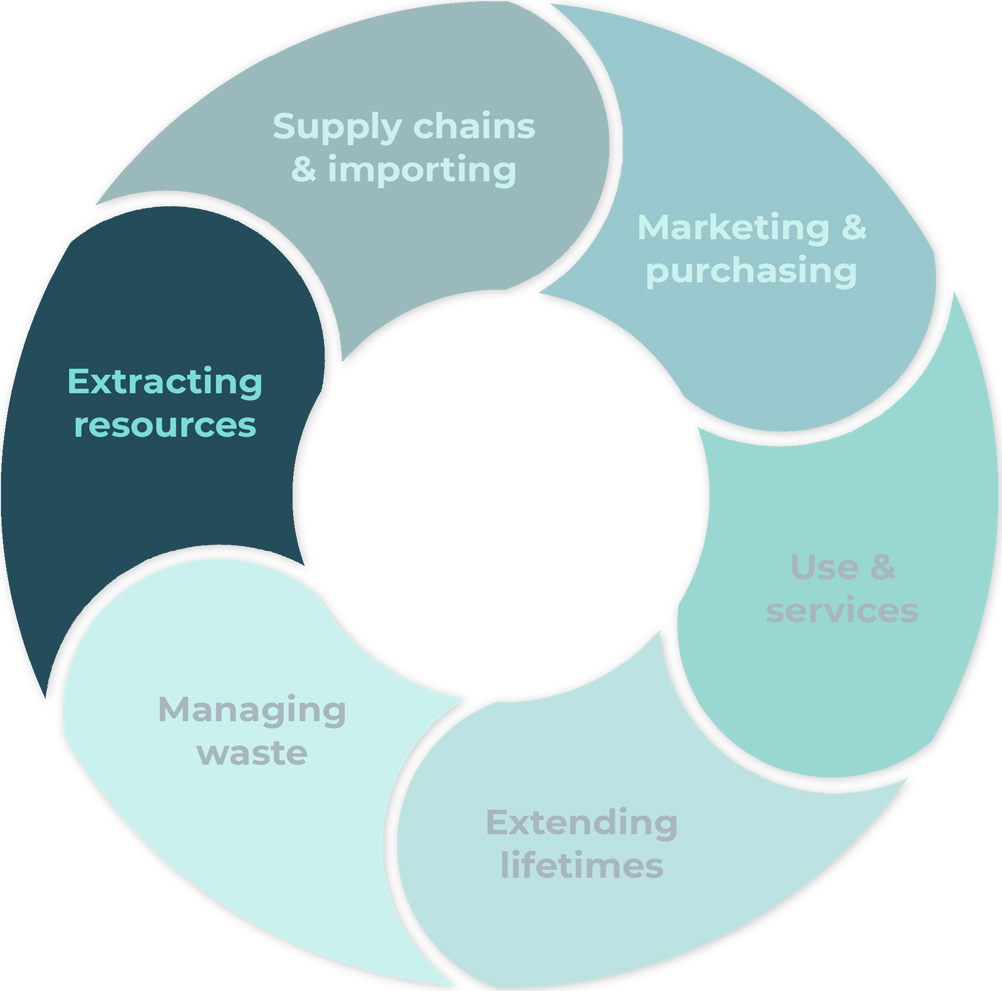
Targeted action along the device lifecycle
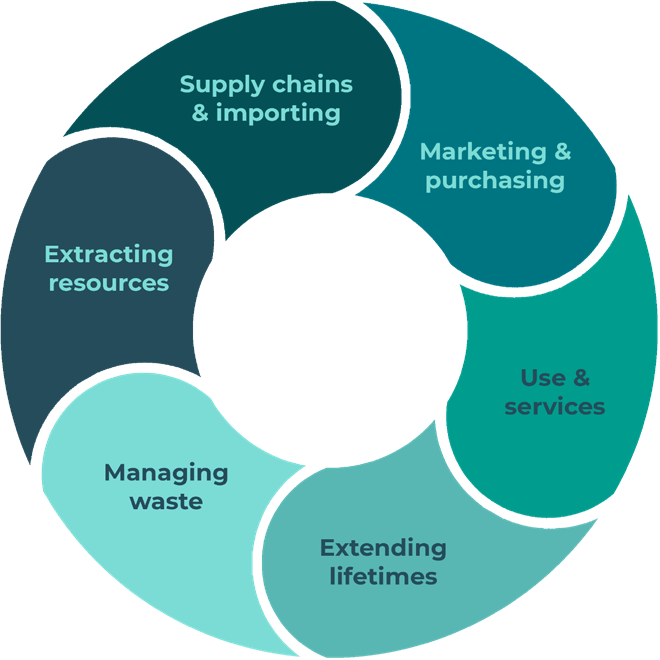
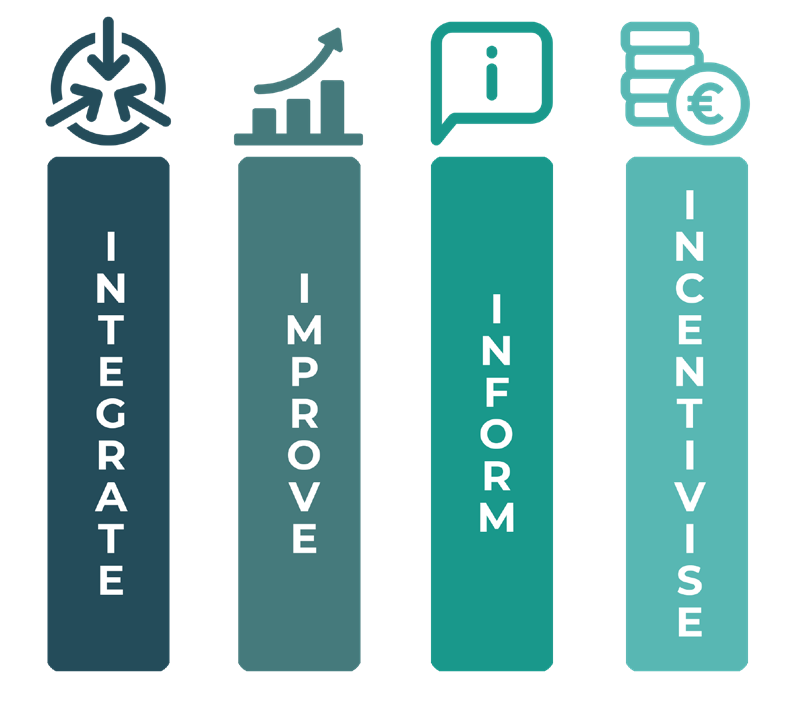
Fig. 1: Four pillars to underpin sustainable internet policymaking 1 Fig. 2: Steps of the tech lifecycle where intervention should be targeted
The life of any modern internet device starts deep underground, in mining operations extracting metals and rare earth element. Often, these mines are located in countries with lacking environmental and labour regulations. The upcoming Conflict Minerals Regulation seeks to address some of the impacts associated with mining in regions of conflict but leaves room for expansion and improvement. Technology companies should be required to report on the socio-environmental impacts of materials they source from a broader range of high-risk areas. Policymakers could also explore the possibility of mining some materials within Europe and extracting rare earth metals from recycled devices.
Currently, most of our internet devices are manufactured outside Europe and imported. But it is rarely clear where the countless parts in our smartphones come from or how they are produced. Since a device's lifetime environmental footprint is largely generated before the point of purchase, greater transparency and impact reporting along supply chains must become the norm. This information could be used to inform a carbon border adjustment, or carbon import tax, to ensure that prices better reflect the environmental cost of electronics, and create a more level playing field for European producers.
Our purchasing decisions are heavily influenced by marketing tactics and the information that consumers receive. Three-quarters of Europeans say they are happy to spend more on environmentally friendly products. Greater awareness of the environmental impact of a device could nudge buyers towards more ethical decisions. Europe could implement a product labelling scheme or trustmark to this end. Digital procurement can similarly be reformed to make greener choices. New requirements to weigh long-term environmental costs in deployment decisions should be implemented, alongside greater investment in low-energy products and services.
Once a device is deployed or brought home from the shop, it is immediately put to use downloading apps, making calls and connecting to digital services. The transmission and storage of all this data use vast quantities of energy. With the GDPR, legislation mandating data minimisation already exists. Large data processor could be required to reduce unnecessary data, and power their data centres entirely with renewable energy by 2030. Streaming sites and other online services also need to reduce their energy consumption. Europe can lead this by investing in research and promotion of low-energy design principles for digital innovators, and establishing an expert taskforce to explore how measurement of energy impacts can be standardised and used to inform consumers, for example by prioritising low-energy results in search engines.
The last decade has seen a boom in edge computing and decentralised services like Bitcoin. Europe needs to become better at anticipating the potential energy impacts of such trends. We should direct public investment into more sustainable alternatives, and dedicate a research centre to study the environmental implications of emerging technologies before they hit the mainstream. Consumers also struggle to switch to greener services because of technology lock-in. A rapid review into barriers to switching could still feed into the design of the Digital Services Act, and future changes to the competition regime.
Governments and technology companies alike have made commitments to reach 'carbon neutrality', but the concept itself is flawed, because it lets polluters off the hook. The European Commission should fix this by upgrading its climate targets and focusing on total emissions reductions, rather than net-zero.
Keeping a device going for longer also reduces its environmental footprint significantly. Major manufacturers should provide five years of software updates to keep smartphones and laptops secure and running smoothly. New legislation could also be introduced to extend consumer warranties. To incentivise more resilient design innovation, manufacturers could be required to cover damage that is easily preventable at the design stage, such as fragile glass screens. Device repair is also laborious, tightly controlled and often expensive, partly because of conscious design choices. A repairability index for devices sold in the Single Market could inform buyers about the expected cost of keeping a device in good condition, popularising modular design and more durable materials.
When a device finally becomes unviable to repair, it is disposed of. But the vast majority of European internet devices end up either in landfill or exported to developing countries, where their parts are processed in polluting and dangerous chemical processes. Investment in recycling infrastructure is urgently required, and a EU-wide takeback scheme for devices could help close the circular economy for internet devices
Policy interventions aimed at improving sustainability almost always involve politically difficult trade-offs. They require us to consider and mitigate knock-on effects on other important objectives like global trading relationships, regulatory alignment, digital inclusion, consumer choice and economic development.
But as we emerge from the COVID-19 crisis, Europe also needs to be clear about its values and priorities. We need a recovery plan that sets us on a trajectory towards more a circular, zero-emission digital economy, underpinned by resilient and transparent supply chains and a purpose-driven and competitive European innovation ecosystem.
Looking back at the EU's Digital Single Market initiative, and ahead at the European Green Deal's ambitious targets, the European Union has already demonstrated the political will, regulatory influence, market power and capacity for innovation necessary to drive change at a global scale. It should now take the logical next step become a global leader in internet sustainability.
2. Introduction
As Europeans, our economic and social lives have become increasingly reliant on digital connectivity. The internet allows us to communicate with distant loved ones, connect people in need, and collaborate remotely. During the COVID-19 pandemic in particular, the internet gave rise to new and sometimes ingenious ways for billions of people to stay safe, connected and productive.
As countries prepare to emerge from this crisis, the Europen Union has already made a public commitment to put the twin challenge of transitioning towards a greener and more digital economy, at the centre of its pandemic recovery strategy, Next Generation Europe. In doing so however, we must also recognise the need for a serious public debate about the environmental impact of our digital economy and connected lives.
Connected devices and internet services can have a material impact on the environment and climate in ways that we tend to underestimate. This impact is already substantial and growing, and though the digital economy is often described as intangible, our reliance on connectivity comes at a tangible cost. We may not immediately see it or feel it, but every message, like and video call, in one way or another, leaves a mark on the planet.
Smartphones, laptops, data centres and the infrastructure that connects us consume a rapidly rising share of global energy supplies. Today, the internet is estimated to use nine per cent of globally-generated energy, much of it still carbon-based. It could contribute as much as 23 per cent of all global greenhouse gas emissions by 2030. 2
But the challenge ahead is not just about our carbon footprint and climate change. Growing demand for internet devices and the smartification of everyday appliances pushes us to extract natural resources in socio-environmentally degrading mining operations. This disproportionately affects developing countries, polluting soils and rivers, stoking conflict and forcing workers into hazardous conditions.
Despite the unsustainable nature of these practices, the e-waste produced by our obsession with rapid hardware upgrade cycles is piling up, in Europe and abroad, with a pitifully small proportion actually processed or recycled within the European Union.
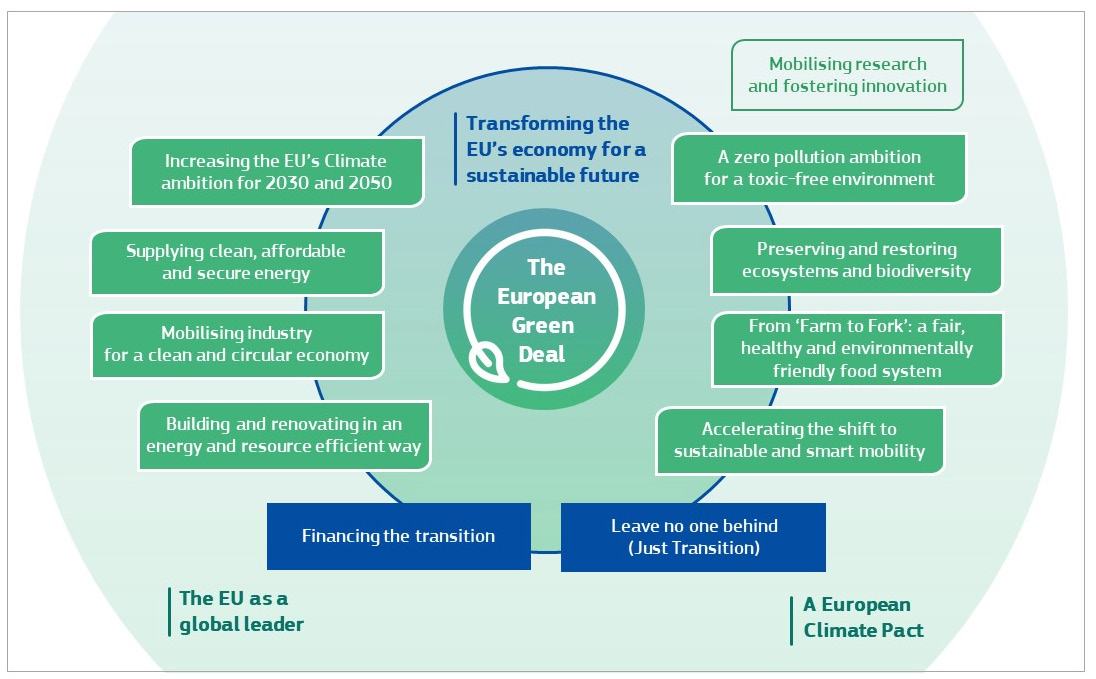
Fig. 3: The European Green Deal Source: European Commission
Vehicles to address these challenges already exist. The European Green Deal, the European Commission's most prominent environmental policy, sets out a goal to reach net-zero carbon emissions by 2050 across the bloc. 3 The environmental impact of the internet must become part of this agenda.
Other promising policy ideas already in development include the Right to Repair electronic devices, incentives for climate-neutral data centres by 2030 4 and proposals to introduce environmental transparency requirements for telecoms operators. 5 The Commission is also consulting on measures to strengthen the role of consumers in the green transition by providing more information and creating higher standards for device sustainability. 6
While ambitious in overall scope, however, the Green Deal still lacks a serious examination of the unique dual role of technology in the looming climate crisis. From efficiency-improving but energy-hungry AI systems to IoT-powered smart cities, internet technologies have the potential to serve as both solution and contributing factor to the world's mounting environmental challenges.
Raising awareness of the environmental impacts of our digital lives among consumers, industry and policymakers should be a first step. Adoption of more sustainable design practices is another. Environmentally friendly design choices for everything from internet infrastructure and standards to services, software and hardware already exist. But their adoption can only be ensured and accelerated with greater public awareness, coordination and scrutiny.
About the structure of this report
The remainder of this report is divided into two parts: the next section provides context and an overview of the broader issues surrounding the internet's footprint. It suggests four pillars that should make up a comprehensive European approach to internet sustainability:
The following section then follows the lifecycle of an internet device and the services it might access. Along the way, we will make recommendations where we see the potential for policy interventions, greater consumer awareness or improved industry practice.
This report includes statistics relating to the 'carbon footprint' or 'greenhouse gas emissions' of products, services and activities. Where possible, these figures will be denoted in terms of their approximate equivalence with the greenhouse effect caused by carbon dioxide, written in kilograms or tonnes of ‘CO2e’, carbon dioxide equivalent. This calculation is approximate because different activities emit a range of greenhouse gases that create effects that change over time.
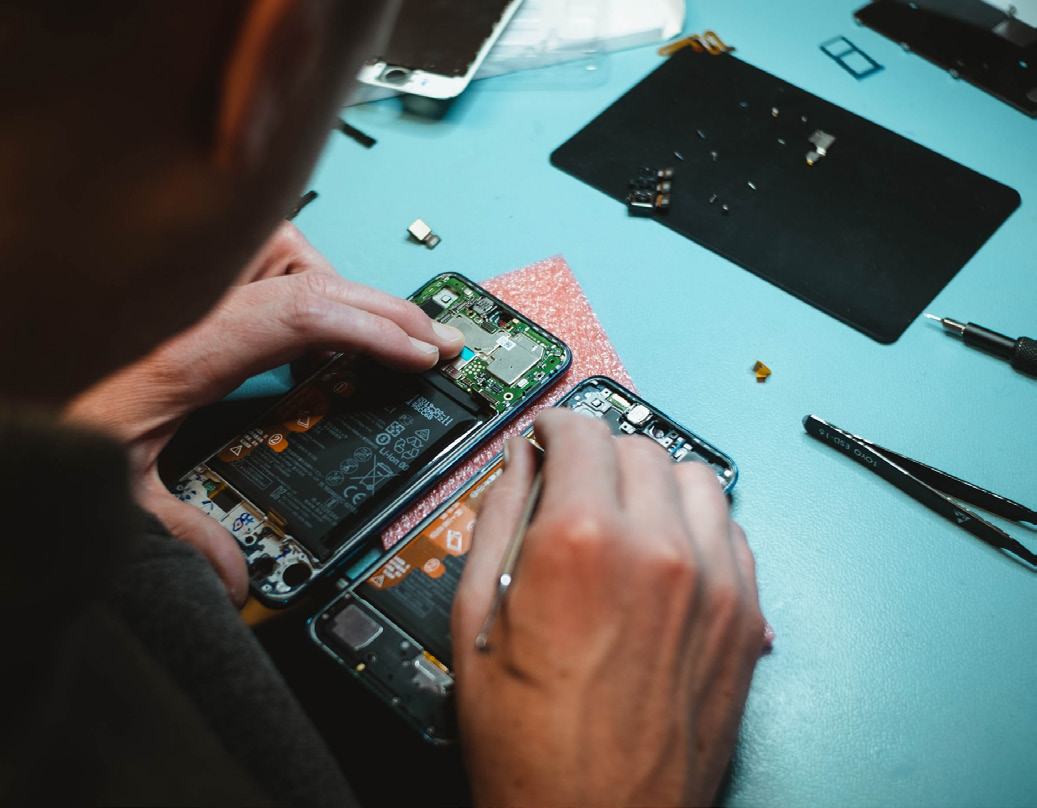
Europe urgently needs a Right to Repair Photo by Kilian Seiler on Unsplash
Of course awareness alone does not solve complex problems. The scale and conceptual fuzziness of the internet makes quantifying impacts in a meaningful and comparable way challenging, and as with any area of environmental policymaking, there are trade-offs to consider, from questions over economic growth and cyber-security to considerations for inclusion and accessibility.
This report aims to take a holistic view of the internet and its relationship with our environment. It lays bare the multitude of ways in which our digital footprint affects the planet, and highlights some promising business models and policies that could reduce that impact or even reverse it. It also sets out several recommendations that policymakers across Europe should consider, stress-test and adapt to tackle this challenge head on.
In the aftermath of the COVID-19 pandemic, Europe will need significant investment to restore quality of life and economic progress. This will be a moment for difficult political decisions, whose consequences may shape our economy for decades to come. But it will also serve as an opportunity for Europe and its partners to act as a global standard-setter, invest in sustainable innovation and, by transitioning towards a greener, digitally transformed economy, pursue a course that can serve as a model for others around the world.
3. The environmental impact of our digital lives
In recent decades, environmental protection has become one of the most pressing issues facing the planet and its inhabitants. People all over the world are looking for ways to take action by reducing their waste and energy consumption or thinking more carefully about how their actions affect their natural environments.
Despite this growing sense of urgency, our consumption of energy-intensive products and services continues to rise. More people spend more time connected to the internet, using more devices – which we choose to replace more regularly—in increasingly energy-intensive ways.
The environmental impact of our digital lives is real, and growing rapidly, but it is generally poorly understood. The internet is a fuzzy concept with a complex architecture, and unlike industrial smog or plastic bottles, its environmental footprint is not as immediately visible. However, the internet is not just something that just exists in the cloud, and its effects are startling when brought into sharp focus.
The physical devices, cables and servers that make up the internet are made from a wide array of materials that all need to be extracted from the ground, requiring large scale mining operations to dig, shatter and explode the earth. To illustrate the vast scale of these operations, consider the example of smartphones. Europeans buy around 200 million smartphones a year, 7 each requiring the mining of more than 34kg of raw ores, which are then smashed, burnt and dissolved to extract the valuable minerals inside. Each year, more than 6.8 billion kilograms of earth is removed and processed, more than the weight of the Great Pyramid of Giza, 8 just for the smartphones used by Europeans.
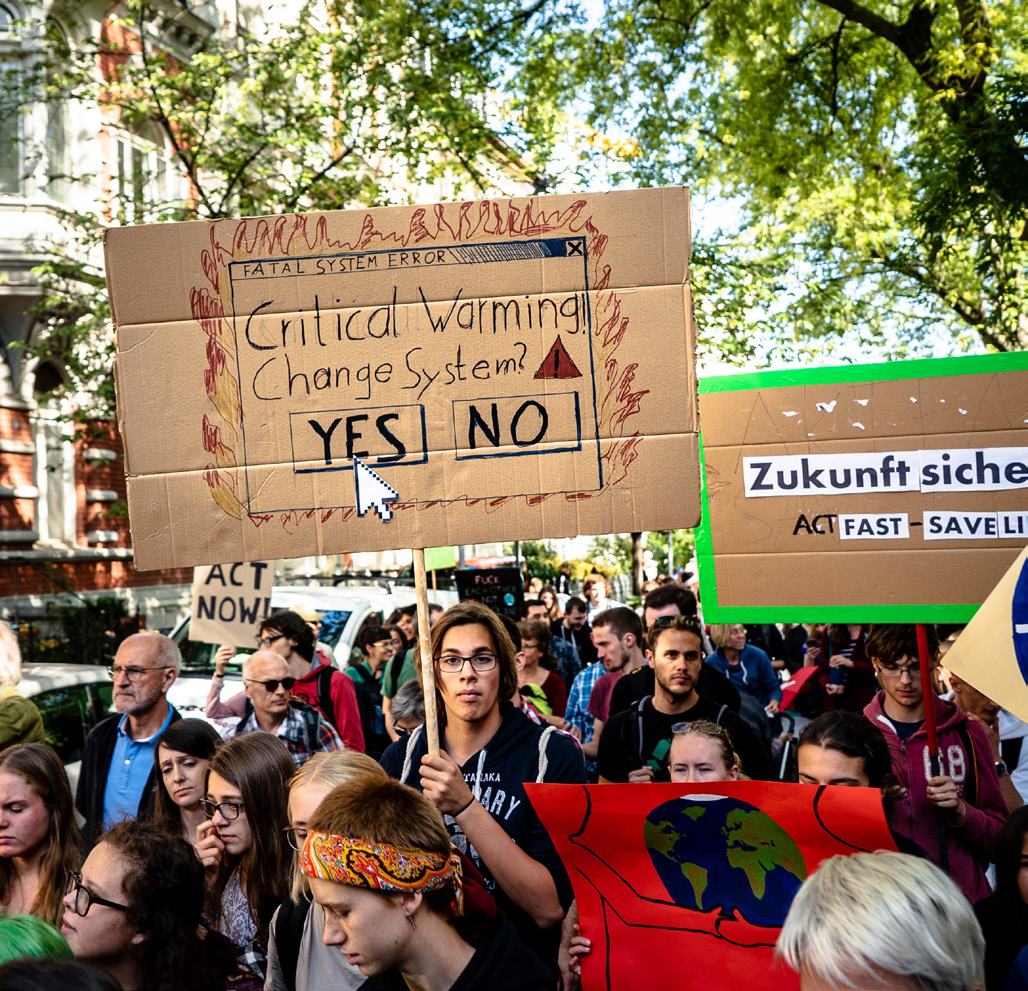
Photo by Mika Baumeister on Unsplash
These mining operations are generally conducted by people in less economically developed countries, often under abysmal working conditions. Processing of raw materials is dirty work, polluting large amounts of freshwater and producing radioactive waste, which can leak into surrounding watercourses. 9 The materials are then transported using fossil fuel-powered vehicles to other countries, in many of which product manufacture is made cheaper by inadequate environmental protections. By the time a smartphone or laptop reaches a shop or online store, up to 95 per cent of its lifetime greenhouse gas emissions have already been created. 10
From the moment an unsuspecting consumer removes their new smartphone from its box and connects to the internet, the carbon footprint of its use is inextricably intertwined with the cables, interchanges, and data centres that transmit data to and from it, or store photos, emails and device backups in the cloud. The physical infrastructures of the internet consume large amounts of energy, currently between five and nine per cent of global generation. The vast majority of this energy still comes from polluting sources, such as coal and gas, which means that the internet's less tangible outputs – our data and communications matter too. According to some estimates, a single email creates around 4g of carbon dioxide. 11 Unaware of the impact of our actions, we send roughly 300 billion emails per day, creating 1.2 million tonnes of emissions every twenty-four hours. 12
This pales in comparison with streaming video content, which is estimated to account for 60 per cent of internet traffic. 13 Europeans watch more than a billion hours of streaming content every day, 14 a large portion of which is powered by fossil fuels. 15 Content providers and data infrastructure owners are pledging to reduce the climate impact of online video, but progress is slow because of the complexity of consistently providing large quantities of renewable energy.
Let's say that after months of texting, calling, emailing and streaming, our hypothetical consumer drops their device. The screen smashed, they will struggle to repair it without professional help. Repair manuals and spare parts are rarely made available to end users, and manufacturers often threaten tinkerers with draconian warranty conditions, making costly manufacturer repair seem like the only choice. But enticed by marketing campaigns that tout thinner bezels as life-changing innovation, they may well give up altogether and just opt to buy a new device, beginning the cycle anew.
The consumer's old smartphone will likely languish in a drawer for several years before being disposed of, 16 and even if they are in the minority of people recycling their device rather than throwing it away, it will likely be shipped to a less developed country. Working in dire conditions, low-paid workers will disassemble the device for its valuable components but may well struggle since it was designed in a way that makes this process difficult. Many parts will be lost, and those that can be reused will be subjected to acid and chemical treatments that are prone to leaking into the environment.
Just looking at smartphone sales, half a million Europeans set out on this sad journey every day, largely unaware of their unsustainable patterns of consumption or the business practices and design choices that have brought us here.
How the internet powers green action
The story is not all bad. Internet technologies also have the potential to bring about significant reductions in carbon emissions from other sectors. The carbon footprint of a paperback book is around 1kg CO2e and a newspaper creates 0.3kg to 4.1kg CO2e. Reading online has a far lower impact, even taking a device's footprint into account. 17 Video conferencing and remote access technologies enable workers to communicate and collaborate without polluting travel, and advances in virtual and augmented reality may soon create immersive remote experiences that reduce the need to travel further. The COVID-19 crisis has demonstrated the viability of shared productivity tools and video conferencing, and recent months have seen significant innovation in how organisations conduct meetings, participate in education, make decisions and even socialise online.
These technologies are inherently designed for communication, and this becomes all the more important when a concerted, international effort is required to solve a problem. Coordinating a response to the environmental crisis is unimaginable without the ability to easily share data, resources and ideas across the globe. Digital technologies connect people to each other and to vital information about the progress of environmental change. The instant transmission of data from weather and air quality sensors across the world enables scientists to coordinate their research and, ultimately, devise solutions.
Understanding and addressing the environmental crisis will require remote sensing of everything from weather patterns and traffic to water levels and emissions on a scale not before deployed. For example, AirQ air quality sensors have been deployed across the city of Xanthi in Greece to collect data on annual trends in pollution. 18 Many applications have also been directed towards monitoring energy generation. German off-grid solar supplier Mobisol has integrated connected devices into their solar arrays to enable centralised energy monitoring. 19 The UK's telecoms regulator Ofcom projected that inserting connected devices into roads and vehicles could enable a communications network that reduces congestion and pollution, saving £7 billion per year in economic costs. 20
Connected technologies could also help reduce our impact on the environment by augmenting our physical abilities and travelling to locations that humans cannot. Solar arrays in dry and sunny areas will be a key source of renewable energy in the coming decades, but they are often hampered by atmospheric dust and debris, which coat the panels and reduce efficiency. Autonomous robots and drones will be able to clean the panels, even in the most remote of locations, supplied with weather and particle sensing data via the internet. 21 Other machines can survey renewable energy equipment such as wind turbines for rust, reducing the overall cost of this source of energy.
Artificial Intelligence (AI) and Machine Learning (ML) could also be instrumental in helping us understand and better respond to environmental and energy issues, as is laid out in the European Commission's Strategy for AI. 22 AI and ML are particularly useful for the efficient processing of big data sets and the automation of complex tasks and will be instrumental in the creation of more and more detailed environmental models over time, aiding in efforts to combat environmental degradation. 23 These technologies can help us forecast supply and demand for renewables, monitor natural gas leaks, coordinate shared mobility options and public transport modes, drive efficient autonomous vehicles, make buildings smarter and model internet infrastructure to maximise efficiency and reduce latency. 24
We are already seeing real-world use cases for these technologies. Caribbean and Pacific Islands have been particularly affected by extreme weather and climate-change-related flooding. However, a lack of tools to measure the damages has scuppered international negotiations. Now, a supercomputer in the Caribbean is contributing vital data on weather changes and sea-level models to help the region prepare. 25
There has been extensive analysis of how the internet and digital technologies can support in achieving the UN Sustainable Development Goals. 26, 27 Digital technologies certainly have the potential to improve energy efficiencies, revolutionise our understanding of the environment and enable us to respond to challenges more effectively. But Europe's technology response to the looming climate crisis must not be naive.
Every tech solution that benefits the environment in one way may also have far-reaching effects in other areas: most green technology relies on rare earth metals, which are mined in environmentally destructive and substandard working conditions. Stricter sustainability standards and supply chain governance, on the other hand, are likely to increase the cost of internet devices and services, potentially excluding greater numbers of people from the benefits of access. Every technological response comes with tangible environmental, economic and social costs, which need to be carefully balanced against any predicted benefits.
AI systems and neural networks require training with vast data sets to build an understanding of patterns in text or images and create useful algorithms. 28 This training is often energy-intensive, with the most complex natural language processing algorithms creating as much as 300 tons of CO2e to train a single AI model, the same as more than five petrol cars in their entire lifetime. 29 It also creates huge quantities of data, which is often stored in carbon-intensive data centres.
The energy costs of these technologies make it clear that they deserve a more careful cost-benefit analysis. We need accurate models and shared taxonomies that can measure their environmental cost and be used to assess public procurement and spending decisions in the digital space. Energy efficiency must also become a greater focus in AI research.
The path to saturation
Connected devices can increasingly be found embedded in our daily lives, in our household appliances and lighting, and our towns and cities. These technologies have the potential to help reduce the energy consumed by our daily activities, using monitoring, sensing and automation. 30 But they also require resources and energy to produce and run and could create an environmental impact on a large scale.
The Internet of Things (IoT) can support sustainability by optimising the timing and energy consumption of household devices. For example, a connected washing machine knows when demand for electricity is lowest and times its cycle to smooth out demand on the grid and reduce energy costs. Connected vending machines notify suppliers when they've run out of crisps to reduce unnecessary journeys to restock. Sensors and cameras and all sorts of other devices collect data on their surroundings, the weather and human behaviour to optimise the provision of public services and our collective response to the environment.
One of the fundamental misconceptions about the digital world is that it somehow transcends the natural limitations of traditional industrial economies. While a shortage of workers, space, storage, resources, or any number of other physical inputs would limit economic growth in the tangible economy, modern digital consumerism perpetuates the idea that the same rules don't apply on the internet because the digital economy is deemed intangible, allowing indefinite growth.
Unfortunately, this is not true. It is predicted that by the end of 2020, more than 5.8 billion devices will be connected worldwide – and each comes at an additional cost to the environment. 31 Most connected devices are always on, collecting and responding to information stored in data centres. While they may not consume large amounts of energy in use, we know that 85 to 95 per cent of their lifetime energy footprint is created in production, and their sheer number and variety makes them particularly susceptible to obsolescence once software or hardware support runs out. Unless we drive down the internet's reliance on extractive industries, drastically extend the lifespans of our connected devices and pave the way for a more circular digital economy, the Internet of Things will first and foremost become an Internet of Waste.
4. The four pillars of a European approach
The twin aims of greening and digitising our economic activity are central to Europe's recovery from the COVID-19 pandemic. The challenge then is to develop a holistic approach to internet sustainability and do so quickly. Because if our demands on the internet and digital economy continue to grow at the current rates, environmental impact will follow in lockstep. Europe's climate goals require every sector to make changes on an unprecedented scale, and there is some promising work that could serve as a model for the move to a more sustainable internet. In particular, there are important lessons to be learned from sectors with a similarly complex ecosystem of companies, users and regulatory bodies.
Take the case of electric vehicles, for example. A lack of charging infrastructure prevented consumer demand and vice versa, so policymakers across the bloc took a holistic approach to the problem, with many Member States making large investments in charging infrastructure, providing financial incentives for buying electric vehicles and grants for local authorities and consumers to install charging points. This spurred demand, causing car manufacturers to create more alternatives and make them more affordable. Governments, car producers and environmental campaign groups provided consumers with information about the damage caused by conventional vehicles and the benefits of electric models. Europe's journey towards electric mobility remains long and challenging, with questions looming over long-term sustainability, but concerted efforts have encouraged several Member States to announce a ban on new fossil fuel-powered vehicles between 2025 and 2040. 32
Similarities can be seen in Europe's approach to reducing disposable plastic bags. A few years ago, cities, forests and waterways were littered with thin plastic bags, and in 2015 the Commission consulted stakeholders and introduced legislation to reduce the use of disposable plastic bags by 80 per cent by 2019. 33 Bag charges and complete bans in some Member States coincided with information campaigns by retailers and the release of several high-profile television documentaries including Blue Planet, which laid bare the impact of plastic waste on marine life. Affordable reusable bags and innovation in biodegradable and compostable plastics made alternatives accessible. The use of disposable plastic bags has since plummeted, setting the scene for new European legislation that covers a wider range of single-use plastics. 34
These examples demonstrate four essential actions to create change in a complex ecosystem. Together, these four actions represent a comprehensive European approach to create environmental change. This report makes recommendations that will help policymakers in the European Commission, Member States and local governments apply this approach to the internet. Throughout the report, the desired type of action is noted against each recommendation.
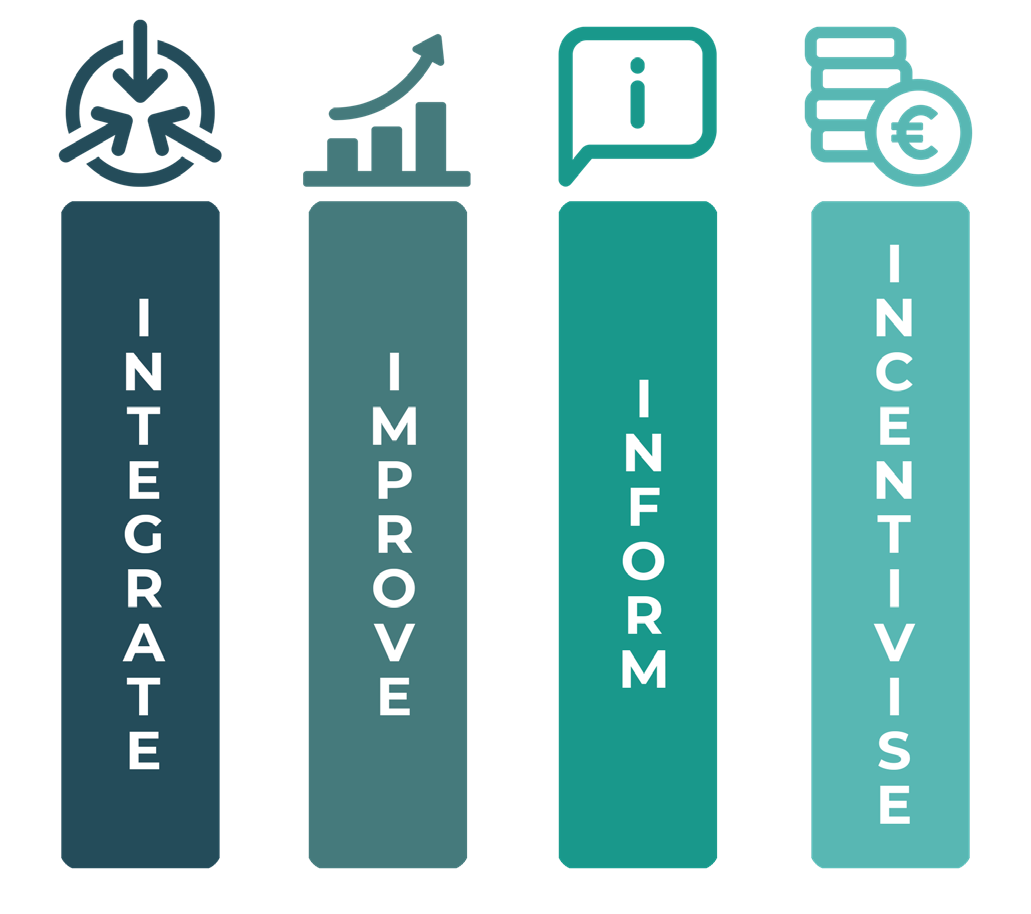
Fig. 4: Four pillars that underpin internet sustainability
1. Integrate sustainability into all digital policy
Holistic policymaking means identifying a problem in its various manifestations, tackling it from different perspectives and with a wide range of tools, and understanding the cross-cutting and mutually reinforcing nature of the challenges involved. It requires a look at all the layers of the internet, from manufacturing supply chains and device life cycles to network infrastructure and the online services it enables. Accordingly, the policy response must reflect the diversity of issues and stakeholders involved, recognising that environmental protection, if done right, cannot be disentangled from consumer protection, competition reform, regional rebalancing or data policy.
Recommendations:
- Legislation in the US has shown the power of stricter rules on conflict minerals, which must be applied to tech companies and the materials they use to have a significant impact. The European Commission should expand the new Conflict Minerals Regulation to include more downstream actors, apply it to more materials from high-risk areas, and deploy effective penalties for failure to comply.
- Supply of rare-earth metals, cobalt and lithium is volatile and deposits within Europe could fulfil part of the bloc's demand. Long development times and price fluctuations necessitate centralised action to secure future supplies. In the medium term, the European Commission must explore the feasibility of underwriting operations to secure independence from foreign sources.
- The majority of valuable minerals in internet devices are lost to landfill, while techniques to extract them are developing quickly. The European Commission and Member States must invest in research and development to create urban mining facilities that reduce our reliance on destructive mining operations.
- Opaque supply chains leave room for polluting and unethical practices and prevent accurate measuring of carbon emissions. A handful of projects have shown that full supply chain transparency is possible, and the European Commission should create a set of common standards and legislation to require accurate public reporting to shine a light on environmental impact at every stage of production.
2. Improve design and give innovation purpose
Most of the devices and services we use today have been designed to maximise useability, aesthetics and profitability. Replacement cycles and repairability too are a function of design. But it is important to remember that consumers, innovators and lawmakers can influence these design choices. It is only through further innovation that the environmental crisis can be mitigated, but that innovation must be purpose-led. Not only does Europe have the consumer market, public sector spend and standard-setting clout to nudge companies into more responsible design choices and behaviours, it also has the expertise and innovation ecosystem to create viable alternatives.
Recommendations:
- The Commission should make many of its recommendations for green procurement of digital products and services mandatory. Environmental impact should become a required weighted criterion in procurement processes. It should also formalise a sustainable public procurement tool in consultation with EU public bodies.
- Data centre energy consumption is skyrocketing and the associated emissions must quickly be curbed. The European Commission should set targets for data centres to be powered entirely by renewable energy by 2030. This will push beyond the current goal of carbon neutrality.
- The impact of online services is highly dependent on their design, and small changes can create large reductions on a global scale. Web designers and software engineers should be supported to create a set of low-energy design principles with funding from the European Commission's Horizon Europe programme.
- Edge computing and decentralised services can rapidly increase internet traffic by huge amounts, and their distributed nature makes them difficult to steer towards sustainability. The European Commission and Member States must get ahead of these developments to provide environmentally friendly options, and should, therefore, invest in a research centre to anticipate changes in demand.
- Technology lock-in is causing unnecessary environmental impact, and consumers are stuck with a shortlist of large providers. The European Commission should begin a rapid review of the impacts of technological lock-in on ethical consumer choices so that its outcomes can still feed into the design of the Digital Services Act as well as future changes to the competition regime.
- The language of net-zero, while helpful in the medium term, risks letting tech companies off the hook for their emissions. The European Commissions should alter its climate policy to focus on concrete targets for emissions reductions to create a stronger impetus for change.
- With many products receiving only two years of software updates, consumers are encouraged to replace their devices before they need to. The European Commission should expand Ecodesign legislation to mandate that internet-connected devices receive software and security updates for a five-year minimum.
- Our internet devices have become increasingly fragile, with all-glass designs becoming more widespread, resulting in unnecessary breakage and waste. The European Commission could counter this by extending consumer warranties on smartphones and laptops to five years, and requiring manufacturers to cover preventable fall and water damage.
- Repairing smartphones and laptops is made unnecessarily complex by manufacturer control. The European Commission must apply the incoming changes to the Ecodesign Regulation to internet devices, and give users a robust right to repair. This should include the provision of repair manuals. Replacement parts should be available within 15 days for a minimum of five years.
- A minority of Europe's e-waste is recycled properly, and widespread change will be necessary to create change in a complex area. Investment in recycling infrastructure is urgently required, and the European Commission should initiate a bloc-wide takeback scheme for internet devices to guide consumer behaviour, and provide financial incentives to companies that design devices in a way that makes recycling easier.
3. Inform and empower consumers
In other sectors, the application of behavioural science approaches has been effective in nudging consumers towards more sustainable choices. Providing consumers with real-time information about their electricity consumption can encourage them to use less, 35 particularly when combined with statistics showing that neighbours use less energy. 36 Armed with this knowledge, users will be empowered to make informed decisions about the devices they purchase, the data they store in the cloud, and the number of marketing newsletters they receive. Resistance to this kind of intervention is likely because any reduction in purchasing as a result of greater information could affect manufacturers' bottom lines. But here, again, business models that capitalise on longtermism could emerge.
Recommendations:
- The European Commission should explore how to implement a coherent environmental impact labelling scheme that enables consumers to compare products and understand their lifetime. This scheme could bring together efforts under the Circular Economy Action Plan and the Energy Labelling regulations to make significant gains in transparency and consumer empowerment.
- The environmental impact of web services is opaque, and more information would empower users to choose green services. The European Commission should work with browser and search providers to establish how environmental information could be conveyed, and create an expert taskforce to consult on possible legislation to support the collection of this data from service providers.
- The repairability of products is difficult to glean at the point of purchase. Publishing repairability scores would enable consumers to make informed decisions, so the European Commission should fund the development of a scoring system and mandate that scores are presented on product packaging and online. This should be included as part of the product environmental impact label recommended earlier in this report.
4. Incentivise positive change
Large scale deployments of internet devices by public bodies are becoming the norm in much of Europe, with smart cities and smart energy metering projects involving thousands or even millions of devices. These decisions are heavily influenced not only by cost but also rules around procurement and taxation, many of which are influenced by the EU. Reducing the environmental impact of the internet, therefore, requires legislators to shape the behaviour of both consumers and public bodies by providing incentives for environmentally friendly decisions, and disincentives that nudge towards green alternatives. Any changes to taxation and funding may be controversial, and legislators must carefully balance the desires of European producers and users with the potential effect of higher costs on Europe's relationships with foreign exporters.
Recommendations:
- Unwanted communication and unnecessary data storage have a significant impact on the environment. The European Commission should pass environmental legislation to sit alongside the GDPR, which makes it compulsory for companies to practice data minimisation and limit mass emails from an environmental point of view.
- Devices with excessive computational power and energy consumption are often purchased because of a lack of clear information and supportive legislation. Further research will be necessary to understand how low-tech solutions can be adopted more widely for personal use and in public procurement. The European Commission should launch a dedicated investment fund for the development of lean solutions to build and disseminate this understanding.
- Outsourcing the production of our internet devices does not prevent their environmental impact from affecting us. We must pay the full price of the carbon emissions of our purchases, and the European Commission should press ahead with plans for a carbon border adjustment.
5. The lifecycle of an internet device
The following sections of this report trace the lifecycle of an internet device, from the extraction and transport of its materials, to purchase and use, to extending its lifetime and disposing of it at the end of its life. Each section gives an introduction to the lifecycle stage and makes a handful of policy recommendations that could help reduce the environmental impact of that stage.
5.1 Extracting natural resources
The internet is made up of physical infrastructure, from the core networks and cabling to our homes and smart devices. These underlying systems are made of a wide range of materials manufactured in factories in countries across the world. Smartphones, for example, can contain upwards to 62 different elements in a single device. Production of internet equipment and our everyday digital devices is incredibly resource-intensive, requiring plastics, glass and various metals to be sourced, processed and shaped into components before they are packaged, transported and used, or passed down the supply chain to become just one component in a larger device. While efforts to source these materials from recycled products are increasing, as described later in this report, the technology sector is far from joining up the circular economy.
Metals are used in the production of all internet technologies, with aluminium, iron and copper making up a large proportion of the materials in servers, cabling, laptops and smartphones. Many of the metals in internet technologies are mined outside the EU and imported, which makes it more difficult to monitor and reduce the environmental impact of these operations.
These materials are often used in minuscule quantities, but they are vital in the design of modern devices. Cobalt, for example, is found in every lithium-ion rechargeable battery in every smartphone, laptop and electric vehicle. Around half of the world's known cobalt reserves are in the Democratic Republic of the Congo (DRC), where mining is frequently associated with violence, child labour is still prevalent and workers' rights are extremely weak. Even the largest technology companies, including Apple and Samsung, have failed to ensure that their cobalt supply chains do not involve child labour. 37
The EU is reliant on other countries to mine and process many metals, and there is stiff competition for available supplies. Spurred on by government subsidies for electric vehicle sales, China has grasped control of half of the global stocks of lithium, one of the main components of rechargeable batteries for smartphones, tablets, laptops and electric vehicles. 38 Lithium is mined in Australia and refined from salt flats in South America, where China has invested around €4 billion to secure continued access. In some cases, EU Member States have beaten China to deals with South American countries, such as a deal between Germany and Bolivia, but China's dominance continues to grow.
Perhaps the most controversial and environmentally concerning components found in electronics and telecoms equipment are the small amounts of rare-earth metals (REM) which are scattered across their circuit boards, screens and batteries. REM are a set of 17 elements found in underground ore in different parts of the world. They are used in the vast majority of electronics, as catalysts, phosphors and polishing compounds, and are often mined in developing countries under poor working conditions. 39 Despite their name, most REM are not especially rare but usually found in very low concentrations. This makes them difficult and expensive to mine. The 100 or so grams of REM found in an iPhone requires miners to remove and process around 34kg of rock, often through the use of chemicals that contaminate surrounding soil and wildlife. By-products of the refining process are often radioactive and are frequently stored in precarious facilities, creating a risk of groundwater contamination. For example, the Lynas Advanced Materials Plant in Malaysia has been the subject of a longstanding campaign from environmental groups about the safety of its radioactive waste storage. 40
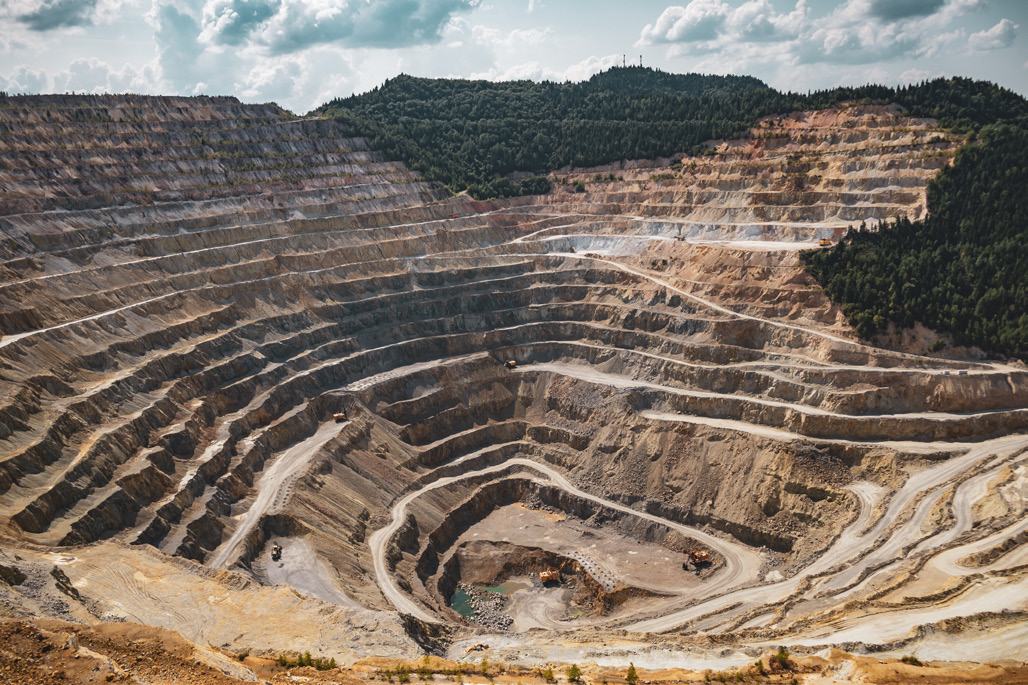
Photo by Vlad Chetan on Pexels
Demand for cheap products coupled with China's low wages and more relaxed environmental regulation has enabled the country to become the largest producer and consumer of REM and many other metals. China now controls over 95 per cent of the world's supply, so the EU is highly dependent on China's policy in this area. China's power over REM creates a bottleneck that could interrupt supply with little notice. In 2010, for example, China cut export quotas by 40 per cent, and stopped the supply of REM to Japan for two months during a diplomatic dispute that year. As a result, relying on a steady and affordable supply of REM from China creates a potentially significant risk for the European production of green technology. This near-monopoly has resulted in the price of lithium tripling between 2015 and 2018 to over €17,000 per tonne. 41 The corresponding increase in production costs for batteries and solar technologies demonstrates the impact that China's activities can have on our ability to address environmental challenges with technology. As Europe grapples with the new geopolitical world order and its implications for global trade and digital sovereignty, such fragile and fraught supply chains could provide opportunities for mining operations in Member States, many of which have potential untapped deposits of rare-earths and lithium. 42 However, the benefits of domestic mining and processing must be weighed carefully against the costs, which will inevitably be higher than elsewhere because of the Union's stricter environmental and employment legislation. Europe must also consider the risk of investing while a foreign power could easily raise or lower the cost of these materials.
REM and many other metals are pivotal in any sustainable transition because they are used in a wide range of green technologies. Electric vehicles, wind turbines, solar panels and many other technologies cannot be built without these materials, and these products are deemed crucial to reduce reliance on fossil fuels. So amidst the geopolitical complexity of mining and processing, global demand for REM has been increasing up to 10% per year. 43 Europe will need 18 times as much lithium by 2030 and 60 times as much by 2050 to meet its climate ambitions. 44 The complexity of their supply also calls into question whether these materials should be prioritised for green and renewable technologies, rather than internet devices.
Expanding conflict mineral legislation
Reducing the negative impact of our reliance on REM and other materials used in electronics will require legislation that improves supply chain transparency and incentivises better socio-environmental protections and working conditions. Section 1502 of the US Dodd-Frank Act is an example of such legislation, which requires publicly-listed US companies to analyse their supply chains for the 3TG conflict minerals (tin, tungsten, tantalum and gold) from the DRC and its neighbours, mitigate risks and report on their efforts. 45
In the EU, the Conflict Minerals Regulation will come into force in 2021, which aims to stem the trade of 3TG to prevent the funding of armed conflict and the use of forced labour. 46 The Regulation will require anyone importing a certain amount of 3TG from conflict-affected and high-risk areas to check whether their imports have been mined responsibly, take action to mitigate any negative effects and report on these efforts.
The Regulation is a promising start, but it is lacking in several areas, reducing its potential positive impacts drastically. While ‘upstream’ producers that import and process the materials are required to monitor, mitigate and report on conflict mineral risks, there is no such requirement on ‘downstream’ producers such as manufacturers. 47 This means that companies manufacturing the internet technologies we use will not be subject to any requirements under the Regulation. The supply chains that feed technology manufacturers are often complex, with materials going through various stages of processing in different countries before they are assembled and shipped to customers in Europe. The Regulation will only be effective if every producer in the supply chain is included in its requirements, from mining and processing to assembly and import.
The Regulation also lacks a coherent sanction regime, which means that companies failing to comply with the rules will not face any financial or criminal penalties. Instead, the Regulation leaves this responsibility to Member States, without even a mention of the 'effective, proportionate and dissuasive' principles that apply to penalties for many other pieces of EU legislation such as the General Data Protection Regulation. 48 It is hoped that the 'name and shame' approach will force change, but this is unlikely because the companies required to report will likely not be well-known, and the manufacturers of internet products will not be required to participate. Without meaningful sanctions, it is unlikely that Member States will consider this a high priority, and there is no guarantee of the Regulation creating any change.
As described above, the range of minerals involved in conflict, pollution and rights abuses is far wider than the 3TG minerals the Regulation targets. This will result in very few of the unethical materials used in internet devices being covered, severely limiting the impact on this large and growing sector. New applications for materials are emerging regularly, and the areas of high-risk can change quickly, necessitating a broader approach that considers the impact of all materials from high-risk areas, not just four. This would then include REM as well as other materials that will become more important as we transition to sustainable technologies, such as cobalt and lithium.
Device manufacturers take advantage of the relaxed environmental legislation and low pay in developing countries to create products that are cheaper to purchase than the true cost to people and the environment. It is possible that the additional reporting requirements and mitigation activities suggested here will result in higher prices for consumers. However, the reality is likely to be more complex, with new opportunities to compensate for increased costs in other areas, and a reduction in costs as the upfront investment is recouped. New funding models may emerge, such as product-as-a-service, which could further negate the impact of these changes. Overall, any new legislation must encourage the fair distribution and sharing of the burden of environmental action.
Given the fragility and weaker political systems of some exporting countries, interventions aimed at reducing reliance on global supply chains can have complex and unintended consequences. For example, the Dodd-Frank Act has resulted in a drop in US demand for imports, reportedly pushing miners in the DRC out of work and into armed rebel groups to earn money. 49 Any changes to regulation must, therefore, be carefully analysed with expert groups and public bodies such as the World Trade Organization and the International Labour Organization.
INTEGRATE: Legislation in the US has shown the power of stricter rules on conflict minerals, which must be applied to tech companies and the materials they use to have a significant impact. The European Commission should expand the new Conflict Minerals Regulation to include more downstream actors, apply it to more materials from high-risk areas, and deploy effective penalties for failure to comply.
Mining within Europe
As demand for mined materials increases, so too does the pressure to explore new sources. Across the globe, many sites could be mined for REM, in Vietnam, Brazil, India, Australia and Canada. Several European countries sit atop deposits of REM, including Denmark (Greenland), Norway, Finland and Sweden. 50 Serbia is also home to lithium, with reserves of around 1.5 million tonnes identified, 51 and some estimates suggesting the Jadar river valley could provide 10% of the world's lithium reserves. 52 It is not yet clear how environmentally intrusive or cost-efficient it would be to mine these reserves, but if considered feasible, Serbia's deposits could supply the EU with quantities of lithium that would at least significantly reduce reliance on other countries. Mining within the EU would also result in greatly improved working conditions for mining employees.
While the EU has funded projects to explore rare earth mining within the bloc as part of the Raw Materials Initiative, 53 volatile market conditions have prevented any developments breaking ground. 54 Greater independence from foreign sources of strategically important resources could contribute to a more resilient and greener European tech sector, and this warrants investigation of whether Europe could underwrite investment to protect new developments from financial infeasibility. Through this funding mechanism, the EU's pursuit of greater technological sovereignty could be balanced against other interests, such as protecting local natural environments, as well as potential impacts on workers and communities. Europe also has a collective responsibility to aid the economic development of countries in the Global South whose exports would be most affected, so further research must be conducted to explore the impact of mining on European soil.
Mining in Europe could be far more expensive than the upstream supply chains that currently underpin digital device manufacturing. This could make products and services more expensive in the medium term, but the environmental payoff would be significant.
INTEGRATE: Our supply of rare-earth metals, cobalt and lithium is volatile but deposits within Europe could fulfil part of our demand. Long development times and price fluctuations necessitate centralised action to secure future supplies. In the medium term, the European Commission must explore the feasibility of underwriting operations to secure independence from foreign sources.
Urban mining
While mining for REM and other minerals within the EU is a potential option, the vast investment required to establish a substantial mining operation within Europe brings into question whether the inevitable environmental cost of mining and processing is worthwhile, or whether exploring other options could be a more fruitful and ethical option.
Despite some recycling efforts, many devices end their lives in landfill still containing valuable materials, with less than 1% of REM being extracted from end-of-life devices across the world. 55 Extracting these materials is challenging because they are often used in minuscule amounts, soldered and embedded into tiny components. As successive generations of smartphones and tablets strive to fit more and more technology into ever-smaller devices, recovery of materials only becomes more challenging. However, there are hopes that innovative new recycling processes will help the EU respond to the rising demand for specific materials.
Urban mining, the local extraction of materials for reuse, is one option, but these processes are still in their infancy. 56 In the UK, a company extracting neodymium from hard drives using hydrogen believes it can meet a quarter of the country's demand by 2030. 57 A pilot plant in Europe has successfully recycled a handful of REM from just over 100kg of in-process wastes and end-of-life magnetic products as part of a European Union-funded project. 58 A new polymer created in South Korea can attract and trap atoms of valuable metals such as gold from the solution created when a circuit board is dissolved in acid. 59 Copper and silver have been extracted from discarded LED bulbs in Canada 60 and an experimental urban mine in Australia produces gold, silver and copper from phones, laptops and televisions. 61 While a tonne of raw material is needed for five or six grams of gold in a traditional mine, urban miners could expect to produce as much as 350 grams from a tonne of discarded devices. 62
As of 2018, the EU has spent around €39 million on research and development around REM recycling, but there are still no industrial recycling plants planned. 63 This has been blamed partly on a lack of projects focusing on collection, but it is also early in the life cycle of many of the products that use these minerals at scale, such as the large batteries in electric cars. The first generation of electric vehicles may only just be coming to the end of their lives, but the volume of discarded batteries and other components containing valuable minerals is going to grow exponentially over the next few years. The lithium, cobalt and REM found in these parts could significantly lower pressure on mining operations, reducing Europe's reliance on foreign producers, as well as our environmental impact.
Europe needs to explore a variety of approaches and these should include innovation in mining in the medium term, but the earth's deposits will not sustain our ever-increasing demand for REM and other minerals indefinitely. In the long term, Europe must move towards a circular economy, which will necessitate not only recycling infrastructure, but also a total rethink of how we design technology and the rate at which we replace it.
INTEGRATE: The majority of valuable minerals in internet devices are lost to landfill, while techniques to extract them are developing quickly. The European Commission and Member States must invest in research and development to create urban mining facilities that reduce our reliance on destructive mining operations.
Case study: Drone-powered rare earth mining

Photo credit Flo Maderebner on Pexels
The mining of rare earth metals is expensive, polluting and often undertaken in poor working conditions. To try and resolve these issues, research is being conducted into alternative methods of finding rare earth metals using emerging technology. Researchers at the University of Cambridge, UK, are currently experimenting with specially designed drones equipped with cameras that can recognise rare earth metals (REM) from the sky. 64
Due to their atomic structure, REM reflect light in unique ways. The challenge is to recognise these light signatures when they are mixed in with those of other substances. By scanning a collection of REM to understand the way they reflect and change light, the researchers have developed an understanding of the light signatures of REM to spot them from far away.
While human-powered mining requires high concentrations of minerals in veins and sediments to be financially viable, small deposits of REM can be found at sites of past volcanic activity, which could be spotted and retrieved by the drones. The researchers aim to reduce the amount of human labour required to find and extract REM across the globe. In the long term, it may be possible to automate the most dangerous aspects of mining work. But this will, in turn, require a rethink of corporate responsibility and international development policies to support areas that are economically dependent on the mining sector.
5.2 Supply chains and importing
Reducing the energy consumption, pollution and human toll caused by extractive industries for the manufacture of devices only deals with the physical inputs of our digital economy. While some of the environmental impact of internet technologies comes from their assembly, transport and sale, a significant proportion comes from the supply chain of parts. Most electronic devices contain hundreds of different parts supplied by a complex web of companies located across the world. An iPhone, for example, contains parts from over 200 different suppliers. 65
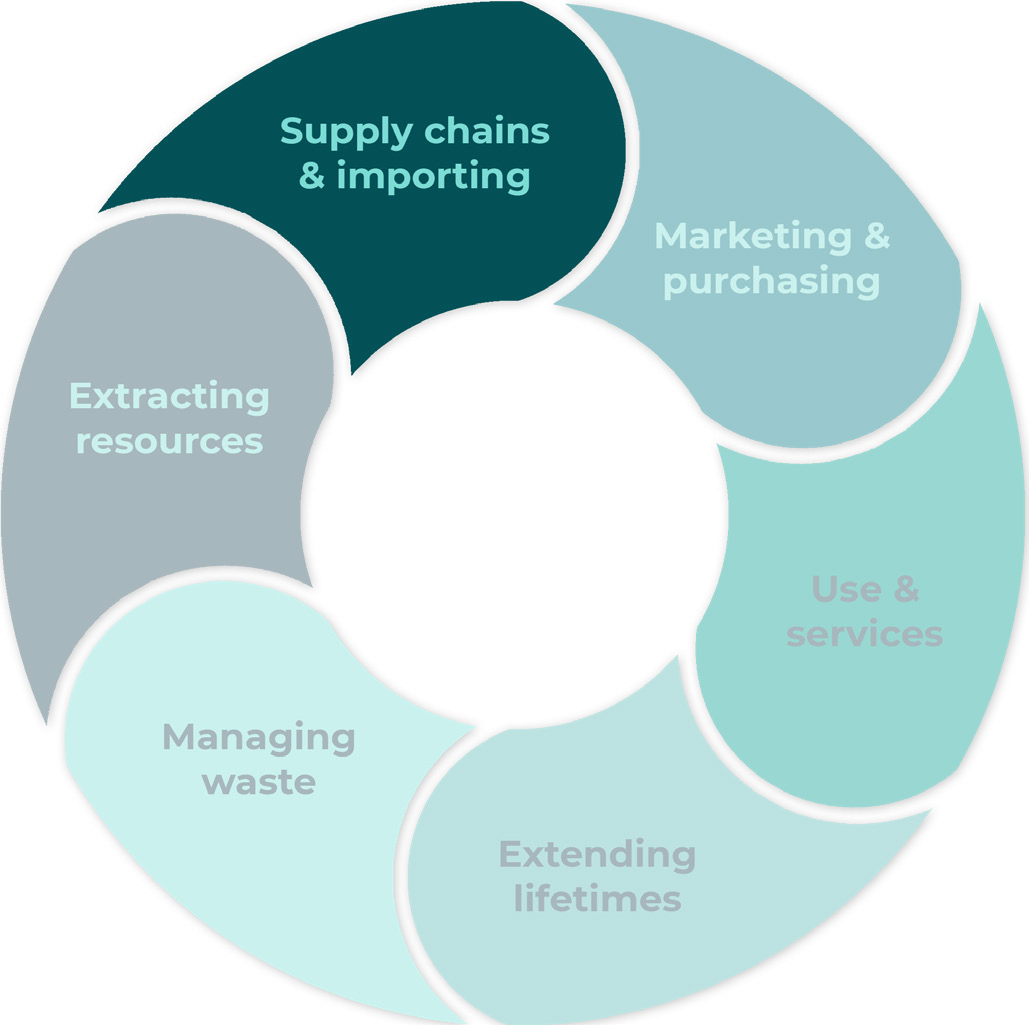
The complexity of examining all of the levels of the supply chain creates a challenge for legislators because while it is possible to mandate sustainable practices by device manufacturers, it is much more difficult to impose restrictions and get sufficient visibility on the second-tier suppliers producing parts for assembly. The lack of transparency also means there is little incentive for manufacturers to improve their processes and sourcing. Verifying that a device was produced sustainably therefore requires standardised and trustworthy reporting of the environmental footprint and provenance of individual parts and steps in the production process.
Internet habits are inseparable from their impact in the physical world, and through their actions, Europeans create strong economic and social forces outside the bloc. Europe is reliant on other nations to produce physical technology and provide services that facilitate communication and trade, but it has the power to influence the sustainability of those products and services too.
The EU's goal to reach net-zero carbon emissions by 2050 cannot be achieved without addressing the emissions caused by the products and services we buy. 66 Most of these emissions do not occur on European soil, but they go into our atmosphere, and we cannot outsource our environmental impact. Europe imports over €2 trillion worth of goods each year, and we must use our purchasing power to set global standards for sustainability. 66

Photo by chuttersnap on Unsplash
Supply chain reporting
Some device makers are attempting to improve this situation. Fairphone, the Dutch ethical smartphone manufacturer, has mapped and published their device's entire supply chain, with details on which companies are producing each part and where their materials came from. 67 This demonstrates that it is possible to establish transparency in great detail and other technology companies should follow suit. Greater transparency in supply chains creates additional risk for manufacturers because it might uncover unethical or even illegal activity, so there is currently little incentive for companies to provide this information in an accessible format.
Blockchain or distributed ledger technologies (DLT) may help to improve the recording and reliability of information about energy and resources used in the creation of devices, by creating an immutable record of where each part has come from. 68 DLT could be used to keep a tamper-resistant evidence trail on any asset, which could be implemented in the environmental space to track the emissions and provenance of materials for any product or service. DLTs aim to create a verifiable record of who exchanges what with whom, and so could address issues of environmental governance and entitlements to natural resources, incentivise environmentally sustainable actions or substantiate claims of reduced environmental impact. 69 It is also important to acknowledge the additional environmental impact caused by these technologies themselves, which will be discussed in this report's section on decentralised services.
Circularise is one such application, which uses blockchain to communicate about the materials, origin and production standards of any product. 70 Also, the World Economic Forum (WEF) has launched a track and trace platform to prove the environmental sustainability of supply chains. 71 Stating that 90% of consumers want big brands to help them be more environmentally friendly, WEF hopes the platform will bring together information from different sectors on the source and provenance of a product's materials, as well as how it has been produced.
Policymakers could refer to successful transparency legislation in other sectors. For example, several European countries including France, Germany, the UK and Italy, have created legislation that requires companies to analyse their supply chains and take action to prevent modern slavery and forced labour. 72 Both environmental protection and modern slavery are systemic issues which will require an approach based on common standards, and the EU is in a good position to create them. 73 To avoid fragmentation of standards in the single market, the European Commission should consider a common framework for large manufacturers operating in the single market, and this type of information should be made available, ideally in a public database. Many practical barriers will need to be resolved in consultation with industry, civil society organisations and innovators in the DLT space but the EU should not shy away from legislation if proven feasible.
INTEGRATE: Opaque supply chains leave room for polluting and unethical practices, and prevent accurate measuring of carbon emissions. A handful of projects have shown that full supply chain transparency is possible, and the European Commission should create a set of common standards and legislation to require accurate public reporting to shine a light on environmental impact at every stage of production.
Carbon border adjustment
The vast majority of our internet devices are manufactured outside the EU and imported, with €260 billion worth of computing devices brought into the EU in 2019. 74 The international outsourcing of manufacturing has been happening for many years, with drive for profit and global competition pushing operations to countries with lower operating costs and environmental standards. Building our internet technologies outside the bloc has the effect of outsourcing the environmental impact of our purchasing choices, and while we escape any local pollution effects, the greenhouse gases emitted still have an effect on us and the rest of the globe.
As the EU's environmental regulations have expanded and become more stringent, producers within the union have been required to reduce their impact. This includes the Emissions Trading System, which requires producers to purchase carbon allowances to cover the emissions of their operations. Reducing the environmental footprint of manufacturing has driven up costs for producers which is often passed on to consumers in the form of higher prices. These prices represent a more accurate cost of the product, as they take into account more of the environmental impact created. However, higher prices could prevent the 11 per cent of European households without internet access from connecting, so there is a careful balance to be struck. 75
Furthermore, the outsourcing of manufacturing to other countries allows technology companies to avoid paying this true cost. Inevitably, as political will leads to European environmental regulations becoming stronger, the disparity widens, incentivising more producers to move their operations abroad, a process called 'carbon leakage'. This could result in further regulations having diminishing returns, as well as pushing manufacturing businesses and jobs out of the bloc.
As part of the Green Deal, the European Commission made reference to a carbon border adjustment, which would apply an additional tax to imports based on their carbon footprint. Such a measure could be effective, but must be designed carefully so as not to create unintended consequences. 76 International trade policy is complex, with customs unions, trade agreements and the World Trade Organisation's rules shaping the possibilities for incentivising or mandating environmentally friendly activity.
Additional taxes have proved unpopular in recent history because wealthy Europeans are far more likely to maintain the most carbon-intensive lifestyles, 77 and they are more easily able to shoulder any additional cost without changing their levels of consumption. On top of this, creating a new international taxation scheme will be challenging amidst the current global trade wars. Any efforts to implement a carbon border adjustment must therefore move in tandem with progress on global standards for environmental impact to avoid the outsourcing of these issues.
The Commission is currently investigating the possibility of instituting a carbon border adjustment, and it could have wide-ranging effects on the environment if it takes the above concerns into account. If successful, it could incentivise environmentally conscious consumer choices as well as reductions in manufacturer impact.
INCENTIVISE: Outsourcing the production of our internet devices does not prevent their environmental impact from affecting us. We must pay the full price of the carbon emissions of our purchases, and the European Commission should press ahead with plans for a carbon border adjustment.
5.3. Marketing and purchasing
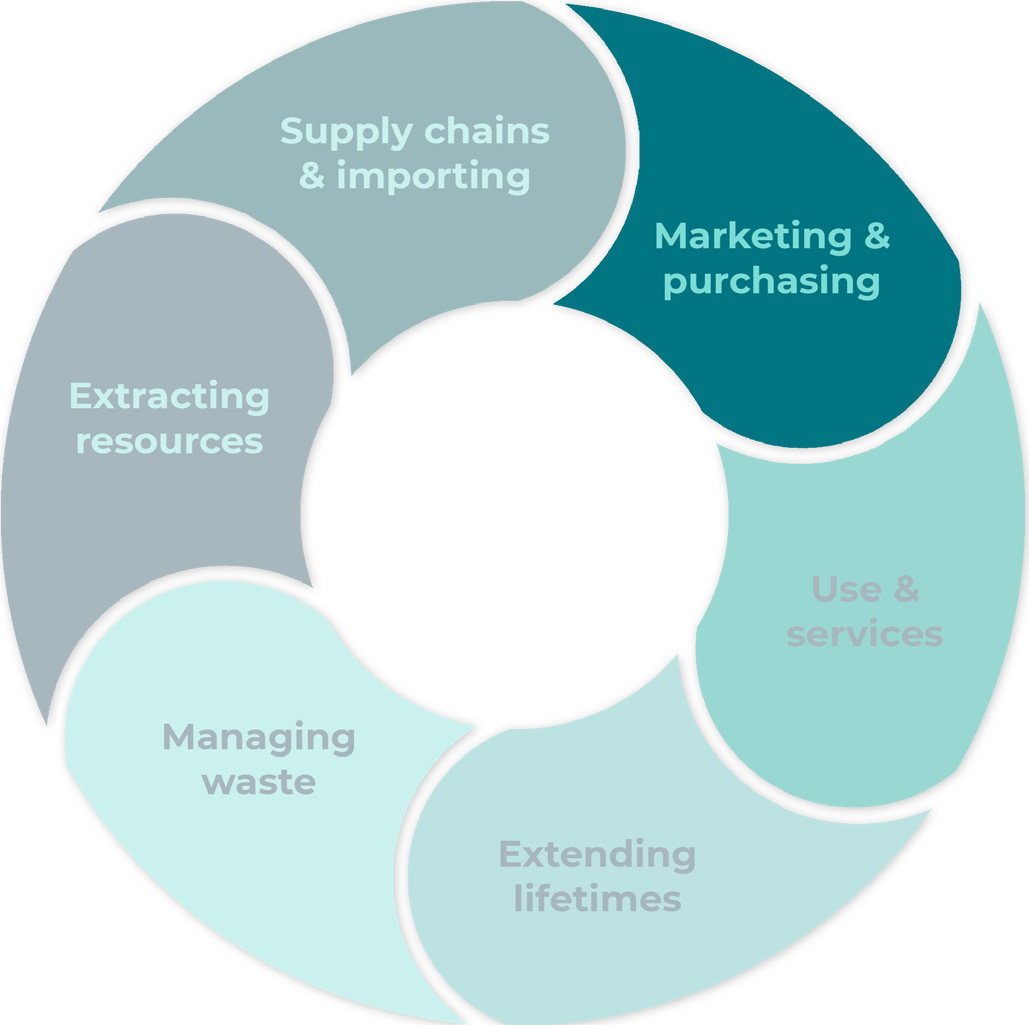
People buying digital services and devices have considerable influence over the environmental impact of the internet, and this includes public bodies, which procure vast quantities of internet technology for a range of uses. Three quarters of Europeans are willing to spend more on products and services that are more environmentally friendly. 78 Greater consumer awareness should therefore lead to more sustainable purchasing decisions - from choosing social networks and streaming services to ISPs and smartphones - and consequently to a much greener digital economy, but the reality is far more complex.
The replacement cycle adopted by consumers is partly a result of marketing tactics by device manufacturers, many of which release incrementally improved devices each year with huge fanfare. Stakeholder pressure on companies to pursue growth and output makes this release cycle almost inevitable, with each new model's marketing touting new and advanced features in comparison with last year's. This marketing is remarkably effective at persuading consumers to replace their devices more often, despite evidence that they could save around €100 per year by keeping and repairing a smartphone, for example. 79 This established pattern reinforces and is reinforced by several factors, including innovation cycles, design choices and consumer demand.
Public bodies are just as susceptible to marketing and innovation trends as consumers, but the impact of individual decisions can have far greater effect because organisations conducting digital procurement will likely be deploying tens, hundreds, or even thousands of devices. It is therefore vital to consider how public procurement can be guided to support the environment.
Cost is another important factor, and sustainable and ethical options are almost always more expensive. The Fairphone, produced from sustainably sourced components and designed using a modular approach so that it can be upgraded for many years, costs around €200 more than comparable models without the same green credentials. 80 Renewable energy providers are almost universally more expensive, 81 and a broadband connection through providers using renewable energy costs up to twice as much. 82 These extra costs highlight the difficulty of providing a sustainable internet experience for the 11 per cent of European households that are currently still excluded from access, often because of prohibitive costs. 83
Choosing low-energy devices
Different types of internet devices vary widely in their computational power, and consequently, in their energy consumption. The difference can be orders of magnitude: while a desktop computer uses around 200kWh per year under typical use, 84 a laptop uses around 30kWh, 85 and a smartphone uses around 7kWh per year. 86 Each of these devices can be used for the most popular internet tasks, such as browsing the web, watching streaming video or making video calls, but using smaller and less powerful devices can dramatically reduce the energy required. This means that decisions about the category of device to purchase for any given task can have a significant impact on the internet's environmental impact, when considered at the scale of purchasing by consumers, companies and public bodies.
Encouraging users to buy the least powerful device for a task would challenge established norms for future-proofing. The constantly expanding possibilities of computing make it seem sensible to think ahead and buy a device that is more powerful than current needs require, but this means that consumers, companies and public bodies purchasing internet devices are likely to choose more powerful and more energy hungry technologies than are necessary, wasting energy and physical resources in the process.
Innovation in this area includes low-energy devices that are small, affordable and powered by open source operating systems that enable them to be used for a wide range of purposes. The Raspberry Pi, a small computer with energy needs comparable to a smartphone, is one example of a device that can conduct a wide variety of tasks in a cost and energy efficient way. The Pi has been used to bring connectivity to remote areas without reliable electricity, including a project to bring educational materials and instant messaging to the Zaatari refugee camp in northern Jordan. 87
A relatively new category of devices are reducing energy consumption even further, by harvesting energy from the environment around them. Beyond solar power, these devices could harness temperature differentials, vibration, nearby electrical cables 88 and even harvest the energy from radio signals such as Wi-Fi or Bluetooth. 89 As this technology develops, more devices could be charged and powered from ambient forms of energy.
Creating greater consciousness for the internet's environmental impact among European consumers, who often have several devices at their disposal, could encourage them to switch to more task-appropriate low-energy devices. 90 Campaigns aiming to convince users to choose options that use the minimum energy have had some success. The I Prefer 30 campaign, which pushes for consumers to reduce the temperature of their laundry cycle to 30 degrees celsius, has seen modest impact. 91 However, there have been few campaigns designed to encourage purchasing the minimum viable product for environmental purposes, for example buying the smallest car for a family's needs, so further research into effective methods would be required.
While the Commission provides guidance on how to select digital technologies for reduced environmental impact, it should take this further by investing in low-tech, low-energy solutions and public campaigns to support purchasing behaviour change.
INCENTIVISE: Devices with excessive computational power and energy consumption are often purchased because of a lack of clear information and supportive legislation. Further research will be necessary to understand how low-tech solutions can be adopted more widely for personal use and in public procurement. The European Commission should launch a dedicated investment fund for the development of lean solutions to build and disseminate this understanding.
Product environmental impact labelling
There have been extensive efforts to help people understand the environmental impact of flying, 92 driving, 93 eating, 94 and many other aspects of our lives. 95 Consumers purchasing washing machines, tumble dryers or cars can easily check their energy consumption before purchase. A growing number of foodstuffs are even printing their carbon footprint directly onto packaging. 96 This information is beginning to enable consumers to make more informed choices about their activities and consumption.
In the technology sector, environmental impact information is harder to come by. While some manufacturers publish reports of their products' full life cycle footprint, 97 these figures are not readily available in a simple, standardised format at the point of purchase. This makes it difficult for users to compare different products to each other or to other activities.
While there are a handful of environmental labelling schemes that could be applied to internet technologies, doing so must be carefully considered in the context of each specific device or service. For example, EU regulation for the labelling of household appliances such as washing machines, refrigerators and lightbulbs focuses on the energy consumption and performance of the product while in use. 98 Most household appliances use more energy and create more carbon emissions during their lifecycle of use than in manufacture, partly because household appliances last longer, and partly because household appliances use far more energy heating water and powering motors. It is therefore logical that consumers would value information about energy use at the point of purchase, as it has a significant bearing over the cost of the appliance over its lifetime.
However, most consumer internet devices, including laptops, tablets and smartphones, on the other hand, use very little power during operation, creating the majority of their lifecycle emissions during manufacture. The difference is significant, with the average washing machine creating 43 per cent of its emissions during manufacture, 99 and the latest iPhone creating 79 per cent. 100 This means that a label showing energy consumption during use is not going to give an accurate picture of the environmental impact of purchasing a new smartphone.
A carbon labelling scheme for consumer products has been suggested, which would display the total lifecycle greenhouse gas emissions in kilograms of CO2 equivalent on the packaging of the product. A survey of 10,000 consumers in the US and several EU countries found that 67 per cent would support such a label, 101 and Swiss technology brand Logitech has pledged to begin labelling its products in this way over the next few years. It is a simple idea, but it remains a challenge to visualise what any number of kilograms of gas looks like, or the impact it has on the environment. As a result, the label's utility would be limited, only enabling consumers to make comparisons between similar products, which has limited utility when comparing the vast diversity of types and features of devices. Furthermore, the carbon footprint of a product is only one aspect of its environmental impact. Consumers are going to need more information, presented in a more accessible way, to be empowered to take environmentally responsible decisions.
Recognising the limitations of carbon footprint measures, in 2010 the European Council invited the Commission to 'develop a common methodology on the quantitative assessment of environmental impacts of products, throughout their life-cycle, in order to support the assessment and labelling of products'. 102 The Commission has since funded research into this harmonised measure, the Product Environmental Footprint, which considers toxic pollution, ionising radiation and the depletion of mineral resources. 103 After extensive consultation with environmental experts and industry, the Commission is gearing up to propose that manufacturers use the measure to substantiate any environmental claims, as part of the 2020 Circular Economy Action Plan. The Commission has also announced a new Industrial Strategy to support the twin green and digital transition, 104 and is consulting on how to empower consumers to make environmentally friendly purchasing decisions, including controls on environmental information to prevent greenwashing, and minimum standards for eco-labels. 105
The Product Environmental Footprint measure should form part of a comprehensive labelling scheme for internet devices, but it does not include impacts such as repairability, recyclability and the ethical extraction of resources such as Rare Earth Metals. A label that included these, giving a compound rating with detail on each element, could be a powerful tool for consumers wanting to understand the environmental impact of their device purchases. Fig. 4 is a mockup of a potential label, which is easy to understand and gives a quick assessment of the product's environmental impact.
The mockup includes a QR barcode, which would link to a webpage containing more detailed information about the product, including the product's lifecycle carbon footprint in kilograms of carbon dioxide equivalent and as a percentage of a consumer's annual carbon budget, clear information on the finite resources used in its manufacture, and the ease with which it can be repaired and recycled, including links to repair manuals and services. This page would be part of a public register, which would enable users to compare any available product within the category. 106 Ecodesign legislation is regulated by Member States, for example by the Office for Product Safety and Standards in the UK 107 and the Department of Jobs, Enterprise and Innovation in Ireland, 108 so a new body could be created to maintain this register, potentially in collaboration with industry bodies and civil society organisations across Europe.
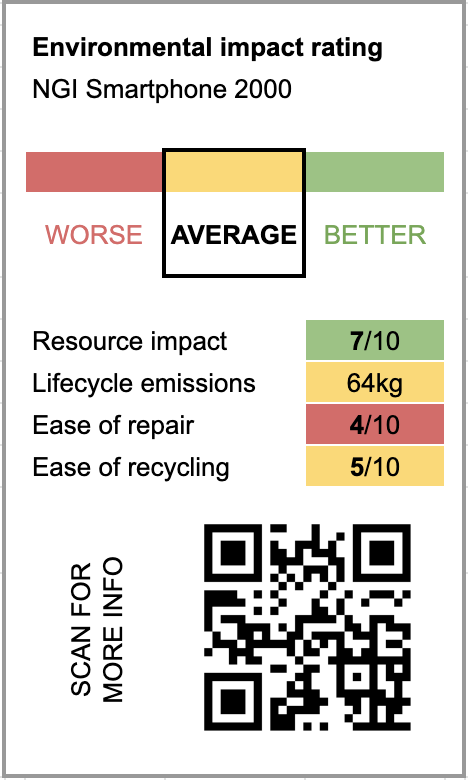
Fig. 4: Concept for an environmental impact label (image by author)
Any new labelling initiative must be tested thoroughly with consumers to ensure that it is effective in quickly providing enough information to make environmentally friendly decisions. As has been seen in other sectors such as food and drink, manufacturers are likely to resist changes that reduce the likelihood of purchases, but our consumption of internet devices must reduce if we are to meet our climate goals.
INFORM: The European Commission should explore how to implement a coherent environmental impact labelling scheme that enables consumers to compare products and understand their lifetime environmental footprint. This scheme could bring together efforts under the Circular Economy Action Plan and the Energy Labelling regulations to make significant gains in transparency and consumer empowerment.
Shaping public procurement
While consumer behaviour is important, public bodies such as national and local governments spend billions of euros on internet technology each year. These bodies procure digital technologies at such enormous scales that even small changes in strategy and policy could drastically reduce environmental impact. One factor increasing pressure on the procurement of internet technologies is that Member States are gradually digitalising public services, led by Estonia, Spain and Denmark. 109 Putting public services online reduces costs, increases accessibility for those in remote areas and reduces the environmental impact of travelling to public buildings and managing paperwork. However, it also requires the provision of digital service design, resilient cloud infrastructure and device deployment for all public workers managing processes around health, education, taxation, citizenship, and many other areas. All of these activities have an environmental footprint, which must be carefully managed.
Take the digitalisation of public services to its logical endpoint, and we arrive at the smart city. A smart city deploys sensing, analysis and automation technologies to improve services and, for example, reduce the energy consumption of the systems embedded into public infrastructure. This could include connected smart networks of traffic lights to optimise traffic flow, and intelligent street lighting networks that enable disaster response, movement sensing and improvements in efficiency and light pollution, and cameras that monitor the behaviour of citizens. Manchester, UK, a city of over 500,000 inhabitants, embraced a widespread smart city programme that included the installation of a connected LED street light system, replacing 56,000 old lamps and improving efficiency by around 60 per cent. 110 The system is connected so that city employees can control lights remotely, and sensors on each light monitor air quality and traffic flow. The change is expected to save around €2.3 million annually and reduce the city's carbon emissions by 7,500 tonnes each year. However, smart city schemes come with downsides. The thousands of sensors, cameras and switches are energy-intensive to produce and need regular maintenance and replacement, creating significant environmental impact. 111 Further concern is created by the massive amounts of data that will be collected by the system, which will require storage in data centres, and the privacy implications of this data storage.
Aside from the environmental impact of producing and powering devices and services procured by public bodies, escalating reliance on connected systems and information storage could make it more difficult to revert to non-digital delivery of public services should this ever be required. There is also a significant risk of governments becoming locked in to a certain provider's technology or method, which increases the possibility that whole systems will need to be replaced if support periods end or the technology is superseded. These concerns could leave public bodies stuck for decades with out of date, inefficient and insecure systems that are no longer supported by the manufacturer. As public sector adoption of smart technologies is only set to accelerate in the years to come, policymakers and CTOs in public bodies across Europe should put greater emphasis on technological diversity and long-term viability of systems when setting out criteria for large scale infrastructure deployment.
The European Commission provides guidance on green public procurement in general, 112 as well as advice on procuring connected technologies and services in an environmentally friendly manner, 113 and specific recommendations on cloud computing, 114 and computers. 115 However, these initiatives are entirely voluntary. The Scottish Government has also created a Sustainable Public Procurement Prioritisation Tool, which supports public bodies to consider the various aspects of environmental impact against the benefits of any purchase. 116
IMPROVE: The European Commission should consider legislation to make many of its recommendations for the green procurement of digital products and services mandatory. Environmental impact should become a required weighted criterion in procurement processes. We should also formalise a sustainable public procurement tool in consultation with public bodies across the bloc.
5.4. Use and services
We are increasingly surrounded by digital and connected devices that provide us with information, inundate us with advertising, and connect us to our workplaces and loved ones. All of that information is transmitted along cables and through wireless networks, stored and processed in enormous data centres and brought to us via yet more equipment and devices - from phone masts and street cabinets to our smartphones and laptops - that require significant amounts of energy to produce.
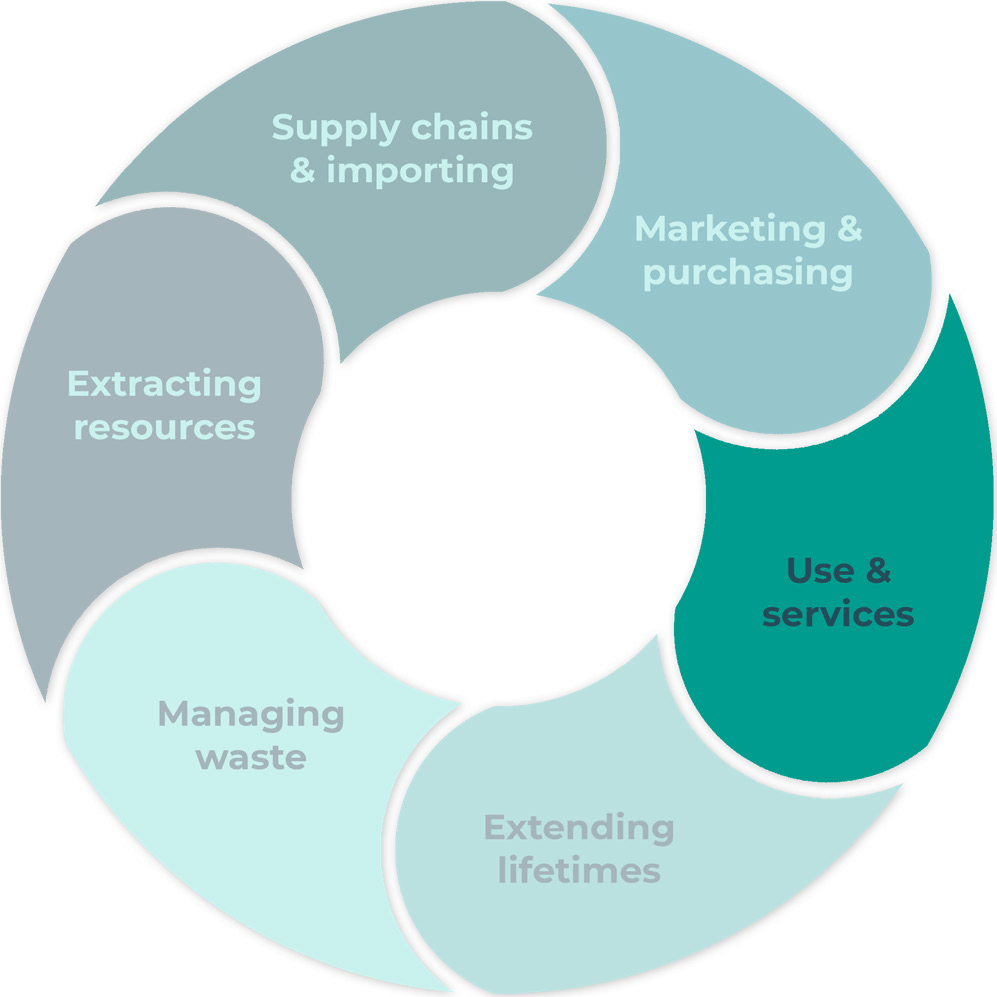
Powering the world's communication technology requires a staggering amount of electricity, estimated at between five to nine per cent of the world's total generation capacity in 2018. 117 Predictions of future consumption vary, from around 20 per cent of global electricity supply to a 'worst case scenario' of 51 per cent by 2030. 118 Despite industry commitments to move to renewable sources of energy, most of the electricity powering the internet still comes from burning coal and gas, 119 which suggests that our internet use is currently responsible for around 2 per cent of global greenhouse gas emissions, roughly equal to the entire global airline industry. 120 If nothing changes, the worst case scenario could see the internet contributing as much as 23 per cent of globally released greenhouse gas emissions by 2030. 121
Just like flying, driving or ordering food delivery, everyday actions on the internet have a sizeable carbon footprint:
- Sending a text-only email creates around 4g of greenhouse gas emissions. 122 Sending 65 emails is the equivalent of driving 1km in a petrol car.
- Sending large attachments could create 50g, roughly ten times as much as a simple text email.
- Thirty minutes of video streaming emits between 28 and 57g. 123 Binging on a 10-hour series could use the same energy as charging a smartphone 145 times.
- A group video conference on Zoom creates 4.5g of CO2e for each participant in an hour-long call. A company of fifty employees each participating in two hours of video calls every working day create as many emissions as the burning of 50kg of coal per year.
Data management
All traffic passes through and between data centres, large buildings containing rows and rows of tightly stacked storage and processing equipment, all cooled to prevent overheating. Data centres across the globe used around 416 TWh, or about 3 per cent of global electricity supply in 2019, which is nearly 40 per cent more than the consumption of the entire United Kingdom. Data centres make up around half of the internet's total energy consumption, and their use is predicted to double every four years. 124
The carbon footprint of a data centre depends significantly on its location, which is often near its primary users. Because data centres produce large amounts of heat and require cooling to prevent damage to equipment, it can be far cheaper and less energy intensive to locate data centres in colder climates, and many European data centres are located in northern countries such as Sweden. However, many sectors of the service industry demand the quick network response times facilitated by close proximity, including high-frequency financial trading and livestreaming game services. The location of data centres can also be influenced by the availability of cheap energy, as in China, which is home to six out of the ten largest data centres in the world. 125 China's data centres are powered 73 per cent by coal and produced 99 million tonnes of CO2 in 2018, the equivalent of 21 million cars. 126
There are thousands of data centres across Europe, with the highest concentrations in the UK, Germany, France and the Netherlands, 127 and many use as much energy as a large town. 128 The boom in new data centre installations is even requiring some national governments to plan for increased energy infrastructure. The Irish Government predicts a significant rise in energy demand from data centres in the next few years, from 250 Mega Volt Amps of demand in 2015 to around 1400 MVA by 2026. 129 Some areas have begun clamping down on data centres, including Amsterdam, Netherlands, which in 2019 instituted a temporary ban on new installations because of the burden on space and energy. 130
INCENTIVISE: Unwanted communication and unnecessary data storage has a significant impact on the environment. The European Commission should pass environmental legislation to sit alongside the GDPR, which makes it compulsory for companies to practice data minimisation and limit mass emails from an environmental point of view.
Minimising data transmission and storage
On modern devices, messages, photos and videos are often instantly uploaded to the cloud. The online storage of data, including websites, videos and documents, requires hard drives to be powered and running constantly. While rapid improvements in storage energy efficiency make it difficult to calculate the energy used in storing data, it is clear that minimising the amount of data stored could help to reduce energy demand.
Unsolicited emails are a significant source of wasted energy, as well as an invasion of privacy. Analysis of the EU's General Data Protection Regulation (GDPR) has found that its clampdown on unwanted marketing messages has resulted in an overall reduction of 1.2 billion emails per day being sent in the EU, reducing emissions by 360 tonnes of CO2 daily, 131 enough to power over 20,000 homes. 132 That, quite literally, makes spam and marketing emails litter. Further gains could be made by reducing the number of marketing emails even more, but the GDPR already requires companies sending marketing emails to rely on a legal basis for doing so, which limits the scope for further reductions within current regulation.
Green energy and efficiency improvements in data centres
The technologies inside data centres are quickly becoming cheaper and more efficient to run. Individual storage drives, as well as the networking infrastructure that connects them, consume less energy than they used to and some data centres are being merged into 'hyperscale' data centres, which enable more effective use of a smaller number of servers. 133 This reduces the energy consumed per gigabyte of data stored or transmitted, which is good for energy consumption in use, but incentivises data providers to replace them more frequently. On top of this, the greater power and storage capabilities of new data centres enable use to continue increasing exponentially, reinforcing the ability of businesses and consumers to store and access large quantities of data with ease. The computation power of data centres appears infinite, but it comes with a quantifiable environmental impact that must be reduced.
Locating data centres near renewable energy generation also opens up the possibility of scheduling computation to utilise energy that would otherwise go to waste, such as in times of high wind and low electricity demand. 134 However, the energy required by data centres is so enormous that it can exhaust local supplies of renewable energy, forcing local users back onto fossil fuel generation. 135 Server virtualisation and improvements in data management can reduce the energy consumption of servers 136 but more work is required to understand the best methods of increasing efficiency. Many of the biggest providers of data centre services have made commitments to reducing their environmental impact. This has sparked efforts to improve the efficiency of data storage. Researchers have proposed that graphene could replace silicon in future data centres, which could reduce heat generated by 25 per cent, extending equipment lifetimes and reducing cooling requirements. 137
These developments are promising, but with growing demand, there is only one guaranteed way to significantly reduce the environmental impact of data centres. Every data centre must be moved to renewable energy. Data centres create a relatively constant energy demand so the load could be managed easily on the grid. Making such a change would also increase pressure on energy companies to invest in renewable energy technologies. This could be achieved through EU legislation similar to the Renewable Energy Directive, which requires that 32 per cent of energy consumed within the bloc is generated from renewable sources by 2030. 138 However, the policy could not apply only to EU-based data centres, as this would likely cause mass offshoring of data services. It must instead apply to all services that are provided to anyone located within the EU, just as the GDPR protects all EU citizens from services they use worldwide.
IMPROVE: Data centre energy consumption is skyrocketing and the associated emissions must quickly be curbed. While some tech companies have made progress, we need to see greater reductions across the board. The European Commission should increase targets so that all data centres are entirely powered by renewable energy by 2030. This will go beyond the current goal of carbon neutrality.
Online services
Understanding the environmental impact of our browsing, calling, streaming or gaming on the internet is a challenge, and few online service providers publish data on their energy consumption and mix. While it may be easy to visualise the carbon footprint of a flight from Brussels to London, which will burn similar quantities of fuel with each journey, the internet's distributed nature and long-term impacts make understanding the energy consumption of online services entirely abstract.
In the early days of the, narrow bandwidth limited the user experience to text-based webpages, emails and simple images. Over time, faster connections and greater processing power have enabled us to share and consume a wide range of media, from audio and video to live streamed immersive virtual reality experiences. These new services have come with a remarkable increase in data usage. As an illustration, the Wikipedia page for Game of Thrones takes up 946KB of data, while watching the show's finale in HD could use as much as 5GB, over 5,000 times as much data.
Video now makes up 60 per cent of global internet traffic, 139 and as the popularity of streaming services has soared, so too their environmental impact. In 2018, online video viewing generated more than 300 megatons of greenhouse gases, as much as the entire country of Spain. 140 Streaming giant Netflix reports that its energy consumption rose by 84 per cent in 2019, and with an undisclosed proportion of their 451,000 MWh coming from carbon intensive sources, it is clear that our TV binging habits are contributing to climate change. 141
Redesigning web services
There is a wide range of efficiency-improving techniques that can be used by designers of software and web services, such as minimising the computation required to render webpages, improving audio and video codecs, nudging users towards lower quality streams or using static content rather than constantly rebuilding pages. Through the nascent field of sustainable software engineering, proposals have been made to redesign energy intensive services to better suit their real-world use and reduce energy consumption. This includes the Principles of Sustainable Software Engineering, which aim to create a new generation of sustainable software engineers. 142
One study looking at YouTube's energy consumption estimated that removing the video feed for the many users only listening to audio in the background could reduce the service's carbon footprint by 100,000-500,000 tons of CO2e annually, roughly equivalent to 30,000 UK homes. 143 Recent improvements in video encoding efficiency reduced Netflix's traffic flow by 20 per cent, but this change also coincided with the rollout of Ultra High Definition or 4K streams, which in turn could increase data traffic by some 10 billion gigabytes per month. 144
Even small changes such as reducing the amount of code transferred to a user's computer can make large reductions in impact on the grand scale of the internet. 145 But such changes require willingness for change from industry and a greater level of awareness by both developers and users, who should be able to see more clearly which services are carbon intensive. These design changes could be supported by the creation of a set of low-energy principles for web design and user experience.
IMPROVE: The impact of online services is highly dependent on their design, and small changes can create large reductions at a global scale. Web designers should focus on reducing the computation and data required by their services, and should be supported to create a set of low-energy design principles with funding from the European Commission's Horizon 2020 programme.
Browser and search labelling
Information about the environmental impact of online services is not readily available to users as they browse the web or watch their favourite programme, which reduces their ability to make environmentally conscious decisions. While these calculations are often complex, a handful of browser extensions can estimate a user's footprint as they browse, 146 highlight particular sites that are powered by renewable energy, 147 or prompt a user to consider whether a short email is necessary. 148 Search engines already prioritise sites that load quickly, and they could analyse pages for complexity, physical distance from the user, and file size, all before loading the full page.
The EU and Member States should explore methods for reporting the environmental impacts of online services in ways that make sense to consumers and incentivise a more conscious approach to connectivity. Some potential technology and policy levers could include the development and promotion of green search engines that prioritise or filter results on the basis of sustainability metrics or a shared protocol that could be displayed in browsers. Investment in research into sustainable design principles could also make it easier for businesses to create less energy-intensive websites and services, but sustainable hosting options must also become widespread to create the required reductions in environmental impact.
INFORM: The environmental impact of web services is opaque, and more information would empower users to choose green services. The European Commission should work with browser and search providers to establish how environmental information could be conveyed, and create an expert taskforce to consult on possible legislation to support the collection of this data from service providers.
Case study: Low-Tech Magazine
Thermoelectric Stoves: Ditch the Solar Panels?
Wood stoves equipped with thermoelectric generators can produce electricity that is more sustainable, more reliable, and less costly than power from solar PV panels.
May 2020

Picture credit: Low-Tech Magazine, https://solar.lowtechmagazine.com/
A further proof of concept can be found in Barcelona, where the server for Low-Tech Magazine runs entirely using renewable energy. 149 The sunny climate means that the whole site can be powered by solar panels and a battery. The specially-adapted version of the site uses low-resolution images and shows visitors the weather forecast for the next few days to indicate when the site might have insufficient power to run. While the site is primarily a demonstrative art project, its design principles could be adopted by other websites and online services, reducing both loading times as well as energy consumption. News websites could, for example, reduce the quality of images of weather or other content over time, to minimise data storage and transmission.
Centralised services vs. Edge Computing
In recent years, computing power has centralised so that more processing is conducted in data centres and the requirements on personal internet devices have reduced. This trend has enabled the development of lower-power devices such as mobile phones and sensors, which rely heavily on the computation of data centres.
80 per cent of today's computation is done in data centres, which concentrates the energy consumption within highly controllable spaces. This makes it easier to increase efficiency and reduce the environmental impact of computation overall. However, the European Commission predicts this figure will invert in the next five years, so that the vast majority of processing will be conducted in or near consumer devices. 150 This could have a significant impact on the carbon intensity of using the, and highlights the importance of encouraging consumers to power their devices with renewable energy at home and at work.
However, this view is not universally held. Modelling by Huawei, for example, predicts a significant increase in the centralisation of energy consumption from user devices to data centres. 151 We can see this trend echoed in the recent launch of high-bandwidth centralised services in the gaming sector, where Google Stadia and PS Now transfer the computation required from home consoles to centralised servers and stream video of the gameplay back to users' devices in near real-time.
Designing sustainable decentralised services
Taking this even further, decentralised services have no coordinating server or central authority, instead transferring data directly between peers in the network. This approach has many benefits but also presents significant challenges in reducing environmental impact. This complexity arises because computation on the network is conducted by its peers, spreading the resource requirements and energy consumption amongst many unknown participants.
Distributed Ledger Technology (DLT) or Blockchain is one type of decentralisation that removes the middleman from systems that keep track of information, like financial transaction ledgers. This technology was first used to create the digital currency Bitcoin, which became popular for its ability to transfer value without requiring a bank or government to sanction the transaction but also raised questions about the energy costs associated with some DLT.
Since its launch in 2009, Bitcoin has at times seen a dramatic rise in value; at the top of these peaks, 'mining' of Bitcoin and similar cryptocurrencies can become very lucrative. However, the popularity of Bitcoin in particular comes at a price to the environment, as the system consumes vast amounts of energy. In March 2020, Bitcoin consumed roughly as much energy as the entire nation of Belgium 152, and most of that energy is generated from coal and gas. 153 This huge demand is caused by mining, the process that generates new Bitcoin and records transactions on the network's distributed ledger, which uses massive amounts of computing power to demonstrate proof of effort. In other words, the miner with the most powerful - and by extension energy-consuming - computer is most likely to generate financial value from Bitcoin. 154
Based on the value of Bitcoin in March 2020, miners were collectively able to generate roughly €6.4 billion worth of Bitcoin each year, 155 so there is a significant financial incentive to take part. Over half of these mining pools are located in coal-reliant China, which also pushes up the carbon footprint of the currency. 156 The efficiency of the system is so poor overall that around 322kg of CO2 is emitted for each single Bitcoin transaction, equivalent to around 800,000 VISA card transactions. 157 In Iceland, Bitcoin mining is projected to soon use more energy than the country's residents. 158
Overall, DLT may yet support the greening of our economy. It provides a reliable way of recording and verifying information in transactions, making it useful in tracking the provenance of products and materials through the supply chain. However, it is important that decentralised services are designed from the outset with sustainability in mind. Efforts so far have included encouraging miners to switch to renewable energy, either through demonstrator projects 159 or mining processes which financially reward miners that can provide proof of their renewable energy use, but the fact remains that proof-of-work algorithms are deliberately inefficient by design. 160
For currencies like Bitcoin, changes could also be made to their energy-intensive proof-of-work algorithms to reduce the computation required, for example to a proof-of-stake mechanism. 161 Bitcoin Green, another cryptocurrency, was explicitly designed to reduce the environmental footprint of transactions by using a proof-of-stake method that incentivises miners to make the system more efficient, rather than less. 162 If the entire Bitcoin ecosystem switched to Bitcoin Green, it would reduce its energy consumption by a factor of ten thousand. However, because decentralised services have no central authority dictating how they work, once they are set in motion it is difficult to make changes to their functioning because all users would need to agree to switch to a new system.
The distributed nature of computation and energy consumption in decentralised services makes it difficult to target them specifically. Unlike applying rules or incentives to centralised data centres, whatever changes are made must apply across all the network's users. As a result, legislators must assess how any large increase in environmental impact caused by these services can be taken into account in EU-wide regulation. For example, an adjustment to the Renewables Directive could be made to increase pressure on energy providers to switch to renewables. Bitcoin is an example of how quickly and unpredictably these services can grow, and it is clear that foresight-led and agile regulatory approaches are necessary to adequately address them. 163 The Commission should therefore create a strategy for coping with the potentially rapid increase in energy consumption that could be caused by future services, to keep abreast of developments on the cutting edge of this field and provide options for early, protocol-level interventions.
IMPROVE: Edge computing and decentralised services can rapidly increase internet traffic by huge amounts, and their distributed nature makes them difficult to steer towards sustainability. The European Commission and Member States must get ahead of these developments to provide environmentally friendly options, and should invest in a dedicated research centre to anticipate changes in demand.
Making switching easier
Users of digital services often suffer from technology lock-in and experience considerable friction when trying to leave a service or move their data to another platform. Social networking is a good example, where a user will be connected to hundreds of others, with photos, posts and other historic records stored in a proprietary format. There are nascent efforts to combat this, in part through the GDPR rules on data portability. These rules mandate that providers must enable EU citizens to export their personal data and take it with them to other providers. This data should also be provided in a machine-readable format so that it can be imported into other services, and providers should offer the options to move this data to another service automatically.
Consumer choice in the digital economy is also restricted by the high concentration of market players, some of whom have de-facto monopolies, and a lack of viable alternatives. When choosing a social network, for example, a user is likely to use whichever service is used by their friends and family, a situation which has resulted in the rise of a handful of social media giants. But while Facebook got an A-rating for sustainability from Greenpeace in 2017, Twitter and WeChat both received F grades for their carbon reduction efforts. 164
A similar situation plagues the streaming media sector, where high barriers to entry for new competitors and exclusive content deals for platforms mean that consumers' choices are more restricted than they seem. While they may wish to support a hypothetical green streaming service, their favourite content or preferred payment model might only be available on Netflix (D-grade) or Amazon Prime Video (C-grade). At the very least, this highlights the need for cross-industry commitments to sustainable practices.
This effect is worsened by the gradual move to 'everything as a service' over the last few years. The prevalence of cloud-based software and services has increased dramatically, moving away from traditional physical media such as DVDs. Anything from photo editing applications and games to films and music now require a permanent internet connection to load adverts, access user data, verify licences or receive updates. This includes mobile games that do not function on an underground train away from mobile signal, game subscriptions that fail during an outage, and enterprise software that limits functionality when used offline. This constant connectivity and communication only exacerbates internet traffic, often without providing any real consumer benefit.
Instead of buying software and media for a lifetime, consumers now commonly purchase a limited licence to use it for as long as it is supported by the provider. In addition to killing almost the entire second-hand market for digital products, this has led to cases of online purchases, such as films, getting removed from user libraries and devices when the provider's licence expires, requiring further purchases and their associated traffic impact. 165 Taken together, these developments mean that consumers increasingly struggle to use a computer without a constant active internet connection and having to stream, download and re-download significant amounts of data for often basic online services. Reducing internet traffic will require a rethink of these digital services and ownership models, and we could see a resurgence of locally stored purchases as consumers retake control. 166
Making switching between services easier would empower consumers to move their data to more ethical and sustainable services, and would put greater pressure on providers to improve their services from an environmental perspective. The European Commission should begin a rapid review of the impacts of technological lock-in on ethical consumer choices, so that its outcomes can still feed into the design of the Digital Services Act as well as future changes to the competition regime. It should set out next steps for data portability as part of its ongoing GDPR review and continue to work with data protection authorities, consumer regulators, industry and CSOs to define interoperability standards and make switching possible and easy across key digital services.
IMPROVE: Technology lock-in is causing unnecessary environmental impacts, and consumers are stuck with a short list of large providers. The European Commission should begin a rapid review of the impacts of technological lock-in on ethical consumer choices so that its outcomes can still feed into the design of the Digital Services Act as well as future changes to the competition regime.
Industry commitments on energy consumption
The internet technology industry has committed to reducing its carbon footprint by 45 per cent between 2020 and 2030. 167 Improving their sustainability is going to require companies to commit to more than cosmetic changes or emission offsetting schemes. In many cases, such as powering data centres, these changes may be as simple as switching to renewable energy providers, and indeed many companies have made this commitment. However, companies that facilitate the energy- and resource-intensive production and transport of goods such as clothes, furniture and technology will need to fundamentally redesign their business models and rethink supply chains to adapt to the reduced consumption levels required for genuine sustainability.
- Telefonica commits to reduce energy consumption by 85 per cent per unit of traffic and reduce emissions 50 per cent by 2025 and 70 per cent by 2030, and become carbon neutral by 2050, relative to 2015. It also aims to use 85 per cent of electricity from renewable sources by 2025 and 100 per cent by 2030, as well as reducing supply chain emissions by 30 per cent per euro purchased to 2025 compared to 2016. 168
- Vodafone aims to purchase all of its electricity from renewable sources and reduce its greenhouse gas emissions by 50 per cent by 2025, compared to a 2017 baseline. 169
- Nokia aims to reduce greenhouse gas emissions from its activities and energy consumption by 41 per cent, compared to the 2014 baseline. 170
- BT Group aims to purchase all of its electricity from renewable sources by 2020 and reach net zero carbon emissions by 2050. 171
- Orange made a commitment in 2015 to reduce carbon emissions by 50 per cent for each customer-usage between 2006-2020. It has also launched green innovation projects to reduce the energy consumption of its networks. 172
- Microsoft has committed not only to reach net-zero by 2030, but by 2050 it aims to undo all of the greenhouse gas emissions it has caused since the creation of the company in 1975. 173
- Google reached net zero for its offices and data centres in 2017 through a combination of renewable energy use and offsetting through power purchase agreements (PPA). 174
- Apple reduced its carbon footprint by 35 per cent between 2015 and 2020 by switching its stores, offices and data centres to renewable energy and pushing suppliers, which create 50 per cent of its emissions, to reduce their impact. 175 Energy consumed by individual Apple products has also dropped 70 per cent since 2008. 176
- Amazon has committed to reaching net zero emissions by 2040 and is investing in wind and solar to reach 100 per cent renewable energy across all business operations by 2030. 177
- Facebook has committed to reducing its operational greenhouse gas emissions by 75 per cent between 2017 and 2020, and also aims to purchase 100 per cent of its equivalent power use in renewables in 2020. 178
- Netflix offset 100 per cent of its non-renewable energy use through renewable energy certificates and also invested in carbon offsetting projects. 179
Beyond net zero
Most organisations committing to action on the environment are setting an end goal of net-zero greenhouse gas emissions. This has also become the standard measure for the EU's climate goals, as discussed earlier in this report. The speed of change required means that 'offsetting' emissions will be a vital tool to manage the emissions of sectors that cannot change quickly. However, net-zero targets have been criticised because it is possible to offset using a variety of schemes that make no significant reductions in reality. 180 Some of these schemes involve funding renewable energy projects, but many others invite investment into unrelated activities, the impact of which can be difficult to measure. 181
Concerns extend to the Renewable Energy Certificates used by Netflix and Power Purchase Agreements used by Google, which purchase an equivalent amount of renewable energy to cover consumption from carbon-intensive sources. While these schemes help promote the transition to more renewable energy sources in the short to medium term, they do not help reduce the overall amount of greenhouse gases emitted into the atmosphere and are therefore not a sustainable solution over the long term. Offsetting allows large companies to nominally address their carbon footprint without actually having to change any of their underlying production processes or harmful ways, and are unlikely to result in the kinds of drastic reductions in overall emissions required over the next few years.
The Paris Agreement, which sets out global targets for emissions reduction, binds the EU to reducing its greenhouse gas emissions by 40% between 1990 and 2030, 182 a target that will not be met by outsourcing and offsetting alone. A question remains as to the extent that technology companies, particularly those with little directly-owned physical infrastructure, should be permitted to take their time to transition to less energy-intensive processes across the value chain, and net-zero targets are a distraction from genuine emissions reduction. To tackle this, the European Commission can start by moving away from using the language of 'net zero' in its climate targets.
IMPROVE: The language of net zero, while helpful in the medium term, risks letting tech companies off the hook for their emissions. The European Commissions should alter its climate policy to focus on concrete targets for emissions reductions to create a stronger impetus for change.
5.5. Extending lifetimes
All connected devices have a temporary lifetime, during which parts degrade. At some point it becomes so difficult and expensive to repair the device that it is cheaper to replace it. This lifetime can vary from a few years for laptops and powerful computers down to a few hours for disposable smartphone batteries. 183 On average, smartphones are replaced every two years in the EU, and half of all replacement smartphones are purchased for their updated design and features, rather than to replace a lost or malfunctioning device. 184
Increasing a device's average lifespan to three years would save 29 per cent of its lifecycle carbon emissions. 185 One obvious way of achieving greater longevity is to allow customers to better maintain and gradually improve their device without wholesale replacement. Modular designs enable users to upgrade individual parts, but such an approach requires a commitment by manufacturers to ongoing support.
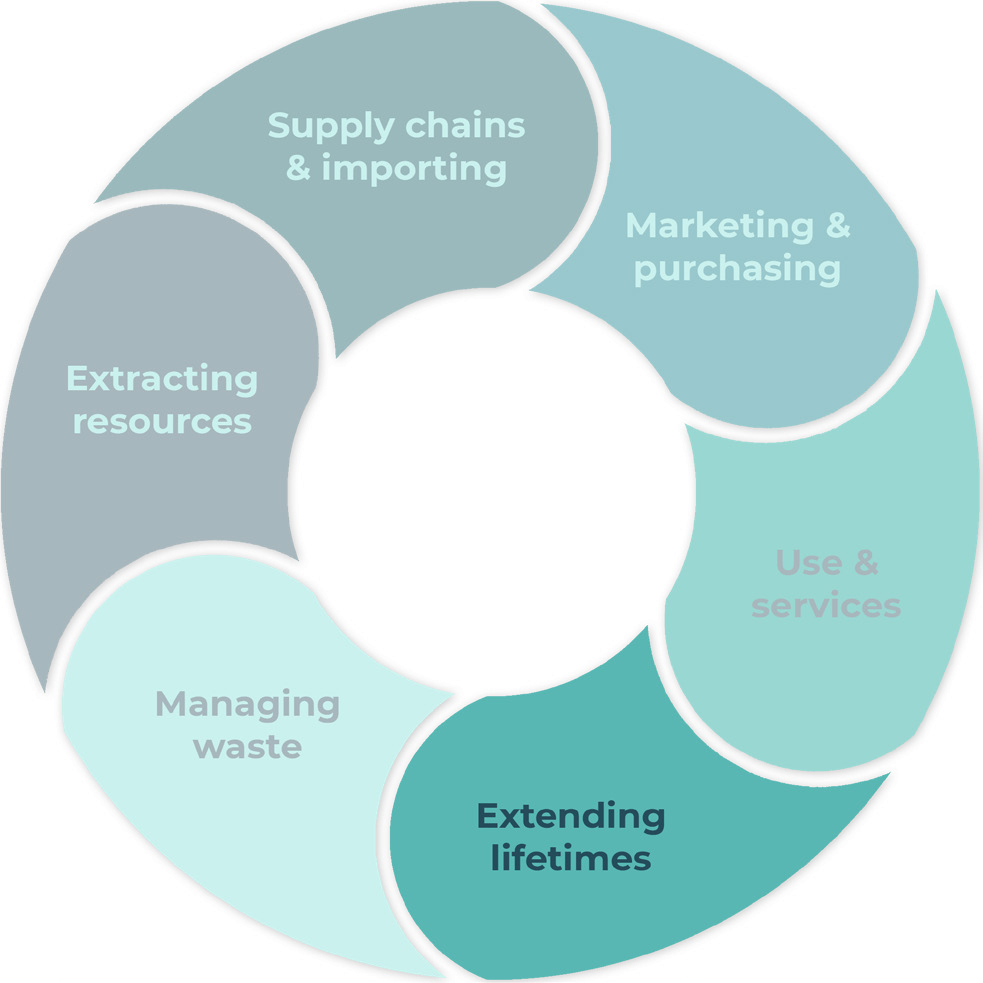
Beyond the pull and allure of heavily marketed updates, critics and consumer rights organisations have accused device manufacturers of pushing consumers towards new devices by deliberately creating products that do not last as long as they could – a concept described as manufactured or planned obsolescence. Planned obsolescence can be a grey area because it is often difficult to tell whether a manufacturer aims to shorten lifespan. In early 2020, the French Government fined Apple €25 million for intentionally slowing the speed of older iPhones without notifying users, which it saw as a deliberate attempt to persuade customers to upgrade. 186 Apple made the decision to prevent shutdowns caused by degraded batteries, which it considers a consumable part of the device, and it has now made it clearer when this is happening.
Extended software updates
Device lifetime can be shortened artificially if manufacturers stop providing software updates that ensure they are secure and continue to be compatible with newer products. For example, smart speaker company Sonos recently announced it was ending support for devices launched before 2015, opening the door to incompatibility with newer speakers, which are often bought to augment a user's existing setup. 187 Different categories of connected products each have their own expected timelines, which are often not reflected in ongoing software support. For example, while smartphones are replaced on average every two years, 188 consumers could reasonably expect a connected washing machine 189 to last six years and a fridge to last over a decade 190, requiring long-term software and security support.
Manufacturers can also limit the upgradeability of devices by creating software updates that are only available to newer models. This is a particular issue for Android smartphones, which have a common core operating system but are manufactured by many different companies, with differing approaches to maintaining a consistent stream of updates. 40 per cent of Android-powered devices are no longer receiving updates that would ensure they are protected from malicious attacks and running smoothly, 191 while Apple claims that 70 per cent of iPhones are running on the latest software, iOS 13. 192 Some smartphone models are guaranteed only to receive two yearly updates, meaning they could be left insecure in just over two years. 193 With a view to cyber security, it is in the public interest to support phones, smart devices and laptops for a minimum of five years.
The UK Government plans to mandate strict security standards for connected devices, including that manufacturers of consumer devices must clearly state the minimum amount of time the device will receive security updates. 194 The EU could attempt to address long-term updateability through an ambitious, EU-wide industry agreement or code of practice for consumer security. 195 However, the failure to agree a renewed agreement on universal chargers suggests that legislation may ultimately be needed to mandate longer support timelines.
IMPROVE: With many products receiving only two years of software updates, consumers are encouraged to replace their devices before they need to. The European Commission should expand Ecodesign legislation to mandate that internet-connected devices by major manufacturers receive software and security updates for a five-year minimum.
Durability legislation
The durability of a device is another deciding factor in its lifetime, with the design of many devices increasing their likelihood of obsolescence and subsequent replacement. In an effort to make their products smaller and more aesthetically pleasing, many manufacturers have moved towards using more fragile materials. Devices with thin protective bezels and wraparound glass are notoriously breakable. 196
If manufacturers fail to target R&D at the sustainability and resilience of devices, policymakers could explore further regulation or legislation to improve their durability, nudging manufacturers to ensure resistance to accidental drops, water and dust, as well as ensuring and increasing long-term health of batteries. 197 To this end, the EU could go as far as mandating that product warranties cover accidental drops and contact with water. Consideration should be given to the cost implications of more durable technology, which may disproportionately affect consumers with lower incomes. However, the higher cost of purchase may be outweighed by reduced repair costs and less frequent replacement.
IMPROVE: Our internet devices have become increasingly fragile, with all-glass designs becoming more widespread, resulting in unnecessary breakage and waste. The European Commission should counter this by extending the consumer warranty on smartphones and laptops to five years, and requiring manufacturers to cover damage from accidental drops and contact with water.
Repairability
Repairing and upgrading devices extends their lifespan, but many users are actively prevented from doing so by manufacturers. Devices such as smartphones and laptops often contain proprietary parts only available from the original manufacturer and require specialist tools or glues to open and reassemble devices.
Increasingly, product policies and design go hand in hand to deter consumers from replacing previously easily accessible parts of their own devices, like memory used in laptops, by threatening sometimes illegally 198 - that even simple fixes could void a device's warranty. The lack of access to repair manuals, often restricted by manufacturers on the basis of copyright, compounds this. 199 During the COVID-19 crisis, under-resourced hospitals reportedly struggled to repair medical equipment because manufacturers refused to publish service manuals, or even removed existing copies from the internet. 200
Perhaps the most common repairability concerns and frustrations for internet users are battery-related. Most consumer devices are powered by lithium-ion batteries with an average lifetime of two to three years, which are considered a consumable part. Since the release of the first iPhone, most manufacturers have adopted soldered batteries that cannot be easily replaced by the user, requiring expert support. These services tend to be more expensive than the replacement battery itself. They are rarely offered in-store and sometimes require sending the device away. All of these factors influence consumer decisions about when to replace a device, as they tip the balance towards the far simpler prospect of purchasing a completely new model. 201
Repairability is not just a question of waste reduction or consumer protection. Manufacturers of smart devices consider the repair and maintenance of their own devices a form of direct competition to new product sales. As a result, business models, corporate policies and product design have converged to create quasi-monopolies on the repair and maintenance of their devices or lock users into service contracts, inflating prices and stifling competition, especially from small businesses. This trend makes repairability a competition and market issue, and approaching it as such could make it easier to get manufacturers to change their practices.
There are several initiatives across Europe that aim to improve the durability and repairability of devices. eReuse is a European community of advocates for the circular economy of electronics, which publishes device durability reports and creates services to track the sources of components and encourage longer life cycles. 202 The Restart Project is a social enterprise in the UK that runs 'restart parties' to help consumers learn how to repair their electronic devices. 203 It also advocates for the rejection of disposable devices and the teaching of electronics repair in schools. 204 Greater awareness of the repairability of devices would empower users to fix and upgrade their devices, either themselves, or with the support of a professional. However, the lack of change from manufacturers demonstrates that it is not enough to rely on voluntary efforts.
Case study: Fairphone

Photo credit: Fairphone
The Fairphone is an 'ethical' smartphone. 205 Designed in Amsterdam, the Fairphone aims to resolve many of the sustainability issues involved in modern internet devices. The phone is easy to open and repair, and the modular modular design enables users to extend its lifespan by swapping out parts if they break or need upgrading. This approach allows the replacement of every part of the phone, including the battery, camera and its screen – the item most likely to break on a smartphone. Users can tinker with individual modules without special tools, and Fairphone is working on providing software and security updates for five years. The latest Fairphone 3 has been awarded a 10/10 score for repairability by iFixit, the online repair manual. 206
Fairphone uses only ethically-mined and recycled materials, sourced from conflict-free materials initiatives. Many manufacturers have stopped sourcing materials from the Democratic Republic of the Congo and surrounding countries, worsening already severe poverty. Instead, Fairphone works with these communities to encourage responsible mining and ensure miners can make a living in safe working conditions.
The Fairphone is designed to be as recyclable as possible. When it finally comes to the end of its life, the company will take back old smartphones in exchange for a discount on a new Fairphone, recycling the parts or even repairing the phone for someone else to use.
The Right to Repair
The 'right to repair' is one part of the solution to this problem. The concept originated in the US, where legislation was passed in Massachusetts in 2012 that forced car manufacturers to publish repair manuals. 207 The idea was adapted for the electronics industry in 2013, when a coalition of fixers in the repair scene and environmental campaign groups formed The Repair Association. 208
The campaign recently entered mainstream US politics, when Presidential candidate Elizabeth Warren called for legislation to make farming and other electronic equipment easier to repair and upgrade. 209 Warren was inspired by farmers in rural communities across the country, who had purchased farming equipment produced by John Deere and Case Corporation. 210 Tractors and other equipment have traditionally been maintained, repaired and upgraded by farmers, and these skills are a vital part of the job, since extended breakdowns can be costly. But as the technology embedded in these machines has advanced, some manufacturers have taken the decision to lock down the software of their equipment so that it can only be accessed and amended by authorised repair specialists. This includes diagnostic tools, which users of John Deere's products say would enable them to understand what is causing any malfunction, but which is increasingly inaccessible by the end user.
The same principle also allows device manufacturers to remotely deactivate their products if any parts are replaced with non-manufacturer versions, locking users into permanent maintenance contracts. These examples suggest a gradual move from pure ownership of products to a pseudo-subscription model, where manufacturers retain significant control over how the product is used. This control allows manufacturers to dictate product lifespan, which could vastly alter environmental impact.
Device manufacturers have argued that loosening their grip over the repair process will reduce the quality and safety of repairs. 211 However, the safety of repairs is partly influenced by how easy it is to open and repair a device. If a smartphone is designed to prevent access using proprietary screws, glue and fragile parts, the risk of injury or damage to the device is far greater.
In several other technology areas, the EU sets mandatory environmental standards through the Ecodesign Directive. These include maximum power consumption in use and in standby mode, as well as minimum performance standards. Changes in 2021 will raise these standards further, requiring manufacturers of several products such as washing machines and dishwashers to provide spare parts and repair manuals for 10 years, with parts delivered anywhere in Europe within 15 days. 212 It is clear that these new rules will drastically improve the repairability of these products, extending their lifetime beyond the failure of many parts.
The European Commission has proposed a 'Circular electronics initiative', which could establish internet technology as a focus for the right to repair under plans to strengthen the circular economy. 213 It recommends that batteries, screens and back covers should also be removable, and repair and maintenance information should be made available to consumers. By including smartphones, tablets and laptops under Ecodesign legislation that currently applies to televisions and washing machines, the EU could pressure manufacturers to make their products easier to repair and upgrade. The European Commission should introduce legislation that extends the right to repair to all communication technologies to empower users to access repair manuals and spare parts for their devices.
Policymakers could also explore legislation that would make it mandatory for certain parts of electronic devices to be modular so they can easily be replaced. 214 Regulations should take into account that the environmental impact of digital devices is concentrated in their manufacture, by mandating reductions in Product Environmental Footprint. This would allow for a more holistic approach to improving the practices and designs of manufacturers.
Lastly, manufacturers could be required to provide parts for a longer period of time. Doing so could increase costs and put dominant manufacturers at a significant advantage, but ensuring that devices last longer will reduce overall costs for consumers. As with any legislation and regulatory burden, policymakers will have to carefully balance the environmental benefits of longer device lifetime with the potential impact on competition and increased cost to consumers, as well as the secondary impacts on digital inclusion and fair access. It will require unambiguous legislation, and possibly a rethink of IP and copyrights, for manufacturers to publish repair manuals for connected and electronic devices. But if policymakers create the conditions for repair and maintenance to become a meaningful economic activity again, it could have a positive impact on local economies and contribute towards fairer, more consumer-oriented, and diversified technology supply chains.
IMPROVE: Repairing smartphones and laptops is made unnecessarily complex by manufacturer control. The European Commission must apply the incoming changes to the Ecodesign Regulation to internet devices, to give users the right to repair. This must include the provision of repair manuals, and replacement parts should be available within 15 days for a minimum of five years.
Repairability indexing
Understanding the repairability of a device is a complex task for consumers and repair professionals alike, who must research the availability of repair manuals and spare parts, the complexity of physically opening a device, and the impact on a manufacturer's warranty. Combining these factors into a simple score, potentially in conjunction with a trustmark scheme, could drastically improve consumers' ability to make informed decisions about their device purchases. One example of this type of scheme is operated by iFixit, an online repository of repair manuals and device teardowns, which rates how easy it is to take a device apart for repair. iFixit takes apart most smartphones and many other devices such as smartwatches and assigns each a repairability score. 215 In iFixit's rankings, Fairphone's two latest models are the only ones to receive a perfect ten score, with popular devices such as the iPhone 11 receiving a six, 216 and the Samsung S20 Ultra receiving a three. 217
While these rankings are useful, consumers should be entitled to information about more than just the physical repairability of devices. Ratings could include an assessment of the price, availability and speed of delivery of parts, the accessibility of repair manuals, the likelihood of repair being required and the cost of repair services. Research into a repairability index scoring system for technology has already been conducted by the European Commission. 218 This system could be adapted for different categories of product, and also balance reparability with reliability.
The French Parliament has already voted in such a system, to begin in 2021. 219 It should be in the interest of businesses and all Member States to avoid fragmentation in this space. The Commission has an opportunity to initiate legislation alongside other Green Deal measures to establish a reparability index into law across the bloc, mandating that a simple and accessible scoring system be developed and presented on packaging for consumer information.
INFORM: The repairability of products is difficult to glean at the point of purchase. Publishing repairability scores would enable consumers to make informed decisions, so the European Commission should fund the development of a scoring system and mandate that scores are presented on product packaging and online. This should be included as part of the product environmental impact label recommended earlier in this report.
5.6. Managing waste
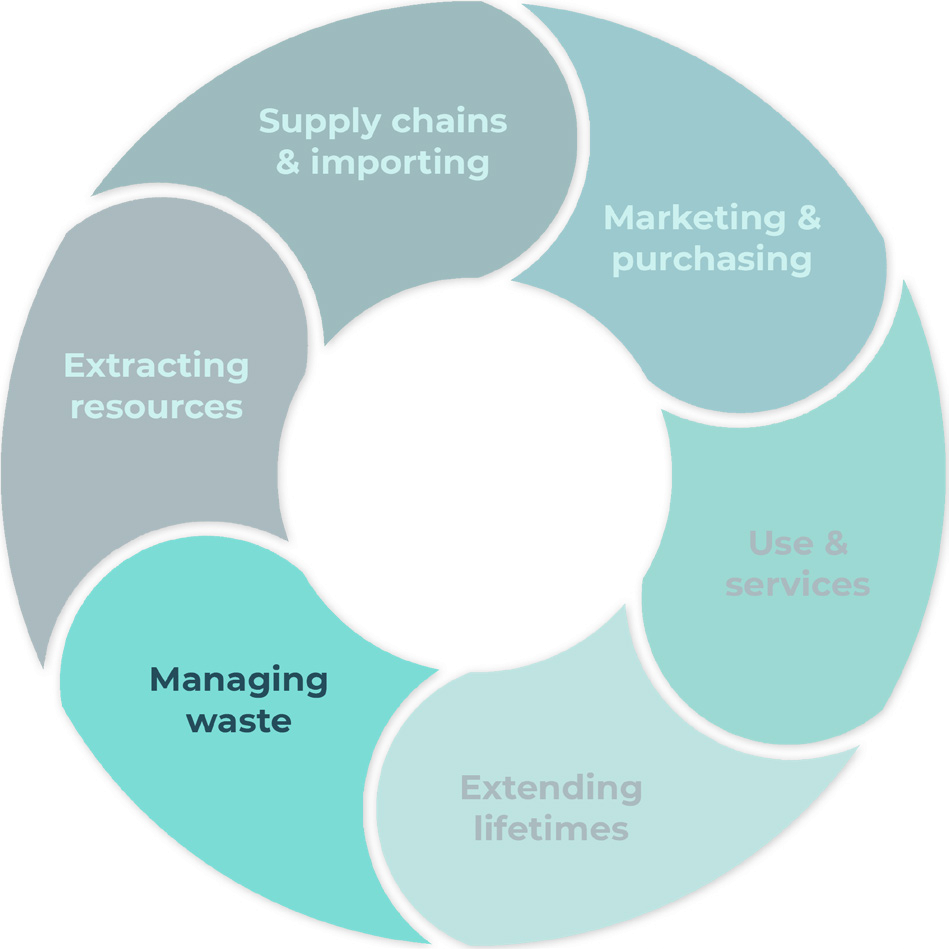
Every part of the internet eventually creates electronic waste, from data centres and physical network infrastructure to smartphones and Internet of Things devices. The more devices we connect and use, the more future waste is created. But unwanted devices can often be given a new life. For example, there are several programmes to rehome old smartphones. In the UK, smartphones can be donated to Unseen UK to be given to survivors of modern slavery, 220 and in Canada, CNIB Foundation loads donated smartphones with accessibility apps for someone who is blind or partially sighted, to help with everyday tasks. Despite these efforts, the amount of electronic waste we produce is increasing rapidly, with the United Nations estimating a 21 per cent increase in the last five years. 221
Recycling
When electronic devices reach the true end of their lives, some or all their components can be recycled, and across the EU, around 40 per cent of electronic waste is recycled through official channels. 222 However, much of the process of recycling is outsourced to countries outside the bloc. Despite a ban on e-waste exports, 1.3 million tonnes of undocumented goods are exported from the EU each year. 223 In the UK, as much as 80 per cent of electronic waste recycling is shipped to emerging and developing countries. 224 When it arrives, it is smashed, burnt, melted or subjected to acid stripping to extract copper, steel, gold and aluminium. These dangerous operations risk worker safety and pollute communities, since parts containing mercury and lead that can not be reused are discarded or burned in local dumps. 225 The World Health Organisation has repeatedly highlighted calls for intervention around electronic waste. 226
Recycling is a notoriously challenging area for standardisation and reform. Capabilities, infrastructure and supply chains vary greatly across local governments. But if Europe is serious about building a circular economy for digital devices, it will have to take a concerted approach to recycling, beginning with incentives to recycle the approximately 700 million unused smartphones laying in consumer's drawers. 227 Doing so could recover 14,920 tonnes of gold, silver, copper, palladium, cobalt and lithium with a value of over €1 billion, significantly reducing our reliance on imports of conflict minerals. An EU-wide takeback scheme could facilitate this. 228
IMPROVE: A minority of Europe's electronic waste is recycled properly, and widespread change will be necessary to create change in a complex area. Investment in recycling infrastructure is urgently required, and the European Commission should initiate a bloc-wide takeback scheme for internet devices to guide consumer behaviour, and provide financial incentives to companies that design devices in a way that makes recycling easier.
Device chargers
One area of renewed focus for the European Commission is device chargers, such as those included with smartphones. An estimated 12,000 tonnes of chargers are disposed of each year. 229 The European Commission has tried for many years to encourage a universal standard, both with a view to reducing e-waste and protecting consumer interests.
Since 2009, Europe has had some success working through voluntary agreements with mobile phone and smart device manufacturers and as a result, much of the market has converged around USB Micro-B and USB-C connectors. 230 However, some market players continue to produce proprietary chargers, arguing that conformity would hamper innovation. 231 There has also been little progress on other devices, such as laptops, which can vary more significantly in size and energy consumption and therefore present challenges for standardisation. Negotiations over new voluntary agreements with phone manufacturers have proven difficult and the Commission recently announced a legislative proposal, due in late 2020, which is expected to address common chargers for mobile phones 'and similar devices'. 232
Another approach to the issue is to require manufacturers to sell devices and chargers separately. 'Decoupling' could drive down costs for customers who already have a compatible charger and would ensure they do not buy unnecessarily bundled additional chargers. However, only 40 per cent of participants in an EU-wide survey said they would purchase a device without a charger included, showing how consumer interests and the EU's environmental agenda are likely to clash on this issue. 233 Further research showed that chargers and accessories are responsible for only around 2 per cent (1.5kg CO2e) of the full lifecycle impact of smartphones. 234
6. Conclusion
The digital revolution has great potential to accelerate our efforts to resolve the environmental crisis, and it will be vital in Europe's twin green and digital recovery from the COVID-19 pandemic. The European Commission has begun to explore legislation that could protect the environment from the growing impact of digital technologies, including through consultations and proposed strategy. However, the number of connected devices is skyrocketing, creating ever-increasing internet traffic, driven by unrestrained video streaming, perpetual cloud syncing and largely unnoticed surveillance data collection. Only a small proportion of web services are powered by green energy and without urgent action, the internet will become one of the largest consumers of carbon-intensive energy worldwide. This cost-benefit analysis between the internet's contributions to a greener economy, and its own damaging impact often goes unaddressed in discussions about digitalisation and the role of technology in addressing our environmental and social challenges.
Without a complete rethink of our approach to technology, we are not going to reach Europe's ambitions for a green and climate-neutral economy where no one is left behind. Our internet devices must be more sustainably sourced and designed to last longer. European consumer culture needs a reset, empowering individuals, organisations and governments to make environmentally conscious decisions based on transparent information and economic as well as social incentives. Annual hardware updates to smartphones need not be the norm, even as marketing campaigns and the imperatives of ever-shorter replacement cycles declare incremental changes to product design triumphant leaps in technological innovation. Ultimately, consumption patterns, both online and offline, will have to change.
Europe's Member States and technology companies have an opportunity to take a leading role in the innovation necessary to resolve the tension between the benefits of digital connectivity and environmental damage. New business models and transparency across supply chains could set domestic companies apart from their foreign competition, and the public and private demand for such action will make it a worthwhile investment. European producers and service providers must seize their chance to differentiate from global competitors by providing long-term hardware and software support, improving repairability of devices and working with policymakers to create a level playing field with foreign exporters.
European institutions have proven themselves to be supporters of purpose-led innovation. The unique approach that has supported consumers through the digital single market, negotiating trade deals, improving choice and protecting rights across borders, must now be applied to guide patterns of consumption to solve the looming environmental crisis. If it is to meet its aims for carbon neutrality by 2050, the Union must accelerate its efforts to legislate for a new, green digital economy.
The challenge for the institutions in Brussels, as well as for governments at all levels, is to move into new territory, and make tough decisions that may at first prove inconvenient for consumers or limit their choices. But a smart digital policy will also drive green innovation, open untapped markets and reveal economic opportunities that build on European strengths in research and development, inclusive innovation and industrial policy.
The decisions ahead will be politically challenging and may at times face backlash, which is why it is important to consider how to engage with citizens early about the trade-offs and potential lifestyle changes associated with them. In some technology areas, we have already seen success in tying together the dual goals of environmental action and continued profit making, for example in teleconferencing and remote working technologies that help to reduce the immense carbon footprint of business travel. Renewable energy is also quickly reducing in price and solar and wind could soon become the cheapest electricity sources.
Making changes to how the internet is powered, governed and used will also trigger secondary or unintended consequences. To ensure no one is left behind when the internet goes green, policymakers will have to engage with the public at large - mapping, anticipating and remedying social impacts and creating as much buy-in for reforms as possible.
The difficulty with a holistic approach is knowing where to delineate responsibilities. The complete intertwining of the internet with our society makes this a significant challenge. Expanding the reach of legislators too far risks making political interventions unpalatable, paralysing legislators through sheer breadth, and diluting efforts to regulate. Action must therefore be carefully targeted as well as taking into account the full picture.
If Europe intends to meet the challenge set out in the Green Deal, tough and carefully negotiated choices will be required from policymakers, businesses and consumers alike. Virtue-signalling that is not matched by marked changes in behaviour and patterns of consumption will do nothing to avert the looming environmental crisis. For governments, this will mean developing policies that could - at least temporarily and in some sectors - discourage economic growth as it is traditionally defined. Some of these policies may frustrate Europe's trading partners, and even increase prices for consumers. For businesses, tough choices might mean foregoing short-term profits to design products for longer life cycles, or redesigning business operations to genuinely cut emissions instead of using carbon trading to achieve a merely superficial net-zero target. For consumers, the toughest challenge will be to reconsider their priorities, evaluate their needs, and change their behaviour - from the virtual shopping aisle to the real-world voting booth.
More research is needed in many of these areas, particularly around designing products that last longer and are more recyclable, as well as to understand the unintended consequences of interventions on other sectors and groups of people. 2020 has already demonstrated the ability of both Europe and its Member States to move swiftly in the face of adversity and coordinate drastic changes to our economies and livelihoods in the public interest. As the European institutions and Member States set out their ambitions and plans for a green economy in more detail over the coming months and years, it is crucial that connected and emerging technologies are put in the service of this generation-defining effort, and don't become one of its largest detractors.
IMAGE CREDITS
Illustrations & icons:
- Pages 4; 11-13: Increase by Alice Design from the Noun Project
- Pages 4; 11-13: Inform by Lakshisha from the Noun Project
- Pages 4; 11-13: Euros by Adrien Coquet from the Noun Project
- Pages 4; 11-13: Integration by Adrien Coquet from the Noun Project
- Page 6: Figure 3: The European Green Deal, European Commission
Photos:
- Page 7: Europe urgently needs a Right to Repair, Photo by Kilian Seiler on Unsplash
- Page 8: The environmental impact of our digital lives, Photo by Mika Baumeister on Unsplash
- Page 15: Extracting natural resources, Photo by Vlad Chetan from Pexels
- Page 18: Case study: Drone-powered rare earth mining, Photo by Flo Maderebner from Pexels
- Page 19: Supply chains and importing, Photo by chuttersnap on Unsplash
- Page 28: Screenshot from Low-Tech Magazine
- Page 34: Case study: Fairphone, Photo by Fairphone
Websites
https://www.ngi.eu https://research.ngi.eu
https://twitter.com/ngi4eu https://twitter.com/ngiforward
-
https://ec.europa.eu/info/strategy/priorities-2019-2024/european-green-deal_en ↩
-
https://www.datacenterdynamics.com/en/news/eu-wants-data-centers-be-carbon-neutral-2030/ ↩
-
https://ec.europa.eu/info/sites/info/files/communication-shaping-europes-digital-future-feb2020_en_3.pdf ↩
-
https://ec.europa.eu/info/law/better-regulation/have-your-say/initiatives/12467-Empowering-the-consumer-for-the-green-transition ↩
-
https://www.gartner.com/en/newsroom/press-releases/2019-08-01-gartner-says-worldwide-smartphone-sales-will-decline- ↩
-
https://www.sciencemag.org/news/2019/04/radioactive-waste-standoff-could-slash-high-tech-s-supply-rare-earth-elements ↩
-
https://theconversation.com/how-smartphones-are-heating-up-the-planet-92793 ↩
-
https://www.sciencefocus.com/planet-earth/the-thought-experiment-what-is-the-carbon-footprint-of-an-email/ ↩
-
https://www.carbonbrief.org/factcheck-what-is-the-carbon-footprint-of-streaming-video-on-netflix ↩
-
https://theshiftproject.org/wp-content/uploads/2019/07/Excutive-Summary_EN_The-unsustainable-use-of-online-video.pdf ↩
-
https://www.zenithmedia.com/online-video-viewing-to-reach-100-minutes-a-day-in-2021/ ↩
-
https://www.bbc.com/future/article/20200305-why-your-internet-habits-are-not-as-clean-as-you-think ↩
-
https://www.bbc.com/future/article/20200305-why-your-internet-habits-are-not-as-clean-as-you-think ↩
-
https://www.gsma.com/iot/wp-content/uploads/2018/02/iot_dt_airq_01_18.pdf ↩
-
https://www.powerengineeringint.com/digitalization/internet-of-things/off-grid-solar-supplier-gets-iot-boost/ ↩
-
https://www.ofcom.org.uk/_data/assets/pdf_file/0025/38275/iotstatement.pdf ↩
-
https://ec.europa.eu/info/sites/info/files/commission-white-paper-artificial-intelligence-feb2020_en.pdf ↩
-
https://www.independent.co.uk/life-style/gadgets-and-tech/features/how-technology-will-solve-the-planet-s-hardest-problems-a7150341.html ↩
-
https://www.climatechangenews.com/2018/08/01/super-computer-caribbean/ ↩
-
https://www.climate-kic.org/insights/digital-with-purpose-delivering-a-smarter-2030/ ↩
-
https://au.int/en/pressreleases/20191026/african-digital-transformation-strategy-and-african-union-communication-and ↩
-
https://www.technologyreview.com/s/613630/training-a-single-ai-model-can-emit-as-much-carbon-as-five-cars-in-their-lifetimes/ ↩
-
https://www.raconteur.net/technology/industrial-iot-climate-change ↩
-
https://www.gartner.com/en/newsroom/press-releases/2019-08-29-gartner-says-5-8-billion-enterprise-and-automotive-io ↩
-
https://en.wikipedia.org/wiki/Phase-out_of_fossil_fuel_vehicles ↩
-
https://eur-lex.europa.eu/legal-content/EN/TXT/?uri=celex:32015L0720 ↩
-
https://ec.europa.eu/commission/presscorner/detail/en/IP_19_2631 ↩
-
https://www.sciencedirect.com/science/article/abs/pii/S0301421517302793?via%3Dihub ↩
-
https://ideas.repec.org/a/eee/enepol/v132y2019icp1256-1261.html ↩
-
https://www.irishtimes.com/opinion/cobalt-mining-shows-clean-energy-revolution-comes-at-a-price-1.3717629 ↩
-
https://thediplomat.com/2019/02/china-rushes-to-dominate-global-supply-of-lithium/ ↩
-
https://www.theguardian.com/global-development/2018/oct/12/phone-misery-children-congo-cobalt-mines-drc ↩
-
https://www.sciencemag.org/news/2019/04/radioactive-waste-standoff-could-slash-high-tech-s-supply-rare-earth-elements ↩
-
https://oilprice.com/Energy/Energy-General/A-New-Lithium-War-Is-About-To-Begin.html ↩
-
https://www.ft.com/content/efa997fc-1b7a-11ea-97df-cc63de1d73f4 ↩
-
https://www.sciencedirect.com/science/article/pii/S0169136815300755 ↩
-
https://www.ft.com/content/5e6e99c2-4faa-4e56-bcd2-88460c8dc41a ↩
-
https://www.globalwitness.org/en/campaigns/conflict-minerals/dodd-frank-act-section-1502/ ↩
-
https://trade.ec.europa.eu/doclib/docs/2017/march/tradoc_155423.pdf ↩
-
https://www.computerweekly.com/feature/Upcoming-conflict-minerals-regulation-does-not-cover-major-technology-companies ↩
-
https://www.irishtimes.com/opinion/cobalt-mining-shows-clean-energy-revolution-comes-at-a-price-1.3717629 ↩
-
https://ec.europa.eu/jrc/sites/jrcsh/files/jrc105010_161214_li-ion_battery_value_chain_jrc105010.pdf ↩
-
https://www.miningsee.eu/rio-tinto-invests-200-mln-in-serbias-jadar-lithium-project-exploration/ ↩
-
https://www.euractiv.com/section/batteries/news/europe-takes-on-chinas-global-dominance-of-rare-earth-metals/ ↩
-
http://ec.europa.eu/DocsRoom/documents/10882/attachments/1/translations ↩
-
https://fortune.com/2019/07/27/rare-earth-metals-recycling-us-china/ ↩
-
http://www.suschem.org/highlights/ree4eu-pilot-plant-success ↩
-
https://arstechnica.com/science/2020/06/new-polymer-easily-captures-gold-extracted-from-e-waste/ ↩
-
https://vancouversun.com/news/local-news/urban-mining-ubc-engineers-say-e-waste-more-lucrative-than-ore-pulled-from-the-ground/ ↩
-
https://www.euractiv.com/section/batteries/news/europe-takes-on-chinas-global-dominance-of-rare-earth-metals/ ↩
-
https://www.cam.ac.uk/research/features/fingerprinting-rare-earth-elements-from-the-air ↩
-
https://www.nytimes.com/2016/12/29/technology/iphone-china-apple-stores.html ↩
-
https://www.fairphone.com/wp-content/uploads/2019/09/FP3_List_Only_Suppliers.pdf ↩
-
https://www2.deloitte.com/content/dam/Deloitte/lu/Documents/technology/lu-blockchain-internet-things-supply-chain-traceability.pdf ↩
-
https://www.odi.org/publications/11206-delivering-blockchain-s-potential-environmental-sustainability ↩
-
https://www.ledgerinsights.com/wef-blockchain-traceability-sustainability/ ↩
-
https://www.globalslaveryindex.org/2018/findings/importing-risk/g20-countries/ ↩
-
https://www.antislavery.org/eu-legislation-slavery-supply-chains/ ↩
-
https://ec.europa.eu/eurostat/statistics-explained/index.php?title=File:Extra-EU_imports_of_computer,_electronic_and_optical_products,_2019.png ↩
-
https://ec.europa.eu/eurostat/statistics-explained/index.php/Digital_economy_and_society_statistics_-_households_and_individuals ↩
-
https://www.lexology.com/library/detail.aspx?g=ec066070-1b37-4446-8fd6-890eb51a6205 ↩
-
https://www.cambridge.org/core/journals/global-sustainability/article/unequal-distribution-of-household-carbon-footprints-in-europe-and-its-link-to-sustainability/F1ED4F705AF1C6C1FCAD477398353DC2/core-reader ↩
-
https://ec.europa.eu/commfrontoffice/publicopinion/archives/ebs/ebs_416_en.pdf ↩
-
https://www.ademe.fr/sites/default/files/assets/documents/evaluation-economique-allongement-duree-equipement-synthese.pdf ↩
-
https://www.theguardian.com/technology/2019/sep/18/fairphone-3-review-ethical-phone ↩
-
https://www.simplyswitch.com/energy/guides/compare-green-energy/ ↩
-
GreenNet in the UK is roughly twice the price of other providers https://www.greennet.org.uk/internet-services/broadband ↩
-
https://ec.europa.eu/eurostat/statistics-explained/index.php/Digital_economy_and_society_statistics_-_households_and_individuals ↩
-
https://www.energuide.be/en/questions-answers/how-to-reduce-the-energy-consumed-by-my-pc-smartphone-and-tablet/2124/ ↩
-
https://www.sust-it.net/energy-saving/laptop-computers&company=60 ↩
-
https://www.zdnet.com/article/heres-how-much-it-costs-to-charge-a-smartphone-for-a-year/ ↩
-
https://actu.epfl.ch/news/bringing-social-media-to-unconnected-areas/ ↩
-
https://www.theguardian.com/science/2019/jan/28/scientists-create-super-thin-sheet-could-charge-our-phones ↩
-
https://theshiftproject.org/en/article/lean-ict-our-new-report/ ↩
-
https://www.aise.eu/documents/document/20181220110932-ip30_report_2018_final_hd.pdf ↩
-
https://www.theguardian.com/environment/2020/jan/09/quorn-to-be-first-major-brand-to-introduce-carbon-labelling ↩
-
For example: https://www.apple.com/environment/pdf/products/iphone/iPhone_11_PER_sept2019.pdf ↩
-
https://ec.europa.eu/info/energy-climate-change-environment/standards-tools-and-labels/products-labelling-rules-and-requirements/energy-label-and-ecodesign/energy-efficient-products/washing-machines_en ↩
-
https://www.ethicalconsumer.org/home-garden/shopping-guide/washing-machines ↩
-
https://www.apple.com/environment/pdf/products/iphone/iPhone_11_PER_sept2019.pdf ↩
-
https://www.carbontrust.com/resources/product-carbon-footprint-labelling-consumer-research-2020 ↩
-
http://register.consilium.europa.eu/doc/srv?I=EN&f=ST%2017495%202010%20INIT ↩
-
https://ec.europa.eu/environment/eussd/smgp/communication/impact.htm ↩
-
https://ec.europa.eu/commission/presscorner/detail/en/ip_20_416 ↩
-
https://ec.europa.eu/info/law/better-regulation/have-your-say/initiatives/12467-Empowering-the-consumer-for-the-green-transition ↩
-
https://theshiftproject.org/wp-content/uploads/2019/03/Lean-ICT-Report_The-Shift-Project_2019.pdf ↩
-
https://www.gov.uk/government/organisations/office-for-product-safety-and-standards ↩
-
https://dbei.gov.ie/en/What-We-Do/EU-Internal-Market/Ecodesign-/ ↩
-
https://ec.europa.eu/digital-single-market/en/digital-public-services-scoreboard ↩
-
https://www.theclimategroup.org/sites/default/files/downloads/tcg_smart_cities_introduction.pdf ↩
-
https://confidentials.com/manchester/cityverve-is-it-time-for-a-smarter-manchester ↩
-
https://ec.europa.eu/environment/gpp/pdf/20032020_EU_GPP_criteria_for_data_centres_server_rooms_and%20cloud_services_SWD_(2020)_55_final.pdf ↩
-
https://ec.europa.eu/environment/gpp/pdf/toolkit/computers%20and%20monitors/EN.pdf ↩
-
https://www2.gov.scot/About/Performance/scotPerforms/partnerstories/SustainablePublicProcurementPrioritisationTool ↩
-
https://www.enerdata.net/publications/executive-briefing/expected-world-energy-consumption-increase-from-digitalization.html ↩
-
https://www.energuide.be/en/questions-answers/do-i-emit-co2-when-i-surf-the-internet/69/ ↩
-
https://www.sciencefocus.com/planet-earth/the-thought-experiment-what-is-the-carbon-footprint-of-an-email/ ↩
-
https://www.carbonbrief.org/factcheck-what-is-the-carbon-footprint-of-streaming-video-on-netflix ↩
-
https://www.forbes.com/sites/forbestechcouncil/2017/12/15/why-energy-is-a-big-and-rapidly-growing-problem-for-data-centers ↩
-
https://www.wbur.org/hereandnow/2019/09/13/china-data-centers-carbon-footprint ↩
-
https://phys.org/news/2019-01-oil-dublin-rich-europe-hub.html ↩
-
http://www.eirgridgroup.com/site-files/library/EirGrid/4289_EirGrid_GenCapStatement_v9_web.pdf ↩
-
https://www.datacenterdynamics.com/en/news/amsterdam-pauses-data-center-building/ ↩
-
https://www.edie.net/news/8/How-GPDR-is-curbing-carbon-emissions/ ↩
-
https://www.epa.gov/energy/greenhouse-gas-equivalencies-calculator ↩
-
https://eta.lbl.gov/publications/united-states-data-center-energy ↩
-
https://www.cl.cam.ac.uk/research/dtg/www/files/publications/public/sa497/akoush-hotos11.pdf ↩
-
https://www.nrc.nl/nieuws/2020/06/05/gebroken-beloftes-hoe-de-wieringermeerpolder-dichtslibde-met-windturbines-en-datacentra-a4001882 ↩
-
https://www.scholars.northwestern.edu/en/publications/data-center-it-efficiency-measures-evaluation-protocol ↩
-
https://lifelinedatacenters.com/data-center/graphene-promises-bring-new-life-data-centers/ ↩
-
https://ec.europa.eu/jrc/en/jec/renewable-energy-recast-2030-red-ii ↩
-
https://theshiftproject.org/en/article/unsustainable-use-online-video/ ↩
-
https://theshiftproject.org/wp-content/uploads/2019/07/Excutive-Summary_EN_The-unsustainable-use-of-online-video.pdf ↩
-
https://www.theguardian.com/commentisfree/2020/feb/12/real-problem-netflix-addiction-carbon-emissions ↩
-
https://phys.org/news/2019-05-rethinking-digital-environmental-impact.html ↩
-
https://www.sciencedirect.com/science/article/pii/S2214629618301051#bib0165 ↩
-
https://www.wired.com/story/sustainable-software-design-climate-change/ ↩
-
https://theshiftproject.org/en/carbonalyser-browser-extension/ ↩
-
https://chrome.google.com/webstore/detail/ovo-carbon-capper/fhnhofnjjgdecmbjjjikhekdmepoejnk ↩
-
https://ec.europa.eu/info/sites/info/files/communication-european-strategy-data-19feb2020_en.pdf ↩
-
https://arstechnica.com/tech-policy/2017/12/bitcoins-insane-energy-consumption-explained/ ↩
-
https://www.jbs.cam.ac.uk/fileadmin/user_upload/research/centres/alternative-finance/downloads/2017-global-cryptocurrency-benchmarking-study.pdf ↩
-
https://arstechnica.com/tech-policy/2018/02/in-iceland-bitcoin-mining-will-soon-use-more-energy-than-its-residents/ ↩
-
https://www.climatechangenews.com/2017/12/15/bitcoin-reforms-proposed-curb-soaring-carbon-footprint/ ↩
-
https://www.nesta.org.uk/feature/innovation-methods/anticipatory-regulation/ ↩
-
https://www.techdirt.com/articles/20180912/09473640628/you-dont-own-what-youve-bought-apple-disappears-purchased-movies.shtml ↩
-
https://collider.com/why-you-should-keep-buying-blu-rays-and-dvds/#physical-media ↩
-
https://www.itu.int/en/mediacentre/Pages/PRO04-2020-ICT-industry-to-reduce-greenhouse-gas-emissions-by-45-percent-by-2030.aspx ↩
-
https://www.telefonica.com/en/web/responsible-business/environment/energy-and-climate-change-2 ↩
-
https://www.vodafone.com/content/dam/vodcom/sustainability/pdfs/sustainablebusiness2019.pdf ↩
-
https://www.nokia.com/sites/default/files/2019-05/Nokia_People_and_Planet_Report_2018_Targets_environment.pdf ↩
-
https://btplc.com/Digitalimpactandsustainability/Ourapproach/Ourpolicies/Environmental_Policy.pdf ↩
-
https://hellofuture.orange.com/en/networks-future-will-less-energy-intensive/ ↩
-
https://www.theguardian.com/technology/2020/jan/16/microsoft-carbon-emissions-negative-2030 ↩
-
https://www.apple.com/environment/pdf/products/iphone/iPhone_11_PER_sept2019.pdf ↩
-
https://s22.q4cdn.com/959853165/files/doc_downloads/2020/02/0220_Netflix_Environmental_Social_Governance_Report_FINAL.pdf ↩
-
https://www.theguardian.com/travel/2019/aug/02/offsetting-carbon-emissions-how-to-travel-options ↩
-
https://eco-act.com/carbon-offsetting/carbon-offsetting-is-it-really-a-solution-to-climate-change/ ↩
-
https://ec.europa.eu/clima/policies/international/negotiations/paris_en ↩
-
https://metro.co.uk/2017/08/14/are-new-disposable-battery-packs-for-your-smartphones-an-ecological-disaster-6851973/ ↩
-
https://publications.jrc.ec.europa.eu/repository/bitstream/JRC116106/jrc116106_jrc_e4c_task2_smartphones_final_publ_id.pdf ↩
-
https://publications.jrc.ec.europa.eu/repository/bitstream/JRC116106/jrc116106_jrc_e4c_task2_smartphones_final_publ_id.pdf ↩
-
https://www.engadget.com/2020/02/07/france-apple-ios-slowdown-fine/ ↩
-
https://onezero.medium.com/the-future-doesnt-last-98cabae2404 ↩
-
https://publications.jrc.ec.europa.eu/repository/bitstream/JRC116106/jrc116106_jrc_e4c_task2_smartphones_final_publ_id.pdf ↩
-
https://conversation.which.co.uk/home-energy/washing-machines-faulty-broken-lifespan-lifetime-warranty-guarantee/ ↩
-
https://www.ransomspares.co.uk/blog/news/how-long-should-appliances-last.htm ↩
-
https://www.zdnet.com/article/android-security-warning-one-billion-devices-no-longer-getting-updates/ ↩
-
https://9to5google.com/2020/03/03/samsung-galaxy-s20-android-updates/ ↩
-
https://www.gov.uk/government/news/government-to-strengthen-security-of-internet-connected-products ↩
-
https://www.gov.uk/government/collections/secure-by-design ↩
-
https://bgr.com/2017/04/24/galaxy-s8-drop-test-video-squaretrade/ ↩
-
https://publications.jrc.ec.europa.eu/repository/bitstream/JRC116106/jrc116106_jrc_e4c_task2_smartphones_final_publ_id.pdf ↩
-
https://www.ifixit.com/News/10016/warranty-void-if-removed-stickers ↩
-
https://www.theguardian.com/sustainable-business/copyright-law-repair-manuals-circular-economy ↩
-
https://www.businessinsider.com/ventilator-manufacturers-dont-let-hospitals-fix-coronavirus-right-to-repair-2020-5 ↩
-
https://www.greenpeace.org/usa/wp-content/uploads/2017/10/Guide-to-Greener-Electronics-2017.pdf ↩
-
https://www.ifixit.com/Teardown/Fairphone+3+Teardown/125573 ↩
-
https://en.wikipedia.org/wiki/Motor_Vehicle_Owners%27_Right_to_Repair_Act ↩
-
https://www.theverge.com/2019/3/27/18284011/elizabeth-warren-apple-right-to-repair-john-deere-law-presidential-campaign-iowa ↩
-
https://www.latimes.com/business/hiltzik/la-fi-hiltzik-right-repair-20181116-story.html ↩
-
https://www.businessinsider.com/apple-loses-money-on-device-repairs-every-year-2019-11 ↩
-
https://eur-lex.europa.eu/legal-content/EN/TXT/?uri=uriserv:OJ.L_.2019.315.01.0285.01.ENG&toc=OJ:L:2019:315:TOC ↩
-
https://ec.europa.eu/environment/circular-economy/pdf/new_circular_economy_action_plan.pdf ↩
-
https://ecostandard.org/news_events/work-on-material-efficiency-standards-for-ecodesign-finally-kicks-off/ ↩
-
https://www.ifixit.com/Teardown/Samsung+Galaxy+S20+Ultra+Teardown/131607 ↩
-
https://publications.jrc.ec.europa.eu/repository/bitstream/JRC114337/jrc114337_report_repair_scoring_system_final_report_v3.2_pubsy_clean.pdf ↩
-
https://repair.eu/news/major-steps-taken-for-durability-and-right-to-repair-in-france/ ↩
-
https://www.theregister.com/2020/07/02/united_nations_warns_of_global_ewaste_wave/ ↩
-
https://ec.europa.eu/eurostat/tgm/table.do?tab=table&init=1&language=en&pcode=t2020_rt130&plugin=1 ↩
-
https://www.parliament.uk/business/committees/committees-a-z/commons-select/environmental-audit-committee/news-parliament-2017/-electronic-waste-and-the-circular-economy-inquiry-launch-17-19/ ↩
-
https://www.theguardian.com/environment/2017/nov/20/electronic-recycling-e-waste-2017-gadgets ↩
-
https://www.ban.org/news/2019/2/6/gps-trackers-discover-illegal-e-waste-exports-to-africa-and-asia ↩
-
https://circulareconomy.europa.eu/platform/sites/default/files/impact_of_ce_on_fmcg_-_mobile_phones_case_study.pdf ↩
-
https://ec.europa.eu/environment/circular-economy/pdf/new_circular_economy_action_plan.pdf ↩
-
https://op.europa.eu/en/web/eu-law-and-publications/publication-detail/-/publication/c6fadfea-4641-11ea-b81b-01aa75ed71a1 ↩
-
https://ec.europa.eu/growth/sectors/electrical-engineering/red-directive/common-charger_en ↩
-
https://ec.europa.eu/info/law/better-regulation/have-your-say/initiatives/2020-Common-chargers-for-mobile-phones-and-similar-devices/F18119 ↩
-
https://ec.europa.eu/info/law/better-regulation/have-your-say/initiatives/2020-Common-chargers-for-mobile-phones-and-similar-devices ↩
-
https://op.europa.eu/en/publication-detail/-/publication/c6fadfea-4641-11ea-b81b-01aa75ed71a1 ↩
-
https://publications.jrc.ec.europa.eu/repository/bitstream/JRC116106/jrc116106_jrc_e4c_task2_smartphones_final_publ_id.pdf ↩