About Nesta
We are Nesta, the UK's innovation agency for social good. We design, test and scale solutions to society's biggest problems. Our three missions are to give every child a fair start, help people live healthy lives and create a sustainable future where the economy works for both people and the planet.
For over 20 years, we have worked to support, encourage and inspire innovation. We work in three roles: as an innovation partner working with frontline organisations to design and test new solutions, as a venture builder supporting new and early stage businesses and as a system shaper creating the conditions for innovation. Harnessing the rigour of science and the creativity of design, we work relentlessly to change millions of lives for the better.
Find out more at nesta.org.uk
If you'd like this publication in an alternative format such as Braille or large print please contact us at [email protected]
Authors
Max Woollard
Andrew Sissons
Summary
It is often claimed that the UK's housing stock needs to be much better insulated before heat pumps can be installed. This is largely untrue. Insulating homes is generally a good thing – it saves energy, makes homes healthier and more comfortable, and can ease pressure on the electricity grid – but it is not essential for switching homes to heat pumps.
This paper considers:
- whether heat pumps require insulation
- the benefits and costs of insulation
- what a pragmatic approach to insulating homes in the UK looks like.
Key points
Heat pumps can be installed and work efficiently in less well-insulated homes. It is often claimed that homes need to be well insulated to have a heat pump, but this is largely untrue. While better insulation is always beneficial with any kind of heating system, it is not an essential prerequisite for getting a heat pump.
The key factors affecting a heat pump's efficiency are system design and adequately-sized radiators. While insulation plays an important role in reducing heat demand, and can in some cases make heat pumps operate more efficiently, it is not the key factor in heat pump efficiency. Instead, having a well-designed heating system, with correctly-sized heat emitters which enable a lower flow temperature, is the most important factor behind a heat pump's efficiency.
Heat pumps can be cheaper to run than gas boilers, but only if electricity is cheap enough relative to gas. High electricity-to-gas price ratios from roughly 2016 to 2021 made heat pumps more expensive to run, which may have encouraged installers to couple them with improved insulation. However, the electricity-to-gas price ratio has fallen to a level where efficient heat pumps can compete with boilers on running costs. Government action – including rebalancing electricity levies – could make heat pumps still cheaper to run.
Heat pumps generally reduce carbon emissions by more than insulation.
Low-carbon heating can fully eliminate direct carbon emissions from home heating, while insulation on its own can only reduce emissions. Viewed purely from the perspective of decarbonising, investing in low-carbon heating is an effective way to meet the UK's climate goals. However, insulation should not be viewed solely in terms of carbon savings.
Insulation brings many benefits to households and society. Besides reducing energy bills and carbon emissions, insulation can also bring a range of other benefits. It can improve comfort and health in homes, especially in households that cannot afford to properly heat their homes. It may enable more flexibility in energy use, which could ease pressure on the electricity grid.
However, insulation is not always cost effective. Some insulation measures, such as draught proofing, loft and cavity wall insulation tend to have lower costs and offer excellent value for money. Other measures, especially solid wall insulation, are often more expensive and do not always justify their cost.
Our recommended approach to insulation
As a result, we propose a pragmatic approach to insulating homes in the UK alongside a heat pump rollout. In our view, the UK should insulate many more homes, but it is not cost effective to insulate every home to a high standard. Our proposed approach is that:
- we should aim to improve roughly 13 million homes to reach the equivalent of EPC C standard or equivalent by 2030, with an estimated investment requirement of around £60 billion
- properties with easy-to-treat cavity wall and loft insulation should be targeted as a priority over hard-to-treat properties
- greater emphasis should be placed on insulating properties in fuel poverty, and governments in the UK should aim to insulate fuel poor households and social housing to a high standard wherever possible
- there is a strong case for higher standards in private rental properties, and governments in the UK should regulate for minimum standards of insulation
- this insulation rollout should happen alongside a low-carbon heating rollout, and households should not be discouraged from buying a heat pump if their home is poorly insulated.
1. Do heat pumps require insulation?
How does insulation impact efficiency?
Insulation affects a home's heat demand (or ‘thermal efficiency') – how much heat the home needs to stay warm. This heat demand remains (roughly) the same whatever heat source is used – whether a boiler, heat pump or other heating system. Better insulation will reduce energy bills whatever the heating system – it is not uniquely required for a heat pump.
The efficiency of a heat source itself is (mostly) separate to the heat demand. Heat pumps typically have a Coefficient of Performance (COP) of around or just below three (comparable to an efficiency of around 300%), which means they produce three units of heat for every unit of energy put in. Well-installed heat pump systems are more efficient than this, although poorly-installed systems can also be significantly lower. A gas boiler typically has an efficiency of around 85%. The efficiency of the heat pump itself primarily depends on how well it is installed – technical qualities such as the flow temperature, radiator sizing or underfloor heating and heating controls have a big impact on efficiency. A home's thermal efficiency can have some impact on heat pump efficiency, but these effects are fairly small relative to the design of the system and how it is operated. Insulation can increase a heat pump's efficiency by allowing a lower flow temperature to be used for space heating, which raises the efficiency of the system.
Running costs and the electricity-to-gas price ratio
Prior to the energy crisis a fabric first approach would have been necessary for all heat pump installations due to the gas price ratio being as high as 6:1. This ratio has now dropped back below 4:1, enabling a well-installed heat pump installation to have comparable running costs to a gas boiler. This ratio is subject to change over time, but current forecasts suggest that it will stay in a range where a good heat pump installation would have a limited impact on bills. The UK Government has also pledged action to further reduce the electricity-to-gas price ratio, including by rebalancing levies on electricity bills.
The concept of heat pumps requiring high levels of insulation may have arisen partly due to the previously high ratio of electricity-to-gas prices. If electricity prices are decoupled from gas prices, resulting in an even smaller ratio, the need for high levels of insulation also drops. This could also be achieved by removing environmental and social levies from electricity bills and shifting them towards gas bills or general taxation.
Is there a risk in installing a heat pump before upgrading fabric?
In an ideal world, homeowners would make all upgrades to their homes – including insulation and heat pump – at the same time. This would enable the heat pump to be correctly sized for the newly-insulated home. If homeowners install a heat pump first and later go back and install more insulation, this could result in the heat pump being larger (in kW output terms) than needed.
While not ideal, an oversized heat pump is not necessarily a big problem. The cost of installing a heat pump increases by a relatively small amount as the size of the heat pump increases, and heat pumps can be resized. A home may have installed larger radiators than needed to account for a larger heat loss, but this will then allow a lower flow temperature to be used if more insulation is added and the heat loss is reduced. An over-sized heat pump does run the risk of over cycling – which reduces efficiency and the lifetime of the device – but this is only a major risk if the minimum output of the heat pump is too high for the home. Heat pumps can typically modulate down to around 30% or less of their maximum output.
Carbon savings from heat pumps and insulation
Low-carbon heating and insulation can both reduce carbon emissions, but low-carbon heating will generally have a much larger and more sustained impact on emissions. Insulation reduces carbon emissions by reducing energy use, but a well-insulated home with a fossil fuel heating system will still emit carbon. Low-carbon heating, by contrast, eliminates direct carbon emissions in the home, by replacing fossil fuels with electricity. As the electricity grid decarbonises, heat pumps should become a zero-carbon source of heat.
As mentioned in the Rebound Effects section on p.12, the addition of insulation can sometimes result in lower than expected or limited carbon savings due to rebound effects. In comparison, a heat pump will normally provide at least a 20% reduction in overall household emissions, even when running on emissions-intensive electricity, and can be as large as 80% in countries with cleaner electricity. The emissions savings will only continue to increase as the grid continues to decarbonise and more households adopt their own solar generation.
The Climate Change Committee's (CCC's) Sixth Carbon Budget suggests that energy efficiency will only account for eight percent of the reduction in residential emissions by 2050. By contrast, installing low-carbon heating (either at building scale or via heat networks) will account for 87% of emissions reductions by 2050 in the Sixth Carbon Budget – more than ten times the carbon savings of insulation.
If the aim is to reduce carbon emissions as quickly as possible with a limited budget, homes that already have low-cost insulation measures like loft insulation or draft proofing will typically achieve greater carbon savings per pound spent by adopting a heat pump.
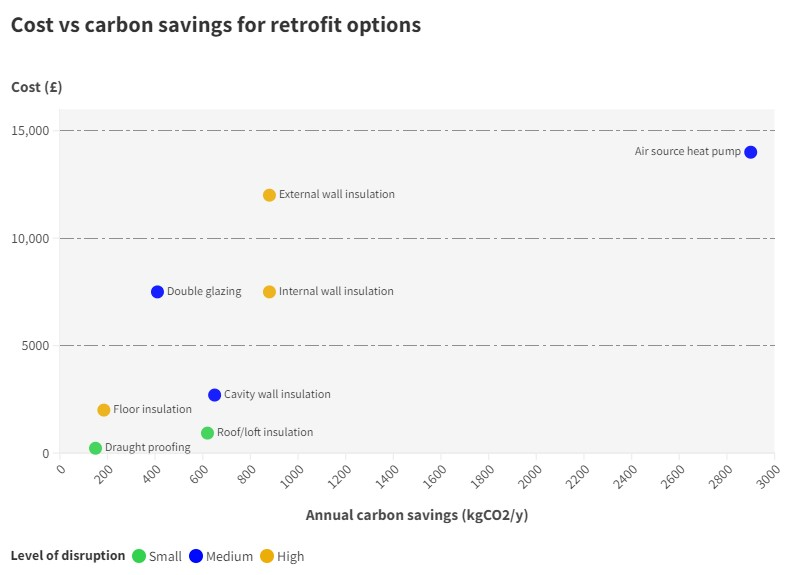
Figure 2: The cost and relative carbon savings from retrofit options in a semi-detached home. Cost and carbon savings from Energy Saving Trust, June 2023
Heat pumps in leaky buildings
As previously mentioned, the heat loss for a property is mainly independent of the heat source. A heat pump can heat any property as long as it has been sized correctly with an adequate heat distribution system. The viability of a heat source, such as a heat pump, is dependent upon how efficiently it can provide each unit of heat and the cost per kWh of the energy source. Despite the commonly touted requirement for heat pumps to be installed in properties with high levels of insulation, there are plenty of examples of properties that are not fully insulated running with COPs well above three. Heat pumps have also been used to heat larger, older non-residential properties such as those maintained by the National Trust. In cases such as Anglesey Abbey, the replacement of an oil boiler with a water-source heat pump and solar panels has led to significant energy savings of £7,000 per year. Although not a direct comparison with an air-source heat pump in an ordinary residential setting, examples like this show that older 'leaky' buildings are able to use heat pumps effectively.
2. What are the benefits and costs of insulation?
Fuel poverty
Increases in fuel prices due to the energy crisis have caused a surge in the number of households that could be considered to be in fuel poverty. Currently the Low Income Low Energy Efficiency (LILEE) metric is used to measure fuel poverty in England. It accounts for energy efficiency, household income and modelled energy costs, with households that reach a Fuel Poverty Energy Efficiency Rating (FPEER) of C considered not fuel poor.
The LILEE has identified 3.26 million households that are considered to be fuel poor. These households have an EPC rating below C and so should be targeted for retrofits. If households with an EPC of C or higher are included then the number of households living in fuel poverty would rise to between 7.5 million to 8.8 million. It is worth noting that the highest proportion of households in fuel poverty are those with solid uninsulated walls (22.8%). These households are the most difficult to bring to EPC C. Households with no solid wall insulation should be targeted for the easiest retrofit types, such as loft insulation and draft proofing, as some properties will be able to achieve a C rating in the absence of solid wall insulation. Although the total number of properties that could achieve an EPC of C is unclear, 49% of fuel poor households could reach band D with a single energy efficiency measure.
Figure 4 shows the proportion of households that live in fuel poverty for each energy efficiency band. When looking at the total population of households in fuel poverty, 78.4% of all fuel poor homes are in the D band. The remaining households in fuel poverty are split between 16.6% in band E and 5% in band F/G.
Impact on the electricity grid
One argument in favour of insulating homes is that it reduces pressure on the electricity grid. When most of the UK's housing stock has switched to heat pumps or other electric heating, this will significantly increase demand for electricity. Insulation can reduce pressure on the grid through two channels:
- reducing total electricity use (by reducing heat demand)
- allowing heat pumps to be used more flexibly.
There has been some research conducted by the National Grid to try and quantify the value of insulation to the electrical grid. The network value of energy-efficiency measures, such as thermal insulation can be £1,000 or more per home. This value varies highly based on location and larger-scale trials are required to provide more clarity. Installation of energy-efficiency measures in areas with severe network constraints realises approximately seven times more value than in areas with moderate constraints. Energy efficiency delivers five times more value in zones with chronic network constraints (five-years) than in regions with short-term (one-year) constraints.
Insulation is commonly proposed to be an enabler of flexibility from heat pumps and electric heating. However, it is important to note that its role in flexibility provision is still quite uncertain. As an enabler of flexibility, insulation would decrease the rate of heat loss from a property, thereby potentially allowing pre-heating (either to a higher temperature than usual or to a usual set point temperature) during low-demand periods when the carbon intensity of electricity is lower. This is typically motivated by price signals provided by dynamic or flexible tariff structures. Insulation enables the property to remain in a comfortable temperature for longer periods, thereby enabling the avoidance of 'peak' periods on the grid. In this case, insulation could help introduce a new revenue stream for consumers via being paid for their flexibility or utility savings from tariff structures, further reducing payback times on investment.
Alternatively, increased insulation could reduce a household's potential flexibility by reducing its total heating demand. A reduction in total demand could actually result in well-insulated homes having a smaller source of flexibility revenue if flexibility is valued per kWh shifted.
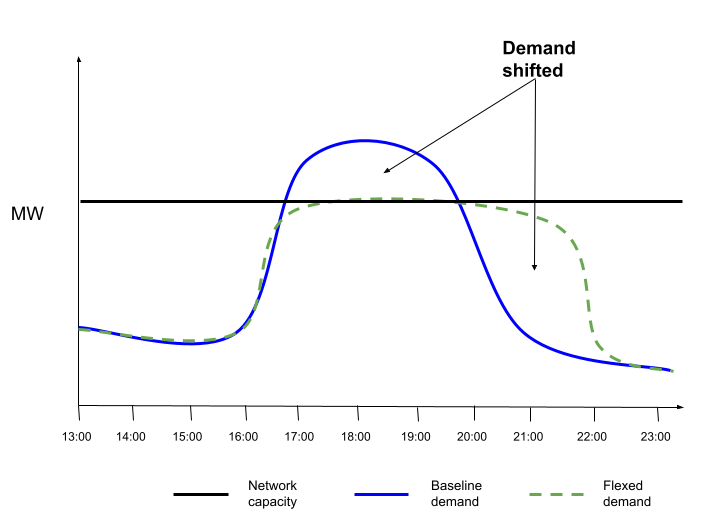
Figure 5: Illustration showing a profile where demand is shifted away from the typical evening peak period
These benefits could be significant at a UK-wide scale as domestic electrical consumption is projected to double by 2050. However, there are other ways to achieve similar impacts – including use of thermal storage (ie, storing heat at times where electricity is cheaper) or further upgrading the electricity grid. Despite the uncertainty around insulation enabling flexibility, its ability to reduce overall demand will always be of value as it can contribute towards deferring and reducing the magnitude of upgrades to the grid.
Wider benefits of insulation
Aside from carbon savings, insulation also has a number of wider benefits that are important to consider.
- Fuel poverty – analysis by UK Finance estimates that the health implications of fuel poverty cost the NHS £1.2 billion annually.
- Health – Citizens Advice argues that more than 650,000 cases of childhood asthma could be avoided by 2030 if children have warm or healthy homes. Half a million adults and children could avoid developing mental health conditions associated with living in a cold home. This would result in reduced numbers of days of missed school and work whilst reducing patient numbers for conditions made worse by a cold home by 30%. The NHS could save £2 billion by 2030 if all properties were insulated to EPC C.
- Economic and social boost for regions with the most inefficient housing – Citizens Advice estimates that this boost could be up to £39 billion by 2030. It estimates that there are 15 million inefficient homes, 13 million of which could be raised to EPC C by 2030. It argues that this would save consumers £24 billion in utilities between 2023-2030, a proportion of which would be spent in local economies to boost regional growth.
Rebound effects
Increasing levels of insulation may cause a rebound effect as homeowners that had been restricting their heating use are able to heat their homes more. As a result the rebound effect is often largest for the poorest households, but it is still observed in other households. Some studies have found that insulating the lofts and cavity walls of existing UK housing stock only reduces gas consumption for the first year or two, with all energy savings vanishing by the fourth year after a retrofit. This means that improving insulation may not provide savings in energy or carbon emissions to the level expected. However, in fuel poor homes, this is offset by significant benefits to health and productivity as a result of homes no longer being under-heated.
Our view is that, in fuel poor or vulnerable households, an increase in consumption due to any rebound effect is overall a good thing due to the social and financial benefits associated with increases to energy efficiency. In contrast, the rebound effect is more detrimental in households with a higher income where increased levels of insulation are less likely to decrease under-heating, and therefore do not have the same associated social and financial benefits.
In contrast, the installation of a low-carbon heat source such as a heat pump would have much greater carbon savings even in the case of a rebound effect. An average boiler in the UK will typically emit 2.2 tonnes of CO2 per year, whereas a heat pump's yearly emissions are dependent upon the carbon intensity of the grid. As the grid decarbonises the CO2 emissions savings from a heat pump will continue to increase and can already be close to zero for periods of the day in spring and autumn if homeowners possess solar panels.
3. Towards a pragmatic approach to insulation
How much would it cost to insulate all homes to EPC C?
Insulation is helpful in any home, regardless of its heating system, but wall and floor insulation can be very expensive and is therefore not always cost effective. Much of the remaining insulation on UK homes – including solid wall insulation and double or triple glazing – has a very high cost, and will produce only relatively modest energy bill savings. There are between 15 million and 16.7 million homes in the UK with an EPC rating of below C,,. There is also a wide range of estimates, from £43 billion to £271 billion, for the total costs associated with converting as many UK residential properties as possible to EPC C. This huge range of estimates can partly be explained by different approaches to the EPC C target. Many estimates assume that not all properties will actually be upgraded to EPC C – because the cost is prohibitive, because it's not technically feasible or for other reasons such as conservation areas. Some estimates consider the full cost of shifting every home to EPC C, including homes that would be hard to treat.
The following is a summary of the key estimates for the cost of reaching EPC C in all or most homes.
- Citizens Advice estimates that 13 million properties in the UK are considered to have significant potential to be upgraded to EPC C, with an average cost per household of £3,800. Converting all 13 million properties to EPC C by 2030 would have a total cost of approximately £58 billion.
- The CCC estimates that it would cost £67 billion to complete the energy efficiency upgrades required in the Balanced Net Zero Pathway target by 2050. This target shares the same ambition of achieving a minimum standard of EPC C, with 15 million properties receiving at least one major insulation measure (loft/wall/floor). In total this estimate predicts the deployment of 3.1 million cavity walls, 11 million lofts and 3.4 million solid walls. Alongside this, low-cost measures such as draft proofing could benefit a further eight million properties. The cost per household is estimated to be less than £10,000 with 63% of households spending less than £1,000. The total cost estimate was also lowered by excluding half of solid wall properties and all houses in conservation areas. It is worth noting that the number of recommended loft insulations is higher than the total number of uninsulated lofts detailed subsequently. This is because the CCC considers any property with less than 200mm loft insulation to be uninsulated or in need of a top-up, in comparison to the Household Energy Efficiency Statistical Release, which considers this to be anything less than 125mm.
- BEIS made a preliminary estimate in 2019 for the cost to be between £43 billion to £80 billion to get all properties to EPC C by 2035. The variation in this estimate is due to a balance between practicality, cost-effectiveness and affordability which affected the total number of homes that would receive insulation measures. The total number of homes that would receive treatment and upgrade to an EPC C rating is unclear, however, the ambition is similar to the CCC's estimate. The average cost per home is between £1,800-£3,400.
- The Energy Efficiency Infrastructure Group estimates that £89 billion would be required for an EPC rating of C across all properties by 2030. This total cost would equate to an average of £3,800 per property and is greater than the BEIS estimate partially due to a completion date of 2030 rather than 2035. As with BEIS's estimate, it is unclear exactly how many properties would receive treatment with this estimate.
- At a UK-wide level, the cost of insulating all UK homes to EPC C standard has been estimated at around £271 billion by UK Finance. This would represent an average of £16,000 per home that needs upgrading. Delivering that between 2025 and 2030 would cost around £46 billion per year from public and private sources. By comparison, spending £10,000 on a heat pump or other low-carbon heating in every UK home would require an investment of around £290 billion in total.
In our view, the projections from the CCC and Citizens Advice strike the best balance between the target date, total cost and number of homes increased to EPC C. The approach taken by Citizens Advice has the potential to retrofit 13 million homes to EPC C by 2030 at a cost of £58 billion. An emphasis is placed upon targeting properties that might be considered ‘easiest' as well as those that are considered to be in fuel poverty. If these measures were adopted it would theoretically leave two to three million properties being considered hard to treat, the majority of which need multiple energy efficiency measures or solid wall insulation.
How many homes are already insulated in the UK?
At the end of 2022 there were an estimated 29.4 million homes in the UK. The Household Energy Efficiency Statistical Release identified that from this total:
- 14.8 million properties had cavity wall insulation, accounting for 71% of properties with a cavity wall
- 17.0 million had adequate loft insulation, accounting for 67% of properties with a loft
- 805,000 had solid wall insulation, accounting for nine percent of properties with solid walls.
The remaining properties for each type of insulation can be separated into easy to treat and hard to treat.
- Cavity wall insulation – Of the approximate 5.1 million homes without cavity wall insulation, 3.8 million are easy to treat standard cavities and 1.3 million are hard to treat. It is also worth noting that around one million properties have an unclear level of cavity wall insulation. Some ‘easy to treat' standard cavities may be unsuitable for cavity wall insulation due to moisture risks caused by driving rain.
- Solid wall insulation – 7.7 million uninsulated solid wall properties. Solid wall insulation is more expensive and generally has a higher proportion of properties that are considered to be unsuitable/unfeasible for solid wall insulation retrofits.
- Loft insulation – 7.9 million uninsulated lofts. Approximately 5.7 million homes are considered easy to treat and 2.3 million are considered to be hard to treat or unfillable. Around 500,000 properties have an unclear level of loft insulation.
A pragmatic approach to insulation
The addition of extra insulation is a prime example of the law of diminishing returns. Simply put, the first millimetre of insulation added will provide the greatest reduction in heat loss, the addition of each subsequent millimetre saves much less, until there is very little benefit in adding any more. As a result, whilst the addition of extra insulation provides reduced running costs, beyond about 100mm the savings become marginal.
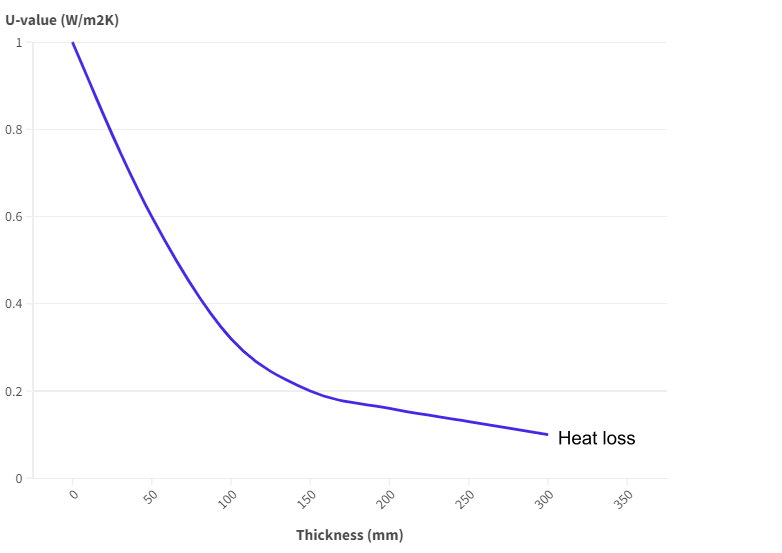
Figure 6: Illustrative example of the law of diminishing returns for insulation
When assessing a pragmatic approach to how much insulation is appropriate before adopting a heat pump, it is important to remember that each homeowner has different priorities when balancing comfort, capital costs, running costs and carbon reduction. Some insulation measures such as solid wall insulation and cavity wall insulation can incur prolonged disruption. Homeowners may wish to trade off slightly higher running costs to avoid disruption and upfront costs. It is of vital importance that a heat loss survey is carried out by a trusted source, such as an MCS certified installer. Homeowners may be surprised to find that their predicted utility bills with a heat pump are lower than expected.
Cheaper measures such as loft insulation and draft proofing could be carried out at the same time as a heat pump's installation, but without the need for more disruptive and expensive retrofit options such as solid wall or cavity wall insulation.
This approach is particularly useful for homeowners who are considering their options when their original heating system has broken. Homeowners making a distress purchase could install a heat pump and then add additional energy-efficiency measures at a later date, as their balance of aforementioned priorities dictates.
Regulating private rental properties
The highest proportion of households living in fuel poverty are private renters with 24.1% being in fuel poverty. The current Minimum Energy Efficiency Standards (MEES) have set a requirement for all privately rented homes, in England and Wales, to be at least EPC E. Proposals to increase the MEES to C have recently been cancelled. These proposals included a £10,000 cost cap which limited the average cost per property to £4,800. Approximately 64% of private rented properties in England and Wales are below an EPC C, totaling 2.26 million properties. Using these figures would indicate the total cost to raise the private rented sector to a minimum EPC C would be approximately £11 billion.
In Scotland, there are currently no minimum energy efficiency requirements for the private rented sector. Plans for an EPC E requirement that were meant to come into force in 2020 were cancelled by the Scottish Government, citing the Covid-19 pandemic as their reasoning. The Scottish Government is currently consulting on a minimum energy efficiency standard that private rented sector landlords would be required to meet from 2028.
The private rented sector faces a unique challenge when trying to improve energy efficiency. Tenants typically pay utility bills, but don't have any control over upgrades to the property or heating system. In cases where landlords incorporate utility bills into the rental price tenants have little incentive to moderate their usage. This relationship between landlords and tenants makes a strong case for the use of minimum energy efficiency standards in the private rented sector.
Our recommended approach to insulation
We propose a pragmatic approach to insulating homes in the UK alongside a heat pump rollout. In our view, the UK should insulate many more homes, but it is not cost effective to insulate every home to a high standard.
Our proposed approach is that:
- we should aim to improve 13 million homes to reach EPC C standard by 2030, with an estimated investment of around £60 billion
- properties with easy-to-treat cavity wall and loft insulation should be targeted before hard-to-treat properties
- greater emphasis should be placed on insulating properties in fuel poverty, and governments in the UK should aim to insulate fuel poor households and social housing to a high standard wherever possible
- there is a strong case for higher standards in private rental properties, and governments in the UK should regulate for minimum standards of insulation
- this insulation rollout should happen alongside a low-carbon heating rollout, and households should not be discouraged from buying a heat pump if their home has outstanding recommendations for insulation.
Endnotes
- OpenEnergyMonitor, an open source platform that people use to monitor the efficiency of their heat pump, often shows heat pumps achieving COPs well above four.
- Chris Williamson (Nesta), Heat pumps are great. Let's make them even better, October 2022.
- The January to March 2024 Ofgem Price Cap implies an average electricity-to-gas price ratio of 3.85.
- HM Government, Heat and buildings strategy, November 2021.
- Nesta, How the energy crisis affects the case for heat pumps, October 2022.
- Nesta, How to reduce the cost of heat pumps, February 2022.
- Heat pumps normally cycle (turn 'on' and 'off') two to three times an hour. This is normal. Over cycling is when this process happens too regularly and causes a drop in efficiency.
- International Energy Agency, The Future of Heat Pumps, December 2022.
- In the Climate Change Committee's Sixth Carbon Budget, the Balanced Pathway shows Residential Energy Efficiency contributing 5.5 MtCO2e reductions in carbon emissions, out of a total of 70 MtCO2e reductions required from residential buildings (making eight percent of the total). The Balanced Pathway shows that building-scale low-carbon heat reduces emissions by 55 MtCO2e (74% of the total), and low-carbon heat networks reduce emissions by 10 MtCO2e (13% of the total).
- OpenEnergyMonitor, an open source platform that people use to monitor the efficiency of their heat pump, often shows heat pumps achieving COPs well above four with varying levels of insulation.
- National Trust, Our work to combat climate change at Anglesey Abbey.
- Department for Energy Security & Net Zero, Annual Fuel Poverty Statistics in England, 2023 (2022 data)
- National Grid, Realising the value of domestic energy efficiency in GB electricity distribution, June 2021.
- UK Finance, Net Zero Homes: Time for a Reset, November 2022.
- Citizens Advice, Home advantage: Unlocking the benefits of energy efficiency, June 2023.
- Citizens Advice, Home advantage: Unlocking the benefits of energy efficiency, June 2023.
- University of Cambridge, Assessing the effectiveness of energy efficiency measures in the residential sector gas consumption through dynamic treatment effects: Evidence from England and Wales, January 2023.
- Nesta, A gas boiler emits more annual CO2 than seven transatlantic flights, February 2022.
- Citizens Advice, Home advantage: Unlocking the benefits of energy efficiency, June 2023.
- UK Finance, Net Zero Homes: Time for a Reset, November 2022.
- Climate Change Committee, Written evidence from the Climate Change Committee, November 2020.
- All estimates for total costs to get to EPC C adjusted to account for inflation since publication date.
- Citizens Advice, Insulation Nation, September 2022.
- Citizens Advice, Home advantage: Unlocking the benefits of energy efficiency, June 2023.
- Climate Change Committee, The Sixth Carbon Budget: The UK's path to Net Zero, December 2020.
- Department for Energy Security & Net Zero, Household Energy Efficiency Statistical Release, December 2022.
- Energy Efficiency Infrastructure Group, Turning stimulus into recovery: From the Green Homes Grant towards a resilient Net Zero economy, September 2020.
- UK Finance, Net Zero Homes: Time for a Reset, November 2022.
- Department for Energy Security & Net Zero, Household Energy Efficiency Statistical Release, December 2022.
- Department for Business, Energy & Industrial Strategy, Improving the Energy Performance of Privately Rented Homes in England and Wales, September 2020.
- Department for Levelling Up, Housing and Communities, Live tables on Energy Performance of Buildings Certificates, July 2023.