
About Nesta
We are Nesta, the UK's innovation agency for social good. We design, test and scale solutions to society's biggest problems. Our three missions are to give every child a fair start, help people live healthy lives and create a sustainable future where the economy works for both people and the planet.
For over 20 years, we have worked to support, encourage and inspire innovation. We work in three roles: as an innovation partner working with frontline organisations to design and test new solutions, as a venture builder supporting new and early stage businesses and as a system shaper creating the conditions for innovation. Harnessing the rigour of science and the creativity of design, we work relentlessly to change millions of lives for the better.
Find out more at nesta.org.uk
If you'd like this publication in an alternative format such as Braille or large print please contact us at [email protected]
About IMS Heatpumps
Emma Bohan is the Managing Director of IMS Heat Pumps. Established in 1997, IMS are one of the UK's leading installers of Ground Source Heat Pumps and Air Source Heat Pumps, operating from offices Sheffield, England and Perth, Scotland. With in-house teams providing excellent designs, installed by highly skilled and knowledgeable engineers, they ensure that the systems they install provide you with all the heating and hot water that you need.
Emma has been leading IMS since 2019, working with people who have been involved in the heat pump business since she first met a heat pump in 2002. IMS are MCS Accredited, Heat Geek Certified and Which? Trusted Trader Approved. Emma sits on the CIBSE Heat Pump Working Group, the MCS Installer Forum and Heat Pump Working Group, and is Vice-Chair of the Ground Source Heat Pump Association.
Find out more at www.imsheatpumps.co.uk or send an email to [email protected]
About BetaTeach
Nathan Gambling is the owner and creator of BetaTeach and the podcast BetaTalk. He grew up around family members involved in the development of combustion technology and the installation of vapour compression heat pump systems around Europe.
As well as holding industry qualifications, assessor qualifications and a PGCE, Nathan has a degree in behavioural studies. BetaTeach exists to activate people as learning resources for one another and to nudge people towards self directed learning.
Nathan uses different forms of media and communication to promote learning and the good practice needed to accelerate mainstream adoption of energy transition technologies.
He will soon be embarking on a new media adventure to help disseminate quality information.
Authors
Shaan Jindal (Nesta)
Oliver Zanetti (Nesta)
Emma Bohan (IMS Heat Pumps)
Nathan Gambling (BetaTeach)
Benoit Siberdt (Nesta)
Elysia Lucas (Nesta)
Oli Berry (Nesta)
Published 24/06/2024
Acknowledgements
The authors would like to thank all participants who completed the survey. Their responses will be invaluable in helping us, and others, understand the issues that heat pump engineers across the UK face, and how they can be better supported in their work. We hope this work will inspire tangible solutions to the issues identified through this survey.
We also would like to thank all organisations and companies that donated prizes for the survey prize draw, all of which were instrumental in encouraging heating engineers to take time out of their busy days to complete our survey. We would like to thank the donors of our top prizes: Sunamp and Trianco for donating an Activair Plus heat pump package containing a Trianco Activair heat pump and Sunamp Thermino heat battery; and Wolseley for donating a Vaillant aroTHERM 5kW heat pump.
We'd like to thank all other prize donors for their generous contributions: Altecnic, The Boiler Shop, Build Test Solutions, Carno, Condensate Pro, Danfoss, EcoForest | Nuenta, Econic, Freedom Heat Pumps, Furbnow, Go Geothermal, Grant UK, Ground Source Heat Pumps Ltd, Groupe Atlantic, Ground Source Heat Pump Association, Grundfos, h2x Engineering, Heat Engineer, Heat Pump Association, Heat Pump Federation, Hydratech, Intatec, Jaga, Jouln, Kensa Heat Pumps, M-Press Fittings, NIBE, Panasonic, Renbee, Sentinel, Stiebel Eltron, ThoroughFlush, Ultimate Renewables, Vaillant, Veritherm, Viessmann and Worcester Bosch.
Finally, we would like to thank BetaTeach students Hannah Barrow and Georgia Greenfield for their feedback on an early draft of the report.
Key findings
Barriers to increasing installations
Engineers want to install more heat pumps, but face barriers in doing so.
Eighty-seven percent of respondents reported that they wanted to increase the number of heat pumps they install each year, but reported barriers to doing this. Only 16% of sole traders and 43% of companies with one to five employees reported that they mostly or only install heat pump systems, suggesting that a large proportion may be able to replace much of their existing work with heat pump installations, if barriers to doing so are addressed.
Respondents reported that their largest challenge with increasing heat pump installations was either:
- the time spent on unnecessary tasks or administration (19%)
- an inability to find additional suitable staff (30%)
- a lack of customer demand (41%).
Heat pump installation administration
Administrative tasks are a larger barrier to engineers than tasks relating to the physical installation of a heat pump.
A smaller proportion of respondents reported spending the right amount of time on administrative work activities (such as post-installation paperwork (32%), business management (41%) and business administration (41%)) compared to practical tasks (such as heat pump installation (77%), commissioning and handover (77%) and servicing and maintenance (85%)).
This suggests that administrative tasks may be a bigger barrier to increasing installations than elements of the job relating to physically installing the heat pump. Finding ways to make these tasks less time intensive, could allow engineers to increase the number of installations they complete.
A greater proportion of respondents reported wanting increased support from both digital tools and staff for post-installation paperwork (35%), business administration (34%), and business management (32%) than those that would prefer support from just one or the other. However, almost a third of respondents also reported that they don't need support from digital tools or staff for these tasks.
Although digital tools aren't the only solution to this problem, the results show they could play an important role. With 70% of respondents currently using digital tools to support their work often or always, engineers are clearly comfortable using digital tools to support their work. However, a much smaller proportion use them for post-installation paperwork tasks such as the Boiler Upgrade Scheme (BUS) grant application (25%), District Network Operator (DNO) registration (29%) or Microgeneration Certification Scheme (MCS) documentation (36%), compared to system design or other administrative tasks. This suggests improvements to tools in terms of user experience, scope or both may be needed to better support engineers, particularly with post-installation paperwork.
MCS umbrella schemes are providing companies with an alternative method to deliver MCS-certified installations.
The smallest companies may be using MCS umbrella schemes to certify their installations to avoid the barriers associated with becoming directly certified. Only 16% of sole traders and 42% of companies with one to five employees were MCS certified, compared to 87% of companies with six or more employees.
Conversely, only 16% of companies with six or more employees reported installing heat pumps through an MCS umbrella scheme, whilst 60% of sole traders and 54% of companies with one to five employees did so.
Eighty-two percent of participants reported that they didn't obtain MCS certification because there's too much paperwork, and 62% reported it was too expensive. These barriers are likely to have a greater impact on sole traders and companies with one to five employees.
This shows the importance of umbrella schemes in enabling a larger number of companies to enter the heat pump sector and in increasing the number of heat pump installations completed in the UK. Given these advantages, it may be beneficial for MCS to give greater recognition and support to such schemes.
Staffing
Employers prefer to hire more experienced staff, but there isn't a common most-wanted skill they're looking for.
Although there wasn't a common skill that was most-wanted across company owners, there was a common preference for hiring more experienced staff for their chosen skill. Sixty-four percent of company owners reported wanting to hire someone with over three years of experience. By contrast, only 2% of company owners favoured taking on a first job applicant.
A high demand for experienced staff may explain why many respondents identified difficulties with finding new staff as one of their top barriers to increasing installations. Pathways for more junior staff and recent graduates to enter and progress in the sector are crucial for ensuring engineers can develop their skills, growing the skilled workforce, and increasing the number of installations the sector can deliver.
Employers expect a much higher level of practical heat pump installation experience than apprenticeship graduates currently have.
Less than 10% of company owners said they were confident or very confident that those who've recently graduated from an apprenticeship scheme are trained to an appropriate level, with 61% having no or very little confidence in their training. Almost half of company owners believe the training that apprentices receive on general plumbing skills and heat pump installation skills is what needs to be most improved.
This clearly points to a need for a deeper focus on practical skills in the training that apprentices receive. This will likely require additional support to colleges, and to the companies with whom an apprentice does their workplace training.
Practical experience of installing heat pumps is viewed as an essential skill by employers.
Sixty-seven percent of company owners reported that they were unlikely or very unlikely to take on candidates with qualifications that don't include work-based learning, which are alternatives to the traditional apprenticeship route. The proportion of respondents who reported that they would be likely to take on such candidates increased with company size.
Practical skills are so important to employers that 34% reported that they wouldn't take on candidates who have qualifications without work-based learning even with other incentives or support schemes. Twenty-nine percent of respondents said that they'd be encouraged to take on such a person if the employee's salary was initially supported. This was the most popular incentive amongst respondents.
This suggests a need for non-apprenticeship courses to include a greater element of work-based learning experiences, or for the establishment of pathways to support those who obtain such qualifications with securing on-the-job training opportunities after graduating. Again, employers will likely require support to partake in such schemes, as will the companies delivering the training.
The smallest companies are reluctant to take on apprentices as they can't find appropriate candidates and the costs of doing so are too high.
Only 16% of sole traders and 31% of company owners with one to five employees currently employ an apprentice, compared to 70% of company owners with six or more employees.
This pattern may occur as the biggest barriers companies face with taking on apprentices are larger for companies with five or fewer employees.
The most common challenges faced by respondents who've taken on apprentices were:
- finding a suitable apprentice for the role (41%)
- a lack of nearby colleges delivery high quality training (31%)
- the financial costs to the business (23%).
The results suggest that providing financial support for companies that take on apprentices may allow a wider range of employers to do so. It's also clear that the quality of training needs to be improved, and teaching likely requires a greater focus on the practical elements. Although many respondents reported difficulties with finding a suitable apprentice for the role, this barrier may be a mix of multiple factors, including financial costs and quality of college training, and requires further research to better understand.
Customer demand
Many companies may already be able to meet an increase in customer demand.
Fifty-nine percent of company owners reported that they never or rarely decline heat pump installation work because they don't have the capacity to do so. This suggests that many may already have the resources to respond to an increase in customer demand for installations. An additional 25% of company owners reported declining viable heat pump installation work sometimes, which may imply that they could take on more if administrative burdens were reduced or if it was easier to hire extra staff.
Engineers believe potential customers don't proceed with installations as the costs are too high.
Forty-five percent of survey participants believe that customers don't progress with a heat pump installation after receiving a quote as the costs across quotes are too high. A further 27% believe customers received a cheaper quote from another installer.
This may mean a wider range of finance options, that go beyond the existing government grants, are needed to support homeowners with the upfront cost of installation. New finance schemes could be provided by government, private bodies, or both.
Over a third of engineers have declined work as they believe a heat pump wouldn't sufficiently heat a customer's home.
Thirty-seven percent of respondents reported declining work as they didn't believe a heat pump would heat a customer's home to a sufficient standard. This was the second most common reason for declining work after simply not wanting to work with the particular customer (38%).
Given studies suggest that heat pumps are suitable for almost all homes in the UK, it's important to understand why engineers believe certain homes aren't suitable for a heat pump, and whether it's being used as a reason for avoiding certain types of jobs or riskier installations. Without understanding and addressing this, engineers won't be supported to install heat pumps in the full range of homes that are suitable. Customers may also be dissuaded from further exploring the possibility of installing a heat pump with an alternative provider, depending on how the information is communicated to them. This could further reduce customer demand for other installation companies.
Introduction
About the report
This report is the result of a collaboration between Nesta's Sustainable Future Mission team and industry experts Emma Bohan, Manager of IMS Heat Pumps, and Nathan Gambling of BetaTeach and BetaTalk. Frustrated by what they perceived as a lack of installer voice in the discourse around heat decarbonisation, the two approached Nesta in spring 2023 with the idea of collaborating on a programme of research that was genuinely installer led. The aim was to uncover challenges and barriers that existing heat pump installers face to installing more heat pumps, and make recommendations that would lead to meaningful solutions to those challenges. Emma and Nathan would bring the industry expertise while Nesta would bring the research rigour. The research's focus on barriers and solutions aligned well with Nesta's approach to innovation, as well as the wider goals of the Sustainable Future Mission team's Heat Pump Installer Skills and Capacity area of focus, led by Oliver Zanetti, who also oversaw this project.
A survey approach was selected, and partners from across industry were involved in identifying the key themes the survey should cover, which Shaan Jindal from Nesta then designed and implemented. Emma and Nathan's extensive industry contacts were then mobilised to disseminate the survey to potential participants, and many of these contacts also generously donated prizes that encouraged participation in the survey. Analysts from Nesta's Sustainable Future Mission team analysed the quantitative data, extracted key findings, and identified the implications of those findings. The final report was written by Nesta colleagues, led by Shaan Jindal.
Rationale
In order for the UK Government to meet its legally binding net-zero targets, fossil fuel heating systems will need to be replaced with heat pumps and other low carbon heating systems in around 1.6 million homes each year by 2035. The UK Government has an interim target of installing 600,000 heat pumps every year by 2028. But with only 55,000 heat pumps installed in 2022, installation numbers need to grow quickly.
The UK Government and heating industry have identified that the heating sector currently doesn't have the capacity to deliver these installations at a fast enough rate to meet the UK Government's targets. To date, the focus for increasing the rate of installations has been to try to increase the number of trained heat pump engineers that are entering the workforce.
This is vital to meeting the UK Government's installation targets. The Heat Pump Association (HPA) has estimated that around 50,000 installers might be needed by 2030, while Nesta's previous research has suggested a slightly lower figure of 37,000. But the current workforce is currently a fraction of this size. Although the precise number of individuals working as heat pump installers in the UK is not known, there are currently around 1,500 installation companies certified through the MCS, many of which are sole traders, microbusinesses or small companies.
Although increasing the size of the workforce is a vital way of increasing the rate of heat pump installations in the UK, it's not the only way to do so. Another approach to increasing the rate of installations is to improve the system in which existing engineers and companies work. This could make the work of engineers more streamlined and efficient, and decrease the amount of time each installation takes to complete. This would also improve the sector for new entrants, and help them install a greater number of heat pumps than they otherwise could.
This report explores the barriers that heat pump engineers currently face in increasing the number of installations they do, and explores ways that these could be addressed.
Methodology
Sampling method
This survey sought the opinions of heat pump engineers currently working in the sector. It was openly accessible online between 4 October and 27 November 2023 and took approximately 20 to 30 minutes to complete. Respondents were able to save their progress and return to the survey at a later date, allowing it to be completed in multiple sessions.
Only those who responded to a question confirming that they currently worked with heat pumps were able to progress through the survey. Those who had never installed any heat pumps and stated they didn't intend to do so in the foreseeable future were not given access to the survey questions. The survey was widely advertised through IMS Heat Pumps, BetaTeach and Nesta's considerable list of industry partners, many of whom generously donated prizes to encourage participation. It was also shared widely on social media and reported on in trade press and media. This approach to surveying is called convenience sampling.
A convenience sampling approach was considered most suitable for this survey for two reasons. First, there is no formal definition of who is and who isn't recognised as a heat pump installer. Some engineers are affiliated with MCS through their work, some use umbrella schemes, some install heat pumps without MCS certification in domestic retrofits, and some install in new build homes where MCS is not needed. Some work wholly in domestic or commercial contexts, whilst others work in both.
Second, though the UK heat pump sector is known to be relatively small, its size is not accurately known. The MCS reports that there are currently 1,500 certified heat pump installation companies, many of which are sole traders, microbusinesses or small companies. By contrast, data from the HPA shows that in the years 2021 to 2023, around 11,000 individuals completed short courses that upskilled them for heat pump installation.
The uncertain contours of the heat pump sector present a challenge for surveying. Convenience sampling was used to allow all those who felt themselves qualified to participate in the survey to do so, with wide advertising of the survey undertaken to achieve a sample of installers large enough to produce meaningful findings.
The sample
In total 367 complete responses were received. After removing survey respondents who don't currently work with heat pumps, the final analytical sample included 345 installers. This analytical sample includes 13 partial responses from installers who completed the survey but didn't press submit, and those who didn't complete a final optional question.
We decided not to include any more of the 401 partial responses in our analysis. This was based on an investigation of these responses which showed no evidence that survey completion was affected by the age or occupation type (eg, whether they were a company owner, employee, or contractor) of the respondent. However, those who have worked in plumbing and heating, or with heat pumps, for a longer time were more likely to have completed the survey. This might occur as those who have been involved with an activity for a greater period of time may have more opinions on it, and therefore may be more interested in completing a survey where they can express these views.
Limitations
When interpreting the findings presented in this report it's important to acknowledge that the survey sample wasn't designed to be representative of the heat pump engineer population as a whole. This is because of the convenience sampling methodology discussed above, which doesn't try to match the spread of demographics of the survey sample with that of the general population of heat pump engineers. Moreover, it may be the case that the individuals who responded to our survey differ from those who did not respond to it. This means there is a possibility that responses to our survey may not reflect the wider views of the population.
It's also important to note that the survey was hosted online, and that there wasn't an option to complete the survey in a physical or offline format. This may have resulted in potential respondents who were less confident with certain technologies
not completing the survey. As a consequence, our sample may not capture engineers with low digital literacy.
To explore whether the individuals who responded to our survey were materially different from the wider population, the demographics of this survey sample were compared with the wider population as reported in similar studies. As illustrated at the beginning of Section 1, the demographic characteristics of our sample were similar to that of other studies of the sector, such as the UK Government's study of heating and cooling engineers. However, there's the possibility that this sample may differ on other unmeasured variables.
Interpreting the report
This report contains a large number of charts that illustrate the findings from the survey data. In all cases, the figures in these charts are displayed as percentages. It is important to note that while in many cases the results for the entire sample are displayed, in many others only the results for a particular cohort within that sample are shown. This is explained in the text and also in the caption beneath each chart. The total number of people in each cohort are noted in the caption. This is shown as "n = [number]".
This report uses heat pump company size as a way to explore variations in experience between different cohorts. For the most part, companies in the heat pump sector are very small. This means standard terminology such as sole traders, microbusinesses and small businesses risked concealing important specificity. When collecting data, the following groupings were used:
- sole trader
- company of 1-5 people
- company of 6-25 people
- company of 26-100 people
- company of 101 people or more.
When comparing responses between respondents of different company sizes in this report, the last three categories have been amalgamated into one that represents all businesses of six or more employees. This is due to the small number of responses in the final three categories. Because of this non-standard breakdown of company size, and to avoid confusion, each group is descriptively named as follows throughout the report:
- sole traders
- companies with one to five employees
- companies with six or more employees.
1. Who completed the survey?
This section outlines the demographic characteristics of our sample, and the contexts in which they work. This is to contextualise the results in this report.
What are the demographic characteristics of our sample?
As in studies of the UK's heating sector conducted by the UK Government and Vaillant, our respondents were almost entirely male (97%).
Respondents to our survey were younger than other studies have found the UK heating sector to be. The UK Government's study of heating and cooling engineers found that 63% of the workforce is aged 45 or older, whilst in our study, just 45% of respondents were aged over 45 (Figure 1). However, this may be a feature of the heat pump sector specifically. The same UK Government study found that engineers who installed heat pumps were younger than the rest of the sector, with only 49% of those engineers aged over 45 years. This closely matches our sample.
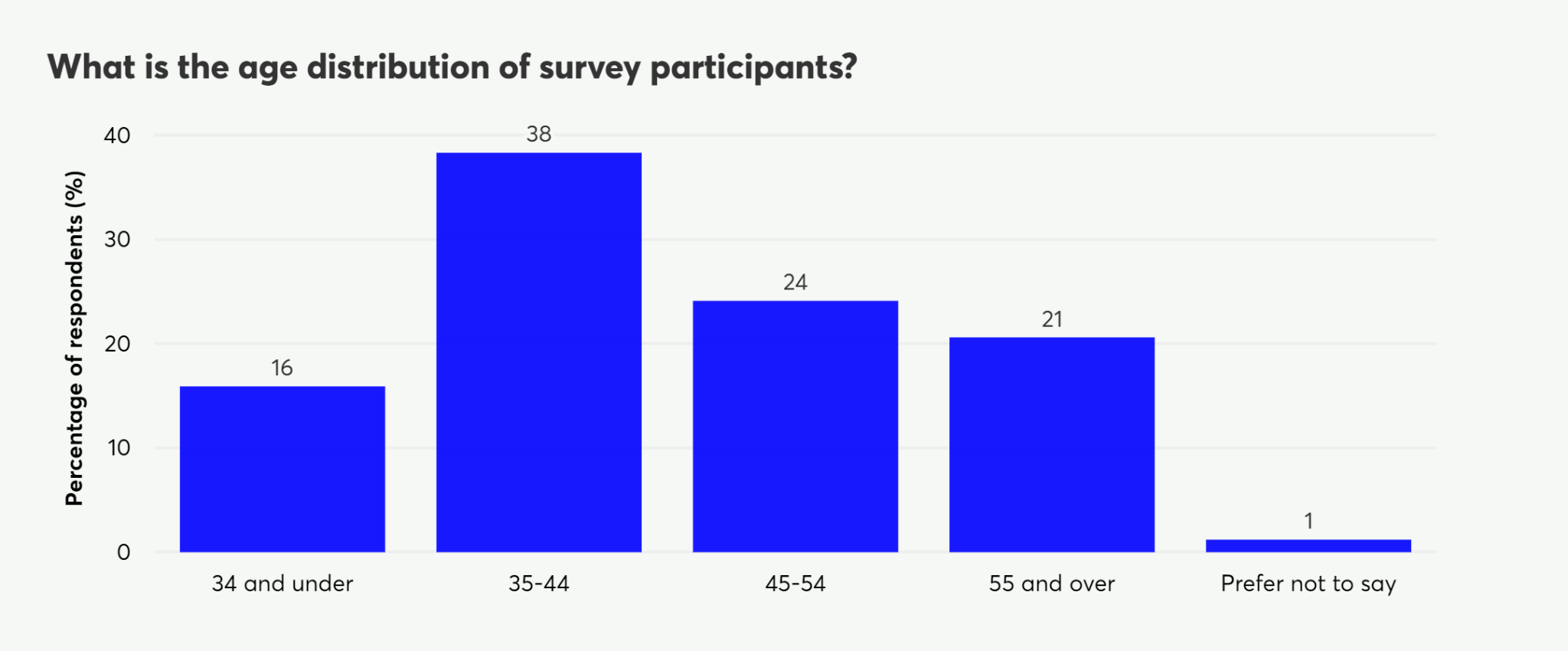
Figure 1: Distribution of survey participants' ages across age brackets (n = 345).
Our respondents predominantly worked for firms based in England, and one fifth (19%) of respondents worked for firms that operate across the UK (Figure 2).
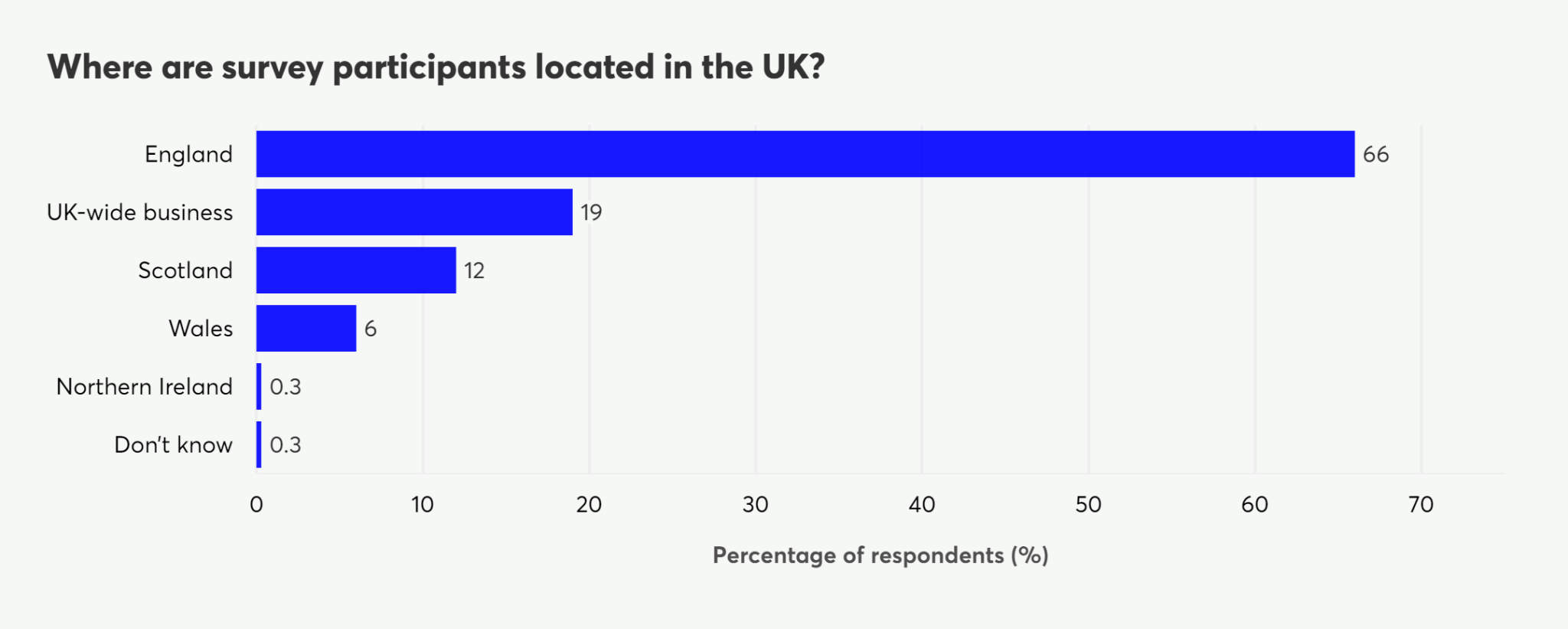
Figure 2: Distribution of survey participants (n = 345) working across UK locations.
What is our sample's role in the workforce?
Experience
Respondents to the survey generally had a lot of experience in the heating and plumbing sector. Almost half (48%) of respondents had been in the sector for over 20 years and more than three quarters (81%) for over a decade (Figure 3). This is very similar to findings from both the UK Government and Vaillant's surveys of the heating sector.
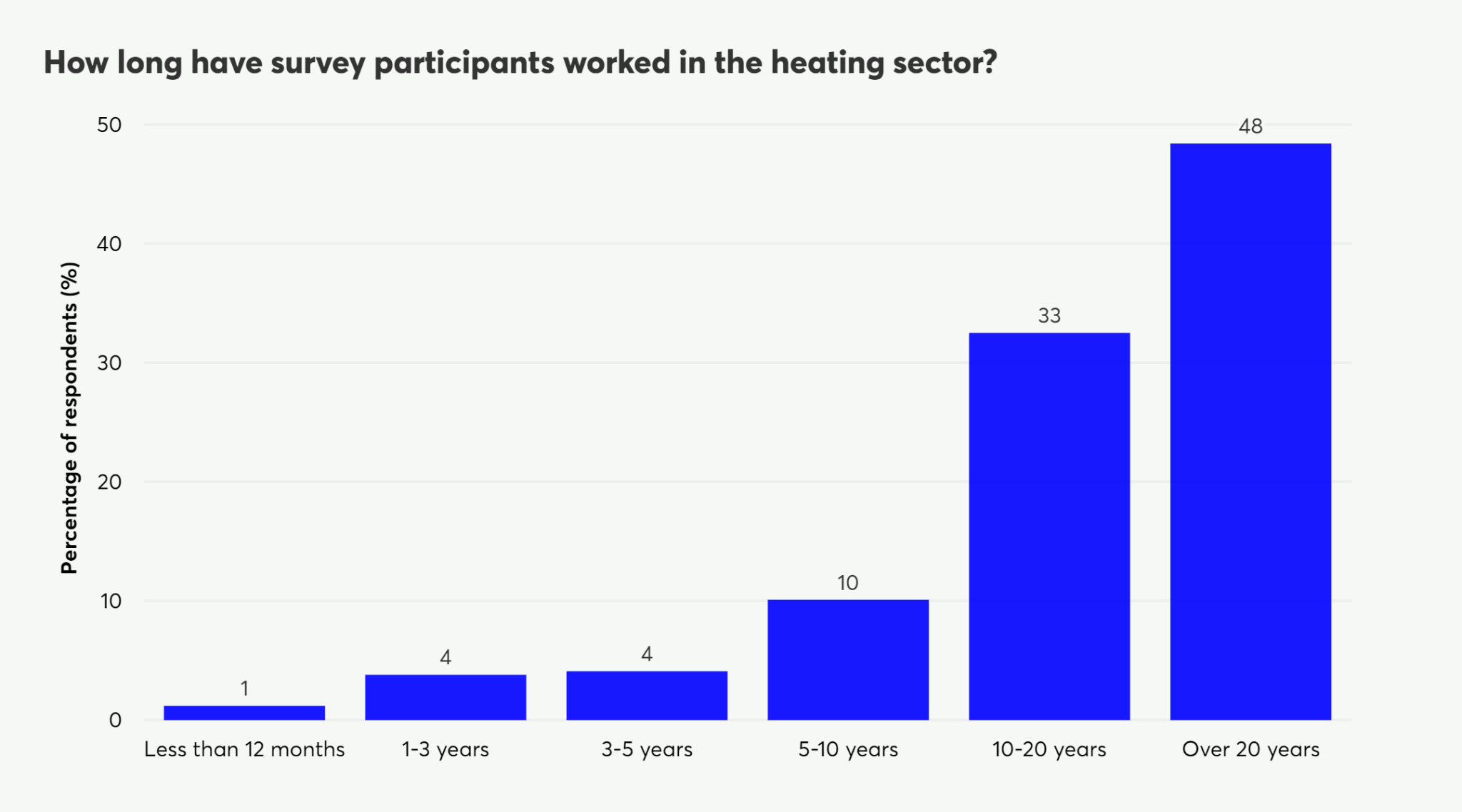
Figure 3: Distribution of survey participants (n = 345) across length of time working in the heating sector.
Respondents generally had less experience with heat pumps specifically. Whilst 81% of respondents had worked in the wider sector for over 10 years, only 32% had worked with heat pumps for this length of time. Similarly, 36% of respondents had worked specifically with heat pumps for three years or less, whilst only 5% had worked in the wider heating sector for this amount of time (Figure 4).
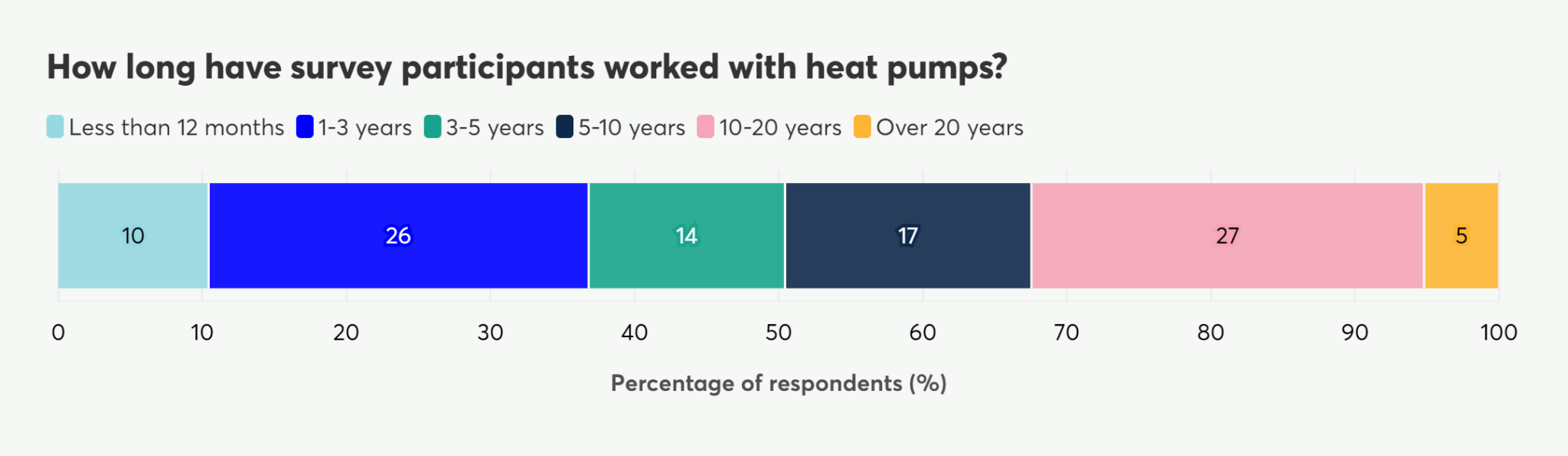
Figure 4: Distribution of survey participants (n = 345) across length of time working with heat pumps specifically.
Taken together, these two charts indicate that the vast majority of our sample began their careers working in other types of heating and transitioned to heat pumps during their career.
Employment characteristics
Fifty-eight percent of our respondents were owners of companies, 33% were employees and 9% were contractors or freelancers (n = 345).
About a fifth (19%) of company owners were sole traders and over half (54%) were owners of companies with one to five members of staff (Figure 5). The remainder owned companies with six or more members of staff, with the large majority of these owning companies with 6-25 employees.
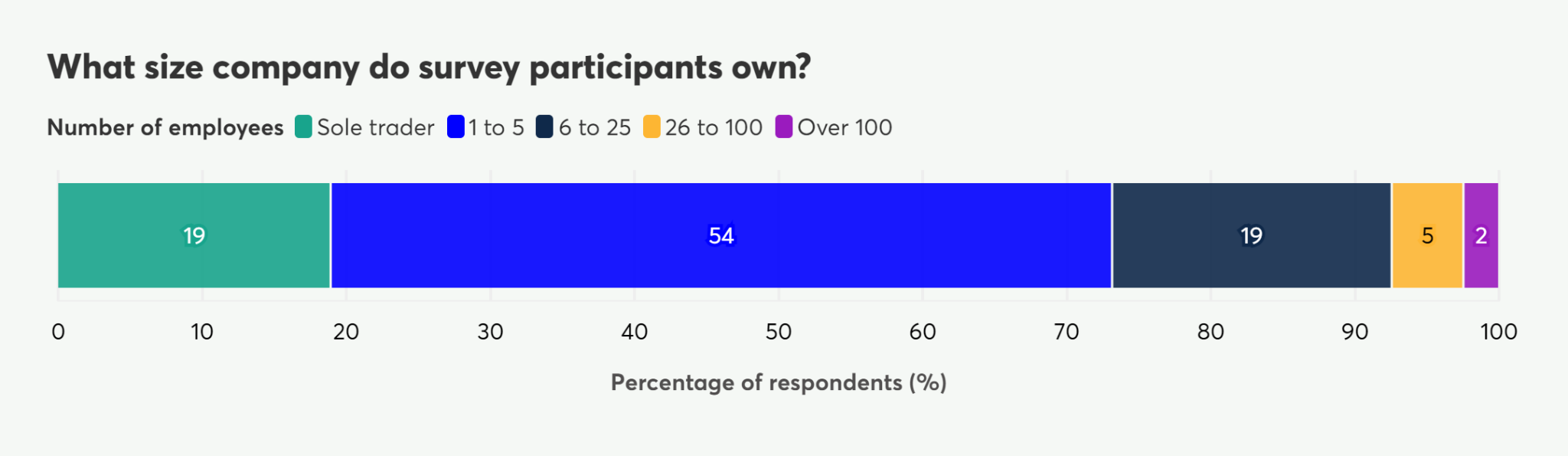
Figure 5: Proportions of respondents for each size bracket of the company owned (sole traders, n = 38; 1 to 5 employees, n = 109; 6 to 25 employees, n = 39; 26 to 100 employees, n = 10; over 100 employees, n = 5).
What type of heat pumps does our sample install, and in what contexts?
The vast majority of our sample mostly installed air source heat pumps, mostly worked in a domestic context and mostly conducted retrofit work.
Almost all respondents indicated that they install air-to-water heat pumps, though many also install other heating technologies alongside this (Figure 6). When asked about their most-installed type of heat pump, the vast majority of respondents (86%) reported that it was air-to-water heat pumps.
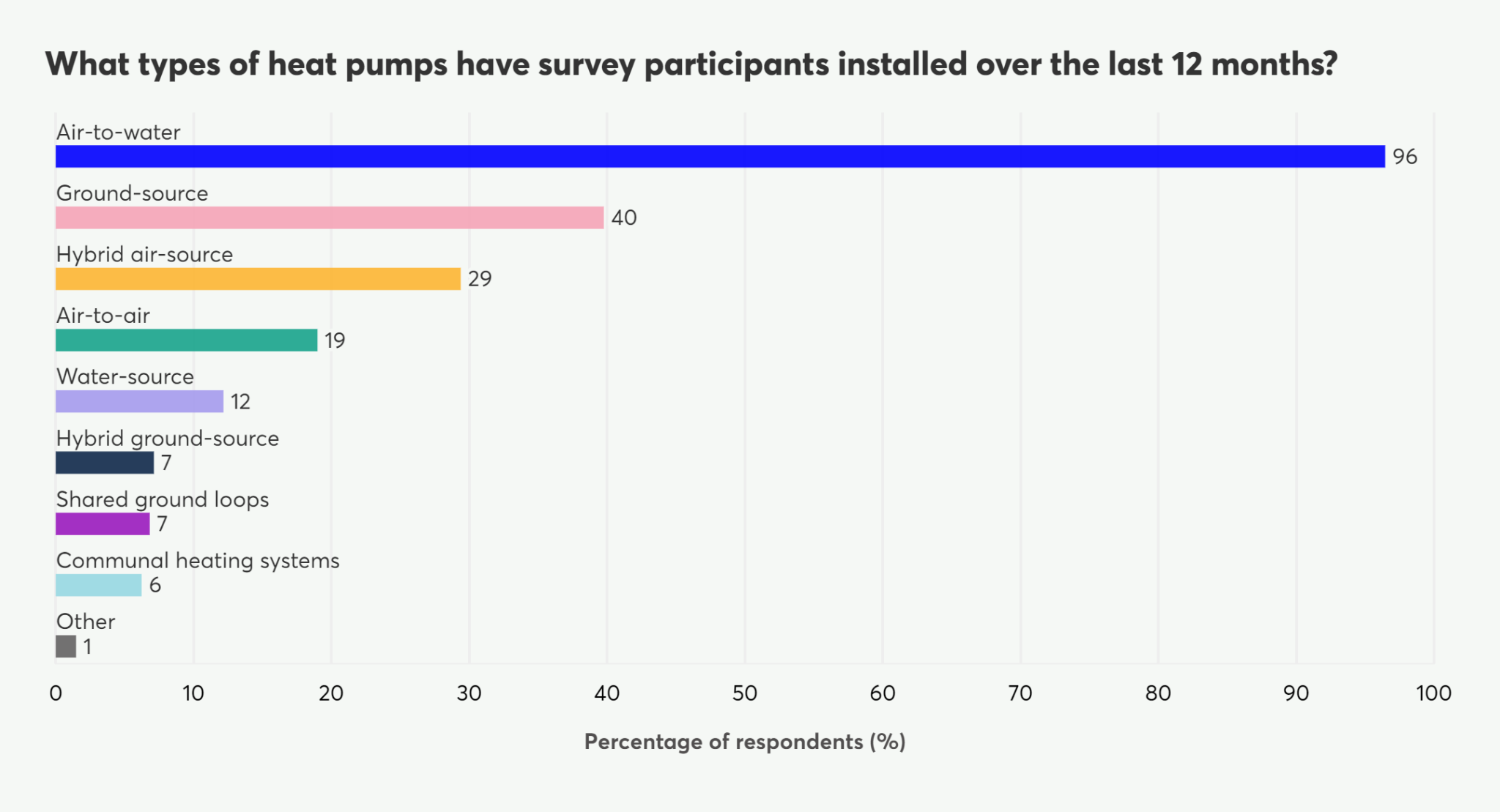
Figure 6: Types of heat pump systems that respondents (n = 337) have installed over the last 12 months. Respondents were able to select all options that applied to them. All survey participants were asked but values displayed exclude those who have not done any heat pump installations.
Almost all respondents worked entirely or mostly in the domestic sector (Figure 7).
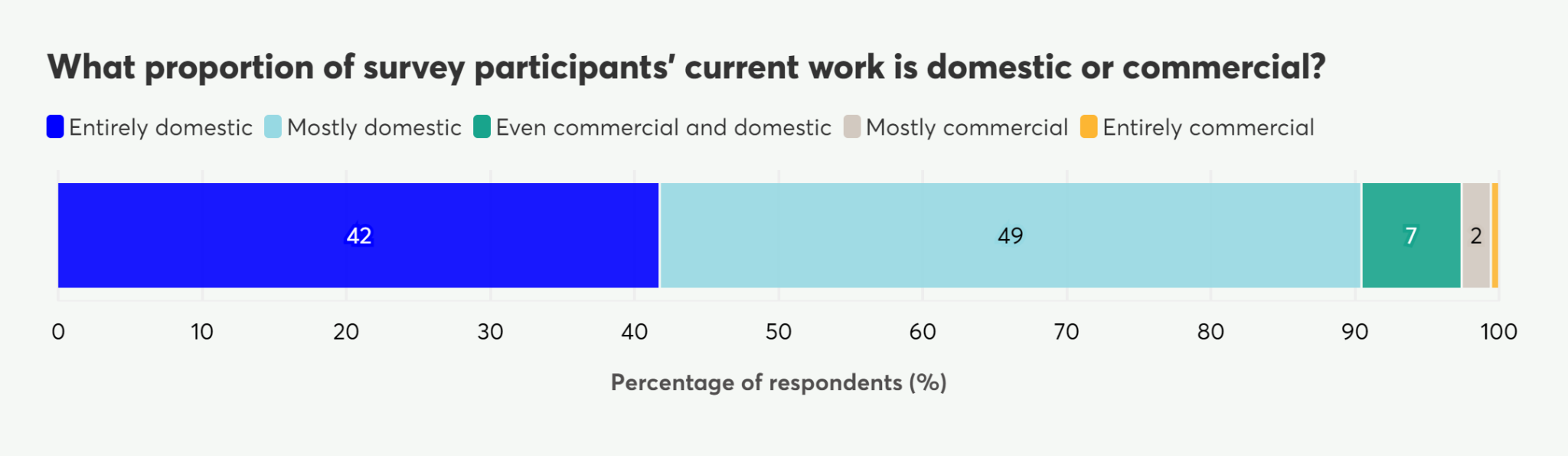
Figure 7: Proportion of survey participants that work in the domestic and/or commercial heating sector (n = 345).
The majority of survey respondents worked mostly or only in a retrofit context (Figure 8), though 59% reported working in both new build and retrofit properties.
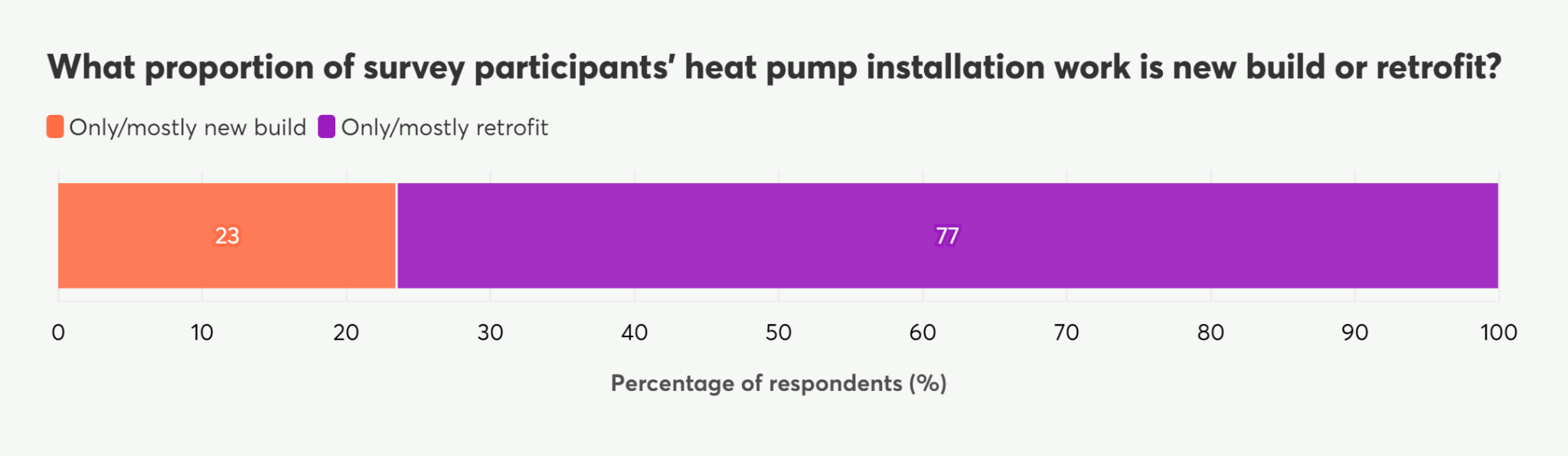
Figure 8: Proportion of respondents (n = 345) who have worked in only/mostly new build or retrofit heat pump installations over the last 12 months.
Almost all respondents who worked in a retrofit context reported that the majority of their retrofit work was in individual private homes (92%).
2. The barriers to increasing heat pump installations
This section explores the experience of heat pump engineers in their work installing heat pumps. It examines the current levels of productivity of heat pump installers, their aspirations for the future, and barriers they face to increasing productivity. The barriers outlined in this section will then be explored in further detail in the remaining sections of this report.
How does the number of heat pumps installed differ with company size?
Overall, the majority of company owners installed fewer than 10 heat pumps in the 12 months preceding their participation in the survey (Figure 9). However, there were differences across company size.
The proportion of respondents who installed a greater number of heat pumps increases with company size. Sole traders almost exclusively reported installing less than 10 heat pumps. While companies of one to five employees most frequently installed between one and nine, more than a third (38%) reported 10 or more in the past 12 months. Forty-one percent of the companies with six or more employees reported over 50 installations, with another cumulative 42% between 10 and 49.
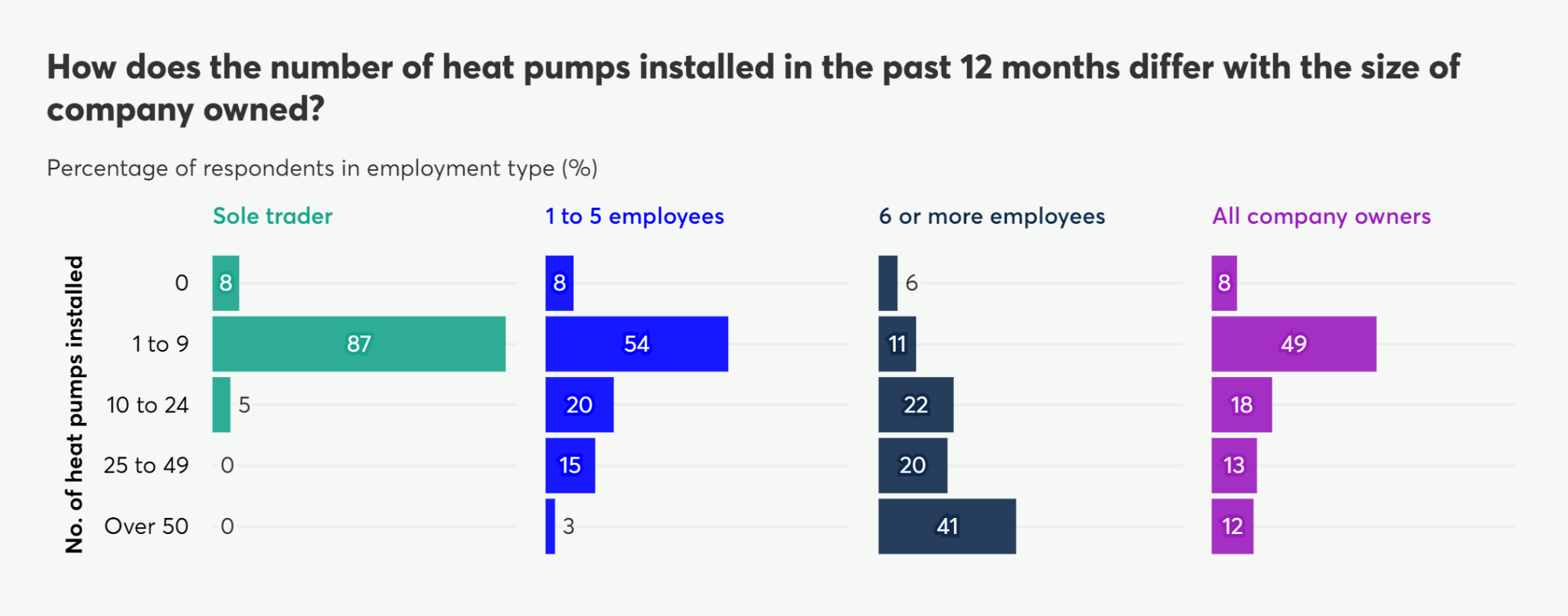
Figure 9: Distribution of number of heat pumps installed over the past 12 months across company owners (sole traders, n = 38; owners of companies with 1 to 5 employees, n = 109; owners of companies with more than 6 employees, n = 54).
Do heat pump engineers want to increase the number of installations they do?
The vast majority of survey respondents reported that they wanted to install more heat pumps, irrespective of whether they were company owners, employees or contractors, and irrespective of the size of the company they were a part of (Figure 10).
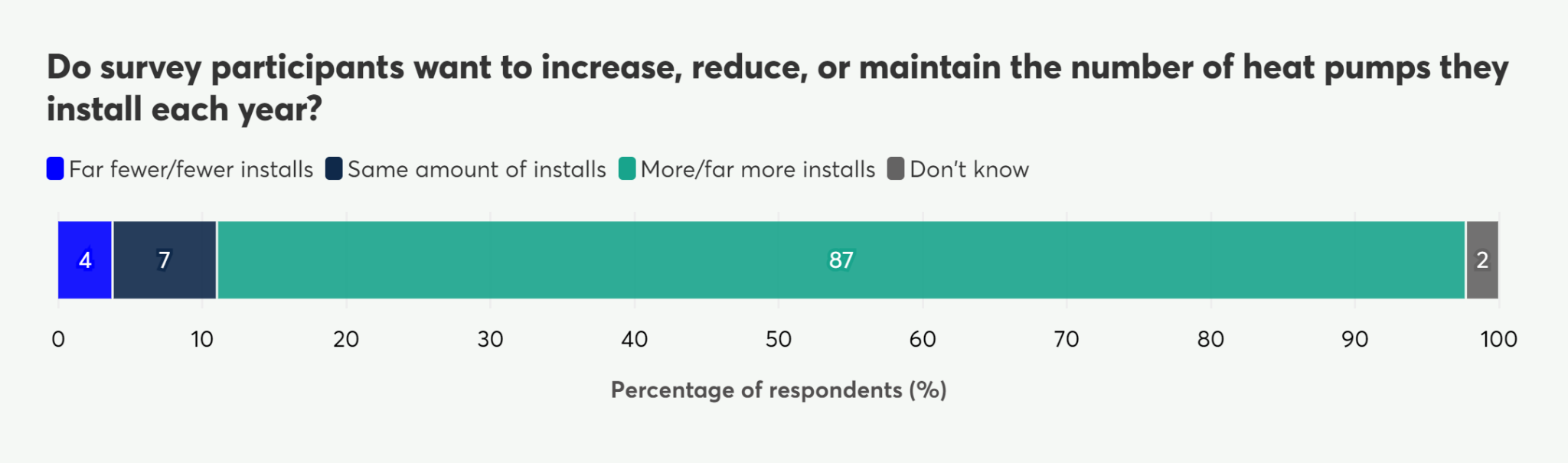
Figure 10: Proportion of respondents (n = 345) that want to increase, reduce, or maintain the number of heat pumps they or their business install each year.
The current composition of survey respondents' work suggests that installing more heat pumps may well be possible. Only 16% of sole traders, and less than half (43%) of owners of companies with one to five employees, report that their companies install mostly heat pump systems (Figure 11).
In principle, some companies may be able to install more heat pumps by substituting heat pump installations for other work. However, heating engineers face barriers to doing this.
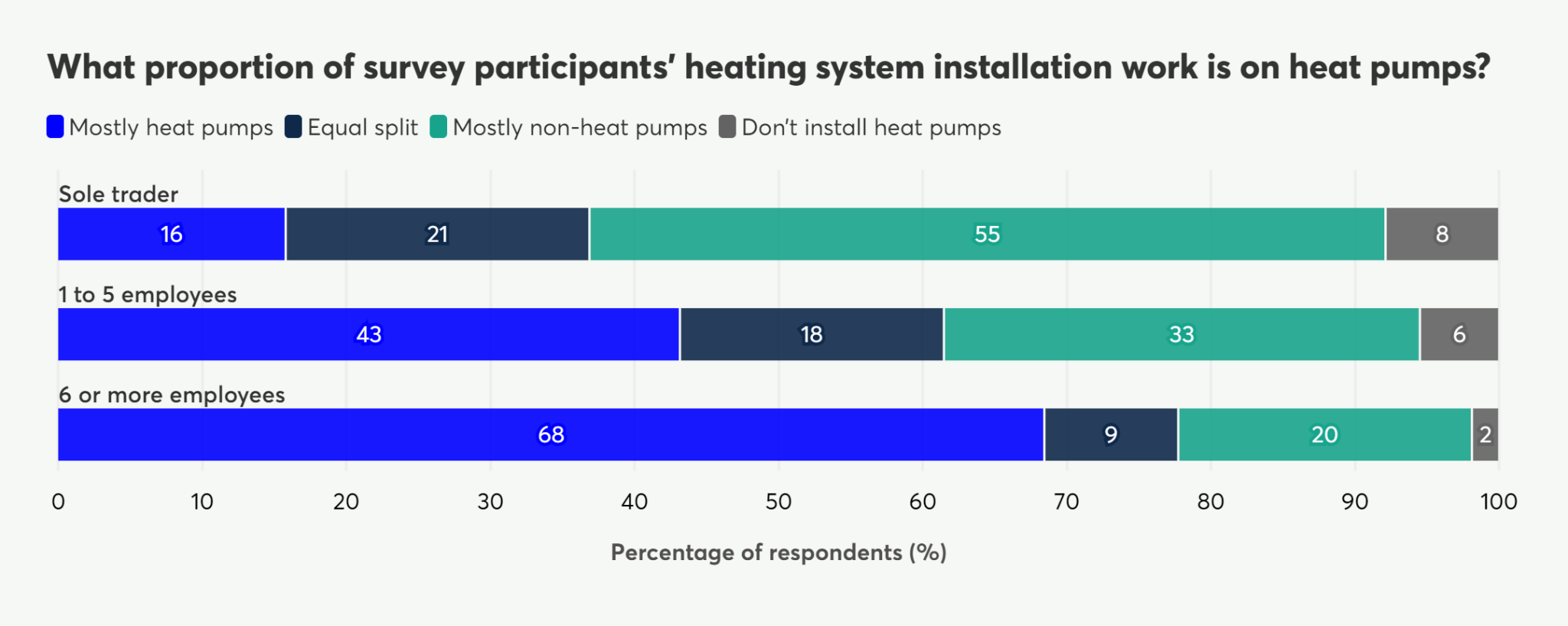
Figure 11: Distribution of number of heat pumps installed over the past 12 months across company owners (sole traders, n = 38; owners of companies with 1 to 5 employees, n = 109; owners of companies with more than 6 employees, n = 54).
What's preventing engineers from installing more heat pumps?
Company owners were presented with a range of potential challenges and asked to select the one they considered to be the biggest barrier to installing more heat pumps. They were also able to describe other barriers in a free text box (Figure 12).
Overall, company owners reported that their biggest barrier was little customer demand (41%). A third (30%) reported that it was finding suitable additional staff, and a fifth (19%) said it was the time taken on unnecessary tasks and administration. The order of importance of these challenges differed depending on company size.
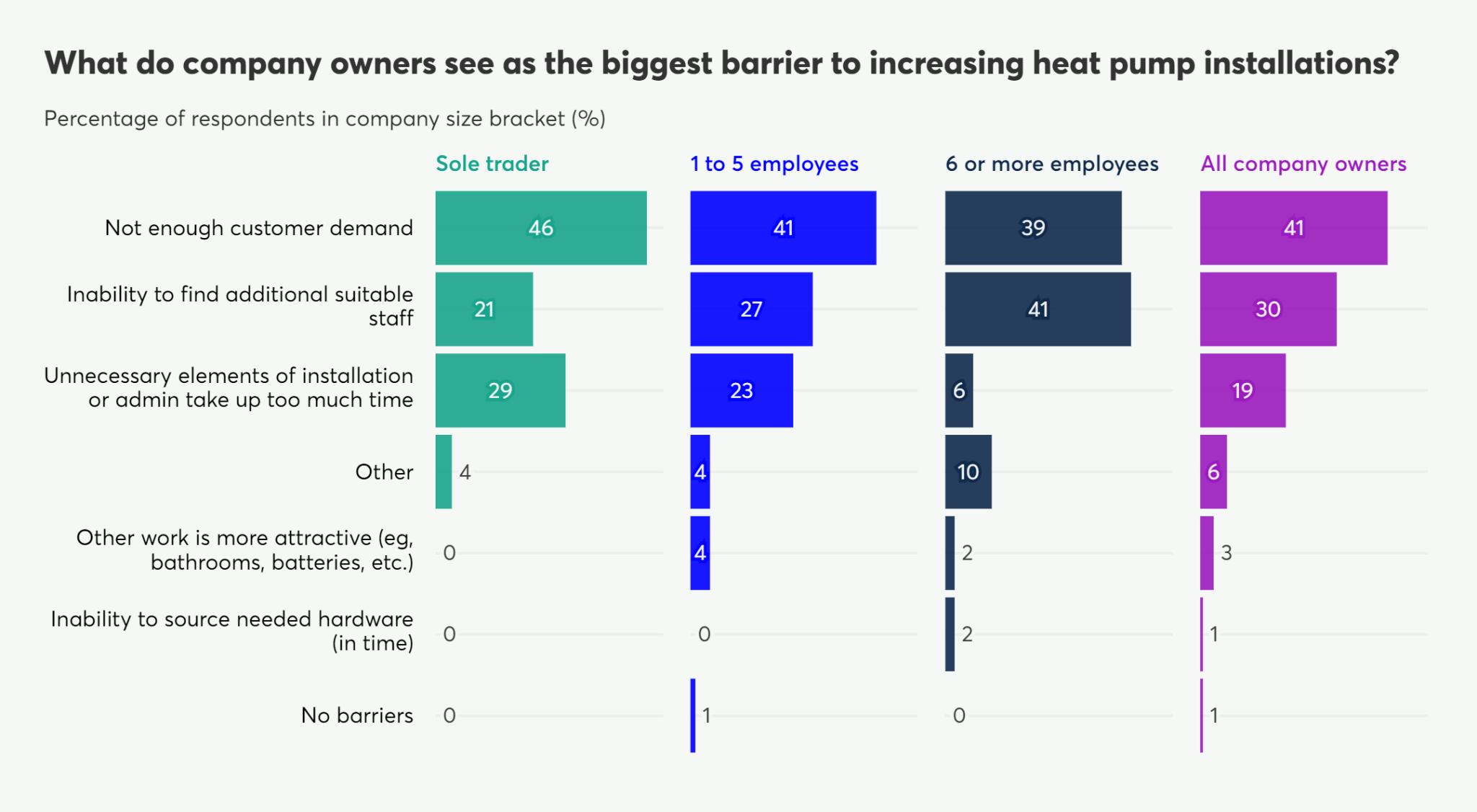
Figure 12: Main barriers to increasing the number of heat pumps installed, as selected by survey participants that are company owners (sole traders, n = 28; owners of companies with 1 to 5 employees, n = 93; owners of companies with more than 6 employees, n = 49).
We'll explore these three areas in the following three sections of this report, turning first to the challenges generated by unnecessary elements of installations or administration that take up too much time.
3. Administrative inefficiencies
As described in Section 2, inefficient processes relating to heat pump installation and administrative tasks were identified as one of the top barriers to increasing installations by respondents, particularly by sole traders and company owners with one to five employees. This section explores this in further detail, looking at the tasks respondents felt to be the most inefficient, potential solutions to these inefficiencies that come from digital tools, and the challenges heat pump firms face relating to MCS certification.
For which tasks and processes do installers most need support?
Respondents were asked about a range of work activities associated with heat pump installation. For each they were asked to assess whether they spent the right amount of time on it, whether they didn't spend as much time on it as they felt they should, or whether they spent too much time on it.
Addressing tasks that fall into the latter two categories has the biggest potential for increasing the productivity of heat pump engineers, and could enable them to install more heat pumps. Reducing the amount of time that installers spend on tasks that take too long could free up time to work on installing more heat pumps. Reducing the time taken to complete tasks that engineers don't have enough time to do will reduce the pressure on installers to do these tasks and allow them to fit them into the time they have available. It may also allow them to focus more on the quality of their work, and perhaps even allow them to complete more installations.
As shown in Figure 13, the option, “I spend the right amount of time on this" was least frequently selected for administrative tasks, such as post-installation paperwork, business management and business administration, suggesting that undertaking such tasks are a larger barrier to engineers than practical or physical heat pump installation tasks.
Over half of respondents (56%) reported that they take too long on post-installation paperwork and a third (33%) reported the same for business administration.
Conversely 39% of participants felt they weren't spending as much time as they should on business management.
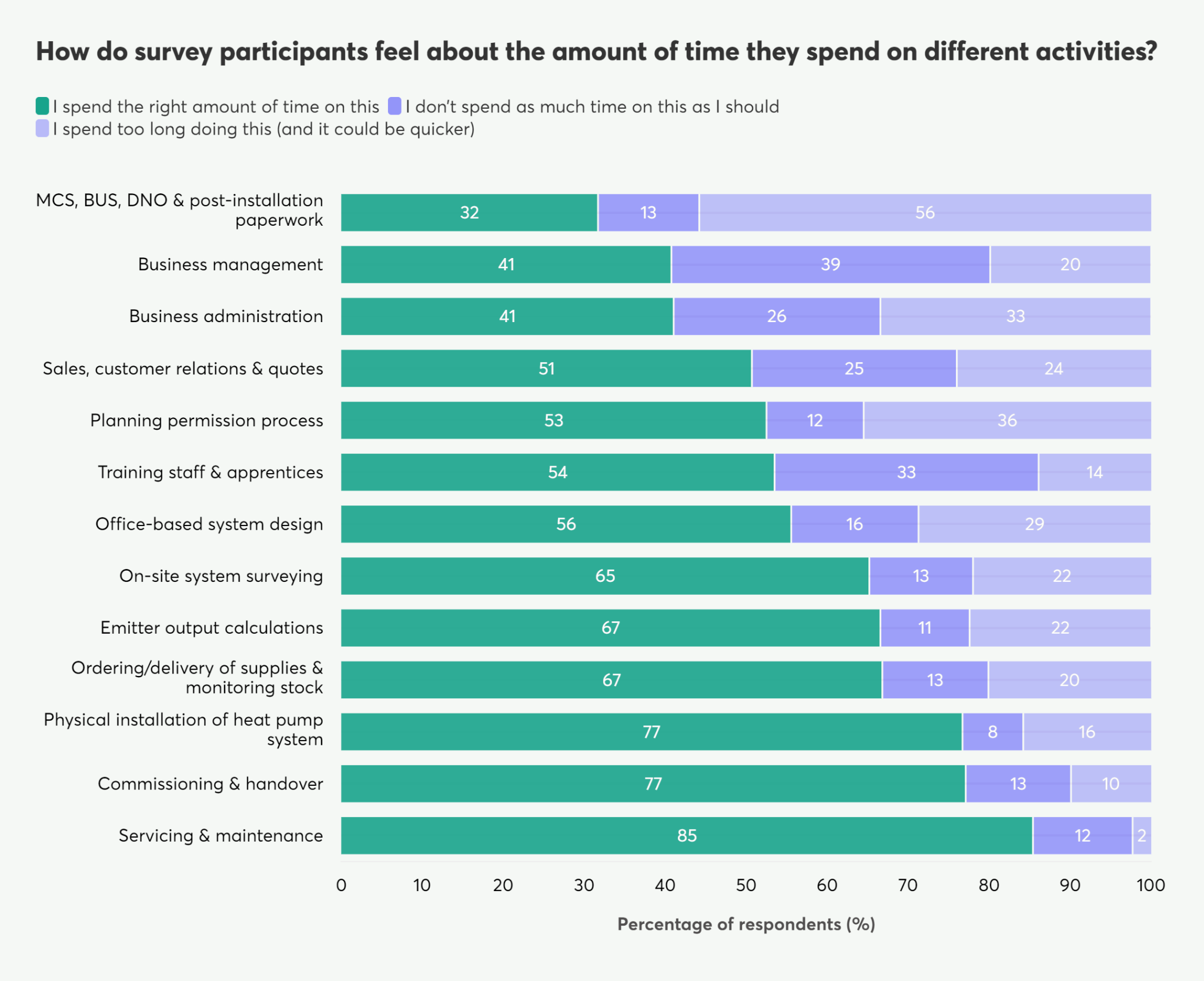
Figure 13: Amount of time spent on business activities by survey participants. Values displayed for each activity are the percentage of the number of respondents who did not select "This isn't part of my job". MCS is Microgeneration Certification Scheme, BUS is Boiler Upgrade Scheme and DNO is Distribution Network Operator.
To understand these challenges in finer detail, we broke down the three tasks for which the lowest proportion of respondents reported spending the right amount of time on by business size. This revealed that businesses of one to five employees appear to be the most stretched, as the smallest proportion of these respondents reported that they spend the right amount of time on any of these tasks. (Figure 14).
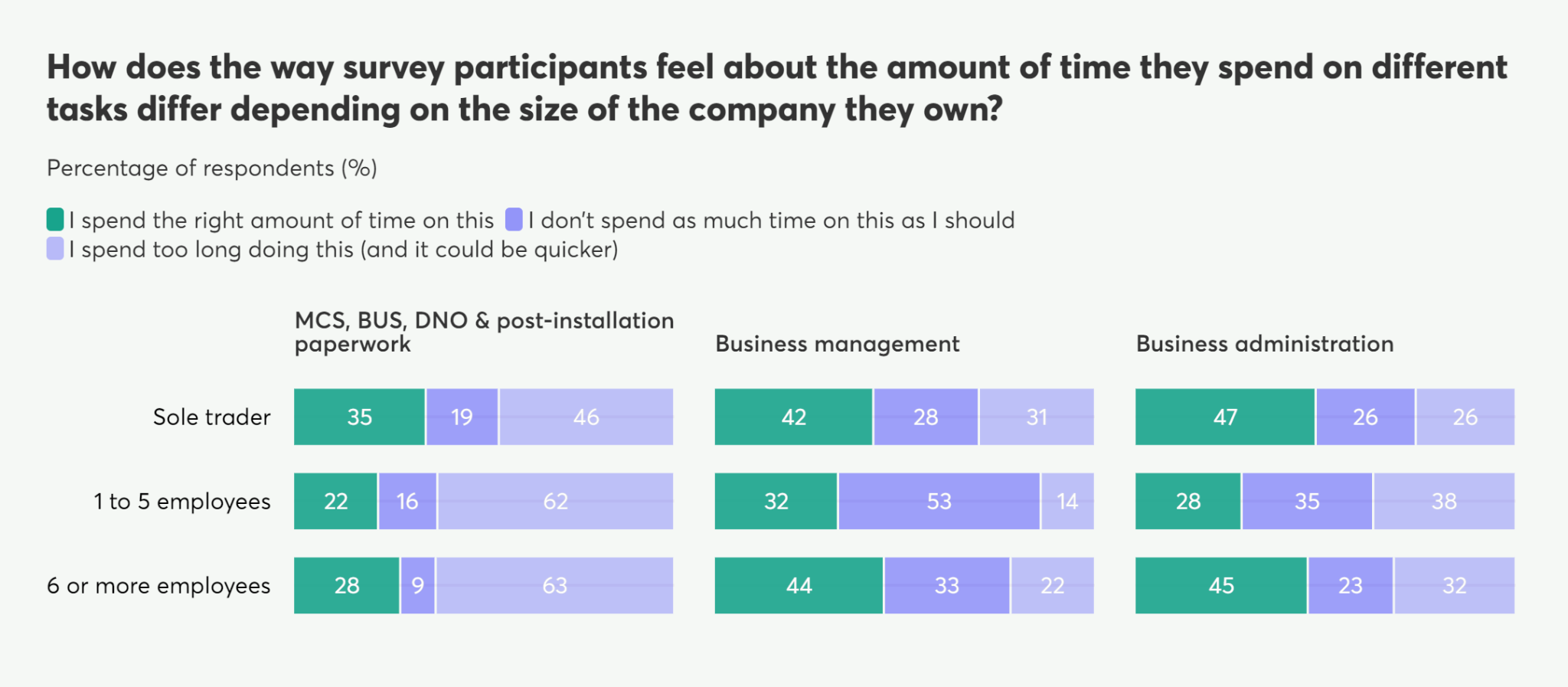
Figure 14: Amount of time spent on business activities by survey participants that are company owners. Values displayed for each activity are the percentage of the number of respondents who did not select "This isn't part of my job”. MCS is Microgeneration Certification Scheme, BUS is Boiler Upgrade Scheme and DNO is Distribution Network Operator.
Participants were asked what would support their business to undertake these tasks: more staff, digital tools, or both. Figure 15 suggests that support from both digital tools and staff is most desired, particularly by company owners with one to five employees and company owners with over six employees. The majority of sole traders would prefer support from only digital tools for post-installation paperwork and business administration, though the responses are more mixed for business management. A preference for staff support is lowest for post-installation paperwork across all three company sizes, suggesting digital tools might be particularly helpful for this activity. It's also important to note that across all three tasks, many respondents reported that they neither required support from digital tools nor staff. The preferences of employees and contractors, though not displayed on this chart, are similar to those of company owners.
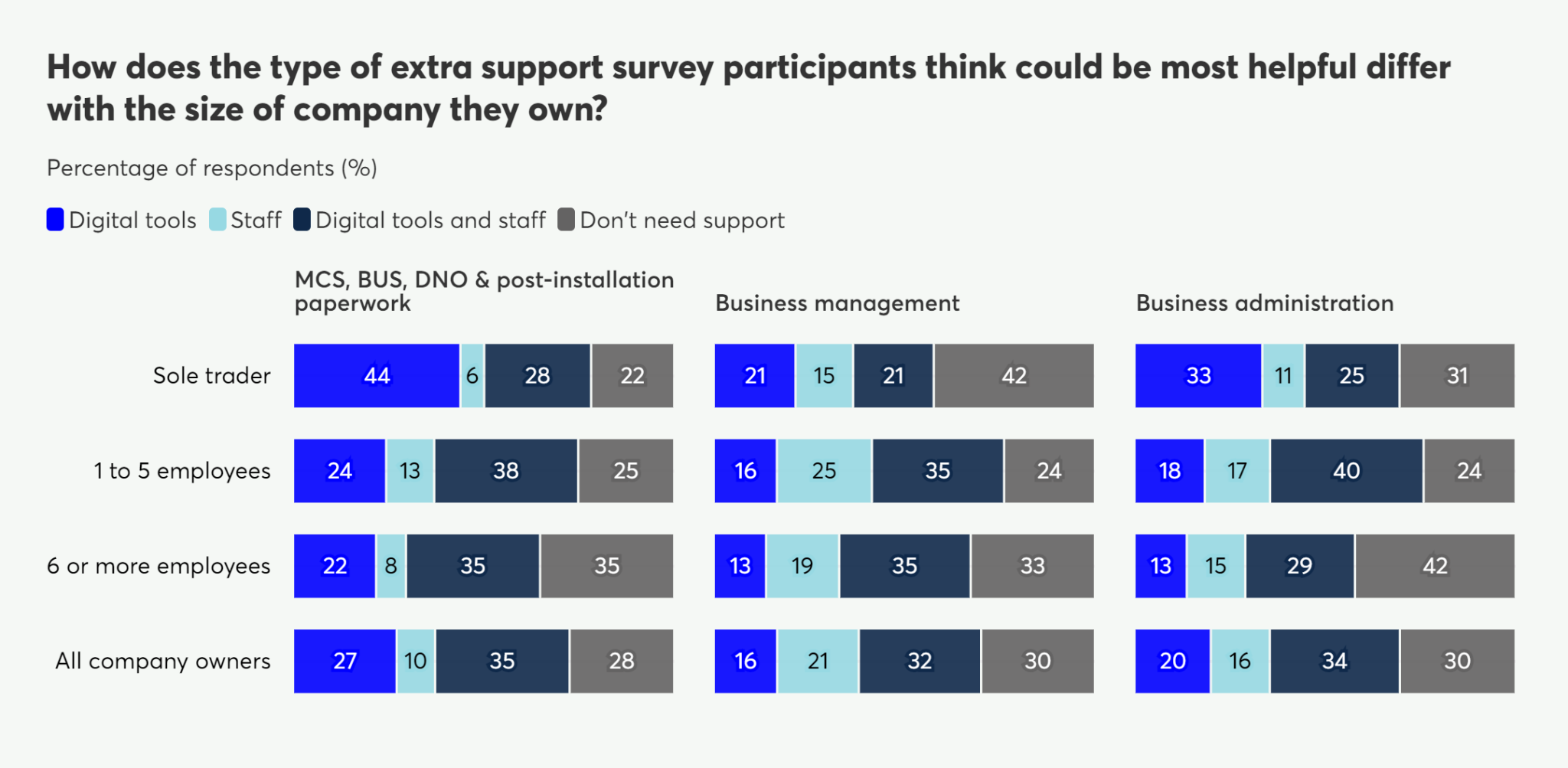
Figure 15: Type of support needed by company owner survey participants with business activities related to management, administration and post-installation paperwork. Values displayed for each activity are the percentage of the number of respondents who did not select "This isn't part of my job".
As noted in Section 2, all heat pump engineers want to increase the number of heat pump installations they do (Figure 10), but currently sole traders and company owners with one to five employees mostly install other heating systems (Figure 11). Supporting these businesses with ways of making heat-pump related business management, business administration and post-installation paperwork more time-efficient could allow them to increase the number of heat pump installations they're able to do. In the next subsection, we explore the role digital tools could play in doing this. We address taking on new staff in Section 4.
Figure 16 shows how digital tools are already frequently used by heat pump engineers. This suggests that engineers are already open to using digital tools as part of their work, and may simply need improved tools to help reduce the inefficiencies they face with their administrative work.
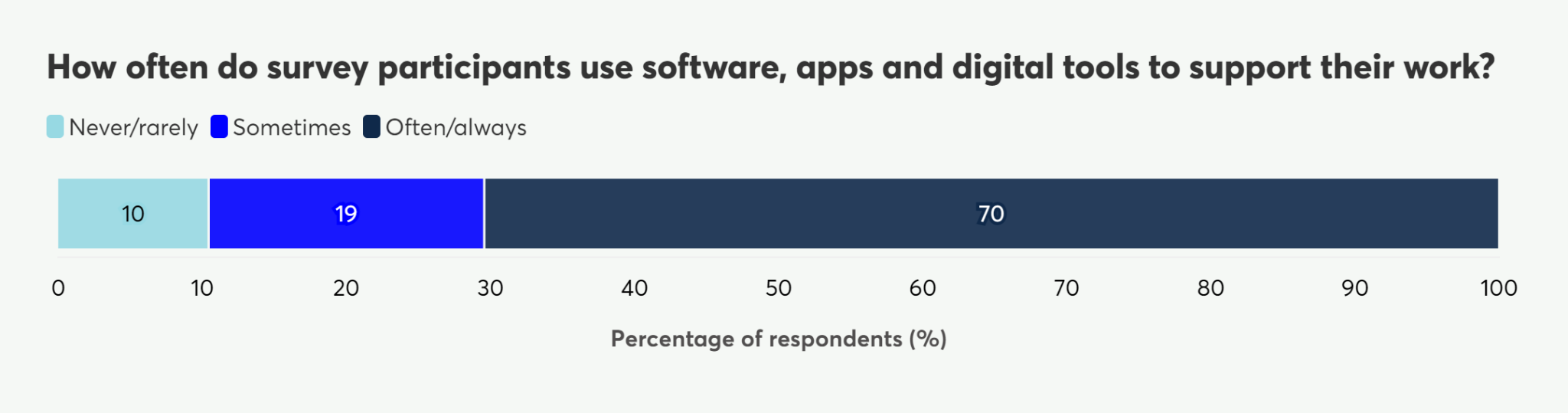
Figure 16: Digital tool usage patterns of survey participants (n = 345).
Figure 17 suggests that the areas of work that respondents least reported spending the right amount of time on – business management, business administration (yellow bars), and post-installation paperwork (purple bars) – are the areas in which a smaller proportion of respondents use digital tools.
A much larger proportion of respondents reported using digital tools for tasks relating to system design such as heat loss calculations (84%), emitter output calculations (71%) and system design (63%), than post-installation paperwork tasks such as generating documents for MCS (36%), DNO registration (29%), and BUS grant applications (25%). These post-installation paperwork tasks were one of the top areas that respondents reported wanting more support, including from digital tools (Figure 15).
Although many respondents seem to be using tools for business administration activities such as invoicing (59%), generating quotes (54%), and customer management and relations (44%), their desire for better support from digital tools for these activities was still high (Figure 15).
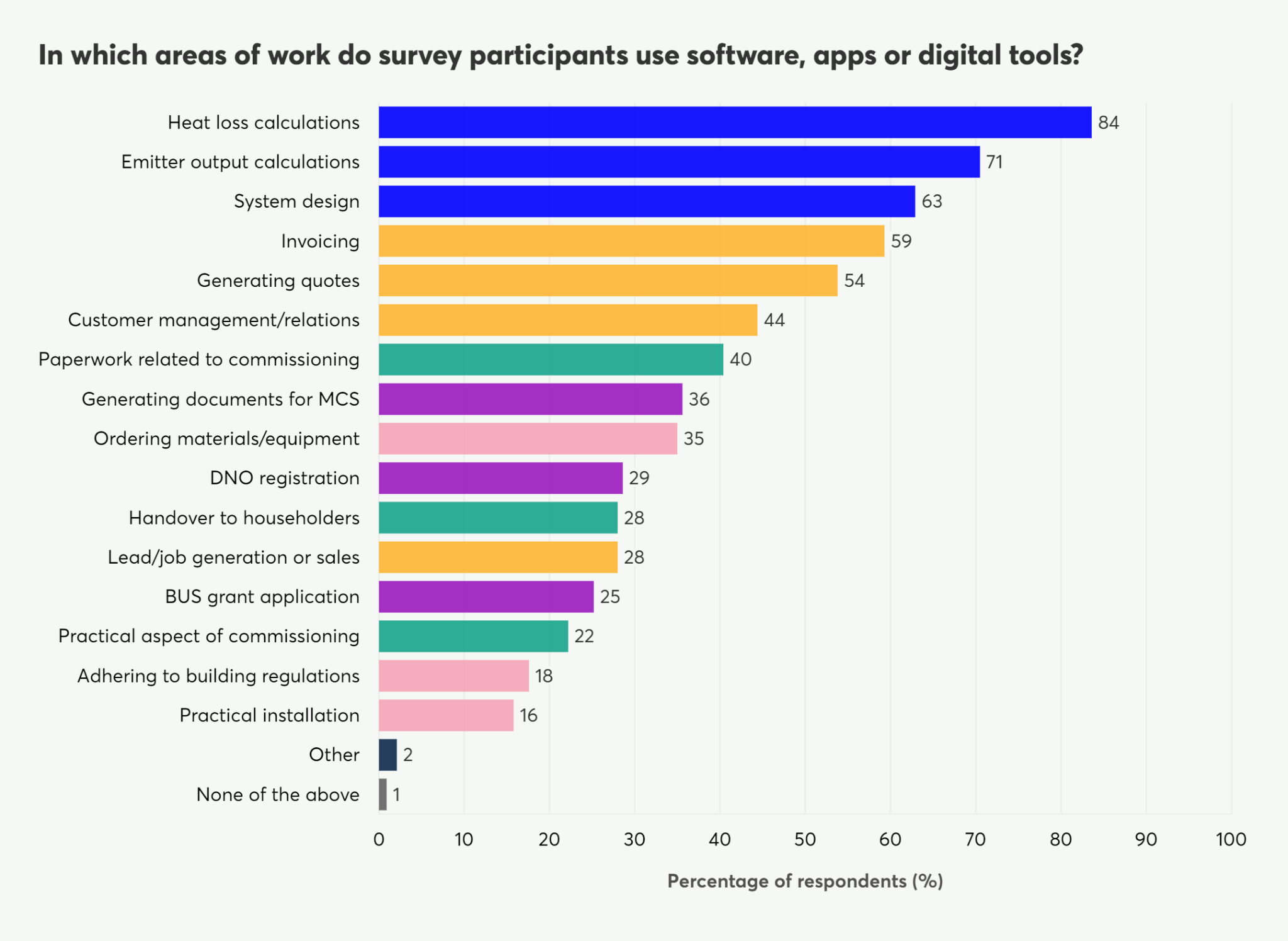
Figure 17: Work activities that survey participants (n = 329) use digital tools for. Respondents were able to select all options that applied to them. Blue bars correspond to activities related to system design, yellow bars are business administration activities, green bars are related to commissioning and handover, purple bars correspond to post-installation paperwork and pink bars are for activities related to actual installation delivery.
Participant responses suggest that digital tools still have much room for improvement in terms of cost, reliability, ease-of-use and functionality. Although ratings weren't especially negative, a similar proportion of respondents rated tools as fair/neutral or poor as rated them good across these measures (Figure 18). Respondents rated the choice of digital tools lowest of all other features surveyed.
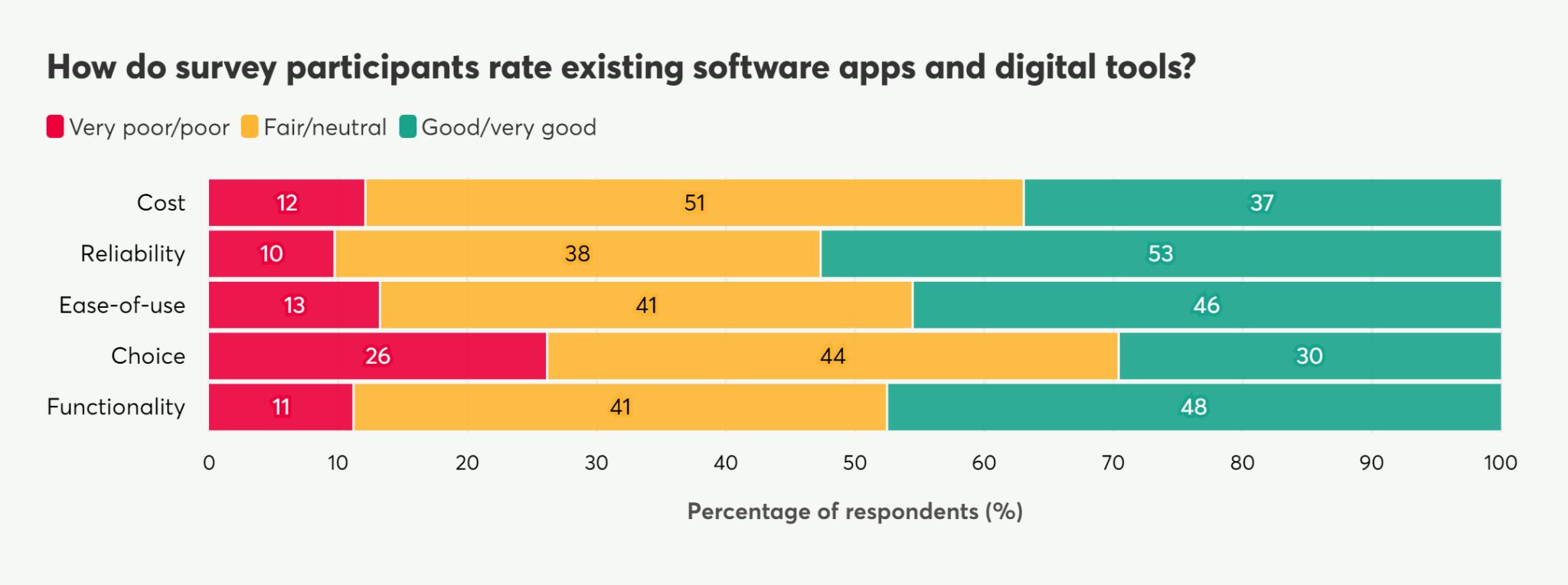
Figure 18: Levels of satisfaction among survey participants with different aspects of existing digital tools. Values displayed for each activity are the percentage of the number of respondents who did not select "Don't know".
As illustrated in Figure 13, less than a third (32%) of participants reported spending the right amount of time on paperwork relating to MCS, BUS, DNO and other post-installation activities. To explore participants' feelings about MCS specifically, a further set of questions was asked.
For installers who work in a retrofit setting, offering installations recognised as MCS certified is a key way of attracting customers and increasing installations. This is because funding schemes, like the BUS in England and Wales or the Home Energy Scotland Grant and Loan in Scotland, require qualifying installations to be MCS certified. Installers can offer MCS-certified installations either through their own MCS accreditation or via umbrella schemes. Umbrella schemes allow access to MCS certification without a business needing to go through the accreditation process themselves.
Overall, just under half (49%) of the company owners who responded to our survey were currently MCS certified (Figure 19). MCS certification was more prevalent among companies with six or more employees compared to sole traders and companies with one to five employees.
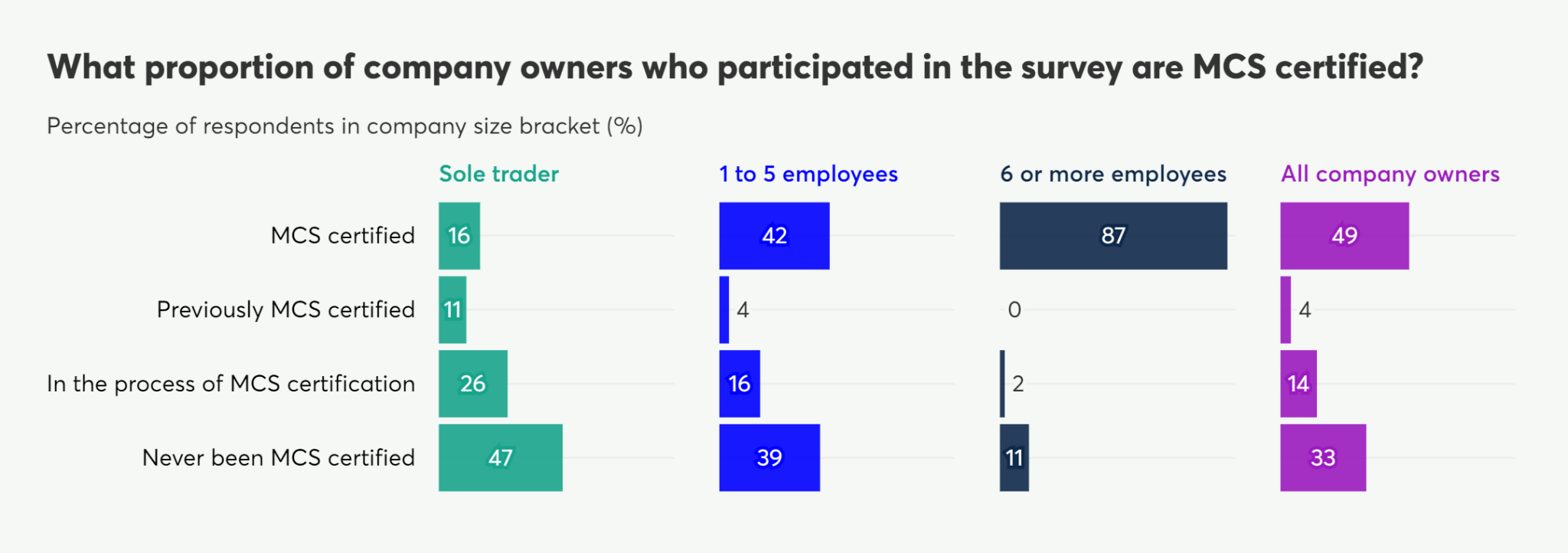
Figure 19: Proportion of survey participants who are company owners that are MCS certified, across different company sizes (sole traders, n = 38; owners of companies with 1 to 5 employees, n = 109; owners of companies with more than 6 employees, n = 54).
Where relevant, respondents were asked why they chose not to become certified or recertified by MCS. The most frequent answer was the amount of paperwork certification entails (Figure 20), while the second was that it was too expensive to do so. This may explain why a larger proportion of companies with over six employees are MCS certified. These companies may be better able to afford the fixed cost and time taken to complete paperwork for MCS certification, and experience a quicker return on the time and financial investment compared to sole traders and companies with one to five employees.
Why don't survey participants obtain or re-obtain MCS certification?
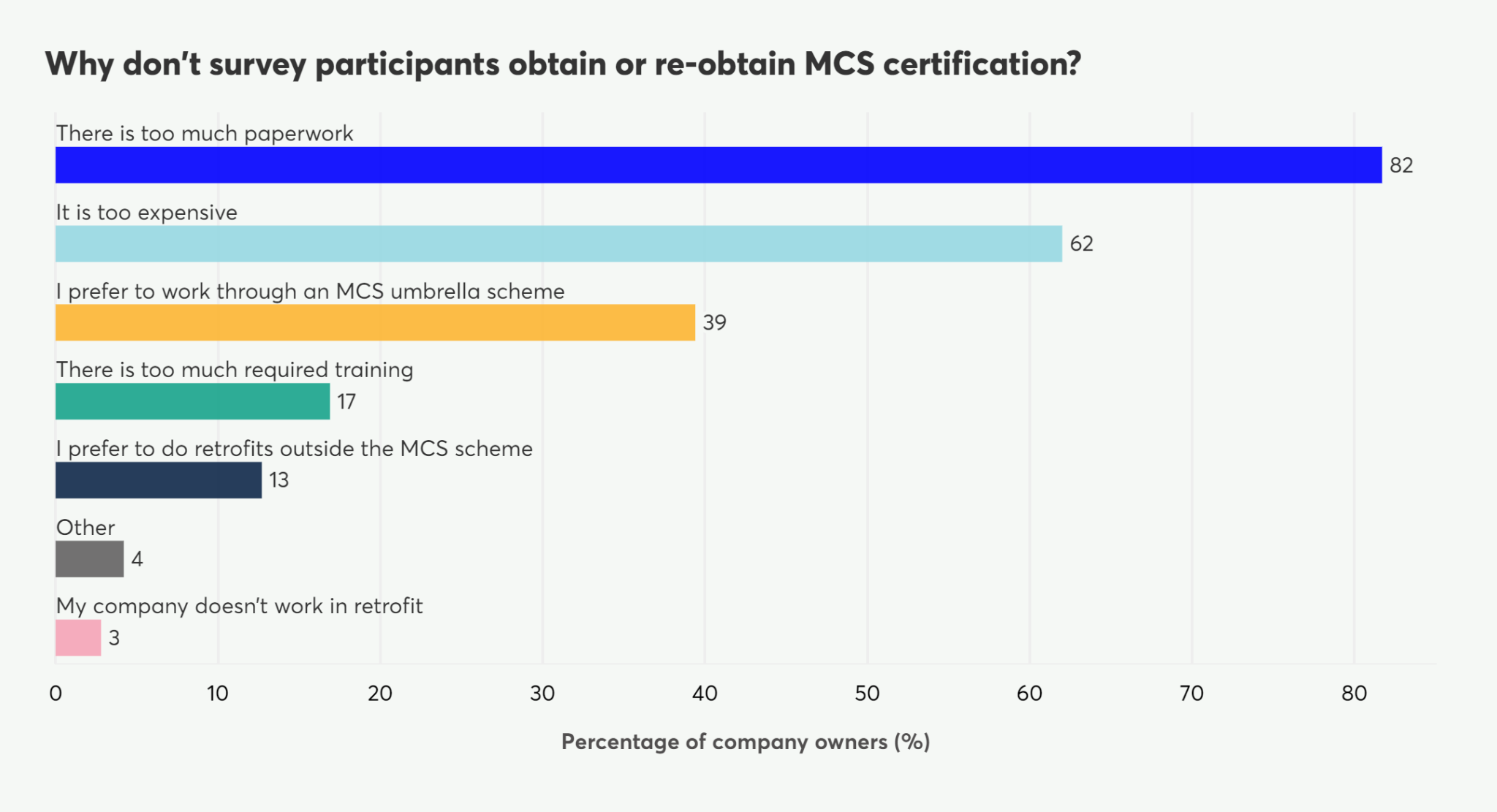
Figure 20: Reasons why survey participants, who are company owners, have not obtained, or re-obtained, MCS certification (n = 71). Respondents were able to select all options that applied to them.
Although a smaller proportion of sole traders and companies with one to five employees were MCS certified, Figure 21 shows that companies of this size often used an umbrella scheme instead.
The majority (60%) of sole traders reported using an umbrella scheme or another firm to certify their installations, and an almost equal proportion of companies with one to five employees use these methods (54%) as those who have their own MCS certification (50%). These are comparatively much lower than companies with six or more employees.
Over a quarter of sole traders reported installing heat pumps without MCS certification in a retrofit context.
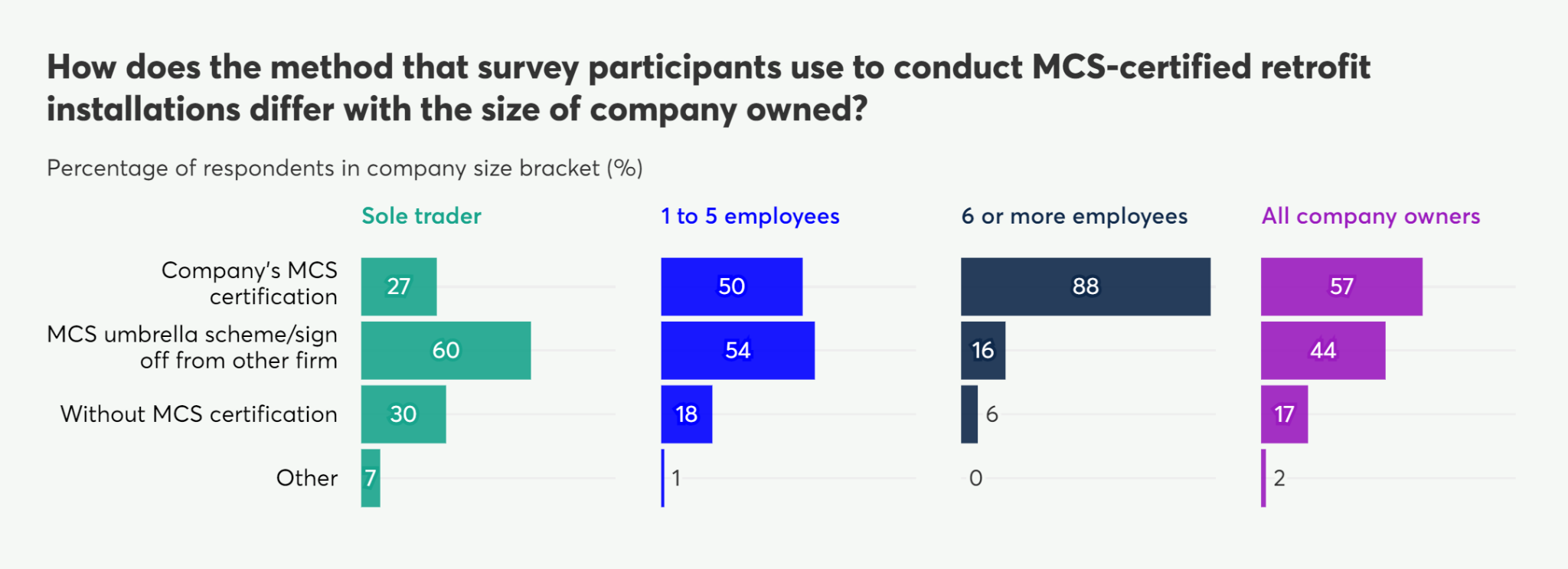
Figure 21: Methods that company owner survey participants use to conduct MCS-certified heat pump installations in retrofit settings, grouped by the size of company they own (sole traders, n = 30; owners of companies with 1 to 5 employees, n = 94; owners of companies with more than 6 employees, n = 51). All company owners that do retrofit work were asked but values displayed exclude those that said "Don't know" and who have not done any installations. Respondents were able to select all options that applied to them.
Implications
The survey identifies some demand for digital tools from installers and areas ripe for innovation. Aligning these could reduce the day-to-day burden of administration and paperwork in heat pump installation.
Digital tools are not a panacea to heat pump engineer productivity. However, compared to fossil fuel heating systems, heat pump installations contain many elements for which digital tools might be helpful. For example, heat pump installations have a greater need for system design calculations and installation paperwork, due to processes like electricity grid connections, government funding schemes, and customer handover.
With only 32% of respondents reporting spending the right amount of time on post-installation paperwork, and 41% on administrative tasks, many engineers may appreciate support with these tasks (Figure 13). The survey results suggest that digital tools could provide a pathway to expedite or automate elements of this paperwork and, in this way, reduce its day-to-day burden.
Heat pump installers are familiar with digital tools. Eighty-nine percent of respondents report using digital tools to help them in their work sometimes, often or always (Figure 16). They also would like to see more support from them. For three key areas in which further support could help their businesses, around or over half of company owners called for support from either digital tools alone or for digital tools and staff; although almost a third reported that they didn't require extra support from either (Figure 15).
There is space for improvement and innovation. The majority of respondents described existing tools as very poor, poor or fair/neutral in relation to the cost, ease of use, choice and functionality (Figure 18). Only in terms of reliability was there a majority (53%) that described existing tools as good/very good (Figure 18). The survey also exposed areas that could be ripe for innovation. These are areas of work where installers either spend too much time on a task or don't have enough time to dedicate to it. There are also areas that relatively few respondents report using digital tools. Aligning good user experience with areas of high time demand and low current use of digital tools may have potential to add value.
The paperwork and cost burden of MCS certification are high for the smallest businesses.
MCS certification is more prevalent among companies with six or more employees, but much lower for sole traders and companies with one to five employees (Figure 19). This may be because the top reported barriers to MCS certification, the cost and amount of paperwork, become proportionally more burdensome the smaller the company is.
If the smallest companies are to gain their own MCS certification, MCS must work to ensure that the benefits of MCS certification outweigh the costs of doing so for such companies. If not, MCS certification may become a barrier to installing more heat pumps. It may do this either by imposing time costs that reduce productivity, or financial costs that either increase costs to consumers or decrease the viability of smaller firms entering the retrofit sector.
MCS umbrella schemes are providing companies an alternative method to deliver MCS-certified installations.
For heat pump installers, an MCS umbrella scheme confers the benefits of MCS certification without the need to manage all elements of the MCS process internally. Sole traders and companies with one to five employees appear to be the highest users of MCS umbrella schemes as an alternative to getting directly certified (Figure 21), which suggests that these schemes are allowing a larger number of companies to enter the heat pump sector.
Given their utility for this section of the market, greater recognition and support for the role of umbrella schemes by MCS may be advantageous in enabling a greater number of companies to install a greater number of heat pumps. There may also be space for increased competition in this area, either reducing overheads or increasing the services delivered to allow greater use of umbrella schemes by existing firms or to help new firms enter the retrofit market.
4. Finding additional staff
As described in Section 2, many respondents reported that the biggest barrier to them installing more heat pumps was an inability to find suitable additional staff for their company, particularly company owners with six or more employees. The results described in Section 3 also illustrated how respondents wanted support from staff, as well as digital tools, to help them with business and installation activities that were taking too long, or for which they didn't have enough time. This section explores heat pump installers' experiences of taking on new staff and apprentices.
Do company owners want to hire new staff?
A large majority (81%) of company owners with six or more employees reported that they were likely or very likely to employ new staff in the next 12 months (Figure 22). By contrast, about half that proportion of company owners with one to five staff reported that they'd be likely or very likely to do so. A large majority of sole traders reported that they would be unlikely or very unlikely to take on new staff. This may be the case because many may be sole traders by choice and not interested in taking on new staff.
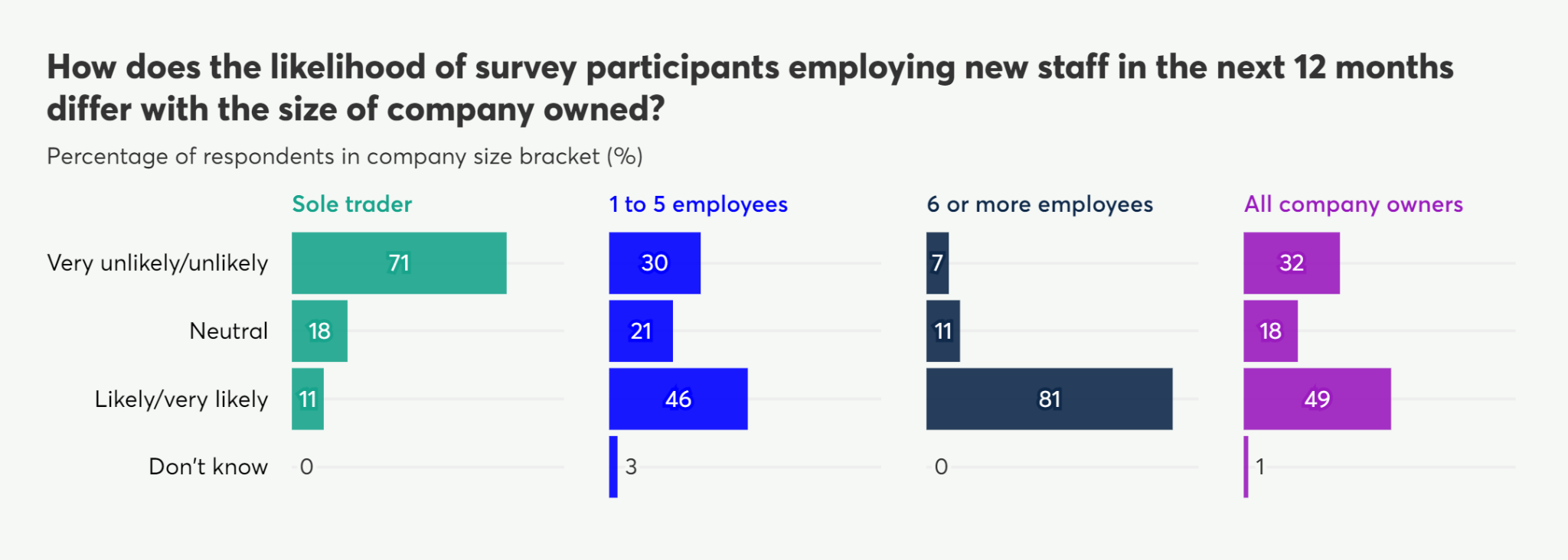
Figure 22: Likelihood of company owner survey participants employing new staff over the next 12 months (sole traders, n = 38; owners of companies with 1 to 5 employees, n = 109; owners of companies with more than 6 employees, n = 54).
What type of staff do respondents want to hire?
Company owners have different preferences on the level of experience, type of skills, and type of contract for the staff they'd like to hire, depending on the size of the company they own.
Types of contract
Figure 23 shows that almost all company owners with six or more employees would prefer to directly recruit permanent staff, whilst the preferences of sole traders and company owners with one to five staff are more mixed between directly hiring staff and hiring contractors.
A slightly larger proportion of company owners with one to five staff preferred to directly recruit new permanent or temporary staff compared to hiring a contractor. A much larger proportion of sole traders preferred hiring contractors over directly hiring staff.
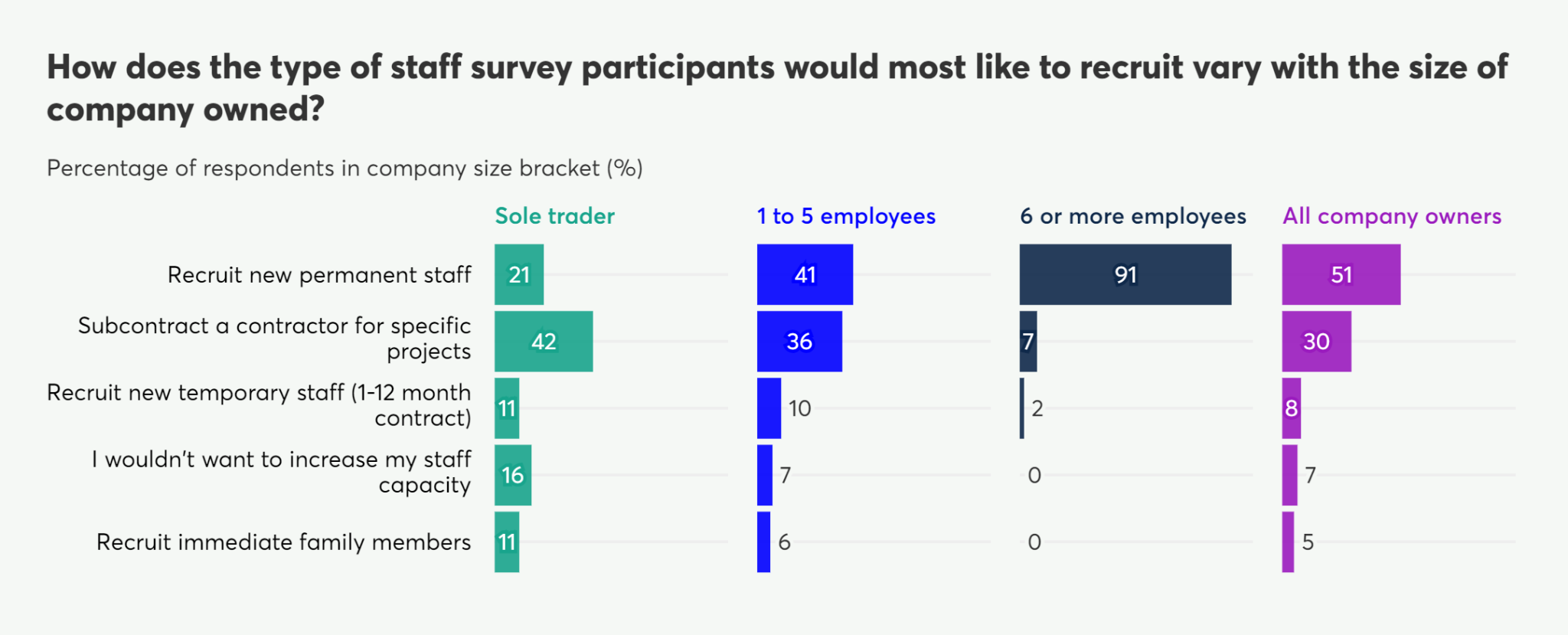
Figure 23: Types of staff survey participants would most like to recruit vary with the size of company owned (sole traders, n = 38; owners of companies with 1 to 5 employees, n = 107; owners of companies with more than 6 employees, n = 54) would most like to recruit. All company owners were asked but values displayed exclude free text responses that were deemed not relevant (n = 2).
Types of skills
employees on the skills they'd like to hire, and a more mixed response from sole traders and company owners with one to five employees.
Figure 24 suggests that most owners of companies with six or more employees want to recruit staff with sales and marketing skills and heat loss surveying and calculation skills. Sole traders were most interested in hiring heating system designers and those with F-gas qualifications. Owners of companies with one to five employees had mixed preferences.
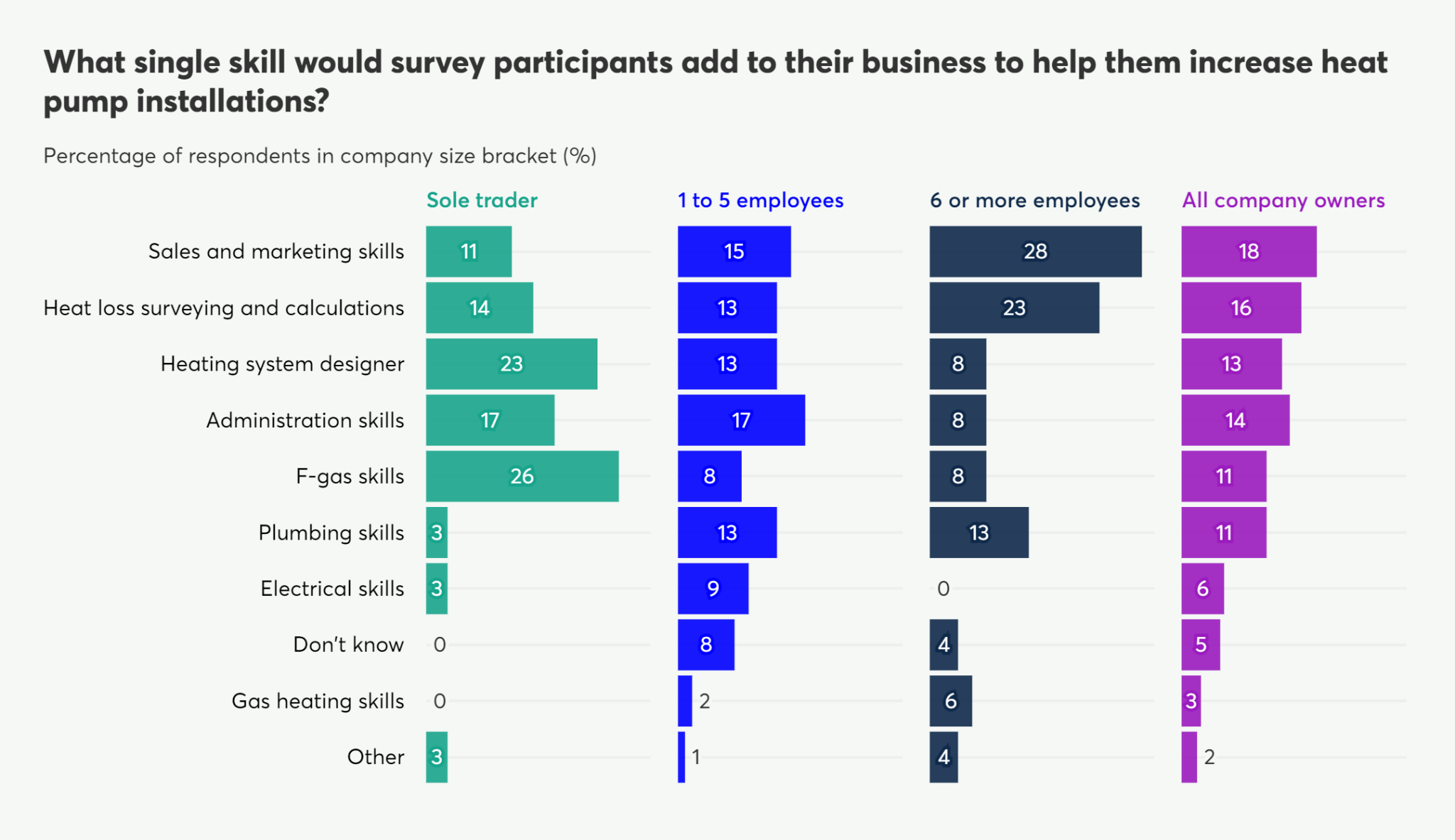
Figure 24: Additional skill survey participants need to add to their business to help them increase the number of heat pump installations, across size brackets (sole traders, n = 35; owners of companies with 1 to 5 employees, n = 106; owners of companies with more than 6 employees, n = 53). All company owners were asked but values displayed exclude free text responses that were deemed not relevant (n = 7).
Levels of experience
The majority of respondents from all company sizes preferred hiring more experienced staff for their most-wanted skill, though the trend is much stronger for company owners with six or more employees (Figure 25). While sole traders and company owners with one to five employees also preferred more experienced staff, they were more open to employing staff with different levels of experience.
However, there was very little demand for first job applicants from businesses of any size.
A large proportion of sole traders didn't know which level of experience they wished to hire. This might be explained by Figure 23 which suggests sole traders are more interested in hiring contractors for specific projects, rather than directly hiring staff.
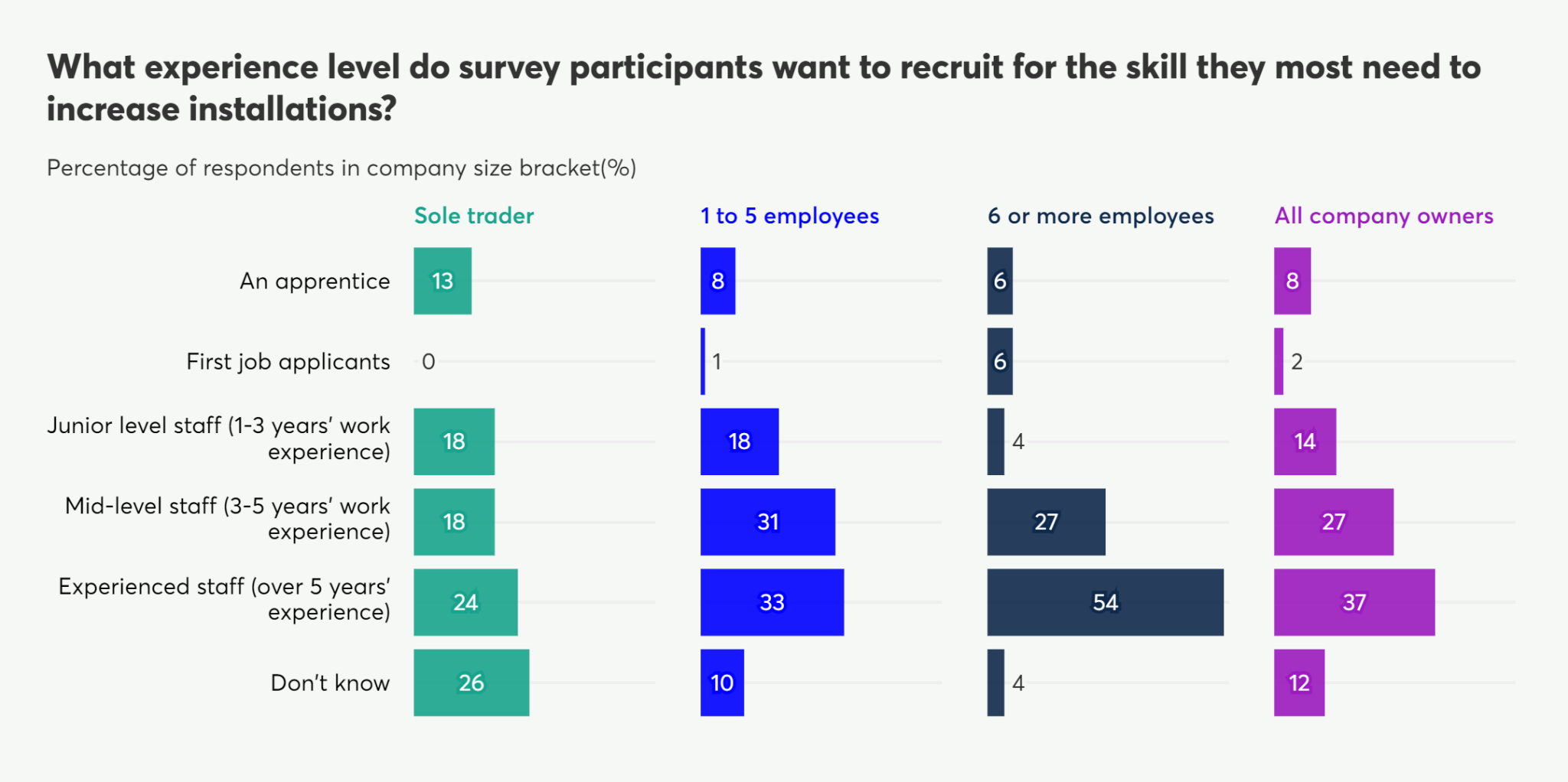
Figure 25: Recruitment preferences of company owners who identified skill gaps in their business, across size brackets (sole traders, n = 38; owners of companies with 1 to 5 employees, n = 101; owners of companies with more than 6 employees, n = 52).
What are the barriers to taking on first job applicants?
As noted above, a very small proportion of all company owners reported wanting to take on first job applicants (Figure 25). However, taking on and upskilling these new entrants is a crucial part of growing the overall heat pump workforce which, in turn, will help the sector to deliver more heat pumps.
There are broadly two types of first job entrants: those that have graduated from an apprenticeship scheme and those who have qualifications without a work-based learning element. We explore the barriers company owners face for each of these recent graduates below.
Graduates from an apprenticeship scheme
Sole traders and company owners with one to five employees may not be taking on apprenticeship graduates as they're not confident in that cohort's ability to do the job well.
Figure 26 shows how sole traders and company owners with one to five employees have much lower confidence than owners of larger companies in the level of training that graduates from apprenticeship schemes have. Less than 5% of sole traders and less than 10% of company owners with one to five employees said they were confident or very confident that those who've recently graduated from an apprenticeship are trained to an appropriate level, with around two thirds of each group having no or very little confidence in their training.
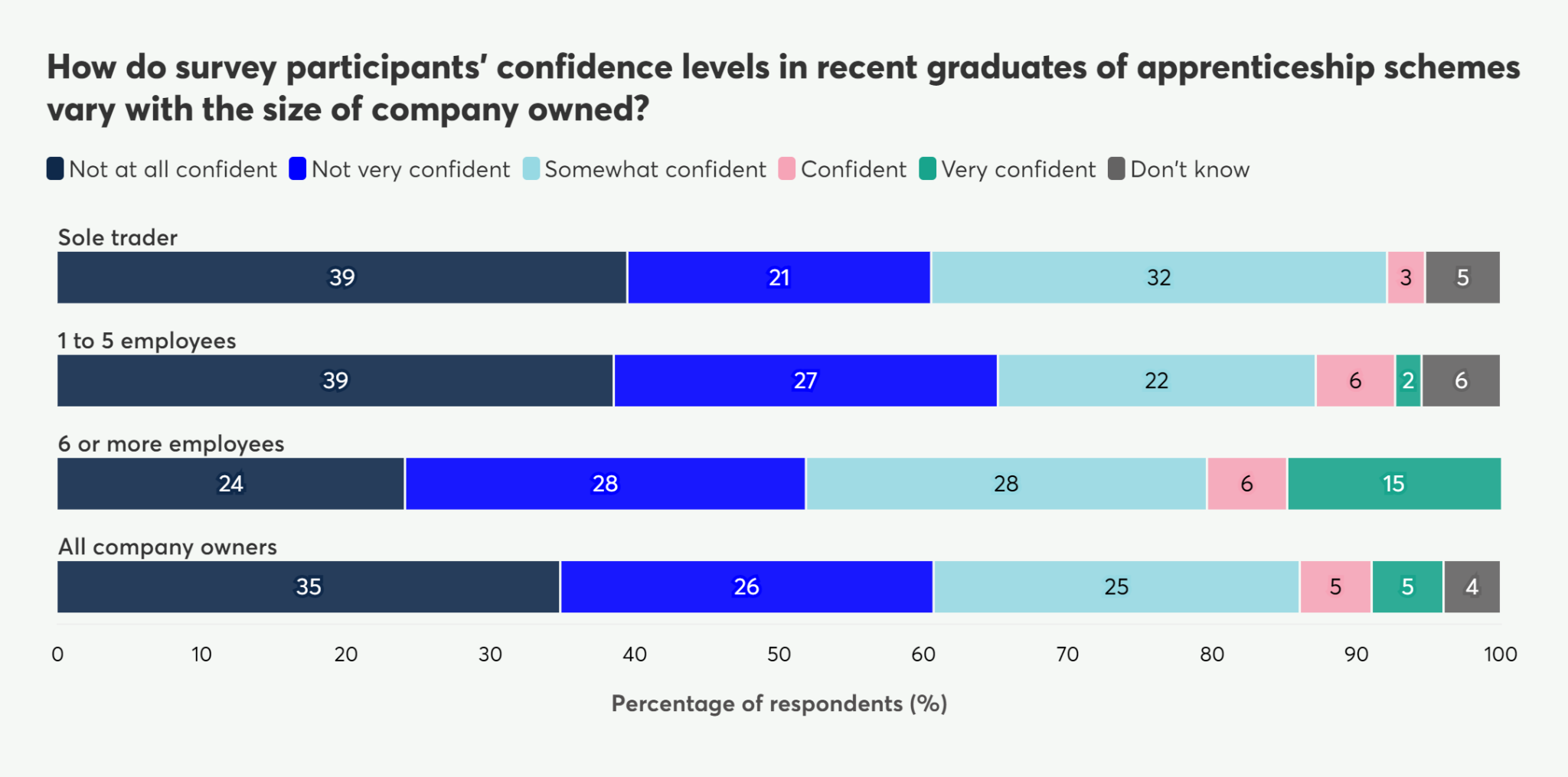
Figure 26: Levels of confidence amongst survey participants, who are company owners or sole traders, that recent graduates of apprenticeship schemes would be trained to an appropriate level (sole traders, n = 38; owners of companies with 1 to 5 employees, n = 109; owners of companies with 6 or more employees, n = 54).
The main skills respondents think could be improved in the training that apprentices receive are practical heat pump installation and general plumbing skills (Figure 27).
These technical skills are also the main skills employers are looking for in recent graduates from apprenticeship schemes. When asked specifically about their expectations for recent graduates, respondents expect that graduates should be able to either undertake stages of a heat pump installation with a quality check after each stage or to complete one in its entirety unaccompanied, with a final quality check (Figure 28).
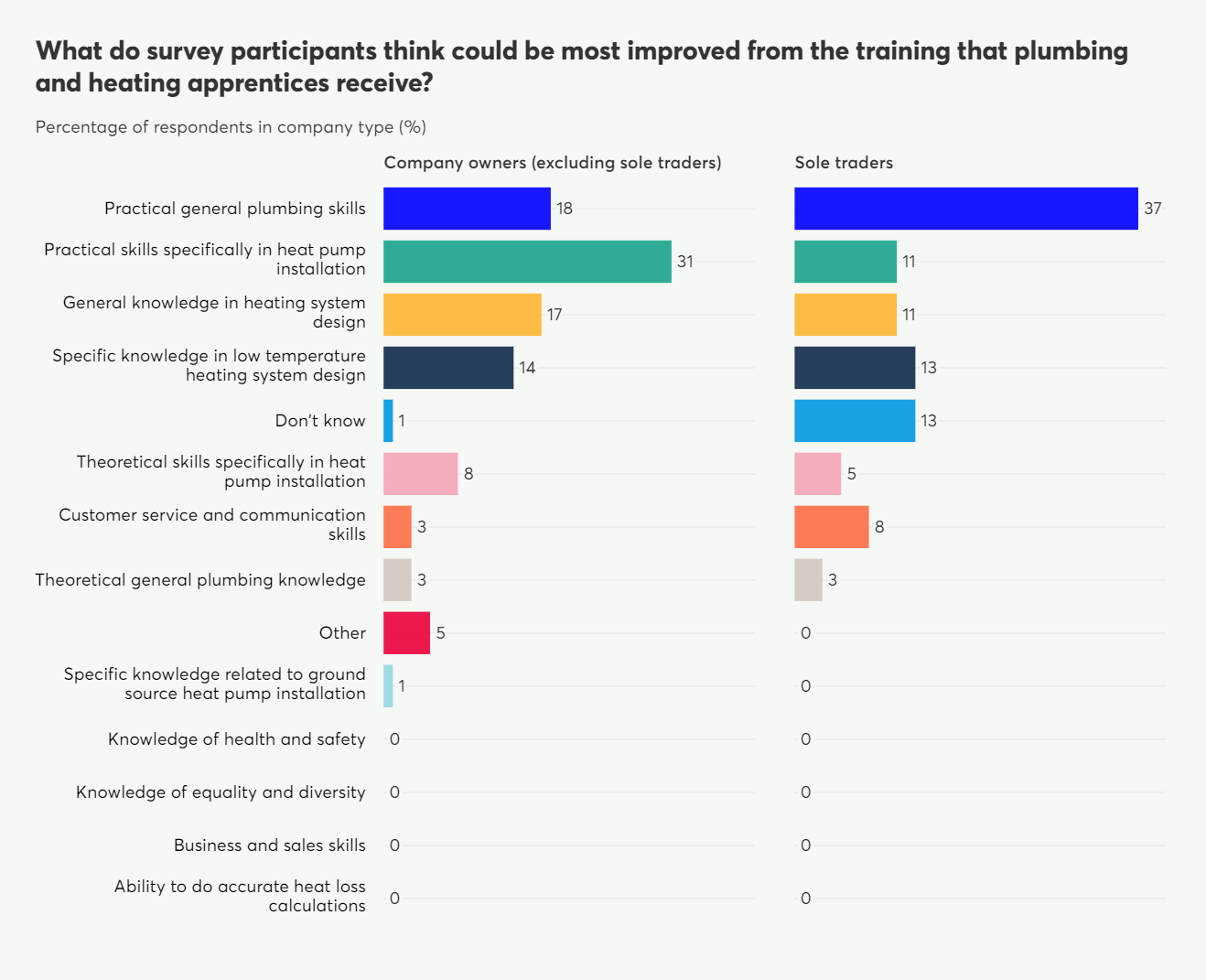
Figure 27: Skill or knowledge area that survey participants (n = 201) think are most in need of improvement in plumbing and heating apprenticeship training.
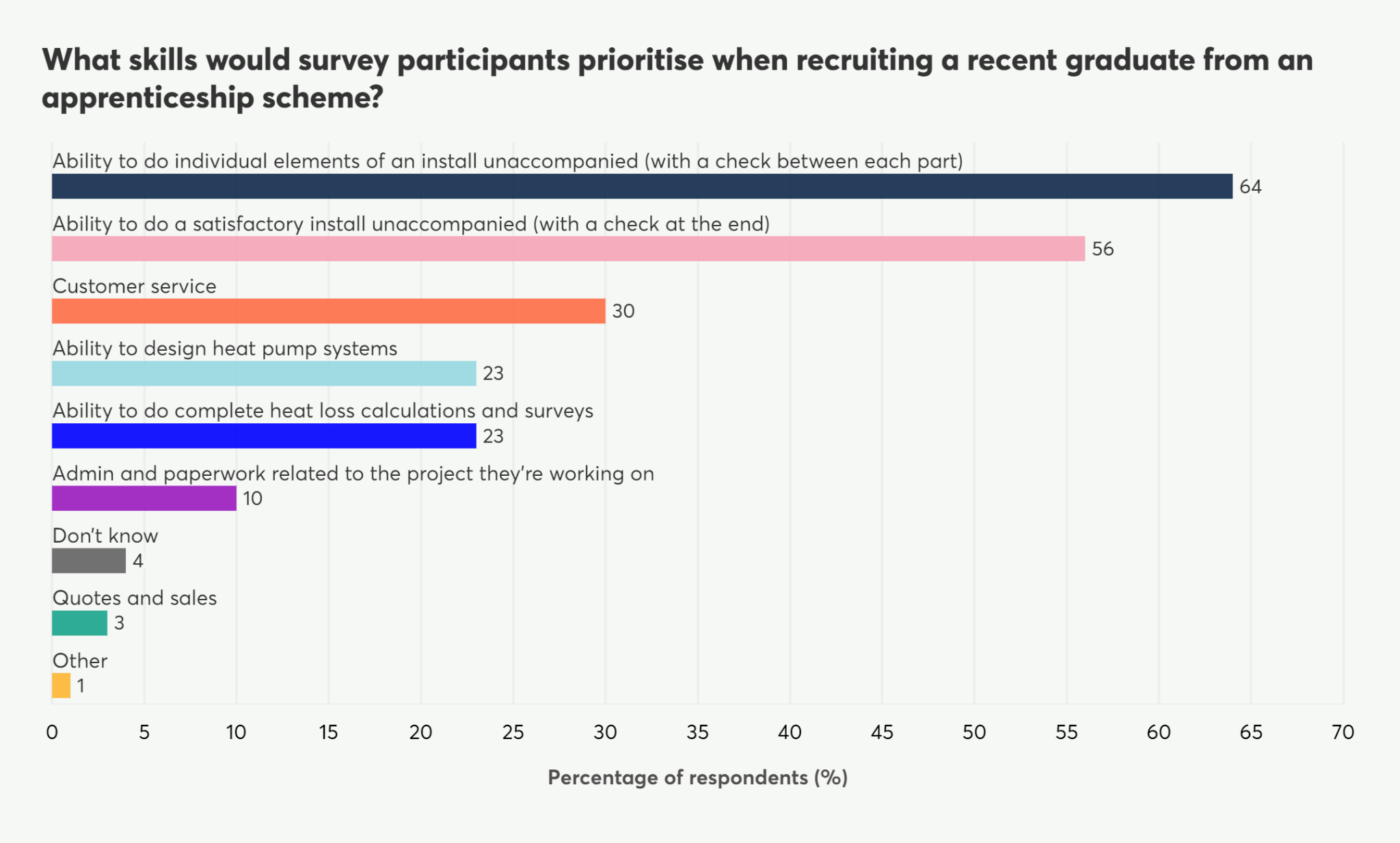
Figure 28: Skills desired and/or required by company owners (n = 201) when recruiting apprentices graduates. Respondents were able to select up to three options.
Graduates with qualifications without work-based learning
Some students do courses without a work-based learning element. These courses only teach the practicalities of plumbing and heating in a classroom setting and do not expose students to the real-world application of that knowledge in the way an apprenticeship does.
Figure 29 shows how a large majority of respondents, across company sizes, reported that they'd be unlikely to take on applicants who had qualifications without a work-based learning component.
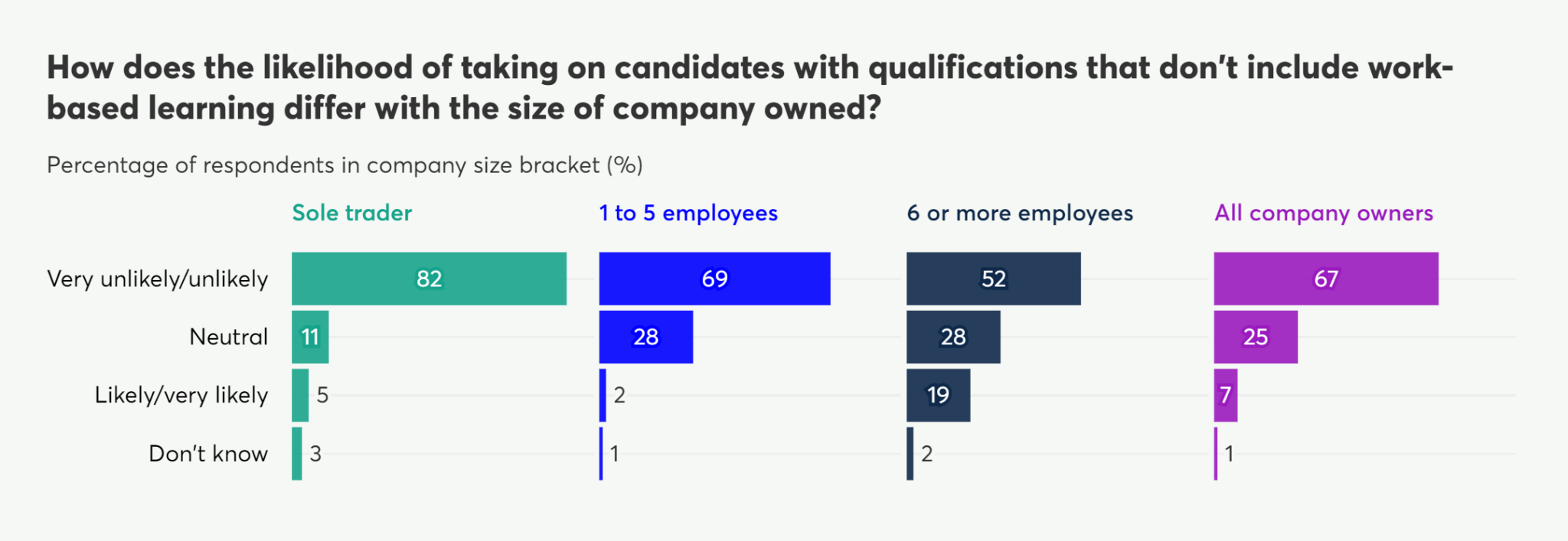
Figure 29: Likelihood of survey participants who are company owners to recruit staff with qualifications that don't include work-based learning (sole traders, n = 38; owners of companies with 1 to 5 employees, n = 109; owners of companies with 6 or more employees, n = 54).
Participants were asked to compare the reasons why they might prefer a new member of staff from an apprenticeship route over a graduate of a course without a work-based learning element. Figure 30 shows that a large majority of company owners (67%) reported that they had higher confidence in the ability of the former type of candidate to do the job.
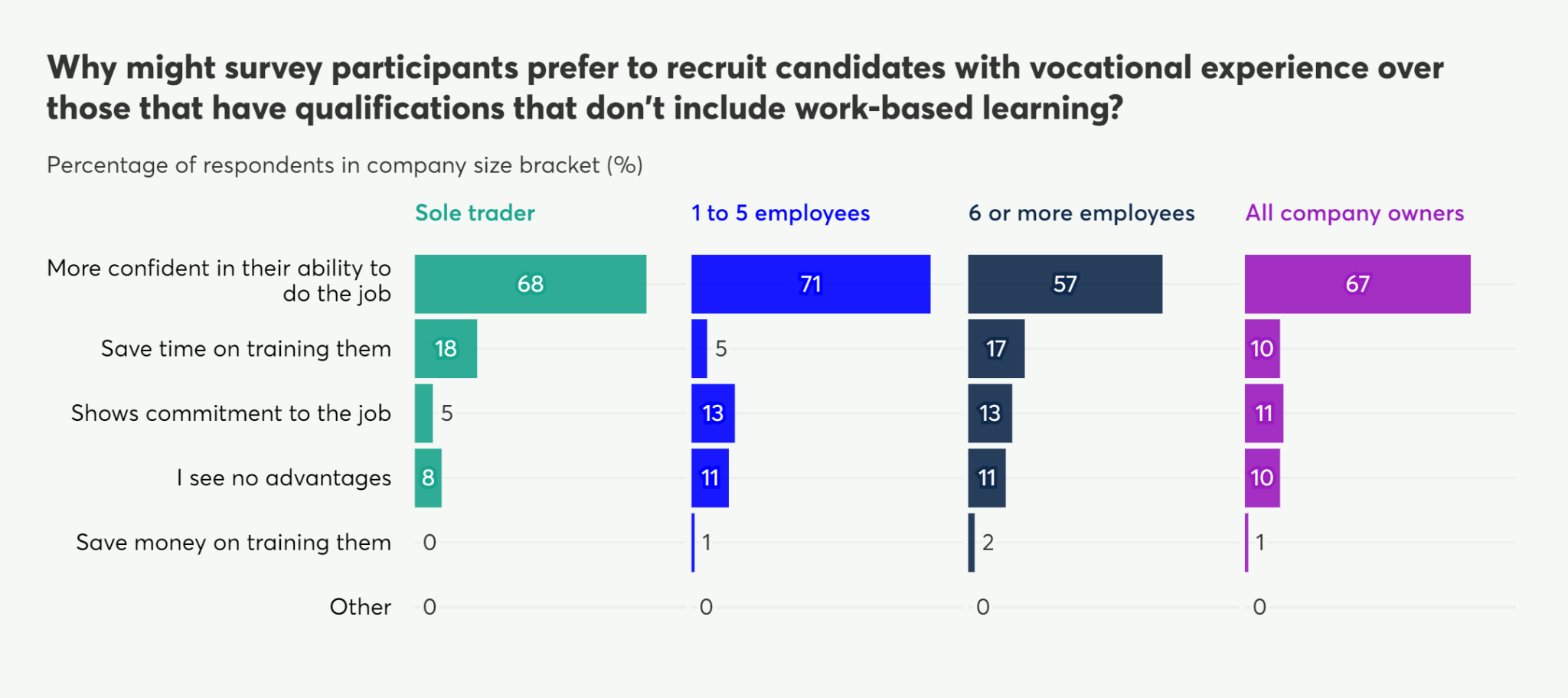
Figure 30: Main reasons why survey participants, who are company owners, might prefer to take on candidates with practical or vocational experience over those with qualifications that don't include work-based learning (sole traders, n = 38; owners of companies with 1 to 5 employees, n = 109; owners of companies with 6 or more employees, n = 54).
Even with the offer of different support mechanisms, the majority of sole traders and over a quarter of other company owners wouldn't take on a graduate of a course without a work-based learning element (Figure 31). However, for many owners of
companies with one to five employees and companies with six or more employees this barrier may be overcome with financial support for the new hire's salary.
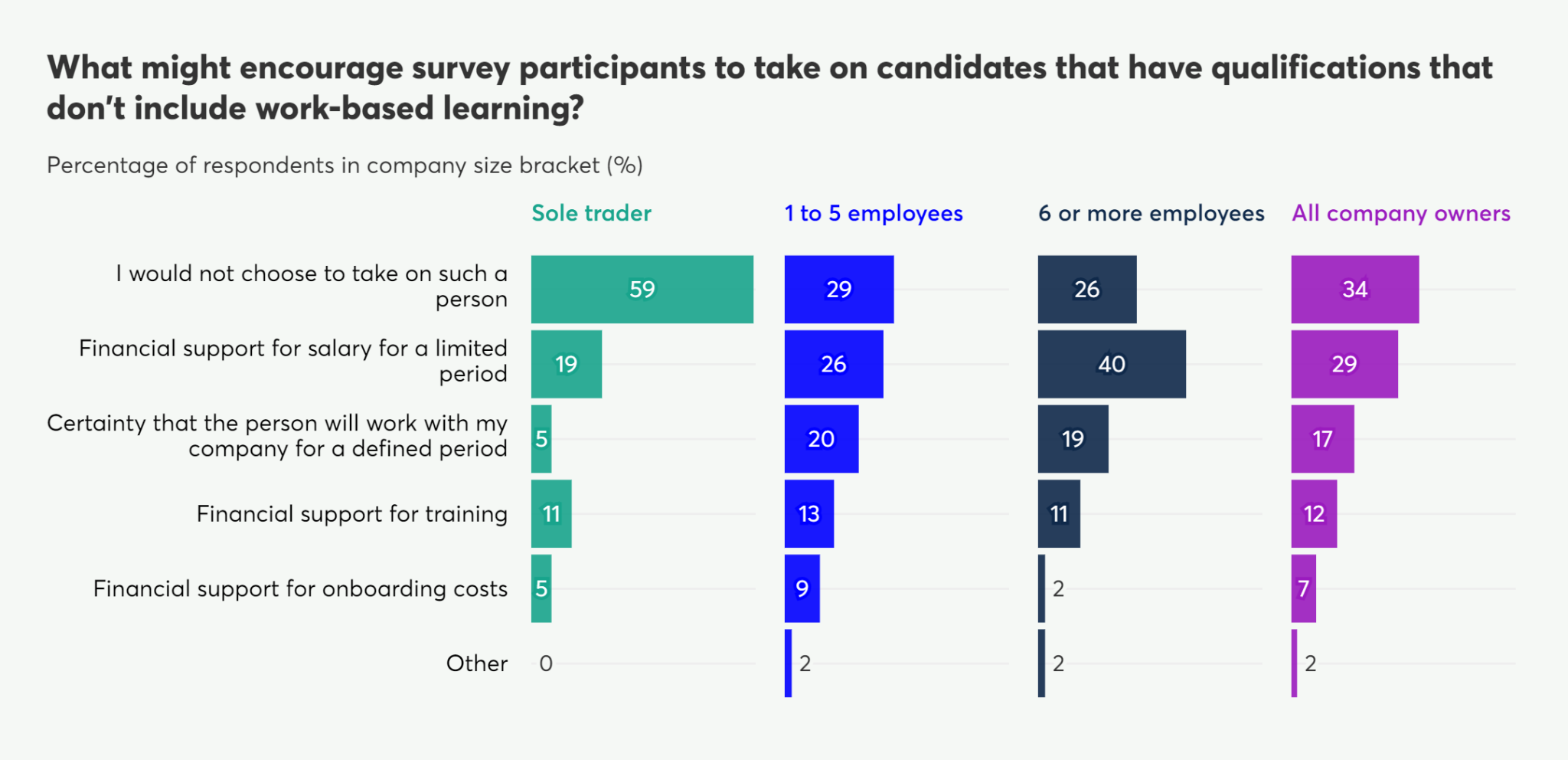
Figure 31: Ways survey participants (sole traders, n = 37; owners of companies with 1 to 5 employees, n = 106; owners of companies with more than 6 employees, n = 53) may be encouraged to take on candidates with qualifications that don't include work-based learning.
How can employers be supported to take on apprentices?
Apprenticeships can help future heat pump engineers to build the practical experience expected by employers. They can also enable employers to train the future workforce to the standard they expect to work with or hire. This section explores survey respondents' feelings about taking on an apprentice.
Although the majority of company owners with six or more employees report having taken on an apprentice within the 12 months preceding their participation in the survey, almost half of company owners with one to five employees (43%) and almost two thirds (61%) of sole traders report that they didn't do so over that time period and don't intend to do so over the next 12 months (Figure 32).
This may be because these respondents are not looking to grow their teams, or as sole traders, prefer to work alone. However, the survey also suggested that foreseen barriers to taking on apprentices may discourage those who have not taken on apprentices from doing so.
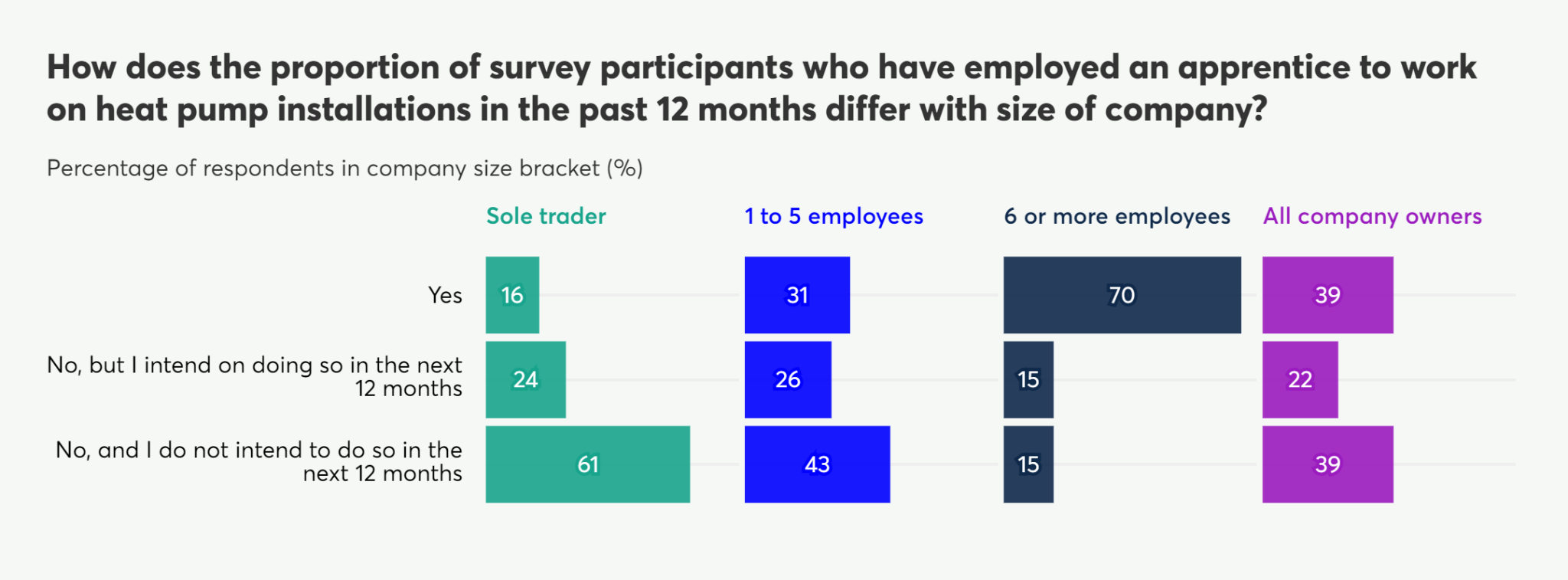
Figure 32: Proportion of company owners that have or haven't employed an apprentice in the last 12 months to work on heat pump installations (sole traders, n = 38; owners of companies with 1 to 5 employees, n = 109; owners of companies with 6 or more employees, n = 54).
Figure 33 suggests that taking on an apprentice may be less challenging than it is perceived to be. Over a quarter (26%) of those who had actually taken on apprentices said they didn't face any challenges with doing so, whereas only 8% of those who had not taken on an apprentice expected not to face any challenges.
There are also differences between perceived and actual challenges. Thirty-five percent of respondents thought an apprentice might cost their business too much, while only 23% experienced this in reality. Similarly, 27% of respondents thought an apprentice might slow down their work while only 10% experienced this in reality.
Nevertheless, almost three quarters (74%) of company owners who took on apprentices did face at least one challenge, suggesting there is still a major need for support with this.
Overall, the most common challenges respondents faced when taking on apprentices were related to difficulties with finding apprentices that fit the role, the lack of nearby colleges delivering relevant or sufficiently high quality apprenticeship training, and high cost associated with taking on an apprentice.
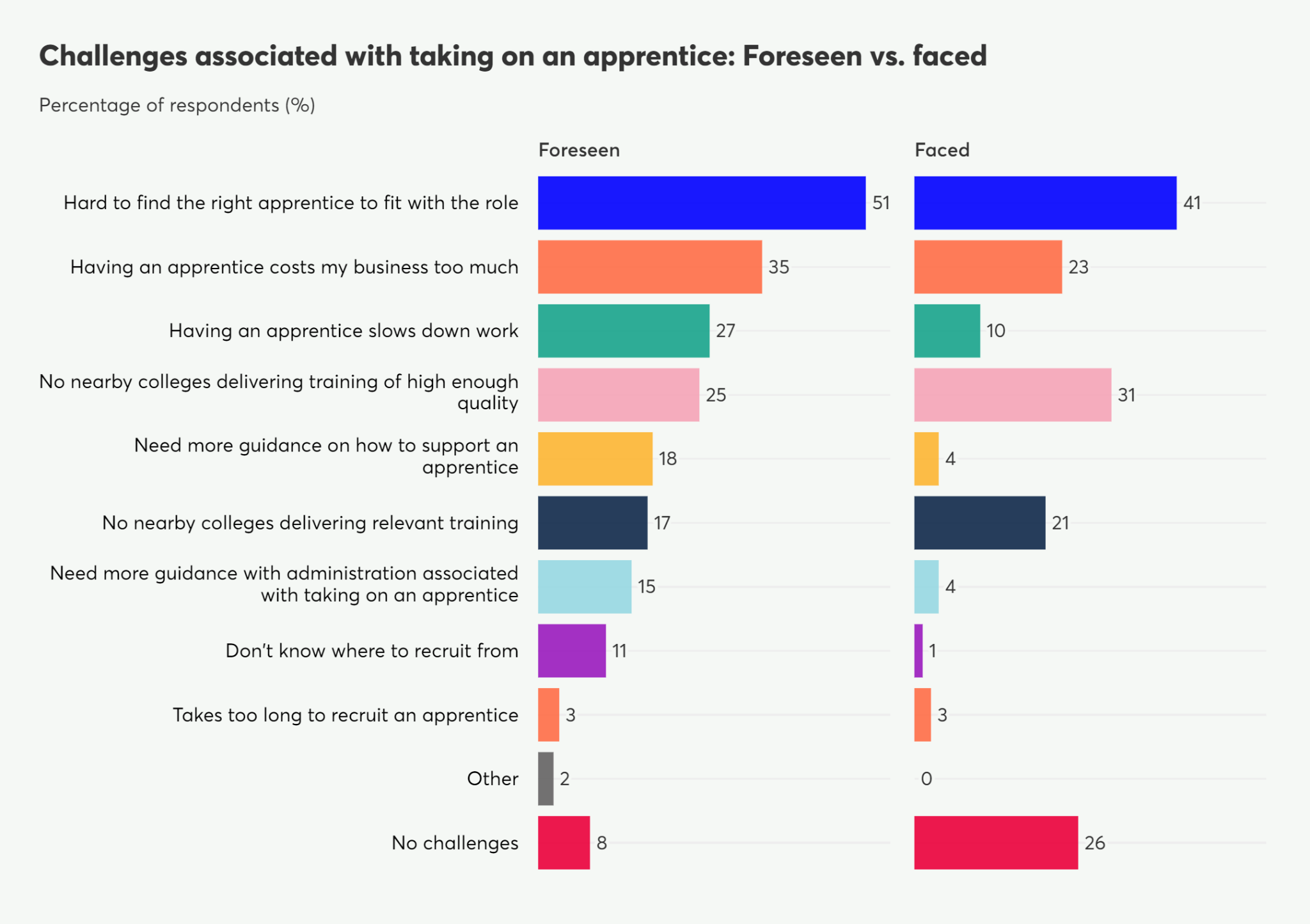
Figure 33: Challenges foreseen by survey participants who have not taken on an apprentice (n = 123) vs. challenges faced by survey participants who have taken on an apprentice (n = 78). Respondents were able to select up to three options.
Implications
Many, but not all, company owners are open to expanding their business.
Across company size, company owners are broadly open to employing more staff. Less than 10% stated that they wouldn't want to increase their staff capacity when asked about the type of contract they'd hire employees through (Figure 23).
Although companies are open to employing more staff, many sole traders and company owners with one to five employees reported being unlikely to do so within the next 12 months (Figure 22). This suggests there may be a need for support to better enable sole traders and companies with one to five employees to expand.
There isn't a common most-wanted skill that companies need to help them increase installations.
Although most company owners with six or more employees are looking to take on employees with either sales and marketing or heat loss surveying and calculation skills, there's a lot more variety in the top skill that sole traders and those with one to five employees are looking for (Figure 24).
Continuous learning is important for all individuals in the sector. Helping staff acquire new skills could help companies increase the number of heat pumps they can install with the employees they have. It could also help employees find new roles with other companies in the sector. Training is expensive and those who are the most highly skilled are also in the highest demand.
Improved training and skills development will help the sector deliver more heat pumps and will improve the career prospects of individuals in the sector. Modes of training and skills development need to be devised that meet the needs of the sector, particularly in terms of quality of training and applicability to practical experience.
Very few employers prefer to take on newly qualified staff for their most-wanted skill.
Across all company sizes employers have a preference for staff with at least three years' experience for the skill they most need to increase installations. Although sole traders and smaller companies are a little more open to hiring less experienced candidates or apprentices, almost no respondents wanted to take on first job applicants (Figure 25). This high demand for experienced staff could explain why respondents have reported difficulties finding staff as one of the top barriers to increasing their installations.
This highlights the need to ensure that there are pathways for more junior staff and recent graduates to enter the sector. Failure to ensure these pathways exist could prevent new heat pump engineers from developing their skills, thus slowing the growth of the skilled workforce and the number of installations a company can do.
Given a smaller proportion of companies with six or more employees want to hire staff with less than three years of experience compared to others (Figure 25), there's a risk that more experienced staff could leave smaller companies to work for larger companies. This could leave sole traders or companies with one to five employees with the financial and time burden of upskilling the more junior workforce, and the risk that they'd move on to a different company after they've been skilled up. This would put those smaller businesses in a vulnerable position.
Apprenticeship schemes need more and better quality training on the practical installation of heat pumps to help apprentice graduates move into their first job.
The majority of company owners reported that the most important skill they look for in apprenticeship graduates was an ability to install a heat pump independently (with checks) (Figure 28). However, most weren't confident in the level of training that recent graduates from apprenticeship schemes have (Figure 26), and cited that apprentice training on practical tasks relating to heat pump installation and plumbing needed to be improved (Figure 27).
This points to a clear demand, from employers, for a deeper focus on practical skills in the training that apprentices receive. This may require additional support to colleges, and to the companies with whom an apprentice does their workplace training. Not only will this give those that may take on recent graduates the confidence in making the time and financial investment needed for hiring staff, but it'll also give apprentices more confidence in doing their job.
Pathways are needed to support those who've obtained qualifications without work-based learning, and for employers that would like to support them with their first job.
The majority of employers reported that they'd be unlikely to take on candidates who have qualifications without work-based learning (Figure 29). Respondents reported that this would be because they'd be more confident with the ability of someone with practical experience to do the job, as opposed to financial or time-saving benefits (Figure 30).
This means non-apprenticeship courses either need to be improved to include a greater element of on-the-job experience as part of the qualification, or that there should be better pathways to support new graduates from these courses to secure first jobs that will give them the work-based training they require. Employers will likely require support for these schemes, especially sole traders and businesses with one to five employees, a greater proportion of which also reported wanting to take on junior staff (Figure 25). Although most company owners still wouldn't take on candidates without work-based learning as part of their qualification when offered incentives, financial support for the new hire's salary was the most popular incentive selected (Figure 31).
Although company owners are open to taking on and training an apprentice, there are barriers to them doing so.
A much lower proportion of sole traders and companies with one to five employees are likely to take on an apprentice compared to those with six or more employees (Figure 32), signalling particular barriers for companies of this size. Companies with five or fewer employees may be less able to train, upskill and appropriately manage apprentices. These companies are also less likely to have the available finances to support an apprentice.
As with employing those that have qualifications without work-based learning, supporting companies that take on an apprentice with the financial burden of doing so may be helpful in enabling a wider range of companies to do so. It's also clear that the quality of training needs to be improved. Both the classroom and practical training delivered by colleges, and the workplace training delivered by companies who employ apprentices, need to be improved.
The most important challenge, both foreseen and faced by employers, was finding an apprentice to fit with the role (Figure 33). There is a need for more research to understand what specific challenges exist here, and what solutions could be put in place to reduce the impact of this barrier.
5. Low customer demand
As noted in Section 2, a similar proportion of participants across all company sizes responded that one of the biggest barriers to them installing more heat pumps was a lack of customer demand. This section explores the experience of customer demand amongst survey respondents.
Do companies have the capacity to cope with an increase in customer demand?
Overall our results suggest that companies would be able to cope with an increase in customer demand. Over half (59%) of company owners reported that they never or rarely have to decline viable work because they don't have the capacity, and only 13% report having to decline work often or very often (Figure 34). This means that there are many companies that are likely to have the resources to increase the amount of heat pumps they install, even if some are getting close to their full capacity.
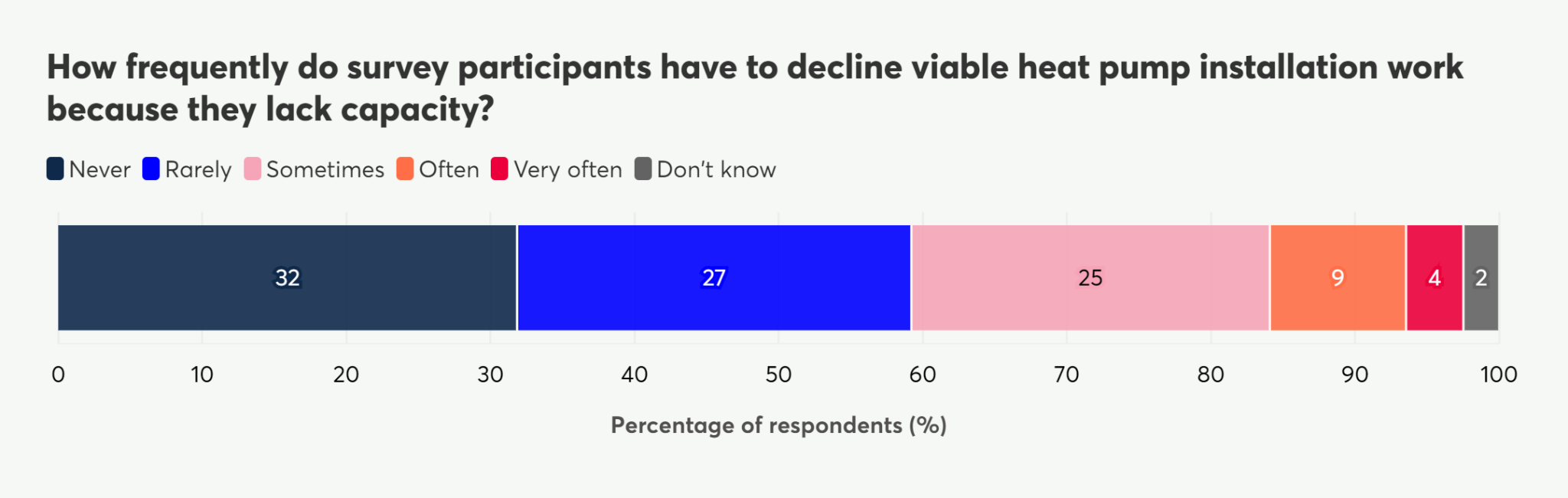
Figure 34: Frequency levels at which company owners (n = 201) decline installation work.
When are potential customers losing interest in an installation?
Although one aspect of low customer demand may be that there simply aren't enough households interested in installing a heat pump, another aspect to this barrier might be that potential customers lose interest between the initial enquiry and deciding to go forward with an installation.
Survey respondents were asked their impressions of where customers dropped out in different stages of the customer journey. Around half (56%) of enquiring customers lost interest upon receiving a quotation (Figure 35). Of those who did continue, around half again (51%) dropped out between the delivery of a comprehensive quotation and moving on to installation (Figure 35).
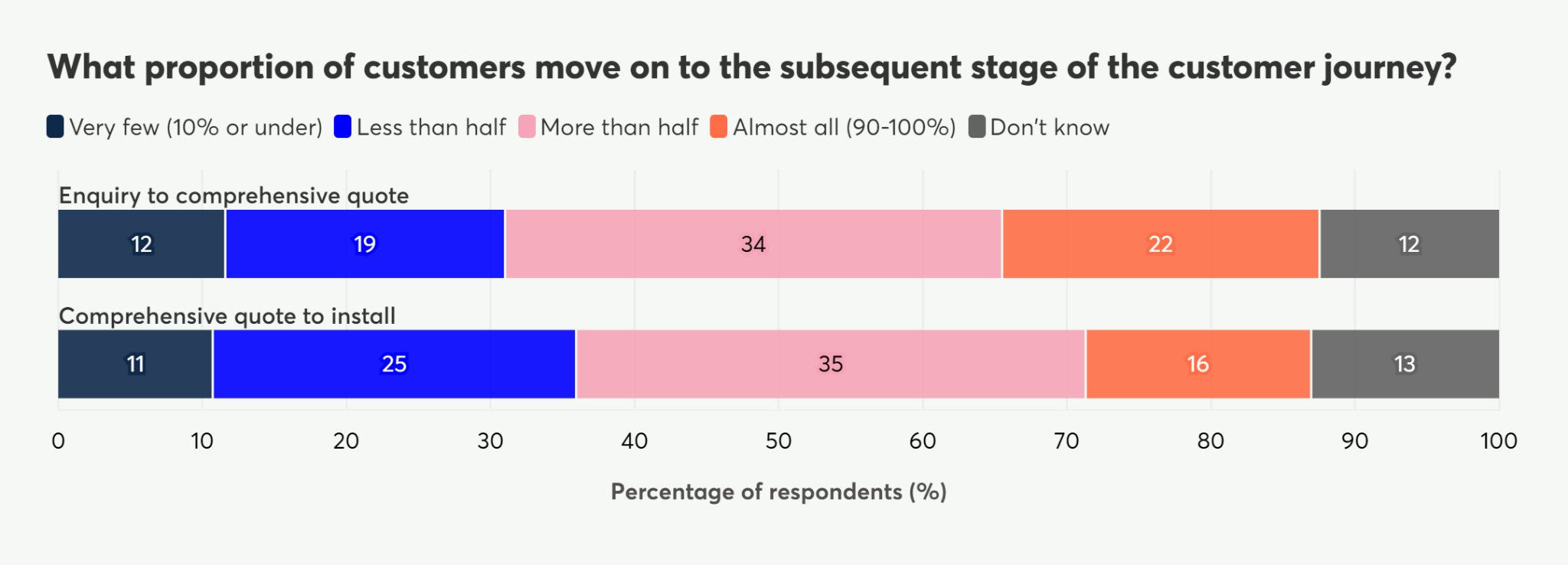
Figure 35: Reported conversion rates of enquiries to comprehensive quotes (top) and of comprehensive quotes to installations (bottom) by survey participants (n = 345).
Survey respondents were asked the proportion of customer enquiries for which they produced comprehensive quotes. Figure 36 suggests that a larger proportion of companies with six or more employees generate a greater proportion of comprehensive quotes from enquiries compared to sole traders and companies with one to five employees. Companies of this size may be able to be less selective than smaller firms at this stage, due to a larger staff base.
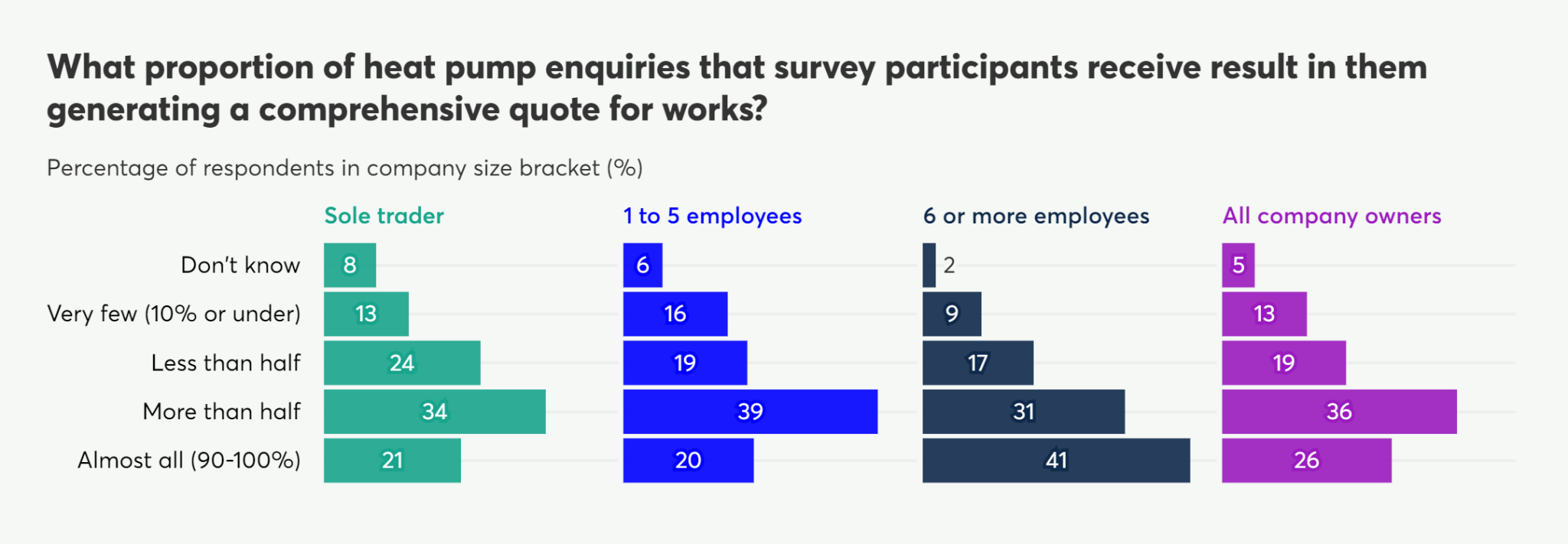
Figure 36: Proportion of heat pump enquiries received by survey respondents that result in them generating comprehensive quotes, across different sizes of company owned (sole traders, n = 38; owners of companies with 1 to 5 employees, n = 109; owners of companies with 6 or more employees, n = 54).
Figure 37 shows how a lower proportion of comprehensive quotes for companies with 6 or more employees result in actual installations, compared to sole traders. This could be as sole traders are more selective about when they quote in the first place. The relatively small proportion of companies with one to five employees who experience quotes leading to installations over 90% of the time is a sign that many may be facing issues with customer demand at this stage.
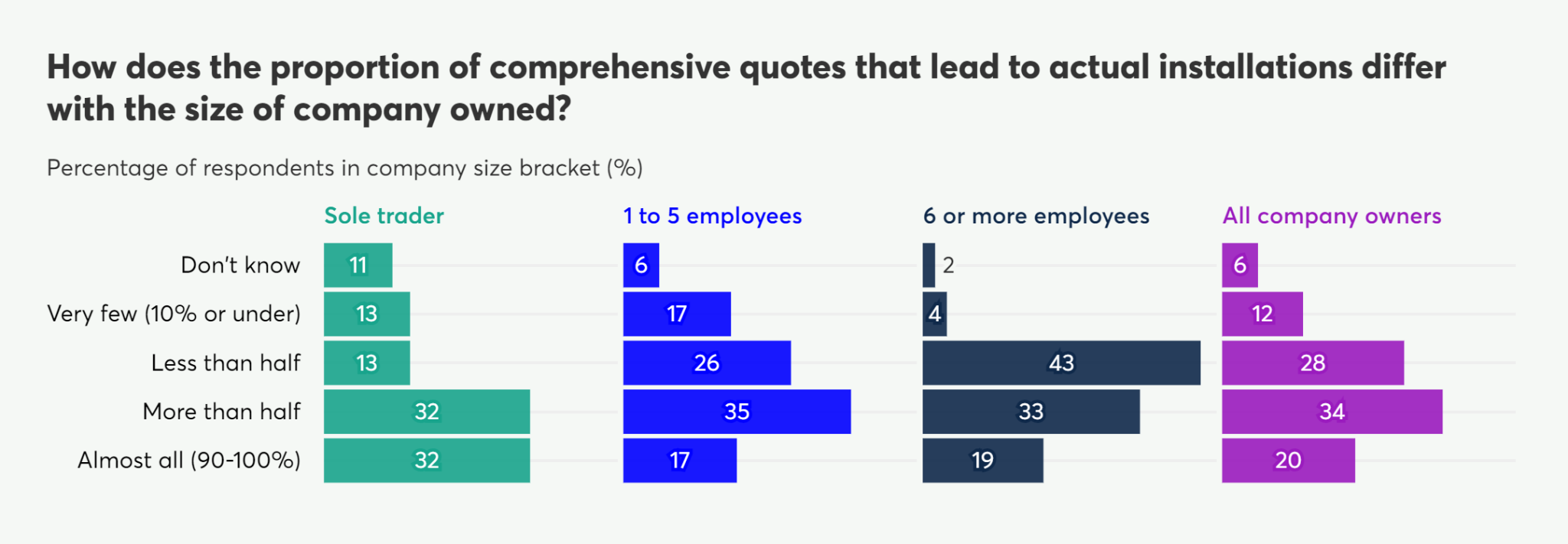
Figure 37: Trend across company owners' proportion of quotes that result in actual installations (sole traders, n = 38; owners of companies with 1 to 5 employees, n = 109; owners of companies with 6 or more employees, n = 54).
Why don't customers progress with installations after receiving a comprehensive quote?
The majority of respondents believe the cost of installation is the main reason why customers abandon their plans for installing a heat pump. Forty-five percent of respondents believe customers think the cost is too high across quotes they've received from all installers and an additional 27% believe customers received a cheaper quote from another company. This pattern is the same across company size, and between company owners and employees and contractors (Figure 38).
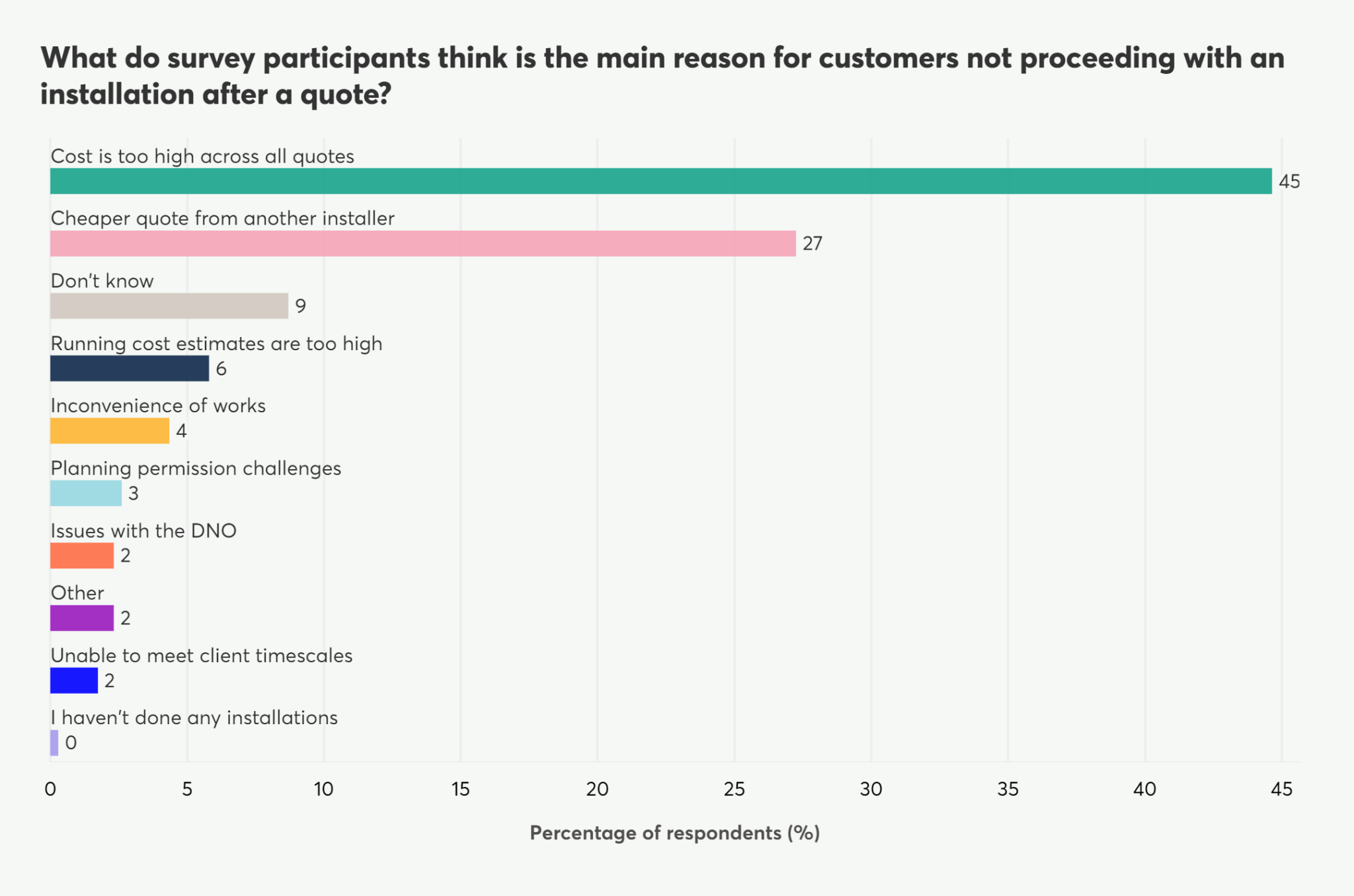
Figure 38: Reasons survey participants think are causing customers to not proceed with an installation after receiving a quote (n = 345).
However, it's not always the customers that decline work. Seventy-nine percent of respondents have declined to work with a customer at some point in their heat pump installation career (Figure 39). The majority of those that have declined work have either done so because they don't want to work with the customer (38%) or because they don't believe a heat pump will sufficiently heat the customer's home (37%) (Figure 39). Over a quarter (28%) have also declined work if they think it'll be too risky for the company (Figure 39).
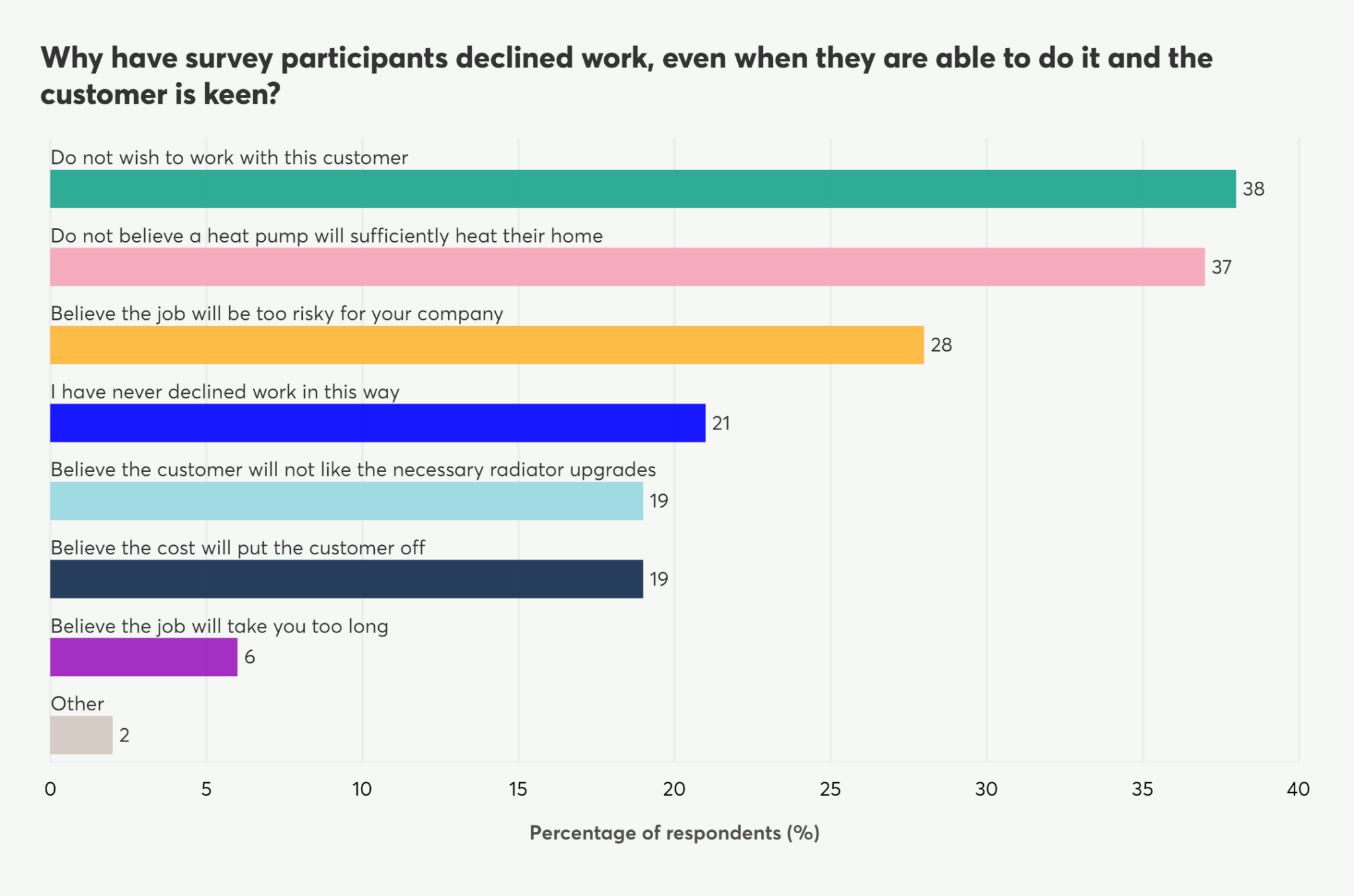
Figure 39: Reasons why survey participants have declined work (n = 345). Respondents were able to select all options that applied to them.
Implications
Many companies may already be able to meet an increase in customer demand.
The majority of companies report never or rarely declining work (Figure 34). This suggests a large proportion of companies are well placed to take on more heat pump installation work with the capacity they're currently operating with. Moreover, if a greater proportion of customer enquiries led to a heat pump installation, it's likely the existing workforce would be able to install them.
Engineers believe the high costs of installation are driving customers away.
Engineers believe potential customers aren't going forward with installations either due to the high costs of installing a heat pump or because they've received cheaper quotes from other companies (Figure 38).
Although there are government-funded grants available to almost all homeowners in England, Wales and Scotland, other finance schemes may help customers with the upfront costs of installing a heat pump. Innovation in finance provision by government or private providers could help customers go forward with heat pump installations.
Companies are declining installations as they don't believe a heat pump will suitably heat a customer's home.
Although studies suggest that heat pumps are suitable for almost all homes in the UK, a large proportion of engineers reported that they've previously declined to progress with an installation as they think the technology won't suitably heat the customer's home (Figure 39).
Assuming many of these homes could be heated with a heat pump, it would be important to further investigate why engineers are declining to work in these homes. If it's related to business risk, it would be important to know how this risk could be reduced, to enable engineers to install more heat pumps.
If it's related to a preference for the type of work engineers choose to do, there's a risk that households that might otherwise be keen and ready to install a heat pump are being turned away, depending on how the rejection is communicated by the engineer. For example, if engineers tell a customer that their home isn't suitable for a heat pump, instead of explaining that they choose not to work on their home, customers may not continue exploring the possibility of installing one with another installer. This would also reduce customer demand for other heat pump installers.
6. Conclusions
This survey and report came about as the result of a collaboration between Nesta's Sustainable Future Mission team and industry experts Emma Bohan, Manager of IMS Heat Pumps, and Nathan Gambling of BetaTeach and BetaTalk. Our collective aim was to uncover the challenges and barriers preventing heat pump installers from installing more heat pumps, and to highlight where meaningful solutions could be utilised to overcome them.
The results of this survey show that engineers want to install more heat pumps, and many may already have the capacity to do so. Many sole traders and companies with one to five employees work primarily with other heating systems, suggesting there's an opportunity for them to substitute this work with heat pump installations. However, there are three key barriers preventing installation companies from increasing their installations:
- time taken on unnecessary tasks or administration
- an inability to find new staff
- a lack of customer demand.
Time taken on unnecessary tasks or administration
Survey responses suggest that engineers are content with the amount of time they spend on the practical installation of heat pump systems, but don't feel they're spending the right amount of time on administrative tasks such as post-installation paperwork, business management, and business administration.
Survey respondents reported needing increased support from both staff and digital tools for these work activities. As respondents currently tend to use digital tools for other work activities, it's possible that those used for administrative tasks, and particularly post-installation paperwork, need improvement. Although digital tools may provide the support needed for many, many respondents also reported that neither extra support from staff nor digital tools would be helpful.
Although obtaining MCS certification has large benefits to engineers, it's clear the associated financial costs and administrative burden is dissuading sole traders and company owners with one to five employees from doing so. Instead, these companies prefer to have their installations MCS certified by using umbrella companies. This suggests umbrella schemes are playing an important role in enabling and increasing the number of heat pump installations completed, especially by the smallest companies.
Finding staff
Although company owners are open to hiring more staff, many sole traders and company owners with one to five employees are unlikely to do so in the next 12 months. Whilst there isn't a common most-wanted skill across companies, employers generally prefer to hire staff with at least three years of experience. This desire for experienced staff could explain why finding staff is one of the top reported barriers.
Supporting employers with taking on and upskilling recent graduates and junior staff is a crucial way to ensure the workforce grows and is able to increase heat pump installations.
However, responses to the survey suggest that employers expect a higher level of practical experience than recent graduates currently receive training in. The results suggest that the training apprentices receive on plumbing and practical elements of a heat pump installation need to be much improved. The results also suggest that there needs to be pathways to support those who have qualifications without work-based learning to find on-the-job training opportunities. This is because the majority of employers reported being unlikely to hire candidates who have qualifications without a work-based learning element.
In terms of taking on and training an apprentice, respondents reported that the main challenges they faced were related to difficulties with finding apprentices that fit the role, the lack of nearby colleges delivering relevant or sufficiently high quality apprenticeship training, and the high cost associated with taking one on. Financial support and improving the training on practical elements of heat pump installation that apprentices receive in college may encourage more companies to take them on.
Customer demand
Survey responses suggest a large proportion of companies are well placed to take on more heat pump installation work with their current operating capacity. However, engineers believe customers aren't choosing to progress with installations because the cost of heat pump installations are generally too high, or because they've received a cheaper quote from other companies.
Although government-funded grants are available to most homeowners in England, Wales and Scotland, additional finance schemes for heat pump installation may also be required to boost customer demand.
Finally, many heat pump companies report declining installations as they don't believe the technology will suitably heat a customer's home. As heat pumps are suitable for almost all homes in the UK, it's important to better understand and address the reasons for why this is happening. Reasons could range from a genuine belief that these homes are unsuitable to a preference of not working in more risky or complex contexts. The support required for this will depend on the underlying reasons behind this.
The findings from across this report will have value to both industry actors and to the government. By foregrounding the voices of those in the know – the installers on the ground installing heat pumps right now – this report illustrates where investment, innovation, government policy and other interventions have the potential to shift the dial, increasing the number and pace of heat pump installations in the UK and accelerating the UK's move to net-zero emissions.
Endnotes
| Work area |
n excluding respondents who selected "This isn't part of my job" |
| Business management |
287 |
| Business administration |
290 |
| Training staff and apprentices |
273 |
| Sales, customer relation and quotes |
292 |
| On-site system surveying |
296 |
| Office-based system design |
254 |
| Emitter output calculations |
272 |
| Ordering/delivery of supplies and monitoring stock |
274 |
| Planning permission process |
183 |
| Practical/physical installation of heat pump system |
292 |
| Commissioning and handover |
292 |
| MCS, BUS, DNO and post-installation paperwork |
208 |
| Servicing and maintenance |
260 |
| Size of company owned |
Work area |
n excluding respondents who selected "This isn't part of my job" |
| Sole traders |
MCS, BUS, DNO & post-installation paperwork |
26 |
|
Business management |
36 |
|
Business administration |
38 |
| 1 to 5 employees |
MCS, BUS, DNO & post-installation paperwork |
77 |
|
Business management |
105 |
|
Business administration |
104 |
| 6 or more employees |
MCS, BUS, DNO & post-installation paperwork |
43 |
|
Business management |
54 |
|
Business administration |
53 |
| Size of company owned |
Work area |
n excluding respondents who selected "Don't know" |
| Sole traders |
Business management |
33 |
|
Business administration |
36 |
|
MCS, BUS, DNO & post-installation paperwork |
32 |
| 1 to 5 employees |
Business management |
92 |
|
Business administration |
99 |
|
MCS, BUS, DNO & post-installation paperwork |
95 |
| 6 or more employees |
Business management |
52 |
|
Business administration |
52 |
|
MCS, BUS, DNO & post-installation paperwork |
51 |
| Work area |
n excluding respondents who selected "Don't know" |
| Cost |
314 |
| Reliability |
319 |
| Ease-of-use |
325 |
| Choice |
321 |
| Functionality |
322 |
58 Victoria Embankment
London EC4Y ODS
+44 (0)20 7438 2500
[email protected]
X @nesta_uk
f nesta.uk
www.nesta.org.uk
ISBN: 978-1-916699-24-3
Nesta is a registered charity in England and Wales with company number 7706036 and charity number 1144091. Registered as a charity in Scotland number SCO42833.
Registered office: 58 Victoria Embankment, London EC4Y ODS.