Authors
Esme Yates, with contributions from Tom Gunter and Sarah Cattan.
About UK 2040 Options
UK 2040 Options is a policy project led by Nesta and delivered in partnership with the Behavioural Insights Team. It seeks to address the defining issues facing the country, from tax and economic growth to health and education. It draws on a range of experts to assess the policy landscape, explore some of the most fertile areas in more depth, test and interrogate ideas and bring fresh angles and insights to the choices that policymakers will need to confront, make and implement.
About Nesta
We are Nesta. The UK's innovation agency for social good. We design, test and scale new solutions to society's biggest problems, changing millions of lives for the better.
About the Behavioural Insights Team
BIT is a global research and innovation consultancy which uses a deep understanding of human behaviour to improve people's lives.
Executive summary
Children born today will be taking their first steps into adulthood in 2040. What will life in the UK be like for them, according to current trajectories? What policy options do we have now that can influence or change that trajectory for the better?
When we started UK 2040 Options in June 2023, with 12 months to go before the general election, we asked more than 60 education experts two simple questions: 'what are the greatest issues facing the education system?' and 'what interventions might best help to address them by 2040?' As education is devolved, we asked experts to consider these issues in relation to England.
The results highlighted the range of challenges facing England's education system, some well-known, some more surprising.
It sparked a year-long dialogue with experts about where there is consensus on the issues and way forward, and where there is fertile ground for new ideas.
With the Education Policy Institute, we set out the fundamental facts about the education system that policymakers need to know. We then worked with experts to dig into the big choices the new UK Government would face. This report focuses on 10 of the most interesting, innovative policy ideas that have emerged during this process.
What follows is not intended as a set of Nesta recommendations, but exciting ideas from some of education's brightest minds, offering food for thought for policymakers looking to innovate in an area of policy that is vital for improving outcomes between now and 2040.
The 10 ideas in this report are:
- Build a professional development system for the early years: raising the quality of training and development early-years practitioners receive throughout their careers.
- Reshape school structures: a single system to run and improve schools: blending the best of the maintained system and the trust-led system.
- Make teaching a 21st-century career: backing innovation in working practices to increase flexibility and reduce workload.
- Decouple the process of mainstream Education Health and Care Plans from special school admissions: enabling mainstream schools to understand and meet a wide variety of learning needs.
- Develop the next generation of integrated family support services: building on Sure Start and Family Hubs, and testing, learning and iterating to continuously meet the needs of users.
- Protect young people's mental health: introducing legislation to create ‘safe phones' for under-16s.
- Expand enrichment to all young people: opening schools from 8am to 6pm.
- Make kinship care the first port of call: allowing children who cannot live with their parents to stay in their family networks wherever possible.
- Revive youth apprenticeships: targeting apprenticeships at young people, and offering a different approach for adults upskilling and reskilling.
- Increase the supply and demand of sub-degree qualifications: introducing exit qualifications after each year of university study.
Introduction
The new Education Secretary refers to her department as the Department for Opportunity, underscoring the central role of education in the new Government's Opportunity Mission. A good education system can break the cycle of disadvantage, grow the economy and create the foundations for happy and healthy lives.
Inequalities often start early in life and grow over time. This means that the people, structures and processes at each stage of education can affect how skills and opportunities are spread across the population. Every phase provides a chance to make a difference – from early years to schools, further education and universities, as well as children's services.
But no matter how excellent the education system is, it cannot tackle inequalities alone. Many barriers to opportunity lie outside the remit of the Education Secretary: poor mental health, poverty and insecure housing all make it harder for children and young people to participate in education.
At the heart of mission-led government is the recognition that the departments, systems and services that serve our communities need to be joined up. For the Opportunity Mission, all parts of society must play a role in helping young people to thrive. But, in the challenging fiscal context, there are tough choices to be made about where to prioritise investment and reform.
As education is devolved, we have considered these issues in relation to England.
Where are we now?
The fundamental facts and trends that underpin the education system offer a mixed picture. Data on progress made in the nation's schools provides what can feel like a rare glimmer of public sector success in recent decades. In the 2022 Programme for International Student Assessment (PISA), which assesses the mathematics, reading and science ability of 15 year olds globally, England made significant progress in driving up standards, ranking 11th for maths (up from 27th in 2009) and 13th for reading and science (up from 25th and 16th respectively).
But these positive results hide deep-rooted inequalities. Children from disadvantaged backgrounds, those with SEND, or those with experience of the care system often fare much worse than their peers. Any headway made in addressing these gaps before the Covid-19 pandemic has been erased: the difference in GCSE results between disadvantaged students and others is now at its widest in 10 years. We also see big differences across the country. In some areas, half of all students did not achieve passing grades in English and maths in 2022.
Every level of the education system is struggling with recruitment and retention of its workforce. The services around it – local authorities, children's social care services, child and adolescent mental health services (CAMHS), SEND support services – are unable to meet the increase in demand for them.
What could a better 2040 look like?
The ideas here set out ways that the UK Government and other parts of society – including local authorities, education institutions, parents, businesses, charities and technology companies – could work together to make a difference for children in England. They range from creating 'safe phones' for children and flexible working policies for teachers, to a professional development system for early-years practitioners.
The ideas fall into three broad categories.
- Stronger foundations: focusing on people, processes and systems to create a more effective, equal and resilient system.
- Outside the classroom: tackling barriers in society, so that children can turn up to nursery or school happy, healthy and ready to learn.
- Boosting skills: creating more routes into skilled employment through youth apprenticeships and a more flexible higher education system.
In this report, we outline 10 specific ideas that could get us closer to this vision.
Stronger foundations
Our experts told us that to improve education outcomes, we need to focus on improving the foundations that underpin every system: people, structures and processes.
Education is a fundamentally human business. It relies on well-trained, motivated professionals, operating in an environment that enables them to focus on the activities that have the most impact on improving children's outcomes. But our system is falling short. Despite recent reforms to professional development for school teachers, the early-years sector is lagging behind. Meanwhile, the emphasis on improving pay for teachers hasn't been matched with a drive to make sure working practices keep pace with other leading professions.
Governance of the school system is in limbo, with half of schools run by local authorities and half by academy trusts, creating complexity, inefficiency and blocking widespread improvement. The SEND system is vital for making sure that every child gets the support needed to fulfil their potential, but is dogged by bureaucracy and stress. This compounded by having to simultaneously dovetail with two incompatible school governance structures.
Here we present four ideas that could strengthen those foundations.
Early years: create a professional development system
What
Provide the early-years sector with a professional development system that replicates and adapts the system created for teachers, driving up the quality of early-years education and care.
Why
High-quality early-years education is crucial for improving children's life chances and closing the disadvantage attainment gap. Disadvantaged children are 18.6 months behind their peers by the time they reach 16 and 40% of this gap already exists by the age of five. The Covid-19 pandemic has exacerbated the issue, leading to more children with higher needs or developmental delays, especially in language and communication.
Early-years workforce
There are just under 350,000 people delivering early education for children aged 0-5 across early-years settings in England. Most practitioners are female and aged between 25-39.
The majority (75%) work in group-based settings, which are private, voluntary or independent nurseries; 16% work in school-based settings and 9% are self-employed childminders who run their own businesses.
There are also ongoing recruitment and retention challenges. More than 80% of settings are struggling with recruitment and almost 60% of nursery staff are considering leaving the profession. As a result, just 17% of settings report being in a position to expand the number of places, with 35% planning to reduce places unless there is more support from government for recruitment and retention.
Recruitment and retention pose significant challenges for the sector. Turnover rates exceed the national average and 64% of providers struggle to meet staffing demands. Low pay is the primary factor, as the sector faces strong competition from hospitality and retail. Most staff work for private providers, which, under the current financial model, limits government's ability to influence workforce sufficiency through pay.
The state of professional development is another key factor. The early years stands in stark contrast to the carefully constructed school teacher development system, where a 'golden thread' of evidence underpins the training and development teachers and leaders receive at every career stage. Course frameworks are developed by an expert advisory group and quality assured by the Education Endowment Foundation. Training is delivered through a tightly managed pool of training providers and delivery partners, inspected by Ofsted and funded at the point of access.
Instead, the early-years qualifications market is an unregulated wild west. There is an overwhelming number of qualifications on the Department for Education's (DfE's) approved list, delivered by a fragmented and unregulated market, leading to inconsistent quality and availability. Practitioners often find the system difficult to navigate and are unclear which opportunities are high quality, accredited, or relevant. There is no agreed body of knowledge underpinning the qualifications, which means students and practitioners across the country are learning vastly different things about how to educate and care for young children.
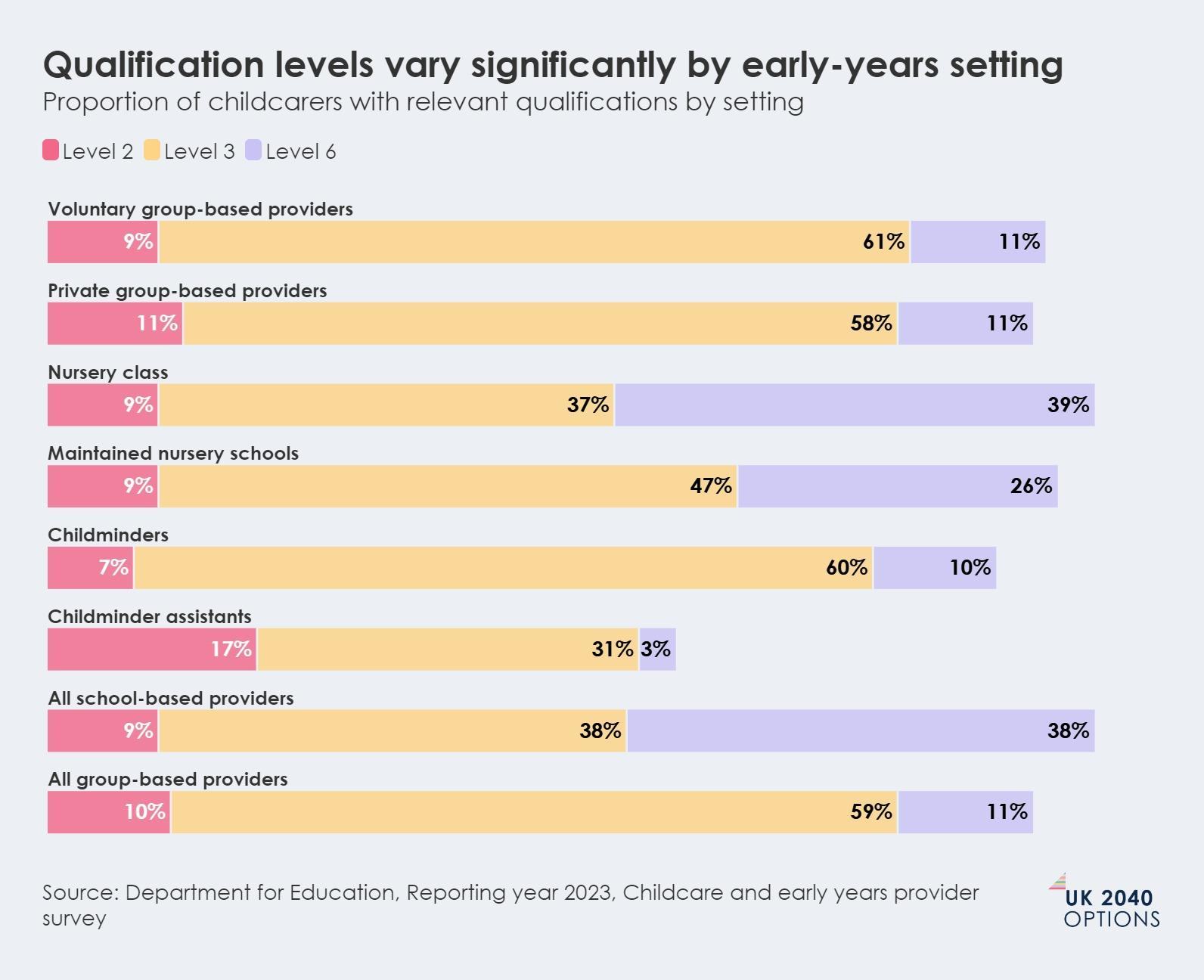
Low entry requirements and inadequate training pathways further compound these issues, and inconsistent induction training across the sector makes it challenging for new practitioners to build expertise at the steepest part of their learning curve. Leadership qualifications, such as the Early Years Teacher Status, are not attractive to potential candidates because they do not lead to enhanced pay, status or conditions of employment, which ultimately means they have limited impact on the quality of leadership in the sector. Financial pressures have led many local authorities to end free training, while providers often lack dedicated training budgets.
How
- Develop a new national progression map. This would outline clear progression pathways, provide a single source of information on career possibilities and establish the associated qualification requirements at each level. The map would set out available training routes and indicate how they can be accessed from different entry points (which is important because of the wide range of qualification levels and work experience).
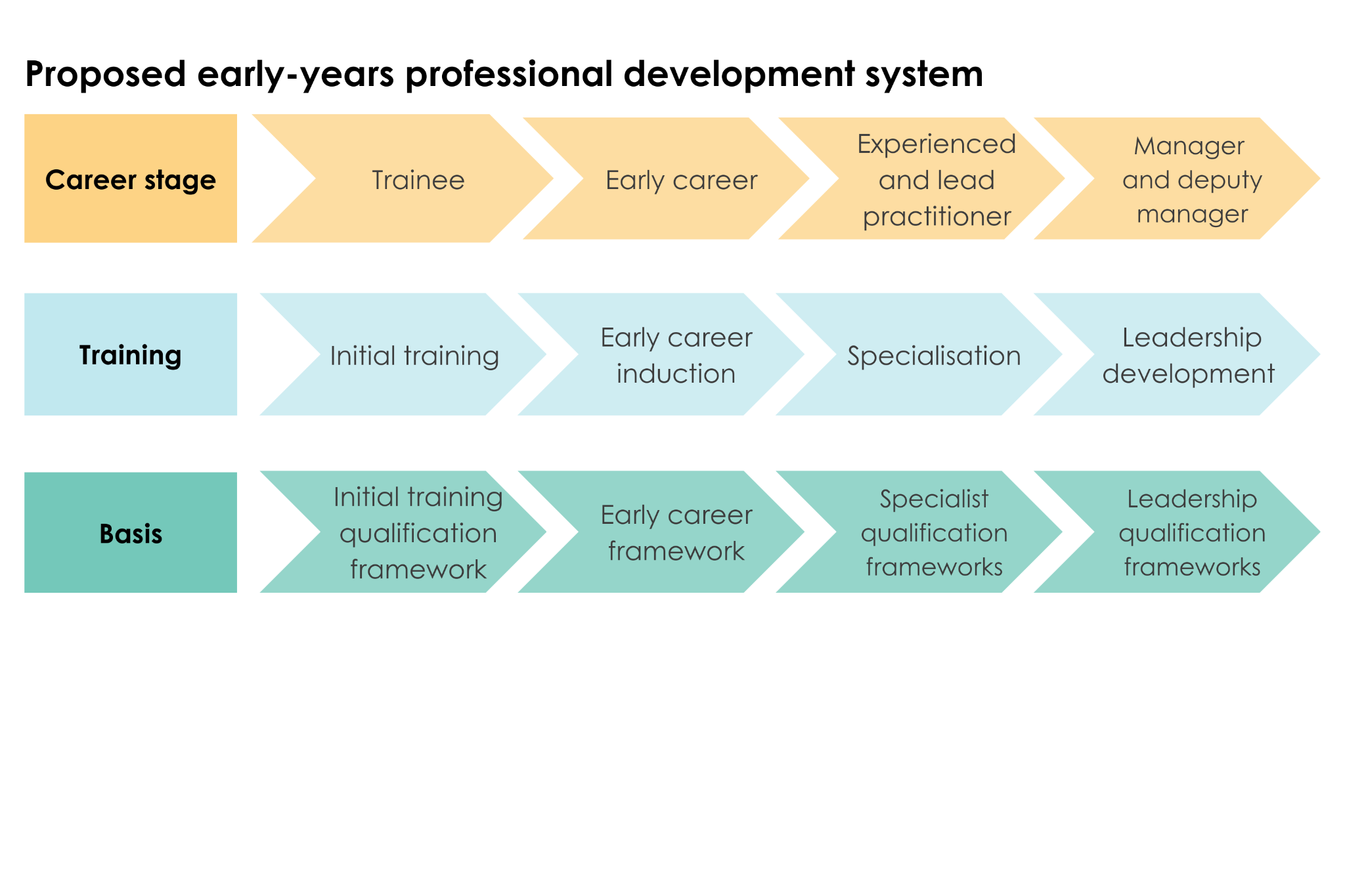
- Establish a core body of expertise. This would define high-quality early education and care, and form content frameworks to underpin the training practitioners receive. Government could task the Education Endowment Foundation with synthesising the international evidence, highlighting evidence gaps and prioritising further evidence generation to address them. In parallel, it could establish a group of leading practitioners and academics to define the practices and behaviours of expert early-years education and care. This expert advisory group – akin to that which advised on teacher reforms – would then develop new frameworks for qualifications, which would be quality assured by the EEF to ensure alignment on evidence on effective practice and grounding in robust standards. This would result in a comprehensive body of professional knowledge to underpin training from initial training through to early career support, specialisation and leadership. The National Professional Qualification (NPQ) for Early Years Leadership serves as an exemplar.
- Build the delivery infrastructure. The government could launch a procurement initiative for lead training providers, including universities, charities and private providers. Providers would be assessed on their course development approach and delivery model, including provisions for sector challenges such as curricula adaptation for a heterogeneous workforce and funding backfill for staff training. A network of delivery partners would be established for national coverage, potentially using existing structures such as teaching school hubs or early years stronger practice hubs. Large nursery chains could continue designing their own training, adhering to the content framework. Ofsted would be responsible for quality assuring lead providers and delivery chains.
- Funding and regulation. To ensure widespread adoption of these new, high-quality qualifications, funding and regulation changes are necessary. The proposed Teacher Training Entitlement could be extended to early-years practitioners, providing fully funded, evidence-based training. Simultaneously, Ofqual could be tasked with de-accrediting qualifications not part of the progression map, simplifying the qualifications landscape for potential and current employees.
Impact and trade-offs
Creating a streamlined professional development system for the early years should improve outcomes for young children, particularly those from disadvantaged backgrounds, by promoting evidence-based practice and ensuring its consistent and widespread use at all levels. Programmes such as the Nuffield Early Language Intervention (NELI) demonstrate the potential impact of evidence-based practice: disadvantaged children gain up to seven months' progress in language skills. For the professional development system to deliver on its potential, government would need to continue investing in programme evaluation and in the scale-up of those that are well-evidenced to fill the evidence gaps about what works.
Clearer progression pathways and associated professional development opportunities should improve practitioner motivation and retention given the clear link between dissatisfaction with training opportunities and attrition. But success hinges on organisational culture: some practitioners value practical experience over qualifications so without proper recognition, additional training requirements could hinder retention.
Delivering nationally approved training through local partners should ensure high-quality content can be accessed across the country in ways that best suit the needs of a diverse sector. Settings of whatever size would be able to be part of a local network, as would childminder agencies and childminders, helping them share knowledge and best practice.
Implementing this policy would require substantial government investment. The government spends around £170 million on teacher professional development each year, but recent budget constraints have led to reduced funding for NPQs, limiting them to teachers in disadvantaged schools only. Although recent government packages to support the early-years sector – such as the one-off £180 million for workforce development in the early years education recovery programme – have been welcomed, this level of investment would need to be increased and sustained.
It would also require some investment from settings, which would fund practitioners' time out. This is challenging when budgets are tight and complicated by staff-to-child ratios. It may be easier for larger chains than small settings and for childminders who often have to access professional development in their own time. Fortunately, there has been an increase in well-evidenced online training, for example NELI, which could alleviate some of this pressure through increased flexibility and accessibility.
Future policy choices will be influenced by the weight government places on expanding capacity in the system versus enhancing the quality of early childhood services. This isn't an either-or situation; it is possible to design a system that prioritises quantity and quality. But pay is consistently cited as one of the top reasons for recruitment and retention challenges. To really make an impact on the supply of high-quality professionals in the sector, investment in professional development would be more effective if practitioners were also better remunerated.
Reshape school structures: a single system to run and improve schools
What
Government could outline a clear vision for – and path to – a single governance structure for the school system, which blends the best of the current two systems together.
Why
England's school system operates as a complex hybrid, split between two primary governance models: half of schools are academies in school trusts, half are maintained by local authorities. This arrangement has evolved without a clear end vision in mind, which is now causing significant challenges for wider policymaking.
What is the difference between a maintained school and an academy?
Maintained schools are funded via their local authority, which retains some responsibility for their performance. Academies are state schools that are funded directly by the government and have additional freedoms around pay, conditions, admissions and curriculum when compared with maintained schools. In reality, many academies do not exercise these freedoms to the full extent – for example, many use local admissions procedures and broadly follow the national curriculum.
Some maintained schools chose to become academies and converted their status voluntarily, while maintained schools that have received two or more consecutive Ofsted ratings below 'good' are required to convert into academies and join a school trust. Free schools are academies set up from scratch. All academies are run by not-for-profit school trusts which vary in size between 1 and ~90.
What is a school trust?
School trusts are charities that run academies. Trusts might run a single school or a family of schools (known as 'multi-academy trusts' or MATs), working in collaboration to deliver high educational standards across the group. School trusts can use their collaborative structure to do things that are harder for standalone schools to do, such as:
- sharing expertise, resources and facilities
- offering structured career pathways, underpinned by attractive pay and professional development for staff
- re-deploying expert teachers and leaders in schools that are struggling
- providing specialist support to schools in areas such as finance, IT, recruitment and building maintenance.
Families of schools also have the potential to achieve economies of scale and be more efficient, meaning more money can be invested in supporting children.
There are now around 2,500 trusts running over 10,000 academies, up from 203 trusts in 2010; 89% of academies are in multi-academy trusts, with the average trust running seven schools.
Arguably, England is slowly drifting towards a fully trust-led system, projected to happen by 2041. However, this is not guaranteed: the easiest conversions have occurred, suggesting that the process is likely to become more challenging. Failing to resolve this challenge for another 15 years risks continuing the disruption in other areas of policymaking, and could mean losing the benefits of maintained schools.
Challenges of the dual system
The current dual system is:
- disjointed between schools and the wider support services they rely on: any policy interventions to reshape the broader landscape of support for young people, for example in improving SEND provision, would likely struggle to simultaneously dovetail with two incompatible systems
- unstrategic: local authorities struggle to manage fewer schools with diminishing expertise, diverting them from critical roles such as supporting vulnerable children
- inefficient: parallel structures increasing costs at every level, and ineffective, as its complexity hinders regulation and innovation
- complex: misaligned powers and responsibilities causing confusion over accountability for school improvement and support for vulnerable children.
These issues collectively hinder the system's ability to provide consistent, high-quality education and support across all schools.
Advantages of the academy system
The most important benefit of the academy system is the ability to resolve an issue of dual failure, where a school is underperforming and its local authority school improvement capability is also underperforming. Before academies, because the only school improvement capability sat in geographically locked local authorities (you could not move a school from one local authority to another), if that capability was poor quality and the school was underperforming, there was no alternative. 'Sink schools' with sustained chronic underperformance stayed that way for decades.
The academy system changed this. It allowed the most challenging schools to be supported by non-geographically restricted school improvement teams in school trusts. These strong trusts have raised attainment in previously chronically underperforming schools in disadvantaged areas. It is their biggest success.
The academy system also has greater financial and reporting transparency, the ability to close collaboration and resource pooling within a single governance structure, and they have been the home of much innovation in curriculum, instructions and assessment.
Advantages of maintained system
The maintained system has benefits too, which are often under-recognised in the debate. Some functions in the school system are easier to do together, across a local area, such as admissions policies.
Maintained schools follow a national curriculum, ensuring that all pupils receive the same entitlement to a broad, knowledge-rich, ambitious curriculum. And, crucially, maintained schools provide a legitimate role for local democracy and communities to have a stake in the schools in their area.
How
Plan for 2030
- Set a deadline for all schools being in a single structure and stick to it. The education system, like the wider economy, benefits from policy clarity and stability over time. Previous governments have failed to provide this, flip flopping on whether to resolve this problem. The system is looking for leadership and pragmatism and providing it should be the first step.
- Redesign the regulatory, inspection and commissioning frameworks. These are crucial for unlocking the benefits of a single governance structure, providing transparent mechanisms for ensuring every school is run by the people best placed to improve it, regardless of geography. Maintained schools are more likely to integrate if they are confident the process will be managed fairly and transparently. Ofsted could provide nuanced performance insights, and the DfE could use its commissioning powers to expand successful school programmes, help struggling schools get support, and intervene where necessary – including by transferring schools from weaker trusts to stronger ones. This approach must gain and retain teachers', school leaders', parents' and pupils' trust, with transparency in decision-making. But, expert commissioners would need to make tough decisions in pupils' interests.
- Increase the supply of high-performing trusts, including via local authority spin-outs. Moving towards a single governance structure requires an adequate supply of strong trusts willing to take on more schools. Existing initiatives such as the Trust Establishment and Growth Fund and Trust Capacity Fund are making a contribution in this area and should be supported.
Regional action is needed, especially in areas with fewer academies, such as the North West. The DfE's regional directors could develop action plans for growing trust capacity, tailored to each region's unique context. A partnership-based approach might make it possible to recruit local authorities as allies, which would enable them to continue advocating for their communities. Local authorities with a track record of providing effective support to schools, and which have retained a relatively large pool of schools, could be enabled and encouraged to spin out their school functions. These new trusts could then take on schools in neighbouring areas. Meanwhile, trailblazer local authorities could be identified for full academisation, getting early access to scrutiny powers in return.
- Phase-by-phase approach, starting with secondaries. 83% of secondary schools are already academies. The DfE's regional directors could be tasked with identifying barriers to conversion for each remaining school and develop tailored action plans within a year. A timeline could be established for every secondary to be on the path to joining the single governance structure by the end of the following school year. This approach is inspired by successful past initiatives, such as Labour's plan in 1997 to cap primary class sizes at 30. It was achieved by breaking down the problem and addressing challenges school-by-school, problem-by-problem. Solutions to common barriers for secondaries could include: creating a matchmaking process for schools unsure about which trust to join, or offering enhanced conversion support with financial and administrative assistance.
- Address primaries next. Only 39% of primary schools are academies. While the vast majority (81%) of non-converted primary schools have considered becoming an academy, almost all (94%) believe there would be negative consequences, with the biggest concern being a loss of autonomy and culture.
This presents a dilemma: schools worry about excessive control from a trust's central teams, but trusts argue that this control is necessary for improvement. As a result, autonomy has shifted from school-level to trust-level. However, trusts vary in their operating models, with some offering more school-level freedom than others. Informing schools about these different models and delegation schemes may address some concerns.
Some schools are also reluctant to lose much valued support from their local authorities, with 40% of primary heads from non-converters describing this as a 'key' reason for not converting. A solution could be allowing high-performing local authorities to create spin-out trusts. This would maintain familiar support for schools while transitioning to the trust system. These trusts would need to be separate legal entities with independent governance to ensure accountability, avoid conflicts, and allow for interventions when necessary.
Then later
- Further reforms to the architecture. The single governance structure, once in place, will inevitably require further evolution of the regulatory and commissioning framework. This could include consideration of proposals for an independent regulator, alongside proposals to devolve powers to combined authorities.
- Piloting the integration of other education phases. Once the above plan has been delivered and a cohesive, functional and unified system populated by strong trusts established, new opportunities would begin to emerge. A single governance structure may provide fertile ground for more concerted efforts to further integrate schools, nurseries and colleges. Government could pilot extending schools' curriculum and teaching expertise to early years and post-16 education.
Impact and trade-offs
It could unblock the barriers to rapid, widespread improvement by increasing coherence and efficiency in the school system. It would provide a mechanism for improvement that doesn't depend on geographical luck. Trusts, rather than external bodies, do the work of school improvement and should be held accountable. This new system could offer a simpler, more transparent structure where resources and expertise are shared, empowering collective improvement.
The pandemic demonstrated the value of being part of a formal school family when facing challenges. This new system should boost resilience through strength in numbers.
A single structure might allow for better policymaking by aligning money, incentives and accountability. It would also create a leaner system with fewer organisations to monitor and regulate. More money could be spent on the children who need them most. It would save time and money by consolidating operational tasks, allowing reinvestment in areas that enhance children's outcomes, particularly in underperforming schools.
However, despite the long-term benefits, these changes would lead to short-term disruptions.
Make teaching a 21st-century career: back innovation in working practices
What
Unleash a new wave of working practices to make teaching a top career choice. Government could back school trusts to lead the way: incentivising innovation and scaling up best practices.
Why
Nothing improves pupil outcomes and closes attainment gaps more than having an expert teacher at the front of the classroom. But there is a shortage of expert teachers in schools, especially in secondary STEM subjects and disadvantaged areas. In 2023-2024, new recruits barely replaced leavers, despite the Government spending £200 million on training incentives and offering £6,000 retention bonuses in some subjects. In 2022-2023, £486 million was spent on supply teachers in maintained schools, a 17% rise on the previous year. No system can improve when 9% of the entire profession leave every year.
In a competitive labour market in 2024, employers must carefully manage workload and offer flexibility to attract and retain staff. And teaching is falling behind: particularly when it comes to workload and working flexibility, where the gap is widening. People join the profession to make a difference, but teachers are being driven out of the classroom.
While the private and third sectors widely adopt flexible practices, many schools don't provide options such as job shares, offsite planning time, and privilege days (such as for weddings and birthdays). Graduates in other fields value working from home as equivalent to a 6.2% pay rise. However, less than a quarter of teachers report that their school has a flexible working policy, and only 3% of school websites mention such policies.
Teaching is always going to be less flexible in some ways than other graduate professions: teachers need to be in the classroom with their pupils. It is also going to be more intense during term time, which is in part offset by longer holidays. Pay and professional development matter too, which is why increases to starting salaries and recent teacher pay deals, alongside sustained investment in professional development, has been welcomed by the sector.
These problems intersect with family life at every stage, and inflexibility hampers retention as well as recruitment. While some believe that teaching is a family-friendly career, women in their 30s are the single largest group to depart from teaching.
Dixons Academies Trust: a nine-day fortnight for teachers
Flexible working in schools is possible. Dixons Academies Trust is pioneering flexible working for staff across its 17 schools, introducing a nine-day fortnight for teachers, giving them one day off every two weeks without reducing student contact time. This innovative approach will be made possible through:
- creative and dynamic scheduling
- new approaches to student grouping
- increased planning, preparation and assessment time, with options to take these from home.
The Trust is also exploring how technology can reduce workload and increase flexibility, including:
- automating administrative tasks
- generating lesson resources and plans
- using AI to reimagine school timetables
- enabling the best teachers to influence more students beyond those physically in their classrooms.
How
- Generate innovation and build the evidence base. School trusts, backed by government, could incentivise a new wave of innovation in working practices to match the innovation in teaching practices the free schools programme unlocked in 2010. They could work with the Education Endowment Foundation to run funded pilots of different working practices, based on emerging learning from its ongoing research theme around recruitment and retention. These would take place across a cross-section of schools and be rigorously evaluated. The most promising approaches would be trialled at a wider scale to create a robust evidence base, making England a world leader in innovative school working practices. Studies should take into account the education attainment in these schools so that pupil outcomes aren't jeopardised.
- Upskill school leaders in effective approaches. Evidence and proven approaches could be incorporated into the DfE's professional development frameworks for school leaders. This would give school leaders the expertise and confidence needed to roll out new working approaches that fit with their culture and values.
- Invest in technology as an enabler. Technology is a crucial enabler of flexible working. It can be used to reduce time spent planning and marking, allow teachers to work remotely during non-contact time, and open the door to new teaching models. At Cumbria Education Trust, for example, small groups of high-attaining Year 6 pupils from each primary school receive virtual lessons from a secondary maths teacher. With technology firms already making inroads into the workplace with AI, government could invest in projects with the potential to streamline teacher workload, as it has done with Aila, Oak National Academy's AI lesson planning assistant.
- Tilt academy trust regulations towards impact on workforce. As the largest employers and with cross-geographical reach, trusts offer the best opportunity for system-wide change. The DfE would need to prioritise staffing outcomes in its expectations for all trusts, building on its framework for high-quality trusts to elevate staff retention to a headline performance metric for trust growth decisions and any new trust inspection regime.
Impact and trade-offs
Creating conditions in which schools, academy trusts and local authorities prioritise staff retention, and innovate to make their schools great places to work, would have several advantages. Flexible working can be good for teachers, schools and pupils. Current evidence, although limited, suggests that flexible working practices can have a positive impact on teachers' wellbeing, work-life balance and job satisfaction. There is tentative evidence that these factors are precursors to retention; where flexible working is offered, teachers are more likely to be satisfied with their jobs and want to stay.
Schools and pupils also benefit. Teaching quality is the best way to improve pupil outcomes, and teacher experience is an indicator of teaching quality. Attracting high-quality candidates to job vacancies and retaining experienced teachers reduces recruitment and induction costs, while enhancing staff capacity and expertise.
High-profile school leaders are already promoting their approaches to flexible working practices, and the DfE produced a toolkit school leaders can turn to. However, policymakers hear less from leaders who are struggling to implement flexible working or not trying at all, for fear of missteps, so resistance from some would need to be proactively addressed.
In primary schools, inconsistent staffing could have an adverse effect on outcomes. While job sharing enables flexible working, teacher familiarity improves effectiveness and supports parent-teacher relationships. However, retaining experienced teachers through flexible arrangements may outweigh potential negative impacts. The key question is whether this trade-off benefits overall pupil outcomes.
Flexible working can only go so far. Post-pandemic, lower school attendance and increased pastoral issues, especially in disadvantaged areas, have intensified teachers' stress and workload. Flexible working alone cannot solve these pressures and might even complicate staff management, potentially exacerbating challenges. Further research is needed to balance the benefits of flexibility against its potential drawbacks.
Decouple the process of mainstream EHCPs from special school admissions
What
Decouple Education, Health and Care Plans (EHCPs) from mainstream schools, and devolve the funding directly to schools or academy trusts so that learning needs can be met more quickly and without the friction and bureaucracy of the current system.
Improve the assessment and identification of different specialist or additional needs, and set the expectation that a wide variety of learning needs can, and should, be met in mainstream education.
Why
The system providing education and care for children with SEND is in crisis. EHCPs were introduced in 2014 to better join up education, health and care services. They aimed to provide accountability and assurance, outlining in writing what should be put in place to meet a child's needs. However, 10 years on, the system is still not improving outcomes for children and is highly challenging for families to navigate.
It is also not sustainable. Since 2014, the number of young people with an EHCP has more than doubled; it is now almost two and a half times the number of statements of SEN - the precursor to EHCPs – in 2010. Today, nearly 40% of young people are classified as having SEND at some point in their school career. And, despite significant funding increases, local authorities are still struggling to meet demand. The high-needs budget – which funds support for children with EHCPs and special school places - has grown substantially over the past decade, rising from just under £5.5 billion in 2013-2014 to over £9 billion today; 40% of this increase has occurred in the last three years alone.
Reform would need to tackle two critical questions.
1. What exactly is the need we're talking about, can we reliably assess whether a pupil has it, and is there a specific and evidence-informed intervention that would support the pupil to overcome it?
The SEND system is too focused on labels. These are often assigned following poor-quality assessments which put pupils into broad and often poorly defined categories of need, without clarity on exactly what intervention (beyond what is offered by a good school and a good home life) will best address the need. This is made worse by the fact that parents who can afford private assessments are able to secure a diagnosis faster, creating a two-tier system. Yet there is also often a lack of rigour in private assessments. This can lead to perfectly normal variations in the rate at which children learn being identified as SEND.
The absence of a collective understanding of what SEND is also means labels are assigned based on arbitrary factors rather than an evidence base. Factors such as when in the year a child is born, what school they attend, or their ethnicity (Black Caribbean pupils are twice as likely to be identified with social, emotional and mental health needs as their white British peers) are more influential in whether they are labelled as having SEND than anything else about them.
There is a common-held belief that securing a SEND label will “grow the cure”, with resultant support expected to solve any challenges a child is facing at school. In reality, labels are used so inconsistently that they often obscure the specifics that underlie a child's challenges, making it less likely that their needs will be met. Labels can also be marginalising and stigmatising, leading to limiting assumptions about a child's ambitions or potential.
The EHCPs which result from SEND diagnoses are seen as a binary: children with one receive support and funding, while those without struggle alone. This exacerbates pressure on diagnoses, with thousands of children waiting longer than the statutory 20 weeks for an assessment, and negative outcomes leave parents feeling desperate. Some families can afford to challenge these local authority decisions through tribunals, which widens the gap between children whose parents can advocate for them, and those who can't. As one trust CEO said: "We need to end the effective arms race... where [parents] feel to get the support their child needs, they have to fight for it."
2. What mechanism would best allocate resources to this need?
The SEND system's current mechanism for allocating resources consists of assessments, decisions taken from those assessments based on a type of local authority tariff (if you have a high level of need as set out by the tariff, you may get an EHCP and specific resources), appeals, and (too often) legal battles in the courts. Local authorities lose more than 98% of these appeals.
This system doesn't work: in part because the assessments aren't sufficiently precise or reliable; in part because the administration of the system consumes vast quantities of the resources that the system has available; and in part because any system that involves legal action will benefit those more affluent parents who can navigate it with the help of lawyers. The EHCP system as it is currently designed allows for unlimited demand — and has actually increased demand — without addressing the constraints of limited resources.
The NHS uses a different model, and it would collapse overnight if it was required to allocate using the same mechanism as the SEND system. The NHS is allocated its budget and it trusts professionals – doctors and nurses – to allocate based on clinical need. There are no legal entitlements, tariffs, or courts involved. A professional, using the resources available, makes a decision about a patient's care based on clinical need.
How
-
Set the expectation that the majority of children, with a variety of learning needs, can thrive in mainstream school through high-quality teaching.
This would require action from school leaders, teachers and government.
School leaders: foster a culture where every child is expected to thrive. Schools become places where pupils with a wide range of learning needs and disabilities can be understood and supported. Teachers would be accountable for the success of all their pupils; in return, leaders would ensure they have access to the training, resources and expert support needed to support diverse learning needs effectively.
Teachers: focus on delivering high-quality whole-class teaching, adapting their teaching for any pupils who need extra support, not just those with a label. As skilled professionals, teachers are best placed to make decisions about how to meet their pupils' needs. Explicit teaching, worked examples, scaffolds and questioning are just some of the evidence-based practices teachers could use to help their pupils learn.
Government: fund high-quality professional development for teachers and leaders at all levels, giving them the evidence-based expertise needed to deliver high-quality teaching for all pupils. This includes the new SENCO National Professional Qualification (NPQ). The content underpinning this training would continue to evolve as the evidence base develops.
-
Devolve all funding currently being spent in mainstream education to schools/trusts, and give them the mandate to decide how to allocate resources. This would remove the battle for resources that parents, schools and local authorities have to go through to secure an EHCP, and the bureaucracy of the current system. Instead, funding could be allocated to schools based on Pupil Premium rates, and school and/or trust leaders would make decisions about how to best use the additional funding. This would be significantly more effective in a fully trust-led system, which would benefit from economies of scale and allow expert staff and resources to be deployed more flexibly across schools.
-
Create a rigorous, evidence-based system for assessing, diagnosing and
supporting children (similar to NICE). Government would need to continue
developing National Standards, outlining effective methods for diagnosing
and supporting pupils with additional needs, based on current evidence.
There should be a shift from overemphasis on diagnoses and assessments to
establishing and implementing best practice for supporting children with
various conditions and learning needs. This approach, similar to NICE's
evidence-based guidance for health professionals, could be developed for
SEND. It would prioritise developing a better understanding of what support
works to meet and accommodate a wide variety of learning difficulties, and
guidance to help teachers implement this evidence-based practice. It could
lead to the end of the generic 'SEND' label.
-
Decouple EHCPs from mainstream provision. EHCPs would no longer be a
mechanism to access funding and additional support within mainstream
schools. Instead, they would be the gateway for a special school place. A
two-stage process could be instituted to decide whether a child needs a
special school placement.
- If parents and the school, having taken all possible steps to address
learning gaps, determine the child needs more sophisticated support, the
local authority should conduct an EHCP needs assessment.
- If the local authority decides that the child would be better supported in a
special school, the child would receive an EHCP. A separate process
would then determine which special school they would attend, which
would take into account the child's needs and what resources are
available to meet them.
Impacts and trade-offs
Inclusive schools, filled with a more expert workforce who have the confidence to
meet a wide range of needs, should improve outcomes for children with SEND. But it
should also improve outcomes for all children. It should create a school environment
where difference is normalised, and where children with additional needs aren't
seen as having something 'wrong' with them.
Removing the bureaucracy of the EHCP system would reduce the administrative
burden on parents, schools and local authorities, and allow those closest to the child
to make decisions about how best to support them with the available resources. It
would end the “effective arms race" by no longer requiring parents to battle to
prove what is 'wrong' with their child in order to get support. Standards would set out
a marker of what support children are supposed to get, and evidence-based
assessments would bring rigour. This should also be fairer; reducing the gap between
those children whose parents can advocate for them, and those whose cannot.
But trust would need to be rebuilt with parents so that they have clarity and
confidence in how their child's needs will be met without a personalised legal
document. In the current system, it makes sense that parents might seek more
specialised provision through an EHCP if their child is struggling. Strong parental
engagement programmes that set clear expectations and maintain good
communication could lead to more transparency and less friction between parents
and schools.
Outside the classroom
When we asked experts what they would prioritise to improve education outcomes
by 2040, many of the ideas put forward did not sit inside the education system at all.
Wider factors such as poverty, children's social care, mental health and their use of
technology came up repeatedly.
This comes as no surprise. Today's young people have the poorest mental health of
any age group, 4.3 million children in the UK are living in poverty, and children who
grow up in care will likely suffer persistent disadvantage throughout their lives. Despite
most social media platforms having a minimum age of 13, 60% of children aged 8-12
have their own profile. And the services that sit around schools are struggling to bear
the weight of demand.
The impact of these issues doesn't stop at the school gates. The education system is
increasingly being asked to pick up the pieces, which diverts time and resources
away from giving children a good education. These barriers need addressing so that
children can arrive at school happy, healthy and ready to learn.
Here we examine four ideas that focus on how all children can thrive not only in
education, but outside of it too.
Develop the next generation of integrated family support services
What
Create a long-term plan for coordinated family support services, optimised by
ongoing testing, learning and iteration.
What are integrated family support services?
Family support services refer to both targeted and open access services that
respond to the needs of families with young children. These include services for
play and learning, community health (such as antenatal and postnatal services),
and information and support on parenting, health, employment and benefits.
Integrated family support services, often adapted to the needs of a particular
community, can offer a central point for families to access such services. This
approach recognises that families' needs are sometimes multiple and complex,
and require a coordinated approach to be tackled most effectively.
Why
Disadvantaged children face significant long-term disparities in education, finance
and health compared to their more affluent peers. This opportunity gap begins early:
by age five, low-income children are nearly five months behind their more affluent
peers developmentally, and by the time they sit their GCSEs, they are a year and a
half behind. Their life expectancy is also a decade shorter, with more years in poor
health and fewer in employment.
The genesis of many of these inequalities is the family environment in their youngest
years. There is a steep socio-economic gradient in aspects of the home learning
environment, such as parents reading and playing with their children. For example,
families where both parents are highly educated spend, on average, nearly 40
minutes more a day on educational activities with their young children, compared to
parents with low levels of education.
More disadvantaged parents are also more likely to suffer from psychological
distress, which can affect relationships within the family, parenting and ultimately
children's outcomes. Less well-off parents also lack the material resources to invest in
educational resources, nutritious food, and safe and stable housing. This has been
exacerbated by the fact that household incomes across the distribution have grown
much slower than in previous decades, and policy changes since 2010-2011 have
reduced support for low-income families.
While the renewed commitment to early intervention through Family Hubs by the
previous government was positive, it falls short of offsetting previous funding cuts. The
initial £300 million annual commitment over three years is less than the original Sure
Start funding, despite Family Hubs catering for a much wider age range (0-19). Family
Hubs currently operate in half of local authorities in England.
While the highly localised approach to implementation has led to welcome
innovation, alongside it are few mechanisms to systematically evaluate approaches
and learn what works, making it much harder to scale success. A new generation of
integrated family support is needed.
The history of integrated family support in England: Sure Start
and Family Hubs
Sure Start, launched in 1998, was the first initiative to support integrated family
support at scale. It targeted children aged 0-4 in deprived areas, through a
network of one-stop shops. Initially, 250 Sure Start Local Programmes (SSLPs) were
created, focusing on open access and user-led services for families in the
bottom third of the income distribution. It was run by central government.
By 2004, Sure Start was rebranded as Sure Start Children's Centres, with a goal to
establish centres in every community by 2010. At this point, responsibility for
provision was transferred to local authorities. At its peak in 2010, there were
about 3,500 centres. They improved education attainment and supported
children with special educational needs, with impacts particularly significant
among children in low income families. Centres that opened under the initial
SSLP phase were found to improve outcomes more.
However, after 2011, Sure Start funding was no longer ringfenced. Local
authorities adjusted to austerity measures by closing centres, reducing their
opening hours or the range of services they offered. Local authorities also gained
more discretion over provision. Many started expanding their services from
children aged 0-4 to older children, and focusing on families with more complex
needs rather than a universal offer.
In 2016, the All-Party Parliamentary Group for Children's Centres recommended
that the government augment children's centres into Family Hubs. In 2021, the
government announced £300 million to roll out the Family Hubs model in half the
local authorities in England. The provision is targeted at areas with highest
deprivation, with a spread across rural and urban areas.
How
-
A national, long-term vision for an integrated system of early-years support. It
would require clear objectives, defined by measurable outcomes and targets.
A holistic outcome framework that reflects at least children's health and
cognitive and socio-emotional developmental outcomes could be used to
establish the targets.
Such outcomes could be defined using the Early Years Foundation Stage
Profile – which set standards for the learning, development and care of
children from birth to five years old – and could also include intermediate
measures of development at earlier ages. It would need to prioritise the
outcomes of disadvantaged children if it is to reduce inequalities, by targeting
areas of higher deprivation.
-
Collaboration between multiple parts of government and local partnerships.
Families' needs don't neatly coincide with administrative boundaries. Joining
up different forms of support for families and children requires working
collaboratively within and across government departments, agencies and
services.
-
Optimising implementation through data and evaluation. Building an optimal
system requires ongoing testing, learning and iteration. The services involved in
supporting families often hold a wealth of quantitative data about their users,
from midwifery records to early-years settings data and benefit eligibility
status. Learning and evaluation mechanisms would ensure services are always
evolving to meet the needs of users, by enabling those running the services to
draw conclusions about what is working (and what is not).
Quantitative evaluations could intentionally test different hypotheses against
each other. For example, while there is high-quality evidence of the impact of
specific interventions as part of Sure Start, we know little about the bundles of
services that are most effective for different families and how they should be
integrated for maximum impact.
User research would help those designing these services to understand what
the users need and how well the services are working for them. Incremental
adjustments could then be made iteratively, constantly improving the services
in response to the data.
Impact and trade-offs
There is high-quality evidence that integrated community-based family support
services can deliver long-term impacts on childhood inequalities that surpass their
costs. In England, the most successful programme was Sure Start; children living near
Sure Start centres in the early 2000s performed better in their GCSEs by 0.8 of a
grade.
The impact on disadvantaged children was even greater: low-income children and
those from ethnic minorities gained an additional three grades, improving their
outcomes from CCDDD to five Cs at GCSE. The centres also improved medium-term
health outcomes: early teens (ages 11-15) were nearly 10% less likely to be
hospitalised if they had greater access to a centre as young children, preventing an
estimated 13,000 hospitalisations and reducing NHS costs.
The educational and health impacts of Sure Start persist well into adolescence,
highlighting that such early interventions not only improve individual outcomes but
also enhance future workforce productivity and reduce public service pressures. For
example, the reduction in hospitalisations offset about a third of Sure Start's costs,
while savings in SEND support offset around 8%. In terms of lifetime earnings, for every
£1 spent on Sure Start, children benefited by £1.09 through improved school
outcomes.
Despite the evidence that integrated family support can have a real impact, these
approaches rarely create cashable savings. In the short-term, they may avoid some
costs, but it will generally take a long time to break even and to generate tangible
benefits in terms of labour productivity. This creates a trade-off for government
between investing in these approaches where potentially higher returns accrue over
a longer period, versus investing in approaches where returns are seen much faster,
but are potentially lower.
Protect young people's mental health: create 'safe phones' for under-16s
What
Government could legislate to create a two-tier phone market: retaining unrestricted
smartphones for over-16s and introducing highly regulated 'safe phones' for
under-16s. These safe phones would connect under-16s to parents, maps, music,
educational and health apps and more, while removing the 'addictive by design'
smartphone functionalities, apps and social media.
Why
Mental and physical health: the number of children and young people with a mental
health condition is rising dramatically. Between 2017-2021, there was a 60% increase
in the number of children aged 6-16 with a probable mental health condition. In
2023, 95% of school staff said they had witnessed increased levels of pupil anxiety
since the start of the academic year. Childline has seen a 71% rise in calls from
children under 11 struggling with loneliness over five years. At the most extreme end
of the spectrum, there has been sharp rise in teen depression and suicide rates since
2010. International evidence shows the same pattern.
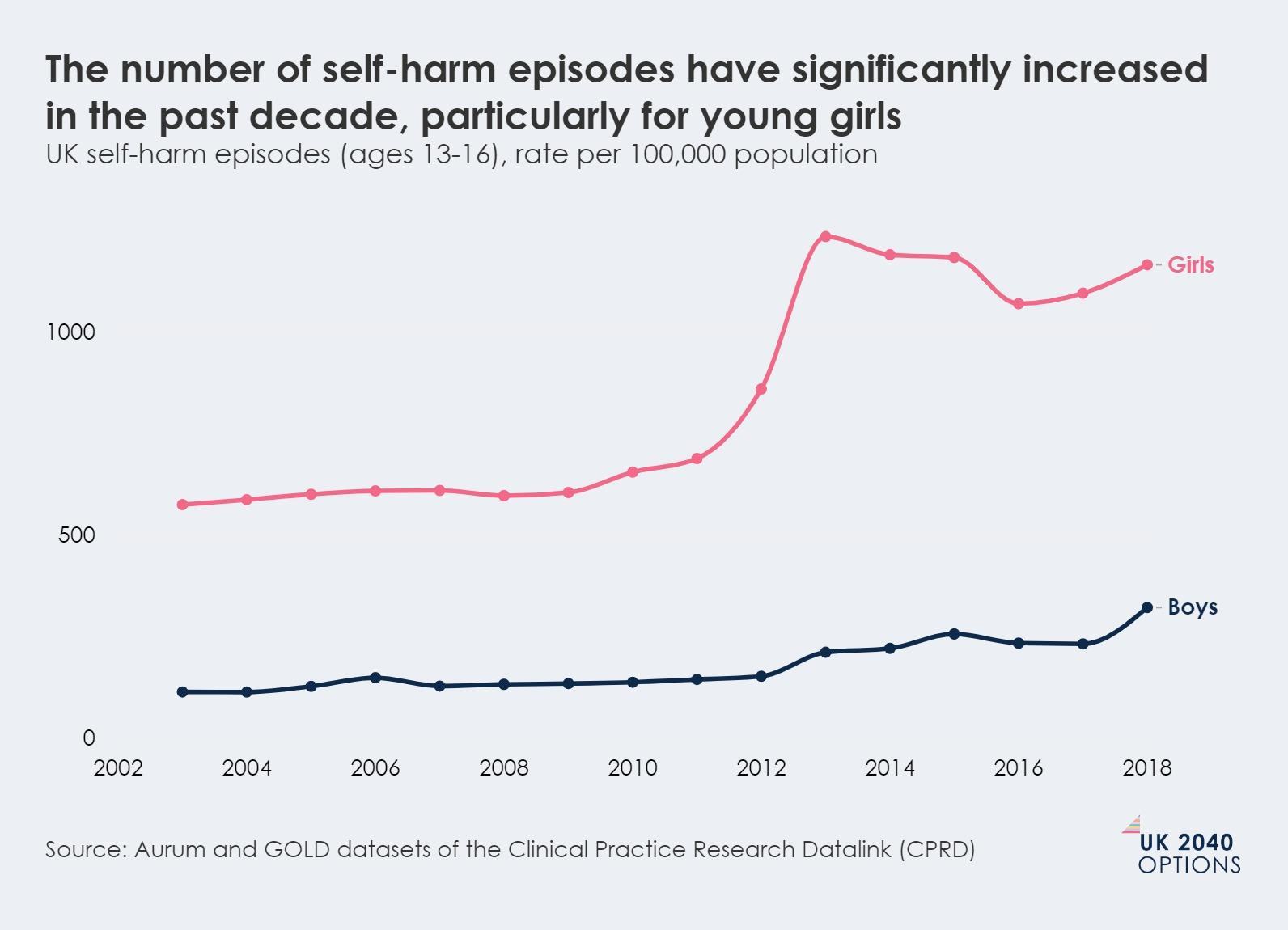 UK self-harm episodes (ages 13-16), rate per 100,000 population
Source: Aurum and GOLD datasets of the Clinical Practice Research Datalink (CPRD)
Professor Jonathan Haidt and colleagues have compiled (and continue to compile)
all the research associated with smartphone use. While causation isn't proven and
the quality of the studies collated does vary, they collectively suggest that the only
plausible explanation for why children's mental health has deteriorated around the
world at the same time is the widespread use of smartphones
But it isn't just about protecting mental health. Children using devices for more than
five hours each day face a 43% higher risk of obesity and are 79% more likely to sleep
less than the recommended eight hours. Screen time is also linked to the
development of short-sightedness in children.
The rise of children's smartphone use
- 99% of children spend time online
- Nearly 25% of five- to seven-year-olds have their own smartphone
- 90% of children own a mobile phone by the time they are 11
- 50% of children under the age of 13 are on social media (despite most
platforms having a minimum age of 13), and 60% of children aged 8-12
have their own social media profile.
Learning and development
Smartphones also have a significant negative impact on
children's academic performance and cognitive development. Constant
task-switching between using smartphones and other activities such as formal
education can harm children's ability to sustain attention, which is essential for
learning. Data from Oak National Academy shows that children stick with lessons for
five times longer on a laptop than they do on a smartphone. According to UNESCO,
it could take up to 20 minutes for pupils to refocus their attention after getting
distracted by their phones.
Smartphones are 'addictive by design', and the mere proximity of a smartphone can
affect school performance: one study found that undergraduate students with
phones in another room outperformed those with phones on their desks or in bags by
11%. Schools that ban smartphones report improvements in performance. John Wallis
Academy, for example, has implemented a robust ban and has seen a reduction in
detention, disruption and truancy as a result.
Serious online harms
Children are regularly being exposed to content that is not age
appropriate, that is sometimes dangerous, and which impacts their understanding of
relationships and sexuality. As the Children's Commissioner stated: "I truly believe that
we will look back in 20 years and be shocked by the content to which children were
exposed."
Ofsted found that nearly 90% of girls and nearly 50% of boys said they had been sent
explicit pictures or videos while the Children's Commissioner found that half of
13-year-olds had viewed "hardcore misogynistic" pornographic content on social
media. The NSPCC has reported an 82% rise in online grooming crimes against
children in the last five years, with 25% of these crimes involving primary-age children.
These findings raise questions about how ‘virtual' harms are treated, and the
effectiveness of current online safety measures, particularly age verification
mechanisms.
Displaced activity
Academics are in dispute about the causal relationship between
smartphones and harms. But there is no disputing that the amount of time children
spend on phones is stopping them from doing other things – reading, socialising,
playing outside, playing sport – which are essential for their development.
How
Pass primary legislation to establish a licensing regime to distinguish between
restricted safe phones and their apps – which would be appropriate for under-16s –
and unrestricted smartphones and apps, which could only be sold, supplied and
marketed to over-16s.
Key aspects of the legislation would include the following.
-
Create an independent body (or extend the remit of an existing independent
body, such as the Children's Commissioner or Ofcom), free from industry
influence and tasked in law with keeping children safe. Have it consult and
collect advice and evidence from experts before setting out, and
subsequently updating, rules defining the parameters for the mandatory
features of a restricted child-appropriate safe phone (for example, absence
of addictive by design functionality; high resistance to 'unlocking').
-
Require manufacturers and distributors to be licenced/approved to produce
and distribute restricted ‘safe' phones and applications for use by under-16s.
-
Prohibit, using both civil and criminal sanctions, the sale, supply and marketing
of unrestricted products to under-16s, with the presumptive onus of age
verification on the supplier as is the case already for tobacco, alcohol and
gambling. Ensure that there is a significant and obvious visual difference
(shape and colour) between a safe phone and smartphone to support this
effort.
-
Set a cut-off age to enable a phased roll-out, similar to the proposed smoking
ban. This would mean children born after a specified year would not be
allowed a smartphone until they turn 16.
-
Require age verification at the point of device set up and in app stores, in
addition to existing requirements for online services to age-verify their users in
the Online Safety Act. Require ongoing dynamic age assurance during
device use to ensure that children are only accessing safe, age-appropriate
content and services.
-
Promote/subsidise trade-in programmes to increase take up and address the
'hand-me-down' issue (that parents typically pass on smartphones to children
rather than buy new devices).
-
Consider developing an accelerated telecoms regulatory approval process,
which would help bring 'safe' devices to market more quickly.
Impacts and trade-offs
This proposal provides a balanced approach. It aims to increase protection of
children in the online world through a pragmatic collective action solution. It
considers how to take the burden off individual parents and schools, while
acknowledging that smartphone technology is here to stay and can benefit society,
children and families.
It will help children to develop healthier relationships with technology. Critics of this
idea may be concerned that reducing children's contact with technology will be
bad for them in the long run: they'll be unable to control their urges once they come
into contact with it. However, it is aimed at protecting children from the risk of
meaningful harms, while empowering families to be able to use the right technology
safely. The young adults of 2040 should be given the chance to have a healthier,
deliberate and non-addictive relationship with technology.
But any solution to this problem needs to consider the following complexities.
The genie is out of the bottle: the world will only continue to be more digitally
connected, and any policy response needs to acknowledge this. This idea should
not be likened to smoking – where the UK Government is planning to legislate for an
outright ban for children – but to road safety, which has benefited from an
ever-evolving programme of regulation such as seatbelts, airbags and traffic
management.
Banning smartphones in schools is not enough: attainment can be adversely
affected by what children see and do outside school just as much as during school
hours. It would, however, be a symbolic first step. There is non-statutory guidance in
place for schools on banning phones, and an increasing number of schools have
announced bans, but many struggle to enforce them. A solution should extend
beyond the school gates, removing the burden on schools to fix a problem that exists
in wider society.
This is a collective action problem: increasing numbers of parents – and schools –
believe that smartphones are harming children, but it is difficult to act in isolation
without the systems (and the support) needed to ensure that children are safer
online. That is why movements such as Smartphone Free Childhood have evolved, to
create a community of support for like-minded parents. This signals that there is a key
role for the Government and Parliament.
It is also a social justice issue: vulnerable and disadvantaged children are more likely
to interact with social media in a harmful way. Many parents and carers lack the
time, knowledge, or resources to effectively manage their children's smartphone use.
If this issue is left solely to parents to address, there is a risk that it will exacerbate
inequalities.
It makes commercial sense that technology companies design addictive products:
they need you to need them. However, there are too many examples of these
companies failing to keep children safe, and government regulations not providing
an effective safety net. The Children's Commissioner recently issued a strong
statement about technology companies' role in online safety, saying “tech
companies continue to downplay children's experiences on their sites” and “we are
letting these platforms off the hook through low ambition and low accountability”.
Market dynamics must therefore be factored in. While technology companies may
initially resist due to potential financial impacts, this idea creates a new market for
child-safe devices, which could experience significant growth and drive innovation
in the sector. This is already starting to happen: in response to the growing demand
for children's smartphone alternatives, manufacturers Nokia and HMD have
launched The Better Phone Project, an open innovation project to design the ideal
child-friendly phone.
Provide quality enrichment activities to all young people
What
Introduce the target that all young people across England can participate in
enrichment activities from 8am to 6pm, Monday to Friday, and give local authorities
the mandate and resources to coordinate and meet demand.
This is an evolution of the extended services in schools programme, which ran
between 2003 and 2010 in England.
What is enrichment?
School enrichment refers to additional educational activities, programmes, or
experiences provided to pupils beyond the academic curriculum. They are
designed to enhance learning, develop skills and broaden horizons – helping
schools develop a whole person.
Examples of enrichment activities include sports, arts clubs, volunteering, social
action and adventures away from home.
Why
Enrichment activities are an important part of a rich and happy childhood, but
current provision is patchy and expensive. This creates a wide enrichment gap
between disadvantaged pupils and their more affluent peers. Young people in the
South East are twice as likely to play a musical instrument and 40% more likely to do
dance than their peers in the North East. Almost half of pupils from the highest
socioeconomic decile attend youth clubs, Scouts or Guides weekly, compared to
just 26% in the lowest decile.
Access to enrichment isn't just a nice-to-have. The rising tide of mental and physical health issues among young people is fuelling an attendance crisis and impacting attainment, particularly for the most disadvantaged pupils. There are well-evidenced links between attendance, behaviour and wellbeing (physical, connectedness, belonging) that can be achieved through enrichment programmes. Enrichment also provides opportunities to let off steam, develop passions and socialise with a diverse group of people.
There are economic benefits, too. Keeping children occupied around the school day allows parents to work more. The biggest gap in childcare provision is for children aged 5-14: three-quarters of local authorities don't have sufficient wraparound care for primary school children, the cost of after-school clubs and childminders has risen above inflation over the last 10 years and more than 10% of parents cannot afford the available options. Half of mothers feel they miss out on a promotion as a result of working around drop-off and pick-up.
Many schools would like to run enrichment activities, but face challenges from ever tightening budgets, teacher workload pressures and difficulty connecting with local partners. Cutting enrichment and subsidised after-school clubs is a common way for schools to reduce their outgoings.
The youth sector has capacity to help, but lacks coordination to identify schools or young people in need. Youth centres provide a space for young people to participate in a range of activities, but over £1 billion in cuts over the past decade has led to a 70% reduction in youth services nationwide. Four in ten councils no longer operate any youth centres, and the ad hoc patchwork of voluntary organisations that have stepped in to fill the gap created by funding cuts often struggle to find physical spaces to connect with young people.
How
- Make local authorities responsible for providing all young people with access to high-quality enrichment. Local authorities would have a duty to coordinate and commission provision in their local area, and the freedom to decide how best to deliver it. Schools and youth sector organisations benefit from intermediary ‘brokers’ to quality assure and manage enrichment, coordinating demand with the available supply.
- Extend school opening hours from 8am to 6pm. Schools are uniquely placed at the heart of their communities, and many have access to, or have their own, halls and sports facilities. Schools would make their spaces available for enrichment and wraparound childcare, with a right of first refusal. Crucially, this should not rely on teachers working longer hours, as charities and community groups would deliver the activities. Where staff are required to be on site (for example for safeguarding purposes), they would be reimbursed.
- Funding and accountability. Local authorities would be funded directly by central government to carry out their duty. Enrichment funding, currently dispersed across small pots held by various government departments, would be consolidated into a single pot for local authorities to draw on. There would be public performance metrics to hold local authorities accountable for ensuring there are a range of high-quality options across the area. The onus on making sure children are taking up these opportunities would rest with schools. Schools could provide the enrichment activities themselves, supported by an uplift in core funding for delivery. In return they would complete a simple data return each term showing weekly pupil participation, with emphasis placed on participation by disadvantaged pupils. Alternatively, schools could use local authority-coordinated options for a nominal per pupil fee.
Impacts and trade-offs
Several evaluations of the extended services in schools programme demonstrate the positive impact this policy could have on children's outcomes. It improved engagement with disadvantaged families and raised attainment, attendance and behaviour. Notably, many schools saw stronger community connections. There’s also evidence that enrichment lowers obesity levels by up to 40%, can lead to improved behaviour and can help develop useful life skills, such as enhanced confidence, resilience and relationships.
It can boost attainment, too: taking part in non-academic extracurricular activities, such as sports clubs, can yield approximately one month’s worth of progress in academic achievement. Involvement in sports, hobbies, art or music can increase the likelihood of progressing to higher education and employment.
There are also huge potential economic benefits to providing free wraparound care for all families. A universal childcare guarantee for all children up to the age of 11 could generate £21 billion for the economy, consisting of £13 billion through increased wages and £8 billion through tax, national insurance and a fall in social security.
However, extending the school day could cause tension with the school workforce, who are already feeling overworked, underpaid and unappreciated. It would be important that teachers would not be expected to bear the vast brunt of this policy, with local authority and external organisations taking the lead instead.
There would be a risk that non-mandatory enrichment would be taken up least by the pupils who need it most; perversely, this would widen the gap that already exists. It would be important for schools to more proactively engage with and communicate the services to those at-risk pupils and their parents.
To achieve this there would be a cost. Existing funding could also be directed here, including programmes already funded by Arts Council England, Sports England for athletic clubs and sports hubs, and from DCMS for youth hubs and community hubs. Many schools also use their core funding or Pupil Premium to deliver enrichment.
Research shows that when schools contribute even a small amount towards services, they tend to engage more seriously and effectively with them. This could play a crucial role in developing the enrichment sector. By slightly increasing schools’ budgets, we could empower schools to stimulate growth in these services through their increased demand.
Make kinship care the first port of call
What
Make kinship care the first option considered when local authorities have concerns about a child’s welfare or when a child cannot live with their parents, and establish a more supportive system of support for kinship carers.
This would shift the dial from cost-intensive late intervention services to earlier support for families. It draws on the independent review of children’s social care, which recommends an expansion of well-supported kinship care in order to improve outcomes for children and families.
What is kinship care?
Kinship care means that children whose parents are unable to look after them on a short- or long-term basis are cared for by other relatives, such as grandparents, uncles or siblings, or by other adults who have a connection to the child, such as neighbours or a close friend of the family.
There are several types of kinship care arrangements.
- Informal: caring for a child without legal responsibility or local council involvement. Parents help arrange it.
- Special Guardianship Orders: a court order making an individual the main carer until the child is 18. They share parental responsibility with the parents, but make most decisions.
- Child Arrangements Orders: a court order allowing an individual to care for a child until 18. They share responsibility, making daily decisions but consulting parents on major ones.
- Family and friends foster care: officially fostering a child as a relative or friend, with the local authority acting as the corporate parent. Foster carers must be approved and assessed and receive paid fostering allowance.
The 2021 Census estimated around 113,000 children were living in kinship care in England. In 2023, there were more than 82,000 looked-after children (who are children in the care of the local authority and could be living with a foster carer or in a children’s home).
Why
Growing up in care often leads to worse outcomes across health, education, employment, offending and homelessness. Nearly 50% of children in care have a diagnosable mental health disorder, compared to nearly 10% of children who are not in care. Nearly 50% of under-21s in contact with the criminal justice system have spent time in care, as have up to 27% of the adult prison population. Educational attainment is also lower: children referred to social care at any point in their childhood are twice as likely to fail an English or maths GCSE than their classmates. Additionally, care leavers are four times more likely to be on benefits, and 25% of the homeless population has been in care.
But inequalities are just as great within the care-experienced population: children in kinship care have better outcomes. They do better in their GCSEs and have better social and emotional wellbeing than children in foster or residential care. They are also more likely to stay with their siblings compared to those in foster care, and report that they feel loved. Adults with a history of kinship care have lower rates of long-term illness, and higher rates of employment compared to those who grew up in foster or residential care.
Local authority budgets are straining under the soaring costs of children’s social care, as it accounts for nearly one-third of council funding. This is driven by a surge in vulnerable children referrals, escalating costs of placements and inadequate central government funding. Over the past 12 years, the number of children in residential care has surged by 79%, while spending has only risen by 61%. The system is skewed towards crisis intervention over prevention, which is more costly and harmful to children: 81% of recent funding increases went to crisis intervention, up from 67% a decade ago, with £4 of every £5 spent on late intervention services.
Despite better outcomes than the formal care system, kinship care is not prioritised or consistently funded. More than a third of councils lack an up-to-date kinship care policy and half of young people aged 11-18 in kinship care experienced multiple placements with other foster carers before settling with their kinship home. The previous government committed to piloting an allowance for kinship carers, matching the foster care allowance in just eight local authorities. Across the rest of the country, it is up to local authorities to decide if kinship carers receive financial support. This creates perverse incentives: kinship carers must choose between having parental responsibility without financial support, or becoming foster carers with financial support but fewer rights.
Most kinship carers live in poverty: a survey of kinship carers revealed nearly half could not pay all their household bills, and over a third could not afford clothes for their children. Many were concerned that their financial situations might eventually prevent them from continuing to care for the children. Although kinship care provides love and stability, growing up in poverty can harm children’s health, wellbeing, and education.
How
The review set out three important policy changes.
1All families should have a legal right to engage in a process to develop an alternative solution to a child going into care. A new pathway should be created to enable local authorities to support and oversee family-led alternatives without the child becoming looked after.
This would require the introduction of primary legislation requiring local authorities that are concerned about a child’s welfare and are considering issuing care proceedings to first seek a solution through a 'family group decision-making process'. This is a way for a child’s wider network to come together and make a plan on how to best care for the child when there is a safeguarding concern.
When a family-led alternative to care is found to meet the best interests of the child, a new pathway would be created through legislation to allow the local authority to coordinate bespoke caring arrangements without the child becoming looked after. It would be treated like any other family arrangement as opposed to an arm of the care system, but with the added oversight of support, monitoring and supervision agreed between the family and local authority to ensure the child’s best interests. Strong governance and accountability mechanisms would be established, including a statutory requirement to regularly review the arrangement.
This would also require changes to the training and development of social workers to provide a more detailed focus on the complexities of kinship care. The proposed early career framework for social workers provides an opportunity to do this.
2If an alternative to care is found within wider family networks, local authorities would divert funding that would have been spent on formal care.
The uses for this funding could range from home adaptations to compensating reduced working hours. It is a strategic financial decision for local authorities to consider the trade-off between upfront spending on family support or higher costs on formal care. This requires changing rigid finance rules to offer flexible support to kinship families. A precedent exists in adult social care, where home adaptations are funded to keep adults at home. Central government must also build capacity and incentives, providing early and multi-year financial settlements to help local governments plan for medium-term efficiencies.
3If a court decides family or friends should look after a child full-time, they would be eligible for kinship financial allowance throughout England, equal to the allowance a foster carer receives.
This requires primary legislation to create a legal duty to provide a kinship allowance. The government would need to introduce guidelines that set out the criteria for calculating payments to kinship carers, and local authorities would be required to promote the allowance.
Impact and trade-offs
Evidence shows these interventions work. Kinship care leads to better outcomes for children than looked-after children. Children who grow up in well-supported kinship care are more likely to have better physical and mental health, employment, behavioural and education outcomes than children who grow up in foster or residential care.
There is also robust evidence that this can help keep children and families together: a recent randomised controlled trial of family group conferencing (a type of family group decision-making) showed children whose families were referred for a family group conference before care proceedings began were significantly less likely to be in care 12 months later than those not referred.
However, it would require the system to think about risk differently. Kinship care requires proportionate oversight mechanisms to ensure child safety while respecting the unique dynamics of family relationships and the normal imperfections of family life. Institutional anxiety about child protection often leads to an emphasis on regulations in children’s services. Striking the right balance is challenging; overly stringent oversight could deter families from participating if they feel the state is interfering in family life. A balanced risk assessment needs to consider the opportunity cost of not opting for kinship care. It should evaluate whether a child is better off with family, despite imperfections, compared to multiple temporary foster placements and residential care, which carry high risks in the long term.
Investing in kinship care could save the Treasury large sums over the next 10 years, but it requires significant upfront investment. It is estimated that for every 1,000 children raised in kinship care rather than the care system, the government saves £40 million. More specifically, the independent review of children’s social care estimated that the new pathway to put family-led solutions first would cost £620 million over the next five years, but could save £733 million in the same period. Local authorities could save a total of £1.1 billion over the next 10 years, seeing a return on investment after three years due to fewer children entering care. Establishing a kinship allowance is estimated to cost around £450 million each year for the next 10 years, while saving between £300 million to £660 million each year. It could result in a positive impact on public finances from year four onwards.
Boosting skills
In today’s fast-changing world, the skills of the workforce are vital to economic stability and growth. However, businesses are facing skills shortages and struggling to fill vacancies because applicants do not have the right skills, qualifications or experience. Our experts were clear that if you were designing the skills system from scratch, it would be unlikely to resemble the current model.
After decades of reform, apprenticeships are still not getting enough young people into skilled employment. The system is employer-led, which means employers design apprenticeships and create the demand themselves. However, the apprenticeship levy disincentivises hiring young people, and too many employers are therefore using it to upskill those with existing qualifications. Without a steady stream of entry-level talent, the country is going to struggle to grow its skills base.
There are also growing concerns about higher education. After significant efforts to widen the pool of people accessing higher education, public commentary suggests that university might not be 'worth it' after all. This is concerning: as AI and technology promise to reshape the labour market, we need more graduates – not fewer – with higher skill levels to solve challenging problems.
However, this cannot be achieved by continuing to stretch the current model of higher education, which is driving universities to the brink of collapse and becoming unaffordable for students. The immersive, expensive, three-year degree is not the only route to higher skill levels.
Here we look at two ideas to boost youth apprenticeships and introduce more flexibility for those who choose university.
Revive youth apprenticeships
What
Encourage employers to use apprenticeships to train young people, offering a different approach to adult upskilling and reskilling.
This idea is proposed by the Gatsby Charitable Foundation.
Why
Apprenticeships are an effective route into skilled employment for young people. Government benefits because apprentices are starting to pay tax and training costs are largely covered by employers. Apprenticeships give businesses the skills they need to grow. They reduce youth unemployment. They give young people opportunities for rewarding careers.
However, despite significant political attention and reform, we’re still a long way from realising this vision. There has been a significant drop in the number of young people starting apprenticeships and employers are left frustrated by the apprenticeship levy.
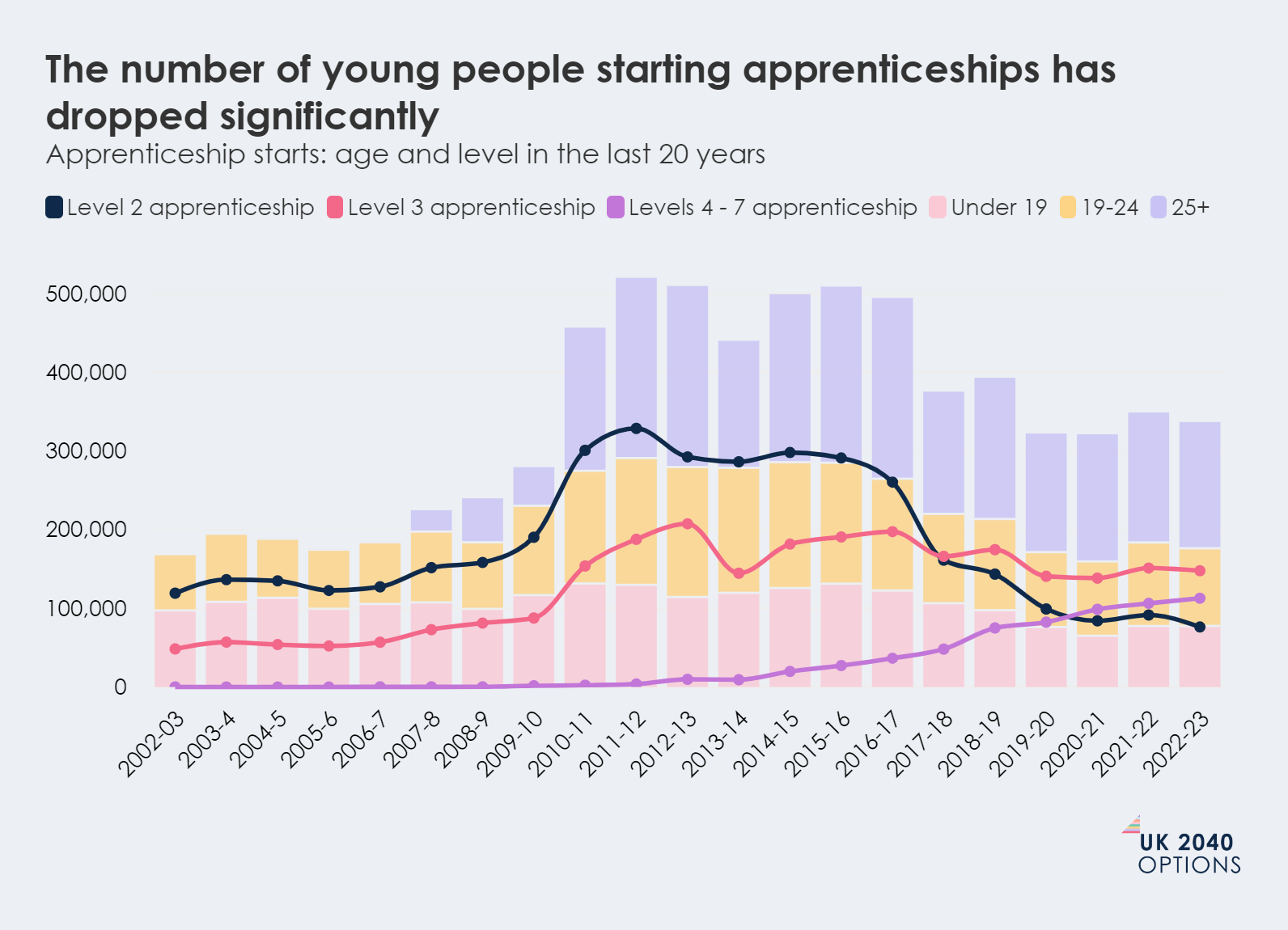
The age and skill profile of those who do take up apprenticeships has also shifted. In 2004, the age cap was removed, enabling over-25s to take up apprenticeships. The number of adult apprentices increased further after the government-funded initiative, Train to Gain, ended in 2010. Significant numbers of working adults began taking shorter and lower-level apprenticeships in sectors, such as retail, that had not traditionally offered apprenticeships.
The shift was a concern to Doug Richard. And so in his 2012 Review of Apprenticeships he recommended that they “should be clearly targeted at those who are new to a job or role that requires sustained and substantial training. Training and accreditation of existing workers that are already fully competent in their jobs should be delivered separately; as should provision aimed primarily at supporting entry into employment.”
This guiding principle of the Richard Review seems to have been forgotten in the policy changes that have followed.
In 2017, the apprenticeship levy was introduced in response to concerns about declining employer investment in training. It is a tax on UK employers that funds an annual apprenticeship budget of around £2.5 billion for England alone and pays for the off-the-job training of all apprenticeships, whether with levy paying or non-levy paying employers. But employers and other stakeholders suggest it is not working. Employers also have employees who do not have the right skills for the role they are in. According to the 2022 Employer Skills Survey, 10% of employers have a skills shortage vacancy and 15% of employers have at least one employee who does not have the necessary skills for their role. But despite this, employer investment in training continues to fall.
For much of the last decade apprenticeships have been the only substantial form of publicly funded training available to adults. Because of this, many employers have tried to use apprenticeships to solve all their upskilling and reskilling needs. A CIPD survey found that 76% of employers used their levy funds to convert existing management or leadership training programmes into apprenticeships. It has also led to employers creating apprenticeships for occupations that in other countries would never be an apprenticeship.
The levy has also led to increasing numbers of apprenticeships. There are now more than 700 different apprenticeship standards, which is more than any other country. In addition, around 20% of these standards allow for different occupational specialisms (524 in total). The proliferation and complexity of apprenticeship standards is a real risk to the system, because:
- large numbers of different apprenticeship standards makes it harder to ensure rigour and quality
- apprenticeships become too narrow – reflecting specific job roles rather than occupations – and do not provide the transferability that justifies public funding
- employers who have not been involved in the development process cannot identify which apprenticeships are most appropriate for their skills needs
- training providers find it challenging to meet demand for the off-the-job element of many different apprenticeship programmes.
In other countries, employers and unions work together to ensure that there is the right balance in the breadth and depth of training so that it meets the needs of both the employer and the apprentice. The unopposed voice of employers in the English system has led to some narrow and very specialised standards that are not suitable for apprenticeships.
The rising number of young people not in employment, education or training (NEET) and skills shortages in key sectors of the economy are barriers to growth.
How
The new UK Government has indicated that it will use Skills England to identify qualifications that the levy could be spent on, rather than the levy being used solely for apprenticeships. The same approach could be used to increase apprenticeships targeted at young people, by restricting the occupations the apprenticeship element of the levy can be used for.
The key change to apprenticeships that followed the Richard Review was that the training became occupationally focused. Using the Standard Occupational Classification (SOC), occupational standards can be mapped to the labour market. It is then possible to identify which standards are particularly suited to young people by:
- comparing the occupations with those in other countries where youth apprenticeships are predominant
- using labour market information to identify where there is a high prevalence of younger workers, for example, 42% of all bricklayers are aged 16-24
- using vacancy data or the US occupational database O*NET to explore what experience is needed for an occupation and the level of training required.
Skills England could carry out these analyses and create a list of occupational standards that would be eligible for apprenticeship levy funding. Skills England could also assess whether the selected standards are broad enough to provide a springboard for apprentices at the start of their career.
The concept of occupational competence is critical to technical education and is one of the ways that it differs from academic education. Occupational competence is, like a driving test, a pass or fail criteria-based assessment. The criteria of what counts as competence needs to come from the employers in the sector, and getting this right is important for all future employers of the apprentice.
The confirmation of occupational competence through an end point assessment (EPA) is similar to the examinations seen in other countries with strong apprenticeship systems, such as Austria, Norway, Germany and Switzerland. Skills England should undertake an analysis of how these examinations work to see how EPAs in England can be simplified and potentially made cheaper.
In these countries it is possible for an adult with an appropriate level of experience to take the same examination as an apprentice and be awarded the same qualification. In England, this would mean making the EPA standalone, so young people would achieve the diploma by completing an apprenticeship, whereas adults would complete only the training they needed to pass the EPA. This additional training and assessment could be paid for from the non-apprenticeship element of the levy, but could be done at lower cost and with far greater flexibility for the adult and for the employer.
It is also inconsistent that the state pays for the education and training costs of classroom-based 16-18-year-old students, but employers have to pay for training an apprentice. The government could instead meet these costs from general taxation. This will not only reduce costs for employers, but it may also significantly reduce bureaucracy, which may encourage more small businesses to take on apprentices. The government could consider including apprenticeships in the approved training category for child benefits.
Impact and trade-offs
Currently, apprenticeships are being used to tackle the problems of there not being enough skilled workers, and of workers not having the right skills for their roles. Smarter use of the levy would make it possible to provide more targeted initiatives that will help reduce the scale of both these problems.
The issue for youth apprenticeships is the supply rather than the demand; there are large numbers of young people who would take an apprenticeship if they could get one. The number of apprentices in the economy is the result of decisions made by employers. The changes proposed here will encourage employers to take on younger apprentices. However, it is also important to keep in mind that the levy only pays for the off-the-job training and there are other costs associated with an apprenticeship.
In other countries, apprenticeship salaries are often set by employers and unions and are initially lower than the equivalent apprenticeship salary in England, but the salary rises as the apprentice gets closer to occupational competence. A London Economics study found that, in England, apprentices were paid around 50% of the equivalent skilled worker wage throughout their apprenticeship, whereas in Germany the apprentice’s wages was around 25%. These differences are in part driven by the number of adult apprentices in England. German apprenticeships are also longer, generally lasting three or four years compared to an average of less than two in England. Longer apprenticeships means that firms can recoup their investment in training before the apprenticeship is completed. The recent increase in the minimum hourly wage for apprentices in the UK may have been well-intentioned, but it will make apprenticeships less attractive to employers.
Research has highlighted the substantial costs associated with taking existing members of staff away from their day jobs to train an apprentice. This is particularly true at the start of an apprenticeship when the apprentice is unable to make a significant contribution to the productivity of the firm. The costs are such that if the firm cannot keep the apprentice after their apprenticeship is completed, they risk making a substantial loss on training and the firm will not benefit at all. In Germany, apprenticeships are more attractive to firms partly because taking on an apprentice and training them is less risky than recruiting an unknown worker who would then be difficult to dismiss due to workers’ rights. If the new government improves the rights of workers, employers may find youth apprenticeships more attractive.
Employers are sometimes reluctant to train because they are concerned that other companies will poach their trained workers and their investment in skills will be wasted. Government should not fund non-transferable firm-specific skills training, but rather focus on using funds to reduce the risk to employers of developing and accrediting general occupational skills that are of value to all employers.
Nationally agreed standards would need to underpin any government investment in skills, whether the money comes from the levy or general taxation. IFATE’s framework of national occupational standards is a good foundation but it would need to be used more flexibly if we are going to solve the skills issues in the economy.
Increase the supply and demand of sub-degree qualifications through exit qualifications
What
Every university student could receive a qualification at the end of each year of full-time study. This differs from the default model for higher education, which is to study for three years to achieve an undergraduate degree.
To achieve this, government would restrict entitlement to student loan finance to courses offering these exit qualifications at level 4 and level 5, and implement the Lifelong Learning Entitlement (LLE) in full, with some changes made to increase flexibility.
A new labour market for level 4 and 5 qualified workers would start to emerge. Reinvigoration of these qualification levels would shrink the current gap between level 3 and level 6 outcomes for students, reduce the social divide between graduates and non-graduates, and lift more people into higher-skill occupations as the labour market evolves.
What is the Lifelong Learning Entitlement?
From September 2025, the LLE will combine the publicly funded student finance systems for further and higher education courses: higher education student finance loans and Advanced Learner Loans in England.
The LLE will provide individuals up to the age of 60 with a loan for four years of post-18 study, usable throughout their lifetime. It aims to help people adapt to changing workplace skills and employment patterns.
Key features:
* supports flexible study options
* allows funding for specific modules and full years
* enables credit transfers, part-time learning and for studying to be spaced out.
Some of the ways this could impact higher education:
* more modular and flexible course structures
* increased multi-provider and interdisciplinary study
* greater focus on modular learning versus complete qualifications.
Why
For many, going to university after school or college is a rite of passage and, after decades of progress to widen participation in higher education, more young people have graduate parents encouraging their aspirations to go to university.
However, 40% of students wish they had chosen a different course or university (or both) once enrolled. They are increasingly choosing their course for the anticipated value of job or career prospects afterwards rather than love of their subject, are daunted by fees and levels of post-graduation debt and struggle with maintenance loans that have failed to keep up with the cost of living. A quarter of students work significant hours alongside their studies to make ends meet, diminishing the student experience.
The beginnings of depressed demand for higher education from young people and mature students alike is accompanied by frequent public commentary suggesting that university might not be ‘worth it’ after all, encouraging young adults to consider alternatives, such as apprenticeships and sub-degree qualifications at level 4 and 5.
Supply and demand for level 4 and 5 qualifications have languished over recent decades despite evidence that students get excellent employment and salary returns from sub-degree level qualifications. Arguments that there is no demand for sub-degree level qualifications reflect the fact that there has been a dwindling supply of programmes after the polytechnics became universities post 1992, and funding for full degree programmes improved. Further education colleges increasingly saw their level 4 and 5 programmes rejected in favour of university degrees, while universities were able to argue that there was no demand for such programmes.
The current uptake of level 4 and 5 qualifications is so low that, with increasing demand for higher level skills in the labour market to drive growth and productivity, a growing rationale for people to reject a traditional university education without clear alternatives could be disastrous for the economy and for human flourishing.
The enduring model of a three-year, residential degree, mainly for school or college leavers, is starting to look outdated.
A new approach to post-compulsory or tertiary education would reinvigorate demand, provide industry with the skills it needs, and underpin the government’s commitment to increased productivity and growth. And because 75% of the 2035 workforce is already working, it is vital that any new approach works not just for young people, but also for older, working people, so they can upskill and re-skill. At a time when the sustainability of universities is under threat, following years of stagnant funding rates, new offers to attract a different cohort of students could provide a lifeline.
How
This idea envisages a medium- to long-term strategy that would change the way people engage with higher education, diversify pathways to higher level qualifications and regenerate demand for level 4 and 5 qualified workers.
- Mandate universities to offer exit qualifications at the end of each year of study. This could be implemented by making the offer of annual exit qualifications a condition of tuition and maintenance funding through the Student Loans Company. The qualification would reflect what the student had learned and achieved that year – for example, level 4 after the first year, level 5 after the second (a full degree is a level 6 qualification).
- Full implementation of the LLE, with smaller credit requirements. This should increase the diversity of the courses higher education offers, and drive more agile responses from universities towards evolving skills needs. In parallel, funding incentives for universities, colleges and students would be needed to increase engagement with new patterns of higher education, allowing students more flexible choices to work while studying and/or accumulate credit at one or more levels.
- High-quality information and guidance for potential students. This would be vital to ensure that students get value from their studies and make choices that support options for further progression in careers or study. Data collection and analysis would be needed to evaluate the policy’s impact on skills development, students’ interests and employer needs. Arguably, this should ensure that it is in providers’ interests to be aligned to their students’ best outcomes.
- Adapt funding models and regulation to meet this flexibility. As well as implementing the LLE in full, funding models would need adaptation in acknowledgement of the higher costs associated with shorter recruitment and marketing cycles, and increased student support needs. Professional, Statutory and Regulatory Bodies (PSRBs) would need to reconsider accreditation, licence to practise and membership criteria to match changing patterns of higher education and qualification attainment. Changes to regulation and quality assurance would also be required to support coherence and positive outcomes for students undertaking their studies in a less linear fashion.
Through shifting towards this model, universities would start to differentiate their offers by offering alternate models of higher education – for example, more condensed study to achieve level 5 in one year or 18 months, smaller modules of study offered in part-time roll-on, roll-off patterns allowing students to undertake meaningful work while studying and powerful articulation agreements with further education colleges.
Impact and trade-offs
This relatively simple, low-cost proposal to mandate exit qualifications at the end of each year of higher education study should create a healthy supply and demand arc for level 4 and 5 qualifications, provide positive choices for students, address anticipated skills gaps in the economy and prevent higher education once again becoming the preserve of the affluent.
It is also an effective way to phase in the LLE rather than expecting an immediate full shift towards stackable short courses – a more radical change for both providers and students. With more students moving between institutions and courses on their journey to a degree, a quasi-credit transfer model could evolve more organically, with lower risk and without the painful arguments about whose credit is transferable where, or indeed about who holds the credit control.
It would also have a number of benefits for students. Anxious about the time and financial commitment needed to pursue a traditional degree at university, students would be able to pursue their studies one year at a time. This has the potential to significantly increase demand for post-compulsory education and widen participation to groups currently underrepresented. At the same time, students who come to regret their choice of course or institution would be able to switch to an alternative course for year two and/or year three of their studies.
Alternatively, students could enter the workforce after a year or two of studies with a level 4 or 5 qualification, receive workplace experience and refine their requirements for further learning, before completing a full degree. Currently, a student who drops out of higher education after one or two years’ study receives no qualification but will carry the student loan obligations to repay tuition fees for up to 40 years. Students considering dropping out mid-year would be more likely to complete at least a full year of study.
This intervention does not interfere with the market for full degrees, but does create the conditions for a balance of supply and demand for sub-degree level qualifications to evolve. At a time when the sustainability of universities is under threat following years of stagnant funding rates, new offers to attract a different cohort of students could provide a lifeline.
Students and providers making full use of the LLE would create a market in diverse forms of skill development and higher education models, engendering fruitful competition between providers driven by student and employer demand. The three-year residential model of higher education would start to lose its market dominance, resulting in a creative diversity of higher education offers, more clearly articulated pathways through FE to HE, and better choice for students and employers with more price competition. The pressure on public finances to pay for the higher skill levels needed in the economy is stretched over longer time periods, thereby becoming more affordable.
Conclusion
The 10 ideas in this report were suggested, tested and debated with us by the education experts we have engaged with over the past year.
Each one aims to make a positive difference to the lives of children and young people going through our education system. But the new Education Secretary is starting from a challenging position, and urgent action is needed to turn the dial.
UK 2040 Options began in June 2023 – posing the question of what life in 2040 will be like for children born today. We hope that these collections of ideas will provide some inspiration for how we can pave the way to a better, brighter future.
Acknowledgements
We thank David Halpern for his contribution to this work, Lord Gus O’Donnell for sponsoring the UK 2040 Options project, and Matt Hood OBE for his guidance and expertise on this report.
We also thank following for their time and insight on these ideas:
Dr Sara Bonetti (NDNA), Helen Burrows, Mary Curnock Cook CBE (for the higher education idea), Naomi Eisenstadt CB, Claire Fernyhough (Smartphone Free Childhood), Dr Julian Grenier CBE (EEF), Daisy Greenwell (Smartphone Free Childhood), Laura Jones (Nesta), Ben Kingsley, Eva Kolker (BIT), Doug Lemov (Teach Like a Champion), Josh Macalister OBE MP, Damian McBeath (John Wallis Academy), Kelly McBeath (John Wallis Academy), Laura McInerney (TeacherTapp), Loic Menzies (University of Cambridge), Ndidi Okezie (UK Youth), Carey Oppenheim (Nuffield Foundation), Will Orr-Ewing, Baz Ramaiah (CfEY), Tom Rees (Ormiston Academies Trust), Daniel Sandford Smith (Gatsby Charitable Foundation, for the apprenticeships idea), Luke Sparkes (Dixons Academies Trust), Tom Symons (Nesta), David Thomas OBE (Axiom Maths), Nick Worsley (EEF), Will Yates (Public First).
Their inclusion here does not mean they agree with all the ideas within this report.