Would performance guarantees increase consumer confidence in heat pumps?
 www.nesta.org.uk/project-updates/would-performance-guarantees-increase-consumer-confidence-in-heat-pumps/
www.nesta.org.uk/project-updates/would-performance-guarantees-increase-consumer-confidence-in-heat-pumps/
www.nesta.org.uk/project-updates/would-performance-guarantees-increase-consumer-confidence-in-heat-pumps/
When installed correctly, heat pumps are highly efficient. But press coverage of underperforming systems has fed a perception that getting a heat pump is risky - and for some households, this is enough to put them off.
The concern isn't completely unfounded. While public data on heat pump performance in the UK is growing, it’s not yet comprehensive. Some sources, like HeatPumpMonitor.org and Octopus Energy’s new monitoring dashboard suggest high average performance across cohorts of heat pumps. In contrast, the government-funded Electrification of Heat Demonstration project found that heat pump systems were often less efficient in practice than they were designed to be. Although every system certified under the Microgeneration Certification Scheme (MCS) must be designed to deliver at least 2.8 units of heat for every unit of electricity, there is currently no process in place to check how the system performs once installed.
Performance guarantees could potentially help solve both problems: giving consumers greater confidence to choose a heat pump and providing incentives for high-quality installations. Stronger assurances could also reduce the risks for other decision-makers. For example, we have heard that freeholders and property management companies might appreciate a guarantee that letting residents install a heat pump will not cause problems down the line.
Some larger installers have already started offering performance and/or comfort guarantees as a way to differentiate themselves and reassure prospective customers. We wanted to explore whether something similar could be expanded - voluntarily or by mandate - across the whole market.
We set out to test whether an industry-wide performance guarantee could improve installation quality and boost consumer confidence. In the Nesta spirit of speed-testing - sketching out an idea rapidly, rather than mapping every possible barrier - we focused on four questions:
We spoke to nine heat pump installers of different sizes to understand how performance guarantees would impact them, what benefits they see and what concerns they have.
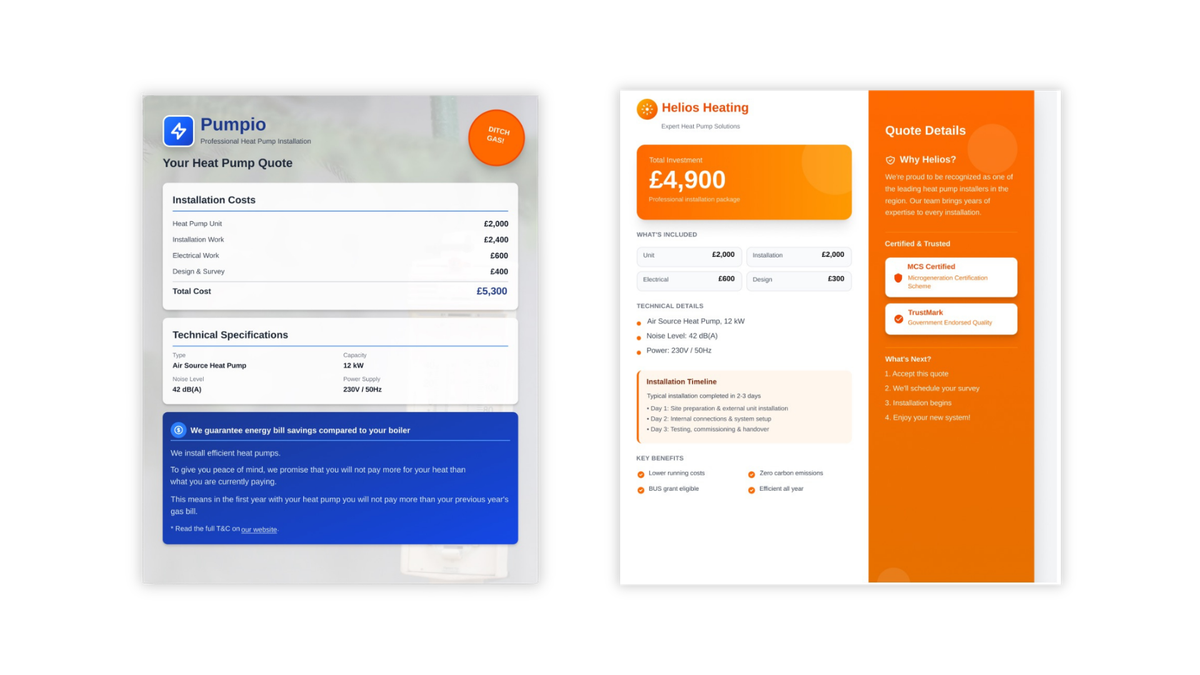
We interviewed 10 people who either had heat pumps or have seriously considered them, using the simple mock-ups of guarantee offers and of monitoring dashboards as shown below. We tested their reaction to guarantees and explored their concerns and questions. We also ran a survey (n=200) of the general population on those topics.
Summary:
We looked at several framings for a guarantee:
| What it is and why it’s useful | Possible issues that we explored | |
|---|---|---|
| Efficiency | Efficiency is captured by two related metrics. The seasonal coefficient of performance (SCOP) is calculated by manufacturers and estimates how many units of heat the system should produce per unit of electricity over an average year. Seasonal performance factor (SPF) is the equivalent figure measured once the system is running in the home. | Depends on choices made at the design stage, installation quality, weather conditions, and how residents operate their heating. |
| Total electricity used | Depends on efficiency and usage, including chosen set temperature. | May be difficult to interpret. |
| Heating costs | Could be framed as a monthly or annual cap on bills, or linked to the cost of gas. For example: “You are guaranteed to pay less than the equivalent gas bill”. Because electricity prices track gas prices, this framing largely sidesteps wholesale price volatility. What remains is effectively a guarantee on the heat pump's efficiency, framed in terms that speak directly to households. | May be easier for customers to interpret, but more complex: bills depend not only on the kWh consumed, but also on electricity prices and tariffs. An installer can guarantee efficiency, but has no way of predicting actual bills. |
| Comfort | Comfort should be guaranteed to assure consumers that a heat pump will manage to heat their home to a consistent comfortable temperature. |
Summary:
We wanted to understand how people would interpret different guarantee framings and the benefits and risks they associate with each.
We found the strongest support for both guarantees were cost-based (“You will not pay more than with a boiler”) and efficiency-based (“You will use four times less energy than with a boiler”). Our research suggested little enthusiasm for guarantees based around an absolute kWh threshold, likely because consumers don’t tend to know how much energy their home typically uses.
“Four times more efficient than a boiler - that’s an immediate hook for me. I really want to look at this… That's measurable, I can ask questions about that."
Homeowner one
“I'd choose the efficiency guarantee. Any guarantee requires measurement. The cost one is easy to wiggle out of, because it's influenced by how you use your heating."
Homeowner two
Some consumers say they would be willing to pay additional a year for a guarantee, a meaningful signal of demand:
“I would be happy to pay £300 extra on the installation for the added peace of mind.”
Homeowner three
Counterintuitively, the more familiar our respondents were with heat pumps, the more sceptical they seemed to be of guarantees. Some said that an installer advertising an additional guarantee made them less sure about the technology, not more. Others worried that a narrow technical guarantee on efficiency would create an incentive for installers to optimise for the metric rather than for actual comfort.
“If it’s not four times more efficient, then it’s not working properly. Should go without saying, 'that’s just what a heat pump is. That’s not a guarantee that’s worth anything.”
Homeowner four
Homeowners who had already been through an installation made a related point: the decision to proceed with a particular installer is largely a question of trust rather than paperwork. A formal guarantee may help to build that trust, but it does not replace the personal relationship with the installer doing the work, which is key in trusting the outcome.
“If I'm with a trustworthy company, I trust they would respond to me if something’s gone wrong."
Homeowner four
Would a universal guarantee persuade more households to install a heat pump? Our research isn’t conclusive, but gave us signals that guarantees appeal to some consumers (particularly those who don't yet know much about heat pumps) and could nudge them into starting the journey.
Summary:
Installers generally take pride in their work and want their customers to have a positive experience. Most view post-installation support as part of the service, and are willing to communicate with customers and resolve issues as they arise.
For sole traders and small businesses, however, a formal guarantee represents a significant financial and legal risk. The larger installers already offering guarantees as a marketing tool can absorb that risk: they have the capacity to monitor systems remotely and the balance sheet to handle the occasional claim, which they report as rare. Smaller installers have neither. They are also concerned about a more fundamental issue: a heat pump's performance depends heavily on how a homeowner operates it, which is outside the installer's control.
"A lot of things are outside of our control. Electricity prices, user behaviour, and also the weather. Guarantees could backfire on the industry if customers feel that it’s fake marketing.”
Installer one
On what could realistically be guaranteed, installers expressed strongly that a cost-based guarantee would only work if conditional on a specific tariff or a third-party optimiser. Several pointed out that any efficiency guarantee would need to be paired with an explicit guarantee on indoor temperature, since sensor placement could otherwise satisfy the technical metric without ensuring comfort. Many considered comfort to be implicitly guaranteed by existing practice, on the basis that a customer unable to heat their home will return to the installer regardless.
Interestingly, installers assumed customers would strongly prefer a running-cost guarantee over an SPF-based one. Our consumer research suggests views are more evenly divided.
Without monitoring, neither customers nor installers can identify when a system is underperforming.
Currently, monitoring data quality is highly variable across manufacturers’ in-built systems. For example, some in-built systems only record hourly or daily data. An industry-wide guarantee would require data that is:
Overall, for guarantees to work, both customers and installers need to be protected in a process where standardised, trustworthy data can act as a fair adjudicator.
"Monitoring is what is missing in the industry at the moment to offer performance guarantees. Guarantees need to be on outcome, not promise of outcome."
Installer two
Some heat pump owners already install independent monitoring kits, such as OpenEnergyMonitor, for their own use, though these add several hundred pounds to the cost of installation. A guarantee scheme would not necessarily require a third-party kit, but a formally enforced guarantee would likely require Measuring Instruments Directive (MID)-approved heat and electricity meters, with clear specifications for what the hardware must measure and how.
An alternative approach would be to regulate manufacturers' in-built monitoring, for example, by setting a minimum accuracy threshold and requiring data to be made available to whichever third party is adjudicating guarantees.
Assuming reliable and independently verifiable performance data, we considered two models for how customers could access remediation when a heat pump underperforms:
| Model A: Consumer-led enforcement with third-party protection | Model B: Centralised monitoring by a third party. |
|---|---|
| Closely resembles the current consumer protection model, in which an unsatisfied homeowner can approach MCS, but with a clear, data-backed criterion for recourse. | A third party centralises monitoring data and proactively notifies installers if their installation meets set criteria for underperforming. |
| The consumer is able to view their own heat pump’s performance, for example using the manufacturer’s app. | This would be a fairer way of initiating recourse, as it doesn’t depend on a household’s capacity to monitor their heat pump. |
| If the data suggests the performance guarantee isn’t being met, the consumer raises their issue with an installer first, using monitoring data as evidence. If that does not resolve the issue, they can escalate to a third party (such as MCS). | The drawback is the burden placed on the independent body, which would need the capacity to process large volumes of data and manage communication with installers and homeowners. |
| The drawback is that placing responsibility on consumers means those with less time, expertise or digital literacy are less likely to seek help. |
These two models are illustrative rather than exhaustive. Other approaches are possible, such as placing the proactive monitoring obligation directly on installers or manufacturers themselves.
Either way, there is a strong case for third-party involvement.
Our customer research showed that most people would primarily trust an external body to monitor their heat pump and notify them in case of problems (a certification body or another government-backed body), though some would prefer to be responsible for identifying issues themselves. Especially current heat pump owners and those who have seriously looked into them are more confident in monitoring performance themselves.
“Recourse is down to the law - they have to do whatever they promise or I can take them to court. But I can't afford that. So I'd expect the external agency to help, they'd take the legal route for me.”
Homeowner one
“I think it's my responsibility, as it would be with a gas boiler.”
Homeowner four
Secondly, the small installers we spoke to made it clear that they do not have the capacity to monitor their installations proactively - further showing the need for third-party monitoring.
Three options appear feasible for raising installation quality (although other options exist). They differ in how much they ask of small installers, the level of consumer redress they enable and the data infrastructure they require.
| Model | Description | Likely effect |
|---|---|---|
A mandated guarantee |
Performance guarantees become an obligatory part of all certified installations, or are embedded into government-funded schemes (scheme for low-income households or BUS). To avoid driving small installers out of the market, a guarantee would need to manage risks put on them, ie, payment cannot be held back conditional on measured performance. |
Likely to require independent data meters, particularly where the guarantee is linked to public grants - though this would translate into additional cost on installations. Could substantially increase consumer confidence by establishing clear expectations and a route to redress. |
An opt-in guarantee scheme |
A voluntary umbrella scheme that allows small installers to offer the same kind of assurance large companies do today. An independent body sets the data and adjudication standards, and could offer incentives for joining. |
Could lift consumer confidence but, being voluntary, would be unlikely to reach the worst-performing installations. Would enable smaller installers without capacity to monitor data themselves to offer assurances. |
Centralised monitoring without a contractual guarantee |
An alternative to guarantees in which a third party centralises monitoring data and uses it to identify installers with consistently low-performing installations and offer them support. Optionally, the scheme could recognise installers with consistently high-performing installations. The focus is quality improvement rather than individual redress. |
Would not necessarily require MID-approved meters. Primarily lifts installation quality; consumer confidence may follow as a second-order effect. |
Reports of underperforming heat pumps risk eroding consumer confidence and stalling large-scale uptake. Households need clearer expectations of what their heat pump should deliver and a clear route to redress when it does not.
A meaningful share of homeowners see real value in a performance guarantee as additional peace of mind, particularly those at the start of their heat pump journey. Our testing suggested that a guarantee on technical efficiency of a heat pump could convince customers as well as a cost-based one could. Those who know more about heat pumps raised concerns over how it would be monitored and enforced.
Two conditions should be met for any guarantee scheme to work:
Even with monitoring data available to them, homeowners are not equipped to diagnose how well their heat pump performs. They want an independent body to notify them in case of issues with their heat pump. Monitoring data would need to be accurate, trustworthy and comparable between manufacturers. This can be achieved either via mandating standardised heat and electricity meters (which add costs), or by regulating manufacturers’ in-built measurement systems, depending on what a guarantee scheme would want to achieve.
Sole traders and SMEs form the backbone of the UK installer market. They can’t absorb the risk posed by unilateral guarantees, and can’t monitor performance proactively at scale. A mandated scheme would need to protect them from those risks.
A performance guarantee scheme could be mandated or opt-in. Softer interventions, for example, centralised monitoring that supports installers with consistently weak performance trends rather than penalising them, could lift installation quality as well.
We encourage further testing of performance guarantees focused on the direct impacts on SMEs, especially those with less experience installing heat pumps. We think that setting clear standards for installers and clear expectations for households could significantly impact consumer confidence in the technology and boost uptake.