Can we help heat pump installers compare umbrella schemes?
 www.nesta.org.uk/project-updates/three-things-we-learned-from-speed-testing-umbrella-schemes/
www.nesta.org.uk/project-updates/three-things-we-learned-from-speed-testing-umbrella-schemes/
www.nesta.org.uk/project-updates/three-things-we-learned-from-speed-testing-umbrella-schemes/

To reach net zero, the UK needs to build a workforce capable of delivering clean heat into people's homes. Despite a recent rise in heat pump training uptake, only 27% of newly trained installers actually fit a heat pump within their first year, largely due to a lack of on-site confidence. Newly-trained engineers face a persistent gap between qualification and practice, which prevents them from gaining MCS certification and bars their customers from accessing the Boiler Upgrade Scheme (BUS).
Umbrella schemes have emerged as a practical way to bridge this gap: certified businesses supervise an installer's work to ensure it meets MCS standards, enabling customers to obtain the BUS grant, even when the installer is not MCS-certified. Yet many engineers new to the sector do not know these schemes exist, and those who are aware often struggle to find specific information or compare meaningfully between providers.
We wanted to test whether giving heating engineers better visibility of umbrella schemes, how they work, what they cost, and what support they offer would increase their likelihood of moving into heat pumps. We also thought competition between schemes will improve quality and reduce cost across the sector.
Nesta's "speed tests" are four-week sprints where a small team moves fast to test an idea and generate insights. Fast, though, does not mean shallow. We made a deliberate choice to get off our desks quickly - moving from initial research into interviews, site visits, and hands-on prototyping.
Showing rough, visual concepts to real stakeholders early on gave us something concrete to react to. People find it easier to tell you what is wrong with something they can see than to describe what they need in the abstract. This also meant we could iterate quickly, adjusting our concepts between conversations and arriving at sharper questions with each round. Speed, in this context, is not a shortcut: it is a way of making sure the insights you generate are grounded in the real world rather than assumptions about it.
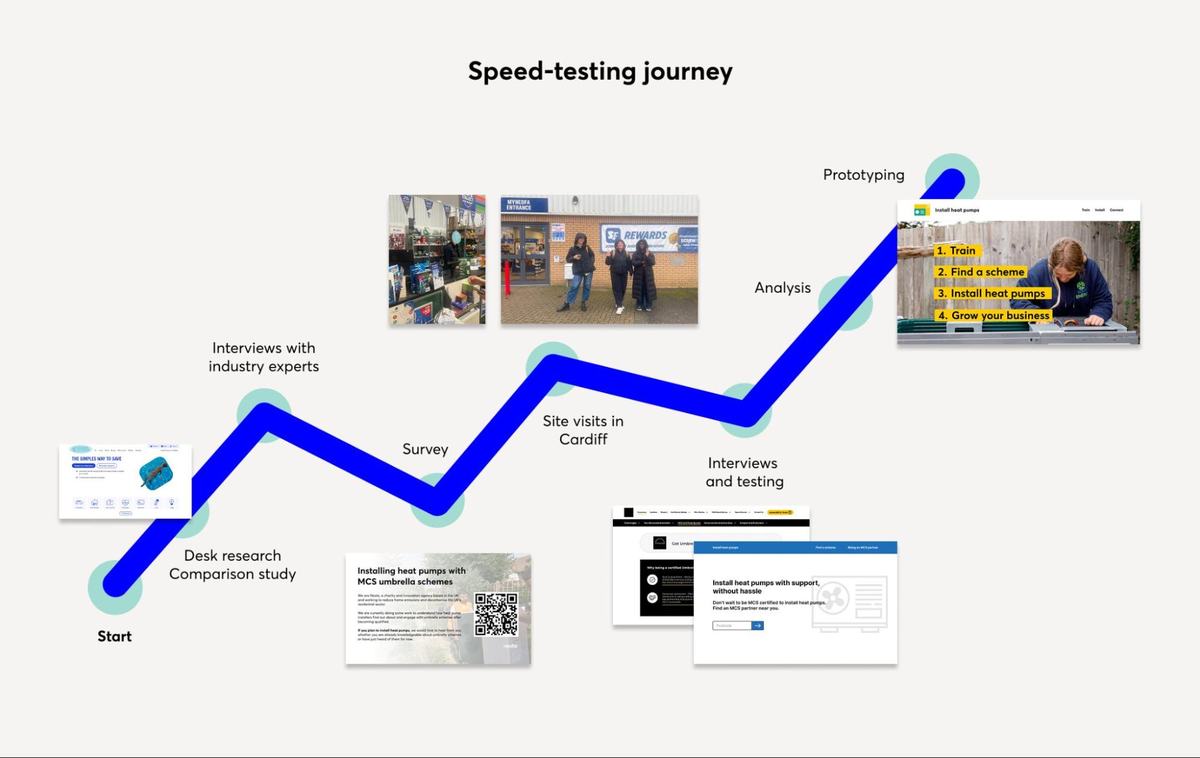
We started by conducting research on existing umbrella schemes: what do they offer? How much do they cost? Is it easy to access them? We then visited merchants and installers in Cardiff to better understand how installers engage with different places, why they visit merchants’ stores, and how long they stay for. This helped us get a better understanding of installers’ habits and how they might find out about and register with an umbrella scheme.
We reached out to people in the industry (manufacturers, trade organisations, and umbrella scheme providers) early on to present them with early concepts to help installers understand what an umbrella scheme is and what they should look out for when picking one. We used simple prototypes to provoke thoughts and prompt interviewees to tell us - from their perspective - what would be desirable, feasible, or impossible to put in place. These prototypes included:
These helped us understand where and who has the capacity to reach installers to make umbrella schemes visible by the most installers.
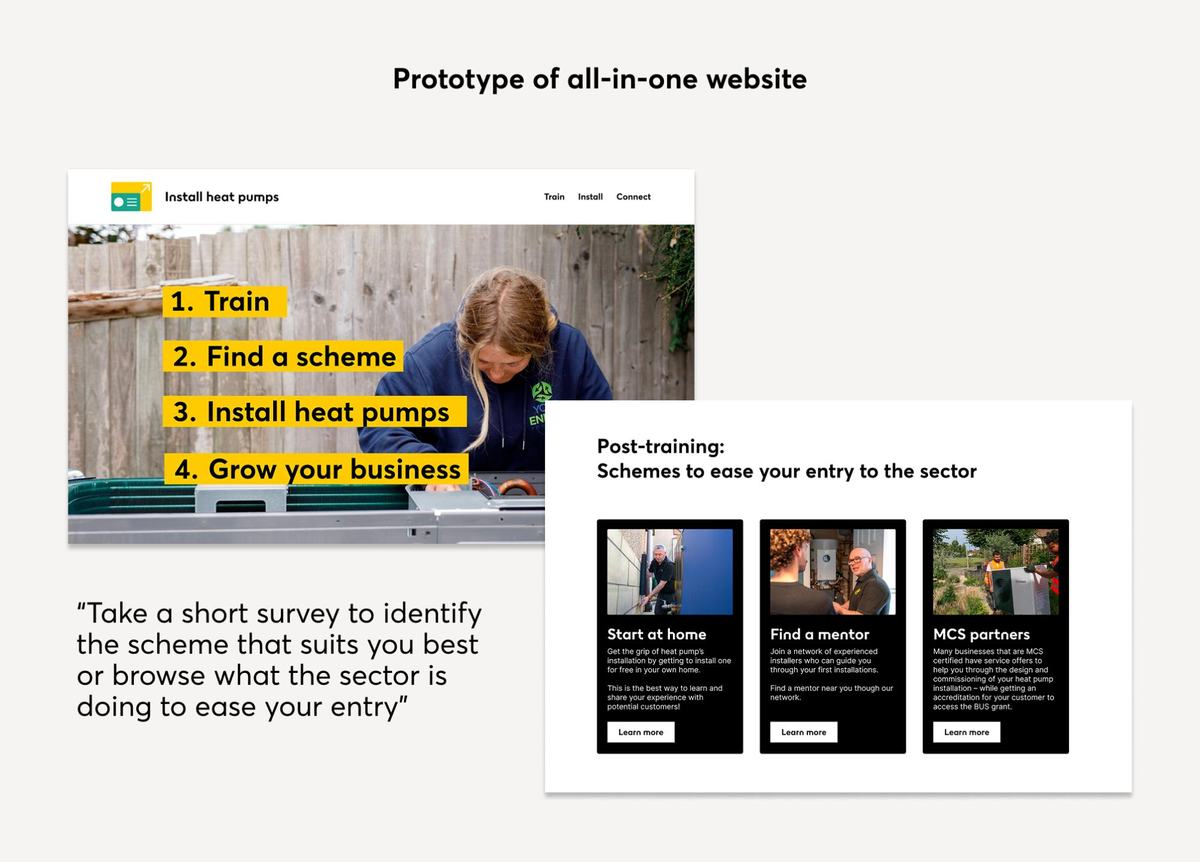
Based on our research and testing, we built a walk-through prototype showing what an independent website could do to best orient installers interested to join the heat pump sector. This helped us clarify what different path installers might take and how to best support them based on their needs - not everyone has to be MCS certified and therefore ways to work with certified businesses need to be transparent and visible.
Even if most installers are familiar with the concept of umbrellas, there isn’t a universal definition for what they are. It is rather an array of functions that the industry is defining and refining for itself. We’ve heard from installation businesses and manufacturers that a regulated term would benefit the industry in setting good practice. However, MCS don’t officially use the term in their communications, as every certified business can act as an umbrella under different forms: either through services or subcontracting agreement. Defining the term would impact how businesses, and specifically smaller ones, work. However, the absence of a regulatory framework can result in a lack of quality control and lead to uneven experiences for installers.
MCS has redeveloped its installer scheme and approach to quality control, including mandatory onsite checks across the sector, requiring all umbrella schemes to conduct a follow-up visit after each installation to confirm it meets performance standards. This new approach, called ‘MCS 2.0’, should raise the baseline across the board and reduce malpractice, such as retrospective sign-off and design-only certification services.
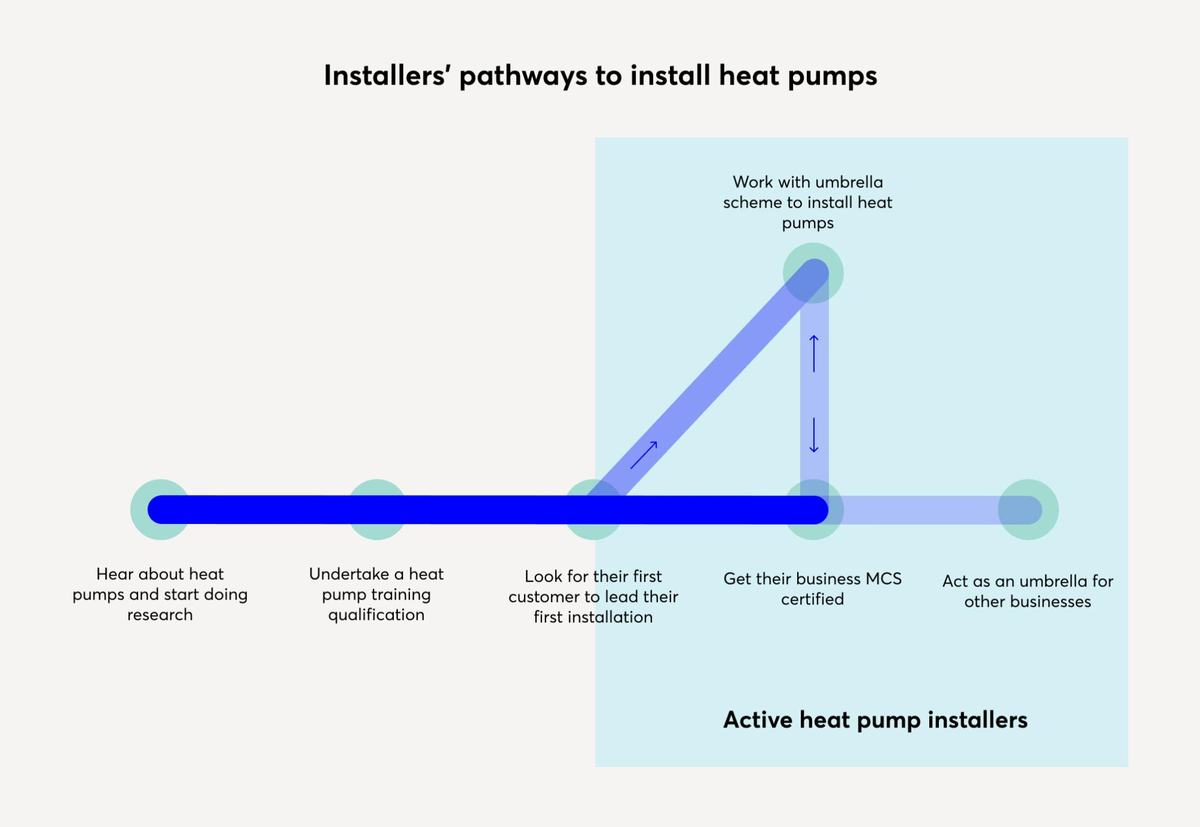
There is no straightforward way to become a heat pump installer. Training is mandatory, but MCS certification is not, and this shapes the range of reasons why engineers may turn to umbrella schemes. The industry has broadly recognised this diversity and developed its offerings accordingly.
As the diagram below shows, three distinct uses have emerged. The first is for newly-qualified engineers who need significant hands-on support to build confidence and complete their first installations, sometimes including people who are already certified but need a refresher. The second is for experienced engineers working as sole traders, who do not need technical guidance but lack the administrative capacity to manage everything independently. The third is for engineers who are actively using an umbrella scheme as a route to getting MCS-certified themselves.
Importantly, not all these paths lead to certification, and many arrangements become an ongoing part of an engineer’s business strategy, rather than a one-off stepping stone.
“Not everyone needs to be accredited.”
Installers coming from the gas industry are unlikely to be familiar with the term "umbrella scheme", though many will know the concept through subcontracting. Most people we spoke to agreed that manufacturer and merchant websites are the most likely first port of call, with brands emerging as the primary source of leads and referrals for umbrella companies. Data on installer preferences is still limited, which made this one of the harder questions to answer. That said, cost and type of support consistently came out as the most important factors, ranking above brand reputation or lead acquisition.
“You need to go to the source of truth: installers and influencers.”
Manufacturer
“It’s boiler manufacturers who also do heat pumps who are most likely route to referral and could do a lot more!”
Umbrella scheme provider
“There’s a funneling problem. Would a centralised approach work?”
Umbrella scheme provider
In-person routes tell a more mixed story. Merchants could play a role, but our visits suggested that in-store discovery is limited in practice. Training bodies are a credible touchpoint, though mainly for engineers already on the path to certification rather than those at the start of their journey. MCS currently offers little information on umbrella schemes, and it is not clear that installers actively use it as a resource. Manufacturer engagement shows some promise and is worth exploring further.
“Heat pumps? We don't have that here in the UK. It's German right?”
Heard from a worker in a store
This speed test surfaced a set of challenges that no single part of the industry can resolve alone. There is no shared definition of what an umbrella scheme is, no consistent way for installers to find or compare them, and a gap between what businesses need today and what regulation is moving to address. Even where objectives are aligned, communicating new requirements and ensuring their uptake remains difficult, and the risk is that solutions arrive too late to meet the challenges they were designed for.
There are also limits to what action within the heat pump sector alone can achieve. Reaching targets of 10,000 new installers per year will require upskilling to become visible and attractive to heating engineers much earlier in their careers. The businesses, trade bodies, and manufacturers already engaged in heat pumps are largely reaching people who are already interested. The harder and more important work is upstream, in the sector where most heating engineers currently sit.
For Nesta, the immediate priority is developing our Start at Home scheme, which offers newly qualified heat pump engineers hands-on support through their first installations. This sits directly within the high-support pathway identified in this speed test and will give us a closer view of what engineers need in the early stages of their transition. We will revisit the broader questions raised here as our mission priorities develop.