Making contact with reality: why human expertise shapes the Longitude Prize
 www.nesta.org.uk/blog/why-human-expertise-shapes-the-longitude-prize/
www.nesta.org.uk/blog/why-human-expertise-shapes-the-longitude-prize/
www.nesta.org.uk/blog/why-human-expertise-shapes-the-longitude-prize/
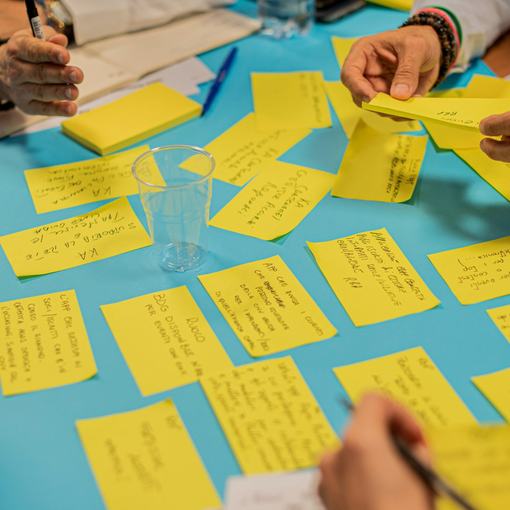
As we prepare to launch a new series of expert workshops to design the next Longitude Prize, Olivier Usher explores why lived experience remains our most powerful design tool.
One of the privileges of my job is getting a group of experts around a table to spend a few hours thinking big thoughts about the future.
My team and I are now deep into organising a series of expert workshops that we’ll be running in June and July, to help brainstorm possible topics for the next Longitude Prize.
(Thanks to Jen Reed at UCL and to Shaarad Sharma at GO-Science in particular, for pulling out the stops in helping us recruit researchers and policy stakeholders to participate. And if you’d like to participate - read on to the end.)
We do workshops like these because our challenge prize design process is expert-led.
But what does it really mean to bring expertise into our work? And why do we do it?
One of the first big prizes I worked on was the Mobility Unlimited Challenge, in which we challenged innovators to transform the mobility of people with lower-limb paralysis using robotics and smart devices.
We spent a year speaking to hundreds of people while designing that challenge prize, but one day sticks in my mind: the day we spent shadowing the staff in an NHS orthotics and prosthetics department.
It was immediately obvious just how diverse the range of user need is, even within what might sound like a single condition. Limb loss for instance: did you lose an arm or a leg? Was the amputation above the knee or below? Are you a fit, young patient who crashed a motorbike - or an older patient with multiple illnesses who had an amputation because of diabetes? And so on: wherever we looked, the problems, and the needs, would break down into ever smaller niches, and they were all distinct and different from each other.
We were offering $4 million in prize money - so the ambition was high. A challenge prize that pinpointed just one of these topics might well have focused on a real and important need - but it would have been highly specific and we feared it would not attract a critical mass of innovators.
Meanwhile, we could see, and other experts we had consulted told us, that advances in smart technology, precision manufacturing and robotics, that had transformed consumer goods in the previous decade, hadn’t yet made their mark in assistive technology.
The problems were multifaceted - but there was a clear, cross-cutting opportunity.
That visit was a big reason why we focused on a broad area of technical opportunity (robotics and smart tech) but held back from specifying a single problem, use-case or type of user for the Mobility Unlimited Challenge.
We awarded the $1 million grand prize in 2020 to the inventor of a revolutionary smart wheelchair that you can now buy - but finalists included a robotic exoskeleton and a muscle stimulation device - thanks to this broadly-defined topic.
"For the sparks of insight we need in picking the topic of a Longitude Prize, the input that comes from real humans is hard to beat."
Fast forward a few years, and in the first months of the pandemic, I worked on the design of the Longitude Prize on Dementia - which we awarded the grand prize for earlier this year. We had lots of in-person engagement with patients and their families planned for this, which was rudely shifted onto Zoom like so much else in spring 2020.
But for this project, lockdown was a blessing in disguise: because in holding online focus groups with dementia patients and their families, it quickly became obvious to me that our deeply-ingrained stereotypes of older people as technologically backward were a load of nonsense.
Here was a group of people, happily engaging with us on a newfangled videoconferencing platform none of us had even heard of a few months earlier, telling us about all the technological tricks - smartphones, Amazon Echos, apps and so on - that they were already using to maintain their independence.
Our preconception - that the prize would have to focus on low-tech solutions, on services or on “dumbed down” tech that hid its sophistication from its users - evaporated in that 90 minute Zoom call.
Seeking the expertise that came from the lived experience of people affected by dementia gave us the confidence to think bigger and more outlandish thoughts, and to confidently set a bold technological focus for the prize. And from there, you can draw a direct line to CrossSense’s £1 million grand prize-winning smart glasses being showcased on BBC One in February.
We hear a lot about being data-driven in decision-making.
And you can’t open LinkedIn today without being faced with stories of how people have used AI to replace human experts and insight.
I’m a fan of data - it’s at the core of our Longitude Prize on ALS. And while I’m not exactly a fan of AI, I do think there are interesting and valid uses for it in our work.
But for the sparks of insight we need in picking the topic of a Longitude Prize, the input that comes from real humans, with deep expertise from science, technology, business or their own life experiences is hard to beat.
We have workshops planned over the summer to help us pinpoint interesting topics and potential funders and partners for the next Longitude Prize.