Six possible futures in a world with weight-loss drugs
 www.nesta.org.uk/blog/six-possible-futures-weight-loss-drugs/
www.nesta.org.uk/blog/six-possible-futures-weight-loss-drugs/
www.nesta.org.uk/blog/six-possible-futures-weight-loss-drugs/
Just weeks ago, new research published in The BMJ confirmed an uncomfortable truth about weight loss drugs - they are phenomenally effective, but only for as long as you take them.
The meta-analysis, led by Susan Jebb’s team at Oxford, found that people start to regain weight immediately after stopping treatment, returning to their original weight within around a year and a half. Behavioural support can slow this down somewhat, but the implication for health systems is clear. If we rely on weight-loss drugs as a long-term solution, we have to accept paying for them indefinitely.
That doesn't feel like an appropriate plan for the one in four people in the UK already living with obesity - a number that will only grow if the conditions shaping our food environment don’t change. Zooming out further, I’ve been thinking about six possible futures that we could get to in terms of obesity and weight loss drugs in the UK.
In this future, GLP-1 drugs become so cheap and the side effects so minimal, that one third, or even half the population takes them long-term at various doses. Much like glasses made blurry vision a solvable problem, weight management becomes something most people simply handle with medication.
This mass adoption makes businesses reliant on selling junk food non-viable. Advertising chocolate everywhere stops making financial sense - billboards once decorated by Big Macs are now blazened with nutrient-dense snack pots. As the burden of diet-related health plummets, so too do NHS operating costs. It's a compelling vision, but entirely hypothetical. It can't happen now, and we shouldn't bet everything on it.
Alternatively, instead of turning to weight-loss drugs we see a massive push towards ambitious food policy. Much stricter standards are imposed, including advertising regulations, tax incentives, business-specific targets and standards for all food sold. Drugs are limited to the most clinically severe patients and wealthy private users.
This approach is cheap compared to mass medication, but it would take a significant amount of time to play out - not to mention the sheer scale of political capital and legislative timetabling required. You wouldn't see big health improvements or benefits to our NHS or economy for some years, which makes this scenario unappealing for the government of today, who have eyes on a 2029 election.
In this scenario, GLP-1 drugs become more affordable but remain expensive enough to exclude many people. Let’s say private usage expands as the monthly cost halves from £150–300 per month to £75–150 per month.
The danger is that obesity becomes further entrenched as a marker of inequality. We already have a 14 percentage point gap in adult obesity rates between the least and most deprived areas (22% versus 36%). And this gap is growing - among children it widened from 8.5 to 13.3 percentage points between 2006 and 2019.
What’s worse, without changes to the food environment, food companies intensify their focus on those who aren’t able to take the drugs, through price promotions, value messaging, and the continued clustering of fast food outlets in poorer areas.
Under this two-tier system population obesity rates might drop, but inequality grows massively. We end up with an arms race between big pharma and big food, while the government stays passive and society pays the price. This feels like something you’d expect in the US, but could happen here too.
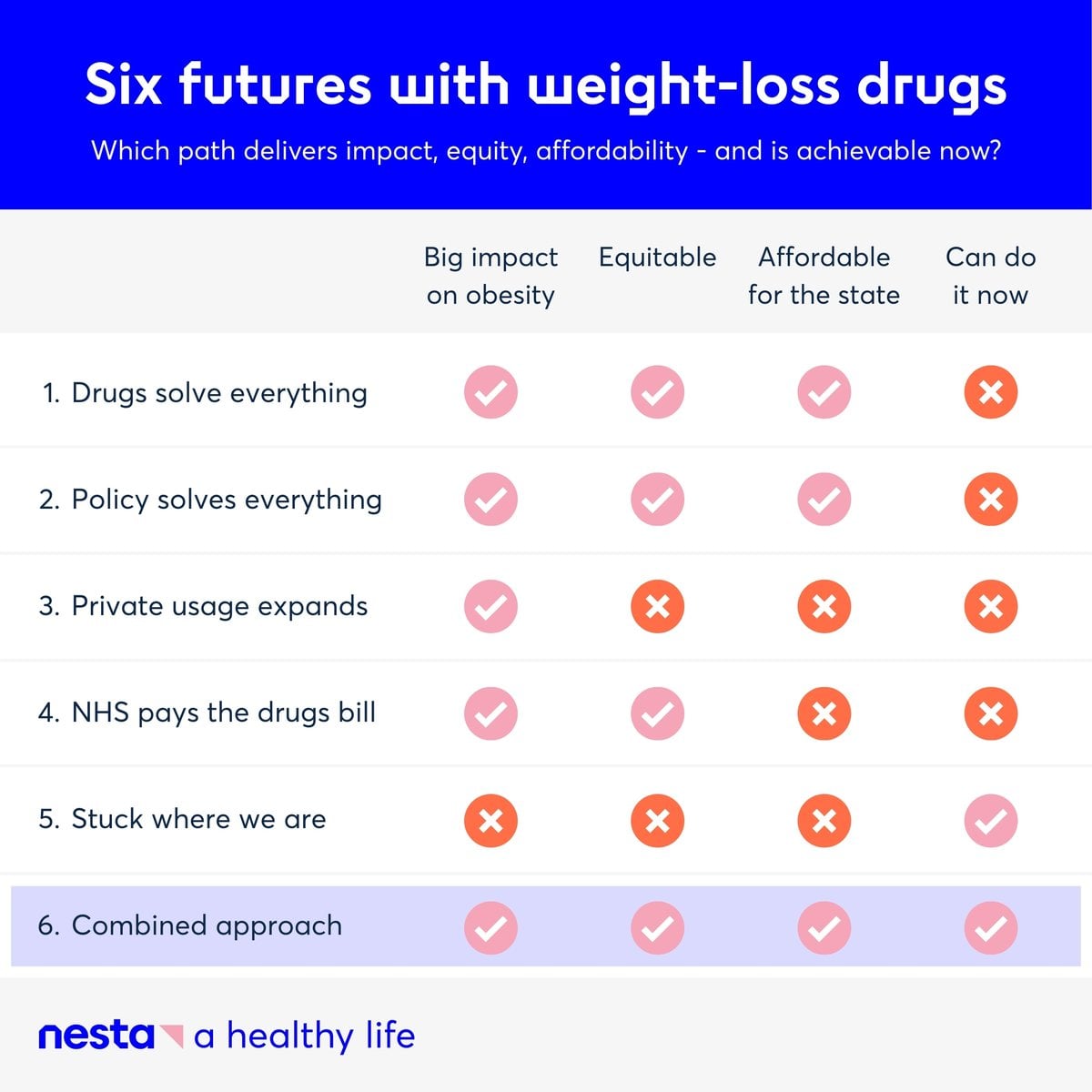
Six futures with weight-loss drugs: which path delivers impact, equity, affordability - and is achievable now?
What if the NHS covered weight-loss drugs for everyone who needed them? This would have a significant impact on obesity and be broadly equitable. A golden ticket and guaranteed revenue stream for the pharma company that secures that deal.
But it’s not without serious downsides. Even with significant price drops, the cost to the public purse would be enormous. Inequality would still widen, if less dramatically than in scenario three. Obesity rates would fall, but at the expense of other public services. And with weight regain guaranteed, the bill never stops. Meanwhile, food companies would continue targeting their marketing at those not taking the drugs.
Perhaps the most dispiriting possibility: nothing changes. Even if a decade on, patents expire and prices fall, the reality of weight regain persists. A wealthy few pay to remain on medication indefinitely, short-term users regain the weight they lost and everyone else remains stuck in the same food environment that's making it so hard to maintain a healthy weight.
Policies that sound good - like the recent TV and online ad restrictions - arrive full of loopholes and industry concessions. Without better policies, new cases of obesity keep coming. Rates plateau at current levels - still unsustainable, and set to worsen as today's children become tomorrow's adults. This is not where we want to be.
This is where I believe we need to head. Currently, NHS England plans to offer tirzepatide to 580,000 people in England over five years. That's 1.3% of adults - against a backdrop of 13 million living with obesity. Instead, we need to operate at a different scale: perhaps 5% of the population receiving drugs on the NHS, with many more accessing them privately. However, this only works if we simultaneously transform the food environment, slowing weight regain for those coming off medication and preventing weight gain in those currently at a healthy weight.
Over time, a combined approach allows us to reduce the proportion of people who need drugs long-term. As prices fall, our recurrent bill becomes more manageable, perhaps covering 3-5% of the population rather than the much higher figures we'd need otherwise. Population obesity levels are reduced by a half - returning us to 1990s levels.
We can't rely on drugs alone, and we can't ignore them either. We need action on both fronts. Professor Jebb’s research reinforces what we've long argued: if we want to make real progress on obesity, we need equally ambitious action to improve the food environment. That means policies like mandatory health targets for retailers, stricter advertising regulations, or tax incentives that make healthier choices the easier choices.