Integrating early years education and family support: five findings from new research
 www.nesta.org.uk/blog/integrating-early-years-education-and-family-support-five-findings-from-new-research/
www.nesta.org.uk/blog/integrating-early-years-education-and-family-support-five-findings-from-new-research/
www.nesta.org.uk/blog/integrating-early-years-education-and-family-support-five-findings-from-new-research/
The early years of a child's life are when the foundations of physical, emotional and social development are laid. But babies and young children growing up in poverty are more likely to miss out on the resources and experiences needed for healthy development.
There is strong evidence that both high-quality early childhood education and integrated family support services can help children’s early development, particularly those living in poverty. It is possible that bringing these two essential services together could lead to significant positive impact and provide families with more consistent, joined-up support.
However, there is currently little known about the most effective way to integrate early education and wider family support services in England and Scotland. To address the knowledge gap, Nesta commissioned Isos Partnership to conduct an exploratory study on current and ideal levels and types of service integration. The report, Building bridges, draws on evidence from nine local area deep dives, an online survey of 65 local authorities, and responses from 57 early years providers.
In England, early education is called early childhood education and care (ECEC). In Scotland, this is known as 'early learning and childcare’ (ELC). For the purposes of this blog, we use early years education to refer to both ECEC and ELC.
Here are our five key takeaways from the research.
A majority (89%) of early years settings who took part in the research reported that they are now providing direct support to families. These settings occupy a unique position of trust, as frontline workers interact with parents on a near-daily basis. Through informal conversations early years workers can often identify when a family is struggling and needs support. 91% of early years settings and 80% of local authorities reported that earlier identification of family needs and swifter joined-up action had been enabled by early years settings providing support to families.
Responses on direct support to families
A bar chart representing the percentage of respondents from ECEC/ELC settings who voted either 'yes' or 'no' in response to the question 'Does your setting provide direct support to families of children who attend your setting?' Responses are represented horizontally against 'yes' and split into three bars: all respondents, respondents from England and respondents from Scotland. It shows that a high proportion of services in both England and Scotland have answered 'yes', with more responses for 'yes' in England (92%) than in Scotland (83%).
However, across our research activities, participants told us that the expanding role of early years settings is also borne out of need: reduced capacity in wider public services like health visiting and home-visiting teams means families are not always getting support through universal services. Early years settings are often acting as the final safety net for families, as they have such direct visibility of when a child or parent is struggling and are able to step in.
Early years settings are often providing both "direct" delivery (providing support themselves to families) and "indirect" delivery (connecting parents to external support).
The type of family support offered by settings, whether direct or indirect, was seen to vary across four areas or domains of family need:
Settings were more often playing a direct role in relation to domains of child development and inclusion, and more likely (but not exclusively) playing an indirect role in relation to family wellbeing and financial hardship.
Whether or not help is offered by an early years setting seems to be driven by factors such as staff capacity, connections to external support services and local needs. The help offered to families was not observed to vary according to the provider type (whether the setting was a private, voluntary or independent setting,maintained or school-based).
| Domain of support | Direct role | Indirect role |
|---|---|---|
| 1. Child development and home learning | Settings often play a direct role - 1:1 advice to parents; community building through family groups/parenting programmes. | Signposting and introducing - especially where local services are strong. |
| 2. Inclusion and additional support needs | Settings often play a direct role - inclusive practice, advice and community building for parents of children with ASN/SEND, and joint delivery of support with specialist teachers, EPs, SALT. | Alongside direct support, signposting parents to support and advocating for them. |
| 3. Family wellbeing | Some settings play a direct role as a lead professional, or due to gaps in support from external services. | Settings' role often indirect - signposting and introducing families to wider services, and working as part of multi-agency teams around families. |
| 4. Cost-of-living and financial hardship | Some settings offer direct assistance (food, clothing, books). Some offer "advice" (eg, budgeting). | Often an indirect role - signposting or introducing families to services (eg, welfare rights, food banks, housing). Some accompanying (helping with forms, assessments) and advocating. |
There is no single, one-size-fits-all model for integrating early years with broader family support. The most effective integration models are tailored to fit local and community needs. Across England and Scotland, the research identified three main, existing models for integration.
Across England, early years settings are often co-located with broader family support; however participants reported that this does not automatically lead to integrated working practices. Local leaders told us that effective co-location requires a shared ethos, mutual respect and understanding between practitioners, continuity of relationships, and routine sharing of information.
83% of local authorities surveyed reported that early years settings were represented on local strategic partnerships focusing on children and families. However, only 42% of early years settings are able to confirm that this was the case in their local area. Where early years networks do exist, they tend to focus on sharing practice and training rather than exercising strategic influence. Providers who participated in our research told us more formal structures are needed to bring settings together locally and enable early years settings to be involved as a strategic partner.
Test
A bar chart representing the percentage of respondents from ECEC/ELC settings who voted 'yes', 'no' or 'don't know' in response to the question 'In your local area, are there any local strategic partnership arrangements that bring together services for children and families on which early years providers are represented?' Responses are represented horizontally against 'yes', 'no' or 'don't know' and split into three bars: all respondents, respondents from England and respondents from Scotland. It shows that 'Yes' is the most common answer, with 42% of respondents across England and Scotland selecting this, followed by 'don't know' with 37% and then 'no' with 21%.
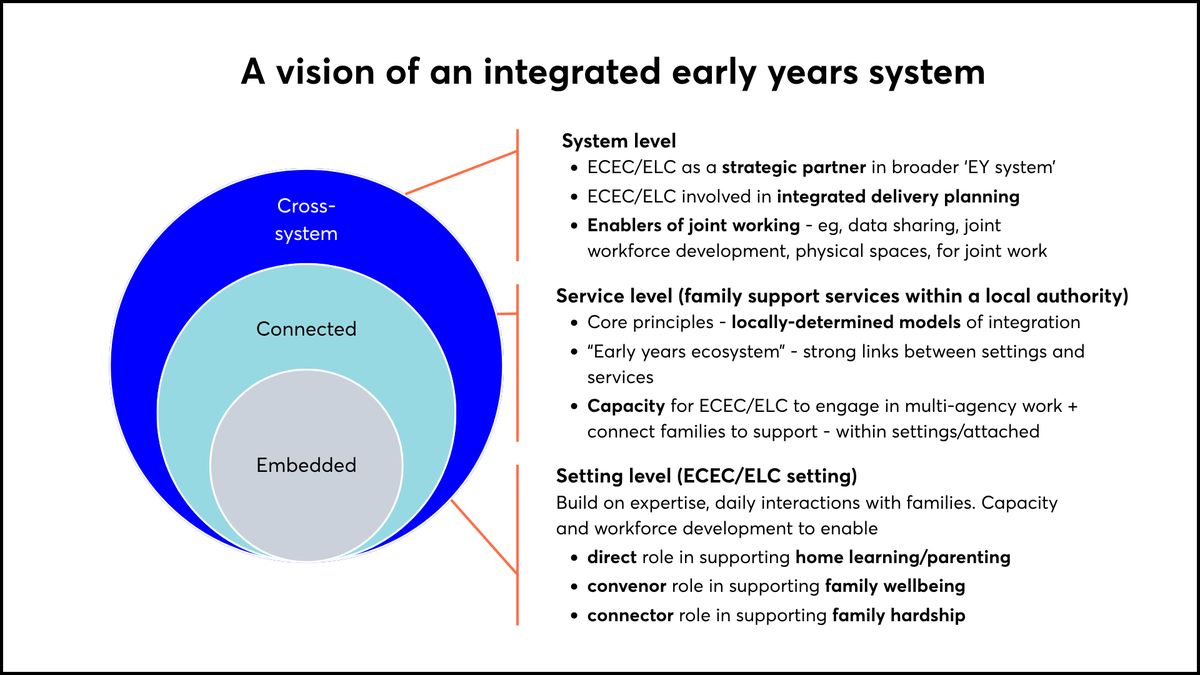
A circular model showing a vision of an integrated early years system
Early years settings are uniquely placed to act as a vital frontline connector for families, but currently this is an inadvertent benefit left to chance. To move away from a patchy and unsustainable landscape, the report outlines five core recommendations for reform across England and Scotland.
By positioning integrated early childhood education and learning at the very heart of the family support ecosystem, local areas can provide children and families with support that is timely, consistent and joined-up, helping more children reach their full potential in the early years.