About the authors
Isos Partnership is a research and advisory company with a track record of successful delivery over two decades. We work with national and local government, charities, schools and trusts to develop policy and improve education and services for children and families. Find out more at www.isospartnership.com.
About the commissioners of this research
Nesta is a research and innovation foundation that designs, tests and scales solutions for the biggest challenges of our time. Driven by a vision to improve the lives of millions of people, our focus up to 2030 is on three missions: breaking the link between family background and life chances, halving obesity and cutting household carbon emissions. Find out more at nesta.org.uk.
Executive summary
About this research
This research, commissioned by Nesta and carried out by Isos Partnership, explored how early learning and childcare (ELC) settings in Scotland and early childhood education and care (ECEC) settings in England can be – and already are being – integrated with wider support for families. Conducted between summer 2025 and spring 2026, the study aimed to understand current approaches to integration and to recommend how a more joined-up early years system can be built for the future.
The research was exploratory in nature. Its findings are drawn from qualitative and quantitative evidence gathered across nine local areas – six in England (Barking and Dagenham, Blackburn with Darwen, Cambridgeshire, Milton Keynes, Sheffield, Warwickshire) and three in Scotland (Fife, Inverclyde, Perth and Kinross) – as well as an online survey of 65 local authorities (LAs) and a call for evidence that received 57 responses from ELC / ECEC providers.
65
LA survey responses
(England & Scotland)
57
ELC / ECEC provider call
for evidence responses
9
Local area deep dives
Why integration between ELC / ECEC and family support matters
High-quality early education and joined-up family support can create a virtuous circle. High-quality ELC / ECEC can improve outcomes for children, while support for parents / carers can have a positive impact on families and on children’s home environments. Greater integration of ELC / ECEC and support for families has the potential to further improve outcomes for both children and families.
At present, however, these two elements – ELC / ECEC and family support – operate largely in parallel rather than in concert. ELC / ECEC settings are uniquely positioned to bridge this gap. They see children and families on a near-daily basis, are in a position to build relationships and trust with parents / carers and are already the first port-of-call for many families who need help.
What the research found: Current approaches to integration
The evolving role of ELC / ECEC settings in supporting families
Of the ELC / ECEC providers that completed our call for evidence, 89% reported that they provided some form of direct support to families – a similar proportion of LAs reported that settings in their local area offered support for families. The evolving role of ELC / ECEC settings in supporting families is in part a reflection of the daily contact and relationships between ELC / ECEC settings and families. It also reflects, however, an increase in the need for additional support for children and parents / carers, and reduced capacity of some wider services.
We found that ELC / ECEC settings offered a range of support that was both "direct" (that they delivered themselves) and “indirect” (connecting families to wider services). The nature of the support provided by ELC / ECEC settings differed according to the areas in which families needed support, which fall into four broad domains.
- Child development, parenting and home learning – where settings typically played the most direct role. As well as supporting the development of children when they attend a setting, these settings also offered advice to parents / carers on home learning and parenting, parenting groups, and (co-) delivering formal parent support programmes.
- Inclusion and additional support needs (ASN) / special educational needs and disability (SEND) – where settings similarly reported playing a direct role (supporting children, providing advice to families), as well as connecting families to wider support services, assessments and groups for parents / carers of children with ASN / SEND.
- Family wellbeing – where the role of ELC / ECEC settings ranged from signposting to acting as the lead professional on early help cases.
- Financial hardship – where settings largely played an indirect role connecting families to welfare, food and housing support, albeit often chasing up services and advocating on families' behalf. Settings also reported providing direct support to families with tangible household items like food and clothing.
Support for families provided by ELC / ECEC settings is patchy and not consistent. The different approaches taken depend less on the type of provider, and more on ethos, capacity and the needs of the community serviced by a setting, as well as their links with external support services.
Integration between ELC / ECEC settings and wider family services
The role of ELC / ECEC settings in supporting families should not be seen in isolation, but as part of a wider ecosystem of support for families to which settings can connect. There are, however, a range of ways in which the work of ELC / ECEC settings and family services can be integrated. We observed a range of approaches –
- hub- or centre-based models – co-locating services in one-stop-shops, more common in urban England and in areas with a legacy of Sure Start;
- multi-agency locality teams – external, targeted services wrapping around families and settings, more common in rural areas and Scotland; and
- setting-led models – where individual ELC / ECEC settings, often large community providers, have built their own multi-disciplinary capacity.
There is no hard-and-fast rule about which models are best suited to which contexts. Local approaches need to be calibrated to local context (the area but also the community and neighbourhood) and will depend on the extent to which it is efficient to base support in hubs, deliver through outreach, build the capacity of universal and community settings, or adopt a mixture of these approaches. The more sophisticated and established models of integration between settings and services are those focusing on parenting, home learning and ASN / SEND.
ELC / ECEC settings’ involvement in local strategic partnership working
The ELC / ECEC sector often lacks formal structures that would allow settings to be represented and engage as a strategic partner in key local area partnerships. This can inhibit integration between ELC / ECEC and support for families at a strategic level in local areas. Where they exist, early years networks tend to focus on sharing practice and disseminating information rather than strategic influence. A small number of LAs have developed innovative structures – early years phase councils, provider reference groups, expert panels – but these remain the exception.
Recommendations for strengthening integration between ELC / ECEC and support for families
90% of ELC / ECEC providers and 95% of LAs agreed that greater integration would improve outcomes for children and families.
This research sets out five recommendations for national policymakers and local system leaders for capitalising on the role ELC / ECEC settings can play in supporting families and fostering greater integration between settings and services. There was a broad consensus about these recommendations among colleagues from Scotland and England who participated in this research. As such, we have presented a single set of recommendations for national governments and local system leaders in the two countries, recognising that implementation may look different in each national context.
1 National governments should formally recognise and define the broader role of ELC / ECEC settings in supporting families.
There is an opportunity for national policymakers to formalise the unique role that ELC / ECEC settings can play in connecting families to support and make this a central pillar of national strategies and the delivery of support for families. The future role of ELC / ECEC settings in supporting families should be grounded in the principle of social pedagogy – seeing children through the lens of the families and communities in which they grow. The role should be shaped by three principles: relationships (who knows the family best?), expertise (who understands what support is needed?), and agency (who is best placed to effect change?). In practice, this would mean ELC / ECEC settings would act as "bridge” between setting and family in relation to home learning and parenting; as a “convenor” in family wellbeing; and as a “connector" in addressing financial hardship.
2 National governments should provide sustainable resourcing to build long-term capacity for ELC / ECEC settings to play a broader role in supporting families.
ELC / ECEC settings cannot fulfil a broader family support role without dedicated capacity - via supernumerary staffing or attached practitioners – that sits outside existing staffing ratios. How that capacity is created and deployed will differ between (and within) local areas. National governments in England and Scotland should establish the conditions in which local areas can develop and sustain integrated approaches to supporting families. We recommend that national governments establish consistent expectations that each local area should have a model of integrated working in which there is dedicated capacity to connect ELC / ECEC settings to support for families, within which local areas would have flexibility to design approaches that reflect their local context. National governments should enable local areas to fulfil this expectation by providing them with long-term, flexible funding to create this capacity sustainably.
3 Skills for identifying needs and supporting families should be incorporated into national and local ELC / ECEC workforce development.
National policymakers should make the skills of identifying and exploring sensitively the potential signs of family needs a core component in the early career training and formal qualifications pathway of ELC / ECEC practitioners. (We have focused our recommendation on formal, nationally determined qualifications as we recognise the constraints on settings to find time and budget for staff to undertake continuous professional development (CPD) during standard setting operating hours.) Beyond this, national policymakers should create additional qualifications and “advanced practitioner” progression routes for staff in dedicated roles focused on brokering and/or delivering support to families. Locally, there should be opportunities for ELC / ECEC settings and services working with families to undertake joint workforce development to build the mutual understanding and collaborative relationships on which integration depends.
4 National and local governments should support the ELC / ECEC sector to act as a strategic partner in local multi-agency partnership working and in developing local integrated plans.
National policies and programmes – Best Start in Life in England (BSIL); Getting It Right For Every Child (GIRFEC) and Whole Family Wellbeing in Scotland – should set clear expectations that ELC / ECEC providers are recognised as key partners in local multi-agency planning. Local areas should be expected to develop or maintain structures that enable the ELC / ECEC sector to come together, shape strategic initiatives, and be represented on key local partnerships. National policymakers and local system leaders should consider how to support providers to participate in sector-wide and partnership structures, and in the development of local integrated delivery plans (especially where this is linked to key national policies and programmes such as BSIL, GIRFEC and Whole Family Wellbeing).
5 National policymakers should develop consistent guidelines and templates for multi-agency data-sharing agreements.
There was a strong desire for nationally consistent guidance and templates for data-sharing between education, health and family services so that practitioners can be confident about sharing information across sector boundaries where it aids joined-up support for families. Local system leaders, regional networks, professional associations and national governments can play a key role in disseminating and endorsing examples of effective local approaches.
Introduction
Background and aims of the research
The impact of high-quality early education on children's outcomes is well established, as are the benefits of joined-up support for families. Together, they can create a virtuous circle: meeting the needs of adults and supporting them as parents / carers transforms the family environments in which children grow up and can improve outcomes throughout their lives. This research has explored how these two elements – early years education and support for families – can be and are being brought together to improve support and outcomes for children and families.
Specifically, this research has explored the subject through the lens of "integration” between services that support families and providers of early learning and childcare (ELC) in Scotland and early childhood education and care (ECEC) in England. We use the term integration to mean ways of joining up delivery of support for children and families from ELC / ECEC settings and wider children and family services. An integrated early years system would be one where parents / carers only had to tell their story once, where practitioners are able to build strong relationships and trust with one another and with parents / carers, where there is mutual understanding and respect between practitioners and families, and where families can access support in familiar and accessible settings.
'Effective integration provides families with a one stop shop to get the help they require when they require it, without having to tell their story over and over again.' – LA early years (Scotland)
'Effective integration means families feel like everything works together, not like they are being passed from one service to another.' – LA early years lead (England)
At present, however, little is known about approaches to integration in the early years. As such, this research has aimed to –
- explore current approaches to integration between support for families and ELC in Scotland / ECEC in England; and
- consider what role ELC / ECEC could play in a future integrated early years system and what improvements would be needed to create this system.
This research takes place when early years education and family support are going through significant changes in Scotland and England. We want this research to be useful to national policymakers, system leaders and frontline practitioners in Scotland and England by building an understanding of the key ingredients of successful integration and how that can be factored into national policy developments as well as practice at local and individual provider levels.
This research has been largely exploratory. Our aim has been to identify and learn from local areas that have developed approaches to early years integration. While this report is rich in detail from the local areas and settings that have taken part in this research, we do not seek to make broader claims about the strength of integration beyond these local areas and settings.
Our approach
The research took place in three phases, between summer 2025 and spring 2026.
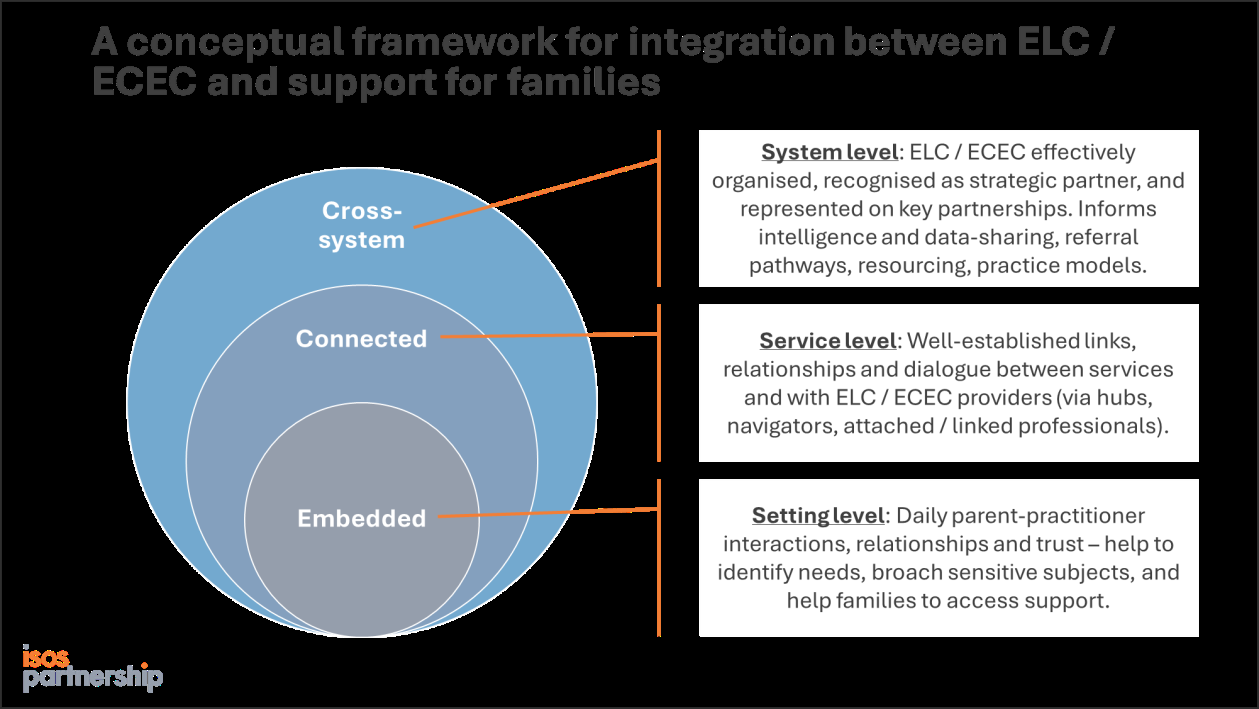
In the first phase, we undertook a brief review of existing evidence and held a series of initial scoping interviews with relevant experts and stakeholders in Scotland and England. This allowed us to build an initial understanding of what was known about integration and what we might expect to see in our evidence gathering. We used this to develop a conceptual framework of approaches to integration in order to have a consistent way of structuring our evidence gathering in Phase 2. Our conceptual framework (figure 1) captures some of the characteristics of integration we might expect to see at three levels –
- how ELC / ECEC settings are involved in strategic partnership working at the cross-system level;
- how family services join up and connect with ELC / ECEC settings; and
- how support for families is embedded at an individual provider level.
Phase 2: Evidence gathering
We used a range of methods to gather evidence about trends in relation to integration, hear the perspectives of different actors in the system, and explore established approaches to joined-up working in depth.
- An online survey for LAs – we received 65 responses: 51 responses from 50 English LAs (33% response rate), 13 responses from Scottish LAs (41% response rate), and one anonymous response.
- A call for evidence for ELC / ECEC providers – we received 57 responses (39 from providers in England, and 18 from providers in Scotland) from a range of types of provider, including: LA-operated; maintained; private, voluntary and independent (PVI) providers; and childminders).
- Deep dives in nine local areas (six in England, three in Scotland) – these involved discussions with LA leads for early years and family services; practitioners from services (health visitors, family support workers, speech and language therapists (SALT)) and third-sector organisations supporting children and families; ELC / ECEC settings; and parents / carers (through individual / group discussions, or anonymous written feedback).
Phase 3: Collating our findings and shaping proposals
During the final phase of the research, we undertook expert workshops in Edinburgh and London to test our findings and explore potential recommendations in the context of Scottish and English policy respectively. We also held meetings with a project steering group during each phase. We used these discussions to steer us when collating the evidence and shaping the recommendations set out in this report.
The structure of this report
This report is divided into two parts. Part 1 focuses on current approaches to early years integration, with three chapters detailing our findings respectively for each of the three levels of our conceptual framework – the provider, service and system levels. Part 2 focuses on our five main proposals for creating a future integrated early years system. These cover the role ELC / ECEC providers could play in such a system and what would be required to bridge the gap between where we are now and this future system.
Throughout the report, we use ELC / ECEC when referring specifically to providers and settings, and the broader term “early years” when referring to the wider system of support for families of pre-school-age children. We use "settings" to refer to the individual spaces in which ELC / ECEC is delivered, and the term “providers” to refer to the organisations responsible for providing ELC / ECEC – some larger providers may run multiple settings. When we use the term “local area”, we are referring to the geographical areas covered by LAs, and we use the term "locality" to refer to smaller geographical areas within an LA area.
Part 1: Current approaches to integration
Chapter 1: The evolving role of ELC / ECEC settings
ELC / ECEC settings are stepping into a broader role in relation to supporting families
Key finding
89% of ELC / ECEC providers reported that they were providing direct support to families.
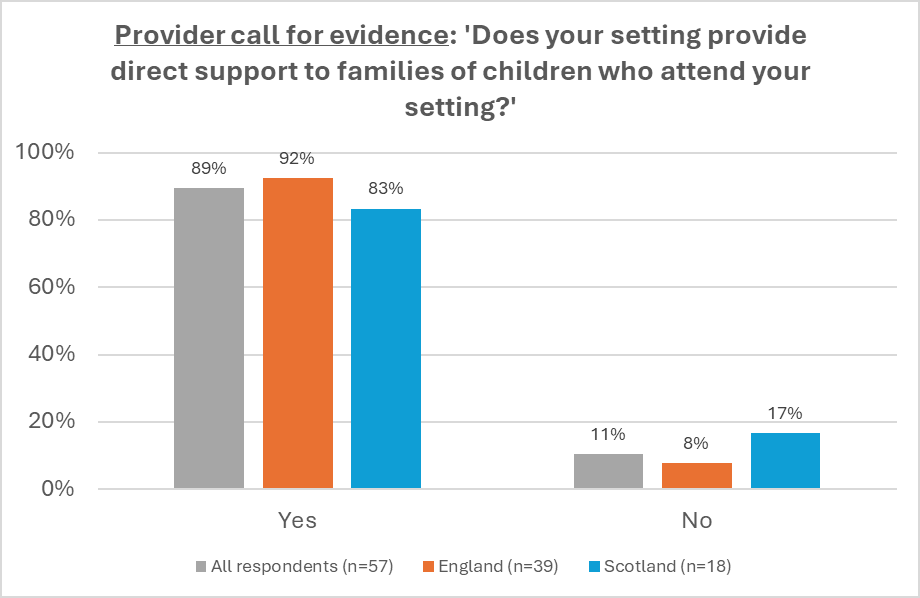
Among those that took part in this research, there was a strong belief that ELC / ECEC settings are playing a broader role in supporting parents and families, as well as children, in the early years. In the responses to our provider call for evidence (figure 2), 89% of ELC / ECEC providers reported that their setting was providing direct support to the families of children who attended their setting. The percentage responding "yes" was slightly higher among ECEC providers in England (92%) than among ELC providers in Scotland (83%).
LAs, providers and parents / carers described the positive benefits of ELC / ECEC settings offering broader support for families
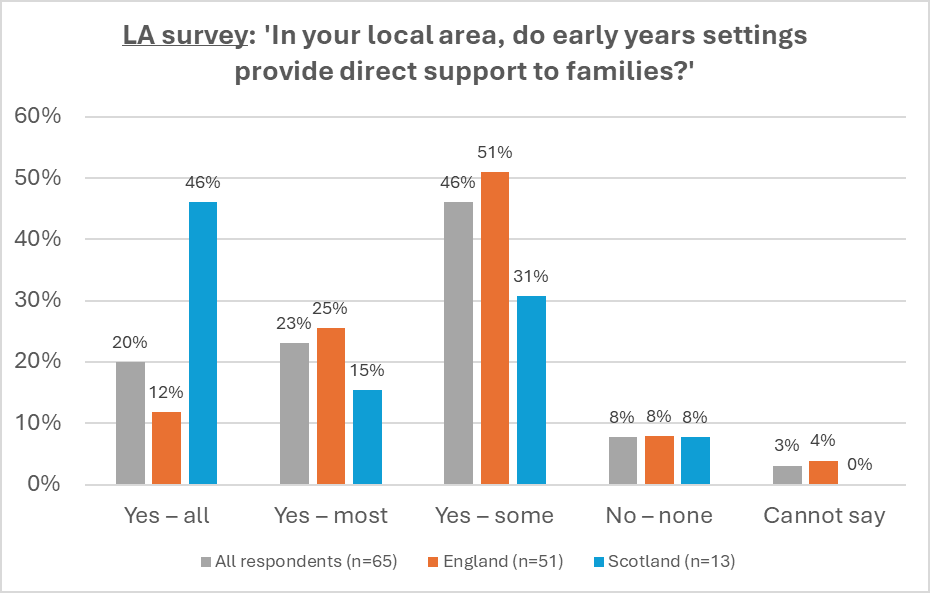
In our parallel LA survey (figure 3), almost nine in 10 (89%) of LAs reported that some (46%), most (23%) or all (20%) ELC / ECEC providers in their local area provided direct support to families.
Key finding
91% of ELC / ECEC settings and 80% of LAs reported that ELC / ECEC settings providing support to families enabled earlier identification of the need for support for families and swifter joined-up action.
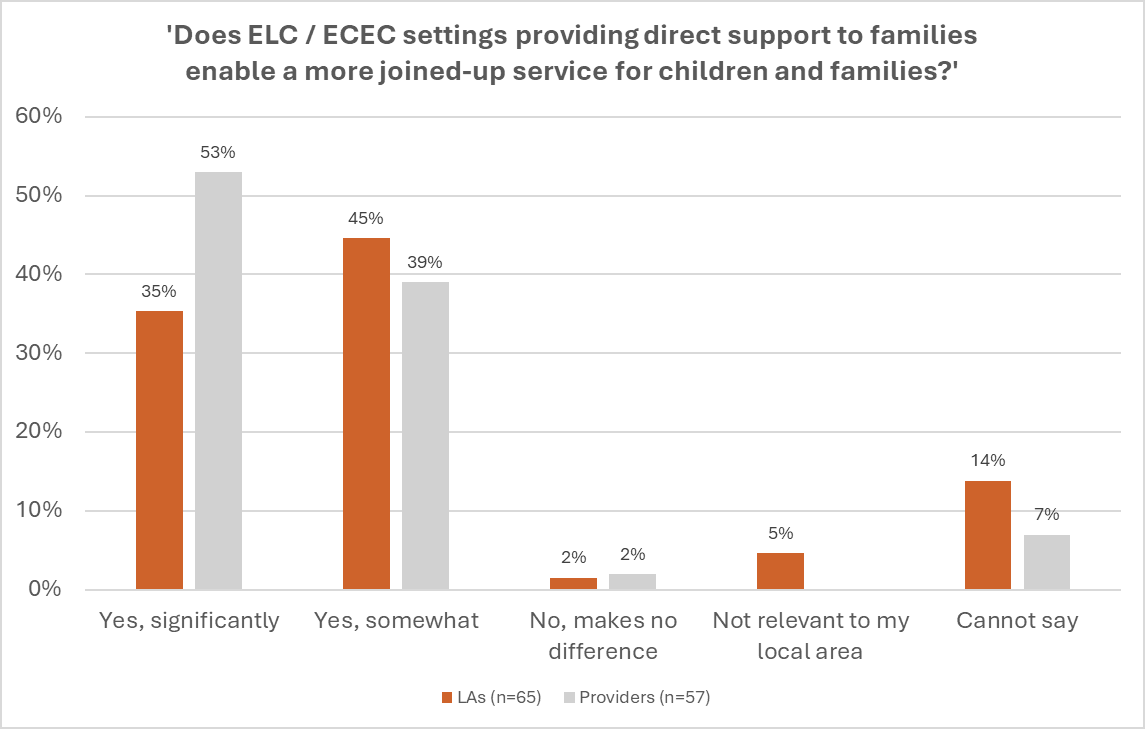
Among those who completed our survey or call for evidence, most ELC / ECEC providers and LA leads considered that ELC / ECEC providers offering support to families enabled a more joined-up service for children and families. As figure 4 (below) shows, 92% of ELC / ECEC providers and 80% of LA leads responded that ELC / ECEC providers offering support to families made a significant difference or somewhat of a difference to fostering a more joined-up offer of support. Scottish LA leads were more likely to report a significant difference (69%) than their English counterparts, but it was the opposite among providers, with 62% of English ECEC providers reporting a significant difference compared to 33% of Scottish ELC providers.
LA leads and ELC / ECEC settings considered that ELC / ECEC settings offering broader support to families built on settings' knowledge of and relationships with families, and had the following benefits –
- earlier identification and swifter action where families need support;
- better join-up of practitioners, sharing of expertise, and seamless support;
- better family engagement with external support services due to parents' trust in the ELC / ECEC provider and the latter's ability to connect families to services; and
- positive impact on parental wellbeing, confidence and parenting skills, and consequently on child development.
'This direct support helps children feel secure and resilient, gives families confidence and practical tools, and strengthens community wellbeing by making support accessible and relational.' – Private ECEC provider (England)
Likewise, parents / carers gave numerous examples of how their child's ELC / ECEC provider had been instrumental in identifying the family's needs, initiating multi-agency assessments and coordinating support from different services. In the
examples they gave, they highlighted the impact of the joined-up support they received, thanks to their ELC / ECEC provider, on their own wellbeing, their understanding of their child's development, and home dynamics.
‘The Early Years Family Learning Practitioner has been an invaluable support to me. ... I feel I understand my child behaviours more, and can support them better. The work I have done with the Family Learning Practitioner on sleep was life changing. The positive impact on my whole family can be under-estimated. This has helped my health and my children's education / behaviour.' – Parent (Scotland)
‘Having a CAF [common assessment framework] suggested [by the ECEC setting] and put in place, helped me with my anxiety and struggles with having to explain things over and over again to everyone. It was easier to keep on top of all the challenges with the streamlined support from relevant professionals.’– Parent (England)
Parents/carers specifically valued that support from their ECEC / ELC provider was provided on an ongoing basis from a consistent individual with whom they could build a relationship.
‘I have been on so many waiting lists and found it impossible to get appointments to see my health visitor, speech and language therapist. Waiting times are so long. It makes you feel quite alone and helpless. It was fantastic to have the Family Learning Practitioner at school. The same regular person who got to know me and my child.' – Parent (Scotland)
Four factors behind the evolving family support role of ELC / ECEC
Key finding
The evolving role of ELC / ECEC settings in supporting families in part reflects the fact that ELC / ECEC settings have daily contact with families and can build relationships and trust with them. It also reflects the increase in need for additional support, changes in family support networks, and reduced capacity of wider services. The importance of this role is not always recognised, however.
While it is seen as beneficial, this broader family support role for ELC / ECEC settings is not the result of deliberate national policy. Instead, it has evolved at local area and individual provider levels, in some instances by design, but in others by necessity. The reasons why the broader role of ELC / ECEC settings in supporting families has evolved would be a study in its own right. Put briefly, participants in this research highlighted four inter-related factors.
- What one LA lead called a "natural link” between ELC / ECEC settings and support for families – ELC / ECEC settings see families on a daily or near-daily basis in a way that can foster strong relationships and trust. They operate in spaces with which families are familiar and comfortable. Furthermore, ELC / ECEC settings have connections with a range of services that can support families.
- The increase in the number of children and families requiring additional support – this includes both the volume of children and the complexity of their needs, for example experiences of trauma, poverty, ASN /SEND, and the impact of passive screen time on child development.
- Changes in the context in which parents are parenting – practitioners told us that, compared to previous generations, parents / carers were less likely to be connected to extended family support networks that could have passed on the craft of parenting, and more likely to experience mental ill health at the start of their parenting journeys – one service leader estimated that 50–60% of parents experienced poor mental health in this period. This is backed up by a recent Home-Start UK study, which found that nearly half (49%) of UK parents of children under 5 reported feeling lonely or isolated. Among parents reporting feelings of loneliness or isolation, half (51%) reported that this affected their mental health, and similar proportions of parents reported concerns that this was affecting their children's happiness (49%) and development (44%). Only a third (36%) of UK parents of children under 5 said that they have regular meaningful contact with another adult.
- Reduced capacity of wider support services – ELC / ECEC practitioners described how services that previously would have seen children and families regularly - health visitors, midwifery services, and home visiting services – had changed their models of delivery to deal with reduced funding. This can often leave ELC / ECEC settings as the only service that is not in a position to look away when children and families need help. As one Scottish voluntary ELC provider put it, ‘we are a filling-the-gap service'.
The net effect of these factors has been for ELC / ECEC settings to step into a broader role, supporting both –
- parenting – in terms of the craft of parenting, and how parents / carers can support their child's development; and
- overall family needs – helping to connect parents / carers with the support needed to address their own individual needs and the broader wellbeing needs of the family.
‘Gone are the days when we can go in as practitioner and do painting, teaching. It is very much a role around early help.' – LA early years officer (England)
'Nowadays, it is not just about teaching children, we are more to support parenting.' – PVI setting (England)
ELC / ECEC provider leaders in Scotland and England noted, however, that the broader role of ELC / ECEC was not seen as being on a par with other services that support children and families in the early years. They argued this could create barriers for ELC / ECEC being involved in multi-agency discussions and receiving timely information about assessments and support.
'We have face-to-face contact with families daily. Some other services, like health visitors, may only have seen families once in the past year. ... Where we make referrals around additional needs, the feedback goes to the health visitor, but not us. This needs to be looked at. We need to be part of GIRFEC as a named person. It can be frustrating, especially around safeguarding and additional support need decisions.' – LA-operated ELC provider (Scotland)
‘Early years settings are not recognised as educational professionals ... particularly by children's services. Communication continues to be poor and we are often “forgotten” when it comes to important joint agency meetings such as child protection strategy meetings.’– Voluntary ECEC provider (England)
What broader family support are ELC / ECEC settings offering?
Key finding
ELC / ECEC settings reported offering a broad range of support for families – both in terms of the domains in which families needed support (e.g., support for home learning as opposed to support for financial hardship), and in terms of the form that support takes (whether the setting delivers this itself or connects the family to an external service).
ELC / ECEC settings described how they are in a unique position to identify where a family may need additional support, to be curious and to explore the support a family might need.
'It's about knowing your parents – you know if something is a bit off when they come to the door. We can have the conversations with them without being intrusive. If we can gain good will and confidence, they open up.' – Voluntary ECEC provider (England)
'We are the core of what happens. ... We have the biggest picture of the needs of the children and the family. We see families on a daily basis. We build relationships with them, they open up to us, they trust us.’– LA-operated ELC provider (Scotland)
Having identified that a family needs additional support, there are different routes that an ELC / ECEC setting may take to support them, either directly or indirectly. We use the term “direct support” to refer to support that ELC / ECEC settings deliver themselves or deliver jointly with other services. We distinguish this from “indirect support", where the role of ELC / ECEC settings is to connect families to external support. The graphic below (figure 5) sets out the range of direct and indirect support that ELC / ECEC settings may offer to families.
Figure 5: Illustration of the range of ways in which ELC / ECEC settings may support families
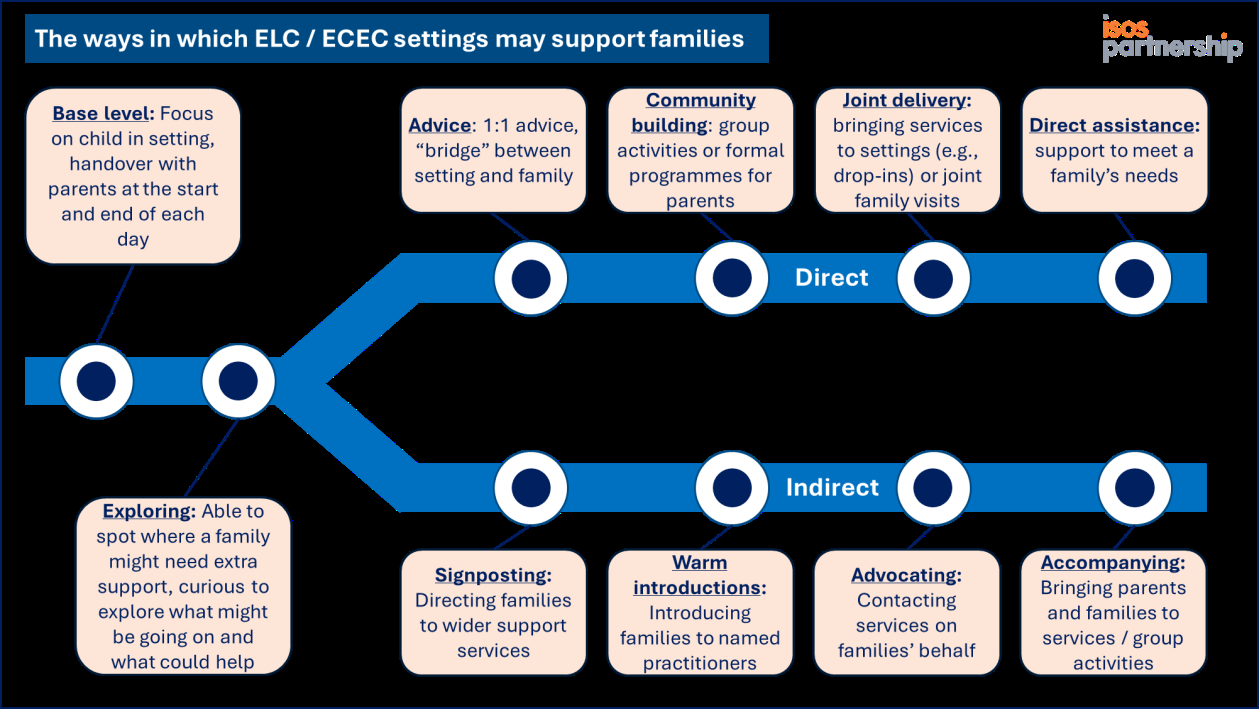
- Advice: almost all ELC / ECEC settings that participated in this report described having an "open door” for parents / carers to talk to them about support they or their child might need. Settings described how they would offer advice on a range of topics – speech and language, play, sleep, eating, toileting – and would act as a "bridge” between the setting and the home learning environment.
'I work very closely with the families I provide care for and am at the end of a phone 24/7. They often ask me for general health advice, what to do at home for development ...' – Childminder (England)
'We have an open-door policy and create strong relationships with our parents and carers.' – Private ELC provider (Scotland)
- Community building: this form of support involves offering group activities for parents / carers (both with and without children). Many ELC / ECEC settings were offering group activities (e.g., stay and play sessions) and formal parenting programmes; they either delivered these directly or hosted an external service. Often, these activities were run both to build parents' / carers' skills and confidence, and to foster personal connections between parents / carers and tackle social isolation. Most group-based settings reported offering this form of support.
'We also connect parents with local services to reduce isolation and ensure joined-up care.’– Private ECEC provider (England)
'We have a night monthly where parents can socialise with their children, food is provided and an activity. This helps families who experience isolation [in] our locality.' – Private ECEC provider (Scotland)
- Joint delivery: some ELC / ECEC settings described inviting external services (e.g., SALT) into the setting to deliver drop-in sessions, or ELC / ECEC staff doing joint home visits with external services.
- Direct assistance: ELC / ECEC settings may provide support for families with food (e.g., having a community larder or food bank on site, space permitting), a clothes exchange, or a lending library. These were reported by some, but not all, settings.
'Wellbeing Wednesday – providing food and clothing bank for our families and community to support poverty. Items are available each Wednesday.' – LA-operated ELC provider (Scotland)
'The swap shop enables parents to place unwanted, toys, clothes, nappies etc. ... and other parents that need [those items] to take them.’– Voluntary ECEC provider (England)
- Signposting: all ELC / ECEC settings described how, where they identified a family needing support, they would signpost the family to relevant external services. This might include paediatricians, SALT, early help, welfare, employment, housing, and wider community support services.
- Warm introductions: some ELC / ECEC settings described how they would go a step further by ensuring that families were introduced to a named person in an external support service. They termed this practice “warm introductions" to distinguish it from simply giving a parent / carer a number to contact or making a paper-based referral.
‘Our open-door policy has ensured that parents have a safe space to share concerns and ask for advice and often results in the setting making referrals to other agencies for example Speech & Language, or Community Paediatrician.' – Voluntary ELC provider (Scotland)
'If support is out of our league, we refer to the necessary professionals such as SLT/OT [occupational therapy] / Early Help Support Workers / Health Visitors / DV [domestic violence] support and also non-professional establishments such as toddler groups, local parents network.' – Childminder (England)
- Advocating: some ELC / ECEC settings described how they would – in some cases by necessity – go further still and impress upon practitioners in external services (e.g., housing, social care) the need for support for a family. This would involve ELC / ECEC settings contacting a service on a family's behalf, in some cases because the family did not speak English fluently or needed support completing the paperwork, and in other cases to chase a service to ensure a timely response.
- Accompanying: in some instances, ELC / ECEC practitioners described going with a parent / carer to a group session (e.g., if this was in an unfamiliar place or to ensure the parent / carer attended the first session and connected with the support on offer) or a meeting with an external service (e.g., an appointment with a health service or a welfare rights service).
'Some of our providers will accompany families to meetings and workshops. This is as a result of the positive relationship that our providers develop with their families and also their understanding of their needs and the level of support required.' – LA lead (England)
'We also offer support during difficult meetings either in person or via video call.' – Childminder (England)
As with integration at service level, the role of ELC / ECEC settings differs depending on the areas in which a family needs support
Key finding
ELC / ECEC settings were more likely to report offering direct support to families in relation to (1) child development, parenting and home learning, and (2) inclusion and ASN / SEND. Settings were more likely to report offering indirect support in relation to (3) family wellbeing and (4) financial hardship.
The nature of the family support role of ELC / ECEC settings – and whether this involves offering direct or indirect support – depends on the area(s) of support that a family needs. Through this research, we identified four broad domains of support where ELC / ECEC settings were playing a role –
- Domain 1: support for child development, parenting and home learning;
- Domain 2: support for families in relation to inclusion and ASN / SEND;
- Domain 3: support for family wellbeing; and
- Domain 4: support where families are facing hardship.
Figure 6: Graphic summarising the roles of ELC / ECEC settings across four broad domains of support for children and families
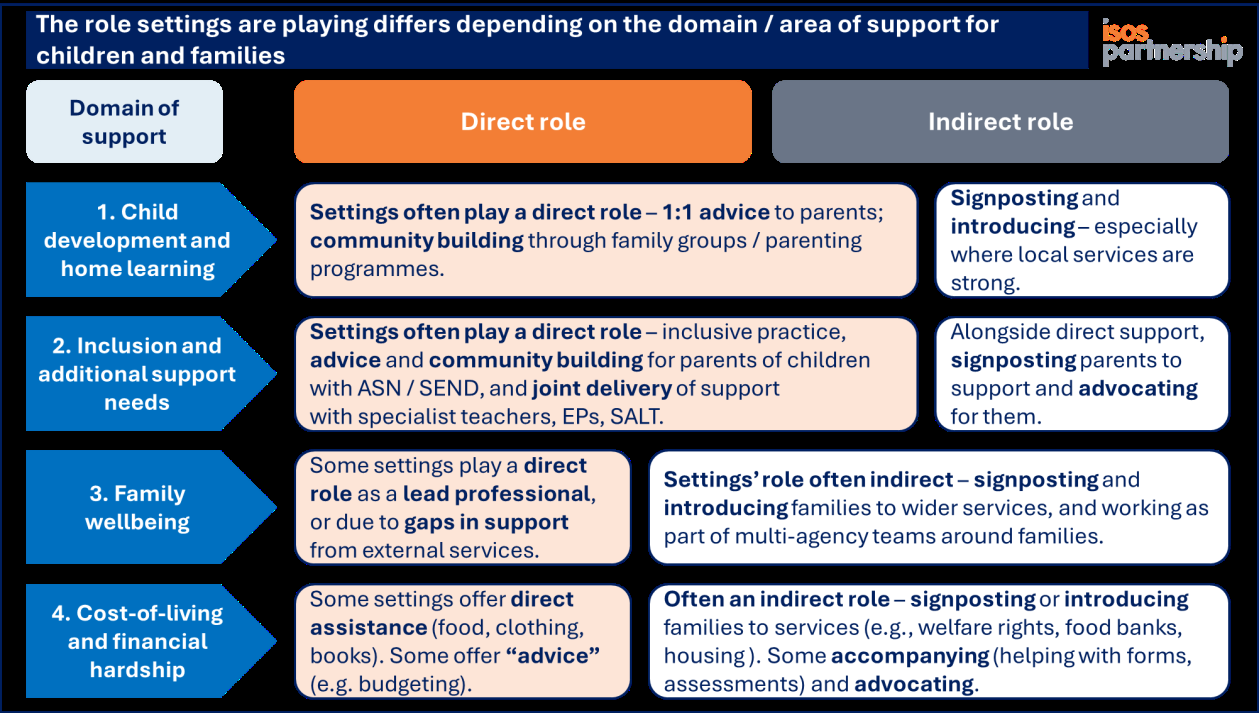
While the role that ELC / ECEC settings play is broad – and often covers all four of these domains of support – it is possible to identify areas where ELC / ECEC settings are playing a more direct role in supporting families, and where the role is more indirect.
'Any day, I could be social worker, I could be mental health professional, I could pick up any of these things.’– LA-operated ELC provider (Scotland)
Domains where ELC / ECEC settings tend to play a more direct role
Figure 6 (above) illustrates how ELC / ECEC settings are playing a more direct role in the domains of support for parenting and home learning (domain 1) and inclusion and ASN / SEND (domain 2). The ELC / ECEC role here tended to involve –
- informal advice to parents / carers on aspects of home learning and parenting, including specific advice for parents / carers to help them understand and support their child's additional needs;
- community building through group sessions (to connect parents / carers to peer networks - see the example of the Early Years Community Research Centre, below) and formal home learning or parenting programmes; and
- joint delivery through ELC / ECEC settings inviting services to deliver on-site drop-in sessions for parents / carers – most often the services were health visiting, specialist teachers, inclusion advisers, SALTs and educational psychologists (EPs).
Case study: The Early Years Community Research Centre
The Early Years Community Research Centre is a partnership between Sheffield Hallam University, Save the Children UK, Sheffield Council and a local school. It offers community nursery provision for 40 children aged 2 to 4, but this is part of a broader vision of creating a virtuous circle by identifying opportunities to transform adult lives and thus improve children's life chances. Staff at the Centre are trained in trauma-informed practice and seek to create an open and safe environment where parents can talk about the support they need. The Centre brings in external services such as housing and employability, hosts multi-agency drop-ins for parents of children who need additional support, and employs a family link worker. Leaders see the Centre as a civic asset, grounded in and shaped by the needs of the community it serves. There is a breakfast club, run by parents, which was set up because some parents were struggling to feed themselves while getting their children ready for nursery and were experiencing social isolation. The pattern of hours offered by the Centre has also been adapted in response to parental feedback to support parents to access work and training.
It was not uniformly the case, however, that ELC / ECEC settings described playing solely a direct role in these two domains. In some local areas where there was a strong and accessible offer of parenting support from a local service or Family Hub, rather than duplicate this offer, ELC / ECEC settings described their role in terms of signposting and introducing parents / carers to that offer of support. Similarly, in relation to ASN / SEND, some ELC / ECEC settings described how they played a more involved, yet indirect, role in terms of advocating or making referrals to services on behalf of families to ensure they got access to the support they and their child needed.
Domains where ELC / ECEC settings tend to play a more indirect role
ELC / ECEC settings were more likely to describe playing an indirect role in supporting families who were experiencing financial hardship. Settings noted that this was the area where it was most difficult for them to identify where a family needed support, in the main because parents / carers were less likely to disclose needs relating to financial hardship.
'Parents ... are more likely to share [that they need support] around SEND, child development, but less likely to share if someone has lost their job, or the family is in financial hardship.' – Independent ECEC provider (England)
ELC / ECEC settings also noted that they did not have the expertise, capacity or leverage to alleviate a family's hardship. They said that their role in this area of support tended to involve signposting and connecting families to welfare support, food banks, housing and community services. In some cases, settings described advising parents / carers on financial support they could access, helping them complete paperwork, and accompanying them to appointments. ELC / ECEC settings said that they were increasingly spending time “advocating” for families – chasing up housing services on their behalf, making complaints and escalating cases – in response to a growing number of cases where inadequate housing was having an impact on families and on children's ability to learn. Some ELC / ECEC settings highlighted the risk of damaging relationships with families if they tried and failed to help them access support in areas like housing or financial hardship.
'I have personally hunted down a housing officer on one occasion.' – ECEC provider (England)
Some ELC / ECEC settings described playing a direct, albeit more limited, role, often related to helping families access tangible household items, such as food, clothing and books. Several ELC / ECEC settings (and LAs) described how they had moved away from the model of "food banks", which some families might find stigmatising, and instead created models of support designed to empower families, such as creating community larders and subsidised cafés (space permitting). In a small number of instances, settings described buying equipment (e.g., buggies) for individual parents. As one provider put it, ‘we mop up for our communities'. Some ELC / ECEC settings reported that they were providing advice about managing household budgets and finances, but this was rare.
The domain of family wellbeing was the one where the ELC / ECEC role was most mixed. Leaving aside ELC / ECEC providers' statutory safeguarding responsibilities (where the provider role is clearly defined), we came across a range of ways in which ELC / ECEC settings were involved in supporting the wellbeing of families and parents / carers. In most cases, particularly where there was a well-developed offer of early help / family support, ELC / ECEC settings described an indirect role of signposting and connecting families, via referrals, to that local offer of support.
In some local areas, settings were playing a more direct role. In some cases, this was by design – where a feature of the local early help model was to build the capacity of ECEC settings to act as the lead professional. In other instances, ELC / ECEC settings were stepping into supporting family wellbeing due insufficiently swift or effective support from external agencies.
'Some providers will take a Lead Professional role when a CP case or Team Around the Family is opened and a familiar, consistent contact is required to support the holistic family plan.' – LA lead (England)
Settings acknowledged that they had a role to play in supporting family wellbeing but argued that this should be as part of a multi-agency team around a family. Settings argued that not only did they not always have the expertise to advise on parental and family wellbeing, but they often did not have access to supervision.
'We are not experts in evaluating home life. ... If I open a CAF, it is just me and the parent. There are no other professionals. I'm not an expert.' – Independent ECEC provider (England)
‘We're meant to be working in partnership with other services, but I'm the “boots on the ground”, I'm the one chasing up services when things have not been done, chasing up applications, referrals and responses.’– LA-operated ELC setting (Scotland)
What determines whether an ELC / ECEC provider is able to offer support for families?
Key finding
Our research suggested that the likelihood of an ELC / ECEC setting providing support for families depended on three main factors: (i) whether the setting had a community ethos, (ii) the setting's physical and staffing capacity, and (iii) the needs of the community served by the setting. Among the LAs and ELC / ECEC providers that contributed to this research, it did not appear that provider type was the main factor in determining whether a setting offered broader support for families or not.
We are cautious about drawing firm conclusions about whether the family support role played by ELC / ECEC differs according to the type of provider – the numbers responding to our call for evidence and taking part in our deep dives were not large enough for this purpose. From the evidence we gathered, it did not appear that provider type alone determined whether an ELC / ECEC setting was offering support for families. Instead, we found that there were three main factors that determined whether a setting was doing this.
- The setting's ethos – whether the setting saw their role solely in terms of educating and caring for children, or more broadly in supporting the families and communities in which children grow up – what we might term “social pedagogy".
- The setting's capacity – both in terms of staffing and physical space. We heard examples of settings whose leaders counted themselves fortunate to be in larger buildings with space for one-to-one conversations with parents / carers or parenting groups. Likewise, we heard examples of settings that had been able to create supernumerary capacity, for example through applying successfully for grant funding, to have a member of staff responsible for family support who was not counted within staffing ratios.
- The needs of the community served by the setting – which would affect the level and type of support that families might need.
In Scotland, some LAs reported a distinction in support for families between settings that were delivering 1140 hours and privately funded settings. In the case of the latter, LAs and ELC settings reported that it was more difficult to engage working parents / carers in support for families because of the pressures of work, and that they had to find alternative ways to reach out to working parents / carers.
The role of childminders
Childminders accounted for seven of the 59 responses to our provider call for evidence, and all bar one said that they provided direct support to families. This tended to involve informal one-to-one advice on home learning and child development, and signposting to external services. Childminders play a unique role that exemplifies the way ELC / ECEC providers can use their relationships to provide and connect families to support. Equally, however, the scale at which most childminders work means that the growing need to connect families to support and engage in multi-agency working is placing significant strain on childminders' capacity, particularly those working alone and picking up additional work to support families.
The role of ELC / ECEC in supporting families should not be seen in isolation from a broader “ecosystem” of support for families
Key finding
The potential of ELC / ECEC settings to transform families and improve life chances for children can only be realised if settings are connected to a thriving ecosystem of support for families. That ecosystem needs to encompass a range of support for adults, families and children, as well as extending to cover the period before children attend settings and when they move on to school.
ELC / ECEC settings can potentially transform parents' and children's lives, but this can only be done if settings are connected to a wider “ecosystem” of support for children and families. ELC / ECEC practitioners cannot address a parent's / carer's mental ill health, financial hardship or unsuitable housing alone, but they can be the ones to spot where families are struggling with these challenges and to connect them to support that can make the difference.
The idea of an "ecosystem" of support for families should also encompass the period before children start to attend ELC / ECEC settings, which for many children will include some or all of the crucial first 1001 days. In most local areas that took part in this research, leaders described approaches to integration at a point in time – how multi-agency support comes together at the point at which a family's needs are flagged up. With some notable exceptions (see the case study of Blackburn with Darwen below), few local system leaders were in a position to describe an offer of support for families that was integrated across a family's journey from conception and the perinatal period through to the child's entry into early years education and the transition to school. (Some LAs in England and Scotland described their aspiration to develop an offer of support that spanned families' journeys but were only at the earliest stages.)
Case study: Blackburn with Darwen's focus on perinatal mental health
Blackburn with Darwen has a longstanding commitment to joined-up, holistic, whole-system support for families. Leaders consider that this delivers positive outcomes for children and families, as well as better value for public funds. Central to this is a focus on integrated support for parents / carers before children access ECEC provision through an innovative cross-sector approach to supporting perinatal mental health. Leaders have commissioned a range of community and health services –
- a Parent and Infant Relationship Service (PAIRS) supporting parents of children aged 0-2;
- Lancashire Women providing support to parents of children in neonatal intensive care units;
- enhanced home visiting support from Home-Start and Dads Matter for children aged 0–5; and
- support from Lancashire Mind for parents who have experienced miscarriage or baby loss.
A truly integrated early years system would be one in which ELC / ECEC settings are part of an ecosystem of support for children and families that spans a family's journey from conception, birth, a child's early years and beyond. ELC / ECEC settings are in a privileged position to identify family support needs, but only from the point children start attending those settings. The role of ELC / ECEC settings should be complemented by other services that work with families from conception, at birth and before children attend ELC / ECEC settings – as well as services that work with the families of pre-school-age children not attending ELC / ECEC settings. Those services play an equally important role in spotting where a family needs help and connecting them to support.
Case study: The Pre-3 Community Team in Fife
A key aspect of integrated working in Fife is the Pre-3 Community Team, delivered jointly by the LA's education service and local health services. The team brings together the Child Development Centre and educational home visitors. It supports the families of children who have significant needs in two or more areas of their development so that support is in place – for example from SALT, EP, occupational therapy (OT), physiotherapy – when the child starts in an ELC setting.
[^6] See, for example, Why babies' first relationships matter: The value of parent-infant relationships in the UK, produced by the Centre for Mental Health and the Parent-Infant Foundation. This estimated 'a robust and prudent estimated social return on investment of £6.08 and £10.30 for every £1 invested, for specialised parent-infant relationship teams in common and severe cases respectively'.
Chapter 2: Approaches to integration at service level
Integration between ELC / ECEC settings and services depends on how services are organised and their accessibility
Key finding
In terms of how ELC / ECEC settings and broader services for children and families work together to deliver joined-up support, we found that there is no optimal model of integration at the service level. Instead, there are a range of ways in which integration between ELC / ECEC settings differs to reflect local context.
The way in which services and ELC / ECEC settings connect to deliver joined-up support for families differs depending on how local family services are organised, as well their effectiveness and accessibility. Integration at service level, and how ELC / ECEC settings and families access support, differs according to (a) how services are organised (whether through “hubs” or multi-agency teams), and (b) the availability and effectiveness of local support services. It is not the case, however, that one model is best suited to one type of local area. Instead, the optimal way of integrating ELC / ECEC and wider family services is one that is carefully calibrated to local context, and will depend on the extent to which it is efficient to balance basing support in hubs, delivering through outreach, and building the capacity of universal and community settings.
Support delivered through “hubs” or “centres”
One model of delivering joined-up support is where services are organised into "hubs" or "centres” that act as one-stop-shops of support for families. These models were more commonly reported in England (due to the legacy of Sure Start) than Scotland, and within England more often in urban areas with high levels of deprivation. The services included in hubs / centres differed between local areas but often included the following elements –
- a core of health, education and care services in their hubs / centres – health visiting, midwifery, early help, children's social care, SEND, SALT, community paediatricians, parenting support and home visiting services;
- a range of support for adult and family wellbeing – adult mental health, adult education, voluntary and community sector organisations, welfare and employment support, and cost-of-living support (food banks or community larders);
- birth registration services in the hubs / centres of some local areas; and
- community spaces and cafés were often reported so that hubs / centres were seen as open and non-stigmatising spaces serving the whole community.
Within these models, the hubs / centres are designed to be the “go-to” places for ELC / ECEC settings and families. This means that access to joined-up family support will often involve an ELC / ECEC provider signposting, introducing or accompanying a parent / carer to a service or activity based in the hub / centre. Once in the hub / centre, a family may be connected to the broader range of services on offer.
In English local areas with these models, each hub / centre was responsible for a defined geographical patch – see the Blackburn with Darwen case study below. ECEC settings were organised into clusters aligned with each hub / centre. This gave them a direct link to the locality hub / centre, so that they could develop an understanding of the support available and build relationships with hub practitioners.
Case study: Blackburn with Darwen's network of Family Hubs and Children's Centres
Central to support for families in Blackburn with Darwen is a network of hubs that provide multi-agency support. There is a Family Hub and a Children's Centre in each of four localities, which provide health visiting, midwifery, paediatrics, early years development, SEND, early help, and a range of community services in a single one-stop-shop. Strong links between the Family Hubs and ECEC settings are fostered. Each ECEC provider has a named lead professional in the Family Hub (which enables ECEC practitioners to connect families to support) and there is joint workforce development for services in the Family Hubs and ECEC settings. There are also shared multi-agency practices; for example, the use of Well Comm screening across all ECEC settings and health visitors has resulted in improvements in identification of needs and children's early language development.
Support delivered through multi-agency teams
An alternative approach to integrating ELC / ECEC and support for families is where services are organised into multi-agency teams that can wrap around settings. These models were more commonly reported in rural local areas in England (where distances make it impractical to rely on families travelling to a central hub) and in Scotland. They were also reported in urban areas in addition to, rather than in place of, hubs of family support. Rather than organising services as a one-stop-shop to which families and settings can be signposted, multi-agency models work on the basis of services coming to ELC / ECEC and community settings that families are already accessing - see the case study from Barking and Dagenham below.
Footnotes:
Support delivered through ELC / ECEC settings
Case study: The nursery readiness project in Barking and Dagenham
The nursery readiness project is a successful pilot working across six primary schools with nurseries. A multi-agency team, comprising health and education specialists, worked with a targeted group of children and parents / carers on a structured six-week programme that included toileting, speech development, creating successful routines, and developing independence. The pilot has already made a significant difference to the children's readiness to learn, with a 75% increase in the number of children able to use the toilet independently before coming into nursery, children settling into nursery more quickly, and better relationships with and between parents / carers.
This can mean that support for families is often hosted, coordinated or delivered by ELC / ECEC settings. For example, an ELC / ECEC setting and an external service would jointly deliver parenting support programmes, or an ELC / ECEC setting would host multi-agency drop-in sessions where parents can speak to health visitors and SALTs. An important characteristic of these models is the emphasis on workforce development to build the capacity of universal services, such as the ELC / ECEC settings, to deliver a broad range of support for children and families.
If, however, local support services are not perceived as sufficiently accessible and/or effective, the joining up of family support may be led more by individual ELC / ECEC settings. In this research, we came across examples of settings – more often those run by social enterprises or larger community organisations, as well as some schools - that had created a family support practitioner role and had formed a partnership with local multi-agency services (e.g., health visiting, SALT) or formed their own team of multi-disciplinary practitioners. These models were often developed in part as a proactive response to local needs (often in areas of high deprivation), and in part to fill gaps in support from wider services.
'[We] are acutely aware of the limitations of wider services so are trying to do what we can to bridge the gaps we have identified.' – Maintained nursery school (England)
Case study: Indigo Childcare's joined-up family support in Glasgow
The Indigo Childcare Group is a social enterprise and registered charity that has operated in the Glasgow area for over 30 years. Indigo's model is an all-through approach, providing integrated learning, play and childcare services for children and young people aged from six weeks to 16 years.
Indigo operates a triple layered support model, providing services for children, their families, and the wider community. This includes Family Matters (a universal whole family service) and Loving Language (a specialist speech, language and communication service, led by their in-house speech and language therapist and focused on closing the attainment gap). Family support services include family support planning, short breaks and respite, a family pantry, a combined clothing and data bank, peer support and advocacy, among others.
Indigo is one of the founding partners in Castlemilk Together, a collective of over 40 organisations, including voluntary sector partners, the local authority, health services and emergency services. With a focus on food, this partnership facilitates joint planning, helps avoid service duplication, and allows for shared insights on community needs.
Co-location
Key finding
Co-location between ELC / ECEC settings and wider family services is a feature of most local areas in England. It is not a scalable model of integration – it may provide some added benefits for settings, but is only one way of fostering joined-up working (and not a guarantee of it).
Through this research, we explored co-location as a model of integration – specifically, where an ELC / ECEC setting and other services for children and/or families are based in the same building.
We found that most LAs reported some examples where ELC / ECEC settings and wider children and family services were co-located, but this only applied to a very small proportion of ELC / ECEC settings in their local area. In all cases, LAs reported that the proportion of ELC / ECEC settings that were co-located with wider services was no more than 10%, and in some cases considerably less. This is reflected in the responses to our LA survey and provider call for evidence, in which co-location between ELC / ECEC providers and wider services was reported by 75% of LAs, but only 28% of ELC / ECEC providers. Both LAs and providers in England were more likely to report this form of co-location than their Scottish counterparts. There was interest among Scottish LAs in exploring models of co-location of services to create one-stop-shops.
Where ELC / ECEC settings were co-located with wider services, LA leads and ELC / ECEC practitioners considered that this had been beneficial in enabling connections between practitioners and services, sharing information, and coordinating swift multi-agency support for families. In our survey, 83% of LAs said that this form of co-location had significantly or somewhat enabled more joined-up support for families. In one local area, ECEC settings co-located with Family Hubs acted as showcases of good practice and supported the professional development of other ECEC settings.
'Co-locating external family support services with ECEC or ELC provision can significantly enable a more joined-up service for children and families. It improves accessibility, communication and allows professionals from different services share the same physical space, which fosters informal and formal collaboration, leading to quicker decision-making and better coordination.' – LA lead (England)
Furthermore, participants in this research stressed that co-location was merely one means of achieving integrated working, not a guarantee of it. We heard examples where, despite physical proximity, the culture and practices of practitioners remained separate and siloed. For co-location to be effective requires there to be a shared ethos, mutual respect and understanding between practitioners, continuity of relationships, and routine sharing of information. One co-located ECEC provider described how they had created a set of formal expectations of partners to set the parameters and non-negotiables of integrated working. Co-location is one way to foster integrated working, but not a guarantee and is not scalable to all ELC / ECEC settings, and thus not likely to be a central feature of integrated support for families in the early years.
‘Co-location isn't the silver bullet, having strong respectful relationships between professionals is the answer.' – LA lead (England)
Attached services
Another model of integration we explored was what we termed “attached services" - where named link practitioners from key services are “attached” to ELC / ECEC settings.
In our LA survey and provider call for evidence, 60% of LAs and 46% of ELC / ECEC providers reported that there were services “attached” to ELC / ECEC settings in their local area. In Scotland, the responses from LAs (54%) and ELC providers (56%) were more aligned than among their English counterparts (61% of English LAs and 41% of ECEC providers reported attached services). This suggests that there may be a gap between the theory and the reality of having services attached to ECEC settings in England, but that attached models are more firmly established where they have been developed in Scotland. Around three quarters of Scottish LAs (77%) and English LAs (73%) reported that attached working either significantly or somewhat enabled a more joined-up service for children and families.
In Scotland, the services most commonly reported to be attached to ELC settings were health visiting (given the role health visitors have for pre-school-age children under GIRFEC), family support workers, SALT, EPs and, in some instances, community paediatricians.
'We have good relationships with the local health visiting and social work teams and this has led to early support for families in need. Additionally, speech and Language services had provided a SALT therapist to visit weekly for a term ... Regular monthly support from local Education Psychologist has had very significant positive impact ...' – Voluntary ELC provider (Scotland)
'We now have a named Health Visitor who works directly with us which is invaluable for questions and someone to bounce ideas off.' – Private ELC provider (Scotland)
In England, the services most commonly reported to be attached to ECEC settings were early years and/or inclusion advisers, early help teams, and public health practitioners.
'... each setting has a named HV [health visitor] / SALT / Family Support Worker for quick case discussion, joint observations and warm handovers.' – LA lead (England)
'We have a link Child Development Practitioner or Public Health Nurse [attached] to each early years setting, they have check-ins with them when the children in their settings are 3-4yrs to attempt to pick up any children identified as having additional needs that may not be “reception-ready”.' – LA lead (England)
Several LAs that took part in this work described their aspiration to develop integration through services being attached to ELC / ECEC settings, in order to build relationships between practitioners and with families, and foster continuity. Some reported that they had not been able to establish or maintain a model of attached services due to capacity constraints in certain services (health visiting was often cited). They described how services had developed models where ELC / ECEC settings had access to a locality team, rather than a named link practitioner.
'[We have] locality-based teams rather than specific named workers. It is an aspiration of Families First to see workers linked to settings although this has not been achieved to date.' – LA lead (England)
Integration between ELC / ECEC settings and services differs depending on the area(s) in which a family needs support
Key finding
More sophisticated and established models of integration have been developed in relation to support for parenting, home learning and support for ASN / SEND, and there are a broader range of models of integration in this area – hub-based approaches, LA-level services attached to settings, and embedding capacity to support families in ELC / ECEC settings.
The precise form of integration between ELC / ECEC settings and wider services differs not only between local areas (depending on how services are organised), but also within local areas and settings according to which of the four domains of support a family needs.
Domain 1: Support for child development, parenting and home learning
This area of support is focused on supporting parents / carers as their children's "first educators”. This is often delivered through a mixture of individual advice, group activities and formal parenting programmes. We have come across a wide range of ways in which ELC / ECEC settings connect with wider services to deliver support in this area. In Scotland, we have come across examples of support for parenting and home learning being delivered in a range of ways. The case study below from Perth and Kinross is an example of an LA-level service providing additional, dedicated capacity for family support that is attached to ELC settings.
Case study: The early years family learning practitioners in Perth and Kinross
Leaders in Perth and Kinross have brought together their support for parenting into a Family Learning Service that sits within Early Years and covers support from pre-birth to 16. Within the Service, there is a team of early years family learning practitioners (EYFLPs) who are attached to every ELC setting (both state-funded and privately-funded) – EYFLPs work can work with one or more settings depending on size.
The EYFLP role means that there is a dedicated practitioner to support families, who works on site in a setting and is able to get to know families, but crucially provides additional capacity and not part of the setting's staffing ratios. EYFLPs, many of whom had worked as early childhood practitioners previously, reflected on how the role enabled ELCs to connect families to support they needed, without placing additional demands on staff. As one put it, ‘Nurseries want to support the children but don't have the time to support the family as a whole, which is where our role is valuable.'
The EYFLP work to a single practice model (Togetherness) and are trained to deliver a range of evidence-based programmes (Incredible Years, Eat Well Play Well, Peep Learning Togeth). EYFLPs deliver groups that are open to parents, but may also tailor groups to specific themes related to local need, as well as offering 1:1 advice for parents and help with accessing wider services. Support from EYFLPs is available during termtime and school holidays.
(Since our research took place, leaders in Perth and Kinross have begun a piece of work to bring together practitioners working with ELC settings, primary and secondary schools, in which the learning from the EYFLP role will be used to shape a similar mode of engaging with primary and secondary schools.)
By contrast, the case study below from Fife describes the approach of having a Family Nurture Centre, with a dedicated family worker, as a hub of parenting support in each of Fife's seven localities. Another Scottish LA described a similar model, in which four ELC establishments had an extended role in relation to supporting families, led by a funded family liaison practitioner.
Case study: Family Nurture Centres in Fife
In each of Fife's seven localities, there is a Family Nurture Centre acting as a hub of support for parents / carers and families. The Family Nurture Centres are extended ELC settings, with a broader remit to deliver support for families in the locality.
Led by a dedicated family worker, each Family Nurture Centre offers a programme of family learning and parenting support, which includes accredited programmes (Incredible Years, Mellow) as well as wider activities for children and families based on feedback and local needs. As well as running stay-and-play sessions and parenting programmes, the Family Nurture Centres also offer activities focused on adult education, managing budgets and cooking, depending on what local parents / carers want. They also help to connect parents / carers to wider support services. The vision, in the words of one Family Nurture Centre leader, is that ‘we want to support the whole family, not just the child. We want to support parents to be the best version of themselves, the best parent for their child.'
The Family Nurture Centres deliver during term time and in the holidays. They also facilitate Early Years Collaboratives in their locality, bringing together ELC settings and wider services to share information and foster collaboration.
Another Scottish LA described their approach of providing additional funding to ELC settings to support the creation of a family champion role within the setting's staffing structure. Family champions received additional training to offer individual advice, connect parents / carers with wider services, and deliver Triple P (Positive Parenting Programme).
We have also seen examples of ELC settings forging direct connections to local services. Flexible Childcare Services Scotland (a national charity and social enterprise with several ELC settings) created an integrated partnership between an ELC setting in Aberdeen and the local health visiting service. This has seen a named health visitor attached to, and delivering appointments in, the ELC setting, which has led to a reduction in missed appointments and an increase in the identification of needs and referrals for support.
In England, we have also seen a range of ways that services connect with ECEC settings to deliver support in relation to child development, parenting and home learning.
- In one local area, there was an Early Years Development Team located in each of its Family Hubs delivering a range of activities to promote home learning to which ECEC settings could connect parents / carers.
- Another local area had rolled out a network of speech and language champions in each of its Children and Family Centres to provide access to support for early language development for families, to which ECEC settings could connect families.
- In another local area, the Adult and Community Learning Service was heavily involved in the delivery of parenting programmes, often in partnership with and on the sites of ECEC settings.
- In the example from Barking and Dagenham below, the LA created the role of "family navigator” to engage families and overcome barriers to families finding out what support is available and how to access it. Another local area had created a network of community early years practitioners, each responsible for a geographical patch, to liaise with ECEC settings and run workshops for parents / carers, stay-and-play sessions, and the home learning programme of their local Family Hub agenda.
Case study: The family navigator role in Barking and Dagenham
The London Borough of Barking and Dagenham is characterised by high levels of deprivation and a young and rapidly growing population. Following a period of budget cuts, the borough is now rebuilding its services and provision for young families. Two particular areas of recent innovation are the development of the family navigator role and the nursery readiness project. Six family navigators have been recruited and are based in the Family Hubs. Their main role is to work with families to help them access the broad, and growing, range of services on offer. This is particularly important given the levels of isolation faced by some young families in the borough and the difficulty they have experienced in finding out about services that might support them. The family navigators are also reaching out to the early years settings in their locality, to broaden their knowledge of the services on offer and support them to signpost families more successfully.
Domain 2: Support for families relating to inclusion and ASN / SEND
This domain is closely connected to domain 1, since a growing focus of the support and advice that ELC / ECEC settings and wider practitioners were offering to parents / carers related specifically to parenting children with ASN / SEND. ELC / ECEC settings draw on their own expertise, resources and inclusive practice in this domain, as well as connecting with a range of services (specialist teachers, inclusion advisers, EPs, SALT, OT, physiotherapy) to request assessments and access additional expertise. The models of integration between additional needs support services and ELC / ECEC settings in Scotland and England displayed some similar features.
First, we saw a number of examples of local areas that had developed a common assessment for assessing children's needs. In Blackburn with Darwen, for example, a common tool for screening and assessing children's development – in this case, their language development – has been rolled out and is used consistently in all ECEC settings and the health visiting service. The example from Cambridgeshire, below, highlights the use of integrated multi-agency assessments for the families of children with complex needs.
Case study: The complex needs pathway in Cambridgeshire
In Cambridgeshire, a large, mainly rural county, with over 375 early years settings, support for children in the early years with complex needs is integrated through the early support pathway for SEND. This is a one-stop-shop complex needs pathway for children in the early years, currently covering around 1,800 children. An early help assessment is carried out on all children who are referred to the pathway, and then a multi-agency panel meets regularly to allocate support. Some of the features that make this integrated way of working successful are
- Proactive relationships with early years settings. The local authority monitors referrals from early years settings into the support pathway and actively follows up with any settings where referrals seem to be abnormally high or low.
- Having in place a robust data-sharing agreement, including with health. Information from early help assessments and notes of visits are made available to paediatricians carrying out diagnostic assessments, giving them a fuller picture of how children present both at home and in their early years setting, and the local authority can task a health visitor or a paediatrician to carry out an assessment.
- Direct and practical support to early years settings. All settings have a named health visitor – not just a generic advice line. Health visitors will go into settings when requested, make observations, contribute to the early help assessment and provide support afterwards. Settings can also access direct support from the nursery nurses, local authority's SEND services, and speech and language therapists.
Second, we saw examples of external advisers working with settings to build capacity and inclusive practice. In one English local area, a team of early years inclusion advisers works directly with ECEC settings to observe, model and train practitioners in inclusive practice. In several local areas in Scotland and England, local SALT services have developed an integrated offer of support focused on upskilling practitioners in ELC / ECEC settings to identify needs and put in place support as part of a universal offer of support in settings. This has meant that ELC / ECEC settings are in a position to put support in place as soon as a need is identified – settings and families do not have to wait for a referral to be accepted. It has also meant that support is more joined-up when a SALT does need to get involved, as they can build on the work begun by the ELC / ECEC provider.
Case study: “Let's Connect" in Fife
Family Nurture Centres in Fife act as centres for excellence, pioneering new approaches. For example, the “Let's Connect" initiative was initially developed in the Family Nurture Centre in Cowdenbeath, with involvement from SALT, health visitors, OT and education services. This approach involves upskilling ELC practitioners to give parents / carers the tools to support their children's development through directed play. This approach has now been rolled out to 80% of 2-year-old rooms across Fife.
Domain 3: Support for family wellbeing
This domain is focused on supporting the wellbeing of parents / carers (as adults with needs in their own right) and families in order to ensure that children are in an environment in which they can thrive. This might involve support for adult mental health, adult additional needs, bereavement or family separation, and may involve ELC / ECEC settings linking with early help / family and community support services. (The role and connections between ELC / ECEC settings and children's social care services is set out clearly in law in both Scotland and England.)
In Scotland, the main way that ELC settings connected with wider services in this domain was by identifying needs and signposting / introducing – and sometimes advocating on behalf of – families to local family and community support. This was also true in some local areas in England. As we described in Chapter 1, some English LAs have developed models of early help in which settings are supported to act as the lead professionals for families needing support. In these instances, the role of wider family services was to build the capacity of ECEC settings through regular training and supervision.
Domain 4: Support where families are facing hardship
This domain is focused on support where families are facing a form of socio-economic hardship – financial hardship, unemployment, inadequate housing or homelessness. Where ELC / ECEC settings identify that a family needs this form of support, the services they may need to join up with might include welfare support, employment support, Citizens Advice, food banks or similar schemes, local community support, and local housing associations. In most cases, ELC / ECEC connect families with these forms of support through signposting, introductions and advocating – this is not an area where ELC / ECEC settings have the expertise or capacity to support families directly, save for providing some necessities (food, clothing, books).
One form of integration between ELC / ECEC settings and wider services in this domain that we did see, illustrated in the Milton Keynes case study below, involved a range of local services coming together to identify families eligible for, but not taking up, ELC / ECEC entitlements.
Case study: Milton Keynes' network of Family Centres
Milton Keynes has built a hub and spoke model connecting every early years provider in the city with one of its 10 Family Centres. This allows ECEC settings to supplement the support they provide directly to families with a range of services based in Family Hubs including early literacy and communication interventions, speech and language champions, health and midwifery, and wider family support services spanning housing, benefits, inclusion and SEND support.
Milton Keynes' Family Centres also play a key role in encouraging families to take up government-funded childcare places. The LA's improvement partner for early years leads a multi-agency participation group that analyses Department for Work and Pensions (DWP) data on a six-weekly cycle to identify families eligible for the 2-year-old childcare offer (Families in Receipt of Additional Support) who have not yet enrolled their children in a setting. They coordinate the Family Centres team to contact 100% of families appearing on the DWP list. In addition to this, one dedicated worker meets individually with parents / carers who need more intensive support to access early education. This approach has helped Milton Keynes achieve a 79% take-up rate of the 2-year-old funded entitlement, 14% above the national average.
Chapter 3: Approaches to integration at system level
Key finding
83% of LAs that responded to our survey reported that ELC / ECEC settings were represented on local strategic partnerships relating to children and families. Only 42% of ELC / ECEC providers that responded to our call for evidence said that this was the case in their local area. This reflects the fact that, unlike schools, ELC / ECEC providers often do not have structures in place that bring the providers in a local area together and enable the local ELC / ECEC sector to engage as a strategic partner in key local partnerships.
Most LAs reported that the ELC / ECEC sector was represented on strategic partnerships
A key indicator of an integrated early system is that ELC / ECEC settings are recognised as strategic partners and are represented on key place-based strategic partnerships. In response to our survey (figure 7), 83% of LAs strongly agreed (23%) or agreed (60%) that ELC / ECEC providers were represented on multi-agency strategic partnerships for children and families. The proportion among Scottish LAs was higher, with 92% strongly agreeing or agreeing with the statement (compared to 80% among English LAs).
Figure 7: LA survey responses about ELC / ECEC provider representation on local strategic partnerships
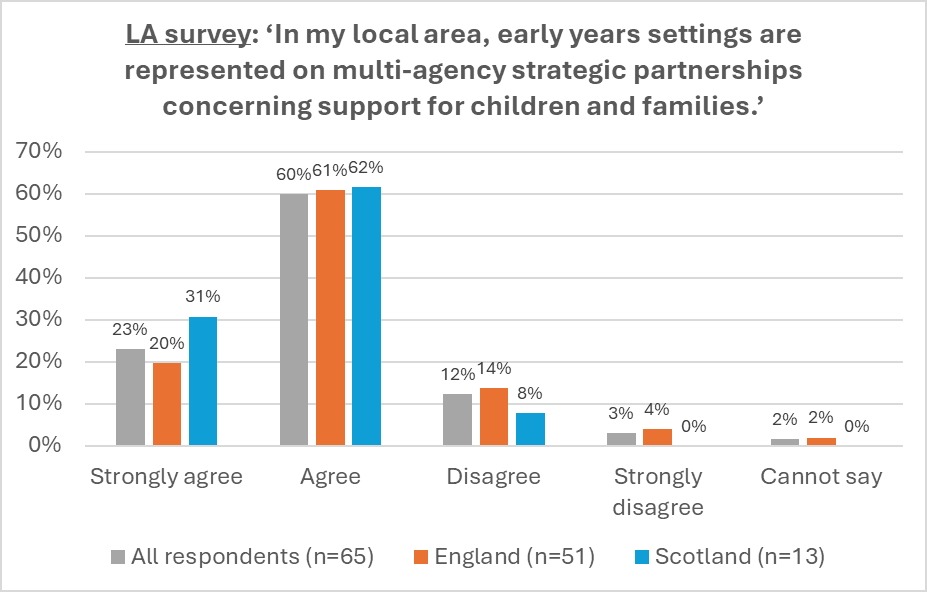
Among Scottish LAs, the most commonly cited strategic partnerships on which ELC providers were represented were GIRFEC, Whole Family Wellbeing, children's services planning, and ASN. Among English LAs, the strategic partnerships on which ECEC providers were represented were BSIL and Family Hubs, SEND, safeguarding, and Schools Forum.
In response to our survey (figure 8), almost nine in 10 LAs said that having ELC / ECEC providers on multi-agency strategic partnerships enabled more joined-up support for children and families, either significantly (43%) or somewhat (46%). LAs in Scotland were more likely to report that the impact was significant (62%) than LAs in England (37%).
Figure 8: Responses from LAs and ELC / ECEC providers about the impact of ELC / ECEC involvement in local strategic partnership working
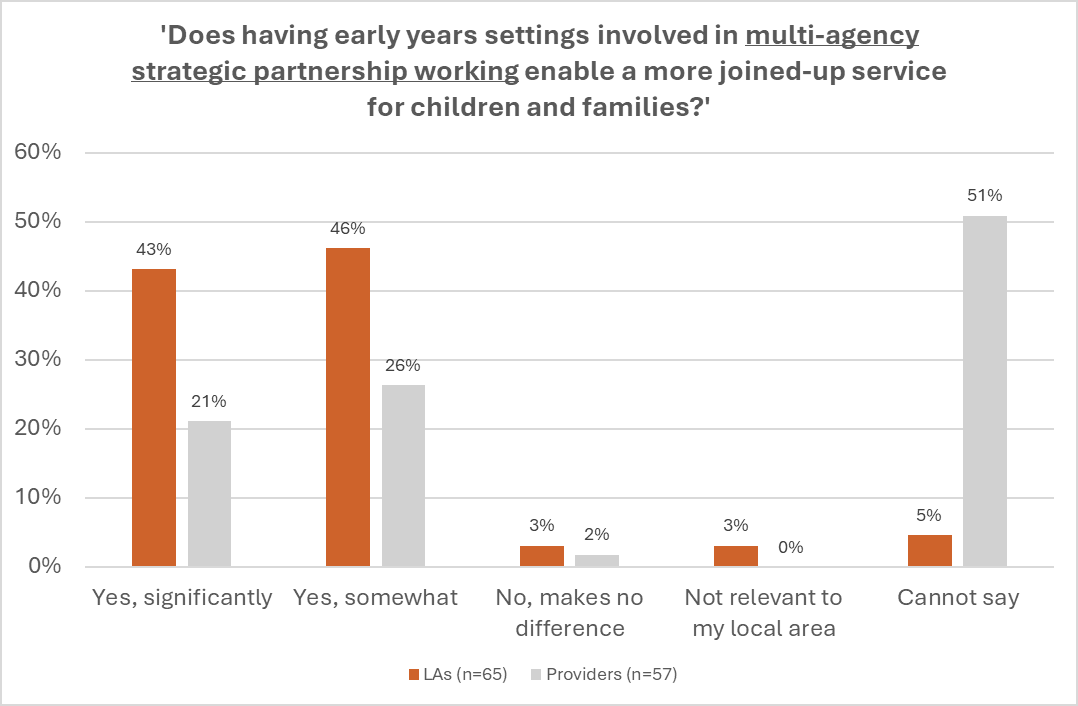
LAs identified the following benefits of ELC / ECEC providers being part of local strategic partnerships –
- better understanding of community needs (more common among Scottish LAs);
- recognition of the ELC / ECEC sector (more common among English LAs);
- better join-up and planning of pathways of support;
- the development of shared priorities; and
- extending the reach of strategic initiatives by building on the relationships ELC / ECEC providers have with families and communities.
'Early years representation on our multi-agency strategic groups ensures a more coordinated and seamless offer for children and families by aligning education, health and safeguarding priorities from the outset. Through shared pathways, consistent information-sharing, and joint decision-making, we reduce duplication, identify needs earlier, and provide the right support at the right time.’ – LA early years lead (England)
In some areas, however, LA leads reported that the ELC / ECEC perspective was represented on strategic partnerships by LA officers, or that there was a gap in terms of the sector's representation on strategic partnerships overall.
‘Settings are represented through myself in a QIO [Quality Improvement Officer] role and through Lifelong Learning colleagues who work with families in areas of deprivation.' – LA lead (Scotland)
'... there is a gap in representation at strategic multi-agency partnerships.' – LA lead (England)
ELC / ECEC providers were less likely to report that their sector was represented on local strategic partnerships
By contrast, only 42% of ELC / ECEC providers that completed our call for evidence said that their sector was represented on local strategic partnerships (figure 9). A similar proportion (37%) said that they did not know if their sector was represented. The difference between the responses from LAs and ELC / ECEC providers is likely to reflect the fact that, while there is an ELC / ECEC representative on some key strategic partnerships in most local areas, the ELC / ECEC settings not directly involved in those partnerships are unlikely to know about them, their area of focus, or who the ELC / ECEC representative is. Those who said that ELC / ECEC providers were represented on strategic partnerships tended to be the providers who reported being directly involved in those partnerships, as well as reporting that the partnerships had a positive impact on creating joined-up support for children and families.
Figure 9: ELC / ECEC provider call for evidence responses about ELC / ECEC representation on local strategic partnerships
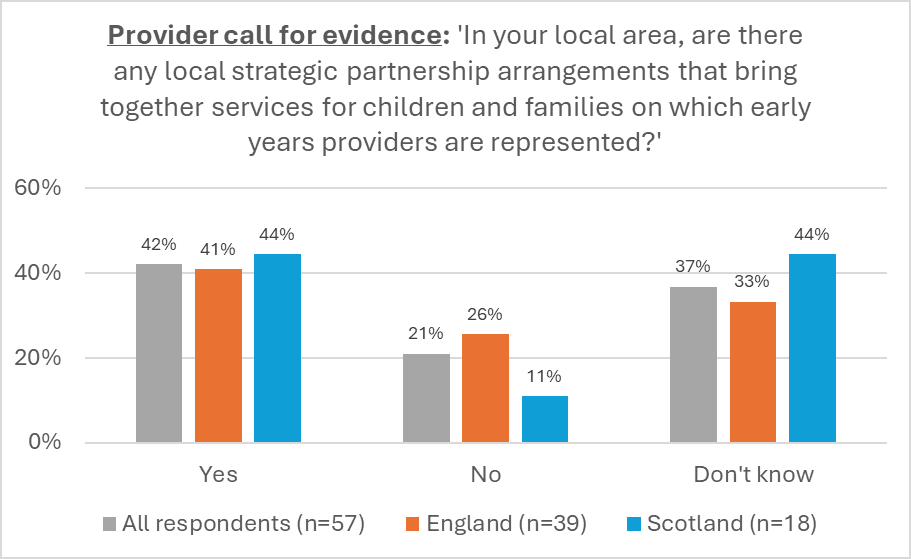
In contrast to headteacher associations for school leaders, the ELC / ECEC sector is rarely organised as a formal strategic partnership. In both England and Scotland, most local areas described having early years networks or collaboratives in place, but their focus tended to be on networking between practitioners, disseminating information and training, and sharing practice. Even where these networks were successful, LA leads described ongoing challenges in securing consistent provider engagement in general, due to provider capacity, and specifically in relation to certain types of providers. English LAs reported that it was harder to engage providers from larger private chains. Scottish LAs described challenges of bringing together providers who are delivering 1140 hours of funded ELC and those who are not. Both described challenges in getting ELC / ECEC setting staff, and particularly childminders, to engage in networks or strategic meetings during working hours. Some LAs described running sessions after 8pm or on weekends, as this was the only time ELC / ECEC staff could engage.
‘Early years and childcare settings are usual[ly] small organisations work[ing] on very tiny margins. Staff release and ability to attending meetings and engage in wider projects can be limited. ... It's difficult for early years and childcare settings to organise themselves into such a way that they can represent each other and share information.' – LA lead (England)
While early years networks can play an important role in disseminating information, they do not enable the ELC / ECEC provider sector to be represented as a partner on local strategic partnerships. This explains why over a third of ELC / ECEC providers responding to our call for evidence did not know if their sector was represented on strategic partnerships – providers who are not directly involved in strategic partnerships have no way of knowing which of their counterparts are involved in which strategic partnerships and the work of those partnerships.
Some LAs have developed structures to enable their local early ELC / ECEC provider sector to engage in strategic partnership working.
- One LA had developed an “early years expert group", with all types of ECEC providers represented and members assigned to attend specific local strategic partnerships.
- Another LA had created a “strategic reference group for early years”, chaired and led by providers, which the LA consulted on strategic initiatives and funding.
- One LA described an “early years phase council", which had representatives on strategic partnerships relating to BSIL, early help and SEND.
- In one local area, the maintained nursery schools convened local early years networks and had representatives that attended headteacher association and strategic partnership meetings on behalf of the early years sector.
These are, however, the exceptions. Overall, the absence of formal structures that would enable ELC / ECEC providers to act as a strategic partner on local place-based partnerships can be a limiting factor to integration between ELC / ECEC and support for families at the system level.
Other system-level features of integration
Some local areas had fostered integration at the level of strategic planning. They had done this by bringing together ELC / ECEC providers and services involved in supporting children and families to create a single, integrated offer of support. This is illustrated by the example from Warwickshire, below.
Case study: Warwickshire's Early Years Integrated Delivery Plan
Warwickshire County Council and strategic partners redesigned their offer of support for children and families in 2019. As a large rural county, rather than relying on families travelling to centres of support, they focused on strengthening multi-agency
locality working and building the capacity of universal services so that families can access support in places they would ordinarily visit.
Education, early help and children's services work on the same geographical footprints, alongside a network of 14 commissioned Children and Family Centres. ECEC providers are crucial to delivery of support for families – the ethos across the county is that ECEC providers have a responsibility not only to support the child in their setting but also to spot where families might need broader support. ECEC providers receive training and, in a recent pilot, supervision from a specialist safeguarding nurse, to support them to play this broader role supporting families.
A key feature of integrated working in Warwickshire has been the “Early Years Integrated Delivery Plan” (EYIDP). This was developed to bring partners that support children and families together to identify common priorities and develop a seamless offer of support. For example, partners have mapped support for school readiness to create a coherent, integrated offer that can be communicated to families. Practitioners reflected that the EYIDP has created a platform for further integrating early years support for families, while leaders are considering developing a public-facing version of the plan.
In Scotland, integrated strategic planning was often linked to the Whole Family Wellbeing agenda, while in England the focus of integrated strategic planning was the development of BSIL local plans. One local area in England described their aspiration to create integrated locality plans, including early years, for each of their Family Hubs.
Case study: Sheffield's Test, Learn and Grow approach and locality-based partnerships
Sheffield is using a Test, Learn and Grow approach to pilot small, specific changes to the Making it REAL (Raising Early Achievement in Literacy) home learning environment programme, monitoring impact and making refinements to improve outcomes. First, practical activities were demonstrated during 'play, chat and learn' workshops to show families what they would receive if they signed up. Second, parents / carers who had already experienced the programme were connected with other parents / carers through WhatsApp. These two changes to delivery led to an increase in sign-ups for the programme over a three-week period, and demonstrated the power of making changes to delivery based on the insights of frontline teams and communities. The Test, Learn and Grow approach is now being deployed with other areas of early years programme delivery.
Early years governance in Sheffield consists of city-wide strategic boards and seven locality-based partnerships, based around Family Hubs. The local authority is currently working to strengthen the role of ECEC providers in local decision-making at both levels, by overcoming key barriers such as incompatible working hours and limited capacity to release staff. The city's Best Start Local Plan aims to re-engage providers as co-designers and shapers within the system, including through the BSIL board.
We heard some examples of jointly commissioned and delivered services across education and health. That notwithstanding, we heard fewer examples of integration through pooling financial resources. Leaders highlighted the challenges of aligning priorities and pooling resources where funding was provided through time-limited grants linked to specific initiatives.
Likewise, we heard about examples of local strategic partnerships using data and intelligence from ELC / ECEC settings to inform the planning of integrated pathways of support for families. While there were some examples of local data-sharing agreements, the lack of clarity about data-sharing, particularly across education and health services, was often cited as a barrier to integration and joined-up family support.
Part 2: Recommendations for strengthening early years integration and support for families
Five recommendations
Among participants in this research, there was a strong consensus that greater integration of ELC / ECEC and support for families would improve outcomes for children and families – 95% of LAs (in our survey) and 98% of ELC / ECEC providers (in our call for evidence) strongly agreed or agreed. In our deep dives, system leaders, practitioners and parents / carers described the value of integrated working and the important role played by ELC / ECEC settings in supporting families.
'I absolutely agree that greater integration between ECEC / ELC and family support is a good thing, as I have experienced the positives first hand.' – Parent (England)
‘I also agree the greater integration ... is a good thing. Because they worked together to help me and get the right support that we needed! Without all of their support I would've really struggled so thank you!' – Parent (England)
In this report, we make five recommendations for how national policymakers can build on the broader role of ELC / ECEC settings in supporting families and create an integrated system of support for families in the early years, and how local system leaders can foster integration at local level.
- National governments should formally recognise and define the broader role of ELC / ECEC settings in supporting families.
- National governments should provide sustainable resourcing to build long-term capacity for ELC / ECEC settings to play a broader role in supporting families.
- Skills for identifying needs and supporting families should be incorporated into national and local ELC / ECEC workforce development.
- National and local governments should support the ELC / ECEC sector to act as a strategic partner in local multi-agency partnership working and in developing local integrated plans.
- National policymakers should develop consistent guidelines and templates for multi-agency data-sharing agreements.
These recommendations were developed and tested through discussions with expert stakeholders in England and Scotland. There was a broad consensus about these recommendations between participants in this research from Scotland and England. As such, we have presented a single set of recommendations for national governments and local system leaders in the two countries, recognising that implementation may look different in each national context. The two quotes below capture the important inter-connections between these recommendations – they are not intended as a “pick-and-mix" of policy options, but instead an attempt to capture what it would take to create an integrated early years system.
What would enable greater integration of ELC / ECEC and support for families?
'A highly skilled workforce. A clear strategic shared vision across services. Integrated information sharing systems that support a holistic approach to family support. A clear financial commitment from central government in support of early intervention and prevention approaches. A strong evidence-based approach to intervention and prevention.' – LA lead (Scotland)
'Effective integration of ECEC/ELC and family support services depends on strong leadership with a shared vision, aligned policies and funding, and collaborative partnerships across sectors. It requires a skilled workforce trained in cross-sector approaches, secure information sharing, and clear referral pathways. Services must be family-centred, accessible, and equitable, with parents actively involved in decision-making. Continuous communication and regular evaluation (most important!) ensure that integration remains effective and responsive to community needs.’– LA lead (England)
Putting our proposals into practice
A key conclusion from this research is that there is not a single “right” model (or models) of integration between ELC / ECEC and support for families that should be prescribed by national policymakers. Instead, models of integration and joined-up support depend on local area, locality and neighbourhood context. It matters more that families experience support that is joined up than which organisation provides it.
As such, our recommendations focus on how to create the conditions for a more joined-up system of support for families in the early years, in which the role of ELC / ECEC settings is recognised and enabled. We hope that key elements of our five recommendations could be used to inform the policy development and roll-out of national policy programmes – such as BSIL in England; and GIRFEC, Whole Family Wellbeing and the expansion of 1140 hours in Scotland. While there are potential resource implications (particularly recommendation 2), there are also actions that national policy and local system leaders can take to move towards a more integrated system of support in the early years to which funding is not a barrier.
Recommendation 1: National governments should formally recognise and define the broader role of ELC / ECEC settings in supporting families
What would be needed from national policymakers?
Fostering greater integration and creating a more joined-up system of support for families in the early years will require the broader family support role of ELC / ECEC settings to be explicitly recognised, formalised, defined and planned for in national policy. This would mean that –
- the role and expectations of ELC / ECEC settings (and the reciprocal roles of wider services);
- how they will be enabled to fulfil that role; and
- how settings and services will be regulated in the future and how outcomes will be measured;
would be a central pillar of future national policy thinking in relation to ELC / ECEC and support for families, and would inform key national policy strategies – such as BSIL (England) and GIRFEC (Scotland) – and the design of day-to-day policy relating to early years and support for families. Policy analysis was not the main focus of this research. Nevertheless, our findings suggest that, while national policy in both England and Scotland recognises the value of integration between ELC / ECEC and support for families, it is necessary – and opportune – to go further in order for there to be consistent and sustainable approaches to integrated support for families in the early years.
What is needed at national level to strengthen integration?
'Devise policy from a multi-agency perspective with a holistic approach to supporting children and families at the earliest opportunity.' – LA lead (Scotland)
'A shared outcomes framework covering child development, family wellbeing, and early intervention.' – Voluntary ELC provider (Scotland)
‘Establish a national strategy that aligns early childhood education, health, and family support under a shared vision, with clear accountability and joint planning mechanisms across sectors.' – LA lead (England)
We propose that the role of ELC / ECEC settings is reframed in terms of a broader, "social pedagogy” – seeing children through the broader lens of the families and communities in which they grow up. As one ECEC provider in England put it, ‘We don't see the child in isolation ... and we never can.' Furthermore, this would require national policymakers to frame the role of ELC / ECEC settings not purely as childcare that has value insofar as it enables parents / carers to work, but as a public good that provides the foundations of children's education and has the potential to transform adult and family lives.
What is needed at national level to strengthen integration?
'Recognition that families need support at various different levels not just to support employment. ELC is not just childcare, there needs to be an understanding that childcare alone will not support parents into work.' – LA lead (Scotland)
Our other recommendations flow from this, including -
- how capacity in ELC / ECEC settings to support families is built and resourced (recommendation 2);
- the skills that the ELC / ECEC workforce will need (recommendation 3); and
- the status of the sector as a strategic partner (recommendation 4).
They all require, however, that there is clarity about the respective roles of ELC / ECEC settings and wider services in working together to deliver joined-up support for families. How, then, might we define the broader role that ELC / ECEC settings could play in supporting families?
We propose that the broader family support role of ELC / ECEC settings should be shaped according to three principles.
- Relationships – who has the strongest relationship with a family? Who knows the child and family best?
- Expertise – who has the expertise to understand a family's needs and the support that might help to address those needs?
- Agency – who is in a position to effect positive change for the family?
This would mean that ELC / ECEC settings would have –
- a direct role in supporting families where, according to the three principles above, they are best placed – where settings have the relationship with a family plus the expertise necessary to determine the support needed and the setting is in a position to effect positive change for the family; and
- the role of connecting families to wider support where a setting lacks the expertise and/or the agency to effect positive change.
The graphic below (figure 10) sets out what this would mean in practice for the role of ELC / ECEC settings across the four domains of support we explored in Part 1. In the graphic, we propose the following ways of conceptualising the role of ELC / ECEC settings, and connections with wider services, in supporting families.
Child development and home learning (domain 1), and inclusion and additional support needs (domain 2) = direct role. During the research, several ELC / ECEC practitioners described their role as a “bridge” between the setting and the home learning environment. We think this is a helpful idea, as it captures the way ELC / ECEC settings can provide a mix of informal advice, home learning resources, group sessions, formal programmes and connections to wider support services. We propose that in these two (connected) domains the ELC / ECEC role could be conceptualised in these terms. We also recommend that, in domain 1, the ELC / ECEC role should be complemented by support for parents / carers both before children start in an ELC / ECEC setting and when they reach school age. In domain 2, the role should be connected to wider support services (specialist teachers, EPs, SALT, OT, physiotherapy) and networks for parents / carers of children with ASN / SEND.
Family wellbeing (domain 3) = convenor role. In a well-functioning integrated system of family support, ELC / ECEC settings would bring their expertise on child development and knowledge of a family to a multi-agency team around the family, as well as helping to create a community of parents around the setting. We have suggested the ELC / ECEC role be conceptualised as a “convenor” role, since it would involve direct and indirect aspects, and bringing together practitioners and parents / carers.
Financial hardship (domain 4) = connector role. While ELC / ECEC settings may offer support with specific, tangible household goods (food, clothing), we suggest that the role ELC / ECEC settings could play in this domain should be understood as an indirect role, focused largely on connecting families to wider services that can address the causes of family hardship.

We recommend
- National governments should formally recognise and define the broader role of ELC / ECEC settings in supporting families. We have set out a conception of this future role based on social pedagogy (seeing children in the context of their families and communities). This broader role should become a central pillar of national policy relating to early years and families – it should be embedded in national strategies and reinforced in guidance and delivery of national policy.
- In framing this reimagined role for ELC / ECEC settings, national policymakers should also define the wider ecosystem of support for families. This would ensure that there are clear expectations of the role ELC / ECEC settings can play in supporting families, but equally of the role that wider services that support families need to play, and how the two should connect.
How could local system leaders support this recommendation at local level?
Participants in this research highlighted three ways in which local system leaders (strategic leaders in LAs, health services, third-sector organisations and ELC / ECEC providers) could support greater integration of ELC / ECEC settings and wider support for families.
- Championing early intervention, prevention and joined-up working – leaders across agencies and services committing to a vision of joined-up, preventative support for children and families, protecting and aligning resources so that there is capacity for this, and fostering an ethos of multi-agency working. Insofar as it is possible, leaders maintain this commitment in the face of financial pressures to reduce capacity to only areas of direct organisational responsibility.
- Bringing all ELC / ECEC providers together, maintaining connections between settings and services, and ensuring all ELC / ECEC settings are treated equally when seeking to connect families to wider support services – this was a theme in Scotland, where some ELC settings considered that providers delivering privately funded ELC were not able to connect with family services (e.g. being told that services did not take referrals from private providers) in the way that providers delivering 1140 hours were.
- Developing mechanisms to unblock cases where a setting has identified that a family needs support, but this has become "stuck". ELC / ECEC settings described how they could find themselves advocating on a family's behalf and chasing up services that are not working together or not responding quickly enough to a family's needs. In a well-functioning, integrated early years system of support for families, the role of ELC / ECEC settings should not include chasing services to get them to listen and respond, or stepping in to provide support because nobody else will. We suggest that local areas develop a route for ELC / ECEC settings to escalate cases that require the LA and/or other strategic partner agencies to use their authority to unblock.
Recommendation 2: National governments should provide sustainable resourcing to build long-term capacity for ELC / ECEC settings to play a broader role in supporting families
What would be needed from national policymakers?
ELC / ECEC settings cannot fulfil a broader family support role without dedicated capacity that sits outside existing staffing ratios. This capacity needs to be created as a function of ELC / ECEC settings as institutions, not as an additional expectation of all ELC / ECEC practitioners in a setting. Investing in ELC / ECEC's capacity to support families would release and utilise the latent expertise and skills, and would therefore be cost-effective and financially beneficial in the long term.
This research has shown that there are a range of ways in which this capacity could be created, for example creating supernumerary capacity to support families embedded within settings, or alternatively delivering support through external services attached to settings. Our research has underscored the importance of local flexibility in shaping how support for families is delivered, both between and within local areas. While there should be consistent expectations that ELC / ECEC settings have access to capacity to enable them to connect families to support, how this is configured will look different in different local areas.
'If there were funds for a post for someone a few hours a week to be a family liaison person that would increase engagement and ability to help.' – Private ELC provider (Scotland)
‘There needs to be capacity to get beyond the idea that the role [of ELC / ECEC] is “just managing children”.” – LA lead (England)
We propose, therefore, that local areas are provided with resourcing to create capacity for ELC / ECEC settings to connect families to support. Local areas should have flexibility to shape those approaches to reflect local context and the needs of different types of providers. For example, it may make sense to create capacity within larger ELC / ECEC settings, but connect with childminders through a peripatetic approach. The corollary of this is that resources would need to be distributed at local area level, rather than provider level. If this recommendation was to be taken forward, further work – and potentially piloting – would be required to model the financial implications, and then agree the most appropriate funding sources and methodologies.
'Deliver policy which is clear in intention and outcome, but which is also flexible enough to adapt to meet the needs of different geographies, and local need.' – LA lead (Scotland)
The feedback from this research suggests that resources for this purpose should form part of an overall, long-term budget with clear expectations about overall outcomes. Participants in the research argued that short-term, time-limited grants often encouraged siloed (as opposed to joined-up) working at local level, driven by grant requirements (rather driven by a shared local vision), and left no lasting legacy when funding was withdrawn (as opposed to building sustainable approaches).
'If you do not have a sustainable funding model, you will not have a sustainable practice model.' – LA lead (Scotland)
... invest in sustainable funding models that enable long-term integrated approaches rather than short-term projects.' – LA lead (England)
We recommend
- National policymakers should provide long-term, multi-year funding to local areas (potentially as additional funding within existing grants) with the expectation that this is used to build capacity that connects ELC / ECEC settings and support for families.
- National governments should provide consistent expectations that each local area should have a model of integrated working in which there is dedicated capacity to connect ELC / ECEC settings to support for families.
- Local areas should have flexibility to shape local models that fulfil these expectations to reflect their local contexts.
How could local system leaders support this recommendation at local level?
Where these have been created, local areas should seek to sustain models in which there is capacity that enables ELC / ECEC to connect to wider support for families. Given that many ELC / ECEC settings are offering support to families through their daily interactions, system leaders in all local areas should consider how they might –
- formalise the family support aspect of settings' work, providing consistent expectations so it becomes part of the core offer in settings across a local area and ensure consistency and quality of advice;
- align existing services with ELC / ECEC settings to make joined-up working as seamless as possible – for example, through standardising and streamlining pathways for requesting support or referring to external services, and communicating these to all ELC / ECEC settings; and
- where possible, pilot small-scale approaches that increase the capacity of ELC / ECEC settings to play a more direct role in connecting families to support.
Recommendation 3: Skills for identifying needs and supporting families should be incorporated into national and local ELC / ECEC workforce development
What would be needed from national policymakers?
ELC / ECEC settings playing a broader role in supporting families would have implications for the training and development of the ELC / ECEC workforce. Those implications will, however, be different for practitioners whose primary focus is on supporting children in their setting, and for practitioners and leaders who are involved in roles dedicated to connecting families to support.
- ELC / ECEC setting staff are the professionals who see children and family members daily. They are, therefore, best placed to identify when a family might need support, even if they are not the ones to deliver or arrange that support. It is vital that their early career training and ongoing development includes (a) how to identify common signs that parents / carers or families may need support, and (b) how to build relationships, foster trust and broach sensitive subjects in discussions with parents / carers and family members.
- A strong ELC / ECEC sector within a truly integrated system is one where leaders and advanced practitioners are enabled to develop their craft in building relationships with families, working with practitioners across multiple agencies and disciplines, and delivering evidence-based support to families. Where dedicated capacity is created to connect ELC / ECEC settings and support for families, the practitioners filling those dedicated roles will require additional training (e.g., in giving evidence-based advice on child development, parenting, and home learning). This training should form part of a career progression pathway through which ELC / ECEC practitioners can become "advanced practitioners” in supporting families.
What is needed at national level to strengthen integration?
‘Provide more training opportunities to support staff knowledge and skills around multi-agency working.' – Voluntary ELC provider (Scotland)
'They [staff] need really good training and to feel empowered to reach a conclusion, to be brave enough to suggest something might be wrong, and to be confident in the conclusion they come to.' – Independent ECEC provider (England)
The focus of our proposals is on the content of existing qualifications for ELC / ECEC practitioners, as well as providing routes for those practitioners who, in the future, may step into dedicated roles that support families. We recognise that, across the ELC / ECEC sector, funding for additional CPD is limited, and that settings are finding it increasingly difficult to free up practitioners to undertake CPD during standard working hours.
We recommend
- National policymakers should make the skills of identifying and exploring sensitively the potential signs of family needs a core component in the early career training and formal qualifications pathway of ELC / ECEC practitioners.
- Beyond this, national policymakers should create additional qualifications and "advanced practitioner” progression routes for staff in dedicated roles focused on brokering and/or delivering support to families.
How could local system leaders support this recommendation at local level?
Local leaders can support the ELC / ECEC workforce and integrated working via –
- joint workforce development for practitioners from a range of settings, services and disciplines that work with children and families – both in the sense of practitioners from different services doing their training together (to build mutual understanding of one another's disciplines, to share expertise, and establish common practices), but also of practitioners building relationships and connections between one another (“knowing to whom to pick up the phone", which can enable seamless support for families);
- continuing to offer CPD opportunities for ELC / ECEC practitioners and joint workforce development flexibly – scheduling meetings at times outside the standard operating hours of ELC / ECEC settings to give practitioners maximum opportunity to engage; and
- providing regularly updated information and communications (and having a central point of contact, like a “navigator”) so that ELC / ECEC practitioners know the support that is available in their local community and can connect families to that support more swiftly.
What is needed at local level to strengthen integration?
‘Shared training and standards bringing ELC educators, family support workers, social workers, health visitors, and early intervention teams together.' – Voluntary ELC provider (Scotland)
'When early years staff, health teams and family support know each other, talk regularly and understand each other's roles, it's much easier to work together around a child. Shared training builds a common understanding of child development and family needs ...’– LA lead (England)
Recommendation 4: National and local governments should support the ELC / ECEC sector to act as a strategic partner in local multi-agency partnership working and in developing local integrated plans
What would be needed from national policymakers?
National policies and programmes – BSIL in England; GIRFEC and Whole Family Wellbeing in Scotland – should set clear expectations that ELC / ECEC providers are recognised as key partners in local multi-agency planning. Since partnership structures and the make-up of the ELC / ECEC sector will differ between local areas, we do not suggest that a specific model of ELC / ECEC sector organisation and partnership representation be mandated at national level. Instead, national policymakers should set an expectation – linked to the additional resourcing we proposed (recommendation 2) – that LAs should ensure that the ELC / ECEC sector is supported to come together as a sector to shape strategic partnership working, and is represented on key local multi-agency strategic partnerships related to children's and family services.
What is needed at national level to strengthen integration?
‘Listen to the staff working with children on a daily basis, give them a voice – they know the needs of families working in their setting and the local community.' – Voluntary ELC provider (Scotland)
'Recognise knowledge and expertise in Early Years Education ... Acknowledge that we often know families and children better than anyone and respect our input.' – Voluntary ECEC provider (England)
We recommend
National policymakers should set expectations (e.g., through policy guidance or conditions of funding) that local areas should support the ELC / ECEC sector to come together to engage in local strategic multi-agency partnerships and developing local integrated delivery plans.
How could local system leaders support this recommendation at local level?
At local level, we suggest that local system leaders develop – or maintain – approaches that enable the ELC / ECEC sector locally to engage as a strategic partner in local partnership arrangements. We described some of the approaches local areas had developed in Chapter 3 – early years phase councils, reference groups, and expert groups. The common features of these approaches are that they –
- establish small, strategic groups drawn from all types of ELC / ECEC settings;
- place ELC / ECEC representatives on key multi-agency partnership boards; and
- enable the ELC / ECEC sector to shape strategic initiatives to support families.
Local areas may want to consider how to support some ELC / ECEC providers to play this strategic role (e.g., through backfill cover, secondments or providing a small amount of funding to create a partnership body for local ELC / ECEC settings), given that ELC / ECEC settings tend to be smaller institutions with fewer staff and tighter staffing ratios. This may look different for different types of providers – for example childminders - but it is important that local sector structures are able to connect and represent the perspectives of all types of ELC / ECEC providers in a local area.
As well as improving ELC / ECEC representation, local system leaders can strengthen integrated strategic planning and delivery. National policies and programmes – such as GIRFEC and Whole Family Wellbeing in Scotland, or BSIL in England – may provide opportunities to develop local strategies and delivery plans in a way that brings together ELC / ECEC settings and wider services and that focuses on integrating the delivery of support for families. Examples in this report, such as Warwickshire's early years integrated delivery plan, show the value of –
- local system leaders identifying a specific priority or area of support for families (e.g., support for parents / carers, school readiness, tackling poverty) where there is the need and/or opportunity for greater integration with ELC / ECEC settings;
- bringing services and ELC / ECEC settings together to map existing activity;
- agreeing how the respective roles of ELC / ECEC settings and services should be integrated to offer seamless pathways of support for families; and
- developing a shared delivery plan, with identified responsibilities, milestones and partnership structures to monitor progress and adapt plans as required.
Recommendation 5: National policymakers should develop consistent guidelines and templates for multi-agency data-sharing agreements
What would be needed from national policymakers?
We propose that there should be common national guidelines and template data-sharing agreements covering what information can be shared between services working with children and families, including ELC / ECEC providers. The barrier to integration cited most often by practitioners in Scotland and England was the lack of common, consistent, national guidance on data-sharing, particularly between practitioners ELC / ECEC settings, education and health services.
Our research suggests that national guidelines and templates for multi-agency data-sharing would give local system leaders and, especially, practitioners confidence about what information can – and should – be shared on a day-to-day basis. This would ensure that practitioners from ELC / ECEC settings and wider services working with families had as full a picture as possible about a family's needs, who was involved in supporting them, and thus how best to coordinate further multi-agency support.
In addition, national policymakers can also play a key role in identifying, endorsing and disseminating current examples of effective local practice. Through this research, we have come across examples where local system leaders have worked in partnership with national governments to test, learn and grow practical approaches to joined-up support for families of children in the early years. In these examples, national governments have played a key role in enabling these approaches to be tested (e.g., providing funding for pilot projects) and then endorsing and disseminating effective practices.
What is needed at national level to strengthen integration?
‘Make data sharing easier with standardised systems and data sharing agreements country wide, this would remove the biggest barrier to all services as people worry about what they can and can't share.' – LA lead (England)
We recommend
National policymakers should develop consistent guidelines and templates for multi-agency data-sharing agreements to ensure there is clarity about how practitioners working with children and families can share information that enables a more joined-up offer of support.
How could local system leaders support this recommendation at local level?
Local leaders can enable – and in some cases already are enabling – integrated working by developing or maintaining local data-sharing agreements and practices. In addition, local system leaders can further reduce practical barriers joined-up working between ELC / ECEC settings and wider services by –
- planning integrated pathways of support across multiple settings and services; and
- enabling settings and services involved in supporting families to access physical spaces where they can work together and deliver support for families – it will not be feasible to ensure that every ELC / ECEC setting has access to a dedicated, on-site physical space for delivering family support, but access to on-site or community facilities should be factored into local models for delivering support for families.
Regional networks and professional associations can play a key role not only in sharing examples of good practice between local areas, but also bringing those examples to the attention of national policymakers. We would encourage local system leaders, regional networks and professional associations to share examples of effective and established local approaches to the practical enablers of integration, such as data-sharing.
What is needed at local level to strengthen integration?
'Having simple consent processes and agreed ways to share information also helps families avoid repeating their story. Clear referral pathways, named link professionals, and handovers make sure support feels joined up rather than confusing.' – LA lead (England)
Conclusion
This research has found that ELC / ECEC settings are increasingly becoming a vital frontline service, not just in offering early education for children, but in connecting families to broader forms of support. One of the initial hypotheses of this research was that greater integration of high-quality ELC / ECEC and support for families could help to deliver better experiences and outcomes for children. The parents and practitioners that participated in this research underscored the value of joined-up services working together to deliver seamless pathways of support for families.
While some models of joined-up support for families have been developed by local areas and by individual ELC / ECEC settings, the challenge now is how to build on these developments and ensure they are embedded consistently. While we can identify common trends across the local areas and settings that have taken part in this research, the evolution of the broader family role of ELC / ECEC settings is patchy and inconsistent. In some instances, where this broader family role of ELC / ECEC settings has been proactively designed by forward-thinking local areas or providers, there have been concerns about long-term sustainability without greater certainty, recognition and support through national policy, not least in terms of funding. In other instances, ELC / ECEC settings have found themselves stepping in to support families to compensate for gaps in support from, or insufficiently responsive, local services.
The challenge, therefore, is how to build on promising examples of practice at local area and setting level, and build an integrated early years system with ELC / ECEC settings at its heart. Our recommendations offer a way towards that goal. If there is a consensus that ELC / ECEC are among the services best placed to identify where families need help and connect them to support, this needs to be a central pillar of national strategies – rather than an inadvertent benefit – and supported accordingly through policy design, regulation, funding and workforce development. Returning to the conceptual framework we developed at the start of this research – in which we set out what we might expect to find – the graphic below (figure 11) shows what, based on our recommendations, an integrated early years system could look like in the future. It would be one in which –
- at the local system level – ELC / ECEC settings are recognised and enabled to engage in strategic partnership working, driven by integrated delivery plans, with a continuous focus on enabling joined-up working between settings and services;
- at service level – all local areas have well-established models, locally determined yet informed by common expectations, that provide dedicated capacity so that ELC / ECEC settings can connect families to support provided by a thriving "ecosystem” of settings, services and third-sector organisations; and
- at setting level – ELC / ECEC settings use their daily interactions with families to offer a range of direct support (for home learning and parenting), and convene other services (family wellbeing) or connect families to wider support (family hardship), within the ecosystem of early years support for families.
Figure 11: Graphic showing how our recommendations would fit together to create an integrated early years system
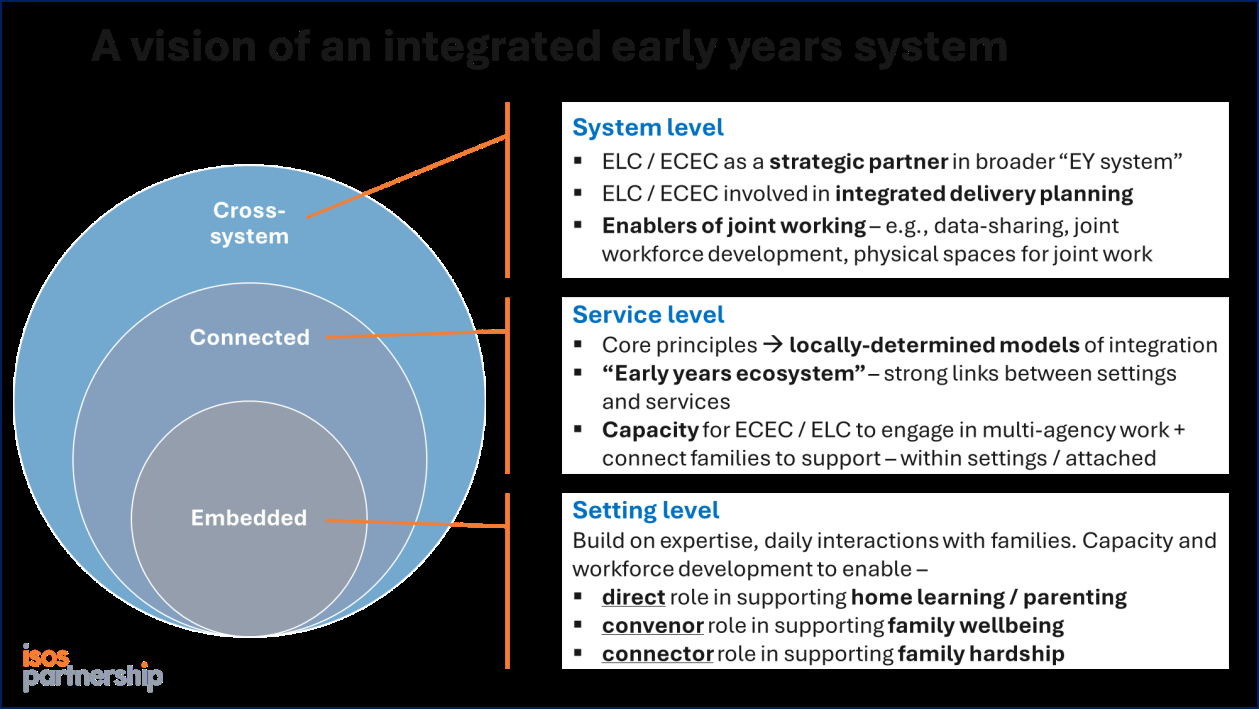
Acknowledgements
This research has been carried out by a small team from Isos Partnership – Ben Bryant, Natalie Parish, Dr Sam Baars and Jodie Reed.
The project has been undertaken in partnership with Nesta – special thanks to Simran Motiani, Lizzie Ingram, Livia Katz and Linda Macdonald for their collaboration and advice, as well as the wider team at Nesta.
We are also grateful to members of the project's steering group for their time, insights and guidance – Nathan Archer, Rob Beal, Cara Brundle, Sally Hogg, Anna Hunt, Ben Lewing, Tim McLachlan, Sarah Newman, Maria Nugent, June O'Sullivan, Eleanor Passmore, Angela Prodger, Jo Siddle, Emily Steers, Polly Walker and Julie Wild.
Lastly, we are grateful to all colleagues who participated in this research – through our local area deep dives, our online survey / call for evidence, and our expert workshops, and other discussions throughout the project.
Glossary of abbreviations used in this report
ASN – additional support needs
BSIL - Best Start in Life
CAF - common assessment framework
CPD - continuous professional development
ECEC – early childhood education and care
ELC - early learning and childcare
EP - educational psychology / psychologist
GIRFEC - Getting It Right For Every Child
LA - local authority
OT - occupational therapy
PVI – private, voluntary and independent (a type of ELC / ECEC provider)
SALT – speech and language therapy / therapist
SEND - special educational needs and disability