How can the Welsh Government turn the tide on obesity?
 www.nesta.org.uk/blog/how-can-the-welsh-government-turn-the-tide-on-obesity/
www.nesta.org.uk/blog/how-can-the-welsh-government-turn-the-tide-on-obesity/
www.nesta.org.uk/blog/how-can-the-welsh-government-turn-the-tide-on-obesity/
In May, Wales will elect a new Senedd. Whoever takes office will face a familiar set of challenges, including record NHS waiting lists, persistent health inequalities, and weak economic growth. Obesity is an important driver of all three.
If Wales is to become healthier, fairer and more prosperous, tackling obesity must be a core focus for the next government. The new restrictions on the placement and promotion of less healthy foods in shops are a good start, but addressing obesity on the scale needed will require more ambitious policies.
This means a more comprehensive approach to tackling the root causes of obesity, including the introduction of mandatory healthy sales targets for retailers, alongside expanded access to effective weight-loss medicines for those at highest risk.
Nesta’s analysis suggests that more than a third of adults in Wales were living with obesity in 2022-23 - higher than official figures indicate, and the highest rates in the UK. Childhood obesity is also higher in Wales than in England and Scotland (comparable data is not routinely reported in Northern Ireland. This means hundreds of thousands of people in Wales face higher risks of preventable disease, disability and early death. Without decisive action, these harms will grow for future generations.
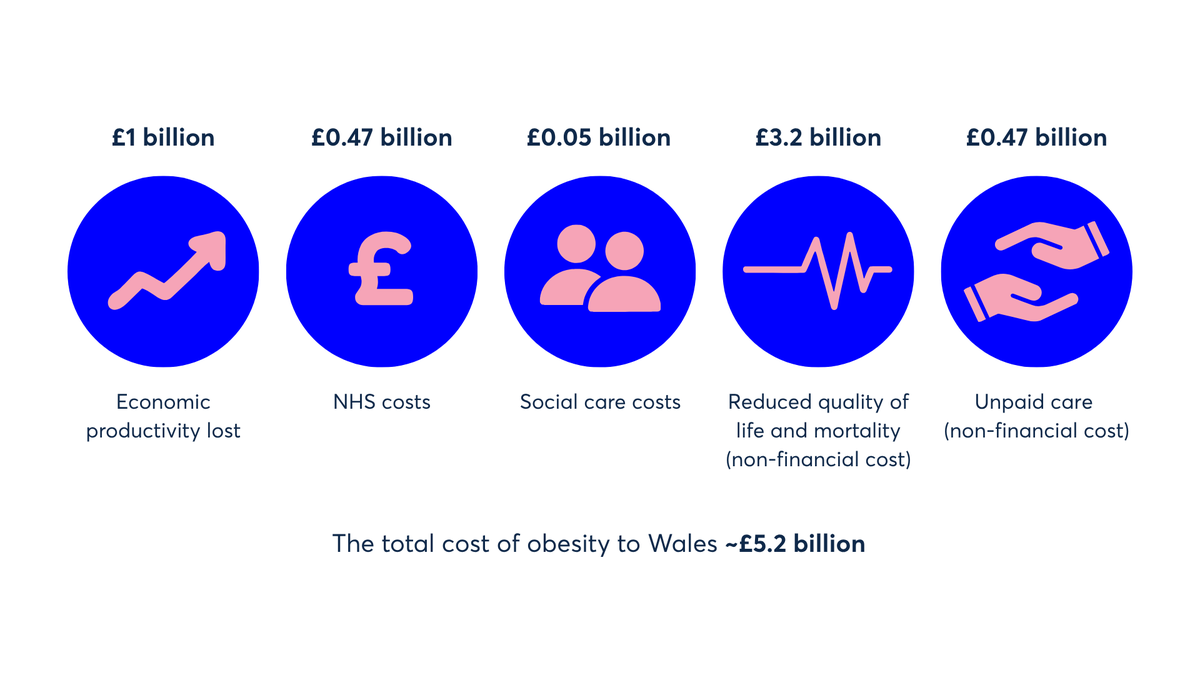
Nesta-commissioned research by Frontier Economics suggests that obesity costs Wales more than £1 billion a year in lost productivity. This is a significant drag on economic growth in Wales, which already has the lowest productivity of any UK nation, 15% below the UK average.
Overall we estimate that obesity costs Wales around £5.2 billion a year, and this figure is rising. This includes approximately £470 million in direct NHS spending, alongside wider societal costs from reduced quality of life and costs associated with paid and unpaid social care.
Estimated by Nesta, based on research by Nesta and Frontier Economics. Productivity-related costs were calculated within the study, using Wales-specific data, including median earnings. All other cost estimates were derived by scaling UK-level costs in proportion to the number of people living with obesity in Wales relative to the rest of the UK.
The NHS in Wales is under severe strain. Around one in four people in Wales are now waiting for NHS treatment, the highest level on record. Obesity increases the risk of conditions such as type 2 diabetes, heart disease, musculoskeletal problems and some cancers. Reducing preventable ill health, including obesity, must be part of any serious plan to ease pressure on health services in Wales.
Obesity also does not affect all groups equally, with higher prevalence in more deprived parts of Wales. Men living in the most deprived areas of Wales can expect 16 fewer years in good health than those in the least deprived areas; for women, the gap is 20 years. Chronic conditions such as obesity are a major driver of these stark differences. Nesta’s analysis shows that tackling obesity is essential to narrowing gaps in healthy life expectancy between richer and poorer areas. Any government serious about reducing inequalities in Wales cannot afford to ignore obesity.
To halve obesity prevalence, people living with excess weight would need to reduce their average daily calorie intake by around 8.5%, or 216 calories per day. That is roughly equivalent to a single slice of medium pepperoni pizza.
There is no shortage of policy ideas aimed at achieving this. Many already appear in Welsh Government strategies. The challenge has been prioritisation.
With limited resources, governments should prioritise the most impactful interventions. That means focusing on a small number of high-impact policies, rather than spreading effort thinly across many initiatives with varying levels of impact and evidence.
Nesta’s blueprint for halving obesity shows that the most feasible and effective approach combines population-level prevention, which makes healthier choices easier by default, with effective treatment for people at highest risk of obesity-related ill health.
Last year, the UK government announced plans to introduce mandatory health reporting and healthy sales targets for large food businesses in England - a policy known as the healthy food standard - as part of its 10 Year Plan for Health. The healthy food standard could also be a landmark opportunity to champion prevention and reduce historically high levels of obesity in Wales.
Supermarkets account for more than 80% of people's energy intake, making them central to any serious obesity strategy. Nesta’s modelling suggests that setting mandatory health targets to bring the sector in line with the healthiest performing retailer could reduce obesity prevalence by around 20%, and at very low cost to the Welsh Government.
This approach is uniquely impactful and cost-effective because it sets clear outcome goals while giving supermarkets flexibility in how to deliver them - whether through reformulation, pricing, promotions or marketing. This flexibility helps to minimise business costs and means they are far less likely to be passed on to the public - Nesta estimates that the cost to the UK's largest food retailers of implementing the healthy food standard would be less than 0.1% of the industry's ~£210 billion annual turnover. Public backing is also strong: research by More in Common for Nesta found that 70% of people in Wales back targets to increase the sale of healthier food.
Wales now has an opportunity to take a major step forward in improving the food environment through a healthy food standard. Acting quickly to introduce it would help ensure people across Wales can benefit sooner.
Prevention must remain the foundation of obesity policy in Wales. But effective treatment also has an important role to play. Rapid advances in weight-loss medicines, including GLP-1 agonists such as Tirzepatide (Mounjaro), present a significant opportunity, with users losing on average 15–21% of their body weight over 72 weeks, depending on dose.
These medicines treat obesity, they do not prevent it. Weight is often regained once treatment stops, and side effects are common. Without changes to the food environment that contributed to weight gain in the first place, sustained weight loss is less likely - reinforcing why prevention remains essential.
Access is currently skewed towards those able to pay privately, with around 95% of users obtaining GLP-1s outside the NHS at typical monthly costs of £150–£200. Analysis from The Health Foundation shows this private market is already marked by significant socioeconomic inequality. Without expanded NHS provision, lower-income groups risk being largely excluded, widening health disparities.
In England, NICE has recommended a phased 12-year rollout of Tirzepatide, initially prioritising people with the highest BMI (>35) and at least one weight-related comorbidity. Around 186,000 people in Wales would meet these criteria. However, NHS rollout plans in England suggest that fewer than half of eligible patients may receive treatment over the full 12-year rollout, implying that if Wales followed a similar approach, the number treated could be closer to 87,000 people - roughly one in eight adults living with obesity. Even with full implementation, the rollout pace means it is unlikely to materially reduce overall obesity prevalence in the next five years. Wales has agreed in principle to a 12-year rollout but has not set out detailed phasing or pace.
Because obesity rates are higher in Wales than elsewhere in the UK, the potential benefits of expanding access to GLP-1 medicines may also be greater. If deployed effectively, these medicines could help reduce some of the associated health harms, ease pressure on the NHS and support economic productivity in the near term, while longer-term prevention policies reshape the food environment.
The next Welsh Government should explore how to accelerate and expand access faster than England’s phased approach. Delivering this will require adapting workforce capacity, funding, IT systems and care pathways, to enable faster and more equitable access, with wrap-around care proportionate to clinical risk. Delivery models may evolve towards lighter-touch digital monitoring and greater roles for GPs and community pharmacists for lower-risk patients, while maintaining specialist support for those with complex needs.
High obesity rates are not inevitable, and neither are their costs.
Action on obesity will be most effective when prevention and treatment are pursued together. Expanding access to effective weight-loss medicines should sit alongside, not instead of, action to improve the food environment, which offers a more sustainable, lower-cost route to population-level impact. Together, these approaches can help more people reach a healthier weight and make that weight loss easier to sustain.
The evidence is clear, the policies are known, and Wales has the powers to act. With the right choices, the next Welsh Government can lead the way in building a healthier and more prosperous nation.