Devolving the Warm Homes Plan to local government makes sense - but the Boiler Upgrade Scheme should stay
 www.nesta.org.uk/blog/devolving-the-warm-homes-plan/
www.nesta.org.uk/blog/devolving-the-warm-homes-plan/
www.nesta.org.uk/blog/devolving-the-warm-homes-plan/
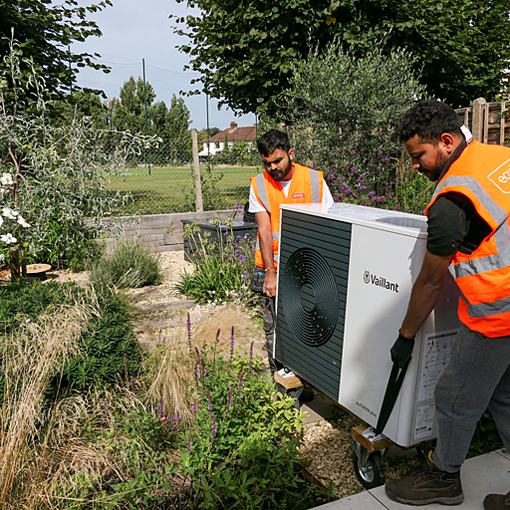
In her Labour Conference speech, Energy Secretary Miatta Fahnbulleh announced that she would devolve the Warm Homes Plan, the UK government’s £15 billion funding pot for upgrading homes.
Putting mayors and strategic authorities in charge of upgrading home energy and heating makes a lot of sense. Home heating is an especially localised issue, with local authorities having a better understanding of local housing stocks, fuel poverty levels and supply chains. Nesta has long called for a neighbourhood approach to complement our current individual household approach. As Fahnbulleh put it, the “Great Home Upgrade” should operate “postcode-by-postcode, street-by-street, community-by-community”.
For this neighbourhood approach to work, local government needs the funding and powers to take the lead. Up until now, the area-based approach outlined in the Warm Homes Plan has made slow progress, because most local authorities lacked the resources to get started.
Devolving funding to local government - specifically to strategic authorities, which cover city- and county-regions - will change this. It will make energy and home heating a clear responsibility of mayors and other strategic authorities, and give them the tools to do the job, building up teams with the expertise to make Fahnbulleh’s vision a reality.
But to make this work, the UK government should avoid devolving the Boiler Upgrade Scheme (BUS), which provides direct subsidies to households that get a heat pump.
The BUS is an effective, demand-led subsidy. It is available to any household that replaces a boiler with a heat pump, covering several different types of heat pump. The scheme is simple, has relatively little friction and is easy for heating businesses and households to access. It is more effective at increasing heat pump installations than its Scottish equivalent, the Home Energy Scotland scheme, and much simpler than its predecessor, the Renewable Heat Incentive.
The BUS can also support local government in upgrading home heating in their area. It gives areas two routes to upgrade homes: one via the private market, one via area-based schemes. Wherever a local authority runs a scheme to upgrade multiple homes with heat pumps (including networked ground source and air-to-air), it can access the BUS. Likewise, homeowners can do the same independently - meaning local authorities don’t have to do all the work. Having two routes to upgrade homes makes sense.
Devolving heat pump subsidies to local government would effectively mean ending the BUS and replacing it with multiple new schemes at local level. Each strategic authority would receive a share of the funding (due to rise to £700 million by 2029/30) and would be responsible for spending it, with or without conditions attached by Whitehall (such as whether the money has to be spent on heat pumps, or how big the subsidy should be). This devolved model would create a number of problems.
First, it would be hard to allocate the right amount of funding to each area. Heat pump uptake is uneven and unpredictable, but the UK government would have to find a way to allocate it. This would inevitably mean some areas under-spending and some running out of budget, creating uncertainty for the industry. The BUS, by contrast, directs money wherever it is needed.
Second, it would create huge uncertainty for the heating industry. A significant majority of retrofit heat pump installations depend on the BUS, especially now that the Energy Company Obligation scheme (ECO) is gone. There is a high chance of gaps in funding (as we have seen with the abolition of ECO), leading installations to collapse and companies to go bust or exit the industry. There would also be uncertainty about what subsidies would be available where and friction for installers in accessing them - especially as many installers work in small businesses. Abolishing the BUS could wipe out the heat pump industry in England and Wales - and it would be very hard to rebuild it. This would severely jeopardise the UK’s climate goals and leave more households burning imported gas.
Third, devolving the Boiler Upgrade Scheme could add significant friction to the customer journey for heat pumps. Different local schemes would likely have different requirements, likely including links to a range of other home energy and heating schemes. Experience from the Home Energy Scotland Grant and Loan scheme, which has a much more friction-heavy process for the household compared to the BUS in England and Wales, suggests this approach has a real impact on heat pump uptake. Scotland’s scheme has had in recent years a lower rate of take-up compared to BUS, on a population-adjusted basis, despite having some things in its favour - a more generous scheme and a higher proportion of off-gas grid homes. It is also telling that very few companies work across the border of both England and Scotland, since they need to adapt their business processes to the different bureaucratic requirements. It is notably the case that Octopus Energy, one of the largest installers in England and Wales, does not offer heat pumps in Scotland. The installer companies also play a crucial role in promoting the heat pump grant schemes and the Home Energy Scotland Grant and Loan scheme (HESGL) scheme being less installer-friendly could well be another cause of lower take-up in Scotland.
Though the BUS scheme is best administered nationally, there is significant opportunity to make it do heavier lifting for strategic authorities’ local heating work. We think the BUS could change to better support neighbourhood delivery, by becoming much easier for local authorities to access when they run place-based schemes.
For example, when developing a local air source heat pump scheme, they should be able to easily aggregate BUS applications so that individual homeowners or installers do not need to apply separately. This should also apply to networked ground source heat pumps, which rely on shared infrastructure projects.
Ministers have positively talked about needing a national “supportive spine” to help local areas deliver on the devolved Warm Homes Plan. This would be provided by the government-announced Warm Homes Agency, which should exist mainly to help local areas, offering tools, guidance and specialist expertise. The Boiler Upgrade Scheme should be seen as a core part of this national spine: there to help both local authorities and individual households electrify.
Devolving the Warm Homes Plan to strategic authorities is a good idea, but it will work best with some support retained at national level - and the Boiler Upgrade Scheme should be part of that.