What is collective intelligence design?
Collective intelligence design is the art and science of bringing together diverse groups of people, data (including information or ideas) and technology.
When should we use collective intelligence design?
You can use collective intelligence design at any stage in a typical innovation, product development, policy design or service design process. You might use collective intelligence at just one of the stages in your process, or across multiple stages.
Use the table below as a guide to how collective intelligence design can help you address your challenge. Your starting point - the reason you decide to use collective intelligence design - will lead to different results, and the projects you design will have different characteristics. A brief summary is provided in the table below.
| Examples of common issues | Purpose for using collective intelligence | Common characteristics | Example outputs |
|---|---|---|---|
"I have poor/incomplete information about this issue, or it is changing rapidly." "I want to anticipate how a problem or situation might change in the future." |
Understand problems Generate contextualised insights, facts and information on the dynamics of a situation. |
|
Real-time data dashboard. Open map of local level (granular) data. Predictive model. Early warning alerts. |
"I understand the problem I’m working on, but I don’t know how to best tackle it." "My existing approaches to tackling this problem aren’t working well enough." |
Seek solutions Find novel approaches or tested solutions from elsewhere. Or incentivise innovators to create new ways of tackling the problem. |
|
A register or prioritised list of new or existing solutions to adopt, adapt or test. Prototypes for scaling and/or further investment. |
"I want to share ownership for the decision(s) I need to make." "I need other people to act with me on this issue." |
Decide and act Make decisions with, or informed by, collaborative input from a wide range of people and/or relevant experts. |
|
Participant-ranked list of proposed actions/ideas for implementation. Clarity on majority or consensus view on a given topic or course of action. Collective agreement on next steps. |
"I want to track if this project/policy is working the way it is intended." "I want to share what is known and what works with others so that they can act more quickly/smartly." |
Learn and adapt Gather data to monitor the implementation of initiatives, and share knowledge to improve the ability of others. |
|
Open source repository of tools, designs or software. Experiment results made available to others. Formalised hubs of knowledge on ‘what works’. Online learning programmes/exchanges that are personaslised or enhanced based on others’ experiences. |
You might have one primary purpose for collective intelligence that you focus on, or you might incorporate two or more purposes in your project. You can introduce it in a modular and flexible way.
An example of a project which combines multiple uses (or categories) of collective intelligence is Regen Network, which aims to reward positive changes to our ecosystems.
Understand problems: Regen Network uses satellite, sensors and on-the-ground observation data to understand current ecological conditions.
Seek solutions: A network of farmers around the world are incentivised to experiment with new approaches to improving things like carbon sequestration, cleaning waterways or increasing biodiversity. They are paid as ecosystems improve and conditions set out in ecological protocols are achieved.
Decide and act: Ecological protocols are crowdsourced from relevant experts which stipulate the improvements needed for any particular ecosystem.
Learn and adapt: The satellite, sensor and on-the-ground observation data help farmers to monitor progress in real-time and learn which experiments are working best.
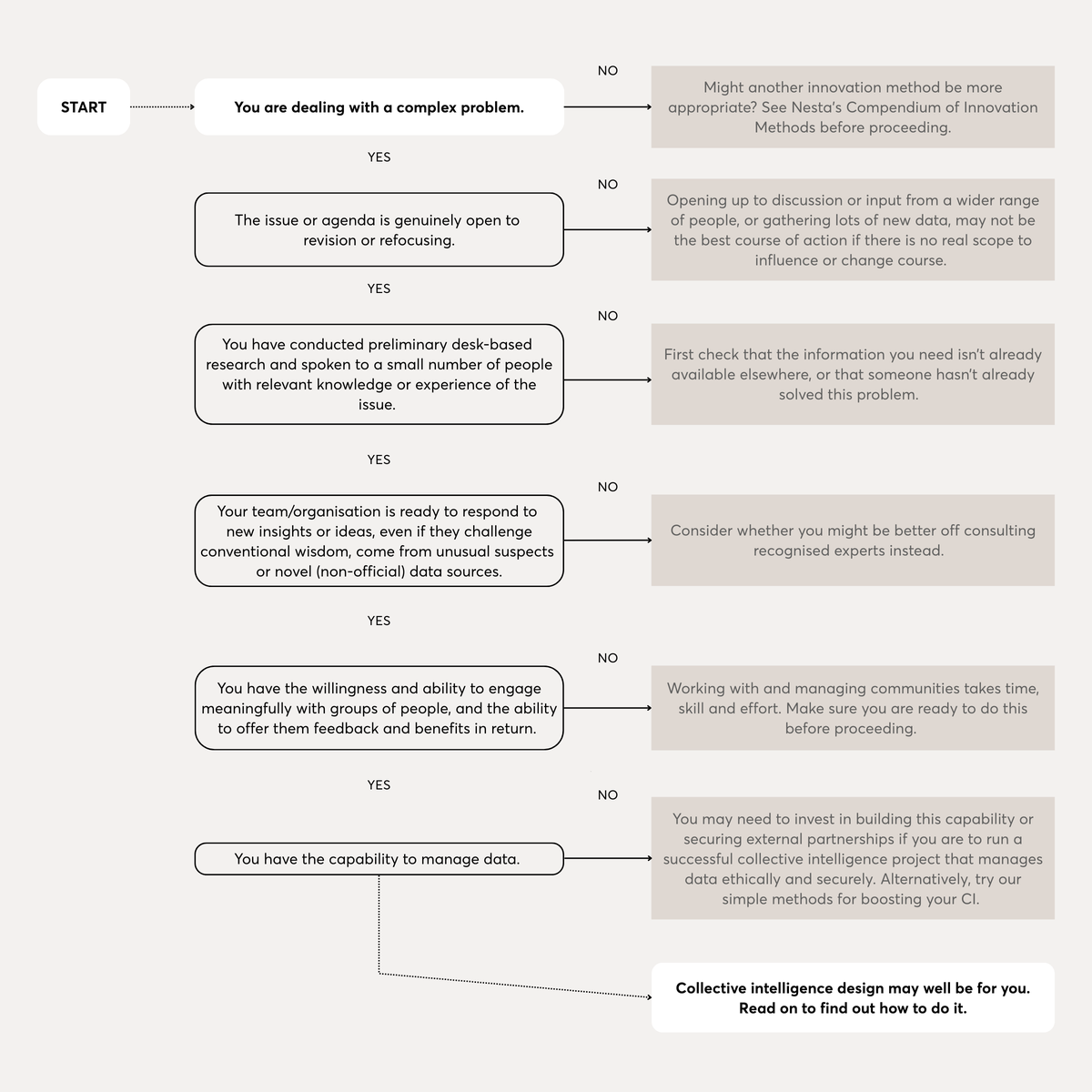
How do we know if collective intelligence design is right for us?
Use the following flowchart to help you decide if collective intelligence is right for your challenge and if your team or organisation is ready to use it.