Principles
The collective intelligence design principles are pieces of advice to help you design your project.
They are guidelines and considerations to take into account - more like a compass than a definitive roadmap. Apply them when you select, create and organise elements in your project.
1) Increase diversity of the people you involve and the opinions you listen to.
Research shows diversity of people and perspectives can enhance the collective intelligence of a group. In fact, diverse groups often outperform groups of likeminded experts and the brightest individuals too. Don’t just include the ‘usual suspects’ in your project. Bring together people with different experiences, ways of understanding, interpreting and solving problems (this is known as cognitive diversity) to help you address your challenge more successfully.
2) Enable people to contribute views and ideas independently and freely.
You’ve successfully brought together a diverse group of thinkers and solvers. But groups can still be dominated by the loudest person, minority views can often be ignored, and groupthink can lead you to the wrong answer. Enable people to contribute their intelligence freely and independently, taking care to think about how you manage group dynamics and behaviour to mitigate against biases and make sure every voice is heard.
3) Integrate different types of data to unlock fresh insights.
The emerging variety of real-time, ‘groundtruth’ and novel data sources is helping us to build better models of the world. Think carefully about which data and information can help you to measure or describe the problem you’re interested in, from proxy indicators to inputs from those most closely affected by the problem. Select, test and combine new sources of insight to improve the timeliness and appropriateness of your response.
4) Be citizen-centered: data empowerment, not data extraction.
Start with the problems that matter to people not a particular technology. Don’t just use people to extract the information you want, but make sure they can access and use the collective intelligence that is created. Involve people in producing and using data by working with them as agents of change not passive beneficiaries. Ensure people understand and can determine how their data is used. Create for the public commons where possible - opening up information and technology for others to use. Applying this principle will help you avoid some of the potential risks of using collective intelligence.
Process
At the heart of the playbook are four purposes for using collective intelligence design: to understand problems; seek solutions; decide and act; and learn and adapt. In this playbook, we’ll also refer to them as categories of collective intelligence.
The starting point for collective intelligence design is to have clarity on what you want to use collective intelligence for. Select a purpose, informed by the issue you’re seeking to address. This is the guiding star of how your group will design collective intelligence, and how you will navigate this playbook.
There is no hierarchy among the different purposes of collective intelligence, nor do they have to be used sequentially. They can, however, be used in combination. The case studies illustrate how this modular approach has been adopted by many examples of collective intelligence in practice.
Tip: If you are just starting out with collective intelligence design, we suggest focusing on designing one use to begin with. Over time, you may find that you want to use collective intelligence in other ways as part of your project or initiative.
Public Lab initially engaged 100 volunteers in community mapping activities to understand the problems caused by the Gulf oil spill and track BP’s clean-up efforts. As the community matured it wanted to share its knowledge with other community groups. To do this, it created an open source repository of DIY community monitoring tools so that other groups could learn and adapt for their own purposes.
Canvas
The collective intelligence design canvas is a template for people wanting to design a collective intelligence project.
As you design your project, you should print out and populate the canvas with the choices you make and the elements relating to your project. This will give you an overall picture of your project, and help you see all the relevant components at-a-glance.
Whether you’re designing to understand problems, seek solutions or one of the other categories of collective intelligence, there is a specific canvas for you. There are also worked examples for your reference.
The canvas and examples of how it can be used can be found in the Collective Intelligence Design Playbook: activities PDF (activities PDF) on pages 7-23.
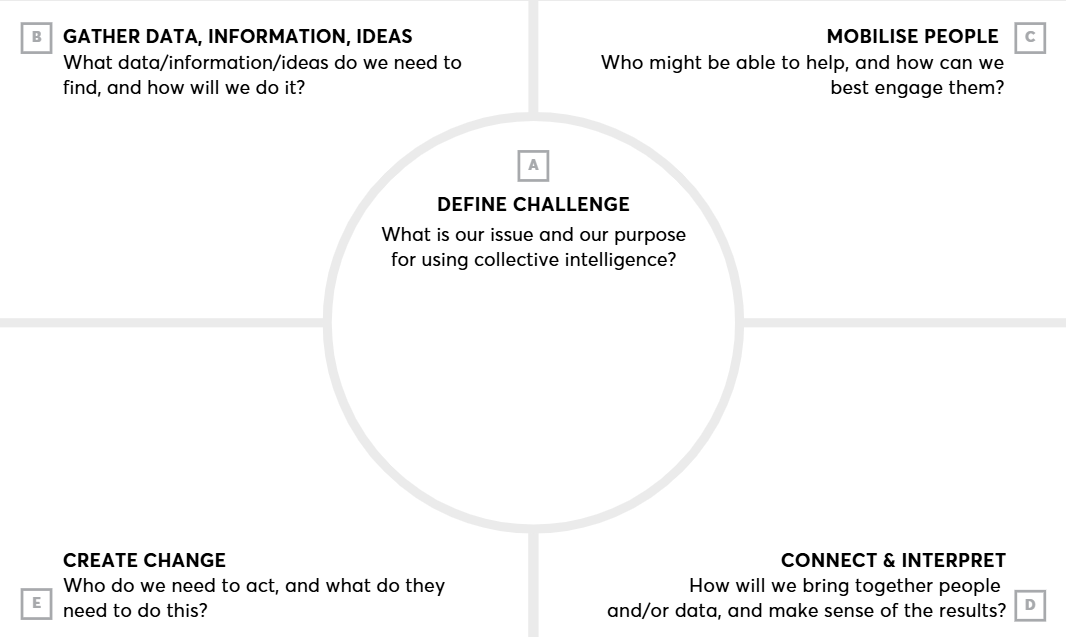
Template of a collective intelligence project design canvas.
Stages and questions
The collective intelligence design canvas is made up of five sections, which relate to the five key design stages of collective intelligence design.
Each design stage has a number of key design questions. These will help guide you to find the right answers for your challenge. There is a set of design questions for each of the four different purposes of collective intelligence.
You should attempt to answer all these design questions as best you can. We suggest you work through them sequentially stage-by-stage. You should also allow time for reflection and iteration. As you work, you may find that answers to previous questions need to change - so pause to check and refine periodically.
For each purpose of collective intelligence, there is an associated canvas pre-populated with the specific design questions relevant to your purpose. Print out a copy of this canvas for reference on pages 9, 13, 17 and 21 in the activities PDF alongside a blank one for your team to fill in. Printing it out on A2 or A1 size paper will make it easier for your group to work on it collectively.
| Design stage | Description | Questions |
|---|---|---|
A: Define challenge |
What is our issue and our purpose for using collective intelligence? The first step is to clarify the issue you are addressing and why it is important. You should also spell out your reason for using collective intelligence - is it to understand a problem, find a solution, make a decision or to learn/share what’s working? Being clear on purpose and the change you want to see will help you keep focused on achieving your outcome. |
|
B: Gather information and ideas |
What data/information/ideas do we need to find, and how will we do it? Any project needs to start with a good understanding of the information it already has, what it can access and what it needs. This stage is about exploring uncommon sources of data and insight that might illuminate your issue in a new way, and the methods you can use to gather them effectively. |
|
C: Mobilise people |
Who might be able to help, and how can we best engage them? Collective intelligence design can help you tap into distributed experience and expertise to answer your questions. For this to happen, the goal needs to be clear, 'the crowd' needs to be carefully defined and targeted, and the motivations and incentives of those participating need to be considered. |
|
D: Connect and interpret |
How will we bring together people and/or data, and make sense of the results? In this design stage, you will design how people will contribute and interact when they’re brought together, considering how to manage group dynamics to draw out the best from your crowd. You’ll also think about how you will store and process any data you’ve collected. Finally, you’ll need a plan for turning often messy data or unstructured text into useful results and insights. |
|
E: Create change |
Who do we need to act, and what do they need to do this? Here you’ll design how to turn the results of collective intelligence into action in the real world. You’ll create a prototype and testing plan, and make sure you have thought about how you’ll feedback to participants and open up information for them to use. |
|
Prompt cards, activities and pointers for discussion or reflection
Collective intelligence methods and tactics
Included in the activities PDF are six different decks of prompt cards. These prompt cards contain a variety of popular collective intelligence methods or tactics. Each card provides a summary of the tactic or method, and a short case study that illustrates its use in practice. The combination of methods and tactics that you choose to use are highly important. They are the means to your end goal of collective intelligence. Some might be new or less familiar to you, while others have existed for decades. You should be prepared to experiment with combinations until you find what works best.
The prompt cards are just a selection to help you get started, they are not exhaustive. Don’t be restricted by them - instead use them as a basis for exploring a range of approaches and select the most appropriate combination. The decks and cards are clearly labelled so you know which design stage they relate to, and which categories of collective intelligence projects they are usually found in. You should print these out double-sided before beginning your design activity.
Prompt cards are on pages 39-51, 69-79, 91-98, 107-110 and 130-134 in the activities PDF.
Mix and match worksheets and guides
Each stage contains a series of worksheets and guides in the activities PDF to help deepen or stretch your thinking on particular design questions. Many have been curated from toolkits that we admire, while others have been created especially for this playbook. You don’t need to try all of these activities at every stage every time you design a collective intelligence project. Select a few that you think will be most useful.
If you have just one day, you will probably be designing at a very high-level, using only 2-3 additional activities beyond the canvas and design questions. If you have a week, or longer, you may want to dive deeper and complete a larger number of the exercises together. Each activity and exercise has a suggested timing and group size to help you select appropriately. We also signpost which design question and design stage it relates to.
As you become familiar with the playbook, we hope you will find the activities that work best for you, adapt them further, or even add your own. You will find all activities grouped together in the relevant design stage section of this playbook.
For quick reference, in the activities PDF refer to the navigation page for understand problems on page 10, seek solutions on page 14, decide and act on page 18 and learn and adapt on page 22. These pages show the recommended worksheets for you to complete for each design stage depending on your selected purpose, in one place.
The pointers for discussion or reflection
Each design stage includes a number of pointers that you should discuss or reflect on as a team. These pointers can be found on pages 26 (for define challenge), 36 (for gather data, information and ideas), 66 (for mobilise people), 90 (for connect and interpret) and 129 (for create change) in the activities PDF.
They are based on existing research and practice from the collective intelligence field. We suggest you do this at the outset of moving into each design stage. You can also view the pointers for each design stage in the next section of this playbook.