Acknowledgements
Many thanks to Yamini Aiyar, Christian Bason, Hannah Burd, Anjum Dhamija, Andrew Knight, Geoff Mulgan and especially to Laurie Smith for contributions to this maturity framework. We are very grateful for your time and wisdom.
Introduction
The purpose of this framework
There is growing interest globally in the concept of mission-driven government and mission-driven organisations; both states and institutions are looking for ways to focus public and private efforts behind ambitious, long-term goals to deliver social value.
Missions require organisations and governments to set clear and challenging objectives, but they also mean empowering staff and public servants to work collaboratively and iteratively to achieve those objectives. With a mission-driven ethos, organisations in the public sector and beyond can mobilise commitment and improve performance. A more mission-driven workforce has a greater ability to address complex societal challenges.
The successful operationalisation of missions can transform cultures and norms. It can create systems that encourage accountability, collaboration and a shared commitment to achieving impactful outcomes across all levels of an organisation.
How an organisation or system transitions to mission-driven ways of working is just as important as the transition itself. Change that is too fast or that is driven solely by mandates and compliance mechanisms risks missions becoming little more than a performance. Such organisations run the risk of ‘mission-washing': talking the talk on missions, but not walking the walk. As interest grows in mission methods, it becomes more important to provide clear guidance and frameworks that can distinguish meaningful changes from empty rhetoric.
Working in collaboration with Nesta, Georgetown University's Better Government Lab has developed this maturity framework to help public sector leaders, workers and other stakeholders to follow through on mission-driven approaches.
We recognise that there is no single blueprint for mission-driven ways of working, so this framework is designed to accommodate diverse types of mission. They range from grand, aspirational missions as exemplified by the five missions of the UK's Labour government – to missions with a very specific, localised focus, such as a hospital working to transform the care it offers patients.
We also hope this framework will be useful regardless of how change is being initiated, so when a mission has been authorised at the highest level of an organisation (as with the Labour government's five missions), but also when a mission is being championed from within a system, whether by a pioneering civil servant, a reforming team leader, a catalytic funder or a community organisation. If this framework succeeds, it will help people who are leading missions right around the world – from Whitehall to Windhoek, Warsaw to Wellington.
Each mission will vary in its scope and means of execution, both within and across different countries. But all missions have something in common: an explicit commitment to achieving an ambitious goal and empowering people to pursue this goal with enthusiasm. Any useful framework for assessing the readiness of an organisation for genuine mission-driving working must accommodate\ differences while also not diluting this common essence.
This framework is intended to help organisations assess whether they are genuinely mission-driven or simply mission-washing. By identifying key processes and behaviours that define mission-oriented work, it helps civil servants and public sector leaders to characterise their organisation's maturity. Rather than policing adherence to a fixed model, it is intended to promote self-evaluation and continuous improvement. Leaders can use the framework to assess current practices, identify areas for improvement and prioritise their efforts.
Why 'organisational missions' and 'grand missions'?
When we designed this framework, we decided it was important to distinguish between two different conceptions of missions. In the first section of the framework, we focus on what we call ‘organisational missions'; in the second, we focus on ‘grand missions'.
When we talk about ‘organisational missions', we picture an organisation operating with a highly developed and focused sense of purpose. This concept is broadly applicable; it can apply just as well to a local church group or a private sector start-up as to a government. This concept can also apply at many scales in a particular system: from an agency (e.g. in the UK, the Department for Education), to a sub-unit (e.g. a primary school), to a team (e.g. the team teaching Year 4 (3rd Grade) in a school, or the team at the Department for Education that is working to improve teacher training).
When we talk about 'grand missions' we have in mind a more distinctive set of challenges and contexts. Grand missions are the kinds of society- or economy-wide goals the current UK government is aiming to achieve, such as reaching zero-carbon electricity by 2030. Grand missions are ambitious goals of extraordinary complexity, often spanning multiple actors, sectors and geographies.
We make this distinction for three main reasons.
First, we want to make the framework as broadly useful as possible. Some people will find a focus on organisational missions sufficient, while others will benefit from the additional and more specific material we have developed on grand missions.
Second, we worry that some organisations pursue grand missions without the fundamentals of purpose-driven management practices. A top-down, disempowering organisational management approach with unclear purpose will hinder progress on grand missions. We believe that maturity at an organisational level is necessary but not sufficient for achieving a grand mission.
Third, we wanted to make full use of the long history of theory and practice on organisational missions and purpose-driven management practices. This complements our evolving understanding of grand missions in the spirit popularised by the pioneering work of Marianna Mazzucato and colleagues at The Institute for Innovation and Public Purpose (IIPP) at UCL in London. The work of the IIPP and others continues to build out an impressive literature that explores how missions can be used to pursue grand societal challenges. We believe it is valuable to connect this work into the longer and more general history of thinking and practice on purpose-driven organisational management practices.
We are conscious that this wider literature may be less familiar to readers, especially in the UK, so there follows a brief history of organisational missions.
A brief history of organisational missions
'Missions' entered the lexicon of management theory and practice as early as the 1950s. Peter Drucker's influential The Practice of Management (1954) argued that organisations must have a clear sense of purpose, and this idea of orienting around a particular goal gave rise to ‘mission statements'. The idea is to make the organisation's ultimate goal clear, whether to people in the entire organisation or those in a particular team or division. The aim was to inspire serving employees to make their best contribution, and to attract prospective employees with a commitment to the mission.
The idea of an organisational mission or purpose dovetailed with another influential management book of the mid-20th century, Douglas McGregor's The Human Side of Enterprise (1960). McGregor argued that when employees are oriented towards a mission – that is, towards the goals of their work, as opposed to outputs – they are best managed using ‘Theory Y' approaches. This is a class of management techniques that emphasise trust, support and personal growth, and that seek to unlock creativity and intrinsic motivation.
By contrast, where employees do not care about the mission, they require strict oversight, and will only work if closely supervised and motivated by external rewards or fear of punishment. This contrasting class of techniques – ‘Theory X' approaches, to use McGregor's terminology – comes into play when employees are not, in the parlance of more recent works, ‘mission motivated'. James Q. Wilson's Bureaucracy (1989) later helped bring this way of thinking about purpose-driven organisations – and equivalent management practices – to the public sector.
These ideas have since moved beyond theory into a rich body of practice. In the last 30 years there has been a boom in empirical work that investigates the impact of mission-oriented management practices, employee motivation in the public sector, and the levers that help public agencies execute their missions. The overwhelming lesson from this research is that organisations that succeed in tapping into the motivation of their people deliver greater public value, and are also more efficient. For obvious reasons, this toolkit appears to be especially powerful in the context of public service.
A key contribution of this framework is to reconnect the debate about grand missions with the underlying cultural conditions that support purpose in an organisation – what we refer to as 'organisational missions'. Such a mission involves an organisation adopting a distinctive class of management practices that promote trust, judgment, empowerment and creativity, and cultivate competence. This kind of work gives grand missions a fertile ground to grow on.
On the flipside, it will be hard – perhaps impossible – to move the dial on a grand mission if staff in a government department, say, or across a wider system feel micromanaged, burned out, distrusted and unsafe to experiment. To pursue a grand mission in these conditions is like trying to start a fire without oxygen.
Still, when it comes to grand missions, empowering management is only a foundation. And so the second half of this report focuses on grand missions in the broad, aspirational sense in which it is used in the 2024 manifesto of the current UK Labour government – the use more closely associated with scholars such as Mariana Mazzucato, Christian Bason and Geoff Mulgan.
Mariana Mazzucato's influential work, Mission Economy: A Moonshot Guide to Changing Capitalism (2021), sees such missions as frameworks that can foster innovations capable of solving grand societal challenges, from climate change to inequality. Mazzucato argues that missions should be ambitious and aspirational, orchestrating public and private sector collaboration to address what she calls ‘wicked problems'. Solving for grand societal challenges has its own set of demanding practices, and so in the second half of the framework we focus on these. The relative novelty of grand missions means this latter half of the framework is somewhat more speculative – we present it here as a work in progress to be improved upon.
Part 1. Organisational missions
Key question: Is your organisation set up to deliver on its mission?
An introduction to organisational missions
In this first section of the framework we focus on leading an organisation for purpose, unleashing people's energies and ideas to transform a culture and deliver on the aims of an inspiring mission. This contrasts with a more traditional command-and-control structure, in which an organisation is run by instructing people to deliver outputs or solutions.
We divide this section of the framework into two sections:
- Processes and practices that can foster a sense of mission; and
- Outcomes and assessable behaviours that suggest people feel a sense of mission
We think of these as complementary perspectives, each giving a sense of whether an organisation is mission-driven – with the relationship between them akin to the connection between backstage and front of stage activity in a theatre. Like work done backstage, mission-oriented processes and practices are the underlying procedures that drive the success of more visible activity. They can include, for example, leadership rituals that foreground the organisation's purpose, or a regular rhythm for communications on mission progress.
- The equivalent to front of stage is the visible activity of mission-oriented outcomes. This is, for example, the experience someone has of using a service provided by the organisation. We propose ways to evaluate these outcomes, for example by using employee engagement surveys to measure the salience of the mission among staff, or the extent to which service users feel they benefit from the mission.
Evaluating outcomes is more difficult than evaluating processes but we think both are important. We also believe that by evaluating the two together, we can better characterise an organisation's maturity in its mission driven work. For example:
- If an organisation has neither adopted mission-oriented practices nor seen evidence of the mission in how employees feel, it is going through the motions – we call this ‘mission-washing'.
- If an organisation sees positive changes in how employees feel that suggests a deep-felt sense of mission, but lacks formal processes to maintain and deepen this sentiment, leaders might find that the mission is fragile, and dependent on key individuals a situation common in start-ups. We call this 'mission-striving.'
Thinking about both processes and outcomes gives us four archetypes for an organisation's maturity level with regard to mission-driven working. Organisations might find these archetypes helpful when thinking about where they are on their journey to being truly mission-driven.
Figure 1: Four levels of organisational maturity
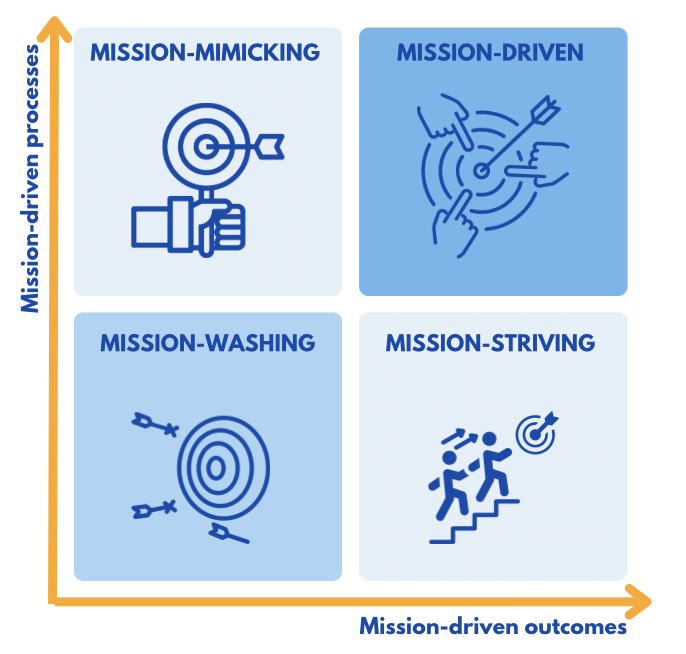
Mission-Driven
Organisations that are implementing observable processes and achieving mission-driven outcomes
Mission-Striving
Organisations that are achieving mission-driven outcomes without fully understanding what processes are enabling those results
Mission-Mimicking
Organisations that appear to be engaged with their mission on the surface but are not achieving desired outcomes
Mission-Washing
Organisations that say they are committed to a mission, but are neither visibly engaging with one nor creating allied internal practices
The Framework: Six domains of mission-driven working
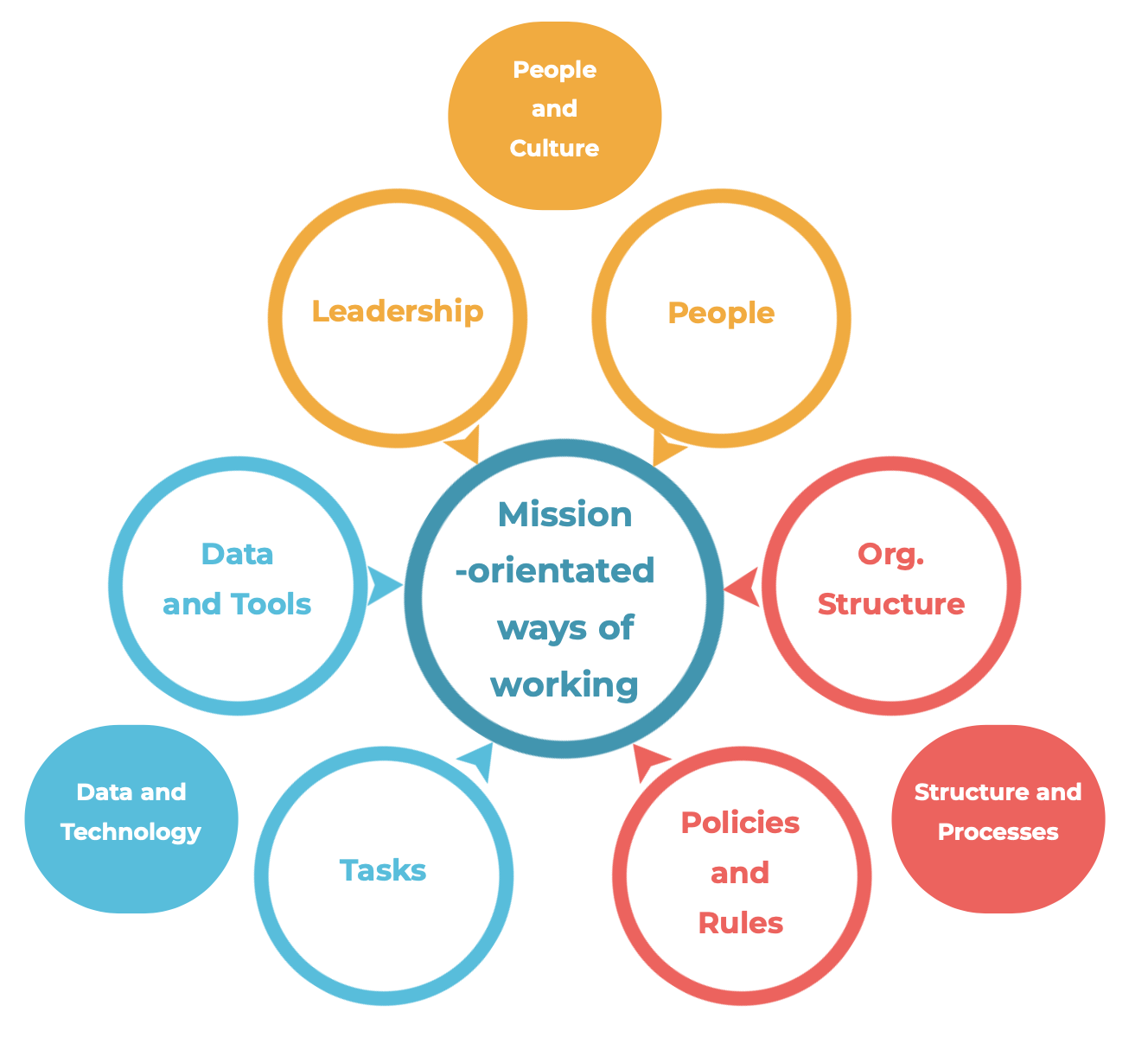
In our experience of studying organisations, we find that evidence of being mission-driven shows up in six domains. These are:
- Leadership
- People
- Organisational Structures
- Policies and Rules
- Tasks
- Data and Tools
By evaluating processes and outcomes in each domain, we get a 360-degree view of the mission-driven maturity of the organisation, and can also pinpoint areas of promise, or problems.
Below we visualise the six domains as mutually supportive circles (we recognise that in reality these overlap). We have mapped the six domains onto what in the framework for mission-driven government developed by Nesta and the UK's Institute for Government are described as three ‘foundational enablers': People and culture, Data and technology, and Structures and Processes
Figure 2: Where does mission-driven working show up?
Below we set out the maturity framework under the six domains. For each we name the kind of mission-driven processes and mission-driven behaviours and outcomes we would look to see. For outcomes, we name medium-term outcomes specific to each domain, and a common set of long-term outcomes that are the same across all domains. This reflects that each domain contributes to the same ultimate outcomes, such as an employee feeling a high degree of commitment to and ownership of the organization's mission.
Domain 1: Mission-driven leadership
These outcomes can be used by an organisation as a tool for self-evaluation, or they could be employed by an outside party (e.g. a government evaluation agency, or a hired consultancy) to assess the maturity of an organisation's ways of working, and to track changes over time in mission orientation.
We would emphasise that what matters is less the “score” of each indicator we do not see this as a ‘pass/fail' boundary – and more the relative strengths, weaknesses and direction of travel. The framework is intended primarily to help prioritise efforts and to support an organisation's progress towards adopting a more mission-oriented approach.
In Section 3 we pull the outcomes together into one place, along with some recommendations for survey questions that can be used to measure behaviours and outcomes.
Missions are typically adopted by large, operationally complex organisations such as public bureaucracies. They tend to be characterised by steep hierarchies and strict divisions of labour. Employees can experience their daily work as receiving and acting on a set of instructions, meaning they feel they are working to deliver a series of tasks. Similarly, public sector leaders often feel they are locked in a machine, restricted by tight bureaucratic structures and rigid procedures.
To create a mission-oriented culture, leaders must carve out some freedom inside these constraints, for themselves and for their people. Leadership is critical to employees' belief in the importance of their organisational purpose so an organisation will struggle to be mission-driven if it doesn't have mission-driven leaders.
Mission-leadership is partly about communicating a clear, compelling vision. A mission must be cultivated and embodied by leaders if it is to inspire action. Public employees are more likely to find their organisation's mission inspiring when their leaders model commitment to the mission. Some argue that the craft of inspiring people to join a shared mission is the essence of leadership.
Mission-driven leaders must also be transformational; they must stimulate employees to internalise the purpose of the organisation in a way that transcends self-interest. Transformational leadership requires leaders to keep the mission salient, running it through the organisation's work plan and strategy, while bringing to life the social value the mission is adding. Successful mission-driven leaders use both words and deeds to inspire their employees to mission-oriented behaviours. This includes role-modelling values that correspond to the mission.
A final aspect of mission leadership is to foster psychological safety, because learning is so central to a mission-oriented workforce. When an organisation has high psychological safety, individuals feel included, safe to learn, safe to contribute and safe to challenge the status quo. A psychologically safe environment is one in which individuals at different levels feel part of a collaborative effort, and the work is the better for it. Such organisations exhibit higher performance, team cohesion and higher retention of mission-motivated employees, as well as a greater pace of learning.
1.1 Mission-driven leadership: Processes and practices
| Element |
Evaluation focus |
Indicators |
| Leadership |
Mission Clarity and Communication: Leaders clearly and consistently communicate the mission and its importance |
• Documented organisational mission connected to societal needs
• Documented alignment of strategic goals with the mission
• Leaders frequently organise forums or venues to facilitate understanding and discussion of mission-oriented agenda (e.g. training, discussions, team-building activities) |
| Leadership |
Transformational Leadership: Assessing how the behaviours of leaders seek to develop, share and sustain a vision or mission |
• Employees are frequently directed by their leaders to raise awareness of the importance of organisational values and outcomes
• Leaders role-model behaviours are consistent with the stated mission
• Leaders intellectually stimulate employees to challenge old assumptions about organisational problems and practices
• Leaders promote autonomy and the ownership of tasks and decisions
• Leaders endorse and deploy non-monetary methods other than contingent rewards/sanctions to encourage individual employees to pursue organisational goals |
| Leadership |
Psychological Safety: Evaluating the extent to which leaders create an environment where employees feel safe to share ideas, ask questions and take risks without fear of negative consequences |
• Frequent team-building activities that promote trust and inclusion
• Access to channels for employees to safely ask questions and voice opinions to leadership
• Instances of open dialogue and constructive dissent between leadership, management and frontline staff
• Leadership is responsive to employee input and concerns |
1.2 Mission-driven leadership: Promising outcomes
| Element |
Evaluation focus |
Medium-term |
Long-term |
| Leadership |
Mission Clarity and Communication |
• Increased awareness of organisational mission and goals |
• Increased organisational mission valence (defined as the perceived attractiveness of an organisation's purpose) |
| Leadership |
Transformational Leadership |
• Increased recognition/rewards for public-service values
• Increased job satisfaction and engagement[^6] |
• Increased public-service motivation (defined as an individual's interest in issues of public interest or public institutions) in employees
• Increased recruitment and retention of mission-driven staff
• Increased speed of feedback loops (e.g. time taken for frontline difficulties to be acknowledged and for improvements to be implemented) |
| Leadership |
Psychological Safety |
|
|
Illustrative examples
- A government agency holds a range of ongoing staff-training courses; at every session, employees are asked to discuss the purpose of the agency's work, to share successes and talk about times they've come up against barriers in trying to deliver on the agency's mission
- A local council runs an annual award ceremony to celebrate people who show extraordinary commitment to its mission, and it rewards these employees with extra space and autonomy to work on a project that would contribute more to the mission.
- A charity creates a mentoring program that pairs experienced and highly motivated staff with newer employees; the initiative fosters a deeper understanding of the mission for new joiners, and reconnects leaders and long-serving staff with work being done on the ground.
Domain 2: Mission-driven people
Leaders can articulate a vision, but this will have a limited effect if day-to-day staff do not feel empowered to work in service of the mission.
An organisation can be run in such a way that it orients its staff towards an organisational mission and empowers people to contribute. Alternatively, an organisation can be run in a more hierarchical way via instructions, treating people as units of capacity to carry out tasks. We call the former style ‘managing for empowerment'. It requires the organisation to adopt line-management practices that foster autonomy, cultivate competence, strengthen people's connections to the organisation's purpose and to their peers, and tap into their intrinsic motivation. We would hope to see a mission-driven approach to managing people manifest in three different areas:
- Autonomy: Staff are given a zone of independent action in which they can make judgments and see themselves as causal agents
- Competence: Staff are encouraged to foster a sense of skill and agency in the work they do, and a confidence in their personal ability to further the mission
- Connection to peers and purpose: Staff are encouraged to connect to and feel in productive relationship with other people through their work – especially co-workers and beneficiaries
The ultimate goal is to create an environment in which people feel trusted and empowered. Empowerment-oriented management practices increase mission motivation, as evidenced in both experimental and observational studies.
By allowing staff to exercise their judgment and trust their capabilities, organisations enhance mission alignment and motivate employees to engage more fully in their work. This helps to retain staff and keeps people engaged; evidence shows that when individuals perceive that their contributions are meaningful and impactful, they are more likely to remain at the organisation, as well as remain committed in their work. As well as motivating current employees, a reputation for empowering management can also attract new staff with high intrinsic motivation.
2.1 Mission-driven people: Processes and practices
| Element |
Area of focus |
Indicators |
| People |
Autonomy: The degree of decision-making freedom and control people have in their roles |
• Formally delegating decision-making authority to those lower down the hierarchy
• Availability of flexible working arrangements (e.g. virtual, hybrid and work share)
• Access to opportunities that build personal initiative and creativity (e.g, hackathons and allocations for creative time) |
| People |
Cultivating competence: The training and development available to employees to enhance their skills and knowledge |
• Access to training programmes that build mission-oriented practices
• Access to skill development opportunities (e.g. mentorship and a fund for further education)
• Inclusion of mission-point conversations between managers and employers during feedback sessions and performance reviews |
| People |
Connection: The strength and quality of relationships among employees, and between employees and the organisation's mission, peers and beneficiaries. Purpose: The alignment of employees' personal goals with the overall mission |
• Peer reviews and discussions to foster a collective sense of mission and peer accountability
• Frequency of cross-functional collaboration and innovation |
| People |
Connection: The strength and quality of relationships among employees, and between employees and the organisation's mission, peers and beneficiaries. Peers: The strength of the relationships and collaboration between colleagues (i.e. Is there a supportive and cohesive work environment?) |
|
| People |
Connection: The strength and quality of relationships among employees, and between employees and the organisation's mission, peers and beneficiaries. Beneficiaries: The impact employees feel they have on the end users of their services |
• Engagements to connect employees with clients or beneficiaries, allowing them to witness the positive consequences of their actions at workWritten communication and sharing of frontline impact (e.g. reports and newsletters) |
2.2 Mission-driven people: Promising outcomes
| Element |
Area of focus |
Medium-term |
Long-term |
| People |
Autonomy |
• Increased awareness of an organisation's mission and goals |
• Increased organisational mission valence (defined as the perceived attractiveness of an organisation's purpose) |
| People |
Cultivating competence |
• Improvement in job performance and expertise |
• Increased employee mission motivation (defined as an individual's commitment to action on behalf of the mission)[^16] |
| People |
Connection |
• Increased job satisfaction and engagement[^17] |
• Increased recruitment and retention of mission-driven staff[^18]
• Increased speed of feedback loops (e.g. time taken for frontline difficulties to be acknowledged and for improvements to be implemented) |
Illustrative examples
- A government agency helps staff to develop a clear sense of the impact of their work through direct engagements with clients or beneficiaries, allowing them to directly see the positive outcomes of their efforts
- A local council runs regular peer reviews and discussions to enhance a collective sense of mission and accountability among team members
- A charity organises hackathons, inviting employees to collaborate across departments, generating generating ideas that will help make progress on realising the organisation's mission
Domain 3: Mission-driven policies and rules
An organisation's policies and formal rules shape how people go about their work, and can either promote or stifle innovation. With mission-driven working, we emphasise empowerment not compliance, in part because we don't want to inhibit initiative.[^19] While compliance-oriented management can be important when there is little room for discretion (e.g. with respect to remuneration frameworks), too much red tape can diminish motivation and engagement, prompting people to disengage from the organisation's purpose.[^20] It is therefore crucial to balance controls with encouraging autonomy and creativity.
The organisational opposite of red tape, which emphasises compliance, ‘green tape' can offer employees more discretion and judgement. Rather than enforcing or proscribing specific behaviours, green tape defines when employees can exercise discretion. Adopting this approach can both enhance peoples' job satisfaction and boost their motivation to help achieve mission goals.[^21] By contrast, overly stringent controls – excessive reporting requirements, rigid adherence to protocols, and micromanagement – can hinder individual bureaucrats' ability to contribute. By converting from a red-tape to a green-tape approach where possible, organisations can foster a culture of creativity and contribution.
3.1 Mission-driven policies and rules: Processes and practices
| Element |
Evaluation focus |
Indicators |
| Policies and Rules |
Workforce Management: Evaluating the extent to which people are recruiting, developing, and supported to ensure their roles and performance align with and advance the organisation's mission-oriented objectives Recruitment: Assessing the process of identifying, attracting and selecting suitable candidates for job vacancies |
• Established fast-stream recruitment programmes that attract the talented and mission-motivated
• Position descriptions explicitly advertise the ability to serve others and cultivate competence
• Mission motivation is included in selection criteria for potential recruits |
| Policies and Rules |
Workforce Management: Evaluating the extent to which people are recruiting, developing, and supported to ensure their roles and performance align with and advance the organisation's mission-oriented objectives Remuneration: Assessing the policies for compensating and financially incentivising employee performance and mission motivation |
• Salaries are regularly revised to market rate or higher
• Employees have documented and easily accessible channels to have remuneration-based conversation with their managers |
| Policies and Rules |
Workforce Management: Evaluating the extent to which people are recruiting, developing, and supported to ensure their roles and performance align with and advance the organisation's mission-oriented objectives Performance Management and Review: Reviewing the process of systematically evaluating and improving employee performance |
• Established model of strength-based feedback, tailored to fostering individual accomplishments and skills |
| Policies and Rules |
Workforce Management: Evaluating the extent to which people are recruiting, developing, and supported to ensure their roles and performance align with and advance the organisation's mission-oriented objectives Promotion: The advancement of an employee to a higher position within the organisation, typically involving increased responsibilities, status and compensation |
• Documented reward and recognition programs that acknowledge mission-oriented work (e.g. mission ambassador profiles and financial rewards)
• Criteria and processes for promotions are communicated to employees
• Promotions are utilised as a means of celebrating employees who have shown exceptional mission motivation |
| Policies and Rules |
Workforce Management: Evaluating the extent to which people are recruiting, developing, and supported to ensure their roles and performance align with and advance the organisation's mission-oriented objectives Rotation and Assignment: The practice of moving employees through different roles or departments within the organisation and other public-sector agencies |
• Employees have access to rotation-based opportunities through different roles or departments; frequent rotations suggest an active and well-implemented rotation program
• Criteria for assignments and rotation decisions take into account employee motivation and preferences |
| Policies and Rules |
Workforce Management: Evaluating the extent to which people are recruiting, developing, and supported to ensure their roles and performance align with and advance the organisation's mission-oriented objectives Employee Exit: Assessing the reasons for employee departure (both voluntary departure and dismissals) |
• Departing employees are surveyed on their decision to leave, with explicit reference to orientation with the organization's mission (e.g. whether their departure is related to an inability to contribute to/fulfill the mission)
• Dismissal and overall departure rate: monitor the frequency of employee departures within a given period; an unusually high rate might indicate issues with managerial processes or broader organisational culture |
| Policies and Rules |
Continuous Learning and Innovation: Assessing the degree to which employees are encouraged to engage in ongoing learning and creative problem-solving, ensuring they are able to use their skills and initiative to contribute to advancing the organisation's mission-driven goals Professional and Personal Development: Commitment to enhancing employees' skills, knowledge and personal growth in ways that align with both their individual career aspirations and the organisation's mission |
• Employees have access to training programmes that enhance mission-building practices (e.g. online courses and in-person workshops)
• Employees have access to formal mentorship programmes (internal and external)
• Employees have access to mission-aligned initiatives that improve practice |
| Policies and Rules |
Continuous Learning and Innovation: Assessing the degree to which employees are encouraged to engage in ongoing learning and creative problem-solving, ensuring they are able to use their skills and initiative to contribute to advancing the organisation's mission-driven goals Innovation and Improvement: Evaluating how effectively the organisation fosters a culture of creativity and ongoing enhancement, ensuring that new ideas and processes contribute to mission advancement |
• Regularly scheduled communities-of-practice meetings and collaborative projects foster knowledge-sharing and skill development among employees across different roles and departments
• Employees have access to a confidential platform for submitting feedback and suggestions, with documented follow-up actions taken by management to address the input received (e.g. digital or physical suggestion boxes).
• Established channels enable frontline employees to share insights and experiences directly with management, ensuring their voices influence decision-making processes and organisational strategy on mission-building practices |
3.2 Mission-driven policies and rules: Promising outcomes
| Element |
Evaluation focus |
Medium-term |
Long-term |
| Policies and Rules |
People Management |
• Increase of 'green tape' culture that empowers and supports employees[^22] |
• Increased organisational mission valence (defined as the perceived attractiveness of an organisation's purpose)[^23] |
| Policies and Rules |
Continuous learning and Innovation |
• Increased sense of respect and trust within the workforce[^24]
• Increased job satisfaction and engagement[^25] |
• Increased employee mission motivation (defined as an individual's commitment to action on behalf of the mission)[^26]
• Increased recruitment and retention of mission-driven staff[^27]
• Increased speed of feedback loops (e.g. time taken for frontline difficulties to be acknowledged and for improvements to be implemented) |
Illustrative examples
- A government agency includes assessments of both technical competencies and mission motivation in recruitment (e.g. behavioral interviews and situational judgment tests that reflect real-life challenges faced in the organisation).
- A local council implements a rapid-stream recruitment programme that is specifically designed to attract talented individuals who are not only skilled but also deeply motivated by the mission.
- A charity organises regular communities-of-practice meetings for frontline workers, where employees from various departments come together to share insights, discuss best practices and collaboratively tackle mission-related issues.
Domain 4: Mission-driven structures
Organisational structures influence how institutions make decisions, communicate, and collaborate, and can thereby help or hinder mission-driven ways of working. There are two key dimensions to an organisation's structure: the depth of organisation in terms of the number of layers it comprises, and the breadth of each of those layers (i.e. the number of direct reports to each manager). It is the interplay between these two dimensions that either facilitates or hinders mission-driven working.
1The depth of a management hierarchy can either slow down or speed up decision-making, communication and innovation. For example, a deeper structure can slow down decision-making as each change requires multiple levels of approval, leading to delays and discouragement. Organisations are more likely to foster a mission-driven culture if senior management is receptive to frontline workers, and if managers consciously attempt to reduce top-down compliance. Organisations also need to encourage frontline workers and managers to take the initiative, and not feel inhibited by the hierarchy.[^28]
2Management spans of control (i.e. the number of people they manage) can also affect the ability of managers to guide and support mission-driven work.[^29] A wider span of control can signify trust in employees and promote agency – indicating a coaching relationship – while a narrower span allows for more focused attention on complex tasks, ensuring that mission-critical projects receive the necessary support and resources. Broad spans of control sit well with empowering leadership styles – managers need to stop hoarding decisions, and empower their teams.
Reporting lines are also important to mission-driven working. They need to be clearly understood, but also adaptable, allowing for cross-functional collaboration when needed. Clear but flexible reporting structures, such as matrix working, can foster a culture of collaboration.
4.1 Mission-driven organisational structures: Processes and practices
| Element |
Evaluation focus |
Indicators |
| Org. Structure |
Depth of Management: Assessing how the number of management layers that separate employees from top management affects decision-making speed, communication flow and overall organisational agility |
• Hierarchy is responsive to tasks and capabilities (e.g. senior management formally delegating decision-making authority during innovation projects)
• Senior management provides insight into decision-making processes and encourages lower-level input on mission-driven activities |
| Org. Structure |
Breadth of Management: Assessing the number of direct reports a manager supervises, which reflects their ability to oversee, guide and support mission-driven work |
• Breadth of control (i.e. how many direct reports per supervisor) varies across the organisation, depending on the nature of the work and the capabilities of both managers and team members (e.g. wider span of control may indicate greater trust in employees and efficiency for some tasks, while a narrower span allows for more focused attention and support on more nuanced tasks)
• Managers reallocate resources or offer additional support for mission-critical projects |
| Org. Structure |
Reporting Lines: Assessing the clarity and flexibility of the reporting lines that encourage mission-driven practices |
• Functional reporting lines are clearly defined and documented for both in-person, remote and virtual employees
• The documented lines of reporting are consistently mirrored in actual reporting practices
• Organisational structure allows for flexibility in reporting and cross-functional team collaboration, when needed |
4.2 Mission-driven organisational structures: Promising outcomes
| Element |
Evaluation focus |
Medium-term |
Long-term |
| Organisational structure |
Depth of Management |
• Increased job satisfaction and engagement[^30] |
• Increased organisational mission valence (defined as the perceived attractiveness of an organisation's purpose)[^31] |
| Organisational structure |
Breadth of Management |
• Increased confidence and competence in exercising discretion[^32]
• Increased organisational agility and adaptability[^33] |
• Increased employee mission motivation (defined as an individual's commitment to action on behalf of the mission)[^34] |
| Organisational structure |
Reporting Lines |
|
• Increased recruitment and retention of mission-driven staff[^35]
• Increased speed of feedback loops (e.g. time taken for frontline difficulties to be acknowledged and for improvements to be implemented) |
Illustrative examples
- A government agency identifies a mission-critical project aimed at improving community healthcare access; extra support is provided by assigning additional staff and offering specialised training to enhance team capabilities.
- At a local council, the administrative team handles routine paperwork and scheduling, with the team manager typically overseeing a larger group of 15 staff in the team. However, for a community-development project focused on redesigning public spaces, the manager oversees a smaller team of five, each with specialised expertise in urban planning, etc.
- A charity delegates decision-making authority to lower-level employees in specific project areas – for example, frontline workers lead strategic workshops and are empowered to follow through on action points.
Domain 5: Mission-driven tasking
Mission motivation can be nurtured in everyday operations. Integral to this is the question How does the organisation design, distribute, delegate and monitor tasks?
There is more than one way to manage tasks to empower and motivate employees. The right approach will depend on the particular context, culture and workforce of the organisation.[^36] Tasks can be nuanced, and specific to organisations and roles. Beyond common administrative tasks, in areas such as human resources or procurement, there are tasks where the output is highly observable (e.g. injecting a vaccine) and others where that is hard to observe (e.g. helping a young person return to work). Each has different trade offs between compliance and empowerment.[^37]
There are, however, some general ways in which tasks can be managed to help employees feel more connected to an organisation's goals. For example, an organisation can describe tasks in a way that highlights the impact on citizen welfare – e.g. 'people protected' as opposed to ‘vaccines delivered'. They can also use outcomes as an organising logic, for example by establishing a team or project to boost patient welfare. Managers can give individuals scope to design their roles and tasks with their personal expertise and motivations in mind, helping to maximise their contribution. Organisations can use data to pull attention ‘down and out', encouraging accountability to citizens and learning from peers, as opposed to pulling attention 'up' through a system of monitoring and compliance.[^38] Together this can improve job performance and satisfaction, help people to build capacity, and ultimately foster motivation and a common commitment towards the mission goals.[^39]
5.1 Mission-driven tasks: Processes and practices



