Executive Summary
Although it is widely recognised that innovation is an important contributor to economic growth, the specific mechanisms by which firms successfully innovate is still the subject of much study and debate. It is agreed that achieving superior innovation outcomes in modern times requires particular skills and practices to navigate highly uncertain, complex and distributed environments – this best practice approach is referred to as the fifth generation innovation process. At the same time, recent research by NESTA (Bakhshi et al. 2008) suggests that firms that make proportionately greater use of services from the creative industries have significantly superior innovation performance. While this indicates a relationship between the use of creative services and best practice innovation processes, the specific mechanisms by which this occurs are poorly understood. In order to test a number of hypotheses about these mechanisms, NESTA is intending to run an innovation vouchers pilot involving firms in creative and non-creative sectors.
The purpose of this paper is to set out a theoretical framework to explain how businesses in the creative industries may be contributing to improved innovation performance within firms in the wider economy. The argument put forward is that creative innovation services provided by creative businesses help firms innovate more effectively by addressing behavioural failures, such as risk aversion, status quo bias and myopia. These behavioural constraints and biases make it difficult to adopt and adapt the fifth generation innovation processes that represent modern innovation best practice, and are particularly problematic for small and medium-sized firms that do not have the routines and resources to systematically overcome these behavioural limitations. Creative innovation services may help SMEs overcome behavioural failings by, for example, creating closer connections to consumers through communities and mediated identities, making use of social network dynamics and in general helping to address failures of imagination.
The vouchers pilot will be well placed to test a number of specific hypotheses related to the way in which creative innovation services mitigate behavioural innovation failures with the wider economy, and generally whether the shift to fifth generation innovation processes induces demand for these types of creative services. It may also be possible to view policies in this area as temporary rather than as permanent subsidies, if small one-off 'nudges' are able to push SMEs over the threshold of behavioural limitations into superior innovation practices.
Section 1 of the paper sets out the relationship between innovation and economic growth, and distinguishes between innovation systems at the macroeconomic level and innovation processes at the firm level. Section 2 describes how the innovation process has been evolving over time, through five generations that culminate in the network-based models of collaboration and specialised knowledge production that have now emerged. Section 3 introduces the evidence from behavioural economics that individuals and firms face constraints in making choices related to novelty such as risk and loss aversion, myopia, endowment effects and a range of cognitive biases. Section 4 examines how creative innovation services can help address these behavioural innovation failures and confer a source of competitive advantage. Section 5 concludes with a consideration of six specific hypotheses that may be tested by the NESTA vouchers pilot, and discusses the use of innovation vouchers as nudges rather than as permanent subsidies.
1. Innovation and economic evolution
Innovation is not an end in itself, but a means to the end of economic growth, development and adaptation. In evolutionary or ‘Schumpeterian' models of economic growth (Nelson and Winter 1982; Aghion and Howitt 1992) the origin of growth and change comes from within businesses and leads to the creation of markets and industries through a complex dynamic process of competition and collaboration. Economic growth is a product of an innovation trajectory. This begins with the new ideas of an entrepreneur, who creates a firm that establishes a market. New firms enter and compete as new market niches develop. This transforms the economic structure from within as other firms, markets and industries adapt to this change. Eventually, this complex evolutionary process of creative destruction stabilizes with a new economic order in which the novel idea has become embedded in the knowledge base of the economy. Evolutionary growth models emphasise the role of dynamic mechanisms of change and coordination. Of the many aspects of the innovation-based growth model e.g. entrepreneurship, finance, structural dynamics, industrial organization, technological trajectories etc. - several relate directly to the context of NESTA's innovation vouchers pilot.
First, innovation involves differential growth (Metcalfe 1998, 2003). Not everything grows at the same rate: firms, markets, occupations, technologies, standards, networks, industries, regions, institutions are all subject to differential growth. Differential growth occurs because of differential selection and replication. This results in structural change or 'creative destruction'. Growth by innovation creates both winners and losers, as some firms grow in market share and as some technologies displace others. Some skills and resources increase in value, others decline. Economic evolution thus involves a continuous process of entry and exit. It also involves a process of becoming different as firms adopt new ideas into their business activities, including new business models themselves; as consumers adopt new goods and services into their lifestyles; and as new connections are formed between businesses, and between businesses and consumers. This is a difficult process, and the argument developed in this paper is that this is why innovation services, in part provided by creative businesses, have value.
1.1 Macro innovation systems and micro innovation processes
A second important aspect of the evolutionary perspective on growth is that the process of change and adaptation itself involves resources, institutions and knowledge. These are broadly known as the innovation system. At the macro, regional or sectoral level of economic analysis, an innovation system refers to the set of resources, capabilities, technologies and institutions, broadly conceived, that systematically contribute to the process of innovation (Lundvall 1992; Nelson 1993, 2002; Edquist 1997). The scope, scale and efficacy of an innovation system determine the innovation prospects, and therefore growth prospects, of a macroeconomy. Unlike resources and knowledge devoted to the operational production of goods and services, resources and knowledge devoted to the innovation system are not of value in-themselves, but only to the extent that they facilitate the process of innovation. Metcalfe (1997) defines an innovation system as 'the set of institutions to create, store and transfer the knowledge, skills and artefacts which define technological opportunities'. Innovation policy, in turn, aims to develop the innovation system.
However, innovation ultimately operates at the level of people, firms and networks of firms learning to do new things. While the innovation systems concept is useful for thinking about change at the level of the macroeconomy, the focus here is on the mechanisms by which firms in one sector (i.e. creative industries firms) may contribute to innovation within firms in other sectors of the economy. Firms, from this perspective, are simultaneously competitive and cooperative systems. They compete with other firms for resources and custom. But they also cooperate, both internally in the creation of value, and externally with other firms to secure resources, to develop knowledge and to deliver inputs. The dynamic capabilities and absorptive capacities (Teece and Pisano 1994; Cohen and Levinthal 1990) of a firm determine its ability to compete and grow through innovation. Innovation happens in firms as a function of their capabilities to do new things, via the firm-level innovation process, which can be defined as 'the set of activities undertaken by a firm to search for, select, develop and exploit new sources of value'.
Every firm has an innovation process, whether or not it is recognised as such, insofar as it is subject to the forces of competition, since firms engage in innovation as a means of competing. The quality of a firm's innovation process thus determines, in part, its competitive abilities. However, firms clearly differ in their innovation processes. Some will be minimally resourced, haphazard and opportunistic. Some will be highly organized and considerably resourced. Some minimal innovation processes will succeed, and some highly organized processes will fail, and vice-versa. Some innovation processes will reflect the specific traditions of the firm, others the common practices of the industry, others will be the result of rational deliberative strategy, and others will be a combination of all of these.
1.2 Innovation processes evolve
Market selection acts directly on the goods and services that firms produce, but indirectly on the rules and routines that constitute the innovation processes of successful firms. Successful innovation processes will thus 'evolve' in a population of firms (Nelson and Winter 1982; Dopfer and Potts 2008). This leads to continuing competitive pressure on firms to develop superior innovation outcomes and better innovation processes. (It is thus useful to think of innovation processes as akin to 'technologies'.)
As better innovation processes are developed (better as 'judged' by market selection), they are eventually imitated by other firms. In this way, 'best practice' innovation is adopted into and diffused throughout the 'innovation system'.
The evolution of the innovation processes in firms has been directly and powerfully shaped by business conditions relating to technology, markets and organizational strategy (Kline and Rosenberg 1986; Teece 1987; Barras 1990; Bessant 1991, 2003; Dodgson et al. 2005). Yet these forces are not always the same everywhere. It follows that in any industry, there will exist, over the population of firms, a gradient of innovation processes, with some firms at the frontier of best practice and other firms further back from, or inside, that frontier. (This is analogous to firms with respect to 'production technology' frontiers.) Processes of both competitive selection (entry and exit) and competitive learning by firms will continually move the population of firms toward the frontier (while at the same time leading firms will continue to push the frontier ever outwards).
However, this can sometimes be a slow and uneven process. In sectors that are not highly competitive, there can be reduced incentive to adopt better innovation processes. This can affect an entire industry, resulting in a stable state of sub-optimal innovation performance. Adoption of best practice innovation processes can also be more difficult for smaller firms that may lack the resources or capabilities to do so.
Innovation also happens between firms as they form collaborative networks (including with users or consumers) to engage in more complex production processes and develop new knowledge. Just as businesses connect into complex supply chains at the operational level, with the output of one the input of another, so too are they connected at the innovation level, with some firms supplying innovation services to others. Examples of innovation services include specialised R&D, some forms of finance such as venture capital and strategic management consultancy. It will be also be argued in this paper that firms in the creative industries supply creative innovation services to other businesses and consumer markets, as discussed in Section 4. As will be discussed in the next section, firms with innovation processes that leverage innovation services provided by other organisations are practising fifth generation innovation.
2. Five generations of innovation
As discussed above, innovation processes involving models of business organisation, networks, technologies and strategies evolve. At this micro level, a crucial element of the evolution of innovation is the increased complexity of organisation and feedbacks within the 'business ecology' of innovation.
Innovation scholars have recognised and documented at least five generations of the innovation process with respect to firm strategy and organisation. Note these five generations have not proceeded everywhere sequentially and simultaneously. Some industries or market segments are still in early generations. Some policy is still geared to earlier generations.
| Generation |
Description |
| 1st: Supply push |
Science → Technology → Applications by firms to market |
| 2nd: Market pull |
Market demand → R&D → technology & manufacture → sales |
| 3rd: Coupling model |
Science and technology → interactions between R&D, design, operations, marketing, etc (all within the firm) → Markets |
| 4th: Collaborative model |
Science and technology → interactions between R&D, design, operations, marketing, etc (collaboration with customers, suppliers, research alliances) → Markets |
| 5th: Strategic, integrated & open |
Systematic interactions with all sources of knowledge |
As shown in Table 1, one of the main changes evident across the five generations of innovation process is the shift from closed models (in the extreme form the well-known first generation model of science and technology 'push') to progressively more open models, with the boundaries of the innovating organisation becoming increasingly porous.
It should also be noted that each generation builds on the previous generation, retaining its features, but adding increased complexity through greater forms of interaction and feedback. In this sense, each new generation is more complex than the previous.
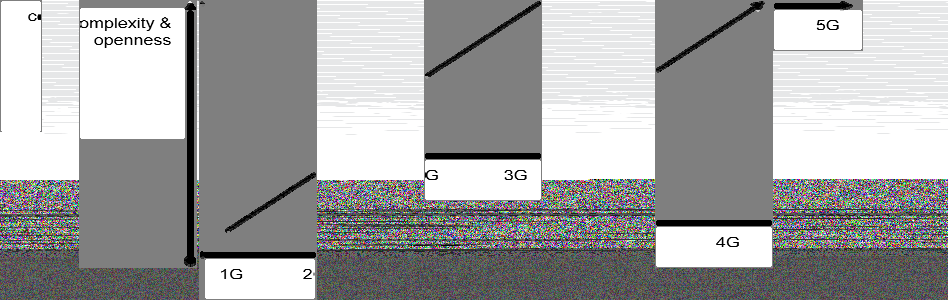
Figure 1: As the innovation process evolves, it becomes more complex and open
The increase in openness and complexity associated with later generation innovation processes creates greater strategic innovation management challenges. Each generation of innovation process is harder to adopt than the previous. Innovation processes are thus not a 'free good'. They are often expensive to acquire and adopt, and difficult to effectively use. This is evidenced by the creation of formal innovation (not R&D) departments and the growing role of the Innovation Director in world-class competitive firms.
But failure to move to latest generation innovation processes (if other firms can) ultimately leads to a failure to be able to compete. In some markets this selection pressure is powerfully enforced 'innovate or die' – in others less so. Thus the actual state of the innovation processes across even a single firm with multiple lines of business can vary considerably.
Firms clearly upgrade their innovation processes for good economic reasons. Each generation of the innovation process is more effective and powerful than the previous in its ability to gather and process distributed information and knowledge, and to thus make new connections and yield new sources of value. Adoption of new generation innovation processes is therefore a source of competitive advantage, as discussed in section 2.2 below.
Currently, fifth generation innovation processes describe the frontier of modern best practice in business innovation. Their key characteristics are discussed next.
2.1 Characteristics of 5G innovation: strategic, integrated and open
The diagram titled "Fifth generation innovation" illustrates a flow:
1. Science & technology points towards Innovation process shaped by innovation strategy and high level organizational and technological integration.
2. Innovation process shaped by innovation strategy and high level organizational and technological integration points towards Markets.
3. A feedback loop from Markets points back to Innovation process shaped by innovation strategy and high level organizational and technological integration.
4. A smaller box, Strategic and technological integration with customers, suppliers, innovation communities and networks, is also shown, indicating its role in shaping the innovation process.
The source is Dodgson et al. 2008: fig 3.5, p. 63.
Figure 2: Fifth generation innovation (source: Dodgson et al. 2008: fig 3.5, p. 63)
Fifth generation (5G) innovation is a strategically integrated network-based innovation process. This is an open-innovation process in that the innovation process within the firm is deeply integrated with sources of knowledge both inside and outside the firm: it is a distributed knowledge, distributed innovation process which is central to what the firm does.
Central to the emergence of 5G innovation processes (Rothwell 1992, 1994) are the arrival of new technologies that dramatically lower the cost and increase the efficacy of networked communication and distributed production. 5G innovation thus goes beyond the development of operational or information technologies and develops and demands innovation technologies (IvT) to connect the different knowledge-bases and complex networks of suppliers, collaborative partners, customers and research affiliates. It is thought that innovation technologies (IvTs – Thomke 2003; Dodgson et al. 2005) such as simulation modelling and visualization technologies including virtual worlds, are increasingly changing how innovation itself is produced.
Combined with these IvTs are new 'social technologies' and business models to exploit the new technological opportunities that increased communication and coordination allows. These are, in turn, intensified by the increased scale and scope of a global market for technologies, partners, suppliers and consumers that radically de-localise the innovation process and increase its distributed complexity in both time and space (Archibugi and Michie 1998; Meyer-Krahmer and Reger 1999; Cross et al. 2001; Coombs et al. 2003). This combination of globalization, new business models and organizational possibilities combined with significant improvements in both ICT and IvT constitutes the foundation of 5G innovation.
5G innovation represents the frontiers of contemporary practice. It is most apparent in the leading technology sectors subject to intense technological and global market competition. As Dodgson et al. (2005: 36) explain: 'the fifth generation innovation process, the systems integration and networking model is still emergent, and many of its features are still being developed. Within the firm we see greater appreciation of the role of knowledge, creativity and learning as sources and outcomes of innovation'. 5G innovation practice is emerging in consequence of intense enterprise competition as firms seek to gain competitive advantage through improved innovation systems to exploit new technologies that enable networked and distributed learning and innovation. In turn, this requires often significant changes in business models and the commercial logic of how value is created and exploited. Dodgson et al. (2005: 37) continue: 'Value is increasingly determined not so much by ownership of assets but by the connectedness of those assets in networks and is realised in new forms of project organization and project based firms'.
5G innovation thus defines current best-practice business innovation in the context of new digital technologies of production, communication and innovation, business networks and the rise of co-opetition (Brandenburger and Nalebuff 1996), increasing interaction with suppliers and consumers, adaptation of business models to take advantage of the increasingly distributed and open nature of knowledge production and the 'intensification of innovation'. Five key aspects of 5G innovation process may be identified (see Table 2).
| 5G dimension |
Examples |
| Business networks |
Consortia and joint venture formation, social and professional networks, 'coopetition' |
| Innovation technologies |
Multi-agent simulations of new product uptake, visualisation and virtual world technologies, rapid prototyping |
| Multiple sources of ideas/novelty |
Increasing importance of lead users and beta testing, marketing focus on bidirectional dialogue, rise of consumer co-creation |
| Role of brokers |
Innovation marketplaces e.g. yet2.com, nine sigma, innocentive, commercial value of brokering e.g. Innovation Xchange |
| Importance of business models |
Value realization through connecting assets and knowledge |
While these dimensions of 5G innovation are distinct, all imply the central importance of innovation services. These are peripheral aspects of earlier generations of innovation systems, which were entirely or largely conducted within the firm. In 1G innovation, this was all conducted within a single department within the firm (R&D), whereas by 3G this function took place across the firm but within its boundaries. However, beginning with 4G and fully realised in 5G, the role of external suppliers and brokers of innovation services becomes a core part of the innovation process as the firm's innovation system begins to connect in ever more complex ways to other knowledge 'partners'.
A general characteristic of 5G innovation is the increased role of not just innovation services (i.e. production of IvTs), but also the coordination services that connect these innovation services into networks. Just as economic growth and development shifts the industrial structure of an economy ever more toward services, the growth and development of the innovation system follows the same reason: namely increased complexity requires more services to coordinate that complexity - the provision of such services in turn enables further exploitation of such specialization. 5G innovation drives increased 'servicization' (Gallouj and Weinstein 1997; Miles 2000; Tether 2003, 2005; Metcalfe and Miles 2000) of the innovation system. The creative industries are important suppliers of such innovation services, a role that is amplified in 5G innovation processes.
2.2 5G innovation is superior, but more complex
The increased complexity of 5G over 4G, and of 4G over 3G, etc., arises from the increased feedback and more integrated networks that later generations allow. Firms need to be more open, which requires developing outward-facing networks, alliances and strategic partnerships. They need to be able to absorb new ideas better (Cohen and Levinthal 1990), especially ideas that did not originate within the firm. It also means firms need to develop more project-based capabilities and more flexible business models. All of this makes them harder to manage, and more prone to both tactical and strategic mistakes.
Yet the benefit of this more complex, more technology embedded, more open innovation process is that it is more powerful. It harnesses new ideas and knowledge from wider and more distributed sources, and integrates and develops them to exploit opportunities more rapidly and effectively (Koen et al. 2001; Doz and Kosonen 2008). Many of the firms considered world-class or with leading positions in their respective markets can be observed to be practising most or all of the activities associated with 5G innovation (Dodgson et al. 2005, 2008).
But, as with all systems, the higher the system complexity the more points there are of potential failure (or the more the process exposes latent points of failure and suboptimal choice). As discussed in the next section, behavioural failures in particular are the flip-side of the increased power of 5G innovation processes.
3. Behavioural innovation failures
As shown in Figure 3, innovation processes can fail in multiple ways.
The diagram "Three classes of innovation failure" illustrates three overlapping categories:
-
Systems failure
- Elements & connections
- Missing institutions
- Failed connections & integration
- Coordination failure
-
Market failure
- Prices
- Externalities
- Incomplete property rights
- Asymmetric information
-
Behavioural failure
- Choices
- Bounded rationality
- Heuristics & biases
- Knowledge & novelty
Figure 3: Three classes of innovation failure
Innovation failures can happen in three ways, although these often overlap. In summary, systems failures occur when the component elements and system connections that compose the innovation process fail; market failures occur when the innovation system is operational, but the information in the system is distorted or incomplete; and behavioural failure occurs when inappropriate rules for choice (with which to process information within the system) are used.
'Classic' market failure in the production of ideas implies a less-than-optimal supply due to the ease of appropriability of new ideas (Martin and Scott 2000). Possible solutions include subsidising the production of ideas (e.g. using R&D tax credits), publicly funded research institutes, or creating artificial monopoly rents to incentivise knowledge creation (cf. Wolf 1979). Market failures also arise when there is a lack of competitive pressure. This occurs when constraints on entry into a market or regulations prohibit competition in certain dimensions (Metcalfe 2003). Protected markets have little incentive to innovate and thus demand innovation services. Imperfect information is another example of market failure: innovators may struggle to access finance, for example, if investors are less well informed than innovators about a project's prospects and risks.
Innovation failure occurs as systems failure when constrained by the capabilities of firms and elements of the innovation system to effectively coordinate into a functional system. This is most likely when innovation occurs over a network of businesses and thus depends upon the connections between each and the integration of the whole (Drejer 2004). Innovation systems failure is characteristic of 3rd, 4th and especially 5th generation innovation processes.
Such failures on the supply side may be due to:
- communication problems between partners, or failure to connect with appropriate partners;
- different or incompatible strategic objectives, or strategies that seek to exploit partners;
- difficulties sharing knowledge due to tacit dimensions or differing knowledge capabilities;
- business model incompatibility;
- different expectations, time horizons, or other operational aspects.
There may also be failures of demand, as for example with:
- failure of users to imagine or appreciate the benefits of the new idea;
- excessive risk aversion to novelty and bias toward existing solutions;
- perceptions of quality, including observed adoptions by others;
- constraints to adoption via finance, costs, systems integration;
- requirements of learning and behaviour changes associated with the novelty;
- failures of idea to be successfully retained or reversion to past preferences and behaviours.
Each of these systems failures is an instance of businesses or consumers failing to adopt and retain change: these are innovation process failures. Many of these potential failures associated with novelty, imagination and uncertainty can be explained by insights from behavioural economics, as discussed below.
3.1 Evidence from behavioural economics
This section examines the origins of innovation process failures in terms of a suite of 'behavioural heuristics and biases' that affect SMEs in the context of innovation. Behavioural approaches to choice in economic analysis emphasise the role of bounded rationality and the use of choice heuristics (Simon 1955, Conlisk 1996). Bounded rationality refers to the costs associated with making choices in terms of gathering, assessing and processing information. Because of these costs, people do not make 'rational' choices but instead use decision-heuristics (or simple rules) to make choices that are 'good-enough'. These rules are generally acquired and adapted to a particular context in which they may perform tolerably well. This occurs when the choice situation is mostly transparent, where sufficient time for learning and refinement of the choice heuristic has elapsed, and when the context remains stable. However, these rules can fail or become dysfunctional in the absence of these conditions. This is a common problem in the context of novelty and innovation, both for consumers and businesses.
Viewed from the perspective of bounded rationality, business management and consultancy services can be seen as 'innovation services' to the extent that they diagnose dysfunctional choice and operating heuristics and seek to replace these with better rules for operation (Bessant and Rush 1995; Earl and Potts 2004).
The ubiquity of bounded rationality and the consequent use of heuristics lead to characteristic and systematic biases in the decision making of people, and therefore of firms. Behavioural experiments provide a way of unpacking the extent of these biases, and thus provide estimates of the sort of compensatory spurs needed to overcome them (Thaler and Sunstein 2008). Some of the major biases or behavioural failures which have been identified through behavioural economics research are shown in Table 2 below.
| Bias |
Definition |
| Excessive risk aversion |
Choice over uncertain outcomes are biased toward certainty |
| Loss aversion |
Equivalent losses and gains are experienced unequally |
| Myopia & hyperbolic discounting |
Overweight the near future and underweight the distant future |
| Status quo bias |
Overly strong preferences for current states |
| Sunk cost effects |
Treating sunk costs as significant (rationally they shouldn't be) |
| Endowment effects |
Overvaluing assets you have, undervaluing assets you don't |
| Availability biases |
Treating recent or high-profile information as excessively salient |
| Framing biases |
Organizing information on inappropriate templates |
| Optimism bias |
Systematic overestimation of one's own abilities |
| Confirmation bias |
Tendency to ignore evidence that does not support existing hypotheses |
There is a large literature on behavioural applications in economics extending from behavioural choice theory (Kahneman and Tversky 1979; Earl 1990, 2005; Rabin 1998; Gigerinzer 2000; Loewenstein 2000; Mullainathan and Thaler 2001; Camerer and Loewenstein 2004), behavioural theory of the firm (Cyert and March 1963; Nelson and Winter 1982), and behavioural finance theory (Shleifer 1999). Policy implications of behavioural economics are discussed in Dawney and Shah (2005) and Sunstein and Thaler (2008).
A behavioural approach to innovation – a behavioural innovation economics (see Morrison and Potts 2008) – seeks to extend the field of behavioural economics to the study of innovation processes. (See also Bianchi 1990; Raines and Leathers 2000; Geiger and Cashen 2002; Brocas and Carrillo 2004, 2008; Magee 2005; Shiller 2005; Schweizer 2006; Dew et al. 2008; Becker and Zirpoli 2008; Sarasthvathy 2008; Beckenbach and Daskalakis 2008; Schulze and Hoegl (in press)). Its central ideas are that:
- Innovation is not a perfectly rational process but is subject to the systematic (predictable) effects of what Richard Thaler calls: bounded rationality, bounded selfishness, bounded self-control, and bounded arbitrage.
- Agents engaged in innovation (in both supply and demand) use choice-heuristics for coping with uncertainty. These are affected by innate cognitive biases as well as social-interaction effects.
- Agents differ in their behaviours with respect to creativity, novelty and uncertainty due to both innate differences, learned differences, and institutional or contextual differences.
- All biases that apply to behavioural (consumer) choice theory, behavioural theory of the firm and behavioural finance models also apply to behavioural innovation theory, only more so (because of the additional context of novelty).
Behavioural innovation theory thus offers a useful approach to the study of innovation by serving to map and analyse the heuristics and biases at work in the innovation process (in terms of all five generations, Rothwell 1994) as these operate across all actors in the innovation process. These include inventors, entrepreneurs, financiers and investors, development and marketing agents, designers, operations managers and consumers. The impact of behavioural failures on critical interactions in the innovation process can also be analysed, including business interactions in supply chains and knowledge collaborations, partnerships and alliances between businesses and research institutes, interactions between businesses and consumers or users, and the role of interactions between consumers themselves, as seen for example in social network effects (Potts et al. 2008).
3.2 Why is 5G innovation difficult?
The perspective of behavioural innovation economics emphasises that innovation is difficult and prone to failure because choice under uncertainty and choice under novelty are especially prone to the effects of behavioural heuristics and biases. This is summarised in Figure 3 below.
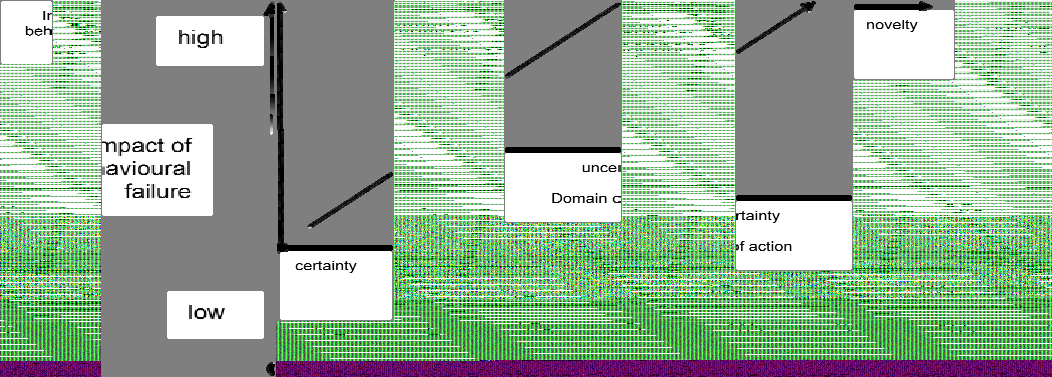
Figure 4: Behavioural failures have greater impact as uncertainty and novelty increase
Consequently, the impact of behavioural failures is amplified in 5G innovation processes that have evolved to manage uncertainty and novelty.
This can be seen by considering three of the key constraints arising from the systematic biases and errors identified by behavioural economics: inertia, loss and risk aversion, and myopia.
Inertia covers a raft of heuristics and biases that share the common characteristic of reluctance to change. This manifests in status quo biases – the tendency to prefer whatever the current situation is, however arbitrary or even dysfunctional – and to resist change or impose high standards of proof of the benefits of change before attempting it. This can be a consequence of sunk cost effects, where decisions about future investments erroneously take into account the cost of investments already made.
Inertia can also arise as strategic and organizational conservatism bias (Gilovich et al. 2002), where firms maintain existing strategies, business models and resource configurations, even in the face of evidence that the sources of competitive advantage in their markets have changed. This can lead to incumbents being blind-sided by disruptive innovations from new market entrants (Christensen 1997).
Similar effects occur on the consumer side when a particular product is part of a broader consumption system (such as home media systems). Interconnectedness between the components means that innovation in a particular product has ramifying consequences across the 'consumer lifestyle', potentially becoming a barrier to adoption of new technologies (Earl 1986; Castner and Campos 2002).
Reluctance to change, or systematic over-estimation of the costs of change and under-estimation of benefits, is an almost universal heuristic that leads consumers to exhibit often 'unreasonable' reluctance to try new products or services or of firms to invest in new markets or technologies. Inertia creates path dependence for individual firms (and consumers) that may prevent them from operating at the frontier of best practice.
As discussed in Section 2, a major characteristic of successful 5G innovation is the ability to form connections with multiple sources of knowledge outside the organization. These networks can be quite open, especially when facing users or consumers. Inertia causes difficulties in forming appropriate and effective connections to other businesses or to consumers/users (Dixon 2000), because costs are upfront and known and benefits are highly uncertain. Inertia also arises in business networks involving complex integration technologies and agreements when the interdependence of connections makes even small changes difficult to value due to ramifying systemic effects (Damanpour 1987, 1991).
Risk and loss aversion is a common and much studied aspect of human and organizational behaviour (Kahneman et al. 1991). Excessive risk aversion means that choices over uncertain outcomes are biased toward certainty (Rabin and Thaler 2001). Loss aversion means that losses and gains that are in reality equivalent are experienced asymmetrically with losses systematically overvalued. Both have significant impact on the ability of firms to engage in innovation 'rationally'. Risk and loss aversion make the rational benefits and strategic advantages of adopting 5G innovation processes difficult to imagine or see clearly because of instinctive framing of such connections and openness in terms of down-side risks rather than up-side benefits (Earl 1986, Paquet 1998). Risk and loss aversion also affect consumer and user adoption of novelty, impeding the adoption of new products and services (Bromiley 1991).
SMEs are particularly prone to risk and loss aversion biases simply by being 'small'. Larger firms have sufficient capacity to devote resources and attention to overcoming risk and loss aversion, often with the development of routines and procedures to do so. This is also an area where outside help in the form of management consultancy is engaged (as a form on innovation service, discussed in the following section).
However the impact of risk and loss aversion on SMEs crucially depends on the dynamic status of the firm. A small start-up with an aggressive growth strategy will likely perceive the loss of not acting to build networks or not experimenting with new technologies and markets as the manifestly risky course of action. Whereas a small company in a mature market with few aggressive competitors will perceive the opposite, finding the risks and potential losses associated with change toward 5G innovation models quite possibly unbearable.
Myopia tends people and firms to overweight the near future and underweight, or sometimes ignore entirely, the more distant future (Frederick et al. 2002). Myopia interacts with 'endowment effects' – the tendency to overvalue assets already owned compared to assets not owned – and 'availability biases' - treating recent and/or high-profile as excessively salient (Kahnaman et al. 1991, Kahnaman et al. 1997) - making it often difficult to both conceptualize and value future outcomes when they depart from the current context of assets, strategies, competencies and markets. Myopic bias will tend to overvalue tactics (what the business is doing now) and to undervalue strategy (how it will move into the future). The strategic management of innovation is, in considerable part, the development of strategies to overcome myopic bias. The bias tends to lead to systematic underinvestment in new technologies and market development, particularly among SMEs.
Myopic bias has particularly inhibitory effects in developing new knowledge and the connections, partnerships and capabilities to create such possibilities. Because innovation involves experimentation and potential outcomes that are difficult to imagine due to their distance in the future, this can induce reluctance to enter into such networks, and to adopt different business models that may take considerable time to adapt and optimize. On the consumer side, myopic biases inhibit adoption of new products and services, or new ways of consuming that may take time for benefits to accrue.
Other behavioural limitations may also contribute to difficulties in adopting and adapting 5G innovation processes – further research is required. The point remains though that the complexity of 5G best practice innovation exacerbates the impact of behavioural biases for individuals and firms, especially SMEs, and that concerted effort and sometimes significant resources are required to overcome these.
As discussed, innovation can occur between firms as they provide services to help overcome the impact of behavioural constraints on adoption of best practice innovation. The next section discusses how creative innovation services, in particular, can contribute to the improvement of firm innovation performance in this way.
4. Creative innovation services
The creative industries are often claimed to be a highly innovative sector (Howkins 2001; Tepper 2002; Cunningham 2006). Yet the specific mechanisms underlying this association are often only vaguely indicated. This is often framed broadly in terms of supply of creative inputs, or the training of creative workers. Still, compared with high technology sectors, for example, there have been relatively few studies of the innovation process in creative industries firms (Tether and Massini 1998; Castaner and Campos 2002; Tether 2003; Gilsing and Nooteboom 2005; Handke 2007).
The specific nature and form of innovation processes within creative industries sectors is, however, logically distinct from the argument that they provide innovation services to firms in other industries. It can be argued that the creative industries have had long experience with 5G innovation processes – much more-so than other sectors – and are thus in a prime position to provide the adoption, diffusion and coordination services of that innovation model throughout the economy.
Firms in creative industries thus interact with the economy through two distinct mechanisms. The first is at the operational level via the supply of creative goods and services (and with corresponding demand resources from other sectors). This is reflected in input-output tables (Bakhshi et al. 2008), and in terms of the various endeavours to decompose the types of services supplied into modal types (Miles and Green 2008).
The second way is at the innovation level, in which creative businesses supply innovation services to other businesses. This manner of creative service supply is less well studied, but it is proposed as an important part of how the creative industries help firms in the wider economy to innovate. This may occur directly via inputs into innovation processes (such as new ideas, designs or technologies) or indirectly, by shaping the conditions necessary for innovation: by making connections to other firms or knowledge-communities, shaping consumer adoption and retention of novelty in new market niches, and so on. As indicated in Figure 5, creative innovation services are therefore a subset of creative services.
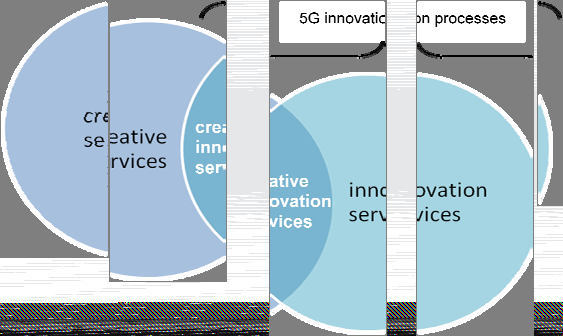
Figure 5: Creative innovation services are a subset of creative services
Non-creative innovation services are supplied by many businesses throughout the economy. Entire sectors such as investment banking, venture capital, scientific instruments, experimental high-technology sectors, business consulting, and many others specialise in the provision of services that facilitate the process of innovation. These businesses form the commercial, market or private sector component of the innovation system, operating in parallel with public sector elements such as higher education, public research institutes, public procurement, Regional Development Agencies, and so on.
4.1 How creative innovation services can help overcome behavioural failures
The supply of creative innovation services does not map uniquely to the industry sub-classifications within standard creative industries definitions (e.g. DCMS 1999), as these are based on consumer market (industry) classifications. Instead, they relate to aspects and phases of the innovation process. The 'map' of creative innovation services is yet to be charted, however it is possible to identify the major types as indicated in Table 4.
| Creative innovation service |
Value |
| Creativity services |
Providing new ideas as content into other businesses |
| Creating new market niches |
Shaping consumer preferences and perceptions to differentiate |
| Design and interface |
Shaping interactions between the technical and social |
| Normalisation of novelty, persuasion |
Via story-telling, representatives of new (magazines, advertising, TV drama) |
| Business models |
Translating models of value delivery |
| Connecting to user-communities |
Creating communities, shaping identity |
| Social network markets |
Choice over uncertainty in social context and signalling |
| Technologies to lifestyles |
Social context of use |
| Lifestyles to technologies |
Applications of technology |
As discussed, 5G innovation processes are complex and difficult to achieve. They require high levels of openness, successful network construction and management, careful systems integration, knowledge management, specialised competencies, and flexible business models. They present serious strategic management challenges and conflict with many aspects of received innovation model practice. Unsurprisingly, they are often hard to acquire, adopt and retain. Creative innovation services can, however, help address these challenges.
How? First, the most common behavioural failures in the context of innovation are in dealing with novelty. Within organizations, loss and risk aversion, status quo biases and suchlike can stifle the experimental 'play' of new idea development, and sunk cost effects can inhibit adoption of new ideas when that, as it inevitably does, requires old ideas (and routines) to be discarded (Bromiley 1991; Castner and Campos 2002; Magee 2005). Novelty can fail because change is behaviourally hard. This is magnified when novelty originates outside the organization, or across networks. These same difficulties are also experienced by consumers who face similar aversions due to potential risks associated with novelty and the various losses associated with giving up familiar 'solutions' to problems. Advertising and marketing, for example, are in large part about the design of products, strategies and messages to minimise these effects, often through the mechanism of 'social network markets' (Potts et al. 2008): in this sense they operate as creative innovation services by helping novelty to diffuse. Firms in creative industries have long been steeped in environments that are saturated with novelty (the fashion industry in prime example, but similarly so for architecture, music, film and television) and in consequence have 'evolved' various methods, strategies and structures for successfully not just generating novelty but also for processing, adopting and retaining novelty in different forms, from different origins and at different scales, on a routine basis. These innovation capabilities are, however, far from easily codified and packaged and thus still require direct engagement to be successfully transferred.
Second, the development of B2B connections and networks requires a shared culture to provide a necessary context for sharing values and 'mental models' (Foster 2005) that may translate into the mutual trust necessary for contracts and collaboration. With all novelty there is an 'imagined community' whose choices shape the individual's own choice, and such a community is signalled by cultural cues including design, style, language, shared events, tastes, and overlapping social networks that meet in cultural environments (Hartley 2008; Currid 2007). This 'cultural system' introduces both individuals and ideas to others: the old-fashioned notion of 'networking'. Firms in creative industries provide innovation services when they supply these means of overcoming the inhibitions to change through the creation of real (or even imagined) communities. The development of these shared cultures can create appreciation of shared problems, and thus opportunities (Dixon 2000).
Third, firms in creative industries do not just routinely deal with novelty, as above, but also with imagination of the future. A significant innovation barrier lies in conservatism or inertia biases stemming from failures to imagine the future as potentially different from the present and, even harder, to imagine that difference as a positive change (Earl 1986). The framing of change in terms of risks and potential losses rather than opportunities and potential gains is a basic (arguably evolved) human instinct that requires effort to overcome. A rational calculation can of course be made over such systematically biased inferences, and a certain degree of risk aversion is indeed considered consistent with rational choice theory in economics, yet it is equally plausible to view excessive risk and loss aversions as failures of imagination. Part of the innovation services that firms in creative industries can provide is thus in the provision of models, tools and prostheses to aid such imagination, whether within individual firms, across networks of firms, or helping consumers imagine new possibilities and opportunities. Indeed, learning to connect and focus on changing consumer needs can assist with bringing demand-side considerations into 5G innovation processes (Chesbrough 2003; Prandelli et al. 2008).
A good example of such harnessing of imagination is of course the fashion industry, an almost pure example of trading in imagination through normalisation of change and risk-taking and emphasising the excitement and benefits of the creation and adoption of novelty (Potts 2007). From this perspective it can also be argued that part of creative innovation services is the provision of imagination technologies (ImT), alongside the innovation technologies (IvT) that are considered central to the 5G model (Dodgson et al. 2005). ImTs overlap with IvTs in simulation and visualisation technologies, but are often far more quotidian, including stories, dramas, music and other forms of symbolic narrative and content that can be used as templates for conceptualising novelty. The design and architecture industries are similarly heavy lead-users of technology-based visualisation and simulation tools. By helping firms and consumers to more clearly imagine different futures - while carefully calibrating acceptable differences (Nooteboom et al. 2006) – these methods enable the benefits associated with adoption of novelty to be identified, in turn highlighting the costs of not changing, which are often instinctively assumed to be zero (Kahneman and Tversky 2000; Lowenstein et al. 2003). By providing imagination technologies, creative businesses thus supply innovation services.
Fourth, innovation failures can accrue from the cumulative effect of behaviours, habits, routines, procedures, practices, and so on that may have worked well in past or different contexts, but are presently failing. These are often very difficult to recognise or diagnose because they are subject to strong inertial effects, confirmation and control biases and sunk cost effects. Firms, like people, often require external critique to recognise the origin of such problems and to lead to solutions (Damanpour 1991; Bessant and Rush 1995; Lovallo and Kahneman 2003; Doz and Kosonen 2008). Firms in creative industries can provide such innovation services in two overlapping ways: by furnishing, in the form of business models and working practices, new models of different behaviours and practices to imitate or adapt; or by developing the space of attention and representation to trigger such reflection that may lead to changed behaviours (Earl and Potts 2004; Lanham 2006). Disrupting embedded behaviours and practices is a necessary pre-condition for development of 'discovery-driven' strategy, which is considered part of best practice for remaining competitive in a complex and uncertain economic environment (McGrath and Macmillan 2009).
Fifth, new technological and economic opportunities are not successful innovations until they have connected into consumer lifestyles, or have shaped, however marginally, new ways of living (Dopfer and Potts 2008). Here, the crucial skills and knowledge upon which innovation depends are often not technical, but cultural. The 2G innovation process was an early version of this (although at a distance relying on social anthropology, psychology and mass marketing), but 5G is its mature state. Businesses in creative industries are often highly technologically sophisticated and lead users of new technologies, yet it remains their ability to connect these to current and emergent cultural contexts, even leading that cultural context, that is the core of the innovation service they provide.
Business in the creative industries is itself much closer to the 5G innovation model than earlier innovation generations: it is often modular and project-based, it is well practised at looking 'around the corner' for new opportunities and threats, and it is naturally based on ‘open innovation' and flexible business models (Caves 2000; Von Hippel 2005; Eikhof and Haunschild 2006). Non-creative innovation services, however, are often optimised about closed or proprietary innovation systems and vertically integrated business models. Thus while complementary in the whole, there is scope for creative industry innovation services to increasingly occupy the space of non-creative innovation services as 5G innovation processes are more widely adopted.
4.2 Matching creative innovation services to demand
Although not widely appreciated, the creative industries are part of the innovation system through the supply of creative innovation services. These services have always been part of innovation systems in market economies, but have grown in significance only recently in conjunction with the rise of 5G innovation processes. Demand for creative innovation services can therefore be expected to be strongly related to the adoption of 5G innovation processes.
Demand for creative industry innovation services depends upon the innovation problem the non-creative (rest of economy) firms are facing. This can be initially conceptualised in terms of the innovation phase the problem occurs in: origination, adoption or retention. The demand for creative innovation services will therefore relate to one of these categories, as shown in Table 5.
| Demand for innovation services in origination |
Supply of innovation capabilities to create new ideas |
| Demand for innovation services in adoption |
Supply of leading preference formation, social network market services |
| Demand for innovation services in retention |
Supply of embedding and normalization services e.g. brand awareness |
A second way of conceptualising demand for creative industries innovation services is in terms of 5G adoption requirements (Table 6 below). This class of demand for innovation services may be less explicit than demand by reference to an innovation trajectory. In order to demand creative industries services as a way of developing and adopting a 5G innovation, firms in the non-creative sector can only arrive at this demand if they first express a demand for a 5G innovation process. Demand for creative industries innovation services is therefore a 'tacit demand'. In this respect, it may not be explicitly expressed, contracted or remunerated, yet may still be delivered (thus giving rise to what economists call 'spillovers').
| Business networks |
Supply of services to enable increased network connection |
| ICT & IvT (& ImT) |
Supply of imagination technologies to facilitate whole of network creativity |
| Multiple sources of ideas & knowledge |
Services to integrate and connect tacit knowledge and shape it into new ideas, solutions, supply of access to user-consumer communities and open innovation communities |
| Brokers |
Services to connect 'tacit demand' |
| Business models |
Services to export value creation models from creative domain |
A central issue is why businesses in the non-creative sector may be well aware that they would benefit from the adoption of 5G innovation process models, and further that engagement with creative industries business is one of the ways in which they may attain this outcome, but yet still fail to express demand for these creative innovation services. It is common to presume that such instances are examples of market failure. We instead suggest that the behavioural heuristics and biases discussed above systematically generate difficulties for SMEs in adopting open, network-based innovation processes. This leads to an induced demand for creative innovation services over and above the demand for other (non-creative) innovation services that are less due to behavioural failures, but rather derive from lack of management or technical competences to undertake innovation (see Figure 6 below).
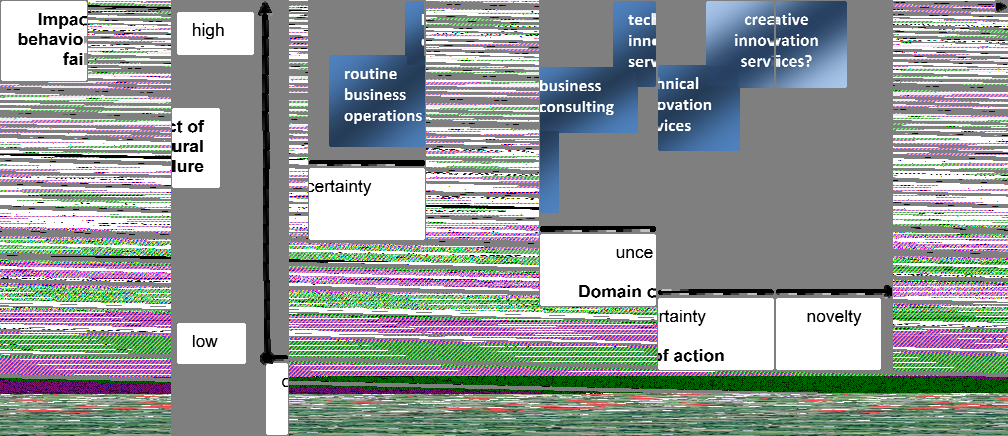
Figure 6: The emerging significance of creative innovation services
5. Implications for vouchers pilot
The macro and social costs of sub-optimal innovation processes can be considerable (although difficult to measure as these are potential opportunities foregone). By implication, the returns to creating incentives to adopt best-practice innovation may also be considerable.
This section sets out the implications of the argument for NESTA's proposed vouchers pilot. From the perspective developed in this paper, the underlying hypothesis to be tested is that the shift to fifth generation innovation processes creates an induced demand for creative innovation services – if this hypotheses is rejected, it would indicate that creative industries firms do not contribute to improved innovation performance in firms within the wider economy. In practice we suggest this translates into six specific hypotheses that are amenable to testing in the pilot.
5.1 Hypotheses
Hypothesis 1: Only some firms in creative industries supply innovation services
Some parts of creative industries will be more important providers of creative innovation services; others less so (these will be 'just' creative services providers). However, it is prima facie unclear how to distinguish the two. It may be that creative innovation services are bundled with other creative services. If so, this raises the question of the extent to which this is recognised, contracted and remunerated, i.e., to what extent is creative innovation services a distinct market? To what extent are there positive spillovers between creative businesses and SMEs in the wider economy?
Hypothesis 2: Behavioural innovation biases might be 'easily' overcome
The benefits of 5G innovation to firms are clear and logical. Yet, risk and loss aversion can make these rational benefits and strategic advantages difficult to see clearly because of instinctive framing in terms of down-side risks rather than up-side benefits. It is cognitively easier to imagine things going wrong than to imagine emergent benefits associated with new knowledge, changed specializations or new markets. The vouchers program directly contributes a mechanism to overcome the initial risk and loss aversion associated with the uncertainty of contracting with a new type of business by mitigating down-side risk. The question is: how large is the behavioural effect? This can be reframed as: how large does a voucher need to be to overcome the (hypothesised) effect? The size of the voucher should thus reflect estimates of the thresholds to overcome in 5G adoption. Behavioural failure occurs when currently perceived costs outweigh hard to imagine benefits. The voucher will be successful only if it can nudge people and firms over the threshold.
The proposed vouchers have been set at £4000 (compared to the Dutch innovation vouchers which were valued at €7500, Cornet et al. 2006). While somewhat arbitrary, it should be a sufficiently large amount to cover transaction and overhead costs for businesses who are participating in the program. Importantly, in cases where it manifests as a pure rent transfer, it will not be unduly distorting of the competitive landscape. The amount also seems plausible given the likely size of the risk and loss aversion effects hypothesised to be at work in the failure of demand for creative services.
A basic principle in experimental economics is that incentives are necessary to induce 'rational' action (Smith 2000). Yet these incentives need not be large; to be effective they only need to cover opportunity costs. In laboratory experiments involving undergraduates, for example, these can be equivalent to just a few pounds. In voucher experiments and programs in consumer markets (e.g. schooling, food and health vouchers) there is ample and consistent evidence that the behavioural effect of vouchers operates below the full cost of the service (Bradford and Shaviro 1999). Recipients of vouchers commonly and systematically use the voucher as well as their own 'top-up' contribution in enacting a changed behaviour (e.g. in schooling or health services purchase). To be effective, therefore, a voucher need only be large enough to offset opportunity costs, switching costs, transactions costs or, as we suggest, the perceived behavioural costs: beyond this level it is simply a rent transfer to the voucher recipient. Nevertheless, it remains uncertain what this level will be in the B2B context or the innovation context, let alone together, as there is little experimental evidence or theory to go on. Yet the threshold might be relatively low in the context of 5G innovation, as it need only overcome perceived loss aversions or myopia, or to be framed within the firm as an experimental action. Arguably, this may require only a small nudge. In firms where it required a larger incentive, there may be compounding factors that might indicate the unlikelihood of successful innovation inducements. The pilot could usefully aim to illuminate this.
Indeed, the case can be made that the amount of the voucher might also be usefully randomised, with firms not knowing the size of the amount awarded until after acceptance notification. The same number of vouchers could be allocated over £0- £8000 interval (same expected value of £4000) but with the additional benefit of enabling: (1) controlled experimentation about the marginal benefit of a voucher; and (2) evidence of threshold effects (e.g. are they ineffective below £2000?). This would be valuable information to minimise public cost while retaining maximum effectiveness.
Hypothesis 3: Clustering matters to delivery of creative innovation services
It is to be expected that economic geography will be an important factor in the effectiveness of delivery of innovation services. This effect is expected to be even more pronounced in delivery of creative innovation services due to their role in addressing behavioural failures. The effect of tacit knowledge or differences in mental models/worldviews would be expected to be ameliorated by physical proximity. This could be tested by issuing a sub-set of the vouchers to recipients that are further away than easy travelling distance from the creative providers, i.e. so that voucher services are delivered remotely, not face-to-face.
The centrality of business networks in 5G innovation processes further highlights the question of the role of geographic clustering and distance effects (physical, cultural, etc.) of the efficacy of such networks and project-based knowledge creation. While the project has no control group against which to test, it will therein provide a benchmark for future studies. Still, there are good theoretical and empirical reasons to suppose that the efficacy of such a program would be conditional upon geographic concentration. Yet clusters exist for a reason, namely they significantly lower the costs associated with the transmission of tacit knowledge (Porter 1990). Creative innovation services are likely to be an extreme case of this.
Hypothesis 4: Demand for creative innovation services varies by sector
There will of course be considerable differences in the SMEs under the rubric of 'non-creative firms'. This matters for the purposes of this pilot because firms in different industries and markets will be better grouped with respect to characteristics of their industrial ecology and characteristic innovation processes. For example, firms from industries with well-adapted and functional 1G and 2G innovation systems in mature markets might have less to gain from firms in industries more characterised by 3G and 4G innovation systems in growing markets. They should in principle demand very different creative operational services and creative innovation services. It remains an open question whether creative innovation services add more or less value to businesses at 1G or 4G, but in either case it will be important to seek to classify the recipient firms more by generation of innovation system and state of market, rather than by 'sector' alone. Within a sector there can be highly diverse business models, technology dynamics, and network effects (Tether 2003).
It will therefore be important in the pilot program to distinguish between firms of otherwise similar size with respect to their dynamic state: firms rapidly growing or shrinking will have very different risk and loss aversion biases to a stable firm, which will thus impact on their inherent demand for CI innovation services and, in turn, the type of services they will seek.
Hypothesis 5: Firm size determines effectiveness of creative innovation services
While the category of SME may be a suitable gathering station, it will nevertheless be important to seek to identify particular size effects within this study. Businesses in creative industries are somewhat statistically unusual in that the industry is populated with both very large content aggregator and distributor companies as well as a large number of small enterprises (Caves 2000). It has often been argued that the smaller businesses are just as, if not more, effective at innovation precisely because they are more 'nimble' and flexible. However, it does not necessarily follow that this logic extends to the supply of creative innovation services. Indeed, because it requires specialist capabilities, there may well be a lower bounds or thresholds below which innovation services are ineffectively supplied (the alternate hypothesis is that there are no such effects).
In the context of 5G innovation processes, a crucial activity is the formation of partnerships and network collaborations both with other firms and with consumers/users. It is to be expected that a voucher stimulus would have differential effect by size in consequence of specializations and competences, although there is little theoretical or empirical guidance as to what these thresholds might be. This pilot thus provides an opportunity to examine these effects.
Hypothesis 6: Two-way knowledge transfer
A final consideration is that creative businesses themselves also suffer from behavioural failures, and that this may impact on their own ability to practice 5G innovation and remain competitive. This may be especially the case given the dominance of micro and small firms in the creative industries (Caves 2000).
This implies that creative businesses may use their own methods and strategies, implicitly or explicitly, to overcome behavioural biases in adoption and development of 5G innovation practices. This may include use of consultants, involvement of venture capitalists or other knowledge associated with provision of finance, and learning from customers to whom creative services are provided. In the latter case, this would involve knowledge flowing back into creative businesses as they provide services to firms in the wider economy. However, the degree to which this two-way knowledge transfer is possible depends on the absorptive capacity of the CI firms themselves (Cohen and Levinthal 1990). It would be reasonable to infer that those CI firms most actively involved in provision of creative innovation services have a higher absorptive capacity and are therefore best positioned to learn from their customers.
5.2 'Nudging' innovation
The vouchers pilot, depending upon what is learned, eventually supposes a full vouchers program. What is crucial to appreciate through this transition, should it happen, is that it remain a light-touch non-distorting program based about 'nudging' actions that are tending in that same direction already, but are somewhat stifled by various behaviourally-based failures or constraints.
To emphasise, this is not about changing incentives to redirect action. It involves no planning or conceptions of what specifically should be done, nor interventions to set people, firms or industries on a different course. This program succeeds only to the extent that it enables businesses and consumers to do more of what they already want to do. It is in this sense a 'nudge' policy, or a further instance of what Thaler and Sunstein (2003a, 2003b) call 'libertarian paternalism'.
The innovation vouchers program extends the Thaler and Sunstein framework in two directions. The first is to extend the behavioural heuristics and biases framework normally exclusively applied to consumer choice into the realm of firms as based on the 'behavioural theory of the firm' (Cyert and March 1963). The second is to place this in the context of 5G innovation systems (Rothwell 1994; Dodgson et al. 2005). Vouchers thus directly contribute a mechanism to overcome the initial risk and loss aversion associated with the uncertainty of contracting with a new type of business by removing the down-side risk of loss. By combining these two positions with the findings of Bakhshi et al. (2008), with respect to the possibility of innovation services supplied by the creative industries and the seeming effects of increased demand, we arrive at a coherent framework for voucher-based nudges.
Innovation vouchers seek to catalyse new connections between creative and non-creative firms, and which might eventually become self-sustaining, but are commonly experiencing arrested development due to the behavioural effect of heuristics and biases that make reaching the 5G frontier difficult for many firms. A vouchers program can help businesses overcome a raft of inhibiting behavioural biases and market failures to move toward the 5G innovation frontier by facilitating demand for creative industries innovation services.
Finally, how will we know when nudges are no longer needed, in other words when it is time to exit the program? The basic sign would be the emergence of flourishing B2B creative-non creative markets. This may perhaps take the form of the emergence of dedicated creative innovation service trading platforms (similar to ninesigma and yet2.com). It is entirely reasonable to consider public seeding and brokering of such markets, but these should eventually aim to become self-sustaining.
A central argument has been that the behavioural effects of biases in adoption of new generations of innovation process affect SMEs more than larger firms, simply because larger firms have greater resources and specialised operations to overcome these effects. The virtue of such voucher-based nudges is that it provides a way to keep SMEs that are trying to innovate 'in the game' and helps mitigate some of the innovation costs of being small.
References
- Aghion, P., Howitt, P. (1992) 'A model of growth through creative destruction.' Econometrica, 60(2): 323-51.
- Archibugi, D., Michie J. (1998) Trade growth and technical change. Cambridge: Cambridge University Press
- Bakhshi, H., McVittie, E., Simmie, J. (2008) Creating innovation: Do the creative industries support innovation in the wider economy? NESTA research report (Feb 2008): London: NESTA.
- Barras, R. (1990) 'Interactive innovation in financial and business services' Research Policy, 19(3) 215-37.
- Beckenbach, F., Daskalakis, M. (2008) 'Behavioural foundations of innovation surveys' International Journal of Foresight and Innovation Policy, 4(3/4): 181-99.
- Becker, M., Zirpoli, F. (2008) 'Applying organizational routines in analyzing the behavior of organizations' Journal of Economic Behavior and Organization, 66(1): 128-48
- Bessant, J. (1991) Managing advanced manufacturing technology: The challenge of the fifth wave. Oxford: Blackwell.
- Bessant, J. (2003) High involvement innovation. Chichester: John Wiley & Sons.
- Bessant, J. and Rush, H. (1995) 'Building bridges for innovation: The role of consultants in technology transfer' Research Policy, 24(1): 97-114.
- Bianchi, M. (1990) 'The unsatisfactoriness of satisficing: From bounded rationality to innovative rationality' Review of Political Economy, 2(2): 149-67.
- Bradford, D., Shaviro, D. (1999) 'The economics of vouchers' NBER Working Paper #7092
- Brandenburger, A., Nalebuff, B. (1996) Co-opetition. Doubleday: New York.
- Brocas, I., Carrillo, J. (2004) ‘Entrepreneurial boldness and excessive investment' Journal of Economics and Management Strategy, 13, 321-50.
- Brocas, I., Carrillo, J. (2008) 'The brain as a hierarchical organization' American Economic Review (forthcoming)
- Bromiley, P. (1991) 'Testing a casual model of corporate risk taking and performance' Academy of Management Journal, 34(1): 37-59.
- Camerer, C., Loewenstein, G. (2004) 'Behavioural economics: past, present and future' Advances in Behavioral Economics, Princeton University Press: Princeton. pp. 3-51.
- Castner, X., Campos, L. (2002) 'The determinants of artistic innovation: Bringing in the role of organizations' Journal of Cultural Economics, 26(1): 29-52.
- Caves, R. (2000) Creative industries: Contracts between art and commerce. Cambridge: Harvard University Press.
- Chesbrough, H. (2003) 'The era of open innovation' Sloan Management Review, 44(3): 35-41.
- Christensen, C. (1997) The innovator's dilemma. Harvard Business School Press: Cambridge (MA).
- Cohen, W., Levinthal, D. (1990) 'Absorptive capacity: A new perspective on learning and innovation' Administrative Science Quarterly, 35(1): 128-52.
- Conlisk, J. (1996) 'Why bounded rationality?' Journal of Economic Literature. 34(2): 669-700.
- Coombs, R., Harvey, M., Tether, B. (2003) 'Analysing distributed processes of provision and innovation' Industrial and Corporate Change 12(6): 1125-55.
- Cornet M, Vroomen B, van der Steeg M (2006) 'Do innovation vouchers help SMEs to cross the bridge towards science?' CPB CPB Netherlands Bureau for Economic Policy Analysis Discussion Paper No. 58
- Cross, R., A. Parker, Prusak, L., Borgatti, S. (2001) 'Knowing what we know: supporting knowledge creation and sharing in social networks.' Organizational Dynamics, 30(2): 100-120.
- Cunningham S (2006) 'What price a creative economy?' Platform papers #9. Currency House: Sydney.
- Currid, E. (2007) The Warhol Economy: How fashion, art and music drive New York city. Princeton University Press: Princeton.
- Cyert, R., George, G. (1969) 'Competition, growth and efficiency' Economic Journal, 79: 23-41.
- Cyert, R., March, J. (1963) A behavioral theory of the firm. New York: Prentice-Hall.
- Damanpour, F. (1987) 'The adoption of technological, administrative and ancillary innovations: Impact of organizational factors' Journal of Management, 13: 675-88.
- Damanpour, F. (1991) 'Organizational innovation: A meta-analysis of effects of determinants and moderators' Academy of Management Journal, 14(3): 555-90.
- Dawney, E., Shah, H. (2005) 'Behavioural economics: Seven principles for policy makers.' New Economics Foundation.
- DCMS (Department of Culture, Media and Sport, UK Government) (1998) 'Creative industries mapping document' HMSO: London.
- Dew, N., Read, S., Sarasvathy, S., Wiltbank, R. (2008) 'Outlines of a behavioral theory of the entrepreneurial firm, Journal of Economic Behavior and Organization, 66(1): 37-59.
- Dixon, N. (2000) Common knowledge: How companies thrive by sharing what they know. Cambridge, MA, Harvard Business School Press.
- Dodgson, M., Gann, D., Salter, A. (2005) Think, play do: technology, innovation and organization. Oxford University Press: Oxford.
- Dodgson, M., Gann, D., Salter, A. (2008) The management of technological innovation. Oxford University Press: Oxford.
- Dopfer K, Potts J (2008) The general theory of economic evolution. Routledge: London.
- Doz, Y., Kosonen, M. (2008) Fast Strategy: how strategic agility will help you stay ahead of the game. Wharton School Publishing: Philadelphia.
- Drejer, I. (2004) 'Identifying innovation in surveys of services: A Schumpeterian perspective' Research Policy, 33: 551-62.
- Earl P.E. (1990) 'Economics and psychology: A survey' Economic Journal, 100: 718-55.
- Earl, P.E. (1986) Lifestyle economics. Harvester Wheatsheaf: Brighton.
- Earl, P.E. (2005) 'Economics and psychology in the twenty-first century', Cambridge Journal of Economics 29(6): 909-26.
- Earl, P.E., Potts, J. (2004) 'The market for preferences', Cambridge Journal of Economics, 28(4): 619-33.
- Edquist, C. (1997). Systems of innovation: Technologies, institutions and organizations. Washington: Pinter.
- Eikhof, D., Haunschild, A. (2006) 'Lifestyle meets market: Bohemian entrepreneurs in creative industries' Creativity and Innovation Management, 15(3): 234-41.
- Elder, J., Georghiou, L. (2007) 'Public procurement and innovation: Resurrecting the demand side' Research Policy, 36: 949-63.
- Foster, J. (2005) 'From simplistic to complex systems in economics' Cambridge Journal of Economics, 29(6): 873-92.
- Frederick, S., Loewenstein, G., O'Donoghue, T. (2002) 'Time discounting and time preference: A critical review,' Journal of Economic Literature, 40: 351-401.
- Gallouj, F., Weinstein, O. (1997) 'Innovation in services' Research Policy, 26: 537-56.
- Geiger, S., Cashen, L. (2002) 'A multidimensional examination of slack and its impact on innovation' Journal of Managerial Issues, 14(1): 54-68.
- Gigerinzer, G. (2000) Adaptive thinking. Oxford University Press: Oxford.
- Gilovich, T, D. Griffith, D. Kahneman (eds) (2002) Heuristics and biases: The psychology of intuitive judgment. Cambridge University Press: Cambridge.
- Gilsing, V. Nooteboom, B. (2005) 'Density and strength of ties in innovation networks: An analysis of new media and biotechnology', European Management Review, 2: 179-97.
- Hartley, J. (2008) Television truths: forms of knowledge in popular culture. Blackwell: Oxford.
- Handke, C. (2007) 'Surveying innovation in the creative industries' working paper, Humbolt University, Berlin.
- Howkins, J. (2001) The creative economy. Penguin: London.
- Hutton, W. (2007) Staying Ahead: the economic performance of the UK's creative industries. The Work Foundation: London.
- Kahneman, D., Knetsch, J., Thaler, R. (1991) 'Anomalies: the endowment effect, loss aversion and the status quo bias' Journal of Economic Perspectives, 5: 193-206.
- Kahneman, D., Schwartz, A., Thaler, R., Tversky, A. (1997) 'The effect of myopia and loss aversion on risk taking: An experimental test' Quarterly Journal of Economics 112(2): 647-61.
- Kahneman, D., Tversky, A. (1979) 'Prospect theory: An analysis of decision under risk' Econometrica, 47: 263-291.
- Kahneman, D., Tversky, A. (eds.) (2000) Choices, values, and frames. Cambridge University Press: New York.
- Kline, S., Rosenberg, N. (1986) 'An overview of innovation'. In R. Landau and N. Rosenberg (eds) The positive sum strategy. Washington: National Academy Press.
- Koen, P., Ajamian, G., Burkart, R., Clamen, A., Davidson, J., D'Amore, R., et al. (2001) 'Providing clarity and a common language to the 'fuzzy front end'' Research Technology Management, 44(2): 46-55.
- Lanham, R. (2006) The economics of attention. University of Chicago Press: Chicago.
- Leigh, A. (2003) 'Randomised policy trials' Agenda, 10(4): 341-354.
- Loewenstein, G. (2000) 'Emotions in economic theory and economic behavior' American Economic Review, 90(2): 426-32
- Loewenstein, G., O'Donoghue, T., Rabin, M. (2003) 'Projection bias in predicting future utility,' Quarterly Journal of Economics, 118(4): 1209-48.
- Lovallo, D., Kahneman, D. (2003) 'Delusions of success: How optimism undermines executives' decisions' Harvard Business Review, July 2003.
- Lundvall, B.Å. (1992) National systems of innovation: Towards a theory of innovation and interactive learning. New York: Pinter Publishers.
- Magee, G. (2005) 'Rethinking invention: cognition and the economics of technological creativity' Journal of Economic Behavior and Organization. 57: 29-48.
- Martin, S., Scott, J. (2000) 'The nature of innovation market failure and the design of public support for private innovation' Research Policy, 29(4-5): 437-47.
- McGrath, R., Macmillan, I. (2009) Discovery driven strategy: Unconventional paths to exceptional growth. Harvard Business School Press: Boston.
- Metcalfe, J.S. (1997) 'Science policy and technology policy in a competitive economy' International Journal of Social Economics, 24: 723-40.
- Metcalfe, J.S. (1998) Evolutionary economics and creative destruction. Routledge: London.
- Metcalfe, J.S. (2003) 'Equilibrium and evolutionary foundations of competition and technology policy: new perspectives on the division of labour and the innovation process' In Pelikan P, Wegner G (eds) The evolutionary analysis of economic policy. Cheltenham: Edward Elgar. pp. 162-190.
- Metcalfe, J.S., Miles, I. (2000) Innovation systems in the services sector: Measurement and case study analysis. Kluwer: Boston.
- Meyer-Krahmer, F., Reger, G. (1999) 'New perspectives on the innovation of strategies in multinational enterprises' Research Policy, 28(7): 751-76.
- Miles, I. (2000) 'Services innovation: Coming of age in the knowledge-based economy' International Journal of Innovation Management 4(4): 371-389.
- Miles, I., Green, L. (2008) Hidden innovation in the creative industries, NESTA research report. NESTA: London.
- Morrison, K., Potts, J. (2008) 'Toward behavioural innovation economics' CCI Working Paper, QUT.
- Mullainathan, S., Thaler, R. (2001) 'Behavioral Economics' in N. Smelser and P. Baltes (eds) International Encyclopaedia of the Social and Behavioral Sciences. Oxford: Elsevier. pp. 1094-1100.
- Nelson, R. (1993) National innovation systems: A comparative analysis. Oxford University Press: New York.
- Nelson, R. (2002) ‘Technology, institutions and innovation systems' Research Policy, 31: 265-72
- Nelson, R., Winter, S. (1982) An evolutionary theory of economic change. Cambridge, MA: Harvard University Press.
- Nooteboom, B., Vanhaverbeke, W., Duysters, G., Gilsing, V., Van Den Oord, A. (2006) 'Optimal cognitive distance and absorptive capacity' CentER Discussion Paper Series No. 2006-33.
- Paquet, G. (1998) 'Evolutionary cognitive economics' Information Economics and Policy, 10(3): 343-57
- Porter, M. (1990) The competitive advantage of nations. New York: Free Press.
- Potts, J. (2007) 'Fashionomics' Policy 23(4): 10-15.
- Potts, J., Cunningham, S., Hartley, J., Ormerod, P. (2008) 'Social network markets: A new definition of creative industries' Journal of Cultural Economics, 32: 167-85.
- Prandelli, E., Sawhney, M., Verona, G. (2008) Collaborating with consumers to innovate: conceiving and marketing products in the networking age. Edward Elgar: Cheltenham.
- Rabin, M. (1998) 'Psychology and economics,' Journal of Economic Literature, 36(1): 11-46,
- Rabin, M., Thaler, R (2001) 'Risk aversion' Journal of Economic Perspectives, 15(1): 219-232.
- Raines, P., Leathers, C. (2000) 'Behavioral influences of bureaucratic organizations and the Schumpeterian controversy' Journal of Socio-Economics 29(4): 375-88.
- Rothwell, R. (1992) 'Successful industrial innovation: Critical factors for the 1990s' R&D Management 22(3): 221-39.
- Rothwell, R. (1994) 'Toward a fifth generation innovation process' International Marketing Review, 11(1): 7-31.
- Sarasthvathy, S. (2008) Effectuation: Elements of entrepreneurial expectation. Edward Elgar: Cheltenham.
- Schulze, A., Hoegl, M. (in press) 'Organizational knowledge creation and the generation of new product ideas: a behavioural approach' Research Policy.
- Schweizer, T. (2006) 'The psychology of novelty-seeking, creativity and innovation: Neurocognitive aspects within a work-psychological perspective' Creativity and Innovation Management, 15(2): 164-72.
- Shiller, R. (2005) 'Behavioural economics of institutional innovation' Southern Journal of Economics, 72(2): 269-83.
- Shleifer, A. (1999) Inefficient markets: An introduction to behavioral finance. Oxford University Press: New York.
- Simon, H. (1955) 'A behavioral model of rational choice,' Quarterly Journal of Economics, 69: 99-118.
- Smith, V. (2000) Bargaining and market behavior: Essays in experimental economics. Cambridge University Press: Cambridge.
- Teece, D. (1987) The competitive challenge: Strategies for industrial innovation and renewal. Ballinger: Cambridge (MA).
- Teece, D., Pisano, G. (1994) 'The dynamic capabilities of firms: An introduction' Industrial and Corporate Change, 3(3): 537-56.
- Tepper, S. (2002) 'Creative assets and the changing economy' The Journal of Arts, Management, Law and Society, 32(2): 159-68.
- Tether, B. (2003) 'The sources and aims of innovation in services: variety within and between sector' Economics of Innovation and New Technology, 12: 481-505.
- Tether, B. (2005) 'Do services innovate differently' Industry and Innovation, 12(1): 153-84
- Tether, B., Massini, S. (1998) 'Employment creation in small technological and design innovators in the UK during the 1980s' Small Business Economics, 11: 353-70.
- Thaler, R., Sunstein, C. (2003a) 'Libertarian paternalism is not an oxymoron' University of Chicago Law Review 70(4): 1159-1202.
- Thaler, R., Sunstein, C. (2003b) 'Libertarian paternalism' American Economic Review 93(2): 175-79.
- Thaler, R., Sunstein, C. (2008) Nudge: Improving decisions about health, wealth and happiness. Yale University Press: New Haven.
- Thomke, S. (2003) Experimentation Matters: Unlocking the potential of new technologies for innovation. Harvard Business School Press: Cambridge (ΜΑ).
- Von Hippel, E. (2005) Democratizing innovation. MIT Press: Cambridge (MA).
- Wolf, C. (1979) 'A theory of non-market failure: Framework for implementation analysis' Journal of Law and Economics, 22: 107-29.