


Around two-thirds of adults in the UK are living with excess weight or obesity. Nesta’s Blueprint for halving obesity shows that only a small number of policies are likely to deliver large reductions in obesity. Taxes that target less healthy food are one such option.
At the moment, little is known about how a tax based on a food’s overall healthiness (such as the UK’s nutrient profiling model), rather than individual nutrients, might work or the impact it might have when applied to specific categories of unhealthy foods. Our work fills this gap.
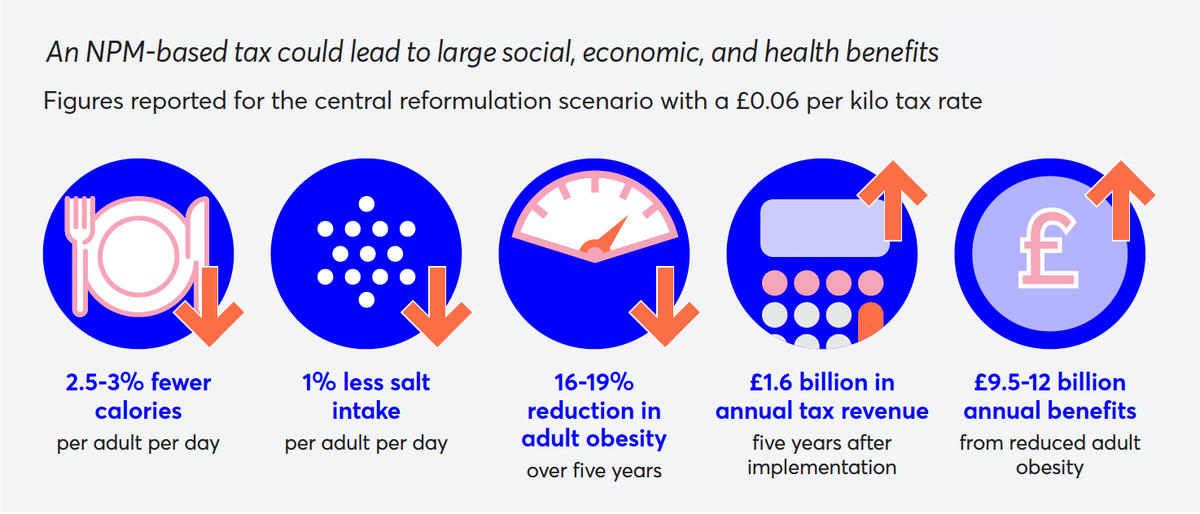
We modelled the potential health and economic impact of this NPM-based tax on categories of unhealthy foods purchased to eat at home. Our analysis suggests an NPM-based tax could meaningfully improve people’s diets and reduce obesity, with modest increases in spend on food eaten at home.
However, choosing whether and how to introduce a food tax is ultimately a policy and political judgement, balancing health benefits, consumer costs, and feasibility for industry.
What's in the report
- We reviewed examples of food taxes and other taxes on goods like alcohol and tobacco from the UK and around the world. In our review, we identified a gap in the evidence around how a tax based on a food’s overall healthiness (measured by the UK NPM score) could work in the UK.
- The World Health Organisation recommends NPM as a strong measure to base a food tax on. The NPM is already established in existing UK legislation, and might give businesses greater flexibility in how they make foods healthier than a tax based on individual nutrients.
- We applied an NPM-based tax to target the 12 categories of foods (e.g. breakfast cereals, ice creams, and morning goods) that contribute most to our ill-health, as defined in existing UK restrictions on promotions, placement, and advertising on unhealthy foods. This exempts healthier foods from paying a tax. We assume the tax is applied to manufacturers of such unhealthy foods.
- We commissioned Oxford Economics to model the impact of an NPM-tax on calories and salt consumed, the price of food, and tax revenue. To reflect uncertainty in our assumptions, Oxford Economics modelled a range of scenarios varying in how consumers or producers might respond when faced with such a tax.
- Our findings suggest that an NPM-based tax could deliver meaningful improvements in people’s diets and health, and could reduce the prevalence of adult obesity by 16-19% (with and without compensation).
- Our modelling also shows that an NPM-based tax would likely increase the average price of a typical food basket for consumers by around 1%. While groceries that are classed as ‘healthy’ shouldn’t increase in cost, some of the most unhealthy products would see higher price rises.
Findings/recommendations
An NPM-based tax could deliver health benefits in a similar range to other high-impact obesity policies (such as the proposed National Food Strategy salt and sugar levy or the recently announced healthy food standard). While there is no silver bullet to tackle obesity, and food taxes represent a powerful potential route to reducing obesity levels, the introduction of any new tax comes with trade-offs for the government.
At present, there is a high-impact obesity reduction policy already on the table: the healthy food standard, based on Nesta’s proposal on health targets for large food retailers. We believe this policy has the greatest potential to impact obesity levels in the near future, while being low-cost to the government and consumers. Nesta's priority remains the timely and effective implementation of this policy.