By Andrew Sissons, Katy King, Madeleine Gabriel, Daniel Lewis, Marcus Shepheard and Juliette Caucheteux
The war in Iran looks set to have a prolonged impact on oil and gas prices. While the rise in European gas prices has so far been modest compared to 2022, it is likely to at least wipe out the £150 reduction in energy bills announced at the Budget in November 2025. It could get much worse.
At the time of writing, wholesale gas prices have risen by around 50% since the invasion of Iran at the time of writing, still well below the peaks of 2022 but at the highest level since early 2025. The wholesale gas price allowance in the Ofgem price cap is 2.71 p/kWh for April to June 2026. It would need to reach around 10p/kWh for prices to reach the £2,500 level at which the government capped them in 2022.
The government is reluctant to provide blanket financial support this time, arguing that support should go only to those households that really need it. This makes economic sense, as untargeted support tends to favour the richest households, who are usually the ones consuming more energy, and is thus not the most efficient use of taxpayer money. The government argues it is better prepared for this crisis and will be able to target household support in a way the previous government could not in 2022.
How reducing oil and gas use benefits the economy
But while financial support can be important in responding to an energy crisis, the government's first port of call should be to reduce oil and gas demand without reducing the amount of useful energy people use. It can do this through energy efficiency measures – especially low-cost ones that can be implemented before next winter – and through helping people switch to more efficient electric technologies, such as heat pumps, solar panels, batteries and electric vehicles.
Reducing the use of oil and gas will limit the impact on energy bills, reduce the damage to the economy and boost Britain's ability to withstand energy shocks. It will also strengthen the government's fiscal position, in the short and long term, making it easier to provide financial support if and when it is needed.
This note sets out how the government can respond to an energy crisis by reducing reliance on oil and gas. It focuses on domestic energy bills – gas, electricity and heating oil – and sets out the following three-point plan for government action.
- A big push on low-cost energy efficiency measures ahead of winter
- Speeding up electrification over the summer
- Using the crisis to lock in energy bill stability in the long term
The UK uses around 780 TWh of oil and around 680 TWh of natural gas. Oil is primarily used in transport, as petrol, diesel and kerosene for jets. Gas is primarily used for home heating (being burned in gas boilers) and for generating electricity in gas-fired power plants, alongside other uses. Because gas plays a key role in the electricity system, it sets the marginal price of electricity most of the time, which means electricity prices will also rise as gas prices rise.
How does the UK produce and use gas, oil and electricity?
Simplified version of the UK Energy flow chart, TWh, 2024
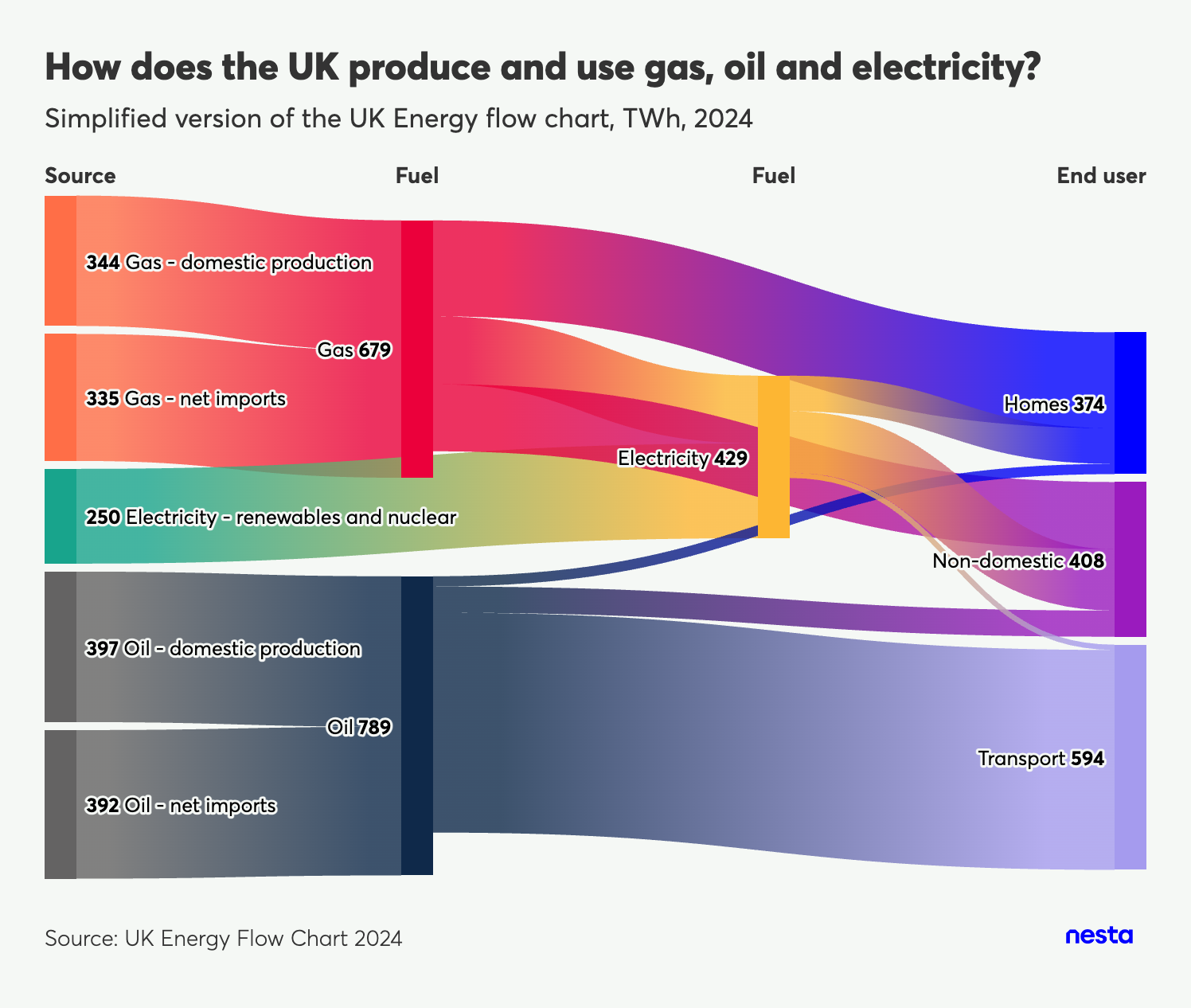
Source: UK Energy Flow Chart 2024
The global supply shock to the oil and gas supply from closing the Straits of Hormuz appears likely to be between 10% and 20%, although this is highly uncertain. While this does not imply a similar reduction in supplies available in Britain, which has a diverse mix of sources, it gives an indication of how much prices might rise.
According to the OBR, the price elasticity of gas for households is around -0.1, which implies that doubling the price of gas would only reduce demand by only 10%. If UK households can reduce gas use through energy efficiency measures (rather than through pure price effects), it could help to take the edge off price rises (although gas prices are set by European and global markets, so UK efforts will only play a small role in shaping prices).
There are three key ways the UK can reduce its reliance on oil and gas.
- Clean power: Investing more in renewables, nuclear and storage to reduce reliance on gas for generating electricity.
- Energy efficiency: Improving the energy efficiency of homes, businesses and transport.
- Electrification: Replacing direct oil and gas use with electric vehicles and heat pumps. These not only use electricity instead of gas, but they are also several times more energy efficient than their fossil fuel equivalents.
Pursuing these measures to reduce reliance on oil and gas can benefit the economy in numerous ways.
Reducing net imports
The UK imports around half of the gas it uses, and around half of the oil. Although it also exports oil and gas from the North Sea, it is a net importer overall, accounting for around 1.6% of GDP. Rising oil and gas prices will increase these net imports, acting as a drain on the economy, lowering both aggregate supply and demand. Reducing oil and gas demand would reduce this effect.
Raising productivity and growing the economy
Reducing energy use via energy efficiency – that is, using less input energy for the same output – directly increases productivity and the size of the economy. Productivity is a measure of how much output is created from a given level of input. Gross Value Added (GVA), one of the ways we measure economic growth, is calculated by calculating output and subtracting inputs. In both cases, producing the same with less makes the economy bigger and more productive.
Protecting consumer spending
Household spending on electricity, gas and vehicle fuel together accounts for almost 5% of consumer spending. If the price of all of these rises, households will spend more on them and likely have to reduce spending on other goods and services (absent new sources of income). This makes consumers worse off and reduces aggregate demand, which is likely to lead to an economic contraction given that the UK already has moderately high inflation. Reducing reliance on oil and gas via greater energy efficiency can mitigate this effect by reducing bills and protecting consumer spending.
Protecting the government's fiscal position
The OBR estimated that having three more 2022-style energy crises up to 2050 would raise the UK government's debt-to-GDP ratio by around 13%. The 2022 energy crisis played a role in precipitating a fiscal crisis that brought down the Liz Truss government. Reducing reliance on oil and gas reduces the effect of these shocks by protecting the economy and reducing the need for the government to subsidise energy bills.
1. A big push on low-cost energy efficiency measures ahead of winter
Reducing oil and gas use is key to our economic resilience. Governments across the globe are implementing a range of measures aimed at reducing their population's energy use in the short term, ranging from dimming street lights, mandating an increase in working from home, or reducing air conditioner usage.
The UK government's first port of call should also be to support consumers in reducing energy usage, whilst avoiding implementing policies that have an outsized impact on people's daily lives.
There are many low- and zero-cost energy efficiency measures that households can take quickly, at little cost. These measures can scale up much more quickly at a national level than deeper insulation measures and can generate meaningful savings. It is plausible that many households could save at least 10% off their energy bills through these measures, and that millions of households could take action before the next heating season (see Annex 1 for a detailed breakdown of measures).
Governments in the UK should be forthright in promoting these measures to households through all channels possible. It should not repeat the mistakes of the 2022 crisis, where the government was squeamish about telling households to save energy, and abandoned its Energy Efficiency Taskforce soon after launching it.
What measures should be prioritised?
Nesta and Cambridge Architectural Research identified 10 low- or no-cost energy efficiency measures that households can do quickly. These all have an estimated payback period of under five years, and could be delivered in millions of households ahead of next winter.
Annex 1 has a table of all 10 measures, with estimated savings and payback periods for each. The key types of measures are summarised below.
- Changes to heating systems, such as turning down boiler flow temperature.
- Changing behaviour, such as washing laundry at lower temperatures.
- Low-cost insulation, such as draught proofing and loft insulation.
- Changing tariffs and heating controls.
Many households will already have undertaken some or all of these measures. However, there are likely to be millions of households that could benefit from each measure.
Higher cost insulation measures, such as wall and window insulation, are also worth promoting and supporting. However, they will not be able to scale up as quickly, and represent less good value for money for households in the short term, while reducing gas use less than electrification.
What action should the UK government take?
The government should launch a national campaign with clear advice on low and zero-cost measures that people can take ahead of winter. The campaign could be delivered in part by government, but lean heavily on delivery partners. These could include:
- local authorities, local energy groups and charities – these could receive grant funding to help
- private sector bodies, including energy companies, banks and DIY stores
- key public sector actors, such as GPs and schools
- broadcasters and key influential sources of advice.
To underpin this campaign, the government should:
- convene stakeholders to agree on consistent messages and sources of truth on energy saving, to limit competing or confusing advice
- provide a white-label advice service via gov.uk
- create campaign assets which can be used by a wide range of stakeholders.
Incentives for energy efficiency
The government should consider a wide range of additional short-term incentives for energy efficiency upgrades over the next year. This could include:
- expanding zero VAT to a wider range of energy-saving measures, such as:
- DIY insulation materials, including for draught proofing
- smart thermostats, heating controls and optimisers
- energy advice surveys
- providing time-limited subsidies or discounts for key low-cost materials and services, such as draught proofing
- allowing private landlords to count any upgrades done this year towards the cost cap for MEES regulations, to incentivise them to front-load investment.
Emergency measures to shift electricity demand
Shifting electricity demand away from peak periods could also help reduce gas use and save on energy bills. Lowering peak demand is especially critical, as these periods are when gas is most likely to set electricity prices.
Several emergency measures could support this objective, particularly if combined with strong public communication, including:
- encouraging and/or incentivising the rollout of smart meters among households
- encouraging smart EV charging, batteries and demand-side responses would allow households to shift consumption away from peak periods
- making Covid-19-style live data on energy demand available
- mandating default time-of-use tariffs would strengthen price signals, encouraging consumers to shift demand to off-peak periods
- incentivising demand-side response and interruptible contracts for large consumers, alongside temporary mandatory curtailment for public sector institutions in extreme scenarios
2. Speed up electrification over the summer
Households can achieve much deeper reductions in gas use by switching to electric technologies at home. While it is not feasible to scale up electrification as quickly as low-cost energy efficiency actions, it could still make a significant dent in gas use, while the crisis could act as a spur to speed up the rollout (as 2022 did for many European countries).
How heat pumps reduce gas use
Heat pumps are a replacement for gas (or oil) boilers, which use electricity to very efficiently heat buildings. A moderately well-performing heat pump will use around 3.5 times less energy than a gas boiler to produce the same amount of heat. In a typical home, installing a heat pump saves around 11,500 kWh of gas a year and replaces it with around 3,250 kWh of electricity. Even if all of the electricity used by the heat pump is generated by gas-fired power stations (which is a questionable assumption, given that heat pumps can be used flexibly to match times when clean electricity is more plentiful), it still reduces gas use in the short term by 40%. In the medium term, this is likely to exceed 80%.
The economics of heat pumps are likely to improve slightly during the crisis, as rising wholesale prices tend to raise gas bills more than electricity bills. This is because wholesale costs make up a bigger share of the gas bill than the electricity bill. During the 2022 energy crisis, the price ratio fell sharply, from a peak of over 5.7 to a low of around 3.2 under the Energy Price Guarantee.
The price ratio fell to 3.2 in April 2023 under the Energy Price Guarantee
Under the default tariff cap the price ratio would have bottomed out at 3.5 in October 2022, and been 4.0 in April 2023
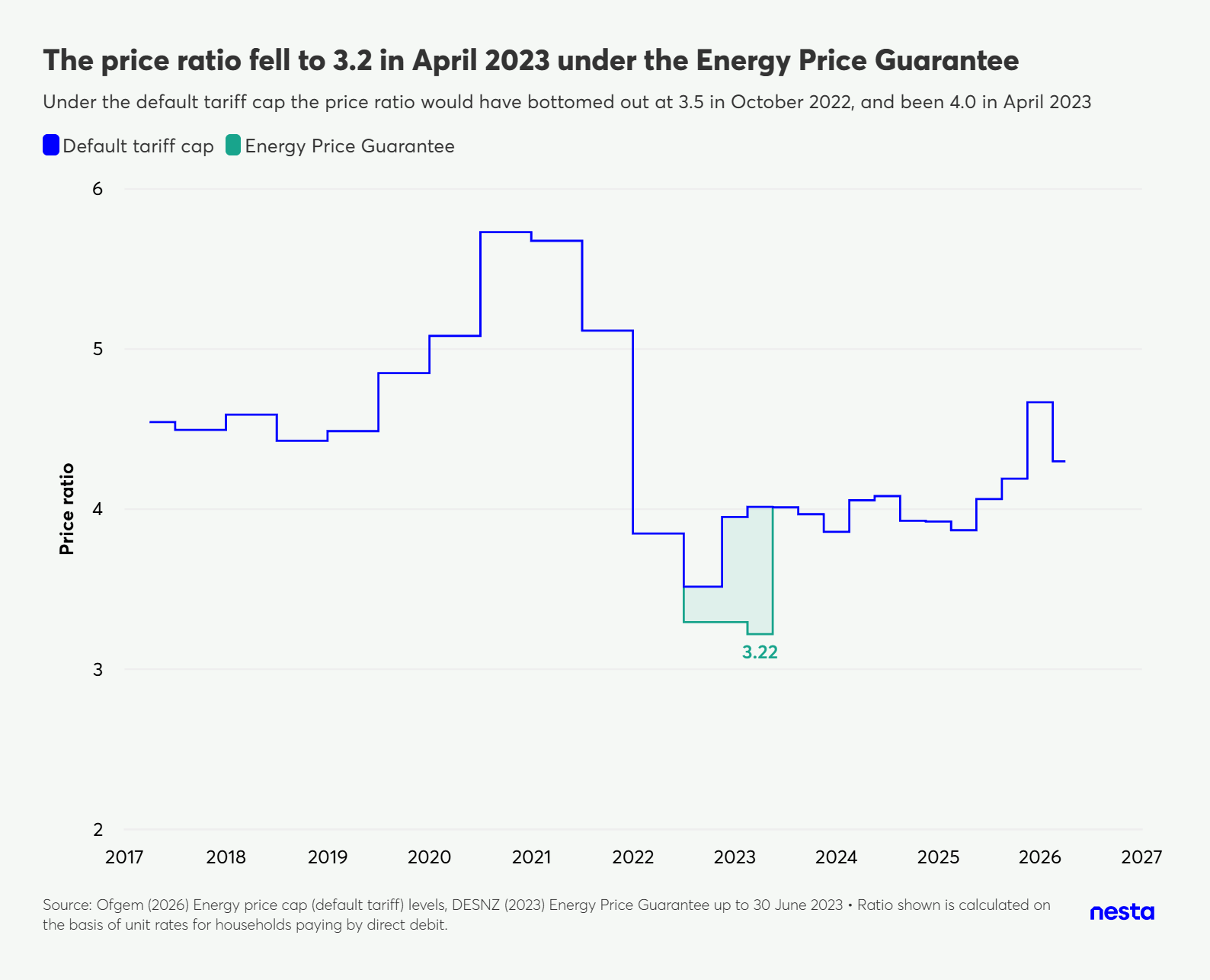
Source: Ofgem (2026) Energy price cap (default tariff) levels, DESNZ (2023) Energy Price Guarantee up to 30 June 2023. Ratio shown is calculated on the basis of unit rates for households paying by direct debit.
However, the UK government could take action to make heat pumps much more attractive and to scale up the supply chain in the short term. While there are constraints in the supply chain, summer is a good time to promote heat pump uptake because many heating engineers are less busy servicing existing boilers.
What action should the UK government take?
Boost installer capacity over the summer by encouraging heating engineers to "start at home" with a heat pump
Around 27,000 heating engineers have now completed heat pump training, but many do not currently install heat pumps. Nesta's Start at Home scheme, which offers these engineers a funded heat pump to install at home, boosts confidence and technical skills and enables engineers to begin installing. Government could promote this scheme, which uses the Boiler Upgrade Scheme, over the summer.
Increasing the Boiler Upgrade Scheme (BUS) grant over the summer
It is positive that the UK government has uplifted the BUS grant to £9,000 for heating oil and LPG users. The UK government could go further with this, and there is an argument that a higher BUS in summer would help heating engineers plan their workloads more smoothly and kickstart the market more effectively. A temporary increase this summer (with perhaps a reduction in future winters) could provide a short-term incentive but also improve the seasonality of the heat pump market.
Increase funding to fuel poverty schemes temporarily
The abolition of the energy company obligation (ECO) scheme has reduced the funding available for upgrading fuel-poor households in the short term, and the new low-income scheme won't be up and running until 2028. There is a case to temporarily boost funding to the Warm Homes Local grants to local authorities in England, with equivalent funding to Welsh and Scottish governments for their fuel poverty programmes.
Remove costs from electricity bills
The key barrier to heat pump uptake remains the high cost of electricity relative to gas. If the government is providing taxpayer-funded support, the first port of call should be discounts on electricity bills. This has the benefit of reaching all households (unlike oil or gas subsidies), while improving the case for heat pumps.
Urgently removing planning constraints
Planning remains a barrier to installing heat pumps and solar in many homes and the government should urgently seek to relax restrictions over the summer. Key priorities include making it easier to install heat pumps and solar in conservation areas and relaxing the rules around one heat pump unit for most houses and blocks of flats.
Air-to-air is an attractive option for heating many homes, with the added benefit of providing cooling over summer. Getting the air-to-air subsidy up and running urgently could help boost uptake, while also encouraging the use of air-to-air alongside existing boiler systems, which could also help reduce gas demand ahead of next winter.
3. Use this crisis to create more stable long-term energy prices
The fact that a potential energy crisis in 2026 has followed so soon after a serious crisis in 2022 suggests this may not be a rare event. Given the damage that energy crises do to the economy, to the government's fiscal position and to people's lives, the government should plan to insulate itself from future crises. The best way to prevent future energy crises is to reduce reliance on fossil fuels.
Government is already doing most things it can to reduce the role of gas in the electricity system, via Clean Power 2030. However, the biggest use of gas in Britain is for home heating, where progress has been much slower. To fix home heating, the government needs to make fundamental changes to how energy bills are charged. An energy crisis gives an ideal opportunity to do so, while also making future energy prices more stable and predictable.
The most important priority is to lower the ratio of electricity to gas prices, which is crucial to driving the switch from gas boilers to heat pumps. They should also look at stabilising household energy bills in the long term, both by guaranteeing the level of the electricity to gas price ratio and considering a gas price stabiliser.
Government should set a price ratio target to provide certainty for clean heating
The government could use the crisis and the likely temporary improvement in the price ratio to lock in more permanent changes. As prices begin to fall or settle after a crisis, it will create a window to make more radical changes to energy bills in a falling market.
To provide more stability to households, the government should set a target that the ratio of electricity to gas prices should not exceed 2.9. It is currently 4.3, although it is tentatively forecast to fall to 3.7 in July.
The price ratio guarantee at 2.9 would mean the median household will be better off switching from a gas boiler to a heat pump on lifetime costs under the current subsidy regime. It would also provide more stability for households, making it more certain that they will be better off.
How could the government achieve this ratio?
The government has various options for maintaining the price ratio at or below this value. These include:
- Changes to levies on electricity and gas bills, including both removing and rebalancing levies
- Taking action on other aspects of the electricity bill, such as debts and VAT
- More radical market reforms, such as:
- Creating a national strategic reserve of gas power plants
- Spreading network costs over a longer period of time, such as via slower depreciation or borrowing
- Abolishing or amending the price cap, putting more emphasis on flexible tariffs for electricity
The table below gives an example of some fiscal measures that would reduce the price ratio to around 2.8, at no cost to the government, with no impact on the typical energy bill.
| Option |
New price ratio |
TDCV bill change |
Cumulative cost (HMT) |
| Status quo (April - June 2026 price cap) |
4.3 |
- |
- |
| Move costs of gas standing charge onto gas unit rates |
3.7 |
£1 |
£0 |
| AND remove RO and FiT from electricity bills |
3.4 |
-£47 |
£1.6 billion |
| AND remove electricity debt-related costs |
3.3 |
-£73 |
£2.5 billion |
| AND zero-rate VAT on electricity |
3.2 |
-£111 |
£3.9 billion |
| AND increase VAT on gas to 20% |
2.8 |
-£2 |
-£0.3 billion |
Source: Nesta analysis based on Ofgem data for the April - June 2026 price cap
To enable it to maintain the price ratio at or below 2.9, the government would need to establish a balancing mechanism to enable it to adjust electricity and gas bills as needed. This could be done through Ofgem and the existing price cap regime, or via a new levy pot controlled by the Treasury.
The government should also keep the target price ratio under review over time. As government plans to reduce subsidies for heat pumps in the future, it may need to lower the price ratio further to ensure heat pumps remain cheaper than gas boilers on a whole-life cost basis.
Government should consider a gas price stabiliser
Alongside a price ratio guarantee, the government should consider introducing a price ceiling and floor for gas bills. This would set a range – perhaps between 5p and 10p per kWh – that the gas price could move between.
Above 10p, the government would subsidise bills (at roughly the same level as the Energy Price Guarantee), while below 5p it would tax them, building up reserves against future crises in the process. The thresholds would be uprated in line with CPI inflation, and could also be reviewed over time depending on government priorities and the market for electrification.
If gas prices become much cheaper than this, it becomes very hard to maintain the economic case for installing heat pumps, even if electricity is also very cheap. This is because heat pumps typically have a higher upfront cost than a gas boiler, and can achieve a lower whole-life cost only by making large savings on energy bills. If gas is very cheap, these savings are smaller, which undermines the case for investment in electrification.
10p per kWh is just below the level at which the UK government capped gas bills under the Energy Price Guarantee in 2022. Above this level, the impact of rising gas prices on households becomes very significant, leading to a big drop in household spending and potentially many households using much less heating than needed.
A gas price floor and ceiling would act as a kind of automatic stabiliser for the economy. During periods of low gas prices, which are likely to be good for the economy, it would raise tax take and slightly lower aggregate demand. During periods of high gas prices, it would help to cap inflation while injecting some subsidy into consumers' pockets, helping to limit the hit to aggregate demand. The gas price stabiliser could also be fiscally neutral over time, if tax receipts during low price periods matched subsidies during energy crises.
While the gas price stabiliser needs further development and consideration, a policy to smooth gas prices is worth considering. Volatile gas prices are a big problem for the economy, and limiting their movement upwards and downwards could help make the UK economy more resilient in future.
Annex 1: List of low- and no-cost energy efficiency measures with payback under five years
Please note that estimated annual savings per measure are based on modelling figures from October 2023.
| Action |
Impact on bill |
Estimated saving per year |
Payback period |
| Instant payback (zero-cost measures) |
|
|
|
| Because these cost £0 to implement, your payback period is immediate. |
|
|
|
| Turning down boiler flow temperature to 60°C |
Saves ~8% of your gas bill (Nesta/CAR) |
~£70 |
Instant |
| Adjust radiator valves in less-used rooms to 1.5°C cooler than living room |
Saves ~5% of your gas bill (Nesta/CAR) |
£50 |
Instant |
| Setting the hot water temperature on a combi boiler to 42°C |
Saves ~2% of your gas bill (Nesta/CAR) |
£20 |
Instant |
| Turning appliances off at the socket |
Saves ~5% of your electricity bill |
~£40 |
Instant |
| Washing laundry at a lower temperature and fewer loads per week |
Saves ~3% of your electricity bill. |
~£30 |
Instant |
| Switching to a 'Time of Use' tariff or opting into saving events |
Costs nothing to switch and allows you to access cheaper off-peak electricity rates, eg, five hours of half-price electricity every Sunday with British Gas' PeakSave events & Scottish Power's 'Power Saver' offering 8 one-hour slots of cheaper electricity per week |
Varies |
Instant |
| Turning down the thermostat by 1°C |
Saves ~10% of your gas bill. |
~£90 |
Instant |
| Ultra-fast payback (under 1 year) |
|
|
|
| These are minor, low-cost purchases that pay for themselves within months. |
|
|
|
| Energy-efficient shower head |
Costs £20 and saves 7% of your gas bill. |
~£63 |
Under 4 months |
| LED light bulbs |
Cost £3-£12 per bulb and collectively save 5% of your electricity bill. |
~£45 |
6-12 months |
| Medium payback (1 to 5 years) |
|
|
|
| These represent smart, cost-effective investments for your home. |
|
|
|
| Roof/loft insulation (from 0mm to 270mm) |
Costs £900 and saves 27% of your gas bill (Nesta/CAR) (Note: If you already have 120mm of insulation, topping it up to 270mm costs £750 but only saves an additional 2%, pushing the payback period to decades) |
~£243 |
Under 4 years |
| Smart thermostat |
Costs £200 and saves 5% of your gas bill (Nesta/CAR) |
~£45 |
4 years |
| Draught proofing |
Costs £250 and saves 6% of your gas bill. |
~£55 |
Under 5 years |